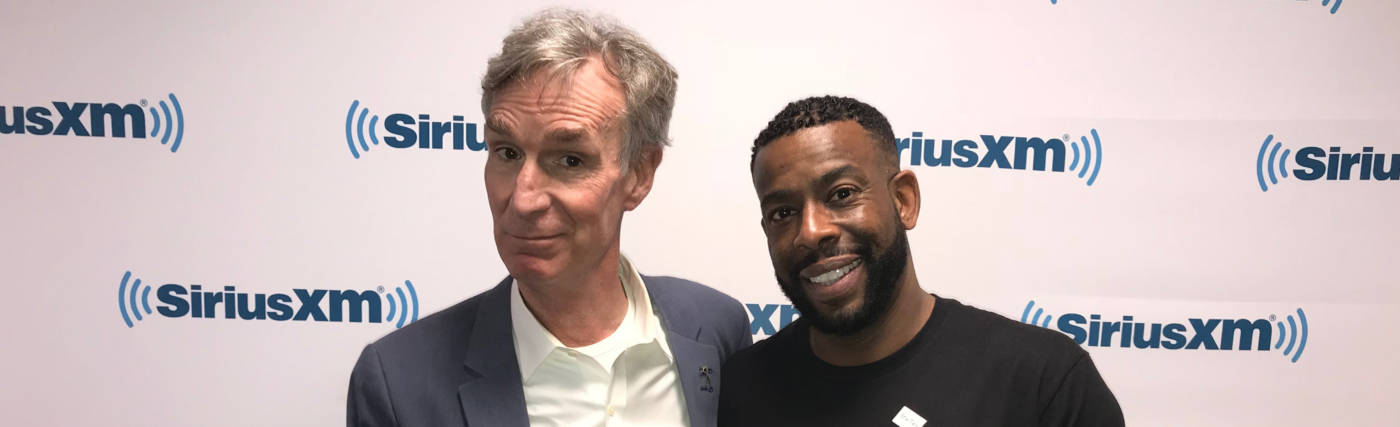
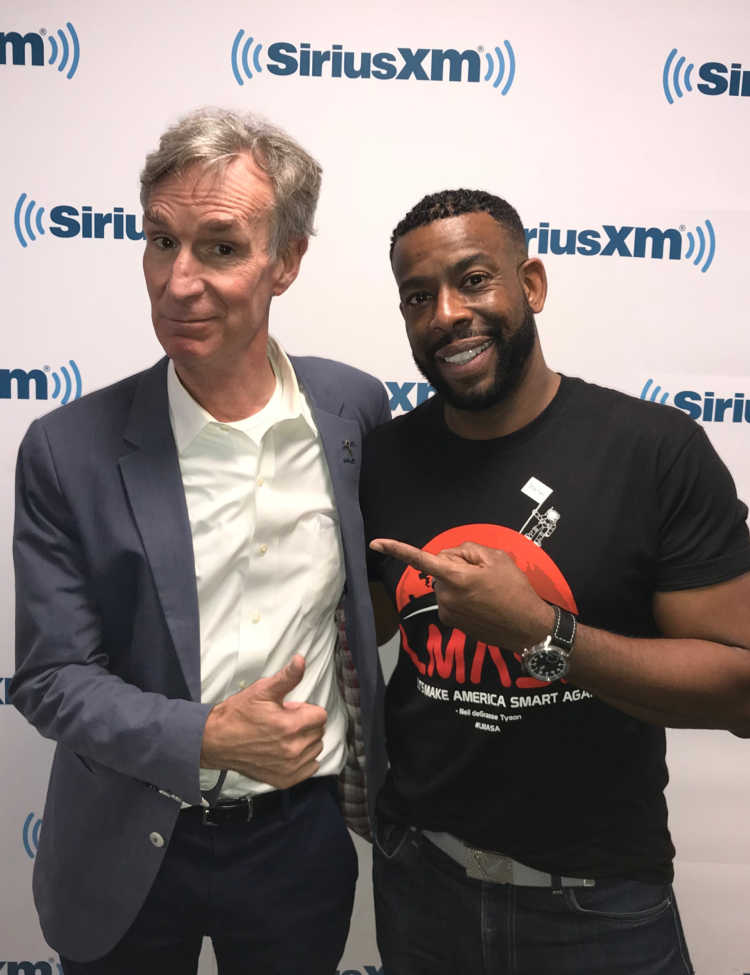
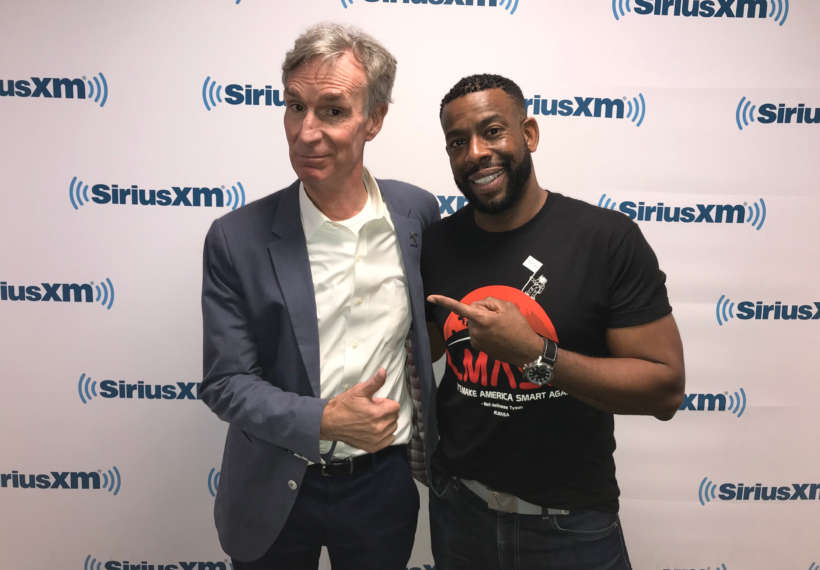
Bill Nye and Chuck Nice are together again and this time they’re live from the Sirius XM studios to answer calls and field fan-submitted Cosmic Queries on a variety of subjects from GMOs to solar sails. To start, Bill and Chuck dive into Bill’s new documentary Bill Nye: Science Guy which charts Bill’s transition from iconic science educator to one of the leading advocates on climate change. You’ll hear from Bill himself on making that transition and about the making of the documentary, for which he had no creative control. After that, we dive right into the Cosmic Queries. You’ll learn how we measure greenhouse gases in the atmosphere by sampling ancient ice. Explore the promise of solar sails and the Planetary Society’s citizen science approach to making them a reality. You’ll also hear about the moon’s rotation, volcanism, and how GMOs are embraced by most farmers even though they don’t solve every problem. Lastly, Bill gives advice on what everyday people can do to stop climate change, how to raise climate change awareness, and much more. (Previously recorded.)
NOTE: All-Access subscribers can watch or listen to this entire episode commercial-free here: Bill Nye Live from Sirius…XM.
Transcript
DOWNLOAD SRT
Welcome to StarTalk, your place in the universe where science and pop culture collide. StarTalk begins right now. Bill Nye the Science Guy. For children of the 90s, that name stirred up an excitement for science that no school teacher...
Welcome to StarTalk, your place in the universe where science and pop culture collide.
StarTalk begins right now.
Bill Nye the Science Guy.
For children of the 90s, that name stirred up an excitement for science that no school teacher could ever produce.
Through his hit TV show, Bill Nye taught a generation of children that science is an integral part of all our lives, and much more than textbooks and tests.
Now in the 21st century, Bill has become one of the most outspoken climate change advocates and purveyors of scientific truths.
Climate change as we know it today is characterized by an abrupt increase in the Earth's temperature.
Today, Bill and comedian Chuck Nice are here to answer all of your scientific questions.
Prepare to have your mind blown.
So grab your microscopes and fire up your Bunsen burners.
It's time for a very special live edition of StarTalk Radio.
All right.
Thank you for joining us, all of you who are listening to Insight.
My name is Chuck Nice, and of course you heard from a very well-produced introduction that this is a special live StarTalk Radio episode featuring Bill Nye the Science Guy.
And it's all about Bill today because Bill has a documentary.
As a matter of fact, it's called Bill Nye, colon, Science Guy.
And right now, without further ado, none other than the one, the only, the inimitable Mr.
Bill Nye.
Bill, how are you?
Wow, fabulous Chuck, so good to see you.
It's been a little while, man.
It has been a while.
Happy Tuesday.
Happy Tuesday to you too.
So I wanna talk of course right away and I see already people are-
You wanna talk on the radio?
I wanna talk on the radio with you.
And is that a novel idea?
No, no, it's been done.
But lead on.
I wanna talk about the documentary of course.
Can you give us some insights?
So I signed a contract, I have no creative control.
Get out.
Well, anyway, they followed me around for two years.
Nice.
That's you.
They followed me around for two years.
And they, you know, there was some good moments and some moments that make me squirm.
Really?
Yes.
Can I have one of those moments?
Just, I mean, I don't wanna spoil or alert, but just maybe the context of-
Well, when they're asking me about my family and whether or not I had children and why I didn't have children and so on.
The personal stuff.
The personal stuff.
The personal stuff.
Very troubling for me.
Well, listen, a lot of people don't know this about you, but you are a family guy in terms of, you are passionate about your parents, their service to this nation, the type of people that they were as educators, the impact that they had on your life.
Yes.
I mean, these are things that I just know about you personally.
Yes.
And it's in there.
What am I supposed to, it's all in there.
Well, but I mean, a lot of it's in there.
All right.
And so along with my interactions, can we say interactions on the radio?
So with, you know, creationists, climate change deniers and so on.
Right, so let's talk about that for a quick second because everyone who knows you, including my own son, who is 11 years old, who...
I was 11 for a while.
For a while.
I feel his pain.
You were 11 for about what, 10 months?
Yeah.
It was longer than that.
I had to think, yeah, it was a little longer than that.
I'll have to check.
But here's the thing, it's so funny that they play your Bill Nye the Science Guy in schools today.
Yes.
And kids love it.
You have an ability to connect and really excite.
I love you, man.
Bring it on, Chuck.
Yes, well, I put my heart and soul into that thing.
You did.
And it wasn't just me.
When you see the movie, you'll see Jim and Aaron are in there, the other, the co-creators.
But we had a fantastic crew that worked really hard.
And we did this, we did the show in a warehouse in Seattle.
And I don't think any of us thought it would be this big a deal and have these kinds of legs.
Yeah, man.
That your kids are watching 20 years later.
20 years later, my children are watching you in school.
And by the way, with the same effect, being excited about science.
Passion, science.
Science.
So anyway, tell me how you go from Bill Nye the Science Guy where you walk down the street, and I've seen this happen.
We were walking down the street and people were like, Bill, Bill, Bill, Bill.
And I'm like, Jesus, that's got to really, I mean, seriously, that's gotta get old.
It's gotta get old.
Well, what you want is to interact with people human to human.
But if all somebody wants is to shout, or if they want something from you, like downstairs today, somebody wanted an autograph on a picture that he had printed.
But the reason he wants it is to sell it on the electric internet.
And so, okay, am I a commodity or a colleague?
And it's all good.
I mean, this is how you, this is your bread and butter.
It's your bread and butter.
All right, so how do you go from this great educator, which you still are, and transition into what I know now is your passion, which is climate change, climate instability, we should call it really, and climate deniers, and educating the masses on, can we call it imminent danger?
Is it truly imminent danger?
Well, that's the problem, the feature of climate change is it's happening in slow motion.
So over the course of 20, 30, 50 years, it's just a little longer than you can get your head around.
But yeah, so we had these catastrophic storms, very expensive, Puerto Rico is a mess, Houston is badly damaged, and so Pensacola, Florida, these places, and so these are all gonna cost money, and you can't tie any single weather event to climate change, but the big picture is we expect with the warmer ocean to have stronger storms, and that's what we've got.
And so we also expect higher snowfalls in some places, because the ocean's warmer, so more water evaporates in the nominally cold years, cold time of year rather, cold seasons, and so these are all things that you'd expect from the electric computer models that climate scientists write.
And the striking thing, if you watch, I hope everybody watches the film at least once.
You know, you can go back and see it a couple times.
You know, buy a ticket each time.
I'm here for you, man.
No, there's a guy in the film, Joe Bustardi, who's a meteorologist, and he's a conservative commentator.
He goes on conservative television and radio and says climate change isn't an issue.
Don't worry about it.
It's a small effect.
But he apparently missed a huge thing when he was in school.
And by that, I mean, I'm talking about the greenhouse effect.
Carbon dioxide is a tiny fraction of the Earth's atmosphere.
Nowadays, 0.04%.
0.04%.
Which is the same as 400 parts per million.
People talk about parts per million.
It used to be 300.
Anyway, he apparently, listening to him talk, believes that because it's a small fraction, this tiny fraction, less than half a percent, rather, less than half of a tenth of a percent, he thinks that because it's a small fraction, it would have a small effect.
But we all eat food, and that comes from green plants, which depend on carbon dioxide.
Correct.
And so without carbon dioxide, the world would be about 30 degrees Celsius colder, which is the difference between liquid ocean and frozen.
For frozen ocean.
So it's a huge thing that apparently he missed.
It's fascinating.
So his degree in meteorology, and he kind of missed this.
He missed this in school.
Whereas the strongest greenhouse gas is water vapor, to be sure.
But carbon oxide is right now, for us humans, the most important one, because we're pumping it out and warming the world at an extraordinary rate.
The speed.
The speed.
At which we're warming the world is the problem.
So now, one of the things, and listen, guys, for those of you who are on the phone, please hold.
I see that...
Oh, it's lighting up.
Lighting up.
We've got lines lighting up, and we're gonna get to...
They're blinking.
We're gonna get to every one of your calls.
But I just want to establish a couple things with Bill, one of which is the measurement of greenhouse gases in the air, in the atmosphere.
People are like, well, how do we know?
How do we know that there's so much more of this so-called gas in the air?
I mean, seriously, if you're so smart, how do we know?
So go ahead, how do we know?
Well, what you do is the traditional way.
Nowadays, there's means to detect carbon dioxide directly with infrared light.
So you beam it through the air and carbon dioxide it resonates, vibrates at a certain frequency and you detect the fraction.
You just detect the fraction right there, directly.
But you can, for you go to a company that liquefies air, which is very common.
Liquid nitrogen is the, I believe, is the most common industrial chemical, liquid nitrogen.
It might be ammonia, but anyway, it's very common.
It's cheaper than gasoline because they take air and freeze it and it turns to, or get it very cold, rather, and it turns to a liquid and then you can, it becomes a parfait and you can see where the, how much carbon dioxide is there.
This is not rocket surgery, but it is science.
It is technology, it's complicated, but we understand it very well.
Okay, so now that brings me to the next question, okay?
And then I'm gonna get out of the way and start letting other people ask you questions, but I think it's important.
So now that's how we know what's in the air.
How do we know that there's so much more of this in the air?
Oh, oh, oh.
So watch the film, everybody, Bill Nye, Science Guy.
It's at the Sunset Landmark Theater this weekend here in New York, New York.
The towns are nice.
They named it twice.
So what is a very compelling way to measure the composition of the ancient atmosphere is to go to the ice.
So people go, by people, scientists, climate scientists, go to the ice in Antarctica and Greenland, sometimes, I guess, Siberia, drill down, down, down through the ice with a hollow drill bit.
And by hollow, it's the diameter of a saucepan lid.
I guess it's 20 centimeters in diameter.
And you pull up a cylinder of ice, a big ice stick, well, not tube.
So it's a solid cylinder of ice.
Solid cylinder of ice.
And it's very straightforward, especially if you get your head just right and look at it carefully, you can see the layers of snow.
And they're just like tree rings or analogous to tree rings.
Every year it snows, you get a layer.
Every season, there's layers and you can count the layers and they've counted back now 650,000 years or so.
And then when you find that layer of ice, 65, 650,000 layers down, you know that that was ice from 650,000 years ago.
And they, even when it's frozen, as when you watch the movie Jim White from University of Colorado explains, even when it's frozen, it's 10% air.
So you can carefully analyze that either by shaving it or melting it and as saying, as they say, keeping track of the gas.
And you can determine the composition of the ancient atmosphere.
And look, everybody, what would you be doing right now if you weren't listening to StarTalk?
You'd be watching CSI Poughkeepsie.
Do they have that?
Yeah, it comes on right after law and order elevator unit.
Yeah, so anyway, there's a lot of CSIs and that's a show based on science, based on inferring what happened at a crime scene based on evidence.
So this is the same kind of thing.
When you find the bubbles of atmosphere in the ancient ice, you're looking at the ancient atmosphere.
There's nobody running around in Greenland with a hypodermic needle a mile under the surface squirting bubbles into ice.
And it's not, I mean, this is it.
When you find these bubbles, these chemicals, that is the composition of the ancient snow and the ancient atmosphere.
The ancient, the atmosphere gets trapped between tines of snowflakes.
And then as it gets crushed down, the air literally dissolves into the solid ice.
It's fabulous.
You know, as this Danish professor claims of mine says, when you're standing on the ice, you're standing on a mineral near its melting point.
Ice is a mineral.
It's a very cool way of thinking about it.
Because you think of minerals, you think of rocks and stuff.
Yes, it's going way down deep and drilling them.
He's right.
It's a mineral that's, when it's at minus 20 Celsius, it's pretty close to its melting point of zero Celsius.
Sweet.
All right, man.
So it sounds to me like this is pretty much science that's settled.
Well, it's settled in the scientific community, yeah.
Oh, okay.
All right.
Well, then let's explore whether or not it's settled with our callers.
Why don't we go to the phone and take Skyler, who is calling from San Francisco, Skyler.
How's it going?
I'm doing great.
Thank you for taking my call.
And Mr.
Nye, it's a pleasure to speak to you.
Greetings.
Are you a member of the Planetary Society?
Is that what I'm seeing there?
I am the honorary member of Planetary Society.
I visited it last month in doing research for a science fiction novel that I'm writing.
Oh, good.
And your work with the solar sails was very important to me because in my book, I used those.
So a solar sail, everybody, is a spacecraft with a big shiny sheet that's so low mass, Chuck.
Yes.
How low mass is it?
It's so low mass that sunlight gives it a push.
And you say, well, light has no mass.
How can it have any momentum?
It does.
Light is pure energy and it has momentum.
And this is a consequence either of classical physics, pointing vectors and so on, or relativity.
You get the same answer.
So these ideas have been around about making solar sail spacecraft for decades.
Yeah.
And the Planetary, Japanese Aerospace Exploration Agency, JAXA, did it.
And now the Planetary Society has done it.
Just citizen-funded spacecraft, very cool.
Mm-hmm, yeah.
I really wanted to thank you and your team for the fabulous work that you do and for allowing me the pleasure of picking your guy's brain.
You guys are fabulous.
Thank you, Skyler.
Carry on.
Thank you for your support of the Planetary Society.
We'll be returning in just one second.
Stay tuned more of Bill Nye when we return.
This is a special live StarTalk Radio with Bill Nye the Science Guy!
Right here in the studio.
I love you, man.
Thank you, Chuck!
All right, let us, hey, Mark, Mark actually has a question.
Mark is calling us from Fredericksburg, Virginia.
Mark, how are you this afternoon?
Say hello to Bill Nye.
Great, hi Bill.
I've always wondered about the rotation of the moon, causing it to always show us its same surface, but if it rotated at a different speed, we would have deduced that we were a globe thousands of years earlier than maybe we ended up agreeing.
I was wondering, is the rotation slowing down, speeding up, will a million years we see different parts of the moon from the Earth?
Well, you're taking my word for it, but first of all, the moon and the Earth are what they call a gravitational lock.
So the moon rotates one time for every single time it goes around the Earth, but it wobbles a little.
So we actually see 10%, 15% more of this side of the moon than the far side.
It's an interesting little thing.
And the moon is moving away from the Earth.
It's not spiraling in, it's spiraling away.
So in the coming millennia, you would expect to have it smaller in the sky.
But there's no hurry on this.
It won't change much in our lifetime.
And by the way, or BT dubs, as the kids say.
The ancient Greeks knew that the Earth was round because they saw the shadow of the Earth on the moon during a lunar eclipse.
And so they inferred, they realized that the only shape that always makes a curved shadow is a ball.
So the ancient Greeks did not have any flat Earth notion that's unique to the last couple months.
Yeah, I was gonna say, it's kind of a new development.
And what do you think about that?
Where does that come from?
Hey, flat Earth guy, go to the edge and take a picture and send it to put it on the electric internet.
We'll all see you're the edge of your flat Earth.
Dude, it's a ball.
Stop it.
You've got pictures, get over it.
Get over it.
Which by the way-
You can go any direction on a ball and not fall off.
That's the nature of balls.
Which, yes, yes.
And I love the way you phrased it too.
Before you say anything, wait, because Bill brought up flat Earth and you do something on your show that was, for me, the best example of why the Earth is round ever.
You took a small mechanical boat on a track.
HO Railroad track and put a boat on it.
You put a boat on it.
And then you showed it going over the horizon.
And we had a curved track.
A curved track.
Curved, concave down.
That is to say, the middle was a hill.
Right.
And it mimicked the sunset perfectly, or a boat going over the horizon perfectly.
Yeah, yeah.
So this is the...
When I was brought up with this myth, it's very reasonable, Columbus and his contemporaries observed ships going over the horizon and disappearing and coming back.
And he realized it must be a ball.
They didn't really...
Apparently didn't really have a handle on gravity and why it was possible.
But the ocean and the air and you and I and the ships are all held on the Earth's surface by gravity.
That the air and the ocean is held on by gravity is kind of a step in thought.
But there it is.
That's it.
Here we are.
Hey, Mark, thanks a lot, man.
Thanks for calling in.
Did Joe actually...
Joe Barscotti, as others may have made, did he actually make a prediction that the coastal weather was going to be getting so much worth that insurance companies stopped selling policies?
Joe Barscotti?
I don't think he made that prediction, no, but I'm not sure.
But Joe Barscotti would not take the following two bets.
I offered him $10,000 at a giant check printed at a company.
I don't get any kickbacks.
I think it's called bigcheck.com.
bigcheck.com?
For all your BigCheck needs.
And people have BigCheck needs.
Anyway, I offered him $10,000 that 2016 would be the hottest year on record and that the decade 2010-2020 would be the hottest decade so far.
He would not take either bet.
And then he came back with this very complex thing about one and a half degrees if there's an R in the month or something.
It was due respect to Mr.
Bustari.
It was a confusing counter proposal that had nothing to do with my first two offers.
Anyway, neither he nor Mark Marano would take these bets.
So I was willing to spend $40,000 of my own money with these guys, but neither of them would take either bet.
Very reasonable that 2017 will not quite be as warm as 2016 because the El Nino, the warming water, the warm water in the Pacific is not as warm as this year as it was last year.
However, there's so much carbon dioxide being put in the atmosphere so fast.
2017 may still be 2016.
Oh, it's exciting.
It is.
In a grim, creepy way.
Looks like we got a little horse race happening.
Okay.
Horse race of death.
I love it.
Hey, let's move on.
Hey, Mark, thanks again.
And let's drop down to Troy or Tony in Queens, which definitely must be here in New York City.
And he has a question about, what does that say?
An article about volcanic eruptions.
Volcanic eruptions.
Who doesn't love volcanic eruptions?
Thank you.
Thank you very much for taking my call, Bill.
It's a pleasure talking with you and Chuck Nice.
And yes, my question is regarding that article from the Edinburgh University.
It's been called the largest volcanic region below the Arctic ice sheet.
I would like to know, what's your take?
How does this factor into climate change?
Bill, before you say anything, let me just tell you, Tony, that with your accent, the way you say ice sheet is my favorite phrase in the world now.
Thank you.
Go ahead.
In the world.
And Chuck's got a lot of phrases that he really likes.
I can tell you from experience.
So, if there's a volcano under the ice, you would presume that it would warm?
They said there are many.
Let's call it volcanism.
Nice correction.
Thank you.
Under the ice, that would make the ice sheet slide down faster, because it would make the bottom of the ice sheet either soft or even liquid, liquid water, and that would accelerate the ice sliding off the Antarctic into the ocean, which would exacerbate sea level rise.
So, it's another amazing, fascinating thing that we discover by sending scientists to Antarctica.
And this is a perfect analog for me, why you want to one day send scientists to Mars, because they make discoveries by being there that you don't make otherwise.
And I'm sure that this discovery has been backed up by satellites, by space assets.
And the same will be true on Mars.
So, having the ice sheet slide into the ocean is going to raise sea levels.
And we have Miami, Pensacola, Galveston, Houston, here in the United States, let alone all the developing world countries where the seaports are much more vulnerable.
I love this.
I mean, seriously, this is almost as good as a bedtime story, which we should tell to my kids.
Hey, Tony, thanks a lot, man.
And keep saying ice sheets, please.
The difference between an ice sheet and a glacier, if you're scoring along with us.
Let's go ahead.
Generally, an ice sheet is sliding on ice.
So ice is sliding on water, whereas a glacier is generally ice sliding on rocks, on soil.
Excellent.
Cool.
Generally.
Hey, I'm going to go ahead and David Owen from California says he has a question about GMOs.
Now, David, I'm going to preface your question by saying this.
Anybody who's calling in to ask Bill whether or not he is on Monsanto's payroll or whether or not he is receiving any money from third party outside sources to say anything about GMOs, I can tell you right now.
I've already asked him that.
And the answer is no, and then I'll let Bill tell you how he came to his conclusions about GMOs.
Before we start, what is David's question?
Yes, I'm just saying.
I'm prefacing that, but I'm going to let you take it from there, David.
Hey, how's it going, you guys?
Thank you so much for talking with me.
Of course.
So my only question is I'm not sure if Bill is familiar with methyl bromide.
I mean, for detecting carbon dioxide?
I know it's like a huge ingredient in fungicides.
Oh, that could be, yeah.
So fungicides, go ahead.
Yeah, I just want to be an inspiring farmer.
And I know that majority of the big agriculture fields that have GMO crops are usually roundup ready.
That was a breakthrough, yeah.
Yeah.
My only question is, like, I'm not sure if you're familiar with Dr.
Paul's statements.
So what's your question?
Yeah.
Yeah, I just don't understand how you can be a proponent of GMOs when usually those are just able, like, the only reason those are round is to spray more chemicals into the soil.
So are you saying that methyl bromide is bad for the ecology because it's a fumigation agent that they use?
Is that what you're saying?
Yeah, and it destroys the ozone layer, which ultimately is, like, a tribute to climate change.
So you're a farmer and it's all about money.
Kind of.
It's more about feeding people.
Okay, but you can't do it and lose money every season, right?
No.
My experience with this is genetically modified crops are a tool that many farmers embrace, and the breakthrough, or the whole thing, started with cotton.
They found a way to put a gene in the cotton that bow weevils could not tolerate, and so the cotton plants thrived instead of being denuded by bow weevils.
Corn and soybeans, corn was attacked by the European corn borer, an invasive species that came, they believe, to the US on the straws of brooms for sweeping the floor.
And so they found, the seed companies found a way to put the bacillus thuringiensis gene in the corn so that instead of spraying it on, many organic farmers use Bt spray.
This bacterium, if a corn borer eats it, it causes the corn, I believe the corn protein to form a crystal in the tummy of the caterpillar and the caterpillar can't live there.
So they put this in the corn and it revolutionized the industry because they were able then also, after this technology was developed, instead of spraying for weeds, they could use glyphosate, which goes by the brand name of Roundup, and glyphosate is unique in that it breaks down in six weeks.
Many other pesticides or herbicides, rather, stick around for much longer than that.
So GMOs are not the silver bullet.
They will not answer all problems, but many farmers have had success with putting the BT gene in the plant rather than spraying it on.
So nobody wants to overuse pesticides for two reasons.
First of all, as you pointed out, it's potentially very bad for us, for the environment.
The other thing, it costs money.
The more you spray, the more money we're spending.
Now, one last thing that David made a comment about.
Farmers in large scale farms, farms of all sizes, prefer to get the latest seed.
They want the newest seed because people are working very hard to develop more palatable, more nutritious crops.
Just anecdotally, I remember as a kid how far apart corn stalks could be planted compared with how far apart they could be planted now.
And they're much closer together than they used to be because of advances in breeding and this genetic modification technology.
So my experience is farmers want the newest seed.
Keeping last year's seed actually makes you fall behind.
You're less competitive with other farmers.
Two more things to keep in mind.
Farming is not really natural.
If you stop farming, the forest or whatever it is, the prairie takes over.
We have 7.4 billion people in the world.
Pretty soon we're going to have 9, 10, 10 billion people in the world.
They're all going to want to eat something.
Not if I have anything to do with it.
I'm talking to you, little Rocket Man.
Thank you, Chuck, Mr.
Chuck.
So these things are all important to keep in mind.
Now, if, as I say all the time, if consumers want organic products, then that will be the free market.
The market will take care of that.
Farmers will raise organic crops instead of some other style of crop, and they will be prosperous.
So as we did the Netflix show Bill Nye Saves the World, we had a woman who says she's a ninth generation farmer from Iowa.
The Rob Fraley, who won the World Food Prize for putting the gene in cotton that enabled bow weevils to not eat it, not destroy it.
And we had the guy from the Department of Agriculture who studies the economics of genetically modified crops versus standard or old style crops.
And he said, the guy from the Department of Agriculture said, it's not that much of an advantage, like it's a push.
It's a farmer's choice whether to go this way or that way.
But the future is going to be more food for more people.
You, David the farmer, make the decisions that you feel best about.
All right, David, we're up against a break, but did that sufficiently answer your question?
I don't want to steamroll you here.
I just want to make sure that we have a real discourse.
What's happening?
Yeah, it just remotely answered it, but I know you guys are on a timeline, so I'll let you guys go.
Well, we appreciate your patience, and hopefully we'll get a chance to do this again, and maybe you guys can talk some more.
Carry on!
Carry on!
So what we're going to do right now is take a very brief break, and remember, this is a special live StarTalk radio with none other than Bill Nye.
Bye Got a scientific question you've been waiting to ask?
Have no fear, Bill Nye and Chuck Nice are here to give you answers.
Just call 877-974-7487.
877-974-7487.
This is StarTalk Radio Live.
Indeed it is StarTalk Radio Live.
I'm Chuck Nice, and I'm sitting here with none other than Bill Nye.
Yes, I am here with Chuck.
And this is weird for you, because normally you're the guy who, you've done radio for God knows how long.
Well, several decades.
I shouldn't say it like that, several decades, you know.
But it's kind of cool that I'm sitting here doing radio, actual live radio with Bill Nye.
I love radio, the most visual medium.
Look at that rocket.
Shhh.
Here comes a steamboat.
How about that?
So for those of you speaking of visual mediums, Bill just got sexy for us.
Took off the bow tie and the jacket.
And so...
We're stopping there, though, Chuck.
Just some information.
I'm so damn disappointed.
No, you're not.
Lead on.
Let's take a question.
Yeah, let's lead on.
And I'm actually going to take a Facebook Live question.
This is from Skipper Coates who says, Hello Bill, I'm a science educator.
In your opinion, would you like to see teachers focusing on teaching the facts of climate instability?
Or should we shift our focus to engineering solutions?
That's interesting because our current Secretary of State believes that we'll engineer our way out of this problem.
That's a great question.
What we want to do is, as I like to say, everything all at once.
We want to reduce emissions and develop new technologies.
Now, keep in mind, everyone, that even if you're a vegetarian, but you're familiar with this phenomenon.
There's a roast in the oven, and you turn the oven off, the roast continues to cook for a while.
The heat continues to move from the outside to the inside, spreading inward.
And so, there's a certain amount of climate warming that's, as we say, baked in, irreversible into the atmosphere right now.
So, what we want to do is reduce our emissions to slow that, and then we want to develop new technologies three things.
Clean water, renewably produced, reliable electricity, and then access to the internet or whatever the internet comes to be called in the coming decades.
With those three things, we could save the world for humankind.
You know, the Earth's going to be here no matter what we do.
I want to save it for me.
I like your plan, Bill.
I like your plan.
So, we want to teach both in school.
We want to teach why climate change is happening, the greenhouse effect, and humans' proclivities for burning fossil fuels, and a little bit of the chemistry of carbon.
It's buried.
We're going to unbury it, combine it with oxygen, make carbon oxide, which makes the world warm.
And then we want to talk about the engineering solutions, which involve wind, solar, solar energy, a little bit of geothermal energy, a little bit of tidal energy.
With those things, we could change the world.
Don't shut down existing nuclear plants.
And for the nuclear people proponents, I'm open minded, of course.
But just getting a nuclear plant license takes 15 or 20 years.
People just don't want it, whether it's great or not.
It's uphill.
It's just a hard thing to get done.
And for some communities, it's just a political poison pill, so forget it.
Yes, yes.
All right, let's move on to I have to ask this question from Facebook Live.
And this is Mark Ostrom, who says this, so Bill, what happened after you walked into that elevator full of party girls?
Nothing.
for those of you who didn't see this video on the electric internet, it's awesome.
I was in Las Vegas doing Life is Beautiful, which is a concert.
In fact, it was a week before the shooting.
That aside, the elevator door opened and there were four women dancing.
I think the modern verb is twerking.
Is that a verb?
Yeah, that'll work.
Now, I, as you know, am not a woman and I'm not young anymore.
But you do twerk, very often.
I'm young at heart.
But I'm not sure what the motive was.
So their face, their backs are to the elevator doors.
Right.
Doors open, four women, and I won't say matching, but thematically similar swimsuits.
Black and white swimsuits.
And then they realized it was Uncle Bill.
And they sort of stopped in their tracks.
But I'm just not clear on what the activity they were involved in was to start with.
So they're watching themselves in the reflective surface.
Yes, that's what they're doing.
They're recording themselves in the portrait phone.
Right.
But are we aware that in the Las Vegas elevator, virtually any modern elevator, there's a camera watching you anyway.
So there's some person there in the security camera department stroking his or her chin.
So anyway.
Is that what we're calling it now?
Well, somebody was wondering.
Maybe it's comedy.
I was unfamiliar with this activity.
But I my relationship to these ladies, I believe, would be avuncular.
Having the characteristics of or pertaining to.
That may be your relationship to them, but their relationship to you was not.
And they knew exactly who you were.
And they were like, oh my god.
And so I just I said, greetings ladies.
Carry on.
Enjoy your time here.
Looks like you're headed to the pool.
Have a lovely afternoon.
Not much happened beyond that.
But it was fascinating to me that everybody, I was in Australia and newscasters asked me about this video in a few seconds of video.
I know, I know.
But it wasn't any doing of mine, people.
I just played the door open.
I played the hand I was dealt.
I pushed my floor button and encouraged them to carry on.
Carry on.
Alright, fantastic.
So listen, let me just let you guys know.
So Eric and Will and Rob we're going to get to you.
And Lupe, hopefully, we'll get to you and Mike as well.
So let's continue with our special live Star Talk Radio with Bill Nye and go to Eric in Illinois who wants to know what, Eric?
Well, first, I want to thank Bill for inspiring me as a young person to go into science and go through it all the way through college.
I was actually a high school science teacher for a while.
Right on.
Thank you for your service.
You're very welcome.
So my question is, what can everyday people do to combat climate change?
Well, what I used to say was vote.
Voting is the most important thing we can do to establish new policies, new regulations that we need.
Now, regulations, everybody, are now perfectly analogous to a machine.
This is to say, the machine to do whatever it's going to do, you want it to have all the parts it needs, but no more.
You don't want it to have any extra parts, and you also don't want it to not have enough parts.
It won't work.
So, when it comes to regulations, we want all the regulations we need and no more.
And so, voting is how regulations are established.
Now, of course, yes, of course, it's great to not throw away recyclable water bottles.
Do you drive an electric, do you own a car, Eric?
I do.
It's a company vehicle.
I've suggested for years that they switch to a, you know, hybrid.
Anyway, after you have an electric car, you'll never go back.
Do you own a house?
I do.
So, the single biggest thing you can do to save energy is to replace the windows with modern windows.
It's a very expensive bunch of messing around.
But Bill, it pays for itself.
It does pay for itself surprisingly quickly, less than 10 years.
And so, 10 years, I know if you're a young person, sounds like a long time, but in home owning, it's sort of day at the office.
And the whole thing that's surprising to everybody until you stop and think about it is everything, every single one of us does affects everyone on Earth.
Wait a minute!
Because we all share the air.
There is nobody that you're going to interact with actively who's not breathing.
Not breathing this stuff.
And so every time you can conserve or not put carbon dioxide or unburned methane in the atmosphere, that's good for everyone on Earth.
So literally turn out the lights in the room when you're not in it.
That's a real thing.
If everybody turns out every light that doesn't need to be on, we would probably have a substantial amount, I'm going to say shooting from the hip, four times as much electricity for free.
If we did that one thing.
The coral approach.
The coral approach.
The coral approach.
Tiny, tiny little creatures.
Little zoa xanthellae.
Zoa xanthellae.
Doing their coral thing.
That's right.
And then you get a giant reef.
That's right.
Collectively.
A huge reef.
But every one of them, just tiny, tiny corals.
Doing their thing.
Making little shells.
What are we building?
We should build something.
Alright, let's move on.
Because we are running out of time.
We are up against it.
And let's go to Rob from Ontario, Canada, who wants to know what.
Rob, say hello to Bill.
Hey Bill, how's it going?
I grew up watching your show.
Huge fan.
TV Ontario.
The crawl space with Kevin and Patty.
Give them my best.
Anyway, you have a question about global warming.
Yeah, so just as some context.
So there's been a lot of documentaries recently regarding animal agriculture and contribution to methane gas to the atmosphere.
I'm just curious if you can clarify what is the more significant contributor to global warming?
Methane or carbon dioxide?
Oh, you guys do respect.
Methane is more powerful as a greenhouse gas than carbon oxide, but there's much, much, much, much more carbon dioxide than methane.
So I'm not saying that animal husbandry or agriculture isn't a significant contributor to global climate change.
But if you're asking this or that, carbon dioxide is the big one.
You guys, I don't make this rule.
That's just how it is, everybody.
If you watch the film Bill Nye, Science Guy, which I had no creative control over, you can see Dr.
Jim White from the University of Colorado who points out that greenhouse gases are warming the world.
That's what they do.
That's all they do.
That's what he says.
He also goes on to say that he believes in God.
He's a very deeply religious guy.
Nevertheless, carbon oxide and methane keep the world warmer than it would be without them.
There you have it.
Thank you.
Rob, thank you so much.
Let's go to Lupe in Texas who wants to know about education.
Lupe, say hello to Bill Nye.
Hello, Mr.
Nye.
What is it going to take?
Because I see our state here in Texas where the educational system is really going away from science.
But, I mean, for all the problems we create for ourselves here on this planet, I know we can solve them through science and conservation.
But without...
How do we get to the point where we're actually applying that versus just talking about it?
Well, first of all, you listen to StarTalk.
I think that's the most important thing you could...
No, but raising awareness is really important.
And as I say all the time, if you want to do something about climate change, I'm not kidding, everybody, if we were talking about it, if we were talking about it the way we talk about the president's tweets or we talk about whatever became of these soldiers in Niger, if we were talking about climate change, the way we talk about those issues, or the latest thing with Hollywood and the interaction of men and women there, if we were talking about climate change, the way we talk about those things, we'd be getting her done.
We'd be getting her done.
Getting her done.
And so this is an opportunity, you guys, to raise awareness.
And if you have people in your life, I can imagine in Texas especially, you have people who don't want to accept the reality or consequence of climate change.
Ask them why.
Why don't you believe that?
What makes you think the evidence from the ice cores, what just happened with Hurricane Harvey and all this are not, or Irma, are not real and dangerous things?
What is it that gets you, that makes you think this isn't happening?
So everybody, the evidence scientifically is overwhelming.
We just have this extraordinary circumstance where the fossil fuel industry has been successful in introducing the idea that plus or minus 2% is somehow the same as plus or minus 100%.
So talk about it, Lupe, talk about it with your friends.
Get out there, Lupe.
Save the world.
There you go.
Get out there and be safe, Lupe.
So listen, here's what I'm going to do here because we are up against the end of it.
Is it the lightning round?
It's not even a lightning round.
So here's what I'm going to do.
Will, you grew up with Bill.
You've been waiting for him for 27 minutes.
Just say hello to Bill Nye for me.
Will, are you there?
I'm here.
Just say hello to Bill.
I don't have time for your question.
Just say hello to Bill, please.
Sorry, buddy.
Well, here's what's happened.
Will, you grew up watching my show.
What do I recommend to kids today?
There's all bunch of people emerging on the internet that are doing the same sort of thing.
Derek Muller, physics girl Diana Cowan, space gal Emily Calandrelli, and ASAP Science.
Those people are emerging, filling the role that the Science Guy Show filled in a different media era.
Take it, Chuck.
Fantastic.
And listen, Mike, from Long, and thank you, Will, and thank you for your patience and holding.
Mike, you've been holding for a long time, too.
And please, say hello to Bill.
You cannot ask your question, but say hello to Bill.
What do I think people, why do I think people don't accept scientific truths?
We're chipping away.
Look how popular StarTalk is.
Turn it up loud, everyone.
There you go, Mike.
Thanks for hanging in there and being so patient.
We really appreciate you.
So listen, this has been a special StarTalk Live Radio with Bill Nye.
My name is Chuck Nice.
Thank you for being with us.
I want to let you know that if you want to know about the film, please go to billnyefilm.com.
Right on, Chuck.
And I also want to let you know that everything that you would like to find about StarTalk Radio, whether it is StarTalk, StarTalk playing with science, which is a sports and science mashup show, or StarTalk All-Stars can be found at startalkallaccess.com.
And I am going to say goodbye, but I'm going to let Bill Nye have the final word.
Thanks for listening to StarTalk, you all.
Working together, we can embrace the process of science, reach a common understanding, and dare I say it, save the world!
Oh, we have 30 seconds.
Wow.
The way Chuck introduced that, I thought we were out of time.
But everybody, thanks for listening.
Check out the film.
I had no creative control.
Check out the Netflix show Bill Nye Saves the World.
We made 12 more.
Do you know why we made 12?
Why?
I don't know.
That's what Netflix is numbered.
They're very secretive.
But they should start before the holidays, and you should watch them the rest of your life.
It will be fantastic.
Thank you for listening.
See the full transcript



 Unlock with Patreon
 Become a Patron