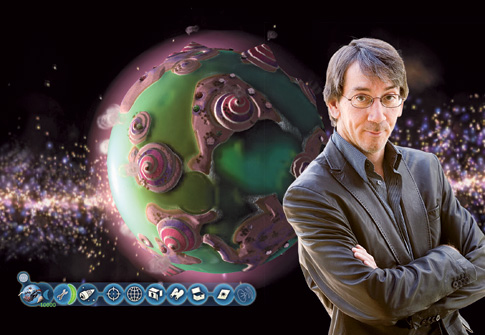
Video games are a ubiquitous component of modern life and pop culture. But is there more to them than entertainment? In Part 1, Neil deGrasse Tyson finds out if video games breed violence and what kids actually learn from shooter games with guests Jeffrey Ryan, author of “Super Mario – How Nintendo Conquered America” and Will Wright, creator of The Sims and Spore. They chat about the evolution of choice and moral dilemma in video games; Moore’s Law of processing speed; and computer game graphics, verisimilitude and the cartoon laws of physics. You’ll also find out why Space Invaders sped up as you played it, what inspired Will Wright to create SimAnt and why co-host Eugene Mirman thinks Happy Days started the U.S./Iran conflict.
Transcript
DOWNLOAD SRT
Welcome to StarTalk, your place in the universe where science and pop culture collide. StarTalk begins right now. Welcome to StarTalk. I'm Neil deGrasse Tyson, an astrophysicist with the American Museum of Natural History here in New York City, where...
Welcome to StarTalk, your place in the universe where science and pop culture collide.
StarTalk begins right now.
Welcome to StarTalk.
I'm Neil deGrasse Tyson, an astrophysicist with the American Museum of Natural History here in New York City, where I also serve as the Director of the Hayden Planetarium.
And on this episode, I've got with me my cohost, Eugene Mermin.
Eugene.
Hello.
Welcome back to StarTalk.
We've been running the world with you, doing the Eugene Mermin comedy tour.
Yes.
And I got you in my shop, right here.
Yes, right here in your home.
For today, we've got a special topic, I think, and it's gonna be the science of video games.
Video games.
These are the mind-controlling forces that operate on children and adults alike.
And you know who's gonna help me do this is...
I would hope it's the person right over there.
And I would hope you can see him as well.
Jeffrey Ryan, Jeff, welcome to StarTalk.
Thank you, and I have to say, I really enjoyed your 1980s video game, Neil deGrasse Tyson's Punch Out.
Is that a thing?
I didn't know about that.
Yeah, you didn't know about that?
Nobody told me.
Yeah.
Who punches who out?
You punched everyone else out.
Little Joe, Glass Tiger, everyone.
I could do that.
Now, why do you know this?
Because you write about video games.
Yes, I wrote a book called Super Mario, How Nintendo Conquered America, all about video games.
Nintendo Conquered America, because I look around and I see kids just playing Nintendo, and Nintendo makes the Wii, right?
So this is what Americans are doing.
We're just placid video game players.
That's what you mean by conquered, right?
Yes.
We are a threat to no one while we're playing video games.
Yes, if you crossed off Nintendo and wrote in Borg, you might be a little bit more worried, but Nintendo is fine.
The Borg.
Yes, okay.
And so, how long would you say they have had control over America?
They started in 1981.
They had a Space Invaders knockoff called RadarScope.
That wasn't doing it well.
I remember Space Invaders.
You're down there with little missiles, and these creatures would come down from space, and you'd have to slide left and right and take them out.
And that was-
Do you remember the knockoff radar something or other?
RadarScope.
RadarScope, okay.
Yeah, so it wasn't selling that well.
And they decided they're going to rip the guts out of the consoles that they made, and they would have a guy who had never designed a video game before design a video game because everyone else was busy.
And the game that they designed was Donkey Kong.
The guy who made it, Shigeru Miyamoto, was now the world's greatest video game designer.
So what was he doing before he was not doing video games?
He was-
He made sushi in the subway.
He was basically painting the cabinets.
He was designing some of the hardware.
And now he's not even allowed on TV in Japan because he's too popular.
He's too popular.
Tell me his name again.
Yeah, Shigeru Miyamoto.
So did you say he's not allowed on TV because he is too popular?
Yes, because he doesn't want to get mobbed by fans when he's walking down the street.
He'll only go on TV in other countries, not in Japan.
He doesn't know about cars.
Actually, he rides a bicycle.
He refuses cars.
See?
I have literally solved his problem.
What he needs to do is a thing called driving to the studio and then he can be on TV.
Of all the places to not be allowed, television is the funniest because it is enclosed by walls.
Right, you can't attack him through the TV.
That's the point here.
But let's go even pre-Nintendo.
Okay.
Video games go way back, right?
Oh yeah, the first real video game was in 1961.
Oh, it wasn't the moon landing?
That would have come later, in 1969.
No, the second video game was the moon landing.
The first one was called Space War.
It was made in MIT and the guy named Steve Slug Russell, who wasn't really that big despite his name being Slug.
His middle name was Slug.
His nickname was Slug.
Nickname was Slug, okay.
So it was a crowd source game where anyone who stopped by, if they wanted to put something in, they would add it and that would be another feature to Space War.
Crowd source, that means you have enough people who are programming fluent, walking by your activities so that they can put in a feature.
Yes, this was an outer space game.
You had a little triangle and a little cigar and you were shooting each other.
So the first video game.
So this is by people who hadn't been to space.
It was a triangle and a cigar, like in space.
So the first video game was a space game.
Yes, yes, it was.
It was a space simulation.
We win, astrophysicists win.
Wait, wait, wait, it gets even better.
I think it's not weird that scientists' first game is a space game.
I'm just saying.
I think that makes sense.
I'm just saying, okay.
It gets even better because there was a random star field in the background and someone decided.
Don't talk to me about random star fields because I have issues.
Well, someone else had an issue too.
They wrote a program called Expensive Planetarium that put a correct star field on the sky.
If I were, that's what I would have done back then.
I would have been so on their case.
Look guys, we got a real sky here.
Do it.
All right, okay, so that's good.
What's the first video game that anyone really knows about?
The one I recite is, of course, Pong.
Pong, yeah.
That's the one that had distribution.
Yeah, that was in 1972 by Atari.
Also in outer space.
I mean, no one talks about it, but it did place in outer space.
And prove to me, Pong didn't take place in outer space.
I can prove it because you can hear sound.
You can hear a Pong.
Oh, but what if you're wearing space headphones?
Okay, maybe.
Space headphones, he's got you.
He's got you.
But there's sound from outer space.
Like we heard the moon landing.
Anyway, I understand.
You don't know about microphones.
No, no, it starts to sound.
It gets converted to radio signals.
It moves at the speed of light.
Then it gets converted back to sound again.
Exactly.
What I'm saying is the Pong ball was in a spacesuit, and all the walls were in spacesuits, and it all took place in space.
In his mind, yes.
So, early 70s Pong.
And so, it was a computer game, though.
I remember you could connect it to your TV.
Yes, yes.
Pong eventually came out on a special chip, and there were 100 different consoles that were all called Pong clones.
You could buy 100 different video games that were all just one video game.
Were they different things where it would go faster or slower?
No, no, they were all identical.
It was all the same.
Was it before you weren't allowed to steal things from people?
Like, how is that?
Pong itself was actually stolen.
The idea was from something called the Magnavox Odyssey.
It's from an idea called Ping Pong.
Yes, it was originally.
To be honest.
Ping Pong stars.
That's the Jesus of it all.
Okay, wait, so it was stolen from Matchbox 20?
From the Magnavox Odyssey, which was showing off in the summer of 1971.
In the fall, the guys from Atari.
Magnavox, man, this is like early hardware.
Yes, this is old.
So was it not?
This is like solid state hardware.
This is before computers.
So Nolan Bushnell saw this and thought, you know what, I can do better than this.
And he did.
Pong is better than the Magnavox Odyssey game.
All right, so now we got Pong, but still space is a recurring theme.
So give me a quick top 10 list of the greatest space video games that you can give me.
Well, the first big one is Asteroids.
Asteroids from 1980.
Love Asteroids.
Yeah, yeah, yeah.
Oh, yeah, yeah, yeah, yeah.
Then Mindstorm on the Vectrex.
Nothing?
Wow, wow.
I did not think someone was gonna talk about the Vectrex.
Why wouldn't I talk about the Vectrex?
Eugene, I worry about you.
Okay, so go on.
Then you've gotta go to the original Star Wars game, where you could actually sit down, you could go into the Death Star, vector graphics, again, just like the Vectrex.
You can blow things up.
I hope they didn't do the Castle Run in 530 Parsecs, right, or whatever, however that scientifically illiterate sentence goes in the movie, but go on.
No, but you could blow up the Death Star again and again and again.
Cool.
It was like there was an endless series of Death Stars out there.
And right up until nowadays, you've got Mario.
Mario is now going into space.
In space, well, Mario Galaxy, right?
Yep, in Super Mario Galaxy, he can visit Micro Planets, which I need to tell you this, Micro Planets, the Light Planets have been very small.
Okay, I figured that out.
Plenty more to come here.
I spent time in San Francisco, and we chatted with Will Wright.
Will Wright, who created the video game Sim.
When we come back for some of my interviews with Will Wright.
With StarTalk, and I'm your host, Neil deGrasse Tyson, joining me, one of my favorite co-hosts ever, Eugene Mermin, Eugene, and Jeff Ryan.
Jeff, author of Super Mario, and how Nintendo...
Conquered America.
Conquered America, and this is scary.
We're gonna dip back and forth into what that book is about, but in this segment, I just wanna tell you, I was in San Francisco, and I said, I'm not gonna avoid this opportunity to get access to none other than Will Wright.
Will Wright is the creator and founder of the whole Sims series.
Yeah, he made Sims before that SimCity, he made Spore.
Yeah, yeah, this is video game in another kind of concept.
So it's not so much an escape into some place that doesn't exist.
It's an attempt to...
Oh, it's a real place.
It's an attempt to try to create something that pretends to be real in your life.
It's SimCity, like you said, it's Spore.
Sim, what's it, Sim Life?
Sim Life, Sim Ant.
Sim Ant.
There was actually Sim Ant.
I missed that one.
Yeah, you were an ant.
Really?
Yeah.
There's a follow-up called Sim Uncle.
Oh, ant, ant as in...
No, no, it was actually ant, it was actually, yeah.
He says I could, sorry.
You were an ant, yeah.
So I've got these clips.
I just was in his office.
I pulled out my microphone and interviewed him.
You did it in his office, not at the Presidio?
I did it in his office.
And so I've got these clips.
Let's find out about it.
By the way, a brief background on him.
When he went to college, he studied architecture.
I've got a list here.
What else did he do?
Mechanical engineering, computer programming, which is an interesting sort of combination.
It's the sort of thing that would lead you to make Sims.
Yeah.
It's exactly what they had figured.
And in fact, he never actually graduated from college.
I think the greatest of those in the world are-
Like Bill Gates.
Like Bill Gates, right?
Yeah, I regret now having a BA.
Think of what you could have been.
What could I have been if I didn't finish my degree in comedy?
So, let's tap into this clip and see what he says.
So, in this particular clip, he talks about the human, the biological urge to play.
Oh, okay.
And what role that serves in our lives.
Let's check it out.
Yeah.
Culturally, the idea of play is interesting because play has been around for millennia.
People have been playing board games, chess, Go, things like that.
Go, the Chinese territory, Asian.
Yeah, black and white stones, et cetera.
So games have been around a long time.
The idea of play has been around a long time.
Technology has had a huge impact on the concept of play and interaction.
I think if you step back, though, there are two things that we kind of consider in the realm of entertainment, which I would typically characterize as storytelling and play.
I think both of these things are fundamentally educational technologies.
You know, we all have a very limited set of experiences to base our world models on.
If your caveman friend leaves the cave and he's almost attacked by a tiger and he comes back and tells you the story of what happened to him, you now have the benefit of his experience without having had it.
Without putting your own life at risk.
Yeah, so that storytelling has allowed you to build a more elaborate world model at low risk.
I think play has a very similar role in that we can play with problem-solving strategies and toy environments and basically build more elaborate, more accurate, more robust world models around it.
Then what do you say of the video games where, okay, you got the experience of brandishing a gun, but now you just want to keep brandishing a gun?
When does it transition from life experience to something that could be a socially regressive behavior?
Well, you know, I think there's a big difference between somebody playing a video game and the way they're thinking about it and somebody watching a video game, typically a parent watching a video game, they see guns and explosions and death and mayhem, and they assume that it's an aggressive activity.
The player's point of view, though, is far more symbolic.
It's almost like if you didn't know anything about chess, you were watching people play chess, you would wonder, okay, why are these people pushing around these little pieces of wood all day?
What's the point in that?
You're not seeing the symbolic rules and strategy going on underneath.
Even somebody playing a shooter, they're actually thinking in a much higher level abstract space, and they're actually doing very general problem solving within that space.
How can I unlock this and go around that and have to distract this guy first?
And it's a very elaborate, symbolic abstract puzzle they're solving.
And the passerby doesn't notice that, obviously.
No, what they notice are guns and shooting and loud explosions, okay.
They don't see the abstract problem solving.
If you look at any kid play a video game, it's interesting.
You hand them the controller, they don't read the manual, they don't even ask you necessarily how to play the game.
They start pressing buttons.
Manual?
What's a manual?
Right, right, right.
What's amazing is that even like a seven year old, when presented with a video game, naturally exhibits the scientific method.
They basically come up with a hypothesis about the way the game works.
They experiment by trying something, pressing buttons, observe the results of the experiment.
Modify their behavior.
They modify their behavior.
They basically refine the model, their theory, and so forth.
And so they're naturally and very efficiently exhibiting the scientific method.
And they're able to absorb and reverse engineer incredibly complex systems very rapidly that way.
And I think most parents, when they're watching their seven year old play these games, have no appreciation for this amazing process of learning the kids going through.
So are you in denial of some of the accusations that violent video games breed violence?
I'm not in denial of it.
I mean, I think that-
What could argue the opposite, that you let out your emotions so that you don't exhibit violence in other ways.
Yeah, it's interesting that kids in the absence of video games used to play Cowboys and Indians, or Cops and Robbers, or whatever it was.
And that was encouraged in our childhood, right?
Yeah, I mean, basically, get outside and play.
I don't care what you're doing.
And if you're tying your friend to a tree, that's fine.
Tying your friend to a tree.
Yeah, that's perfectly acceptable.
But sitting here and reverse engineering a complex system using the scientific method, that's totally unacceptable.
So, Jeff, is he, he thinks he doth protest too much, or is he?
No, no, he's right on.
He's right on the money.
That's what a lot of lewdology, which is the study of play, the science of play, is about.
Lewdology.
Lewdology, the study of play.
Yep.
Why is lewdology the study of play?
Who's Mr.
Lude?
Antron 1 Lude was the founder of play.
Antoine.
I made that up.
You're sort of an expert and sort of a liar.
I see now.
So violence in video games, let's look at Mario, Mario and Super Mario.
There's some mild violence in there, right?
Yes, and when you think about it, it's actually.
You shoot fire at mushrooms, which is not a nice thing to do.
Or maybe not at mushrooms, maybe at what, turtles?
It's kind of severe because you're stepping on these things and you're squashing them, but then they disappear.
So the consequence of the violence.
The gore.
Yeah, the gore is minimal.
Is that good or bad?
I think that it's more abstract.
It takes the idea of violence away and it's just an opposite of what we're talking about.
There's a whole episode of Star Trek on that very problem where two states were at war with each other and they computed the war by calculation and one city would be destroyed on the computer and they would line people up who were residents of that city to be exterminated just to satisfy the war that was being conducted on computer.
There was no blood, there was no gore, there was no violence in that sense and Kirk decided that's not good.
So that means it's not good.
What a bold decision for Kirk to make.
He's more in favor of punching things himself.
Secular humanism is everything I've always dreamed of and more.
So he violated his prime directive of not interfering with the culture and interfered with the culture.
So the absence of the consequences of violence, you're not even concerned about that.
No, when Grand Theft Auto, when those games came about 10 years ago.
In that, though, you see the prostitute you've shot right there animated and you're like, oh, I get it, that was wrong.
You have choices in that game.
You don't have any good choices.
Your choice is either to do nothing or to steal cars and murder people.
But go up to 10 years later, a game called Red Dead Redemption, which is a Western game.
Yes, it's a Western game, which the exact same idea, but your character can do all those same things.
He can do good things also, and you choose not to do the bad things because you know this person has a bad past and this person's trying to redeem themselves.
So there's a whole moral structure and code getting established while you play this game.
Yes, in 10 years.
And getting back to Will's point, a passerby just thinks it's just all violence.
Yes, but you're going through a moral journey at this point.
You're making the choice to be good.
See?
Missile Command isn't what you think, Neil.
Missile Command has choices.
You know what I wonder, obviously humans are not the only mammals who play, right?
I mean, especially the felines, you know, the cats, the lions, tigers, and...
My cat is especially good at Buck Hunter.
Buck Hunter?
If you knew what it was, you'd thought that was fairly funny.
It's a game where you hold a gun and shoot deer on the screen.
Oh, okay.
And occasionally mice.
Yeah.
And so what's interesting, though, is often some of those games are they would play with their prey without killing it.
That's kind of what our video games are doing.
So our video games are just what other animals, other mammals are doing in the wild.
Our video games are playing, though, with like, games.
I mean, other animals.
It's the actual animals.
We're not like batting around a raccoon and then going, no, we're just kidding, goodbye.
And then eating it afterwards, right?
You're not eating it, yeah.
That's a different level of play.
We know it with the Covenant aliens instead.
Yeah.
But it is true that I think some of the, I don't know, you'll know the data, that some of the most popular video games ever were not violent, so Pac-Man, for example.
Yeah, but you could say Pac-Man is about fighting.
A little yellow thing that eats stuff and ghosts try to murder him?
It's eating fruit and things.
Well, the yellow things, you don't know that that's fruit, it's yellow things.
It's yellow things.
It's pills.
A drug addict that's being tried to murder, be murdered by ghosts.
That's it, it's because it's gotta have it.
Also, you gotta give props to Tetris.
Yes.
Come on now.
No violence there.
Tetris was the first video game in space.
Russian cosmonauts brought it up with a game plan.
Oh, you mean literally?
Yes, yes.
Yeah, yeah, because they invented the thing.
See?
It's the one good thing from communism.
With StarTalk continues, more of my interview with Will Wright from his office in San Francisco.
We'll see you in a moment.
Welcome back to StarTalk.
Neil deGrasse Tyson, I'm here with Eugene Merman, professional stand-up comedian.
Yes, tweeting at Eugene Merman.
Yes.
I love your tweets, by the way.
Thank you.
And I've got Jeff Ryan, Jeff Ryan, author of...
Super Mario, have Nintendo conquered America.
Conquered America, audacious title, that is.
And I've got a pre-recorded interview when I spent time in the office of Will Wright.
He's the creator of Sim.
And in fact, this next clip, he talked about things you learn by playing his game.
Yeah, awesome.
I don't, for instance, I don't need to be locked in a bathroom with no doors because I've seen it on Sim.
And I understand what that experience is like.
You go hungry, you starve, and you die.
We'll get his take on what that means.
Let's check out this next clip.
I thought when I was first designing SimCity that it might appeal to a small segment of hardcore gamers like strategy gamers and maybe some architects, but I didn't think it would have any real mass appeal that it ended up having.
But in retrospect, I mean, when you think about kids playing with train sets.
The creating world.
Yeah, basically these little microcosms.
And I think SimCity is in some sense kind of a train set come to life.
What I liked about SimCity was you're playing the role of mayor and everything is just right.
And then a monster came through town.
Actually, I got a lot of letters from real mayors of small towns that had played SimCity and they were all saying, I wish running my city was like this because you have actually a lot more power in SimCity than you do as a real mayor.
But of course, the monster was metaphor for some disaster that you don't know it's gonna befall your city.
Well, one thing I noticed when I did the very first version of SimCity was that at some point they'd find the bulldozer and they'd realize the bulldozer could demolish buildings.
And they'd kind of just go crazy demolishing buildings and laughing maniacally and fires would break out the power lines and go down.
It took them about five or 10 minutes to kind of realize that it's really easy to destroy things.
Then they would stop and they would start reconnecting the power lines and rebuilding the roads.
And they would realize that creation process was much more challenging than the destruction process.
And it's almost like you go up to an ant colony and you put it with a stick.
It's very easy to disrupt that.
But then if you stand back and look at the, you know, magnificent engineering and intricate structures that they build, you realize that it's the creator process that's really the challenge.
Tell me about SimAnt.
Well, SimAnt, you know, I was fascinated with ants as a kid, but as I got older-
Did you burn them with magnifying glass?
I probably did at some point.
The work of Edward Wilson-
The famous ant sociobiologist.
Yeah, myrmecologist.
Myrmecologist?
Myrmecology is the study of ants.
I had no idea.
If you read his book, you would.
Excuse me.
Okay, EL.
Wilson, the myrmecologist.
He does a great job of connecting the depths of science to the almost experiential, you know, he talks about growing up in Alabama and digging in the dirt in his backyard and finding these wonderful little things in the dirt crawling around, this whole world just living under his feet.
A universe.
Yeah, most people are slightly aware of, but they have no appreciation of how intricate and involved and complex that system is.
In some sense, Edward Wilson and his colleagues did a good job of reverse engineering the way ants behave and how they communicate.
And an amazing system, because an ant colony is actually quite intelligent.
You know, some ant colonies can exhibit the problem-solving abilities of a dog, but the ants themselves are incredibly dumb.
I mean, they're simple little kind of robotic intelligences.
Somehow that high-level intelligence emerges from the interaction of these simple elements.
So it's one of the few models where we can actually deconstruct an intelligence, an intelligence system, and understand the way it works.
And if you start studying ants, you start realizing all these different communication channels they have.
Some are local, some are global, some are based on different periods of time, and then the variety of species and their different life cycles or life strategies.
So ants have always captivated me, and I had to do a game about ants.
You had to.
Nobody else did, so.
If you're gonna create a world, then the layering in that world is completely a function of how powerful your computer is to drive it.
Yeah, the old 8-bit systems, you could only do one level, but then when you got to the 16-bit system, you could have parallax, where things scrolled at different levels, so it looked more like you were walking and the background is really moving behind you.
Okay, and so give us a greater sense of immersion.
Yes.
And now, when we have multi, a 64-bit.
Now you can basically do anything.
Dual quad processors.
Yeah, whatever you imagine, you could probably have show up in an actual.
So we're no longer limited by processing power.
Is that what you're saying?
Right, that's why you don't see people talking about like, you know, 101,024-bit systems.
After the 32 and 64-bit systems, they give up with that because the processing powers aren't just squaring the previous number.
The internal guts are much more complicated than double it.
I see.
So if you have to make an improvement or have to be much better than just doubling.
Well, you can't line, if you have quad or oct or 20 or 30 processors, I mean, what's to stop you from just gluing together however many processors you want and need?
That was a rumor about the original PlayStation 3, that it was gonna be a Beowulf cluster of all of the PlayStation 3s that weren't being used, and you would use everyone else's so you could have the world.
Oh my gosh, yeah.
Beowulf is the lingo for massively parallel systems.
Yes.
The computing system.
In the old day, you'd have one processor and you'd have to wait for it to calculate the next thing.
But if you've got two going simultaneously, do them both at the same time.
And they were gonna link.
PlayStation 3 was going to be like 85 PlayStation processors.
Yes, all together.
And then you would be able to stop Al-Qaeda.
That's all we need to just tie with a rope.
So I wanted to talk more about this processing power because it's fascinating that you're at some kind of functional limit of what that will bring you.
Because I think to myself, one of the things that in Super Mario and in Nintendo in general, they were not into complete realism.
No, no.
They went another direction.
They want the verisimilitude of realism.
Versimilitude.
Yeah, can't wait to find out what you mean by that.
It's definitely of some sort of variety.
There's internal logic to the physics of Mario games, but it does not match up with our actual physical world.
Right, so therefore you can accept that other world and then you get totally into it and you're not judging it for it not matching our world.
Mario can jump nine feet high.
Right, unlike Spy Hunter, which does adhere to our world.
Yes, and when Mario jumps, he can change how he's moving mid-jump.
He can go like this and then decide, no, I want to go back this way.
That's the cartoon laws of physics, where you can have modified rules.
When StarTalk continues, what we'll do, we'll go back to my interview with Will Wright and we talk about in the future possibly merging the computing power with brain power and see what that future might bring.
Lobot.
Robot, robot human, then you slaved.
Two video games.
All right.
We'll see in a moment.
Welcome back to StarTalk.
Eugene.
Yes.
You're a closet video game fanatic, I'm learning, in this interview.
I think that, I don't know if fanatic's the right word, but yes, I know things about video games.
But I don't know if my reference to Spy Hunter and Tetris makes me.
This is things about you I had not previously gleaned, I just want to say.
He knew about the Vectrex.
That's what I'm saying.
Yeah, yeah.
Yes, everything I know is pre-1991 and a tiny bit about soul caliber.
So Jeff, it's great to have you, author of Super Mario and how Nintendo conquered the world.
We're dropping into the segment clips of my interview with Will Wright.
One of the world's greatest game designers.
Yeah.
World's greatest game designers.
The Batman of game designers.
In this next clip taken live in his office with my portable microphone, he talked about just the relationship between computer processing power and the human mind and how they can merge or not.
Let's find out what he said.
SimCity was basically about creating a city and running it.
The Sims is much more zoomed in.
You're actually creating a family and a house.
It actually started as an architectural simulation.
I wanted to do something where basically you could design structures like houses and then have little simulated people living in these things.
Why do the Sims speak a different language?
The essence of it is that you're actually dealing with two processing systems.
You're dealing with the CPU inside your computer and you're dealing with the human imagination.
There are certain things that the CPU and the computer does very well, rendering three-dimensional graphics, simulating simple state machines.
There are other things that the human imagination actually does a much better job at simulating.
When the Sims talk, they speak in this kind of gibberish.
But what we found is basically if we had pre-recorded voice, it would instantly destroy the illusion and they would feel robotic.
By having them speak gibberish, your imagination fills in what they're saying, and they seem much more real that way.
In order for that to work, as you say, the scene has to have a pre-expectant emotion surrounding it.
That's exactly right.
So when the Sims are interacting, they do have an emotional overlay.
They know that they're angry, that they're sad, that they're flirting, whatever it is.
And the vocal tone reflects that.
When we study people talking to each other, there are actually four or five layers of meaning beyond just the words that you're saying.
There's the tone of voice you're using, the rate at which you're speaking, the body language you use, a lot of other things.
The non-specifically verbal means of the way we read each other.
The non-grammatical, non-syntax.
That's how I should say it, non-grammatical.
And of course, in email, we've lost all of that.
Yeah, that's one of the reasons why I think there are a lot of misunderstandings in emails because you lose those other four channels of information.
But in real life, not everyone is as good at reading those non-syntactic cues.
Oh yeah, that's part of your brain that some people have far more developed.
And in the limit, you're autistic, your brain prevents you from seeing this.
And also when you get into things like gestures and even parts of the vocal tone can be culturally specific.
There are a lot of gestures that to us seem very reasonable, like the OK symbol.
In Germany, that means you're an a**hole.
Or the thumbs up, which we kind of think is a good thing.
No, in Iran, that seems rather vulgar.
So part of the success of your game, I think, is not that it's some mechanical thing happening in front of the user, but that it's a user interacting with other human elements.
It's a partnership, really, between the computer processor and the human imagination.
Those two things are working in sync together to create this world.
That world exists somewhere between the two.
But is what you're saying, that there's maybe some games out there that restrict your imagination and what role it could play in what the game is, and those are not as successful games.
Yeah, I mean, I think that a lot of designers don't fully utilize the human imagination.
This isn't just true of games.
This is true of all forms of media.
I think Hitchcock was a master at using your own imagination against you.
The scariest parts of his movies were the things that you never saw, where he left the blank there for your imagination to fill in, which is far more terrifying than anything he could put on the screen.
That's a fascinating point.
You agree with all this.
You have to, right?
Oh, yeah, yeah.
This is brilliant analysis, because once the computer needs you to fill in what it is it's trying to show, it's a partnership between the video game and the processing of your mind.
You're working in parallel with it.
It's a Beowulf system, you and it.
So that's a...
You love this Beowulf system.
It's your favorite thing.
Wait, a thumbs up in Iran is a bad thing.
I haven't attempted that.
You just insulted Iran by doing that.
I know, and we can trace our whole conflict back to happy days.
Fonzie is the farce of what is now...
That's when the turbulence in the Middle East began.
You don't want to know what A means in Farsi.
Exactly.
So it brings me back to this computing challenge of if you're going to show facial expressions and have them resemble something that's real, there's a lot going on in the human face and the human emotion.
There was a game that came out recently called LA.
Noire, which was a procedural game where you talk with people, and then they'd give you answers, and you'd hear them and you'd read them, but then you'd also read their heads.
You'd look at their faces and what they moved and how they contorted, and you tried to figure out if they were lying when they said it.
Listen, this might be good for autistic people to learn how to read, to read...
Maybe a video game where they solve murders.
Then they can finally know when we're happy and not.
This is StarTalk.
You know, when we come back, there'll be more on the science of video games and how they've controlled our lives and taken over our...
Civilization.
And taken over our populace too.
We'll be back in a moment with StarTalk.
Welcome back to StarTalk.
I'm Neil deGrasse Tyson, Eugene Merman, Jeffrey Ryan, Jeff.
Tell me about the effect of improved processing power on what games were and what they became over the decades.
This is what you do, you think about this.
You've reviewed video games.
And their processing power.
It's a fantastic thing to read about.
Because underlying all of this is Moore's Law, this famous edict by Gordon Moore from Intel who said that processing power is going to double every 18 months or one year.
Which means that everything about computing gets twice as good every year or so.
So how long ago did he say this?
Like some time ago, right?
He said in the 60s.
Is it still true?
It's still true.
Yeah.
So it doubles every 18 months.
So whatever video game you have now, it's obsolete a year later.
That's what you're saying.
Yeah, well look at Mario, my particular favorite.
The Super Mario Brothers, you could do three different colors at the same time in a sprite.
Mario was a sprite, a movable image.
And you could rotate that to make it look like he was animated, but you still had only three colors.
Go up to the 16-bit systems, now you could have a whole ride of colors, but you could still only do so much moving things around.
There's only so many sprites you can put on the screen, but when you get up to 32-bit, 64-bits, you go to the PlayStation and then the Dreamcast, PlayStation 2 and Xbox, all of a sudden, you have thousands of different elements on screen that can be a whole ride of colors, the panoply of the rainbow.
You don't even have to go to outside anymore.
Because of how many colors you have on the thing.
Okay, so that's just the display power.
But how about the actual things that are going on, the layers that you can go in, the number of possible things that can happen?
They did a demo test to show.
This was like 10 years ago.
So this is 10-year-old tech.
They took a fake ping-pong ball.
This is, say, Nintendo.
Nintendo, just like in Pong.
And they put it in basically a room that had like a thousand other ping-pong balls all sitting on mousetraps.
And they dropped it down, and it perfectly replicated what would happen if that actually occurred.
So they got the laws of physics right?
Yes.
Somebody is putting in the right laws of physics.
Because you know...
Sounds like a fun game also.
Let's not look at how fun it is to drop a ping-pong ball in a room.
I'm just saying that when I see a game, and if an object is thrown, and its trajectory happens a little faster than my intuition tells me, I know somebody is messing up the laws of physics.
Are you saying that like a little blue bird wouldn't turn into three blue birds that break ice?
You know, I don't mind violating the biology, but you're going to have to answer to me if you're going to violate the physics.
Well, one of the greatest video games of all time was because of processor lag.
Space Invaders, you know how they started off slow, and they got faster and faster as they went down?
They were always supposed to be that fast, but there were so many elements on screen, so many sprites, the computer just couldn't keep up.
So it had to render it slow, and as you got rid of them, it moved faster.
I didn't know that.
So it's an accident that the game was fun?
It wasn't a bug.
It's called a feature, not a bug.
Yes.
Because at the beginning, there are many more of the invaders coming down to you.
So the more that you shoot, the harder it gets for you.
Yes.
And it would be no fun to spend the game dodging slow invaders.
I understand.
All right, so with this processing power, what can we look for?
Comes great responsibility.
So with the processing power, there's the effort it would take to render things convincingly, like water, like clouds, like light trajectories through ice.
In a couple of years, you're going to be able to go through a video game that looks like a Pixar movie.
It's going to be that photorealistic, and the physics are going to match up that precisely.
Because we know intuitively light comes through and it refracts in water, it's refracting on your eyeglasses right now.
I know what that looks like, if not consciously.
I feel it.
And if that's missing in a video game, then there's something missing in my experience.
There's a great game called Skyrim, The Elder Scrolls V.
I've heard that.
I've heard it's amazing.
Because the physics are so good and because it's a video game, someone bought something like 2,500 wheels of cheese, and they went up to the top of a mountain, and they said, release 2,500 wheels of cheese.
And 2,500 wheels of cheese all rained down on top of the mountain, and in real time you got to see the physical effects of a mountain cascaded by a cheesequake.
Let me ask you, are you describing what happens in the video game, or a guy likes the game, and then he threw a bunch of cheese down a mountain?
It's very confusing.
The cheese was not a quest in the game.
You can do anything you want in this game.
You can follow the quest, or you can go off on your own.
This guy went off on his own, and decided to have some cheese fun.
Oh, in the game, he did this.
We were on the same page.
You were like, there's a guy who loved the game so much.
He went up a mountain and dropped 25 wheels of cheese.
Well, you're going to have to explain how that relates to the game.
This was in-game.
But I understand now what you're saying.
And there's also the structure, the structural stability of objects that are destroyed or come to life or bend or break.
It used to all be in the background, but now you can punch the wall.
It's a lot of fun.
Well, anyone who's played a sports game knows the fact that someone's going to catch a pass, and the football just kind of goes through their hands, or their hand goes into another player, and it's like the clipping is off.
You're not actually touching someone.
It's like you're an amorphous blob matching up with their amorphous blob, and you may be defined, but your blobs aren't defined, but they're getting that down, so your hand matches up to your hand.
This is how God describes humanity also, and why he can't understand football.
So this is good stuff.
So we have much to look forward to in the role of processing power.
Yes.
Is there some holy grail of what has never been represented?
Ping pong balls, that's a good example.
Anything else?
Is there some move through?
What happens if you drop a tiger in a room full of ping pong balls on mousetraps?
Has anyone made that?
Maybe we'll get to it.
Accurately, anybody can make it.
So that wraps up part one of this two-part StarTalk radio broadcast on the science of video games.
And my guest this week has been Eugene Merman.
He's been our co-host before, and our special guest author of Super Mario, How Nintendo...
Conquered America.
Conquered America.
Thanks for being on StarTalk.
Find us on the web at startalkradio.net, where you can download from our archive old episodes.
StarTalk Radio is brought to you in part by a grant from the National Science Foundation.
And I'm your host, astrophysicist, Neil deGrasse Tyson, as always, urging you to keep learning.
See the full transcript



 Unlock with Patreon



 Become a Patron