The X-Prize is motivating engineers, scientists and private industry to “Make the impossible possible.” Get an insider’s look at the X-Prize when Neil interviews founder Peter Diamandis. In Part One, Peter tells Neil that his mission in life is “To open up the Solar System.” Find out his inspiration for the first X-Prize, and the difficult road to make his “bold, crazy idea” a reality. You’ll learn about Anousheh Ansari, the Iranian-American engineer whose family donated $10 million for the first prize, and who became the first Iranian in space and the first self-funded women to fly to the ISS. You’ll also hear about Paul Allen, who spent $26 million backing Burt Rutan’s winning SpaceShipOne. In the studio, Neil and co-host Chuck Nice discuss Charles Lindbergh and the role money and private industry plays in reaching for the stars.
NOTE: All-Access subscribers can listen to this entire episode commercial-free here: X-Prize (Part 1).
Transcript
DOWNLOAD SRT
Welcome to StarTalk, your place in the universe where science and pop culture collide. StarTalk begins right now. Welcome to StarTalk Radio. I'm Neil deGrasse Tyson. I'm an astrophysicist and director of New York City's Hayden Planetarium, right here in...
Welcome to StarTalk, your place in the universe where science and pop culture collide.
StarTalk begins right now.
Welcome to StarTalk Radio.
I'm Neil deGrasse Tyson.
I'm an astrophysicist and director of New York City's Hayden Planetarium, right here in New York City.
And I've got with me co-host, Chuck Nise.
Hey, Neil.
Chuck, welcome back.
Hey, man, thanks for having me.
Always good to have you as my co-host.
Always good to be here.
You know, today we'll be talking about my interview with a space entrepreneur.
Isn't it cool that that pair of words even exists?
In our culture.
A space entrepreneur.
I'm just hoping that you have a side business.
So you can pay your rent.
So you can pay your mortgage.
Because space entrepreneur doesn't actually conjure up visions of cha-ching.
So, we got my interview with space entrepreneur Peter Diamandis.
We had him on StarTalk before when he discussed his asteroid mining company.
Yes.
Planetary resources.
That's as visionary as you can get.
That really is.
But again, he ain't paying his mortgage next month.
Not off of that.
And you know, the funny thing is, though, I remember that show, because we did that show together, and you asked him something that you said, do you think that this is where the first trillionaire will come from?
And just the concept alone.
The first trillionaire.
The first trillionaire.
But not next month.
He's homeless until then.
Exactly.
So in this episode, we're gonna focus on his more famous endeavor, the X-Prize.
And in this first clip, we talk about when he and I first met.
Oh.
He actually tracked me down.
I had just started at the Hayden Planetarium, and I was really deep into sort of transforming the planetarium into its present day state, and he shows up.
Let's check it out.
I was looking for people who had wanted to go to Jupiter, Saturn, Pluto back in the 1950s.
I had just assumed the title of director.
I didn't even know we had such names.
I had to call the librarian.
I think you came out with a box of like letters.
Had dust on it, we're 50 years old.
I'm just impressed that you knew that.
How did you even know that?
Well, I'm a science fiction reader, and at the back of some of these paperbacks was a one page form that you could fill out in the 1950s that said, if you're interested in traveling to the planets, fill out this form and submit it to the Hayden Planetarium, and when this capability comes online, Pan Am or someone will fulfill it.
And I said, wow, there's a great marketplace for space tourism.
So I think we did find the box, but then what'd you do with it?
Realized it was useless.
Plus, they're all dead.
Very depressing.
But it told me that you were really thinking about the future in an important, not just in the, I'm in the lab, what should the future be, but you were thinking about it in a marketing sense, right?
Yeah, I mean, I wanted to go to space since I was born in the 60s and...
Early 60s.
I was born early 60s.
I became conscious, if you would, during the Apollo era and during Star Trek, and at some point gave up on NASA being the mechanism I was gonna get into space.
And as a result, I was like, okay, so how am I gonna do it?
Well, NASA wasn't going fast enough for you?
You know, the probabilities of being selected as an astronaut, I have a better chance of being an NBA All-Star at Five-Five than I do an astronaut.
You have to jump really high.
Maybe you have a chance, yeah.
Okay, so you didn't want to just watch it happen.
You wanted to participate.
I wanted to go.
I wanted to take other people with me.
It's my mission in life to open up the solar system.
I don't know why I have that mission, and it's a pretentious mission, but it's what drives me.
How many people among us talk like that?
You know, I have to say this.
It's rather visionary, but at the same time, is it really practical?
Is it really practical?
Do people really want to go to space?
Go on, squash the man's dreams.
Is this what you tell your children?
Daddy, I want to grow up and I want to be...
No, son, you'll never, daughter, you'll never...
No, I kind of do.
I'm like, you know what?
You need to lower your expectations.
You need to bring it down a notch.
You know we don't dream like that in his house.
So if it wasn't clear from that interview, Hayden Planetarium did have this little promotional stunt where you would write in your name and we would collect this pile of names and the first mission to the moon, this was back in the 50s, so we hadn't been anywhere yet, right?
Sputnik had barely been launched.
So he wanted to use these names to contact these people and say, do you want to be the first to go?
You applied, here we are.
And as they come to the door, entering the door with a cane and an artificial hip and they can't hear, because those folks are surely 80 years old by now.
Absolutely.
But somebody was thinking about it and that's what really impressed me.
I don't know if you caught it, but he's actually 5'5.
Yes, I heard it.
He's got a better chance of being in the NBA than being an astronaut.
Is there a height restriction?
No, you can't be too tall.
Because you don't fit in the capsule.
Right, I was going to say, he should be better at being an astronaut for being small.
Well, I mean, he might have had some other reasons, just the statistics, the pure statistics of being selected, one out of however many.
But he might have been an astronaut.
A lot of people became astronauts and never thought they'd ever get selected.
So he might have been short sighted on that end.
But it's always good to have somebody who's thinking about the future on that level.
And he wants to open up the solar system and have it become our backyard.
I mean, how could you fault that for a vision?
I like the vision.
It's the Jetsons.
It is, it is.
That and houses that go above the clouds depending on the weather conditions.
Oh, where did you pick this up?
Did you never see that in the Jetsons?
Oh, in the Jetsons.
Yeah, they actually raised it like so.
Okay, so you have, it's a cloudy day.
You raise the level of the building.
So it goes above the clouds.
So you have sunlight.
It just doesn't rain on your house.
It never rains on your house.
It seems to me, if you have the power to levitate your building, that you have the power to change the cloud to not make it rain.
You also have flying cars that fold up in the briefcases, too.
I forgot about that.
Yeah, so I mean.
I forgot all about that.
Right, yeah.
And you walk your dog on a treadmill at 30,000 feet in the air.
So basically, the Jetsons are never gonna happen, is what we're saying.
Well, okay, so maybe some aspects of it, like push button.
What gets me in the Jetsons was that the maid, it was a robot.
Rosie the robot.
Yeah, the maid was female, but it was a robot.
Why would it have to have any gender at all?
That's true.
That's crazy.
That was very racist.
I mean, sexist.
That was very sexist of the Jetsons.
The only thing she needed was a Mexican accent, and that would have made it, you know.
Just complete.
Exactly.
Rose said, yes.
You want me to do a Jetson?
That's so wrong.
So freaking wrong.
That would have just completed the whole story.
You might as well go full bloat.
If you're gonna do a go full boat.
And plus, the maid, all she did was push buttons, if I remember correctly.
The house was self-maintaining.
Right, but did she carry a dust brush or something?
Like, for what?
I don't know, you know, because that made her useful.
The fact that she actually, you know, actually got to sweep something up.
Here we are trying to invent a future that will never come.
You're listening to StarTalk Radio when we come back more of my interview with Peter Diamandis, ex-Prize founder.
Welcome back to StarTalk Radio.
I'm Neil deGrasse Tyson, my cohost today is Chuck Nice.
Hey, hey.
Tweeting at Nice Chuck.
Chuck Nice Comic.
Chuck Nice Comic.
Yes.
It wasn't always that.
You're right, it used to be Nice Chuck Nice.
And then people were like, that's not true.
So I went.
People called you out.
Right, I went, okay, let's just go with Chuck Nice Comic.
So today we're featuring my interview with the founder of the X Prize, Peter Diamandis.
If you know what the X Prize is, you're totally on it, but not everybody knows.
I don't think everybody knows what the X Prize is.
And for those who don't know, what is the X Prize?
Well, in my-
I'm just saying, cause I totally know.
Oh, you are lying, man.
So, in this, so Peter Diamandis, he founded the X Prize, and I caught up with him.
We were at a, we happened to be at a conference together, and I said, I gotta get an interview with this guy, cause he's a busy guy.
And so we interviewed him in the hotel, and I caught up with him, and we, so let's pick up on that interview, where he talks about what inspired him to develop the X Prize.
I had just read a book called The Spirit of St.
Louis.
A friend of mine gave me to help motivate me to finish my pilot's license.
Spirit of the Airplane St.
Louis.
Spirit of the Airplane St.
Louis, yeah, written by Charles Lindbergh, and it was his autobiography, and I had no idea that Lindbergh crossed the Atlantic to win a $25,000 prize.
I thought he woke up one day in New York and decided to fly east and ended up in Le Brej, but that's not the case.
It was a $25,000 prize by a hotelier, Raymond Ortega, that really motivated nine different teams to spend $400,000 to try and win this $25,000 prize, and I said, wow, that's incredible.
If I can tap into that kind of energy.
It's a 16 to one ratio.
Yeah, and I thought it was an extraordinary value proposition.
Plus, he's not even responsible for people crashing the Atlantic.
Well, he wasn't responsible.
In fact, four of the nine teams perished.
The most likely teams to win didn't make it.
And Lindbergh was by far the most unlikely person.
He was called the flying fool.
He had been flying for two years.
No one would sell him an airplane or an engine.
He ended up going to a small airmail company in San Diego, Ryan Aircraft, that sold him an airplane.
They literally sign a one page contract and he builds the airplane in 60 days, right?
You can't even get a contract negotiation in 60 days at this point, let alone build an airplane.
Too many lawyers.
I tell you.
Shakespeare knew too many lawyers.
I fully agree with that one.
So Lindbergh makes his trip and I'm saying, my God, that's an extraordinary way for me to stimulate space flight.
I'm gonna create a prize for people to fly into space.
And I came up with the idea of the X Prize and I think you know, Neil, that the X stood for a variable to be replaced by the name of the person that put up the money.
I didn't know that.
I didn't know who was gonna fund it.
So it was the X Prize as in...
Yes, the unknown.
And X was, you know, room in a room 10 for 10 million, X for experimental, it worked really well.
So I'm now looking for people who might wanna back this idea of traveling in space and I come across this little Hayden Planetarium page in the back of a paperback and I reach out to you.
There he is.
Yeah.
What he's saying is, if you can put up prize money and everybody wants to win the prize money, the sum of all the money they all invest vastly exceeds what you actually have to pay out in prize money.
Right.
So what you're doing, it's a lever, it's a leveraging factor on R&D money.
It's actually brilliant.
It's brilliant.
Yeah, it's kind of like a Kickstarter campaign.
It really is like the early version of Kickstarter.
You get everybody to put their money in, but the difference is they're chasing after your money.
Chasing after your money, exactly.
And in some cases, you get people who put in more of their own money than the prize money just to get the attention for having won.
And we call those people stupid.
But it's still very brilliant.
Did you know that Charles Lindbergh did this for the cash?
No, I did not.
He's not remembered that way.
He was the hero Lindbergh, and heroes don't do anything for money.
They do it for principle and mission.
That is why I'm an Amelia Earhart fan, as opposed to a Lindbergh fan.
I didn't know you chose sides here.
I do, because she was an aviator that-
Aviatrix?
Oh, sorry, Aviatrix.
That's what they're called.
Dominator, Dominatrix, aviator, Aviatrix.
Is that for real?
You didn't know this?
I thought you just made that up.
No, I did not.
Really?
Yes.
I learn something every day I'm with you.
That's what life should be about.
If life is about anything, it's about learning something every day.
Learning something every day.
She's an aviatrix.
Aviatrix, fantastic.
But you know what, the thing is-
Because I thought you would have known from surely you knew Dominatrix.
That's why I thought you would have-
No, you are assuming facts that are not in evidence, sir.
However, you are correct.
So I didn't know you, I might be Amelia Earhart fan too.
I'm a big Amelia Earhart fan.
I enjoyed the movie with her as well.
Exactly, but now Charles Lindbergh, who would have thought, because he is seen as such a hero-
Correct.
For completing the first transatlantic flight.
Right, alone.
Alone, the first singular transatlantic flight.
But who knew he was just a greedy bastard?
You know, hero.
It says greedy.
So, a couple of problems.
Flying across the Atlantic solo.
Okay.
Okay, notice how long this flight took.
33 hours and 30 minutes from takeoff to landing, all right?
Right.
And so-
So, bathroom.
First thing I'm thinking.
First thing-
Bathroom, how do I do it?
Okay, so-
How do I go?
You could probably pee anywhere, who knows who's gonna, you know.
They did not have Pampers back then.
As for the-
Or it depends, they did not.
So you're talking about cloth diaper, that is very-
I don't know if he wore a diaper, but he's also, he's gotta stay awake.
And the Spirit of St.
Louis, the plane, the name of the plane, which is hanging for all to see, guess where?
Smithsonian.
Smithsonian.
The Smithsonian.
Smithsonian.
The Miss Thonian Museum in Washington, DC.
Exactly.
So it's up there with the Wright Flyer, with it the Wright brothers had flown and all the other things.
Of course it is.
So that had to be special modifications to make it that far.
You needed a bigger fuel tank.
Of course.
It needed to be more fuel efficient.
So if you have a bigger fuel tank, your plane does not have as much lift because your plane is heavier.
So you gotta make your wings bigger.
All right.
So these are modifications to what would otherwise be stock airplanes that you have to put into play.
And so it just so happens, I recently learned, that his airplane needed constant steering because it was not otherwise an entirely stable machine.
So that's one thing to keep you awake.
So not only was he greedy, he was stupid because seriously, here's a guy who modifies a plane that you have to stay awake for 33 hours in order to pilot.
Oh yeah, that's correct.
That's right.
Had he dozed off.
Had he dozed off, he would have gone down.
No, it's possible to stay awake for 33 hours.
I mean, we've all pulled all-nighters, like in college perhaps.
I used to hang out with David Blaine all the time.
So I mean, that's a whole weekend, just never going to sleep.
You know, the morning comes, you see the sun rise, waffles, it's a new day.
You're good for another 12 hours, easily, right?
So it's not an impossible thing to imagine.
But there's another challenge here.
So the engine, if you run it that long back then, it would seize up.
It would seize up.
It would seize up.
And it would need to be lubricated.
And this engine apparently had a way to self-lubricate during this period.
Sweet.
No, so this was almost like some advanced design in NASCAR.
So now I don't have to fill up as much as you.
So that's one less pit stop.
So little advantage that his competitors didn't have.
A self-lubricating engine.
Holy cow.
And you always know that the lubrication matters because anytime someone is flying by in a movie and they shoot at the airplane.
Yeah, the first thing that.
Typically it's not the gas tank because then the whole thing would just explode.
The oil is coming out.
It's always leaking oil.
Always the oil.
Right.
Right, and then the oil goes away, it seizes up and there you have it.
So this at 450 gallons of fuel.
So give the man props for literally and figuratively, props for making this trip, in spite of him having done it for money.
That's all I'm saying.
And this thing about unstable airplanes, do you realize we've gone full cycle?
So airplanes were not particularly stable, so you'd always have to be very dexterous to pilot it.
Then we figured out how to make stable airplanes.
But it turns out that stable airplanes are not always the most fuel efficient.
And so we now make airplanes that are the most fuel efficient only when controlled by computer.
Gotcha.
And so it's a fascinating fact.
There's some airplanes that require computers to keep them stable.
And yet they're the best designed planes out there.
And so, yeah, there you have it.
You hope the computer doesn't mess up and the pilots, oh my gosh, I gotta actually steer this thing.
All right, when we come back, more of my interview with X-Prize founder, Peter Diamandis.
You're listening to StarTalk.
We're back on StarTalk Radio.
I'm Neil deGrasse Tyson, Chuck Nice.
Always good to have you.
Always good to be here.
Listening to my interview with the founder of the X-Prize, Peter Diamandis, coming off a segment on Limburg's The Spirit of St.
Louis.
Yeah.
Do you know, every pound matters when you're airborne, or if you're flying in space, because the fuel is trying to keep this mass going.
So in his airplane, he had to take out all the dead weight that was there.
I mean, he was a slender guy, fine, but he'd even got rid of his radio.
Radio was back then were heavy.
Oh yeah, that's right.
And it turns out back then, 1927, the radio wasn't very useful.
It wasn't reliable, and who's he gonna talk to in the middle of the Atlantic?
Well yeah, that's the thing.
Anybody listen to it?
No.
Good evening, Mr.
and Mrs.
America, and all the ships at sea.
Yeah, that's not happening.
That was not happening, right, right.
So what I wondered was, who puts up the prize money for the X Prize?
All right, it's one thing to say, win this prize, you invest your own damn money.
Right.
And that way we get the sum of all of this R&D money.
Somebody's gotta put up the money.
And so I talked with Peter Diamandis about how he got the money, who would win that eventual prize.
Let's find out what he says.
The original X Prize was funded by the Ansari family, and Anusha and Hamid Ansari, both born in Tehran.
She was born in the early 60s, inspired by Apollo and Star Trek as well, but she's living in this country that has no hope of a space program.
And she moves over to the US when she is in high school, becomes a serial entrepreneur, builds a number of hundred million dollar and billion dollar companies.
And I read about her, bring her this opportunity.
Now, I have to understand, this is five years after I've announced the X Prize, on stage, with no money, no teams.
Little bit of hood spots, the Greek word for duts.
Greek spoke Yiddish.
And she says, yes, on the spot.
After 150 CEOs have turned me down.
I mean, Richard Branson has turned me down twice.
Fred Smith from FedEx has turned me down.
These are people for whom 10 million dollars is lunch money.
It is, but...
That means they really don't believe you.
Perhaps that was definitely the case, but their answers were, why isn't NASA doing this?
Can anyone really pull it off?
And isn't someone going to die?
Yeah, so they don't really believe in you.
And they're scared about the risk.
But my point to them was, listen, you only pay after someone does it.
Don't believe me.
But risk aversion is killing us in this country.
Anything big and bold and...
Audacious.
Audacious really takes risk.
And if you're not willing to take that risk, you're stuck.
All right, so she comes through, forks up 10 million.
The first X prize is what?
The first X prize is $10 million for the team who can build a privately funded spaceship.
You had to demonstrate 90% of your funding or more was from private sources.
We didn't want the government of China coming in to win this.
Not that we've not built a great space program.
We just wanted people who were gonna worry about every penny they spent.
So $10 million goes to the team who can build a private spaceship, they can carry three adults.
So it's the proverbial people working in their garage.
Philosophically, that's what you're asking.
I wanted people reinventing how we do this because it was extraordinarily expensive, right?
The cost of going into space on the shuttle had reached a billion dollars plus a flight.
And the number of flights we're doing in a year, in a great year, was five or six.
And an off year was two or three.
And that works out to like $100 million a day in orbit.
Yeah, I mean, it's an extraordinary amount of money.
Wow.
Well, so a couple of amazing things in that clip.
First, Anusha Ansari comes here just from another country, from Iran, and just starts raking in the dough by creating entrepreneurial companies.
That's what makes America great.
America, what a country.
What a country.
It's like, damn.
So that's A.
B, so it's interesting that Peter Diamandis was turned down by all these marquee billionaires.
Yeah.
What's up with that?
And it's funny because what you said is true.
It's like, $10 million is lunch money to these guys.
Completely lunch money.
It's not a big deal.
Yeah.
But I think that.
By the way, you know what's been making the rounds lately?
I demonstrate how rich Bill Gates is.
I did that in a lecture and someone put it up on YouTube.
On YouTube?
And how did you demonstrate that?
How do I demonstrate that?
Yes.
How do I, should I just make you watch it or should I, do you want me to tell you?
I wanna know.
I watch it anyway.
How rich a rich person is.
So what I said was, okay, I own a home, I have a job, all right?
So there's a certain sort of valuation of my life.
Okay.
Made, established by that.
And I asked myself, what is the lowest denomination coin in the street that I would bend down and pick up?
Is there anything lower than a penny?
Because that would be my answer.
So I make it up my, I'm not picking up pennies.
I'm done with pennies.
Nickel is nice and big, but no, I'm done with nickels.
A dime, if I'm in a hurry, no.
But if I'm just strolling, or if I'm sitting in a park bench, I'll bend down and pick up the dime.
If you're already in the sitting position.
If it's a quarter, I'm picking it up every time.
Right.
It's good for laundry, parking meters.
Plus it's a quarter.
It's a quarter.
So I figured my boundary between picking something up and not is between 10 cents and 25 cents.
Okay.
So then I said, given Bill Gates' wealth at $50 billion.
Right.
How much money would correspond to the amount of money I would leave in the street to him?
$45,000.
So he would not, he's too busy to bend over, pick up $45,000.
So he's got to be sitting on a park bench to pick up $45,000.
Maybe he'll bend over, lean over and pick it up.
Maybe.
Maybe.
Maybe.
Let's hear it for America.
That's awesome.
You can just become a billionaire.
That is awesome.
And it takes the few real visionaries, even among them, to fund the X Prize.
When we come back, more of my interview with Peter Diamandis.
I'm a space tourist.
I'm a space tourist.
I'm a space tourist.
I'm a space tourist.
The space station is like its own little world up there.
So we're segregated even in space.
Exactly.
God, what is wrong with us?
Even in space, we segregate ourselves, God.
So in this next clip, we speak about who owns the airspace above your head, and the conditions set for who would actually win.
The Ansari X Prize, let's check out.
A country owns its airspace.
The United States can prevent a foreign airliner from flying through our airspace, but you don't own space over your head, which means that a foreign government can fly a satellite over our head.
So Sputnik was able to fly over multiple countries, as was our first satellites here in the United States.
Without any assumption of military retaliation.
And without having to look for approvals from all the countries that you're flying over.
And so there was no official definition.
The US looked at 50 miles, other people looked at 100 miles, we picked 100 kilometers, knowing full well most Americans wouldn't have a difference between 100 kilometers and 100 miles anyway.
It was a low enough altitude that allowed the current state of the art to work, you know, composite materials versus exotic materials for the reentry speeds coming from 100 kilometers.
So we announced this competition.
We end up having, ultimately...
So you build a ship that will go to that altitude and then come back.
In order to win the prize, you have to build a private spaceship that can carry three adults to 100 kilometers altitude, land safely, and within two weeks make the same trip again to show reusability, because ultimately that's the name of the game.
If it's reusable and low cost, that means we can open up a spaceflight industry.
Of course reusable is supposed to mean low cost.
It is.
It's supposed to correlate.
It hasn't in the past.
It has not with the shuttle program in the past, but in this case it was because the fact that you're using the same vehicle in a very short period of time means you really can't spend that much time or that much money between reflights.
So those are the rules.
We announced that it's fully funded with the backing of Anusha and Hamid Ansari and Anusha's brother-in-law Amir.
There were three of them passionate about space and 26 teams from seven countries are rushing into the competition.
All kinds of different approaches.
The beautiful thing about a competition like this is ultimately the sort of Darwinian diversity of approaches.
But you just set up the goal, not the pathway.
People find their own pathway.
And we say, I don't care how you do this.
Just as long as you do it privately, you win.
And I don't care where you went to school, what you've ever done before, where you're from, fly, do it twice in two weeks, you get the money.
And, amazingly, these 26 different teams are trying every possible combination.
We have vertical takeoff, horizontal takeoff, teams taking off out of the water, out of land, teams that were using a helicopter for a stage, a balloon for a stage.
One team was being towed behind an airplane.
One team was sitting on top of an airplane with their rocket.
Another team had a rocket suspended below an airplane.
We had liquid engines, hybrid engines, solid rocket engines, literally every possible combination.
I'm ready for you to list Flubber as a…
That was not one of them.
Flubber, for those who don't remember, was a magic ingredient in a Disney movie.
It had anti-gravity properties.
So this is human ingenuity doing the Darwinian spread of possibility.
Absolutely.
And these are individuals as driven as I am about opening up space.
And it wasn't for the money they're doing this.
This was the excuse, right?
This is something they dreamed about doing since their childhood.
And when they would go and speak to their friends or to an investor and say, I want to build a private spaceship, people would look at them crazy, say, you want to do what?
But when this competition ultimately got announced, it was $10 million, it was backed by some incredible people.
I mean, you were a supporter back then.
I said positive things about it.
Meaning you said positive things about it.
We had 20 astronauts who were with us on stage.
I had Dan Gold in the head of NASA, I had Patty Smith, the deputy at the FAA.
The Lindbergh family were supportive.
So I collected a number of people whose reputation was far better known than mine at the time, who said positive things about it and credentialed this.
In fact, my goal was always to announce this bold, crazy idea above the line of super credibility, so that people would say, wow, that's great.
How can I participate?
And so once this got announced, the people who were crazy now had a rational excuse to go raise money and try and make their dreams come true.
And it worked, it's in a garage.
That's what exactly it's the Wright brothers all over again.
But in the era of space, that's actually a cool thing.
You got to hand it to him and frightening at the same time.
I'm going to build a spaceship in my garage.
Well, okay, had you been around in 1902, you would have said you're going to build an airplane, an aeroplane in your garage.
You probably wouldn't have the, so you're just a Luddite, just admit it.
Okay, you know, I resemble those remarks.
But we come back more StarTalk at my interview with ex-Prize founder, Peter Diamandis.
We're back on StarTalk.
I'm your host, Neil deGrasse Tyson.
You can find StarTalk on the web at startalkradio.net.
And I got Chuck Nice here.
Yes, good to be here.
Tweeting at ChuckNice Comic.
That's right.
I'll find you.
My interview with Peter Diamandis, founder of the X-Prize, it worked.
People did what they wanted to do.
It's a brilliant idea, I have to say.
Brilliant idea.
Let's find out how much everybody spent collectively to try to win the X-Prize.
Yeah, ultimately we had 26 teams from seven countries who spent $100 million to try and win the $10 million.
In aggregate.
In aggregate, and it's typically the ratio of a great incentive prize.
10 to 40-fold of prize money spent in aggregate by the teams to try and win the competition.
So October 4th, 2004, in the Mojave Desert, just about sunrise.
October 4th, you did it on October 4th.
Well, listen.
You have to do it on October 4th.
As you know, Neil, there are two important space dates that the space community sort of celebrates.
It's April 12th, which of course is the first human in space, Gagarin and October 4th, Sputnik.
But I had nothing to do with October 4th being chosen.
That was all Burt Rutan.
So Burt Rutan is the legend of aviation, the man who built the Voyager aircraft, who's built more.
Voyager aircraft, that's the one that went around the world.
Went around the world.
On one, what was the rule?
On one tank of fuel.
One tank of fuel.
One takeoff, one landing.
That was the Gossamer Albatross?
The Gossamer Albatross was the human powered vehicle.
Oh.
Okay, I'm confusing those two, but this one, his is in the Mississaugroup.
Yeah, the Voyager aircraft was a very long wing.
It was...
The wings had wheels at their tips, if I remember correctly.
Because they were filled with fuel and gravity pulled them down and until lift carried them up into the air.
It was flown by Bert Rutan's brother, Dick Rutan and Jeannie Yeager.
The two of them flew around the world.
Yeager related to...
Chuck Yeager.
Chuck Yeager, who broke the sound barrier, right?
No.
No, not related.
So Bert Rutan was backed by Paul Allen.
Of Microsoft fame.
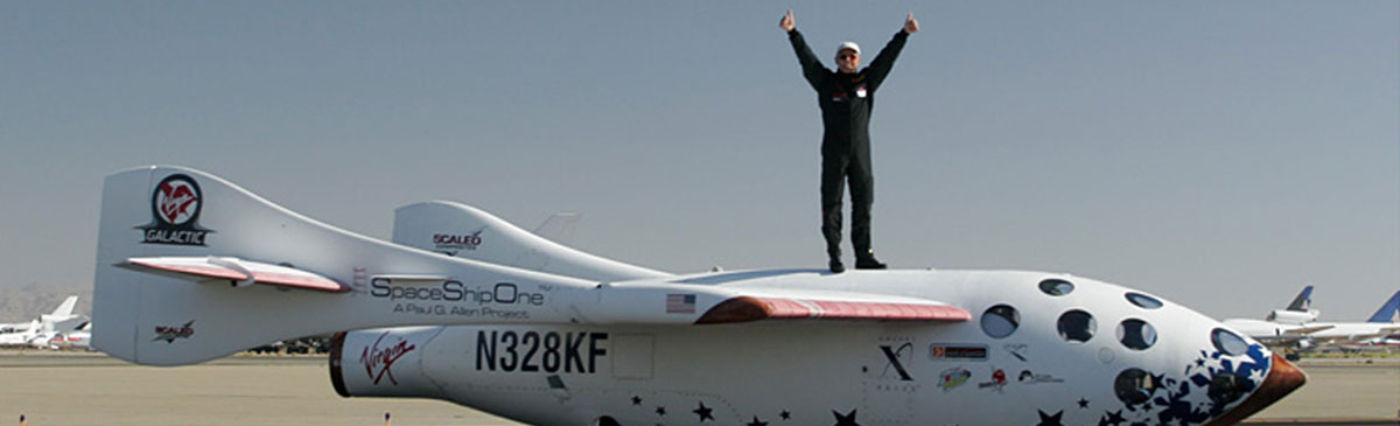
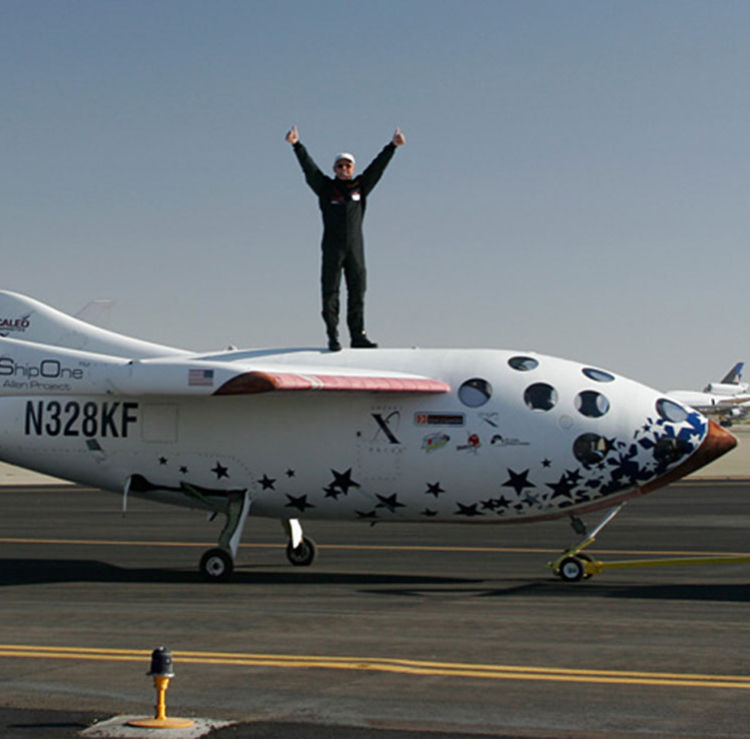
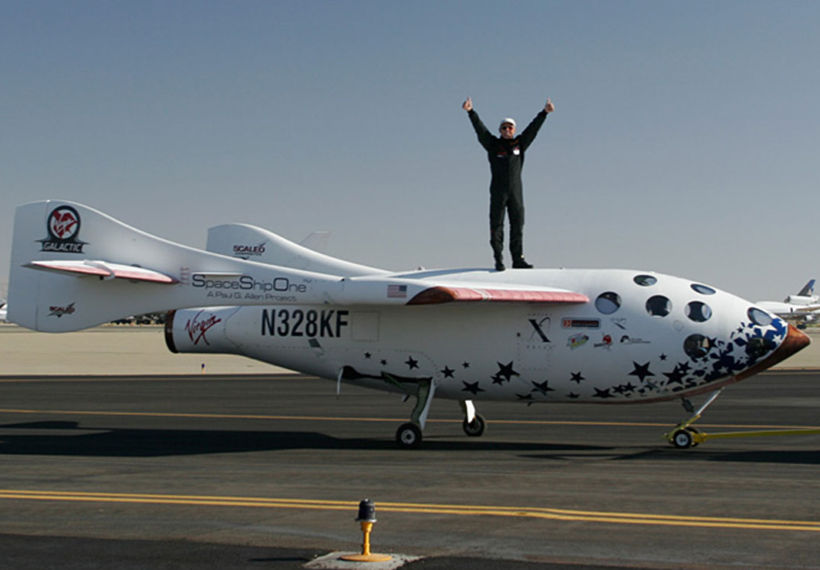
Of Microsoft fame and who spent 26 million dollars funding Bert to build Spaceship One that ultimately won the 10 million dollars.
That's a little weird.
So explain that one to me.
Well, 26 million dollars was how much it cost.
And at the end of the day, Paul was brilliant because he made back that 26 million plus, the 10 million defrayed part of the cost.
But he ended up licensing the design to Richard Branson, who used the design of the winning vehicle, Spaceship One, to build Virgin Galactic, which now sells tickets for 200K a pop to go into space.
He also was able to donate the spaceship to the Smithsonian and got a tax write-off, got movie rights, got TV rights.
He did great.
He made his money back and then some, which I'm very happy for because I want to encourage other people to back these kinds of crazy teams in space.
So you're saying it's still possible for a company to spend more in R&D than they will actually win in the prize because perhaps for some of them, there's the prestige of having won it.
There's also the back end of the business.
So when we designed the Ansari X Prize, it was very much with the idea that the winning team would go into business offering seats to space.
That was the purpose, you know, to create this prize and have it be won and have it just be a, with all due respect to museums, a museum piece wasn't the idea.
I wanted to kick off an industry.
Well, he sure as hell did.
Yeah.
You ever Google private enterprise space?
Just Google that.
You get an entire list of all the companies that are currently involved in doing space without NASA.
We're doing space in a way that NASA might one day need them and pay them for that service.
Correct, yeah, there's a new space race and it's private enterprise.
Private enterprise and you all heard of Virgin Galactic with Richard Branson and Elon Musk, his SpaceX.
He's been, there's a recent cover of The New Yorker.
Did you catch it?
No, I didn't.
It's got the space station up there.
And it's got a delivery messenger on a bicycle going towards the space station with a little satchel of goods.
Right.
So delivering cargo to space is no longer, doesn't have the romance it once did, but it's a need and you can create an economic model.
And so people are doing it.
That's what it is.
And there are even some aerospace giants involved in it, Lockheed Martin and Boeing.
But the real story here is the fact that small entrepreneurs have decided that they're not gonna wait around for governments to lead their way.
Right.
And they're gonna try to get into space and create a business model because of it.
And I still think we're not there yet, but they're doing it.
And I'm not gonna stand in their way.
Unlike you.
No, I can't wait for it to happen.
I just can't wait until we're all waiting in a line, having to take off our shoes and go through the TSA so that we can go to space.
That's gonna be great.
I mean, no, seriously, that's really...
That'd be the TSSA, Transportation Safety and Space Agency.
And Space Agency, yes.
So, you know, I think it'll happen, but the fact is that when are they gonna be able to bring it down to a level?
It's always gonna be for rich people.
That's really the deal.
Right, because a scene on Virgin Black is $200,000.
Exactly.
And you know who's gonna go up in that?
Is, what's her name, with the meat on her body?
Lady Gaga.
Lady Gaga, she bought a scene.
Oh, she really did?
Yeah, yeah, she's gonna sing a song from space.
Okay, see, now already I hate space travel.
Now I hate it.
What do you have against Lady Gaga?
I, well, meat.
I'm a vegetarian, that's what I have.
No, I just can't stand...
You're jealous of her Twitter followers.
You know how I gotta be, I am.
But the truth is, though, why is it that, well, you know what, I guess in a way it's a good thing.
Anything that actually promotes it.
That makes it pop culture.
That makes it pop, it's a good thing.
I got you to agree.
That's my whole point of this whole episode.
You know what, you win, I'm beating down.
You've been listening to StarTalk Radio.
Thanks for joining us in this hour.
I want to thank Peter Diamandis for being my guest.
And I've got here Chuck Nice.
As always, good to have you in studio.
I'm Neil deGrasse Tyson, bidding you, as always, to keep looking up.
See the full transcript



 Unlock with Patreon
 Become a Patron