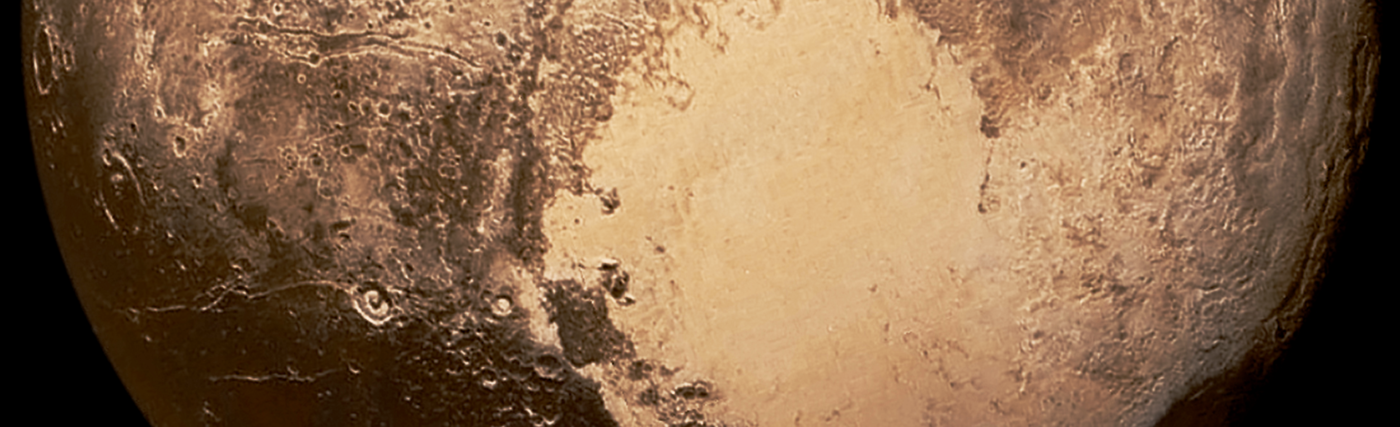
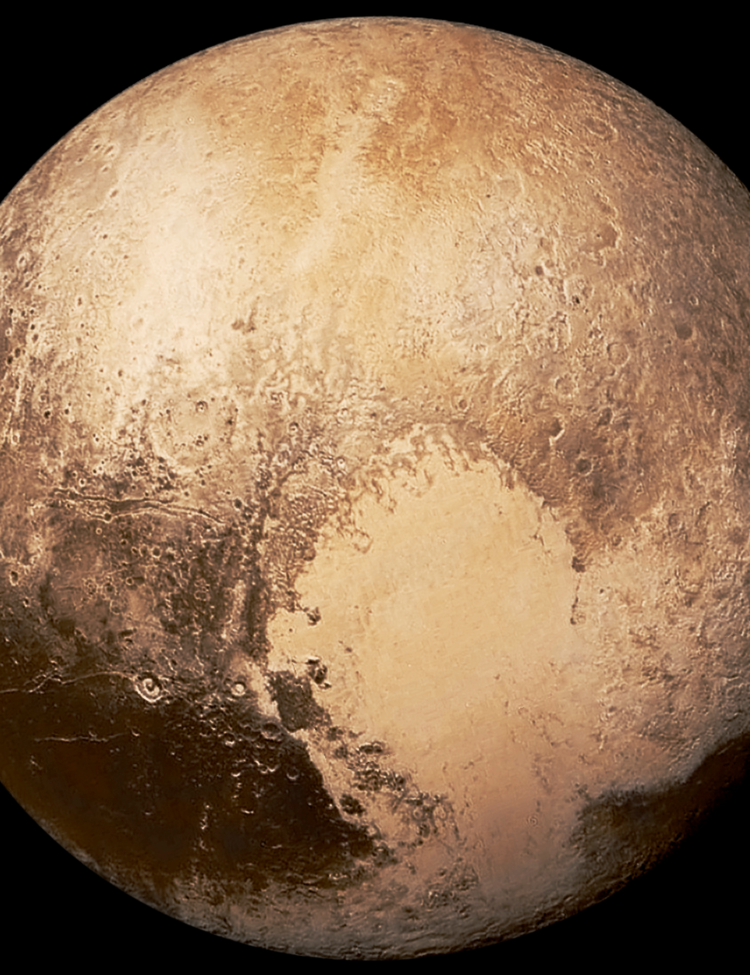
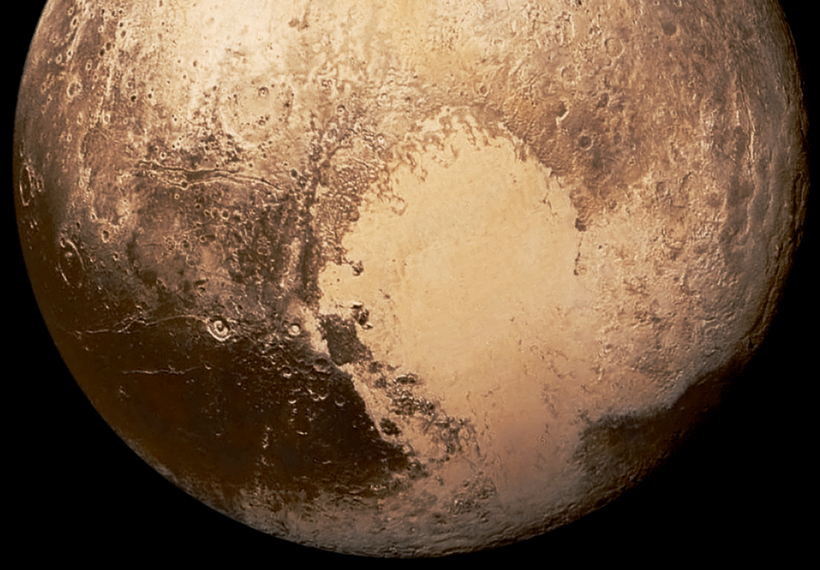
Whether you think Pluto is a planet, a dwarf planet, or an animated dog, there’s one thing everybody can agree on: the Pluto unveiled by the New Horizons mission is more “stunningly complex” than anyone expected. That includes both our host, Neil deGrasse Tyson, his guest, Dr. Alan Stern, the Principal Investigator for NASA’s New Horizons mission, and our in-studio guest, astrobiologist (and StarTalk All-Stars host) Dr. David Grinspoon. Join us as we explore Pluto, from its 1,000-foot-high methane crystals that run for hundreds of kilometers, to its volcanoes and glaciers, to its Texas-sized ice field known as Sputnik Planum which covers about 1 million square kilometers without a single crater marring its surface. You’ll hear about Pluto’s atmosphere – another unexpected discovery – and the possibility of an ocean of liquid water under Pluto’s frozen surface. Of course, no discussion of Pluto would be complete without Neil debating both Alan and David about how we should classify everyone’s favorite Kuiper Belt object, and about the vote by the IAU that demoted Pluto to dwarf planet – and you may be surprised by what Neil concludes. You’ll also hear about what we’ve learned about Pluto’s largest moon, Charon, the possibility of “Planet X” deeper in the Kuiper Belt, and NASA’s future plans for the New Horizons spacecraft. Plus, co-host Chuck Nice explains why you shouldn’t sneeze on Pluto but you should consider investing in Plutonian real estate.
Transcript
DOWNLOAD SRT
Welcome to StarTalk, your place in the universe where science and pop culture collide. StarTalk begins right now. This is StarTalk, and I'm your host, Neil deGrasse Tyson, your personal astrophysicist, and I'm also the director of New York City's...
Welcome to StarTalk, your place in the universe where science and pop culture collide.
StarTalk begins right now.
This is StarTalk, and I'm your host, Neil deGrasse Tyson, your personal astrophysicist, and I'm also the director of New York City's Hayden Planetarium at the American Museum of Natural History.
My co-host today is Chuck Nice.
Yes.
Chuck.
Hey, Neil.
You're looking good.
Got your NASA uniform on.
That is correct, sir.
I am wearing a NASA shirt.
NASA t-shirt.
Very good.
Trying to get in good with me.
You don't need to do that.
I love you no matter what.
I appreciate it, man.
I really do.
Actually, when I cover, I'm wearing a shirt over top of this shirt, and I have to make sure that the M stays visible.
Otherwise, it looks like ASSA.
Okay, fine.
Which for some reason makes sense when I wear it.
Today, we're talking about Pluto and the farthest reaches of our solar system.
Yeah.
A lot of stuff out there.
Featuring my interview with Mr.
Pluto himself, Alan Stern.
Yes.
He's a friend and colleague.
He's the principal investigator, the PI of NASA's New Horizons mission to Pluto.
That's right.
He's also a planetary scientist at the Southwest Research Institute in Boulder, Colorado.
It's no Hayden Planetarium, I'll tell you that.
Just saying.
Actually, Boulder, Colorado, they have the real sky.
Yeah, they do.
No noise pollution there.
No light pollution.
Light pollution, exactly.
No light pollution.
Now, people know my history with Pluto, and just in all fairness to that, I had to bring on somebody who's a Pluto sympathizer.
And it was awesome.
Who's also an expert on the solar system.
And it was great.
We're gonna bring in planetary scientist, David Grinspoon.
David, where are you?
Hey there.
Oh, hey, dude.
Your Twitter handle is Dr.
Funky Spoon, which every time I hear, I gotta recite it.
Funky Spoon.
Dr.
Funky Spoon.
You're a senior scientist at the Planetary Science Institute.
And where's that?
Well, Planetary Science Institute is in Tucson, but I'm actually in Washington, DC.
We're sort of a distributed beast, the Planetary Science Institute.
We have members all over the world, and I'm here, I'm part of the Washington outpost.
Okay, cool.
And you study comparative planetology, which is cool.
This is where you see what planets have in common and what differs among them.
You're a particular expert on icy moons and Mars and Venus.
You wrote a book on Venus.
I remember, I think I own that book.
What was that one called?
Yeah, Venus Revealed.
I love Venus because it's so much like the Earth and so much unlike the Earth.
It's both, it's a mystery.
You said Venus Revealed.
It might have been a better title, Venus Unveiled.
Then you get the double.
You get the double.
The double entendre going on there, seeing as how Venus, the Demilo and you know.
Maybe the next edition I'll go for the unveiling.
And also you care about Pluto.
And I'm told you're working on a new book with Alan Stern.
What's that one called?
And Alan and I are working on a book called Chasing New Horizons.
Oh, okay.
Little word play there, New Horizons, the mission and right, Chasing New Horizons.
When does that come out?
It comes out next year, 2017.
Nice, okay.
We'll look forward to that.
And by the way, you are one of our newly knighted StarTalk All Stars.
Congratulations.
But it's up for you to say whether you want to be that or not.
Oh, I very much want to be.
I'm really excited to be a StarTalk All Star.
I had a blast at our launch party and recording the first few episodes.
I'm looking forward to doing more.
Excellent.
And this is not your first time on the air with us.
So it's great having you.
So tell me about New Horizons.
It already passed by Pluto, right?
When did that happen?
Yeah, it happened just about a year ago, or approaching a year ago on July 14th, July 14th, 2015.
It was a long time coming and-
So David, David, I remember growing up and every planetary encounter was a flyby and that word was part of our culture.
Then we got a little more expensive with our spacecraft and they carried extra fuel and they could pull up, slow down and enter orbit.
So no one used the word flyby, it seems, for decades.
So why didn't we pull it slow down and pull into orbit around Pluto so we can hang out there?
Why did everything have to focus down into just a few seconds of closeups and then the thing overshoots and gets lost in the Kuiper belt?
Like George Bush over Katrina.
Yeah, right.
Now, it's, I mean, you're right to relate it to that history because the reason why our first missions to Venus and to Mars and to Jupiter were flybys is because it's easier to do a flyby.
You don't have to take another big rocket and all that extra fuel with you to slow down when you get there to go into orbit.
And Pluto was really hard to get to because it's so darn far away.
And, you know, we were lucky to be able to do a flyby to, you know, we had to launch a really fast rocket, throw everything we had at it basically just to get a very small spacecraft there.
And even so, it took how long?
Even so?
It took nine years.
Nine years.
Now, I've tried to spread this fact far and wide that the first rule of any science experiment is that it needs to be completed before you die.
So is that fair enough, David?
Is that a fair enough first rule?
Well, I think it's a good rule.
It's going to be challenging for some of the things we would like to do in the future, like getting to the exoplanets unless we greatly extend our life expectancy.
But yeah, I tend to favor projects that I might have some chance of seeing to complete.
So you put some awesome rockets on what is otherwise a relatively light space probe, and it gets out there very fast.
You get high acceleration.
And then we also had to do a Jupiter flyby to further accelerate.
Amazingly, New Horizons took one year to get to Jupiter.
I mean, think of how fast that is.
Wow.
You know, all our Galileos and Voyagers, they took years and years.
New Horizons got to Jupiter in basically one year and then picked up even more speed with the Jupiter gravity.
Just to be clear, you stole some of Jupiter's orbital energy and gave it to New Horizons.
Confess that.
We pilfered a little bit of momentum from Jupiter.
I don't think Jupiter is going to care, but it really helped us out a lot.
So we'll get back to that in a minute.
But just some facts about Pluto, named for the god of the underworld.
Right.
That's right.
And all this time I thought it was the dog.
I am.
I can't believe that.
A little bit morbid.
And you know, there was a bit of a controversy because there was one idea that all of the features on Pluto should be named after things having to do with death and the underworld.
Like every feature on Pluto should have something to do with death.
And other people said, well, that would be really pretty morbid.
Why don't we name features on Pluto after, you know, a spacecraft and scientists and gods and, you know, people that had something to do with Pluto.
I vote for death.
That is so much cooler.
It's way cooler.
Yeah, but an entire planet just devoted to death?
Hey, listen, it worked for Darth Vader.
Wait, just, just, just by the way, he slipped in the fact that he called it an entire planet.
Just kind of reminds you who you who you kind of reminds you.
By the way, just what is the mass of Pluto relative to Earth's moon?
Pluto is really, really tiny for a planet and or for a object that some people might call a planet.
And it is in fact only about a sixth the mass of Earth's moon.
So it's really, you know, okay, just just just fess that up.
I know what you're saying, man.
Listen, even a micro penis is a penis.
Time to throw to the clip.
So Alan Stern came to town and I sat down with him catch up on New Horizons flyby of Pluto.
Let's check it out.
What a year it was for New Horizons.
I just want to say congratulations, my gosh.
Oh, thanks a lot.
You know, New Horizons is a huge team of people.
Actually over 2,500 people worked to build it.
Oh my gosh.
And what center, what institutions were?
It's a joint project funded by NASA, but a joint project of the Southwest Research Institute and the Johns Hopkins Applied Physics Lab.
Lots of big partners in it and also small and large corporations, everybody from Lockheed and Boeing.
Somebody's got to build the spacecraft.
And all the instruments in the ground system, mission control, all of it.
And so I'm going to ask you like cliche questions like, what most surprised you arriving at Pluto?
Two things.
One was just how stunningly complex the Pluto system is compared to our expectations.
And secondly, the viral public response, just loving the exploration, just people, a billion web hits, 10 times anything NASA had ever seen, 450 newspaper covers above the fold on a single day, every continent on earth, even Antarctica.
So the Antarctica Daily News?
Exactly.
I got a copy of it.
It's not called that, but yes, they sent it to me from the poll.
The one and only news.
I said, every continent but Antarctica on a radio show, and the Antarctic people got all upset.
We covered it.
So and I have to agree, not that I had any professional expectations for it, because I don't study planets professionally, but to see the images and the nuance and the detail, I was fully expecting it to be some pockmarked victim of whatever hits it, you know, and then it's just that.
But it had an entire surface personality that could not be explained by just things hitting it.
And so I was delighted.
Yeah, you know, we see canyons, we see glaciers, we see evidence of potentially former liquids that ran on the surface.
We see really varied terrain.
It's like out of a sci-fi novel, thousand foot high methane crystals that run for hundreds of kilometers.
So does this tell you that Pluto was geologically active?
Is there a word for the geology of Pluto?
Very clearly.
But it seems so little and we don't think of tiny objects as having active geology.
That's right.
But is that a bias?
It's a bias.
The less planetary sciences we get surprised when we go to new places.
This is the first time we've been to a dwarf planet and guess what we discovered?
It's a lot more complicated than anybody expected.
There's a place we call Sputnik Planum on Pluto.
It's a big ice field.
It's a thousand kilometers long.
It's a million square kilometers.
We can't find one crater on it.
And we've age dated it from that and it was born yesterday.
In other words, you age date because you have some expectation of what rate craters would accumulate.
So it's sort of like we know how hard it's raining and you can say, well, this piece of paper has that many dots, how long has it been out there versus some other piece of paper with more or less dots.
And so that paper would have been out there longer.
Right.
And in the case of Sputnik, the planet is the scale of the state of Texas and it was created yesterday geologically.
Whoa, whoa.
This little planet is somehow active after four billion years.
Any understanding of that?
Okay.
So, so what people don't understand is scientists love being stumped.
We love being stumped and we don't mind being wrong.
Like, we thought Pluto would be simpler.
We were wrong.
This is wonderful.
David, so you're a planetary, a comparative planetologist, right?
And so, so how would you compare Pluto's features to other stuff going on in the solar system?
I didn't see it.
I've, I didn't notice anything like it out there, but you've got a better mental inventory.
It's marvelous.
I mean, you know, I'll admit to having some anxiety that in addition to just wanting the darn thing to work after all those years, I had some anxiety that maybe Pluto would be boring after all, it's, you know, it's, it's, it's small, maybe it'll just be full of craters and not that interesting.
But in fact, it's anything but and there are features that are reminiscent of many other places and yet there are aspects that are just all, you know, pure plutonium and nothing like it.
You know, maybe the most similar place is Neptune's moon Triton which is around the same size and you know, also a frozen outer solar system object that's largely composed of nitrogen.
I'm saying they look they look alike or they actually so you've got some chemistry analysis of what's going on on the surface.
I'd say that, you know, there's some similar features but it's not like you would mistake one for the other.
But you have nitrogen ice that's frozen nitrogen.
I guess what else what else you have nitrogen ice.
You've got traces of methane methane ice.
Yes.
And also you have some features on Triton that are probably that are surely water ice, you know, the sort of bedrock the strong stuff on Pluto and also on Triton is water ice kind of playing the role that the bedrock that rock plays.
So just to be clear, nitrogen ice, we know nitrogen that we breathe that in our atmosphere.
Methane is the gas that most people in urban centers would use in a gas stove.
Right.
So you're cooking with gas.
Cooking with gas, right.
It's also the gas that we make ourselves.
Out of your butt.
I was going to say cows.
Cows, okay, fine, cows, yeah, comes out of their digestive system, not ours, right.
Exactly.
It was a cow.
So but methane, we're familiar with it as a gas.
And you're saying it's methane ice, which means it's not only cold enough to liquefy the gaseous methane, it's cold enough to solidify liquid methane.
What temperature is that?
It's, oh gosh, minus 200, I don't remember the exact.
Okay, so really cold, really cold, but it's pretty darn cold.
You could have just said darn cold, that would have worked perfectly for us.
So they're also beyond what the chemistry is, there's surface features that are intriguing, one of which people illustrated with a valentine shaped heart.
And so what is accounting for these bright and dark areas and these these different colorations?
Yeah, well, the bright stuff seems to be relatively fresh ice, meaning in the case of this heart, it may be as young as a million years old, which in terms of, you know, planetology is like born yesterday, there's no craters on that thing.
So it's really fresh.
The darker stuff is probably ice that has been irradiated and mixed in with organic stuff that, you know, the methane, of course, because it's being irradiated by ultraviolet from the sun makes organic stuff like we're made out of it, which is one of the cool things about these bodies is that they all have some organics.
So it's a source of energy for methane to explore other chemical reactions.
Absolutely.
Yeah.
And the methane is, you know, it is an ice, but it's also a gas at those temperatures.
It's probably both on Pluto, and so you have this weird kind of meteorology where stuff is condensing out and evaporating depending on the season and the latitude.
So you have stuff moving around on the surface too with this process of evaporating and condensing in different places.
Okay.
You guys are a bit audacious, I think, in asserting that Pluto has an atmosphere when by my notes, it says the atmospheric pressure on Pluto is one one hundred thousandth the pressure that we have here on Earth.
Wow.
You still want to call it it because the word atmosphere, so let's go there and breathe it.
This is the people's first thought.
And then you come out and read is one one hundred thousandth.
So your definition is clearly different from the person in the streets definition.
Yeah.
I mean, you know, it depends on what you want to call an atmosphere, you know, maybe you want to call it a dwarf atmosphere, I don't care.
But but it's you know, it is gas that's gravitationally bound to a planet and interacting with that planet surface.
And there's more of it there than there is out in the vacuum of space.
So so if you were on Pluto and you sneezed, you would actually get rid of the entire planet's atmosphere.
You can probably sneeze some of that stuff right off the bat, which is why astronauts should always, you know, bring some antihistamines when they go to a planet like that.
So if it's, is there any kind of life anybody can imagine, presumably not life as we know it, but life as we don't know it, that could be sustained on Pluto anywhere on it or within it?
Absolutely.
I think the most promising.
You would say yes to that?
Because the thing is, you know, as we're finding with a lot of these icy bodies out there, there's much more activity than we thought there would be, which means there's some kind of energy source.
It's internal, probably on Pluto, it's radioactive decay that's moving around.
So sources of warmth.
And if you've got sources of warmth on a body that's largely ice, then you figure at some depth within, there's probably liquid water.
So, we think Pluto probably has an ocean of liquid water at some depth beneath the ice, and there's at least some energy source, and we see organic stuff on the surface, there's probably been some mixing, so.
I think you're reaching for it there, I think.
But here's one I'll grant you.
All right?
In five billion years, five billion years, the sun goes red giant, all right?
And it engulfs the orbit of Mercury, Venus and possibly Earth.
And that makes it much warmer in the outer solar system.
So will that help out your life cause on Pluto?
Definitely, definitely.
I mean, you know, as you say, I'm sort of reaching for it for trying to find conditions that might support life today.
And that's why I'm thinking about the interior.
But yeah, at some point in the future, when the sun continues to heat up as it is doing now and goes, you know, into its late stages and the Earth's zone of the solar system, what we consider the habitable zone now gets uncomfortably warm, there may be briefly at least a habitable zone in the outer solar system.
And yeah, Pluto might actually experience a time where you could even have a liquid water ocean on the surface.
So it's like planetary real estate.
First rule, buy on the fringe and wait, right?
Exactly.
That's right.
But also, what do you do?
The future is in the outer solar system.
Did you hear what David said?
He said it might get uncomfortably warm here on Earth.
Yes.
We would vaporize.
I think that's what you're saying here.
So Pluto might be the next frontier to move to when we can no longer live on Earth.
Right.
Or we just go to another solar system.
Yeah, but at least it's moving in the right direction if we go to Pluto.
So many new things were discovered about Pluto.
And I asked Alan if any of that has changed anything, how we view Pluto, how people should view Pluto based on new information from New Horizons.
So let's check out my interview.
Other than Pluto's surface as an object, has it changed anybody's notions of things dynamically?
It's a thing orbiting the sun.
Well, with the exception of Neil Tyson, it's convinced most people that it's a planet.
Okay, I'm pummeling him now.
And then when people find out that if you drove around the circumference of Pluto, it's as far as from Manhattan to Moscow.
They said, I didn't know it was that big.
Yeah, I would say whether or not anyone calls it a planet, I think I learned this word in the Carl Saganian universe, where we get to call it a world.
And a world has a certain intimacy to it, a conversational intimacy, because it tells you that it's a place.
Maybe we'll go visit it one day.
It's interesting to think about and to explore.
And maybe that's what matters here.
Is it a world?
The moons of Jupiter are worlds.
They're planets.
Alan Stern has planet on the brain.
Yeah, well, you know, it's important.
And my field is called Planetary Science.
So I think it's important that we as practitioners understand what the central objects in our field are.
And where Pluto falls in that is secondary to just having a basic, logical, consistent understanding of what are planets.
And there's two ways to go out.
You can go at it scientifically.
And scientifically, the geophysical planet definition says that when objects are big enough to be round, by self-gravity, and they're not so big that their central temperature causes them to ignite infusion, anything in between, which is from about a tenth of Pluto's size up to about 10 times Jupiter's mass will be called a planet.
It's very simple.
Or you could use the Star Trek test.
You know, when the viewfinder comes on, the public knows in about a half a second what they're orbiting.
It's a spaceship, it's an asteroid, it's a comet or a planet.
Pluto passes by either test.
But really, it's really about we as scientists being able to order things into boxes so that we can categorize in a logical way.
It's not Pluto's problem.
It's our problem.
Well, Pluto is an inanimate object.
Okay, but of course, whatever is your concern about the legitimacy of the vote, our community voted in 2006 for the new classification.
I don't believe...
Actually not so.
Four percent of the International Astronomical Union was there.
Four percent voted.
It was almost 50-50.
And so about two percent voted each way.
And it went the other way.
On a vote made up of non-experts called astronomers, not planetary scientists, I'd like to redo that vote.
Okay, so now...
And really get the experts in.
But fine.
What I'm saying is, I don't think anything I did had anything to do with that vote.
And that's the vote that sets the language.
So...
Seven years ahead of that, running a very prominent exhibit at the American Museum of Natural History, you wanted to take Pluto and the small planets like it off the list of planets.
Didn't you do that?
No, not really.
No, we never had a list of planets.
That's the thing.
We never said Pluto wasn't a planet.
We just grouped it with the Kuiper Belt.
If I go over to AMH today, I won't find any numbers like eight?
Never!
There was never the number eight.
I was misunderstood.
I'm having the best time.
The press misunderstood me and my team who did this.
So, Pluto is a planet.
The institution did not commit to whether...
I'm asking Neil.
I think the disservice...
Let me at least meet you halfway.
I think if dwarf planet is a category of planet, I have no problem with that.
What happened was people thought the dwarf planet is not a planet anymore.
And that's where I can meet you somewhere on the island.
Good.
So, I like that.
Dwarf planet is a category of planet, just like dwarf stars.
The sun is a dwarf star.
Would anybody deny it's a star?
Yeah, it's a dwarf star.
Most people don't know it's a dwarf star, but it's a dwarf.
Yeah.
Yeah.
That's pretty good, Neil.
Oh, we're shaking hands.
Uh-oh.
Because Neil just said dwarf planets are planets.
We can edit that out.
You guys edit that out later.
You probably will.
Guys, I told you to edit that out.
Why is it still in there?
Let me just say, that is a deeply wounded man you're talking to right there.
I mean, he just went Taylor Swift on you.
He was just like, we are never getting back together, Neil.
Never.
It's a planet, damn it.
It's a planet.
So, David, what's your take on all this?
Well, you know, you heard me earlier in this conversation use the word planet, and that's almost my reflex.
Like, I wasn't trying to be provocative or make a point then.
It's honestly how I think of it.
And I do understand how people that are concerned with thinking about orbits and classification of gravitational influence, you know, might put dwarf planets like Pluto in sort of their own category.
But as a planetary scientist, you know, I go to meetings where we talk about planetary geology and processes of planetary atmospheres.
And when we're doing that and we're doing comparative planetology, we do use the word planet often when we talk about Pluto.
We're saying, well, you know, this planet has a, has a crater population that shows that this area is young and people don't stand up and go, wait, you know, they correct and go, no, you mean dwarf planet.
That's because they've all been brainwashed.
That's right, exactly.
And can I just put it this way?
Would this be fair to say, to look at dwarf planets and bodies such as Pluto, the way the statement would be, all human beings are apes.
Not all apes are human beings.
So could it be something along those lines when it comes to dwarf planets?
Well, yeah, I mean, I actually like, I thought the conversation between Neil and Alan that I just listened to was pretty interesting because to me, I definitely don't have a problem with the reclassification.
I think, you know, we've learned enough about these other objects and even about the exoplanets, which they didn't even really get into to re-examine the word planet.
But I always thought it was a little funny to say, and a dwarf planet is not a planet.
That was the part that seems like sort of an add-on.
Like a dig.
That was a dig, you're saying.
So what I did, because of my episode dealing with the public in Pluto at the museum, I published a book called The Pluto Files, The Rise and Fall of America's Favorite Planet.
And in there, it's a fact-based, and at the end, I save one little section where I have a two-page expression of my opinion.
And all I say there, and David, you're a sensible guy, I don't see why you would object to this, but I want this on camera to verify once I tell you.
So that what we really need, and this echoes a little bit of what Alan was saying, the word planet is not a useful word anymore.
When I say planet, I just discovered a planet around another star.
Oh, is it rocky?
Is it gaseous?
Is it near?
Is it an inhabitable zone?
Might it have life?
Does it have an atmosphere?
You have to ask me 20 questions after I hand you a classification that tells you the word needs improvement.
So the classification is far too large.
Far too large.
So we should have 20 different classific...
20 different things should be like rocky objects and gaseous objects, objects with rings, objects, and then have find some words for that.
That way I can say I found one of them and then you're right there.
Absolutely.
I mean, we've always had gas giants and terrestrial or rocky earth-like planets.
It's already ready to happen.
We didn't know that there were more kinds of planets and we're discovering so much in our own solar system and wonderfully around other stars that yeah, I mean, we definitely are evolving the way we think of planets.
And I think they should have waited.
We should wait until we get a nice, well-defined catalog of exoplanets so that when we finally lay down a new set of definitions, it includes not only this solar system, but all others yet to be found.
Well, I mean, yeah, the definition's going to be reworked and reworked again because we're at our infancy of learning about exoplanets.
And you know, the IAU, when they made this...
International Astronomical Union.
When they made this vote about Pluto, and I agree, I mean, I think most people agree that that vote wasn't the last word and that it wasn't that well done.
A lot of people that even sort of agree with the decision acknowledged that that was sort of rushed and everything.
But also another thing is that they didn't really deal with the exoplanets at all.
They were just like, well, we'll wait on that.
And so now you have the sort of absurd situation where almost all the planets in the universe, basically all the planets in the universe, are not included in the IAU definition of a planet, in the official definition.
So I think there's gonna be another stab at it.
And maybe they'll take another look at this question of whether dwarf planets need to be defined as not planets or simply as another kind of planet.
In a certain sense, I don't really care.
It's a little bit distracting.
I mean, what's really cool is the fact that we've learned about all these new kinds of objects.
I refer to them as planets.
I can't help it, but as long as we're talking about them and people are interested in them, then the nomenclature is the most important thing.
Well, coming up next, more about Pluto's largest moon, Charon.
David, am I pronouncing that right?
Charon.
Yes.
Good, thank you.
And New Horizons' continuing journey into the Kuiper Belt when StarTalk returns.
Welcome back to StarTalk.
I'm here with Chuck Nice.
And our guest via Skype, Planetary Scientist, David Grinspoon.
Dr.
Funky Spoon.
That's cause that's his handle.
That's his Twitter handle, Funky Spoon.
David, why are you funky?
Well, you know, some of us are just born that way.
Nice.
As you know, I play music too, in addition to different stuff.
Oh, okay.
And so.
All right, we'll give it to you then.
We'll give it to you.
For now, you're borrowing it.
We need more evidence.
Well, featuring my interview with Alan Stern, lead investigator of the New Horizons mission to Pluto, NASA's mission to Pluto.
And let's talk about their moons.
All right, for the longest while, we didn't even know Pluto had a moon.
But you know what, here's the thing, before you get to that, cause I know you teased that talking about Sharon.
I need to talk about the fact that I just wanna know how you feel about getting hate mail from children for killing Pluto.
Oh, oh, yeah, cause I got blamed.
I know you got blamed.
And you know what's funny?
I hate to say this, but Alan almost blamed you in our earlier when we heard in that clip, it was like, you and your team, Neil.
Right.
It was almost accusatory the way he stopped short of it.
He stopped short of it.
I have a file cabinet draw of hate, pissed off, angry, third graders.
Whole classes, the teacher organized, organized rebuttals.
Yes.
Look, I happen to have one right here.
Well, you got one.
Yes, I do.
Dear Dr.
Tyson, you are a big poopy head.
I remember that one.
Pluto is my favorite planet.
Okay, I was a poopy head in that moment.
So I was like the leading edge of this.
David, can I get some sympathy or something from you for that?
Well, yeah, of course.
I was working at the Denver Museum when all this came down and I'd have kids freaking out and wondering what happened to Pluto.
I mean, people get very emotional about it.
Why is that?
I mean, seriously, if you said to me, like, Venus is our solar system's whore, nobody would get mad, be like, oh, well, you know.
Okay, fine.
Yeah, I think it's...
What is it?
I think in America, that's why I subtitled my book, The Rise and Fall of America's Favorite Planet, because an American discovered it.
Oh.
And it was discovered the same year that Walt Disney first sketched the dog that would get the name Pluto.
So, and when you're a little kid, when do you first learn about the solar system in like third or fourth grade?
When are you first doing cartoons?
Yep, same time.
Around the same time.
So, at the time you learn about the planet, you're learning about the dog or you're admiring the dog.
Exactly.
So, I think Americans had a little extra attachment compared to the rest of the world.
I asked people in Europe, in France, I said, do you care that Pluto's de Quote de Motive?
Are you kidding me?
Pluto is a peasant planet at best.
Hey Chuck, I gotta tell you, it does upset me a little bit when you talk about Venus in that way.
Of course it would upset you that way.
I think there's something about it being small and kind of an oddball and maybe a little bit of an underdog.
People were sympathetic with Pluto and it's actually a very interesting phenomenon.
Well, plus we would learn that Pluto had a moon in 1978, a moon of Pluto was discovered named Sharon.
Sharon!
Sharon, which was the name, correct me if I'm wrong, David, the name of the ferry boat driver that would carry your unfortunate soul across the river into Hades.
Is that correct?
Yeah, it was also that the wife of Jim Christie who discovered Sharon was named Sharon.
Oh, nice.
Okay.
It was kind of a twofer there.
Some people pronounce it Karen, but Sharon works for me.
And also the it's not only Sharon, but it's got four other moons.
So Pluto has at least five moons.
Is that correct?
Yeah.
And actually it has only five moons.
I mean, as far as we could tell, one of the things New Horizons did was look really carefully to try to discover other moons.
And they actually were very careful because there was this worry that they might hit something.
So there was this whole hazard avoidance sense that we really got to make sure there aren't any other small objects around Pluto.
That would be embarrassing.
You know, something really tiny would doom the spacecraft at those speeds.
But all they found was this one giant moon Charon, which we already knew about, and then these four smaller moons, which are named Nix, Hydra, Kerberos and Styx.
Wow, you're right.
Everything does have to do with death around Pluto.
Yeah.
Well, this was the thematic relevance.
Since all the moons of Jupiter are named of Greek characters in the life of Zeus, Zeus being the Greek counterpart to Jupiter.
So we try to be mythologically consistent, and why not, just as homage to the Greek and Roman history of all of this.
So during the flyby, the New Horizons mission also got a good look at Charon.
And so I asked Alan Stern about that.
Let's check it out.
It's 1200 kilometers, 750 miles across.
It orbits pretty close to Pluto.
And so if you were standing on Pluto, it would be much bigger in the sky than seeing a full moon.
And also, it's about as bright as a full moon because it's icy and very reflective.
Oh, because the moon itself is not very reflective.
Our moon is kind of just dirt.
It doesn't reflect very well.
Yeah, it's just dark dirt.
Yeah, yeah.
But Charon's icy, and we've discovered that it had a really interesting geological pass.
It has the largest canyon system.
Just to be clear, as bright as a full moon looks to anybody at night, it would be much, much brighter if it were made of icers or something more reflective than its current substance.
You mean our moon.
Our moon.
I just want to make it clear because people talk about how bright the moon is, or I can read by moonlight or jog by moonlight, but it would be way brighter if it weren't so dark.
Exactly.
As a matter of fact, so we've learned that Charon has something no other place in the solar system has.
It has a dark pole, like an antipole or cap.
It has no atmosphere, but it apparently used to in the past because there's some telltale evidence of that.
There's evidence that it used to have an ocean on the inside like Europa.
Well, because Europa has a subsurface ocean.
Yeah.
We found that the inside has ammonia ice in it and we see that in the ejected blankets of craters where we can tell the composition of what came out of the center.
So there's a term for that.
I never knew that had a term.
So an asteroid or some impactor strikes and it makes a hole deep enough that whatever is below the crater right splashes up.
It excavates that material and Sharon's got this enormous canyon system that dwarfs the Grand Canyon.
It's just another cool place.
I think we need to rename our Grand Canyon because now that we've got to, there's the Mars, you know, everybody's got a canyon bigger than earth.
What do you think?
We got to rename this.
Even Pluto and Sharon.
Yeah.
So, David, you got a name for our Grand Canyon, the not so Grand Canyon.
Baby Grand Canyon.
Baby Grand, the baby Grand.
The baby Grand Canyon.
The Steinway Baby Grand Canyon.
We'll have it sponsored.
Somewhat impressive canyon.
So David, what else can you add about Sharon?
Well, Sharon is another delight.
You know, even on its own, it was almost worth the price of admission of getting there.
It's got some strange features.
For one thing, it has this northern cap that's significantly darker than the rest of the moon.
As Alan said, it's kind of an anti-ice cap, right?
Yeah, yeah, exactly, and there's some suspicion that it might have to do with exchanging gas between Pluto and Sharon, if not at present, maybe in the past.
No, no, that system is tipped, right?
That orbital system is tipped relative to Pluto's plane of orbit around the sun.
Is that correct?
Yeah, exactly, but of course, it's tidally locked now, so if you were on Sharon, there'd be one place on Sharon where Pluto would always be overhead and you could just stay there and go around and watch Pluto go by.
In other words, Sharon does not rotate relative to Pluto.
Yeah.
Yeah.
It always shows the same face.
Yeah.
Mm-hmm.
Wow, that's pretty cool.
It's very cool.
So it's double tidal lock.
Yeah.
Did I tell you?
Did I tell you in high school?
No.
I didn't tell you?
No.
I didn't tell you?
No.
In high school, I wrestled in high school.
Well, that I knew.
I was undefeated and I was captain.
Okay.
I was kicking some serious ass and I want to invent a new wrestling move called the double tidal lock.
Doesn't this sound like a move that has to have that name?
Okay.
So, but I never perfected it, but I'll show it to you later.
We got to get, no, don't show me.
So David, tell me about moons.
Our moon, people talk, they've been talking for a long time about moons being important to develop life on a planetary surface.
Why?
I've never really agreed with that connection.
I don't know if I agree with it either strictly, but the logic is that on Earth, our giant moon, and by the way, Earth and Pluto have in common that they have the two giant moons in the solar system, as far as the relative size of the moon to the planet.
You know, Earth is rather extreme, Pluto is even more extreme as being a fraction, a sizable fraction of the planet.
Yeah, in fact, for Pluto and Sharon, the middle point of their gravity is outside of the physical body of Pluto.
It's a double planet.
It's basically a double planet.
Whatever.
Damn, you got me to say planet.
I was just about to say this.
You just said planet.
This is a diabolical plot.
Okay, go on.
The thing on Earth is that the moon stabilizes Earth's climate by acting almost as like the outrigger on a canoe by preventing the axis of Earth from wobbling more.
It certainly has played that role.
Now, whether you could say without the moon, Earth would be lifeless or would just have life that had adapted to somewhat more wobbly climate, I'm not sure, but that is the idea.
I did not know that.
The moon, our moon, acts as a keel, kind of.
In a way, yeah.
Exactly.
That's amazing.
That's exactly right.
A gravitational keel.
A gravitational keel.
I would say, look at the temperature range over which we survive or even thrive anyway on Earth.
We have humans living in the equator, we have Eskimos living in the Arctic, so I don't think that we would fear that.
Yeah, I agree with you.
I mean, you can imagine somebody looking at our planet from some other kind of planet and going, oh, look at these seasons, they have winter and summer, nobody could possibly live there.
It may just be that kind of Arctic.
Okay, cool.
So, New Horizons went by Pluto and it kept going on a flyby and it's looking for other stuff out there in the Kuiper Belt.
I had to ask Alan Stern, what's next for New Horizons?
Check it out.
So, back in November, October, November, we fired the engines a series of times to target it for its next flyby.
It's about a billion miles past Pluto.
It's a building block of these small planets like Pluto and Eris and the others.
It's about the size of Chesapeake Bay.
It's four billion years old.
It's always been in the deep freeze, so it's scientifically a great sample of that early era.
It doesn't have a really good name yet.
It has a license plate.
It was detected by the Hubble for New Horizons.
It's called 2014, which is the year it was found, MU69, which is a jawbreaker.
So, we'll do better.
We're going to have a naming contest with NASA and pick something.
Good.
So, that's going to be another flyby.
That'll be a flyby.
All right.
And we know when.
It's a very easy date to remember.
It's January 1st, New Year's Day, 2019.
2019.
I'll put that on my calendar.
And again, you're flying by.
Do you have fuel for yet a third destination?
Probably not.
But we have plenty of fuel to run the spacecraft on a Voyager-like mission way out to the heli sphere.
Because that uses less energy, of course.
Yeah.
Yeah.
Yeah.
And of course, you've got this is the fastest spacecraft ever launched from Earth.
It is.
And you will leave the solar system the way Voyager did.
Exactly.
Okay.
Will you ever overtake Voyager?
No.
Oh, that's too bad.
And a lot of people wonder why.
If it was the fastest launch, how was Voyager ahead in staying ahead?
I think because Voyager cheated.
It got some extra boost from Jupiter, I bet.
It got four boosts.
Four boosts?
From each giant planet.
Oh my God.
I didn't know it was all four.
Yeah.
Oh my God.
And we only got Jupiter.
So they're a little faster than us.
But that's fine.
So this is stealing some of the orbital energy of a giant planet and you get a little boost out of that.
Yeah.
That's fine.
I don't think the planet's mind.
I don't think they notice.
They're inanimate objects.
So, David, tell me something about the Kuiper Belt.
Is it real enough and it extends out there?
It's, I mean, the Kuiper Belt is this vast outer realm of our solar system that we really didn't even start to learn about until, you know, the 1980s and 1990s.
And by the way, it's not a coincidence.
It's not simply a coincidence that that's around the time where people are wondering whether Pluto just belongs in the Kuiper Belt as a species of object, right?
Absolutely.
That was the discovery that led to this whole question of reclassification was the fact that there are lots of objects out there, not just Pluto.
And that led some people to say, oh, how many is lots?
How many is lots?
Oh, gosh, it's, it's, by the way, when you're funky, you can't use the word gosh.
Those two.
Well, damn, there you go, that's funky, gosh, dardly, golly, golly gee, diddly doo.
I'll tell you, only bar in that funky moniker, you got to keep earning it.
There are millions of objects in the Kuiper Belt, you know, it's because you get to smaller and smaller objects.
And there are, you know, just little chips of things too, because it's been collisional in the past.
So it's, it's vast.
And you call them objects, but what we can call them comets.
They're, they're icy, right?
Yeah, well, I mean, exactly.
I mean, if you took them into the inner solar system, a lot of them would turn into comets.
They'd start to develop tails and evaporate material.
Like Pluto would do.
Yeah, go on.
And you know, the larger ones are, as we've been discussing, dwarf planets, the larger ones around because of self-gravity.
So there's a whole spectrum of objects, you know, it's, it's a vast realm.
And in a lot of ways, it's the largest part, the main part of our solar system in terms of number of objects and in terms of the volume of space it takes up.
And it is a belt, by the way, it's not a sphere of comets like we have farther out in the solar system.
It's it's concentrated along that plane, where the planet's also you have the Oort cloud, which is an icy body of comets, a zone of comets, which is spherical.
So we call it a cloud.
And this is a belt like the asteroid belt, which is kind of slightly flattened in a plane.
So this is the lingo.
I mean, it's a thick thickened belt.
You know, the objects are kind of they're not all neatly in that plane.
They're all a little bit tilted so that it's a it's a fat belt, but it's not they're not isotropic.
That is, they're not equally in all directions.
They are concentrated in the plane that the planet's orbiting.
So this will go on for another how much power does the thing have to keep going?
It's supposed to, you know, in terms of it's got a plutonium power source and quaint.
It's plutonium, plutonium.
We said plutonium past Pluto.
Not uranium.
That would be a uranium thing.
It's going to slowly lose power, but it's going to last for decades, probably at least until the 2040s.
They should be able to stay in contact with it just as we've been able to stay in contact with the Voyagers for decades after they completed their primary mission.
And just if I remember correctly, you cut your teeth on Voyager, didn't you, back in the 70s and 80s?
Yeah, I was a student, an undergraduate intern at the Voyager-Jupiter encounter in 1979.
It was a really life-changing and mind-blowing experience.
Wow, we have so much in common.
I watched every episode of Star Trek Voyager.
Yeah, pretty similar in some ways.
That might have been your first encounters with Carl Sagan at the time, who was active at Voyager.
Yeah, I think Sagan was a mentor of mine then, and just getting to see him work and interact with the rest of the team.
Of course, they were filming Cosmos, the older Cosmos, so there were film crews in there while they were looking at the first pictures from Jupiter.
And as a wide-eyed undergraduate kid, that was a pretty mind-blowing experience.
Nice.
Well, when we come back, we're going to talk about Planet Nine.
What is that?
It's a hypothetical planet could be hiding in the farthest reaches of the solar system.
When StarTalk continues.
We're back on StarTalk with my co-host, Chuck Nice.
That's right.
And our guest in via video call, David Grinspoon, Planetary Scientist.
David, good to have you, as always.
Thanks, always fun to be here.
We're featuring my interview with Alan Stern, who's the PI for the New Horizons mission, the NASA mission to Pluto and beyond.
Yes.
And now earlier this year, since, Dave, we got you online, and you were outer solar system guy.
Earlier this year, two Caltech astronomers asserted the existence of a planet nine deep in our solar system.
Mass, maybe about 10 times that of Earth.
So none of this little puny pipsqueak stuff.
We don't have to worry about whether or not this is a planet.
Exactly, exactly.
Size does matter.
And I think the numbers they put out were like 20 times farther from the sun on average than Neptune.
And it might take 10 or 20,000 years for it to complete one orbit around the sun.
So I had to ask Alan, cause he's-
It's a long day, man.
It's a long year.
It's a year.
Oh, that's a year.
Sorry, not yet.
Still.
One revolution would never turn one.
Yeah, never turn one.
Not if you're human.
So I asked Alan Stern about this planet nine.
Let's find out.
Tell me about planet nine.
A Pluto?
I'm pummeling him again, like the record show.
I was widely quoted, you know, actually I think it was Nadia Drake that did the article that asked me about that designation, you know, which I really think-
So that's a beef between you and Mike Brown.
I think-
Mike Brown named it planet nine, right?
And I think that was disrespectful of Clyde Tombaugh and his living relatives and the legacy of what he did.
So I was widely quoted as saying, apparently Caltech professors can't count.
That became a hashtag, Caltech can't count.
I missed this.
Was this in a Twitter war?
Just a couple of weeks ago.
Yeah, it was a Twitter war.
Okay.
But we had a good time.
But you know, if you actually count all the objects that are small planets in the solar system, it's actually up around 23.
Yeah, it's a couple of dozen.
And so, yeah, he probably should have, there are many more creative things he could have called it as a placeholder name.
He could have easily just called it planet X and that would have been perfectly fine.
It would have been even cool.
Yeah.
And it's mysterious.
With the X files.
Yeah, yeah, yeah, yeah, yeah, okay.
And so, can you comment on how Planet Nine was discovered?
Should we have as much confidence as Mike Brown did in the method?
Are you talking about Pluto again?
No, I'm talking about Planet 9.
We're not gonna call it that.
Not today.
He's not gonna call it.
No.
What would you like to call it?
Planet X.
The object, Mike Brown called Planet 9, which I'm happy to call Planet X.
Okay, could you comment on the method of how that was inferred?
So it hasn't been discovered.
Not directly, right.
And there have been many claims in my career of we think we can predict the planet.
A lot of them fall apart.
In fact, even the claim that led to the discovery of Pluto was they did the math wrong.
And Pluto was found only through Clyde Tombaugh's hard work.
So David, I looked at the research paper that made this announcement.
It seemed pretty legit to me using sort of gravitational Calculations.
Thank you.
No worries.
That's what I'm here for.
No, so you do the inverse calculation for the gravity equations.
Normally you say, here's the mass.
What is the force of gravity at some point?
Right.
But instead, what you say is there, things are behaving in a way that is surely the result of some source of gravity we don't know anything about.
Let's look at how they're behaving and infer the existence of a source of gravity elsewhere in space.
That's basically what they did, David, correct?
Yeah, I mean, I think it's a good piece of work and it's definitely legit.
Whether or not their specific prediction will pan out, who knows?
I mean, as Alan said in your discussion with him, there's a history of this kind of prediction being off.
It's a hard thing to do.
But certainly they saw a pattern in the orbits of other objects that seems to be non-random and seems to imply the existence of some other mass.
And you know, what's great about science is they made a prediction.
We'll look, either the object will be there or it won't be and science will move along.
But I think as Alan said also, you know, they're bound to be a lot of objects out there.
We are going to find other planets in our solar system.
Where did they come from?
Well, you know, the origin of the solar system was messy.
There was shuffling around the giant planets and a lot of pretty sizable objects got tossed out.
That's why we have a Kuiper belt, for instance.
There was this tossing out of planetesimals of little planets and some not so little ones got shuffled around as well.
Just quickly, so you tell me the Kuiper belt was not left over from the origin of the solar system.
You're saying it may be the castaway debris from what was going on from within this, with the inner solar system.
Yeah, I mean, well, it's left over in the sense that it's a remnant of that process, but that process was one of shuffling around and tossing things out of the inner solar system and ending up elsewhere.
There was a lot of chaotic-
It's our inner solar system junkyard, basically.
That's what you're saying.
It's our inner solar system junkyard.
So it might have, so there's some cast, some, what you're saying is there are much larger castaways out there if this prediction is correct.
It might not be the only one because this we only happen to infer its presence because it has a visible effect on other Kuiper Belt objects.
But there could be many large planets out there is what you're suggesting.
Yeah, I think there should be based on what seemed to be the best theories we have of solar system formation.
And it may be that, you know, this specific prediction, even if it's wrong, it will lead us to other things, which I think we will find more planets out there.
So is this gonna give you, is this gonna give us another source of predicting mass extinctions on earth, that this thing only comes around every 10 or 20,000 years, that'll disrupt Kuiper Belt Comets and send them raining down on earth?
Well, it could.
I mean, you're referring to, you know, there was this idea of nemesis, which was like, yeah, basically a companion to the sun, which every once in a while would disturb the outer cloud of comets and send objects in.
The problem with that is that I think the evidence that there's a periodic signal that extinctions come in regular intervals isn't really very good.
And so it may be explaining something that doesn't really need an explanation, you know?
So I'm kind of skeptical of that just because I don't see the signal in the data of Earth.
So it turns out in addition to Planet Nine, Alan Stern told me Planet Nine could just be, excuse me, Planet X.
Planet X, right.
Could just be the tip of an iceberg of many, many larger planets in the outer solar system.
Let's check it out.
Modern planetary science is pretty sure that as we can look further and further with better and better technology, we will find more planets further out and lots of them and even big ones and I hope-
Big ones like Neptune size.
Certainly Earth size.
Yeah, at least Earth size.
The models suggest that Earth size planets in the Oort cloud are a good bet.
So we should watch that space.
Yeah, we absolutely should.
It'll be exciting.
Yeah, yeah.
But we're gonna have to get used to the number that there are just large numbers of planets, just like there are large numbers of stars.
And who knew in the 20th century that the solar system was so good at making so many planets?
And are some of these planets, do we think, escaped from the inner solar system and they're just sort of wandering out there?
Well, a lot of the ones that are in the Oort cloud came from the middle solar system, the region of the giant planets.
When the giant planets got big, their gravity was enough to clear out all kinds of stuff, littler stuff.
It threw the comets to the Oort cloud, it threw a lot of comets out of the solar system altogether, it threw the planetesimals, which are 10,000 times bigger than comets, it flung small planets around and even big planets because Jupiter can haul an Earth all the way to the Oort cloud.
I didn't know that.
Well, you know, of course, why not?
In fact, there's a theory that some dynamicists work on that indicates that even a Neptune or Uranus may have been ejected.
There may have been a fifth giant planet in our solar system.
And so some of those things got thrown completely out into interstellar space and some got stuck on the very edge of the solar system, the lip of the potential well, called the Oort cloud.
And it's kind of the solar system's act.
So once again, thrown up there and we're going to go find it.
The more we learn about the more nuanced and the more complex it is.
And that's a good thing.
Yeah, I think so.
David, give me some final reflections on all of this.
Well, the Oort cloud is a magnificent structure.
You know, we think of the stars as so far away and our solar system is isolated.
But if you include the Oort cloud around our star and those probably around others, then they're almost touching.
I mean, the Oort cloud goes maybe a third of the way to the nearest star.
It's, you know, it's something like a light year in diameter.
And just to clarify, we're not speaking of a gaseous cloud here.
We're speaking of a volume populated by a swarm.
I love that word, a swarm of icy bodies.
That from a distance, it looks like a, like when you say a cloud of bees.
Right.
Yeah, and it's an isotropic sphere, meaning that it's not flat like everything else in the solar system.
It's completely round.
There's many comets in any direction you can point from the sun.
And it's the sort of reservoir of icy stuff that once in a while, something gets disturbed by a passing star or one of these planet Xs or whatever, and comes flying in towards the sun.
And that's when we see it develop a big tail.
So it's cool.
I think if a comet comes in from above the solar system, we know it's going to be an or cloud comet because that's the only thing that actually has comets that can come from that direction.
That's right.
Right.
Right.
So Chuck, what do you make of all this?
Well, you know, I think that it's very clear that people are passionate about planets, which I think is a good thing.
And I just love that there are scientists having Twitter wars like Donald Trump.
I think that is awesome.
So Twitter wars over things other than Donald Trump's hair.
Exactly.
Yeah, I think that's great.
What I like about it is the idea, which is an emergent discovery, David, correct, that many things that we identified as planets in stable orbits around host stars could have been flung from those host stars and could just be wandering interstellar space.
When Alan mentioned a Neptune getting thrown out of our solar system, I couldn't help but thinking, well, does that mean that one of these days a Neptune is going to come flying into our solar system?
Yeah, it'll be a flyby.
You know, it's like, what are you doing in my neighborhood?
I thought I told you never to come around here.
I just want to see what's going to happen if a Neptune comes flying.
But what would be cool is if some of those planets still had a residual heat source, such as Earth still does.
And if that's the case, you could have life possibly evolving on planets.
On a totally rogue planet.
On a totally rogue planet.
And they will know nothing of a host star as they wander through space.
We don't need no stars.
We don't need no stinking stars.
We don't need no stinking stars.
David Funky Spoon, David Grinspoon, thanks for being on StarTalk.
And again, welcome to the community of StarTalk All-Stars.
I look forward to seeing you in many ways and times.
And Chuck.
Yes.
It was good to have you, man.
It was good to be here.
This has been our show.
Thanks for tuning in to StarTalk, featuring my interview with Alan Stern.
And, as always, I am Neil deGrasse Tyson, bidding you to keep looking up.
See the full transcript



 Unlock with Patreon



 Become a Patron