



 Unlock with Patreon
About This Episode
(WARNING: This episode contains strong language, discussions of suicide and mental health, and other adult topics.)
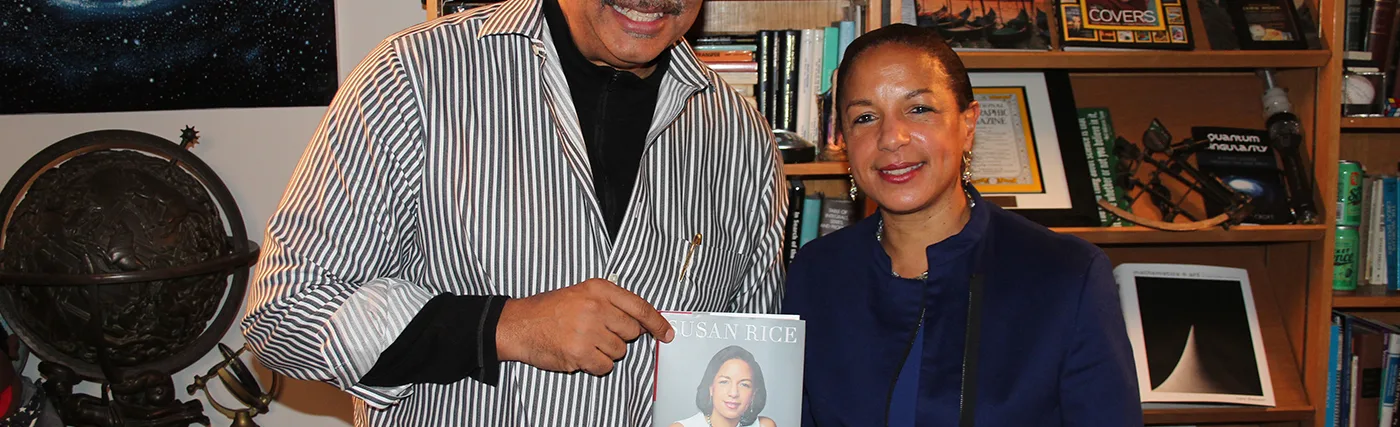
On this episode of StarTalk Radio, Neil deGrasse Tyson investigates the ever-changing, fragile, and layered world of geopolitics with former National Security Advisor to President Obama – Ambassador Susan Rice, PhD. Susan’s book, Tough Love: My Story of the Things Worth Fighting For explores her “dynamic career on the front lines of American diplomacy and foreign policy.” In-studio, Neil is joined by comic co-host Chuck Nice and neuroscientist Heather Berlin, PhD.
We start at the beginning. Susan takes us back to her youth where she first learned the concept of “tough love.” We discuss the three different types of parenting: authoritative, authoritarian, and permissive. Heather helps us understand the roots and development of “mental toughness.” Susan explains how playing basketball and tennis helped her prepare to deal with difficult situations later in life.
Find out why a little stress can go a long way. Susan shares some of the challenges she faced during her turbulent first few months serving as National Security Advisor. Heather tells us the upsides and downsides of compartmentalizing your brain. You’ll learn about dissociative identity disorder.
Then, we welcome Stephen Garcia, Chief Information Security Officer at the cybersecurity company ConsenSys, to explore what warfare might look like in the future. Ambassador Rice weighs in on the future of national security and foreign policy. We ponder the rise of autonomous weapons. Discover more about how information is being weaponized. Lastly, we ask: should there be ethicists advising countries on matters of national security?
Thanks to this week’s Patrons for supporting us: Paul Weist, Alexandra Uribe Coughlan, Annie C Hickman.
NOTE: StarTalk+ Patrons and All-Access subscribers can watch or listen to this entire episode commercial-free.
Transcript
DOWNLOAD SRTFrom the American Museum of Natural History in New York City, and beaming out across all of space and time.
This is StarTalk.
I’m Neil deGrasse Tyson, your personal astrophysicist, and I got with me my coach, Chuck Nice.
Tweeting at ChuckNiceComic.
Well, thank you, sir, yes.
I follow you.
I follow you, too, to the ends of the Earth.
Whereas you only follow me on Twitter.
Earth has no…
I’m following you to the gates of hell.
You’re following me like, maybe I like this, maybe I won’t.
Earth has no ends, it’s a continuous surface, in case you hadn’t noticed.
See, that’s why I follow you.
I’m following you.
I’m following you.
I’m following you.
I’m following you.
I’m following you.
I’m following you.
I’m following you.
I’m following you.
In this particular episode, we’re going to talk about the roots of mental toughness as they resided inside former National Security Advisor to the President of the United States, Susan Rice.
Right, we need somebody mental.
We got Heather Berlin.
You’re our go-to mental person.
I’m happy to be the mental person of this group, yes.
Right, and you’re one of our featured people on StarTalk All-Stars.
It’s just great to have you in the StarTalk family.
I’m happy to be here.
As long as we’re not a pain always reaching for you for this, but it’s just always good to have you.
Just a little bit of background on Susan Rice.
She came out with a book called Tough Love.
Tough Love.
And she was national security advisor to President Obama, 2013, 2017.
UN ambassador.
So the United States has an ambassador to the UN as distinct from ambassadors to other countries of the world, right?
And she was a Rhodes Scholar.
Wow.
And so she went to New College at Oxford and she’s author of the memoir, Tough Love, My Story of the Things Worth Fighting For.
Interesting.
Yeah, so she’s got the pedigree, she got the attitude, she’s got the, you know, she’s ready to shake that up.
And so she credits some of what she’s accomplished, I would say a lot of what she’s accomplished, to how she was raised with Tough Love.
Tough Love.
So let’s check out that first clip.
Tough Love, this kind of title, like we say, of our grandparents.
So, you’re not a grandparent yet.
God, no.
Okay, well then, so when you’re up there, naming a book, like with the grant, that’s a previous generation’s.
Oh, you’re dogging my title now.
A little bit.
Come on, man.
A little bit.
You know what?
Everybody I know knows what Tough Love means.
They do.
The young people know.
Even the young people?
Hell yeah.
Okay.
Certainly my young people know.
That’s different.
I’m kicking their ass.
No, no, no.
No.
And all the young people who work with me know what it means, too.
Because last time I saw their upbringing, they get a trophy for participating.
There’s nothing tough about their life.
Not in my household.
That’s the point.
So to me, it means loving fiercely, but not uncritically.
And when you mess up, the people who love you are supposed to tell you straight up that your stuff is not together.
I think that’s the polite term.
And there are many families where they’re always bolstering each other’s efforts, even if it has failed.
And you’re saying if someone has failed, you get on there, you tell them how and why.
With the aim of helping them do better.
Do better.
Not just to beat them down.
Right, right, right, right, right.
But I’m just contrasting it with the fear of being truthful with someone, because you might hurt their feelings.
Yeah, that was not a familiar concept in my household.
So, my parents raised me and my brother very much in the vein of tough love, and for better or for worse, my own kids have inherited the same.
All right, well, they seem to be doing okay.
They’re doing okay.
Knock on wood.
So one’s a senior in college and one’s a junior in high school.
And they’re doing okay.
They’re so far.
So guys, what do you think of her definition of tough love?
I mean, I think it’s a unique definition.
What we normally think of, at least in the field of psychiatry, as tough love, is when somebody is kind of really out of control or they’re, let’s say, a drug addict, and it’s about…
You mean literally out of control.
Like out of control.
Yeah, and it’s about then coming in with harsh enforcements of restrictions.
That’s not what she said that she had?
Well, I mean, she has more…
There are different types of parenting.
So there are three different types of parenting.
One is authoritative.
Authoritative.
One is authoritarian and the other is permissive, right?
So she’s more just what I think she’s describing is authoritative parenting, which is that you’re demanding you have high expectations, rules.
Lots of structure.
Lots of structure, but you’re also responsive and like connected emotionally.
Whereas authoritarian is…
That’s it.
That’s it.
And there’s no, you know…
Purely punitive.
Who the hell are you talking to like that?
So…
So, so, so, but, so, so her way, which is not author…
Not authoritarian.
Not dictatorial.
Right, like, like totalitarian.
Authoritative.
Yes.
Why should we assume that would work for everyone?
Wouldn’t that just fall flat for some people trying to grow up?
Boom, and see, that’s where, when you said, how do you feel about her?
And I said, I would, my response was going to be, it’s fraught.
And the reason why I think it’s fraught is because children are individuals who respond differently to different stimuli.
That’s why I’m asking Heather.
Right, right.
So there’s studies that show, yeah.
So basically it’s all about the combination of the personality type of the child with the parenting.
So there’s no one right way to parent.
And every type of parenting, there’s articles that say that it’s really good or it’s really bad.
And really the key factor is how it interrelates with the personality.
And it’s the same thing with learning.
For example, some people need really restrictive ways to learn, like being tested all the time and having structure and they work really well in that system.
Others don’t.
And they need a more sort of permissive environment where they can learn on their own.
So it’s the same thing with parenting.
But what’s described here is there was one way everybody got raised.
And it either works for you or it doesn’t.
Right, and so in some cases, and also there are cultural differences as well.
So depending on the culture that’s a child.
One of them is that some people go, mm-hmm.
Exactly.
Did your culture go, mm-hmm?
This was not, not fly in my house, no.
That was not one of your cultures.
No, but like for example, authoritarian or like sort of very, very restrictive parenting works better in Asian cultures because that’s part of the culture.
They find that that type of parenting, whereas in the US, for example, they get worse results with that kind of parenting because it conflicts with the culture.
Yeah, exactly.
So you have to be careful when you’re imposing other sort of cultural standards that work in one place or here, it might not work.
However, you know, sometimes it’s when you look at cultural.
Now, I will just say this and people are gonna be maybe.
We’ll just edit it out.
Yeah, that’s right.
I was gonna say, I’m gonna say this and it probably won’t even be heard, but the more what is perceived to be permissive in many cultures are the way Caucasian parents, white people actually let their children do pretty much anything.
But I see that there are some benefits to that where the child feels emboldened to try things and be more adventurous.
So, you know, there’s.
So the permissive type of parenting has its own advantages.
So it does encourage independence.
The idea is that you sort of create an environment where the child can make their own decisions and that they’ll be more prepared for life.
But on those kinds of parenting, you get more people tend to be more impulsive.
Yet at the end of the day, they are better when it comes to sort of making their own decisions.
And so, you know, every, as I said, every type of parenting has pluses and minuses, yeah.
So when kids are born, there should be some readout on what kind of upbringing that genetic.
Eventually.
Yeah, eventually, yes.
You go, boop, okay, this one needs, you know.
And if you ever.
We are gonna be beating your ass every day.
Here’s a really good one.
Let me tell you something, mister.
Your backside’s in for a real tanning.
I’m letting you know.
A really good example, though, is there’s this film called Three Identical Strangers with these triplets.
Documentary.
And they were separated at birth.
And it was an experiment that was, obviously, this should never be done, but they did this where they.
An experiment where none of the parents knew.
None of the parents or the children knew what was happening.
So the same exact DNA, but they put them in three different households with different socioeconomic statuses, different types of parenting.
Wait, this is legal?
This was not legal.
No, no, no, no, this was not.
This is the kind of stuff her people do.
Not anymore.
I didn’t say you, I said your people.
He’s like, look, the most the physicists will do is give you a nuclear bomb.
Exactly.
Exactly, Chuck, see?
What was interesting and what they kind of-
Right, so it was low socioeconomic, middle class and then an upper class.
Yeah, but they also had different types of parenting.
And I think it was like the lower SES or was more permissive-
What’s SES?
Socioeconomic status.
The highest one I think was very distant, cold and restrictive.
And I believe that, unfortunately, that child ended up committing suicide.
Yeah, yeah.
And so basically-
Well, I’ll tell you why, here’s why.
Red Fox said it first.
Okay.
Elizabeth.
Red Fox said it first.
When asked, how come black people have such a lower suicide rate than white people?
You said, it’s hard to kill yourself jumping out of the basement window.
That is so funny.
That is so funny.
That is terrible.
I’m sorry, that is amazing.
That was Red Fox, 1969 or something.
It’s so hard to kill yourself jumping out of a basement window.
I’m coming to join you, honey.
But I’m walking upstairs.
All right, we gotta keep going.
So she also credits her ability to tackle difficult situations to playing sports.
Oh.
So there’s a whole social thing that goes on in sports.
It’s not just the contest itself, but the interpersonal dimension of it.
So let’s find out what she says about this.
I was very much a tomboy growing up, and I was really into sports.
And my idea of fun as a scrappy kid was playing football with the boys or basketball on the neighborhood court.
But that evolved into playing varsity basketball as well as varsity tennis, a little bit of softball in high school.
And I was a much better tennis player, and I am a much better tennis player than I ever was a basketball player.
There are a lot of myths out there about me.
The only good one is that I was a really excellent basketball player.
So people wanna believe you were good at basketball.
People have circulated a myth that I was a great basketball player.
But in fact.
Not true.
In fact.
In fact, I was a mediocre basketball player and a pretty good tennis player.
And still play tennis.
So what did it do for you other than that?
It taught me how to really compete and to lose, but also to win and to want to win and to lead a team.
And I spent a lot of time describing the role that I had as national security advisor as being akin to playing point guard on a basketball team.
Because one, that was my position.
Two, when I was playing in high school and later in graduate school.
Is the captain usually a point guard?
Not necessarily.
Not necessarily.
Okay, I was just wondering.
I mean, but on the court, that’s in fact often the role that the point guard’s playing.
Because they’re seeing the whole court, they’re calling the plays, they’re dishing the ball for the most part to the shooters.
Putting the ball into motion.
Yeah.
And making sure that the stars who usually those with the great outside shots are the ones under the basket are putting it in.
Get the opportunity.
Now then you get your extraordinary point guards who do all of the above.
I was not one of those.
So, it was really a huge growth experience playing both tennis and basketball.
Here’s what I wonder.
Is the personality type that we see among sort of athletes, is that developed by them being athletes or was it always there and now it attaches to the fact that they have great athletic performance?
Yeah.
I mean, it’s like what came first, the chicken or the egg.
I think certain types of people are…
The egg came first.
Yeah.
It’s been answered.
Thanks.
I got that.
Okay.
I’ll just check.
It was just laid by a bird that was not a chicken.
Got it.
So you didn’t know that.
And there’s a mutation and then what comes out of the egg is what you would call a chicken.
Right.
Who laid the egg was not a chicken.
Right.
Got it.
You know, certain people with personality…
You’re born with the genetic predisposition to have certain types of personality traits and those might be more attracted to certain types of sports also, you know.
So it could be that you are more into playing with a group and a team and, you know, you like that aspect of it.
I must know what personality attracts to golf.
Really?
Boring one?
I don’t know.
But the mental discipline, though, it takes, like, you know, just to play golf even or, you know, any sport.
It’s all a mental discipline.
Super mentally tough.
Absolutely.
And so you need that.
So I think you come to it.
Those, at least, you excel in sports.
Come to it with certain genetic predisposition, and then they develop it even further.
So I think it’s the discipline.
It’s being able to control your emotions under pressure.
High stakes.
That’s another trait.
So it’s not just control over your body.
No.
It’s mostly control over your mind, I think.
Because baseball is 90% of baseball is half-mental.
Right.
But yeah, I mean, it’s being able to have the discipline to practice, but also to control your emotions under high stress, to rebound from losses.
Right?
You know, so if something happens, you lose a point you get now, you have to be able to get right back on there and not be kind of thrown off.
Which are good life skills.
All good life skills.
So I think, you know, you’re attracted to a sport for certain reasons, but then you develop these skills along the way.
So but without sports, you still want to be mentally tough.
What would be, what’s a pathway, if you didn’t, if you didn’t do sports like Susan did?
What’s interesting is that you can actually, when we talk about mental toughness, we’re talking about when you’re sort of emotionally aroused or have a negative emotion, how you can kind of, in a way, suppress it and keep going on and not let it kind of defeat you.
And so we, studies have shown that actually mindfulness and meditation increases parts of the, particularly the left prefrontal cortex, which works to down regulate the amygdala.
And so those people who can sort of, sort of overcome trauma.
Amygdala is part of your brain?
Is part of your brain involved in emotion?
Fight or flight?
Fight or flight response.
And so it’s resilience or mental toughness is really about how we can overcome these negative emotions and go on and sort of reframe things in a positive way.
And we find that if you have more activation in the left prefrontal cortex, you can do that.
One way to do that is through meditation.
So what if, just as a question, like for developing mental toughness, what if adversity and failure actually, so of course everybody feels bad and they’re angered, right?
But what if that actually fuels better performance?
So what you’re saying is that which doesn’t kill you makes you stronger.
Please comment on that.
So there’s a sort of, we all need a little bit of stress that actually helps us increase our performance.
And there’s this sort of inoculation, a little bit.
So it’s all about the amount.
So a little bit will get you to the sort of what we call optimal state of arousal and increase and improve your performance.
Too much, however, will become detrimental.
I mean, yes, like physiologic stimulation, exactly.
So you need a little cortisol.
That would be really awkward.
Not be good for now.
But yeah.
I really like this game, buddy.
I got a good example of this, if I may.
A track buddy of my father.
My father ran track.
They were competing against the New York Athletic Club.
All white, all wasp of the day.
No Jews?
Not exactly.
In his club, Pioneer Club, they picked up everyone who was not admitted to the New York Athletic Club, which were blacks and Jews.
So my father ran alongside Jews, apparently not anyone from your family.
The Berlins don’t play sports.
So there’s still a racial dimension to this, as there was so much in society back then.
It was deep, deeper than even today, as much as anyone complains.
It was worse.
It only encompassed everything.
So the coming around the backstretch, my guy, his name is Johnny Johnson, is ahead of the runner from the New York Athletic Club.
And on the backstretch for the final straightaway, the guy from the New York Athletic Club, Johnny Johnson overhears him yell to his runner, catch that nigger.
Wow.
Which by the way is shocking today, but back then…
And so he said, this is one nigger he ain’t gonna catch.
And then increased his win.
Motivation.
Motivation, exactly.
So too little is not good, just enough is right, but if he, let’s say, got really angered by that to the point where he was so enraged that he kind of, his performance could have been injured.
Oh, it could subtract if he got too fired up.
Yes, if it’s too much, too much, so just enough.
All right.
So you grew up in a Jewish household.
Yes, I did.
So was sports.
Therefore, I did not play sports.
It’s just not part of our culture.
So it’s really true, that scene in the movie Airplane, where the flight attendant, then stewardess, had reading material, and someone seated there says, I just need something light.
And says, well, here’s a pamphlet on famous Jewish athletes.
That’s exactly.
That’s exactly.
But the Sanico-facts are Jewish, it’s very important.
There’s exceptions, but in general, the stereotype is legit.
I was never very good at any sports.
You know what?
Had I known this before this episode, I would have let both of your asses out in the street.
I didn’t even watch it.
I was like, God, this is exhausting.
No, I did, I played several sports.
But I didn’t like it because I was forced into playing sports because my father was a really accomplished athlete.
Another way to say it is you didn’t have the mental toughness.
That’s right.
That’s another way to say that.
I’ve been talking the last 20 minutes here with a woman, Heather, she’s telling us what’s going on.
Did you play a sport new?
Yeah, I played everything.
Oh, you were like wrestling.
I rode, I also danced.
And I played basketball street ball in the Bronx.
And here’s the measure of things, just so you know.
If it’s a five on five choosing sides, how, where in that ranking are you chosen?
Oh, see, I was always first.
First, yeah.
Okay, no, I was never first, but I was like fifth.
So I was like midway in the Bronx, but then I spent a year up in Lexington, Massachusetts, and I went to the playground there, and we played ball, and I went to jump to block someone’s shot, and I blocked it with my elbow, and I realized I jumped much higher than was necessary to block this person’s shot, because my elbow blocked the ball.
So they all thought I was some amazing basketball player when it was average.
And it turns out you were just black.
Funny how that…
That sounds like we need to go to commercial.
Coming back more with my interview with former National Security Advisor to Barack Obama, Susan Rice, who’s got her new book, Tough Love, and we’re unpacking the tough love and how all that came about.
And we’ll talk more about that when StarTalk returns.
The future of space and the secrets of our planet revealed.
This is StarTalk.
Welcome back to StarTalk, Chuck Nice, Heather Berlin.
Heather, give me your full title, because when you first came on, I didn’t give it.
I’m a cognitive neuroscientist and assistant professor of psychiatry at the Icahn School of Medicine at Mount Sinai.
See, that’s why I could not.
We’re done here, that’s it.
See that, right there.
I don’t have to play a sport.
So my interview with Susan Rice, former national security advisor to the president.
We’re talking about mental toughness, a running theme in her book, Tough Love.
But in there is also just how do you deal with stress?
Mental toughness is one thing to just come back from failure, but how about just stress?
How about, you know, if you’re trying to keep peace in the world, there’s no greater source of stress than geopolitics.
And the Obama administration, like so many, was not short on crises.
So I just asked her, what were your challenges in that role?
So I think the hardest part of the job of national security advisor is the number and the weight of the issues that you’re confronting at any given time.
I mean, it’s almost overwhelming.
It feels, I’d describe it as like a slab of concrete lying on your chest, and then they just put more and more bricks on it, and you still got to breathe.
So, for example, in my first six months on the job, this is beginning in July 1st of 2013.
The day I got in the office, the Egypt blew up and a coup occurred, which we didn’t actually term a coup.
This was the Arab Spring.
This was after the Arab Spring, but yeah.
Then Edward Snowden was in the middle of doing his nasty, releasing alleged US government secrets.
We had the war in Syria evolve into the use of chemical weapons and the challenge over the red line that President Obama drew as to whether or not we’d deal with the chemical weapons through the use of force.
We had an extraordinary secret negotiation going on that led to the Iran deal.
We had secret negotiations going on that led to the opening to Cuba.
We just had all these things.
This was day one.
The first six months.
But day one was Egypt and Snowden.
And that’s not even giving you the whole picture of what we were dealing with.
But the crush of those issues and the import of each of them and the downside of failure for our security and our interests on any given one of those was quite daunting.
So Heather, what kind of people handle stress better than others?
Well, there’s actually been some studies which find that there are some genetic differences.
So we all have, it’s adaptive to have a stress response.
So you have what’s called the HPA axis, but you know that fight or flight response.
HPA stands for what?
The hypothalamic adrenal, no, no, pituitary adrenal axis.
So basically it’s releasing norepinephrine and epinephrine and then also you have cortisol.
So that kind of gets you going when you have to run or fight something.
We all have that and that’s adaptive.
But then what comes in next is how do you handle it?
How do you go back?
I got to, before you continue, so the idea that when you’re scared you pee your pants.
Okay.
Is that from birds?
No, no, because a bird, if you scare a bird, a bird poops and then flies off.
Right.
So they don’t want to carry extra weight.
But actually no, it’s the reverse.
So when the sympathetic nervous system is aroused, it restricts so you become less likely to basically crap your pants.
So why does everyone talk about pooping your pants?
That’s interesting.
I don’t know where that actually came from.
But physiologically speaking, that’s not…
Everything tightens up and it stays in.
It tightens up, it stays in.
It’s not the time to be doing your business when you’ve got a run.
That’s true.
Excuse me while I…
But usually it’s right.
It might help if you were…
.
to actually crap your pants because I don’t want to do anything with you once you do that.
Oh, that might be a way to get the animal to run away from you.
I see.
They don’t like your stank.
But what happens is…
Sorry.
So you have this response.
Everything sort of restricts.
But then the parasympathetic nervous system kind of kicks in, which kind of relaxes everything and calms it down.
And that’s how people respond or deal with stress.
So genetically speaking, some people are more what we call resilient.
They can respond to stress and kind of calm down their nervous system.
Can this be trained?
So, with certain techniques, behavioral techniques, we call it, it’s a biopsychosocial kind of phenomena where there’s some biological aspects, there’s some things in your environment that can help you.
But really…
Right, so I guess, let me tighten that question.
Does more exposure to stress make you better at stress the next time or does it make you worse?
There’s a theory that it’s called about inoculation.
So in small doses, so the whole thing, there’s actually a great book called The Coddling of the American Mind about how we’re protecting our kids so much.
Yes, exactly, Jonathan Haidt.
And it’s Safe Spaces, yes, Greg Lukianoff.
And basically, you know, we’re creating these safe spaces.
We’re protecting our kids.
We’re trying to allow them to have any anxiety.
But actually, it’s good to have it in small amounts, to have a little bit of adversity.
Just a reminder, the safe spaces are you were warned in advance that someone might say something that would trigger you.
Yeah, exactly.
And then so you avoid it.
Exactly.
Which is not really good, psychologically speaking.
What we want to do actually to decrease anxiety is called exposure.
The more you expose people, you can train the brain and the body how to respond.
And so then when something, let’s say, really traumatic happens, you’ll be more prepared to handle that.
So in small doses, it could help you.
But in large doses, it could really…
It could hinder you.
And we also find that like, especially during youth and childhood, if you’re exposed to high cortisol levels, it actually affects the way the hippocampus, the part of the brain involved in memory develops.
But we find that people who are traumatized early in life have smaller hippocampi.
But later in life, you can actually try to regrow those neurons and exercise, aerobic exercise is one thing.
Hippocampi is plural of hippocampus?
Yes.
Hippocampi is plural.
Yes.
But exercise…
I was a big man on the hippocampus.
Did I tell you that?
I feel like I’ve heard that joke before.
That hurt my prefrontal cortex.
So I had to ask Susan, how did she cope with the stress?
The other challenge was, how do you not just deal with all the crises in your inbox, but how do you also, as I say in the book, put points on the board, get affirmative things done that we chose to do that we thought would be beneficial to the United States?
So, for example, like negotiating the Paris climate agreement, we didn’t have to do that, but we chose to do it.
That was an affirmative opportunity.
You want your job to be more than just solving problems.
You want to actually be proactive and be remembered for doing something progressive or positive.
Exactly.
So those were the two big challenges.
And then in terms of my background and what prepared me, I mean, first of all, I was fortunate to have had a series of jobs in the run up to becoming national security advisor that had given me a real insight into the work and the issues and how to navigate.
But I also had learned as a child something that I found was really invaluable as national security advisor, which is to be able to compartmentalize the painful, tough, wrenching issues that you’ve got to deal with from when you come home and try to be a mom or a daughter or a wife or whatever it is and not let the weight of those issues literally prevent you from sleeping, exercising, functioning as a normal human being.
It wasn’t just a bad day at the office.
It was a bad day on planet Earth.
Exactly.
And you learned some stuff in that job that you really wish you didn’t know.
Bad day in the Western hemisphere.
So, I actually learned that as I explained through enduring my parents’ really ugly and violent divorce and yet still trying to perform in school and be a good student, play on my sports teams and try to maintain my friendships that focus on what you have the ability to control and don’t let that which you can’t completely control cripple you emotionally or psychologically.
Compartmentalizing.
Is there a downside to compartmentalizing?
My most creative thoughts come when things kind of spillage from one thing to another.
So is it possible to over compartmentalize?
Yeah.
First of all, it is an adaptive defense mechanism because if things are stressful and overwhelming but you still have to function in society or at home, one technique is to suppress or repress things to the unconscious, but compartmentalizing is you sort of put it in a different brain state.
You only can access it when you’re one state and not the other, which temporarily works.
But we see psychiatric illnesses where in a sense they’re over compartmentalizing and they actually split into these different, it used to be called multiple personality disorder.
Now it’s called identity, what is it called, identity disorder.
But basically the idea is that you now start forming a whole other identity that’s associated with those traumatic thoughts.
That’s the limiting case of this.
Right, and then you can’t access them, you can only access them when you’re in one state and not the other.
So they become sort of almost so separate that the information flow isn’t there anymore and you kind of dissociate is what we call it.
So dissociative identity disorder, that was the name of it.
So what are ways people learn to cope with difficult situations when they have to function in the rest of their lives?
Is compartmentalizing the only way or is there some?
So, there are a number of defense mechanisms and we all kind of tend toward one or the other.
Like, for example, people who are highly intelligent use intellectualization as a defense mechanism, right?
So you can kind of, I can’t imagine who that might be, but you can kind of over intellectualize things away.
But that’s a more mature defense mechanism.
So there’s more mature ones and there’s more primitive ones.
Now, tell me about the primitive ones, the primitive ones.
The primitive ones are less sophisticated.
So they’ll be just like where you automatically repress something or relegate it to the unconscious where it can then come up in other ways, right?
It can percolate.
It can percolate.
Psychosomatic.
Uninvited.
Uninvited, exactly.
So then, you know, these classic cases with like Freud described of these psychosomatic symptoms, all of a sudden you have some weird twitch in your arm or, you know, it comes out in other ways.
So I think there are more adaptive types of defense mechanisms and there are ones that can be more problematic.
But they all, taken to the extreme, can become problematic and create psychiatric illness.
The idea, I mean, the real goal is to integrate the uncomfortable memories and anxiety-provoking thoughts into your consciousness in a sort of neutral way where it doesn’t disturb your daily consciousness.
But we just raised a point.
Yeah.
If you have a really uncomfortable memory, why not suppress it?
Because it will come out as in none of the other ways.
Suppose I suppress it so effectively, it’ll never come out.
Maybe for years and years and years, and then 10 years later all of a sudden you have some major panic attack because you were triggered by something that was deep in your unconscious.
So the best idea is to reintegrate that memory in a neutral way.
So it doesn’t lurk.
So it doesn’t lurk in the background doing weird things and affecting your behavior outside of your awareness.
It never fully goes away.
You want leaders to be able to not have something lurk in the wrong moment.
Sounds like a good thing.
Not to have lurking leaders.
Why does that sound so good?
When are we going to not get lurking leaders?
Lack of insight into your own unconscious processes is really not great.
So just being sort of ignorant and blind to them is not a good policy.
All right, we got to take a break, but when we come back, we’ll get into the anatomy of national security when StarTalk returns.
Bringing space and science down to earth.
You’re listening to StarTalk.
We’re back, StarTalk.
In this segment, we’re gonna talk about the future of national security, featuring my interview with Susan Rice, former national security advisor to Barack Obama.
And since we’re talking about security, we’re bringing somebody with us, what he does for a living, Stephen, Stephen Garcia, welcome.
Thank you.
Your first time on StarTalk.
It is.
And you’re kind of local to us.
Yeah, yeah.
So we’re gonna pull you back.
Yeah, yeah.
We’ll totally pull you back.
But I’m definitely a fan of the podcast.
Excellent.
So you’re expert on data and cyber security, chief information security officer at ConsenSys, very cool company name.
What is it?
Blockchain.
Blockchain, excuse me.
Blockchain software tech company, very nice.
Advisory board member for Rutgers University’s big data programs.
So big daddy, big data.
That’s what he put on his business card.
So let’s go hit the Susan interview and then we’ll come right back to you.
Do you have a sense of the direction of the future of security, national security?
Is it how many soldiers you have lined up on a battlefield or is it how many programmers you have to protect your cyberspace?
Or is it how many scientists and engineers you have to innovate?
I mean, so the profile of war is evolving.
Yes.
So what do you see the future, if you had a crystal ball, given your life experience?
Well, I hate to traffic in crystal balls.
But I would say several things.
One, the domains in which conflict can occur are evolving.
So we think of fighting as being on the ground or in the air or on the sea, but it’s also increasingly, as we discussed a little bit earlier, in space, under sea, in the cyber domain, and elsewhere that are very hard for the average American to envision.
And those domains are already active battle spaces, at least in theory.
Those are the physical domains.
Then there’s the means of combat, potentially.
And that’s where things like artificial intelligence, machine learning, data, biotech, and CRISPR come in.
Because all of these are ways in which the nature of the tools that we have to engage in combat, potentially, can change radically.
And then the question becomes such moral issues as ones of agency.
Like, do we ever want to have fully autonomous weapons?
What happens when artificial intelligence outsmarts the people who built these weapons?
Yeah, so Stephen, what kind of security risk do we face today as a country?
Cyber security risk.
And what should we do about it?
I mean, to start based on what Susan said, I think we don’t want autonomous weapons, right?
Every major sci-fi movie we’ve seen has talked about it.
Right, 2001 The Space Odyssey, Tron, all the Matrix movies, Terminator 1, Terminator 2, Judgment Day, this is known.
We just kind of can’t let that happen.
We just want ordinary people giving the command to kill rather than machines giving the command to kill.
Yeah, I think that’s appropriate.
I like that a lot.
Yeah, I mean, if Chuck wants to drop bombs, I think I got a chance to reason with him versus a machine.
Unless the machine has a higher level of reasoning than you do.
Yeah, and in which case we’re all done.
Why are we laughing?
That’s the point where the machines say, humans are no longer useful to the survival of this world.
Exactly.
I mean, we do tend to make irrational decisions, which can be good and bad, right?
But I mean, we have empathy, so that’s, but sometimes we might choose, in terms of numbers, to kill more people because of an emotional decision versus a rational one.
So, I think working with the, together with-
But why wouldn’t AI also have those same emotional profiles in principle, if they’re like us, except better versions of it?
Because they don’t actually feel emotion.
We can program in an algorithm, but the actual feeling of, say, sadness or pain or empathy, I don’t think that they will ever have that.
How do we know that wasn’t just programmed into you?
Because I have subjective experience.
I think, therefore I am.
So what should we be doing?
Well, so to her point, too, we have new theaters of war, C.
Boy Bill Nye, he’s on a show called Blind Spot where they did a whole episode on some hackers taking over a satellite that was weaponized.
And back in the Reagan time, when we talked about Star Wars, it felt like sci-fi and it was out of the realm of possibility, where now maybe not so much.
Most of the world’s data travels through.
Just to be clear, Star Wars under Reagan, because most people alive today were not yet born when Reagan was president.
You’re not referring to the movie series.
You’re referring to the government program.
The floor of monies to create a fail-safe, fool-proof defense system to then render the Soviets’ weaponry obsolete.
But it doesn’t need to just remain defensive.
It can be offensive.
And so with this New Age space race, with satellites going up into space, that’s another theater.
The undersea water cable is getting tapped for information.
That could be another big source of national security.
So we’re gonna be moving away from marching armies to defense of cyberspace.
Yeah, and it makes more sense.
As the future of war.
Yeah, it makes more sense because the risk-to-reward ratio is better, right?
There’s a value on human life versus data, right?
So if you can still take over a country with a few keystrokes versus a standing army, makes a little bit more sense on multiple.
He sounds like he’s thought about.
Yeah.
Don’t he sound like?
Mm-hmm.
Okay, what’s in your basement, dude?
Here’s how you would do that.
You would just take over.
It also gives lesser powers the opportunity to enter the theater of war, as opposed to our more commonly known enemies.
It democratizes who can start a war, is that right?
Yeah, the playing field does change a little, right?
Because you don’t need that capital for tanks, planes, whatever.
Okay, as creepy and as weird as it is that we could be cyber attacked, that’s just another way to be attacked.
So, otherwise we’d be spending money on tanks, spend the money on cyber protection.
And you don’t see any problem with that.
Not when he owns a cyber company.
Stupid question.
So, the Department of Homeland Security, they do have the Cyber Security and Infrastructure Security Agency, and they are responsible for protecting our federal networks.
And there’s a few pillars of things that they do protect on a national level.
But I think it’s important, too, to not just think about this in terms of nation states.
We also have to think about this in terms of private companies.
Because the internet doesn’t discriminate whether I come into you as a private individual to make my way to government, right?
So it has to be a partnership, right?
Because all governments use third parties anyway, right?
So if you’re a XYZ random company that has government contracts, you’re a potential factor.
But I asked Susan what countries needed to do going forward to change their approach to national security issues.
Let’s check it out.
Okay.
So should the future of those meetings that you described with these heads of agency, should they have an ethicist sitting right at the same table?
Because you’re about to make a decision that affects the health and well-being.
Well, you could argue that.
Right now we have lawyers.
Maybe we should have lawyers and ethicists.
Did I say lawyers?
We have national security lawyers.
But each of us actually have to be ethicists, not just have a specialized, somebody to police us because we don’t think about the consequences of our actions.
Absolutely.
It’s not taught in school.
No, and the other problem is-
Then your mama give it to you, but people otherwise don’t.
Exactly.
And the ethics that we may apply to these questions of war and peace are not gonna be the same ethics that other countries apply.
And how do you therefore have global norms and rules about how to deal with these new technologies?
They tried that with the Geneva Convention.
And to a large extent, that worked.
But you can observe and police and enforce those kinds of crimes.
It’s a lot harder to see how you police and enforce what you’ve taught a machine to do, particularly once it’s out of your control.
Or a cyber attacker.
Or disinformation that’s released into a…
Absolutely.
So it’s getting wild out there.
Information’s getting weaponized.
Yes, absolutely.
And this is exactly what we’ve seen with respect to how Russia’s trying to corrupt our democracy and pit Americans against each other.
Not just through…
It’s working.
They’re effective at it.
And it will work unless we get hip to it and work together to prevent it.
Information is definitely being weaponized by domestic actors and foreign actors.
And we need to find new ways to determine the quality of information and not allow the weapons to be turned against our unity and democracy.
This is part of the cost of an open, free society.
We have susceptibilities that closed societies don’t have.
That’s exactly right.
And that’s an eternal battle.
Let’s hope it’s an eternal battle because otherwise we lose.
When I look at our susceptibilities, there’s banking, there’s interpersonal, there’s how people are treating each other, there’s elections.
All of this has a cyber component to it because we now interact through our Facebook pages and we see ads or videos.
So how do you balance the free movement of people through society with the security risk that we face walking into it flat footed?
Yeah, well, delicately.
No, like every tool, it’s double edged, right?
So we’re an open and free society and we want that, but there are risks to that, right?
And so in particular, attention with our elections, I point to, Michael Isikoff has a book called Russian Roulette.
I forgot who the co-author was.
But it’s a really good breakdown of what happened with us in terms of what Russia did.
And what you effectively have here is that, in particular, with Facebook and the Cambridge Analytica scandal where you had this company that essentially started plotting all these data points for everyone, they, I don’t want to call it the equivalent, but they effectively did a genome mapping of all of our preferences and data points and that weaponized the data that you’re talking about.
This is what happened.
So, now they know, hey, Neil is very disposed to wanting to talk about this and talking about that and we call them troll farms where there are these kind of fake accounts that are designed to seem like real people and start inflaming people and getting them into conversations and then all of a sudden you have a polarized nation.
So, you effectively, because the United States is a titan and so, kind of like the Avengers in that point.
You don’t beat us from the outside.
You take, what was that movie?
Civil War, where the guy was like, no, no, we’re going to.
Bucky!
Bucky, I love you.
Please, stop trying to hurt us.
Okay, sorry.
Wait, so Heather, this sounds like something you guys never thought could or would happen.
You knew that we would have hot buttons as human beings, but to have that weaponized put against us, to pit us against each other.
Well, no, I mean, it’s psychological warfare and it’s just basically the brain is an information processing machine.
So you can manipulate people by manipulating the information that they are accessing.
Right, you knew you could do that one on one, but you know you can do that for an entire society.
Well, now we have the tools to do it.
Yeah.
Well, no, we’ve always had the tools to do it, so let’s be clear.
Well, now they’re better, though.
Yeah, they’re much better and they’re more effective, but the truth of the matter is, what happened with what you said, Cambridge Analytica and Facebook and the weaponization of information is something that the military calls PSYOPs.
That’s exactly what it is.
So why, I don’t understand why people don’t say what things are.
That is called PSYOPs.
It is forbidden because it is that effective.
So, you know.
So what kind of policy changes do we need to put into play to protect us going forward without completely constraining our freedoms?
I mean, a little, a lot would work in helping with data protections.
The European Union is a little stronger, a lot stronger than we are on that, so it would help if our data was treated like the commodity that it is.
What does that entail?
I don’t know what you mean when you say that.
Access to your personal information.
But not only that, I mean, also like just restrictions on disinformation.
I mean, you know, I was talking to an executive at Facebook who actually left Facebook because they’re not putting restrictions on disinformation and political ads.
That’s really dangerous.
So I think there are places where we can in the sort of private sector, you know, or at least let there be policies in place so that, you know, nonsense isn’t getting out there, at least in the political realm, which influences how we vote.
And the media, they have to be the watchdogs they’re supposed to be, not lapdogs, not saying…
Watchdogs, not lapdogs.
Because you can’t just say, oh, the administration said this and that’s it.
Like, your job is to question that, right?
And so the public trusts the media to give that information.
We’ve seen very recently that has not always been the case.
And Heather, should we be manipulated without even knowing it?
That’s the insidious part of it.
Most of us think we’re making decisions of our own free will, but we’re really doing things because we’re being unconsciously manipulated all the time.
It’s because we’re all in a simulation and someone else is programming our behavior.
Sweet.
I’m sorry, we gotta end.
On that note.
We gotta end it.
We gotta do another show around you, okay?
We appreciate that.
So we gotta end it there.
Heather, thanks for coming, as usual.
Chuck.
My man.
Always good.
All right.
This has been StarTalk, and I’ve been your host, Neil deGrasse Tyson.
As always, keep looking up.




 Become a Patron