


 Unlock with Patreon
About This Episode
What is the rocket equation? How do airplanes fly? Neil deGrasse Tyson and comic Chuck Nice go through some things you thought you knew about how airplanes fly, x-rays, and how to fuel a rocket.
Can you fly a plane upside down? Learn about the wings of airplanes and how they are engineered to take off into the air. Discover how differences in air speed create lift, extra features that reduce drag, and what happens when a plane stalls in the air. Plus, what is the best direction for take off and landing?
What do airport x-ray machines have to do with black holes? We dive into astrophysics’ connection to the everyday x-ray machine and Riccardo Giacconi’s Nobel Prize-winning work. Learn about the electromagnetic spectrum and what it means to be transparent. Are all substances transparent to different bands of light?
What if you took a road trip and never stopped for gas? We learn about how to fuel a rocket for a trip to space and how you might need more fuel than you think you need. Learn about rocket boosters and how rockets are water-powered. Why does a rocket launch in stages?
NOTE: StarTalk+ Patrons can watch or listen to this entire episode commercial-free.
Transcript
DOWNLOAD SRTThe wing is now pitched upward towards the moving air.
Right.
It’s pitched upward, so air is flying straight into the wing that’s gonna also add to the Bernoulli effect, and that plane is gonna pop.
Welcome to StarTalk, your place in the universe where science and pop culture collide.
StarTalk begins right now.
Yes.
You got one of your favorite kind of episodes coming up.
All right.
It’s Things You Thought You Knew.
I think you like those.
You are correct.
You like those.
I do indeed.
I’m glad you like, I like making you happy.
It’s because I know that I don’t know.
And so this is a way to remedy that.
I’m glad you like it.
I’m glad you like it.
That’s right.
It’s a cure.
So Chuck, do you ever wonder how airplanes fly?
Have you ever walked up to one?
And I sound like the guy in The Matrix.
You ever marvel at an airplane?
That 300 tons of metal?
Mr.
Anderson.
No, he was talking to Morpheus at that time.
Oh, Morpheus, that’s right.
Yeah, yeah, yeah.
That’s right, because he was talking about, yeah.
He was trying to get him to reveal the codes for Zion.
Yeah, yeah, yeah.
So anyhow, do you ever marvel at an airplane?
Of all sizes, they just go fast forward and then they fly.
Do you ever pause and reflect on this?
I’m not gonna say I have, to be honest.
I’d be lying if I said.
Just give me the scotch before we take off and I’m good, all right.
There you go, I’ll tell you what I marvel at.
What?
How sometimes I get a really decent meal in first class.
That’s to me is the modern aviation marvel.
Okay, all right, so here you go.
So you may have noticed that all airplanes have wings.
Yes.
Okay, so wings are a good thing, that’s a good thing.
I will say.
They also have mini wings on the tail, okay?
Right.
And then they have like a vertical wing, which is like the stabilizer wing.
And so that prevents it from sort of fishtailing.
All right.
Because if it’s going quickly through the air and air parts on the left and right side of that tail fin, that gives the plane stability moving in one direction.
Now, when I was a kid, I built model airplanes that flew gliders.
And I tried making gliders without a tail fin and it just fishtailed the whole time.
It just didn’t, it couldn’t stabilize.
So doing piece by piece, adding and subtracting bits to my models, I was able to sort of learn early on in my life what role these were playing in the stability and the lift on an airplane.
Interesting.
Yeah, just so I go back on that way back on this.
So now, you may have also noticed the shape of the cross section of a wing.
Yes.
So if you take a cross section of a wing and sometimes you can see this.
You can see it when you’re on the, if you sit on the wing of a plane.
On the wing.
When you’re sitting in the wing seat.
In the wing seat, right.
So that’s usually where the exit, there’s usually an exit door above the wing so that you can step out.
So the top part is curved.
Right.
And the bottom is, it’s typically flat.
Right.
So you have a pocket of air that the moving wing is passing through.
And the air wants to stay as one parcel.
It wants to.
So as you do this, the air on top to go that bigger distance has to travel faster to keep up with the air on the bottom so that when it reconnects, it’s the same parcel.
All right.
So you have forced the air to move faster on the top than on the bottom.
And fast moving air has lower pressure.
And I’ve done this before.
I don’t know who’s going to be listening to this and who’s going to be watching it, but you can take a ribbon.
So I’m going to use my letterhead.
I don’t know if you can see.
From the desk of Neil deGrasse Tyson.
No, it’s right.
It’s a Hayden Planetarium.
Right.
Museum of Natural History.
So not that it matters what paper you do use, but I’m getting a nice long, skinny strip from that.
There it goes.
And here it is.
Just limp in front of me.
And now I’m going to blow across it.
Okay.
Here I go.
There you go.
I’m blowing on top of it.
Top of it, but it straightens out, lifts up.
Correct.
So the faster air going on top has lower pressure relative to the pressure of the air on bottom.
So the air on bottom presses it up.
It’s pushing.
It’s pushing.
It’s pushing it up.
You have an entire pair of wings doing this.
An entire pair of wings.
And the faster you move, the bigger the pressure difference is between the two of them.
Period.
Okay.
So on the runway, where you’re ready to take off.
Right.
And the plane accelerates the pressure difference between the top and the bottom is becoming greater and greater and greater.
And the plane’s saying, I’m ready to do this.
Okay.
But you don’t want to rely only on that.
You want to make sure this happens.
So, what, by the way, it continues to accelerate through this.
What the pilots do is, they, they up the flaps on the tail wings, okay?
Right.
What does that do?
That creates extra pressure to push the tail down, pivoting the nose upwards.
When the nose goes upwards, the upward pressure on the wings is no longer just this Bernoulli effect.
Bernoulli is the guy who first decoded this phenomenon.
It’s not only that, the wing is now pitched upward towards the moving air.
Right.
It’s pitched upward.
So air is flying straight into the wing that’s gonna also add to the Bernoulli effect and that plane is gonna pop.
That’s why it doesn’t slowly gain altitude.
That plane changes its angle to the air and it flies.
High above the ground.
And there’s strong reason to do that because it also reduces the acoustic footprint of the takeoff.
The higher it can get the fastest, the less influence that sound is gonna have on houses and other things that happen to be in the runway path.
So these two-
Lowering property values everywhere.
Everywhere.
And so this effect of pitching the wing so that the moving air just presses it upward is so effective that you don’t even need Bernoulli to fly an airplane.
You know, you can have Johnson do it or you can also, you know, Smith is cool, you know.
You can have Ray J.
Johnson do it, but you don’t have to call him Ray.
Ray J can do it.
So that’s an old timer reference there for people over 70.
So the upward pressure will do that.
That’s why, for example, if you’ve ever been to an air show, I highly recommend it.
Even if you’re anti-military, the air shows like display not only military jets, but future of civilian jets, but you should see what your taxpayer money is going towards.
If you have the occasion to visit an air show, they’re big ones in the United States, outside of Paris, and outside of London.
Farnborough is one.
These are major air shows.
But anyhow, the F-16, as well as other planes, the last I saw was the F-16 airplane, can fly upside down.
Oh yeah, I saw a Top Gun.
I saw it.
If this Bernoulli effect only pushes upwards, with that orientation of the wing, how the hell do you fly upside down?
You just angle the wings so that the air hitting on the front edge of it, the urge of that is to push it upwards rather than any other direction at all.
If you maintain that pitch of the wings, you can sustain a lift for the airplane.
You can fly it at any angle for that.
But if you’re not otherwise in Top Gun or you’re doing fancy things, you let Bernoulli do most of the work.
Look at that.
And there you have it.
So you’re just creating lift.
Correct.
Now, have you seen those little winglets at the tip?
Lately, in the last 10 years, almost all planes have them.
Yes, all the planes have a little wing on the wing.
A little wing on the wing.
It’s like a little wing hand.
Hey, we’re the wing hand.
Yeah, all right, so they knew and learned that air moving over the wing, oh, by the way, the wings get narrower as you get to the tip.
Take a notice of that next time.
They’re very large as they attach to the airplane, and then they get narrower.
That’s a very important feature for strength, by the way.
The strongest part of the wing is the nearest part to the plane.
That’s a good fact.
You don’t want it breaking somewhere else.
So air not only moves over the wing, but it also moves off the wing horizontally.
What they found is the air going off the tip of the wing created little turbulent eddies.
Gotcha.
And anytime you have turbulence, you have a drag, a turbulent drag.
They said, is there any way to smooth over these eddies?
So they did this research under the umbrella of one of the A’s of NASA.
Recite for me the NASA acronym.
National Aeronautics and Space Administration.
The first A in NASA stands for aeronautics.
A big part of their budget is to study aeronautics.
They discovered that if you put a little uptick, a little up angle in the tip of your wing, you can reduce the drag, thereby increasing fuel efficiency, thereby enabling cargo planes to carry that much more and that much farther.
Look at that.
Overall, they saved between 10% and 15% of all the fuel costs the world has seen since that’s been introduced.
And that is huge.
Huge.
Yeah.
Huge.
Yeah, I got to tell you, first of all, I look at it like great for the ecology.
But if you’re running an airline, it’s just good for the bottom line.
It’s good for the bottom line.
And you will also notice that that little piece of the wing, if it’s done in a modern design rather than the original designs, they just slap something on there.
They glued it on with, I don’t know.
But the modern design…
Chewing gum.
Chewing gum.
It’s integrated to the shape and the form of the wing.
You’ll notice that the wing continues to get narrow to that tip, right?
So it continues to get narrow, easing the air off of the tip so that you don’t have this turbulent eddy.
So that’s how you have that.
So now here’s the thing.
The plane wants to get airborne as quickly as possible.
Right.
So there’s a speed below which it will stall in the air and just fall out of the sky.
If it’s going faster than that, then all the upward forces are keeping it afloat.
All right.
Right.
Like I said, less than that, you will stall and drop out of the sky.
So when you hit that speed, okay.
Which I believe is 88 miles an hour.
I’m pretty sure.
Yeah.
It should be that even if it’s not that, right?
Let it be 88 miles an hour.
So there’s the plane.
So you want the highest possible airspeed.
The airspeed is what matters to whether you’re going to stall, right?
It’s how fast is the air moving over your wings?
So every plane, if it has the option, is going to take off into the wind.
Because what matters is not the speed relative to the ground, because a tailwind would give you high speed relative to the ground.
But once you’re airborne, you want to stay there.
And so what matters is the speed over your wings.
That’s why every airport and aircraft carriers have at least two runways at an angle to each other, so that when the wind direction switches, they can change which runway you’re using, so that you will always take off into the wind.
And the two, I forgot what the, is it 45 or 30 degree angle?
It’s not at a 90 degree angle to each other.
Because if you do the math and the geometry on this, you want it to be about a 30 degree angle, because then all combinations, what you do is, if the wind changes direction, then you just take off in the opposite direction of the, all right, and it turns out many solutions are solved just by having two runways at that angle.
And that’s why aircraft carriers, you will see, just take a look at their shape.
The World War II class aircraft carriers, they had two angles you could land on their deck.
And if you’re going to land from the direction you’re coming, they would turn around the aircraft carrier so that you’re coming in against the wind.
So you want to take off against the wind, so this makes for a great bit of, for someone facing adversity in life.
You say to them that airplane achieves its greatest lift when taking off into the highest headwinds.
And that notwithstanding, you were still screwed, my friend.
You’re still flucking this class.
Go to the remedial class.
Too bad, too bad, you’re not an airplane.
Don’t ever be a counselor, okay?
Chuck Nice, worst life coach ever.
Chuck, the fact that you even thought that.
Oh my gosh.
There’s some person who’s got adversity in their life.
Too bad, you’re not an airplane.
Oh, well.
All right, so also, they land into the wind, okay?
Because they want their slowest possible speed relative to the ground.
Right.
And that way, when they reverse the thrust of the engines, they don’t accidentally run off the end of the runway.
So that’s why planes land and take off in the same direction, often on the same runway.
That’s why.
Look at that.
And you know how they know which way the wind’s blowing?
They look at the windsock.
Oh, I was going to say, you lick your finger.
Oh, then they roll down the window of the 747.
Yeah, and you roll down the window of the plane, you stick your finger, okay, there we go.
That’s it.
Maybe Lindbergh did that, I don’t know.
But you look at the windsock, and I look at the windsock every single time, and I confirm that we are indeed taking off in the direction of the wind, because it’s the opposite direction the windsock is pointing, right?
We’ll see next time.
You want to go against the wind.
So wherever the windsock is blowing, that ain’t the way you want it to be.
That ain’t the way.
Real simple.
Yeah, but you can reaffirm that the traffic controllers are doing the right thing by making this observation.
Yeah, they’re not just up there drunken partying.
They actually are paying attention.
They’re also paying attention.
Well, that’s exactly it.
Also.
The way you said it, they’re not just drunken.
They’re also looking at your ass.
So all this is going on on the runway.
And I got more to talk about airports.
I mean, there’s so much going on.
You know why they’re called gates?
No.
They used to be literal gates.
Airports, you go up to the gates and they’d open the gate.
And then you’d walk onto the tarmac and get on the airplane before there were jetways.
Back in the day when you had to climb the stairs to get on the plane.
Well, the president still does that when he lands in different countries.
And small airports, you would do that.
But I’m just saying they were literal gates.
And then we moved them indoors.
And now you have these jetways.
You don’t even see when you’re…
Am I indoors?
Am I outdoors?
Where am I?
Well, just a reminder that it’s a real object that’s really flies.
And thanks to engineering for this.
The people that say, I don’t trust science and say…
We made a 300-ton hunk of aluminum fly at 550 miles an hour across country serving you hot food and giving you the internet while you sit in your comfortable chair.
And at the end of that, you’re going to complain that the salad had too much salt.
That’s how you know you’re living in the future.
But see, the salad did have too much salt, Neil.
I mean, I wasn’t just nitpicking, okay?
I know I might seem demanding, but there is a reason behind my complaints.
You know you’re in the future, that’s all I’m saying.
Yeah, man.
Anyway, claims that there’s more to talk.
One day, we’ll talk about the pressure difference between inside the cabin and outside.
That’s a fun thing.
I do experiments on that.
But one day, we’ll do more.
When you have more appetite for airplanes and airports, you can take this up again.
I like it.
Chuck, we got to take a quick break, but when we come back, more of the things you thought you knew on StarTalk.
Hi, I’m Chris Cohen from Hallworth, New Jersey, and I support StarTalk on Patreon.
Please enjoy this episode of StarTalk Radio with your and my favorite personal astrophysicist, Neil deGrasse Tyson.
Welcome back.
We’re in the middle of things you thought you knew.
Let’s continue.
Chuck, when was the last time you had an airport?
I don’t know, a couple weeks ago, a few weeks ago maybe.
All right, I want to give you things to notice on your next trip, because otherwise it’s just a drag to go through and TSA and everything.
Just some things to notice.
You mean things like we’ve become a slovenly country that looks like we’re going to the damn bathroom in the middle of the night when we travel?
Put some clothes on people, real clothes, okay?
No, they got their pajamas on because they want to sleep on the plane.
No, no.
All right, so here you go.
So the first thing at the TSA, you got the X-ray machine, right?
You got the X-ray machine.
I just want to alert you of something.
There was a day, and I’m old enough to remember, before anything got X-rayed.
You know why?
Because nobody had an X-ray machine to do it.
And in the 1960s, there was a spate of hijackings.
Many of them were to Cuba because our diplomatic ties had been broken off.
And because the Cuba were like, they were commies, right?
They were sympathizers with the Soviet Union.
They were in our hemisphere.
And so we didn’t have planes to Cuba.
So if someone wanted to fly to Cuba, they had to hijack a plane.
So I don’t mean to laugh, but the hijackings to Cuba were like…
So Congress said, we gotta stop this.
The only way we can do it is maybe we can X-ray your luggage.
Okay, so does anyone have an X-ray machine that we can just drag in here and do this, right?
That’s not so large like you find in the hospital.
Astrophysicists of the early 1970s had just miniaturized X-ray detectors to put into satellites to observe the universe in the X-ray part of the spectrum.
Because black holes and matter swirling in down the throat of a black hole just before it goes to die radiates X-rays.
And we calculated this and we knew this and we said, we’re gonna find black holes in the universe.
We need an X-ray telescope.
Well, the X-ray machines are huge.
We then we gotta make them smaller to fit into the orbiting satellite.
And so a company called American Science and Engineering based in Cambridge, Massachusetts, pioneered small X-ray detectors and then they got tapped by the government and say, will you bring those into every airport in the country, every international airport?
And thus was born X-ray detectors at airports because of astrophysicists.
Now were any of these astrophysicists also hijacking planes because I can see a connection.
Oh, the conspiracy theories.
Okay.
And one of the leaders of that was a guy named Riccardo Giacconi and he was also a professor, a scientist up at the Harvard College Observatory, the Smithsonian Astrophysical Observatory today, it’s just called the Center for Astrophysics.
And when I was an undergraduate there, I worked in his group, the X-ray group, we did some things, all right.
And he would later be given the Nobel Prize for pioneering X-ray, opening up an entire new window on the universe, X-ray astronomy.
So, and another cool thing is, I would later be tapped by the White House to serve on a committee to give out the Presidential Medal of Science, okay?
And this is under the George W.
Bush White House.
So I’m there and we get invited to the ceremony.
So I’m ready to enter the White House and he’s, oh, we awarded it to him.
He’d already got the Nobel Prize.
Dude, give him the Presidential Medal of Science.
Right, exactly.
So, so he’s coming into the, oh, right, I know, I know.
But so he comes in and he’s going through this, there’s this house you have to walk through before you get to the White House.
And that’s where all the security measures are.
So he’s walking through and I can’t help but notice the White House is using an American science and engineering X-ray detector.
Which this guy invented, it was his company.
It’s his company.
And as to what we told, we have come full circle here.
Yeah, that’s so funny is like the guy who made the thing that you’re using for security is the ultimate security risk.
Because he would know.
Because he knows all the back doors if there is any.
Because he invented, he knows what, yeah, exactly.
That would be the case.
If you’re using his machine.
He’ll know how to get around anything in his own invention.
If he had come to the White House when I was head of security, I’d been like, no, get that guy up against the wall, full pat down, full pat down.
That’s right, everything.
We got to make sure this guy knows how to hide stuff.
Believe me.
So anyways, when you go through, they’re not ASNE detectors anymore, but that was the birth of that entire movement.
And it was astrophysicists serving our needs happened to also serve the needs of the government.
By the way, I retell that story in my book, Accessory to War, the unspoken alliance between astrophysics and the military.
And more broadly, it’s between astrophysics and security.
But anyhow, so you go through there and a lot of airports, I’d like they have mosaics in the floor.
I have a little photo essay, I might publish it one day, and it’s the birth of flight, it might have some rockets, it’s got the night sky, and it’s usually some interpretation of it.
So I look down as much as I look forward when I’m walking through airports, just to see what the mosaics are.
The only time we will hear Neil deGrasse Tyson say, keep looking down.
So Chuck, so the interesting thing about X-rays, we think of them as penetrating through objects, right?
Special kind of light energy.
But it’s not as weird as you think.
You realize, visible light penetrates glass.
That’s why windows are made of glass.
Okay, I mean, listen, I know that that was a scientific stretch, but.
Okay, but wait a minute, but let’s keep going here.
Do you know that glass blocks x-rays and high energy light?
All right, now we’re doing something.
So not all substances are transparent to all bands of light.
That’s all I’m trying to say.
I got you.
So microwaves, which is what your phone use to communicate.
Right.
They clearly pass through walls.
Yep.
Because when you go indoors, you can still use your cell phone.
I mean, unless of course you have Sprint.
I mean.
I mean, then, you know, give it up.
You know what I mean?
Like, oh my God.
How would, how would I?
If you go Sprint as a sponsor of StarTalk.
Yeah, yeah, exactly.
I’m roaming in the kitchen, but not in the living room?
What?
So, so microwaves pass through walls that are otherwise opaque to you.
So the fact that x-rays go through like luggage and things and human flesh, you know what x-rays don’t really go through?
They don’t really go through your bones.
I was about to say, why don’t you, if you really want to fool an x-ray, just make everything out of human bones.
No, no, no, no, no.
So, no, so it doesn’t, does not go through bones.
So bones cast a shadow on what it is they’re trying to view.
Ah, so really, you’re not seeing the bones themselves.
You’re not seeing the bone.
You’re seeing the fact that the x-ray went everywhere else.
Except the bones.
Right.
So it’s like when you stand in front of the sun and you do a puppet, you know, on the ground, a shadow puppet, it’s really just the, you know, it’s not the image of your hand, it’s the absence of your hand.
Correct.
Right.
It is, it is, it is, you’re giving meaning to the absence of sunlight.
Right.
Where your hands had blocked the photons.
Exactly.
From hitting the sand.
Right.
So that’s what’s happening in it.
Yeah, yeah.
That’s cool.
That’s cool.
When Wilhelm Wittgen discovered X-rays and he put his hand in front of it, and he saw that there the, he saw the bones, he could barely see the flesh because it went right through his flesh, okay?
When you’re looking out a window, you’re not looking at the window.
You’re looking at what’s beyond the window, okay?
So he’s looking at, he doesn’t see the flesh, he sees the bones because the X-rays were absorbed by the bones.
And he also think I saw his wedding ring or something, which absorbed even more X-rays, and it was like pitch black rather than sort of grayish.
And please do not ask why his wedding ring was made out of human bone.
He’s a weird kinky man, that Wilhelm.
Wilhelm Röntgen.
In fact, in all the rest of the world, they call Röntgen rays rather than X-rays.
But yeah, yeah, yeah.
So point is, X-rays are useful for looking through your luggage and finding things that you might make a weapon out of, typically out of metal.
But they will not find weapons made out of things that are not metal and are otherwise transparent to plastic, like a plastic gun.
If you make a plastic gun, it’s not gonna find it in the same way it would reveal a regular metal gun.
Big time controversy on that too, about printable guns.
Correct, correct.
So here’s an interesting thing you can do.
Like you said, like I noted, the bone does not completely block the X-rays.
It just blocks more X-rays than your flesh does.
So it casts its own mild shadow in the photograph.
Okay, if you have different frequencies of light and you interplay them, you can see what the trend line is in the thing’s attempt to absorb it or not.
And once you do that, you’re better at detecting what could be in the suitcase if you move the frequencies back and forth.
But what they also do is they attach color.
This is the literal use of false color, where you attach a color to the edges of signals that are shown up in the image, in the X-ray image.
Because your eye picks up color much better than it picks up tiny changes in a grayscale shading.
So if I say anything grayer than this level, make it red, anything less gray than that, make it blue, your eye, boom, I see red and blue as two completely separate things rather than as the continuum that it is.
So the folks back there, the TSA, they have a fascinating task ahead of them to identify objects and shapes and highlight them in ways that it makes it easy for the person looking at your luggage rather than harder.
Right, and so yeah, yeah, that’s super cool.
And I wonder do they assign a special color to sex toys because they tend to somehow find them all the time.
I’ve never seen this ever happen.
Is this you trying to pull sex toys through the security?
I’m just saying, I don’t know how every time it, you know.
You heard that this happened.
This is what I hear, that somehow they’re just like, gotta check that one.
And it’s just like, nope, just another sex toy.
Sorry, everyone, everything’s great.
All good.
Don’t reach to be alarmed.
This guy right here.
Just another tech sex toy.
So you’re free to go with your sex toy.
And by the way, those flappy things at the entrance where your luggage into the machine.
Yes.
They’re like, have heavy metal particles in them, so the x-rays don’t come out.
So don’t reach in there, because it’s trying to shield you from the x-rays that would otherwise leak out of that hole.
Nice.
There you go.
Well, that is super.
I have to tell you, I will never look at the x-ray machine again the same way.
That’s what I’m saying.
And I want you to think of astrophysicist when you do.
And I will now, which I have never done before.
I can say that with a…
X-rays are just another band of light that comes to us from the depths of space that humans on earth with excellent engineering has exploited for all manner of social, cultural, geopolitical purposes.
Look at that.
Thank you, Wilhelm.
Time for a break.
But when we come back, we will continue stuff you thought you knew on StarTalk.
We’re back, one of my favorite segments, Things You Thought You Knew.
Let’s continue.
Chuck, I got some more explaining to do.
Oh, I feel like, I feel like, I don’t know, Lucy, was that, that was Ricky.
Lucy, you got some explaining to do.
So, some long ago sometime, I think we talked about the rocket equation.
I want to talk about that again, but then take us into space with it and talk about some other stuff as well.
All right.
Blast off, here you go.
All right, so if you’re going to drive from New York to California.
Right, which I’m never going to do.
And you have an internal combustion engine car, or ice cars in the lingo, by the way, internal combustion engine, you fill up the tank with gas until it’s empty, and then you fill it up again.
And then you fill it up again, until you get to California.
You have convenient filling stations along the way.
All along the way, just little daggers in the heart of the earth, all along the way.
Now, if you didn’t have those, you would need a single tank big enough to get you to California, a single tank.
Right.
Okay, so we have to ask, what does that tank weigh?
All right.
Now, if that tank weighs as much as the car, and then some maybe, then the fuel you’re burning in New York, part of that is just simply to move the car that’s filled with fuels who haven’t burned yet.
Exactly.
Such is the challenge with rockets.
Because we don’t have filling stations in space, every ounce of fuel you burn is to get the next ounce of fuel higher up so that it could then burn afterwards.
So, let’s run a quick mathematical example.
You ready?
If I tell you it takes one pound of fuel to put one pound of payload into orbit, you ready?
Right, right.
Okay, you’re with me.
Okay.
Stay with me.
One pound of fuel for one pound of payload.
One pound of payload into orbit.
Right.
All right.
Suppose I want to put two pounds of payload.
I’m gonna need two pounds of fuel.
No.
You’re gonna need a pound of fuel for each of those pounds.
I need the fuel for the fuel.
I need fuel for the fuel.
Damn, that’s right.
A pound of fuel.
So I need a pound of fuel for the pound, a pound of fuel for the fuel.
For the fuel.
So now that’s three pounds of fuel.
Right.
To put two pounds into orbit.
Two pounds, right.
Now let’s go three pounds of payload.
Okay.
So there’s a pound each for each of those that three pounds.
Right.
Okay.
Plus a pound of fuel for each of those three pounds of fuel.
So I need six.
But wait.
Then, am I saying this right now?
Then you need a pound of fuel for the fuel that’s gonna get the three pounds of fuel into orbit.
The point is.
Whether or not I even explain that accurately.
You get the point here.
The point here is that the amount of fuel you need for every increment of payload grows exponentially.
And it’s a famous equation called the rocket equation.
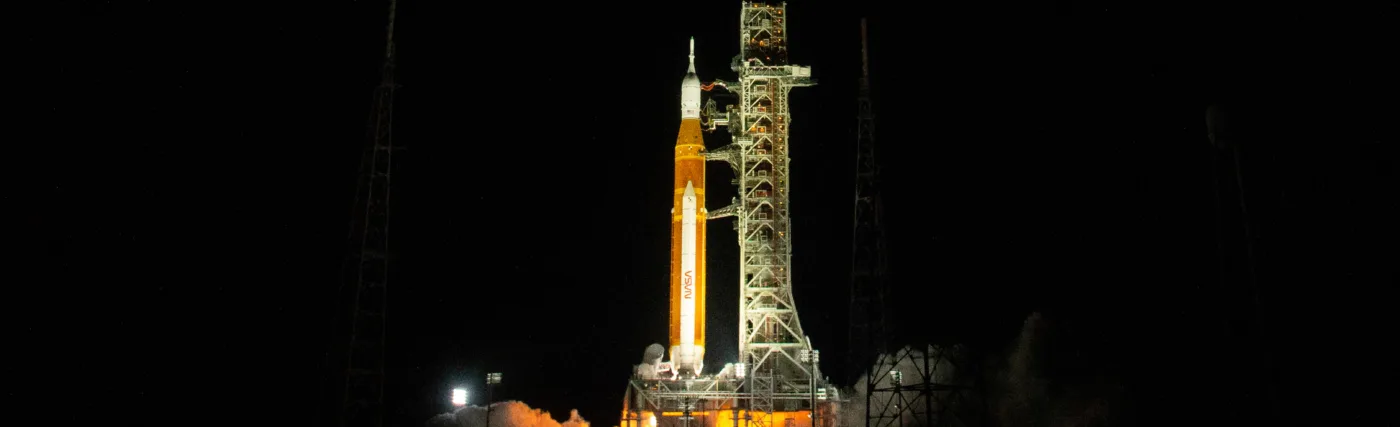
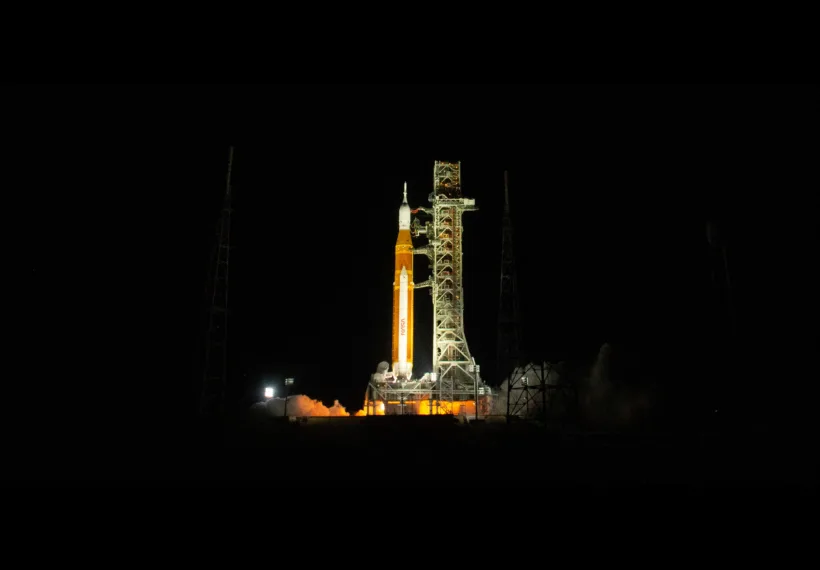
That’s why if you saw the launch of either the Apollo missions, if you’re old timer, or the recent Artemis missions, you see this huge rocket.
And right at the top is the Orion capsule, the service module and the capsule.
It’s way, it’s the little thing at the top.
And everything else is fuel, because that has to go not only to Earth orbit, but to the moon and back.
And the astronauts are the payload plus whatever the hell else they’ve taken up there.
So the rocket equation, you need calculus to do that correctly.
So a more realistic calculation would be 10 pounds of fuel for one pound in orbit, a payload, right?
That’s more realistic.
So now two pounds is, you need 10 pounds for that extra pound of fuel plus 10 pounds of fuel for the 10 pounds of fuel that got the other pound of fuel.
So it is crazy.
It’s completely crazy.
Okay, so now here’s an interesting fact.
Okay, when you burn your gasoline, okay, how does it turn into energy?
You remember?
There’s a small spark.
It turns into an explosion.
It pushes a piston.
It’s a spark.
Right.
Correct.
And the explosion is the gasoline plus what?
They infuse it with air or something.
Like it becomes a fuel.
Air, air.
And what’s in the air?
Oxygen.
Yeah, yeah.
So the air, what’s in the air?
Oxygen, thank you.
So you have gasoline plus oxygen makes energy.
Okay?
When it burns.
You got the oxygen for free.
It’s just sitting there in the air.
Right.
If I have a rocket, I want it to leave the air.
If I’m leaving the air, I don’t have oxygen.
Oh no.
I have to bring the oxygen with me.
Oh, this is getting more expensive all the time.
So here you go.
So do you remember the Artemis and the space shuttle has two solid rocket boosters on the side?
The two boosters and then it releases them.
Right.
Those two boosters burn air with their mixture when the rocket gets high enough.
They’re done.
We can’t have them trying to work where there’s little air because what’s the point of that?
So you get to use the free air to launch the rocket at its lowest level through the atmosphere where there’s plenty of oxygen.
Then they drop away.
And anything that happens after that needs its own oxidizer and the fuel tanks that not only started burning at the base on the launch pad, but continue in orbit is the larger tank that has two tank containers.
One of them holds hydrogen, the other holds oxygen.
And the hydrogen tank is twice as big as the oxygen tank.
So when I mix them, what’s the mixture?
That sounds a little bit…
Sounds a little bit like H2O.
Oh, well, yes.
So when I mix hydrogen and oxygen, it is highly exothermic, meaning it releases tons of energy.
And the exhaust is water.
Oh, wow.
So we have this incredible propellant that the byproduct is water.
Yes.
Why doesn’t everything run on that?
I love the gears are going in Chuck’s head.
I’m just saying.
There isn’t hydrogen just laying around, okay?
But it’s everywhere in water, but pure hydrogen is just so you have to get the hydrogen.
So you’re going to get it from the water to begin with.
And guess how much energy it takes to separate the H2 from the O?
So the energy it takes to separate the hydrogen oxygen is slightly more than you’re going to get back by recombining the hydrogen and the oxygen.
I see.
Yeah.
So it’s not quite an equal thing, but that’s how you get your hydrogen fuel.
It sucks.
And where are you going to get that energy from?
Is it an oil plant or whatever?
You can use solar power to do that, by the way.
But I’m just saying, there’s no such thing as a free lunch.
Wow.
So, and by the way, they use liquid hydrogen and liquid oxygen because it’s much denser.
You get way more fuel than if it’s just gaseous hydrogen and gaseous oxygen.
But liquid hydrogen is liquid at like four, I forgot the number, but low single digit Kelvin temperature.
Oh, wow.
Okay.
We got a whole other explainer on Kelvin.
Low single digits.
So the whole thing is chilled.
And that’s why you look at some launch videos of the Saturn V rocket.
You see this ice rolling up the sides?
Yes.
It’s Florida.
Where the hell’s the ice come from?
Because this stuff is cold.
All right?
Keeping liquid oxygen and liquid hydrogen.
So that when they combine, you have the maximum number of molecules to do it, get the maximum amount of exothermic reaction, and you get the maximum thrust.
And according to Newton, you cannot move forward unless you spew something else back out the other side.
Normally, for me, it’s hatred.
Yeah.
I’m glad you said that instead of flatulence.
Otherwise, you could have grabbed that.
That was my first thought, but I was like, let’s go a little deeper.
That was your first thought, right?
I was like, let’s go a little deeper.
Let’s get, let’s be a little more mature, yeah, okay.
So the point is, unless you have friction to help propel you forward, if you’re just trying to move through the space or through the air, something has to come out the back so that you propel forward.
For every action, there’s an equal and opposite reaction.
And that’s why you have this huge plume coming out the other side.
And so that’s the Rockets 101 for you.
That’s very cool.
Very cool.
And all that began like in the early 20th century.
So the Russian who did this early 20th century is Tsiolkovsky.
I always mangled the name.
Tsiolkovsky.
There we go.
I think I did that right.
He first wrote down the rocket equation and Russia didn’t look back.
And so the Russians had the rocket equation.
They had Sputnik.
They had Leica, the first mammal.
They had the first astronaut.
So they beat us at everything except for landing on the moon.
You know, that’s-
So we land on the moon, say we win.
They beat us at everything else.
All right.
So this has been another StarTalk, Things You Thought You Knew edition.
I thank my co-host, Chuck.
Always a pleasure.
I’m Neil deGrasse Tyson.
As always, I bid you to keep looking up.
Come on.

 Become a Patron