


 Unlock with Patreon
About This Episode
Are we rethinking the Big Bang? On this episode, Neil deGrasse Tyson and comic co-host Chuck Nice explore features of the James Webb Space Telescope, magnetism and how the aurora borealis works, and if the Big Bang is being debunked.
Learn how the JWST is more than just its pictures. What bands of the electromagnetic spectrum can the it see in? Find out about William Herschel and his discovery of infrared light. How does the JWST avoid detecting itself? Learn about features to keep the JWST cool and infrared-free.
Will Earth’s poles flip? We discuss Earth’s precession (wobble), bob, and flip. Learn about the magnetic poles. Does your compass actually point to the magnetic north pole? Are the north pole and the magnetic north pole the same thing? Why do we even have a magnetic field? Discover Earth’s molten core, creating a dynamo, and why dead planets like Mars don’t have one. How often do Earth’s magnetic poles flip? Find out what magnets and aurora borealis have to do with each other. Will something bad happen if the poles do flip?
We explore the frontier of scientific research and what ideas are being contested. We walk through the scientific process and experimentations. What are the core tenets of the Big Bang Theory? Could the Big Bang just be a small piece of a bigger theory? Learn about Vulcan, the hypothetical planet pulling on Mercury that was invented to save Newton’s Laws. When Einstein’s relativity came along, why didn’t Newtonian physics go away? All that and more on another episode of StarTalk!
NOTE: StarTalk+ Patrons can watch or listen to this entire episode commercial-free.
Transcript
DOWNLOAD SRTWelcome to StarTalk, your place in the universe where science and pop culture collide.
StarTalk begins right now.
Check.
Yes, what’s up?
It’s time for a Things You Thought You Knew.
Well, right on.
Episode of StarTalk.
Or if we actually said it from my perspective, stuff you’re about to learn.
Stuff you never knew.
Yeah, because you know damn well you didn’t know it before.
There was no way you thought you knew.
So now it’s just stuff you’re about to learn.
We have three whole segments, and each one is fresh and different of things you thought you knew.
So let’s start.
Okay.
There’s a feature of the James Webb Space Telescope that I haven’t seen talked about much.
People only just think of it as some next big telescope that’s out there in space, bringing us badass images.
But there’s certain engineering scientific features that are unique with it that I think are worth calling out.
That sounds good.
If you can hang with me on this.
All right.
Allow me to remind us that unlike Hubble, which orbited Earth 360 miles up, this thing is parked a million miles away in the opposite direction of the Sun from the Earth.
It’s pretty wild.
Yeah.
And so I say parked.
We’re all, it and the Earth are orbiting the Sun together.
And so basically, if you look back in the Earth direction, the Sun will always be there.
So it’s using the Earth as sunblock.
Well, it has some motion where it is, okay?
But it’s not going to drift away from that location, even though there’s some movement within the location.
The point is, occasionally Earth will block the Sun.
But the value of this is, you always know which way the Sun is.
Right.
At all times.
Got you.
It’s behind you.
All right.
The only way to take good pictures and know what they say.
Good one.
Yeah, that’s true.
That’s right.
That’s right.
So that everyone is squinting as they look in the camera.
Right.
That’s funny.
So, by the way, when I was a kid, home movies had these really bright lights.
Yeah.
All right.
And you could barely open your eyes when they were doing this.
You know why the lights are so bright?
You know why?
Because the film wasn’t that sensitive.
You know, if you took a photo just with a regular handheld camera, you can adjust the exposure to let more light come in and then properly expose the film.
But in video, going however many frames a second, every frame is its own photo.
And you need enough light in that fraction of a second to create the image.
So, when you come indoors, you have to bring out the floodlights.
And for the old timers, we’ll remember this.
The young folks will say, Daddy, what the hell have you done?
What?
Exactly.
Did we not pay the electric bill again?
So, but in there is some wisdom because what it says is, if you’re going to take a picture of something that’s dim, you either have to illuminate it yourself, which we really can’t do for the early universe that doesn’t work, or you can take a long exposure to allow the light to accumulate.
But while you’re taking that long exposure, you can’t jiggle the camera.
It has to be perfectly stationary.
We can’t take a flash picture of the outer universe.
So we have to open the exposure for a long time.
Okay, so now watch.
Different bands of the electromagnetic spectrum tell us different things about the universe.
So if you’re going to do that, you need telescopes that specialize in the chosen band.
And by the way, we didn’t even know light came in bands other than visible light.
Somebody had to discover that.
Just think about it.
Why would you have any inkling?
Why would you believe at all that there was a kind of light out there that your eyes could not detect?
Especially if you’re religious.
If you’re religious, what?
God made humans and we have eyeballs to see light.
And how could there possibly be something we can’t see?
So there’s certain expectations of who and what we are as a life form that were completely overrun the day infrared light was discovered.
Did I tell you how we discovered infrared?
Did William Herschel discover it?
Okay, never mind.
Tell the story.
Okay, real quick.
I was thinking of something else.
I’m like, okay, wait a minute.
So William Herschel discovered it.
And how did he do it?
He knew that Isaac Newton figured out that white light is composed of colors.
He just passed it through a prism and it breaks it apart.
So he repeated this experiment.
You put a little slit of light in your room, but the whole room has to be dark so that only the spectrum shows up.
And you pass it through a triangle prism.
You get a rainbow on your table.
And there it is.
Red, orange, yellow, green, blue, violet.
And he had the foresight to ask the question, I wonder if the different colors of light have different temperatures?
Just to even ask that question.
It’s a pretty impressive question.
Think about that.
A simple question may be retrospectively obvious, but at the time, what does he do?
He has a thermometer and puts it in each of the different colors of light.
But wait a minute, you need a control thermometer.
So he took his control thermometer, put it off to the side, just to the side of the red.
So that was not in the spectrum.
And that would presumably just measure room temperature.
But it was still on the table where he was measuring the rest of the temperature.
Your control has to have a minimum of variation other than the one thing you want to change.
So the thermometer is on the table, but just off to the side.
And so there he is, he’s measuring the temperature of blue and red and yellow.
And what he’s finding is that the thermometer off to the side is consistently measuring higher temperature than all the rest of the thermometers.
All the rest of the readings that he was taking.
And he said, WTF!
I’m sure that’s what he said, okay?
Yes, exactly.
I am sure.
And right after that he went, OMG!
Alright, so he publishes this paper.
And it’s just, it’s beautiful in how he’s tiptoeing around a discovery because he doesn’t really know.
He said, could there be light that is unfit for vision?
Unfit for vision.
This is how he described it.
That’s a great description.
And he does this enough and he says, I think I’ve discovered light unfit for vision.
You’re damn right you did.
And it’s light below the red and what do we call it?
Infrared.
And it’s so funny.
You still see the hubris of human existence there.
It’s unfit for vision, not we can’t see it.
We blind to this thing.
It’s got the problem.
It’s got the problem.
It’s unfit for vision.
I hadn’t thought about it that way.
Very good.
So, it turns out, so that’s just an interesting sort of discovery experiment.
And then we would learn, well, if that exists, maybe other bands of light exist.
And so, thus, thereafter, we would discover ultraviolet, microwaves, radio waves, X-rays, and they each have their moment in the sun, so to speak.
And that fills out the entire what we call electromagnetic spectrum.
Only a small fraction is visible light.
And so, now we’re going to say, what in the universe gives off infrared light?
And you find out that things that have kind of any temperature at all will radiate in the infrared, okay?
Now, so, for example, if you have an electric stove and you put it on low and turn out all the lights, can you see it?
No, not if it’s on low, but if you put your hand on it, you’ll burn your hand, okay?
Tell me about it.
Something is coming out of the stove and it’s not unfit for vision, right?
It’s infrared light, okay?
And when the thing gets hot enough, it’s not only giving off infrared, it’ll begin to also give off visible light, okay?
But if the thing is cool enough, it’s primarily only going to be giving you infrared.
Suppose you want to see infrared, all right?
And by the way, infrared doesn’t make it very nicely through Earth’s atmosphere.
You know how you know this?
Because we have greenhouse gases that trap the infrared that is down here, okay?
So the greenhouse effect are molecules that have a special relationship with infrared.
And there’s the ground trying to radiate infrared back into space.
It says, no, you don’t.
And it sends it back down and accumulates, okay?
So here’s the cool thing about the James Webb Telescope.
It has a special reflective surface on its mirrors that are tuned to reflect infrared with very high efficiency.
That’s number one, reflect and focus.
Number two, if you’re trying to detect something that is a very low temperature, what happens if you have a temperature and you’re the detector?
You end up detecting yourself.
Exactly.
You can’t have that.
I went searching for the universe and all I found was me.
So you need a way to cool the telescope.
So we can send up cryogenic liquids and things, but they would eventually evaporate or gain temperature.
So what we figured out to do, we, not I, the engineers who were tasked with this, that telescope has a series of thermal baffles between it and the sun.
All right.
And so those, just take a look at any photo of the full telescope deployed.
These, they’re basically screen.
They’re like sheets that are put up, a series of them in the row.
So sunlight comes and hits one of them.
It reflects some back.
Others get absorbed and gets retransmitted to the next sheet, but that gets re-sent back.
There’s this multiple, triple reflections.
And at each layer, the amount of heat from the sun is dramatically dropped.
Dramatically.
By the time it comes out, the other side is barely there at all.
And so the temperature of the telescope can now drop to what is basically the temperature of deep space, without any influence of sunlight increasing its body temperature, if you will.
That’s wild.
Totally wild.
So now the James Webb Space Telescope can observe deep in the infrared part of the spectrum.
That’s amazing.
Because it can.
Right.
And so there you have it.
A little primer on infrared and infrared telescopes and how that works.
Well, there you go, people.
I hope you’re paying attention because you’re going to be at a cocktail party where this is going to come in very, very handy.
I plan on using it this weekend.
I’m telling you right now.
What’s that skirt for on the outer edge of the telescope?
There it is.
I suppose you didn’t realize that there were baffles that actually filtered the sunlight in such a way that cools the telescope so that we’re able to register the infrared without out registering the heat from the telescope itself.
Yes, this is the kind of stuff you learn when you’re an extremely smart individual.
By the way, off with you.
That’s why you don’t have any friends left at your party.
All right, Chuck, we got to take a break.
But when we come back, more things you thought you knew on StarTalk.
Hi, I’m Chris Cohen from Hallworth, New Jersey, and I support StarTalk on Patreon.
Please enjoy this episode of StarTalk Radio with your and my favorite personal astrophysicist, Neil deGrasse Tyson.
Welcome back to Things You Thought You Knew.
I got a doozy for you here, Chuck.
Are you seated?
Are you ready?
I, you know, I am seated.
I know I’m short, Neil, but I am seated.
All right, here it goes.
So you might have heard intermittently every now and then that Earth’s poles will flip.
Have you ever heard, you’ve heard that, right?
I’ve heard people say it.
Well, thank you for clarifying that, right, right?
And clarifying that it’s not what is true, it’s what people say or think is true.
These are not always the same thing.
So, so, so it was especially bandied about when we were approaching not only the year 2000, but also the year 2012.
But every 10 years, people band together and want to declare that the world is about to end based on some cosmic force.
I’m intrigued.
I think that people need followers.
If you’re the one saying the world’s going to end and no one else is, people will think you have special knowledge and then you become sort of this guru of prognostication.
So, let me just make it clear that Earth’s rotation axis with Santa Claus at the top is not flipping.
That is a completely stable configuration.
We bob up and down a little bit, okay?
On our spinning axis, we not only precess, which is a fancy word for wobble, okay, we wobble, if you ever played with the top, if the top slows down, you see it wobble, but also we bob up and down, okay?
And they all happen on very different time scales, but none of them involve a flipping of Earth’s axis, north and south.
However, what does flip are the magnetic poles, the magnetic poles?
The magnetic poles.
Now, let me just nip something in the bud here, okay, just so you know.
You’re old enough to have probably used a compass in your life when you were a kid, right?
Okay, which way does the compass always point?
North is what they say.
Okay, that’s correct.
And it points to the north magnetic pole, all right?
Right.
Which, by the way, does not exactly align with Santa Claus, all right?
Okay.
By the way, there are things in the universe where it’s almost at 90 degrees to each other.
So there’s nothing specially…
It’s no cosmic prerequirement that they perfectly align in the spinning object, all right?
So in our case, they don’t align.
The north pole is sitting somewhere in northern Canada, all right?
So if you’re trying to find Santa Claus with a compass and you’re in northern Canada, you’re going to land in the wrong spot.
Just to be clear about that.
No wonder we can’t find him.
You didn’t get your presents this year.
You didn’t get your pony.
I can’t find the…
You’re going to pay what you owe, Santa.
All right.
So that thing that’s pointing there is the north pole of the compass needle.
The compass needle is itself a magnet with a north and a south pole.
Now, here’s a little known fact, okay?
What can you tell me about north and south poles of a magnet?
Take two magnets together.
What do they do?
Well, you know, they repel each other if it’s the same pole.
Which repels?
Which repels?
So north to north and south to south.
They each repel each other, right?
The like charges repel.
So wait a minute.
If the needle of a compass that says north on it points to the north pole, shouldn’t it be pointing in the opposite direction?
Right.
It should be repelled and pointing down.
Okay, except it’s not.
It’s attracted.
Which tells you that Earth’s south magnetic pole is in the north.
Because the north part of all book magnets point in that direction.
I just, I don’t even do that.
No, and you know, like, here’s the thing.
You already, what you did was you took the empirical and put it first.
And then you said the ridiculous thing afterwards.
So now what am I left to do?
I’m like, well, he already proved it.
So what am I going to do?
Like, yeah, it’s pre-approved.
I can’t be, I can’t say like, yeah, right, whatever, you know.
No, no, because you’re already with me on it.
Exactly.
I was like, yes, absolutely right.
Demonstrate this.
They don’t tell you that in the Boy Scouts.
No, they don’t.
That the earth’s south magnetic pole is in the north, which is why all north poles are magnets.
Point there.
Sorry, little Tommy, but you’re screwed.
Your compass is lying to you.
Your compass concept of reality is off by 180 degrees.
All right, so here’s what happens.
We have a magnetic field because our core is fluid.
All right, all the heavy stuff when earth was molten, the heavy stuff fell to the middle, and the heavy stuff is the iron, and the light stuff, which is the rocks, floated to the top, okay?
And we don’t think of rocks as light, but it’s much lighter than metal, all right?
And so all the metals, nearly all the metals went to the core.
Some got frozen in place as we have these ores, these veins of ores.
As earth is solidifying, it didn’t fall down fast enough, and it got frozen in place.
There are other occasions where volcanoes can redistribute material from below and put it up in the crust, but basically most of earth’s iron is in our core, and it’s hot, and so the iron is molten, and when you have molten and you’re spinning, you have moving, magnetically chargeable metals.
Iron is magnetizable.
When you have moving metal, you create what’s called a dynamo, and in a dynamo, you basically create a magnetic field from scratch.
That’s why old dead planets that have cooled do not have magnetic fields.
They don’t have magnetic fields.
Mars, no magnetic field to speak of.
Because it’s cooled faster than Earth did.
It’s smaller, so if you’re smaller, you will cool faster.
You don’t have this churning.
By the way, Mars once did, for sure.
Mars has the largest known volcano in the solar system.
Mars used to be hot in the inside, but that’s called Olympus Mons.
It makes our volcanoes look like molehills, by the way.
It’s huge.
Anyhow, the point I’m getting at here is the dynamo goes through cycles.
It goes stronger, then it goes weaker, and it flips.
And so every half million years or so, the magnetic field of Earth has flipped.
Period.
That’s pretty wild.
Yeah, it’s fascinating.
And while it’s flipping, it actually goes to zero and then recovers coming out the other side.
So then that makes me ask, what does the magnetic field of Earth do for Earth and do for us?
Other than give compasses a meaning in life?
Other than confused boy scouts who don’t understand that the compass should be pointing in the opposite direction.
Well, Einstein was quite intrigued by a compass that some mysterious force that you can’t see, touch, smell or taste is forcing the needle to move.
He was very intrigued by that as a child.
So I think we’d be thankful that we had compasses back.
If it was just GPS with a handheld device finding north, I think maybe Einstein would not, you know, he might have gone on to play basketball or something.
Who knows what career he might have had.
So that’s just the opposite of a Gary Larson comic.
That’s where I got that idea from.
There’s a picture of Einstein on a basketball court, like dribbling, right?
And it said, Albert Einstein in school was destined to be, you know, an all-star basketball player until an ankle injury sent him into his physics books.
So the point is that the magnetic field has flipped.
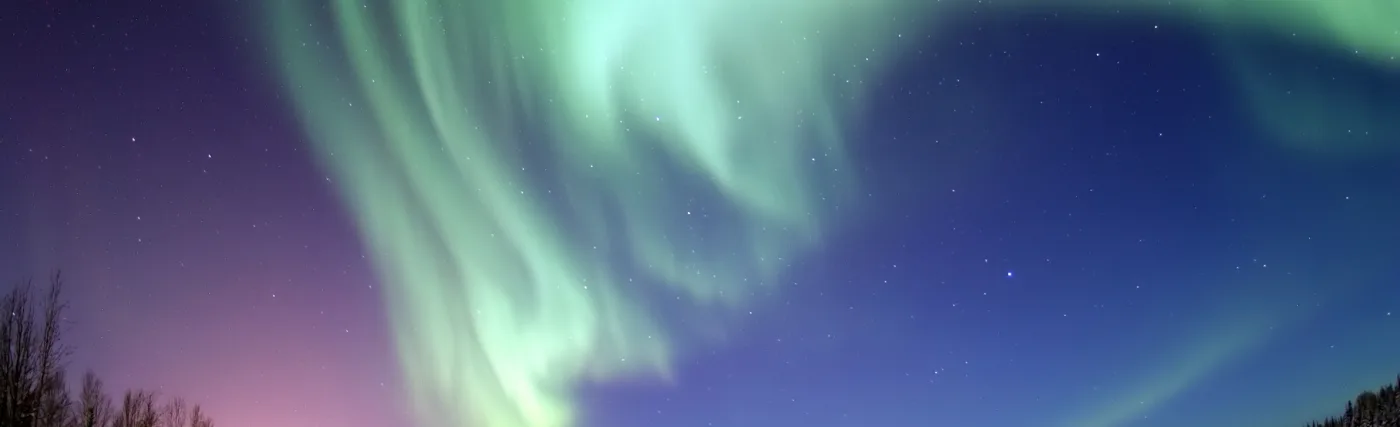
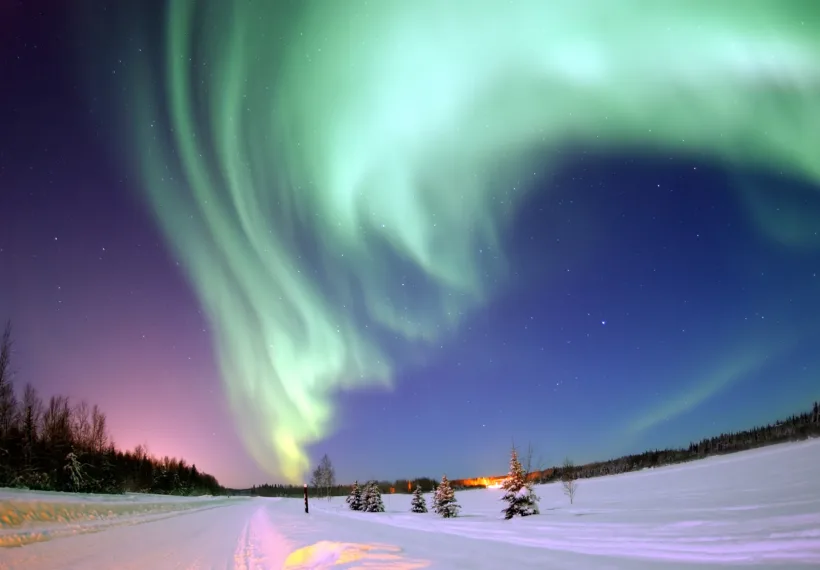
What the magnetic field does when it’s operating is it creates a magnetic shield around Earth, if you will, and when charged particles come from the Sun, the solar wind, we call it, they see this magnetic field and they spiral down towards the poles.
Uh-huh.
Over towards the magnetic poles.
And as they spiral down, they careen into air molecules.
And if you have two molecules that collide with each other, energy gets exchanged, okay?
So your energy of motion gets boosted into the energy inside the molecule itself.
So you’ve excited the molecule.
Then on its own timetable, like fractions of a second, it de-excites and then radiates visible light.
So, wait a minute, what is that?
Oh, I know what that is.
That’s the aurora.
That’s pretty wild.
The aurora borealis that’s in the north.
And take a gander of what it’s called in the south.
Let me see.
The southern aurora borealis.
You know, I’m okay with that.
The aurora australis.
The aurora australis.
The aurora australis.
Because it’s symmetric, right?
We have a north pole and a south pole.
So we make a big deal of our own aurora because 90% of the human population of the world lives north of the equator.
So we get aurora.
So there it is.
And we know the field is flipped.
You know why?
Because you can see volcanic plains where iron came out and the iron aligned with the magnetic field when it froze in place.
And you compare this from different generations of volcanic eruptions.
And you can see the flipping of the orientation of the iron particles.
That is…
It’s remarkable.
That is really outstanding.
That’s pretty wild because, yeah, it’s a magnet.
So it’s metal and a magnet and it’s actually…
It’s doing its thing.
succumbing to the properties of magnetism.
Correct.
Correct.
And if Earth is helping that out, it’s going to align them when it freezes out of the volcanic flow.
So, yeah, no, it’s pretty cool stuff.
And it all comes together.
And by the way, this involved astrophysicists and geologists.
Plus, there was a worry if we don’t have a magnetic field.
That means the charged particles come straight into us and don’t get directed to the poles.
Would that be bad for life on Earth?
So it might be.
You might think it would be.
But there are no particularly striking extinction episodes at the times when these…
When it flips and it goes to zero.
Yeah, there’s no…
By the way, animals are going extinct all the time, especially now because humans have their hands in this process.
We’re told it’s the sixth extinction, really.
So, yeah, that’s in case you didn’t know that your compass points south.
That’s great.
Chuck, we’ve got to take a quick break, but when we come back, more Things You Thought You Knew on StarTalk.
Chuck, we’re back.
Yes.
Things you thought you knew.
Alright, so I got something for you.
So, it’s not so much a thing you thought you knew, but it’s, I have to address something.
I think we’ve seen in the news, you know, every six months goes by, and then you see a headline, oh, astrophysicists have to rethink the Big Bang, or Big Bang debunked, or…
Did you see any of these at any time?
Well, recently, the James Webb Space Telescope, supposedly the headline is, did the James Webb Telescope make scientists think the Big Bang, or has the James Webb Telescope debunked the Big Bang?
Yeah, it makes an excellent clickbait.
There it is.
It’s a clickbait headline.
So let me just explain a few things that’s going on here, okay?
On the frontier of scientific research, it is a bloody place, right?
Ideas are slain.
Two scientists enter.
One scientist leaves.
It’s the octagon.
Welcome to Science Dome.
On the frontier, ideas are contested daily.
And most ideas turn out to be wrong, all right?
So what you are as a scientist working on the frontier, you’re in this idea factory.
That’s what you are.
And you want to…
The successful idea is not the one that’s argued most strenuously or argued by the most articulate.
Yeah, that’s called politics.
That’s called politics.
Exactly, exactly.
It has nothing to do with either of those.
It has to do with evidence.
Which idea is supported by evidence?
So typically what happens is you can test your ideas.
And here’s what you have to be convincing.
You have to say, I think my idea is better than your idea.
And here’s a way to test it.
So I have an idea.
So if you don’t like me, the way you show it is you design an experiment to show I’m wrong.
Oh, that’s some cutthroat nasty stuff right there.
It’s nasty.
That’s some real housewives stuff.
Real housewives stuff.
Let me tell you something, Phaedra.
Your hypothesis is trash.
You don’t like me and you’re going to show me that I’m wrong.
And so you go home and you invent an experiment.
You invent an experiment to test my idea.
Right.
With the objective of showing that I’m wrong.
And it turns out, hey, wait a minute.
I’m getting what the dude says.
Right.
You got to publish that.
I’m picking up what you’re putting down.
And someone else performs another kind of experiment aimed at testing the same hypothesis.
And they get kind of the same result.
And then someone from a different country with a different wall current, 240 volts maybe, and they plug their stuff in, and they’re getting the same result.
When you have repeated experiments verifying an idea, we have a new objective truth that has emerged in those sciences.
Right.
And what I’m telling you is that the Big Bang Theory, by the way, if you type that into Google, you get the TV show.
My personal jury is still out on whether that’s a good or bad thing.
Science is so popular, it’s a TV show, and it’s the first thing you hit, because you got to get through that, then the Big Bang is a K-pop group.
You got to get through that, then you get to the origin of the universe.
I just thought I’d point that out.
Well, it’s good to know that we Google in order of importance.
There it is.
Just saying.
So, here’s the point.
The tenets of the Big Bang, that the universe started out small, hot, dense, where matter and energy were a primordial soup, where the forces of nature had merged, all of that is thoroughly supported by observations of this universe.
Thoroughly supported.
Okay?
Now, there’s some things that, well, did this really cause that?
Or might it be something that we don’t know about yet?
And who ordered up the dark matter?
We don’t know where that came from.
And where’s this expansion?
We don’t know where that came from.
But we can describe it.
And we can measure it.
Here’s the point.
If tomorrow you have a new idea about how the universe works, it’s going to enclose everything we’ve been talking about up to that moment that has been experimentally and observationally verified.
You can enclose it in something deeper.
You can say, wait, I have an idea.
Our universe is just one in a multiverse.
Fine, okay, but our universe would have started with a big bang, okay?
And our universe would have expanded from a dense, hot state and has been cooling ever since.
That’s observed and that’s real and that’s not going away.
That’s my point.
So what you have are journalists trying to make clickbait, and if there’s some little thing in the early universe that is still on the frontier, still being contested in the octagon, in the fight dome, and some new idea is emerging over another idea, people say, oh, Big Bang is in trouble, so I just go back to the drawing, but Big Bang is not in trouble.
I’m just saying, it’s not in trouble.
It is a whole thing that could conceivably fit in a deeper, bigger idea.
But it’s not going to be swapped out tomorrow.
We’re not going to find out tomorrow.
Gee, the early universe was cold instead of hot.
That’s not going to happen.
That’s not how science works.
Right, right.
So if you’re going to come up with something new, you’re not coming up with something that will change the old.
The old that has been experimentally verified.
That’s dumb.
If you’re going to come up with something new about the Earth and the Sun, it’s not going to be, well, it’s really Earth is stationary and the Sun moves around the Earth and the Sun is cold and Earth is hot and Earth is what’s illuminating the Moon.
That is not going to happen.
Right, right, right.
You can’t just pull an idea out of your orifice and ignore experimental verification of what’s going on.
Right.
So you might come up with the Big Fang, but you’re not changing the Big Bang.
Well, what’s the Big Fang?
I get a C plus on that one.
It’s what came before the Big Fang.
We call it the Big Fang.
The Big Fang.
Okay, that’s a B plus.
What’s your thang?
Yeah, it was before the Big Bang.
And by the way, when we think of Einsteinian physics, so it’s relativity, which completely usurped Newtonian gravity and Newtonian motion, what we call the era of classical physics, which led right up to the late 1800s, Newton’s ideas reign supreme.
And he told you what gravity did, what motion did in acceleration in a pre-existing space, and it was working.
It was working.
And then people said, well, wait a minute.
The orbit of Mercury is not really following Newton’s laws.
And we said, oh, we got this.
We know we got this.
There’s another planet you can’t see that’s tugging on it.
We even had a name for that planet.
It was called Vulcan.
A hypothetical planet tugging on Mercury so that we didn’t have to throw out Newton’s laws.
So that was invoked.
We just pulled that out of our ass.
Said, there it is.
We’ll find it one day.
Einstein comes along with a special theory of relativity, and that is general theory of relativity.
And what we find is that at high gravity, like near the sun, and at high speeds, at high gravity and high speeds, Newton’s laws completely fail.
You cannot use them at all.
So, do we say, did we throw away Newton?
No, we didn’t.
You know why?
Because if you take Einstein’s equations and plug in low speeds and low gravity, they become Newton’s equations.
Yes.
So, Einstein basically enclosed Newton’s ideas as a special low speed, low gravity case of a much larger, deeper understanding of the universe.
That is fantastic.
It is beautiful.
And so, and by the way, Newton’s gravity and Newton’s motion were just fine for the Apollo project.
Right.
We got to the moon and back without any Einstein relativity at all.
So, it’s only if you really up the stakes in your gravity.
There’s no way to understand black holes, really, or even the Big Bang itself, with just Newtonian physics.
Point is, new physics does not undo experimentally verified physics.
That’s the whole point of experimental verification.
That’s all.
Look at that.
And so, the Big Bang is just fine.
You want to do something else with it?
Take it body and soul and stick it in some other theory you have.
But you can’t undo what the experiments and observations have shown.
Alright, Chuck, that’s three things you thought you knew.
Yeah.
One right after another.
And now I know.
What?
Now I know.
I thought I knew and now I know.
You were blind, now you see.
Again, I don’t know how many I got left.
We might have to change the format or something.
If I run out, then you’re done with me.
No, then it’s things you thought you knew, but now you’ve got to know again.
No, things you thought you knew, but then you did know, but now you forgot.
Right.
Things you forgot.
Things you forgot.
Things I told you and you forgot.
How many times I got to tell you?
Chuck, thank you for re-birthing this format.
How many times I got to tell you?
That’s not what your mama told you that.
You know that’s exactly where it came from.
All right.
This has been StarTalk.
Things you thought you knew.
Neil deGrasse Tyson, keep looking up.
 Become a Patron