In the nascent days of navigation there was only one way to know where you were going – by letting nature guide you. On this episode of StarTalk Radio, Neil deGrasse Tyson sits down with master navigator Nainoa Thompson, comic co-host Maeve Higgins, and navigation expert Frank Reed to discover more about celestial navigation. Nainoa has sailed from Hawaii to Tahiti, around 2,400 miles, in Hōkūleʻa, a replica of an ancient Polynesian voyaging canoe, devoid of any modern technology. Find out how he uses the stars and many other factors of nature including the sun, the ocean, and seabirds to help him find his way. Nainoa tells us what the easiest part of navigation is and explains how he over-prepared for his first voyage. Learn all about sextants and why the Apollo space missions carried sextants aboard their spacecraft. Frank explains why people bother to do this type of navigation in modern times even though it’s outdated. You’ll hear about the hit Disney film Moana as we discuss what they got right about navigation. Author Dava Sobel stops by to discuss the “longitude problem” – a challenge that plagued 18th century sailors and their voyages – and how it was eventually solved thanks to a competition and a big reward. Primatologist and StarTalk All-Stars host Natalia Reagan also stops by to help us understand that our urge to explore has been with us since we could stand upright. We also examine the extremely difficult situations that occur with celestial navigation, like what do you do when the sun is up? How do you deal with the longitude problem? How do you keep everything straight in your head? Maeve helps us answer some fan-submitted Cosmic Queries about navigation at the speed of light, how the spacecraft Voyager navigated, and what happens if you’re lost in space…could you find your way back to Earth? Frank also shares the odd method European sailors would use in order to find out if they were close to the English Channel. All that, plus, we learn why “wayfinding” is a better word than navigation and Neil sends us off to sea with thoughts from the cosmic perspective.
Transcript
DOWNLOAD SRT
Welcome to StarTalk, your place in the universe where science and pop culture collide. StarTalk begins right now. Welcome to the hall of the universe. I'm your host, Neil deGrasse Tyson, your personal astrophysicist, and tonight, we explore the science...
Welcome to StarTalk, your place in the universe where science and pop culture collide.
StarTalk begins right now.
Welcome to the hall of the universe.
I'm your host, Neil deGrasse Tyson, your personal astrophysicist, and tonight, we explore the science of celestial navigation through the legacy of the great Polynesian wayfinders.
And they're the ones who use the stars above to explore the vast Pacific Ocean over a thousand years ago.
So let's do this.
Maeve, you're a host of a podcast, Maeve in America.
Yep.
And I was honored to be a guest on your podcast.
You were a wonderful guest.
How did that episode go?
Is it okay?
It was one of the lower-ranging ones, but I appreciate the effort.
On this topic of celestial navigation, I know a little bit about it because it just uses the sky, but I would not call myself an expert.
We comb the land for an expert on this, and we have Frank Reed.
Frank, welcome.
So, you're the only one in town who can declare they're an expert in celestial navigation.
Yes.
But you teach it.
Who wants to learn it if you teach it?
There's lots of different kinds of folks that want to learn it.
I mean, there are people that just want to learn about history and astronomy and math, what we might call, you know, astronomy nerds.
Okay.
And you're the man for that?
I'm the man.
Very good.
So, we're relying heavily on your expertise tonight.
And so, we're featuring my interview tonight with master navigator, Nainoa Thompson.
Nainoa Thompson, an ocean voyager who used the traditional Polynesian methods of non-instrument navigating.
And what Nainoa does is reinvent some of the great voyages that we know his ancestors had taken in their exploration of the Pacific.
He limits himself to only the traditional tools and methods that his ancestors invoked.
And so, I asked him about the first voyage that he led from Hawaii to Tahiti.
And that happened back in 1980.
Let's check it out.
I was on a, what we call a Polynesian replica of a deep sea voyaging canoe.
That from Hawaii to Tahiti, Tahiti is our ancestral homeland.
The voyage is about 2,400 miles.
Primarily.
What's the width of the continental United States?
Exactly.
2,400 miles.
Exactly.
You use the word canoe.
And, you know, my naive sense of a canoe is it holds three people and it's tipsy.
And so, do I need to modify my usage of the word in this context?
Maybe I'll use the Hawaiian word.
It's called va'a.
Va'a means the equivalent to canoe.
Kaulua means two, two house.
The va'a kaulua really was the first cataract.
But are there beds?
I mean, people are sleeping, eating, cooking.
The va'a is 62 feet long, Hokule'a.
It's 20 feet wide.
It's big.
It's powered by two big sails.
And if you imagine the first voyage that came from Tahiti to Hawaii that traveled those 2,400 miles 2,000 years ago.
Arguably it might have been the greatest feat of navigation and exploration of its time.
So, Frank, these Polynesian voyages, I mean, the Pacific Ocean is vast.
It's the vastest thing on Earth.
Yeah, yeah.
It's not only pretty big, it's like the biggest thing on Earth, right?
So how does that compare with the European voyages that they took to the New World?
Much much later, obviously.
Well, you know, we can look at voyages that might have been nearly contemporaneous, which is of course the Norse, the people we think is the Vikings, were crossing the Atlantic circa 1000 AD.
And this is...
What were they using for their navigation?
Those helmets?
Because you know they didn't have compasses, they didn't have telescopes, they didn't have sextants, presumably they didn't have maps.
If you're going where no one has gone before, you don't have a map of where you're going.
So it's hard for any of us in modern times to even think of what it means to navigate without these tools.
Right, it was a lot riskier, you know.
Modern scientific navigation, what it did was it made navigation a whole lot safer and a lot more efficient economically, which is really one of the big things that we're looking at.
But modern navigators are not the people who discovered how to cross oceans.
Crossing oceans just took some guts.
Did they know they were going to Tahiti?
Or were they just like, let's see.
If you don't know where you're going, and this vast ocean.
This is the giant question.
Was it deliberate or was it accidental?
And of course, you know, there was this guy, David Lewis, who wrote We the Navigators about 45 years ago, and he gets it right away, which is, hey, it's 3,000 years.
Undoubtedly, both of these things happened.
There were accidental voyages and there were intentional voyages.
Plus, there's no record of all the voyages where they never found their destination nor ever came back.
So, I asked Nainoa Thompson how his ancestors were able to navigate so well by the stars.
So, let's check it out.
So you guys must have known the stars really well.
And I mean, I use my tools to remind me where they rise and set and where to expect them.
But if you don't have the tools, then it's in you somehow.
And then you navigate with them.
So, how do you do that?
I mean, one issue is to even be able to identify and pick out stars and memorize that it's a specific star, it's an identification.
Right, because a star isolated is nothing.
There's a context, a pattern that you have to, so pattern recognition matters.
Right.
But because you can find the star in the sky, it doesn't tell you anything about navigation.
You need to know primarily where it rises and sets.
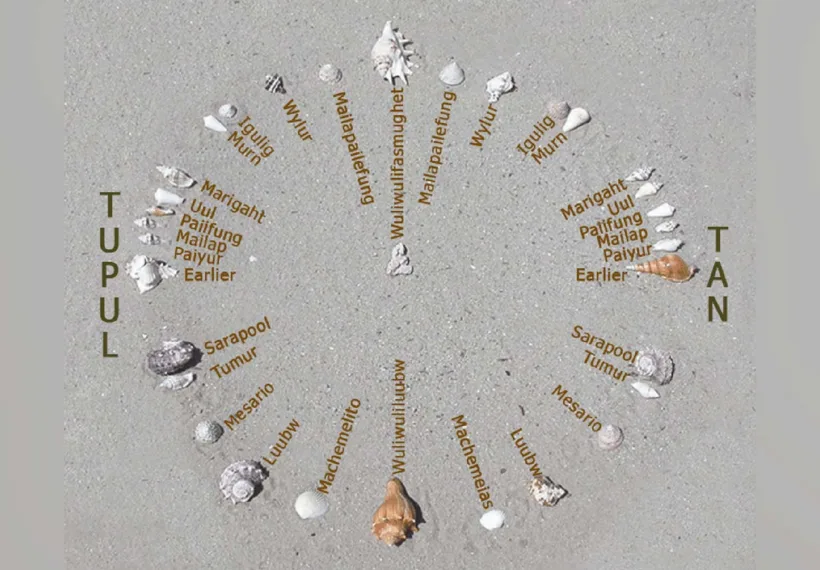
And so, there is this mental construct called the star compass.
Star compass, I like that.
It's as if you're a satellite looking down at the ocean's horizon, and there's a canoe in the center of this big circle, and in the circle is that, that circle, that is...
I got the circle.
All right, here we go.
And it's divided into 32 star houses.
Maybe north is here, south is here, east is here, west is there, and there's seven star houses in each quadrant.
And so, let's say this is the eastern horizon, so you can take a star and identify it, but you need to know what star house it is, like, Mentaka, in Orion's belt, rises due east, comes across the sky and sets due west, or any of the stars.
Right, okay.
So, you've split the perimeter, the horizon, into these places.
If you can identify the star, and if you know what star house it rises and in, you can hold direction.
So, if you want to go east, you go straight towards Mentaka.
That would be easy, right, okay.
If you want to go west, you go straight away from Mentaka.
And any place in between, you know the rest of the stars to make that happen.
Exactly.
And we line them up on pieces of wood on the canoe.
There's actually a canoe compass that is on the deck that makes the 32 houses.
So we actually, if you have a star compass, we're turning the canoe compass in the star compass and lining up different stars of different parts of the canoe to hold the desired heading.
So Frank, do you keep stars in your head?
Yeah.
And you do, too, you know.
I do, but not just because I, just because it's fun, not because I need it to not die.
Right, right, right.
But it's a pattern recognition thing, you know.
You can see patterns and they pop right out at you.
You know when the stars are right and when they're wrong.
If you saw a movie and it…
What does that mean, wrong stars?
Oh, you know, if it was like the last scene of a movie when, you know, say somebody is sinking under the waves…
Oh, the Titanic.
Yeah.
You recognized that right off the top of your head, didn't you?
I call that out.
James Cameron did not have the correct sky over the sinking Titanic in his movie.
Is that what you noticed when Jack was drowning?
It was all I could think of when that was happening.
So that's why you were crying when everybody else was like, da!
Yeah, I was…
Look, some of us were multitasking, okay?
Yeah, thank you.
I was multitasking.
Yeah, so you're right.
So I did catch it.
I caught that it was wrong.
And I saw that it was wrong in a second, too, because I know the sky this way.
It's a pattern matching thing, you know?
I can see it.
I can pattern recognize it.
So in addition to the patterns, what tools do you use?
For celestial navigation, we use sextants.
And we're measuring the altitudes of the stars above the horizon.
OK, so you're comfortable with a sextant.
So I pull this from my office.
Yeah, sure.
This is a vintage sextant.
Yeah, it's actually a quintant, which makes it even more rare.
It's quite exotic.
But yeah, it's perfectly fine to call them all sextants.
You're saying this is one fifth of a circle, not one sixth.
A sext would be a sixth.
I never knew that about my own sextant.
It's not a sextant.
Apparently, it's a quintant.
It's one up.
It's not one down.
Oh, it's better.
Yes, yes, yes.
Wait, so what is it?
It's like little mirrors and little telescopes and...
It's two mirrors that let you look in two different directions at once.
So what this device does...
That would make it for makeup, you know.
You could see the back.
It lets you superimpose two different directions.
So you can look in two directions at once.
So you can see the sun up in the sky and the horizon out in front of you.
And what you do is you line up these two different views.
And when they're lined up just so, you can read off the angle between them from the scale at the bottom of the instrument.
What does it mean that Apollo had a sextant?
I read about this.
I didn't believe it.
It was a combination of not believing it and not understanding why.
So they built a sextant right into the hull of the command module of the Apollo spacecraft.
And it was a real sextant.
And it was coupled directly to that really spectacular computer that they had aboard with its 12K of RAM, which sounds crazy to us.
But it was a really powerful...
Well, see, we have more computing power in that, and we don't know how to get to the moon anymore.
So we've regressed as far as I can tell.
How much is 12K?
It's like a...
It is the size of one of your emails.
You can't imagine how small it is.
You can't imagine.
So that and then a sextant.
It's a fraction of the size of one of your emails.
So what would they use it for?
So this sextant that they had aboard the Apollo spacecraft, they originally thought that they were going to navigate at least back from the moon using the sextant.
Because you know what they were worried about?
They thought that the Russians might try to jam the navigation on the way.
See, there was the height of the Cold War when this thing was built.
The sextant and the computer were designed right at the beginning.
And were they worried because the stars would look different up there?
Like, even if they had, like, those star maps in their minds?
If you're, like, on the moon, wouldn't they...
No, no, you're not that far away.
Oh, you're not far enough.
Yeah, I mean, the stars are so far away compared to the Earth-Moon system.
You go to the moon, it's not, it's not, no.
Really?
And you still need to measure it to get...
But what they originally thought was that they were going to determine their position using this sextant.
They were going to fix where they were in space, how far they were from the moon, on what vector and all that.
So, today, this is obsolete.
Is there any reason for anyone to still know how to use this?
Sure, you can buy a brand new one on...
Right tomorrow.
I mean, they still sell them retail.
Why would anyone...
I can...
Who...
Why?
First of all...
So, you pull this out, and you're flipping mirrors and looking on the horizon and hoping it's not cloudy out, and you're hoping it's at night so that there's a star to look at.
And I pull out...
I say, Siri, where am I?
Yeah.
Yeah, that's fine.
Now...
OK, OK, OK.
What's the best backup to a GPS?
Suppose I don't need a backup.
What's the best backup to a GPS?
What's the best backup to a car?
Maeve.
Is it a horse?
No!
You gave up on horses 100 years ago.
Exactly.
There's a point where you give up on the old stuff.
This is exactly where I'm going.
What's the best backup to your car?
It's your wife's car, right?
So, the best backup to a GPS is another GPS.
And what's the best backup to that second GPS?
A third GPS.
Using celestial navigation today isn't about backing up.
It's about double checking.
It's about sanity checking.
So, one of the most important things that you can do with celestial navigation is you can validate that the GPS is providing real information.
There are two ways that it might not be.
I mean, not from your cell phone.
Your cell phone is going to be right.
But suppose you're a mariner at sea.
Now, there's these guys called pirates.
And these days, the pirates are technologically sophisticated.
So, what if they're feeding false GPS signals into the airwaves?
Yes.
It seems to me, if they're that smart, they can find another way to make money than pirating other ships.
They could just like start a club or something.
So, you know, recently Disney, back in 2016, Disney released the film Moana.
It's about a Native Hawaiian girl's journey of discovery across the ocean.
And the main character, Moana, she uses traditional Polynesian techniques to navigate by the stars.
So, what do you think of the film, Frank?
I'm so worried you're going to drag it like Titanic.
I'm going to just drag it through the dirt and geek it out.
No, I'm not.
I'm not at all.
It's beautiful and it's heartwarming and it's terrific.
You know, there's a line in one of the main songs.
It's Lin-Manuel Miranda.
So, you can't go wrong there.
And one of the lines is, At night we name every star.
We know where we are.
We know who we are.
And that's the essence, I think, of what Nainoa Thompson is doing.
The soul of the whole thing.
Exactly.
So, they put some real effort into getting this right.
Well, this ancient art was never written down and had to be passed down orally.
And if there's any part where someone forgets to tell somebody else, it gets broken and lost.
And so, part of Nainoa Thompson's mission is to try to rediscover what was not passed continually down through time.
And so, no matter how master a navigator you are, you can't follow stars in the daytime.
Except for the one star that's closest to us.
The sun.
So, I had to ask him about that.
Check it out.
The daytime is the hard part.
Sunrise, sunsets, most important time to the day.
So, let's say it's March 21st and the sun's rising on the equinox.
It's zero.
So, this is the spring equinox.
And the sun is rising exactly due east.
And we'll set exactly due west.
The only one of two days where that happens.
So, we're on an imaginary voyage from Hawaii to Tahiti.
We're heading south.
You really want to hope that the sun rises.
It's going to be on your port.
If you're looking forward, your left side beams.
It's 90 degrees from your heading.
The big challenge is the middle of the day.
When the sun gets up too high, you don't know where it came up.
That's where...
By the way, that's only a problem near the equator.
Because you...
I mean, in the equator, the sun essentially at noon goes directly overhead.
And then it could have come from anywhere.
But if you're way north or way south, the sun, you know, it's a low arc across the sky.
And you're saying, oh, it probably came from somewhere over there and it's going to land somewhere over there.
You're very smart, because that's why the system is a tropical system.
You take this system to Alaska and try to navigate.
Because the movement of the celestial bodies are more horizontal than they're vertical, it doesn't work.
Well, I think it doesn't work, but it becomes much, much more inaccurate.
Even when we sail to New Zealand, we only use stars that rise from the equator out 45 degrees.
We don't use them near the poles, because they're not accurate enough.
They're much more too horizontal.
Right, they start skimming the horizon.
Right, right.
Much harder to measure that.
I hadn't thought that through, but of course.
We use half the stars in New Zealand.
Alaska, we wouldn't do it.
So, Frank, is there an ideal latitude where all these measurements are perfect for you?
No, we can obviously correct for them in any way we want, but there are differences in the way things work in different latitudes.
Certainly, if you're in the tropics, there are approximations.
That's how we would think about it today.
There are rules of thumb that we can work with that work much better.
For example, within the tropics...
The tropics is 23.5 degrees north and south of the equator.
That's the tropics.
Sure.
For example, the star Arcturus will rise...
Oh, I think it's 19 degrees to the north of east.
It will set 19 degrees to the north of west.
That's a fixed number.
The star is Zubanel Genubi.
Love that star.
It will rise 16 degrees to the south of east.
It sets 16 degrees to the south of west.
Those numbers will not change much within the tropics.
It's because, if you want to do the math geek stuff on it, it's because the cosine of a number doesn't change much around zero.
You can ask your phone.
You can talk to your phone.
You can say, OK, Google, what is the cosine of 10 degrees?
And it will come back and it will tell you.
And you will see that it's only off by one and a half percent or something like that.
And I hope people are doing that right now.
I wonder what would happen if you asked the sextant.
He would be waiting.
It's not as smart.
But I'm still not clear on like when there's no stars, like how do you know which way to go?
You don't.
You just sit around and wait.
You do really?
You wait till it's dark.
So you work at night basically?
I guess so.
Or what if it's cloudy?
Well, what do you do if it's cloudy?
You go home or you...
You drift aimlessly at sea until a star shows up.
Yes, you can reset.
Well, coming up, we will explore the navigational quandary that is one of science's all-time greatest challenges.
And this is the Longitude Problem.
We're talking about the art and science of ocean navigation.
And joining us now to share some of this historical perspective is science writer, journalist, Dava Sobel.
Welcome.
She was one of our first guests in like the first season of StarTalk, even before we were on television.
Welcome back.
And back then, we interviewed you, your mega bestseller, Longitude, which of course is still available.
You had another book that you just published, The Glass Universe, about the women at the Harvard College Observatory.
You're sisters of the sun.
Sisters of the sun.
They basically discovered how stars work single-handedly.
So a remarkable story.
But that's not why we have you on the show.
No, not this book.
But thank you.
It's great, but Beth, now why?
Longitude.
So tell me, could you just summarize for everyone what the longitude problem is?
So we have latitude, which is.
It's zero, the equator is zero, and we just by convention use degrees, this thing called degrees, which is an angle.
We go from zero to 90, north pole, zero to minus, to south 90, south pole.
So that's latitude.
And that's easy.
You just get the elevation of Polaris above the horizon, so that we got that.
So longitude would just be east and west of some standard.
Right, but the earth is turning all the time, so it's hard to get something as a landmark, a sky mark.
Because the stars find themselves over different parts of the earth throughout the day.
So there's no anchor.
There's nothing that holds still for you the way the north star would help you find your latitude.
Okay.
The problem boils down to knowing what time it is in two places at once.
If you can do that, you can determine your longitude.
Okay.
So you could have a clock with you that would tell the time at your home port or any place of known longitude.
And then as you travel, you keep establishing your local time by the sun.
And so you always have a comparison.
You have the home port time and you have your local time and then you can do the math and figure out where you are.
Do the math, you hear that?
You can never get away from doing the math.
And that was understood very early on, certainly by the early 1500s.
People knew if they could do that, they could get where they wanted to go, but the technology didn't exist.
So you can keep time very accurately with sort of pendulum clocks, right?
But of course that's, if you're on a rocking ship, then it interferes with the rhythms of your pendulum or anything that has a kind of a gravitational rhythm to it.
So this is what they had to overcome.
Exactly.
It was hard.
It was very hard.
Well, we're featuring my interview with traditional Polynesian ocean voyager, Nainoa Thompson.
And I had to ask him how the ancient Polynesians navigated 2,400 miles from Hawaii to Tahiti without being able to calculate longitude.
Let's check it out.
Okay, imagine, imagine.
You're standing on the beach at Waikiki.
You're looking over the horizon to where Tahiti is.
And imagine you draw one line, like an arc, to the west side of Tahiti and the other line to the east side.
That's your target.
It's less than a degree.
So your destination is not in view because it's far beyond your horizon.
So your destination spans an angle from where you're standing.
In Waikiki.
And as long as you navigate inside that angle, nothing else matters.
Because you're going to get to your target on the other side.
Really, really smart.
Wait, wait, in fact, it seems to me your angle can be wider than that because you just have to get your destination within your horizon and then you can just reckon to it.
50 miles.
Yeah, yeah, 15 miles.
So you have a 30 mile, so it's really the width of 30 miles at the distance of where you're headed.
That's your angle.
2400 miles away though.
So, so, so.
Right, so that's 30, yeah, so that's narrow, but still, it's a known problem.
Right.
Yes.
So, but, there's so many unknowns in the navigation that it's not a GPS, it's not a coordinate system.
You don't have longitude.
You need instruments and you need tables, which we don't have.
It's a dead reckoning system.
So you only know where you are by memorizing where you come from.
If you memorize where you come from, that meant you gotta be awake.
You know, we stay up 21, 22 hours a day.
So it ain't easy.
Here's what you do.
Slip this in your coat pocket.
I'm telling you, buddy.
So what, that's that same sextant.
I see he didn't take it.
No, no, no.
He doesn't need it.
That's the whole point.
He's like, I got this.
So if you know where you are and other people don't, then you're in charge.
That's what this comes down to.
Yeah.
And so the Brits, their power rose in the 18th century and 19th century because they valued this.
Oh, yes.
Oh, oh, there was a huge prize offered to spur technology.
People knew that somebody had to come up with a practical method.
Who was offering the prize?
The parliament.
Oh, they were?
Yeah.
How much money was it?
It was 20,000 pounds, but in 1714, so.
That's a lot of money.
Millions of dollars, yeah.
Oh, my gosh.
So what solution did John Harrison, the one...
The hero of the story.
Yeah, yeah.
How did he solve the problem?
He managed to build a clock that was not affected by the motion of the ship.
And...
A digital, digital fact.
So instead of a free pendulum that had parts that were connected by springs, you could practically turn it upside down and it would still keep beating.
And he also conquered the problem of changing temperature.
To win the prize, you had to sail from England to a warm climate like Jamaica, Barbados.
And so there's a huge temperature change.
That's part of the parameters of the prize winning.
Right.
So the parts of the clock would expand in the heat.
And he had to design around that.
And he managed to do it.
This is completely brilliant.
Yeah, yeah.
So what year did this seaworthy chronometer get introduced?
It was the middle of the 18th century.
And then England takes control of the world after this.
Yeah.
So they get to say the sun never sets on the British Empire.
Because they invented the damn clock to enable them to do so.
And he only got 20 grand.
Well, coming up, more on the science of celestial navigation.
Welcome back to StarTalk, from the American Museum of Natural History in New York City.
We're talking about the science of navigation by the stars.
We're featuring my interview with ocean voyager and master navigator, Nainoa Thompson.
He's a native Hawaiian, and I had to ask him about his ancestor's first voyage to Hawaii.
Let's check it out.
When I think of navigation, I think, I'm here, and I want to get there, okay?
But the discoverers of Hawaii are not saying, let's find Hawaii today.
This is not on their docket.
They must simply be exploring.
They were finding another planet.
Right, right.
2,000 years ago.
So, go back 7,000 years ago.
Go to South China Sea.
The first kind of maritime culture was designed.
It was first to go to sea, but not far.
But once they got to Western Polynesia, the next jump was against the trade winds, the easterly winds, to get into Central Polynesia.
That would be the Cook Islands.
That would be Tahiti.
Now, our guess is it took 1,000 years for them to build a vehicle and find a navigator, train the navigator, figure out how to navigate deep sea, open ocean.
So, let's say then they get into Central Polynesia.
Now they're in Tahiti, about time of Christ, and somebody made this voyage to Hawaii.
Did they know where Hawaii was?
How would they know?
Probably not.
So, then the question was, why did they, what was the motivation for voyaging?
This is StarTalk.
Why would anyone do this?
This is a question.
And we have Natalia Reagan in studio.
Natalia is an anthropologist, and she's one of our StarTalk science correspondents.
So, Natalia, what can you tell us about the Polynesian voyagers who discovered the Hawaiian Islands?
Well, humans have been on the move since the dawn of us becoming a species.
And anthropologists have to get creative when they want to understand why and how they did this migratory movement.
And they look at things like language similarities, skeletal remains, genetic markers, radiocarbon-dated artifacts and oral histories to determine basically who were these first Hawaiians.
And because science is not always easy, we don't know exactly who or when the first Hawaiians arrived.
It's putting together pieces of a puzzle.
And that's what makes, I feel, like, anthropology and science so interesting, is every day you're gathering more and more data, and as you gain more data, your theories change.
Well, thank you for coming to StarTalk.
That brings us to the part of the show called Cosmic Queries.
This is where we answer questions from our fan base, drawn from all over the Internet.
And tonight we have...
You've solicited questions about the science of navigation.
Yep.
I haven't seen the questions, but if it's about navigation, I might get one or two, but Frank is gonna have to get all the rest.
All right.
What do you have?
Here, our first question is from Frank Kane.
He's in Orlando, which is in Florida.
Orlando.
Florida Space Coast.
Space Coast.
And this is his question.
How did early spacecraft like Voyager navigate without the benefit of digital computers or cameras?
Well, they had cameras.
They had cameras.
Plus, we know where the bright stars are in the night sky.
Or in the sky at all.
Because when we think of day and night on Earth, it's daytime because sunlight scatters into the atmosphere, preventing you from seeing stars.
But on the moon, you can see stars in day and night.
This night-day thing is an atmospheric Earth phenomenon.
When you're out in space, there's stars everywhere at all times.
So, NASA's list, they just get the brightest stars north and...
That's all it is.
Well, it depends.
I mean, the early star trackers on these spacecraft, they were, of course, sensitive only to low-intensity light, so they could just see the brightest stars.
So Sirius and Canopus, those are good stars to use.
Arcturus, Vega.
Yeah, yeah.
Top ten brightest stars.
Another big thing, of course, is that these spacecraft are tracked.
So we're talking about air traffic control.
You know, they can see them.
And so they track the spacecraft.
The deep space network knows where they are at all times.
Yeah, there's probably some guy really near him in Florida who's like...
Okay, this question comes from Brian Vedder.
How do you navigate when traveling near the speed of light?
Must it be planned or can you make adjustments along the way?
Yeah, if you have that much momentum in one direction, it's going to be kind of hard to like stop and turn around or make a left turn.
So...
But if you accelerate it to near the speed of light, you know where you're going.
I presume, right?
You know, there was this movie, Passengers?
Yeah, it's on my list.
And there's a silly scene where this interstellar craft, which is traveling something like 30% of the speed of light, it's not clear.
They do a gravitational slingshot past Arcturus.
And you know, Arcturus, that's Hokulea by the Hawaiian name.
So we have this scene where this ultra relativistic spacecraft bends its trajectory by swinging past us.
No.
No, no, no.
It's just going to go straight by.
Isn't that what the little Voyagers did?
Didn't they let you...
Yes, they did, but they're not going 30% the speed of light.
That's the issue here.
Yeah, so the Voyager spacecraft didn't have enough energy to leave the solar system entirely when they were launched, but now they do have that much energy.
Where'd they get it?
They basically stole it by slingshotting around...
They get gravity assist around multiple planets.
Instead of multiple planet, it's like a multiple banked pool shot.
So it steals orbital energy from Jupiter and from Saturn and Uranus.
And then it's got enough energy to leave the solar system entirely.
The coolest idea ever.
Coolest ever.
I have a final question.
Oh, final.
Okay, so a final, yeah.
Okay, this is from Fersi Leon.
When lost in space, how does one find their way back to Earth?
If you're lost...
You're not...
You're lost.
You're not able to find your way back.
Right, that's how I look at it.
Would you agree, sir?
How would you try?
Oh, okay, what are some things that you might try?
Let's say you're lost 20 light years from Earth.
You might do something like look for the solar spectrum.
You know, you could start pinging stars and looking for the specific spectrum of the sun.
That matches what you know the sun to be?
Okay, that's good.
But otherwise, yeah, just kiss your ass goodbye.
So, up next, we will find out how the Polynesian voyagers navigated across the Pacific using only the signs of nature when StarTalk returns.
Bye We'll be back on StarTalk from the American Museum of Natural History, and we're exploring the ancient art of celestial navigation, joining the sea, the sun, and the stars.
I asked traditional Polynesian voyager Nainoa Thompson what his greatest navigational fear might be, so let's check it out.
My first voyage, I overstudied the stars because I wanted to.
No, no, you don't overstudy the stars.
Don't come in my office and say you overstudied the stars.
Give me a different sentence.
Well, okay, so I studied, I put the vast amount of my time, my available study into the stars.
Oh, so you didn't study something else.
So I was trying to be like perfectly accurate when I could see.
But my first voyage in 1980, I feared the most cloudiest place on the Earth.
It's called the Intertropical Convergence Zone.
It's halfway between Hawaii and Tahiti.
It's where the northeast trade winds and the southeast trade winds essentially collide.
Just north of the equator, cloudiest place on the Earth and the rainiest place on the Earth.
Yeah, the equator's not known for clear weather.
That's why we put telescopes in desert latitudes, north and south.
Typically 30 degrees north, 30 degrees south is where we put our telescopes.
Yeah, if you're crossing the equator, you're gonna have some non-navigational days.
And the band is normally about 300 miles wide.
And so, I feared it because actually learning the stars was the easiest part of navigation.
Because there are points of light that you can identify in the sky.
And you can memorize mathematically what they rise and what they set.
When nature takes that away and blinds you essentially, your question is really what separates the master from the novice.
So Frank, master and novice, what's the difference?
Navigationally, what's the difference?
Yeah, right.
This is something that's different between a traditional form of navigation and a modern form of navigation.
You know, a modern navigator can be taught to be an expert in two weeks, four weeks tops.
You don't have to go beyond that.
But for the kind of navigation that Nainoa is talking about, one of those key things is that ability to see patterns.
To be able to see a few stars through a break in the clouds and say, oh, that's regular.
Now, that kind of pattern recognition, that takes years.
And I'm not sure how long it takes, because I just grew up doing that myself and I don't know.
People will be apart in the clouds, a star will show up and people will say, what star is that?
I have no idea.
If there's a few extra stars.
I need some more stars.
Aren't you ever tempted to just be like, that's blah, blah, blah.
And like nobody's going to be like, no it isn't.
Like you can just even make up a word.
Yeah, yeah.
And they'll be like, I knew it.
That man, he's a genius.
Yeah, no, that's not how I roll.
No?
No, no.
You just say, I don't know.
Yeah, yeah.
I just say, I need fewer clouds before I can make this judgment.
And so, Nainoa Thompson, he told us about this star compass that the Polynesians used for their dead reckoning.
And he explained how a master navigator can use that concept to navigate without a single star in sight.
Oh, really?
And I said, I don't know how you do that.
So let's check it out.
In the star compass, we hold the sun, we hold the moon, the house during the year and the house during the month.
We hold ocean waves, we hold the wind, we hold flight paths of birds.
We hold every single...
Q needs to be placed into some framework that you can understand where it's coming from or where it's going.
If you see seaweed from the reefs, you know the island's up current.
You can see shallow lagoons underneath clouds that turn turquoise.
You can see wave refraction or absence of wave when the wave breaks it off if it's upwind of you.
But the main best friend, on the oceans besides the stars, is a seabird.
There's two species that live on the island, fly out to sea and come back.
By an amount that you know.
Yeah.
By a distance that you...
I think 120 miles, yeah.
So there's two.
One only flies 10 miles, and you don't need that bird because you see the land.
But the other one is called Manu Oku.
It's a white tern.
This bird will fly out 120 miles, and then it will fish somewhere in that distance that's its range, and it will come back.
You can just follow it back.
And we use the stars, the altitude of the stars and the meridian to tell us the latitude.
And we just dead reckon in the cone, stay in that cone, and then we wait for the first white bird.
And when we see the Manu Oku, in the day they fly like butterflies, just small terns, and they pick off the water.
But when the sun gets low in the afternoon, they rise and they fly direct.
To your point, the flight path of the bird is the path to the island.
So Frank, I was stunned by this, I mean, in a very positive way.
After he said it, it was like, of course you can do that!
But I'm thinking, you know, I come in from a whole other angle.
I need an instrument, I need a technology, I need a GPS.
And he's talking about reading nature.
But I always know when I'm coming close to, like, New York City when I see, like, a pigeon smoking a cigarette, I'm like, I'm not in...
So do you, when you teach navigation, celestial navigation, because this is what you teach it, do you care about nature?
Not in that way.
You know, that's something you can...
We talk about those sorts of things because it's icing on the cake, you know.
But would you use all this, all?
You want to use everything.
The single most important principle of good navigation is to use everything that you can see all the time.
If I can see my GPS, well, obviously, that's the best thing I got going.
But there are hundreds of other things that I can look at to validate it.
And you know, traditional European navigators back in the time before the Longitude solution, when they were approaching the English Channel, one of the biggest things that they would do is throw a line over the side with some glue on the end of the weight, and they'd pull up the mud, and they'd look at this mud, and they'd study all this mud, and sometimes they would taste the mud.
And that's about as close to nature as you might want to get.
Wait, what were they tasting for?
I know, right.
Don't leave us hanging there.
Why did they do this?
Like, English mud tastes better than the rest of the world's mud?
Well, see, there's English mud over here, and then over here there's Irish mud.
And you don't want to eat that Irish mud, okay?
But if it was like clay or something like that, they were like, yeah.
Exactly, here's the deal.
As you're coming into the channel, there are these streams of different kinds of muds and things.
And some of them are filled with organisms, like little tiny shells.
And you can see that in the mud that comes up.
So they could figure out where they were coming into the channel before the solution of the longitude problem.
But somebody has to have established that this was a thing to do first.
This is one of those things that makes you wonder.
You know, it's a lot like asking, how did they figure out all those mushrooms were poisonous?
So somewhere along the line, there were people that were out there tasting mud and making charts, making charts of the kinds of...
So that a next generation person can taste the mud and say, I'm 20 miles from the coast.
In science, we call this calibrating the instrument.
That's right.
Right.
So I liked what this was called.
I hadn't put it two and two together that what the Polynesians call this, when they include all the factors together, is wayfinding.
Yeah.
So that's a way more beautiful term than navigation.
It is, it is.
I asked Nainoa about his deep heritage of this ancient art.
Let's check it out.
Wayfinding is the relationship to being in nature, part of nature.
Because pure navigation ignores all of that.
It's like Earth is just a surface with a grid on it.
My teacher, I sailed all the way to Tahiti, all the way back, 6,000 miles.
He said, Nainoa, sit down.
He goes, you did okay.
If you want someone to know everything, send your son.
You started too old.
And so he said, my grandfather picked me when I was one.
Him.
Put in tide pools to play with the wind and the water and the sand.
To play.
At an old age of five, he was sailing on the voyaging canoe.
He say, when the wave take the canoe up and down, the canoe make me sick.
My grandfather tie my hands with rope, throw me overboard, drag me behind the canoe.
And he says, he says, because I can go in the wave.
And when I go in the wave, I become the wave.
When I become the wave, then I'm navigator.
That's wayfinding.
So Frank, did anyone throw you overboard and drag you through the waves?
First of all, best seasickness cure ever.
You know, sailors tell fish stories and gurus tell stories about how you're never young enough to start.
I seem to recall that's what Yoda told Luke Skywalker.
He is too old.
And so this is just part of the legend, the legend of an art like this.
So would you say that wayfinding is a purer form of navigation than all this newfangled stuff we're using today?
It's a different kind of thing.
You know, one of these, the wayfinding that Nainoa does is deeply cultural.
And there's a poetic side to it as well.
It's romantic.
So you say it's important to keep that alive.
It is, it is.
Would you ever think of it as a backup plan?
Some of the things that they do...
In a zombie apocalypse.
Some of the things, yes.
In the zombie apocalypse.
You see how quickly he agreed?
Definitely for that case.
In the event of the zombie apocalypse, what can you take from these indigenous methods of navigation?
There are things that you can take.
Here's something you can use around this part of the world.
It won't work in the tropics, but it's something that you can use around here.
If you see Orion, and you see the belt vertical in the sky, that means that you're looking east, and maybe a little southeast.
If you see the belt horizontal, that means that you're looking west, or a little southwest.
Oh, and by the way, there's a neat little mnemonic for this.
Think about the letter E.
It looks like that.
So take the three stars of Orion's belt.
It's a navigator's gang sign.
It's a navigator's gang sign for Orion's belt vertical.
But it means east, okay?
The three stars vertical east, and when it crosses over to the other side of the sky, now you get this gang sign, which is west, and the three stars are horizontal.
And that works very nicely, and that's a good old-fashioned traditional method for just quickly detecting compass direction.
Things like that really are useful.
They're useful for the most important kind of check on technology, which is checking for the great big screw-up.
You know, sometimes there's just operator error.
Somebody inputs the wrong waypoint into the autopilot.
So I call it an IO error, incompetent operator.
That's the one, yeah.
And these things happen, so how can you detect them really quickly?
Well, one of the ways that you can do it is by maintaining these sorts of tricks so that you can instantly look at the sky and say, we're going the wrong way.
So it's an idiot check, basically.
It's a sanity check.
But it seems to mean more than that, too, no?
Like, weren't you kind of taken up with the romance of it?
Yes, yes, yes.
No, it was a beautiful thing.
There's nothing wrong with that.
It's much more romantic than this section.
You get that stuff for free.
Well, Nainoa's current mission is a worldwide voyage on a Polynesian replica canoe.
So this is a mission to call attention to the fact that not only are they using this wayfinding method as a way to navigate, Earth is what is supplying these wayfinding methods.
And is there any better way to tell you to take care of Earth than that?
And I feel like with some journeys, people think they're fighting against that.
You know, they're like, we have to get across there.
But this way, you're like, oh, the sea weed is helping me and the birds are showing me.
Like, it's not a fight.
So if I can offer some sort of reflecting thoughts here.
Just the audacity of people to see this infinite ocean and say, let's just go sail it and see what's there.
Oh, my gosh.
What does that require?
Maybe it's actually in our DNA.
Maybe we shouldn't be so surprised.
Because we were kind of doing that ever since we've been human.
We left Africa, crossed Europe and Asia and into North America, down to South America.
And that's just the land part.
Then we figure out how to float a boat.
It's just water.
So what?
Let's keep moving.
Let's keep exploring.
Now that we've explored the entire surface of the Earth, the new ocean is space.
And the shore of that ocean is Earth's surface.
Fully mapped.
So if we're going to continue this DNA-driven exploration of the unknown, space beckons.
We've been to the moon.
We've sent our robotic emissaries to the planets, to moons of the planets.
I can't help but think that in 3,000 years there will be our descendants looking back at the late 20th century and reflecting on what we did the way we are now reflecting on the Polynesians.
And they say, they did it first.
They stepped off the earth into this vastness of space, not really knowing if they'll survive, not really knowing whether they would or should return.
And so suppose we navigate space.
I lose sleep in night wondering what lies beyond that.
What is space?
The shoreline of, in the next voyage beyond.
That is a cosmic perspective.
I want to thank Maeve Higgins, Frank Reed.
I've been your host of StarTalk, Neil deGrasse Tyson, your personal astrophysicist, and as always, I bid you to keep looking up.
See the full transcript




 Unlock with Patreon





 Become a Patron