What do filmmakers do in their spare time? Write? Think? Explore the deepest parts of our ocean in a one-person submarine risking their life for the sake of exploration? On this episode of StarTalk Radio, Neil deGrasse Tyson interviews James Cameron, filmmaker and explorer, on the convergence of exploration, imagination, and innovation throughout his multi-dimensional career. In studio, Neil is joined by comic co-host Chuck Nice and astrophysicist and StarTalk All-Stars host Charles Liu to discuss the impact of Cameron’s career and explorations. You’ll hear about James’ inspirations growing up, including Jacques Cousteau and his groundbreaking films and discoveries. James tells us about his early beginnings as a geek and how he transitioned into the world of filmmaking. We explore some of his seminal films including The Terminator, Titanic, and Avatar. You’ll learn why James wanted to make Titanic – and it wasn’t just to make a movie about the famous ship. Neil confronts James with some issues he has with the “science” of the floating mountains on Pandora, the alien moon in Avatar. You’ll also hear how the ocean influenced the eclectic life seen on Pandora, why detail is the most important thing when creating a film epic, and James tells us the secret to creating aliens in science fiction. Then, Chuck leads Neil and Charles in a game of “Outer Space or Underwater” where our two astrophysicists try and guess where certain life forms are found: science fiction or the ocean. We dive into James’ adventure to the depths of our own ocean as he recounts the process behind his historical voyage to the Mariana Trench. You’ll find out how they built the submarine that got him there and why it was only fit for one person. Neil and Charles give insight into how the pressure of the water that far down can become more and more deadly every meter you continue downwards. Neil and Charles provide a quick lesson on how many ways the universe can kill you. All that, plus, you’ll discover more about exploring Europa and Enceladus, James asks Neil his own Cosmic Query, and we ponder if sending artists should be a facet in the next generation of space travel.
Transcript
DOWNLOAD SRT
Welcome to StarTalk, your place in the universe where science and pop culture collide. StarTalk begins right now. Welcome to the hall of the universe. I'm your host, Neil deGrasse Tyson, your personal astrophysicist. And tonight, we are featuring my...
Welcome to StarTalk, your place in the universe where science and pop culture collide.
StarTalk begins right now.
Welcome to the hall of the universe.
I'm your host, Neil deGrasse Tyson, your personal astrophysicist.
And tonight, we are featuring my interview with explorer and filmmaker, James Cameron.
Yes, he was the director of epic movies like Titanic, which was the highest grossing movie of all time, until Cameron broke his own box office record with Avatar.
And he's the co-designer and pilot of the first solo submarine down to the deepest place on earth.
We discussed this crazy convergence of exploration, innovation and imagination.
So, let's do this.
My comedic co-host tonight, Chuck Nice.
And also joining us at StarTalk All-Star from our stable of all-stars, my friend and colleague, astrophysicist, Charles Liu.
Charles.
You're a professor at the City University of New York, Staten Island.
That's right.
So, there you go.
So, Charles, we were discussing in an interview with film director, underwater explorer, James Cameron.
A remarkable individual.
Yeah, so we sat down recently in a one-on-one chat at the headquarters of the National Geographic Society in Washington, DC for the Explorers Festival.
Oh, that sounds really fancy.
It was fancy, and we had a whole audience there, so let's check it out.
So, Jim, I was going to say welcome, but you're an explorer in residence here for National Geographic.
So, did they ever let you out if you were in residence?
Yeah, the ball and chain kind of chafes a bit, but explorer in residence is an oxymoron.
Yeah, very much so, I think.
You got to kind of get out of your residence to see anything.
Explorer, now get the hell out of here.
Find something to explore.
I love learning from people who have been so impactful on culture and society with a force of inspiration on others.
Were there some such forces of inspiration when you were a kid, scientific or otherwise?
Well, yeah, I mean, my heroes were not musicians, rock stars, sports people.
So you were a weird kid.
I was a weird kid.
I actually started the science club at my high school.
Because I used to get beat up a lot until I got the biggest guy in the class to be my bodyguard by doing his math homework.
Oh, there you go.
And then it was just like, see that guy over there?
Take him out.
Take him out.
So you were a geek kid.
Yeah, I was a total geek, exactly.
But I admired scientists.
I admired astronauts.
I admired people who were exploring.
Jacques Cousteau, the C-Lab program, man in C program, all that sort of thing.
I was fascinated by up and down.
Up and down.
Now, back then, in those years, it would have been sort of easier if you're just reading headlines to be touched by space because of the Apollo program and the rest.
So was it primarily Jacques Cousteau and his programs that got you thinking down as well?
At the beginning, yeah, sure, absolutely.
You know, he was bringing wonders into the living room that we didn't even know existed.
And of course, National Geographic magazine was doing the same thing.
So between those two points of, you know, as a view into the ocean.
Because I lived landlocked.
I was 500 miles from the ocean.
I'm not one of these like surf kids that grew up, you know, with a snorkel in his mouth.
So I was so fascinated.
I made my father put me into a Scuba program in February in Buffalo.
Did he?
In a pool, in a YMCA pool.
Did he know you could die from doing this?
I don't think he cared that much.
Yeah, we got to do what we wanted to do.
As long as we were back by dinner.
You know, so it was all good.
So Chuck, you know more science than most comedians that I've ever met.
So I want to know, were you a geek in school?
Were you a geek bodyguard?
I was a double agent.
I knew all the cool kids, but I was definitely friends with all the geeks.
And so I would try my best to take the heat off the geeks by befriending the cool kids.
But if the geeks ever really needed help, don't call me.
Charles, how about you?
Charles, who did you admire when you were in high school?
Unlike James Cameron, I admired athletes, musicians, and rock stars.
And you became none of the above.
That's right.
It doesn't matter where inspiration comes from, as long as it comes from somewhere.
You know, for me, being a scientist or a mathematician or an academic was a matter of course.
Of course, this is what people do.
So I didn't have to be inspired by them.
I was just going to be one of them.
It was the things that I wasn't actually good at yet or focused on that I admired greatly.
I would love to be able to throw a 50-yard touchdown bomb, like, you know, Terry Bradshaw or something like that.
Oh, don't worry.
I'll teach you.
Thank you, sir.
Let's get back to my interview and find out how his early interest in science in school led to filmmaking Let's check it out.
So after high school, then what?
Well, then a couple of years of college, but I was working as a truck driver, machinist, high school janitor.
You're another billionaire college dropout.
Just say that.
Just come out and say it.
Pretty much, but not a billionaire.
Yeah, I mean, it's fascinating how many people, whatever was the cause, be it the organization and the ossification that can and does happen in college versus whatever else.
If you're truly creative, sometimes that's not for you.
Yeah, well, it was the creative part of it.
I was writing and painting and creating characters and all that, but I'd also be perfectly happy going and studying a plasma rocket engine all day, and drawing it out, seeing how it all worked and that sort of thing.
So it's a combination of curiosity and, I guess, creativity.
And I just didn't kind of know what I wanted to be when I grew up, so I just started working full-time.
I figured maybe if I want to be a writer, I should see a bit of life, you know?
So, you know, I got married, got a house in the suburbs, and I'm talking like 23, by the way.
I was over pretty much life by the time I was 24 and started thinking about maybe I should do something else.
Rocking chair on the porch.
Okay, that's enough life.
Let's get back to science fiction.
So, Charles, I just wonder if he was a little more focused in school, might he have invented a warp drive instead?
Oh, easily.
But remember, it's a matter of what you want to do, right?
Clearly, he could have done any or anything that we would want him to do, but he wanted to make films, and that's what he did.
He wound up changing history of filmmaking.
Yeah, I mean, and it's interesting that he has this physics background because physics is not as highly valued by so many people.
I got to take biology because I'm a living organism.
And many people don't know how fundamental physics is to all other knowledge that derived from it.
Clearly, James...
As said by two physicists.
I'm just saying.
Comedy is the most fundamental thing in the universe.
From which the expansion of the universe derives.
So Cameron, you know, at first, really big surprise, it was Terminator.
And he wrote, directed that and...
I'll be back.
I'll be back.
The best line ever.
No, the best line ever is when he didn't say anything and just ripped the heart out of that person.
You're a dark man.
Biology versus physics.
No, he did that because he wanted the clothing that they were wearing.
And that was the appropriate thing to do if you're a Terminator.
Your clothes, give them to me.
Your clothes, give them to me.
Yes.
You know who he beat up there?
It was three thugs fighting over a telescope at Griffith Park, Los Angeles.
So the Terminator landed in front of a damn planetarium.
Nice.
Very cool.
So he went on, he directed Aliens, The Abyss.
Yes.
They got some underwater action there.
Titanic, of course.
And then Avatar.
And so Titanic and Avatar are the two highest grossing movies of all time.
Number one and number two.
We'll get to Avatar a little later.
But first, I asked James Cameron about the depths of his inspiration that led to Titanic.
Let's check it out.
You could have just read the Titanic book and then made a movie on it.
But I love knowing the depth of inspiration that is behind a project.
Because I don't know how many people who saw and loved Titanic swayed by the love songs and all the rest of this.
I don't know how many of them knew you went to the bottom of the freaking ocean.
And found the thing.
I didn't find it.
Bob Ballard found it.
But of course, every dive you have to find it.
It's not like there are street signs on the bottom pointing to Titanic.
You get down there.
Hang a left at the octopus.
You're 12,500 feet down in the middle of the North Atlantic.
There are no signposts.
You get to the bottom and it's like, I think it might be that way.
And you're looking on the sonar.
So every dive you find the Titanic.
But how I got into it was, first of all, my love of the ocean, which had never lapsed and I was a scuba diver and all that.
When Bob Ballard found Titanic, there was a lot of stuff about ROVs.
So I got very interested in ROVs and I wrote a movie called The Abyss.
And I got to work with real ROVs, remotely operated vehicle, right?
So it's like a camera, self-propelled camera.
So I thought, these are fantastic underwater robots.
To me, they were characters.
I'm thinking like a movie guy.
And so I started working with real ROVs for that film.
So, you know, that was my first baptism into the real world of deep ocean exploration.
So that was in 89.
And then I thought, it wasn't such a big leap to think, well, wait a minute, why don't we just get some ROVs and go to the Titanic wreck for real and make it part of a movie and get 20th Century Fox to pay for it.
So it was all a ploy.
It was a ploy.
And then I had to write this love story.
The movie was incidental to your prime directive.
The stuff you do to be an explorer.
Oh my gosh.
So, some of the great scientific discoveries have made on expeditions that had nothing to do with the science to begin with.
And there was a Charles Darwin on the Beagle.
Okay.
And...
The dog, right?
The dog.
He rode a dog all the way around the world.
Yeah, the dog that took it, that floated him to the Galapagos, yeah.
So, yeah, I mean, that voyage was not for him.
He was piggybacking Stowaway, practically, on that ship.
We also, the moon voyage?
Yeah.
All but one of them who went to the moon was like a military pilot type person, and the science was incidental.
We know the history of the moon and how the moon formed just kind of because they brought back some rocks, not because the whole mission was conceived around productive science.
So, Charles, you think Hollywood movies should continue to be used as excuses for this?
Oh, yeah.
Absolutely.
In fact, most of them are already.
They're wonderful vehicles for us to express science to everybody.
Okay.
So, we will explore the alien world of Avatar.
Cameron's science fiction mega hit Avatar combined his passion with exploring outer space with his passion for the undersea world.
And I asked him about that intersection of inspiration and creating like an audacious world in Avatar.
Let's check it out.
To me, you were in space, but to an oceanographer, you were underwater.
So tell me about these inspirations.
The profusion of life, the colors, the patterns on the animals, some of the animals themselves, like there's a lot of people think of it as a plant, but it's actually meant to be an animal.
This thing that looks like a Christmas tree worm, except, you know, two orders of magnitude, five orders of magnitude bigger, you touch it and it goes down like that.
That's actually based on a real a real polychaete, you know, that lives in the in the reefs.
And any scuba diver got got the reference.
And they say, Oh, I know those colors from certain reef fish, that sort of thing.
So it's again, it's the underwater.
You were showing off your scuba street cred in that movie.
I think I was just, you know, I was such a fan of the imagination of nature.
People everybody has a different relationship with the ocean and scuba divers do all kinds of different things, but sometimes just on a night dive, just sitting and looking at a little kind of one square meter of reef can keep you occupied for the entire tank of air.
And I think you captured that in the main character's first encounter with this life form.
Right.
He's in his own exploratory mode.
Exactly.
He's just curious.
He's a curious monkey.
He's got to touch everything and it all lights up.
So it's kind of an interactive world.
Like, and that's all just from, you know, if you're on a night dive and there's a lot of bio-luminous and algae, you just move your hand like that and it all sparkles, you know, behind it.
It's pretty amazing.
So I just took that and ran with that idea.
And you put it all in space.
So when I think of how might we imagine an alien, let's start on Earth and look at all of the extinct life forms or the undersea life forms that are so unfamiliar.
It's all here.
The aliens are all here.
They're either back in time or they're deep or they're shallow on a coral reef and they're just a different scale.
You can do every alien you'd ever need for every science fiction film for the next thousand years.
All exists right here.
Just change the scale.
So that's where we got all of our inspiration from nature itself.
And sometimes it was a thought process, okay, on Earth we're all on a tetrapod platform essentially.
Everything is pretty much four-limbed.
Even birds are just an adaptation of a four-limbed.
In fact, that's how you know you have a legitimate dragon because it has to forfeit the front limbs to be the wings.
And so you have to know that that's a constriction that nature has placed on us.
Right, because nature will take your pinky finger and turn it into a 20-foot wingspan on a pteranodon, but it doesn't just make it up out of a whole cloth.
So we based everything in Avatar on a six-limb platform.
And the theory there was that it was a lower gravity planet with a high atmospheric density.
And so to get traction running from a predator or running after something, you needed an extra pair of limbs, kind of like the Mars rovers got six wheels instead of four wheels.
Because your interaction with the ground is constrained by the low gravity.
So, except for the Navi, because I debated having six-limbed character.
That would have just been too weird.
It would have been cool.
Sex with a six-limbed thing.
Four-limbed having sex with six limbs.
No, no, no, don't go there.
No.
Dude, I'm a science fiction fan.
That's not a big problem for me.
They're already blue, okay?
Isn't that enough?
They're blue and twice our size.
And twice our size.
I'm, I can work with it.
Oh, oh my goodness.
James Cameron is a freak.
Freakazoid.
Freakazoid.
So, Charles, he says we've got all the inspiration for Antling Life.
Here on Earth.
You agree with that?
Nope.
Neither do I, actually.
I don't.
Yeah, I don't agree.
I agree with his statement that we have enough here on Earth to power science fiction films for a thousand years.
But, really thinking about stuff beyond Earth is the next level.
We have to do that.
Yeah, because the, plus the limb thing.
We have, you know, the eight-limbed thing.
They're not vertebrates, but, you know, the octopus.
Yeah, and we do have the six-legged folks, the insects.
But, I agree, if you're going to be from another planet without any Earth DNA and possibly no DNA at all, you need to look more different than Earth-like looks from itself.
But is that possible?
Because when you think about it, look at all the different forms of life that we find here on Earth.
How different is it when you have DNA in common with an octopus?
That's what I'm saying.
How much further can we go?
I mean, I have DNA in common with some slug that's like just like amorphous and slimy around in the dirt.
Wait, that's my uncle.
But it is true, though, that, of course, the diversity of life on Earth offers some pretty weird looking creatures.
We got to admit that, Charles.
I will admit that.
Alien to our sensibilities.
Pretty amazing.
And so, especially in the deep sea.
And there's some weird looking stuff swimming around.
I'm so glad to mention that because that brings us to a little game show I want to play with you guys.
And it's called Outer Space or Underwater.
So here's what's going on.
Here's the way it's going to work.
I am going to describe to you guys a creature, and you're going to guess whether it's not.
It's from either science fiction or is it an actual creature from under the sea?
Okay, here we go.
The first one is, these creatures can be seven feet long, it doesn't need sunlight, and it doesn't need to eat.
Is it from outer space or from underwater?
Underwater.
Neil?
It depends on how you define eat.
It will certainly need energy.
Perhaps it gets it from some other source.
So I will say, okay, underwater.
Look at that.
You're both right.
It's called a tube worm.
Seven feet long, and by the way, adorable.
You just want to pinch his cheek.
Yeah, they live at black smokers down at the bottom of the ocean.
So they're getting geothermal energy sources.
Here we go.
These creatures lay eggs in the stomachs of other creatures which hatch and kill their hosts.
Are they from outer space or from underwater?
I saw that movie.
Yes, it is outer space.
It is outer space and it is the movie Alien.
Yeah, there you go.
But the tarantula hawk actually attacks large spiders, injects them with a poison that paralyzes them and then lays their eggs in them.
The spiders stay alive until the eggs hatch and the eggs eat their way out of the spider.
That's nasty.
That's kind of cool.
All right, let's move on to our next one.
Is this from outer space or underwater?
This creature can make objects in their vicinity float and their extremities light up.
Come on now.
Underwater, bioluminescent creatures.
You just have to be neutrally buoyant to float, so that wouldn't be too hard underwater.
So I'll give it underwater.
See, this is how you trick scientists.
You give them something that sounds like it should be underwater and it's outer space.
It's called ET.
All right, so I had an issue with Avatar because I get the scientific inspiration for the creepy crawly things and the animals and the plants.
But those floating mountains, it was like, you know, come on.
Now, I don't know, is there anyone who hasn't seen Avatar?
Spoiler alert!
Because in there, there's a moon around an exoplanet.
Yes.
Exoplanet, planet orbiting another star.
A moon around it is called Pandora.
Pandora.
And that moon has a rare element in it called unobtanium.
Unobtanium.
Earthlings, we Earth people being Earth people, of course, we want to invade that place and mine it for unobtanium.
And apparently, these floating mountains have high concentrations of unobtanium.
But I had to ask him about the scientific explanation for the floating mountains.
So let's check it out.
Oh, this is going to be good.
Do you have a way to explain to me how they were floating?
Okay, so...
Don't ask a question you don't want the answer to.
Unobtanium is a naturally occurring room temperature superconductor, type 2 superconductor.
And, you know, with flux pinning, you know, the Meisner effect, you can actually suspend a room temperature superconductor in a strong enough magnetic field.
So the planet has very powerful magnetic fields.
So these or...
Okay, no, it's good.
No, I give him a B plus so far on that.
But go on.
You have to assume that a room temperature superconductor can exist, but we haven't found 95% of the mass in the universe, you guys.
So don't talk to me about floating mountains until you find the rest of that mass.
So I guess here then was my question, because I was ready to accept that.
It's a strong magnetic field.
You float things if it's highly magnetic.
But if they are then primarily unobtanium, then why did the military have to get it from under the tree?
They could just lasso a mountain.
Yeah, I struggle with that.
But here's my explanation.
What we call the fluxcon or the flux concentration is so powerful that it messes with the electronics.
And so their big mining machinery doesn't really operate very well.
All the robotics that they need to extract it doesn't work very well there.
So they go...
He got out of that one.
He got...
So Charles, these mountains floating, how plausible was his explanation?
Is that a scientific account?
I was going to say, the look on your face told us how plausible it was.
But he mentioned the Meissner Effect.
And I remembered seeing it briefly in physics class.
Yeah, superconductors, right?
You've seen maybe on YouTube channel, or maybe you've seen a movie where you have a beaker of super cold, superconducting stuff and then you have these little bubbles kind of floating in midair, it seems, right?
That's because of the Meissner Effect.
You have superconducting things going on.
But it's this little tiny scale, all right?
His explanation of trying to create this whole mountain caused by that and flux density and blabbity, blabbity, blab, no.
So you don't think we can get a moon with sufficient magnetic field strength to levitate mountains?
Well, if we did that, then all those helicopters would be flying off into space, right?
Oh, that's great.
That's right, it wouldn't, right, right.
Given that, it's really all right.
As long as it's self-consistent, as long as there's something internal, we're okay with that.
And I think his line of what he said, that we still don't know what 95% of the matter universe is, is actually very telling.
Because all you have to do is to bridge that gap, take that little tweak up in that unknown, and you're okay.
Well up next, we talk to James Cameron, Avatar director, about his solo submarine dive to the deepest place on Earth's surface on StarTalk.
StarTalk from the American Museum of Natural History, right here in New York City.
We're featuring my interview with film director and explorer, James Cameron.
And his film portrays world on epic scales.
But he says the devil is in the details, not only in his movies, but in his passion for underwater exploration.
Let's check it out.
People want detail.
They want a world that they can immerse in.
We want to know you thought about it.
Yeah, I always think that if you have 10 times more detail than you actually want in the movie, what you do leave in the film feels like it's right.
You may not know why, but it's there for a reason.
Here's a good example.
The lunar lander, right?
The lem.
You got 20 Hollywood films done before that where we're landing on the moon in pointy rockets with tail fins.
And they all look the same.
And then the lunar lander came along and it looked like a bug.
What the hell?
But that's because it was based on certain engineering principles, not Hollywood design ideas.
So, it's not just your interest in the oceans or space.
You've touched and been touched by engineering and technology.
And there was a lot about the cameras used for Avatar, but you go farther back than that.
Well, yeah, I just love engineering.
I love solving hard engineering problems and I love working with really smart engineers in a room and trying to do something that hasn't been done before, like make a sub that can go to extreme depth.
You know, there were materials problems, electronics, batteries, all sorts of things that had to be developed that were actually hard problems.
And, you know, I just like that.
So Charles, he likes solving problems.
So he would have made a good scientist.
He would have made a good scientist.
He would have made a good engineer.
He would have been a good just about anything.
He could have been somebody.
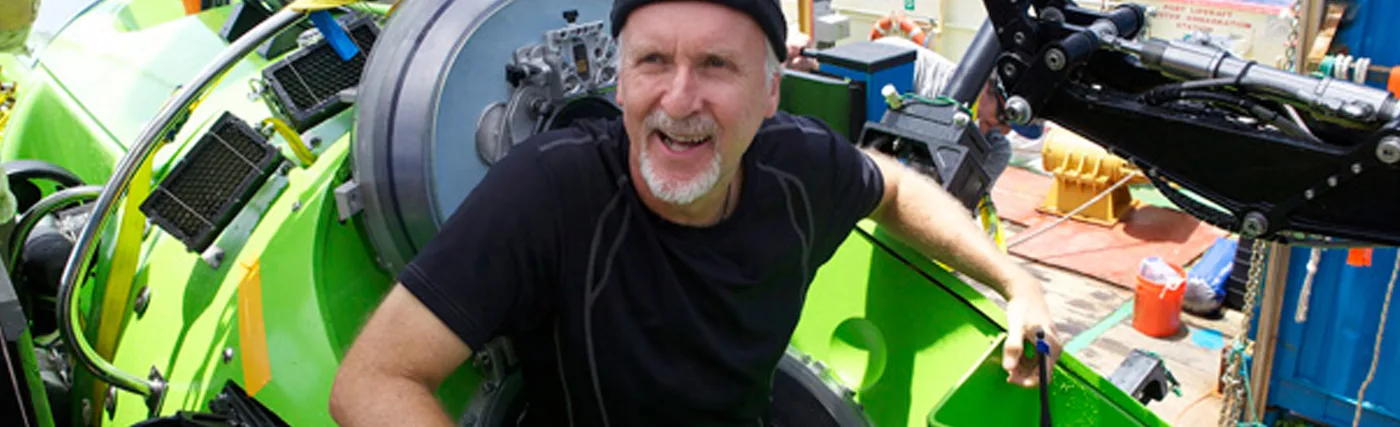
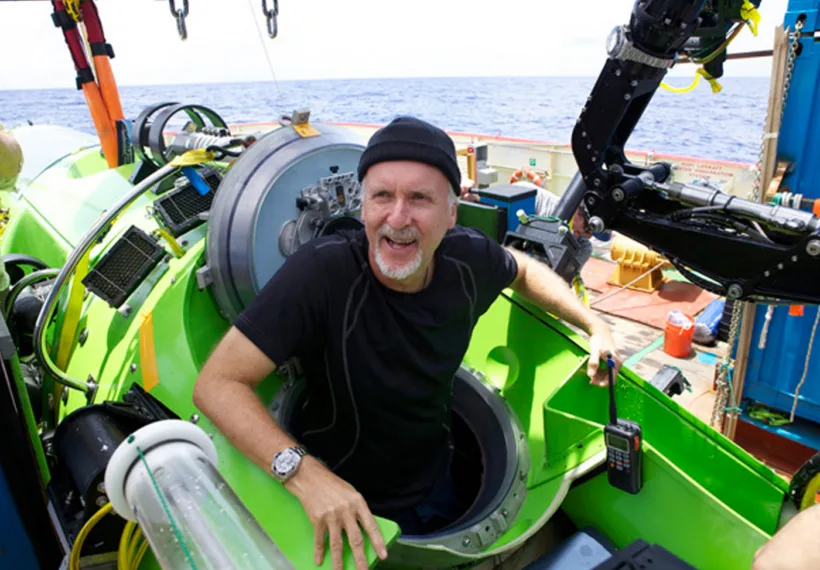
But that got me wondering, okay, what kind of preparation, what kind of thinking must have gone in to motivate him in 2012 to make the first solo descent to the deepest place on Earth in a submarine that he piloted and co-designed.
Wow.
So you know where he went.
What's the deepest place on Earth?
The Marianas Trench.
Marianas Trench.
Thank God.
I thought you were going to say my fears.
Almost seven miles down.
Almost seven miles down off the coast of the Philippines.
And so I asked him about that record setting doc.
Let's check it out.
So what motivated you to go to the bottom of the ocean, bottom of Earth?
You know, the funny thing is that I've been asked that a lot.
And it occurs to me that a kid would never ask that question because a kid would know you just got to go.
Why wouldn't a kid?
He just so dissed me in that moment right there.
I don't know, it's just that we, as a culture, we start to think like adults.
I want to be a kid again.
I know, exactly.
So a kid would say, why wouldn't you go?
It's there, and you haven't looked yet.
So why wouldn't you build a sub and get in it and go and look?
But you went by yourself.
That was kind of a constraint.
I would have built a two-man sub, or two-person sub, but we had to evolve beyond the Trieste that went down there in 1960, which had to be towed out there, and it had a big mast or a tunnel that you went down to get into the sphere.
So it was very much like a military sub.
But we wanted to use the paradigm of modern research submersibles, where you go out on a ship and you put it in the water.
So it had to be a certain weight.
And it all scales up around the size of the sphere.
So we thought, all right, we're going to do this down and dirty.
We're doing it privately.
It's not big institutional money.
It's not a Navy project.
So let's start with the smallest sphere that we can cram a human into.
And so then that instantly pretty much on day one was a one person deal.
So I was going to dive and then my...
Wait, wait, so are you...
Yeah, kind of sitting kind of about like that with the back of the sphere there, or about like that, if you will.
That's spookily like how you had to get into the Mercury capsule.
Yeah.
Because the Mercury capsule was not some lounge chair.
No, it was tiny.
But I figured guys in F-16s fly 11, 12-hour sorties with refueling in the Middle East.
They do it all the time.
And so it's really not...
Humans have subjected themselves.
They do this.
And so, all right, so just to be clear why the shape of the vessel has to be a sphere.
Okay, well...
Tell us about it.
Yeah, this is a leading question because you know the answer.
The sphere is the most elegant shape in nature because this, you know, it's just like a bubble in water.
Nature naturally tends to get these isotropic pressures forming a sphere.
So it's like your bubble is just made out of steel.
Any other shape will tend to fail.
You'll have what's called stress risers where the stress fields will peak at a certain point like a corner if you're building a box or whatever.
So sphere is the elegant shape that resists pressure.
And so you start with a sphere.
Then whatever other shape the vehicle appears to have is usually about the flow dynamics over the vehicle.
You put the flotation up high and the heavy sphere at the bottom and that's how you start.
Otherwise, you're going down head first.
Yeah, or tumbling, which would be even worse.
Yeah, then you get like seasick.
You don't want that, right?
You don't want that, trust me.
Oh yeah, I trust you.
Been there, checked that box.
It's not fun.
But as a filmmaker, as a storyteller, I'm thinking if you want people to be interested in in hadal research, you have to go there.
A hadal?
Yeah, a hadal is anything below 6,000 meters, which is abyssal depth, right?
All the way down to the deepest spots, which are close to 11,000 meters.
So the takeaway from that is below that, you die even faster in a failure.
You die pretty fast at 6,000 meters, actually, but I think it's a very fine degree.
You know, I always figured it wouldn't hurt because by the time the pain impulses got to my brain, it wouldn't be there anymore.
Your brain wouldn't be there, right?
Right, you'd just be crushed.
Yeah.
To a pile of goo.
Yeah.
Pretty much.
Pretty much, yeah, yeah.
So Charles, is my calculation accurate?
He'd be a pile of goo.
You would be a pile of goo.
Every 32 feet that you go down in the ocean, every 32 feet you go further down, you're increasing again the same amount of pressure that we're experiencing now on the surface of the Earth.
So 32 feet is one atmosphere.
That's right.
So we're going down 35,000 feet, that's equivalent of more than 14,000 pounds per square inch on your body.
Imagine if this entire Hayden sphere were smooshing you.
So that's seven tons per square inch.
Seven to eight tons per square inch down the bottom there.
So that's a quick pile of goo.
Oh yeah.
The problem is you...
Oh, that's not the problem.
Oh yeah.
There's some other problem neglected here.
The problem is the cleanup.
If you went from you to goo immediately, you wouldn't feel it.
He's right, right?
By the way, that's the name of the next Dr.
Seuss book.
From you to goo.
What will probably happen is your ship will start to creak.
It'll break.
Water will start coming in.
You will suffer before you become goo.
Because it's not an instantaneous thing.
That's right.
It's a slow death.
That's kind of the problem.
Well, that's pretty cool though.
I mean, since you're a scientist and this is a fascinating conversation about, are there any other really great ways to die in science?
There is no end of great ways to die in the universe.
Really?
Yeah.
Charles and I could just trade back and forth.
Charles, you go first.
OK, go ahead.
I would love to be destroyed by a gamma ray burst.
Ooh.
I don't know what that would be like.
It's a very high energy flow of particles and light.
That would vaporize them quickly.
OK, but what would it actually do to me?
Would it just break me down into like?
So it's high enough energy to completely break apart all molecular bonds in your body.
OK, now that is cool.
Yeah, yeah.
It will just completely disassemble you atom by atom.
Molecule by molecule, then atom by atom.
Oh, wow.
That doesn't even sound right.
I got one.
Asteroid strikes.
Yeah, so you want to be right where it hits so you die instantly.
And you get to watch it come in.
That would be cool.
If you're not right where it hits, you will die, but later, slowly.
Yeah.
Oh, OK.
All right, how about this?
Because I read this from you.
Spaghettification.
Ooh, love me some spaghettification.
Death by black hole.
Death by black hole.
Death by black hole.
Death by black hole.
Death by black hole.
I'd give him a B plus, that's it on that one.
Yeah, you fall into a black hole, that's my way to die.
If I had to pick one of them, forget the gamma ray burst.
It'd be cool to become Adams again, but still.
Falling into a black hole, you get to a point where it starts pulling on your feet faster than it's pulling on your head.
And you end up stretching.
Now, you'll stretch.
We all like a stretch, right?
Oh, this feels good.
Until it stretches you so much that tidal forces, this is what they are, these stretching forces, exceed the intermolecular bonds of your flesh.
And then you snap into two pieces, likely at the base of your spine.
Then those other two pieces continue to fall and they feel these same tidal forces.
And then they snap each into two pieces.
The ultimate chiropractor.
So you go from one to two to four to eight to 16.
You bifurcate your way down into the abyss.
You are extruded through the fabric of space, like toothpaste through a tube.
Nice.
And so we have a word for that, spaghettification.
Nice.
There it is.
Coming up on StarTalk, I asked James Cameron about exploring oceans on other planets when we return.
Welcome to StarTalk from the American Museum of Natural History.
We're featuring my interview with movie director, inventor, explorer, James Cameron.
And his hit film Avatar is set on a fictional alien moon of an actual planet orbiting a neighboring star.
And moons like this might be the best place for alien life.
And so we discussed my favorite moon for the search for alien life, Jupiter's moon Europa.
Let's check it out.
Europa has an icy crust and very likely ocean of liquid water, which we expect has been liquid for billions of years, kept warm by a pulse of gravitational energy sent to it from Jupiter and surrounding other moons.
Yeah, tidal pumping.
Yeah, yeah, tidal pumping.
So it's outside of the traditional Goldilocks zone, which is fun because in our search for life in the universe, it broadens the net that we asked.
Any ice world could be, if it's got gravitational pumping, could have thermal energy, could have a liquid ocean, could have life.
So this is orgasmic for you because it's space and an ocean.
Almost literally.
You get to fly in space and go to the bottom of an ocean and look for life that's alien.
Well, it could be cooler, yeah, if they discovered an immortality drug tomorrow, I would be very happy because I would live long enough to get to go to Europa.
For no other reason.
A couple of other.
So I joke about Europa because if we do find life forms there, there's only one thing we would be forced to call it.
They have to be called Europeans.
I'm pretty sure.
I haven't thought of that.
But Enceladus is good too because Enceladus you've got active venting right now and they think that there's actually an exposed interface where you could theoretically fly down a crevice or a crevasse and get to the bottom and see boiling water.
Not boiling because it's hot, but boiling because it's in a vacuum.
It changes the boiling temperature.
Yeah, exactly.
And so it's just vaporizing.
And you're looking at seawater that is then in communication due to convective currents with some kind of hydrothermal activity.
And what I'm intrigued by is they flew Cassini through a plume and they picked up some...
By the way, by the time this airs, Cassini will be dead.
I know, I know.
Let it rest in peace.
Yes.
It's on a death spiral right now into...
Yeah, into Saturn.
Yeah, I don't know if Cassini was Christian as you just put it across, but whatever religion it was, let it get burned at the stake, maybe.
He probably did.
Yeah, it's on a death spiral into Saturn now to get it out of...
So that it doesn't accidentally crash into one of these moons where there could be...
Where it could contaminate it and screw up our chances of being able to tell life from life.
But yeah, so they found silicon nanoparticles which they believe can only form in the plumes of hydrothermal vents.
So, literally, you've got water that's being brought down, heated up by these tidal effects, squirting up into the ocean, boiling around for a while, getting to the surface and then evaporating, going out into space, getting picked up by a human spacecraft and analyzed.
That's pretty...
Without even having to land.
That's pretty freaking cool.
Yeah.
Now, if they fly around long enough, they might hit a fish.
No, I got something for us.
So, in that same vein, we know that the frozen ice of Europa has cracked and re-frozen because you see patterns that are shifted like a puzzle shift.
Yeah, like that went to there.
Yeah, exactly.
Exactly.
And so, if that's the case, that means there are crevasses that come and then re-freeze.
And so, if there are fish that get caught in the upwell of this water, the fish is now frozen near the surface.
Exactly.
And so, you can have astronauts landing there and not having to drill the kilometer-thick ice sheet.
They can just dig into these frozen carafe sections and then have like a freeze-dried fish right on the spot.
Yeah, or bacteria or whatever it is, but that's the…
I want fish.
That's the low…
What?
Fish like a sturgeon.
Yes.
Is that European caviar as expensive?
So, Charles, what would you visit first, based on your knowledge of the solar system?
Europa, for sure.
I got to tell you, a few years back, I had the great privilege of flying over the North Pole in the daytime.
And the ice pack there, the part that wasn't melted, looked so much like the crust of the surface of Europa.
I just swear, I feel it in my bones, there's something alive down underneath there.
Wow.
So, Jim Cameron is a really curious guy, that's obvious.
And so I asked him if he had any questions for me as an astrophysicist.
So I solicited this from him.
Let's check it out.
All right, I'm going to do this just to mess with you.
You hang out with me.
I want to hear your answer to a question that I think everybody asks and I've never heard a succinct answer that makes any common sense.
If you're not a higher mathematician, the observable universe is 13.8 billion light years.
Well, sorry.
Light years.
13.8 billion years old.
Years old and therefore we can.
The horizon that we have access to.
The microwave background or whatever.
When that light was sent to us, it was 13.8 billion years ago.
So it's a bubble around us with a radius of 13 billion light years, right?
What's outside the bubble?
We know.
Mathematically.
No, no, no.
I got this.
Good.
Imagine the universe is infinite just for the moment.
It turns out that assumption is not terribly important, but just imagine it's really, really big.
And here we are in some spot and I see you, I see you not as you are now, but as you once were five billionths of a second ago.
When the light left me.
When the light left you.
And you look marvelous over that time.
As you look farther out, you will see light that began from the object farther back in time.
Yeah.
From the moon, 1.3 seconds.
From the sun, 500 seconds.
If you pluck the sun from the middle of the solar system now, we would not know about it.
We would continue to orbit.
We would continue to feel the rays.
For like eight minutes.
For about eight minutes and 20 seconds.
And then we would fly off at a tangent and plunge into an icy depth, never to be noticed again.
So we continue this to the nearest star to the sun.
That's four years.
Across the galaxy, 100,000 years.
The nearest large galaxy, two million years.
You keep doing this.
Since we know the universe had a beginning that we call the Big Bang, there will be a point where there will be an object who sent us its light right when the Big Bang was happening.
Yeah, right after.
Okay?
So that creates a horizon in space.
I look this way.
I can't see farther away than 13.8 billion years because that's the beginning of the universe, every direction I look.
So my horizon, like the horizon of a ship at sea, that's a two-dimensional horizon.
That's just a circle, the same distance in every direction.
When in space, your horizon is a three-dimensional circle, which we call a sphere.
So now, suppose there's an object 15 billion light years from us.
The universe isn't old enough for its light to have reached us yet.
So there's still universe beyond this horizon in the way that there is ocean beyond your horizon when you are sailing at sea.
And the day you want to worry is the day the evidence of the Big Bang begins to just disappear.
And no longer is this horizon expanding at one light year per year.
No longer does that wash over any more matter that's out there.
That would be a physical edge of the universe.
And what's beyond that?
I thought I satisfied him.
No, no, no.
You're just defining the terms.
I'm talking about what's outside that.
So the real question is what's outside of the universe?
And I'm delighted to be able to answer for you.
We have no idea.
Top people working on it.
So we ever going to get there, Charles?
Sure.
We already know what's beyond the cosmic horizon for us.
It's more universe.
I just said that.
Yeah.
But you have no idea what's over there.
Well, it's basically the cosmological principle, which says that everywhere is basically the same.
So I get that, but you have to assume it's infinite.
Not necessarily.
Right.
If I go 10 billion light years in this direction and 10 billion light years in that direction, both those points are within my cosmic horizon, but each point is not within the other's cosmic horizon.
And as a result, since we look in every direction and the universe appears on large scales to be homogeneous and isotropic, that means that the rest of the universe is that way.
We have to send out expeditions.
That's what we have to do.
And then bring back the info.
Precisely.
Coming up, more on the intersection of exploration and imagination, with director James Cameron.
StarTalk Featuring my interview with one of the world's most successful and innovative filmmakers, James Cameron.
And his passion is underwater exploration.
But I wonder if he had aspirations to actually explore the frontier above us as well.
Let's check it out.
Do we need to send storytellers into space, or do we just need you to tell stories here that you've invented out of your head?
Yeah, well, look, those are two totally different kinds of stories.
I always think of Avatar as a fantasy.
It's an allegory for the way where it's set in space, but it's really meant to be about our planet and our relationship to nature and so on.
But do we send a storyteller to go along on a Mars mission, let's say?
Oh, you know, I mean, in the NASA worldview, no, you don't, because you need that person to be something else.
Because payload matters.
In my worldview, you have to select your astronauts not only for their ability to perform the mission, but for their ability to come back and tell us what it felt like.
I think that's critical.
I think they, I'm not saying you send, you don't, like...
But that's a storyteller.
That's a storyteller, exactly.
I mean, they're an astronaut first, but they're a storyteller second.
Because they have to tell us what it felt like.
And Buzz Aldrin was great at it.
And Neil Armstrong, who I revere as a god, you know, but he was a terrible storyteller.
In fact, he wouldn't even talk to the press.
He was just basically a private citizen.
Yeah, yeah.
He didn't feel that that was part of the job.
And I feel it is.
And look, I mean, we all, Neil's a national hero.
I don't want to get thrown under the bus for dissing Neil, but he didn't do that part of the job.
And I think that it's critical to, that when we send our, if we're going to send humans, which is kind of a dumb thing to do, robots are going to do it better, cheaper, go farther, be more resistant to radiation, all that sort of thing, but they can't tell you what it feels like.
And they can't tell you what they were thinking.
They can't tell you what the spiritual journey was.
And, you know, when the first time somebody, some small group of people is standing on the surface of Mars, they better goddamn well come back and tell us what it felt like.
Charles, do you have any parting thoughts here?
Albert Einstein once wrote that the origin of all great art and science is the same thing.
It's the sense of wonder and mystery.
Whether or not James Cameron is a practicing scientist, he's drawing from that origin, and he's helping us all see that.
So, first, I agree.
And maybe were we to do this all again, we wouldn't say, who are we going to send into space?
Let's send military pilots that all sound the same.
Maybe we would send a cross-section of people who create civilization.
And every civilization we reflect upon, what is it that rises up above everything else?
It's the architecture, it's the science, it's the art, it's the writing, it's all the things that we value, the expressions of creativity in the human species.
So to say we have all that creativity here on Earth's surface, but we're only sending this one dimension of kind of people into space, I think that underserves our capacity to be curious and our capacity to explore.
So perhaps in a next generation of exploration of space, you don't say, oh, you have to be useful and then be a storyteller in addition.
Maybe the fact that you're a storyteller is the most useful thing about you on that mission.
And the fact that you are an artist is the most useful thing about you on that mission.
Because now you can take the full depth and range of human emotion and apply it to places yet to be experienced by human emotion.
And these are the people who are uniquely placed to carry us not only intellectually but emotionally into a future we so desperately seek.
You've been watching StarTalk.
And I've been your host, Neil deGrasse Tyson, Chuck Nice, Charles Liu.
I've been your host, Neil deGrasse Tyson.
As always, I bid you to keep looking out.
See the full transcript



 Unlock with Patreon


 Become a Patron