


 Unlock with Patreon
About This Episode
Scientists have been searching for aliens in our solar system and beyond, but have not yet found evidence that life exists beyond Earth. SETI, the Search for Extraterrestrial Intelligence, has been scanning the stars for alien radio beacons for 50 years. Radio and TV broadcasts have been leaking from Earth’s atmosphere for over a century, and these traveling time capsules could eventually reach a broader audience than ever imagined. Neil and Lynne review the methods used to locate aliens, and discuss what to do if you’re ever abducted.
Transcript
DOWNLOAD SRTOur universe is filled with secrets and mysteries, leaving us with many questions to be answered. Now, more than ever, we find ourselves searching for those answers as the very fabric of space, science, and society are converging. Here, for...
Our universe is filled with secrets and mysteries, leaving us with many questions to be answered.
Now, more than ever, we find ourselves searching for those answers as the very fabric of space, science, and society are converging.
Here, for the first time, these worlds collide as we give you the knowledge that breaks the barrier between what is science and what is merely pop culture.
This is StarTalk.
Now, here's your hosts, astrophysicist, Dr.
Neil deGrasse Tyson, and comedian, Lynne Koplitz.
Welcome back to StarTalk.
Neil deGrasse Tyson here with my comedian actress co-host, Lynne Koplitz.
How are you, Lynne?
You know what we're going to talk about today?
I do, and I'm excited.
Talking about the search for alien life in the cosmos.
Excellent.
Alien life, nothing like anything we've ever found here on Earth.
And, you know, most people don't know that the search for aliens is not a new thing.
It didn't start with Steven Spielberg making movies.
It didn't?
No, no, it's been going on for centuries.
Who did it start with?
Well, no, I mean, it's been around.
People have wondered.
They've looked up.
We're not the first generation to look up.
We see the planets.
We see other stars.
You wonder, is there any other life out there?
Yeah, but they wondered, like, they're screaming, like, hello.
Yeah, I mean, yeah, how do you communicate with aliens?
Do you get on a mountaintop and just scream, or do you, like, take a torch, or, like, what do you do?
By the way, one of the most sort of famous crazy people to look for life was about 100 years ago, Percival Lowell, one of the sort of the moneyed New England Lowells.
He launched a search for life on Mars, basically.
I'm sorry, Neil, but that is a science geek name.
Have I ever heard one?
Percival Lowell.
What makes that geeky?
When you name your kid Percival Lowell, you're basically saying he's going to be looking for stars, unless he's just Percival and then he's like an NBA player.
Percival Lowell alone, one name is cool, but Percival Lowell, Percy?
Well, he built his own observatory.
He's rich enough to build his own observatory in Arizona.
And guess what he called the observatory?
The Percival Lowell Observatory.
I'm no astrophysicist, but I'm guessing.
So, I mean, it turns out he actually...
What did he say?
Let's just give him props where they need to land.
He started the search for Planet X that led to the discovery of Pluto.
So, that was one successful thing.
So, that was one of his big activities.
Another activity was he believed there was life on Mars and drew canals and he believed that there were cities and they were channeling water from one location to the other.
Why?
Why did he believe that?
Well...
I mean, that's awesome, but was there a reason?
Yeah, he believed that because he didn't speak Italian.
There was an Italian astronomer who believed he saw channels on Mars through his telescope in Italy.
And channels in Italian is canale, not a cannoli.
Not cannoli.
Did you see the look on my face?
I'm like, cannoli, yum, canale.
So he's got a...
So canale, and he sees this research paper, canale on Mars, and he sees it in Italian things, it's canals.
Now, the difference between a channel and a canal is that nature carves channels, life carves, canals.
But are there canals?
No, no.
He made it all up.
He believed, he wanted to believe so hard.
Why are we even talking about this guy then?
Why is he important?
He wanted to believe so hard in the existence of life out there that his brain took over his data-taking ability.
So you say that, and you're saying that's what we do too?
Well, if you're deluded...
People want so badly to believe that there's life.
So we've been certain now.
You can be wanted so badly that it interferes with your ability to take data.
Let's see what our buddy Bill Nye has to say in his manic minute that he gives us.
Let's check him out.
Hey, Bill Nye here.
And if you're like me, you're human.
And there are two questions that come up from the moment you can start to think.
How did we all get here?
And are we alone?
Well, the answers to those questions are what astronomers seek.
That's astronomy.
Now, I was recently interviewed on an international television show along with four people who really believe that an alien spacecraft came to their Air Force base in Montana and shut off the electricity.
Well, of that, I am quite skeptical.
There are billions and billions of digital photographs taken every week, not one of which presents us with a picture of an alien spaceship.
But with that said, are there other worlds?
Absolutely.
Are there other civilizations?
Well, most certainly.
Do they come here in spaceships to flip our switches?
Probably not.
Nevertheless, we keep watching the sky to see if there's someone out there.
I got to fly.
Bill Nye, the science guy.
I love him.
If you've got an opinion about whether there's aliens out there, why don't you give us a call at 1-877-5-STAR-TALK.
Or if you are an alien.
Oh, that too.
But then you wouldn't need to use the phone.
You know what gets me, though?
Everybody is talking about it all the time, about looking for life on other planets, but my guess is...
Looking for life in all the wrong places.
Yeah, exactly.
That's my story.
But here's what I'm wondering.
It's probably not going to be like an alien life.
I mean, at this point, we're just looking for like bacteria, right?
Like something that's living.
In the old days, when you said, I'm looking for life, people would assume you're looking for intelligent life.
But a lot of the search for life today is just trying to find any kind of life at all.
And you know, I got a buddy who works for the SETI Institute, the Search for Extraterrestrial Intelligence.
SETI, that's the acronym for that.
And it's Seth Shostak.
You ever hear of Seth Shostak?
He's a cool guy.
He's a cool guy.
He's like one of the leading alien hunters in the world.
He's committed to-
He's an alien hunter?
Well, actually, that's the title of his-
That's the title of his recent book, Confessions of an Alien Hunter, just released by National Geographic Books.
Let's get a clip of an interview I conducted with them in my office.
Let's check it out.
I'm here in my New York City office with Seth Shostak, an old buddy, a senior astronomer at the SETI Institute in Mountain View, California.
Seth, welcome to New York.
It's a pleasure to be in the Big Apple, Neil.
I'm told you have a new book that just came out.
What is it?
It's Confessions of an Alien Hunter, a Scientist's Search for Extraterrestrial Intelligence.
So is it part memoir?
There is some autobiographical stuff in there.
As far as confessions go, this isn't the kind of confession that you'd have to see a priest about.
That's what I was wondering.
What are you confessing that we should know about?
When you're older, I'll tell you.
Just some of the email and phone calls I get, there's some of that in there, but there's also some of the behind-the-scenes history of the search for aliens.
And again, aliens, is there anything that's extraterrestrial, meaning beyond Earth?
Well, not entirely.
I mean, there may be aliens on Mars, right?
I mean, you know, pond scum aliens, but that's not what I do.
That's not very nice to call them pond scum, unless it is pond scum, I guess.
And as far as I can tell, they don't object.
So it's probably okay.
Indeed.
I mean, there's a lot in there about why we think they're out there.
And that requires going into the question of, well, could there be life even nearby in our own solar system, some of these worlds that might have liquid water?
Mars is an obvious one.
Some of the moons of the outer solar system.
So we've got real astronomy in here, just so the reader can learn about how we pose the question in the first place.
And why is it that if you grab 10 astronomers off the streets of New York, not that I'd ever recommend doing that, but if you were to do that, what fraction of them do you think would say that it's likely there's life out there?
I figure probably 90% of them would.
100% of them.
If it's only 10, it'd be all 10.
Very likely.
You're more optimistic than I am, but yes.
Don't you forget, we see what life looks like in Times Square.
That allows all manner of possibility in the world.
I won't comment on that, but yes.
My big fear is that the aliens have visited us, but they plopped down in the middle of Times Square or in Venice Beach, California, and they just went unnoticed.
They didn't look different enough from anybody else who's walking by or rollerblading by so that they just went home.
I think that was the premise of Men in Black, in a sense, that the aliens were among us.
A lot of people believe that the aliens are among us.
I wish someone would bring one into my office.
It would be job security.
Just to be official, you are not an alien, correct?
No, and I couldn't tell you if I were.
You are not authorized to divulge that information.
We're going to hear more from Seth later on.
I just like the idea of flat out asking people, are you an alien?
Yeah, just to double check.
You never know.
This is StarTalk.
I'm your host, Neil deGrasse Tyson, joined by comedian and actress, Lynne Coplitz-Lynn.
If you have opinions about if there are aliens out there in the universe, I want to know.
We want to know.
18775 StarTalk.
You just want to talk to someone other than me.
I would just like someone else to call in.
I've been trapped with this woman in this room.
So, Lynne, you're right.
Earlier you asked, are we just looking for a little green man or could there be microbial life?
And we think there might be microbial life on Mars.
You just made me smarter than I am.
I actually asked if we're just looking for bacteria or pond scum kind of thing, too.
But microbial is great.
Microbial is cool.
And there's recent evidence that there might be because there's methane emissions from cliff faces on Mars recently found.
Methane is gas.
Gas.
It's a kind of gas that you find in your digestive tract, actually.
Like flatulence?
Flatulence, yes, yes.
So it might be one of...
Lynne, say excuse me.
I didn't know we had that.
It might be one of my ex-boyfriends on Mars.
That might be who they are.
That's why he's an ex, I presume.
Yeah, but wait a second.
So what do you mean there?
It's like little pockets of it.
Yeah, well, if methane were all over the planet, then you can wonder whether there's some sort of geological origin of methane.
But there's a pocket of methane that emerged from the side of one of the ravines right beneath the surface where you think there might be water, because Mars has all this evidence of one's having had liquid water.
And where there's water on Earth, there is life of one kind or another.
So we think the water is beneath the surface of Mars.
There's a cut through the landscape.
Methane comes out.
So it's not just cows.
Wait, and then there's other little emission.
But what other planets could have life on them, Neil, other than Mars?
We don't know, but we're looking, we're being guided by the search for water.
Well, I'm going to ask.
Okay, what about Jupiter?
Could there be life on Jupiter?
Jupiter, if there's life, it's not going to be life as we know it.
Why?
Well, because it'd be gaseous.
What's wrong with Jupiter?
I mean, is there...
Well, Jupiter's got moons.
Maybe there's life on moons.
There's rocky surface moons on Jupiter.
There's Europa, there's Ganymede.
Jupiter's hot too, right?
Jupiter is warmer than it would otherwise be.
That's just because it's kind of like a failed star, so it's got some heat left over, which is kind of cool.
So you've got to...
One of the places I want to go looking...
But it has moons.
It's got moons.
One of them is called Europa, Europa, which is an icy surface, but there's heat pumped in there from Jupiter's gravity that has melted the ice, and there's a liquid ocean of water that's been liquid for billions of years.
So I want to go ice fishing on Europa, look for any life that might swim up to the camera lens.
Oh, that's really exciting.
So Jupiter, now I'm trying to, this is my thing, I was trying to think of this the other day, Jupiter would be, if I tried to compare the planets to real people, No, why would you do that?
Jupiter's, this is how I make things make sense to me, Jupiter's like Puff Daddy, because it's like a failed star, and it's got that moon that's hanging out with it, who's like Farnsworth Bentley, Puff Daddy's little manservant who walks around with the umbrella, who now, that's Europa, like now that's becoming famous.
Jupiter did have manservants in legends, well Zeus had manservants in Jupiter and Zeus.
Mars, well Mars, as you know, we're looking for life on Mars, but I don't know.
I think Mars is Barbara Walters, because it's like cold and dry.
I find other ways to remember my planets, Lynne, so I can't comment one way or another, but I'll give you other spots.
Venus, you're not going to find life on Venus.
It's 900 degrees Fahrenheit.
Yeah, yeah, 900 degrees.
That's hot enough.
It breaks apart any biological molecules you would plop down there.
You could cook up, I did the calculation, you could cook a 16-inch pepperoni pizza on your windowsill in nine seconds.
So Venus is like Miley Cyrus, like hot, hot, hot.
And then one of Saturn's moons, Titan, which is the largest moon in the solar system, one of the several largest moons in the solar system, that's a fascinating place.
Why?
It's one of the few moons with an atmosphere, and it's really, really cold.
So water is like boulders and bedrock on that moon.
Bedrock.
Bedrock.
Water is the rocks.
And methane, it is so cold that gaseous methane has liquefied the rivers of methane flowing on the surface of the moon Titan.
That's exciting.
And so we think it might resemble Earth in our early days.
Do you think that we could like, I was watching Total Recall the other day.
There were people now, right now, listening to the show going, why are these two people together talking?
Because she sounds like some hooker they found on the street and he's a genius.
I must remind people, Lynne Coplix is a comedian.
Thank you.
And that's the joy of the show, people.
That's what I'm saying.
This lets you, you yourself, it's kind of like when you were watching Sarah Palin in the debates, I make people feel like they themselves could do this.
They could sit with an astrophysicist and talk.
So anyway, now I forgot what I was even going to say to you.
Well, we were talking about, where were you?
Well, we were Left Puff Daddy long ago.
Oh, we were talking about Saturn.
Yeah, Saturn's moons.
Saturn would be Madonna.
Because it's the center of its own universe.
Yes, that's true, actually.
Saturn has its own ring system and it's got countless moons.
I've lost count.
Beyond 60, I stopped counting.
60 moons.
It's its own mini solar system.
What do we call it?
That's what I was going to ask you.
Yeah, what?
Is there a way that we could create like a pod that we could live in on another planet?
I don't see why not, but then what's the point?
Just, like...
I don't know, just to get out for a while.
I'd be happy just to go to Puerto Rico.
I just need a break, but to be able to go to Mars for a week is awesome.
We've tried to make these kind of pod places on Earth, and it just doesn't work.
People smuggle in potato chips and Cheetos and things, it just doesn't work.
I think...
Do we have a call?
Our phone number is 1-877-5-STARTALK, if you have an opinion about aliens.
Let's take our first call.
Hello.
Hello.
Yes, are you there?
You are live on StarTalk.
I'm Neil deGrasse Tyson.
I was wondering if you could solve the Drake equation for me.
Ooh, he's calling me out.
I know it's not me.
He's calling.
I would say no, Chris.
I can't.
No, Neil can.
I don't even know what it is, actually.
To me, the Drake equation would have to do with some sort of tasty cake thing.
So, what's Drake?
Drake, as in the bakery, Drake yodels or whatever.
This is fun, calling me out.
This is like, yeah, come outside.
Yeah, come outside and tell us.
What's he talking about?
Frank Drake was a famous astronomer, he's still alive, and he wanted to organize our understanding of the likelihood of finding intelligent life in the universe.
So, he assembled these terms of an equation, which when you multiply them all together, at the end, the number you get is the number of intelligent life forms you would find in the galaxy.
So, you first have to start out, for example, with how many stars are there, and then how many of those stars would have planets, and how many of those planets would have life, and how many of those planets with life would have intelligent life, and how many of those planets would have intelligent life.
Yeah, yeah, yeah, we get it.
So, then what?
So, by the time you're done...
Can you tell Chris that Neil's trying to distract, so he doesn't have to solve the equation?
We just want a number now.
Come on.
The guy's got to go.
I've got things to do.
So, you plug in all your best estimates for these probabilities, and at the end, a number pops out, and depending on how pessimistic or enthusiastic you are, it could be low or high.
We don't have a handle on all those numbers.
The last two are the most mysterious of them all to us.
What are the numbers?
I have to build it up.
So, the last number is what is the lifetime of a civilization that has the capacity to talk to us?
Because we were intelligent, we would tell ourselves 200 years ago, but we couldn't have had a conversation with another SETI searcher because we didn't have radio telescopes.
So, the most uncertain part of this equation is how long is a civilization capable of actually sending radio signals out into space?
And if you do that, I'd say maybe there could be anywhere between 20 and 100 intelligent civilizations in our galaxy, the Milky Way galaxy, that we could communicate with.
Chris, did you hear an answer to your question?
I didn't hear one.
Yeah, 20 to 100.
Oh, 20 to 100?
Well, that would imply that the lifetime is pretty short then.
Indeed, because how much confidence do we have in our own civilization?
It means if you could be so smart that your industry actually kills you because either you bomb yourself into oblivion or you pooch your environment so that you...
In the old days, it would have been like pooping in the cave.
Nowadays, we are destroying our environment.
I'm just trying to say.
You mean where you sleep?
Yes, yes.
Chris, thanks for your call.
This is StarTalk.
Our phone number is 1-877-5-StarTalk.
We love to hear whether you think there are aliens out there and what you think we should do about it, if there are.
We're taking a break.
Whether you're a space cadet or a rocket scientist, we want to hear from you.
The phone lines are open.
Call now.
This is StarTalk.
Welcome back to StarTalk.
I'm Neil deGrasse Tyson with my co-host, the media and actress Lynne Cobblet.
Lynne, how are you?
Hi, Neil.
Our toll-free number is 1-877-5-STARTALK.
If you have an opinion about our subject today, which is the search for extraterrestrial life, in particular, the search for extraterrestrial intelligence.
Aliens.
Aliens.
Aliens.
You know, SETI, that is an actual funded program that's going on today, and there are some serious scientists.
The government doesn't fund that, right?
No, no, no.
They used to, actually, but then they pulled the funding because they were worried how that would look in the governmental annual report where tax money is going to look for little green men.
So now it's like rich people like in Contact?
Exactly.
Just like in the movie Contact.
Yes.
But if they found something, wouldn't the government swoop in and take it from them?
Yeah, probably.
That's annoying to me.
Yeah, I would want them to reimburse me if I were the rich dude.
Seriously, you put that much money in?
I want to be the first one?
No, I will let you know what they say, Barack.
Now, a good friend of mine, who is a leading scientist at the SETI Institute, which is in California, we interviewed him for the show.
I grabbed him and snatched him into my office here in New York.
And it's Seth Shostak.
Yeah, let's see what else he's got to say about the search for life.
Is radio now the leading way to look for intelligent life elsewhere?
Well, that depends on whom you ask.
I'm asking you.
Well, I thought I was asking you.
There's this guy behind me.
I think radio probably is the best bet.
On the other hand, I have to say, thinking about things recently, I think that there's also quite a bit of merit in looking for flashing lights from the sky, simply as a signal.
So visible light, visible light.
Well, visible light, if they're not too far away, as you know, visible light eventually gets absorbed and scattered by dust that hangs between the stars.
So if they're very far away, they might use infrared.
But that's a technical point.
Here's my question.
We think sending radio waves is kind of the, you know, as they used to say, the bee's knees, because that's a way to communicate at a distance.
Radio waves are not absorbed by the gas clouds, not as much as other bands of light.
But suppose a truly intelligent civilization found a much cleverer way to communicate with aliens of their own intellect and would rank us so far below that we're not even worth their interest.
Is that possible?
Well, of course it's possible, but it sounds like a call to inaction, right?
Because that's saying, well, look, they may be using technology that's so far beyond ours that, you know, what we're trying to do is communicate with the equivalent of smoke signals.
But then what are you going to do?
Just, you know, you just give up.
Yeah, he doesn't want to give up.
The guy is on it.
The smoke signal thing.
I mean, again, I'm no astrophysicist, but I'm guessing smoke signals is a bad idea, a bad way to try and get...
Yeah, so the way we do it now is we use electromagnetic energy to communicate with aliens.
What's electromagnetic energy?
It's code for light, light of any kind.
Like x-rays?
X-rays is a form of light, radio waves, x-rays is a form.
So like my mammogram could go out there by accident?
I hadn't thought about that, but if they beam it, they could impress me.
Because believe me, Neil, I've thrown these girls out before and they have brought back some interesting stuff.
I would not be surprised if aliens would respond to my right breast.
My left one, not that interesting, but the right one, it gets lots of attention.
This is like way too much information for me.
No, I'm just kidding, but tell me...
It's light, x-rays is light.
They go out by accident.
Well, yeah, so the ones we want to send out on purpose, the radio waves are one way to do it because they pass through the gases of the interstellar clouds and your mammogram would go a certain distance if you sent out the x-rays.
So there's certain parts of the electromagnetic spectrum that are more useful in this exercise than others.
And so this is how we now do it.
Looks like we've got another call.
We do?
Yeah, Matt from Southern California.
Yeah, Matt, what do you have for us here on StarTalk?
Well, I guess I'm a whole bunch of people who are fans of Star Trek growing up, so I always just thought it was weird that they would always show up at this planet and be able to breathe and walk around with no problems at all.
Although you're talking about life on other planets, how many different kind of life-sustaining ecosystems can there be out there?
How difficult is it going to be for us to get to another planet and for us to have them to enter our atmosphere?
Excellent question.
You know what's going on there is, well, first, something that is behind the question you asked, whether or not you were thinking of it, if they just plop themselves down here on Earth, they are actually contaminating our biosphere with their biology.
They could be infected with something.
With airborne viruses emanating or oozing from them.
And so, actually, NASA has a funded branch of itself that prevents us from contaminating other planets that might have biology we're interested in, and it protects anything that we bring back that has visited a place that itself might have had biology.
So you don't want...
So no one takes contraband.
You can't drop like a snicker wrapper on Mars' surface.
But our history of life on Earth and of civilizations on Earth tells us that the invading species, the species that is the first to visit a new place, takes over.
And whoever was there that got visited gets the short end of that encounter.
No, but it's true because we did it all throughout history, like, you know, with American Indians.
We do it to ourselves.
The Spanish did it to the South American Native peoples.
I mean, it's, and you have invaders.
What's the...
We did it to Indians.
Like, oh, yeah, they showed us how to make corn, and we were like, here's 25 bucks for New York.
Beat it.
So we have to, it's a fascinating sort of geopolitical question.
What happens if aliens visit us first?
It means they're more advanced than us.
But you also have to believe if they're more advanced than us, they've been studying us the way we are trying to study them, so they probably already know, oh, we've got, like, in order to enter the atmosphere, we better not get out right now, because we'll contaminate, they'll contaminate us.
This is very wishful thinking, because military forces invading other countries never gave that much thought to their mission plans for what they were doing.
I mean, that is if they're friendly.
Or they'll just come here and shoot at us with whatever they have.
Well, thanks, Matt, for that excellent question.
You're listening to StarTalk and our toll-free numbers, 1-877-5-STARTALK.
I'm your host, Neil deGrasse Tyson, and I'm here with Lynne Coplet.
Comedian and actress.
You can also track these shows on startalkradio.net if you're sitting in front of your computer.
So, Lynne, you know, we've been trying to send signals out there, and radio signals are one of them, but we're not the first to have thought up a way to communicate.
200 years ago, 200 years ago, one of the most brilliant mathematicians of them all, a guy named Carl Gauss, he...
Honestly.
I'm just telling...
Sometimes you really cure my insomnia.
Thank you so much.
No, this is good.
I promise this is good.
Go on.
He remembered his Pythagorean theorem from middle school.
You just pulled out the Pythagorean theorem.
Yeah, the Pythagorean...
You remember it was A squared plus B squared equals C squared?
Oh, yeah, I remember.
You're shaking now from the memory of it.
So what he thought to do was create a forest, plant a forest in the shape of a triangle and put squares off of each of the sides of the triangle big enough so that an alien on another planet could look down with their telescopes and see the Pythagorean geometry on the surface of the Earth.
And that would be evidence that intelligent people populated the surface of planet Earth.
Or weird log-gathering freaks.
Another guy thought...
Is this because he thought math was the only way we'd be able to communicate?
Well, we could put like a 1970s smiley face, but they won't know what...
But we've done that, haven't we?
They won't necessarily know what a face is.
That assumes they even have a face.
Couldn't we put plaques on the side of spacecraft or something?
Okay, well, yes.
So another effort was we put our first spacecraft ever to leave the solar system.
There are five now.
Four have already left.
The fifth one is on its way out.
All the others, by the way, that we've ever launched, did not have enough energy to leave.
They're all stuck.
They're going to come back.
They're going to land on a surface.
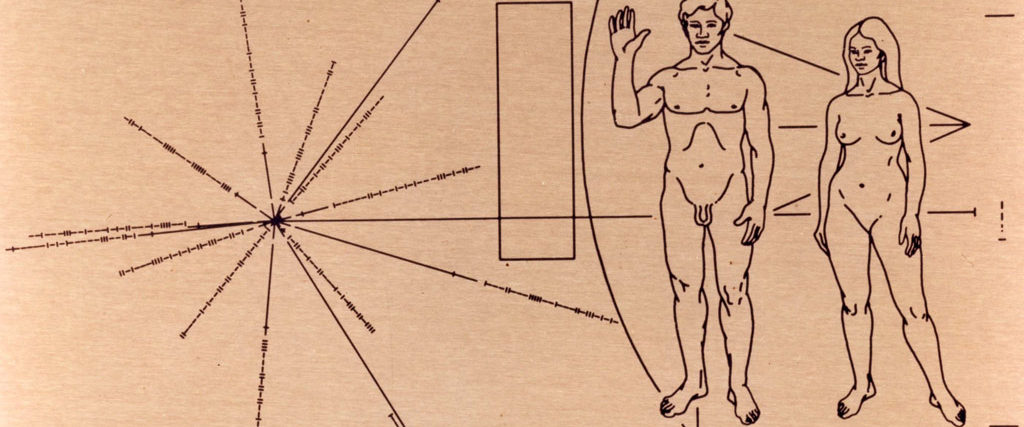
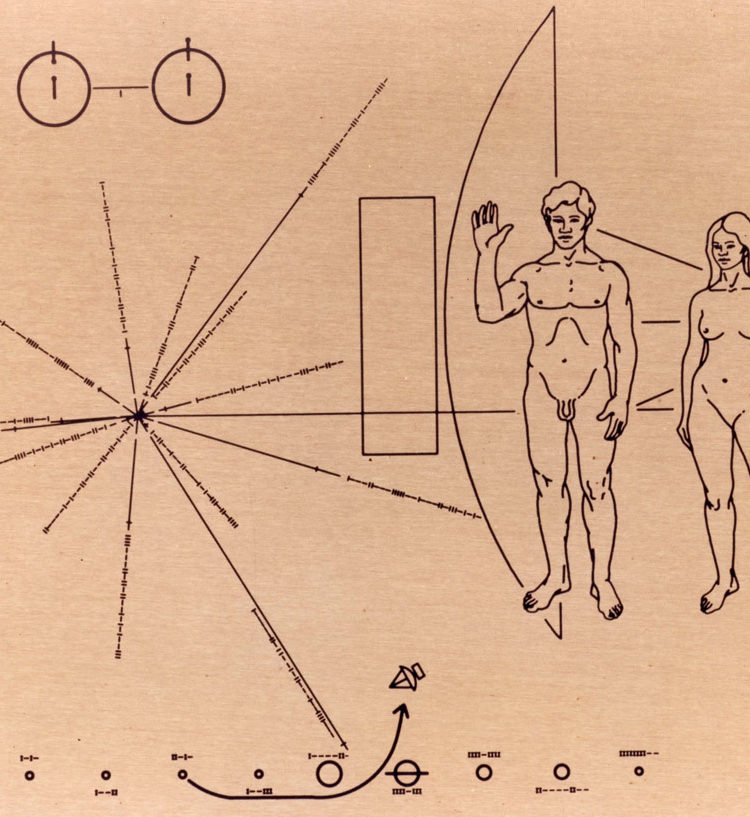
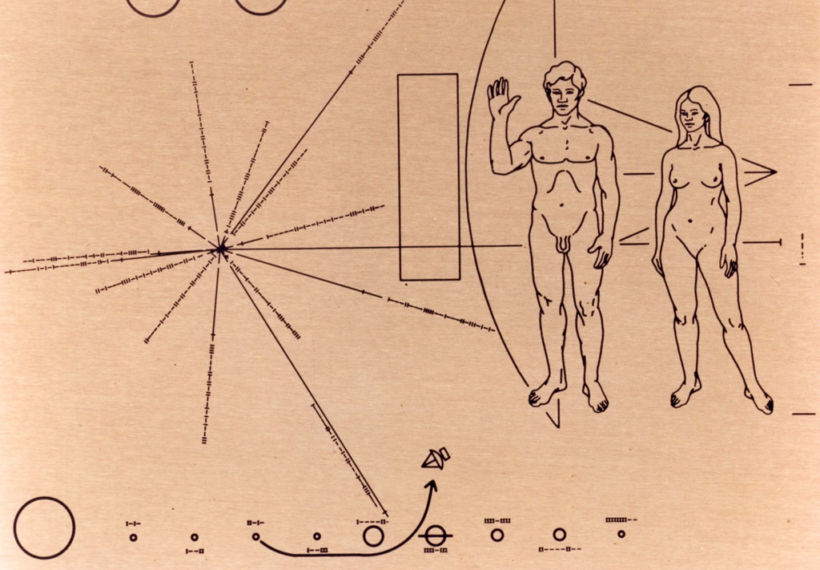
Pioneer 10 and 11 and Voyager 1 and 2.
They each had plaques attached to the side.
They were kind of cute.
They're etched gold.
One of them is like a nude man and a woman.
They're holding hands together.
They're not holding hands.
They're standing next to each other.
The man is the only one waving to the reader, by the way.
It's waving.
Love is planets getting along with one another.
And on there is like a map of...
There's a vocabulary of science that they would then decode to learn where the spaceship came from, what our biology is based on, and what the coordinates of the sun is in our galaxy.
The idea was that that is so desperate.
It makes Earth look like a big old cougar.
What?
Please call me.
Here's how you can reach us.
Here's what we look like.
If I'm not at home, we might be at NASA.
If we're not at NASA, try us here.
We're just trying to make nice with aliens.
Or just plop down in Arizona somewhere, Oklahoma, and visit us.
Come on over.
You got an issue with this.
I'm just saying, if it's your first attempt to communicate with aliens, you might as well put some...
And by the way, the Voyager 1 and 2 not only had this sort of iconography, they had...
there's a record album on it with etched in it is music that Beethoven heartbeats from an unborn child.
I mean, the things that are very human.
Biggie Smalls?
He had a lot of important things to say.
One of my favorite comics of all time, because Chuck Berry is even in this recording, that the aliens actually captured the spacecraft and sent back a message to us, and it said, send more Chuck Berry.
Oh, that's hilarious.
So one of them is you send...
But who decided what to put on there?
Because that's just hysterical.
That's just somebody's opinion.
Well, actually, Carl Sagan was part of a group of people who thought long and hard about what basic information you might send aliens.
One of my concerns about it is that map gave coordinates of where the sun is in the galaxy.
It gave a return address.
And I'm thinking, do you, walking in the street, give a total stranger of your own species your address?
I don't think so.
No.
So the audacity to do this with aliens you never met, I just thought that was kind of bold.
It's kind of like going on Facebook and eHarmony and all that.
I'm telling you, that's what it's like.
It's like just going out there and striking up a conversation when you can't really see them and you don't really know who they are.
We've got another question on our StarTalk hotline, 18775StarTalk.
Luke from LA.
Luke, what have you got?
Hi, Luke.
Hello.
Wait, you have to say it right.
Luke.
Hi, Neil.
I was just wondering, with the recent Kepler telescope that we sent into space, I was wondering why we chose the area of the sky that we did to search for habitable planets.
Excellent question.
So the Kepler telescope is a special telescope specifically designed to look for Earth-like planets in orbit around nearby stars.
Because if you're just looking for Jupiters, we don't know how you'd put life on Jupiters, a big ball of gas.
So you want to find Earth-like planets.
Luke's question is great, then.
So why did we send it where we sent it?
So what you have is it's going to search 100,000 stars in the solar neighborhood.
And you want to be able to look in a zone of the sky where the sun is not in the way.
So not all parts of the sky are equally sort of accessible to you if you're a telescope and you're not in deep, deep space.
But what are we hoping we're going to see?
Because honestly, what's the dream we're going to see with the Kepler telescope?
That's an important question.
Somebody waving?
Little green guy?
No, it's an important question.
And so you got to crawl before you walk.
We don't even know if such planets are out there.
The Kepler mission is going to be an inventory of their existence.
Then when we get the catalog of those stars with Earth-like planets, we then get the next round of telescopes that target those objects, those planets orbiting those stars.
And when you do that, then you look for what's called biomarkers.
These are signals, signatures in the atmosphere of those planets that tell you that there may be life operating on its surface.
Like methane emissions.
Like methane emissions, which would tell you not necessarily that.
Yes, they are flatulence, as the sound effects tell us.
I didn't do that.
I will protect you.
I will protect you, Lynne.
You are not flatulence-filled today.
So anytime you have spacecraft that are going up, the sun is in the way, the Earth can be in the way, depending on whether you are looking for radio waves or what other form of light.
So that predetermines what swath of the sky you are going to end up looking at.
So, Luke, that was a great question.
Thanks for bringing that in.
Thank you, Luke.
So, Lynne.
Let me just say, you are listening live to StarTalk.
Our toll-free hotline is 1-877-5-STARTALK.
I am here with Lynne Coplitz, and I am your host, Neil deGrasse Tyson.
We are going to take a break.
We will be back.
Unlocking the secrets of your world and everything orbiting around it.
This is StarTalk.
Welcome back to StarTalk.
I'm your host, astrophysicist Neil deGrasse Tyson, with my co-host, actress, comedian, Lynne Coplet.
My co-host, not astrophysicist, Lynne Coplet.
A toll-free number is 1-877-5-STARTALK.
Lynne, our subject today, as you know, is the search for extraterrestrial intelligence.
And there was a search that was conducted back in the 1960s that led into an actual signal being sent out.
Normally, the people who hunt for aliens are listening for signals that might be sent our way.
But in the 1970s, Frank Drake, who's a colleague of mine, a scientist, an astrophysicist.
And the guy called earlier and asked about him.
Yeah, okay, one of his equations just got invoked a few minutes ago.
So he actually said, we've done enough listening, let's try to send out a signal.
And so in the 1970s, he commandeered the Arecibo Telescope in Puerto Rico, the largest single dish radio telescope in the world, and sent a signal back out through the telescope.
He used the telescope in reverse and beamed it to a cluster of 100,000 stars called Messier 13, the cluster of stars in orbit around the center of the Milky Way, in the hope that when the signal got there 25,000 years later, some...
What?
It takes 25,000 years for it to get there?
25,000 years for the signal to get to the cluster.
And then, of course, if it's received, then they have to send a signal back.
That's another 25,000 years.
It's radio signals traveling at the speed of light.
So you're not going to have witty repartee here.
No.
But actually...
Neil, I don't mean any disrespect, but that sounds like the worst dinner party ever to sit with Frank Drake and listen to...
That's science geeky, like, I sent the globular cluster Messier 13 in 25,000 years.
25,000 years.
Hey, Frank, get over it.
They're just not that into you.
You're not going to hear back from them.
25,000 years.
They're not calling back.
No, here's what makes it worse.
Lynne, here's what makes it worse.
The entire Milky Way galaxy rotates.
So while we aimed at the globular cluster, Messier 13...
Please stop saying globular cluster.
Well, that's what it's called.
It's a cluster of stars.
It's just so funny.
So our...
Globular cluster, Messier 13.
So we aimed the signal at the cluster, but 25,000 years later, the cluster is not going to be where the signal arrives.
And we're not going to be here to get the message.
That, too.
That's a problem.
So here we go.
So now, second best is we've actually been leaking television signals, radio signals.
It's all the same thing by accident from our communication that's been going on ever since...
Like in Contact.
Yes, like in the movie Contact.
That's an example of the leaked signals that got sent out.
The Hitler thing was going out.
The Hitler thing went out in the 1930s, if you remembered the film.
If you haven't, I strongly recommend Netflix that tonight.
It's going to unite Contact, based on the story by Carl Sagan.
But like weird stuff accidentally that doesn't go together could be getting out, right?
Like I Love Lucy episodes and Nazi Germany.
So the aliens could be like, hmm, there's something for everyone down on that planet.
Yeah.
If you're anti-Semitic or you just like a quirky redhead.
Yeah, or the honeymooners.
There's all this information, our culture, or at least our sense of what we...
Can we block that?
Because that's dumb.
It is what it is.
There's no bringing it back.
There is no bringing it back.
Those things are...
Oh, my gosh.
And now, like, I'm a celebrity.
Get me out of here.
Like, now all the reality TV that's going out, that's embarrassing.
It's there, except you'll come in way behind I Love Lucy the Honeymooners, Howdy Doody, and all the early shows that are on the leading edge of what we call the radio bubble, which right now is about 70 light years out.
It's an entire sphere of radio chatter that, with aliens with strong enough detectors and if they know how to decode our signals, could deduce the nature of our civilization.
I hope we get that from aliens, like alien TV.
How cool would that be?
All of a sudden we just get some weird alien news show.
Who's that?
Well, you know, it's Seth Jostak, who was visiting me recently.
He had a few things to say about Hollywood depiction of aliens.
Let's check him out.
Well, I was never been impressed by aliens in the movies, because they always have a head and two arms and two legs, and they walk and they've got a mouth.
And most life on earth has none of these features.
Well, that's true, but suppose that the aliens look like, you know, I don't know, ground squirrels or insects or something like that.
You know, you couldn't read them in the movies.
You couldn't tell is this guy trying to kill me, trying to eat me, or is he just trying to abduct me for breeding experiments?
So they have to sort of look like us.
I mean, that's a requirement.
Plus, there's an actor inside the costume.
In the old days, for sure.
Yeah, that's right.
But they've gotten away from that.
It's a labor-saving maneuver.
I mean, the rubber lizards.
Yes, it's all computer animation now, which is good because, you know, they don't ask for residuals.
Now, you got to admit some of the best aliens we've ever seen were inspired by sort of insect forms, right?
Well, there have been.
I mean, Hollywood knows what we don't like.
Inherently, we don't like, you know, arthropods, so we don't like insects because they're annoying.
Wait, wait, even though I work in a natural history museum, when you say arthropod, nothing comes to mind.
I'm sorry.
Well, you know, like lobsters or...
Bugs.
Yeah, bugs, bugs, if you like.
I mean, these six-legged guys, we don't like them very much, and Hollywood knows that, so they figure if you don't like little bugs very much, imagine if they put something on the screen that was a bug that was ten foot high at the shoulder.
That could eat you.
Yeah, you probably would like them even less.
And I'm told that in the movie Predator, the evil creature in that was inspired by some kind of bug or insect.
I don't know the answer to that, but it sounds reasonable.
I mean, I don't know.
It was completely creepy looking, and Arnold had the best line in the movie when he removes the helmet of the Predator and says, You are an ugly mother.
You just see him mouth these words.
Well, that sounds like Will Smith when he took after the aliens in Independence Day.
Same sort of line.
My favorite scene in Independence Day was when Will Smith finally pops the hatch of the alien craft and punches the alien in the face and says, Welcome to Earth.
Yeah, that's not really good diplomacy, but given their intentions, probably justified.
This is StarTalk.
You're listening to Neil deGrasse Tyson, your astrophysicist's host, along with Lynne Coplitz.
Our toll-free number is 1-877-5-StarTalk.
If you have a question, comment, or an opinion about the search for alien life in the universe.
You know, Lynne, I want to give away one of Seth Shostak's books.
He's written a book called...
He's really interesting.
It is.
Confessions of an Alien Hunter, published by National Geographic.
In fact, why don't I give that to the very next caller?
How about that?
Let's try that.
How about you give it to me?
I want it.
No, you like work here.
I'm totally kidding.
Is that a Rimaldo, Long Beach, California?
Is that you on the line?
I've seen you many times on the history channels and these scientific shows.
Excellent.
Thanks for following me.
How you doing?
Oh, you say that like a New Yorker.
He totally did.
How you doing, Rinaldo?
Rinaldo, how you doing?
I'm not an astrophysicist either.
I'm just a longshoreman down here, but I'm very interested in some of these, like the universe shows and all that.
They show on the history channel and other knowledge-based channels.
You're going to get a book no matter what question you have, so go for it.
I read Science Fiction and just wonder when is the scientific community going to demand that they put out more movies that concern like, that have authors like Arthur C.
Clarke, like rendezvous with Rama, which is long overdue.
You know, excellent point.
It would be a fantastic movie, you know.
Thanks for that question.
We'll respond to that and you stay on the line and we'll get your address that we can then beam to the aliens.
Thank you, Reynaldo, and you get more reading material.
We're giving you the book.
Exactly.
We'll answer that and you give your address to our producers.
Thanks, Reynaldo, for calling in.
So, yeah, so he gives a very good point.
There's a lot of movies that are not yet made into science fiction, a lot of books, science fiction books, not yet made into science fiction movies.
Among them is Arthur C.
Clarke's rendezvous with Rama, one of his best stories he's ever written.
And I don't have an answer to that.
I think the producers are afraid to be subject to the laws of physics as they are known in their storytelling.
I don't understand what the question is.
What you're saying is why haven't all the science fiction movies been made into movies?
There's crappy science fiction books out there and quality science fiction books, and not enough of the quality books are getting made into the movies.
Because the quality books actually care about the laws of physics as we know them, and then take intelligent steps beyond that.
And they're real things that could really happen?
Well, yeah.
I'll tell you why.
I'll give you the answer.
It doesn't take an astrophysicist to figure it out.
Why?
Because the people who are smart and read the intelligent books don't have the money to make the movie.
So it's all the dumb people who make the stupid movies?
Dumb.
It's just, you know, like, the books I would read wouldn't be the ones that had all the proper astrophysicists.
It would be the stuff that you read on the side of the, you know, in the Hamptons.
Okay, do you know there's a place called the National Academy of Sciences.
Some of the smartest people in the world are members of this.
Do you know recently they have a collaboration with Hollywood that's just started, just started eight months ago, just started.
And it's trying to get Hollywood people to become more fluent in scientific ideas so that they can story tell with scientific fluency.
And so we may see a change, Rinaldo, in what future movies will bring just based on this collaboration.
The way they use real policemen now to consult on like law and order.
Exactly.
And so...
Imagine that.
We really use scientists to consult on science fiction movies.
What an idea.
And so that would be...
And one of my worries, though, is if aliens come, what would they do to us?
Are they there to make peace or are they there to enslave us?
They're going to make us their prison girlfriend.
If they get here first, we are going to have to bite the pillow and take it like a prison girlfriend.
You're listening to StarTalk.
1-877-5-STARTALK is our toll free number.
If you have an opinion on aliens, we're going to take a break.
Have you ever lost a cat?
And have you ever wanted to get your cat back after you lost it?
Hi there, I'm Andrew Hoffman.
I went on this website called inventnow.org.
Then I decided to make an invention of my own.
It's called the Lost Cat Magnet Invention.
So you can get your cat back after you lost it.
Just turn it on, and lost cat stick to it.
That's a good cat.
If your cat was hiding up in a tree, it won't be up a tree anymore.
It will be stuck to the lost cat magnet.
And sometimes they fly toward you in the air.
Just listen to one satisfied cat.
See, that's proof.
You should go to the inventnow.org website too.
But just remember one thing, don't do a lost cat magnet.
Anything's possible.
Keep thinking, get started on your own inventions or just play some games at inventnow.org.
Brought to you by the US.
Patent and Trademark Office, the National Inventors Hall of Fame Foundation, and the Ad Council.
Before the bare necessities, the simple bare necessities.
Have a banana.
Eating well, have two bananas, and playing.
Go together like best friends.
You better believe it.
That bring the bare necessities of life.
It gives you just the right amount of grains, vegetables, fruits, milk, and meats and beans.
Crazy.
So eat right.
You eat ants?
You're going to love the way they tickle.
Be active.
And don't forget to have fun.
That's the way to be the best.
You're all right, kid.
And anything you do.
Yeah, man.
You can go to MyPyramid.gov to play some games and find out more.
Me and Baloo, we've got things to do.
This has been a message from the US.
Department of Agriculture and the Ag Council.
Whether you're a space cadet or a rocket scientist, we want to hear from you.
The phone lines are open.
Call now.
This is StarTalk.
Welcome back to StarTalk.
I'm your host, Neil deGrasse Tyson, with my host, Lynne Coplitz.
Hey, I resent that.
Did you hear our thing?
The intro to our show?
Whether you're a rocket scientist or a space cadet, which one am I?
You could be a rocket scientist.
So, we're talking about alien sightings, the search for extraterrestrial intelligence, and what aliens might do if they visit us.
I think it would be great if they visited us, but we always hear these reports about people getting abducted.
I don't think it's going to be great if they visit us.
I think they're coming for our resources.
I think the best thing to do is to live simply.
Go back to Amish life, so we have nothing that they want.
Just be done.
So, there's nothing the aliens could find attractive.
They'll fly over.
It's just a dark little planet.
They go, oh, wow, there's nothing there.
Just leave us alone.
Let's stop.
That's what I think.
You think they're coming for our technology.
If they flew here on a flying saucer, I assure you, they will not need or want our technology.
No, not our technology.
I think it's going to be like some gas or plant or something we have that they need or our blood or something.
And I just think it's better if we...
Well, the military guys will worry they'll be coming for our women.
They're attractive aliens with good guns.
That might be interesting.
Time to go back to Seth Shostak.
Yes, he's actually thought about this problem.
What do you do if people see visitors from space?
Are they real?
Do we believe them?
Let's see what Seth has to tell us.
So, where does the book leave you?
Hopeful or doubtful?
Well, I hope it leaves people with sort of a sunny view of this enterprise and that they understand some of the issues.
But it ends up actually with a sort of speculation about what the aliens might be like, and the fact that they might not be biological.
We always tend to think of little soft squishy aliens.
I don't think that that's very likely.
I think we'll find something that's, you know, synthetic.
Because, you know, you invent radio transmitters so that you can go on the air and we can find you.
But, you know, within a couple hundred years, you probably invent your successors, and that would be machine intelligence.
So they'd probably be machine intelligence, and they're not likely to want to eat us, if that's any consolation.
But it kind of ends up there.
Well, that's a big leap to say, we'll find intelligence, but it's not biological, but it once was, but it made its technological emissary.
And we're discovering basically their silicon-based descendants.
Yeah, well, I think that that's a likely scenario.
So, Lynne, they might be machines.
That's interesting.
I don't think so.
I think they're going to look like Michael Jackson.
He looks like such an alien to me now.
He doesn't even have a nose, really.
Well, I...
All right, so they might be machines.
They might be machines.
Creepy.
I think about it.
If you're a first emissary to some uncharted place, are you going to send yourself or are you going to send a machine that will then report back to you?
So machines are robotic emissaries of what it is to be human.
Now, this whole...
You know, I'm from the South, so people are always claiming they see a UFO.
Yeah, on their back porch.
When, really, it's just a jug of something they've been drinking.
But the UN UFOs are unidentified.
Wait, how deep South are you?
Virginia.
Virginia, that's not deep South.
No, but my point is that eyewitness testimony isn't really...
I mean, I don't believe, for you and me, and you would think that I would be the one who was totally into UFOs and believed it, but I don't believe...
I think that it's kind of crazy, the UFO sightings, because there's a lot of stuff up there right now.
Like, it's silly to think you really see it.
All manner of things are up there, and if you don't know what you're looking at and you're prone to believe in fantasy, you could think maybe you saw aliens.
Eyewitness testimony is not...
doesn't mean anything.
Well, it wouldn't, because, in fact, it's high evidence in the court of law, but in the field of science, it is the lowest possible form of evidence you could bring forth.
Whether or not you were looking at aliens.
In law and order, it's very important.
If you have a test tube, and you say, this test tube turned red, I'm saying, I'm not going to trust you, I need some evidence.
So what's the best way, you're saying, if you claim to be abducted by an alien, you should bring something with you?
Well, first of all, the best thing would be club it on the head and drag the alien carcass into a lab.
That's the best way to do it.
If you can't do that, you can't overpower the alien.
Because people claim that they were abducted.
If you're up there on the slab, and they're poking at you, I need something better than just you telling me you got poked.
So here's what you do.
You clench.
You point up, you distract the alien, you say, hey, look over there, and then you snatch something off the shelf, like an alien ashtray or something, and then, no, no, okay, or slip it into your pocket, and then when they release you, you have something to take to the lab.
They're not that intelligent if you can, like, five-finger discount something out of there.
Here's my...
What if the aliens have been here already, and they've grabbed something of ours, and they have it in one of their alien museums?
I hope it was something good, and not like a Joni Loves Tachi lunchbox or something ridiculous that they're showing is like the thing from Earth.
Now, everything that anybody loses, they're going to blame it on aliens having taken it.
We've got a call.
We've got Mustafa from Brooklyn, New York.
Hi, Mustafa.
How are you?
Fine, how are you?
Well, I was just wondering, if you had to bet which galaxy would these aliens be coming from, and which direction can I look in the sky toward them or away from them?
Missy A13.
Globular cluster 2000, Missy A13.
So, yeah, thanks, Mustafa.
And by the way, we're feeling book-giving mood again, so why don't you hang on and we'll get your address, and we'll send you an autographed copy of Seth Shostak's Confessions of an Alien Hunter, who graciously gave his time for me to interview him for this broadcast here on StarTalk.
His big confession is, I haven't found one yet.
So, where might it be coming from?
First, I don't believe it would come from another galaxy because it wouldn't have to.
Our own galaxy's got 300 billion stars in it, so from the Milky Way, for sure.
Now, what part of the Milky Way?
Likely in the plane of the Milky Way.
The Milky Way is a very flattened spread of stars.
It's like a pinwheel.
So, it would come within the plane, and I would say maybe the Orion complex of stars.
Oh, good God, Neil.
He just wants to know which way to look.
Should he look towards the East River?
Which way?
The guy just wants to know which way.
You should look up if you want to just get a direction.
I would say Orion.
Orion is a region of freshly formed stars, and it's great.
That's where you should be looking, Orion.
I'm loving it.
So, Lynne.
Lynne, I've introduced you as an actress.
I only know you as a comedian.
I'm an actress-comedian, and I have a show that's on tonight on IFC Channel, Z Rock.
Please watch it at 11 o'clock.
On Sunday nights.
Yeah, it's my backup job in case you get rid of me.
Sunday nights, excellent.
You have been listening to StarTalk.
I am Neil deGrasse Tyson, your astrophysicist host.
It is a program funded by the National Science Foundation.
And joining me all this time has been...
Lynne, thanks for joining me here.
We'll see you guys next week.



 Become a Patron