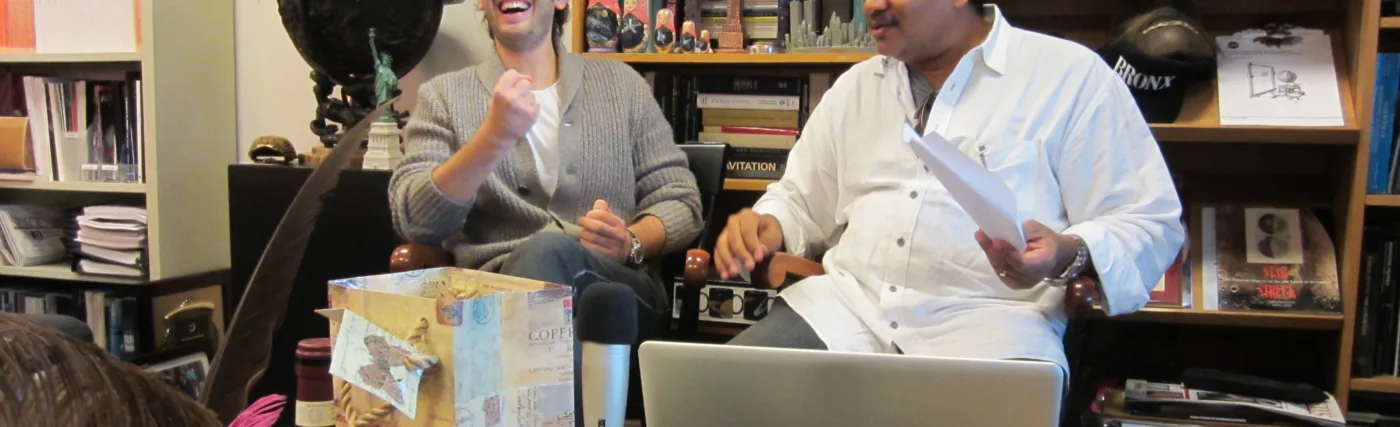
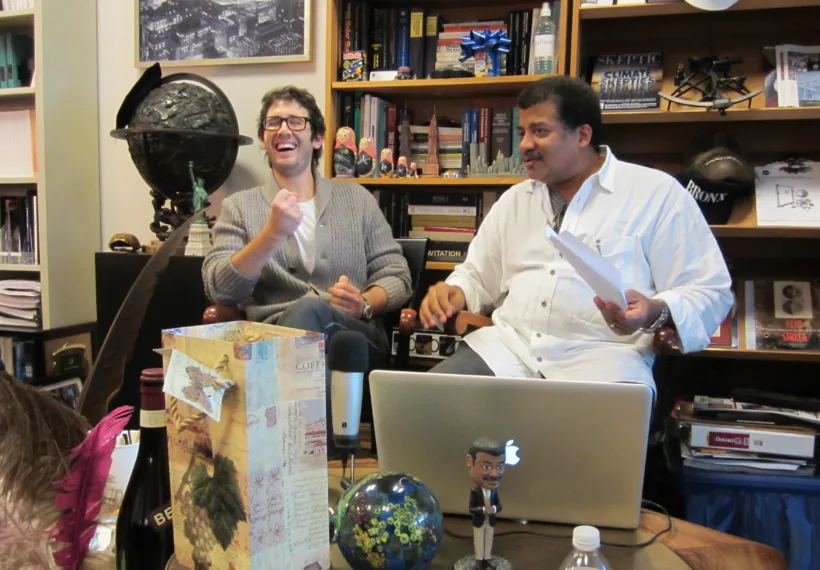
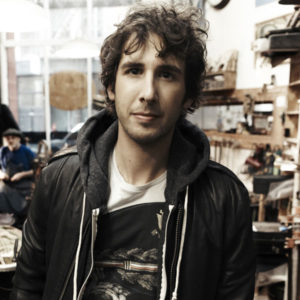
There’s more to a song than meets the ear, as Neil deGrasse Tyson finds out when he interviews singer/songwriter/producer Josh Groban. Josh shares how he got started playing his family’s electronic Casio piano while he was still in diapers, and whether he was a science geek in school. In studio, concert pianist and MIT Lecturer in Music, Elaine Kwon, and co-host Chuck Nice add their voices to the chorus to help us hear the science woven into the songs. You’ll learn how artists breathe life into their music, and about the qualitative difference between human generated and automated music. Explore the importance of the acoustics of a performance space, the effect music has on people, the difference between melody and harmony, the ranges the human voice is capable of, and which was more important, Charlie Parker’s personal style or his sax. Plus, Neil and Josh discuss “acoustic panty removers”, Chuck admits to singing first soprano in his church choir, and we find out whether Rachmaninoff really had “big hands” and what rubato means.
Transcript
DOWNLOAD SRT
Welcome to StarTalk, your place in the universe where science and pop culture collide. StarTalk begins right now. This is StarTalk. I'm your host, Neil deGrasse Tyson, your personal astrophysicist. I serve as director of the Hayden Planetarium at the...
Welcome to StarTalk, your place in the universe where science and pop culture collide.
StarTalk begins right now.
This is StarTalk.
I'm your host, Neil deGrasse Tyson, your personal astrophysicist.
I serve as director of the Hayden Planetarium at the American Museum of Natural History right here in New York City.
And I've got with me in studio, Chuck Nice.
What's happening?
Good, good.
You know, we're featuring my interview today with Josh Groban.
I know.
It's Josh Groban.
Josh Groban, my wife loves that guy.
Every dude's wife loves him.
What is up with that, man?
What is up with that?
She loves him.
Yeah, and you know, we're helpless in this when confronted with his fall.
Exactly, right.
So then I figured, well, to just make this an all music show, I thought I'd bring in some expertise in music.
So we combed the land.
And so we don't want just any musician.
We want, since I'm an academic, I want to get some PhD music going on here.
All right.
So we found Elaine Kwon.
Elaine, welcome.
Hey, thanks for having me.
Thanks for coming.
You have a PhD in music.
Well, actually officially a doctorate of musical arts.
Musical arts.
So does that mean you play better than anyone else or know more about music than anybody else?
Like which?
That's a good question.
Like, do you suck at music, but you know?
Yeah, it's like, could you have a doctorate and still not play anything?
Like, what do you play?
I play the recorder.
Hey, that's valid, that's valid.
Yeah, no, I mean, the DMA is more focused on performance, actually, but you can, you know.
So performance as an art?
Absolutely, yes, for musical arts.
Look at you, not to say that you're tooting your own horn.
And you teach at MIT?
I do.
The Massachusetts Institute of Technology.
Yes, I've been there since 99.
That means she's got street geek cred.
Yeah, I was gonna say, because I hear there are some pretty smart people there.
Yeah, even if you're not a geek, automatically, you become one.
Like, I went to MIT for two years.
I mean, I never enrolled in a class or anything, but.
I thought I saw you there.
You're wandering the halls.
I just hung around, you know.
That's good, I like that.
I went to the block that MIT is on and hung out.
Panhandled.
You were the hall monitor.
The hall monitor, yeah, yeah.
So Elaine, just to throw this out here, because you were like, you kick some major martial arts butt, is that, are my notes here correct about you here?
On my days off, yes.
Is that part of your doctorate?
I know.
Yeah, in the special school where I go for it.
It's like you come in one day and they're just like, yes, it's piano concerto number one in B flat, and by the way, break these boards.
That's right, right.
It's actually what I call my life chord.
I put my life in musical terms.
So yeah, I have my music, which is the piano, it's the passion, I've got my health, which is martial arts, and then the purpose is teaching at MIT.
Does that mean in the bathroom you have your bowel movement right there?
Sorry, I just, if your life is.
If your life is like that, I'm sorry.
So you're five time national champion in taekwondo.
Of all the martial arts, that's my favorite.
Is it?
Yeah, yeah, because I like using the leg.
It's a big leg thing, right?
It is, lots of kicks.
I love kicking.
That's cool.
Yeah, I love kicking, all right.
Yeah, I do too.
Yeah, yeah, yeah.
After the show.
Yeah, we will totally do this.
We'll kick the light out from the ceiling.
So for this first segment, I want to focus on singing as an instrument, voice as an instrument.
Josh Groban, he's award-winning singer, songwriter.
He's also an actor.
Yeah, he had a recurring role in a few shows.
And he sold 25 million records.
Oh, no, he didn't.
Yes, he did.
I was completely unaware of that.
Yeah, yeah, totally.
Yeah, so he's got a very devoted following.
25 million, and now, I mean, was that like 25 million people went out and bought it, or just some really rich guy he knows?
Bought 25 million.
Like, really, he's that popular?
He's very popular.
So let's find out, let's open up the interview, find out just how he thinks of voice as an instrument.
We'll find out.
It's a really kind of interesting thing when you wake up one morning, shortly after your voice changes and realize that, you know.
You just went through puberty.
I just went through puberty, I know.
You know, no need to congratulate me, it's cool.
I'm enjoying it.
And a lot of benefits.
A lot of benefits, boy.
I didn't realize how cool it would finally be.
But it's an interesting responsibility to have an instrument that's inside you.
And, you know, to understand very young that you can't polish it and put it away.
Your body is your instrument.
Gotta treat it right.
It's an amazing responsibility, it's an amazing gift, but at the same time, it can be a real pain in the butt.
So what came first?
Your voice as an instrument or the fact that you actually perform instruments?
It was my love of music and performing instruments that came first.
I got my ear from my dad.
I grew up kind of playing the family piano.
I would come back from concerts and I would just kind of figure out, you know, songs on the piano.
So there's something to be said for a family piano.
Oh, absolutely.
100%.
I mean, my...
It would make a difference if you get to like the Casio plug-in?
That's what we started with.
It was an actual Casio plug-in in like 1983 or something like that.
My dad brought home a Casio keyboard with basically like four beats and two sounds.
And you were two years old?
I was in a diaper playing on that thing.
I would put on the bossa nova beat.
I love the bossa nova.
Oh, the bossa nova.
That's everybody's first button.
It is everybody's first button.
And so I would just kind of throw my hands on the piano and eventually I would make these grand chords, you know, and they were just these, you know, I listen to the videos now and they were these wonderful dissonant chords, but I was just messing around.
Use the word wonderful and dissonant in the same sentence.
Oh, it isn't.
Oh, yes.
Just so you know.
They call you your tenor, I guess.
Is that right?
I actually am more of a lyric baritone, I would say.
I have a lower voice than would be necessary for a full operatic tenor.
I've always...
The tenor sometimes hit those higher registers.
And I can sing those notes.
I just choose not to perform those notes.
So where's your sweet spot?
My sweet spot is in an F, F sharp G range.
Yeah, I can make an F sharp sound like a B.
Let me hear the connect.
I've got to get my piano app on my iPhone here.
Oh, to get it on.
Wow.
Yeah, so he was joking about entering puberty.
And we were joking, because he has such a boyish face.
Yeah, my wife says I'm about to enter puberty any day now.
At least I'm looking forward to it.
So Elaine, when we think of a voice, there's your chest cavity, there's vibrating vocal cords, there's your tongue, lips.
So when you think of music, in your head are you thinking about all the things that go into what makes the vibration?
That's part of what you have to study to understand music, right?
Yep, musicians definitely, we study that, but actually it depends on what instrument you're really focused on.
But in the voice you got the whole, there it is.
For voice, you yourself are the instrument, so you naturally create these vibrations from speaking anyway.
So as a pianist though, as we're thinking about making the tones and not necessarily creating that.
All right, so the piano person doesn't have to worry about air supply, where so many other instruments do, right?
Sure, yes, it's true.
We do have to put breath in the music though, so you put it in with your body, as you phrase with the body.
Really?
Yes, whereas singers will take, or any wind instrument you breathe in through your nose, goes through your diaphragm.
So now, when you say music.
Wait, wait, wait, I gotta hear it.
Wait, you're telling me the piano player is breathing into the music?
Oh, oh, absolutely.
That's phrasing, that's all, that's what it's all about.
So the phrasing comes from the body movements?
Is that what you're saying?
Not necessarily, I mean, if you force that in there, it's false, but you know, music unfolds in phrases, in segments, like sentences.
Wait, wait, wait, but can't I just copy you and turn you into a piano roll?
And the piano roll ain't breathing, it's just.
That's why it doesn't sound, it sounds artificial.
There's music that you hear digitally, you know, you can hear it online, and there's something wrong because there's no breath.
So you're saying there's no life in it then?
Exactly, you can tell when there's a human being behind it.
With the voice, you can, you know, you sometimes can hear the inhalation.
You know, with the piano, you have to breathe as you play and you move and your whole body goes into it.
So tell me about the registers.
Is that what it's called?
The range, low, medium, high?
I mean, for a voice, yeah.
Yeah, for voice.
Your voice register, yeah.
Yeah, so.
Sure, you know, bass, baritone, he's lyric baritone, which implies it's a little bit higher.
You have tenor, you have a contratenor.
Then comes alto, mezzo-soprano, soprano.
And I lost my nuts.
Those are the ranges.
That's the highest if you go, right?
No, no, the highest, you get kicked in the nuts.
Get that straight, you know?
The next one, we'll have a kicked in the nuts symphony.
Yeah, so, you know, as far as determining what your range is, is, you know, you just can just say, well, how low can I sing, and how high?
Because pre-puberty, I think there's no difference between the girl voice and the boy voice.
Well, I know, I sang first soprano in choir, so for a very long.
How recently?
Yeah, I sang first soprano in choir for.
Was it church choir?
It was a church choir.
And for Grace Episcopal Church, and it was wonderful, I replaced a young girl named Lisa, who had moved to Alto because she had, like women go through puberty, their voices change too.
Oh, yeah, absolutely.
So, you were still in there though?
Yes.
Okay.
And so, I was teased quite a bit because I sang the first soprano parts, and then of course, I went through the change and I got my first monthly, and that was the end of that.
Well, they probably were sad to lose your boy voice, because even if you did replace a female girl voice, it's different.
The timbre of your voice is different.
The timbre, okay.
So, here's the thing, when I think of there's music, and then when I think of song, the song brings you in in a different way, because there's words, the lyrics mean something intellectually and emotionally to someone.
But a good performer, where there isn't even necessarily lyrics, presumably can achieve that same influence, right?
So, in my conversation with Josh, I was just trying to understand the effect of music on somebody, whether you feel love or hate, because all his people are women, right?
And so, there's some vector of communication going on with his songs, but don't go on with some other song.
Let's find out where he's gonna take us there.
As a singer, we're nuts.
There's all sorts of vibrations going on and weird mental neuroses that are happening in the midst of singing a song.
So, you try and go through your checklist of everything you need to accomplish, but, it's crass to say it, but my voice goes, it's not vocal masturbation, it's for the audience.
And so, a lot of times, you're not thinking about the enjoyment or the power or whatever.
You're thinking about very kind of boring things sometimes about just making sure the technique is correct, and you hope that you're focusing on the craft of what you do is causing an emotional reaction in other people.
And so, it is amazing when you make connections to Calls of the Wild, I mean.
Because you sing and then they show up.
It's an animalistic thing.
They pay money, they drive great distances.
They drive great distances, they hear these odd noises.
Syllables coming out of your mouth.
The thing that can't always be explained is, lots of people have beautiful voices.
Living in New York, I hear voices better than mine.
I mean, incredible voices.
I sound great in the shower, but I can't sing.
It's a pretty epic reverb in the shower.
Yeah, no, it's awesome, oh my God.
I mean, that's really, no one sounds bad in the shower.
And I've always said, there's no half singing in the shower.
You're either an opera diva or a rock star.
There's no James Taylor in the shower.
There's no tentative, yeah.
No, there is, this is.
Thing in the way, no, no, no.
No, you are, it's all or nothing in the showers.
It's a mating call, really.
It is, because sometimes having the right proper technique has nothing to do with the reaction.
So you might have people that have trained at Juilliard or trained to be the greatest opera singers working out there.
And they might be able to hit the notes as perfectly as somebody can hit it.
And for some reason, it won't make someone cry, you know?
But then you'll get a voice like Edith Piaf.
She was a street performer.
No formal training, but had something.
There was a trill, there was something.
You know, who else was very real that way was Billie Holiday.
Billie Holiday, of course.
Yeah, I mean, you wouldn't put her on an opera stage, but something about that.
There's something.
You felt the words that came out of her mouth.
And I think it's important for vocal students and important for arts programs not to teach nuance out of somebody's natural instrument.
I think that our animalistic call that we have is in us, and it's us, and it's natural.
So what you're saying is it can't be taught except only to find it within yourself.
I think that technique can be taught, and technique is necessary, but I think that we all are born with different nuances that make us who we are as artists, as thinkers, as singers.
When you think about what the mating thing is, it's about expressing that uniqueness, and people can choose whether or not they want to come running to it or not.
So yeah, there's a lot there, and so we're just one, plus, we're just one animal in the animal kingdom that makes music, right?
We've got humpback whales, we've got frogs, we've got birds, we've got...
I'm reminded of a Gary Larson comic where this father takes his son out to the backyard, and his backyard is cordoned off with fences, and there's a fence everywhere in everyone's backyard.
And they see a songbird singing in the tree and says, Timmy, that song by the bird is a primitive way that they show and mark their territory.
And there are these picket fences all completely up and down.
So let me ask, is there, when I think of song, normally, I think of a human voice singing words, but there are piano pieces that are almost that themselves.
Right?
There are these sweeping pieces and then there are other piano pieces where, yeah, the piano is singing to me.
What distinguishes that?
Is it the pace of notes, how long you hold a note?
What is it?
Well, something song-like means that if you're describing a piano piece or an instrumental piece of music, is that means it's trying to imitate the inflections of the words and to convey emotion as strongly as words and the meaning of that can convey.
Oh.
And now, is that just a definition or are you saying that that's really what it's doing?
It's both.
So when I say I'm playing a piano piece, I don't say piano song, unless it's like Songs Without Words by Mendelssohn, which is a piano piece.
Yeah, when I first heard about that, I said, what the, how can she talk, what, what, she's, song without words.
I'd heard, I was young when I first heard that there's such a piece existed.
Yes, yes, it's a literal definition song without words, and it's very lyrical, so that means there's a melody with harmony underneath, because a song is really a melody, because the human voice, we sing, unless you're doing overtone singing, you can, you sing one note after another, and that's melody.
Harmony is when you have the notes lined up simultaneously and are moving across.
So, so, so.
That's why you need more than one person to harmonize, because you can't harmonize with yourself, unless you have playback.
Right, unless you're overtone singing.
Yeah, yeah.
There are some overtone, they can do it with the overtones in the throat, but generally.
These are a different species of humans that can do that, yes, okay.
Or they're schizophrenic or something going on, right.
It's a skill, you know, manipulating the vocal cords, but, but.
But, so would a piano piece that is lyrical, as you described it, can that be as potent as a pop song?
With lyrics.
With lyrics, right.
Oh, I think so.
But it's all in how expressively the performer can do it.
And because piano is a percussion instrument, so once you play a note, the sound goes out.
And so you have, it's this, it's how you connect the spaces between the notes.
And because it is percussive, you can.
Oh, she sounded like Jazzy Neff.
That was it.
It's the space between the notes.
She's getting all jazz at the Blue Note on her.
That's very cool.
Okay, so between the notes is?
Yeah, it's connecting the sounds.
So it's all about phrasing to make something expressive and emotional.
Well, when we come back, more of my interview with Josh Groban and more expert commentary there on StarTalk.
We're back, StarTalk.
Chuck, how you doing?
We're featuring my interview with Josh Groban.
Yeah, I know.
The crooner.
Yes, he is.
The babe magnet.
Yeah, I see.
Gosh, I wish I could sing.
But I can't have a music show without a music expert, and I got Elaine Kwon, a concert pianist.
No.
Yes, concert pianist.
And a doctor of?
A lecturer, a doctor of musical arts.
Doctor of musical arts.
And a lecturer at MIT.
And a lecturer at MIT.
And so what I want to know is.
Why don't you do something which you like?
I'm slumming, right?
So, has your mother told you that over here?
That's okay, Chuck.
We love you here.
So, what's curious to me is, we were speaking in the previous segment, what impact music without words can have versus music with words.
Now I know if I'm here in a performer, and I like their mellifluous notes, I'm gonna be cueing in on the person.
And in fact, we have voice print identification, right?
Voices have signatures.
They have signatures.
You know where most of us first saw voice print identification?
Where?
In the opening scenes of 2001.
Not the very opening scenes with the apes.
The one where he's coming on to the space station and he goes through voice print identification.
They make a whole big deal of this.
It says, Christian name first and given name second.
Or something, or surname, Christian name.
You know, that's how I guess they said it back then.
So then I said, wow, so your voice can do that.
And so I wonder, can a person be as seductive to a listener playing a piano as a crooner can be singing a song?
Oh, absolutely.
I totally believe that.
It might be a little bit harder to identify, but it's-
To see who's playing it.
To who's playing it, exactly.
And would it have more to do with the instrument or the style?
Because for instance, in jazz, you totally know when Charlie Bird Parker is playing.
Because you get the style.
Because you got the style of Charlie Bird Parker.
But also he played a certain saxophone.
You understand what I'm saying?
So which one is more important?
Is it the style or is it like the actual instrument?
I think it's the style.
Because today, especially for recording, there's so much editing that goes on.
But they're not necessarily editing how somebody interprets a piece of music.
So you can tell a lot of us.
Because that's within the notes that they have to keep.
Right.
Yes, exactly.
So rubato, which is the term for when you take time away and give time.
It's that give and take in music, the slowing down, speeding up.
That has a word.
That is very personal.
Would you call it rubato?
Rubato, yes.
Chopin's music, I mean his is full of rubato.
I'd love me some rubato.
Yeah.
No, it would be boring if you didn't have some rubato.
Domo arigato, Mr.
Rubato.
Yeah, exactly.
That's why mechanized playing, it just never is effective because there's no rubato in there and that goes back to breathing.
But you can identify that with certain performers.
There may be a tendency.
Well, Josh's songs, they're like liquid seduction, acoustic seduction.
Let's find out.
We talked about this.
Let's find out what he said.
Okay, so you're a crooner and the women just can't stay away from you.
Well, you know the feeling.
I mean, come on, this is, we're in very similar areas there.
I mean, you start talking about multiverses and the pants just drop.
Well, let me ask you.
So you start singing and the piano goes and it's like an acoustic panty remover.
It is.
Let me ask you if you've thought about this.
How come a guy who sings those ballads, okay, women are throwing panties on the stage, but a woman who sings, like guys don't throw jock straps on the stage.
If they did, I don't know that that would work.
How come it's not symmetric?
It's not.
I want symmetry in this world and I don't understand that.
Okay.
There are attractive singers, but a guy would like it just because she's attractive, not because she sings great.
Whereas guys, man, you sing, they're chasing you down the street.
I would imagine part of it is just convenience.
I would imagine if you're wearing a skirt, it's easier to get the panties off than if you're wearing Levi's.
You would have to take off, we're just getting really technical now.
But yeah.
I had not thought about that.
But if you're like me and like to wear your underwear over your jeans.
There's a geometry problem of removing the topology.
It's way too difficult.
You would be kicked out of the venue for lewd behavior long before you were able to get your jockstrap on stage.
Right, the practical fact there.
That's exactly right, yeah.
If ever I get a jockstrap thrown on stage, I may start to kind of think about how I rewrite some material.
So what percentage of your fan base is female, would you say?
I would say the scientific percentage after studies we've done is about 103%.
Three percent could have a sex change, it would still be 100%.
That's exactly right, yes, yes, yes.
A few of the men have now gone to Thailand and come back as fans.
Built in the sex change factor.
Presumably your audience at a live concert is not 100% female.
So the women are bringing their guys.
And then there you are, and what am I doing sitting next to my woman?
It is my job to make the gentleman in the audience feel great by the end of the night.
Not only because...
Because you know we can so kick your ass at the end of the concert.
That's exactly right, yes.
I don't have the wrestling arms that you have, so you know, I rely on singing and wit to win them over.
So is this comedy, humor?
So yes, you know, I'll explain to the guys in the audience, well first of all, a live concert is your opportunity to give them what they know, but also to win people over.
You know, you want to give people what they didn't know they wanted as well.
So when a girlfriend or a wife or a mom or whoever brings their son or brother or husband, even if they drag them along, it's really my goal by the end of the night for them to say A, I really enjoyed that from a creative standpoint, and B, for them to understand I'm here to help them.
You know, this is just two hours of a very long night, wink, wink, you know, and I want them to have an amazing, I want them to feel good about their investment coming to a Groban concert.
Brownie points, I'm telling you.
Oh, okay, so you're just a cog in the wheel of the guy's evening.
Exactly right.
I'm not just singing for the women to flock to the stage.
Because in practical terms, they can't.
The security will tackle them.
So I'm singing for them to cling even tighter to the person next to them.
That's diabolical.
That's using the power for good, don't you think?
That guy's out of control.
So, Elaine, this concept of romance, I've read there's this romantic period in music, they say, early 20th century.
1820s to about 1900.
So almost 100 years there.
So what makes music romantic, piano music romantic?
What constitutes that?
There's more diverse harmonies and lyricism and melodies.
So the romantic period came about with the growth of the novel also.
So it's about self-expression and the personal journey and individual.
So it's the harlequin of music.
So they coincided.
All the sheet music has a little picture of Fabio on it.
So at that point, music was tonal.
Atonality came in the 20th century, but the tonality was starting to be expanded.
So tonal music means you have a home base, a key center.
And romantic music started to stretch those boundaries.
So you're living more on the edge.
You're going into maybe the more dangerous parts of your life journey.
If you're telling a story through music.
So you're stretching the boundaries.
Like a good novel would be because of the novel takes you there.
And you don't know what you're getting into.
It's exploration.
Fifty shades of scales.
Yes.
And by the end of the romantic period, you're ending up in a completely different key possibly.
Pieces got longer.
Because I guess, what's the one I'm thinking of?
Rachmaninoff, his second-
Piano concerto?
Rocky II, I think I've heard it called.
Yes, right.
It's used a lot in movies.
Is that the one that goes, da, da, da, da, da?
Is that the one?
I feel like swaying to that.
Yeah.
And it's, so have you played, do you play, do you do romance?
I love romantic music.
Yes, I love that era.
I love Rachmaninoff.
Definitely his preludes, his concerti.
The CD I just did, he was Rubinstein.
I'm told he had one of the largest hands of any performer.
That's what all the girls said.
He had an octave in, I don't know, two or three notes span.
It's pretty big.
Wow, that's big.
Yeah, I show a photo to my MIT students, and his knees are way up at the piano.
You need a special piano built.
So he was a giant man.
He was giant, and apparently a bit stoic, but his music was so beautifully expressive.
As was Chopin's, as was Rubinstein's, as was, I mean, there's a whole field of romantic composers, and it's kind of to your liking at that point.
There's such a wide range.
So Elaine, when you play music from this romantic era, do you have to feel romantic while you're playing romantic music so that the listener gets a double hit there?
Is that?
I think it helps if you can put yourself in that mindset.
It's not always necessary because of hours and hours of preparing.
Sometimes the physical just takes over.
Takes over, takes over, yeah, yeah.
But I think the most effective performances is when the audience can feel the mental and the physical and the spiritual all combined.
What's that chocolate movie or the baker's movie where the emotions of the?
Like water for chocolate.
Water for chocolate, yes, that's right.
The emotion of the chef ended up in the food.
In the food, yes.
People ate the food and they felt the emotion of the.
That is why you are sick.
Because my emotions are in your food.
You know, the concerts I've been playing now is based on a series I do, it's called Savor Your Senses, which is actually combining all the senses.
So the listening and the tasting and the hearing and the seeing are all combined.
So I always wondered what, you know, there's science in music, and I like to think there's music in the universe, the harmony of the spheres it was once thought of.
But, you know, Josh Groban, there's actually some geek in him.
And Elaine, you teach at MIT, there's no shortage of geeks at MIT.
If you swing your arms, you knock down three of them.
We are all geeks there.
Let's find out from Josh, just what kind of a geek was he growing up?
When you grow up in the arts, it's pretty much the same lunch table as the science kids.
It was easier for an arts person to be cool than a science person to be cool at that age, isn't it?
It absolutely depends on the group of friends you have around you and the kind of school you go to.
I think that for me, especially with the kind of voice that I have, I wasn't in a rock band.
Playing and singing more classical style and musical theater style songs was not like the cool thing to do.
I tried to play football.
You at least were a wrestler.
I tried to play flag football.
I got hit once and I remember my parents taking me to El Torito afterwards and I was just saying to them, yeah, I'm not gonna go back out there again, guys.
I'm just sorry, that's it for me.
So yeah, no, I-
So had you been good at flag football, you might not have ever gone into music.
I might have become a professional flag football player.
Yeah, no, I had to make music.
I was in love with it ever since I was a little kid.
I didn't know what it was that I was in love with.
I didn't know why it spoke to me so much, but-
Well, I read your FBI file.
Yeah, as-
There's an FBI file?
You have that capability here.
We have the power.
And I heard that you won an elementary school science fair.
I absolutely did.
If you would have fessed that up, here in front of me.
Well, what we did was we set up a system where we put a piece of rubber over a tin can, and then we had that old Casio keyboard, and we put the tin can over the speaker, and we magnified the light onto the, we put a mirror on top of the rubber, and I was able to make sound waves on the ceiling.
Oh my, brilliant.
So you converted the sound waves into optical vibrations.
Optical vibrations on the ceiling, using the light on the cans that we put on top of the keyboard.
And how old were you?
I was 10.
Brilliant.
Thank you very much.
Oh my gosh.
Yes, that was, you know, so-
So I wanted at an early age to try and find ways to get in with both clubs, with the science club and the music club.
Wow.
Making that happen.
Look at that.
So Elaine, is there, is it true what Malcolm Gladwell says that if you're gonna be an expert in something, you gotta have spent 10,000 hours on it?
I believe it is.
Yes, I think so.
There's a certain-
So that'd be the science of talent, I guess, is if you think of it that way.
Yeah, I mean, talent and success, I think, comes from just sheer hard work.
So the 10,000 hours that's indicative of hard work, hard time put in, which you really need to put in.
So you don't believe that there's any natural proclivity to do, you can't be musically inclined?
I think people can be naturally gifted, for sure, but to make that system-
But they can't be naturally great.
Yeah, correct, yeah.
You have to work at that.
You have to work at it.
You can be, some things can come-
I'm not sure how hard I've worked, Neil, but now that you bring it up.
I think to have endurance or longevity.
I mean, in science, you have to study, you have to know what is known before you can declare that you've made a discovery that has never been made before.
And so there's a huge backdrop on this.
I mean, many, many years in school.
And so, actually, Josh had some opinions about what scientists and artists had in common.
Let's find out what that is.
I think there's a certain curiosity that is similar in music and in science.
There's a certain part of the brain that has to flip on in order for me to find a creative space.
And so I think that if I'm writing, it's one of those things where I can't force it.
It's one of those things where I'll wake up in the middle of the night and I'll just go straight to the piano.
And you kind of have to look at, for me, the creation of music and what you're feeling when you're singing all that with the same kind of.
So you're exploring the unknown.
Well, yeah, you're exploring the unknown.
There's a wide-eyed wonderment that I have to where that comes from and what causes it.
I love that, wide-eyed wonderment.
I might write a song about that.
Wide-eyed wonderment.
You got it.
So Elaine, it's one thing to be really good at playing something that somebody else wrote, but what does it then take to then write something that no one else dreamt of?
That's another step, right?
Sure, yeah, absolutely.
And so many people in the classical world, you go to a concert to see a performer perform what somebody wrote 100 years ago, right?
Yes, although every interpretation is different.
Okay, yes.
And so, but because you're in fusion.
Like in jazz, there's a lot of songs that have been sung 100 times, a thousand times.
And a thousand different ways.
A thousand different ways, yeah.
Same thing with classical music, same thing.
But definitely creating your own composition that takes sparks of, I guess, your own personal genius, but it can also be trained, too.
You can put yourself in that situation to create.
Creativity takes practice as well.
So you could do it kind of like the experimentation of science, where you trial and error, and you do things over and over again to see what works and what doesn't, right?
Yes, exactly.
You hardly ever get to see the trash can.
Right.
You only see the finished product.
The finished product.
Yeah, you don't see the scads of sheet music that suck.
If we saw Mozart's trash, Mozart, you suck.
Maybe not Mozart's, because he was pretty imperfect.
Bad example, okay.
But Beethoven, Beethoven, you can see the scratches in the score.
Yeah, Beethoven, get it right, dude, come on.
Beethoven, right while you're deaf.
Yeah, everyone has their own process.
When we come back more featuring the StarTalk Interviews with Music Cleaner, Josh Groban.
Good night We're back, StarTalk, Chuck Nice.
Yes, sir.
With my special guest, Elaine Kwon.
Music expert.
You teach at MIT.
I do.
Well, what do you teach?
I teach fundamentals of music, piano lab, and sometimes harmony and counterpoint.
Okay, cool.
Harmony and counterpoint.
Oh, yes.
Is that like a musical debate class?
I like this music.
No, you don't.
Yeah, so that keeps you, so you see fresh blood coming up every day on that.
All the time.
I've taught hundreds and hundreds of students, and in fact, they learned I was coming on this show, and I have a couple of questions if you don't mind me asking you.
That they have for me?
Yes.
Turning the tables.
Oh, look at this.
So the first one is, does your mustache have a name?
It doesn't have a name.
It has never had a name, but it is true that I have never shaved my upper lip in my entire, I mean, I've trimmed it, but I've never.
Never went totally bald.
Yeah, when I started going to mustache, I could get into X-rated movies.
I said, this is good.
Before, like, it was on the internet.
When you say get into, you mean the theater or the actual movies?
Yeah, let me clarify.
Yes.
No, you know, when you're young, you want to look old, and when you're old, you want to look young.
So it was in that phase.
And so I've had my mustache ever since then.
It's never, a razor has never been to my upper lip.
Oh, no name mustache, okay.
And I'm not so creepy that I named my mustache, no.
Yes, we'll name it now.
Generalissimo Cosmos.
Generalissimo Cosmos.
That is his new name for his mustache.
Great.
And the second one.
Another question, right?
Is from, well, this might be harder, but we don't have to answer it now.
It's from actually a student who was an intern at NASA's Jet Propulsion Lab.
In Pasadena, California.
Yes, Jacob.
And he's asked is, are there any questions that science cannot answer?
I know it's a big one.
I would say that science and questions go together.
Mm-hmm.
Like beans and rice.
Like, you know, like biscuits and gravy.
Biscuits and gravy.
Like grits and butter.
Like grape juice and bounty.
Okay.
That was way too fast.
I have no idea where that came from.
So there are questions that science has yet to answer, but I look at the repository of questions that once befuddled civilization that have fallen to the curiosity and methods and tools of science over the centuries.
And so there's no question that we have yet to answer that I'm gonna say science will never answer that.
We've done such a good job thus far that we will push on.
And as our area of knowledge grows though, so too does our perimeter of ignorance.
So there will be a forever supply of questions until the universe ends.
So the answer is no.
Damn, Chuck, I'm trying to be all poetic here.
I got you, Chuck.
So what do you think, there's this whole frontier here of like music on space missions.
If you're gonna go in space, what music might you take, you might ask.
Because nowadays it's not just you're going up in orbit and coming back, you're going nine months to Mars, a year and a half there and nine months back.
And so you don't wanna get bored.
So I wonder, is there music, because I've thought about this, is there music that is so textured, so rich, so multi-dimensional that you could just carry it for years and never just grow completely sick of it?
That's what I wondered.
In fact, I asked Josh Groban about that.
Let's find out.
I wanted to ask what music, if there's gonna be any kind of arts way in the future, obviously, or even now.
I read something that Sarah Brightman, I guess, was gonna be the first singer in space.
Yes, but she's from Phantom of the Opera.
Yeah.
So yeah, she's going up.
She's, I think, the first professional musician on the space station.
Why not have more?
Why not have a concert on Mars?
Sure, the acoustics would be a little different.
And you can't come back.
No, if I did, I'd make sure we, but think about it.
I grew up where all the people who were sent into space were like military pilots.
And I'm thinking, is that who can best report for you what it feels like?
I want to put some artists up there.
There needs to be some human.
Some poets.
Some people who can feel what that was rather than just know what it was.
And so someone who's compelled to write or to compose or to sing.
I wish Steinbeck had been allowed to travel into space.
I wish he would have been able to come back and journal what that would have been like.
Have we done that, though?
I mean, have we sent...
One of his books is Travels with Charlie.
So he travels with curiosity.
Or Russian Journal.
Yeah, exactly right.
Martian Journal.
But how often have we sent kind of non...
Hardly ever.
So I will put your name in for that.
Thank you.
Well, is that because you actually need the skills that you need?
Or could any of us put on a space suit and trust the other guys to get us up there?
No, some of them became space surgeons when they were fixing the Hubble Telescope.
Right, right, right.
Yeah, so everybody's got tasks.
You gotta have something, yeah.
And it's not quite the...
Oh, I got an extra seat.
You know, yeah.
So maybe that's been the problem, I think.
I think, yeah.
So you wanna go into space?
Oh, I would love to.
There are days where I would be perfectly happy to go to Mars and be one of those that just has a one-way trip.
I mean, I...
Okay, I don't know how many albums you've sold, but you gotta be able to drop 20 million.
I gotta be able to drop 20 million.
At the moment, I'm a little more concerned about Earth and charitable things on Earth.
But if one day I had really a few money and had the opportunity to do it in a heartbeat, I would do it.
I hope it becomes less expensive.
I hope it becomes one of those things where...
I mean, that's what we're all bucking for here.
And my hope and expectation is the day you do that, there's some other creative forces operating within you.
So it's a whole other creative chapter.
The space, Groban.
When I was a kid, my favorite costume was a spacesuit.
All day long, every day, I would wear a spacesuit.
And I was not Josh Groban from Earth.
My parents, you know, with the video camera, they'd say, are you Josh?
I'd say, no, no, I'm not.
And I would open my space mask and they'd say, well, who are you?
I'm John from another planet.
I don't know where this character came from.
Did you specify the planet?
No, I did not.
So it didn't matter where it was from, just that it wasn't Earth.
Just another planet, yes.
It wasn't Earth.
No, no, I'm John from another planet.
Last, from the age of about three to six.
The man is geekier than we thought.
Yeah, it's worse.
You wore a space suit as a kid and John from another planet.
He's out there.
He's not a space cadet, he's a brigadier general.
Exactly.
Oh God, that makes me feel bad about my childhood.
I wore a three-piece suit and I was Stanley from your local insurance branch.
But one day I'm gonna work my way up and own the insurance branch, so don't worry.
So you know the musician Will.i.am?
Yeah.
He's from, what do we know him best from?
His group, The Black Eyed Peas.
The Black Eyed Peas.
So he actually had a song, Reach for the Stars, that quote, premiered on Mars in August 2012 and was beamed back to Earth by the Curiosity Rover.
Wow.
Great.
So the solar system, as it becomes our backyard, there'll be this contest of who's gonna be the first composer, the first saxophone, the first piano composition.
I mean, why wouldn't there be, right?
Exactly, at some point somebody's gotta do it.
Somebody's gotta do it.
And so what I wonder, Elaine, music is used for so many different things that we even take it for granted.
Most of us, I'm maybe older than you, I think, but my first exposure to classical music were Bugs Bunny cartoons.
There was a huge catalog of classical music that showed up in the backdrop there.
Today, there's music being used for gaming, and so I'm just, you're okay with that, and especially, of course, movies.
You're okay with that, are you a classical music snob and you don't want anybody to touch it?
No, I'm not.
In fact, I'm more in the pop culture side, I think.
That's why I teach fundamentals so I can relate to students who have had no experience with classical music.
And the concert series.
I'd be in that class, yeah.
Yes, I actually enjoy teaching the fundamentals to an audience who doesn't have that knowledge.
It's more enjoyable to me.
But yeah, no snobbery at all.
Let's find out.
Josh Groban, we just chatted about the prevalence of music in every walk of life that we now experience.
So let's find out what he said.
I do think that there's a great deal of thought and intellect that goes into some of these games.
The music, for instance, I've noticed, from a music standpoint, you listen to some of the scores that are being written.
To games that are being played by millions of kids.
And they're hearing the London Symphony, play a piece written just for them, you know?
Cartoons used to do the same thing.
Of course.
Looney Tunes.
Everybody's introduction to...
I compare them all the time because they didn't know that they were getting a classical music education.
And they say, oh, cartoons, you know, come on.
And one of my early baptisms was Disney's Fantasia.
Yeah, of course.
But video games are doing the same thing.
There are some wonderful music being written to some of these games.
Hollywood Bowl now is doing video game night.
And they'll do the Hollywood Bowl Orchestra will play, you know, some of the great themes.
How often have you performed at Hollywood Bowl?
I've performed about four or five times now.
In physics, acoustics of the geometry of the chairs matters.
Does that hold up to the acoustics that look like it should have?
Like the amphitheaters of ancient Greece?
It does.
They've renovated it.
Cause it's still a band shell, right?
It's still a shell.
Yes, it is.
It's not amazing.
So the sound doesn't go behind you.
It reflects forward.
It reflects forward.
Now that's either good or bad.
Well, it is good.
I mean, you still have to have great sound engineering.
I mean, their speakers there now are great.
And of course, when you listen to what it was built for, which is a full symphony concert, it sounds phenomenal.
When you're putting pop and rock and that kind of thing, you're at the mercy of the guy at the front mixing.
I felt the same way about Carnegie Hall, where it was designed for pre-electricity, acoustic, and now I heard like a rock concert in there.
I saw Jay-Z there not too long ago.
I don't know if I like that.
It was just huge, very bass heavy.
Huge speakers on the floor.
I'm not at all a snob about that stuff.
I think that it's great that different diverse artists come into halls like that.
I think that way back when, when halls like that were first being made, Mozart, the classical music, that was the pop music of the day.
So I think it's great that all different types of artists play there, but then it's their responsibility, I think, to make sure they have sound engineers that really make the sound appropriate to the venue.
I think that's important.
So Elaine, what's the status of concert venues today?
The acoustics of it, is it good, is it bad?
Is it, have we plateaued?
Well, it-
Is there room for improvement?
I think there's always room for improvement, you know, based on funding to get a new, you know, performance space built.
Of course, the old standards are wonderful.
Carnegie Hall, Lincoln Center, I mean, these are designed to really, to enhance, you know, the instrument.
But, you know, especially classical musicians are finding different places to perform now.
You know, that we're losing audience to a certain extent.
And so performers are playing in rock clubs, in lounges, in, you know, small cafes.
You're a local park.
Yes, right, exactly.
This is what we're doing these days.
So maybe that's more important than the details of the acoustics, just getting the music out there.
Yeah, getting the music out there.
I mean, of course, it's a gift to be able to play in a fantastic venue.
I love playing at Carnegie Hall just because of that.
It's like this.
See, that's one of the cool things about Carnegie Hall.
I love playing at Carnegie Hall.
Yes, I love it.
I love thinking about playing at Carnegie Hall, but she loves playing at Carnegie Hall.
Yeah, she can actually answer the joke.
How do you get to Carnegie Hall?
She can personally answer that joke.
But the cool thing about it is, like in New York, if you go to certain parks, you'll see people playing chamber music.
And these are like really great musicians, but they're just playing for the love of playing and getting the music out there.
And I think it's really important that that happens because it gives people appreciation for the music.
Right.
Yeah, so also music has the power, it seems, to cross cultures like nothing has ever before.
Right, and I asked Josh about that just to get his take on crossing cultures.
You're probably most popular in America, but where are you second most popular?
Scandinavia, strangely, because I'm half Scandinavian, so I'm half Norwegian, so.
So you could do like a punky blonde hair dye and just show up.
I could, essentially, I'll travel to South Africa, I'll travel to Japan, I'll travel to Germany, and I'll say to myself, God, you know, are they gonna know the words?
Are they gonna, you know, is this gonna be any different than America?
Because you're not translating your song.
No, and they know every, they know every word in whatever languages I'm singing in, and they may not understand it completely, but they feel it, and it's interesting to me that they understand.
Well, that's a compliment to you.
Somehow, well.
That you're performing it.
The coolest thing, I think, is traveling around the world and seeing such a similar response, no matter what the culture and what the language is, it seems to be the same.
Well, you sing about love, and.
Universal things, yeah.
Yeah, if I just sang about America, it may not have had the same.
Good point.
Yeah, if I just, you know, if I went to a good old US of A, thanks for coming, Norway.
So pop music, of course, has been the very big thing in America, especially like I think since the 50s, you know, when the teeny, the youth became an economic force and they'd be buying music.
And I've always surprised Americans, they go abroad and they see other people dancing to our music, but, okay, some of that came back because here in America, we were shaking some body parts to Gangnam Style.
That's true.
And last I checked, I don't speak Korean.
That's right, that's right.
And it was not a translated version.
No, it was in Korean.
And I haven't checked this morning, but last I did check because I checked it for a while, there are like tens of billions of views of that video.
And I compared it to how many retina cells are in the eye.
And there has been, only you.
It's been watched more times than there are cells in the retina to have actually registered it.
So what do you think of the internationality of music?
Oh, well, we're all connected fundamentally.
I mean, something like Gangnam Style, I think people are more interested by the dance element of it.
You know, it's a funky dance and it has that motivic theme that you can't get out of your head.
Plus, he has a very unpretentious body, right?
Yeah, he's just like a guy off the street and watching him do this was fun.
Exactly, right, and so people-
Plus he owns it, come on, he sells it!
You don't have to know what he's saying, but that's what connects us about music anyway, is that fundamentally, it's this magical connection and it's all, I believe, for the heartbeat because we have rhythm in all of us.
So we can go anywhere and share whatever music we have and connect instantly.
There are a few things-
We are the world, we are the children.
It's all over the hands.
We are the music.
That makes sense, it makes perfect sense.
That is all the time we have.
We can go on for hours and hours, I'm sure, but Elaine, thanks for being on StarTalk Radio.
It's been so fun.
This has been great.
Thanks for having me.
So music will conquer the world.
Yes.
And ultimately, space itself.
Elaine, thanks for being on StarTalk.
Chuck, always good to have you.
My pleasure.
As always, I'm Neil deGrasse Tyson, your personal astrophysicist, bidding you to keep looking up.
See the full transcript



 Unlock with Patreon

 Become a Patron