Transcript
DOWNLOAD SRT
Welcome to StarTalk, your place in the universe where science and pop culture collide. StarTalk begins right now. I'm your host, Neil deGrasse Tyson, I'm an astrophysicist at the American Museum of Natural History's Hayden Planetarium. And I've got with...
Welcome to StarTalk, your place in the universe where science and pop culture collide.
StarTalk begins right now.
I'm your host, Neil deGrasse Tyson, I'm an astrophysicist at the American Museum of Natural History's Hayden Planetarium.
And I've got with me my co-host, Eugene Mirman.
Eugene, thanks for being here.
Hello, it's great to be here.
I'm your host, Neil deGrasse Tyson, I'm an astrophysicist at the American Museum of Natural History's Hayden Planetarium.
And I've got with me my co-host, Eugene Mirman.
Eugene, thanks for being here.
Hello, it's great to be here.
Eugene, professional comedian and your voice on Bob's Burgers.
Yeah.
Yeah.
Yeah, you get around.
I do.
I do.
I do at least two things, maybe more.
So thanks for doing this.
We're like on TV now.
I know.
Very exciting.
He fixed up.
Normally, we do this on the radio and he's on shaving, he's a little sloppy.
Yeah.
I've never seen the guy this neat.
I have a claw for a hand, but look, science.
Today, you know what our topic is?
Science fiction.
Science fiction movies.
You got any favorite movies?
I do have.
I love, well, one, I love science fiction, but I'd say a lot of superhero movies, Star Trek.
Superhero?
You want to be a superhero?
I don't know that I want.
I don't want the responsibility.
No.
It is a big responsibility to be a superhero.
If you believe even half, even if they have to do basically a quarter of the stuff they have to do in the movies, it's exhausting.
You said Star Trek too?
Star Trek.
Yeah.
I love time travel.
Because there are ways to do time travel that are astrophysically legitimate.
Yes.
Those are my favorite.
Sometimes I'll watch a time travel thing and be like pretty realistic.
Tonight we're featuring my interview with Christopher Nolan.
Christopher Nolan.
He came through town and I snared him, put him in my office and I milked him for 40 minutes of, well, you're not going to see all 40 minutes here.
Did you ever have him take it like a top and spin it?
To find out which reality we're in.
Yeah.
You watched all his movies, right?
I have seen a bunch of his movies.
It was Inception, right?
To know whether you're-
Whether you're dreaming or in the fifth world, I don't know.
Of course, we talked about how he thinks about time and space, and that would have been enough just to talk about Inception, but his most recent movie is-
Interstellar.
Interstellar, where it's more of not only time and space, it's especially relativity.
Now, I know some relativity.
Yeah.
But I don't know it-
How much in comparison-
I do some relativity.
I can do that.
However, I don't count myself as an expert in relativity.
I have to reach out into the ether to find such people, and we did just that with my special guest, Janna Levin.
Janna, welcome to StarTalk.
Janna Levin is professor of physics and astronomy at Barnard College, and Janna, you'd like all grown up because when I first met you, you were an undergraduate at Columbia.
I was just telling somebody I didn't think you remembered that.
Oh, yeah.
What you're majoring in.
You're a professor, wrote books, and expert on relativity and cosmology.
I looked up to you, Neil.
You were writing your Ph.D.
thesis at the time.
Notice that was in past tense.
I looked up to you back then.
I still do.
You're a full-fledged cosmologist, and people pay you to do this.
Yeah.
I get paid to do relativity.
To do relativity.
You think about black holes and the birth of the universe.
Yep.
You were the right person to think about and talk about.
Well, we'll see how it goes.
We'll see.
Janna, you have stars on your...
I do.
You know, I knew you were going to wear a thematic tie.
I just knew you were, so I thought I would match the sort of...
This is a black hole.
I know no one......very...
And it is spherical.
With a horizon.
With a...
And I didn't know where our conversation would go tonight, but I have every possible cosmic object of this tie, including a wormhole and black holes and galaxies.
And this is the best tie to wear if you're eating lasagna, because if something just falls on it, it's just another nebula.
Know from it.
What we want to really talk about is the science of the film Interstellar.
You've seen Interstellar.
I did.
Absolutely.
And it's quite an orgy of relativity.
Yeah, would you say when Matthew McConaughey cries, would you be like, is that physically realistic?
Is that physically plausible?
Within the realm of physics, is that?
Yeah, that was the part that I was not examining scientifically.
So, what I did was, when I started talking to Christopher Nolan, he's not himself a scientist, he's a movie director and producer, but I always like knowing if there's some influence, some teacher, somebody who sensitized you to this whole world of science.
Let's find out.
I think a lot of my interest in physics is from when I was about 10, and I was really watching the original Cosmos.
That was a huge impact on me.
Oh, you're so young.
Oh my gosh.
That was post-Star Wars, that late 70s, when the shuttle was about to go up for the first time.
So it was in the air.
It was absolutely everywhere.
The original Cosmos was 1980 with Carl Sagan.
And I remember watching that avidly.
So you were feeling it.
Oh yeah, feeling it in a big way.
And I think, I mean, it's a testament to the kinds of things that you're doing and so many people are doing educationally.
But I think really that 10, 11 year old, you get really fascinated by it.
But what I found in school was I reached a point where the mathematics became a burden and I wasn't as interested in mathematics as I was in English and writing and that kind of thing.
And so it's where physics starts to depend more on the math.
I sort of lost at that point.
That's a fair point.
I mean, there's a lot of good physics that you can follow just because it's really cool to think about.
Exactly.
Right.
And after that, you're kind of done, right?
Go on with the rest of your life.
But at least it was in there, percolating.
Yeah, very much.
I remember all those great experiments on Newton's laws, you do with a little rolling little lead balls down the slides and things.
Back when they made things out of lead.
Before we knew they would make us stupid and kill us all.
Christopher Nolan, so he studied English literature in college.
And so one of my big things is to get more artists interested in science so that they can fold the science into their art and take us to new places.
And you wrote a novel.
Oh yeah.
That you are a professor, a cosmologist, not to be confused with cosmetologist, just to be clear.
But you wrote a novel, but that's some artistic expression.
I think that this idea that we have to choose at some stage in our lives is kind of silly.
We go through this process where suddenly we have to decide we're going to be one thing or the other, when actually most of us are really a combination of those things, right?
Christopher Nolan is right.
It's the equations that really make science so dreary.
Oh, no.
The math is so beautiful.
I do understand.
It's not saying it's not beautiful.
It just is pretty.
It's such a way in, and it's such an exciting part of it.
I love doing the mathematics, and I think that is exactly the fork in the road.
You get to that fork in the road where you're mesmerized by the universe.
You discover the math.
You either hate it or you love it.
You get to the fork in the road and you pick it up.
You pick up the fork?
It's like the old Yogi Berra.
Sounds very meta.
The mathematics, for you, apparently not for Eugene, is...
Let's just say not for artists.
Let's not single me out.
One doesn't need to be completely mathematically fluent to nonetheless bask in the majesty of the cosmos.
I love logarithms.
I'm not an idiot.
You love logarithms to the base E.
I love them to base 4, base 7 and 12.
Boom!
I might be saying a thing that's right.
But what the equations do, if you want to take that one step deeper, it's like you part the curtains, this veil of the beauty of the universe, and there is the machinery operating.
There is the language.
Yeah, no, I get it.
We wouldn't have like stoves and electricity and fridges and stuff and cars.
I'm very happy with science.
But the math is actually a pleasure to do the math, and at some level, you know, there's this confidence because one thing follows the other.
You say following the chalk, and then you have this confidence when you're at the end of the line.
Following the what?
The chalk.
You know, you're at the chalkboard and you follow the chalk.
I still have one.
You still have a chalkboard.
Actually, I have one, too.
I saved one from a demolition.
Yeah, yeah, they're historical relics.
You know, with Christopher Nolan, he opened a new portal to moviemaking and storytelling.
That scientists are people, too.
Scientists are people, too.
I mean, think about any sci-fi movie from the 50s.
Who is the scientist?
Is the crazy person behind in the lab coat, wiry hair?
You don't care if they're in love.
You don't care if they have kids.
It's only in the 70s when scientists started to have feelings.
And almost always, the scientist is like co-opted by a bad person or the scientists themselves are evil and want to take over the world or destroy the world.
And scientists save the day.
Not politicians, it's not leaders, it's just people who get the job done and who know their math and physics.
And so, that was...
And of course, you know, in the plot line, they visit an exoplanet.
And we recently had the announcement of a whole boatload of exoplanets discovered by the Kepler Telescope.
By the way, that was not an accidental discovery of the telescope.
It was conceived, designed, and built to discover Earth-like planets around Sun-like stars.
So the fact that this catalog exists with such richness of what could be twins to Earth is not itself a surprise.
But the fact that so many planets do exist, I'm ready.
Give me the list, you know?
And the day we can travel through space, we know the order of planets that we might...
Do we have an order now of planets we'd go to?
Well, there are planets, that's a great question.
So, there are planets that you can say, well, okay, it's about Earth sized.
We'll put a check in that box.
Is there an atmosphere?
We don't fully know that just yet.
But if it does, that would be a good thing.
Can you breathe the atmosphere?
Is the planet the right distance from its host star?
So, Janna, do you have a way to get to one?
No, we really don't have a very good theoretical way.
I mean, we know that even if you travel at the speed of light, the nearest exoplanets are a certain number of light years away.
So, even traveling at the speed of light, you're going pretty slowly.
Well, I think, no, actually, I think really quite close to us.
Maybe within a few hundred light years, we should be having a healthy number of exoplanets.
Yeah, so if you draw a couple hundred year radius sphere, it would still be like a hundred years.
Well, only if you're going actually at the speed of light.
And by comparison, Voyager, which has gone the furthest of any human-made objects, just breaking out of the Earth's solar influence, it'll be 10,000 years before it comes across another star system, because we're not going anywhere near the speed of light.
Right.
In fact, when Voyager did its tour of the major planets, we discovered that the moons of those planets were more interesting than the planets themselves.
The moon Io and Europa and all of these moons, they have volcanoes and some of them have atmospheres and lakes of methane.
And so you're right, we're no longer restricted to planets.
Excellent.
So the net that we cast in the search for life as we know it has gotten larger.
Yeah, they should have just gone to Jupiter's moons.
It would have been a shorter trip.
Jupiter's moons.
All the way.
Right, Jupiter's got it all.
Through a wormhole.
If you got to live anywhere.
Holding aside the radiation fields that would cook your gonads, it's otherwise a really good place to start civilization.
Jupiter has a very strong magnetic field and it traps dangerous particles.
That's why the movie, we didn't go to Jupiter.
Well, actually, I don't know if you remember from your chemistry class.
In your chemistry class, remember that mysterious chart of boxes in the front of the room?
Yeah, the periodic table of elements.
In there, did you remember that hydrogen appeared on the left and on the right?
Did anybody remember that?
It's in two places.
The left-hand side are metals and the right-hand side are non-metals.
Hydrogen, depending on the conditions under which you find it, can behave as though it's a metal as well as a gas.
And hydrogen behaves as a metal in the core of the planet Jupiter, where it's under so much pressure that the configuration of the atoms is such that it can move electrons around just the way a metal does, and it can conduct electricity.
And if you can conduct electricity, you can create a dynamo.
If you can create a dynamo, you can create an awesome magnetic field.
What's a dynamo?
Dynamo, would you want to take this?
No, no, please, I'm digging your explanation.
So if you can, if you, in a rotating system, you can send up, you can create electrical currents inside wherever you conduct electricity.
And wherever you have moving charges, you can create an electric field, and with the electric field you have an attendant magnetic field.
And so you can drive magnetic forces with this.
But if they didn't have anything magnetic inside, you wouldn't have a, you wouldn't have poles, you wouldn't have a magnetic field.
In the center of the Earth, one of the bits of strong evidence, we had something metallic in the center was that we, Earth has a magnetic field.
We have an iron core.
Yeah, exactly.
But it's a weak one.
So there are things like, there are things like neutron stars, which have magnetic fields a trillion times the magnetic field of the Earth.
A trillion times.
A trillion or more or a thousand trillion times the magnetic field of the Earth.
So it would be yanking nails out of your shoes and things.
Oh, yeah.
Yeah, you don't want to go near them.
But they can make you...
You don't want to go near...
It's a magnet.
A neutron star is a dead star, a collapsed star.
And because it would be too magnetic, that would be the main risk.
And then it would be burning right away.
Yeah.
And yeah, you'd basically be liquefied on the surface because the gravity is so strong.
Yeah, yeah.
So ignoring the fact that the gravity is so strong, it would liquefy you.
Right.
It's a really bad magnetic field, so you couldn't...
And it's hot.
It's very hot.
Yeah.
Yeah, it depends on how old it is.
They're not hot like stars.
But they're hotter than a microwave.
Well, yeah, that's a weird comparison, I suppose.
Wait, wait, Eugene, microwave ovens never get hot.
It's only the food.
What kind of microwave ovens do you have?
The worst example.
Yes, it was.
Convection ovens?
No, but what they do beautifully is they act like a lighthouse because of that big magnetic field, so that you can see these neutron stars at great distances.
As they rotate.
It's literally a lighthouse.
It's like a beacon, and there are these incredible plots.
But in space, a lighthouse in space.
In space, in our galaxy we see them.
In fact, they're key neutron stars in the galaxy, where you can uniquely triangulate on the solar system from where those spinning neutron stars are.
We call them pulsars.
When StarTalk returns, we'll learn about matter and energy, which Relativity says distorts the fabric of space and time.
It's a fundamental element in the film Interstellar.
Not only in where they go in the universe, but where he goes with his plot lines.
When we come back to StarTalk!
Right here in the Rose Center for Earth and Space, the hall of the universe.
So many names for one giant room.
Well, if it's the center of the universe, you got to reference it somehow, I'm just saying.
I've got Eugene Mirman, my co-host, Professor Janna Levin.
Welcome to StarTalk.
You are a cosmologist.
This is your expertise.
For today's show, we're talking about relativity, the universe, cosmology, everything that you are an expert in.
On a daily basis.
I just dabble in relativity.
It is what you do.
It is.
It is.
Well, we're featuring my interview with Chris Nolan.
And of course, we talked about just his, how he thinks about time and space.
And I just wanted to know from him what's going on in his head that leads him to creating such twisted realities.
Let's find out.
I'm interested in, I call it sort of geometry or topology.
You know, it's those kind of things.
Not the mathematics of it.
That's lost on me.
But just the idea of, well, filmmaking itself, it's this weird combination of two-dimensional images representing three dimensions.
And then you add time and editing and camera blocking and structure the way all the things work.
They just get you thinking about dimensions, really.
Really, it's about, I suppose, shapes and patterns and things.
And that's where the architecture of movies and movie craft is interestingly structured.
And so as I started to make films, I got more and more interested in addressing that in the narrative itself.
And it just pushes you to think of these things.
If you put it in the narrative, it means it's a deeper part of the story.
Yeah.
Rather than just some flashy razzmatazz.
Yeah.
And you start to think about what it means to you.
You know, like why something, why you want to displace a chronology, why you want to tell a story with a beginning and middle and end, but not in that order, you know, that kind of thing.
And it got me thinking about how we tell stories in real life.
We don't get it beginning, middle and end.
You know, we read a newspaper, it gives us the headline version, you know, Man Bites Dog.
Then it starts to fill in all the details.
And then you get another version of the story the next day, and you get more details and everything.
And I thought, you know, why make films that just give you the beginning, the middle and end in a linear form when that's not really the way we experience life in a funny sort of way.
And it's way more intriguing that way.
I think so.
Now I have to think more deeply.
I have to pay closer attention.
Yeah, so he's messing with time.
Janna, what is time?
Simple.
Yeah, it is actually one of the most elusive aspects of physics.
There's this idea of life, psychologically.
But even physically, we know that there is this sort of clock.
The clock never stops.
We never turn around and go back.
We can never accidentally go the wrong direction in time.
It's always pushing us forward.
And yet, we sort of imagine it almost spatially.
We almost imagine it like a dimension.
But I can't look forward in that dimension the way I can look left.
And I can't turn around and look back in that dimension the way I can look right.
And so that aspect of why time is different from a dimension remains sort of persistently confusing.
So then, now we start twisting time.
And no one thought to do that until Einstein, I guess, because is that a fair characterization?
I mean, people may have imagined it culturally, but it wasn't actually on the table as a viable possibility until Einstein.
And it is a viable possibility.
We know that my clock can run differently from your clock.
And that there can be a difference between not only our psychological perception of time, but our biological perception of time.
But our clocks are not going to run differently if we're in the same place at the same time.
No, they're not.
What if you're in two different places?
Then you have to ask what's different about those two places.
If I'm higher up in a building, if I'm in the space station, if I'm near a black hole, my clock will run differently than yours.
The further away I am from the Earth, the faster my clock will appear to run relative to yours.
So if I go to a black hole and have a sandwich and then come right back, how long will it have seemed?
Civilization has come and gone.
So if you fold relativity into a storytelling narrative, now time can be legitimately altered and warped for the purposes of your plot lines.
So is Interstellar realistic, but Star Trek IV The Voyage Home a little unrealistic?
Well, I honestly don't remember The Voyage Home, but I can tell you.
How could you not remember The Voyage Home?
And they saved the whales, right?
And humanity.
It might be the one I never saw.
I think I didn't like that they came back to the present.
It wasn't the most exciting one in the canon, you know?
Yeah, they did come back to the present.
They came back to the present.
They traveled backwards in time.
But the thing about going near a black hole, yes, you can absolutely go incredibly close to a black hole.
I think I once asked how close they had to be in Interstellar.
It was something like a millionth the size of the event horizon of the shadow.
Like you had to be just really on top of it.
What you're saying is in the film, they go near a black hole, close enough to a black hole that the strength of gravity is so high that time goes so slowly that, what is it, one hour at this black hole planet, it's like 20 years.
It would be, that is the actual math of it.
Yeah, you can calculate how close you'd have to get for that to happen.
Now, the thing is that their experience of time is completely normal.
Any time difference you want to write a story around, you can calculate what's the strength of gravity that would give you that time difference.
Yeah, so there you go.
Their experience of time is completely normal.
They have this very rushed hours to try to get back out away from the black hole, and many years have passed relative to the Earth.
In fact, in the film, Anne Hathaway's character said the most perceptive thing about it, that when there's this difference in the rate of your clock ticking, time itself becomes a commodity.
Yeah, exactly.
It's like a natural resource.
A natural resource.
You go down to the black hole, your time is ticking so slowly, you're at risk of when you come back, that your kids are now dying in their deathbed.
The things you care about that are motivating you to go near the black hole in the first place, because I don't know why you would really want to do that.
Right.
All of that is gone.
And that is actually a really powerful moment in the film.
But what might not be as realistic is the question of whether or not they would have enough fuel to execute these things.
This becomes very expensive to escape from a black hole.
If I'm in a bookcase, is that realistic?
Ask Neil.
Neil, can you live behind a bookcase if you're an astronaut?
So, but it's one thing to have time ticket different rates.
It's another thing to be able to visit your past.
Yeah, that's-
Or to see your timeline writ large in front of you.
Yeah.
That's taken yet an extra step here.
It is an extra step.
A lot of people think that somehow the physical laws will protect us from that, that there will be some barrier to being able to do that.
In other words, you're saying some people think there's a yet to be discovered physical law that will declare in our revelation of this law that thou shalt not go back in time and prevent your parents from meeting.
If your parents don't meet, then you're not born, then you can't have gone back in time to prevent them from meeting.
So, it's actually technically possible in the context of relativity to do this.
Like, there are mathematical proofs that if Einstein's theory of relativity is the whole story, then there are certain situations in which you can absolutely go back in time, and this is really problematic, but you're presuming that you have the will to go and stop your parents from meeting, and maybe you can't do things like have will and volition that's inconsistent with the laws of physics.
Or maybe you can't do that.
It may be that you don't purposefully stop them from meeting, and you do something else that changes all the history of the future of the world.
You're literally describing back to the future.
But I understand we can pretend you're not.
But given that, you can get very interesting plot lines, such as what was in The Terminator, Terminator 1, 2 and 3, and all of these time travel movies.
Well, coming up, we'll learn about one of the most twisted plot lines imaginable.
Traveling through a wormhole on StarTalk.
We're back, StarTalk, in the heart of New York City, the American Museum of Natural History.
I'm your host, Neil deGrasse Tyson, of course.
Janna, Professor Janna.
Yeah, thanks.
We're talking about Interstellar, the film.
And one of the most important plot elements, scientific elements, storytelling elements, is the existence of and their journey through a wormhole.
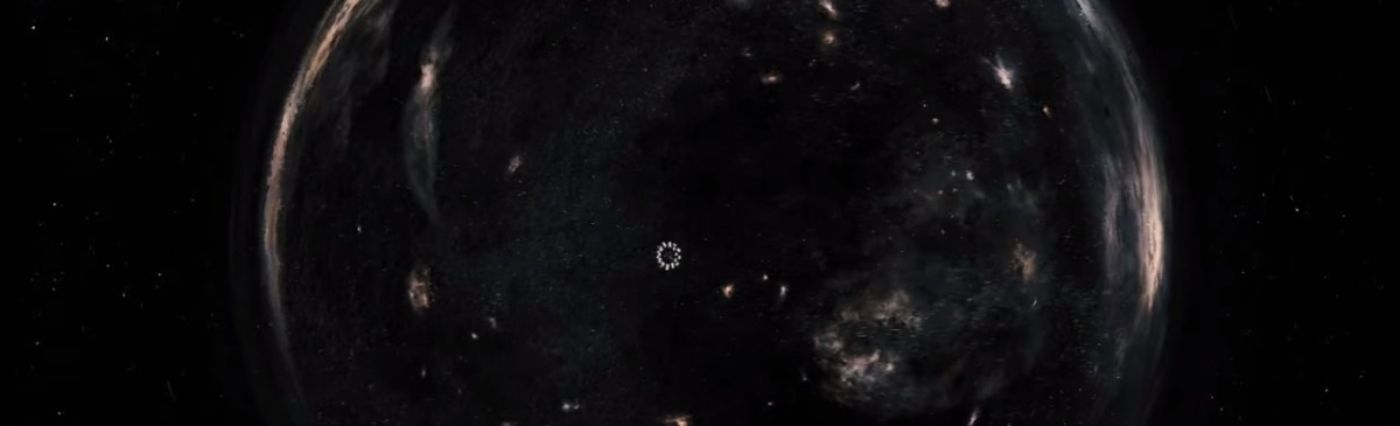
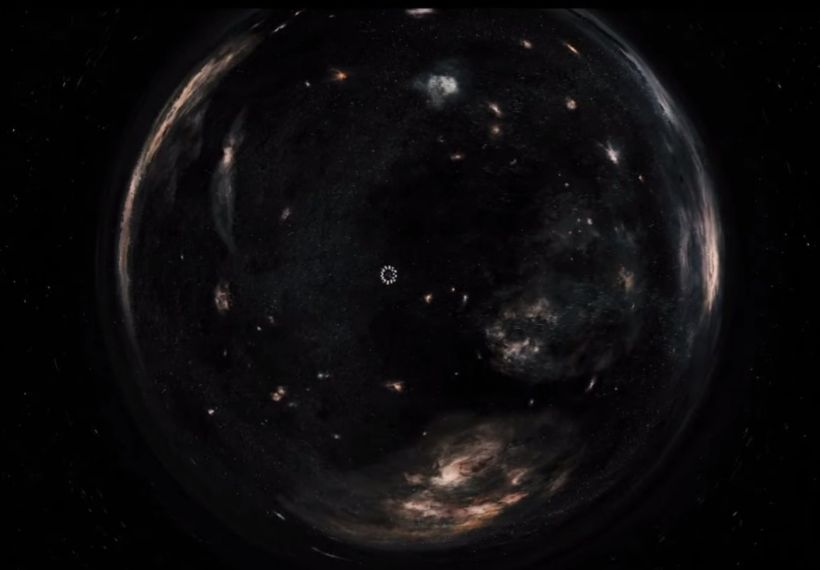
And in fact, we've got an image of a wormhole.
Let's check it out.
Oh, yeah.
The wormhole is a portal through space and time, where in this particular case, we're actually seeing what's on the other side of the wormhole come through us, through the hole, through the channel optically.
And that hole leads to another place.
So we both know one of the advisors, one of the science advisors, the lead science advisor of the film, Interstellar, Kip Thorne.
Kip Thorne, the wonderful, amazing, fascinating Kip Thorne.
Yeah, he's brilliant and a good-
I like this Kip person already.
So you should have said, wait, I found an error in one of his papers.
That was your cue for that.
I'll find it.
I'll look through his notes.
That's where they hide the money.
So Kip Thorne, he's an expert on relativity.
I have a book in my office co-authored by him.
The title of the book is Gravitation, and it's like a zillion pages thick.
We always joke it's the only subject you ever learned about just by carrying the textbook around.
So let's find out what Christopher Nolan had to say about working with Kip Thorne on Interstellar.
Like Kip, we were talking about the wormhole because it was always in the script.
Because he's a wormhole guy.
He's a wormhole guy and I was sitting there talking to him about it.
He put the wormhole in contact.
Yes, on his business card.
Exactly.
He's a wormhole.
Talk to me.
I said to him, we were talking about the hole and much like McConaughey's character because I put this into the dialogue of the film, at one point I said, wait a second, you're saying it's not a hole, it's a sphere.
He said, of course it's a sphere.
It's a hole in three dimensions.
I'm like, no, there's no of course about that.
The rest of us.
Oh, hence you explicated it.
No, because I was like, if we can make somebody understand, somebody who understands the way I suddenly did in that moment of, you can have a hole in three dimensions.
Yes.
That's a terrifying concept.
The fact that you can approach it from any direction and disappear inside of it.
Yeah, really cool.
Because a hole in the pavement, a manhole cover, that's a hole, you fall through, but that's a hole in a surface, which is a circle.
Well, a hole in three dimensions is a sphere.
And so that was brilliantly done and gave you a feeling that it's a hole that you can enter from any direction.
A lot of what I dealt with with Kip, and when you get into the fine detail, when you really try and dig down into this, there's a point where Kip will sort of go, well, that's kind of how we let you guys think of it.
And he's the last guy, he's never exclusionary about his science or whatever, but there's just a point where he's sort of like, look, you have to trust me on this.
It's like, we give you a sort of simple model of it and try and make it accessible in that way.
And then if you dig too deep in that, you have to go to the next level.
The next level is exponentially difficult.
Right, yeah, you don't want to have to go there.
No, you don't want to have to go there, because algebra will be involved.
So Janna, Madam Cosmologist.
I love what they did here was to make the portal three-dimensional.
But because we're in a three-dimensional space-time, you need a three-dimensional portal to move from these, all these three-dimensions to a different location.
We like to imagine from three-dimensions things that are lesser dimensions.
It's a lot easier to visualize.
We all love imagining six dimensions.
It's really hard.
This is going to take a while.
I think, I'm not sure if I'm remembering this correctly, but I think in the movie they make reference to actually higher-dimensional spaces, that in the movie it's not just a whole three-dimensional universe, that there is something that they're calling a bulk, which is a higher-dimensional universe in which these three dimensions are embedded.
So, the notion that you can fall into something from any direction, that alone boggles the mind.
It's a three-dimensional whole.
And that whole leads to another place.
Yeah, it can be a lot bigger on the inside than it is on the outside.
We've heard that before.
She's showing her Dr.
Who street cred.
The TARDIS is bigger on the inside than on the outside.
Is the TARDIS realistic when you describe it as realistic?
Well, for being a fourth-dimensional fictional story, it's really realistic.
Yeah, once you add that context, everything becomes quite reasonable.
So, what are wormholes good for?
You have one?
Yeah, you know, wormholes, although they're probably theoretically possible, are physically, as far as we know, still impossible, meaning to keep the throat open of the wormhole, you need forms of matter and energy that we've never seen before.
We don't know anything that could actually keep the throat open of the wormhole.
So, it will kind of keep closing up.
So, it's unstable?
It's very unstable.
Meaning, if we made a wormhole, we couldn't keep it open, but we also can't make wormholes?
Yeah, so, if a wormhole was formed by some unstable process, it would quickly close.
When you say it would close quickly, how long, like, meaning how long would it stay open?
Seconds?
Like microseconds.
Microseconds.
So, I think the question isn't can we make them, but the question is, is there any form of energy in the universe that's capable of keeping a wormhole sort of afloat?
And we don't know the answer to that question.
We didn't predict dark energy.
There are forms of energy that are surprising to us.
So, we have to be of a civilization that has power over space, time and energy and matter that we are not quite yet.
And perhaps in that future civilization, we can manipulate the fabric of space and time and make wormholes.
So, what came first?
The thing you said first?
The sci-fi.
I think we would be better off manipulating space and time by, for instance, doing something like warp drive.
So, you could do something like warp drive by contracting space-time between two points, bringing them closer together, jumping across.
You don't have to travel 400 light years.
So, that's not a wormhole?
That's not a wormhole.
And then pushing it back out again.
And then you push it back out again.
No big deal.
It's not a big deal.
I want to fight about this.
You're going to warp space and then go from one part of space to the other.
And then you jump across and then you push it back out again.
With a space pogo stick.
Well, you could just step right across if you can pull them closer together.
You have to step out of your dimension and back in.
Well, you could do all of this even in three dimensions.
Just pull two spacetime points closer.
Now, again, it has the same problem, which is that I don't know forms of matter energy that would do it.
But that's warp drive in principle.
So if you want to step aside in principle, then you just push it back out again where it was before.
So you would just need to, it would just be like a mirror.
You'd just walk through something like a mirror.
Or I'm just making names.
You're totally making that up.
You'd walk through just what seems like a glass.
When StarTalk comes back, I want to go through a wormhole.
we'll find out more about how Einstein's relativity can stretch the imagination.
Janna, before the break, you said you can warp space and hop from one part of it to another with a pogo stick.
Or on a bicycle.
He added the pogo stick.
I don't know how you do that without a wormhole.
Well, there is a sense in which we can get space to expand in particular ways.
Or contract.
Or contract.
Yes.
And so if you imagine that there's something called dark energy, which you know very well, which causes the universe to expand at a very accelerated rate, that's one way to push it back out again.
If you could come up with a form of energy that did the opposite, that pulled it together, much like dark energy does, right?
But in the opposite direction, causing the collapse of space.
You're going to be like, Neil, what you're saying is true.
Trust me on the science, Neil.
The reason why this is imperative is that you can travel across a very short distance going less than the speed of light, and that's very important.
And then the space time is able to expand faster than the speed of light.
Now I understand.
So you're saying if you can physically stretch, and you had power to do so, stretch or contract, contract, I bring California to across the street.
You walk across the street, and then you push it back away again.
California back to where it was, and I'm there.
And that wouldn't blow everything up, I guess.
I'm sure it would have all kinds of unforeseen consequences.
But you would be in what used to be California.
No, but if it's the fabric of space and time, you're not actually squeezing matter to do that.
You don't have to squeeze matter.
The trick is that there is no information traveling faster than the speed of light, even though the space-time is expanding faster than the speed of light.
So it's all consistent with the limits of relativity.
When you got this, call me up.
We'll figure that one out.
So there's relativity of space, but there's also relativity of time, of course.
Let's zoom in on my conversation with Christopher Nolan about the relativity of time.
You look at relativity itself insofar as I can understand it, and insofar as I try to explain to the audience what they need to know.
It's all mind-blowing.
It's mind-blowing.
The idea that time can run differently for you depending on how fast you're moving or where you are in the universe, that's incredible.
And I think you took it to an extreme point, which no one had done before.
I don't think I'm giving too much of the film away when I say where you visit a planet that's in a very deep gravitational well, we say.
And the closer you are to a strong source of gravity, the slower your time ticks relative to people you left at home.
And so if you're going to commit to a visit of a planet where time is ticking more slowly, then you've got to be prepared for the consequences of that.
How much more slowly is it ticking?
And what are the age of your kids relative to you when you go back and find it?
Well, before I go down there, Brand, Anne Hathaway's character has a line.
She says we've got to view time as a resource, like oxygen.
As a commodity.
Food, exactly.
And I thought it was just a cool idea.
That was a great line.
So here we have time moving at different rates for different people.
And Janna, could you just give the lowdown on when your time moves more slowly?
So the simplest circumstance that Einstein first thought of was when you're in relative motion.
So you're two astronauts flying past each other in totally empty space, and you're in relative motion.
One astronaut says, I'm not moving, you're the one that's moving, and you're moving near the speed of light.
They will see that person's clock run very slowly.
That person will appear to move slow and talk slow.
Everything slows.
But that astronaut will accuse the other of the same thing.
Right, so there's the relativity of the passage of time.
That's right.
Their experience of their own time is normal.
And then there's also gravity that does this as well.
So gravity does this as well, and you can think of it as a rotation in space-time.
You know, you can rotate left into right, and it turns out you can rotate space into time and time into space.
And one way to do that is to have relative motion, and one way to do that is to go near a very heavy object like a black hole.
So it'd be a black hole, like if you were near Jupiter, it wouldn't be...
Technically, you're probably slowing time for me a little bit.
All right.
What she just said is that you have enough gravity.
That's all I want is to walk around New York City, slowing down everyone's time by just walking right behind them, like a normal person.
So whether or not you can measure it, you can calculate what effect Eugene's gravitational field is having on the passage of time on your clocks.
Yes, and we do notice this with clocks near the Earth versus clocks in the space station.
What's the biggest thing that's near the Earth that would have this effect in a way that you'd really notice?
Like, is it Jupiter or would it have to be the Sun or is there...?
That's an interesting question.
I mean, I've never thought about whether they could do it for the Moon.
I mean, maybe.
It depends on how precise your clock is, really.
That's really the question.
GPS satellites are farther away from Earth than you are.
Agreed.
Agreed, okay.
And so they, in fact, experience a faster passage of time than we do.
But they're sending time signals to your smartphones.
And that time signal they send you is correct.
How do you get the correct time if they have the wrong time?
Because we knew in advance what the effects of relativity would be on the GPS satellite system.
And we precorrect the time that they send down to us so that when it gets to here on Earth, you have the correct time.
And that is general relativity manifest in our civilization today.
When we come back, everything you ever wanted to know about Black Bolt on StarTalk.
We're back at StarTalk, the Rose Center for Earth and Space.
We do the universe here, in case you didn't know.
We're talking today about relativity, about black holes, wormholes.
We have a cosmologist, Janna Levin.
Janna, we want to learn more about black holes.
Everybody loves some black holes.
And we have an image, we have an image, an artist's representation of a black hole.
Let's check it out right here.
So I particularly like this because it has sort of what we say in astrophysics is an accretion disk.
There's a disk of material that might be feeding the appetite of the black hole as it descends.
Also, the black hole is a three-dimensional hole, just the way a wormhole is three-dimensional.
And there's clearly sort of a radiation field just on the outskirts of the event horizon.
And tell everybody what an event horizon is.
I love that term.
It's so poetic.
It is.
It's so beautiful.
So, the black hole...
It's beautiful to say.
It is.
Not beautiful to go through.
It would be unpleasant.
So, the black hole creates a region around it where the gravitational field is so strong that essentially not even light can escape.
You know, we know we have to launch a rocket off the surface of the Earth at a certain speed to get it to escape the Earth.
And the speed at which you would have to travel to escape from the event horizon is the speed of light.
I mean, we will never know anything about what's inside a black hole.
That's what the event horizon says.
It says no information can ever come out.
So we gather from the mathematics suggests that there's something called a singularity at the center, a place where space-time curvature is so strong that you would just be crushed to death just by gravitational forces.
And then, I don't know, blotted out of existence.
We don't really know what happens there.
A lot of people think that's not the whole story and that something would come in.
There are two that are in a death spiral right now, discovered in the center of a galaxy.
They just make a bigger black hole.
Really?
You can't think of a black hole as a thing.
It's really...
It's like a dude?
It's like a place.
It's like Miami.
That's a fair.
Yeah, so one black hole can eat the other.
Right, just a black hole twice as big.
And then it just becomes a bigger black hole.
A bigger black hole.
So, in order to tell this extraordinary story about this planet near orbiting very close to a black hole, they had to sort of loosen up some science shackles in the storytelling.
And let's return to my office, where I talked with Christopher Nolan.
One of my favorite lines from Mark Twain is, first get your facts straight, then distort them at your leisure.
Not exactly.
I mean, that was exactly the process.
It's like, let's figure out what the reality is.
And then I would explain to Kip, okay, but for the narrative, I've got to jump over this bit or ignore this bit or whatever.
And we would have a back and forth about what was allowable and what wasn't.
But generally, I found working with Kip, he wasn't sitting there sort of going, well, here are the rules of the thing.
He was sitting there going, well, these are the possibilities.
This is what real world physics is offering.
Which any good science advice should be to an artist, right?
Just here's a context, see what you can do with it, right?
And what the real world comes up with is so much more mind blowing.
When black holes were first discovered mathematically, nobody thought they were real.
Nobody thought there would be any way nature could make such a thing, right?
Why hasn't everything been destroyed by a black hole?
Eaten by a black hole.
Yeah, why doesn't everything, why are we in one now?
That is a false reputation.
So if you were to replace the sun with a black hole right now.
She's the PR agent.
We would be fine.
Janna, the PR agent for black hole.
That's not their actual reputation here.
They never did that.
If you replace the sun with a black hole, we would be, I mean, aside from having no sunlight.
It would be cold and dark.
Yeah, yeah.
We would not be sucked in any.
We would be on exactly the same.
We are falling into the sun.
The sun is sucking us up just incredibly slowly.
Oh, well, Pella, thank you.
Like, the sun will blow up long before that happens.
We'll collide with Andromeda long before that happens.
Oh, that's nice.
So this is a lot of good stuff.
We'll actually kill ourselves long before that happens.
Put your priorities in order.
Our civilization, but maybe, you know, cats might survive.
My favorite thing about black holes is what it does to your body when you fall in.
As you get drawn into a black hole, feet first, it begins to stretch you apart because your feet are drawn to the black hole faster than the top of your head is.
And then you get taller and taller until you snap into two pieces when the forces of gravity become greater than the molecular forces that hold your flesh together.
And then those two pieces themselves experience this.
It's called the tidal force of gravity and they snap and they become 1, 2, 4, 8, 16.
Then you're a stream of particles descending down to the abyss.
And meanwhile, the fabric of space and time funnels gets narrow so that you are not only stretched head to toe, you are extruded through the fabric of space and time like toothpaste through a tube.
So, you know, I actually composed a poem about falling into a black hole.
May I share it with you?
Okay, I shouldn't call it, it's not, it's a rhyme.
Poets compose poems.
Regular people rhyme stuff, okay?
So, so here it is, here it is.
In a feet first dive to this cosmic abyss, you will not survive because you will not miss.
The tidal forces of gravity will create quite a calamity when you're stretched head to toe.
Are you sure you want to go?
Your body's atoms, you'll see them, will enter one by one.
The Singularity will eat them, and you won't be having fun.
So, that is one way to die by falling into a black hole.
When StarTalk returns, we'll find out why Bill Nye, The Science Guy, is pretty sure that saving the world interstellar style is not in our future.
On StarTalk.
This is Star Talk.
StarTalk is back.
We're talking about the movie Interstellar, featuring my interview with Christopher Nolan in my office at the Hayden Planetarium.
And in that film, there's a blight on Earth, we're all gonna die, we need to find another planet, we find another planet, travel through a wormhole to get there.
My good friend Bill Nye assesses this scenario in his Bill Nye rant.
Space exploration brings out the best in us.
You don't believe me?
How often have you heard somebody say, if they can put a man on the moon, why can't they blank?
And that blank can be filled with anything, like cell phone calls that don't get dropped or better instant mashed potatoes.
It all comes from the technology of space.
So a movie that's about space has got a lot of potential.
But this idea that you can just ruin the place you live and go live somewhere else is unique to our time.
I don't think you're going to really be able to do that when it comes to the Earth.
This is where we make our stand.
The Earth is only this big.
We're all stuck here.
What about Mars?
No.
It hasn't rained on Mars in three billion years.
And as soon as that spacecraft door opens, you'll notice you can't breathe.
See you down the track.
Bill Nye, a man on the move.
He brings up a very important point.
No matter how bad Earth was, is there another place that's better?
Even after we mess it up as badly as we did?
And in Interstellar, they go to a planet that didn't look like the next planet I wanted to go to after Earth.
And I also think that people want to terraform planets.
After we mess up Earth, let's terraform Mars.
What's terraforming?
You turn it into Earth-like.
Why don't we just terraform Earth?
Exactly.
If you have the power to turn another planet into an Earth, you have the power to turn Earth back into Earth.
Yeah.
That's how I see.
I agree.
It's got to be easier than terraforming a planet and shipping a billion people there.
But in any case, the movie Interstellar as well as some other films of recent years, Gravity among them, it got people talking about the universe, about space travel again, about science, about the value of science literacy in leading characters that maybe you want to be when you grow up.
So I chatted with Chris Nolan in my office.
I asked him, what effect does he think his movie has on the dreams of a nation and the world?
I would love for kids today to see Interstellar and get inspired about some of this.
It's what you guys have been doing with Cosmos and whatever.
I mean, it's like if you can show people visually, that's why you need such a lavish visual treatment.
It's like it's about how exciting it is.
It's not about numbers on the page.
It's about flight of imaginations, about Einstein sitting there imagining sets of twins, one on a train going the speed of light, one at the station.
All that stuff, it's so visual and enormous.
So anything you can do, either on television or in a movie or whatever, to try and get that scale and excitement across.
Another thing, in fact, I've been telling this to, because people come to me now to comment on newly released science fiction films.
I think it's because I had some tweets for the movie Gravity.
I heard.
It went a little viral, which was not my intent.
I was just putting it out there and I bump into them on the morning news, on the evening news and on and everyone said astrophysicist Neil Tyson says.
And it's like, my gosh, but that meant that there was an appetite.
Why would anyone care unless the science in a film is now part of the dialogue?
Oh my gosh.
Science in the dialogue.
In your defense, gravity got the gravity wrong.
Listen, Janna, Professor Levin, thanks for coming.
Anytime.
And Eugene, it's always great having you on StarTalk.
Thank you.
You've been watching StarTalk from the Hall of the Universe of the American Museum of Natural History in New York City.
And as always, I bid you to keep looking up.
See the full transcript



 Unlock with Patreon




 Become a Patron