



 Unlock with Patreon
About This Episode
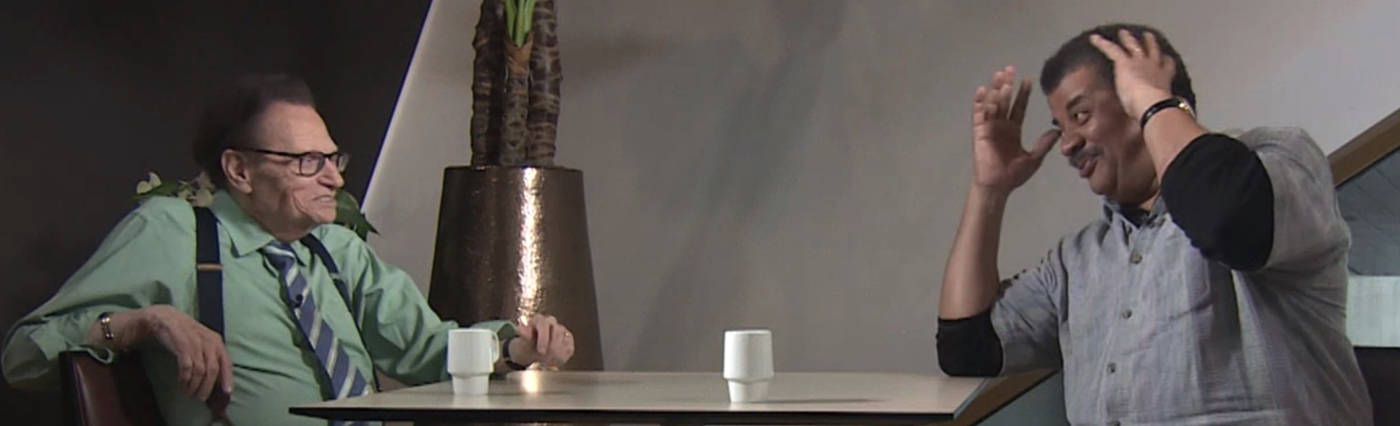
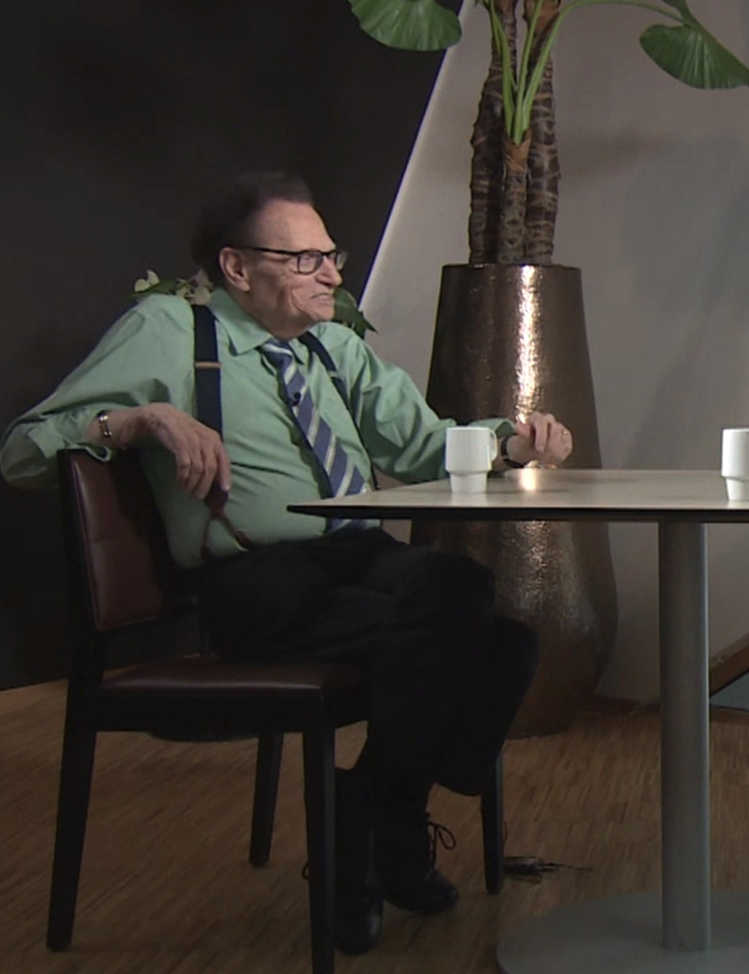
He’s a media icon, he always wears suspenders and a tie, and he’s on this episode of StarTalk Radio. Neil deGrasse Tyson explores the ever-changing world of media with legendary broadcaster Larry King. In-studio, Neil is joined by comic co-host Chuck Nice and neuroscientist and StarTalk All-Stars host Dr. Heather Berlin, PhD, and media scholar Robert Thompson, PhD.
We discuss why Larry has had such longevity in a business that sees constant change. Get the scoop on Larry’s interview process: why he thinks that talking less means learning more, why you must check your ego at the door, and why less preparation might be better than extensive research. Robert Thompson drops in to explore Larry’s impact on the zeitgeist. Find out why the current media landscape for talk shows is now mainly host-focused.
Larry tells us why he’s always ready to fight against new technology. You’ll hear why Larry has had issues translating professional success into personal success. Heather sheds light on how different personalities deal with control or lack of control. We also explore curiosity. Discover what sparks Larry’s curiosity. Heather explains why curiosity is a drug to those who are always seeking knowledge and information. She also explains why curiosity can sometimes function like a vortex.
Who would you interview if you could interview anyone alive and/or dead? You’ll hear how Larry almost interviewed Fidel Castro. Neil tells us why he would want to interview Sir Isaac Newton. Chuck weighs in on why he would revel in the chance to sit down with Vladimir Putin. And, Neil and Heather explain why they would both want to interview President Barack Obama. Lastly, find out what everyone would ask God in an interview.
Thanks to this week’s Patrons for supporting us:
Natalie Rosa, Scott Saponas, Jose Clark, Christopher Cohen, Sergio Rizzuto, Michael Staples
NOTE: StarTalk+ Patrons and All-Access subscribers can watch or listen to this entire episode commercial-free.
Transcript
DOWNLOAD SRTFrom the American Museum of Natural History in New York City, and beaming out across all of space and time.
This is StarTalk.
Welcome back.
I’m your host, Neil deGrasse Tyson, your personal astrophysicist, and we are coming to you from my office at the Hayden Planetarium, the American Museum of Natural History, right here in New York City.
And today’s show is all about curiosity.
Curiosity, what does that even mean?
Are we still curious as a species?
Curious as individuals?
And it will feature my interview with the one and the only, Larry King.
Very curious.
My boys interviewed like 100 billion people.
Absolutely.
All, everyone who’s ever lived, he’s interviewed.
I interviewed Moses.
I got with me as my co-host, Chuck Nice.
Chuck, welcome back.
Always a pleasure.
Tweeting at ChuckNiceComic.
Thank you, sir, yes.
Very nice, I follow you.
And I only follow 38 things.
And not all of them are people, so just letting you know.
I feel somehow devalued, I don’t know.
It’s like, I follow 38 things.
And since we’re touching on the brain here, because curiosity is a human state of mind, we go to our go-to person, Heather.
Heather Berlin, Heather.
Hey, I’m here.
Heather in the house, okay.
Yes, I tweet too, Heather underscore Berlin.
Okay, you’re gonna let meats tell people that?
Heather tweets too.
Heather underscore, I hate underscores.
Heather underscore Berlin, and so.
That was a great endorsement, Neil.
I hate underscores.
Yeah, and wouldn’t it be funny if people were looking you up right now, Heather, I hate underscore.
So welcome back to StarTalk.
You’re like all regular now, it’s always good to have you.
So, Larry King, I bumped into him in Norway, of all places.
Wow.
And I said, I gotta.
The life you live.
It was my first time in Norway, I don’t know if it was his, but I said we gotta get a StarTalk interview with him.
It’s gonna be summer in Norway.
He’s been a talk show host since 1978.
Really?
40 years.
I thought it would be longer than that.
I know it feels like, all the jokes, put it longer.
He was like interviewing Jesus, right?
At the Last Supper.
So, he was a long time on CNN.
Now, he’s like, his post-CNN career is Larry King Now, and Polyticking with Larry King.
So, Larry King, he’s still at it.
He’s still at it.
A Peabody Award winner for excellence in broadcasting.
So, Heather, what do you think has made him so popular?
Well, I think he’s just really good, first of all, at connecting with people, but also just removing himself from the picture.
I think any good interviewer, it’s about eliciting information from people, asking the right questions.
So, if he didn’t do that, you don’t think he’d have the longevity that he did.
Because there’s a lot of interviews.
There’s countless interview shows.
I mean, look at you.
I was about to say, but his rises up above the rest.
Now, I can’t say that, now that you’re…
Well, I think the best interviews are the ones when it’s not about the interviewer.
And you’re really genuinely interested in understanding the human being that you’re there interviewing, and also asking questions that haven’t been asked, being creative in terms of the kinds of questions you ask to elicit new and novel information from these people.
So, and Chuck, you’ve been interviewed, you’ve been, you know…
Yeah.
Last time I have you on the show.
So, another sign of an interview is to ask questions that elicit more than a yeah response.
Who failed, me or Chuck?
One or the other, so I asked Larry, what does it take to make a good talk show host?
Let’s check him out.
I always love my ego at the door.
I didn’t use the word I in interviews.
I asked short questions, I didn’t read the great books.
So, my curiosity delved into people and the way they act and the way they move.
Today, talk shows are all about the host and not even about the host.
Oh, that’s why I can’t watch them.
If you watch a talk, if you watch, if you tune in to a television talk show, a good television talk show, nine out of 10 times, you should see the guest.
Of total video time, yeah.
The guest should be talking.
My truism in life is I never learned anything when I was talking.
I never learned anything.
So I can tell stories, I can make people laugh, but I never learned, I only learned something when I asked a question and someone was talking to me.
That’s a feature of the wisest people we have ever met or know.
They spend less time talking and more time listening.
There it is.
There you have it, now I’m scared to talk.
I know, me too.
Okay Heather, just talk.
I’ll take over, I’ll take over, I say nothing ever more.
I thought it was interesting that he said like he didn’t read the great books, he doesn’t really prepare, he’s just this sort of open.
But he didn’t say he doesn’t prepare.
Well, he didn’t say he doesn’t prepare, but he said he doesn’t, well, in my sense, that’s not a lot of preparation if you’re not like, say reading the person’s book before you interview them, for example.
But he said he didn’t read the great books, which I interpreted as if you read the great books, now you have to show off that you know what’s in the great.
Shakespeare said, and all of a sudden you’re bringing a whole mental baggage, intellectual baggage into a conversation.
So maybe it’s restrictive.
Maybe not restrictive, but it forces you to be a bigger part of the conversation than you should be because you have too much you could say.
Let’s bring some more expertise here, some expertise about journalism, basically, and pop culture and television and the like.
So I’ve got Robert Thompson, I’ve got you on Skype.
Robert, are you there?
I am.
You are a trustee professor of television and pop culture at Syracuse University.
Is that the orange folks up there?
It is.
It is.
Well, welcome to StarTalk.
And you’re the founding director of the Blier Center for Television and Pop Culture.
Did I pronounce that right?
Good.
An author of television’s second golden age from Hill Street Blues to ER.
So would that mean we’re in the third golden age because this is the best television that’s ever happened?
I wrote that book in like 96 and I think we’re still in that second, but maybe we’ll call it the third starting with about the Sopranos.
And so you have a very long baseline of analysis of things that operate in pop culture.
What is your perspective on Larry King’s longevity in this?
I think Larry has a couple of things up his sleeve that people really liked.
And some of it was, and you guys were talking a little bit about this, forget not reading the great books.
He didn’t read the books that he was talking about on the air, and he bragged about it.
Ooh, that’s a dig right there.
He also said that he didn’t know on the way to the station who he was interviewing that night, unless it happened to be a prime minister or someone important.
He was quite proud, I think is quite proud of the fact that he doesn’t do a lot of preparation.
And he gets in trouble with this every now and again.
You remember when he interviewed Jerry Seinfeld?
Jerry Seinfeld had just come off this, of course, spectacularly successful show.
It ends at number one.
And Larry says, so…
Why was your show canceled?
I remember this.
Oh, yes.
Yes, okay, keep going, keep going, tell the story.
Jerry, Jerry really is kind of mean.
You almost want to give Larry a hug after this because Jerry says, starts saying things like, you know.
Does this guy know who I am?
Do you need my resume?
Do you, don’t you realize we had 75 million viewers and he will not let up.
And by the end, Larry King has almost cried uncle, not quite, but he’s close.
Yeah.
Okay, wait, wait, so I bit him in the ass this one time.
All right, but the rest of it, apparently it’s a successful formula, apparently.
Well, maybe that lack of preparation is very much a part of the element.
I think there is a sense that he comes in and he talks about the fact how he is interested in people.
He certainly has a high level of curiosity.
And I think he wanders in there and kind of goes on to that set.
And he doesn’t ask a lot of hardball questions.
He doesn’t seem to be incredibly prepared.
But he kind of seems like what somebody would ask if you ran into them and you were waiting for a bus.
And I think for a lot of people, that is really appealing.
Well, you bump into somebody, you sit next to them on the airplane.
You didn’t do your homework before then.
Exactly.
Now, don’t get me wrong.
I do not recommend people that do interviews take pride in the fact that they’re unprepared to do them.
But Larry King, I think, has managed to make an art with this.
And then there’s the second thing that I think is at the key to his magic, and that is he has been around forever.
He has talked to so many people and every interview that he does is somewhere humming in the background, a fugue with all the other interviews he’s done.
I will give you a challenge.
Watch one of Larry King’s interviews and do it as a drinking game.
And take a shot every time he says, when I was talking to Anthony Quinn, or Derek Jeter once told me, or Lenny Bruce, my good friend, you will be hammered by the end of the first break and you will be out by the end of the show.
Okay, so he’s a name dropper.
No, but it’s not just name dropper because he’s actually talked to these people.
He’s got a sense that Larry King is this human database.
He’s talked to all these people.
So he’s got a comment from an interesting person and a famous person to match any single thing that ever comes up in a conversation.
So he is his own landscape of knowledge on which he conducts his next interview.
So he can draw from all of the vegetation that has grown on the landscape that he tilled.
Completely by instinct, I might add.
Well, of course, technology has changed over the time that he’s been in business.
Yes.
You know, means of obtaining information, delivering information, how people consume information.
And so I just wanted to get his thoughts and his reflections on the state of technology in his business.
Let’s check it out.
How has your life been touched by technology?
You’ve been at this for 60 years.
I can’t even do the math on that.
I push against it.
I started in radio when we had landlines and phone lines, and then came satellites and Ted Turner, and the world expanded.
And now there’s the internet.
But I’m doing exactly what I did 61 years ago, asking questions.
But I’m transmitted differently.
I was transmitted by phone lines.
I did a satellite show on television.
Ted Turner saw this.
Imagine if you had said this to Franklin or Jefferson.
I sat in a studio interviewing you.
We together would be beamed up 23,800 miles, hit a machine that’s traveling with us, beamed up and went down, and reached someone in Moscow or across the street.
Same way, from that beam.
How the hell do you do that?
Now, that amazes me.
If you gave me the scientific explanation, I would be lost in E equals MC square.
But the very thought that I can go up is so amazing to me that I don’t need an explanation of how it works.
But I would love to talk to the guy who invented satellites and what was he thinking?
Did he sit down and say, I can hit a moving object and transmit you 10,000 miles away?
What made him think that?
That’s what fascinates me.
So I love technology, I love what it can do, but I always attempt to push back at it.
There he is.
Technology is the thing I don’t care about at all, but I love to death.
I’d forgotten.
We announced him as having been a TV since 1978, but he was on radio decades before that.
So Robert, how has…
I was there when Alexander Graham Bell said, Watson, come here, I showed up instead.
That was my first radio broadcast over a phone line.
I don’t even know how that works.
How does he do this over a phone line?
He’s like the first…
My first show was calling people and saying, is your refrigerator running?
It’s the first talk show.
So, Robert, has the fact that our capacity to communicate with one another, having become more prevalent, easier, more mobile, has that increased or decreased the percentage of talk shows that are out there?
Has it improved them?
Has it made them too easy so anybody can have a talk show?
What’s the status of it today relative to then?
Okay, well, first of all, yes, it’s increased the number.
The real estate where we can put this stuff now is almost infinite.
There used to be a few national television networks and there was radio and that was it.
So there’s lots more opportunities and it’s true.
If I went down to my class tomorrow and asked how many people in the class had a podcast, my guess is that at least half of them would have one and most of them interview because that’s a natural thing to do.
Now as to the quality, back in the day we had Carson, we had what, Mike Douglas, Merv Griffin.
Carson was amusing enough, but when I compare the kind of interview that Johnny Carson used to do with the kind of thing that John Stewart would do or Colbert, even though that was in the key of comedy as opposed, well, so is Carson.
I think a lot of it is way, way better.
The other thing is we get to hear talk shows and conversations about things other than what Johnny Carson and Merv Griffin and Mike Douglas wanted to talk about.
And let’s face it, that was a pretty narrow set of definitions.
So overall, more voices, more subjects, lower budgets in many cases.
Well, let’s move forward a little bit from those three classic names.
There was also Dick Cavett, right?
That was a little more thoughtful.
It was kind of the egghead.
Yeah, right.
Exactly.
So there were others.
I mean, it wasn’t like Carson was the only one in town.
But there weren’t a lot.
And I think there’s still what Larry King has done is he’s kind of straddled.
As he very much points out, I love that ode to satellite because he started the ode to the satellite with the ode to the landline.
I mean, that that guy is a real when you think about it, Larry King has done the interview format in every other electronic medium except the telegraph.
And and now he’s doing it as well in his coming to you by Morse code.
I started off with a tin can on a string.
And he talks loud enough that that would have probably been effective.
So I think we’ve got more, much more variety, much more diversity.
And it’s one of the reasons why to younger people, Larry King does seem like such an anachronism.
So but he still rises up in the din of talk show hosts that are out there.
Like you said, that number is semi infinite, if not actually infinite, of number of people who have talk shows, podcast, we call them today.
So yet he still rises up even in a generation that because very few people his age can resonate with people who are very young.
I guess Bernie Sanders does, but these people are far and few between.
So somehow he still resonates.
Well, I don’t know.
I’m not sure how much Larry King is resonating with, you know, let’s say my students at the age of 18 to 24.
They probably heard of him.
I have a very strong doubt that many of them have seen an interview that he’s done.
I think Larry King continues to resonate across the board because he is and I hate to throw this word around.
We use it way too much, but he is an icon.
He is one of those.
He’s been imitated on Saturday Night Live.
He’s being imitated here as we speak.
Any decent comedian can pull a Larry King out of their bag of tricks.
A joke about how old he is.
Jokes about how old he is and how many times he’s been married.
I mean, there is a body of work of people who do Larry King stuff.
So that’s why I think he continues to resonate.
How many young people are watching Comrade King on his Russia Today broadcast or are going on to Hulu to see politicking or what’s it called now, Larry King now?
I have a feeling not a whole lot.
But you make an important point that it is possible to have such a body of work that has had such influence over the years that you elevate and you become an icon.
You become a fundamental part of pop culture.
So Robert, thanks for this video call.
It’s great to have you.
Well, I was honored to be in the presence of three such accomplished performance artists.
Well, thanks.
So we’re going to take our first break.
And when we come back, more of my interview with the inimitable Larry King.
Bringing space and science down to earth.
You are listening to StarTalk.
We’re back on StarTalk.
Got Chuck Nice, my co-host.
That’s right.
And Heather Berlin, a friend of StarTalk.
Hello.
It’s like you’re a millionth time on StarTalk.
I love being here.
Plus or minus, excellent.
Because we always have brain issues, and you are our go-to brain person.
So remind me, you are a professor of neuroscience at Mount Sinai.
Psychiatry, professor of psychiatry, and I’m a neuroscientist at Mount Sinai School of Medicine.
At Mount Sinai School of Medicine, right here in New York.
Yes, oh yeah, that would be me.
Well, it’s actually now called the Icon School of Medicine at Mount Sinai.
Because they gave us a lot of money.
As in Carl?
Yes, as in Carl.
Carl Icon.
So we changed the name.
But it’s the same place.
All right, we’re featuring my interview with the one and only Larry King.
And we connected up in Norway.
I was at a conference, we were both at a conference.
And so I wanted to get an understanding of his perspective on his own success.
And so let’s check that out.
How come in daily life, I have been so stupid?
I mean, stupid.
I did not handle money well.
Now I’m talking to you like a psychologist.
I’ve been married many times.
I didn’t handle relationships well, but when that light went on, when I went into that studio, I asked a psychologist once to explain that to me, because I’m supposed to be wise, but I do stupid things.
Why do smart people do stupid?
And he said, because when that light goes on, you have control.
Who doesn’t like control?
So I was doing an hour television show every night and a five hour radio show.
That’s six hours, eight hours sleep.
So there’s 10 hours a day I didn’t control, I wasn’t good at it.
But those six hours, I control.
And I never thought of it as controlling.
But the host of any interview show is the control of that show.
You are the control of it.
Even if I’m talking now, you’re in control.
You cut me off, you could stop me and go to a different set.
You’re in control.
And what a joy that is, what a life that is to be in control of something.
Most people in adulthood control nothing.
There’s a boss, there’s an organization.
They’re beholden to so many other forces.
So, yeah, that’s an excellent point.
I had control of my environment for that period of time.
It’s true.
Except when the producers tell you to shut up because they got to put in a commercial.
Even then, I could say, well, the commercial could wait a minute.
You’re still in control.
You really are.
So, Heather, I mean, he comes to this revelation, which sounds very eye-opening as an eye-opening experience for him.
He came to this revelation through the efforts of a psychologist.
Is this a common need that people have?
They need to be in control?
Yeah.
I mean, so in addition to being a neuroscientist, I also see patients for treatment doing psychotherapy.
Chuck, we have issues.
Without a doubt.
Everybody has issues.
I already see Heather once a week.
But I’m taking new patients.
But no, it is a common issue because relationships are about compromise, which is hard because you have to give up the way you think things should be.
Give up control.
Give up control.
And so the ideal circumstance is if you’re in a situation where everything goes exactly the way you want it to go.
There is no compromise, so there’s no friction.
And part of working out relationships is learning how to give up, how to concede things for the other person and having some empathy.
It’s ironic, though, because part of what he does is trying to reach in and understand other people.
Yet when it comes to his own life, he’s not very good perhaps at maybe conceding to other people in his life and having a bit of empathy in that respect.
He should have just had his wife on his show.
And just like when he got done his show, just come home and just be like, interview his wife.
So he would just keep the work going.
Keep the work going the entire day, you know, just.
But then he’s in control and anyone he has to compromise with would not be.
And that would be a recipe for disaster, it sounds.
A lot of also, you know, celebrities have this phenomena where everyone is sort of bowing down to them like, you know, every one of their needs is met.
And then they go off set and it’s like, hey, you know, why isn’t this happening at home?
And they’re sort of had that level of expectations that whether it’s conscious or not, it can also lead to depression.
I mean, on a smaller scale, I hosted a Discovery Channel show and I had that similar experience where every need was met and then the show ended and I went back to my normal life.
And at least I had something sort of to go back to.
And it was like, OK, I still had a purpose, even though people weren’t, you know, bowing down for me every minute.
But I had another job, a whole job.
I went back to doing research.
But but let’s say an actor or someone whose TV show that is their job, that is their job.
So not only does all of that stop, but now they have nothing to go back to.
And sometimes that can lead to depression.
You know, I’m not important anymore.
Nobody cares about me.
Those kinds of things.
What about all the people and all the institutions and all the cultural, the cultural, cultural forces, cultural elements that lead people to just obey other people?
There are many people where control is not their goal.
They’re happiest following rules established by others.
There are different personality types.
So some people really want to be in control.
Others want to be told what to do.
They want to concede control.
So even with learning, we see that.
Like some people work very good in learning environments where it’s very structured because they want to be told what to do and have set exams.
Whereas others are more comfortable in situations where they can learn at their own pace, where they can sort of set their own schedule.
This is the big discovery that has to happen in school.
Are you one of these or the other?
And one, the other fails the other if you’re in the wrong place.
So there’s no one learning technique that’s good.
It’s about the learning technique combined with that particular personality that’s going to be best.
So Larry also, as an understanding of his success, he credits his insatiable curiosity.
Now as a scientist and as an educator, my ears perked up.
They were all already up, but it perked up even more.
Because curiosity is the center of anything we do in science.
And so I just had to get to the bottom of that.
Just check it out.
You want to know how somebody ticks.
So I think of you and your line of questioning and your perceptive ways that you reach people and have them become comfortable in your presence.
I think of that as what any good psychologist should do.
You know what, I’m curious.
I’ve been that way all my life.
I remember being eight years old getting on a bus and asking the bus driver, why do you want to drive a bus?
And all my life I’ve asked what to me is the simplest of questions.
I remember asking a pilot, when you’re going down the runway, you know it’s going to take off.
Those are things I think about.
I don’t have to know about propeller or division of the jets.
We’ve invented jets since the propeller.
The propeller was going to take off.
Those are things.
The whys.
Why do you care about this?
I interviewed Walter White, who was the first cardiologist.
There were no specialties until he was determined.
You went to medical school but there was no specialty in cardiology.
He was Eisenhower’s physician.
I asked him, if you were starting medical school today, what specialty would you choose?
He said neurology.
I said why.
He said, because what we know about the heart now, which we know so much, we know this much about the brain.
But that’s from asking, from the curiosity that comes, is what boggles your mind?
What makes you tick?
What do you, like I’ve asked you in the past, why do you look at the sky?
What do you wonder about?
So Heather, why do some people lose their curiosity?
Because let’s assume we’re all curious as children.
That’s a very natural thing.
Scientists never really grow up, so they’re still adult children in their curiosity.
But I think many people just lose curiosity.
And sometimes it’s rejuvenated.
That’s possible.
I’ve seen it.
You fan the flame and it reignites and their eyes brighten.
But for many, it’s not the case.
Is there some neuroscience study of this?
Yeah, but it’s actually only recently has there been neuroscience studies looking at what’s happening in the brain when people are curious.
So they’ll give people, for example, a riddle or a quiz, pub quiz kind of question to solve.
And then they wait and they look at just what’s happening in the brain when the person is curious to hear the answer.
And then they give them the answer.
And what they find is that curiosity stimulates the wanting system of the brain, the nucleus accumbens, which is that sort of dopaminergic system in the brain that drives us.
It’s the same kind of drive as we have for…
Dopaminergic mean it provides dopamine, which we want and enjoy.
Yes, yes.
We want more of.
Exactly.
So it starts, you see activation in the midbrain.
Yes.
Yes, it’s the same wanting feeling you get with drugs of addiction or when you’re hungry and you’re seeking out so you basically instead of food being the reward, knowledge, information is the reward that you’re getting.
And what’s really interesting is you see the sort of upside down U shaped curve in terms of satiation of curiosity.
So if you know nothing about the somebody asks you a question, you know, absolutely nothing.
You’re not going to be that curious.
You know a little bit and you want to know more.
You’re going to increase your curiosity until you get to sort of the highest point and the more you know, actually more information you start to accumulate.
Curiosity goes down and the brain activation related to that wanting and that drive goes down because you’ve gotten enough information.
So it’s just like when you’re hungry.
So it’s time to go on to the next subject.
It’s time to go on.
Yeah.
And so we see that there is a neural process because it makes sense if you, evolutionarily speaking, to seek out information to explore things that you don’t understand.
So you’re telling me I am high when I am in search of cosmic truths.
Yes.
Actually, the Red Hot Chili Peppers have a song, Californication, and there’s a line where it says-
Red Hot Chili Peppers, the group.
And it goes, she’s getting high on information.
I love that line.
California-cation.
Yeah, California-cation.
But anyway, so we see it, it’s a natural human drive.
The reason children seem to be more curious is we also have another part of our brain that kind of restricts these desires, these basic instincts that we have.
Otherwise, it could kill us.
Right, right.
I mean, we’re seeing the curiosity killed the cat, right?
We need another part of the brain.
What the edge of this cliff looks like.
Right, right, right.
How far can you go?
Look at that.
He OD’d on information.
This guy was just too curious.
Sort of like you’re looking, looking up and you just sort of fall back and fall off the cliff.
So, we’ve developed these prefrontal cortices that kind of can curb those basic desires.
Curiosity being one of them, one might be food, one might be drive for sex or drugs.
Whatever those drives are, we have something that limits them as we age.
Attempts to limit them.
Attempts to, exactly.
And there’s a balance between these two symptoms, between that wanting dopamine system and that kind of controlling system, the prefrontal cortex, which isn’t developed until around in your mid-twenties.
So, adults are more restrictive and they sense, adults can become more curious if they just kind of turn down activation of that prefrontal cortex.
And we can get them to do that in various ways.
You can turn yours down each morning.
He does it all the time.
I’m doing it right now.
But I mean, the more we let go of control, the more we can kind of engage that curiosity, which is an interesting conundrum with Larry King because he’s both curious yet likes to control.
Right.
So it’s interesting dynamic.
Larry King called it a simple question, but I don’t want to call it that.
Let me call it a naive question.
And a naive question, you make no assumptions about anything.
Because you don’t know anything.
So you ask a basic question that would be overlooked by anyone who knew even a little bit more than you did.
And yet sometimes that’s the very question that gets to the heart of the matter.
Absolutely.
So the more we kind of learn, the more restricted we are in many ways in our thinking.
And we learn what’s a normal question.
What would be, you’re trying, putting in a lot of effort.
What’s a smart question?
And then you’re losing some of these very basic simple things.
So kids ask the best questions, you know, because they haven’t been sort of filtered yet.
And so one way that we can get around that is to release the filter is, first of all, try not to take in too much information so that you become sort of tainted in a way or to just like let go in a way, let yourself be in that flow state where in the moment and anything goes and then you can access those unconscious processes.
That’s why I prefer to be, because I don’t want to restrict what I know out of fear that I won’t be as curious.
I just go into like, let the information be whatever it is.
Where I float next.
Let’s let it happen.
Yeah, let’s let it happen.
Tell me why this propeller doesn’t care that we’re taking off.
I only fly properly.
That just rolled out of his mouth.
But I think another thing that motivated, maybe this works.
When the Wright brothers gave me a lift.
I don’t know if this is what happens with you when you’re interviewing people, but we tend to let our curiosity guide us.
And so you get excited about a particular question and that guides where you’re going to go or about some information you’re curious about.
And that’s that dopamine system at work.
And so I think really good interviewers are using that to navigate their questions rather than some piece of paper that has all the questions written down.
Exactly.
Because you want to be organic in the path that you take through the information.
Otherwise, you’re not tapping the richest parts of what can be contributed.
And the unexpected things that come up.
Absolutely.
We’re going to take a quick break, but when we come back more of my interview with Larry King.
Hey, here’s a Patreon shout out to the following Patreon patrons.
Christopher Cohen, Sergio Rituso and Michael Staples.
Thank you guys for helping us as we journey through the cosmos.
And if you want to have your name shouted out, go ahead to patreon.com and support us.
The future of space and the secrets of our planet revealed.
This is StarTalk.
So we’re back on StarTalk, featuring my interview with Larry King, and we left off with learning about curiosity, just the neuroscience of curiosity.
Delighted to learn that I’m high when I’m curious.
I never thought about it that way, but I feel really joyous.
Come on, help a brother out.
Just help a brother out.
Okay, Earth’s rotation rate is slowing down.
Triggered by the tidal forces of the moon.
Okay, all right.
How’s that for a little bit of info today?
Oh, yeah, that’s good.
All right, all right.
That’ll hold me over for another 15 minutes.
Talking about curiosity with Larry King.
And so, I went back at him with regarding curiosity and I asked him, where does he think he gets his own curiosity?
Yeah, let’s find out.
We would have occasionally guys who, guys like you would come from the Bronx High School of Science to give us science lessons.
I have Bill Nye on my show a lot.
And he’ll tell me how if I put this gas, drop this pellet in, it will go into that glass and when we mix it together, the blue and the yellow will come out green.
I don’t care.
I don’t have curiosity.
I have curiosity about space and how it exists.
But the things you explain about oval and circular, microcosms and things that I’m more interested in the whys of people.
Why do people do what they do?
You know, it’s a truism.
No evil person thinks they’re evil.
If I were interviewing Osama bin Laden, who murdered a lot of people that day in September, I wouldn’t ask him about murdering people immediately.
But I would ask him, why did you, from one of the richest families in Saudi Arabia, why did you go live in Afghanistan?
Why do you live in a cave?
See, that, to me, is the wise of life, not, as you would understand, the distance or parameter that it goes from Saudi Arabia to Afghanistan in mileage from an orbit.
I wouldn’t think about that.
So here’s the difference.
The difference is, you are curious about people.
Very.
What makes them tick, what motivates their actions, what inspires them to do and do, and be what they become.
I’m curious about you.
No, here’s the truth.
Black kid growing up in the Bronx.
Astrophysics?
Yeah, it’s a little weird.
So I’m curious, not in your, how you devise the formula.
If I’m interviewing Einstein, I don’t care so much about E equals MC square, which I still don’t know what that means.
But I would be interested in how Einstein got interested in that and why that matters to him and to me.
Black kid growing up in the Bronx.
Seriously?
Did you look up into the blackness of the night sky and think, I see myself?
So Heather, let me oversimplify something just to get into the conversation.
There are people who are immensely curious about other people.
If they took that to an academic level, they’d become psychologists or anthropologists, you know, cultural anthropologists.
I am very curious, but less so about other people and more about how the universe works.
So I become a physical scientist where my topics are not people, but the laws of nature.
And I’m curious about how the brain works.
Okay, you’re curious about brain as a thing, but brain is not only in humans, but other animals as well.
Here’s my question.
There are people out there who are just curious about other people and they would read The National Choir or Page Six and The Post.
What is driving the interest in other people that is not of an academic nature, more of a nosy, curious, voyeuristic nature?
And why are we fascinated by famous people at all?
So I think there’s an evolutionary explanation for this, right?
First of all, famous people are taking the place of what was in the local tribe as the alpha male or it’s signifying this is an important person I should know.
They have power, status, they can, if I’m friends with them, that could help me have an advantage.
So that’s innate.
We have to be at reproductive advantage for it to work, to make its way.
Or protection.
So you don’t die.
Right, right, right.
So it’s either two things, procreate or…
Or not die.
Yeah.
Or not die.
Exactly.
So I think that that’s part of what’s driving us for these interests.
We’re social creatures.
So again, we care about knowing more about these high status people because is that a person I can trust?
Are they someone that I can, you know…
Wait, but it’s broken there because when they’re in the tribe, they’re bringing back the food.
They wrestled the saber-toothed tiger, it’s a big strong man, they come back and that’s shared with the tribe.
That tribe is much smaller than today.
Today the tribe is a million people in your city.
You are still interested in that person even though they’re not actually putting food on your plate.
Yeah, because we’re these cavemen brains in this modern world.
Our brains have not evolved quick enough for technology.
The imprint is still there.
The technology has moved along.
So it’s old mechanisms that keep running and they’re not adaptive, right?
So, then when people get obsessed and then you feel like you know the celebrity, you feel like they’re partying because they look into a camera, they look into your eyes and so these older mechanisms.
Yeah, but when I was a kid, I thought I knew the people on TV, but then I grew up.
Right, but the interest in their lives is still there.
So, that part is hard to quell.
I think the circuitry of curiosity is in all of us and what it sort of is.
How it manifests.
How it manifests is different, right?
So, you are interested in space, me, the brain, Larry and in people’s histories and stories, but it’s all that same mechanism.
And, I think everybody has that in them that drives them.
They just have to find the right outlet.
Why are some people just really interested in the lives of other people?
I think that that’s an evolutionary advantage to have that.
So, people who are interested.
That was the Newsy caveman.
The Newsy.
Yeah, the gossipy caveman.
The nosy, gossipy caveman.
Right, right, right.
The neighbor caveman.
Oh, they got a new lawn out front of the cave.
Yeah.
What did they do?
And, that’s why that’s the stereotype though of the nerdy professor who’s not very social because their interests lie in trying to figure out like the universe.
That’s what they’re busy caring about, not about like who is married dating.
So my next question to Larry King is kind of obvious when you think about it.
It’s who’s the guest that you never got?
That you would definitely want to have?
And what would you ask?
Really?
Oh, yeah.
Okay.
I went there.
I’m asking.
I piqued curiosity.
We both.
We’re velcro all over.
That’s right.
The vortex is ready to swallow whatever happens next.
Go for it.
If you could interview God, what would you ask?
I was asked that today at a forum I did on one of my forums.
And they said, who would you like to interview that you haven’t interviewed?
And I said, well, I always wanted to do Castro, but I went to Havana.
We didn’t get him.
And that hurt me.
But I’ve interviewed like eight, nine presidents and world leaders and Brando and Sinatra.
But if I could interview God.
My first question, do you have a kid?
Now, if he says no, I throw half of the major religions of the world into chaos.
Didn’t have a kid.
The Vatican closes, right?
What would you ask God?
Well, suppose he says yes, as a kid.
I said, who was he and what was his name?
Was he Jewish?
He said, was it a girl?
Was it a boy?
What if he said Madonna?
Madonna.
So, he should have gotten that interview with God right at the beginning of creation.
Yeah, yeah.
He missed that one.
He missed that interview.
I just have a kid, is he Jewish?
So, that’s hilarious.
That’s, he should do standup.
I’m not gonna go that far.
Says the professional standup comedian in our midst.
No, no, but he’s got a good sense of humor.
He really does.
He’s got a good sense of humor.
So, who would you interview who exists in this world?
Oh, who exists in this world?
Who’s alive?
I think I’d like to talk to Obama for a bit.
To, which Obama?
President Obama.
Yeah, President Obama.
Michelle Obama.
There’s so many people, there’s so many people I want to talk to.
But yeah, I think he’d be someone interesting to talk to.
Okay, the president.
Yeah, yeah, yeah.
And dead.
So, I wanna go back to this God issue because I would love to talk to God.
I wanna know, first of all, why are we here?
Why are we here?
What are we supposed to be doing?
And what happens when we die?
That’s like a fundamental burning question.
I’d really like the answer.
I don’t care about all these religions, whatever, whatever.
Just tell me what happens when I die and what I’m supposed to be doing here.
Who would I wanna talk to living today?
Yeah.
It’s not who, it’s how I would like to talk to them.
And that would be under the influence of sodium pentothal or some type of truth serum.
It’s really not like the interview.
Vladimir Putin.
Really?
Yes.
You wanna get to the bottom of what he’s about.
I wanna know what the deal is, baby.
You wanna get the deal.
Because he’s doing, let me tell you, he’s up to no good, that Putin.
That Putin.
That Putin is up to no good.
I just would like to know.
Okay, now who dead?
Dead, I’m gonna go with Jesus.
Ooh.
Yeah.
I would love to actually sit down and talk to Jesus.
And I’m gonna put him on the spot.
How you gonna put Jesus on the spot?
I’m gonna say, you know, I’m like, okay, now I don’t want any of these parables.
And I want a yes or no, quiet, sir.
Are you the son of the living God?
And did he create the-
The living son of God.
Are you the living son of God?
And is there a God that created the universe?
And then it’s like, I want a yes or a no.
And if it’s no, you got some splaining to do.
I mean, all those other people got some splaining.
Yeah, who would you do?
So for me, living, it would be President Obama.
Oh, we’re on the same page.
Yeah, it’s odd, because I’ve actually had dinner with him.
So-
No, I did, but there were like five other people in the room, so it was like dinner for six or seven.
You couldn’t dig deep, you couldn’t dig deep.
But while he was in law school, he wrote a paper for the law journal, whatever it is, that tapped tenets of quantum physics.
So I just wanted to sort of, I wanted to just have a one-on-one, get them on StarTalk and do that.
On StarTalk, we’ve had three presidents, two?
Two presidents, we had Clinton.
Oh, no, you had Clinton and Jimmy Carter.
And yeah, so I haven’t had eight presidents, right?
But we’ve had two.
Yeah.
Two presidents, right?
I think chances are high you can get them all.
Maybe we get them all, so that’s living, just because he’s seen a lot.
The night I had dinner with him was the evening of the terrorist attack in Paris, where someone shot up the arena.
And so he’s, you know, we’re there having cocktails, excuse me, I gotta get a call.
And then he comes back.
I’ve got to take this.
And he picks up exactly where we were, but he said, what was it?
Oh, that was the French president, who had said we give support, and it was like, this man is bad ass.
So Obama.
But dead?
Give me two, Isaac Newton.
I was about to say.
Isaac Newton.
I just want to get inside his head.
He said, how are you thinking, dude?
Because we need some of that.
You can solve some problems in your day.
We need some of that brain matter.
Now, if I could interview God, okay?
Let’s assume I’m dead at this point and I encounter him.
If he just shows up, then I don’t have to interview him.
It’s manifest, right?
But it’s like, after I’m dead, it’s too late for me, right?
So that would be the time.
That would be an interesting moment.
You can always send you to hell.
That’s what I’m saying.
But if I get one question before I’m sent to hell, okay?
I would ask, before you send me to hell for not entirely embracing your existence, please answer for me.
Why did you create a universe, a universe that was so devoid of your existence?
Why is there so much evidence for your absence, rather than evidence for your existence?
And as someone who studies the universe and asteroid impacts and extinction episodes, it’s just like, if you’re there, you ain’t benevolent, or you ain’t all powerful, but you ain’t both.
So that would be my question.
And then he sent me to hell.
No, maybe he say, you know, that’s an excellent question.
And I’m going to take the next eternity to tell you about it.
And then you got, and then you’re the only guy that got out of hell.
Oh, oh, yes.
Because you asked a great question.
Asked a great question that he’s going to say, well, sit down in my, on my cloud.
All right, exactly.
Now let’s talk.
Maybe that is hell.
You just have to listen to God and on and on.
That’s the end of this episode.
Somebody’s really going to hell on that one.
God is droning on.
This guy never shuts up, does he?
Jesus.
Did I tell you what I did on the fifth day?
Okay, I thought I was bad.
Heather, you ain’t coming back on that one.
All right, this has been StarTalk with a delightful interview with the one and only Larry King.
I want to thank Heather Berlin, Heather, as always, we’d love to have you and this won’t be the last.
And Chuck.
Great to be here.
Heaven, you’re on the air.
God, you’re on the air.
But only for 30 seconds.
We don’t have all night.
We don’t have seven days for you to figure this one out.
All right, I’ve been your host, Neil deGrasse Tyson, your personal astrophysicist.
And as always, I bid you to keep looking up.




 Become a Patron