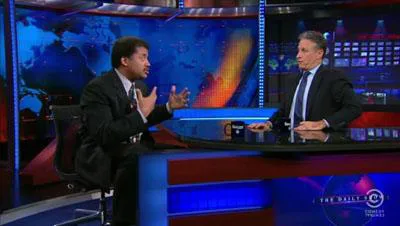
Millions of people know Jon Stewart as the brilliant and hilarious host of Comedy Central’s, The Daily Show. Along with the show’s comedian correspondents, his ironic insight into the political issues of our time has made The Daily Show one of the most-watched news programs on TV. Now meet Jon Stewart, science geek.
Neil talks with Jon about his love for science and technology, the difference between having scientists and politicians as guests on The Daily Show, the importance of scientific literacy, the intersection of science and public policy, and the cosmic connections that unite us all… because even New Jersey is made of star stuff. Charles Liu provides a scientist’s perspective on how the interaction of science and society has affected technological innovation and inquiry from the past to the present, from the Earth to the Moon.
Transcript
DOWNLOAD SRT
Welcome to StarTalk, your place in the universe where science and pop culture collide. StarTalk begins right now. Welcome back to StarTalk Radio. I'm your host, Neil deGrasse Tyson. I'm an astrophysicist and director of New York City's Hayden Planetarium....
Welcome to StarTalk, your place in the universe where science and pop culture collide.
StarTalk begins right now.
Welcome back to StarTalk Radio.
I'm your host, Neil deGrasse Tyson.
I'm an astrophysicist and director of New York City's Hayden Planetarium.
Joining me this week as my co-host is Charles Liu, a friend and astrophysicist with the City University of New York.
Charles, welcome back to the show.
Thank you so much for having me.
And might I say, Mr.
Tyson, the hat you're wearing tonight is absolutely smashing.
You're revealing to a listening audience that I'm not in my normal garb, okay.
Yes, I just came from a commencement.
In fact, Gettysburg College in Pennsylvania.
Congratulations.
And they give you the, I have on the Renaissance version of the graduation hat, which has these multi corners and it's soft velvet.
And I didn't want to take it off because it's the one day a year where you get to, you know, look like you're smart.
It sets off your corsage perfectly, sir.
Thank you.
So Charles, this week, we're going to bring in an interview with Jon Stewart.
Fantastic.
Jon Stewart, we all know Jon Stewart.
Such an impressive man.
He's the host of The Daily Show, and of course, The Daily Show predates him.
It's hard to separate him from The Daily Show, but in fact, The Daily Show was around for several years before he took it over, but now they are synonymous with each other.
I was not aware of that.
And so what, you might ask, what, why did I talk with him about?
You might ask, did you?
What would you talk with him about, Neil?
It's about, first of all, he has, like, scientists on the show with some frequency.
Regularly.
Myself included.
Yes.
And, and also he's, he's smart.
Yeah.
And I just want to find out if, if science had any role in his life that helped make or shape who he is, how he thinks, or what he actually does with how he, how they produce the show.
So why don't we go to the first clip and find out what had, and this interview took place in his office in the World Headquarters of The Daily Show on the west side of Manhattan, just around the corner from Larry Flint's Hustler Club.
If you've been there, you'll know exactly the location of that spot.
Let's check out the beginning of my interview with Jon Stewart.
So Jon, you always have scientists on your show.
This is awesome.
We have you on the show.
We don't always have scientists on the show.
So let me ask you, when you, when you figure out who the guest is going to be, do you have some deeper philosophical mission statement that you are fulfilling when you ask scientists to appear?
Here's the thing.
You always like to balance guests.
We have a lot of political guests.
We have some actors.
We have some things.
I personally am very intrigued and interested in science.
You know, Neil, I don't know if I've discussed this with you previously.
I was a chemistry major in college for the first two years.
Is that right?
William & Mary.
I went through inorganic chemistry was the first year.
Organic chemistry was the second.
What's your favorite element, by the way?
Oh, I'm a huge carbon guy.
Oh, cool.
I enjoy the molecular slut of the table of elements.
It is so a molecular slut.
It will bond with anything.
Totally.
It's ridiculous.
It's so out of control.
And by the way, four bonds.
I don't want to say things that people...
It's all the way around.
That's exactly right.
And I don't know if you knew, you can make more molecules with carbon than you can all other molecules combined.
Didn't know.
What are you kidding me?
I had a picture of carbon up in my bedroom when I was a kid.
Carbon was my teen idol.
No, Jon Stewart has been outed.
I'm a huge carbon fan.
So what happened in the last two years of college?
Well, the last few, it got very hard.
The scientists wanted the exact answer all the time.
They wanted the right answer.
So I switched to psychology where they wanted just an answer.
Any answer.
Any answer, as long as it took up like eight pages and I thought, well, I can do that.
Okay.
So you've been scientifically baptized.
In spite of switching over, you have a sensitivity.
And so now...
Don't make it sound like a penicillin allergy.
I don't have a sensitivity.
I have a love.
A love of science.
A love of science.
Now, here's the thing.
Most talk shows, they'll bring on the politician because they think the politician matters because people vote for them and they allocate monies.
But at the end of the day, I could be biased, at the end of the day, there's scientific issues that affect us all.
Oh, Neil, here's my thing.
You go away and I'm not sure you don't take gravity with you.
I don't know what you got planned.
I don't know what you got in your little suitcase.
You're a scientist.
Yeah.
I mean, my epidermis could be in there.
I don't know.
You got all kinds of things planned.
You would know it if I had your epidermis.
Oh, you would think I would know it.
You'd look really different without your outer skin layer.
So when you bring on scientists, it's not just their work.
Often, the science as it affects policy and society.
So if you were to rank your most important sort of science issues, what would it be, do you think?
To me, the science of health and medicine.
As a registered hypochondriac with the Hypochondriac Institute of Hypochondriac.
Card carrying, apparently.
Card carrying, which by the way, we have no meetings, everyone's afraid to shake hands at the beginning of them.
Health and medicine are at the forefront of any scientific discussion, any scientific breakthroughs.
People don't want to die.
I enjoy a good theoretical, and we're the only animals that seem to know it.
Cows, you can walk right up to them with one of them air guns.
I've seen them blow out their head.
Blow out the head right next to his buddy, and his buddy just stand in there, and then two minutes later he turns around and he sees a line on the ground, he's like, Jimmy, Jimmy, are you all right?
You know, people, because we know we're going to die, science is in essence that search we have to either come up with an answer or to solve the dilemma or to ease our minds about the uncertainty.
And we can also use science to make money.
So it's, I don't want to die and I don't want to die poor.
Neil, that is so crass.
It's not about that.
It's about knowledge.
It's about learning.
Jon Stewart being Jon Stewart.
I like Jon now even more than I did already.
Chemistry, carbon geek.
We just outed him as a chemistry geek.
This is cool.
Although I think he has to learn a little bit about environmental science because, you know, wild cows, they know when they're about to be killed by a lion.
I'm sorry.
I've never seen a wild cow.
Unless you're talking about a wilder beast.
Well, those guys.
Those guys.
Those guys.
You know, who just joined us in StarTalk is one of our favorite, one of my favorite co-hosts, Leanne Lord, comedian, Leanne, welcome back to StarTalk Radio.
Thank you.
Thank you very much.
Good to be back.
We got Jon Stewart on, you know, plugged into the show today.
I know he does politics in the world and I know you've actually done some politics of your own.
Like, you went on a tour through Iraq on a comedy tour, isn't it?
Is that what you did?
What was that?
Yes, I did.
I did a tour for Armed Forces Entertainment.
Actually, I've done several tours with them going to entertainment troops in Afghanistan, Iraq, because apparently, I'll do shows in Baghdad but not Brooklyn, so...
They're still calling for you in Brooklyn there.
Yeah, I'm not going.
I'm not going.
So, you know what I wonder?
With Jon Stewart constantly or often having scientists on his show, we can ask a question even of ourselves.
Charles, what do you think is the most important scientific issue of the day?
Because I can get on the phone, call Jon and say, Jon, do this subject.
Well, it's a little bit prosaic, but honestly, it's science.
Prosaic, I forgot what that word means.
Oh, kind of boring.
Boring, okay.
But it's all about science literacy.
You see, there are so many people in this world today that think that only scientists can do science, which is wrong.
And also the idea that there's somehow some huge difference or even no difference between scientific knowledge and unscientific knowledge.
If we actually knew the difference and the policymakers wouldn't have to lie about it because they wouldn't understand it.
Mm-hmm.
And Leon, what do you think?
What he said.
You're agreeing with Charles?
No, honestly, I mean, part of my answer was going to be the fact that science itself is the biggest issue, not enough education and not enough people being familiar with a subject and honest enough to say when they don't know.
And then that's okay in science, that we can get there if you just say you don't know.
We can start from there.
That is so true.
Well, so Jon Stewart has fun with scientists when they get on there and he tries to extract what's relevant to pop culture and there's also sort of the politics of science itself and how he treats science guests differently or the same from his political guests because you know he's had some political guests on there and sometimes they look like a deer in the headlights, you know, if he comes at them at the wrong angle or in an unexpected way.
The moment he mentions carbon, they're toast.
All right, let's find out what came next in my interview with Jon Stewart.
Political guests lie.
Okay.
They lie and they don't often know what they're talking about.
Scientists have spent years on their craft.
They have a basis of knowledge.
They have a depth of understanding.
So when scientists are on, it's merely a question of trying to chip off a few wisdom chips, shave them down to present them to an audience.
With politicians, you're trying to…You know the scientist is not trying to pull the wool over your eyes.
Well, yes, for the most part.
For the most part.
Now, you mentioned something earlier, which is the money involved.
Now, money is a corrupting influence in any field.
Even scientists, I'm not suggesting that they are pristine in terms of that finance doesn't in any way influence where science money is spent, where the research tends to go.
Certainly, we see many corporations hire scientists, have them do studies that back up the fact that, oh, our product doesn't cause sphincter explosions.
They have a paid guy in their back pocket.
That's exactly right.
So, scientists can also be used and co-opted.
In astrophysics, no one pays us for anything.
Here's your problem.
You went into theoretical science.
No one cares.
Who cares which way the black hole is going?
That's exactly right.
Here's what people want.
They want old people to be able to no longer be impotent.
And that's the science.
That's the highest priority of life.
That's the highest priority of anything.
You are trying to figure out, you're trying to move us next door to God's house.
You want to see if man can somehow look into his window and see what's actually going on in the beginning.
Many scientists are just trying to figure out a way to help Marlboro sell a cigarette that they can bill as a vegetable.
Because it is a plant.
It's a plant.
So are there any particular science subjects that do better with your audience or your polls or however you learn about what they like?
Well, it's very interesting that you would say that.
We don't learn about what our audience likes.
They just come to you with whatever, whoever they are.
Well, what you do is you hopefully earn a certain amount of trust from your audience that the people that you bring on and the things that you talk about will have a certain amount of relevance to their lives or at least interest.
I mean, it's 11 o'clock at night.
You do what feels right to you.
That's exactly right.
And then they eat that.
If I may go with the science of weather, I use my own barometer.
I keep bringing it back to science.
Weather science needs to be.
That's exactly right.
So, in your show, sometimes you have to, like, tow a guest.
Oh, absolutely.
Typically, though, that's a politician.
Scientists, you don't have to tell them.
Because they don't want to talk.
They don't want to say anything.
Because everything they say could be used in a 30-second commercial to bring down their crew.
The politicians are worried that you're going to pull them over.
That's right.
They think that they're about to be ambushed.
Tricked.
That's right.
So, a scientist will just talk about their craft.
Because there's a confidence.
There's a security when they do.
Unless it is, once again, somebody that is coming on that has been disingenuous about the type of research that they're doing.
But typically, the people that we have on are the non-scientist carnival barkers that have been used to headline a scientific issue.
And that's a very different animal, again.
In a political way.
That's exactly right.
And it all breaks down along political lines.
And then, once again, you're dealing with, I mean, politicians are the most stage managers.
You think that actors have publicists and have caution about their public image.
Politicians are, by far.
Why did they even come on your show at all?
Because they are also salesmen.
Here's the problem with them.
They have a product and they must sell it to a constituency because for them to keep their jobs.
And there's a constituency that you're associated with that they want access to.
So that means.
They're the ones doing demographic research, not us.
So Charles, let me tell you.
In our field, because you're my fellow astrophysicist.
Yes, and proud of it.
We hardly ever have, and Pluto aside, we hardly ever have any political, cultural, social controversy in our trade.
Well, then again, also, I mean, did anyone make a buck off of Pluto not being demoted?
Well, I mean, I published a book on it, but anytime I gave a talk, I donated those monies to charity.
We are human too.
Scientists, astronomers, we care about our egos and our profits and so forth, but in the end, what we do or what we've chosen to do for our careers may insulate us a little bit because it's just as Jon says, we're trying to find out what's next door to God's house.
That's kind of cool, right?
Yeah, so are there any other fields you think are more susceptible than we are?
Because I think we're pretty, like you said, we're pretty insulated from this, but there's like physics or biology or pharmaceuticals, this sort of thing.
Yeah, medicine I think has a real issue, health issues that we're talking about.
Sometimes if there's like a car that you want to sell, maybe the engineer will say, well this car is better than that car, I don't know.
But fortunately, I feel pretty safe about that.
I don't know if Leanne has any ideas.
Leanne, which scientists do you trust the least?
Which scientists?
Which ones do you think are most susceptible to special interest groups?
The ones who are trying to sell me chewing gum, actually.
Those four out of five guys, I don't know, it seems a little shady to me.
When we come back, more of my interview with Jon Stewart.
We'll see you after the break.
We're back on StarTalk Radio.
I'm Neil deGrasse Tyson.
With me is my friend and colleague, astrophysicist Charles Liu.
Hi, Neil.
Hey, Charles.
As well as Comedienne, Leanne Lord.
Do you go by Comedienne or Comedienne?
Either one is fine.
Comedienne, I have no feminist issues.
No issues there?
Because some people have issues, and I don't want to have to...
Dude, as long as the check clears, I am all good.
So we've got, in this edition of StarTalk Radio, it's, we've got Jon Stewart as a sort of centerpiece to the subject of the politics of science as well as political science.
And how does politics play out in the conveyance of science on these talk shows or in science, in society and in Washington and anywhere else?
And so, just before the break, Leon, I asked you, were there any scientists who you trusted the least that you were most skeptical about, wondering whether they're bought by somebody?
Is anybody?
You said the four out of five.
Yeah, yeah, I mean, I was joking about that, but I do think your esteemed colleague here hit it on the head.
I'm a little skeptical of the medicine guys.
The medicine guys.
Yeah, because it seems like, you know, for the right amount of money, everybody can line up their scientists and make them say what they want, they make the data say whatever favors their bottom line.
So you're saying scientists can be bought?
Maybe not you guys.
Okay, of course not us.
The gentlemen in the room have the highest integrity.
Everybody else, not for grabs.
We got Jon Stewart to talk about inventions.
So not only just pure science, but inventions that change our lives.
Let's see where that takes us.
Well, the problem with technology has always been that the moment it becomes a breakthrough, now the clock ticks down to its obsolescence.
Because the unfortunate part is not the science, but whatever it is within ourselves that allows you to become impatient and gratuitously unforgiving of the science.
You and I both know plane travel is a miraculous scientific.
Completely miraculous.
Physical, to reverse the power of gravity and then to harness it, to control it to the point where you actually need to use it to get to, let's say, Toledo.
That is a remarkable feat.
And yet, what do you see at airports?
Nothing but frustration.
Where is this plane?
Right.
Oh, I don't know.
Maybe the God is still lifting at his hand 30,000 feet above the world.
I think about this all the time, not the God part, but the fact that I'm there 30,000 feet in the air, going 500 miles an hour with internet, and there are people who get off the plane and complain they didn't get a pillow.
Complain that, oh, you know, the soda was warm.
I didn't get, they didn't have any ice.
Okay, you don't want to take technology for granted.
That's a beautiful point.
I don't ever want to take technology for granted, and yet, look at the way, oh my God, it's been 15 seconds.
Where's my baked potato?
You know, back in the day, you had to literally build a fire pit and do that.
We take it for granted on a consistent level.
Now, the flip side of that, on the science end, is they will dive into things with curiosity and fervor without necessarily know where they're going either.
Right, so they can, they-
Whatever comes out of the shop.
That's right.
So they can drive us into a tree as well.
Whatever comes out of the technological oven.
Right.
There it is.
It's one of those things like, hey, let's try the plane.
That could work, but, you know, oh, they were half-baked.
Oh, geez, that one just went directly into the ground.
I guess we'll have to apologize to Jimmy's family.
That's a rough one.
So you got the flip side of both things.
Ying and Yang, that's my thing.
It's the balance of the universe, Neil, that we're talking about here on your new show, Balance of the Universe with Neil deGrasse Tyson.
That could be a segment of the radio program.
It should be a segment of the radio program.
The Balance of the Cosmos.
The Balance of the Cosmos.
You know what you should talk about?
The positive nature that science has improved our lives and then the moral compass that must be used judiciously.
Ooh.
You a moral compass guy?
I try to always behave in a way where a moral compass is built into the action itself.
That implies that you're doing stuff, oh, I gotta check my compass to see if what I'm about to do is bad.
Well, that meant it's probably bad if you thought you had to then check it.
That's exactly right.
And yet you have these moral compass issues where pushing forward allows for good to come of it, IVF.
It's how you push it.
That's exactly right, how you push it.
Now, no one's suggesting they make monkey-pig hybrids, but IVF.
That's why I'm kind of insulated from it.
Maybe I have the luxury of speaking prophetically about it, but in fact, when I study the galaxy or the universe, there's no, unless I say, here, grab this antimatter, there'd be a moral issue regarding that.
But otherwise, the patient doesn't die, no matter what happens.
Now, do you have any issue with creating antimatter?
No, I'll do that anytime.
Anytime, anywhere?
Anyplace.
That's the kind of thing, if I ever come in and I catch my kid creating antimatter, hey, hey.
You're grounded.
I told you about this.
So, Charles, did you create antimatter as a kid?
I tried.
Yeah, so did I.
Yeah, but it didn't blow up the way I expected it to.
But the whole moral compass thing that Jon brings up is very, very true, but I would add an additional dimension.
That is that science literally helps define the moral compass of our world.
In the 60s, the Pope actually quoted the scientific discovery of the Big Bang as proof that God exists.
And then, of course, Jon mentioned IVF, in retro-fertilization, test tube babies.
Reproductive scientists can actually tell before implantation which embryos are boys, are girls, which ones have diseases, which ones are healthy.
So the scientific frontier informs the dialogue about moral compass, but that's different from saying that it can decide the moral compass.
Right, so other people, people who don't understand science and try to say, well, scientists have to listen to us because they don't know what they're doing in terms of morality.
They actually don't realize how important the science informs their vision of morality itself.
So there's not only the capacity of scientists to inform morality, there's the obligation of those who claim lordship over the moral compass of the country to be scientifically literate.
Unquestionably.
Leanne.
Unquestionably.
You're very agreeable, man.
I am, I am.
But don't you guys think that in terms of the moral compass in science, that science pushes that envelope constantly?
Like it's, OK, we've got a new invention, where everybody gets upset, and then they're back, and we're good now, and then science is out there again.
The monkey-pig hybrid, right.
And then the pig-human hybrid.
Right, that's, give a scientist a cookie, he'll want, how does that story go?
Syrup, pancakes, yeah, all that.
I mean, does there ever come a point that just because we can doesn't mean we should?
Does that ever occur to you guys?
You're never just happy, like, yeah, we're good.
We have 3G on our phones.
We're fine.
No, now we're 4G.
It's true.
The people caught in 3GS, I think, was that phone, but.
So let's, I kept going with Jon Stewart.
I mean, let's see, we kept talking about technology.
Apparently, he's extremely opinionated about it.
Let's see what he tells us next.
Why is it that we have not been able to overcome the bounds of the combustion engine, that the industrial revolution starts?
It's one of the great embarrassing aspects of modern technology.
Right.
We're still using batteries.
Right.
We're still using combustion engines.
Thomas Edison could come down here and recognize all the power sources that we are using.
He should not be able to.
What has happened that we are still just basically burning carbon?
We are, we're basically burning carbon.
That's right.
That we pull out of the ground.
Right.
And we still run away from energy sources that would be much better to tap.
But why?
The volcano erupts.
You know how much energy is in a volcano?
Run!
The hurricane comes.
Run!
Right.
We don't utilize it.
Run!
Yeah, we're victims of nature.
So yeah, I don't want to be the one to run.
I want to be the one who figures out how to tap the volcano.
Economics has a lot to do with it, Neil.
Obviously, economics and psychology, if there are people who can make billions and billions of dollars forcing us to buy internal combustion engines, they're going to try very hard to make sure we don't develop new technologies.
But if I remove the oil, because there's none left, then...
Then you go to war.
No, if there's none left, there's nothing to go to war over.
Right.
Then we can fight over sunlight.
There you go.
How's that for a...
Wow, how much is that going to cost me?
You know, it reminds me, the sun, of course, is powered on thermonuclear fusion, so it's nukes all the way to the center, and I saw a bumper sticker, I think it was a very green bumper sticker, and it said, no nukes, and the O and the no had an image of the sun.
Perfect, perfect.
The sun puts down more than 1,400 watts per square meter.
Now, that's just geek speak for saying that your backyard swimming pool, if it got all the sun...
Because we all have backyard swimming pools, Charles.
Okay.
How about the roof over your bedroom would generate enough sunlight energy, if converted properly, to light your home all day and all night?
That energy is there.
So, roofs are a waste of space unless they can pull in some sunlight.
That's right.
So, all these issues affect culture.
I think we should all be thankful to Jon Stewart for including scientists in his political dialogue.
Most people don't, and they think they can solve all the problems arguing with each other about whose political leanings are more accurate than whose.
Absolutely.
Don't you just need the best sound bite?
No.
Seriously, the guy with the best sound bite wins.
He's clearly right.
That's our culture now, right?
It's not whether you're right or wrong.
It's whether you sound cool.
That's unfortunate, this world in which we live.
See, but we do have a cool sound bite guy, you, but your sound bites are good.
You know what you're talking about.
You're actually factual.
So that's how we're winning.
Well, as I said on Bill Maher a couple of months ago when I was asked to comment on why his previous week's guests all disagreed with evolution and global warming, I just simply said, you know, the good thing about science is that it's true whether or not you believe in it.
So on StarTalk Radio, we have our interview with Jon Stewart continues after the break.
And when that comes, we will find out much more about what Jon thinks of scientific discoveries, what role he thinks it should play in the show, how, what role it plays in, in public discourse, all of the above is what will happen when we return.
Welcome back to StarTalk Radio.
Our guest this week is Jon Stewart, who turned out to be quite opinionated about technology and how we react to it.
Technology never advances with anything that is less convenient than what preceded it.
In the sense that, you know-
So the car is not more convenient than a horse-drawn buggy?
No, no, no, that's what I'm saying, because a car is more convenient than a horse-drawn buggy.
But if they want you to switch fuel sources, if they want, people are never going to, of their own volition, switch to something that is less convenient than what it is because of the virtue of that technology.
Gotcha, gotcha, because technology has to make your life easier.
Or give you the illusion that it's easier, that it's faster, you have to be able to, no one's going to switch to a technology-
On moral grounds.
That's right.
Or on grounds that, well, in the long run, I will be okay.
Each new piece of technology has to make its case.
We can't think that far in advance.
Make your case!
Charles Liu.
Yes.
Well, you know, I bought a hybrid.
Did you?
Why?
But it had to, well, because-
A hybrid car.
Yeah, a hybrid vehicle, because in the long run, it would be better for the environment, but it had to cost $5,000 less than the competitor's hybrid for me to buy it.
So, you can be as green as your pocket-
Wallet allows, precisely.
So, Leanne, do you drive a hybrid?
I do not.
You walk?
No, I drive.
What do you drive?
I drive a Honda Civic.
That's good, that's the same difference.
Well, no, not really.
I don't have any green street crit here, like my co-host.
I'm just flipping the SUVs, the environmental thing.
I would never do an SUV, I would never do that.
Well, so the point is that Jon Stewart was making, is that the way we interact with our technology is we will only allow something if it makes our life easier.
Absolutely.
And if it makes our life harder but saves the environment, it will never fly.
No.
This is the worry.
We're not that species.
So that's some other species.
Yeah, that's some other planet.
You cannot go back to holding hands.
Well, you know, there are some cultures that are willing to do that in this world.
Just not Americans.
Just not us Americans.
Capitalist Americans.
Right.
Well, they're also what favorite discoveries exist in science.
I was very curious to learn of Jon Stewart's science literacy.
And let's find out what how he thinks about the front, the moving frontier of science and technology.
What's one of your favorite scientific discoveries over the past?
That in astrophysics that we learn that the very elements in your body are forged in the cores of stars that exploded, scattered their enriched contents across the galaxy, enabling star systems to form that are enriched with ingredients of planets and life itself.
We are made up of.
We are the molecular.
Yeah, that's true.
We it is true and profound.
And that is that is incredible.
And I did not realize that.
Could you trace in the way that you have genetic lineage that you could trace?
Yeah.
Could you trace the the molecular matter, the stardust, if you will, to what system that you came from?
Would there be a way to track?
Or is all of mankind based on the same carbon explosion?
No, first of all, who's doing the interview?
But I'll answer you.
Here's the thing, you get one exception.
You're far more interesting than I am, so that's my problem here.
But you just brought up a very interesting point.
If we are made up of cellular material from the cosmos, then we should be able to trace it back to certain star systems.
The problem is, that was five billion years ago, but what is certain is that the iron.
I'm not saying they'd still be home.
Right, the iron in your body and all of our bodies all came from the same supernova explosion.
That's a certainty.
But aren't we all from one singular supernova explosion?
Well, we're from several, but we're from one sort of birth sack in the universe.
So are all human beings tied together?
Are we all generated from the same place?
We are not only genetically connected to each other and all life form on earth, we are molecularly connected to all the matter in the universe and we're atomically connected to the Big Bang itself.
That's crazy.
You know what that reminds me of?
Snapple.
I don't know why.
Just good ingredients.
Good natural ingredients put together to taste delicious.
We'll try to get them as a sponsor.
Yeah, please.
I think that would be wonderful.
Snapple.
That's hilarious.
So what's interesting here, first I'm trying to interview him and he's interviewing me.
I noticed that.
I was ready to slap him.
But in any event, there's an important philosophical point to be made that in practically every political discourse, it's all about we versus they and we're not the same because we're thinking differently or we're voting differently.
And what science shows more and more and at every turn of the discovery that we are more connected than ever before.
This is two completely philosophically at odds approaches to life.
And so to the extent that politics drives the world, it leaves me with very little hope about what the future of the world would be.
Charles.
Well, you know, historically speaking, you can even look back and say, archaeoastronomy like Stonehenge, the Brits a thousand years ago, or the Chinese or the Native Americans in Central America.
They all looked under the same sky.
If you look at their astronomical discoveries, even though they never talked to each other, they found the same sky.
That's true.
And so, you know, nowadays people look back and say, oh, it must have been aliens who came in and did that because the people couldn't possibly have learned it.
That's so untrue.
We have been knit since the past.
And so I actually have a little more hope than you have that we can also sleep under the same big sky.
Well, maybe our future in space is what will provide this kumbaya moment for us all.
So in fact, my conversation with Jon Stewart went to space.
He, we were there together.
And let's find out what Jon tells us.
The 1960s were such a tumultuous decade.
And-
Amazing that we went to the moon in the middle of all that.
In the middle of all that.
Of all the nations, the civil rights movement, the war, Cold War, Hot War.
That's exactly right.
And the only hope of that decade was the mission to the moon.
Was the mission to the moon.
And the mission to the moon was to represent the greatest of what man could do.
And I think it was interesting that the achievement in itself became overshadowed by the lack of knowledge of what to do once we got there.
If 10 years after landing on the moon, the best we could do is hit a golf ball.
And be like, man, that thing flies.
You know, then you're-
We're driving around.
That's right.
But I do remember just how astonishing.
Now, in today's media culture, landing on the moon for the first time would be good for a good week's worth of media cycle.
And then something else would happen.
But back then, I remember the astronauts came around to schools.
They sent moon rocks around to schools.
I was in the Boy Scouts at the time.
And we-
You were in the Boy Scouts?
I was in the Boy Scouts.
We guarded the moon rock display.
It was in a VFW hall, and they had all the NASA stuff set up there and a big display.
So you flanked the rock with your uniform.
That's right.
Flanked and protected.
And it's out of a Rockwell painting.
But people were-
Where was your hometown?
Where was that?
This is in New Jersey, Central Jersey.
This is Jersey.
Central America.
Doesn't count.
It was Nicaragua.
But they brought around all the, and these astronauts were-
Rockwell didn't paint New Jersey, I'm sorry.
Settled down.
It's a lovely state.
You know, it's made out of the same stuff as the Supernova.
You should remember that.
You know, we're all connected, Neil.
I've forgotten about New Jersey.
No reason to cast dispersions.
Thank you.
It's all Stardust, baby.
But they all came around and it was, you know, people lined up to look at the rock.
And it was something.
And this is also on the heels of terrible accidents within the space program where people died and really brave astronauts and Chuck Yeager and all those-
The right stuff.
And the right stuff.
And they captured the imagination of people in a way that nothing happened.
They could go to Mars, you know.
Nobody can get up the real enthusiasm for it anymore.
Because in some respects, I think, people had an expectation of what that breakthrough meant as though it would represent a final triumph over our own sort of vulnerability and helplessness within the universe.
And when it didn't, people thought like, what about Mars?
You're like, nah, I don't know.
Okay, so it had a singular place in our dreams that you can never duplicate.
I think, listen, it's always gonna go down as one of the most remarkable achievements in the history of the country.
But then, after a certain point, too, science fiction takes over and you're like, why can't we travel just by thinking about it?
You know, what about hyperdrive?
It's in the intervening 40 years, the advancement has not kept up with the promise of what that was, which by the way, I mean that solely based on the unrealistic expectations of what we have for scientific achievement.
Neil, I gotta say, I'm still a little stuck on the last segment.
I heard the words birthsack and no one picked it up.
No, I just, you know, you don't hear those words every day and we're all from the same birthsack, it's, I don't know, a little troubling to me.
Well, in a cosmic figurative sense, because we all share the same ingredients from the same region of the galaxy that birthed the solar system.
Can I use that word?
Yes.
I know I'm a guy and I don't feel the pain when I use the word, but I mean, do I get permission?
Yes, yes you do.
But to say this, I think the moon would become special again if we figured out how to commercialize it.
If we can get a casino up there, if we can get a hard rock cafe going, if we can get a gap moon.
When we come back.
Well, you know, Neil, you've said before yourself, aside from war or religion or vanity, it's rare that a civilization will muster enough effort to create something truly monumental.
The space program originated from war.
And now if we're gonna go, we might have to just stick with vanity because religion doesn't make a picture.
No, no, there's also money.
I mean, Leanne is right.
I joke with her, but she's right.
What drives huge expenditures of investments is huge expectations of return on those investments.
The old ROI, return on investment.
So I wish it weren't that because I'd like exploring space because it's deep and cool.
And we have a talk show host, one of the most famous there ever was, who is similarly inspired by these thoughts and these mission statements.
All right, so when we come back, we'll pick up our interview with Jon Stewart.
This is StarTalk Radio, welcome back.
So we've got interviews with Jon Stewart running rampant throughout this hour, and what intrigues me is first the fact that he likes having scientists on his show, and it's a political show, so there's this intersection between what the scientist does and the politics of the world.
And politics is all about how to divide people, and scientists by and large is trying to find the one truth that ultimately all scientists agree with.
So I want to get back to you, Charles.
Do you see any science versus politics that never resolved itself, or that it's a dangling sore point in our culture?
It's a continuous back and forth.
Give me some of your best examples.
Oh, I'll tell you.
Bad policy leading to good science?
How about 400 years ago when Galileo got funded by the Doge of Venice to make telescopes as an early invasion warning system, but instead use it to look up in the sky and discover all kinds of things about the universe?
Okay, so that's an interesting interplay there.
And then in our lifetimes in the 1980s.
Wait, wait, just to make it clear.
No one had a telescope before this.
That's right.
And so the Doge of Venice wants to protect this city, and with the telescope you can identify enemy ships much farther away than ever before.
That's right.
So he doesn't see it as, gee, I can discover the universe.
The Doge of Venice says, I can use this for defense.
That's right.
So military funding led to astronomical discovery, the likes of which had never been seen before.
And then even in our lifetimes, the strategic defense initiative, remember Star Wars during the Reagan era?
Star Wars, SDI.
Yeah, that money has led to the discovery of exoplanets.
Which was highly controversial in the scientific community at the time.
That's right.
On the assertion, the correct assertion, that you can't make an impervious bubble around the Earth force field, like on Star Trek.
That's right.
That prevent the missiles bounce off and fall into the sea.
Right.
And so we all knew this, but it was nonetheless funded.
That's right.
It was lousy policy, but it led to the technology that has led to things like adaptive optics and active mirrors that allow us now to find planets beyond our solar system, which now number almost 2,000.
It's really quite amazing how bad science, Good science has come from bad policy over the centuries.
Okay, and how about the opposite?
Has bad science ever, oh sure.
How about the guys in tobacco companies who say that nicotine is not addictive?
That's been funded by plenty of people, too.
Okay, so very bad science.
We are humans, and scientists are not ordained, like we said, they're not whole.
By the way, you say we are humans like there are other people who might not be humans.
Oh, we just want everybody else who thinks that scientists are not human to remember that scientists are human.
We are foiled.
Leanne, are scientists human in your life experience?
Oh, that's true, we better let somebody who's.
Yeah, someone who's not a scientist weigh in on this.
I really think the overwhelming perception of you guys is glasses and pocket protectors, and the fact that you guys are both wearing glasses really shouldn't be construed at all.
But yeah, no, there's a way, you guys get dehumanized a bit.
Well, and so part of the advantage of going on these talk shows is people see us in the context of real life politics and culture and society.
Right, we have opinions, we make mistakes, we sometimes make great positive things, and it's all the mixture of all those things that make science what it is.
I would add, by the way, that when a scientist makes a mistake, it's in almost every case another scientist who finds that mistake, so that the system has built in error-correcting mechanisms that other branches of life and culture don't.
That's right.
You don't get that in religion at all.
But this is why, for example, the climate change conversation has become steering more and more clearly towards something that's scientifically correct as opposed to politically correct.
But it makes for much less fun arguments on the 24-7 talk shows.
Absolutely true.
We learned about the importance of greenhouse gases from Venus and from Mars.
Venus is 900 degrees Fahrenheit, hot enough to cook a 16-inch pepperoni pizza in nine seconds.
Yeah.
I did the math on that.
Congratulations.
Yeah.
Actually, I got 8.6 seconds.
I'm sorry.
Meet me outside.
Wow.
It's a geek off everybody.
So you had to global warming.
Any other sort of issues that could have been politicized, but in the end science triumphs?
Well, I'll give an example of astronomy.
When we are asking ourselves, what is a planet?
It could easily politicized for whatever reason you want, but in the end we wound up discussing it like, I don't know, adults, shall we say?
And eventually we came down with an opinion and people still disagree, but in the end it's not knives and pitchforks.
Well, plus Pluto doesn't really care what we think of it.
And I think it's perfectly happy out there.
We've got another clip of Jon Stewart where I asked him just about his opinions about people and how that might plug in to a new capacity to send people to Mars.
Let's find out.
I know you're not without opinion about people who populate this world.
That's right.
And who influence its fate.
So if there was a rocket ship going to Mars, who'd you put on that first?
Well, you just came up with the game show idea.
That is, if that's not the newest Mark Burnett edition of Survivor, I don't know what is.
So here's the problem you have with the Mars thing.
Your question intimates that it's exile.
The first person to Mars is, that is.
Right, so that's something that has to be earned.
Okay, so you leave him here on Earth.
That's the punishment.
That's exactly right.
We have the person earn it.
I haven't go through 10 years of training.
And then the last minute go, hey, you know what, there's too much weight.
We can't get rid of it.
It turns out there was a, we needed a ratchet set, so you can't go.
So, we send only the brave and the few to Mars and leave the rest behind, apparently.
But that kind of rings.
Yeah, that sounds very Rapture-like.
Rapture-like.
Yeah, and you know what, that actually brings up something I have to apologize.
Wouldn't the Rapture faithful be surprised if in fact they were lifted off of Earth and landed on Mars?
That's totally not what they were expecting at all.
200 degrees below zero, no oxygen.
It's a little chilly, Lord.
It's a little chilly.
Thought your love would be warm.
But that's actually why I was late today and completely unprepared.
I was really kind of hanging out waiting for the last minute Rapture.
I didn't think I would have to be ready for anything after yesterday.
Just in case you would last on the list and they would get to you.
Yeah, you know, it's like, hey, is there a bouncer here?
Are we gonna get?
Charles, you're still here, so you weren't Raptured either.
I wasn't.
No, I must have evolved my position here on Earth as opposed to have been divinely ordained.
I quickly just went to Deborah Harry's Rapture.
That's all the time we have.
This has been StarTalk Radio.
I want to thank my guests.
And, as always, I bid you to keep looking up.
See the full transcript



 Unlock with Patreon


 Become a Patron