


 Unlock with Patreon
About This Episode
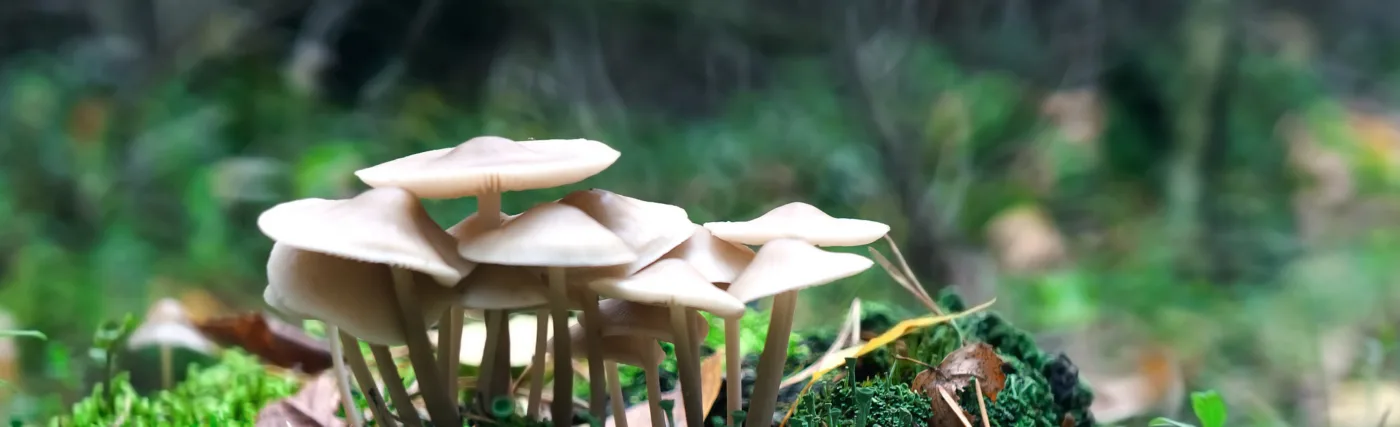
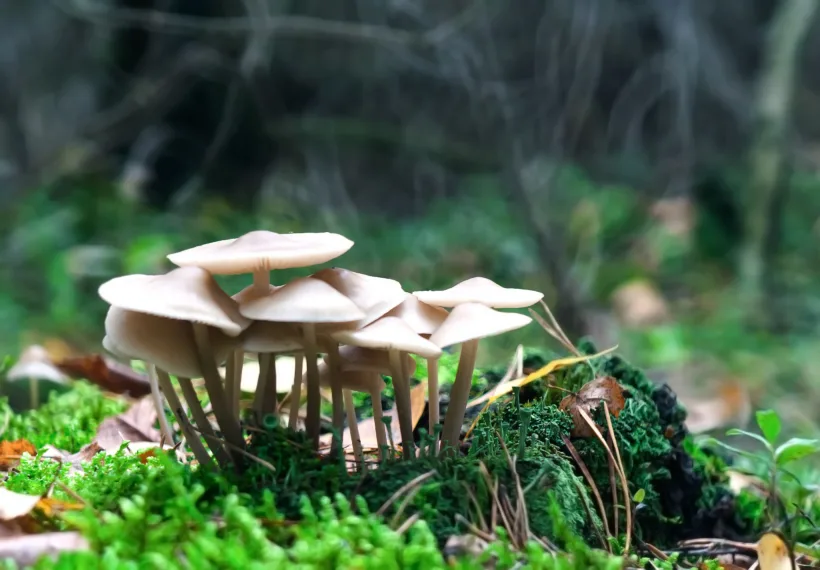
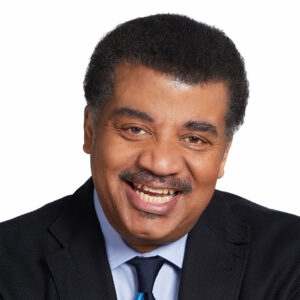
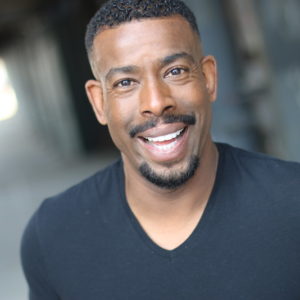
Why are some mushrooms delicious, some make you high, and some kill you? Neil deGrasse Tyson and comedian Chuck Nice discover the weird world of mushrooms, psilocybin, and mycelia with mycologist Bryn Dentinger.
What is a mycologist? Discover the kingdom of fungi, the crazy chemicals they produce, and how mushrooms have a closer common ancestor to us than plants. How did the asteroid that killed the dinosaurs help the mushrooms? When did humans start using mushrooms for their psychedelic effects?
Why are mushrooms so hard to grow? Learn about the differences between fungus and plant life. Learn about how mycelium are some of the largest single organisms by area. How did some mushrooms come to be hallucinogenic? Should we be farming more mushrooms?
What makes prized mushrooms like truffles so rare? Why can’t we farm them? Could fungi be the key to feeding a future Martian settlement? Learn about what fungi are made of biochemically and how many new species of fungi are found everyday. How do fungi interact with the human microbiome? What is Auto-brewery Syndrome? Plus, could a fungus based plague cause a zombie apocalypse like the disease featured in The Last of Us?
Thanks to our Patrons Jack Hill, The Fantasy GOAT, Andrew Gendreau, ND, Vijai Karthigesu, Shellz, and Jeff Lane for supporting us this week.
NOTE: StarTalk+ Patrons can listen to this entire episode commercial-free.
Transcript
DOWNLOAD SRTComing up on StarTalk, Cosmic Queries all about psilocybin, that hallucinogenic chemical found in mushrooms.
I have no particular expertise in this, but we found someone who does an expert on mushrooms.
In the next episode of StarTalk, there is fungus among us.
Welcome to StarTalk, your place in the universe where science and pop culture collide.
StarTalk begins right now.
This is StarTalk.
Neil deGrasse Tyson here, your personal astrophysicist.
They were doing Cosmic Queries on none other than psilocybin.
Oh, my gosh.
Nice.
We haven’t done one of these before.
The psilocybin or the queries?
Queries on psilocybin.
I don’t think I’ve done either, to be honest.
That’s the voice of Chuck Nice.
Chuck, always good to have you, man.
Always a pleasure.
So psilocybin.
Well, I have no expertise in this.
And you may have user’s expertise.
I’m intending to.
This is a fundamentalist academic show.
Well, I certainly have no expertise in this subject.
And I don’t know if, Chuck, you do?
I intend to.
Intend to, okay.
So, but since we find the academics wherever they roam, where the expertise can be found, we’ve got it in Bryn Dentinger.
Bryn, welcome to StarTalk.
Thank you very much, Neil and Chuck.
It’s a real pleasure to be here.
So you’re a curator of mycology, not yourcology, mycology.
At the Natural History Museum in Utah, and you’re a principal investigator in the Dentinger Lab.
What a coincidence there.
What are the odds?
And you’re co-author of a just published study at the Publications of the National Academy of Sciences on the phylogenomics of psilocybin mushrooms.
Whoa.
Whoa.
So this is, so first tell me what a mycologist is.
Sure.
Well, I’ll start off by saying.
I’m gonna go with high.
Okay, Chuck.
Only sometimes.
What is a mycologist?
What is a mycologist?
High out of his mind.
That’s what.
No, go ahead.
But a mycologist is somebody that studies fungi.
Fungi is a whole kingdom of life.
Relative to plants and animals, there’s the whole fungus kingdom.
And we know so much less about them than we do plants and animals.
So mushrooms are just a part of all fungi.
Many fungi are molds and yeasts.
Things that you might be more familiar with on your bread or your shower.
You know, when I wasn’t looking, fungus became an entire branch of the tree of life, an entire kingdom.
And that was based on their mode of nutrition.
So how they get their food basically.
So animals ingest things and fungi absorb things.
And so that was emphasized when they removed them from plants.
I see.
And another thing I learned just recently, like what five years ago, that the common ancestor between mushrooms, fungus, and animals parted later than its common ancestor parted with green plants.
Which logically tells us that we and mushrooms are more genetically alike than either we or mushrooms are two green plants.
I think I can say that, isn’t that correct?
That is absolutely true.
Yeah.
So we share a common ancestor with fungi about a billion and a half years ago.
So that’s quite a long time.
Things have changed quite a bit.
Obviously we don’t look.
Wait, dude, I’m an astrophysicist.
Right, okay, yeah.
So that’s like a split second.
That’s what I say, yeah.
Right, right, drop in the proverbial bucket.
We got this, okay, yeah.
Yeah, so we look entirely different today.
The one tract, the animals, they went through this internal absorption, or sorry, digestion, and then the fungi, they’re sort of the opposite.
They’re like our stomachs turned inside out.
So they just live inside their food, squirt their enzymes out to their environment.
They break stuff down and they reabsorb them.
And that’s why we look so different.
Okay.
So what is a psilocybin?
Yeah, so this is a small molecule that some mushrooms produce.
About 200 species of mushrooms around the world produce this compound.
And nobody knows why they make it.
But one thing that we do know is the way they make it is very highly regulated using a combination of like four genes that encode enzymes that convert the amino acid tryptophan to psilocybin in just four steps.
So why they do this is a matter of huge speculation.
Of course, you and your viewers may already know that one of the activities of psilocybin when it’s consumed is to produce altered states of consciousness in humans and in other animals.
Yeah, mammals primarily or all animals, no matter what?
It hasn’t been tested very widely, so we can’t really say that certainly all the mammals that’s been tested on show behaviors that are consistent with an altered state of consciousness.
Okay, so there’s some mushrooms that are just simply tasty.
Others take you on mental trips and others will kill you.
Oh, let’s hope they never all get together.
Whew, we are in big trouble if they do that.
So this range of things it can do to us, is it just random that happens to be that way?
I mean, there’s a lot of species of fungus, for sure.
It’s not entirely random, at least not in all cases.
In the case of psilocybin, it might be what we call a happy accident that it affects us that way.
It might be that that chemical has some other function in nature that we don’t yet understand.
It traces back to 65 million years.
That’s an awfully suspicious timeframe in the history of life on earth.
Are we to believe that the dinosaurs were high that’s why they didn’t realize that they’re about to get wiped out?
Like, hey man, look at that thing in the sky.
Oh man, that is really, really cool, man.
Rad, man.
Oh my God, look at the trail on it, man.
The colors, the colors.
Yeah, I mean, that’s a little suspicious.
What can you say about that?
I mean, I couldn’t prove Chuck’s hypothesis wrong, but.
Chuck is good at those kinds of hypotheses, by the way.
But I’ll say two things.
One is our ability to precisely pinpoint the origin of this in absolute time is pretty poor.
So, there’s a huge range of possible dates that this originated.
We call this a confidence interval.
And so, the 65 million just happened to be sort of in the middle of that range.
It was the mean, but it doesn’t mean that that was precisely the time at which this molecule appeared.
That said, an interesting consequence of the asteroid hitting earth is that it created a nuclear winter, which blocked out sunlight, and sunlight is necessary for plants to grow.
So, there were no plants around, and therefore, there was nothing that could eat plants.
They were gonna go extinct.
Things that needed to eat plants, they’re gonna go extinct as well.
But things that don’t rely on live plants to feed and survive, could thrive under those conditions.
And that happens to be mushrooms that decompose dead organic material, and things like slugs and snails that eat decomposing material.
So, those kinds of organisms, they actually did well after the asteroid impact.
Wow.
You know, I haven’t put two and two together there to make that, draw that conclusion.
That makes perfect sense.
So, there is the great dying of organic matter, and this is a happy day for mushrooms and snails.
It does appear that mushrooms diversified very rapidly after the asteroid impact in many groups.
So yeah, it may have been an opportunity for them.
The world is ours.
Just a couple more questions before we go to our Q&A.
Chuck, you loaded up with the Patreon questions.
I do, I have them.
Okay, so how did we discover this chemical in them?
Is it just, is it people grazing mushrooms until, I mean, they can’t have been motivated to expect this.
Right?
So I guess, was it just random?
And do we have a, can we date that in the history of culture?
We don’t know about prehistory and what kind of interactions our ancestors had with these mushrooms because it’s not recorded.
But we do know that Mesoamericans.
Astronomically, history goes back to the Big Bang.
So you mean history in the historian sense, where we actually have records of people, places, events, and things?
Our history.
Correct.
We also don’t have a history of its use at the time of the Big Bang.
Yeah.
Who knows?
Maybe it is the reason for the Big Bang.
Somebody, somebody took it and…
But in all seriousness, the first people that were documented to use it were Mesoamericans.
And this was discovered when Europeans first arrived in Mesoamerica and wrote it down and then proceeded to ban its use, of course, because it was total sacrilege.
Right.
So that knowledge was suppressed for hundreds of years until it was sort of rediscovered by an American ex-banker, Gordon Wasson, who traveled down to Mexico on these rivers that they were still being used for ritualistic ceremonies.
And he documented it and published an article Life Magazine in 1957, and that is the source of modern understanding of the use of magic mushrooms.
That’s when he coined the term, in fact, magic mushrooms.
1957.
Life Magazine?
Yeah.
Who would have thought?
And so I presume their use is for this chemical besides just taking them a head trip?
Yeah.
So unfortunately, we haven’t been able to explore that efficiently for the last 50 years thanks to suppression of research by Richard Nixon after he passed the Controlled Substances Act in 1971.
I don’t want these people getting high.
Well, it was a form of social control.
So he was concerned about the subculture subverting his political dominance.
So he created all these challenges for people to explore freely in their world.
But we don’t need to get into politics.
I think the hippies were considered countercultural to what the political agendas were.
And if they’re using psilocybin, and they’re not otherwise harming other people, and you make that illegal, then you can arrest hippies and get them out of your way.
Exactly.
Well, that’s basically the story behind marijuana, too.
But today, we’re now having a resurgence of interest in its medical applications, and it’s showing to have profound therapeutic value for a wide range of mental illnesses, from depression to PTSD, end-of-life care, all kinds of things.
We might have known this decades ago, and it’s only coming out now.
And what are some of the benefits when you talk about depression, PTSD, which are slightly related, but then you say end-of-life?
Is that the acceptance of end-of-life?
Is that a pain management?
What exactly is it for end-of-life?
Yeah, so I should say that I’m not a medical doctor, so I can just tell you what I’ve read.
You could sell to the doctors.
You show up on their doorstep, open your trench coat.
Not quite, not yet.
It is really about accepting your death and coming to terms with that.
So it doesn’t provide any pain relief.
Just dissociation.
Well, I mean, that was going to say that’s a psychological pain reliever.
Yeah, in a way.
I’m Kais from Bangladesh, and I support StarTalk on Patreon.
This is StarTalk with Neil deGrasse Tyson.
So Chuck, we’ve got a question.
I think we’ve laid some good groundwork here.
To see where these questions come in.
Absolutely, let’s jump right into it.
But this is Patrick Weglinski from Salt Lake City, Utah.
And he says…
Oh, another Utah person.
Another Utah person.
Utah, I’m worried now.
You’re all gathering together or something?
Planning something?
Well, this is the place.
That’s what Brigham Young said when he arrived.
Right.
So this is the place.
I got it.
And of course, Joseph Smith had the visions he had.
There might have been some mushrooms involved.
There might have been some mushrooms involved.
There just might have been.
Okay.
That’s hilarious.
He says, hello, Dr.
Dentinger.
I’ve been trying to get into mycology, and it can be very difficult.
I find it much harder than growing plants.
Why are mushrooms so difficult to grow on purpose or by accident?
Why do mushrooms need to have a super sterile condition in order to grow in an artificial environment but can grow in the nastiest conditions in the wild?
That’s right.
That’s so true.
In fact, I saw a crack in the pavement, and the mushroom was popping up through the crack in the pavement.
Absolutely.
So what’s up with that?
Yes.
So it turns out that unlike plants, they have to compete for resources that already exist.
And there’s a lot of things competing for the same resources.
And so it’s just their competition that you get a lot of contamination, but things that can grow better.
Just to be clear, green plants do compete for sunlight.
Yes.
But there’s an abundance of sunlight.
Right.
Whereas you’re describing resources in the environment that one person gets it, the other doesn’t.
Right.
And when you’re growing a plant, you’re not going to grow it in the shade of another plant.
Right.
You’re going to manipulate its environment to make it thrive.
But to do that with a fungus, the only way you can manipulate the environment is to make sure there’s no other organisms present that can out-compete it.
So you have to sterilize it.
But why they occur in nature?
Well, this is just a numbers game.
So every mushroom, just for example, will produce maybe up to a trillion spores.
Those trillion spores have to find a mate.
They’re not a full seed, so they haven’t made it yet.
But there’s half a trillion possible individuals, reproductively mature individuals, that results from a small mushroom.
So you don’t see all the failed mushrooms?
Exactly.
Yeah.
A much more concise way of putting it.
Look at that.
There’s a statistical bias.
That’s right.
Okay.
So if your guy, Chuck, had a trillion pots, he’ll get mushrooms in some of them.
He’ll get some mushrooms with no problem, right?
Or he could just keep a very dirty shower.
Well, that’s cool.
That’s a great thing.
That’s a cool answer, too.
This is Stone Currier.
And Stone says, hello, Dr.
Tyson, Dr.
Dentinger, and Lord Nice.
This is Stone from Boston, Massachusetts.
And yes, Chuck, that’s my real name.
Hey, man.
I was going to say it sounded very, very Hollywood, but…
Yeah.
Yeah, exactly.
It’s a name, Stone Currier, but I’m a leading man.
Exactly.
Sounds like an anchor.
Today’s top story.
I’m Stone Currier.
He says, I’ve heard that the largest living organism is one big circuitry of mushrooms.
This is incredible.
It makes me wonder, is this one organism or just a way for multiple mushrooms to talk?
Also, since they’re talking, where do mushrooms lie on the consciousness scale?
More than my tree, but less than my dog?
And finally, is there any evolutionary benefit that some mushrooms give psychedelic hallucinations when eaten?
So Bryn, this question better be true about mushrooms being the largest organism, because I wrote about that in a book I put out a couple of years ago.
So I’m listening.
It is true, Neil.
It is true.
So as far as we know, the largest by area, the largest individual organism by area, is a fungus that grows in the Blue Mountains of Eastern Oregon, and it covers an area of about three and a half square miles.
Now it may not be the largest in biomass that may be topped by a cloned aspen called Pando in Utah, but it’s certainly many times larger than a blue whale.
And that’s kind of surprising to a lot of people.
Yeah, but what makes it one organism?
It’s not just interconnected, multiple organisms that happen to have, that manage to figure out how to have a network.
Yeah.
So it appears, based on genetic evidence, that it is a single individual that’s connected throughout this three and a half square miles of forest through a network of hyphae, which we call the mycelium.
That’s the mass of hyphae that makes up an individual.
And the mushrooms get produced on the edges of this mycelium whenever conditions are right.
There’s some stimulus that causes it to bank the mushrooms, but they’re simply the reproductive structures.
So the metabolically active organism, what some people call the vegetative organism, this is just the mycelium in the soil.
Which by the way is an excellent story propagator in the HBO series, The Last of Us, which is so cool, because they’re mushroom zombies.
Right.
And they all talk to one another through a mycelium network.
So they, and of course in James Cameron’s Avatar, he was highly inspired by the connectivity of multiple organomistic elements.
So everybody had like a USB ponytail to connect into the plant that went into the animals.
Yeah.
Because the whole planet is connected by one network.
Yeah.
Yeah.
Wow.
That would be so great.
Yeah.
Cool.
What about the hallucinogenics and evolution?
Is there any link between the two of them when it comes to eating mushrooms?
We don’t know what link there is between evolution and these hallucinogenic chemicals.
But if we take a lesson from plants, those chemicals are there to protect the plants from being eaten.
And we think that that’s probably the case with the mushrooms as well.
So, it’s more of a defense than…
It’s a defense.
No, wait, wait, wait.
Until we came along and then it became a very poor defense.
I’m skeptical.
Mushrooms will prevent me from reaching into a flower bush, okay?
There are things that will prevent me, you know, a bee sting prevents me from getting closer to the bees.
A chemical that takes time to have an effect on my brain is too late, I already ate the mushroom.
So how can that be thought of as a defense?
Yeah, that’s an excellent point, Neil.
And we think that it’s not the chemical that’s responsible for the defense, but a conversion of that chemical into something that would cause your stomach to burn.
That’s defense.
And I associate that bad feeling with having eaten the mushroom.
And that would be immediate, yeah.
Oh, oh my gosh.
Okay, that’d be immediate, okay.
We can totally.
And when people, when human beings take psilocybin, do they experience this kind of burn?
Or is that part of the experience?
Feel the burn.
Feel the burn.
No, because it functions at a much smaller scale than humans.
So these chemicals didn’t evolve in response to humans.
We know that because they predate humans by 65.9 million years, at least, so we know that.
So they evolved in response to something else.
And probably it’s invertebrates.
Those are the kinds of animals that cause a lot of damage to mushrooms, particularly land mollusks, slugs and snails.
So that’s why we think that that chemical evolved as a defense against slugs and snails.
Are insects invertebrates?
Are they counted as invertebrates?
They are.
Yeah, they are.
Because they have an exoskeleton.
Yeah.
Yeah, but they still have a skeleton.
I mean, I think of vertebrate or invertebrate.
When I think of invertebrate, I think of jellyfish.
But that doesn’t have an inner or outer skeleton.
It seems to me the exoskeleton ought to count for something in the nomenclature.
It does, but it doesn’t have bones on the inside.
It doesn’t have a vertebrate.
It’s a mush on the inside.
Total mush.
Yeah.
You step on a water bug, you see all the mush pop out.
Or when you bite it with your chopsticks, right?
Yes.
I do that all the time.
That’s how I eat.
That’s where I get my protein.
It’s good for the planet.
This is from me.
What is the difference between Salo Saban and Ayahuasca?
And if you had a friend who owns a resort in Costa Rica, who offered you the ability to come down and do Ayahuasca, is that a safe thing to do?
I can’t speak to the safety of Ayahuasca, other than it’s been used for probably thousands of years by indigenous peoples in the Amazon basin.
But it is different.
The chemistry is different.
So one thing about Ayahuasca is in order for it to be active, you have to mix two chemicals together.
One chemical inhibits the enzyme in your stomach that would normally deactivate the other chemical.
So this is called a mono-amine oxidase inhibitor.
And mono-amine oxidases are enzymes that are there to protect us from getting poisoned when we eat things, primarily plants.
So you’re causing that enzyme to no longer function, which if there are other chemicals involved other than the one in ayahuasca that makes you high, that could be really dangerous.
So sometimes people who have antidepressants, if you take an MAO inhibitor with that antidepressant, that can cause real problems.
So I would recommend you seek some medical advice from a trusted practitioner before you engage in that.
Ayahuasca is also from mushrooms?
No, ayahuasca is from plants.
So it’s usually two plants, but often there’s a mixture of other plants.
But the two plants that are really important are a source of DMT, dimethyltryptamine, which is very closely related in structure to psilocybin, but pharmacologically has a slightly different action.
And the other compound is just this MAO inhibitor, which can come in a variety of flavors.
All right.
So it’s really, you have to deactivate a part, a system in your body to allow the active ingredient to go to work.
Otherwise, it just won’t work.
Yeah, DMT is widespread in nature, particularly in plants.
It’s in many, many different plants.
But do people do administer DMT intravenously or more commonly they vaporize it and inhale it, and that bypasses the digestive system.
The digestive system.
They may.
All right.
Keep it coming.
All right, here we go.
This is Angus McNeil.
And Angus says, Hello Neil, Bryn and Chuck.
I was wondering that since mushrooms have some medicinal purposes and you can eat most of them, would it make more sense to start farming mushrooms instead of traditional crops like wheat?
Thanks, Angus, and I’m 13.
Oh wow.
Yeah, that’s good for him.
Is there an environmental difference between harvesting mushrooms and harvesting green plants?
And I’m not talking about the mushrooms you dig up and they charge $400 an ounce.
Yeah, yeah, right, that they have to enslave pigs, dog on pig labor force, unfortunately.
So yeah, we’re not talking about truffles.
But if mushrooms are nutritious and of course they taste meaty, which is something no one ever accused kale of tasting, I would eat a bowl of mushrooms over a bowl of lettuce any day of the week.
Me too.
It’s true, yeah, I gotta admit, yeah.
And nobody has a kale burger.
But people have definitely had a Portobello burger.
So, yeah, kale burger.
I mean, that’d be a sad universe right there, if that’s all they.
I’d say don’t knock it till you try it.
So, cultivated mushroom, I would say, it would be a replacement for traditional crop plants.
And that’s because the form of nutrition they provide is not complete.
They’re not very full of carbohydrates, for example, which our bodies need.
Well, like corn, right?
Corn or wheat.
Wheat or potatoes.
All the grains.
All right, potatoes.
Grains, rice and potatoes, okay.
So I suppose you could go on a-
Not kale.
Not kale.
Sorry, kale.
No carbohydrates in kale.
What is in kale?
Yeah, marketing.
That’s what’s in kale.
A bunch of marketing.
So, you know, they are, they’re a good source of proteins.
And one important thing is that they have a complete, they’re complete with their amino acids.
So unlike vegetables, which are missing amino acids that animals need, fungi have all of the same amino acids.
And that of course refers back to our shared ancestry from a billion and a half years ago.
That’s why they have the same amino acids we do.
So that’s important.
Nice.
And they have some other vitamins, but you wouldn’t be able to survive on mushrooms.
A lot of the cell walls that they have are indigestible, like cell walls of plants.
So they’re not, they can subsist in mushrooms.
You’re just passing them.
You’re passing them.
They’re not, you’re not extracting anything from them.
You know, but then they, but the protein is a good thing.
The protein is a great thing.
So, I mean, so for vegetarians, mushrooms should be a really great addition to their diet for that reason.
Absolutely.
Yeah.
But you have to eat a lot of them because they’re 90% water.
And that’s one of the other challenges with using mushrooms in place of meat or other foods.
Gotcha.
Oh, that’s a great question there for a 13 year old Angus McNeil.
Way to go.
This is Troy, who said, that’s all he says, he’s Troy.
He’s like Cher.
You gotta know who Troy, if you don’t know who Troy is, then you’re missing out, okay?
Cause I’m Troy, okay?
So there you go.
He says, hey everybody, Dr.
Tyson, Chuck, Bryn, Troy from Virginia here.
Do you think plant life have any similarities that relate to the frameworks of the universe?
I often feel like trees, mushrooms, and plant life have specific traits that model an attribute of the universe.
What do you think that might be for mushrooms or for fungi?
So is there any parallels that you can draw between the universe and fungi?
I think this might be a question for Neil.
I officially don’t understand the question.
Well, I think what he’s saying is when you look at the human brain and there are trillions of connections and then you look at the universe and there’s trillions of stars, and that there seems to be, there really is no correlation, but there seems to be some kind of correlation.
Is there any correlation between plant life and fungi and the universe itself in either its structure, its composition, or anything that you might be able to draw as a parallel?
For the following reason.
So what we learned when we looked out beyond Earth, we found planets orbiting the sun, eventually when we put the sun back in the middle of the known universe.
So that was kind of cool.
Okay.
And then we looked into the atom and we found electrons orbiting a nucleus.
We say, that’s just like the planets orbiting the sun.
It’s just like it, we said to ourselves, we thought to ourselves.
So, but the more we looked at it, the less it resembled it.
We even called the paths of the electrons orbitoles, named after the planets orbiting the sun, orbitoles.
And orbitole is a region of space where you would find the electron.
Point is, that different laws of physics apply for smaller gatherings of matter than for larger gatherings.
Different laws of physics.
So you can’t sort of linearly go from one scale to another, and then expect to have any clue what’s happening in that other scale.
That’s cool.
How about Andrew Gendro, who says, or Gendro, who says, hello, Dr.
Tyson, Dr.
Dentinger, and Chucknology.
I don’t know what that is, but he says, what is it chemically or biologically that makes rare prized mushrooms so delicious?
And why are they so damned rare?
Can’t we just grow them like potatoes?
We have mushrooms and we’ve got the dirt.
What’s the big holdup?
So I guess he’s referring to truffles.
Truffles, yes.
So truffles are just a strategy that many mushrooms and non-mushrooms have taken to get their spores dispersed by animals.
So this has evolved many times, hundreds of times actually, but the truffles that we typically eat as humans, they’re in the genus tuber, which is a reference to the potato as it turns out, and they have to be collected in the wild or sometimes grown in orchards, but it can take years for those to mature and be harvestable.
And the reason is complex.
So one is that they rely on the living roots of trees to grow.
And we haven’t yet been able to figure out how to mimic a live tree in a lab, so…
So they’re basically parasitic to the tree.
You could look at it that way, but most people have viewed it as a mutualism.
So they benefit the tree by giving the tree nutrients and water from the soil, and in exchange, the tree feeds the fungus with sugar that it makes through photosynthesis.
And this is persistent.
This allowed land to be colonized by plants 450 million years ago and has persisted to this day in 90% of all land plants.
So it’s kind of an amazing partnership between plants and fungi that has transformed the earth’s landscape and made it hospitable to animals like us.
So we kind of owe our existence to mushrooms.
Wow.
That is just a terribly fascinating little factoid.
That’s awesome.
All right.
This is Abram Pusada.
And Abram says, Hello, Dr.
Tyson, Dr.
Dentinger, Lord Nice.
As we live in an exciting era of rapidly growing space industry, can you speak to the role of fungi in something like a Mars settlement, which aims to be self-sustaining?
Could it play some part in making soil from regolith?
If so, what else would it need to accomplish that?
Also, assuming that at some time, some amount of soil is present on Mars, do you expect it will be a vital food source for the settlers?
So, are we taking mushrooms to space?
Do they make a good space food?
I think we will have to do that, yes.
So, yeah, they’re really good at decomposing things.
So, if you think of your compost bin, if you have one of those in your yard, that’s essential for breaking down dead organic material and turning it into new forms of nutrients to grow plants.
So, if you imagine first trying to establish a colony in Mars, you’re not going to be ordering up fertilizer off Amazon, right?
You’re going to have to make your own while you’re there.
Amazon delivers to Mars.
It keeps growing.
I missed that.
So maybe fungi are obsolete.
Colonizing Mars, I don’t know.
But I also think referring to our earlier question about their nutritive properties, this would be a good source of protein for early colonizers when there aren’t large herds of cattle yet roaming Mars.
See, I think they’re essential.
And one other fun fact about fungi, a lot of fungi are resistant to high levels of radiation.
And in fact, some fungi can actually convert radiation energy into their own metabolism.
So there’s good reason why fungi are going to be probably a critical component of establishing a settlement on Mars for humans.
That’s so cool.
So now, wait a minute.
You say they’re highly resistant to radiation.
Some, yeah.
Is that because they’re 90% water or is it because they have some properties that are, you know, just whatever properties that might be?
And then could we be able to take that and make a skin for a spaceship as a shield?
Yeah, I like where you’re going with that.
I’m not the one to help out with that, but somebody should definitely look into that.
I don’t know exactly why they are.
Some fungi are highly resistant to radiation.
There’s probably some biochemical basis to it, but I’m not that familiar with it.
Interesting, interesting.
Oh man, that’d be kind of…
Part of it would be just complexity.
Mushrooms are pretty simple, aren’t they?
Well, simple in what sense?
Well, structurally simple.
If you have a lot of complex things going on, then any kind of pulse of radiation can do severe damage to what you are.
If you’re simple, you don’t know any better.
I think you’re right.
The life form, the sort of vegetative phase is very simple.
It hasn’t changed in 400 and some odd million years, maybe even longer, because it’s a very successful strategy.
But when you get to the reproductive phases, those get to be quite complex.
There’s some very sophisticated mechanisms that would easily be disrupted through mutation.
So I would say they’re complex at a different scale.
But yeah, you’re right.
Generally speaking, the kind of the growth habit is pretty simple.
All right, this is Paul Patsova.
And Paul Patsova from Slovakia says, Hello, Dr.
Tyson, Dr.
Dentinger, Lord Nice.
I would like to know, how do the interactions between fungi and the human microbiome influence health and disease?
What are the possible beneficial roles of fungi in human health?
So are there any medicinal applications?
We know about psilocybin, but that’s more mental.
Are there any medicinal applications for fungi?
There are some.
There’s a long history of use of some mushrooms in traditional Chinese medicine primarily.
The jury’s out, I would say, on just how useful they are in modern medicine.
But potentially, there’s something there.
In reference to the microbiome, however, we do have fungi that live inside of us that are commensal.
That is, they live there, they don’t seem to have an impact on us, but probably they’re doing something for us and we just haven’t yet understood it fully.
But we have yeasts that live in our guts.
These can get out of control sometimes and cause conditions like autobrewery syndrome, where you have yeast.
Oh, that sounds delightful.
Autobrewery.
Yeah, so you’re walking around drunk all the time because the yeasts are fermenting the food you’re eating and turning it into alcohol and then you’re drunk.
This is a pretty rare thing, but it happens multiple times.
That is amazing.
Dude, you want to go get a drink?
Dude, I am drunk all the time.
You keep your drink, sir.
I am always drunk.
I mean, it’s much cheaper.
Yes, that’s for sure.
But there’s emerging, I’ll just say this very quickly, there’s emerging evidence that fungal infections have a wide range of impacts on human health from Alzheimer’s disease to cancer.
And there’s one fungus that’s been implicated in causing the accelerated growth of pancreatic cancer.
And there’s a mechanism that’s been established for this.
So it’s not a fungus you’ve eaten, it’s a fungus that’s just somehow thriving inside of you?
It’s a fungus that grows commensally on our skin.
It’s actually the cause of dandruff.
It’s called malassezia.
And sometimes people can get systemic infections of it.
And when it gets into the pancreas, either causing or during cancerous growth of the pancreas, that’s what rapidly, seems to rapidly cause rapid growth of the cancerous cells in the pancreas.
Wow.
That’s crazy.
So we’re just starting to understand the impact of fungi on human health.
So again, if this had been a branch of the Academy at the turn of the century, for example, we would have been far more along than we are right now in the academic understanding of its uses and pitfalls.
Perhaps, but these organisms are super hard to study.
They’re mostly microscopic.
They’re hard to get into culture and to look at and manipulate.
And it’s really only with recent advances in technology that we’ve had the tools to really interrogate in a real way some of these associations with the human microbiome.
So I’m not sure we really would be that much further ahead.
Yeah, had there been more mycologists than ornithologists, but we’ll never know.
Well, plus there’s the tandem advance of other technologies that gives you the power to do the analysis that would not have existed decades ago.
Exactly, right.
Right, okay.
But Chuck, time for like a couple more, like half more questions.
Actually, this is Boegert Dieter.
And just dovetailing on what you just said, he says, hi, I’m from Belgium.
Humans have consumed psychedelic substances for thousands of years, and many known cases of animals getting drunk at high.
Do you think that making mind-altering substances illegal has stunted our growth and our wisdom?
I’m worried about this.
We’re not allowed to get high, but we’re allowed to consume ungodly amounts of advertisements every day.
I’m worried that we’ll stop thinking and stop being creative or revolutionary if we stay sober for long periods of time.
Do you have any thoughts on this, please?
This is a guy who really wants to get high.
Well, maybe he should relocate to Amsterdam.
It’s not that far away.
That’s true.
Now, are mushrooms or hallucinogenics, are they legal in the Netherlands?
Mushrooms have been legal.
With marijuana and hashishas, yeah.
Yeah, and mushrooms were for a while, and now they’re no longer legal, but there’s some loopholes.
People have found that they can still sell hallucinogenic mushroom products that aren’t mushrooms.
So it is still possible to get them there.
But how do I answer that question though?
I mean, I do think that altered states of consciousness, in whatever form they take, whatever the cause of them is, is important for humans to understand better their place in the world and to come up with new ideas that can result in innovation.
And there have been some very high-profile cases of people that have attributed their mushroom trips or LSD trips to their success, like Steve Jobs, for example.
So, you know, I wouldn’t say that it’s necessary for every individual, per se, but I do think it’s a tool in our toolkit that we shouldn’t just disregard out of hand.
Cool.
I’m for it.
So it’s an access point, an entryway?
Yes.
It’s one tool, one access point, yeah.
This is Teresa Anosky, and she says, Hi folks, I’m allergic to mushrooms.
This seems to be an unusual allergy.
What could it be about mushrooms that make me allergic?
It’s Teresa from Long Beach, Mississippi.
Somebody else who wants to get high and can’t, okay.
Yeah, well, I don’t know what the cause of it would be, and I don’t know if it’s all mushrooms or just a mushroom, but they too, you know, they’re complex organisms, cellularly, biochemically.
Fudgei are, you know, biochemical wizards, as one of my colleagues has put it, because they compete in an environment where their only interaction is through chemicals.
That’s how they communicate.
And so they make a lot of chemicals, and so there’s a good chance that there’s a chemical in there that somebody’s going to react to, but could very well just be proteins or even the components of the cell walls, which are indigestible to us.
They have cell walls made out of chitin, which is the same structure found in insects, exoskeletons, and crab shells.
And then they have something that’s very much like cellulose in plants, which is what we call fiber.
So, you know, it could be just that as well.
I actually have one last question from Kevin Lesamilier, who is a friend of the show, and Kevin says, Are there any new species of mushrooms popping up?
And if there are…
Popping up, I see what he did there.
Yeah, did you see that?
And if there are, is there a telltale sign of which ones that send you on a trip or kill you?
Yes, there’s a label on the side.
He said, or is it all trial and error?
Also, in the spirit of mushrooms, Pinot Noir is a classic pairing for any mushroom dish, Risotto being my favorite.
I would select anything produced by Louis Latour from Burgundy.
So we get free wine advice this way.
Yeah, that’s why I read it, yeah.
But let me broaden the question there.
The, there’s, I think, at our museum, at the American Museum of Natural History, there’s a group, there are people who have gone through Central Park right there in the middle of Manhattan and have identified species of plants, previously unidentified, all right?
Which is what, when you get a new species, that’s of course what that means.
And I haven’t read up close on that, whether these have evolved since we’ve had Manhattan or whether just no one looked hard enough.
So there seems to be so many species of fungus.
You must be discovering them every day.
Practically, yes.
But it’s so overwhelming.
We just don’t have the time, because that’s not necessarily valued just describing new diversity today.
We don’t necessarily have the time to focus on doing that.
You hear that, Chuck?
He’s not into diversity.
You heard that.
Yeah, I heard it.
Yeah.
There’s a big attack on DEI right now.
Here’s an example of it.
A mushroom is trying to have identity.
Exactly.
Equity.
To try to get inclusion.
And you say, oh, it’s not worth it.
Yeah, you do know I live in the state of Utah.
That was great.
So, let me help you bail out of this.
I think what you’re saying is that the behavior of mushrooms is more interesting and important than simply identifying every single one that’s out there.
Right, right.
And so, I’ll throw some numbers out at you.
95% of fungal diversity has never been documented.
95%.
So, we’ve described about 150,000 species of fungi, but the estimates range from 2.2 to 12 million species that are out there.
Of just fungus, of all kinds.
And mushrooms represent a small portion, but a fairly diverse group of fungi.
Who do the most visible ones?
Yeah, they’re the most charismatic, if I’m allowed to call.
Yes, exactly.
Hello, I’m a mushroom.
How’s it going?
Do you come to this tree root office?
Nice to see you.
Pick up lines in the mycelium.
I’ve been told I’m very charismatic.
So, the question was, are you identifying new species of fungus?
So, the answer is just plum yes.
Yeah, we encounter them all the time.
I would say every time I go out, I can’t identify something that I’ve picked up, regardless of where I am, whether it’s a well-documented place, like parts of North America or Europe, or somewhere where nobody’s ever collected a fungus before.
In many cases, there’s something there that I don’t recognize.
Now, that doesn’t always translate into a new species, but often it does, especially when you’re outside of the well-documented areas.
If you’re going to decide whether it’s tasty, healthy, will send you on a brain trip or kill you, do you give it to mice first?
We should.
We use phylogenetic prediction to inform whether or not to try a new mushroom to eat.
I’m pretty risk-averse when it comes to eating mushrooms, just because I don’t like things that taste bad.
I’m not worried about getting poisoned, but I have a delicate palate.
I use that rationale to say if I’m in the jungle of Africa and I see something that looks like a European chanterelle, I’m going to give it a try, because I know all chanterelles are edible, at least all the ones that we know about so far, and they’re usually delicious.
Whereas if I’m in the forest in Cameroon and I see a brown mushroom that stains blue when I scratch it, that’s a hallmark of mushrooms that have psilocybin, but is not unique to them.
And so I wouldn’t take the risk, even if I really wanted to get high in the jungle, because there’s a reasonable chance that that blue discoloration is a convergent trait, something that evolved independently.
And so I could get very sick from that.
All right.
Well, we’re going to call, next time we go mushroom hunting, we’re calling you.
Yes, exactly.
Next time I’m out with my pig.
You can’t use the pigs, because the pigs will dig the truffle up and eat it before you can get it.
Eat them.
Yes.
Well, the idea is…
Train a dog.
The idea is…
Yeah, the dog is the way to go.
I saw a great little documentary about, I believe they’re in Italy, where there’s a community of elderly Italian men and their dogs.
And all they do is hunt truffles.
That’s all they do, is hunt truffles.
And it’s a very touching little documentary.
Yes.
More because of the relationship between the men and their dogs.
It seems like a very peaceful life.
Yeah.
So, have you seen…
Let’s end on this then.
Have you seen The Last of Us, or what’s the name of the show?
The Last of Us.
Can you comment on its authenticity?
Sorry.
Comment on its plausibility, not its authenticity.
Is it a clever use of fungus in storytelling versus bad use of fungus?
I mean, I think it’s clever, but it’s not plausible given our current understanding of those types of fungi and the hosts that they parasitized.
That’s why it’s called science fiction.
Given what they’ve shown, have they been…
Did they have one of you, one of you, a mycelopic person on staff?
Not that I’m aware of, but they can call me up anytime.
Well, there you go.
The gauntlet is thrown down.
No, because the better it’s sci-fi movies, they have someone on staff, where at least you begin in an authentic place, and then your creativity takes the storytelling beyond that.
And that reminds me of the Mark Twain quote, first get your facts straight, then distort them at your leisure.
And that always makes for a stronger story, especially in a world where you have scientifically literate comic conners who are going to talk about your movie if you don’t get it right.
You know, they’ll tell you what’s going on.
Well, yeah, I mean, HBO can offer me up a bottle of Latour-Pied Noir, and I’ll be there in a minute.
It’ll be their trouble in hand.
There’ll be Louis Latour in Burgundy.
There’s a Chateau Latour in Bordeaux.
I don’t know if they’re related, but it’s been great to have you here.
Just to even know that I’m glad somebody’s on top of the situation.
And what is the title of this submission to the National Academy of Sciences?
It’s already published.
What’s the title of it?
Yeah, it’s Phylogenomics of Psilocybe and Evolution of the Psilocybin Biosynthetic Gene Cluster.
Yeah, so you went for the short title.
So this is an important place for people to turn if they want to know what psilocybin is doing, or what it’s about, or what its future might hold.
This is a review paper, which is what the National Academy of Sciences is good at.
Which is the summation of years, sometimes decades of research of many, to come up with some understanding of it.
And just for those who don’t remember or never knew, the National Academy of Sciences was founded by Abraham Lincoln in 1863, when he clearly had other things he needed to think about.
He wanted an arm of science to exist independent of government, but responsive to government, when the government had questions and needs and had to seek advice.
So the publication series, I say, is one of the most important shells of science you could ever assemble, the review papers of the National Academy of Sciences.
So there it is.
That’s my shout out for Objective Truths.
Rather than your favorite person on YouTube, who tells you whether or not you should get vaccinated, you know.
As they’re teaching you how to make sourdough.
Oh, that was during COVID.
During COVID, yeah.
All right, Chuck, if you experiment with more mushrooms, give us a call.
We’ll invite Bryn back and we’ll get a full analysis.
Oh, yeah.
Well, now I have homework.
That’s great.
That’s fantastic.
I love it.
I’m up to the challenge.
All right, this has been StarTalk Cosmic Queries, everything you needed to know about psilocybin and more.
I’m Neil deGrasse Tyson, your personal astrophysicist.
And as always, keep looking up.
 Become a Patron