At an estimated cost of 100 billion dollars, the International Space Station may be the most expensive object ever constructed. Orbiting the Earth at 17,000 miles per hour (or 16 orbits per day), the ISS is larger than a football field and will weigh 400 metric tons when completed. Over 12 years, astronauts have spent more than 1,000 hours walking in space to piece together the many parts that make up this unique structure in the sky.
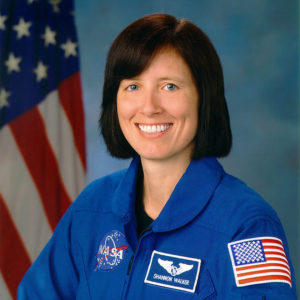
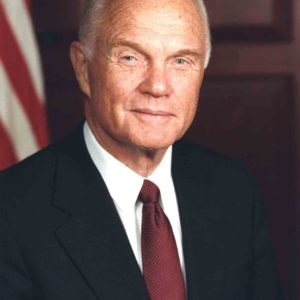
Neil talks with astronaut Shannon Walker while she’s still onboard the ISS about the challenges of spaceflight (including training for weightlessness aboard the so-called “vomit comet”), and speaks with Senator John Glenn about the future of the space station. Architect Jim Polshek brings us back down to Earth with the practical realities of creating buildings large and small. From the German rocket scientist Wernher von Braun’s early plans for a space station, to the history of cathedral building, to how space affects a spider’s ability to weave a web, to the history of the space station, learn how this cosmic construction can change the way we see the world.
Transcript
DOWNLOAD SRT
Welcome to StarTalk, your place in the universe where science and pop culture collide. StarTalk begins right now. Welcome to StarTalk. I'm your host, Neil deGrasse Tyson, your personal astrophysicist. I'm also the director of New York City's Hayden Planetarium...
Welcome to StarTalk, your place in the universe where science and pop culture collide.
StarTalk begins right now.
Welcome to StarTalk.
I'm your host, Neil deGrasse Tyson, your personal astrophysicist.
I'm also the director of New York City's Hayden Planetarium at the American Museum of Natural History.
With me today is my co-host, Chuck Nice.
And one of the cosmic themes that we'll be touching today is the concept, the construction, the maintenance and the running of the International Space Station and other grand architectural visions that human beings have had throughout time.
Sweet.
And later in the show, we're going to invite a friend, an architect grand, architect Jim Polshek who will be joining us a little later.
But before then, we have a very special guest that we'll be tapping into, and it's astronaut Shannon Walker.
You know, you shouldn't say tapping into a female astronaut.
Excuse me.
Okay, fine.
I'm just saying.
We will be communicating.
I'm just saying, yeah, communicate.
Fine, okay.
You're the one with the...
Yes, you're right.
I am the one with the dirty mind.
My mind is beyond dirty, Neil.
All right.
My mind is filthy.
Filthy.
Thanks for that warning up front.
We have a pre-taped recording, a conversation I had with her while on board the space station.
Oh, wow.
Cool.
It even has like time delays in there for the signal to get through all the transponders and things.
Nice.
Yes.
We'll hear that in a bit.
But what I wanted to do is...
I didn't know you could call space.
I was unaware.
Now, what carrier?
What carrier do you use to call space?
Because I know it's not mine.
I'm roaming when I leave my living room and go to my dining room.
It's called NASA.
Yeah, so you got to know the right people to get the NASA on your smartphone, you know?
So a couple of things.
You know, the history of a space station concept, it goes way back, actually, well, way back at least a century.
But the one that's sort of most influential is a version of it that came out in 1929, Herman Obrith, who published the concept of a wheel-like space station that rotates.
That seems vaguely familiar to me.
Well, yeah, that's right, because it's shown up in a couple of movies.
Did he also come up with the concept of a computer that actually takes over the space station and won't allow you to make decisions for yourself?
You mean a homicidal computer?
Exactly.
No, he left that out of his story plan.
So when you have a rotating space station, what goes on is you get to simulate gravity on the outer rim.
It's that centrifugal force that would keep sort of a pail of water full, even if you swing it around vertically.
If you swing it fast enough, none of the water will fall out even though it's hanging upside down.
That was obviously my problem as a child being a weakling.
I couldn't swing it fast enough and I just ended up wet.
So this would upset you the rest of your life.
That explains a lot.
I was going to say, I'm still not over it, as you can clearly see.
Well, it turns out Herman Oberth, one of his students, was Werner von Braun.
He was a space pioneer extraordinaire, and he was German, as the name surely implies, and in the 19-
As most space pioneers are.
In fact, that's right.
In the 1930s, Werner von Braun, as one of his students, was inspired by this space station concept and would later, after the Second World War, be snatched by Americans rather than get sent to trial or to put to death, because he worked for the Nazis at the time, as many of the scientists did of the day.
But he had a special background in aerospace, a word that barely even existed at the time.
And we brought him here and we said, hey, it birthed our aerospace lives.
And so Werner von Braun began to sketch what the future of space might be like, inspired by these early illustrations.
And so there's a famous magazine series in Collier's Magazine.
I don't know if you know about this.
No, I've never heard of Collier's Magazine.
Is it anything like Better Homes and Gardens?
This one, there's a whole series on space and this could be Better Homes and Gardens in Space.
It could have been retitled.
And it was, it birthed the vision statement for America's future in space with the rotating space stations and colonies and food and families.
People living in space.
People living and hanging out, it was Earth, everything you do on Earth, you would now be doing in space.
And so after that, the Russians were the first to get an actual space station as they were the first to do so many things in space.
And Salyut 1 was their first space station.
You know, the original crew got killed coming back, that was bad.
No way.
Yeah, that was bad.
We don't hear much about all their dead astronauts.
That's not something you kind of promote.
I know, exactly.
When you're trying to further your space station.
Exactly, exactly.
Hey, how'd you like to live in space?
I mean, these suckers died on the way back.
On the way back, yeah.
So that you lose your volunteers real quickly.
But I think the first space station most people might remember was Mir.
Mir was, in fact, is Russian for peace, if I remember my Russian, my three Russian words, that's one of them.
And Mir orbited for 15 years.
And the Russians, in fact, set all the duration records for staying in space at the time.
None of these space stations rotated, so they would spend the whole time weightless.
Just weightless the entire time.
The entire time.
I can't even imagine what that would be like.
Okay, now you have just, since you said that, introduced to my feeble mind, so many problems that I can't even begin.
Wait, there's more problems that you could still think about.
Give me another minute.
So, our first version of a space station was Skylab.
Now I remember that.
Yeah, we all remember Skylab.
That was the first one right after the Apollo program, and they used one of the segments of the Saturn V rocket, which wouldn't be taking you to the moon, that would be filled with fuel to get you to the moon.
If you're just staying in orbit, they put the whole space station within one of those segments, and they hung out there.
And what I remember most is when Skylab re-entered the atmosphere, I think it was Baskin-Robbins had a contest that if you got hit with a Skylab part, you get free ice cream for the rest of your life.
Which would only last two and a half seconds because you got hit by a space station.
Quick, have some ice cream before you die.
You would not be alive for it.
Oh, that was the best ice cream of my life, which is now over.
So, you know, I recently I spoke with Shannon Walker, she's an astronaut on board the space station, the International Space Station.
And I wanted to check out what the questions I asked her.
It was a fun interview.
And let's hear what she has to tell us.
Dr.
Tyson, this is Houston.
Please call the station for a voice check.
Station this is Neil deGrasse Tyson.
How do you hear me?
I hear you loud and clear aboard the International Space Station.
It's a pleasure to speak to you today.
How are things up there in orbit?
Do you ever get accustomed to being weightless?
Or is there a sort of a queasiness every morning after your breakfast?
When you first get into space, it feels a bit odd.
It is a very unusual situation to be in.
But depending on the person, your inner ear settles down fairly quickly.
Mine settled down right away and I had very little trouble adjusting to zero G.
So you're really good at amusement parks.
That's true, I am a big fan of roller coasters.
So I have no problems with those.
If I were in the space station, all I'd be doing is sort of inventing physics experiments that will do different things in zero G than they would on Earth's surface.
Is there some bit of physics you can share with us where in orbit, it's just really cool to do and to watch that no one on Earth would have any sense of because we're just sort of stuck here in a one G environment?
Oh, you know, there's so many things you can do when there's no gravity around.
Of course, a lot of the fun things to do are things like playing with your food and making little bubbles and have them go here and there.
There's a lot of different things.
You know, it's tough to say right off the top of my head what some of the really cool things to do other than playing with your food.
Yeah, that's what I would do all day.
I would flick peas around and watch them ricochet off the sides of the module.
In fact, I wonder how much food is embedded in the electronics up there anyway, because the temptation to do that has got to be huge.
It is huge, but of course we have to clean everything up, so we have to temper our excitement with the realities of keeping the station clean.
Do you think they have food fights up there in Zero G?
I hope to God not, because judging from that interview, there would be some pretty ugly food fights.
If you just join us, that was Shannon Walker on board the International Space Station.
She's back on Earth right now, but that interview was taken a couple of months ago when she was still on board.
You know, it's interesting.
When you're weightless, it's Zero G, everything floats.
What's funny is normally when you're eating or just hanging out, you take a glass, let's say, and you put it down, but in space you just let go of it, and it just stays there.
And you have to be careful, that's why there's a lot of Velcro up there.
Everything's got Velcro.
So the space station is huge.
It's like the size of a football field right now.
When you consider all the area taken up by solar panels and the modules that were constructed, and it's an international collaboration, and there's a lot of training they have to do to go up there beforehand.
And you know, people tend to think that there's a, you can just walk into a zero gravity room.
In fact, I asked Shannon about that later.
But no, there's no zero gravity room at NASA.
You have to sort of simulate that.
And so they have what's called the Vomit Comet.
You ever hear about that?
The Vomit Comet.
Yeah.
You never heard about that?
Isn't that a ride at Great Adventure?
I think I've lost my cookies on that once.
So there's an airplane that has a special trajectory through the air that has a segment of it.
It puts you in free fall.
Very similar to what would happen if you cut the cable of an elevator that you happen to be standing in, except you don't crash at the bottom.
I was going to say, yeah, like that, because everybody wants to do that.
So it's a special trajectory.
It's actually a parabolic trajectory where you are temporarily weightless.
You get 20 seconds, 30 seconds of a weightless period.
And so that's a nice place to sort of test your metal to see if you've got the right stuff or just the adequate stuff.
Right, or to see if you can keep your lunch down, hence the name, the vomit comet.
And so the space station is, it's in orbit around the Earth, it's in what we call low Earth orbit, a couple of hundred miles up, and it goes sideways at 17, 18,000 miles an hour.
And the reason why people say, oh, they're weightless because they've left Earth, no, they're still part of the Earth, they're still orbiting the Earth.
They're weightless because they're in freefall towards Earth just the way an elevator is.
All the time.
All the time.
So just constant freefall.
Yeah, and you say, well, why don't they hit Earth because they go in sideways 17,000 miles an hour.
So they're falling along with the Earth.
Along with the curvature of the Earth.
So they're just falling along the curvature of the Earth.
Exactly.
Let me, that is the way I want to fall.
That's the...
Oh my God.
If I could fall like that.
Because that way you never hit anything.
Right.
Yeah.
And so the whole space station was constructed over many years, $100 billion this thing cost, but many, many budgets out of multiple years from NASA.
And there's shared budgets with Italy, with the European Union, as well as Russia.
And now is it a real shared budget or is it kind of like our Iraq war share budget?
It's got a little, some elements of that.
Okay, we put up the first billion, you bring up the food, you know.
It's like, look, this is a global effort.
Yeah.
It's a little bit of that.
But we recognize that we're, you know, we've got the big, we're the big space rollers here.
All right.
So, for Canada has a mobile arm that's up there and, you know.
That is so like Canada.
That is so like Canada, the mobile arm of America, Canada.
So they have an arm that actually deploys satellites and things.
It's a very useful, controllable thing and I think you have to be sort of young enough to have operated video games in order to be good at the mobile arm.
It's called the Canada arm, is what it's called.
Or something else that I did when I was young to be good at operating the arm.
Well, should I ask?
No.
Okay, fine.
That's Chuck Nice you're listening to there.
Professional comedian.
So, you know, it took more than a thousand hours of extravehicular activity to assemble the space station.
This is like a Lego dream if you just like assembling things.
Yeah.
And if you built stuff as a kid and became an astronaut, EVA's extravehicular activity.
That's NASA speak for spacewalk.
Nice.
Yeah, they need more syllables.
I guess it makes it sound extravehicular activity.
We got to take a quick break.
But when we come back, we're going to talk to architect extraordinaire Jim Pulchek.
Welcome back to StarTalk Radio.
So in this segment, I want to introduce an old friend, architect James Polshek.
I'm going to call him Jim for this interview.
He's an architect extraordinaire and former Dean of the Columbia Architecture School.
Why do I know this guy?
Because he was the architect for the Rose Center for Earth and Space here in New York City, which was the completely rebuilt Hayden Planetarium.
Jim Polshek, welcome to StarTalk Radio.
Pleasure, Neil.
Yeah, listen, I got you on here because we're talking about the International Space Station and it's a big, expensive, constructed project that an entire culture comes together and does and executes.
And I want to know from you, is this like an architect's dream to get a nation to say, hey, build this, like the pyramids or the cathedrals or where are you in this?
The dream is to build something that can get away from this earth, which is going to hell fast.
It's an escape mission.
So you want to build the escape pods?
Is that what you're saying, Jim?
You know, small is still beautiful.
So Jim, what is this urge for cultures to just want to build big?
Right now, the space station is a hundred billion dollars.
But first, let me get, what's the biggest thing you've built?
The biggest?
Yeah.
The biggest.
Biggest in concept and scope and grandeur.
The biggest.
Is it not the internet?
Is it not the Rose Center?
No.
Oh, no.
Oh, man.
You got to come down to earth.
It's the place where they clean the water in New York City, New Town Creek.
You made a water treatment plant and that's your biggest project?
Well, it took an awful lot of engineers.
And we were the little teeny dog wagging the great big tail.
Well, in space, somebody's going to have to be cleaning stuff as well.
This is true.
So, keep that on your resume in case we come back to you.
I'm not getting rid of it.
So Jim, the International Space Station with solar panels and all is about the size of a football field.
And with this structures and all it took to put that together, I'm just curious, do you embrace these kinds of challenges as an architect or do you see them as, oh damn, now I got to figure that out?
I am the storyteller.
I don't know what that means.
That means you need a lot of aeronautical engineering.
I think we paid you too much to be our new architect.
That's all you were in the back room.
You were not paying me, brother.
And so I'm just curious.
You look at the cathedrals of Europe.
These are big grand things that took a lot of money, took a long time.
The space station is almost two decades, 15 years under construction.
It's got to be at least a pyramid.
It's got to be at least a pyramid, two decades.
So, Jim, do you analogize one to the other?
Not really.
Actually, I was going to go back to a bad metaphor about this kind of urge to be big, big, big, big.
Cancer is a bad metaphor.
But, I mean, things just keep growing, and I don't know.
The older I get, the more I do.
Small looks good.
Small.
So, you want to build small, not big.
Small.
And for a moment there, I wanted to date you.
You know the expression.
Those are the words I've been waiting to hear my whole life, Jim.
Let's rejoin my interview with Shannon Walker taken a couple of months ago, recorded a couple of months ago while she was on orbit in the International Space Station because we chat about some modifications to the interior and exterior decoration.
Let's see what she tells us there.
Do you look out the window at all?
I do look out the window a lot.
Whenever we have a chance to, the ground keeps us pretty busy and so I don't get to spend many hours a day looking out the window.
One thing about going around the Earth, you don't always cover every part of the Earth, so when something interesting is happening, say the volcano that's been erupting in Indonesia, we've actually been traversing that part of the world during the night time, so we cannot see it easily from space.
But we've seen lots of hurricanes from up here and the oil slick in the Gulf of Mexico was very easy for us to see from up here.
So that's interesting.
So the things that you notice, it's not obvious, I think, to the average person, that you don't see the entire Earth in every view, you're a couple of hundred miles up, so your horizon of view from one edge to the other, it might be a thousand miles, I suppose, or less.
So you don't have a complete Earth-wide view and for that reason, things could be happening that would take several orbits for you to catch up with, I guess, is that right?
In a sense, that's right.
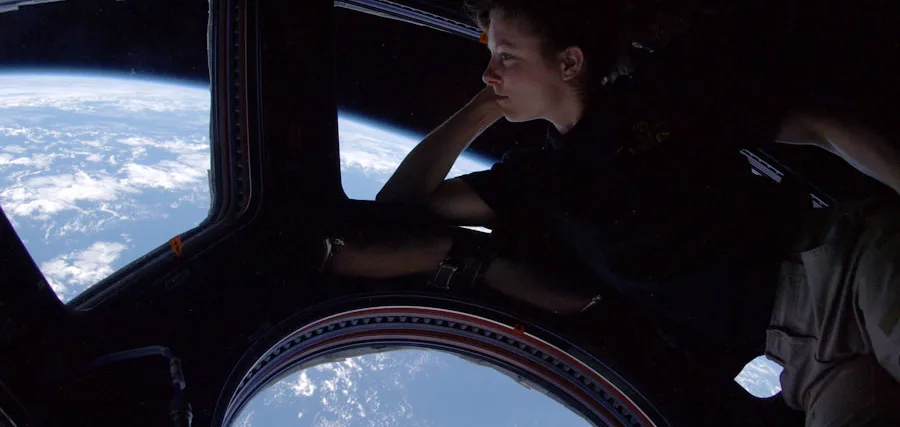
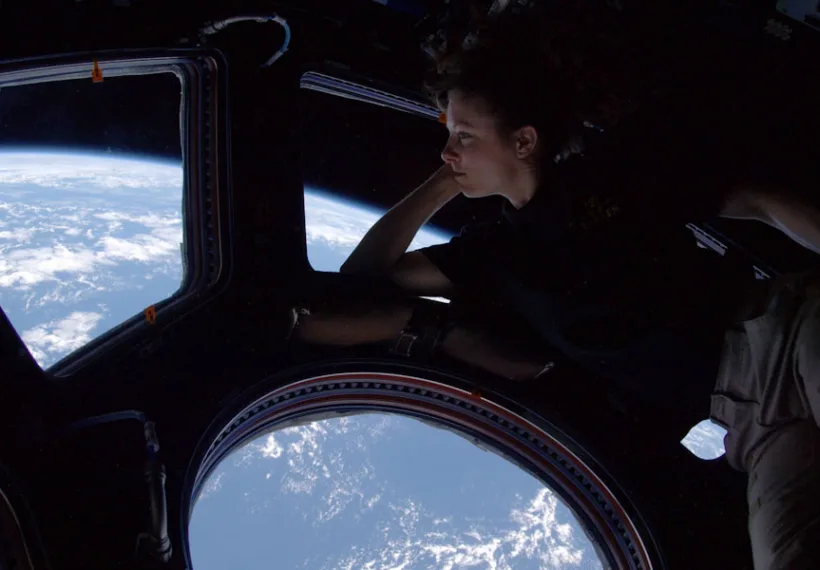
We do have a cupola that's on the station and it gives us a pretty good 360 view of the Earth.
So I can see the Earth's horizon from one end to the other fairly well, but of course, you're looking at a long distance at a pretty shallow angle, so you're not going to be able to see what's happening on the ground pretty far away.
So you really need to be going over something to get a good view of what's going on underneath you.
See, I'm pretty sure I wouldn't make a good astronaut, because I would just park an easy chair up in the Coppola and daydream all day there.
That was Shannon Walker on board the International Space Station.
That's pretty fascinating stuff.
It is.
And like I said, I have the NASA plan on my cell phone, so I was able to call her up.
Just the fact that you can call space just freaks me out.
So Jim Polshek, my special guest today, architect, the International Space Station has modules connected, docking stations, it's got compartments, airlocks, nodes, living quarters, bathrooms.
When it's done, it'll weigh 8,000 pounds if it were here on Earth.
So these challenges are extraordinary.
And I don't suppose they're, I mean, how different are they to what you've got to do to build?
In fact, tell me about the materials you build with.
Are you limited by your materials?
Yeah, everybody is limited by the materials, but you're mostly limited by your budget.
There are only so many materials, and they're not infinite, and they're very old, like glass.
And like stone.
Like stone.
No stone.
We don't use stone on the Space Station.
You know, when you're describing it, you know, I thought of it, submarines.
The other side of the coin.
The space and then there's deep, deep, deep, deep, deep sea, in fact, the pressure difference is way greater under the sea than it is just out in the vacuum of space.
I would have guessed that.
Yeah.
Yeah.
So I'm just curious, what is some of your challenges when you build compared to what we know we had to do?
I'm just trying to think of this cathedral analogy, because this is a huge structure in space, multiple generations participating, multiple countries, all with the shared vision statement that we want a presence in space.
I feel like a little ant pressed between cathedrals on the one hand and the space station on the other.
In other words, we're kind of being manipulated between those two cultures, if you will.
Yeah.
And so, what's, and towards what end?
Well, the end, I'm a hopeless idealist.
I mean, my, I think the biggest thing an architect has to do is just be persistent, never give up the idea, period.
Okay, so there's a mission statement that you say, I'm going there and I'm not giving up.
No, never.
I'm going to build the biggest cathedral in the world.
I'm not giving up, no matter how many people it takes.
The bean counters are telling you, you can't do it, you just keep going ahead.
And so, now, here's the thing, we just learned about the coupler that was added to the, that's awesome, I think.
Like I said, I park an EG chair and that's what get no work out of me for the rest of the mission.
I'm trying to imagine it.
And so, tell me about glass as an architectural element.
That glass in the coupler, by the way, is, Chuck, I don't know if you knew this, it's of a material similar to what your Pyrex glass is in your kitchen.
Like Gorilla Glass or Corning Wear?
Yeah, yeah, Corning Wear, basically.
It doesn't crack under high temperature changes.
And so, when it's hit by the sun, will it bake whoever's sitting under it?
What's interesting about glass is not the glass, as I said, is ancient.
It's the sticky stuff that holds it together, that keeps the weather from coming inside.
And if somebody invented a weapon that would melt sticky stuff, and they beamed it on this city of ours, this great city, it would all fall down.
Is this what you think about at night, how to destroy New York?
Damn bum us out, Jim.
To each his own.
Well, plus, I wonder if the military is listening to this, because if someone else built a rogue nation builds a space station, you don't need bombs, you just have to melt their clock.
I just see a Bond character just going, America, this is Scorpio.
We've just melted all the clocking around your windows.
You know, I mean, windows in cathedrals, they paint on them, or they have stained glass.
And so they also tell stories.
Now, ours don't really do that, because we want to look out of these windows, of course, in space.
Well, I was thinking about the windows in many cathedrals, because they have little pictures of people in suits.
Those people in suits often were the people that gave the money that allowed the trades, the guilds to operate.
Oh, okay.
Yeah, they look like them.
Yeah, it was like a little vanity thing.
Yeah.
Jim, we have no image of you in the Rose Center for Earth and Space.
I hate to break you that news.
You even have my name, but it's very small.
Is there a Bank of America window, at least?
Yes, the one you get your...
That's an ATM.
We'll be back in a few minutes, but more from our interview with Shannon Walker when we return.
We're back on StarTalk.
I'm Neil deGrasse Tyson with my co-host, Chuck Nice.
Chuck, thank you.
Thanks for being on the show.
We've got with us architect James Polshek.
Non-comedian.
Non-comedian.
He's trying to help us understand and sort of tie a bow on this package that is the space station as a major work, not only of engineering, but of architecture.
I'm intrigued when you reminded us all that the cathedrals of yesteryear, the patrons would have little sort of versions of themselves standing next to Jesus or whoever venerated figure was in the stained glass.
Well, I was thinking about that tall building in Dubai.
The tallest one in the world.
Yeah, I think it's called the Hajj or the Bajj.
Well, it isn't actually.
It's now named after the guy from Abu Dhabi who gave them the money to complete it because they went broke.
And that, by the way, is seven football fields high.
Seven high.
And it's now called Khalil.
Khalil.
That's just the name of the building.
Khalil.
So what you're saying.
That's good.
So Jim, you're saying if NASA runs out of money, we'll just name stuff after the highest bidder.
That's what you're suggesting.
Name it after Donald Trump.
We got enough stuff in New York named Trump.
I am so looking forward to the Taco Bell International Space Station.
So, Jim, so who built these cathedrals?
Was it just people off the street?
Who did it?
You know, you're talking to Shannon Walker.
Shannon Walker is our astronaut in space.
We'll get back to my interview with her.
Female monk.
These were monks.
They were disciplined.
They didn't care about name recognition.
They had rules, unwritten rules.
They were the astronauts of the day.
But the monks weren't necessarily architects, right, or designers or?
They were like a guild.
They knew how to make things.
They had dreams and they made things.
So guild.
So is there a sort of counterpart to that today?
Something called unions.
Unions are the guilds.
The disappearing guild.
Okay.
Interesting.
So the unions on earth and in space, it's the astronauts.
You got it.
Yeah, Chuck.
What?
No, no.
I didn't realize that that was the purpose of monks.
I just thought they were dudes that walked around with turkey legs.
I didn't know that they actually built things.
Turkey legs?
No, that's King Henry VIII with the turkey legs.
They made them.
I'm thinking like Friar Tuck.
Wasn't he a monk or was that a friar?
You got it.
He was a monk.
That's a friar.
Yeah, that's a friar, right?
Chicken licking.
All right, so Jim, do you distinguish when rich people give money to build something as opposed to governments or agencies or the state?
Well, sign of the times, I have to watch what I say, but you know...
No, you don't.
Not on this show.
Chuck has to watch what he says.
Real estate developers...
You're an architect, for goodness sake...
.
have been around since the papacy began.
I mean, in fact, they were the biggest real estate developers ever.
Okay.
The church.
And that's where the cathedrals came from.
And the name of the game was awe.
Today, the name of the game is Profit.
Uh-huh.
Chuck, you know about that.
Oh, yeah.
So, back then, what they were trying to do was impress, you know, try to, you know, strike people awe-inspiring.
Wow.
It was a wow factor.
It worked.
Well, we get impressed...
I'm impressed just by having my conversation with Shannon Walker on orbit on the space station.
Let's pick up my next segment with her.
I understand you're speaking to us from the Kibo Japanese module up there.
And from what I understand, the space station is this amalgam of national modules where astronauts from the various participating countries conduct experiments of interest to their nation or their scientists.
And I'm just curious, in each module, do they serve their local food?
So if you wanted a Russian cuisine one night, you just sort of float over to their module or you want some sushi, you go to Japan.
What's the coordination of these various modules and how do they work together?
To answer your question on the food, we do have a variety of food up here from all nationalities.
So yes, I can have Russian food one night and Japanese food the next night and food from Europe the night after that and of course American food.
All the modules, all the laboratory modules work together and we are scheduled to work in just about all of them.
So I have conducted experiments for the Japanese in the Japanese module, for the Europeans in the European module and of course for the Americans in the American module.
The Russians are heavily conducting experiments down in their module.
You've been to Russia before.
How is your Russian right now?
And I understand that you're coming back in the Soyuz capsule.
I visited Russia some years ago and got to visit Star City and they had a mock-up of the Soyuz.
I barely fit in it, but I guess you're not in there for very long.
You're just coming back to Earth's surface.
Coming back, yeah, we're only in there for a few hours.
Coming up, it was about two days that we were in the Soyuz module.
I'm actually the co-pilot on the Soyuz module, so my Russian is very technical in nature and it's good enough to communicate with the Control Center and with my Russian commander on the Soyuz.
So if you see something really cool out the window, you have no Russian for that.
It's got to come out in English, I guess.
It would probably pop out in English first and then I know a few Russian words to say how cool things are, but it would be a short conversation.
So, we've got an international collaboration in space.
It's about time countries collaborate for something other than waging war, I say.
So, Jim, my special architect guest today on StarTalk, I can't shake this sort of cathedral analogy to what's going on here.
In fact, when we were building the Rose Center for Earth and Space, we all collectively thought of it as sort of a cosmic cathedral, right?
I mean, it's grand, it inspires awe.
And when we think of designs, however, when it's an international collaboration, the stuff has to fit together.
But if you're designing different places of worship, for example, it's got to honor whatever is going on in the various religions, right?
Yes.
Boring answer, but true.
That's why we have Chuck here.
But no, the Rose Center was a once in practically any architect's lifetime, a chance to kind of peel the onion.
And there's you inside.
I mean, it'd be great to project your face on the sphere.
No.
Which I'm sure you wouldn't mind.
No.
No.
I assure you, in spite of what went on on the Colbert Report the other night, I have no such ego or intentions, no.
But yeah, there's a whole sphere waiting to tell a story.
It's part of what's going on.
It's also a mystery.
Yeah.
I mean, when we were doing it, I was, as you know, because you've seen some of the images, I was inspired by science fiction images on novels published in 1930, 32, thereabouts.
You straighten me out once, once we saw a great big sphere in a photograph of Manhattan Island landed almost exactly where the center is.
And I said, what is that?
And you said it's the size of an asteroid that landed in Arizona, 50,000?
Yeah, years ago.
Right?
Yeah.
Yeah, but if it's sitting in Manhattan and it fell from space, Manhattan wouldn't still be there.
That's just one of these things.
It would be like melting the caulking in the window.
But the Bronx would.
The Bronx, yeah.
Nothing could kill the Bronx.
So obviously, the International Space Station is being used as a scientific laboratory.
And it's been criticized by some scientists as, well, we're not really advancing a space frontier as much as we'd like.
But I think people forget that sometimes there's other geopolitical motives for doing things as well.
The fact that we have an international collaboration up there, that has geopolitical value.
True.
The fact that there are multiple nationalities of astronauts shaking hands and...
People working together.
Working together.
That's always a good thing.
Very Star Trek.
They may even have, at some point, I'm looking forward to the space station having some guy who looks like a prawn or some sea creature up there giving orders.
Or somebody who's imminently logical.
Right.
So...
Well, you're leading me to mention the psycho-pharmaceutical element of being in space.
Oh, well, that's interesting.
Well, you want to go there because NASA, as you may know, did experiments with spiders.
I did not know.
Yeah, because here's what happens.
If you try to drug-induce the state of mind of some creature, let's say a dog or a rat, you can't then say, hey, how do you feel?
This is true.
Well, you can, the problem is if they answer you, you're just as high as the animal.
So in fact, there was a period where NASA did some experiments with spiders.
Why is that?
That's a fascinating question.
Yeah, why spiders?
Because spiders, when they're doing their thing, make a perfect web.
So in fact, spiders were given marijuana and various experiments.
And stoned spiders?
And did they weave a web in the shape of a brownie or a donut?
Wait, wait, let me back up.
First of all, there was an experiment to see how spiders...
Chuck.
There was an experiment to see whether spiders in zero G would spin a web any differently.
Now, you need a good baseline for how differently a spider can behave under different chemical or other forces of nature, be they chemical or otherwise.
So, you do the other experiments, and you do things that we know influence us, marijuana.
So, one of them is marijuana.
And so, the spider tried and got about halfway, lost concentration and gave up.
Why were there two...
I'm just saying.
Why were there two female spiders?
Well, okay, so the female spider lays the eggs.
They do more things for you.
Tell me about it.
The spiders have names, by the way, Arabella and Anita.
Those two spiders were on Skylab back in the 1970s.
And so, but we're resurrecting these experiments, just want to let you know how they were.
So, the marijuana-induced spiders, they gave up halfway.
And here I am as a sucker trying to get a medical marijuana card.
All I had to do was spin a web.
Gotta take a break, but more StarTalk when we return.
We're back on StarTalk.
I'm Neil deGrasse Tyson with my co-host, Chuck Nice.
I also have with me in studio, architect Jim Pulchek.
Before the break, we were talking about spiders in space.
Just to clarify, I want to get the data straight here.
The spiders I'm referring to, there was a pair of spiders, Arabella and Anita, they were spiders that were taken up on Skylab back in the 1970s to see how they would spin a web in zero-G.
But you need further baselines of how spiders would spin.
So you subject them to other forces of chemistry that might alter the integrity of what it is they spin.
So on Earth, they then subjected them to marijuana.
They also put other spiders on speed, benzadrin is some variant on speed.
With that one, they spun their webs with great gusto.
I'm sure.
I'm sure they ran out of silk.
But the problem is, they spun it with such gusto, it was not without the planning necessary to go along with it.
There were huge gaping holes in the web when they were done.
That makes perfect sense.
So they did a fast job, but it was not a very good job.
Another set of spiders, they subjected to caffeine.
These are things that we know exist in our culture.
Of course, caffeine is one of the most common drugs in soft drinks, in tea, in coffee.
Of course, this latest, what's the stuff people drink now?
These energy drinks, yeah, like vitamin zero.
So, what do those spiders do?
Well, problem was, they were incapable of spinning anything better than just a few threads together, but at random.
And so, from just caffeine, just caffeine.
That's right.
So I'm curious about that.
So you're better off, you know, smoking a blunt than you are having a cup of coffee.
If you're a spider, I'm not advocating anything here.
And there's another one, they gave them an ingredient, a common in sleeping pills, and they just dropped out before they even started, that one.
Sleepy spiders.
They spun a hammock.
But experiments on people, I think are even more important than all the rest of this.
In space, as you may know, you lose bone density in space.
And not only that, because gravity is not operating on your body, you actually get taller in space.
You can grow an inch or two in space just by being there.
Your body kind of stretches back out.
That's pretty cool.
It's pretty cool.
It's like being on a cosmic rack.
It's a painless cosmic rack.
But the problem is, being in zero G, the stress that your body is normally under, under one G is what maintains, apparently is what maintains bone density.
And so in space, if you're up there a long time, we learned in the early days of the Mir space station, and all of this has been confirmed by the International Space Station, that you come back with lower bone density than you did when you went up.
So basically you come back as Sally Field.
So the weird thing is you come back taller, but then you crumble into a pile of dust.
You're like a vampire.
That's part of the problem.
So the International Space Station has been actually a little bit controversial over the years.
On the 50th anniversary of the moon landing, I actually spent time in Washington DC and got to interview a whole bunch of folks from that era, including, I have a clip when I was down there, chatting with John Glenn, America's first orbiting astronaut.
And American hero.
And a fellow Ohioan.
Half the astronaut corps is from Ohio.
Are you from Ohio?
What else?
Let's check out what John Glenn has to say about the International Space Station.
I'm here with Senator John Glenn, America's first astronaut.
What do you think should be NASA's greatest priority going forward?
Well, I'd like to see us fulfill our commitments on things we've already committed to and have not fulfilled before we do a lot of other things.
We built the International Space Station.
We have spent just around $100 billion on that station.
It just now is able to have a full crew on board, and yet they cut the research money out of it.
And I think that is one of the craziest things I've seen in all the time I was in government, is to make $100 billion investment and not even try to get the research return on it.
So I'd like to see that done.
If we want to go to the moon and Mars, that's fine.
I think that's great, but let's pay for it, and let's not take the money out of the research that was supposed to be done on the station.
Perfect answer.
Once again, it's all about money.
Oh my God, that's actually stunning.
Well, okay, since then, that was summer 2009.
Because if you do the math, 50 years earlier would have been 1969.
That was a big celebration at the Air and Space Museum in Washington.
So since then, there's been a movement in Congress and elsewhere to designate the International Space Station as a national laboratory.
And when you do that, then there's a stream of research money that then support the zero-g experiments that you would conduct.
Well, I hope so, because nothing would be worse than to have a hundred billion dollar paperweight floating out in space.
That's crazy.
Paperweight?
Well, I'm just saying, like if you don't actually...
A weightless paperweight.
A weightless paperweight.
You know, in architecture, that would be called historic preservation.
Interesting, interesting.
That's right.
Even the government gives you a tax break and it's basically the same thing.
So here in space, a 15-year-old thing would be historic preservation.
Absolutely.
Interesting.
If we do that on Earth, why not do it in space?
So we want just to preserve it, to actually exploit all that it can be for us.
Because zero-G, you can grow very pure crystals.
There are a lot of things that happen on Earth when subjected to one-G, turn out one way, when subjected to zero-G, become something else.
That universe of zero-G research is not fully explored.
I don't have a problem with that.
Especially since the International Space Station in this international capacity forms a kind of platform for international relations like none has ever happened before in the history of the world.
It's one of the greatest collaborations there ever was.
All I keep hearing is $100 billion.
That's all I keep hearing.
So Jim, if you had $100 billion, what would you build in zero-G?
The most comfortable bed that the world has ever known.
Except that, Jim, you're floating, Jim.
Beds are for 1G people.
I gotta imagine the bed.
What we do is imagine.
Imagine a zero-G bed.
That's what you'd be doing, Jim.
Just to remind you, that interview with John Glenn, John Glenn was not only our first astronaut to orbit the Earth, he had three orbits back then.
He also later became, he's a colonel, and he became Senator Glenn.
How old is he now?
He's like 130.
He went into space when he was almost 80.
I mean, back into space.
And so, an American hero and an American treasure.
We've gotta wrap the show, but I want to thank my guests.
And as always, I bid you to keep looking up.
See the full transcript



 Unlock with Patreon

 Become a Patron