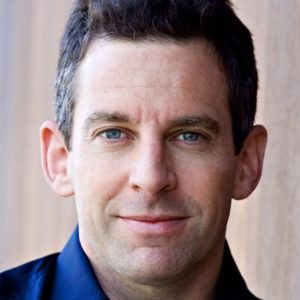
Are we in control? In control of ourselves? Our lives? Our destiny? Neil deGrasse Tyson welcomes neuroscientist, philosopher, and author Sam Harris, comic co-host Godfrey, neurotheologist Andrew Newberg, and author Robert Wright to uncover the mysteries of the human mind. We explore free will: is it an illusion? What are the ethical implications of free will? Will there ever be a cure for evil? Discover more about the science of morality and if we get our sense of morality from certain parts in our brain. Explore whether science and religion should work together and if neuroscience can offer any explanation for spiritual experience. Sam tells us about the origins of religion and why religion might have been the first attempt at science. We discuss the “God of the Gaps” theory and why religion still exists in the face of an increasing number of atheists in the world. You’ll hear about the practices of meditation. Ponder the similarities between using psychedelic drugs and practicing deep meditation. Robert, author of Why Buddhism Is True, explains to us why Buddhism is “true.” You’ll also hear about enlightenment, and Neil creates his own type of meditation that ends in all of our deaths at the hands of the Sun. We answer a fan-submitted Cosmic Query about the drug DMT and if there is any scientific evidence that it’s being released in the brain moments before death. You’ll also find out some surprising details about one of the most famous short stories in history, An Occurrence at Owl Creek Bridge. Dive into the mysteries of human consciousness as we investigate why consciousness will always be difficult to understand unless we find out how to view ourselves differently. You’ll also hear about the ethical dilemmas that await when we create conscious artificial intelligence. All that, plus, Neil shares why, for him, looking at the cosmos serves as a spiritual experience. Some would say you have no choice but to listen.
Transcript
DOWNLOAD SRT
Welcome to Star Talk, your place in the universe where science and pop culture collide. Star Talk begins right now. Welcome to the hall of the universe. I'm your host, Neil deGrasse Tyson, your personal astrophysicist, and tonight we're gonna...
Welcome to Star Talk, your place in the universe where science and pop culture collide.
Star Talk begins right now.
Welcome to the hall of the universe.
I'm your host, Neil deGrasse Tyson, your personal astrophysicist, and tonight we're gonna tackle deep questions about the human mind.
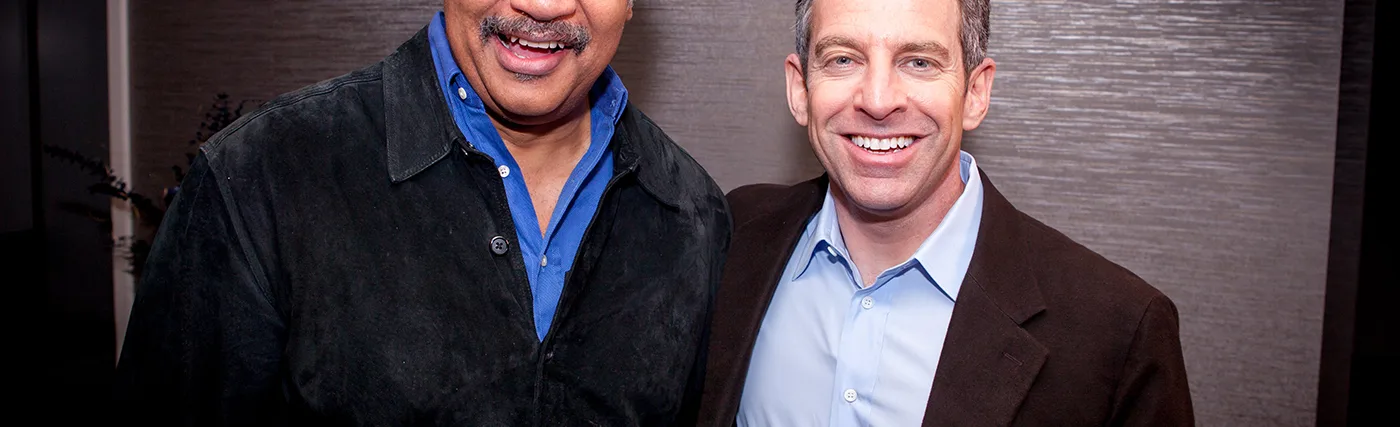
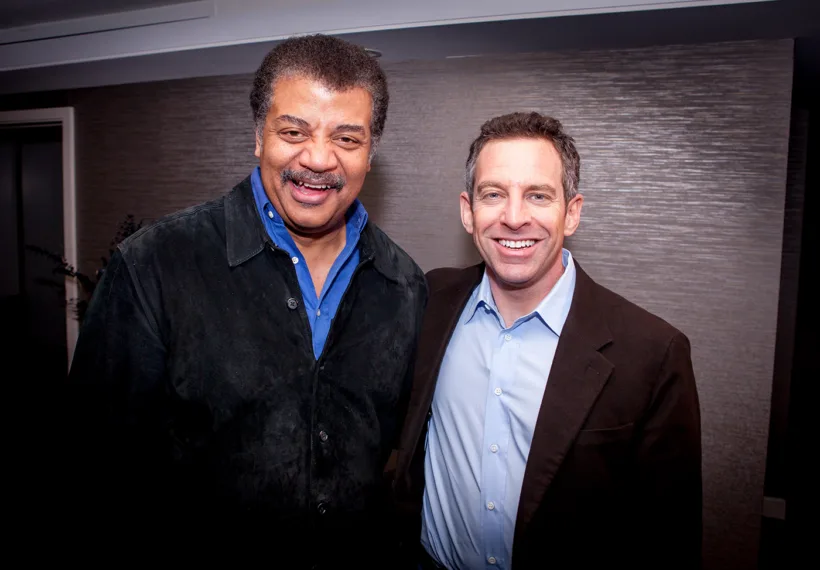
Featuring my interview with neuroscientist and author Sam Harris, I picked his brain on everything, from free will to religion to psychedelic drugs to the mystery of consciousness.
So, let's do this.
My co-host tonight, Comedian Godfrey.
The man known as Godfrey.
Tweeting at Comedian Godfrey.
Comedian Godfrey.
We'll look for you there, dude.
All right, you've appeared in Zoolander?
Yes.
And Blue Steel.
Blue Steel.
I was in Zoolander 2.
Zoolander 2.
I had a cameo in Zoolander 2.
Well, everybody had cameos.
Everybody had cameos.
What was your cameo?
I was just on a rooftop extolling the virtues of a cosmic perspective.
Of course you were.
Of course he was doing that.
So thanks for being here on Star Talk.
Thank you.
It was a pleasure.
I feel honored.
I feel smart.
And this show is about neuroscience.
So who we have joining us is Andrew Newberg, physician at Jefferson University Hospital in Philadelphia.
Thanks for coming down for this.
And you're a pioneer in the field of neurotheology.
Did you just pull that one out of here?
Yes.
I'm a neuro-comediologist.
What is a neuro-theologist?
So what we're doing is we're studying the brain when people are engaged in religious and spiritual practices and trying to learn about how the brain helps us to be religious and spiritual.
Well, and you're author of several books and one of them I got here, How Enlightenment Changes Your Brain.
That's right.
That's right.
So we're going to lean heavily on your expertise this entire show.
Go for it.
So just like you, as a neuroscientist, we've got Sam Harris, who has a huge background in neuroscience and he likes topics like spirituality and religion.
I sat down recently with Sam, I caught up with him in LA and we discussed free will.
And there's an assumption we all have that we control our own choices and that's a big assumption.
But the neuroscientists have been testing this, okay?
And Sam Harris, among them, say free will is an illusion.
Whoa.
Rather than a reality.
So let's check it out.
When you look at the scientific details, we know that, for instance, a voluntary motor action is preceded by neuroanatomical events that we can detect, you know, with EEG or with fMRI, which precede your conscious awareness of having made a decision.
So at a moment where you subjectively think you're still making up your mind and you're still free to choose door number one versus door number two, we can detect with now, with you know, very high probability that you're going for door number two, precisely an interval where you think you're still just figuring it out, right?
So that's a fairly stark insult to this pretension of having free will.
Completely.
Yeah.
But what I would say is that even if nothing precedes your choice except your choice, right?
So let's say, let's say your thought, like, I'm going to go for door number two, right?
Let's say that is the first cause, right?
There's nothing, there's no neurochemistry we need to talk about prior to that.
Let's just say that that's even the action of your immortal soul, right?
That you know, that is just integrated with the brain somehow and pulling the strings.
That thought, that the fact that it emerges rather than some other thought, which is door number one, the fact that it is effective, all of that is absolutely mysterious, right?
Like it's simply, you can't think a thought before you think it.
It just springs into view, right?
And it's springing into view is totally compatible with a lack of freedom.
And no matter how you massage the physics, whether it's pure determinism or determinism plus some randomness, neither of those dials gives you free will.
So, Andrew, this is an insult to us.
I think he confused himself.
So, Andrew, which camp are you in, in this illusion of free will?
Well, I do think that we have free will.
But I think the biggest question that we have to answer is how are we defining it?
What do we mean when we say we have free will?
I think when Sam is talking about it, he has this sense that there's sort of like this person that says, I'm going to raise my arm and then I raise my arm.
But a lot of the way our brain works is that our will kind of happens naturally.
When I'm talking, what I'm saying, I don't think about what I'm going to say before I say it.
It just comes out.
And in that regard, that mystery that he's talking about, I think that's really where the will is.
The problem is that when you actually try to find it, when you're looking at a scientific way of looking for it, it gets pretty hard to find because you can find all these other things going on, these neural connections and all this stuff going on in the environment that affects the way we make a decision.
So Godfrey, you think you got free will when you're telling jokes?
Well, yeah, free will.
Listen, all this mystery to the brain stuff, all right, here's the reason why he even sounded confused when he was talking about the free will because he paused, he was like, yeah, so it's not a, wait a minute, you don't think a thought before you think it, hold up.
And you even were looking like, yeah, yeah, yeah, okay, your close-ups were hilarious.
What?
Because I really believe all of this is because we have all these mysteries to the brain, right?
You say we use 10% of our brains.
Let me tell you why.
This is my comedic take, comediologist here.
Because you're using your brain to study it, so it ain't going to give you nothing else.
Oh.
So that's why there's the mystery, because you have to use the brain to study it.
That's right.
Unless we find some outside entity to study it, it's not going to happen.
So it's always going to be a 10%.
And how do we know it's 10%?
Because the brain is telling us to say 10%.
How about that?
Except the idea that we only use 10% of our brain is a complete falsehood from the very beginning.
I think the statement was we only know what 10% of our brain does.
And that immediately got misinterpreted as we only use 10% of our brain.
And we so want that to be true, especially in schools with teachers talking to their kids, that there was no force to undo that lie.
Is that a fair...
Yeah, I think so.
I mean, in many ways, when we do a brain scan, the whole brain is on and all the neurons are firing.
But yes, what we're aware of is actually a very small amount.
Yeah, but I like the idea that if the brain is studying the brain, it's got to use some of the brain to study the brain.
So some of that brain can't be what the brain is otherwise talking about.
We're sort of champions.
I think I followed that, yes.
Sam Harris references decisions that preceded the action by a few tenths of a second in the brain.
And why does it matter at all when that decision is made or what the time delay is?
Well, I mean, the argument, there was one or two very small studies actually that showed that right before somebody made a conscious choice to push a button, that there was activity in the brain.
And the argument there is that, well, there's something in our pre-conscious, in our unconscious mind that's helping us to make our decision and that we're not really conscious of doing it.
But I think, again, it gets back to sort of how we define it.
If we're really talking about all the different parts of who we are that make our decisions, then that could be part of the way we actually make our decisions.
It's just how the brain works.
It's how the brain works.
And we're always in this kind of reciprocal interaction with what's going on in the world around us.
So there's never really a place to find that moment where we make a decision.
It's very hard because our decisions are being made all the time.
So we really need a lot more research before I think we can finally say we do or we don't have free will.
Well, if we assume for now that humans, because this is a Sam Harris interview, so let's go along with his claims that we do not have free will.
I asked him about the ethical implications of that, if in fact we're not in control of our own decisions, something else is.
Let's check it out.
I think there are some moral illusions that we can cut through once we realize that free will doesn't make any sense.
And the moment you notice that no one picked their parents, no one picked their genes, no one picked the world into which they were born.
So Hitler didn't make himself, right?
Hitler was made by the universe.
I mean, so he was made by, you know, he, as you know, is stardust plus all of the influences of a society.
And so, when you look at Hitler as a four-year-old boy, you don't look at him as the true author of his evil.
You look at this rather unlucky four-year-old boy who is destined to become the most evil person we can name, right?
And if you could intercede at that point, if there was a cure for human evil, right, if we understood psychopathy or, you know, I don't know what his actual diagnosis was, but you know, if we understood the Hitler form of evil well enough, we would just cure that boy, right?
You would give him, if you knew that there's not enough folate in the diet could predispose someone to that kind of evil, well, then you would be negligent not to give the folate.
And even, and this is true at every stage along the way, and at no point does he suddenly become, in that life continuum, does he suddenly become magically culpable for everything, right?
At no point does he become the author of himself.
And if you, again, even at the age of 50, let's say we catch Hitler in his bunker, and he's now the true author of the greatest act of evil we can imagine, but what happens there if we scan his brain now, this is anachronistic, but we will put him in a brain scanner and find that he's got some enormous tumor in the appropriate spot that could explain his behavior, right?
I mean, you can take the example of Charles Whitman, who is the classic example of a person who was a mass murderer, he's one of the first mass shooters who killed, I think, 14 people at the University of Texas.
So he had a glioblastoma pressing on his amygdala.
He actually, what's amazing is-
I don't know what that means, but it sounds bad.
Yeah, he had a big brain tumor in the right spot that you would expect to undermine his impulse control and give him these experiences of rage that he was complaining about.
He actually, in his suicide note, he asked for his brain to be autopsied so that doctors could explain why he was doing all this.
So he had insight into his problem.
This is not me, is what he was saying.
This is, I'm a victim of my biology, and it turns out he was.
Now, my argument is that the more we understand the brain, the more we understand the neurophysiology of everything about us that we care about, love and hate and things like evil, right, you know, a condition like psychopathy, the more we, the more those descriptions of cause and effect will be exculpatory, the more it will be like finding Charles Whitman's brain tumor.
And if there were a cure for it, you would just give the cure.
So Andrew, will we cure even one day?
I certainly hope so.
That'd be great to be able to do that.
But you know, part of the problem is, and he kind of mentions it, that there are so many factors and there's billions and billions of neurons and billions and billions of connections in the brain that it's going to be very hard.
I mean, sometimes it's obvious, you know, sometimes somebody does have a tumor or something going on in their brain and you say, let's remove it, and then they change their behaviors.
But for the majority of people, especially people who do a lot of evil stuff, it's hard to find the exact abnormality in the brain.
But science progresses.
And so I think in his last reference, he was thinking of the tumor as metaphor for knowing in the future what is making someone evil.
So let me ask a moral question.
So Charles Whitman, let's say he was not killed on the roof of the tower at University of Texas, and they find the tumor, they operate, remove the tumor, now he's just fine.
Does he get prosecuted for killing the 14 people?
Well he would get prosecuted, but he would probably make the argument that he...
No, I'm asking you.
Yeah, I've been involved in these trials.
I'm asking you.
Well, you'd probably prosecute him and if he could convince you...
I'm asking you, a neuroscientist, we just cured this guy of a heinous act.
He's not capable of that ever again.
Does he go to jail?
Can you prove to me that he never can do it again?
No, if you can show to me that that was leaning on his meligdala beligdala and made him dangerous, and now he's not dangerous, and we have confidence enough in your field to assert that as expert testimony...
I don't know if I would have that confidence.
He should go to jail, dude.
Because he's proved you killed these people.
Yeah, he did.
But maybe he won't remember.
So to what extent should we be held responsible for our actions if we are victims of our own neuropsychology?
Well, again, to me, I think we still have a certain degree of responsibility because it's also how we deal with all of those other environmental aspects.
And so when you look at Hitler, for example, as an example, yeah, he had a lot of genes and various issues that went into what made him who he is.
Issues.
He called them issues.
Issues.
He had a lot of issues.
You're a little hateful.
The most issuist person there ever was.
Yes, absolutely.
But I think part of the question is, how did he handle all those issues?
And is there some aspect of his own will that led him down a really horrible path, whereas other people who have been brought up in similar kinds of situations wind up doing great things in life?
Well, coming up, Sam Harris will explain why he thinks science can answer questions of morality when Star Talk returns.
We're back to Star Talk from the American Museum of Natural History right here in New York City.
In my recent interview with neuroscientist and philosopher Sam Harris, we discussed the idea of the science of morality.
Let's check it out.
When you're talking about economics and sociology and psychology and genetics, you're talking the talk of science, right?
And what I say is that once you realize that morality, the questions of good and evil and right and wrong, should be thought of in terms of human well-being and the well-being of conscious systems more generally.
Which itself is not a controversial place to start that conversation.
Except people will then make the move, well, who are you to say that the well-being of conscious systems is the basis of morality, right?
Because there are people who will say, no, morality relates to what God wants, right?
Now, I think actually the people who say that, the fundamentalist religious person who says that this life means nothing.
It's just a matter of whether you get into paradise or hell.
That person is still talking about the well-being of conscious systems.
He or she just imagines that the real dividends are earned after this life.
So Andrew, is it debated or is it controversial where we get our morality from?
Are we hardwired for it?
Well, I think there's certainly parts of our brain that help us to feel moral.
I mean, we have very basic ways of looking at the world as being good or bad.
I mean, that's a survival instinct in us to be able to make sure that we go to good things and avoid bad things.
And so right away, we sort of look at what's good and what's bad and that begins to form our morality.
Then when you add in our bigger brains and our ability to think about things abstractly and be able to bring in our emotions to all these different questions, we use that good and bad to help us figure things out.
Yeah, but I can decide what's good for me, but it might not be good for you.
Oh, absolutely.
And generally we judge morality by how others fare relative to your actions and your decisions.
Right, well, I think one of the, you know, when Sam is talking about the well-being of people, you know, that's a bit of an arbitrary concept.
And, you know, what is the right way to think?
Really, when you think about what science would actually ask us to do, if you think about the theory of evolution, the idea of us trying to sort of be able to survive and adapt and be more effective than the next person, then I'm actually not going to be all that moral to you unless it's to my benefit.
So, but surely science at some level can inform morality, if not define it?
Well, I think so.
I mean, I think we can certainly look to science as a way of helping us to understand the parts of our brain that do help us to be moral.
On the other hand, you know, whenever anybody says to me, we should turn to science to help us be moral, I ask them, you know, how many scientists do you actually know?
Because when you look at scientists, they're every bit as crazy and nasty and cutthroat as everybody else in this world.
I'm going to say every bit as...
How many scientists do you know?
So are you suggesting we should just leave these moral questions to religion?
Well, this is why I love the field of neurotheology, because I think it really is something that requires a hybrid.
It requires science, but it also requires our religious and philosophical approaches to understanding a very complex question.
It's not a simple way of answering it.
The reason why I ask that is in plenty of parts of the Bible, of the Judeo-Christian Bible, there are plenty of parts there.
It's like, whoa, I'm not going to do that.
That's pretty messed up right there.
Right.
You know, look at this retaliation.
I mean, so the whole book, both books are not entirely sources of conduct we would consider moral today.
Right.
Well, and-
So you have to cherry pick it.
You have to cherry pick it.
But that involves some other place which you're making a decision from.
Exactly.
And that's why I think you really need all of these different parts working together.
You can't just look at religion, you can't just look at science, but you need to look at them together.
So I asked Sam Harris about what he thought was the origin of religion in culture.
He's got his own views on this.
Let's check it out.
I view religion in general as our kind of first attempt at science, as our first attempt at telling a story about what's going on.
Making sense of the world.
Yeah.
I think it's simply because we don't have a truly scientific and easily available conversation about the far end of the continuum of human well-being and spiritual experience, quote, spiritual experience to capture your attention at that point.
So then the only language to go to, the only books you find in the bookstore are books which to one degree or another trade in superstition and mythology.
And so they could be traditional religious books or new age philosophy that's just picking and choosing among traditions.
But I think if we had a truly honest positive psychology, which was built out in all the areas that we needed built out to capture the deepest experiences of compassion and our moral commitments to one another, and also mystical psychedelic experiences, the rare moments in life that shatter people's egos in good ways.
I think the temptation to go back to the cemetery of dead gods and resurrect them, I think it would be hard to find.
So Andrew, yet another one of your books magically appeared in front of me, Why God Won't Go Away.
And so there are plenty of atheists in the world.
What are you talking about here?
And the number of atheists are growing.
So you say, why won't God go away as fast as people thought?
What's the thesis here?
Well, we'll see how things go.
But I think that what we're talking about here is that the way our brain is set up, the way our brain works is very compatible with the way people believe and experience religion, spirituality and God, and until our brain undergoes some kind of huge evolutionary change, we're going to be able to hold on to these ideas.
When Sam is talking about religion in that clip, he's talking about a kind of God we refer to as the God of the gaps, that helps us to explain the world, explain where lightning comes from or where a hurricane comes from.
Makes sense of the world.
And makes sense of the world.
Yeah, in an early pre-scientific time.
Yeah, and that is a part of how religions evolved.
But I think far more when you ask people about their religions, it's the experience that they have.
It's the experience of God.
And that's something that isn't answering a question about the world.
It's something that they feel and they experience very deeply.
And again, as long as our brain is able to experience that, then it's going to be hard for that kind of belief system to go away.
Okay, so what does neuroscience say about religious experiences?
Well, when it comes to religious experiences, sometimes people thought, well, maybe there's just a spiritual part of the brain, this little God part of the brain.
But it turns out that when you look at the richness and diversity of these experiences, the emotions they evoke, the visions that people have, the sounds that people hear, it actually turns out based on our brain scan studies, that it really is the entire brain.
And of course, since the brain is connected to the body, it seems to be our entire selves, which is involved in having these religious experiences.
So there's visions, I'm sorry, visions.
So when a preacher said, you know, the other day, God told me.
So that means that is real?
Well, I don't know about that particularly.
No, because every pastor is like, Jesus, the other day, sent me a text.
Sent me a smiley face.
But part of the question, you know, a lot of people who are atheists will say, well, you know, how can people believe in something when there's no evidence?
But that depends on how you define evidence.
You know, when we look at evidence in a biomedical paradigm, we want to randomize double blind placebo controlled trial.
But that's different than what a philosopher thinks is evidence or a physicist thinks is evidence or a theologian thinks is evidence.
So when people say, if you go to a church and you say, do you have evidence that God is in your life?
A lot of the people there will say, absolutely.
Sam Harris referenced the graveyard of dead gods.
So clearly some gods have gone away.
Zeus has gone away.
No one is worshipping Poseidon.
You know, so gods do come and go.
Yeah, well, and I think, you know, some people who are religious also have to realize that religions change and evolve, too.
And the way people do Christianity today, the way people do Judaism, Islam today, very different than what was done a thousand years ago or two thousand years ago.
So those religions have evolved and changed.
And certainly we have gotten away from some of these more individual gods like Thor and some of the ones that are involved in our days of the week.
Yeah, in fact, almost to protect what we think of as a modern religion, those sets of gods we refer to as mythology rather than just religion.
But clearly it was Greek religion, Roman religion.
That's what it was.
Well up next we're going to explore the science of meditation when Star Talk returns.
We're featuring my interview with neuroscientist and author Sam Harris.
He dropped out of college in his early 20s.
And you know what he did?
He studied meditation in Nepal.
And so I asked him about any insights he might have gleaned from that experience.
Let's check it out.
What you can get in Buddhism in particular is, and don't get me wrong, Buddhism has all the trapions of a religion.
There's a lot there that isn't scientifically valid, but you can find a very pure and modern and perfectly secular recipe for just training attention on itself.
And basically learning how to perform an attention-based experiment in the laboratory of your own mind and discover more and more about what human consciousness is like based on direct observation.
And how does this manifest?
If you never meditated, how different would you be in front of me right now?
Yeah, well, you might not notice, it might, again, these are internal changes, so it's not totally obvious, but one is just the difference between suffering and not suffering.
One thing you get out of meditation is you begin to understand the mechanics of your own suffering more and more from the first-person side and you can actually just relax in ways that you wouldn't otherwise be able to relax.
So you can cease to suffer unnecessarily.
You can cease to worry about things that you would otherwise just be just totally hijacked by.
So Andrew, I have to ask you, what is meditation and how does it work on the brain?
Well, there's actually a lot of different kinds of meditation, but one of the most common ones, one of the ones that Sam is talking about is where you bring your concentration.
You focus on a sacred object, on a word, on an image, like a candle.
On a thing, you focus on a thing.
Yeah, and as you do that, you actually use what's called your frontal lobe.
It's right behind your forehead.
It increases the activity because you're concentrating on it.
But if you just do that, it's so simple, but as you do it, other things start to happen.
Your frontal lobe helps to control your emotions.
So your emotions start to settle down and you feel more calm, more relaxed, less stressed.
And we also notice that there's changes going on in the back of the brain in an area of the brain called the parietal lobe, which actually helps to create our sense of self.
And as that quiets down, we begin to lose our sense of self, that sense of becoming one with the universe, becoming one with God, whatever the particular experience is.
So focusing on one thing.
And I thought it was a try to not to focus on anything.
Well, that's a different kind of meditation.
Absolutely.
And so some people actually are trying to clear their mind of thoughts or allow whatever thoughts to happen.
This is mindfulness.
The loud whatever thoughts pop into your head is okay.
And then you just kind of focus on it and then let it go.
Yeah.
So one of the goals of Buddhism, as I understand it, is to achieve some levels of enlightenment.
Right.
So can you tell me about that?
Sure, absolutely.
So enlightenment is a, you know, when we talk about the big E, we talk about the big E enlightenment experiences, where the person is completely transformed by that.
And of course, you know, we all have these experiences, what we call the little E enlightenment experiences, because we have that little aha moment.
We understand how to solve a problem, how to figure something out at work with a relationship.
Now you wrote a book that said it changes your brain.
It changes your brain.
In what way?
So, well, the amazing thing about enlightenment experiences is that even though they might last a moment, it can change the entire way somebody thinks.
It changes the different parts of your brain, your emotional parts of your brain, the abstract thought process of your brain, and you suddenly come to a whole new way of thinking about the world.
And that's something we don't really understand how it happens from a neuroscientific perspective because normally we think that the brain changes slowly over time.
You know, we learn mathematics through all the grades and we kind of develop it slowly.
You don't just, you know, suddenly understand how to do calculus.
Whereas with this, it's like suddenly you get it for the very first time and it's a very, very powerful, life-changing, transforming experience.
Yeah, but I remember finally learning certain tenets of calculus in an instant.
And would that count as enlightenment?
I would call those the small e-enlightenment experiences.
They change the way you think.
I want a big e-enlightenment.
Right, because the big e-experiences change you.
They change everything that you are.
Rather than a thing about me.
Exactly.
Neil seems like a meditative guy.
I don't think I am.
You're about the universe.
You're a man of the universe.
I think you should lead us in the meditation.
Don't you think?
What is in the meditation?
You're connected to the universe, man.
I just see pictures of people meditating, you know.
There you go.
Is that how I do that?
Yeah, that's how you do it.
That's A-way.
A-way.
It's A-way.
It's A-way.
Well, I can invent a way.
There we go.
There we go.
Okay.
So, close your eyes.
Imagine you're rising up off Earth's surface.
You look down.
You see the city from whence you came.
You lift up above the clouds.
You see the continent take shape.
Earth recedes in front of you.
You're on a journey towards the sun.
But before you get there, you pass Venus.
And you're glad that we're not under a runaway greenhouse effect the way Venus is where it's 900 degrees Fahrenheit.
You pass Mercury, the fastest moving planet, named for the Roman god, Mercury, the fastest moving god.
You keep going and you reach the surface of the sun.
And 6,000 degrees, you vaporize.
And your spirit energy dissipates across the solar system, becoming one with the cosmos.
Whoo!
Now that was dope.
That was sick.
The vaporizing was amazing.
You thought that was bad.
But that is good, because now you are one with the cosmos.
The vaporizing, I was like, oh, but oh.
You picked it up.
That was awesome.
Well, science journalist Robert Wright also wrote a book on this topic, and it's called Why Buddhism is True, The Science and Philosophy of Meditation and Enlightenment.
And I think we've got Robert on video call right now.
Robert, are you there?
Oh, there you go.
Hello.
I am here.
I am here.
Thank you for having me.
Hey.
So this is a pretty bold title, saying Buddhism is true.
So could you explain?
Not only that it's true.
Not only that it's true, but why it's true.
So it's even bolder than that.
Tell me why it's true.
The short answer to that question is that we were created by natural selection.
And here's what I mean by that.
Buddhism has long had a kind of diagnosis of the human condition.
And implied in that is a view of human nature.
There are certain claims about human nature made by Buddhism.
You know, humans are prone to suffering.
Happiness doesn't last.
Gratification evaporates.
And also Buddhist claim that humans don't always see the world clearly.
In fact, we're prone to certain illusions.
And I think for starters both of those claims are borne out by the modern understanding of how natural selection shaped the human mind.
The fact is that our happiness was not high on natural selection's agenda.
And if suffering helped our ancestors get genes in the next generation, if not seeing the world clearly and even having specific illusions about themselves or the world helped them get genes into the next generation, then natural selection would favor suffering and illusion.
So what you're saying is that Buddhism is a philosophy of our evolutionary past.
It's an accurate description of what human evolution produced.
It's an accurate diagnosis of our problem, I think.
The thing it adds is a prescription.
It tells you not only what the problem is but what to do about it.
Meditation is part of that prescription.
So was Buddha a scientist at heart?
We don't know much about the Buddha per se.
I would say we know even less about him than we know about Jesus or Muhammad.
But it is safe to say that early Buddhism, the thought that kind of accumulated more than two millennia ago and much of which is certainly attributed to him, was if not scientific in a formal sense was very rationalistic.
And there was a respect for a certain kind of evidence.
A lot of the evidence was introspective evidence, that is people meditating and observing how their minds worked and then arguing about what that meant, coming up with a view of human psychology and a philosophy.
But it was a very prescient philosophy and I think much of it has been borne out by modern psychology.
Well Bob, thanks for this insight that you've added to this.
Alright, coming up we're going to take a trip into the science of psychedelic experiences.
can We're exploring the science of the mind.
And author and neuroscientist, Sam Harris, has written about using psychedelic drugs to explore the nature of his own mind.
And I asked him about that experience.
Let's check it out.
The brain barely works at all without disruptions.
And now you add chemicals to it.
This takes you farther away from an objective reality that science has spent so long in so many centuries trying to decode.
And the farther away you are from an objective reality, I cannot then declare that somehow I'm more in tune with the universe.
Right, well I think it's, I mean the one problem is that we have this one word drugs that covers this vast class of substances that have very different effects.
So I think there are good drugs and bad drugs, there are drugs that are interesting and drugs that you shouldn't want to go near.
That separates you from an objective reality more than sort of most things.
Well it does and it doesn't.
I mean it depends on what your experience is on LSD.
So you can have, I would say on many of these drugs, on many psychedelics, you can have an experience that is more coincident with what you at the end of the day should and would think is true scientifically and you can have an experience that is just a classic case of clinical psychosis and anything in between.
So the problem with drugs is they're very blunt instruments and it's very haphazard what you get.
You don't know what experience you're gonna have until you have it.
And I found them in the beginning very useful in that they proved to me that it was possible to have a very different experience of the world than I was tending to have.
And that consciousness and the brain are perturbable and plastic to a degree that I hadn't expected.
But I think something like meditation, absent of the perfectly targeted drug that we don't yet have, that has no other effects that we don't want.
Mental training is a much more easily governed way to approach these things.
And the other thing is that the insights that I think are most valuable don't need to be married to the pyrotechnics of vast changes in consciousness that you get with psychedelics.
I mean, it's like the deeper insights, for instance, that free will is an illusion or that the ego doesn't exist.
I mean, that's like the two sides of the same coin.
The sense that you're not actually riding around in your head as a subject that's separate from your body.
That can be had in ordinary waking consciousness.
Yeah, Andrew, are there any similarities between being under the influence of a psychedelic drug and what might happen under deep meditation or in a spiritual experience?
Because they're all changes in the brain.
Well, I mean, there are some similarities and differences and one of the things that's interesting, we have surveyed hundreds of people who have had experiences both naturally and then also under psychedelic drugs.
And interestingly, the descriptions.
Are you handing them the psychedelic drugs in your life?
No, no, they've already had the experience.
Come hot?
But there are.
Yeah, who's signing up for your?
I cannot reveal this information.
Any crackheads?
I'm ready for the experiment.
There are some studies being done where they actually are giving them psychedelic drugs.
And they're getting a lot of people to sign up for them.
But interestingly, I mean, they actually describe these experiences as in many ways, every bit is spiritual and every bit as transformative as people who have had the more natural ones.
Now I agree with Sam that, you know, meditation is a more specific approach with drugs.
You don't know what's going to happen.
And I think ultimately, when you do talk about some of the more profound implications like free will and consciousness, oftentimes we see that a little bit more with the spiritual experiences with meditation.
But the drug-induced experiences are very interesting.
And as a neuroscientist, part of why I'm fascinated by them as a neurotheologian, why I'm fascinated by them is we know where they go.
You know, we can say, okay, well, this drug is going to the serotonin system or this drug is going to some other part of the brain, and we can see exactly how they happen.
Could you explain just for take a few moments to describe the differences between the well-known psychedelic drugs, so mushrooms and LSD?
Just can you tell us what's different about them?
Well, actually, a lot of them are serotonin related.
And so LSD and psilocybin, they actually activate some of these serotonin receptors in the brain, which are part of the visual system and part of what create all those very weird illusion and experiences that people can have.
There are other receptors in the brain.
Weird illusions, you mean hallucinations?
Hallucinations, yeah, exactly.
There's a word for that.
I thought I knew it.
Hallucinate.
And then people get issues.
But other ones, I mean, there's something called NMDA receptors.
There's the opiate receptors.
There's cannabinoid receptors for marijuana.
Okay, so each of these drugs target the different receptors.
Yeah, and they can all elicit different kinds of experiences depending on the circumstances.
Well, we've come to the part of our show called Cosmic Queries.
This is where we take questions from our fan base across the internet.
And we're soliciting on the topic of neuroscience.
Christopher Nichols from Vancouver, British Columbia.
Is DMT actually released in your brain just prior to death?
Yeah, we don't know.
It's never been studied and there's no evidence that it is, but some people think it is.
This is accounting for people having their life flashed before their eyes.
I would say that if you died under a steamroller...
You probably wouldn't get much of anything.
I can imagine various deaths where nothing is happening.
You're not reflecting on your life.
No, you're just dead.
But the reason is that people who have the different experiences under DMT have certain similarities to near-death experiences, which is a common experience that people get in near-death.
Hence the suspicion that that's the case.
And there's an entire short story that explores this phenomenon.
And it's an incident at Owl Creek.
No, no, is that right?
It's a...
Is that the name of it?
Owl Creek Bridge.
So there's a Confederate soldier ready to be hanged in the morning by the Union soldiers waiting for sunrise.
And they put the noose on him.
And he, like, lives his life.
But you don't know that.
It's just you think he escapes the noose.
And then...
He's gone.
He's gone.
All that happened in like seconds.
Very cool.
That is part of that experience is that life review that happens in seconds and you see your whole life flashing before you.
That literally does happen for people.
Coming up more on the science of mind when Star Talk continues.
Welcome back to Star Talk from the American Museum of Natural History.
We're featuring my interview with neuroscientist Sam Harris, and I asked him about the mystery of human consciousness.
Check it out.
There's nothing about a brain when you look at it as a physical system that suggests that the lights are on, that suggests that consciousness even exists.
I mean, there's nothing, and there's nothing, it's just, I don't think there ever will be anything.
So it may be an emergent phenomenon that cannot be reduced.
Yeah, it's totally invisible.
It's not only, it's not just that, I mean, it is emergent, and we can talk about the merits of reducing things one way or the other, but here, it's like, if you talk about a physical system that has some emergent property, let's say the brittleness of a physical substance, that isn't, brittleness is an emergent property of how atoms are bound in some kind of lattice structure, but you can understand the higher level property in terms of the lower ones and even perhaps predict it.
And nothing is lost when you move from the brittleness of glass to then talking about its molecules.
That's explanatory and our intuitions run through and all that works, but the move from having three pounds of porridge essentially in your head that is electrically charged and networked together in a way, moving from that to our subjective inner lives, right?
And the fact that it's like something to be what we are, that's a move that is highly unintuitive.
Yeah, Andrew, you guys have been in this business for a long time.
You and your ancestral brain brethren.
Why can't you figure all this out?
Well, I think the biggest problem is that when it comes to consciousness, we're in it.
You know, we're trying to figure something from the inside out and that's where the problem really resides.
So we can never really, we have to somehow jump outside of our consciousness to be able to look at it and to really understand it.
So it's not because you all just aren't smart enough.
Well, that's part of it, too.
How do you define consciousness?
Well, consciousness is really the ability for us to be aware of the world around us and for us to be aware of the fact that we're aware.
So do we have to actually understand consciousness to then create it in AI, for example?
AI, artificial intelligence?
You know, it certainly would help, but it's also possible we could stumble upon it accidentally too.
Well, so I asked Sam Harris, I said what happens the day artificial intelligence achieves consciousness?
Because you know he's thought about this.
Let's check it out.
If I create an AI robot and then I shoot it, is that murder?
If it's conscious it is, yeah.
I mean that's the issue with...
Because space exploration, we say don't send humans because we want to come back and we have to be supported and we don't want to die at the risky frontier of space exploration.
So send a robot.
And if these robots have sufficiently high AI and we name them, then if we don't plan to bring them back and we know this in advance, we don't tell the robot that's murder.
Yeah, no, if we build something that we think is conscious, well then we have an ethical obligation to not...
Okay, I kind of feel the same way, but I don't know how that will actually play out on the frontier of space exploration when we start sending robots that have their own kind of personality and attitude.
Well, my concern is that we will build robots that have all that personality and attitude and may say they're conscious, and we will never know.
We will still not understand the actual basis of consciousness, and we'll just cease to find it a compelling question.
They'll be advertising their consciousness in everything they do and say and notice, and yet we just won't know.
But the intellectual problem is a moral problem, because if we don't know whether the thing is conscious, we don't know whether we're building something that can suffer.
Yeah, so Andrew, how does consciousness play into your research when all these other bits are plugging into it?
The meditation, the discussions of morality?
What is the goal of all this?
I think the ultimate goal is knowledge and understanding, and part of why I've always been fascinated in studying these experiences, enlightenment and spiritual experiences, is because they represent an altered state of consciousness.
And in fact, we were talking a little while ago about you'd have to kind of get outside of consciousness to really look at it.
Those are the experiences where people actually say that.
They actually say that they get outside of their consciousness.
And it goes back to your earlier question too, that I think ultimately we have to find a way of merging science with our consciousness, with our ability to sort of reflect on ourselves and use our brain scans and do all of that together if we're going to truly understand it, understand what it means, how it works, whether it can be in another machine that we could build.
These are the fundamental questions about who we are as human beings.
And to me, this is what makes neuroscience, neurotheology, the study of consciousness so exciting because we're really just scratching the surface.
We really don't fully understand all these things.
And just like exploring the universe out there, we have an internal universe that we really need to try to do our best to explore and understand.
Well, if I may offer some parting thoughts.
I professionally, I'm an astrophysicist.
I look up for a living.
When I'm not looking up, I'm thinking up for a living.
And when I've heard religious people share with me their experiences, their very private experiences with whatever may have been the deity that they worshiped, their eyes are lit.
They can even get emotional, shed a tear, tear of joy.
And I think to myself, has that ever happened to me?
No, not in that context, but something similar.
I've gone on pilgrimages to mountaintops, where there are telescopes sitting at the summit.
And I'm there in the telescope, alone, in a dome, trained on the universe, communing with the cosmos.
And I just think to myself, I'm looking to the center of the Milky Way galaxy and light emitted from a star 30,000 light years away, has been traveling for 30,000 years, moving through the vacuum of space.
And it lands in my telescope, in my detector.
And I use that information to deduce the nature of this universe.
For me, that's a spiritual experience.
I'm connecting with the cosmos.
And I wonder if what I feel while that's happening is lighting up the same parts of my brain as what gets lit up when someone is having a religious experience.
I don't know.
But that's how I feel.
And for me, that's a cosmic perspective.
You've been watching Star Talk.
As always, I bid you to keep looking up.
See the full transcript



 Unlock with Patreon

 Become a Patron