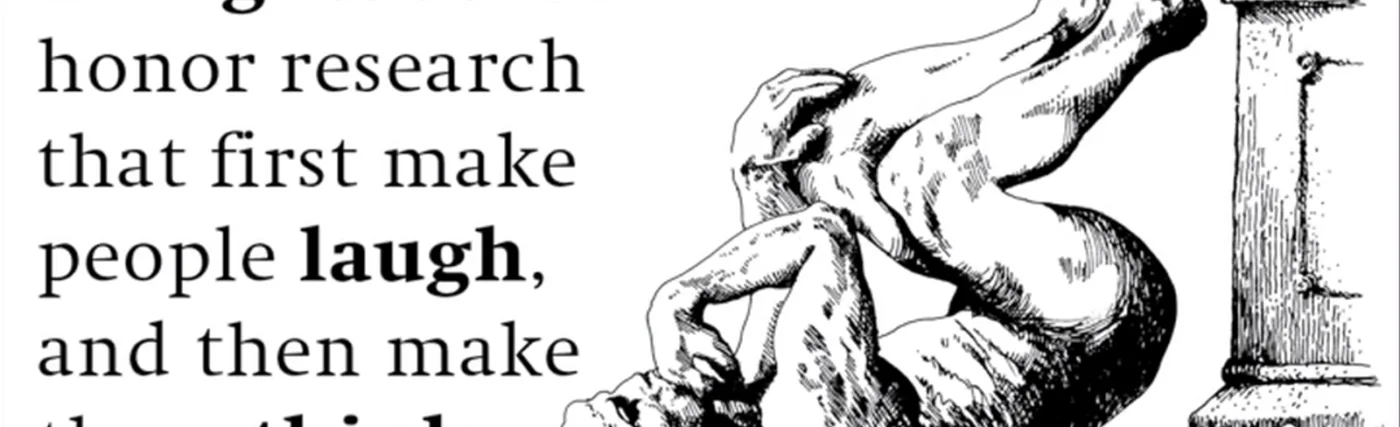
Dive into the strange world of the Ig® Nobel Prize when Neil deGrasse Tyson and co-host Leighann Lord interview Marc Abrahams, the prize’s founder and the co-founder of “The Annals of Improbable Research.” The prize is awarded for research that first makes you laugh, and then makes you think. You’ll discover the “first scientifically documented case of homosexual necrophilia in the Mallard Duck community.” You’ll explore “whether it is mentally hazardous for a human being to own a cat,” touching upon cat bites, depression, toxoplasmosis and “crazy cat ladies.” And if that’s not thought provoking enough, you’ll learn about prize-winning teams that have researched Coca Cola as a spermicide, the validity of the “5-Second Rule,” and the forces required to drag sheep across various surfaces. Last but not least, you’ll hear about the televangelists who won for their “discovery” that black holes fulfill the technical requirements to be the location of Hell. (Warning: This episode contains adult subject matter.)
NOTE: All-Access subscribers can listen to this entire episode commercial-free here: The Ig Nobel Prize.
Transcript
DOWNLOAD SRT
Welcome to StarTalk, your place in the universe where science and pop culture collide. StarTalk begins right now. Now. This is StarTalk. I'm Neil deGrasse Tyson, I'm an astrophysicist and director of New York City's Hayden Planetarium, right here in...
Welcome to StarTalk, your place in the universe where science and pop culture collide.
StarTalk begins right now.
Now.
This is StarTalk.
I'm Neil deGrasse Tyson, I'm an astrophysicist and director of New York City's Hayden Planetarium, right here in the Big Apple.
What else would New York City be, Leighann?
The medium-sized apple, depending on attrition of the population.
I got Leighann Lord across from me as my co-host.
Thanks, Leighann, for coming in for this.
Thank you for the invitation.
Excellent, we don't get enough of you here.
No, no, you don't, actually.
We'll get some more.
Now, you know who we invited into studio today?
You see him, but I have to, you don't know who he is yet.
No, I don't.
His name is Mark Abrams.
Wait, wait, the Mark Abrams?
That's good, you're good, you're good.
Oh, yeah, I catch on.
You're good at a cocktail party.
Oh, you're the one, you're the one I always thought.
I am actually fabulous at cocktail parties.
I really am, it's on my card.
So he's co-founder of the Science Humor Magazine.
You ever thought you'd see those three words together in the same phrase?
Actually, after meeting you, yes.
Well, thank you, thank you.
It's a magazine, I've known my whole professional life, Annals of Improbable Research.
Annals of Improbable Research.
Which you have to pronounce very carefully.
Exactly, and he's founder of the Nobel Prize Ceremony.
Well, we already have one of those.
Yes.
He had to find a different name.
Slightly.
The Ig Nobel Prize Ceremony, okay?
That's actually a word, I had to look that one up again.
If you're Ig Nobel, it's like-
Wait, wait, you had to look something up?
No, I had an idea, but I had to look it up just to confirm.
If you're Ig Nobel, it's like you ain't what anybody should be emulating.
I have a lot of that in my life.
So he's got an Ig Nobel Ceremony, like in Cambridge every year.
This guy's out of control.
And what he does is he combs all the research that's done.
I think occasionally someone might contribute something directly to it, but beyond that, you look around and see what kind of science has been done.
That's a little quirky.
And you say, why did, what?
And then you find, hey, oh, hey, that's kind of interesting or weird or they should be institutionalized.
There's some reaction to the people who conduct the research.
You mean those things that I see and I go, somebody got a grant for that?
Like that kind of stuff?
Exactly.
This guy is like, knows where those are done and who's done it and whether or not they should be granted an award.
So, let me bring him into the conversation.
Mark, Mark Abrams, welcome to StarTalk Radio.
Thank you, thank you.
It's a great honor to be here.
Oh, well, thank you.
Thank you.
With both of you.
And so you're based up in Boston?
I am.
Okay, cool.
Guilty.
Guilty man of New York.
And Cambridge even.
Yes.
The other, our Cambridge.
Yes and no, depending on who you choose to be today.
This America Jack.
Oh, okay, but you're everywhere, you're so.
You're man of the people.
So tell me, can you just submit a paper directly to the Annals of Improbable Research?
Would you read, or is it entirely just, so what's the construct of this?
Here's what it's about.
It took about seven years of trying to describe this to come up with a phrase that people seem to understand.
It's all about things that make people laugh and then think.
Not laugh and then cry.
You can do that if you like it.
That's the best kind, actually.
People cry when they laugh.
Those are the two things for drama, the smiling and crying face.
Often they go together in this case.
It's things that when you first hear about them, or you first see them, they're funny, but they're the kind of funny that a week later, the thing is still rattling around in your head and you really wanna go find your best friends and tell them about it and argue about it.
So you wanna create, so it becomes almost a, not a meme, but a little brain virus that you can't get rid of.
In a way, yeah.
It's things that make you wonder.
That phrase, of course, can mean many things.
I like, it's like, it's sneaky science.
Yeah.
So give me, what's the best example you would give right after telling someone that that's the kind of research you look for?
There's a paper that was published in a biology journal in Europe.
It's a very-
So it's a legit journal?
Yeah, it's a very small one.
It's read by only a few scientists who are specialists in that field.
That would be true for any truly specialist journal.
That's true for even the big ones, even nature and science, which are filled with reports that sometimes can make a person's career because they got a paper published in nature or in science.
But the truth of the matter is that not very many people read those papers.
Those papers are so very specialized, even the words in them.
A few dozen, maybe a hundred people in the world even know what they're talking about.
Those are in the absolute top journals.
So when you get down to the really specialized ones, not many people see these.
Anyway, somebody saw one article, it was in this particular journal, and they sent us a copy.
And that article is...
Oh, so I feel better now realizing that you are not the one combing every single freaking journal in the world.
I and my friends and colleagues are always looking at things, but every day we get a flood of things.
The internet made life much better.
The flood just is increasing all the time.
So there's a flood of stuff coming in from people who notice things.
This particular one that came to mind when you asked, this report is the first scientifically documented case of homosexual necrophilia in the mallard duck.
My blood just ran cold.
Did anybody else?
Because somebody's watching this.
I would be happy to give you more details.
How much more details does one need than homosexual necrophilia in the mallard duck?
That title has all the detail you need.
Neil, it's seldom a question of need.
It's a matter of desire.
Yes, yes, now it's a car accident.
Now I gotta stop and watch.
Ooh, very interesting analogy.
It's rubbernecking on what's going on on the side of the road.
I am indulging in my natural human instincts.
I am not rising above them at this moment.
I need to know about the duck.
Okay, so what motivated this research?
Well, first of all.
Do you get to know that even?
First of all, I should not exactly correct, but channel what Leighann just said.
You need to know about the duck you said.
There were two ducks involved in this.
Ah, yes.
Well, the dead one and the live one, I would presume.
Yes, would you like to hear the story?
I have to.
I'm sorry, Neil, I have to.
The paper was written by a man named Case Mulliker.
He's Dutch.
He is the curator of a museum in the city of Rotterdam.
It's the Natural History Museum in Rotterdam.
Very nice museum.
A few years ago, they put up a new wing with all glass walls, and from the very beginning, birds every day slam into that thing.
They don't see it certain times of day, depending on the light.
And the people who work there got used to the, they pay very little attention, but one day, Case Mulliker was sitting there.
What, wait, wait.
So the sound of birds snapping their neck flying into a window they don't see, became the natural din of sounds in their day.
If this happened several hundred times a day where you work, you would get used to it very quickly.
No, I would stop it from happening.
No, no, you would adjust.
Human beings adjust to all sorts of things.
You would see if you could find a way to stop it, but as it happens, this story has taken many twists and turns, and I've become very friendly with the scientists who wrote this.
And as a result of that, one of the things I've learned is that there is something in the very rough neighborhood of about a billion birds that die every year in the US from colliding with buildings.
It happens a lot.
A billion.
That's about the usual estimate from the people who have spent a lot of time trying to figure out how often this happens, and that's just in this country.
And yet another study.
There are many of them.
But back to the case of the.
One day he was sitting there, Case Mulliker was, and he heard an especially loud, and he was curious.
So he went and he looked out the window and he saw that there was a mallard duck on the ground that pretty clearly had just slammed into the building at very high speed, broken its neck and was dead.
While he was watching, a second mallard duck flew in, landed next to the dead one, and began engaging in activity with the dead one.
Now, Case.
Freshly dead.
Yes, freshly dead if you want to think of it that way.
Case studies birds and he realized quite quickly that he had never heard of anything quite like this happening.
So he decided to, and he did, get his notebook and his camera and he moved a little closer to that spot.
He sat there taking notes while this was happening.
As any good scientist would do.
Yes, or at least many.
And he continued taking notes as this unfolded over the next 75 minutes.
So clearly these weren't resuscitation efforts.
Mallow duck, mouth to mouth.
Or how do we know he's just not a bird pervert?
A deviant bird?
No, no, no, the guy taking the notes.
Like the internet was down that afternoon.
How do you?
Okay, first of all, no, this was in Rotterdam.
Their internet's never down.
Oh, right, because when the internet's not going, it's going on in real life.
Neil, I suspect there are people.
I forgot, it's the Netherlands, I forgot.
I suspect there are people who hearing about an astronomer in New York City who has been very interested in a little planet or non-planet, had a similar question about that astronomer they'd never met, but that's just a guess.
Anyway.
But there are no planets mounting other planets to make baby planets.
I mean, that's the difference between.
Not that we know of.
Not that the theory is born.
How do you make more planets?
How do you make more planets?
There's a mommy planet and a daddy planet.
Let's not abandon this.
So say you've got a big planet and a little planet that's much denser slams into it and it splits the big one into two.
That can happen.
Now you've just made some baby planets by this method you described.
No one watching that would assert that the cosmic objects were making love, that's all.
They might now after hearing us talk about it.
Don't judge.
Do not judge other people's, but.
Exactly.
Yes, do not judge other people's love of astronomy.
That's good.
So 75 minutes of data and he wrote a paper on this.
Yeah, and it was only 75 minutes, by the way, because it was at the end of the work day and he was getting hungry, he wanted to go home to dinner.
So he went outside and he broke it up and he collected the dead specimen for the museum.
He later did an autopsy, that's how he knows that the victim was male as well as the other bird.
And he wrote this up and got published and we gave it an Ig Nobel Prize.
You had to.
Which brought a tremendous amount of fame to him around the world and offers to write books and be on TV and radio and he's got a whole side career going because of this.
But it also brought that study and this scientist to the attention of other people who study birds and who study animals.
It's reached the point now, it was about 10 years ago that we gave him that prize.
It's reached the point now where as Case likes to say, if there's an animal anywhere in the world misbehaving, Case will hear about it, probably in a week or so.
Again, that's value judging that having sex with a dead bird by another bird who's homosexual is misbehaving.
Right, we're putting human values on it.
You just value judge that.
That is making a judgment.
It is just nature being nature.
I have to ask, was his first book called Duck Love?
I have to know.
No, his first one was called The Duck Guy.
His second book was about-
The Duck Dynasty folks hear about this?
This was pre-Duck Dynasty.
And these have only been published in Dutch.
His second book about a different topic, which he learned about because somebody brought it to his attention, knowing that this is the guy who collects unusual things.
His second book has the title The Butt Crack of the Tick.
This sounds like sexually frustrated science.
Radio listeners cannot see the look on Leighann's face.
No, they can't.
They can't.
Yeah, I'm stunned.
The butt crack of the tick.
Yes.
Ticks do have big butts, though, when you look at them.
They're all butt.
Think about it, they got the little front part where they have the legs.
And then there's this huge.
Hey, why do you know this?
Because I've seen tick butts, but I just don't remember seeing a butt crack.
Tell us more, Neil.
Yeah, you are really digging your grave here, sir.
I could get a research paper out of this if you keep.
And perhaps an Ig Nobel Prize.
You keep doing that.
So.
Probably are things that live in there, bacteria and.
Oh, I don't, I can't.
Yeah, don't even go there, right, right.
Right.
I wanna spend more time on a second segment on previous winners of your Ig Nobel Prize, but I wanna first understand the Journal of Improbable Research.
What kind of things land there?
Oh, birds and all sorts of things.
Yeah, the annals, please, of improbable research.
The heart of the magazine, magazine comes out six times a year.
And the heart of it is little pieces, little quotations from scientific studies that are published.
And there are lots of studies published.
The last time anybody did a count, just of journals, this is science journals being published, and this was about 15 years ago, there were about 25,000 scientific journals being published.
Whoa.
And that's if you ignore the little tiny ones that are just within somebody's department somewhere.
So there's so much stuff that nobody ever sees all this.
So the heart of the magazine is little citations, little quotes from some of these things that all, if we've done a good job, have that quality that they're funny, and you also wanna go and tell somebody about them.
But they were not intended to be funny.
No.
They're funny sort of out of context, in a sense.
Some of them are funny in context.
There are some things that just are funny.
Well, we'll get back to the duck again, you know?
No, but that duck got the Ig Nobel Prize, right?
Okay, but I just wanna, just something that's just random that you would choose to land there.
Okay, here's one, here's one.
This one also got a prize, but the people who did it did not think there was anything funny about it when they did.
It was done by seven Australian scientists published in a journal of ergonomics, which is studying how you build and make things that are comfortable to use versus uncomfortable to use, or dangerous versus undangerous to use.
I heard that that only arose as a thing when baby boomers started getting arthritis and turned old.
And they said, we got to invent things that serve our hand and body posture.
They did not want to go quietly into that good night.
I would love to know if that's true.
Yeah, well, it correlates whether or not it's a cause and effect is another thing.
Yeah.
That's when Oxo came out.
Just when I needed Oxo, it's there with all of the kitchen you implement.
Thank you, baby boomers.
So go on, but I interrupted.
This study that these Australian scientists published was called an analysis of the forces required to drag sheep across various surfaces.
Are these, I mean, but sheep have legs.
Sheep do have legs.
Normally.
Which is sometimes part of the problem.
We gave these guys an Ig Nobel Prize and it was only on the phone call when I was offering them the prize that the guy on the other end realized that what they'd done is funny.
Aw.
The reason they did it, they live in a part of Australia where sheep are a major industry and people in that industry had a problem they called some scientists in asking them, can you please make things better?
Can you talk to our sheep?
Yeah.
Well, the problem is that there's a large building and thousands of sheep are brought in at the same time to be sheared, to have their wool cut off.
To be, and the cutting is done with big electric clippers, which are very dangerous.
There are a lot of injuries every year to the sheep and to the people using it.
And things go much smoother if the sheep will move where you want them to move when you want them to, but sheep don't always do what you want them to do.
Like people.
Yep.
So the scientists were asked, is there anything we can do, make the building a different shape or anything to make this stuff go quicker and less dangerously?
That's what the report was about.
One of their conclusions, one of the things that these scientists decided after working on this for a year or so was very simple.
And it boils down to, it's easier to drag a sheep downhill.
Than in any other direction.
Yes.
In some of these buildings, they were trying to drag sheep uphill and the sheep were not caught.
They could have asked an astronomer, you know, we know all about gravity.
Yay, science.
I look forward to your next ergonomics paper about sheep, dear astronomer.
Well, when StarTalk comes back, we have Mark Abrams as our special guest.
Are there any constellations that involve sheep?
No.
Well, there's the ram.
There's Aries the ram.
Yeah, I guess that's sheep, isn't it?
A boy ram, a boy sheep.
Is there a boy sheep?
Yeah, it's ewes and rams.
So we have sheep in the sky.
We got it.
So when we come back, more with Mark Abrams and the Ig Nobel Prize.
We're back, StarTalk Radio.
I'm Neil deGrasse Tyson, Leighann Lord.
My co-host, we've got as a guest, Mark Abrams, down from Cambridge, Massachusetts, where he runs the Journal of Improbable Research and annually awards the Ig Nobel Prize for science research that.
Makes you laugh.
And then.
And then think.
And then think, but it makes you laugh.
And then cry.
But Leighann, you had a question left over from segment one, what was it?
I did, you guys used a term, you banded back and forth, and I feel I generationally missed it.
What's oxo?
Oxo, am I pronouncing it right?
I think it's an entire brand of kitchen implements where when you touch your hand to the handles, it's like, hey, I like this in my hand.
I don't even wanna let go of it.
Oh, so you're cooking with fancy stuff.
No, no, it's not any wall, no.
It costs a couple dollars more, but that's it.
The couple dollars more and the upping of the tone of your voice tells me everything I need to know.
Analyzing the tone of my voice.
You went up an octave, so yeah.
And if I can add some fuel to this fire, that company is British, so these are British expensive.
British impulsing tools, implements.
Yeah, so next time, look at the wall of kitchen implements and there's a whole section.
I don't think they have that at Walmart, sir.
Just hold them in your hand, hold them in your hand and you'll see they feel more comfortable.
So I'll buy better kitchen implements and no food.
People have to make choice.
They gotta make choices.
I'm haggling for a raise here on StarTalk, that's what I'm doing.
So your Nobel Prizes, I'm told you have 10 a year, is that right?
We have 10, yeah, every year since 1991.
And each is in a category.
That's right.
And I was reading over some of the categories, they're hilarious.
So in 2010, when did the Public Health Prize for, well, I gotta read this, because you won't believe it.
Scientists from the Czech Republic, Japan, India, and the United States investigated whether it is mentally hazardous for a human being to own a cat.
That got an Ig Nobel Award.
Oh yes, that was this year, 2014.
And that prize was split between two different teams, one of them based in Europe, one of them based here in India.
The Europe team is really headed by a colorful guy.
You should look this guy up on the internet.
He is the most interesting looking person you have ever seen.
His name is Jaroslav Flegar, F-L-E-G-R.
He's from Czechoslovakia.
A name like that, you gotta be interesting looking.
And he, for 20 or 30 years, has been looking at a particular parasite called toxoplasma that pretty commonly lives in cats.
So it's a natural parasite to the cat.
Yeah, yep.
And it's easily transmitted from cats to people who hang around the cats.
And what.
Just to be clear, if a cat has this parasite, the cat is not sick.
Right.
It's just normal for a healthy cat.
Right.
Okay, gotcha, go on.
Well, in some cases, and nobody understands why sometimes it goes one way, sometimes the other.
That sometimes the cat seems to behave just like a normal cat.
But sometimes, because it has this parasite, the cat will start behaving in ways that are very destructive to itself.
That are toxoplasmic to itself.
Toxoplasmosis is the disease.
And sometimes, apparently, that happens to humans.
And these people are now wondering, well, have been for a while, and other people that, you've heard the phrase cat lady.
Yes.
Of somebody who owns hundreds of cats and behaves in a very, very eccentric way, that maybe a lot of those people are infected with this parasite.
Does part of the manifestation of that infection make you want to acquire more cats?
Because the old cat lady never has just one cat.
Well, that's the thinking that this probably happens, yeah.
So this is a way for the parasite to reproduce itself.
Yep.
By getting you to want more cats that contain the parasite.
I'll go with it.
That's a brilliant parasite.
Yeah.
All this time, I thought it was the cats that were in charge.
It's all about the parasite.
And there are other parasites that behave in similar ways in other animals.
Okay, so what are some of the disorders?
I mean, when I think of a cat lady, they're a little odd, but they're a lot of odd older people.
So I never uniquely implicated the fact that it's a cat lady.
So.
Well, it's not always a cat lady and it's not always a lady.
But they're.
Yeah, they're crazy cat dudes.
They're a whole range and they're, yeah.
Wait, wait, wait, pause.
How many crazy cat dudes do you know?
I'm dating, there are lots of crazy cat dudes out there.
Okay, and do you find yourself especially attracted to?
No, not at all.
Thank you, yes.
I was gonna ask that, but.
What happens is they hide the cat and then I find out there's a cat.
Because you don't necessarily, the first date isn't necessarily at their apartment.
How does one hide a cat?
Well, it doesn't, it's not the, you don't lead with the cat.
She doesn't go home with the first date every night.
Right, and it may not, it's not something they might not lead with, like hi, my name is so and so, I have a cat.
You know, that would be a little off-putting.
If you've had so many bad experiences, I would expect that by now you lead with the question.
Hi, Tay, do you have a cat?
Hi, I find you very attractive, do you have a cat?
Not even do you have a job, is your mom crazy?
Do you have a cat?
But I'm looking at these symptoms.
You've got obsessive compulsive disorder, schizophrenia, and that leads me to wonder whether these legends of cat people, these are people with multiple personality disorders.
Cat woman, and the Natasha Kinsky film Cat People.
Well, I think more than one version of that film, the one she's in, is the one I remember.
These are people.
I wonder why.
These are people who the cat manifestation interferes with their psychological state.
So you think this might go way back.
I heard you laugh when you first brought up this topic and now I hear you asking very good questions thinking about it.
But I'm not crying yet.
That's why we gave a prize.
I'll be crying soon when we're done.
We gave the other, we shared, we gave this prize to two groups.
The other group recently looked at a lot of medical records.
I mean, a lot, many, many thousands.
And they looked at the records of people who had been treated for having, because they were bitten by a cat.
And they found that some large fraction of those people who had been treated medically for having been bitten by a cat also had been treated at some point for depression.
Now, this is, as Neil, as you were saying, this is a correlation.
It's not necessarily the case that one of these causes the other, but it's mighty interesting that these things do seem to go hand in hand sometimes.
Wait, wait, so just, I'm trying to understand what it is that's correlating with what.
Is it that owning a cat could lead to depression?
Or is it that people who are depressed are more likely to own cats?
But it's coming off the cat bite.
Those are the people that were studied that had that hypofraction, that hyposauce.
No, no, the cat bite was just an excuse to now do the test because they're in the hospital.
I mean, that got them to the hospital.
Well, many people have bitten who don't go to the hospital.
Yeah, so there are all kinds of questions that come from this.
But so the simple fact that they found was that in the hospital records, people who have been bitten by a cat, you know, and enough that it shows up on a hospital medical record somewhere, many of those people also have on their same record that they have been treated for depression.
Well, what are we trying to correlate here?
That depressed people buy cats, that owning a cat makes you depressed, that depressed people are more likely to be bitten by a cat?
What are we looking for here?
The answer to your question is, It's all of the above.
Yes, these are good questions and that's as far as it goes right now.
And this makes you very interesting at a cocktail party.
No, I like, I like, I'm doing this at a cocktail party, I'm bringing this up at my aunt's party.
Answers and insight here, don't leave me with 20 questions dangling in front of my face.
You're a scientist, you're supposed to have questions dangling in front of your face.
No, no, no, excuse me, if I have a question.
See how impatient he gets when he has a good question, he doesn't have the answer, this is what drives him forward.
Well, no, no, hold on.
This is science in action, ladies and gentlemen.
Allow me to clarify.
Oh dear.
I love me an unanswered question.
But not after you've already done the freaking research, okay?
Don't do research and say, here are four questions, we don't have the answer.
Go back and do the damn experiment.
And I'll be applying for my grant to do just that.
Next question.
Next question.
So, how about the schizophrenia and compulsive disorder related to cat ownership?
How about it?
Do you think it's, is it that parasite or is it something else about the cats?
I don't know, I don't know.
We just give these prizes, we stir up trouble.
That's what we do, sir.
So, others.
My favorite category you have is safety engineering.
That's just the idea that that would be a category.
I think I know which particular achievement you're gonna mention.
Which one?
Troy Hurtabees, is that the name?
Which is the prize?
Yes.
Yes.
In all 24 years we've been doing this, there is one that still stands out in my mind as having been the most difficult one to figure out a category that describes it.
It's that one we finally came up with, we invented the category of safety engineering.
The prize went to a man named Troy Hurtabees who lives in Canada, in the city of North Bay, Canada, which I think is about a six or seven hour drive north of Toronto.
Troy won an Ig Nobel Prize because he had spent seven years trying to develop and personally test a suit of armor that he hoped would protect him against grizzly bears.
There are films of his tests.
You can see Troy in his suit, which is made from scrounged materials.
He had no money, so he'd get stuff from the dump.
So this is an early Iron Man effort here.
Yeah.
So it's safe to assume that Troy doesn't have Netflix?
Is that what I'm hearing?
Well, he may not, part of the inspiration for this, he said two things drove him to start doing this.
One was he had some kind of encounter with a grizzly bear out in the woods, in the Rockies in Canada.
And the other was around that same time, he had watched the movie RoboCop.
Oh, mercy.
He blend, yes, that's a good summary.
He blended these two, he went, he got some old hockey equipment and some other stuff.
Thank you for your cooperation.
And duct tape and he began building suits and then testing them by having first people do things like throw rocks at him.
I can tell you that if his suit is held together with duct tape, it will not stop a grizzly bear.
My wife is from Alaska and before I visited Alaska, I said, I'm gonna bring my Swiss Army knife so I can defend against the, she said, no.
So it's just, I got the whole, you know what works against a grizzly bear?
A shotgun, that's what works against a grizzly bear.
You know what a 30 ought six.
You know what works better?
A jeep heading in the other direction.
Exactly, yeah.
But Troy, there are films of this.
You can go online.
There was a documentary called Project Grizzly.
You can see Troy in these suits, which got very elaborate.
The later ones had sheets of titanium and all sorts of things inside them.
You can see him being pushed off the side of a cliff.
You can, there's one piece of film where you see.
To test how much it protects them.
That the suit would work, yeah, because he wasn't gonna start by testing with a grizzly bear.
You start with small things and work up, you know, bigger and bigger forces.
You can see him standing there in his suit, which is so bulky, he can just barely move.
If he tries to take a step, he falls over and he can't get up.
You see him standing there.
Like the old armor, I think the old armor of knights.
Yeah, it's, it's.
That was not, you were not tiptoeing through the tulips in that.
They must have gone through the same process, more or less, without grizzly bears, because they were too far south.
You see him standing in the suit in the middle of an empty field, and then you see a jeep coming in from the side of the film frame at, I think it was 20, no, 40, 40 kilometers an hour, and slam into him.
And in this documentary, you hear a radio interview with Troy saying, yeah, we did that 17 times.
Wow, national health insurance is awesome, isn't it?
I can't even imagine doing that here.
What is the copayment on that?
The impressive thing about Troy, though, you might look on somebody who would choose to do this as being-
Yeah, single, crazy.
As being singularly crazy, you might look on that person as being that way, but at the same time, it's pretty impressive that he's done all these things and a lot more, and he's still alive.
He's very careful.
But has he considered that if you're in the woods where you might be attacked by the grizzly bear, you're in the woods to enjoy the woods, not to stand there so that you're not eaten by a grizzly bear?
You're speaking for yourself.
Yes, you are.
You're not speaking for Troy.
Troy, after his one encounter with a grizzly bear, decided it was important for him to go back and spend time with a grizzly bear, preferably that one, but another would do.
You know, part of me wants to know the bear's point of view.
Like, is the bear just sitting there going, dude, Troy, can't we just get along?
This is unnecessary, man.
It's a misunderstanding.
I heard Franklin Ajai joke about grizzly bears, and he says, I wonder what grizzly bears, before they eat you, I wonder if they're concerned if you were free range.
Yeah, well, there was a guy.
Free range humans before you get mauled.
There was another guy who went out and wanted to spend time with grizzly bears and was insistent that he should not have any protection because he and the grizzly bear would commune.
There was a documentary made about him, it's called Grizzly Man, and it's very, very stirring to watch those two documentaries together.
I do admire, though.
He was eaten, by the way, and so was his girlfriend.
Oh, of course.
And it was really horrible.
I bet.
I do admire when he said that the stick-to-it-iveness, to put it very simplistically, of what Troy has methodically done, I mean, that patience, that dedication.
Stick-to-it-iveness.
Yes.
Okay, okay, you're a word lady.
You don't see that in a lot of people.
Some are bag ladies, you're a word lady.
I am a word lady.
Some are cat ladies, you're a word lady, okay.
I accumulate words.
People who have won these prizes are extraordinary people.
Very dedicated.
And you had another safety engineering prize I was reading about, how to capture a terrorist?
What's that?
We got a minute left.
Give me that one in the minute of this segment.
It's a man who lived in New York City, and in the early 1970s, he got a patent for an improved method for capturing airplane hijackers.
This method.
Back in the, that's before hijackers would crash the plane.
They really just wanted to land it somewhere else.
I'm old enough to remember that.
Usually Havana, Cuba at that point.
Yeah, because we had no plane service to Cuba.
So if we had plane service to Cuba, they probably would not have been hijacking it.
They would have just bought a ticket.
But since we had no access to Cuba from the United States, planes from here to Cuba were hijacked.
Okay, go on.
This method would be to install trap doors in the plane right outside the cabin so that the captain could press a button which would open the trap doors.
The hijacker would fall into the trap doors.
There was some machinery which would automatically package the hijacker up, at which point the bomb bay doors, which were installed in the bottom of the airplane, would open up and the encapsulated hijacker would fall through there.
A parachute would open and police, who had been notified by radio, would be waiting on the ground to capture the parachuting encapsulated hijacker when he reached the ground.
That's not a James Bond.
Very.
When we come back, StarTalk Radio continues with Mark Abrams.
StarTalk Radio, we're back, Leighann.
I know, I was thinking that, that's like the sexy StarTalk after dark voice, look at that.
When you were a little boy, did you practice that?
No, in kindergarten.
StarTalk, after hours.
That's a different edition.
It is, it is.
We haven't perfected that one yet.
I can imagine traffic stopping on the street.
Yeah, that's why the fan base is so high.
I don't know, so Mark, you award the Ig Nobel Prize and a big ceremony in Cambridge each year.
That's right.
And you get Nobel Prize winners to award it.
Yeah, we've done this from the beginning.
We always have a bunch of Nobel Prize winners up there.
And in Cambridge, you're never that far away from some Nobel Prizes with Harvard and MIT.
That's right, you go into the men's room and you're standing next to, you don't know who.
If you go into the men's room, if you go in the women's room, you're still standing next to them.
You don't know who, but it's a different set of.
But that would be the, okay, I don't know what would, why the bathroom would need to be specified for when you're standing next to someone who could be important.
Does that mean important people are the only ones who pee?
No, I think it's just saying you could find important people anywhere, even the least likely of places.
Even in the bathroom.
Even though we all go to the bathroom, yes, okay.
But not necessarily with your CV on your arm.
Yes, correct.
So I love these categories, there's safety engineering, a peace prize, chemistry prize, physics prize.
And one of these, what was the category?
I read something about somebody testing the effect of Coca-Cola as a spermicide.
What was that?
That made it a chemistry prize, yeah.
They tested whether Coca-Cola kills sperm.
How did, why come up with that?
These are some doctors.
Why come up with anything?
By the way, I like ideas no one has thought of before.
But just you're sitting there at the soda fountain.
There's a Coke.
I mean, what state of mind and circumstance leads to this thought?
That's really what I wanted.
Here's the story on this one.
Here too.
This happened in a lab at Harvard Medical School.
Deborah Anderson is the scientist who ran the lab.
I like stories that begin there.
This happened at a lab.
Mm-hmm.
They were doing research and tried to come up with new methods of contraception.
And I interrupted you, it was a graduate student?
Deborah Anderson ran the lab.
Ran the lab.
And she had a young, very young doctor, a woman who had grown up in Puerto Rico who was working in the lab.
And the young woman told her that in the high school that this young woman had gone to in Puerto Rico, she said all the girls there used Coca-Cola as a contraceptive.
And Deborah Anderson laughed and thought this was, this was a bizarre joke.
And the young woman explained, I'm not joking.
This was true.
Deborah Anderson checked into it and discovered that around the world, a lot of people then and now use Coca-Cola because they believe it's an effective contraceptive.
They use it as a douche.
That's what led Deborah Anderson to decide, well, let's test whether this stuff does have any effect in killing sperm or not.
So, they got some sperm and they got four different kinds of Coca-Cola.
At that point, it was classic Coke, new Coke, diet Coke, and I forget what the other one was.
Cherry Coke, it has to be.
It may have been cherry or it may have been some other, yeah.
I just realized what I said.
I know, that was, that was, that was, that was, mm-hmm.
They use that the first time, right, okay.
If you like, I'll introduce you to Deborah Anderson.
She'll appreciate that.
She came back to the Ig Nobel ceremony, took a bow this year, by the way.
She's very good about that.
So anyway, they tested it, yeah.
Actually, in the movie, in the song Lola.
L-O-L-A, Lola.
Oh, different Lola, sorry.
Okay, C-O-L-A, Cola.
Okay, so in the written version of the song, it mentions cherry cola.
Oh.
But in the song version, it's Coca Cola.
But the published version, it says cherry cola.
So it goes back.
There are depths.
Yeah, and Lola was, I guess, a transvestite in that.
And not just a showgirl.
I don't think so.
Different song.
Yeah, yeah, Lola was just hanging out at the bar, yeah.
Everything is related.
Walks like a woman and talks like a man.
Not in a sense, it's my Lola.
It's my Lola.
I need to find out about.
Oh, I'm sorry, sorry.
I need, Coca Cola, what happened?
You need what?
To hear the rest of the story.
Thank goodness.
Okay, go.
Yeah, so they tested it and they discovered that in a test tube, it can kill sperm, but in nature, it's not an effective way of preventing contraception.
What's the difference between a test tube and a vaginal wall?
That's what you're telling me here.
And all these surroundings, yeah.
The surroundings neutralize the Coke so that it then is no longer.
And lots of things can go wrong and they're, yeah.
They published something in a medical journal and some.
Saying it did not work.
Saying that, yes, it does kill sperm, but not in the way that you would want to trust it to be at all effective as a chiroceptive.
Some doctors in Taiwan read this report in a medical journal and they decided to run their own test.
They tested the same question using Coca-Cola and Pepsi.
I was wondering when that was gonna happen.
When was Pepsi gonna enter the equation?
So you can go if you want to and easily find their report and you can see the relative effectiveness of Coke and Pepsi.
Both groups, though, are pretty strident in saying that if you want to prevent a child from being conceived, you really should not depend on either Coca-Cola or Pepsi.
I'm saying nothing against the Coca-Cola company or the Pepsi company.
Because it's usually a rum and Coke that might lead to the shenanigans in the first place.
That's how you got there.
So in the end, isn't it what's cheaper, a can of Coke or a condom?
I mean, maybe that's what it came down to.
Coke was cheaper than condom.
For some people, apparently that is exactly what it came down to.
You would do better with a full can of Coke and clocking that brother in the head.
That's it, that's the last one.
1001 uses for a can of Coke.
Well, that was 1002.
And what's this one about black holes?
That's why, you know.
Oh yeah.
You give an award, tell me about that one.
Yep, yep.
The Ig Nobel Award for physics, I guess, is that right?
You may know a fellow named Walter Lewin.
Yeah.
Walter Lewin came and accepted the prize on behalf of the winners, because the winners were indecisive about whether to show up at the ceremony.
The winners were Dr.
Jack Van Impey and his wife, Rexella Van Impey.
They have a television program you may have seen called Jack Van Impey Presents.
They are televangelists.
The program is in the form of a news report with all the trappings of a news report.
They are fascinated by science, although not in the way most people are fascinated by science.
They pluck little pieces of science reports out of the news, and they'll start talking about them.
But you know that if you just let them talk long enough, they will eventually relate that piece of science to something in the Bible cited as evidence.
So cherry picking science.
I wonder where that happens.
Cherries, yes, yes.
That's so rare.
That's, I don't know if that ever, this is the first time I've heard of that.
Yeah, please go on.
And they one night announced, and they gave some detail, that they had discovered that black holes fulfill all of the technical requirements to be the location of hell.
And so we gave them the Ig Nobel Prize and we called them up as we do in almost all cases and quietly offered it to them, gave them the chance to decline.
They did not decline, but they wavered about whether they were going to come to the ceremony.
And finally, not too long before the ceremony, Dr.
Jack Van Impey's secretary called up and said, oh, sorry, Dr.
Van Impey cannot come because he has a previously scheduled fundraiser.
So we called Walter Lewin, who is an astrophysicist at MIT, which is right down the street.
He very kindly came and accepted custody of the prize.
And he talked about how grateful the astrophysics community is for this knowledge that no one had suspected until this work was done that black holes fulfill all the technical requirements.
Well, on the flip side of that, I remember an Ig Nobel paper from decades ago that where there was a calculation demonstrating that heaven was hotter than hell.
Yeah, we didn't give a prize to that, but.
It appeared in the journal.
Yeah.
Yeah, yeah.
That was where, if you can measure the entropy generated by souls who were well-behaved and who believe in a heaven, because if you don't believe in heaven, you're not going to heaven, right?
So it's not everybody, it's just those who believe.
And then, so their souls go to heaven and it brings a certain level of sort of entropy and so then you can add all of that up.
And when you add all of that up, each soul contributes a certain sort of fractional bit of energy to the heaven.
And then there it is, hotter than hell.
And after that article came out, there were almost an endless series of letters from other scientists picking at little bits of the equation.
Saying you made an error and it really should be yours.
Super dynamic approximations were invalid, right?
Wouldn't heaven be air conditioned?
I mean, seriously guys.
Here's another one.
There it is.
See?
There's always one more scientist waiting to wade into this battle.
Did you just call me a scientist?
Thank you.
And how about the, listen, I used to walk dogs.
That's how I bought my first telescope.
I walked, I was in the glory days of dog walking before you had to clean up after them.
So I could walk four doors, they'd poop everywhere.
I would just keep walking.
And you wanted a telescope to examine that?
The inner world of poop.
But my first telescope, I was in middle school.
Back then we called it junior high school.
So what did you find out about dogs pooping and peeing?
I read this.
Oh yeah, yeah, that prize this year.
There have been several prizes over the years related to dogs.
The prize this year went to a team from Czechoslovakia and Germany.
They gathered data over a long period of time and they say that their data shows that dogs tend to align their bodies, that's the line of head to tail.
They tend to align that with the geomagnetic lines of force around the earth.
When they poop or pee.
When they poop or pee.
And they say that data shows that that alignment happened only on the days when the magnetic field was relatively strong, days when there were things interfering and the field lines were not so strong.
So it's not because most city grids are aligned somehow north south, and if you're walking a dog.
I think these were all done out in fields, or most of them were.
And there are lots of questions that it raises, many of which I'm sure you can.
I'm actually not shocked here.
Forget the GPS, you wanna go north south, just make your dog poop.
Listen, I always believe my dog was a genius.
They have an app too that anybody can download for free.
They're hoping that lots more people will gather data on their dogs and send it in through this app.
Or strap something to the dog, a poop app.
Sorry, a poop app.
One more here before we do, I wanna get to that, in the seconds we have remaining.
What's this with the five second rule?
Somebody research that?
That's sacred, you can't touch that.
It was a high school student, a girl in Chicago who did that one summer.
She had a job in a laboratory and she tested the five second rule.
The five second rule being the idea that if you drop food on the floor, if you pick it up within five seconds, it's safe to eat.
Oh yeah.
What she discovered.
Duh, everybody knows that.
What she discovered was, the answer is, well, sort of.
If the food is not sticky and the floor is clean, it's probably fine.
Otherwise, it's probably not.
Make sense.
Yeah, but yeah.
Or.
I don't think anyone who has sticky food that lands down on a dirty floor would be invoking the five second rule.
I also think it depends how hungry you are.
Is that true?
Yeah, they measured bacteria.
She measured bacteria before and after how many got onto the food from the floor.
And not if you kissed it and held it up to God or anything like that.
That would be a separate investigation.
That's a separate experiment.
So you have a book out.
What's the name of your book?
The Ig Nobel Cookbook.
I'm looking at it right now.
That's just out.
We asked a bunch of Ig Nobel Prize winners to send us recipes to cook things related to what they'd done.
The scientist who discovered homosexual necrophilia in the mallard duck.
He sent us his favorite recipe for preparing duck.
Awesome.
Is it homosexual ducks?
Does that change the flavor?
Yeah, does that change the flavor?
It's only in a metaphorical sense.
And so that's one book.
But the other is called This Is Improbable Too, which is a, it stems from a collection of my newspaper columns in The Guardian in London.
You write for the Brits.
I'm proud of you.
I've been writing a column there for about 10 years.
They hardly ever take writers from America.
It's more like I was thrown out of America.
I mean, people there were kind of-
We're not as literate as the folks over there.
So congratulations.
They got you there.
So it's a collection of those articles.
It's a collection of all sorts of things from science studies that most people have never run across that make people laugh and then think.
So you're just, you're at it even more as you do that.
Yeah.
Thanks for being a guest on Star Talk Radio.
Mark, Leighann, as always.
Thank you.
My most charming co-host ever.
I'm Neil deGrasse Tyson.
Star Talk Radio is sponsored in part by a grant from the Alfred P.
Sloan Foundation.
As always, I bid you to keep looking up.
See the full transcript




 Unlock with Patreon

 Become a Patron