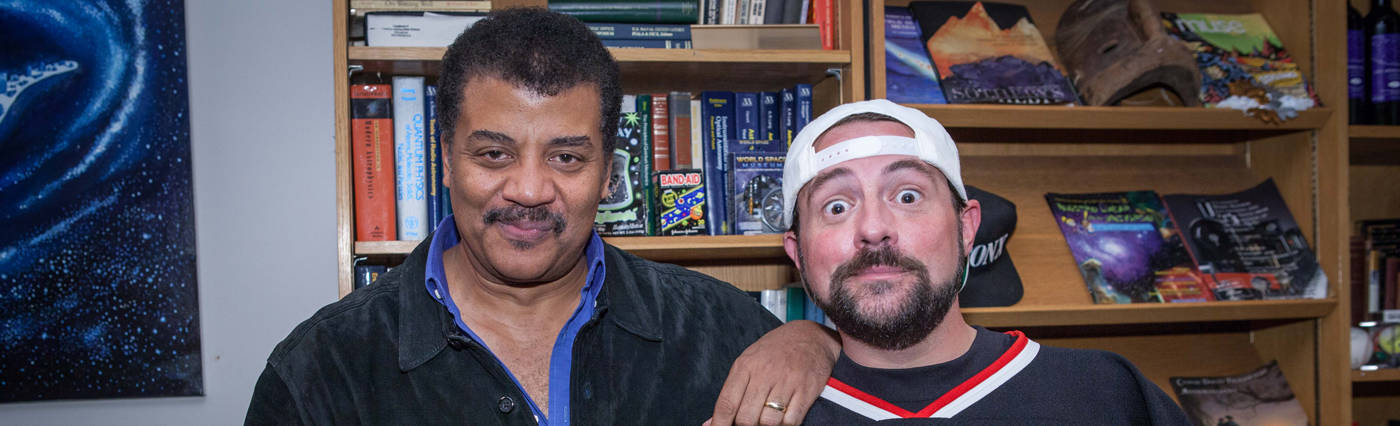
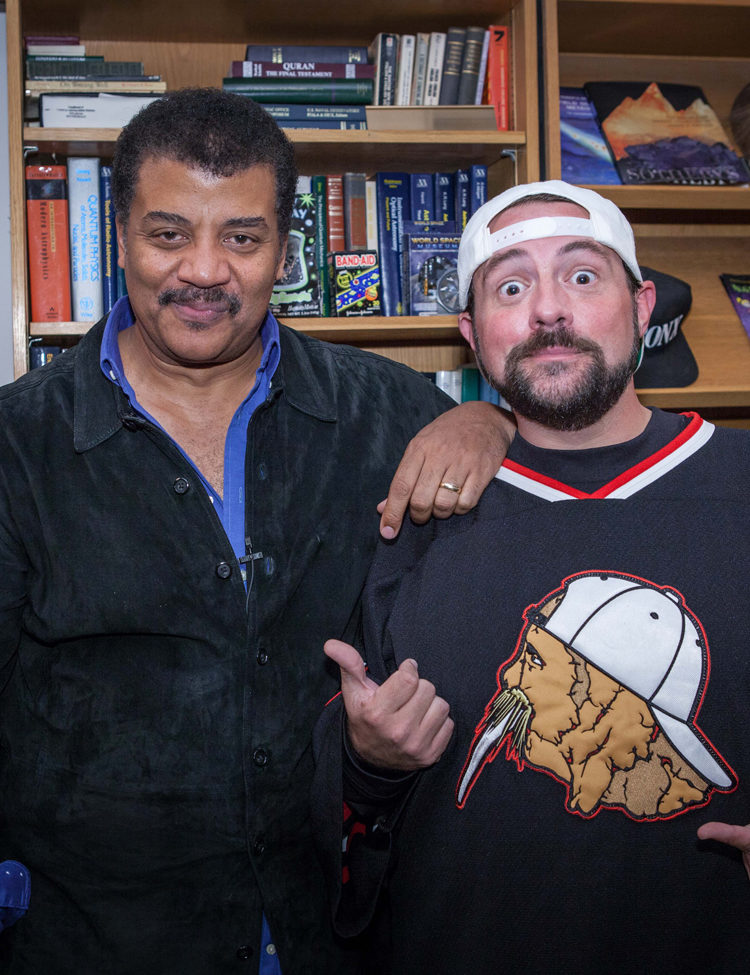
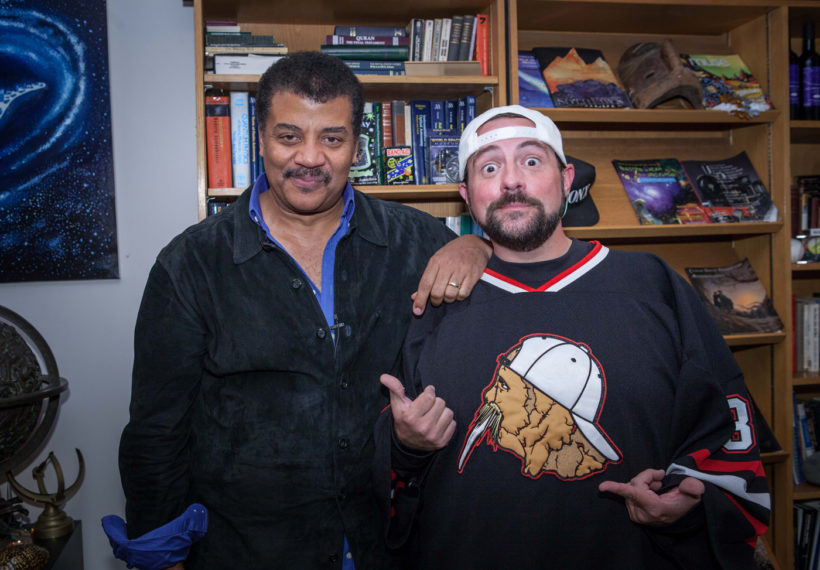
“Scientists are inspired by fiction and fiction writers are inspired by science.” So says astrophysicist Charles Liu, our geek-in-residence, as we enter the geekiverse in this episode of StarTalk Radio. We’re featuring Neil deGrasse Tyson’s interview with independent filmmaker, all-around superfan, and star of Comic Book Men, Kevin Smith. Neil is joined in studio by the two Chucks, comic co-host Chuck Nice and the aforementioned StarTalk All-Stars host Charles Liu. You’ll hear how Kevin’s primary exposure to science came through pop culture and science fiction. (You’ll also find out just how much math and science Kevin actually knows, and why he claims to have a complete lack of scientific curiosity.) Explore the rise of comic book culture and how it has shaped and influenced the modern zeitgeist and pervaded many aspects of popular culture. Charles explains how real scientific discovery and understanding crosses over into the fictional realm of comic books, and Neil tells us the story of how he used astrophysics in his appearance in the Superman comics to determine the location of Krypton in our universe. We also answer fan-submitted Cosmic Queries about the vibranium/adamantium alloy that makes up Captain America’s shield and whether Ant Man could shrink enough to turn into a black hole. James Kakalios, physicist and author of both The Physics of Superheroes and The Physics of Superheroes: More Heroes! More Villains! More Science! Spectacular Second Edition, calls in to offer a scientific explanation of why only the worthy can lift Thor’s hammer Mjolnir, and Wonder Woman’s wristbands (technically, the Bracelets of Submission) can stop or deflect bullets. All that, plus, Kevin talks about his growing interest in “the science of positivity,” Neil ponders Carl Sagan’s thoughts on superhero culture, and we take a look at the mega geek meccas of San Diego Comic Con and New York Comic Con (where Neil and StarTalk will be on the main stage again this year Thursday night, 10/4/18).
Transcript
DOWNLOAD SRT
Welcome to StarTalk, your place in the universe where science and pop culture collide. StarTalk begins right now. Welcome to the hall of the universe. I'm your host, Neil deGrasse Tyson, your personal astrophysicist. And tonight, we are going to...
Welcome to StarTalk, your place in the universe where science and pop culture collide.
StarTalk begins right now.
Welcome to the hall of the universe.
I'm your host, Neil deGrasse Tyson, your personal astrophysicist.
And tonight, we are going to explore the farthest reaches of the geek-iverse.
Featuring my interview with filmmaker, comic book fanatic, and basically all-round geek ambassador, Kevin Smith.
So let's do this.
Co-host tonight, Chuck.
Chuckie Baby.
Tweeting at Chuck Nice Comic.
I love you, man.
I love you, too.
Love you, man.
And Charles Liu, your old-timer now.
That's the whole spinoff thing we do.
And this is like your 100th time as an expert witness on the show.
Happy to be here today.
You are totally tickling my geek underbelly.
Well, for this particular episode, we have you on because you are our resident geek-in-chief.
So, we will be relying heavily on this sort of the geek-spertise of the table.
Oh, that just felt good saying it.
Yeah, because we are featuring my interview with Kevin Smith.
He is director of the cult classics, Clerks, remember that one?
That was an interesting one.
Mallrats and the movie Dogma.
He is a lifelong science fiction and comic book fan.
And he stopped by my office recently.
I said, let me snatch him, put him in the chair and talk to that man right here at the American Museum of Natural History.
Let's check it out.
I'm gonna dive into it by saying this.
I've never been here.
I grew up in New Jersey.
So I grew up a hop, skip and a jump away from Manhattan.
You're telling me you never came?
I've never been to the Museum of Natural History.
I literally had to ask the lady who brought me in.
I was telling her, I was like, I've never been here.
And she goes, really?
That's the end of this interview.
I'm sorry, but this is a chance to convert someone to science.
So I said, is this the place where they hang the big whale?
I've seen it in movies.
And she goes, this is that movie place.
So that's my way of saying, I'm an ignorant man, Neil.
Like, I never pretend to erudition that's not mine.
And science and math were always my weakest subjects in school.
My wife is a massive science buff.
Like I said, I've never been here and I grew up so close.
That tells you that science is the last thing on my mind.
Not even on a school trip?
Never.
Can you believe it?
Like I went to eight years of a Catholic school, so there you go.
There's your problem right there.
There's no science in my life because when I was a kid, and this is absolutely true, everything could be explained by faith.
So, you know, and it wasn't like a TV movie where my young child's soul in school was being pulled toward God or science.
But there was no natural curiosity stirred in me, I think because I went to Catholic school, because I was raised Catholic, and every Sunday I was in church and I was an altar boy.
The mysteries of the universe to me were just like, well, God, and that's it.
And so, you know, that was good enough.
I'm a lazy man, and I was a lazy kid.
So I never really went beyond that.
Science entered my life only through the fictional realm.
Like the only science I cared about was like, oh, they've got spaceships in space, and that's where the empire fights the rebellion, and they have lightsabers and laser pistols and phasers and stuff like that, communicators.
So my interest in science was always kind of based in pop culture.
But I realized that when they, I mean, honestly, I've been ducking you for a while, because people are like, you should talk to Neil, and I'm like, I can't, because I'll be revealed as utterly ignorant.
This dude was avoiding me.
But turning pop culture into science interest?
That's what we do here on StarTalk.
I'm just saying.
He's the perfect StarTalk candidate.
Yeah, that's right.
So what do you think of his excuse for not having interest in science?
Not to be harsh to him.
That means he's about to be harsh.
That's what that means.
Right.
That's the classic, just like, look, I'm not racist, but.
You know he's right.
Go ahead.
You got the floor.
The professor that taught me theoretical cosmology was a Jesuit priest.
So Catholicism has nothing to do with a lack of curiosity.
But I do note that what he said was that math and science were his weakest subjects.
And therefore he didn't have an interest or a curiosity in it because he didn't think it was any good at it.
And so in that sense, I give Kevin a lot of credit.
Because now he has bypassed that challenge, the expectation of others that he's not any good at it, and instead embraced it through what he liked and enjoyed, which is fiction and pop culture and comedy.
So he took what he knew was a product of something and assigned the wrong cause.
Yes, I think that's what it was.
At its core, science is not in conflict with religion.
It's only a matter of if people use it as an excuse or as an idea that makes it a conflict with religion.
Does that make sense to you?
That's how I feel strongly about him.
And as a result, I think Kevin is really cool.
So maybe he's best recognized for playing a recurring character called Silent Bob in his films alongside his stoner buddy named Jay.
I think we have an image of this.
Silent Bob and Jay.
Oh, there they are.
And they're in a comic book store.
So even though Kevin Smith is a huge pop culture fan and science fiction fan, he remains science curiosity challenged.
No.
Yeah, yeah.
I have evidence of that.
Let's check it out.
You're talking to a man who, at age 46, is still not quite sure how the water works when I turn on the spigot.
So the mysteries of the universe.
I got one for you.
Ready?
The refrigerator light.
Not what I get.
There's a little button that pushes off.
Oh, you found the button.
That's where my science begins and ends.
But it takes some curiosity.
The faucet, like, it's not plugged into anything.
And like, so wait, this pressure is just waiting at all times?
Like, isn't this a ticking time bomb waiting to go off?
I realize I'm not smart enough.
I was smart about one thing.
Things that don't exist.
Comic books, movies, TV.
I wasn't even smart about it.
I just liked it.
That's where I invested all my time.
Not even in sports, another unreal thing.
I invested my life, early life in cartoons and comics and movies and TV and fun things and sci-fi.
And so it just worked out.
I don't know what I'd be doing right now if the world didn't fall the way it did, but it just worked out that right now, people are interested in those things, culturally.
It's no longer pop culture, it is the culture.
And because I was raised in it and I'm well versed in it, suddenly there's this weird, you know, the universal lines, as you know, in some time, in some moments, and it has given me a path that's like, so I could literally just be a fan of things for a living?
This is a job?
And so that's kind of what I've, you know, I love making films and stuff, but really, that's only one half of my career.
The rest of it is just spent mostly celebrating things that I enjoy, largely, of course, a lot of it's centered around the unreal, sci-fi.
So that's where my sci ends, with a fi.
You've made a brilliant career out of the sci.
Well, I have used people such as yourself, communities that you represent, and explored ways to attach real science to it.
And I have found that if you identify a fan base that has rabid interest in a thing, and I find a way to attach something real to it, oh, my God, give me all of that that you can.
So, Charles, do you do some of that?
I do.
This is fun stuff.
It's quite potent when it's a ball rolls down a hill and doesn't stop.
That's right.
I must dispute Kevin when he says that he's not scientifically curious.
He is, just in his own way, for sure.
Oh, it's pretty clear that he doesn't think that he is.
Anytime you say, even me, at 46 years old, how does a spigot work?
Charles, do you know how a spigot works?
Absolutely.
There's water pressure.
Okay, wait a minute.
No, let's make this really interesting.
Because I know that Charles actually loves comic books.
Yes, I do.
On a really intense level.
Can you explain to Kevin Smith how a spigot works, but in a comic book story?
It's already been done.
What?
In the Marvel Universe...
But why would anyone do that?
Exactly.
I never heard of Spigot Man.
I'm Spigot Man.
I am here representing the water works.
Actually, in the Marvel Universe...
That is scary.
I love that.
In the Marvel Universe, there was a villain in the olden days called Hydro Man.
Who turned himself into water at will and would attack like Spider-Man and so forth by turning liquid so his punches would be ineffective and then swarm all over him.
He would attack secretly by going through the water pipes and so forth.
And the moment you turned on the water, he would pop out and start kicking your butt.
So this is real.
I'm just making this shit up.
That's amazing.
You turn on the Spigot and only half of him comes out and you quickly turn it off.
You cut him in half.
That's right.
That's right.
But then the one arm comes and turns the Spigot and then the other half comes out.
Okay, so like in Terminator 2, the liquid metal could reassemble into shapes.
Maybe that's where they got that from.
From Hydro.
That's excellent.
So, Kevin Smith, we know he was curious, but why isn't he more scientifically curious?
Let's find out.
You're an astrophysicist.
So let me ask you this.
Why aren't I more curious about science?
Like, why didn't it never hook me?
You know, there's more interesting stuff going on in the real world than there is in someone's imagination in a movie, in a comic book.
And I was so close, you know what I'm saying, with everything that I love.
But why do I have my head so far up my own ass, Neil, that I don't care?
You know, that's weird.
I should care more.
So, are you curious how much Thor's hammer weighs?
No.
Are you cur-
I know, I know, I'm sorry, I know.
But that to me, I know.
What?
No, no, you can't.
But to me that goes back to like, well, it's magic.
This is Curiosity 101.
I know.
That's not, you know, gee, I wonder what would happen if the black hole intersected the center.
No, it is Thor's, he's got a hammer.
Okay, why might the Hulk turn green?
Is there something about gamma rays?
Gamma rays.
Yeah, but I didn't even know those were real until like two years ago.
What are these?
Somebody was like, gamma rays are actually real.
I'm like, no, they're not.
Marvel created that.
You know what else is real?
Anti-matter is real.
Is that real?
Completely real.
Did you see my legit expression where I'm like, are you serious?
And we, my scientific brethren, Right.
proposed it, discovered it long before it ever entered science fiction lexicon.
Really?
Anti-matter?
What is it exactly?
So it is, it's amazing that it exists, first of all, and it's even more amazing that we knew enough about the universe to predict its existence.
So if you take a particle like an electron, Okay.
has a negative charge.
Yeah.
So.
This I remember.
Anti-matter is an electron in every way except it has a positive charge.
So we called it a positron.
So it turns out every particle has an anti-matter counterpart.
And the fun part about it is if you bring them together, they will annihilate and become pure energy.
They annihilate.
And then they both particles disappear.
It is a stunning fact of nature.
Can it be weaponized?
Because that's where we got to worry about dark side or Thanos getting their hands on it.
So you're worried about the nemesis, the superhero nemesis.
So here's the problem.
If you have an anti-matter, what are you going to carry it around in?
It's going to be touching your suitcase, which is made of matter.
So how do you hold it?
See, you're curious.
You're being curious.
Hold my hand here.
Is this how the journey to science begins?
That feeling that I feel right now is scientific curiosity.
Thank You brought them to the side of the light.
So Charles, what does scientific curiosity feel like?
It's really great.
I mean, you start, you work hard.
You know that just as well as I do, Neil.
You're working hard, spending a lot of effort.
You sometimes don't feel like you're getting there.
You're heading towards something you're not sure, but as the unknown slowly becomes known, your excitement builds, things move forward, and then you reach something that's really cool, and you're like, this is awesome.
Yeah, I felt that many times.
Yeah, that's exactly what it feels like.
It's a sigasm.
Sure.
That's what I'm calling it.
Yeah.
A sigasm.
Charles, have you ever faked a sigasm?
Are there any tools in your lab that help you achieve a sigasm?
There was.
OK.
All right, now that you mention it, there was this one time in graduate school.
So there was a premature sigasm.
Absolutely.
But fortunately, nowadays, I teach not just astronomy classes, but also various research methods classes that include sciences like biology, chemistry, biochemistry, physics, psychology.
So really, these days, I can achieve multiple sigasms.
Oh.
Coming up, we'll take your questions about the science of superheroes when StarTalk returns.
Thank StarTalk, we're featuring my interview with comic book writer and superhero super fan, Kevin Smith.
Check it out.
I don't know if you know, I participated a little bit in this with Superman.
Yeah, you were in the comic book?
I remember you in the Superman comic book.
Of course, of course, and also the movie, too, Batman v Superman.
So, for me, it wasn't simply that I was portrayed in the comic, which was an honor and a privilege, and Superman, after all he's done for New York, after all he's done for Gotham City, Metropolis, excuse me, Metropolis.
After all he's done for Metropolis, the least I could do is help the guy out.
He visited right here at the Hayden Planetarium.
How awesome.
But for me, what mattered most was I was able to tell them, the creators of this story, that I can find a real star in the sky that would be red, that would be the right distance given his travel time.
And I said, do you want me to do that?
They said, yeah.
Of course.
And so, it wasn't, it took a few hours.
I have catalogs and access to data.
So I found him a star.
I gave him two stars to choose from.
And they said, we'll pick that one in the constellation Corvus.
And I said, well, why that one?
Corvus, we in the North don't know about Corvus.
It's mostly seen from the Southern Hemisphere.
It's Corvus the Crow.
And they said, smallville crows.
That's what they said!
Really?
They knew this!
They said, they said, a smallville high mascot was the crow.
So they were like, we'll pick that one.
We'll pick that one.
And I said, there it is.
So I gave them the coordinates on the sky, gave them a photo of it.
And I felt privileged to contribute real science to a lore.
Nevermind, privileged dude, you're a part of the Superman universe from now and all time, because DC can literally point to the sky and be like, well, that's it.
We got it, the star is real.
It's got a name, it's got a coordinate, it's real.
And so-
So wait, as an astrophysicist, what, in your expert opinion, happened to Krypton?
Well, their explanation is-
Nevermind them.
What about, what would you think?
It was proximity to Red Sun doesn't have much to it.
The Red Sun helps Superman get powers under his nose.
Yeah, I know, I know.
So what you can do is-
What blows up that planet?
You can, the host, the home star, when it's ready to die, it will expand.
And it can expand so large that it'll mostly fill the orbit of the home planet.
Now, if that happens, it's very hot on the home planet.
The home planet could be made, I'm inventing this up-
Taking it.
In this moment.
This is jazz, dude.
It's what's between the notes that's gonna be the magic goat.
So, if Krypton were made of a mixture of materials and ores that pass through its structure, where different materials respond differently to the same amount of heat.
So for example, iron will expand more when heated than a diamond will.
Just for example, okay?
Well, if you have ores moving through your planet, the planet starts getting hot.
Pieces of the planet will expand more than other parts.
So the planet will not just uniformly grow.
Different pieces will want to bust out and you can destabilize an entire planet that way.
If you have particular ores of minerals that go through it or metals and minerals where this expands more than that, then you've basically lost all structural integrity of your planet and then you could basically take it apart.
See man, if somebody had done that to me in high school, explain the science of how Krypton might have exploded, I could be a scientist today.
So Charles, is this a big secret here?
Should we be teaching superhero physics?
Duh, of course.
Oh, okay.
Absolutely, I do it all the time.
Superheroes are just an exaggeration of what real physics does, right?
Because Superman lifts mountains, we lift little rocks, right?
We can imagine us lifting mountains.
So, let's just ask, if we were to try to lift a mountain, what would happen to it?
By the way, your explanation of Krypton exploding sucked.
Yeah.
But that's okay, it was a good try.
And that's what matters.
All right, let me just say.
No, but he was saying, how could it possibly happen?
We know that it couldn't.
Right, no, no.
Now that I re-hear that explanation, I agree.
You understand the problems.
You need volatiles inside your things.
I give it a C-minus.
Yeah, well, a passing grade for sure.
But you need something that actually heats up in such a way that it creates an explosion, right?
But never minding that, that's really okay.
The point is, when we imagine that exaggerated physics of a superhero, taking it to the extreme gives us a chance to distill the coolness factor, the really special part of the science that can be explained to everyone regardless of their background.
But here's a coolness factor that really is not exaggerated at all, which is basically the Corvus Constellation actually exists.
You actually made Superman live in the Corvus Constellation.
That is a real thing now.
Anybody who picks up a Superman comic book is going to know that they can...
They got to deal with it.
They got to deal with it.
They can actually go and look up the Corvus Constellation.
It's there.
Now, Chuck, you and I, one of our most viewed videos from a StarTalk from back when we were just in the radio and we had like a camera sort of parked on the side.
Yes.
Our most viewed videos, we had a deep and intellectual conversation about Superman.
So, I have that clip.
Here's something Superman would be cool if he could do this.
You know his breath can freeze things, you've seen that, but I've never seen his breath turn things on fire.
No, it hasn't.
Whereas the methane, well, because he focuses a laser on it, the methane that comes out of butt effluences, methane is actually flammable.
Yes, it is.
So, he can use his laser to light the fart and turn it into a flamethrower.
No one can unthink that thought anymore.
That bell has been rung.
Here's the thing that you'll see is...
In the rest of the clip?
In the rest of the clip, Neil goes into great detail about Superman.
First of all, he can't just wear his tights.
He has to wear these tights with these two buttons where you can pull a flap.
He's got this panel in the back and he's got to pull his butt down.
Now, it's bare-ass Superman.
Pointing his behind, but then he's got to turn around and look at his own ass.
And then when he emits his gases, he then makes his laser beam and then...
.
makes a flamethrower.
Out of his ass.
And I'm like, if I was Superman, that's the only way I would defeat any enemy.
Never again would I fight.
Lex Luthor with Charmander, hold on for a second.
So, right now, we move on to a part of our show called Cosmic Queries.
We take your questions about the science of superheroes.
These have been solicited from our fan base on the internet and elsewhere.
And we have a resident super geek-spert, Charles Liu, to help us out.
So, Chuck, what questions do you have?
We haven't seen them before.
Here we go.
This is Chris Ryu from Newton, England.
He says Captain America's shield is made of a fictional material named vibranium, capable of absorbing any vibrations or kinetic energy.
Ignoring the laws of physics, what do you think would be the best usage of such a material?
Well, first of all, his shield is not pure vibranium.
It's an adamantium-vibranium mixture.
As an alloy...
I know.
Thus as an alloy, it's even stronger than pure adamantium, which is what Wolverine's claws are made out of, okay?
But the vibranium, it absorbs any impact.
So, imagine this, put it under a rocket or a space shuttle or something, all right?
And if this thing is taking off, all that thrust has to go somewhere, and you see this huge space underneath, right?
Which you can't be near because all that thrust, all that heat is going away.
Imagine it absorbing all that wonderful impact so that we could launch spacecraft from pretty much anywhere, our backyard, anywhere, and we would not have to worry about having to go only to this place or that place to launch spacecraft.
Wait, is that your only use of this material?
What?
This is my favorite use of the material.
I can send stuff into space, man, from my backyard.
That would be so cool.
Okay.
I'm going to hit you in the face with a shield.
That's what I'm going to do first.
I'm going to hit somebody.
Right, right, right.
Yeah, but.
That's okay.
All right.
All right.
We'll give it to you, Charles.
There you go.
All right.
Next one.
There you go.
You got to ring the bell.
Oh, I got to ring.
Okay, go.
All right.
At Nikolaus, 2404, from Assebruck, Germany, says, if Ant-Man shrinks so much that his density reaches a high enough point, would he transform into a black hole?
There is such a size for which that will happen, but the he has to be much, much smaller than the ant that he becomes, given the weight that he started with, to become a black hole.
Charles, have you done a calculation in your head?
I'm doing it right now.
Assuming that he is about, say, 150 pounds, reasonably muscular, and he shrinks down, the swartial radius of an object of 150 pounds is smaller than an atomic nucleus.
So he would not be able to become a black hole because he can't get smaller than even the smallest particles.
All the nuclei would gather together, and he has got to get smaller than the sum of his nuclei.
Suppose he was a big fat mess when he started.
That helps.
So the bigger he is when he begins, the bigger is the black hole he can become.
And that increases the chance of that happening.
But you're right, but Paul Rudd, who is actually we've had him on StarTalk before, his size would not do this.
Unfortunately, no.
Yeah, yeah.
So the answer is no.
No black hole.
That's disappointing.
Plus, by the way, you don't want him to become a black hole because then that's kind of the end of all things.
All right.
Coming up, we try to explain the stunning rise in comic book culture in America when StarTalk returns.
We are featuring my interview with filmmaker and geek hero, geek saint, Kevin Smith.
And I asked him about the rise of comic book fandom in pop culture today, especially among adults.
Check it out.
When did it become okay for grownups to like comics?
I remember in my childhood.
It's gotta be the recent past.
I would say it's gotta be the last Marvelization of our culture, starting with Iron Man.
Like when I loved this stuff as a kid, it was easy.
When you went to high school, I wanna meet girls.
Like I'm not gonna read this comic book stuff.
Nobody else does.
There was one guy in my class, James Byrne, who did, and I respected the hell out of that, man.
He would sit there and draw, and I'd be like, you're drawing the Falcon.
Like he would draw deep cuts characters from Marvel.
Now, two decades later, there's a cultural shift where the things that most people, like, ugh, that's for garage bands.
I mean, garage bands break big, and like comics were just a garage band that broke very big, and into this very natural world that everybody's familiar with come these unnatural creatures built out of science in the Marvel case.
Like in the DC case, you got Sorrow builds their characters, Krypton explodes, Superman loses, everybody ever knows, and then comes to Earth, becomes Superman.
Batman loses parents, and that's what makes him.
So the orphan motif is recurring.
But Marvel is all about the age of the atom, like when science started capturing people's imagination.
They didn't know enough about it.
They split an atom, and you can sell somebody in the suburbs.
Science.
You can tell someone in the suburbs, they split the atom, like, well, that's big, and they don't even know what it meant.
But that sounds sciency, and so the folks at Marvel were like, let's build our stories around that.
So this kid, he gets bitten by a radioactive spider.
Radioactivity, another thing.
These cats are up in space, and they go through a negative zone of some sort, and get battered by cosmic rays.
This guy, they become the Fantastic Four.
This guy here, gamma rays turn him into the Hulk.
Captain America, it isn't even like I've done it through wholesome training.
They give him a needle, super serum.
So Marvel's character's all based in science, and right at the time when people were waking to it, I think in the post-Second World War.
But these cats, when they were building this world, they weren't thinking of building a world.
Now that has become a world.
Like the fandom, it's weird, the science, if you will, of fandom, turns something disposable into something indisposable just by their passion for it.
All right, so superheroes are the bedrock of pop culture.
Today, thanks to super fans like Kevin Smith.
But Charles, I want to ask, shouldn't we also thank science for giving comic book writers such rich material to work with?
Well, that's an easy one, of course.
But remember that everything inspires everything else, right?
Scientists are inspired by fiction, and fiction writers are inspired by science.
And it's been a give and take for a long time.
Remember that Superman and Batman have been around for almost 80 years now, right?
So it's not that they suddenly appeared.
Right now we have this proliferation of this media, but it's a long time coming.
So we share a ladder, alternating rungs.
Absolutely.
That's beautiful.
Yeah, but you know what?
Here's the thing.
It's the good stuff in science that causes the inspiration.
You know what I mean?
So gamma rays give us the Hulk, and then we have particle accelerators, and that might be the Flash.
But what about the stuff that isn't sexy?
Science that nobody would write a story about.
Nobody would write a story about.
For instance, all these developments in the microbiome, every one of us now, we know we have a microbiome.
I touch you, your biome becomes a part of my biome.
And vice versa.
Right.
I give you bacteriosa.
So she is not a bacterium.
Her power is the transmission of bacteria.
Yes, exactly.
That's nasty.
Or it could be awesome if you have digestive issues.
Yeah, it could help.
Yeah, probiotics.
Oh my God.
It could readjust your...
She's Jamie Lee Curtis.
Digestive...
My lactose intolerance is cured.
Because you're absent certain bacteria that she could just supply you.
Give me some time to digest this one.
Moving along.
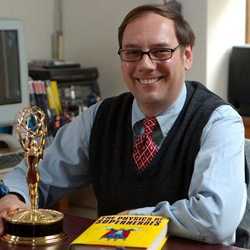
Next up, I want to bring in via video call one of my favorite people, a guy named James Kakalios.
He's a professor of physics.
And this is a book he wrote maybe 10 years ago, The Physics of Superheroes.
Super cool.
A physicist writes a book, The Physics of Superheroes.
So, James, do I have you on the line?
There you go, James!
So, James, you have quite the resume you've put together.
You're also, you are now a resource to filmmakers who have superhero stories because they don't want to mess up and have you talking smack about them on the internet.
Is that what's going on there?
Right.
So, the National Academy of Sciences has this program of the Science and Entertainment Exchange and they have academics consult with the Hollywood creators to try to get their science just right enough that it doesn't take people out of the movie.
Okay, so let me ask you, what is your favorite bit of imagined science in all the superhero stories you've seen?
Well, I have to get a little personal.
And Neil, you are the science advisor for the DC Universe.
I'm actually a consultant in the Marvel Universe.
So, one of my favorite examples is from Indestructible Hulk No.
10 a few years ago where Bruce Banner was describing, discussing why only worthy people can lift Thor's hammer.
It's not that it's heavy.
If you are worthy, you could lift the hammer.
And in the comics, Captain America has wielded it at times.
In the comic book, in that comic book, Indestructible Hulk No.
10, written by Mark Waid, he says, Bruce Banner says, physicist James Kakalios has my favorite science based theory.
When you try to lift the hammer and it detects that you're not worthy, the uru metal in the hammer emits excess gravitons.
And that would increase the mass and the weight of the hammer to exactly balance out the upward lifting force.
And if there's no net force, there's no motion.
If someone who is worthy tries to lift the hammer, no gravitons, normal weight, you can lift the hammer up.
Whoa, so it's a source of its own capacity to change its mass.
You know, since uru metal doesn't exist, who's going to say I'm wrong?
Well, I like that hypothesis.
Were you aware of a calculation I did to establish the mass of Thor's hammer?
I am, and there I have to disagree with that because...
I got raked over the coals for that.
We all sometimes step off the wrong curve sometimes.
And so what can you tell us any insight to the powers of Wonder Woman?
Wonder Woman.
So Wonder Woman is an Amazonian goddess.
She has great strength and reflexes.
And she also has these bracelets that enable her to deflect bullets.
And she has the reflexes, and her wrists are strong enough to deflect a bullet.
But what is the metal that it's made of that can easily deflect the bullet?
In the comics, in the Wonder Woman comics, it is said that her bracelets are made of Amazonian metal.
And we can actually do a calculation of how the mass of a bullet, if it's going, say, a thousand feet per second, 680 miles per hour, ricochets in a millisecond, how much force does it exert?
It's about 2,700 pounds over 0.04 inch squared.
So that's a pressure of about 70,000 psi, 70,000 pounds per square inch.
What kind of metal can withstand that compressive pressure?
Pretty much all of them.
High strength alloy steel can withstand 75,000 psi.
So apparently Amazonian metal is nothing more exotic than cold rolled steel.
But there's still the matter of having reflexes fast enough to deflect the bullet.
In all of these cases, you have to grant a one-time miracle exemption from the laws of nature, otherwise you're not getting anywhere.
Even characters without superpowers, you have to grant them a suspension of disbelief.
The number of times that Batman has been knocked unconscious in his 80-year crime-fighting career, he should be permanently brain damaged at this point.
He apparently has a superpower, some sort of Homer Simpson extra-thick padding that protects his brain.
So James, you have a book that just came out that continues this kind of dialogue.
Remind me of the title.
Right, it's called, thank you, it's called The Physics of Everyday Things, The Extraordinary Science Behind an Ordinary Day.
It follows you as you get up in the morning and you make breakfast, you drive into work, you use your GPS and an easy pass on the expressway, you go to the doctor for a checkup, you go to the airport, you pass through TSA, you fly to another city, you give a business presentation and you wind close out the day in a hotel and at every step when you check your Fitbit, when you use a touch screen, when you're taking a digital photograph with your smartphone, I explain the science of how that works.
Well, James, thanks for being on StarTalk.
Moving on, we're going to take an inside look at the geek mecha known as Comic-Con on StarTalk.
Welcome back to StarTalk from the American Museum of Natural History, right here in New York City.
We are tracing the expansion of the Geekiverse, featuring my interview with Geek Culture superstar, Kevin Smith.
I asked him about the mecca for comic book and pop culture fans known as Comic-Con.
Check it out.
Not more than a couple of decades ago, Comic-Con conventions, what is it?
A few thousand people, they were kind of nerdy.
If you were lucky, kind of nerdy.
Maybe you get one celebrity person, and that was it.
Now there are hundreds of thousands of people in multiple cities.
So who are these people that are being touched by this culture?
I think what's happening is most people who grew up with this stuff are now looking closer to the end than the beginning.
You know what I'm saying?
Like when you use the conundrum of when you're a kid, you can't wait to be an adult.
When you're an adult, you're like, man, it was so much easier back then.
But I think it comes down to, the nearest I could figure, unscientific, is the older one gets, the more one wants to be close to the best time of their life.
Longing for times of simplicity.
Totally, and sometimes there is no, look, you tell me you're the astrophysicist, there is no time travel that we know of yet.
Not anytime soon.
Really?
God damn it.
But closest thing we get is you're driving and somebody plays a song and you're like, oh man, it takes you right back to that moment.
I think that works the same for everybody.
So when you're a 40 year old parent and you got kids and somebody's like, hey, you wanna go see a Thor movie?
You're like, I loved Thor when I was a kid.
Are you kidding me?
They're making these movies now?
That could be why I just learned that in San Diego, during Comic Con, crime rate drops in the city.
Really?
That the Comic Con audience, the Comic Con community is the most peace loving community that ever descends on a city for any reason at all.
All other conventions, there's a rowdy thing, the cops have to check the bars at two o'clock.
That's true.
You don't have that at a Comic Con.
Oh my Lord, you're right.
And so why would it be peaceful unless, in fact, people are channeling their childhood?
And also they're channeling-
I'm putting spitball in there.
Maybe that's-
They're also channeling a morality.
You know what I'm saying?
If you're reading comic books, what are you reading about?
There's a good and evil.
Good people versus bad people.
Well defined, good and evil.
And at the end, good, it's usually proven that, hey, it's better to be good.
Sometimes being bad looks fun, but being good is the right path.
If these people are fundamentally fans of crime fighters and costumes, you gotta imagine they're probably peace-loving people in real life, to some degree.
Or if they're not, some other superhero costume person is gonna take you out.
Cosplay them down to the ground.
You're making us look bad, shut up.
Are they really peace-loving people, or is it that nerd fights are just awful?
Nerd fights are awesome, man.
Nerd fights are great.
Nerd fights are good.
Nerd fights are awesome.
Nerd fights, ha!
See, never a nerd fight with an Asian guy.
This is a new hypothesis.
So have you guys been to a Comic Con?
Of course.
I've been to a few, but not as a thing.
I can't even imagine.
You probably have to put on a mask to go to Comic Con.
But still, I'm just saying.
Can you imagine Neil at a Comic Con?
Our God is here.
No.
So what's interesting in a Comic Con is, to that point, they will value people who are content creators no less than the movie stars that descend from Hollywood to attend.
And that tells you that they're really thinking about the content.
And it's not just the celebrity thing that's going on.
They want to know the content creators, the writers, the producers, the original comic book illustrators.
So you know who the real God is.
It's the guy who's 100,000 years old and still alive.
Stan Lee.
Stan Lee.
Stan Lee.
Yes, that is true.
When he walks to the comic, there's a glow halo around him as he walks through.
There is an idealism in the comic con world.
That's the point Kevin was making.
Coming up next, director Kevin Smith reveals what superpower he'd want to have when StarTalk returns.
Welcome back to StarTalk from the American Museum of Natural History.
We're featuring my interview with superhero, super fan, super geek, Kevin Smith.
And I asked what superpower he would most likely want to have.
Here's his answer.
You know, I mean, it sounds dopey, man.
I wouldn't have said this in my 20s.
In fact, 20 year old me is about to make fun of me for 46 year old me saying this, but like, the power to change a person's heart, take out the bad, stick in the good, and not my idea of good, but just like whatever else than whatever funnels, all that negativity in their life and just flip it.
Like you wouldn't need to fight super criminals because you can just be like, give me your hand.
You know, like don't you feel better?
But even, but you can kind of accomplish that in life with conversation.
You just have to care.
Kevin.
To sometimes tell somebody like, hey it's not that bad.
Kevin, what you just said is profound.
No.
No, let me tell you why it's profound.
Think about it.
There's Superman trying to capture Lex Luthor.
And then when he captures him, what does he do?
Brings him to prison.
What does that do?
But you want to change his heart.
Be nice.
You change his heart.
You don't need prisons.
Lex Luthor, you need to change his heart because he's a guy who's just like fundamentally, the only thing really wrong with him, he hates Superman.
Like if he could just get over that, he could do so much good for people.
So much good for people.
So you change people's hearts instead of locking them up in prison.
No, this is deep.
This is kind of deep.
That is the greatest power because it is, they are not acts of punishment.
They're acts of rehabilitation.
But it's also coming from a guy who just doesn't want to get in the fight.
Like if I could just shake hands with them, they'd feel better.
I'm like, okay, go along your merry way.
Ha, ha, ha.
No, it sounds to me like his real power is killing comic books.
It would be half a page long.
Right, it'd be one page, you know what I mean?
The end of everything.
With Empathy Man.
Like frickin Empathy Man shows up in the comic book.
The comic book is over.
I am Destructor.
You shall all kneel before me or you shall perish.
Chuck, don't you feel better now?
My father never loved me.
It's not your fault.
Well, I made one last attempt to extract some scientific curiosity out of Kevin Smith before he left my office.
I gotta believe that there's some science in you somehow, somewhere.
I mean, aside from, of course, the sci-fi curiosity that comes along with being a sci-fi fan that leads you to science.
The fi in the sci-fi.
The fi in the sci-fi, if you will.
For me, if I was practiced in any science and I've only become practiced in it later in life, I think it's something that only occurs to you with age.
Now I'm kind of into the science of positivity.
Is it?
So the psychology of what it is to feel positive and good about yourself in the world and others.
It's an absolute choice.
I meet so many people in my life who are like, I feel bad, I feel bad.
And I've felt bad at times, too.
But sometimes middle-aged, you just wake up and you're like, ugh, what am I doing with my life?
I feel old.
What am I going to do next?
Am I making a difference?
Am I making an impact?
All those self-doubts.
It's literally just kind of turning it on and just being like, no.
Just be happy.
It's a good day.
You woke up, nothing wrong with the world, and you're going to see people are going to do some things.
It might make you excited.
You might learn a thing or two and stuff.
It sounds stupid.
You have to say it out loud to yourself, but sometimes that's the easiest way to conquer what is the droning voice of negativity.
We have that on blast for our entire lives.
That way when you have a good idea, there's a voice that shouts it right down going, somebody's done that already.
Why do you think you can do that?
Why you, man?
Science and positivity is more about, well, why not me?
You know what it is?
Because we live in a time, especially the modern way people use the internet, where we have multiple channels of critical anger opened to us.
You said, what?
Oh, you're an idiot.
You're this, you're that.
And they're like, oh, let's attack them because they don't agree with what, and what's going on?
What the hell's going on out there?
There's two paths in life, I always felt.
You got your creation and you got your destruction.
And the destruction path is packed.
You can't move because that's the easiest lane to take.
Everybody can knock something or be like, yeah, it's stupid, or take it down or lobby against it.
Once you're on the path of creation, you don't sit around in that destruction path.
You look around, you're like, I hate all these people, I hate everything.
When you're on the move, you love everything, man.
World looks wholly different.
This is the essence of positivity.
Is that science?
Carl Sagan once worried that if we embrace the superhero culture too deeply, that we might use them as an excuse to solve our problems rather than take those tasks upon ourselves.
And there may be some truth in that, but for me, what really matters here is the community.
We've got a sense of what that community is, the anthropology of that community, the fact that crime rates drop, the fact that everyone that's a participant in that community is a champion of good over evil.
And I mean, how many communities are like that while simultaneously not standing in judgment of others?
Perhaps the Bible is a mistranslation of that famous phrase.
In fact, it is the geek that shall inherit the earth.
You've been watching StarTalk.
I've been Neil deGrasse Tyson, your personal astrophysicist, Charles Liu, Chuck Nice.
As always, until next time, I bid you to keep looking up.
See the full transcript



 Unlock with Patreon



 Become a Patron