



 Unlock with Patreon
About This Episode
What can gamma rays tell us about supernovae and galaxy formation? Neil deGrasse Tyson and co-host Chuck Nice sit down with astrophysicist Tim Paglione to explore high-energy cosmic phenomena, gamma rays, and the extreme events that create them.
We start by traveling up the electromagnetic spectrum to understand how gamma rays— the most energetic form of light— are produced in the universe. What do astrophysicists mean by “shock,” and how do cosmic rays get “shocked up” as they move through space? We break down the physics behind particle acceleration, from the Large Hadron Collider to interstellar clouds getting slammed by high-energy particles.
Then, we dive into the mysterious world of muons—particles that shouldn’t make it to Earth’s surface but do, thanks to time dilation. How do these cosmic messengers give us insight into the most explosive events in the universe? We discuss the immense energy of supernovae, hypernovae, and how they compare to the total energy output of our Sun.
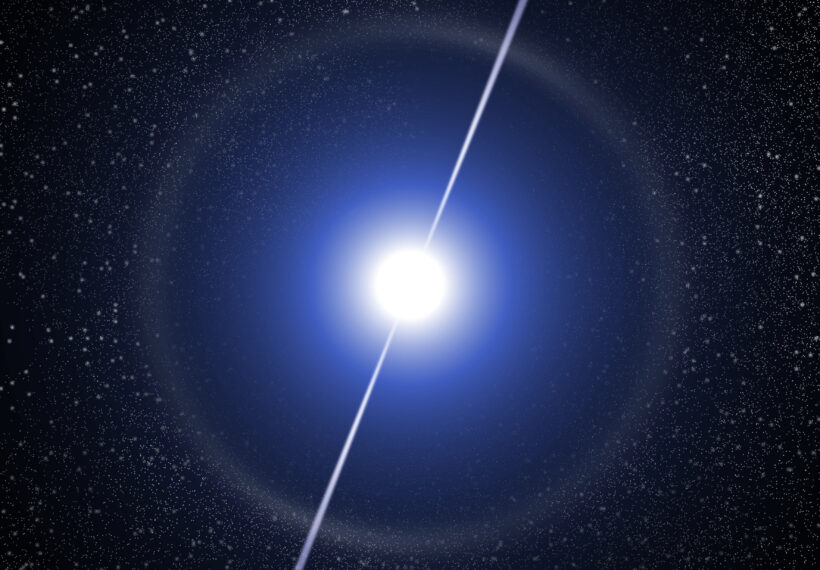
Next, we zoom out to galaxy clusters and the legacy of Enrico Fermi. How does the Fermi Gamma-ray Space Telescope help us detect elusive sources like pulsars and gamma-ray bursts? What makes pulsars spin like high-speed blenders, and why do their powerful magnetic fields act like cosmic particle accelerators?
We also tackle listener questions: Can gamma rays trigger star formation? How does cosmic chemistry work in molecular clouds? And could the explosive deaths of stars be the heartbeat of galaxies themselves? Plus, we discuss JWST’s discoveries of ancient supernovae and what they reveal about the early universe.
Thanks to our Patrons Alexander Storts, Chris Henderson, Micheal Mayo, Jose Lotzin, Rebecca Noland, Scientific Panda, Sander Bergheim, Aubrey Loftus, John Leon, Jaquelin Butkovic, Jesse McIntyre, Kelly Sheffield, Kaseim カセイム, Bradley Westbrook, Chris Rassette, Aquahood, BA_MPH_JD_PhD-aspirant, Ravenwingfeather, Kaity Sturgell, Norma Bazan, Mickey Brumfield, lamar Gibson, Bong Bong, Andrew Hayes, Billy Madison, Bruce Muller, parker martindale, James Pope, Carrie Williams, Robert Lester, Mike Bundy, and My Pug is a Bug for supporting us this week.
NOTE: StarTalk+ Patrons can listen to this entire episode commercial-free.
Transcript
DOWNLOAD SRTThat particle shower, these extensive air showers, they’ll come flying in and those muons will stream down to the surface.
A thousand just went through your body.
Wow.
Another thousand.
Oh.
Oh.
Another thousand.
But the interesting thing is, their lifetime is so short that they shouldn’t make it.
Welcome to StarTalk, your place in the universe where science and pop culture collide.
StarTalk begins right now.
This is StarTalk.
Neil deGrasse Tyson, your personal astrophysicist.
We’ve got a Cosmic Queries lined up for you.
And that means I got Chuck Nice in the house.
That’s right.
What’s up, Neil?
All right.
Good.
Feeling good.
Good.
You know, I’m mining my colleagues once again.
Sounds illegal.
Tim Paglione.
Tim, how you doing, man?
All right.
Welcome to StarTalk, your first time.
Thanks, yeah.
Have we known each other how long?
Probably like 20 years.
Man.
Welcome to the show.
Fellow astrophysicist, your professor at the City University of New York.
Nice.
At the Graduate College.
Excellent.
And at York College, one of the campuses of the CUNY system.
And we have Astrocom here.
And what is Astrocom short for?
So, full name is Astrocom NYC.
And the com in Astrocom is community.
So, it’s all about building community.
Okay.
And you’d mentor students within that community?
Yep.
It’s been 74.
74 students?
Yeah.
We’ve been going for a dozen years now.
Yeah.
Because it’s not good enough just to be a scientist if you just live on an island.
Right.
You got to pass the torch at some point.
Share the torch.
Yeah.
That’s a good island where scientists are actually bringing up other scientists.
Right.
They don’t vote you off the island.
Yeah.
They don’t vote you off the island.
They bring you into the island.
Yeah.
Unless you say you believe in astrology.
Then they’re like, you gotta get out.
No.
A good educator will then show them why that’s in error.
But let’s be honest.
Let’s just be honest here.
Then you vote them up.
So one of the reasons why we have you here is you’ve done a lot of thinking and a lot of observing and a lot of publishing about extreme objects in the universe.
And people love them some extreme things.
Everybody loves extremes.
We love it.
So you go big or you go home.
Yes.
Yeah.
Super fun.
That’s the stuff.
Yeah.
So as we ascend the electromagnetic spectrum in energy and we go red, orange, yellow, green, blue, violet.
I like that.
You skipped it.
I skipped Indigo because Indigo doesn’t belong there.
That’s Isaac Newton being mystically fascinated by the.
You broke up Bell Biv DeVoe.
I don’t think that was his name.
Not Bell Biv DeVoe.
Roy G.
Biv.
So violet and then ultraviolet which can give you skin cancer.
And then x-rays which will give you bone cancer and now gamma rays.
That turned you into the Hulk.
They go right through you.
So tell me about what makes gamma rays in the universe.
Because we know stars make regular light and we also know black holes in their vicinity.
They can heat up the gases and they’ll radiate ultraviolet and x-rays.
But gamma rays seem to just come from their own places.
Yeah, it’s the most energetic light that there is.
So you need a really super energetic process.
So you have to blow stomp them up or have a huge shock run through an area to accelerate particles to nearly the speed of light.
Shock means something very specific in astrophysics.
So tell us about that.
Because otherwise, shock, what does shock mean anywhere?
Oh dear.
That’s not what we mean.
Did you see what that black hole did?
You were shocked by the shock, yes.
So, I mean, simply put, in a certain area, there’s a speed of sound.
And if you go beyond that, that’s a shock.
You make a shock.
You make a shock.
Yeah.
Right.
Just go beyond it.
So you need a process that will overtake something as fast as the speed of sound in that medium.
That’s right.
So like an explosion.
If a star explodes as a supernova, it’ll send a shock wave out through the interstellar medium.
And that’ll bunch up all the gas into high density.
It’ll bunch up all the magnetic field.
So let me ask you this.
When you look at…
Wasn’t he in the middle of explaining something?
No, that’s cool.
So in the medium itself, all right, air is the medium through which the shock wave of sound travels, right?
Sound that we…
The sound that we’re doing right now.
Here on Earth.
So in space, if it’s a vacuum, what exactly is the shock traveling on?
Good question.
Yeah.
There’s always a little bit of something going on out there.
Oh.
Yeah.
And so any time there’s any kind of discontinuity, we would also describe as a shock.
And the things that I’m most interested that’ll create gamma rays, these high energy particles called cosmic rays, they’re accelerated by these bunched up, shocked up magnetic fields.
Okay.
There you go.
Shocked up.
That’s a, that’s a statement.
That is a made up phrase.
Shocked up.
Just like you jacked up, I’m shocked.
No, I’m shocked up, baby.
Exactly.
Tell you right now.
All right, so in that one sentence, you mentioned gamma rays and cosmic rays and shock waves.
Yeah.
Right.
All of this.
And this is high energy phenomenon is where you’re coming from here.
So what’s your best way to create high energy phenomenon?
I know we can do it in the accelerators.
Yeah.
Yeah.
So does our understanding in the accelerator help us in your job?
Actually, it really does.
So once we had the Large Hadron Collider going…
In Switzerland.
The CERN.
CERN.
Yeah.
So from the rates of, you know, the bajillions of collisions that they’re doing there, we were able to figure out basically the interaction rate of protons at those high energies.
And that made actually my models of those proton-proton collisions in the interstellar medium a little more accurate, which was kind of nice.
But we work at way higher energies.
Than we, I mean, the universe.
The universe.
Yeah.
He’s taking credit for the universe.
That is the super-mega-royal we.
My people, my stars, my, yeah, it’s the royal we if there ever was one.
Exactly.
And so you’re accelerating protons to much higher energies than even the most powerful accelerators on Earth.
Yeah, that’s right.
Okay.
And now they’re fast-moving.
Can a single proton make a shock wave?
No, right?
What goes on there?
No.
You need a wave of them.
I mean, a bunch of them.
Yeah, you need a bunch of them.
But as long as they find another proton out there, like an ambient proton, which is just a hydrogen atom.
Ambient, ambient proton.
Right.
Yeah, these are the sleepy ones.
Those are the sleepy ones.
The one’s not looking.
Ambient.
Ambient.
Okay, go on.
So if there’s just an interstellar cloud out there, it’s just hydrogen, mining its own business.
Just hang it out.
Gets whacked by one of these high energy protons, that’ll create a bunch of other particles.
It’s a nuclear reaction.
And just like you would get at the particle accelerators, and all these things come out, these pions come out, some are positively charged, some are negative.
So they call all those daughter products.
Sure.
But never son products.
I was wondering.
Daughters very rarely disappoint.
Sons often do.
I wonder if it was Marie Curie that did that.
Oh, that makes sense.
Good one.
Interesting.
So cool if it was.
It would be.
Yeah.
It’s datable to that point in time, right?
Oh, for sure.
Because that’s when we see the byproducts.
The first person to see the x-rays, yeah.
That’s where the alpha, beta, and gamma rays were first named.
When we didn’t know what they were, that’s just the first three letters of the Greek alphabet.
Makes sense.
Yeah.
So they were just some source of energy moving out of your experiment into somewhere else.
So when alpha rays became what?
What did we discover those to be?
Those are helium nuclei.
Yeah, that’s kind of weird, but all right.
The nucleus of a helium atom, alpha rays, okay?
We just call them rays, because we didn’t know, because we couldn’t distinguish the energy of a wave from the energy of a particle.
Those idiots.
Okay, alpha, beta.
Turned out to be electrons.
Just electrons.
We go from the helium nucleus to an electron.
See, that ain’t right.
That’s wild.
They had a really interesting result though, because they had a whole bunch of different energies of electrons, of beta rays, would come out.
And that led Enrico Fermi to say, there must be something else carrying this extra energy.
And that turned out to be some little tiny massless particle with no charge, which is a neutrino.
Neutrino.
It was little.
It was a little one.
The eno.
The eno makes it little.
And neutral is neutral.
So the energy budget was not resolved.
That’s right.
There was always some leftover.
So is that the residual, the neutrino itself?
Yeah.
Yes, that’s a gangster prediction.
That’s bad ass.
Right.
If you say we’re missing energy, therefore there’s a particle with no charge that carried it away that we didn’t detect.
That’s like making shit up.
Totally.
Just to fill in the blank.
And it turned out to be exactly the case.
Oh yeah, for sure.
That’s so wild.
Wow, that’s very cool, man.
It is.
All right, so now tell me the proton hits what to then make a shower of other particles?
Another proton?
Another proton, yeah.
Okay, and so it busted open the proton.
And my classical knowledge of nuclear physics ends with the quarks that are inside.
But I guess you can pair up quarks and make particles that are not protons but are lighter than protons?
Yeah, yeah, so, well, pair them up, yes.
I guess, I mean, I don’t know.
Yeah, so I mean, from this reaction, from the proton-proton interaction, you end up, primarily you get muons, oh, you’ll get some pions.
Primarily pions are the ones that interest me the most.
There’s positive ones, negative ones, and neutral ones.
The neutral ones, with no charge, they immediately decay into two gamma rays, which is usually what we see.
So there’s a whole chart of what’s going on there that you need to be fluent in.
Otherwise, you don’t know what the hell is going on.
Yeah, kinda.
Okay, remind us about muons, because I’m fascinated that they exist at all.
Yeah, because they’re very short-lived, and so this is one of these interesting.
Can I quantify that short-lived?
Can I quantify that?
I mean, short-lived a few seconds, a few microseconds.
Way smaller, way faster.
Even shorter than that, okay.
In fact, the time it takes a muon to reach the surface of the Earth from space, from the atmosphere, where they’re created by these Cosmic Queries hitting the atmosphere, they shouldn’t live to get to the surface.
Traveling at almost the speed of light, they shouldn’t make it, and yet they do.
And this was one of the…
They should have decayed before they were…
Yeah, okay.
But the trick is that they’re traveling so fast that their clock’s at a different speed than ours.
Oh, that’s amazing!
Ain’t that some stuff?
So you have muons in your exotic places in the universe, but I hear that we also detect muons here on Earth.
So what’s going on there?
So you’ll get one of these energetic Cosmic Rays will come in and hit something in our atmosphere.
So it’s the same phenomenon.
Exactly the same.
Right.
But not happening to us.
The Earth’s atmosphere is a bright, bright gamma ray background, in fact.
So that particle shower, these extensive air showers.
Because it busted open the proton.
They’ll come flying in, and those muons will stream down to the surface.
A thousand just went through your body.
Wow.
Another another thousand.
Oh, another thousand.
But the interesting thing is, their lifetime is so short that they shouldn’t make it.
That trip from the top of the atmosphere down to here, they should decay before that.
They should decay before they hit the earth.
Then why do they make it?
Well, because they’re traveling so fast that their clock is running at a different speed than ours.
That’s amazing.
So they actually don’t know any better.
So Einstein was right.
So it’s a time dilation.
Time dilation, right here on earth.
It’s a, you gotta love science people.
You just gotta love it.
Yeah, I can’t argue with that.
He blows a gasket every now and then.
You gotta love, you gotta recover from that.
So phenomenal.
And muons, they behave like electrons, right?
Yeah, yeah, except there could be positive ones, too.
Well, they’re different.
Thank you, Professor Paglione.
They’re fundamentally different.
I mean, they’ve got mass.
They’re not a fundamental particle like an electron, things like that, yeah.
But they’re analogous to an electron, and why?
Yeah, well, there are muons with negative charges, electrons have negative charges.
But if you leave a muon alone, it’ll decay, and you can get an electron from that.
So in a way, you could think that an electron is kind of hidden inside a muon.
Okay.
That’s weird.
Yeah.
Okay.
All right.
So these energetic phenomena, I think, because we’re colleagues and I hear, the most energetic things I know of are supernovae, and then there’s hypernovae.
Okay.
What are those things?
Hypernovae.
That would just be a big-ass explosion.
I don’t really know.
I mean, there are supernovae that are just extremely energetic.
They’re hard to explain.
It’s the…
Bad-ass supernovae.
Yeah.
Yeah.
You’re right near the edge there.
Is there a quantifiable magnitude of nova, supernova, hypernova, like, that we would be able to understand as a regular person?
Like…
You’re not a regular person.
Let’s get this straight.
You know what I mean?
We have a hierarchy of words, and how do they correspond to hierarchies of energy?
Is that what you’re trying to say?
Yes, that’s what I’m trying to say.
How would you explain, like, okay, so a nova is like ten nuclear bombs or five hydrogen bombs or whatever, just so that we could, like…
I wish I had that number, but I think it’s more of those bombs than I could put that number…
More than we could ever even imagine.
More bombs you can imagine.
Yeah, I mean, you get 10 to the 53 ergs from what we call a type two supernova explosion, so that’s a massive star that’ll explode and end up as a black hole, and that’s like a factor of 10 to the 20 more than a nova, just a little…
10 to the 20 more?
Yeah, yeah, it’s a huge difference in energy.
In fact, in that explosion, correct me if I’m wrong, it’s emitting more energy than all the stars in the galaxy in which it explodes.
Yeah, that’s something, I mean…
That’s right.
If the sun is 10 to the 33 ergs per second, and it’s 10 to the 53 total ergs, so that’s 10 to the 20th more ergs.
The one that I’ve heard is if you add up all the energy that the sun will ever emit in its total lifetime, that’s like a supernova.
That’s a supernova.
Gotcha.
Right.
It’s huge.
Yep, that’s almost the same way to think about the same problem.
So all at once…
All at once.
You’re looking at 10 billion, 15 billion years Yeah.
Of radiation all at once.
Yep.
And so they’re visible across the universe.
So how far away are your objects?
Are they all in our own galaxy?
Everything that I’ve been studying lately has been in our own galaxy, but I’ve also studied other galaxies, but nearby ones, mostly.
But now I’ve just started getting into galaxy clusters, but still nearby clusters.
But they’re getting kind of far away now.
Let’s just take a moment as we record this in the year 2024.
That 100 years ago, Hubble, the man, not the telescope, discovered that we’re not alone as a galaxy in the universe.
Wow.
Ended the Great Debate?
No, he didn’t do the debate.
No, he ended it.
Ended it.
He ended the Great Debate.
The Great Debate was, are the spiral nebulae just local phenomena in our own galaxy?
Or are they whole other galaxies out there like ours?
Island universes.
Now we know there’s a whole trillion of them out there.
That’s amazing.
They got out of control.
Look at that.
So you mentioned Emiko Fermi just a moment ago as the, was he the namer of the neutrino?
I believe so.
He must be Italian.
Neutrino.
That’s exactly how he said it, too.
I believe I have a discovery.
It’s got a neutrino.
That’s Chuck speaking Italian, as far as you know.
By the way, that’s every American who’s not Italian speaking Italian.
And if they were girl neutrinos, they’d be neutrinas.
That’s very cool.
Now I’m interested.
So, we tend to name telescopes after scientists or other people relevant to our field.
And I read recently about the Fermi Telescope.
And I don’t know anything about it.
Could you catch me up on it?
Yeah, so it’s a gamma ray.
It’s the Fermi Gamma Ray Space Telescope.
A space telescope?
Yeah.
You got to be in space because gamma rays will interact with the Earth’s atmosphere.
And give you muons.
Yeah, yeah, and pions and the whole gamut.
Good stuff.
So it’s in space.
Is this the first gamma ray telescope, space telescope?
It is not.
So its predecessor was the Compton Gamma Ray Observatory.
I knew that, okay.
It’s the size of a bus.
It was a really big one.
Because it’s a bus that fits inside the space shuttle.
Yeah.
Just.
Yeah, so it’s not that it just fit in.
It’s designed to just fit in.
Oh, for sure.
That’s your size, just to make it fit.
Yeah, that’s your whole payload.
That’s the whole payload.
Right there.
At the time, and it may still hold the record, it was the heaviest thing that the shuttle ever launched.
Really?
Wow.
Okay.
But you need a heavy detector like that to stop the gamma rays, you know, to detect them.
It’s in essence, the Fermi Gamma Ray Space Telescope is a particle detector.
But it can also know what direction it’s coming from.
That’s right.
So it detects when a photon comes in, and it’s one photon at a time.
Gamma ray photon.
So when the photon comes in, where it came from, as best as it can.
You’re counting one photon at a time?
One at a time.
That’s insane.
They’re rare.
This is the highest energy stuff.
You need something special to create it.
And so yeah, they’re pretty rare.
Man, they’re just…
Dish them out.
Here, one for you.
One for you, one for you.
We got a photon, guys.
Guys?
They’re looking over here.
Let me toss one to those aliens.
We got another one over there.
That’s pretty wild, man.
I mean, when you talk to solar astronomers, you can’t even have a conversation.
Because they have like countless photons coming from the sun.
Even us, just from anything, from a star, you get countless photons, you know?
So they’re precious, one photon at a time.
Okay.
So what will it do that the Compton Observatory couldn’t do?
Fermi was a great improvement on that localization, like figuring out what the direction was.
So it could pinpoint the direction of the gamma ray much better.
That was really important.
Because I think there’s whole generations of detectors where they just detect something.
Right.
And with no information as to where it came from, it just detected it.
Just right.
Right.
And it was even worse with Compton because you would really like to say, oh, we detected a gamma ray from this crazy source.
But you couldn’t quite pinpoint, did it really come from that crazy source or not?
Your uncertainty circle was huge.
Exactly.
Yeah.
Okay.
So now you’re doing a little better.
Oh, a lot better.
Yeah, yeah, yeah.
To, you know, a fraction of a degree.
It still sounds pretty sloppy.
So, observer that you are, space telescopes have high value to you being above the atmosphere.
Oh, yeah.
Detecting your one particle a year or whatever.
Your one photon.
Luckily, it’s more than that.
Okay.
I’m happy to hear.
How many total gamma ray photons have you touched in your life?
Oh, that’s been plenty.
Plenty?
Okay.
Yeah.
Like I was saying before, any time one of those cosmic ray protons hits an ambient proton and the galaxy is full of those gas clouds, they light up.
Oh, God.
Yeah.
So, it’s actually a strong background.
It’s a strong background.
Okay.
All right.
So, you use the Fermi Telescope.
In what way?
I’ve lately been studying, well, things that you can’t detect, oddly enough.
So, there’s all these different gamma rays.
You’re detecting it with gamma rays?
I mean, you think you can’t detect with a regular telescope?
No, no.
There are bright sources of gamma rays, like pulsars and star-forming galaxies and things like that.
But if you look at all the pulsars that are out there, there’s about 5,000 or so that have been detected in the radio.
And many of them are detected as gamma ray sources as well, but only a couple of hundred, about 300.
So, what are the other 4,000 or so doing?
We suspected that they would also be good sources of gamma rays.
And so, we were looking at all the gamma rays.
Just a weaker source?
Yeah, yeah.
So, we were looking at all the undetected pulsars in gamma rays and stacking that signal together to see if, as a population, they actually are gamma ray sources.
And trying to figure out what their properties as a population are.
So, when you stack, you are improving the signal to noise of your data.
Yeah, exactly.
It’s the signal compared to the noise.
We’re trying to reduce the background.
So, every time you stack, the noise slowly cancels itself because it’s not additive, right?
The ups and the downs cancel.
You have a signal, however low, if it’s really there, every next time you’re gonna boost it.
It’s amplified.
It’s amplified.
And every next time you’re gonna tamp down the noise.
In real practice, with a particle detector like this, the background just always adds up, too.
It does!
Oh, man.
But you do get a persistent additional signal from your source population.
So, we stack them both.
You have to beat it.
You have to beat it.
Yeah, we stack them both.
Okay.
Stack the background, compare it to our targets, and then we get a signal above the background.
Okay.
And so, in the inventory of objects or phenomena that are in these catalogs that emerge from the stacked data, is it something other than a pulsar or a supernova or…
Are you discovering new kinds of objects?
Maybe, because pulsars have very low gamma-ray luminosities.
Some people say they shouldn’t do that.
And we’re discovering that we’re seeing them, that these low spin-down, they’re called low spin-down, pulsars are actually potential sources of gamma-ray emission.
So there’s just a lot that we don’t know about the gamma-ray production of pulsars.
It comes out in a wacky area of their magnetosphere.
And does it feel good when someone says, can you just, just for the sake of the people who may not know, because I know, for others, yeah, for the other people.
Like, what is a pulsar and why is it so important when you talk about spin?
Yeah, so a pulsar is the densest kind of object in the universe that we can measure.
It’s all the superlatives like that, right?
It is the densest.
We’re talking something a couple of times the mass of the sun, but the size of Queen’s.
Okay.
So super compact.
That’s wild.
Can’t go any more compact or you get a black hole.
Queen’s, a borough of New York City for international.
It’s a black hole that you can actually observe or right before a black hole that you can actually observe.
Exactly.
Yeah.
So super dense.
Because of that, it has an incredibly high surface gravity, right?
So like a hundred trillion times the surface gravity that’s keeping us in our seats right now.
Oh.
So if you weighed a pound, right here, you’d weigh a hundred trillion pounds on the surface of a neutron star.
You’d be flat as a flat star.
Exactly, right.
You’d be a grease spot.
A spot, that’s all.
Not even a flapjack.
Not even a tortilla.
Right.
A little spot.
But then they pulse, right?
This pulsing is that they’re spinning around really super crazy fast.
Also some of the fastest spinning things.
They spin faster than a blender.
Okay.
Double the mass of the sun, the size of Queens.
Size of Queens.
Spinning faster than a blender.
Yeah.
Wow.
Yeah.
It’s pretty nuts.
That’s wild.
Spinning so fast, they could almost fly to pieces.
I mean, it’s that fast.
Because of that fast spin and that high compression, they have these powerful, powerful magnetic fields, like trillion times higher than the magnet that’s on your fridge, and that generates these intense electrical fields that will accelerate particles, just like the particles at the particle accelerators, Your Honor.
That’s your particle accelerator, right?
The universe as a particle accelerator.
Look at that.
And even though the surface gravity is so high, any particles that are near the surface, and these are just electrons and stuff like that, they will be, instead of falling to the surface, despite that high gravity, they get shot off at almost the speed of light because of the intense electric magnetic fields.
Look at that.
So that means we understand gamma-ray bursts.
Is that what you’re saying?
That’s a stretch, but yeah.
All right.
So a gamma-ray burst is a different thing.
So this is during a stellar explosion, like a supernova.
Something happens as the core of that star collapses and then…
Any time a scientist says something happens, we’re gapping ignorance.
There’s a whole ignorant valley there.
Right.
There’s a whole world inside of something that happens.
Well, people are modeling it and getting pretty good at it.
There’s a student in our group, a master student, who’s been doing these gamma ray burst explosions, but…
Master’s degree.
Yeah.
Which is a master…
Of the universe.
Or master class.
Which would be kind of cool if you’re an astrophysicist.
Yes.
That would be the degree they should give you as an astrophysicist.
You are now a master of the universe.
That, I’m in favor of.
Yeah, we should change that for sure.
Well, let’s look at our Cosmic Queries and see what came in.
Chuck, you have them all?
I have them right here.
You got them all.
Bring it on.
Yeah, well, let’s start with Haywood from Atlanta, Georgia.
Haywood’s asked before.
I think Haywood.
He says, hello, Neil, Tim, Chuck.
Just wondering, do gamma-ray bursts start slowly and build over time or are they instantaneous?
And by that, I think he means not the actual explosion, but the lead up to, because there’s no such thing as a slow-moving burst.
You wouldn’t call it a burst.
You wouldn’t call it a burst at that point.
So leading up to the actual, you know, expulsion of what we just talked about, what’s that process?
Do we have an idea of what that process is?
Yeah, so it’s the collapse of a massive star down to a black hole, presumably.
But then instead of just like this spherical explosion that you might picture, it’s actually, you get a jet, a couple of jets of explosive material, basically that blast out of the star, and those jets tend to be pointed right at us, and that gives you a lot of that high-energy emission once it breaks out of the star.
But it’s seconds.
It’s seconds.
It’s a pretty really rapid rise, and then there’s a slight fade, but it’s still seconds, maybe tens of seconds, and those are so-called long gamma ray bursts.
There are shorter ones that are much, much quicker.
Tens of seconds, and that’s the longest.
Wait, wait, so how do you know it’s that short?
Has anyone witnessed that?
Yeah, we see the light curves of their explosion and then the quick fade.
So somebody’s looking at it before it explodes, and then they see it while it’s exploding in those tens of seconds.
Even though the sky is vast, and with not enough astronomers in the world to look at every star at all times, but you had people looking at the right star at the right time.
Well, not just people, the Fermi Gamma Ray Space Telescope has an instrument that’s looking at the whole sky all the time.
Oh, there you go.
Okay, so it wasn’t appointed observations.
It was a broad…
It’s part of a survey.
Survey, okay.
Exactly.
All right, give me more, Chuck.
Let’s keep moving.
Let’s go with Warma, or it’s Rwamarama, who says, hello, Dr.
Tyson, Professor Paglione and Lord Nice.
Andrew here from Cork in Ireland.
And then he says, I suppose it’s in Gaelic, a thousand welcomes, a hundred thousand welcomes.
And I’m not going to try to pronounce that.
Sorry, buddy.
He goes, my question for you today is, can you explain how the properties of the largest molecular clouds in galaxies influence star formation rates and the overall dynamics of galaxies?
I love that.
That’s a great question.
That’s a really great question.
Yeah, this is where I started before doing the gamma rays, was studying these star formation in giant molecular clouds.
Was your PhD on that?
Yeah.
Oh, cool.
Yeah, in fact, there’s not a word of gamma rays went into my PhD thesis, but the one paper I did as a grad student on it was one of my most highly cited papers.
Nice.
It’s kind of funny.
And now all I do is gamma rays.
I was waiting for Fermi to get launched.
Yeah, star formation happens in these giant molecular clouds.
And so that’s where all the action is.
So yeah, the properties of the molecular clouds definitely determines how it all plays out.
Wow.
And do any of these other phenomena like, I don’t know, the collision of black holes or these pulsar ejections and all of these particles that are excited and then jetted across the universe, do they ever perturb these other, you know, like clouds and things to cause something that we can observe or?
You know, it’s interesting when you’re talking about black holes and this and that.
I’m rolling in my head.
I’m like, no, no, no, no.
But the cosmic rays that we’ve been talking about, they can penetrate into the molecular clouds deeper than anything else.
Okay.
And provide a source of heat.
And what we’ve noticed is that molecular clouds are a little hotter than one might predict.
They should be really cool.
Yeah.
And so there seems to have always been an additional source of ionization, source of heating, and cosmic rays are that source.
Okay.
And this is one of the things that keeps me going in cosmic ray astrophysics is seeing what the contribution of cosmic rays are to galaxy evolution and molecular cloud evolution, star formation.
So molecular clouds can be huge.
That means they have a lot of gravity.
Does that enough gravity to influence other clouds?
Or are they just into its own thing?
Interesting.
I mean, they can merge and do other stuff, but they tend to be really subject to the overall dynamics of the galaxy.
So they’ll follow the gravitational potential of the galaxy.
All right.
This is Ilya.
Ilya says, hello, Dr.
Tyson, Professor Paglione, and anyone else who might be there.
Thanks.
Your title is Lord.
This is true, yes.
Here’s a question from beautiful Portland, Oregon.
From the limited knowledge, gamma is the highest photon energy we have encountered in the universe, but we have also produced photons with much higher levels and particle accelerators here on Earth.
Does the equipment you use in your studies have the capacity to detect and differentiate such particles?
But the truth is, have we really?
No, you can’t compete with the cosmos, man.
No, they totally have us beat.
So the cosmos is a they in that sense.
I’m just doing it.
Sure.
How you’re personifying the universe.
The LHC is able to bang together protons at, I think it’s like 14 tera electron volts, which is just a whole crap load of electron volts.
That’s very high energy.
But we’ve got, there are sources out there that work a thousand times higher.
Thousand times.
Yeah, we’re getting cosmic rays and there are gamma rays that we’re seeing from sources that we truly don’t understand how they can be that energetic.
Isn’t that our best evidence that the Large Hadron Collider would not create many black holes that would eat Earth when they turned on the switch?
That’s an interesting question.
Yeah, because the energetics of the collider, though high, pale compared to the actual collisions happening in our actual atmosphere.
And so you can’t worry that that’s gonna turn us into a black hole when we have higher energy reactions that are happening right above us all the time.
All the time.
That makes sense.
I think the record is 20 TeV for the highest energy photon detected on the Earth.
It might be higher now, but that requires a process or a particle that’s even more energetic.
And so they’re out there.
They’re out there, and we can’t touch that.
Can’t touch it.
Can’t touch this.
So this is Kayla Boudreau.
She says, salutations from Lafayette, Louisiana.
Kyla here, curious about Gamma Ray Telescopes.
How exactly do they work?
Are they used to investigate?
And why do we never hear about them?
I know, how come?
Because you don’t make pretty pictures.
I don’t know.
It’s gotta be it.
People like pictures.
Yeah, that’s true.
I had three photons today.
That does not make a headline.
Yeah, the pictures are kinda grainy.
I’ll admit that, but you know, we usually…
Tim, that’s why there’s Photoshop.
Yeah.
Or artist’s impressions.
Yeah.
You know, it’s a particle detector.
So the particle comes in, it goes through these layers of tungsten basically, and it’ll create a particle-antiparticle pair, and that pair travels through the tracker, the so-called tracker, and that lets us know where it came from.
And then it lands in this silicon calorimeter, which is just an energy measure.
And that’s the way it works.
All right.
So that’s super cool, man.
Tell us about a calorimeter.
So the particle eventually ends up in this calorimeter, and that’s just overall measuring the total energy.
Okay.
Got you.
Like a collection plate.
So, you know, like I said, we get three things.
Its root is calorie.
Yeah.
Yeah, calorie is energy.
Oh, really?
Yeah, calorimeter.
Yeah, calorie.
So it’s heat.
Yeah.
Or energy.
Energy.
Right, yeah, exactly.
Which can manifest heat.
It can manifest heat, but it’s energy.
Excellent.
Technically, heat is exchanged energy.
Got you.
Yeah.
Cool.
All right.
You see how specific these scientists are, people?
You see what a pain in the ass this is?
But it facilitates efficient communication.
That I cannot disagree with.
That’s one thing.
All right.
Here we go.
This is Christopher Stowe, who says, Hi, Kristen Pennsylvania here.
My question is about the chemistry that occurs in these huge clouds.
Is there complex chemistry occurring in the nebula, or is the material too diffused for this to happen?
This guy knows what he’s talking about.
Yeah, that’s really insightful.
This dude knows what he’s talking about here.
It is diffuse, extremely diffuse.
You might, in a dense molecular cloud, you might have a thousand particles in a cubic centimeter, so the size of a dye.
So that’s not much, so they don’t interact a lot.
A dye, you mean a dice?
One dye.
One dye.
One dye.
So, yeah, the chemistry is there, but it’s slow.
Gas phase chemistry is just really slow.
Slow because of the separation among the…
The frequency of interaction is so low, the experimenting is not sensibly happening on a sensible time scale.
You can’t make a compound out of two atoms if they don’t meet up.
So it’s just slow.
It happens.
And you can get complex molecules, but it’s slow.
And molecular clouds don’t live that long.
Yeah, millions of years, they’re a little transient, so…
Now, I’m sorry, that was an astronomical time scale there.
That’s fast.
Right, okay.
There you go.
Well, don’t live, so what happens to them?
Well, they could collapse to form stars, or they could dissipate or be disrupted.
They’re all very turbulent, so they could just fly to pieces.
Okay.
Yeah.
Okay.
All right, this is Sija Minkinen.
Sija Minkinen, who says, hello from the…
I’m guessing it’s not that.
I mean, how about this?
I’m just guessing.
Sija Minkinen, okay, how about that?
Hello from the distant snowy lands of Finland.
My name is Sija Minkinen, pronounced Sija.
Oh, guess who got it right?
Oh, for once, had it wrong the first time until you said, maybe not.
The last name, sorry, I can’t help you there, Chuck.
Okay.
You jackass.
All right, here you go, Sija.
Here’s my question.
If there are regions in the galaxy where stars are born and die very quickly, could these starbursts in some way be considered the vital functions of galaxies themselves?
In other words, do they act as the breathing or the pulse of galaxies shaping their life cycle and their evolution?
Boy, you sound like you’ve been working with Neil for a while.
Yeah, that’s a great question.
And it’s kind of the thing that got me into the Galaxy Cluster Project.
The pulse of the galaxy.
Because galaxies form from infalling gas and things like that.
But then there’s also this process of feedback because you get supernova explosions and things like that, or stellar winds, and when it’s all happening in one burst like that, you can get these giant super bubbles or galactic scale winds that are coming out of galaxies and then re-seeding their neighborhood.
And even turning off the star formation.
So it’s all regulated by these feedback mechanisms.
That’s wild.
They also generate cosmic rays, which can carry away a bunch of the energy as well.
It’s another thing I’ve been looking at.
Very, very cool.
Great question, Saia.
Way to go.
I’ll forgive you for making fun of me.
All right.
This is Michael Kemp, who says, greeting Dr.
Tyson, Lord Nice, Dr.
Paglione.
Sorry.
Rhymes with telephone, I tell my students.
Michael Kemp here from soggy Oregon Coast range in the southwest of Eugene.
James Webb Space Telescope has imaged tons of supernova from the early universe.
Are these early supernovae different from the ones occurring in our universe today?
It thanks a lot.
What would make them change?
Well, that’s a great question.
It’s actually a big problem.
What we assume is that they’re the same as supernova that we know and love, the ones that we’re really familiar with that are nearby, and we’re kind of hoping that they probably are the same so that we understand what they’re like.
Now, what he’s referring to, though, there’s been dozens of new transients discovered by the James Webb Space Telescope.
Please explain transients.
Things that just blinked on and then went away.
Oh, get out.
Don’t repeat.
Transients, like an explosion.
Wild.
Okay.
That’s crazy, though.
So we presumed they’re supernova, but we’re actually still, I think they’re still studying what the heck they are.
This is really new stuff.
I mean, this guy’s up on…
Yeah, he’s up on his stuff.
Way to go, Michael Kemp.
Look at that.
You impressed the doctor here.
Okay.
All right, this is Gavin Bamber, who says, hello from North Vancouver.
Please visit us.
Okay, thanks for the invitation.
Absolutely.
I’ll be expecting my plane ticket.
Was our sun a star that was formed from the debris of a massive star?
If so or not, how many dying stars does it take to form a new star?
Interesting.
So yeah, we’re definitely a second generation week.
The sun is definitely a second generation star, what we call a population one star, even though it’s second generation.
Pop two came first.
I don’t know.
Astronomers.
Pop two came first, pop one came second.
Yeah.
Deal with it.
That’s weird.
There’s pop three now also, which were the first stars.
That’s ridiculous.
Anyway, well, the sun is definitely a pop one star, so it has heavier elements in it, like magnesium and whatnot.
And these things come from exploding stars and other evolved stellar things.
So yeah, for sure, we’re from the debris of a lot of different stars.
So all that, you know, when a star explodes or throws off its outer layers, when it’s a giant or things like that, you know, that all goes back in the interstellar medium, eventually forms another giant molecular cloud, and then forms the next generation of stars.
Falls in and forms a star.
That’s pretty wild.
Next gen.
Next gen.
Gen X.
Let’s start naming them.
Gen X star.
Population one and two, that’s not catchy.
Yeah, it really is.
Just start.
All right.
This is Alyssa Feldhaus.
Alyssa Feldhaus, who says, Alyssa from Rocket City Huntsville here, Dr.
Paglione, can we trace the features in younger galaxies directly to these early starburst galaxies?
And might they be considered progenitors of the galaxies we observe today?
And why pray tell is my favorite candy named after them?
Thanks for keeping me up.
Starburst.
Starburst.
Right there.
You have some on your desk over there.
Oh, very nice.
Look at that.
I mean, the answer to her question in short is yeah.
This is when you know you’re in a real astrophysicist’s office.
When you see some starbursts sitting around.
Anyway, yeah.
You want one?
There you go.
I think that’s just a cool name.
I’m not in the marketing firm for these guys, but yeah.
Yeah, I just went for it.
Yeah.
In astronomy, Neil wrote about this a long time ago.
We use simplistic naming.
We’re not super fancy with the names.
If there’s a burst of star formation in a galaxy, we call it a starburst galaxy.
Get right to the point.
But yeah, I mean, the earliest galaxies were forming a lot of stars.
They were smaller, obviously, and really messed up.
And yeah, we try to make those connections.
But the star formation rate earlier in the universe was a lot higher than it is today.
So, you know, things were…
We’re definitely interested in trying to tie all those together.
Cool.
Time for one more question, Chuck.
All right.
Let’s go to our buddy, Alejandro Reynoso.
He’s from Hackensack, New Jersey.
Oh, okay.
He’s not the big king.
Alejandro Reynoso, from Monterrey, Mexico.
Hello.
Or should I say, hola?
There’s that on there.
No.
No.
Oh, he says this.
My question is, how massive stars, how do they behave different from our sun?
Is the only difference in how they die?
No.
It’s also in how they’re born and how they live.
So it’s everything.
Yeah.
Massive stars do everything just fast.
So let’s talk about how they’re born because that’s pretty doggone interesting.
Well, it’s the same way the sun or a low mass star is born.
It’s a collapse of a molecular cloud.
Right.
But the massive star just does it faster because of the mass.
Because of all the mass.
Yeah.
And gravity.
So it just all happens faster.
All right.
So now I’m this big, giant, fat superstar and I’m just burning away, baby.
What am I doing differently than the kind of star that we have?
And then what am I doing differently than like a brown dwarf?
Like a little boring ass brown dwarf star.
It’s the burning away baby that you were talking about.
It’s the burning.
Yeah.
It’s all in the burning.
So the sun at the core.
But just to be clear, we don’t use the word burn the same way the chemist does.
Yeah.
Of course.
Of course you wouldn’t.
The chemist, burning is a chemical reaction, usually involving oxygen, where it’s exothermic and releases.
We say burn, but we don’t mean burn.
What you really mean is what?
Well, we’re reacting.
We mean thermonuclear fusion.
Fusion, yes.
So it’s a loose tongue.
It’s just a loose tongue.
We’re all guilty of that, that’s why I put that in there.
So here you are, you’re doing your thermonuclear fusion.
Yes.
We talk about hydrogen burning.
Right, that’s hydrogen burning.
So that’s what the sun is doing.
That’s the sun.
Yeah, burning hydrogen and creating helium.
Right.
So it’s helium, helium.
So what’s the big fat guy doing?
So they have enough mass to compress the core to higher temperatures so that they can burn helium into carbon.
Oh.
Or even better, burn carbon into oxygen.
Oh.
Or even better, the next one and the next one and the next one until you get up to iron.
So they’re just making all these elements.
Yeah.
As they burn?
Yeah.
Whoa.
Nucleosynthesis.
Nucleosynthesis.
So that is not just a part of the dying process before they become explode.
That’s the living process.
That’s just the living process.
Yeah.
Interesting.
And that, each one of those is a very energetic process, so they burn fast.
And so, even though, you know, they have more mass, and so you would think, oh, with more fuel in the tank, you’d last longer, they burn it up really, really fast.
Way faster.
Yeah.
They’re super luminous.
I mean, they could be thousands of times more luminous than the sun.
And so, they’re shining, they’re giving off energy that much faster.
Now, does the size compensate for the longevity, or do they just burn out quicker?
They burn out quicker.
They might only last 10 million years.
Yeah.
Instead of a trillion.
Right!
Yes.
So, this is why when star formation is happening, massive star formation, it’s instantaneous.
If you see a massive, there are no old massive stars.
Look at that.
They just aren’t.
It’s better to burn out than it is to fade away.
What’s that from?
That’s Highlander.
No, there’s another one.
Really?
That’s Highlander.
That has two catchphrases.
It’s not there can be only one.
That is the number one catchphrase.
But the anti-hero in the movie, that’s his line.
It’s better to burn out than it is to fade away.
There’s a rock song that has that.
It’s better to burn out than to fade away.
It’s Neil Young.
Oh, Neil Young.
My favorite Highlander line is actually, it hurts, doesn’t it?
He stabs him in the neck.
That’s your favorite line?
Yeah.
This is kind of cruel because he knows he won’t die.
He just stabbed him in the neck.
It hurts, doesn’t it?
Wow, so big giant stars, they live fast and die young.
Absolutely.
Awesome.
Even though they have more fuel.
Even though they have more fuel?
They’re like gas guzzling land yachts of the 1960s and 70s.
They had bigger gas tanks, but they would not go as far as the smaller gas tank that got better gas mileage.
That’s right.
Same analysis.
Very cool.
Let me see if I can reflect on our conversation with a cosmic perspective.
Okay.
What has always fascinated me with science in general, but astrophysics in particular, is that there are things you know and love and see that you have telescopes and detectors, you hypothesize what’s there, and you get more better data, and you figure it out.
Then you realize you’re still only limited by the power of your tools.
You actually wait until a bigger telescope comes along, a better telescope comes along, a more powerful particle accelerator comes along, that could reach into zones of the universe that were previously unknown.
For me, it’s not just about how clever are you with what we already know, it’s you got to bring in the engineers at some point to build the thing to be able to even see where you had never imagined was even possible.
And that’s where the significant growth in a field comes from.
Not only from brilliant people thinking about stuff we already know about, it comes from brilliant technologies that could take us not only where we’ve never been, on occasion, but we’ve never even dreamt of.
And that’s a Cosmic Perspective.
Tim, thanks for coming.
Hey, thank you.
Thanks for making the trip from upstairs.
Here at the Rose Center for Earth and Space, Hayden Planetarium, American Museum of Natural History.
That’s your visitor’s office, right?
Because you’re based at York College.
That’s right.
So thanks for coming.
Absolutely.
Chuck, always good to see you, man.
Always a pleasure.
All right.
This has been StarTalk, Cosmic Queries, the Extreme Energy Edition.
Until next time.



 Become a Patron