Transcript
DOWNLOAD SRT
Welcome to StarTalk, your place in the universe where science and pop culture collide. StarTalk begins right now. Chuck Nice, welcome back. Hey, it's a pleasure to be here. So you know what we're talking about today? I snared an...
Welcome to StarTalk, your place in the universe where science and pop culture collide.
StarTalk begins right now.
Chuck Nice, welcome back.
Hey, it's a pleasure to be here.
So you know what we're talking about today?
I snared an interview with the one, the only, Arianna Huffington.
So we bring in Professor Jeff Jarvis.
Thanks for being on StarTalk.
I feel like I'm gonna get a master's degree just tonight.
Me and you.
We have special certificates for that.
The evening school certificate.
You're a professor of journalism at the City University of New York.
Excellent, and how would you describe your specialty?
I teach journalists to make money.
That's the good answer.
So you wrote a book, Geeks Bearing Gifts.
Imagining New Futures for News.
Okay.
Arguing that there is a future for news.
Excellent, because sometimes I wonder, and our guest for my interview, Arianna Huffington, invented a whole other way to bring news.
They laughed when she sat down on the keyboard, but by God, she made an empire, didn't she?
She certainly did.
That's what it is.
So let's find out from my interview with her.
She had visited the museum.
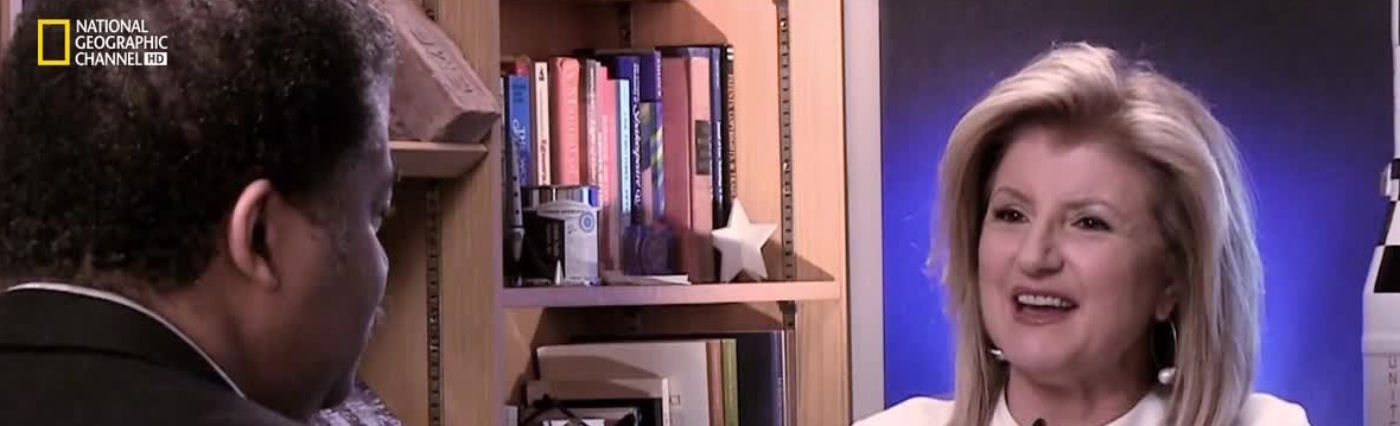
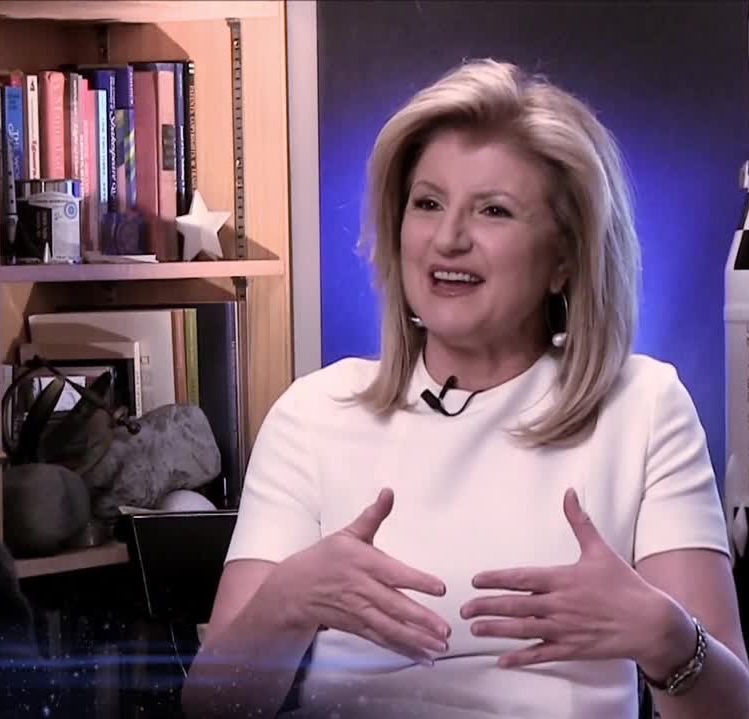
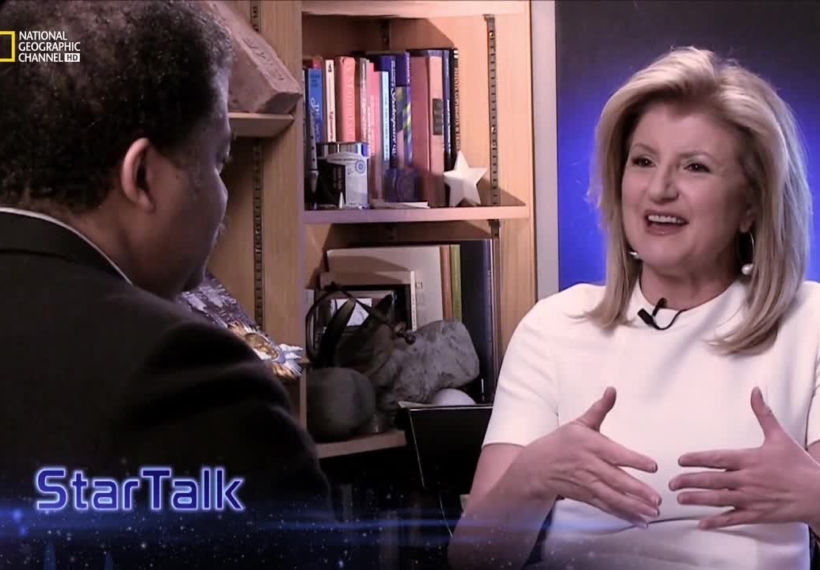
I brought her up to my office.
I just wondered, what is the genesis of this empire?
So let's go back to the beginning and find out where she came from, where she's going.
This year, we are 10 years old.
Happy birthday.
Thank you so much.
And when we were born, the conversation had not yet moved online in the way that it has moved online now.
One of the first things that we did, we kind of elevated blogging because before the Huffington Post, bloggers tended to be stereotyped as people who couldn't get a job blogging in their pajamas in their parents' basements.
So we invited a lot of people who could have access to the New York Times and write their own books to also blog.
We wanted them to be part of the online conversation.
And there was no hierarchy.
So that was also the magic of the internet that you didn't know who would be reading what and what would happen.
So Jeff, she invents an entire branch of news effectively.
Is that, I don't think I exaggerate when I say this.
No, she didn't invent blogging, but she then took blogging and used her Rolodex to bring stars into it and give it some measure of eugenimacy.
Eugenimacy.
Because before that bloggers, like she said, were just people in their underwear in the basement.
I'm here in my pajamas today.
Yeah, yeah.
And thinking that everyone cares about what they think.
Yeah, but there were a few steps in blogging.
I started blogging after 9-11.
I was here in New York.
We were called war bloggers at the time.
There were political bloggers.
There were food bloggers and mommy bloggers.
There have been these phases of bloggers.
But at the end of the day, it's just people owning a printing press.
We're all Gutenberg now.
Interesting.
So would you say that we have entered a new era of news?
But is blogging news?
Yeah, I know.
Yeah.
I mean, you can say we've entered a new era of news, but is blogging news or is it more opinion driven?
It's just a publishing tool.
It can be anything.
I mean, literally, we all have a Gutenberg press in our pocket now.
We can all publish to the entire world.
We can say what we want to.
That can be news.
It can be information.
It can be opinion.
It can be anything we want it to be.
But there was a day when we had tools in place or filters in place to know if you didn't otherwise know for yourself whether somebody is speaking truth or insightful opinions, whether they just got their head up their rectum.
So you're saying that entire construct was nothing more than a mirage?
Yeah.
Wow.
I was part of it.
I was a newspaper guy.
But no, who's to say that just because I own the printing press, I'm the guy who knows everything and you don't?
No.
Well, wait a minute.
If I think of Ben Franklin, he was a printer, okay?
You don't become that unless people trusted what you said.
No, you go out and buy a press.
If you got the money...
Yeah, he had the money.
Yeah, you buy a press.
That was it.
Okay, never mind.
You got that.
You win that argument.
We're done there.
So, is it just a matter of speed, or is it fundamentally different in kind?
I think it's fundamentally different because now, in our little microcosm of the blog world, the blogosphere, we're in networks.
And that's critically new.
Is a network anything different from the fact that we, in the day, when any big city had two, three, sometimes four different competing newspapers, one set of people read one kind of paper, another kind of people read another kind of paper, and the news was not always reported the same way, so the news, your access to the news defined communities.
Indeed.
And weren't they linked together by the news they had in common?
Right, and I think we're coming to the end of the idea of the mass.
There's a couple of academics out of the University of Southern Denmark who talk about the Gutenberg parenthesis.
The Gutenberg was a 600-year exception in history.
And from a time when knowledge was passed around mouth-to-mouth and changed along the way, and then along came Gutenberg and changed everything, and it changed the way we see the world.
We cognate the world now in packages, beginnings and ends.
Love that verb, cognate.
Cognate.
Do we all cognate or just in private?
On Twitter, it's debated.
So we see the world differently now.
Now we come to the other end, they argue, where now knowledge is passed around click-to-click, it's changed along the way, remixed.
The other end, the other parentheses is kicking in that's rounding the era of the Gutenberg influence.
Exactly.
So now I think we return to a time where we're not seen as a mass all the same.
Now we're seen as individuals and communities again, and we redefine ourselves in communities.
Is it really a redefinition or is it just the fact that because, you know, when Neil was talking about newspapers, what you had was a very particular bias for all of the newspapers.
The right way would be point of view.
But it really is a bias.
And each paper had its own bias, and that's how they printed the news, according to that bias.
And now what you find is, instead of that particular bias, people just seek out the news that they already agree with.
Not only that, but let me add to that.
Oh, you have a little faith in your fellow man.
No, no, you're outnumbered two to one here.
So I'm a comedian.
I have no faith in my fellow man.
So here's the thing.
So what Arianna also did was aggregate news.
So that means she's picking news that she's collecting under this one umbrella.
So when you talk about point of view, she could pick points of view that she likes.
So tell me about aggregation as a movement in the internet age of news.
Well, if you go to any story on Google News right now, there'll be 2,000 versions of the same story.
And because we have this overabundance, you could argue, of content now, somebody needs to come along and find the good stuff.
That's aggregation.
It's not a bad thing.
Okay, so here's what I wonder.
If I'm a news source and I'm known for my aggregating and everyone reads me, then who's going to pay for the people to be the investigative journalist?
Oh, that's a very good question.
If I'm sitting there just pulling together news, who is going to go out and get the news?
Now, I asked Arianna that question.
Oh, cool.
Check it out.
Right now, aggregation doesn't mean what you think it means, because if you do it right, and we do, you drive traffic back to the creator of the content.
And that's really the key.
That's the web of this.
Yes, it's the web.
So our promise to our readers is we'll bring you the best of the web.
Even if we had tens of thousands of journalists, we cannot claim that we're going to produce the only worthwhile things for you to consume.
So, okay, so that's a good point.
That is a very good point.
So let me ask you, though.
What of rumors that people then treat as fact?
What is your responsibility as a journalism professional to contain rumors becoming facts?
That's what keeps us employed, right?
You have a flow of information that's occurring without media anymore, and the journalists are here to add value to that, to debunk rumors, to confirm facts, to answer questions, to ask the questions that aren't being asked and answered.
That's what a journalist needs to do, in essence.
I'm sorry.
Have you seen Fox News?
Did you define them as journalists?
No.
By the way, Fox is the majority owner of National Geographic Channel, just to...
Can we get them fired?
As an interest of full disclosure, as I said, have you seen Fox News?
In the next segment, Chuck will be summarily removed by men in black.
So you see yourself as the keeper...
I'm putting words in your mouth.
As the keeper of the truth, selecting from this river of rumors or partial truths that which the public should receive as the filtered information.
Not anymore.
We are not the gatekeepers.
We are not the holders of the Holy Temple of Truth.
Who's the gatekeeper?
There isn't one.
That's scary.
It is a little scary.
No, there's all kinds of sources of information.
There's all kinds of signals of authority and authenticity.
And what do you do in the academia, you real academics?
You use citations.
What did Google do?
Google came along and said that if content is more often cited, it's probably better content.
It's probably more reliable.
Except...
You shall not pass.
If I search Google for flat earth, it will find me every website in the world that celebrates a flat earth.
And I will think that my views are mainstream or that I'm not weirdly...
Outside of the fray.
Outside of the fray because other forces are operating to feed my delusion.
So, Professor Doctor, it is your responsibility...
It's Neil to you.
It is your responsibility to blog more so you rise up.
Put more good stuff on to drive the bad stuff down.
Interesting.
See, put it back on me again.
The universe is on your shoulders.
I'll get to work on that now.
Well, when we have sort of high profile guests like Arianna Huffington, for StarTalk, I always like asking them whether science played any role in their lives, either good or bad, because we're a science show, and I like seeing what those forces of nature are.
So we'll be checking that out when StarTalk comes back.
This is StarTalk, and we are back here in the beautiful hall of the universe, so the Rose Center for Earth and Space.
Absolutely.
I'm feeling the cosmic forces here.
Every time you say that, I feel like we should be wearing costumes.
With light sabers, yeah.
Yes, yeah.
Here we are in the hall of the universe.
Ha ha ha.
He's your father.
I am your father, yes.
So I got Chuck Nice here, Jeff Jarvis, Professor of Journalism.
And what's the title of one of your classes?
Entrepreneurial Journalism.
Entrepreneurial.
So teaching journalists to start businesses, to feed themselves, and also we have a new master's degree in social journalism.
So the utilization of social media.
More than that.
Trying to turn journalism on its head to listen to communities first, understand what their needs are first, before we think we're so big that we know what you need.
So that's good.
So what I wonder is, I'm always curious whether someone who's successful in one job or another, how much influence science literacy may have had in their lives?
Did they enjoy their science classes?
Did they not?
So do you find journalists to be better or not?
Is there anything in there that you can say, these make a better journalist if you have that kind of background?
Oh yeah, I think curiosity, I think the ability to listen first.
But unfortunately-
But scientists do that.
I was gonna say that.
That's very science.
We're curious people.
But we need to teach journalists how to appreciate science, write about science, understand science.
We don't do that enough, frankly.
So, with that, in that spirit, I approached Arianna and I said, did science or science literacy or science curiosity, did any of that impact your life?
Let's check it out.
It wasn't really until later in life that I discovered science and fell in love with it in a very, very unusual way, actually.
Because I've always been drawn to spirituality and I've always been drawn to religion.
And then I started seeing and reading how many scientists actually had a religious foundation.
Or were drawn-
Most, if you go far enough back.
Yes.
It's most of them.
Were drawn to science through wonder, which I started to consider sort of the foundation.
So, that was kind of my unusual connection to science.
And at the Huffington Post, we launched a science section.
But I asked our editor to focus a lot on these intersections between science and religion.
And to break kind of the illusion that scientists are all anti-spiritual and that science negates spirituality because it doesn't.
One of the things, of course, that religion and science would have in common is a sense of wonder.
Exactly.
I mean, you're wondering about different things, but nonetheless, the feeling is surely similar.
And a sense of mystery.
I mean, I find scientists, the best scientists are very humble because even though they discover so much, they are always aware of how much is left to be discovered.
And for me, that's probably the essence of religion, that we don't really know a lot of what life is about and the universe is about.
So that's kind of another connection.
And you can't get more humble than staring into the abyss of the universe.
I have not stared into the abyss of the universe as much as you have, but I bet that's the case.
So what's interesting to me is that she, I ask her about science and spirituality comes up right in that same phrasings.
I was there describing the commonality of feeling, perhaps.
The sense of wonder.
And she says that there's no conflict between science.
Well, there is a conflict if religion is going to make a testable claim and then science tests it and it's either true or not.
Most of the time it's actually not true.
See, that's where religion wins, Mr.
deGrasse Tyson, doctor, because the claims they make are not testable.
Okay, so then there you have it.
Okay, we're done, right, right.
So let me use this then as metaphor for dialogue, dialogue is not the right word, for conflict that unfolds in the public spaces, especially journalistic spaces.
I'll say something about religion, and then people just jump in and they fight and they argue and they scream, and I just watched this go on, even when I didn't say anything controversial, I just said something observational.
One of my tweets on Christmas Day, people lost their minds on this tweet, right?
Christmas Day, on this day, this is my tweet, on this day, long ago, a child was born who by the time he turned 30 would transform civilization.
Happy birthday, Isaac Newton, born December 25th, 1642.
People lost their minds.
That is a 100% accurate statement.
But people lost their minds.
But wait a second.
How many?
How many?
You want to know how many?
I can quantify it.
My average tweet gets like 3000 retweets, average, and a good tweet might get 10,000.
That tweet on Christmas Day got 81,000 retweets.
You know why?
Because a media source online, one of your people, had a headline that said, Tyson trolls Christians on Christmas Day.
This is my man, Isaac Newton, who actually has the benefit of actually having been born on Christmas Day.
Which, by the way, Jesus was not.
Which is what makes the whole thing so great.
That's what I'm saying.
So people said, we demand you take down the tweet.
I said, it's a true tweet.
So the next day, I want to fight back in a polite way.
And I said, I dream of a day when little black boys and little white boys will come together, scientists and believers.
I dream of a day when objective truths, I dream of a day when people are enlightened by objective truths rather than offended by them.
Okay, here's the issue.
There have always been bozos, fools and idiots on earth.
Always.
You can hear them a little easier now, but don't believe just because some small thousand number said something stupid to you on Twitter, that's the end of the universe.
It's not.
It'll be okay.
But that was enough to get people fighting.
So the modern media allows people to scream at one another whether or not they have a background to justify their arguments.
And what do you do with that in your journalism analysis?
It's hard because I think that these days we've got to take a stand for what's right and sometimes things are right.
I had this discussion in the class the other day where you tell me, scientist, I believe that we're pretty set now that measles vaccines are the right way to go.
So if we as journalists want to deal with the truth, I think that's pretty clear.
It's not a two-sided thing, get one side in the other side of CNN.
Get half the other argument.
And so how do we judge our success as journalists then?
Just to be clear, the journalistic ethos is you must give equal time to the other side of a story.
Which is bullpucky.
Why is that the ethos?
What's that word?
Bullpucky.
Didn't hear that one in the hood.
Did you hear that one in the hood?
Yeah, growing up in the hood all the time.
Man, what you say?
Oh, that is bullpucky.
So, okay, so we entered a digital era, post-Gutenberg era.
Is that fair?
Yes.
Well, on the other side of that parenthesis, where whole other challenges have befallen us simply because of that fact.
And we'll learn more about that next on StarTalk.
Chuck Nice, Jeff Jarvis, Professor of Journalism, Chuck Nice, comedian.
Yes.
Yeah, just to verify.
Thank you for giving me a handle as well.
It's just like, Chuck Nice, some dude that was out on Fifth Avenue.
I like Professor of Comedy.
Professor of Comedy.
I'm gonna let you keep liking that.
There you go.
Because I can't claim it.
So what we wanna explore here is, we've got this digital age, so information is instant.
People can celebrate in an instant.
People can argue in an instant.
And these elements did not have a precedent in the world of media reporting.
Every time there's a new major technology, we go through what I would call techno panic.
But the first serious discussion.
That happens every time.
It does.
The first serious discussion of a legal right to privacy in the United States occurred with the invention of what technology?
The Kodak camera.
Because it freaked people out.
Suddenly, your pictures would be taken.
Right?
And it could appear in the penny press.
This was awful.
What did we do?
We figured it out.
We got our norms and straight now.
So now we all take selfies.
Now we all like our photos taken.
We grew up in an era where there were spies, there were secrets.
And so you didn't want anybody to know anything about you.
Now we have a next generation of people, anyone 20 and under, where everybody knows everything about them.
That's true.
They've got pictures at parties, you know, flashing each other, doing shots, and these are pictures that are now permanently available on the internet.
Okay, well what's wrong about that, Neil?
At some point...
I was just observing it.
Did you ever do anything embarrassing as a child?
No.
I know you did.
Yes, but I had the good sense to make sure that no cameras were at their.
We all did embarrassing things when we were younger.
What's wrong with this picture of taking it out on you when you're older?
It means you're intolerant.
I think at some point we become a more tolerant society.
We recognize that everybody has their foibles and we'll learn from that.
But you know what happens?
Because we create our own online presence, it's not created by someone else who took a picture of us.
We can paint whatever image of ourselves we want, whether or not it's accurate.
So I brought up that topic with Arianna Huffington.
Let's check it out.
If you look at the way people use social media, a lot of it is artificial.
As someone said, there is no human being who is as happy as on Instagram, no human being who is as upset, outraged and miserable as on Twitter, and nobody who is as employable as on LinkedIn.
So everything is an exaggeration.
So there is a little bit of a manufactured identity.
You know, it's always me and the sunset, me and this fabulous meal, me smiling, you know, but nobody has a life that's entirely like that.
It's true.
If I see an awesome looking platter of food, I'm taking a picture of that.
We want to post that.
But you know, there are also times...
Look what I'm about to eat.
But there are times when you have a fabulous meal, and there are times when you may be upset about something.
You don't take a picture of you being upset.
Then she just wrapped that up right there.
Yeah, that's exactly what we were talking about.
But that is human nature.
We show our best selves no matter what.
That's why...
I got you that.
But will we mature out of this to come to a world where we are more honest with one another?
There's no guarantees either way, but I hope so.
I think it's possible.
I think there's value in that.
There's value when you find the person who has the problem you have.
You can share that with, you can understand.
Where's the value in someone thinking I'm less than what I want to make people think I am?
Where's the value in that?
Right.
Because at some point, you're not your true self and you'll lose credibility.
But see, that's the whole point of actually being online.
I don't want to be my true self.
That's why my online dating picture is not me sitting on the edge of the bed clipping my toenails.
Aren't you married?
But you understand, like, nobody does that.
Just like, you know, nobody takes a picture of themselves clipping their toenails, just like, call me.
You know?
Because...
But at some point, we need credibility as human beings with each other, and I think that's what's going to come out on the internet.
I think we're going to be real with each other.
Or else, we're just a whole bunch of comedians.
Oh, ooh!
Whoa!
So there's another sort of emergent force out there.
It's not just people who are creating a version of themselves that isn't real.
A new species of life has arisen.
The internet troll.
And I wondered, what would Arianna do?
How does she handle trolls?
I wondered that, because she's got a whole empire.
Surely there are trolls moving in and out of her situation.
So I asked for that, and we will get to that part of the interview when StarTalk continues.
We're back.
Chuck, Jeff, again, thanks for being on the show.
So we're featuring my interview with Arianna Huffington, and in my office, which is great, it's just like she and I, just talking smack about journalism.
And so what came up, which was unavoidable, I think, you had to land there at some point, if you're talking about the health of an industry, internet journalism in there, or internet presence of anything, person, place or thing.
You park the curtains, there's a troll, lurking.
And they don't go away.
So I thought Arianna would have deep insight, perhaps, into this, because she has a media empire.
There must be trolls moving in and out of what she does.
I had to get her perspective on this.
I'm fully aware of the problems with the internet.
And that's why, in fact, finally, last year, the Huffington Post ended anonymity.
We do not allow anonymous comments.
You know, we had them and still have the most advanced algorithmic technology to moderate comments.
But the algorithm wasn't smart enough not to be out-tweeted by trolls.
You know, trolls are incredibly ingenious, some of them.
They want to basically have no other life except to circumvent this technology.
So we actually also had...
Like the original trolls.
Like the original trolls.
That live under bridges.
Yes, exactly.
They just live under the bridges.
They don't go shopping.
They don't go to the amusement park.
They just...
So they're aptly named, yes, trolls.
And so we also had 30 human moderators to supplement the algorithm, and that didn't work.
And then I thought one day, you know, is this really worth it?
Why are we spending all this money on basically dealing with a tiny infinitesimal percentage?
Like, like, zero, zero, zero, zero, one percent.
And so we ended anonymity.
And can invest the resources of these 30 human moderators in more productive ways.
There is something about anonymity that brings the worst out in people.
And I don't believe that we have the responsibility to allow them, unless they have a particular reason why they need to remain anonymous, and we have made allowances for that, like if you are a whistleblower, then you can come backstage and tell an editor why you need to remain anonymous.
But then you reveal yourself, obviously, to the editors, yeah.
And of course, there are famous experiments, psychology experiments, on the conduct of people in the face of anonymity versus not.
How do you administer punishment if the person you're punishing knows it's you, versus you being behind a door?
And we're mean people, a mean species.
We are both.
That's what is fascinating about human nature.
We are a mixture.
Every one of us is a mixture.
Some differently mixed than others.
Some very differently mixed.
But there's nobody who is not mixed in some way, right?
Exactly.
She's so hopeful there.
Man, I'm ready to indict whole groups of people.
She says, no, everyone has a nice side.
Yeah, she's wrong.
So who are trolls and why do they do this?
Trolls are sad souls who want to get a rise out of people who sometimes need their meds, let's be honest.
And I think that we have to deal with them in a lot of levels.
One is that the rest of us, the untrolls, the civilized beings on the Internet, too often encourage the trolls.
You feed the trolls.
You say, oh, look over there, there's a fight over there.
All we're doing is giving them the nourishment they want.
Don't feed the trolls.
Don't feed the trolls.
Don't give them attention.
Don't reward them.
Don't laugh.
Because you're giving them what they want.
And what it means is that the rest of us bear responsibility.
If you end up pointing to a troll, then you are an accessory to the troll.
You're part of the crime.
This is the problem.
We give attention to these moments of bad behavior.
There's someone whose name I forgot who hypothesized that every chat thread degrades to a point where somebody mentions Hitler or Nazis.
Godwin's Law.
Godwin's Law.
What is Godwin's Law?
That given enough time, any chat thread will disintegrate into a mention of Hitler.
Any chat thread.
Any chat thread.
At some point.
You could be talking about the Teletubbies.
The longer it goes, the more likely it'll end up in Hitler.
Tinky Winky was really a brown shirt.
So, why?
What is the attraction of Hitler and Nazis to make its way into every blog?
Because you run out of arguments.
When I run out of arguments, the first thing that might fall is not Hitler.
I'm just...
Yeah, when I run out of arguments, I know I'm talking to my wife.
So, in my interview with Arianna, it became clear she's a successful woman, and I'd like hearing wisdom from successful people.
And she recently wrote a book called Thrive where she explores the challenges of being successful, but still leading a life that is sane.
Let's find out what she told me when StarTalk returns.
We're back.
Hall of the Universe.
Chuck, Jeff, good to have you.
Good to be here.
Yeah, so where did we leave off?
We've got my interview with Arianna Huffington, and she actually published a book called Thrive.
She's a successful person.
Everyone wants to know how do you do it.
And you know, I don't want to quite call it a secret, but she has a revelation.
The revelation is, in our Western society, there are basically only two measures of success.
One of them is wealth, the other is power.
In our society, if you have those two, you are considered successful, no matter what else might be true about you.
And she's concerned that if that's the only measure and metric of your success, what about your mental health?
Are you burned out?
Do you not have time to love, for a family, to go to the beach?
What, where is the rest of the completion of your life?
I asked her all those questions.
Let's find out what she says.
All the signals we're getting are the lives of the rich and powerful and how do you climb the ladder?
And so people as a result are living now under the collective delusion that burnout is the price you have to pay for success.
So that's really why I wanted to write the book.
And then I looked at the science and all this ancient wisdom is validated by modern science now.
The ancient wisdom about the importance of renewal and sleeps and dreams and meditation or whatever you want to call it, prayer, mindfulness, whatever word you want to use, that time to be alone, to be silent, to be connected with ourselves.
So now we have had an explosion of science around these things.
I mean, we've had Richard Davidson at the University of Wisconsin using MRIs on the brains of Buddhist monks to demonstrate the plasticity of the brain and the generation of gamma waves and to show that giving is a shortcut to happiness.
I mean, that sounds like a cliche, but now you have science proving it.
Yeah, so she's on a roll there, right?
She's ready to redefine success.
And do I get agreement that we live in a world here in America today that if you said, last night I got only two hours of sleep, I was working all day, you said, that's a hard-working person, you'll go far, you'll climb the ladder, you'll succeed.
This is how we treat it.
You know, and that's because people, they don't realize that that's not true.
But my father has passed away and he was a workaholic, and that is a real disease, just like any other addiction.
He was a man who felt like he had to be defined by what he did, and so he just worked.
Arianna had mentioned sort of Buddhist meditation as a thing you might fold into this, and I had to take her to task on that, Jeff, but I think she had a good answer.
Let's see how that, shake it, shake it.
The Buddhist monks are not inventing airplanes.
They're not inventing computers.
They didn't invent much that I know of of anything of what we call modern society.
They're not the ones who invented the internet.
It's a bunch of restless people who were not getting much sleep and who were not meditating, perhaps.
But here, no, here's the thing.
In the book, I quote a lot of the people who created the modern age, like Steve Jobs, who said that his best ideas that led to the iconic Apple products came after Zen meditation because, and I'm quoting him, he said, that's when I could hear subtler things.
It's not going to be while you're processing your email or while you're dealing with all the distractions of modern life.
It is inevitably going to be in a moment of quiet.
I mean, and if you look through science, Newton came up with the theory of gravity while in a contemplative mood.
Yeah, he was not-
Having tea in his garden.
He wasn't partying, he wasn't doing email.
Right.
And we have so many examples like that.
So it's not that we should all just meditate, it's that this aspect of introspection should be part of our lives.
Part of our lives.
Part of our lives.
And that way we can still invent the internet in a moment of meditation.
And develop.
Of course, if all we did was meditate, nothing gets invented.
No, no, no.
Of course not.
I think where I absolutely agree with her is that we have an epidemic of anxiety in society.
We have a huge problem among our youth, among ourselves, in how we treat ourselves and what we expect of ourselves.
And I don't think that's about just simply getting more sleep or working less.
I think it's what we expect of ourselves.
But is there's also an information overload where we think we have to process it?
No, no.
There's ever since the Library in Alexandria, there's been too much information for anybody to take in.
This guy goes way back.
Man.
I mean, he went Alexandria on us.
He went Alexandria on us.
He wasn't talking like Sixth Avenue Public Library.
He's talking about scrolls and stuff.
No, we've always had too much information for any one person to take in.
That's not a source of stress.
But what do you think of information being like we overeat food and we get fat?
We have access to too much information and we need to go on an information diet.
Let me ask you this way.
Would you agree that we have too much stress and anxiety in society?
Absolutely.
Me and the universe are tight and I'm really relaxed in the presence of the cosmos.
But you work harder than anybody on Earth.
I do, but does anyone think that I'm uptight?
You're in your 40th hour today alone.
Do I come across as an uptight person?
No, you don't.
So how do you do that?
And this is the way I feel.
It really is about what works for you.
Yes.
And so I do agree with the stress and anxiety that that puts you in a position where other things will not work.
Sleep doesn't work.
Relationships don't work.
And it really is due to stress and anxiety.
It's also about doing something that makes you happy.
True.
Now tell me this.
Comedians have a reputation for being internally sad people.
He stared at you flat-footed.
Yep.
And he was just like, hey man, I know you are hurting inside.
So what we do is we spend a lot of time sitting around thinking about stuff that nobody else does.
And that kind of makes you a little nuts.
And out of that comes humor.
And out of that comes humor.
But you give people a relief from their stress.
You do.
I'll give you that.
We made him happy while we were at it.
Oh no, you made him happy.
In situations like this, I always turn to my good friend Bill Nye to see if he's got some take on life in the information age.
So we're going to check in on him when we come back to StarTalk.
Welcome back to StarTalk from Manhattan, New York City, North America, Western Hemisphere, Earth, Solar System, Sagittarius Arm, Milky Way Galaxy, Local Group, Virgo Supercluster, the universe.
And we don't yet have a coordinate within the multiverse.
We're working on that.
So my friend Bill Nye, he moved to town.
He started in Seattle, went to LA, but he's a New Yorker now and he's loving it.
And he sends in these dispatches from around town.
He has some thoughts about sharing in the information age, as we knew he would.
Check it out.
When it comes to sharing information, humans are in a class by themselves.
I mean, sure, a dog may walk up to a tree and take a pee to let other dogs know that it's his territory.
Coyotes may howl to communicate.
Monkeys may screech to let other monkeys in the barrel know that there's a predator nearby.
Or a whale can swim real fast and breach up out of the sea and flop back down with a great big splash and a great big sound.
But humans, humans, we share all kinds of information with everybody all the time.
We use these big, wide, thin sheets.
But the best you can do with a piece of paper is sort of last night's news.
Now we get news 24-7.
Every day we can share information in a flash at the speed of light all over the world.
That is, as long as you got one of these and you're connected.
So Jeff, you wrote a book, Geeks, Marrying Gifts, Imagining New Futures for News.
So in that, what have you imagined?
I've imagined that we move past the idea of mass media.
We get treated again as individuals and communities with respect.
We find relevance and value.
Are you just making this up?
Are you actually looking at trend lines and extrapolating?
No, I'm saying what I think news needs to do to survive.
Oh.
That's a stronger point.
As long as we continue to try to replicate our old mass media models in this new thing we call the internet.
Look at it this way.
I have my dear phone, right?
And when I go home tonight, I'll put in Waze, and it'll say...
Waze, W-A-Z.
Oh, you had a new phone.
Your phone is now busted on the floor of the hall of the universe.
I have a lot of anxiety right now.
So Waze...
Okay, we get it.
You have a cell phone.
Waze will say, are you going home?
Google, through Waze, its traffic app, knows where I live and where I work.
My local newspaper doesn't know that.
That's ridiculous.
My local newspaper treats me the same as millions of other people.
Whereas big, huge Google sees me as an individual.
I think media has to shift to seeing people as individuals and communities and giving us greater relevance and greater value.
And I think that in there is a new business model that's going to support journalism and create more value.
Is this the next media billionaire?
I hope so.
In the meantime, what do we have?
We just have a lot of cats online.
Yeah.
In fact, I've joked that if aliens came to visit Earth and observed all that goes on, they would conclude that the Internet is powered by kittens.
There would be no other conclusion they could draw.
So this is the continued evolution of something in its infancy.
Yes.
Now let's find out what Arianna Huffington had to say about the future of journalism.
Check it out.
You know, The New York Times famously says all the news that's free to print.
And my concern is that all of us in the media are not really giving our readers or viewers all the news.
We're giving them all the bad news.
There is a bias towards crisis, beheadings, rapes, mayhem.
Obviously, we have to cover all that.
Obviously, we have to uncover corruption and dysfunction.
But we also feel it's about time that we do a better job bringing to our readers solutions journalism.
The things that are working.
We want to focus on what is working, because a lot of things are working.
But you wouldn't know that.
So that's kind of my new priority for the Huffington Post.
So she's thinking that through.
What do you think of this?
Changing what you report, so that the good things show up as much as the bad things, can you catch people's attention with good news?
Yeah, I think you can.
No, you can capture their attention with useful news.
It is our job to call on the powerful and the pompous and tell them when they're full of it.
But we don't do that enough.
Now, in fact, I'd like to take that one step further.
That as an educator and as a scientist, one of the great powers of the mind is a level of, is achieving a level of science literacy that can enable you, no, empower you to know when someone else is full of s***.
Guys, thanks for being on StarTalk.
This has been great.
I learned a lot, laughed a lot, and I didn't know that Chuck was depressed.
I'm your host, Neil deGrasse Tyson, and as always, I bid you farewell.
See the full transcript



 Unlock with Patreon



 Become a Patron