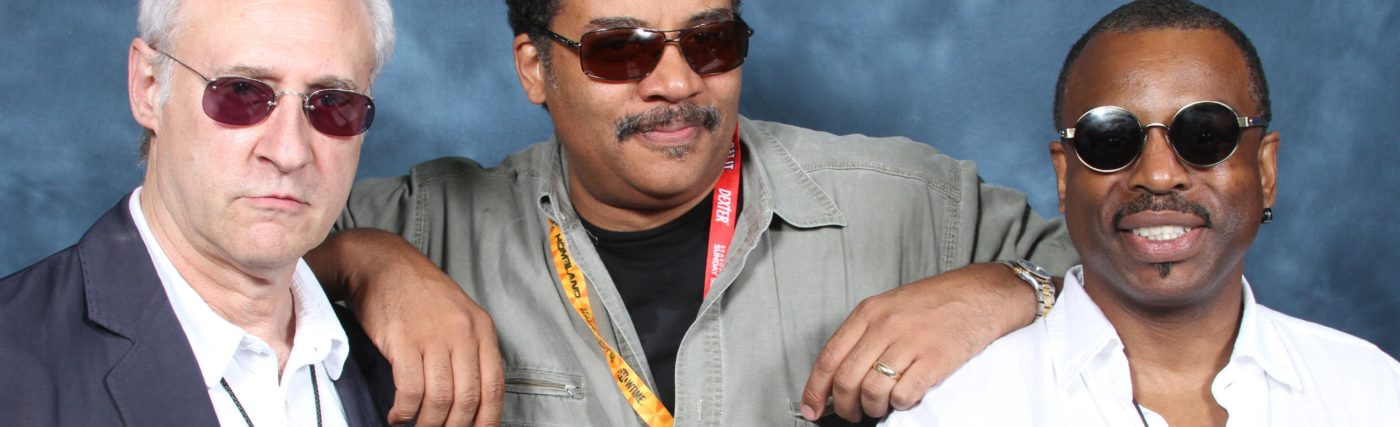
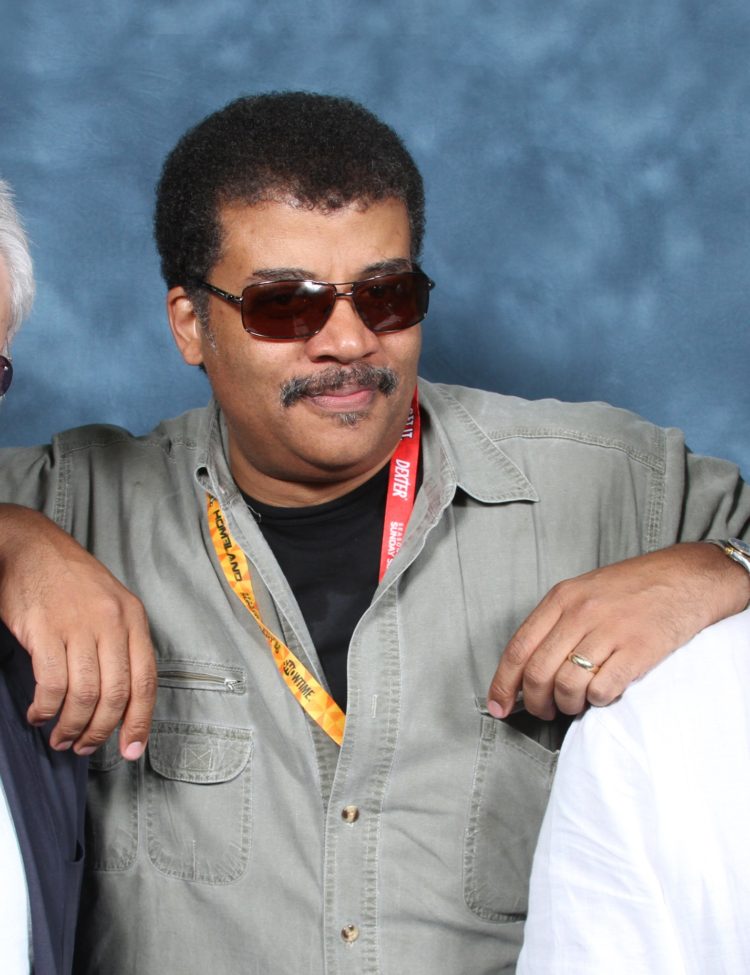
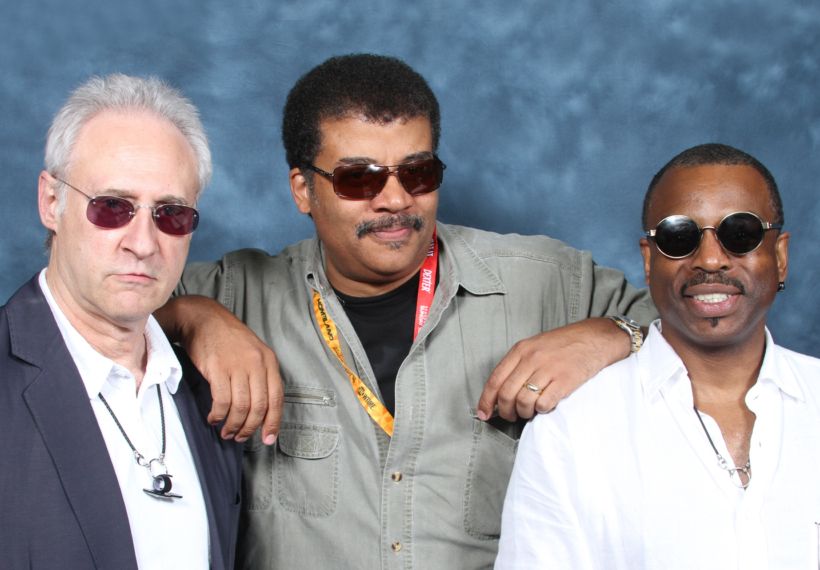
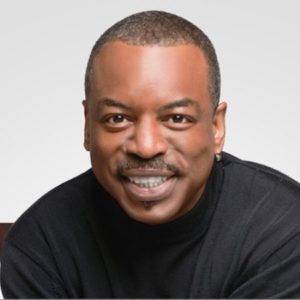
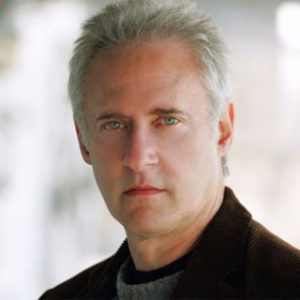
Get the best of both worlds when Neil deGrasse Tyson interviews Star Trek: The Next Generation stars LeVar Burton (Geordi La Forge) and Brent Spiner (Lt. Commander Data) at San Diego Comic-Con 2012. It’s a geek feast filled with favorite episodes and burning questions like “Who would win at chess, Spock or Data?” and “Why did Geordi need a visor in the 24th century?” They explain how their characters’ unique relationship sprang from an obscure audition scene. And Neil takes us where no fan has gone before, journeying into the philosophical (Gene Roddenberry’s idea of “Infinite Diversity in Infinite Combinations”), the intersection of science fiction and science (the X-Prize to create a functional tricorder), the best uses for a magnifying glass (bugs, beware!), and life before and after Star Trek.
NOTE: All-Access subscribers can listen to this entire episode commercial-free here: The Best of Both Worlds.
Transcript
DOWNLOAD SRT
Welcome to StarTalk, your place in the universe where science and pop culture collide. StarTalk begins right now. Welcome to StarTalk Radio. I'm your host, Neil deGrasse Tyson. I'm an astrophysicist at the American Museum of Natural History in New...
Welcome to StarTalk, your place in the universe where science and pop culture collide.
StarTalk begins right now.
Welcome to StarTalk Radio.
I'm your host, Neil deGrasse Tyson.
I'm an astrophysicist at the American Museum of Natural History in New York, where I also serve as director of the Hayden Planetarium.
And I've got with me in the studio, one of my favorite co-hosts, I'm sorry, not the favorite co-host, you're in an ensemble of favorite co-hosts, LeAnn Lorne.
Well, hello there, I'm in an ensemble, fantastic.
Well, welcome back.
I'm so glad to be back.
It's been too long.
Oh my gosh, I want more of you.
Listen, you have my number, just call me.
Well, we got you on this one because I happen to have separate knowledge that there's a geek side of you that is like totally into science fiction.
And earlier this year, I went to Comic-Con San Diego for my very first time.
I was a Comic-Con virgin.
Oh my God, my heart beats wildly, you got to go.
Is it fluttered?
It is, it really is.
Is it warm in here?
And so what was very cool is as I was wandering the floor, well first I was warmed by the reception that I got just being there.
I was about to say, you would be considered a superstar.
I didn't know because famous actors go there, right?
And I'm not an actor, you know?
They don't have any real geek street cred.
Well, that's interesting, you say that because when people came up to me, actors I would have judged as famous, would walk by and they would see them, but then they'd stay with me.
And I realized that, well, actually I could tell them stuff about the universe.
Exactly, as the other people can pretend to tell them things if it's in a script.
You actually know.
But it meant they cared about the real knowledge.
And so I felt as though I was an emissary of my professional community of astrophysicists.
An emissary of science.
Is that on your business card?
Representing my community and in that way, I was re-infusing this deeply inspired and active organization, just all these people who love science as it is captured in the storytelling of science fiction.
So.
I wish I could have been there.
I know, it was gorgeous.
And you know who I bumped into?
Who?
Oh, LeVar Burton and Brent Spiner.
I'm having a Star Trek moment.
Oh, what does that mean biophysically to you?
I can neither confirm nor deny that certain biophysical things are happening to me at the moment.
Well, you know, so for those of you, if you didn't know, okay, LeVar Burton on Star Trek.
Geordie.
Geordie LaForge, Geordie LaForge.
And Brent Spiner was Lieutenant Commander Data.
Data, love Data.
Data, you know, he's one person, I thought he should maybe be Datum, Lieutenant Commander Datum, the singular of Data, but that's another conversation.
Wow, I think you've hit the outer level of geekdom, sir.
I didn't think that was possible.
They were in Star Trek, the next generation series, and they were at a booth signing autographs, and so I managed to nab them and get them to talk to me for StarTalk.
Are you serious?
On the floor of Comic-Con.
And so-
Does your life get any more awesome?
So I've got that interview, and that's gonna be this hour.
So let's, in fact, go straight there and find out how, in fact, my lives had intersected with theirs in the past.
So what a privilege to have both of you guys here.
LeVar, let me start with you.
What you might not have known is that in your days with Reading Rainbow, you did a program profiling the closest public school to Ground Zero from the terrorist attacks on September 11th, and that was my daughter's school.
And so-
PS.
234.
234.
Your daughter-
She was in first grade.
First grade, in fact, was her third day of school, was September 11th, 2001.
And so they obviously have to leave the school.
They can't return to the school.
The school is used as a-
An evacuation center.
An evacuation center.
Yes.
And a year later-
We came with the Reading Rainbow cameras, and the point was to really show our audience the progress of that community that lived right there at ground zero.
That's important because a school is part of a community.
Absolutely, and that was a large part of the message, that this community was affected, and this school was a large part of the healing that needed to be done, and how the community really was able to use the school and the staff and faculty as a resource for the healing of trauma from that day.
So I just want to publicly thank you for that effort.
Absolutely.
Because things come and go and people don't remember to remember, and so you created a beautiful product there, and we still have it.
Thank you.
If it was VHS back then.
Right, yes, I believe I can get you a DVD now.
All right, and also Brent, we have an intersection of some years back.
I remember getting a phone call that there was a play being produced on Broadway that featured scientists and astrophysicists in particular, and then you guys show up at my doorstep.
You and Helen Hunt.
Yep, and John Turturro.
And John Turturro.
And Linda Eamon, who's a fantastic actress.
And Matthew Warchus, who's a world-class director.
We all came to your office.
And the play's called Life Times Three.
Yeah, Life Times Three, Yasmina Rizzo wrote it, who wrote God of Carnage and Art.
It was an amazing play about astrophysicists.
So I guess you came to me because you needed acting?
Exactly.
You know what, we needed to know what are these people like, these-
These crazy astrophysicists.
These science heads, you know?
And I wanted to know how to portray them effectively.
And my character, by the way, was a real son of a bitch.
And I based him totally on you, actually, after that meeting.
You never told me that.
No, not totally, just your personality.
No, but I went and saw the play.
It was interesting because it was circumstances from three different views.
Exactly.
The premise of the play was really that, you know, they always say baseball is a game of inches.
And I think life is a game of inches, really.
And that's sort of what it was about, is that at any given moment, something can happen, something can be said that will completely change the dynamic of the moment and of the rest of time after that.
And so the play was about a young guy and his wife, he was an astrophysicist, invited his boss and his wife to dinner, and they showed up one night too early.
And in each of the three different vignettes, the exact same scene played out, but at some point in the scene, someone said something different and it all changed and went off in another direction.
And you kind of realize that could happen anywhere, anytime, that there are billions of possibilities for every single moment of life.
All different variations on a theme that, yeah, yeah.
And so I was honored that you guys felt that I could contribute to your performance.
And I mean, all three of you, I mean, you know, Helen Hunt, all there sitting in my office at the Hayden Planetarium.
Oh, I remember, you couldn't even listen to me because you were looking at her the whole time.
I thought I was hiding that.
No, not at all.
Apparently.
You were transparent, as they say in science.
So I feel pseudo genetically connected to the two of you.
So thanks.
You are.
For coming to StarTalk here.
Thank you Welcome back to StarTalk Radio.
I'm Neil deGrasse Tyson.
In this show, we're listening to my interview with LeVar Burton and Brent Spiner on the floor of Comic-Con 2012 in San Diego.
LeAnn Lord, you've never been to a Comic-Con.
I have never been to a Comic-Con.
But you're a geek girl.
I am, but I'm broke geek girl is how this has transpired, everybody.
So if you wanna send donations to get LeAnn to Comic-Con, feel free.
Well, you know, Comic-Con is not just sort of the Star, you know, maybe the Star Trek fan base began this whole culture.
Right, I mean, I've been to a Star Trek convention.
Exactly, but of course, Comic-Con is like the superset of all of these.
Yes, the big time.
So there are fans of all the superheroes, Batman, Spider-Man, X-Men, Doctor Who even, and Supernatural, the hit TV series.
So what an experience it is to go there.
And everybody is as crazy as you think they would be.
Wow, way to paint that picture.
But we're featuring my interview with LeVar Burton and Brent Spiner.
You know, they were in The Next Generation, Star Trek, which was the resurrected form of the show that came out in the late 80s and early 90s.
So let's pick up more with my interview with them, just because they agreed to do this from the floor of Comic-Con.
You could feel the energy in the air.
I have it on good rumor, LeVar, that you and one other character in The Next Generation were the only ones in the group that were actual Star Trek fans from way back.
Is that a fair statement?
I think that is a fair statement, and the other actor would have been Whoopi Goldberg.
It was?
It was Whoopi.
Whoopi and I both were largely influenced by Gene's vision of the future, mainly because it was a representation of a future that included people of color.
Which no one else was doing.
Well, not no one.
I mean, there are a couple of instances in science fiction literature, Arthur C.
Clarke, notably.
Okay, but it took him to do it, right?
Yeah, yeah, yeah.
But it was very rare, very rare to see representations of the future that featured heroes who looked like us.
Right.
And for that reason, it was a very easy future to embrace.
And so you became a part of it.
You not only saw it as a future that could happen, you actually joined it.
Right.
How many people get to do that?
I love my life.
Okay, so now the rest of these guys then, they had to like learn the stuff.
Learn the culture, right?
Is that right, Brent?
I just learned the lines, Neil.
I still don't know what it's about, to be honest with you.
So I guess, yeah, the actor, well, they just have to make you believe, that's all.
Well, that's it, that's it.
You have to make yourself believe, and then everybody else believes.
Oh, that's okay, right.
You're believable in your portrayal.
Exactly right, you have to do it with absolute conviction.
And once you do that, and make real choices of how to do it, then the audience will go along with you.
Okay, so now, who would win a game of chess between you and Spock, as Data?
Well, let me think.
I mean, Spock was smart, but he was no Data.
You know, he could probably beat Picard.
Not Data, my God.
Okay, so Data can kick some Spock butt.
Oh, please.
That'd be a cage match kind of thing, right?
You know, I'd like to see that, actually, because, you know, he's much older than I am.
I know I could take him.
And so, LeVar, I mean, I was especially intrigued by your visor, I mean, everyone was.
I mean, that's an extraordinary device that I would just want to own.
Right.
You know, who wouldn't want to see the whole world in every possible wavelength of light?
Exactly.
I wasn't close enough to the series to know why in one year they just took it off.
Yes.
See, I always maintain that, and I love the visor, it's a very iconic piece of Star Trek hardware.
Hardware.
Gadgetry, yeah, yeah, yeah.
Exactly right, and Rick Berman always maintained that the visor was one of those ways that we telegraph the nature of the technological sophistication of the 24th century.
And I had to agree, however.
Right, because if it's just people walking around, it's just a play set in the future.
It's not a participant in the future.
But I always wondered that if our technology was so damn sophisticated, why couldn't we put that technology in something a lot smaller than the visor?
Like, say, the size of an eye.
Now, there's an idea, right?
But you know, I had a similar thing.
When I first met Gene Roddenberry, he said, would you mind changing your appearance?
And I thought, well, he's going to give me a couple of pair of ears or something, whatever.
And he said, no, I'd like to change the color of your skin.
I'd like you to be a different hue.
And I thought, well, all right, why not?
And I said, but you know, don't you think in the future that they would be able to devise skin that would look like skin?
And he says, what makes you think what you have isn't better than skin?
That was Gene Roddenberry.
So there was no way to argue with it.
Right, right, there you go.
Yeah, yeah, yeah.
So what I wondered was if you could get one of those visors but put it as the window on the deck.
Right, right, and you just have a dial, just dial it up.
The lens through which we all see.
We all see it, so it's not just you.
Right.
Because telescopes are kind of like that.
They are.
Think about it, we get all our data from all the bandwidth.
Right, that's right, that's right.
You know what, it's interesting, and not many people know this, and I wonder if you remember, there were sides that Gene wrote for the audition process of Next Gen, and there was a scene between Geordi and Data where they discussed, and they were just meeting for the first time, and they discussed how Data's brain and Geordi's eyes saw the world from a similar perspective.
They saw through to the truth of things, and so they decided to form a team and call themselves.
But where were the perceivers?
The perceivers, the perceivers.
This is an early concept.
Yeah, it was the audition scenes.
It was the audition scenes, and the perceivers never made it into the pilot, but the relationship between Jordy and Data absolutely did.
Well, because then that gives me a place to come through into the show, to feel like I'm connected to the reality of the real universe.
I mean, not to overstretch a metaphor, but today there's so much non-viewing the truth, you know, in politics, in the world, and there you guys were just seeing it as it is, laid bare, in fact.
Laid bare in the facts, laid bare in its appearance.
And so when I think of the first series setting a watermark for just exploring culture, but in a new kind of way, where you can get closer to it without having your guards up.
Right.
Getting closer through a lens of the future.
Yes.
Right?
Yes.
You know, Neil, there are many things I admire about you and always have an enormous respect for you.
Thank you.
But now, seeing that you have Starfleet sideburns, makes me even more respectful of you.
Very few people notice this.
Thank you.
They come to a point.
Excellent.
It's my homage.
It's my homage.
Well, when I see that, I know.
My little bit.
We are starting right here on Earth right now.
It begins with you, Neil.
Yeah.
It begins with you, Idik.
But I can't act.
It begins with you.
I can't act.
I can't.
It is the authentic you, I think, that is really...
I can teach you.
He's taught many porn stars.
And so you'd be an excellent company.
Okay, so if the acting moment arises, I want to call on the two of you.
Please.
And I'm gonna say, give me a second, cause I help you be...
You've informed my characters before.
I help you, I hook you up.
I'm gonna call on you.
I want to come to the Hayden Planetarium and bring my Reading Rainbow cameras and I would like to sit down with you.
My gosh, I will so...
And share you with the Reading Rainbow audience.
You will so be royalty.
I'd love that.
But you got to know somebody to get...
Brent, can you hook me up?
I probably could, yeah.
I'll give him a call.
Cut, Brent.
Oh my gosh, you guys.
You guys are fun.
So tell me about science growing up with you.
Where'd you grow up?
Sacramento, California.
Really, okay, California boy.
California.
And did science mean anything to you as a kid?
Science fiction meant a lot.
Science, you know, outside of...
Just a regular student in science.
Chemistry, had a chemistry set.
Yeah, did you burn anything up?
Not so I could actually be held legally accountable.
So your chemistry set came with a legal document at the end.
There was a disclaimer.
How to absolve guilt.
There was a disclaimer, absolutely.
Made stink bombs in high school.
That's fun.
Yep.
So were you a nerd kid?
I'd have always been a geek, always.
I mean, I didn't have a pocket protector, but some of my best friends did.
That you admit to, yeah.
And you, do you have any science in your history?
Well, I'm from Houston, Texas.
Oh, so you know space.
Well, I know space from, I had a TV, and we used to watch all the space shots.
Being in Houston and having the space program move there in my lifetime was unbelievably exciting.
But my relationship to science, we lived in a very hot climate in Houston, and basically my total association was using a magnifying glass to torture doodle bugs, you know.
So you had the sun and you exploited its presence.
Exactly.
I learned so much about solar energy from that experience.
But I confess that I got a lot of mileage out of my magnifying glasses.
Definitely.
They're completely useful.
Oh, they are magic.
So anything else that, did you collect rocks or anything?
No, I didn't really collect, you know, unlike LeVar, I was actually very cool as a young person.
So collecting rocks was, was not...
I didn't really do that.
Welcome back to StarTalk Radio.
I'm your host, Neil deGrasse Tyson.
In this show, we're listening to my interview with Star Trek actors, LeVar Burton and Brent Spiner, from the floor of Comic Con 2012, San Diego.
In this next clip, we're gonna learn about the roles that they've taken on far away from the Star Trek universe.
So, I hail from New York, where New Yorkers care about their Broadway.
You guys thinking of doing any Broadway anytime soon?
You know what, I'm dying to do another Broadway show.
Just to reconnect with some...
And I love doing it.
I love being on stage and having a live audience.
You know, there's a community in New York that doesn't exist in the movie business, but it is in the theater.
And if you're in a play and you go after the show to Joe Allen's or whatever, and you see all the other actors from all the other shows, everybody's like, hey, how you doing?
What are you doing?
I'm coming to see your show.
And it's a real community.
You ever thought about it?
Oh, I used to think about nothing else.
I mean, when I got the job in Roots, I was a sophomore at USC studying theater.
I didn't even mention it.
We didn't even talk about Roots yet.
Oh my gosh.
What's Roots?
Nah, we know what Roots is.
Roots, my gosh.
And here's the connection.
That scene that happened every time with a new child, the father taking the child, presenting it, uplifting the child to the heavens and saying, behold.
That became iconic.
The only thing greater than yourself.
When my daughter was born, I made the same gesture.
As did I.
I got a photo of it too.
There you go.
She was like five pounds eight, so it's like, I got large hands, just there it was, held it up.
How could you not, right?
That was powerful.
That's right.
My initial desire was to graduate with a Bachelor of Fine Arts degree in Drama from USC, then moved to New York and hustled my way out of the Broadway stage.
Ben Boreen was my idol.
I saw him in the original Jesus Christ Superstar.
Really?
You say that like, I didn't know you were that old.
That's the way you said that.
Was I that transparent?
Science.
Science.
Science.
Science.
You know, it's amazing, the connection between science fiction and science.
It's a really fine line.
It's almost non-existent at this point.
I just did a thing for, you know, the X Prize?
Oh yeah, of course, yeah, yeah, yeah.
There's many of them now.
I mean, it used to be just who can send up a ship and back.
Now can you go to the moon?
And they also added field.
So their biology X Prize is now.
They've got a book of all of the things they want to accomplish.
But the thing that I participated in was, they're offering a prize now to anybody who can come up with a medical tricorder that will scan the body and give...
And diagnose.
Yeah, 13 different diagnoses and be affordable to the consumer.
And they've got three years to come up with it.
Whoever can do it, $10 million.
And they're pretty sure someone's going to do it.
You know, I worry that if the world ever loses science fiction, that dreams and...
There's innovation.
Absolutely.
Without question, the link between science fiction literature, our imaginations and our ability to manifest in this realm is inextricable.
It is our imaginations that produce everything that we have accomplished.
It's not only imagination.
You got to see something that you want to have.
That's right, that's right, that's right.
Because the future is, they're dystopic futures, of course.
You're right, you're absolutely right.
But it's got to be so tasty.
Oh, I was trying to talk to these guys at XPRIZE.
I said, next time you've got to go for the transporter, because doesn't everybody want to go from one place to another in a blink of an eye?
And they said, we're working on it.
Yeah.
You know, that's not tomorrow, right?
No, it's not tomorrow.
They said, 2020, they'll have it.
But the fact is, you know, in 1865, when Jules Verne rode trip to the moon.
Yeah, from Earth to the moon, yeah.
The idea of going to the moon was inconceivable.
The idea of a rocket was inconceivable.
And yet we did it.
Not only did we do it, we went there and we brought them back.
Within 100 years, right, essentially, right.
So I have to ask, was there a particular story theme that impressed either of you that you were in?
Well, I kind of think the most significant one to me was an episode called Measure of a Man, in which my character was on trial, basically to decide whether or not he was sentient, whether he was a sentient being...
One of the best acknowledged, best episodes in the seven-year run of Nixgen.
And whether, if he was not sentient, were we creating a race of slaves, a different kind of race of slaves, or did he have his own right to his own existence?
And it's a fascinating episode.
How about you?
For me, Neil, it's probably not a single episode, but the idea that Gene infused Star Trek with, there's an acronym, IDIC, I-D-I-C, infinite diversity and infinite combination.
And...
That's new to me.
Ah, it's a core tenet of the Star Trek philosophy.
Infinite diversity in infinite combination, and that we have respect for all of the diversity that life presents throughout creation.
And Star Trek diversity is far greater than the diversity of what we find here on Earth.
So what a model that would serve us.
Absolutely, absolutely.
That we hopefully reach a time where we celebrate the differences in people instead of letting them separate us.
And what I love about Star Trek is if you reverse engineer that idea, then it has to begin here on Earth before we can get out there in the heavens.
What concerns me is people say, oh, let's have a new rules where we're all friendly in space.
And I'm thinking, well, if that succeeds, why couldn't you do that down here?
Yeah.
We would have to.
Otherwise, I got no confidence.
We would have to do it here before we get out there.
Just as an existence proof that we're keeping capable of it.
Welcome back to StarTalk Radio.
I'm Neil deGrasse Tyson, and I've got with me LeAnn Lord.
To LeAnn, you're tweeting at LeAnn Lord, aren't you?
Yes, I am.
But she's L-E-I-G-H-A-N-N.
Yes, my parents got creative.
They did.
All right, well, I follow you.
Thank you, and I follow you.
I need the occasional laugh in my day.
Just the occasional.
But that's not why I have you.
It's I got you on the show because you're a Star Trek geek today.
I am a Star Trek geek and lovin it, on a bash it.
A geek tricks.
Ooh, I'm gonna put that on a T-shirt.
Ooh, so in this show, as you know, we're featuring my interview with LeVar Burton and Brent Spiner from Star Trek Next Generation.
I ran into them at Comic Con 2012.
That was my first ever Comic Con.
Stop bragging.
I'm sorry, and it was in San Diego.
And we learned in the previous segment, of course, anyone listening knows that so much science fiction, especially that of Star Trek, influenced technologies that are with us today.
For me, the favorite one, that was the flip phone, which of course was, you know, that was inspired by the.
Absolutely, that was the communicator.
The communicator, but now it's like, if you've got a flip phone, it's like, what's wrong with you?
We're past that already.
Yeah, that's special needs right there.
Give up the flip phone, y'all.
Move on, keep it moving, keep it moving.
moveon.org.
moveon.org, and so I've often said that technology and our inspiration for the future can be fueled by the space program itself, and Brent Spiner and LeVar Burton have had intersections with NASA that reflect some of this.
In fact, they've had paths that cross with NASA astronauts.
Have you met any astronauts?
I have not met any astronauts, but I'm open.
You gotta get out more.
I need to go to Comic-Con is what I need to do.
Get out more.
So let's find out how Brent Spiner's and LeVar Burton's lives intersected NASA.
Gosh, we had an amazing experience.
We went to Washington and the cast of Star Trek was invited for the 30th anniversary of Alan Shepard's first space flight.
So there we all were, along with-
This would be 1991.
Yeah, it would have been, yeah.
Exactly, and we were there with-
You proud of me for knowing my name?
You did the math.
Am I just awesome?
Wow.
But we were there with all the Mercury astronauts.
I mean, all of them.
All of them, with the exception, of course, of Gus Grissom.
But his wife was there.
That's right.
And it was crazy.
They were treating us like we were heroes.
And they, of course, were the real heroes.
We were the pretend heroes, and it was exciting.
Well, that's, you know, of course, here at Comic-Con, the actor is the person, right?
I mean, it's...
And I used to think that was creepy, but then I thought you're the closest they have to the real thing.
If you do a really good job as an actor, they're living a fantasy.
That's what they're doing.
Well, it's sort of like Joseph Campbell's stuff, you know.
It's a...
The power of myth and the hero's journey.
And that's really what it is.
Yeah.
The power to want to believe.
Absolutely.
Absolutely.
And Gene really tapped into that in terms of the whole universe and the mythology that he created in Star Trek.
And the idea that there would come a time in the evolution of humanity where we would have resolved all issues of race and class and economy, right?
And we...
Right, right.
You had the replicator, I guess.
And so the scarcity of resources was a non...
Does not exist.
And it's amazing what that just takes out of the equation.
That's right.
And that subsequent to that point in our evolution, we would really pool our resources planetarily and go exploring.
So, the message here, I mean, it's deeper than I think most people embrace.
They may know it, but they don't think it.
That science and technology might be our only path that allows us to reach a future.
Well, I think it is.
A peace and harmony.
It is.
That's transcendence, really.
That is it.
Yeah, but how many actors get to say that they're in a series that taps those...
You know, we were just lucky to fall into it.
It was a gift.
It really was.
It was not a plan.
Did you think it was just a short revival and it would get forgotten again?
I thought we were going to do one year, because it was pre-sold for one year, and I thought that's it.
It'll be one year and...
Because it was canceled originally, right?
People forget.
Yeah, after 72 episodes.
Yeah, yeah.
The stuff got canceled.
And so, it's a little audacious to just say, I can come back again.
We can do better than that.
Yeah, yeah.
But it really caught fire, you know, and when we were on the air, I think we were the only sci-fi that was on the air at that point.
Now it's all sci-fi and fantasy and it's everywhere.
It's all over the airwaves.
Yeah.
And of course, New York City got the Enterprise Space Shuttle.
That's right.
I was there when it came at Kennedy.
So, you know, it's piggybacked on the 747, so I'm at JFK and it comes in and it just did a low pass and then took off again.
I watched that on TV.
My heart leapt.
I mean, it was...
And that's the culture feeling the future through the myth.
Yes, that's right.
Welcome back to StarTalk Radio.
I'm your host, Neil deGrasse Tyson.
In this show, we've been listening to my interview with LeVar Burton and Brent Spiner from Star Trek The Next Generation, right from the floor of Comic Con 2012, San Diego.
In this final segment, we'll hear about what's been keeping them busy these days, proving that, of course, after all, there is life after Star Trek.
So what projects are you doing now?
Well, I've got a web series I'm doing called Fresh Hell.
It's sort of...
You know what?
Let me tell you about Fresh Hell, because my friend is much too modest to do it justice.
Well, actually, he's not, but I'm tired of hearing him talk.
Honesty between longtime friends, yeah?
Fresh Hell is Brent's web series, and I have said for a long time that very few people use social media and understand new technology and its power the way that Brent does.
And it is some of the funniest stuff you will ever find on the internet.
freshhellseries.com.
Oh, okay.
And I have to say that of all of the episodes, probably the funniest one we've done is one with LeVar.
And what happened to that?
Well, basically, the basic premise is I've done something horrible that we call the incident.
And we don't say what it is, but it has ruined my life, my career, and I have lost everything, all my money, all my friends, everything.
And I'm trying desperately to get myself back to where I once belonged.
And we call this, by the way, a sit-trag, because it's both...
Sit-com, sit or sit-trag.
Well, it's heartbreaking underneath it.
There is a subtext that really is sort of heartbreaking, but in this one particular episode, I go to LeVar to borrow some money because I've got this idea about teaching a class of porno actors how to act.
And LeVar is the person who's gonna give me some dough.
The old friend who gets hit up yet again.
For an investment.
For a loan.
And at some point in almost every episode, someone has reason to say, at least I'm not Brent Spiner.
Then you know you've succeeded.
Exactly.
But you know what, honestly, it is so-
It makes someone's life feel good, right?
That's what it is.
And it really is about, and everyone goes through this, there's another incident that we don't talk about that's an even bigger incident, which is that I made the mistake of getting older.
So I've been dismissed from this fraternity that I've always wanted to be a part of.
And it's not just about show business, it could be anyone in any field.
A lot of people are going through this right now, and that's the trash part of it, you know?
So what you formalized is what was happening naturally in the press.
We all get some kind of psychological pleasure that bad things were happening to an actress or a singer or a performer.
Who is it that cracks her car up or is shoplifting?
Why does that sell unless you're gonna say, well, I'm better than them in this way, even though I don't have their money?
It's true, and it's kind of, there is a sad reality that we love to put people on pedestals, but we love even better to knock them off.
Yeah, that's weird, you know, I don't even know what to make of that.
Well, it's that Schadenfreude thing, right?
I don't know what that's about, but it's a part of the human-
It's a very human thing.
Very human.
And how about you?
What project you got?
Just released the Reading Rainbow app.
A bottom-up reinvention of the television series as an interactive journey of exploration and discovery for kids on tablet computers.
The target age is what?
The three to nine-year-old, that child who's in the process of making a decision as to whether he or she will be a reader for life or not.
So what got you going there?
I mean, that's, of course, noble, but not everybody does that.
Well, I grew up in a house where reading was like breathing.
You know, my mother was an English teacher and you pretty much either read books in Irma's household or you got hit with them.
You got slapped.
Yeah, yeah, yeah.
You were gonna have an encounter with the written word.
A relationship with the books.
Yeah, yeah.
It's a really beautiful app, though.
I mean, really, they did a smashing job with it.
It's fantastic.
So if we get it as popular as Angry Birds.
I love Angry Birds.
Actually, Angry Birds uses real physics.
It does.
And now they got Angry Birds in space.
Angry Birds in space.
That's right.
I believe that all of this media that we are so fond of consuming, no matter what it is, it is all educational.
The question is, what are we teaching?
And so we know that our kids are as attracted to these tablet devices as we are, and that they are as engaged by them as we are, and that genie's out of the bottle.
We're not going to be able to put that genie back in.
And so my goal is to be a part of a balanced diet of what our kids consume.
Beautifully worded.
Can't even touch that.
Let that one get in.
Let me rephrase that.
You gotta love Star Trek.
What an influence it's had on the country, on the world, on people's dreams for the future.
You know, and I see Comic-Con, I see that as the continuation, the spreading and the continuation of the dream of geeks, I guess.
The dream of geeks.
What do geeks dream of out here in nerd nation?
I'm just saying.
I think that if they took over the world tomorrow, that would not be a bad thing.
It would be a much cooler place to live, I think.
Who's to say we have not already?
Oh, you speaking from the geekdom yourself.
I am.
I'm highly positioned in the ranks as I am.
You've been listening to StarTalk Radio.
Find us on the web at startalkradio.net and we also tweet StarTalk Radio.
I tweet at Neil Tyson if you want to check that out.
We're brought to you in part by a grant from the National Science Foundation.
And let me give you a tweet of the week, a simple one.
As always, this is Neil deGrasse Tyson saying, Keep Looking Up, signing off for Stark.
See the full transcript



 Unlock with Patreon

 Become a Patron