What will it take to survive on Mars? To find out, Neil deGrasse Tyson interviews Andy Weir, best-selling novelist and author of The Martian, which was adapted into a feature film starring Matt Damon as astronaut Mark Watney and received 7 Academy Awards nominations. Andy, a college dropout turned software engineer and card-carrying geek, explains the extensive process of bringing his novel to the screen while remaining more scientifically accurate than most other Hollywood blockbusters – a 2% error in launch calculations and an overly-aggressive dust storm notwithstanding. Neil and co-host Matt Kirshen talk about exploring Mars with Adam Steltzner, who led the “Entry, Descent, and Landing” team for the Mars Curiosity rover, and Dr. Jim Green, Director of the Planetary Science Division at NASA. You’ll find out about the numerous obstacles humans face for surviving on Mars, including air-pressure-related dangers like exploding eyes, the abundance of carbon dioxide, solar radiation, and the vast remoteness of Mars. Learn about the challenges of sending the Curiosity rover to Mars, including the terrifying process of landing. Adam also discusses when the next rover will head to Mars with advanced scientific capabilities, and why human exploration has always moved at an incremental pace. You’ll also hear how to grow food on Mars, the history of water on Mars, and what Curiosity found underneath the rusty, red Martian surface. All this, plus Dr. Sheyna Gifford, MD, gives us a tour of HI-SEAS, the Martian simulation habitat in Hawai’i; Chuck Nice roams the streets of New York looking for people willing to take the one-way trip to Mars; and Bill Nye provides some new perspective from high above NYC about how important stories like The Martian are as inspiration to advance us towards the next frontier.
Transcript
DOWNLOAD SRT
Welcome to StarTalk, your place in the universe where science and pop culture collide. StarTalk begins right now. Welcome to the Hall of the Universe of the American Museum of Natural History. I'm your host, Neil deGrasse Tyson, for StarTalk....
Welcome to StarTalk, your place in the universe where science and pop culture collide.
StarTalk begins right now.
Welcome to the Hall of the Universe of the American Museum of Natural History.
I'm your host, Neil deGrasse Tyson, for StarTalk.
Tonight, we're talking about Surviving on Mars, featuring my interview with bestselling novelist, Andy Weir, who wrote the story, The Martian.
So let's do this.
So I've got with me as my brand new co-host, I'm honored.
Matt Kirshen, welcome.
Thank you.
You're a comedian from the UK.
I am, yes.
And you also have a popular podcast called Probably Science.
Thank you, yeah.
I love comedians who think about science.
We do, all we think about it, the probably is in the title because we are idiots.
We cover our backs.
But eventually, when you're no longer idiots, it'll be definitely science.
That's never gonna happen, but I appreciate the optimism there.
Okay, I'm an optimistic guy.
So we also have someone who actually knows something about Mars, an engineer, who's actually landed there.
Not by himself, not of himself.
He's put stuff on Mars.
Adam Steltzner.
All right, you led the entry, descent and landing team for the Mars Curiosity Rover.
That's correct.
The biggest hunk of metal, unmanned metal that we've ever put anywhere.
I was very, very lucky to be able to lead a fantastic team of people developing that landing system.
Woo!
Thank you.
Size of a car, bigger than anything we've ever put down and it was really hard.
Okay, but you don't have to bring the Rover back.
In the movie The Martian, they wanted to bring Mark Watney back.
That's correct.
That is, that's a tough job.
And so that-
So your job's easy.
Yeah, my job's cake.
Anyone could do that.
Anybody could do that.
Seriously, any of you guys, come on, bring it up.
So in fact, bringing somebody back from Mars who has to survive there is the topic of this evening's show.
Yes.
Yes.
And so before we jump in, I just want to give the rundown on the story from the trailer of the movie, The Martian, starring Matt Damon.
Let's check it out.
This is Mark Watney, and I'm still alive, obviously.
I have no way to contact NASA or my crewmates, but even if I could, it would take four years for another manned mission to reach me, and I'm gonna have to design the last 31 days.
So in the face of overwhelming odds, I'm left with only one option.
I'm gonna have to science the s*** out of this.
Okay, let's do the math.
I gotta figure out how to grow four years worth of food here on a planet where nothing grows.
But if I can't figure out a way to make contact with NASA, none of this matters anyway.
So that had seven Academy Award nominations, two Golden Globes.
And how did he survive?
Not on, as the usual wit, prayer and hope.
He survived on, what's the quote?
Science-ing the s*** out of everything.
So I recently had the privilege to sit down with the author of The Martian, Andy Weir, and he's a certified geek himself, not just a storyteller, novelist, he's got some street cred.
So let's get some backstory on Andy and the book.
Let's check it out.
I'd always wanted to be a writer, even when I was in high school, but I also like eating regular meals.
And so when the time came to choose a career, I went with software engineering, and that's what I went to college for.
And I'm a proud four-year college veteran, yet dropout, because I ran out of money.
I went right into the software engineering field.
I was one of the programmers on Warcraft II.
You have geek credential from beginning to end.
I know, I'm just like, I'm just pure geek.
Maybe not quite so much as the other people in this room here, though.
I mean, I don't have a PhD in any day.
Geek is, what do you do in your spare time?
It's true, that's true.
If I paraphrase a comment, a geek is someone who has found something more interesting than sex.
Think about it, right?
Geeks often don't have the option.
That's the problem.
So the nine consecutive hours on World of Warcraft, whatever.
That's an important corollary.
Sad, but true.
Yeah, that's one thing that drives me crazy, is when I was a teenager, geeks were just reviled, beaten up.
Now all of a sudden we're cool.
I think everybody has a secret geek underbelly that they don't always have the occasion to manifest.
And you, I think you found the geek tickle bone.
While I was writing the book, anytime I was tempted to take a shortcut and have unrealistic science or unrealistic physics, I'd say, what if Neil deGrasse Tyson reads this?
No, I'm serious.
Literally, that was my thought process.
I'm like, he will notice this and he will point it out.
I got novelists on notice.
So, he doesn't fit your stereotype of a novelist.
And maybe in this particular case, of course, that was a good thing.
Because he then infused his storytelling with a level of science and engineering that I think is without equal.
Now, you don't have a typical background, do you?
Maybe not.
I mean, it takes all sorts of paths to get here.
But...
Well, your path was what?
I started in music.
In music?
I was an artist and a musician and into theater.
And then one night, coming home from a show, I noticed one of the three constellations that I know the names of.
Orion was in a different spot in the night sky than it had been when I had gone to play the show.
Now, I'd been a very poor student in high school.
So that's when you learned that Earth rotates.
No, no, not yet, not yet.
I actually had missed that whole thing in high school.
I knew something was moving with respect to something else.
And I went to take an astronomy course to teach me why the stars were moving.
The joke was on me.
It had a physics prereq.
And that physics course blew my mind and changed my life.
So, you know, in The Martian, the story is simple.
Don't die.
That's what it is.
Okay, because living on Mars is not easy.
So I asked Andy, just tell me more about the obstacles that humans face on Mars.
I knew some of them, but he thought deeply about them.
And I just want to hear what a storytelling novelist thought about what can kill you on Mars.
Let's check it out.
If I were going to rank the problems of Mars, the number one problem, of course, is just the sheer remoteness of it and the complete hopelessness of immediate help or rescue.
I mean, you are literally years away from anybody being able to do even so much as an unmanned probe to help you.
And most of the things that will kill you will kill you in much less than a year.
Yes.
You'll die of no water in eight days and no food in a month or no...
Yeah.
Or you'll die of no air pressure.
In minutes.
Yes.
If I were to rank it, I put air at the top of that list.
I put pressure is number one, and then comes oxygen.
Yes.
And CO2, actually CO2 cleansing, then oxygen.
Then you start getting, okay, now we can talk about water and food.
Yeah, so air pressure, that will kill you.
Yeah.
No oxygen will kill you.
Yeah.
Too much CO2 will kill you.
And so Mark Watney, the character, had to figure out ways to make oxygen for himself.
And since the author is an engineer, as are you, you've got ways to figure this out.
Yes.
So could you have been as successful as Mark Watney?
I would have freaked out.
Well, at what pressure do you die and how do they calculate that?
Like whose job is it at NASA to kind of work out when you explode?
Your eyes don't explode out of your head, first of all.
But very rapidly, you lose consciousness.
Well, depending if it's absence of oxygen.
If you hold your breath, you can hold your breath for a little while.
So the eyes exploding is a myth?
Yes, it's a myth.
If we were sacks of gas and then the pressure rapidly dropped, then the gas would want to equilibrate and you'd pop your eyes out like one of those squeeze dolls.
But it's not a total recall.
Oh, okay.
If they don't pop out and then the Mars gets in the atmosphere and then they pop back in, you're fine.
You're like, oh, that was close.
I almost died.
But given that it's a second, so you're saying your eyes would explode.
We're fluids.
But if I had like a party balloon.
We're incompressible fluids.
If you had a party balloon.
That would die.
Yeah, a party balloon would expand and explode.
And in fact, weather balloons that go up to very high altitudes where there's very low air pressure are underfilled at the ground.
And then just enough to start rising.
And as they get higher and higher, they grow larger and larger simply because the pressure drops.
Because they have gas inside of them.
But we have liquid inside of us.
And as the pressure drops, there are dissolved gases in our blood that will try to get out and will get out.
And that's how you get the bends, right?
That takes a few minutes, you know.
But generally pressure among gases tries to equilibrate immediately.
And like I said, if you just wear a sack, a balloon of gas, eyeballs will pop out like that.
Why are you smiling at this?
What?
I don't know.
It's just your voice.
The dulcet tones.
Say more about your eyes exploding.
Yes, so your eyes as they...
We should do a series where Neil just explains horrific events in a really compelling manner.
So in the movie they had an oxygenator where they would heat the CO2, which is most of the Martian atmosphere, as thin as the Martian atmosphere is, it's mostly CO2.
And you can't breathe CO2 and stay alive.
So you heat it to like 900 degrees, 900 degrees Celsius.
And then you can perform electrolysis at that temperature, yanking the carbon off the CO2, leaving O2.
And then you could breathe that.
So that's good.
And then he figured that out.
He knew how to do that.
And that's why he didn't die, for that reason.
And you also have to be able to remove CO2, because that's toxic to you if there's too much.
And so they talk about CO2 scrubbing, something that's a very, by the way, if you figure out how to scrub CO2 out of smokestacks, yeah, oh my gosh, you know, that's the end of global warming.
You take CO2 right out of the air, bury it once it came, then trees do a great job with that.
Trees do it too.
Yeah, yeah, yeah, yeah.
You plant more trees.
Yeah, lots of trees.
Algae.
Tons of trees.
Yeah.
Yes.
So would algae maybe be a solution if you're trying to colonize Mars?
There are many of the notions about making Mars like Earth, which I, by the way, I'm not a big fan of, involve some microbiological, rapidly growing thing to help...
Terraform.
Yeah, it's a terraform.
Terraform Mars.
Right, right.
And so if you do that, you can't only just remove the CO2.
You need a way to put oxygen back in.
And on Earth we get our oxygen from plants, from your trees and other life forms.
Other life forms.
So does photosynthesis.
Exactly.
So we know Mars is not an easy place to survive.
And so we might wonder, what about just other places in the solar system?
Whether they're any better?
Yeah, we found a few little online reviews of some places other people have been.
So this is one, someone went to Venus.
Online travel reviews of some...
Yeah, I was surprised with you.
I was surprised with you.
Only two stars.
Yeah, it says, but for one night, a thousand hours later, the night still hadn't happened.
Venus rotates, takes longer for Venus to rotate once than it does to go around the sun.
So a day lasts longer than a year.
Apparently so.
Gravity was fine, but the atmosphere was gross and the heat made me literally die.
Yeah, because it's 900 degrees Fahrenheit there.
So you would vaporize.
So you wouldn't really complain about anything else.
Well, they managed to survive just long enough to write that, apparently.
Venus, you said the gravity was fine, because Venus is generally considered our twin, our sister planet, because it's about the same size as Earth.
I didn't know that.
So more so than Mars.
You go there, you weigh a few pounds within your weight here.
That's why it's called the sister planet.
It's the only thing that resembles Earth is the surface gravity.
Nothing else.
All the rest will kill you.
All right.
Where else have people been on the Internet?
We've got Pluto.
Pluto.
Yeah.
The website promised a planet.
We wanted a planet.
This was not a planet.
And then the sun.
Oh, really?
People visited the sun.
People visited the sun.
Yeah, and this is what they wrote.
They went, oh, one star.
Oh, sorry.
A star.
I guess I see what he was doing there.
Well, up next, we're going to assess the scientific accuracy of the novel The Martian when StarTalk returns.
Featuring my interview with the Martian author, Andy Weir.
Let's check it out.
The movie takes place in 2035.
That's not a random time in the future, presumably.
No, it's not.
I calculated all the orbital trajectories that Hermes has to take to get from Earth to Mars and back and all that stuff like that, based on an ion propulsion drive that can provide a constant two millimeters per second per second acceleration, which, as I'm sure you know, is way the hell more than we can do right now, but whatever, for a ship that size.
So I needed to find launch windows because the positions of Earth and Mars now mattered so that they could do that in the most effective way.
So these are real launch windows if we were actually to do this.
If you had a ship with that ability, this is the time when you would want to launch it.
Now, NASA usually does Hohmann transfers, which are point thrust, point thrust.
Now, this is a continually accelerating ship, so that, I mean, when I was about 12 integrals deep, I decided I'd just make a noose and hang myself before I worked it out with PureMap.
So I did everything with simulation.
So you have way more accurate information in this story than most people will ever know.
Yes.
Yeah, so I think this movie's one of the most scientifically accurate movies ever made, and it was a Hollywood success.
So this is encouraging.
These real orbital dynamics, and apparently, I didn't know this, that orbital dynamicists are called slingers, as in like slingshot people.
That sounds like a nickname they gave themselves.
Ha ha.
Could have happened that way.
Yeah, I'm a slinger.
And apparently, they checked his launch calculations, and they found that he was within 2% of the values that were actually required.
So that's good, right?
Pretty good.
2% still misses Mars, but.
So that's bad, it's not just pretty good, it's bad.
For a science fiction author, it's fantastic.
Okay, so when you landed Curiosity on Mars, where would Curiosity have been if you were 2% off?
2% of the distance from Earth to Mars, we would have missed the planet.
You would have just missed the planet?
Yes.
Okay, so how precise do you have to be?
It's like hitting a golf ball from let's say here in New York City to where I live in Pasadena, California in a hole-in-one.
Didn't Kim Jong Il do that?
So we were told, yes, yes.
Okay, so you're hitting a hole-in-one across the United States.
Yeah, it's very, yes.
It's challenging.
We consider it a challenge.
How many things, when you were waiting for it to land, how many different things could have gone wrong?
Oh, countless, thousands of errors could have killed us on the way down.
And I was kind of terrified, and we were watching the data, and I was kind of dumbfounded that nothing had gone wrong yet.
So, translation, I'm so impressed with how brilliant I was.
So, Andy Weir, as we've made it clear, was meticulous in bringing scientific accuracy to his story, but there's one thing, he got like really wrong, and I had to bring it up in the interview, so let's check it out.
You have a spaceship that wants to take off, and there's a dust storm, very common on Mars, whose pressure is so great that it's tipping the spaceship, and the Martian atmosphere is so thin, and the mass of dust that it carries is so low that it is not tipping over spaceships.
It cannot possibly, it could barely tip over a piece of paper.
It's like he's blowing on you now, like this.
That's about it.
That's about it, okay?
Yeah.
So you went there, and I've defended you, by the way.
Yes, you have, thank you.
I've said, look, he's earned it, and he needs it to tell the story.
At least he got the fact that Mars has dust storms.
And I'm the fan of Mark Twain's edict, first get your facts straight, then distort them at your leisure.
I have since learned that Mars has lightning.
I did not know that at the time.
So Mars has lightning.
I could have had a lightning strike ultimately be the cause of all these problems, like a lightning could have struck something critical that had fuel and oxygen mixture and that would have been good without violating physics, but oh well.
So I did a calculation.
I'm not certain it's completely correct, but if anything, it's approximately correct.
Since the Martian atmospheric pressure is 1% that of Earth's, that would mean, that should mean that 100 mile an hour wind on Mars would feel like a one mile an hour wind on Earth.
It would feel about like a 10 mile an hour wind because there's a square going on there.
Oh so the energy.
It's an energy thing.
It's a rho V squared thing.
Okay.
But nonetheless.
So 10 miles an hour is still not gonna Not gonna knock you over.
In the way that 100 mile an hour one wouldn't.
Absolutely not.
But you know, I'm with you, Neil.
To tell a good story, you need a good villain.
A little hoo is not a good enough villain.
That's not a good villain.
But at least his villain had roots in reality.
Where Mars has dust storms.
Yes.
And just to be clear, high winds on Mars with such low pressure is not gonna lift heavy dust.
No.
It's gonna lift very light dust.
In fact, that's why we call them dust storms.
Yes.
It'll be like talc or something.
Yeah, very small particles.
Very small particles, very light.
But it's also something that threatens our spacecraft when they're operating on the surface of Mars today.
So it connects to the fact, science fact of our expeditions to Mars right now.
So that works.
It works.
It works for me.
Now for me, the most fictionalized part of the film, the one that made it so unbelievable, were several facts.
One, the United States and China cooperated in space.
But this one, above all, above all, everybody who made an important decision in that film was scientifically literate.
That is not the world we currently live in.
And so, in fact, realizing that that's not the world we currently live in, scares the hell out of me.
I'm just saying, okay?
That's not a recent realization.
No, no, no, no.
No, it's the movie crystallized it for me.
And every important decision at all ranks, no matter their title, the people were making important decisions they were scientifically literate.
And no matter the title, if someone who reports to you had better information than you did, you listen to them.
Yeah.
Because that actually is the most important, most laudable feature of the film for me.
The idea of listening to all the ideas and valuing them on their merits.
No matter the power structure in which you are embedded.
Regardless of the human being who brings them into play.
Beautiful.
Yeah, I think if this film happened like in reality and there was someone stranded on Mars, there'd be people claiming that it's all happening on a Hollywood sound stage.
Like man, never landed on Mars.
It's a myth.
Why is the flag blowing?
It's one mile an hour.
Well, up next, our very own Mars Rover expert is gonna help us separate fat from fiction for what it is to drive on Mars.
On Mars, when StarTalk returns.
Thank Welcome back to StarTalk.
We are here under the Hayden Sphere of the American Museum of Natural History, and we're talking about astronaut Mark Watney's attempt to not die, his survival on Mars from the best-selling science fiction story, The Martian, written by Andy Weir, and it's my interviews with him for StarTalk.
Let's check it out.
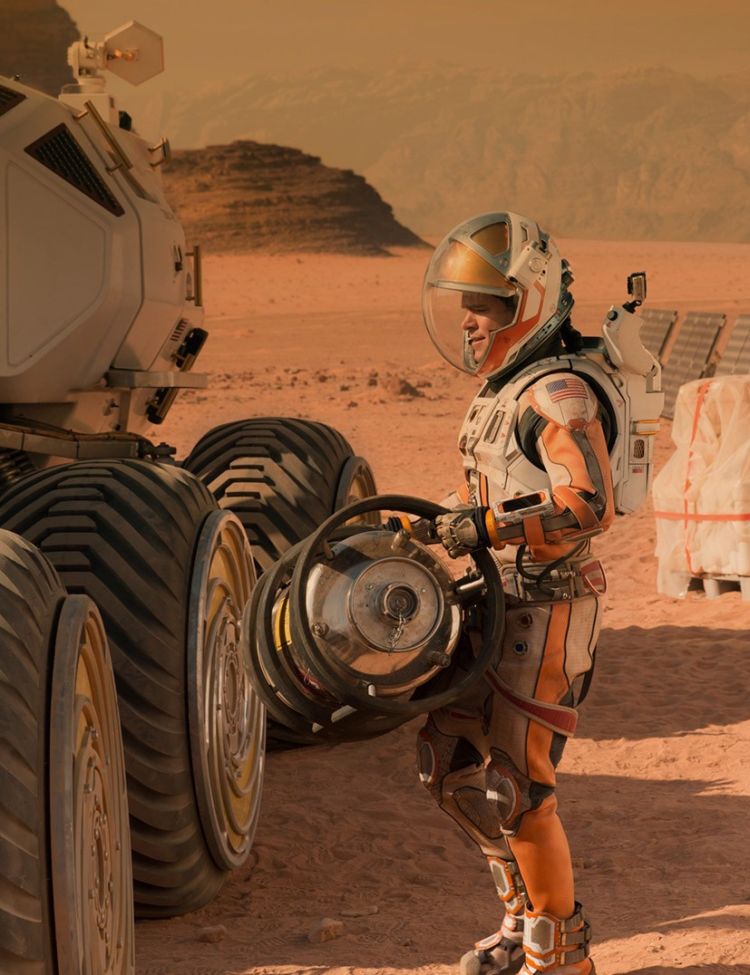
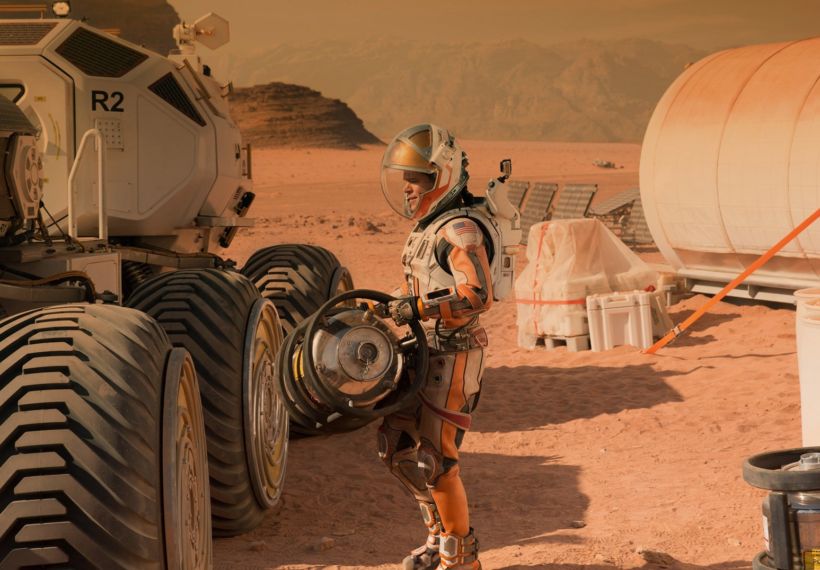
Part of Mark Watney's survival was knowing where past sources of energy and rocket ships, and because we'd been to Mars before.
Right.
And so he's got to get around, and so he's got a rover.
Yeah, he goes to the Ares IV eventual landing site, where they have sent.
Because this was Ares III.
He was on Ares III.
Ares IV, they had already sent the Mars Ascent Vehicle, and it was sitting there making its fuel, and all the presupplies hadn't come yet, but they had sent the MAV.
And so Mark.
By the way, which is a completely sensible way to do future space exploration.
You just send supplies separately, no reason to risk lives doing that, and then you send astronauts later.
Once you've confirmed that the supplies made it okay.
Yes, and then they can pitch tent and set up and play house.
Mm-hmm, yep.
And so he realized that there's a spaceship capable of getting him into low Mars orbit, right there on Mars, he just needs to get to it.
The bad news was it was 3,200 kilometers away.
So he had to take these rovers, which were really designed for a 20 kilometer range before being recharged and drive 3,200 kilometers.
So it was quite a challenge.
Well, Adam, you led a team, Curiosity, a car-sized rover, to move on the surface of Mars.
Yep.
What would it take to drive that 3,200 kilometers?
A very, very long time.
Actually.
So it's true, she's only gone 13,992 meters in four years.
See, he used meters, now the number sounds bigger.
You got that?
A whopping 13,000.
Every guy knows that trick.
Yeah, yeah, it's a trick, it's a trick.
It's 13 kilometers.
If you do it in miles, it's even less.
It's like eight miles, okay.
But we're not, unlike Mark Watney, we're not hitting the gas and trying to get somewhere.
We are actually, well frankly, science-ing the s*** out of Mars along the way.
Okay, because you're not in a hurry.
We're not in a hurry, we're exploring.
We're looking at the surface of Mars.
We're learning about its history.
We're learning about its ancient environment.
We're searching for the possibility that it could have supported life.
But as evidence of how slow and how methodical and interested our science team is, we went to the Gale Crater for some clay minerals that we saw from orbit, signatures of clay minerals.
So clay is where there was water and deposits that settle and then you just for the non-job.
Yeah, like the bottom of a lake bed kind of feel.
We still haven't got to that deposit that we saw in the entire time that we've been on Mars.
And yet we've done a whole lot.
Because you've been busy.
Because we've been busy.
Because it's been stopping for pee breaks.
All right, so let's back up for a minute because your specialty was getting the thing there safely.
Yes sir.
So that the scientists could do their job.
And so what I remember from Spirit and Opportunity, the previous round of this, they had like airbags.
So the thing comes down and airbags deploy and it bounces until it stops.
Now you have Curiosity, because those were the size of like microwave ovens, let's say.
Yes.
Okay, so Curiosity is the size of a car.
And why not use airbags again?
So there are no fibers known to humankind from which we can make a fabric, from which you can make a bag that could handle the loads of that car-like rover hitting the surface of Mars.
Okay, so now actually you used what I told is called a sky crane.
Yes.
This sounds complicated.
What is that?
It's like a jet pack.
It's like a jet pack.
The rover was sort of wearing a jet pack and then about 25 meters from the surface of Mars, the jet pack lowers the rover below it and the two descend until the rover's on Mars.
Okay, I think we have a video of this.
Can you be the narrator voice of this?
Drew, you got the video, let's check it out.
Okay, talk us through it.
All right, so we hit the atmosphere going quite quickly, about 13,000 miles an hour.
That's fast enough to burn up or melt the whole spacecraft.
That would be uncool.
So we wrap it in a special shell.
We actually steer our way through the atmosphere.
This was the first for this expedition and that's where you see those rockets going off.
We're actually maneuvering in the atmosphere.
And then when we've slowed down to about a little less than 1,000 miles an hour, we open up a parachute.
In our case, the world's largest supersonic parachute.
We open it up to Mach 2.
We get rid of the heat shield that protected us from atmospheric entry and then we let go and we go on to rockets.
Now you can see a rover with its wheels.
There's six wheels.
They're all sort of tucked up and it's got this jet backpack on top of it.
It's slowly descending into the Gale Crater.
We're looking at the ground with a radar and then here we do the sky crane maneuver.
We lower the rover below us, drop the wheels down.
Both vehicles continue to descend until Mars takes up the weight of the rover.
We sense that, cut ourselves free, and fly off to a safe distance.
I uh...
I uh...
I uh...
I uh...
I uh...
I uh...
I uh...
I uh...
You know that's what happened in your room.
You know that.
Well, I could, no, I could, absolutely not.
But it is absolutely true.
It is absolutely true that the entire team recognized that if it didn't work, we were gonna get no sympathy from anybody.
Because people...
No, it's not a matter of no sympathy.
There would be like, you know...
Oh, a prosecution?
I'm beginning to see why you were so happy when it landed.
Yeah.
Yeah, so congratulations.
And it's all about dropping speed to zero in a way that does not destroy the craft.
Yes.
Now, I gotta call this out.
In that video which you guys produced at JPL, the craft made noise before it started feeling the heat of the atmosphere.
Right, yes.
I just, you know.
Yes.
It whizzed by in the vacuum of space.
I just, I think it was its rocket, its reaction thrusters were making sound.
And the sound came through the vacuum to my ear.
No, it was the transducer that was present actually.
It's just a recording.
He's making, he's making.
Oh, so it was a recording device in the craft that you were bringing outside.
So we could, it's as though our ear is on the metal of the craft.
Yes.
At what age, Neil, did your teacher start to hate you?
Okay, the earliest, I've never gone public on this.
The earliest incident was I was in kindergarten and I drew with my crayons the night sky.
And, but it was not necessarily from Earth, it was just space.
And I drew it completely black, but with some dots of white crayon.
And the teacher said, no, the sky is dark blue.
The night sky is dark blue.
And that didn't make any sense to me at all.
And she later the next day checked on it, came back and apologized.
Wow, great kindergarten.
Yes, good teacher.
That's the Neil deGrasse Tyson origin story, right?
We'll tell Marvel Comics, okay?
I'll get my own movie out of that.
So the rover cost how much?
You know, $2.5 billion.
$2.5 billion?
Yes.
So $2.5 billion is probably the other reason you were relatively happy when it landed.
Yeah, well, and a decade of my life.
So listen, we've got an uncrewed rover there, moving around slowly, but if you send people, we're going to want to move faster than that, presumably.
And Mark Watney in The Martian had like a human sized rover, like the kind of rover they used on the moon.
I mean, big, you can drive.
So how, presumably, they're going to find you when that time comes to land one of those suckers.
Perhaps, yeah, certainly we work together with the folks who are doing the human exploration.
At Johnson, absolutely.
Because you guys have this sort of, well, all the engineers have good mechanical background on this, right?
Yes, and we're all working together at the same purpose.
And so, so you, if I imagine humans on Mars, I would want a rover that moves faster.
Yes.
Than your Curiosity rover.
Yes.
Okay, and when is the next time we're going to send another rover?
We'll be sending a rover in 2020.
2020, so another one of these Mars windows.
Yep, it's going to be a rover very much the size of Curiosity, it's actually a little tiny bit bigger.
But even more profoundly, I think, it's going to select samples to be cored from the Martian surface, placed in specially sealed containers for possible return to Earth.
In some other planned mission, yet to be funded.
In another mission that would yet to be funded, that would follow it on.
But the incremental nature of this is not unfamiliar to NASA.
When we went to the moon, every next mission was an increment on the previous one before we landed there with astronauts.
Yes, almost all the big stuff we've ever done as human beings has been incremental, whether it's castles, bridges or spacecraft.
We've got to wrap up this segment.
Adam, thanks for being on StarTalk.
Oh, my pleasure.
Thank you.
Breaking down the Martian and the Rovers.
Coming up next, can you actually grow food on Mars?
That's next on StarTalk.
This is StarTalk, the American Museum of Natural History, the hall of the universe.
We're talking about what it takes to survive on Mars.
Featuring my interview with Andy Weir, author of The Martian.
And we've been exploring not only what it takes to land on Mars in this show, but now we want to know what it takes to live there.
And we've got just the guy to help us out.
So let's do this.
Joining us on StarTalk, special guest, Jim Green.
Jim, welcome.
Jim is a friend and colleague, and he's up from NASA headquarters in Washington, DC.
So you oversee solar system exploration for NASA.
That's right.
That's a big job.
Cassini, Dawn, Pluto, New Horizons, Mercury, so Cassini went to Saturn.
Yeah.
Dawn went to an asteroid.
Two.
Two asteroids.
That's the series.
Okay.
A messenger to Mercury, New Horizons to Pluto.
Right.
They can't hide out there.
They can't hide.
I'm on it.
So if I land on Mars, and I want to come back as early as possible after that, what is the launch windowing for me?
So we can go in 180 days, get down on the surface for about 30.
Just to be clear, you can take six months to get there.
On that order.
A little more depends on the opportunity.
Then you spend 30 days.
Right.
Then you got to get your can back, so to speak.
Get in the can and get it back.
So 30 days keeps you in that same window.
Pretty much so.
But in The Martian, Mark Watney is stuck on Mars for way longer than that.
And he grows his own food.
So I had to ask the Martian author, Andy Weir, how do you do this?
How do you survive 500 days?
Let's check it out.
The surface of Mars is not soil in the way we think of soil on Earth.
Soil on Earth has microbes and organic molecules.
Not so much on Mars.
So what does it mean to farm on Mars?
So the first thing you need to do is breed dirt.
So you start with Martian soil.
Well Martian regolith, really.
It's just...
So regolith would be a surface of basically powderized rock.
Right, and it's devoid of life.
It has literally nothing, we're assuming, at the moment.
And then you inundate it with water.
You inundate it with biological material, poop, yes.
And then you inundate it with the bacteria that is found in Earth's soil.
And that will make it a suitable environment for roots to germinate.
So it's not really Mars farming, it's Earth farming on Mars.
Yes.
Earth farming on Mars, do you agree with that?
Yeah, that's true.
But Mars is going to help us a lot.
So what Curiosity has done is it is drilled below the surface.
And we know Mars is really red.
And the scientists got incredibly excited when our first drill, we drilled up gray material.
So we scooped that into our instruments, tasted it.
And it had carbon, hydrogen, oxygen, nitrogen, phosphorus and sulfur.
Nitrates, okay, and the soil was moist.
So basically fertilize it, right?
Well, the nitrates are, yeah, you're still going to have to add a lot to it.
And the soils also were curiosity.
Stop.
You got through the top surface of Mars, which basically has no organic anything, you get to a lower level that's not rusty red, and you get a full portfolio of atoms that make organic molecules.
Correct.
As well as fertilizer.
Correct.
So, would this mean that at one time in Mars' past, it was an oasis?
It could have been.
We do know that in Mars' past, that it had a significant amount of water.
At about 3 billion years ago, 30% of the Northern Hemisphere was covered with water, and in some places over a mile deep.
So let me get back to Mark Watney's potatoes in poop.
Yeah.
His potatoes in poop, how realistic is that?
That's a good question.
It's reasonably realistic.
Curiosity tells us...
Just in case you missed it, he needed fertilizer and went to the toilet...
Dispenser...
.
dispenser place where all the human waste is wrapped in packets because it doesn't...
Oh, it took the water out.
Oh, it dehydrated it.
Oh, I'm sure you had to recirculate that.
You're not throwing water away on Mars.
Especially not out of your poop.
Right.
Okay.
So it's dehydrated poop that he then uses as fertilizer for the plants.
So that's clever.
Very.
And it's realistic.
Yeah.
I believe so.
But some of that still needs to be researched.
So one way to imagine you're on Mars is to pretend you're there here on Earth, right?
And so they're researchers at the Hi-Seas Research Station in Hawaii.
And a crew member, that's what they're called, Sheyna Gifford, sent us a video dispatch from this simulated Mars habitat.
I didn't even know such a thing existed.
Let's check it out.
Hi, Neil.
Welcome to Hi-Seas, the Hawaii space exploration analog and simulation.
And I'm really excited to give you guys a tour.
This is the biology lab and this is our astrobiologist, Cyprien Versot.
Most of the experiments we're doing here in this lab are designed to figure out how we can live on Mars from what is already there using biology.
One of the alternatives I'm working on is based on cyanobacteria, which are basically green microbes.
You can see them here, which do photosynthesis like plants.
And they are very interesting in this context because we could use nutrients from the ground, gases from the atmosphere, and water, which we can find in different forms on Mars.
And once we have grown them, we can use them to produce basically everything you need.
Fantastic.
All right, so remember to bring the green bacteria.
Cyprien is doing amazing work here and so are some of the other crew members that you'll meet soon.
All of our work is powered quite literally by the sun.
So let's look outside so you can see the solar panel system.
That's where we get almost all of our power.
So we have to go outside to go cave exploring or collect rocks.
We put on these suits.
We do our science.
We do our exploring.
We come back.
We recompress for five minutes and then we can enter the habitat again.
Around the corner is maybe the second most important feature to the HAB after the power system.
This is our toilet, it works without water, no flushing and then one thing you didn't see through the window is we have a solar stove outside that is used to distill the stuff that is contained in these little buckets.
So question, if we really needed to, could we use what we collect in these toilets to grow food?
The way Margot ate it?
I wouldn't really want to do it inside the HAB.
I'm pretty sure the smell is not very nice.
No, we haven't had to go there, but we could.
Okay, well that's almost your entire tour of Simulated Mars.
Last thing before we go, Neil, I just want everyone at home to know, we Martians heard your podcast about what you would do with trash on Mars.
Our answer is, what trash?
Everything continues to have a use, it's a cycle, it's a loop, and that's how we're going to survive in space.
We look forward to seeing you as soon as we get back to Earth, or maybe you'll join us here on Mars.
Thanks guys.
Alright.
Well, up next, we're going to answer your questions about surviving on Mars on StarTalk.
We're talking about Mars, surviving on Mars.
And right now, it's time for Cosmic Queries, a fan favorite.
And these are questions we solicited from our fan base, and you got ahold of them somehow.
I got the questions.
So somehow you got ahold of them.
I got them.
And whatever I can't answer, I'm handing over to Jim, and it might be all of them, so bring it on.
This is called from the internet and other sources of our social media.
Go for it.
All right, Neil and or Jim.
Seth Kane from North Hollywood, California asks, would underground settlements be more feasible for long-term colonies on Mars for protection from solar radiation?
Ooh, Jim.
Absolutely.
Good answer.
In fact, you know, what we are looking at.
How bad is the solar radiation?
Well, you know, we have two major sources that we have to worry about.
One is called galactic cosmic rays that comes from within the galaxy, bombards our solar system in every direction.
High energy particles.
High energy particles.
Those are the one that probably gets you more than anything else.
Gets you cancer.
And then the solar.
Solar flares and solar coronal mass ejections.
Those accelerate particles to very high velocities and sprays them all over the place.
But we have ways that we can see how the sun is behaving and provide alerts.
I like the way you say we have ways.
We have, we have.
It's very sinister.
So this is basically space weather.
Space weather.
Is where we monitor the conditions of space.
And in the future where we might have colonies or any other activity, we would just alert people, get behind the shield for the next 20 minutes.
No different from a storm is coming, get inside.
Next question, go.
All right, Nick Hernandez.
Thanks Jim for helping me out on that.
Nick Hernandez from Fukuoka, Japan.
I probably mispronounced that.
Says, what sort of vehicle and power is needed to get a lander off Mars for a return trip home?
And how would this vehicle compare to the Apollo lunar lander?
Ooh, nice.
Jim.
Ooh, all right.
So it's gonna be.
I'll start you off.
Okay, so they pop on the moon, it's one sixth of earth gravity.
So you can sort of run some numbers from that.
Mars is like 40% of earth's gravity.
So whatever it is, it's gonna have to be a little more.
That's all I can say.
Okay, now you take it from here.
And a little more than that because of the atmosphere, because it has to plow through that.
Now even though that's a percent of our atmosphere, it's still something you have to take into account.
The air resistance of its movement.
So these have to be pretty hefty vehicles.
There you go.
Thank you.
Next question.
All right, next and final question from Mikey Bauman on Twitter.
And I think this is the most important and serious question of them all.
Says, if left unprotected in the Martian atmosphere, how long would a Mars bar survive on Mars?
In the Martian atmosphere.
You know Mars bars last decades here on Earth.
Well, they get that sort of white stuff on the chocolate if you leave it for too long, right?
Right, but if you close your eyes, you don't even notice it.
You know what the white stuff is, it's just chocolate.
It's cocoa butter.
It's the fat of the chocolate rising to the top.
So it's becoming unmixed.
There was a guy in the audience right there who had the face of like, how does he know everything?
No, I think a lot about chocolate.
My wife makes a lot of desserts.
So I know more about chocolate than I should.
So when people describe you as their favorite chocolate scientist, I always...
Now, sidewalk science correspondent, Chuck Nice, he took to the streets of New York to find out more about our collective love for Mars.
Let's check it out.
We're at a train station.
Would you take a one-way ticket to Mars?
I don't think so, because I feel like there's other people in the field that are a lot more out there that can actually make Mars successful.
Yeah, I'd do it.
Really?
You're a brave man.
I'm a history teacher, so if I can make my mark in history, I would do it.
Sure, yeah.
Okay, now you're forever living on Mars.
Well, that's fine.
How about a one-way ticket to Jersey?
Would you take that?
No.
No.
Wanna go to Mars?
All right.
Like Matt Damon did, he put his, and he fertilized his, and made potatoes, you know?
Basically.
I don't think you can say fertilize on TV.
Up next, Bill Nye the Science Guy imagines soaring over the surface of Mars.
So, let's see what he has to tell us tonight.
Hey, Neil, how's it going, man?
Bill Nye here, we're flying over you.
I don't know if you can hear me.
The Rose Center looks beautiful from here.
Soaring above the city gives you a new perspective on the world below.
From up here, it's easy to imagine streaking through the skies of Mars, searching for a place to land or even set up a colony.
Now, the first Americans who lived here lived in small villages.
There were only about 400 people on the whole island.
Today, there are 4,000 people on every city block.
But just look at all these shapes.
Everything here came out of someone's head and that person or those people understood science.
Now, through the tradition of our innovations and technology, we've been able to construct these skyscraping buildings and the tendrils of trains and tunnels that connect the 8 million people bustling about below.
When I look from up here, I realize how important stories like The Martian are.
They're inspiring.
They help us realize how much we can accomplish when we work together as we reach for the next frontier.
Back to you, Neil.
Neil!
So I'm actually on record for my skepticism regarding the first settlers on Mars.
Because when we think of the pilgrims as an analog, the difference between the pilgrims landing in the New World and the first team of humans landing on Mars is that in the New World, when they got off the ship, they could breathe the air.
Trees were made of wood like the trees back at home.
They could rebuild damage to their ships.
Food was growing on the branches.
I thought of the first colony of Mars as being way more hazardous than what the colonists experienced crossing the ocean.
But then I saw the movie The Martian and I realized that that's the wrong analogy.
I wasn't thinking about it the right way because the difference is that today we have the advances in engineering, science and technology that empowers us to take on frontiers that without it would kill us in an instant.
And this is a Cosmic Perspective.
You've been watching StarTalk.
See the full transcript




 Unlock with Patreon







 Become a Patron