


 Unlock with Patreon
About This Episode
Could a coronal mass ejection wipe out all electronics? Neil deGrasse Tyson and comedian Matt Kirshen learn about The Carrington Event, eclipses, and how the Parker Solar Probe doesn’t melt with heliophysicist Lika Guhathakurta.
How does energy get out of the sun? What happens below the sun’s surface? We break down the photosphere, helioseismology, and the sound of the sun. We discuss the 2024 North American solar eclipse and some of Lika’s favorite eclipses. What makes some longer than others?
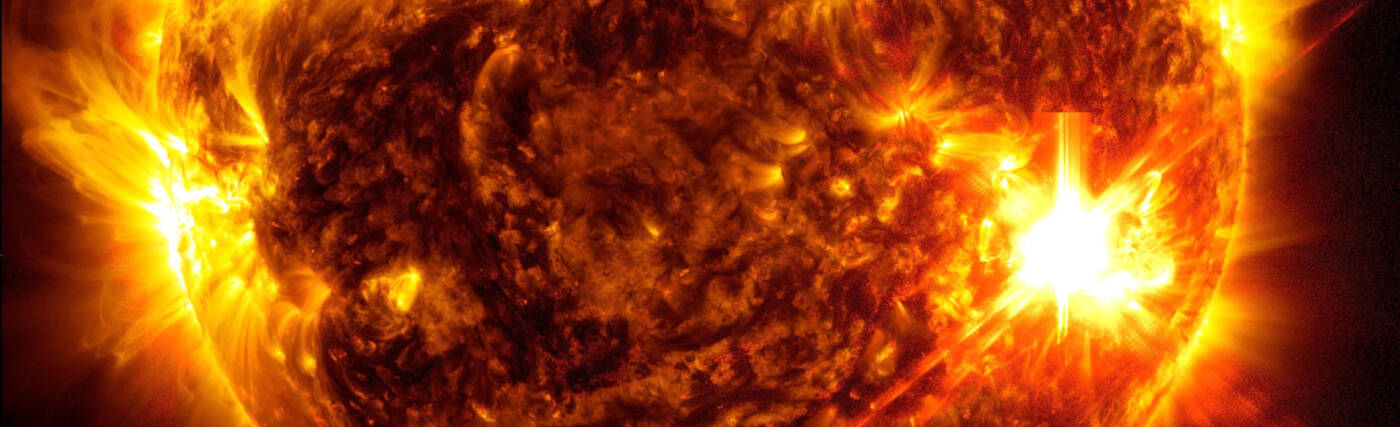
We explore the category five coronal mass ejection that caused colorful auroras more south than before. What determines the color of the aurora? How much notice do we get before a CME reaches Earth? Can we predict when they happen? We break down the 1859 Carrington Event and what it would look like today. Could a CME wipe out all electronics? How big would the CME have to be?
Learn about the Parker Solar Probe and its mission to get closer to the sun than ever before. Could we touch the surface of the sun? How does the probe not melt? Discover the solar cycle and how AI is helping with solar research. Plus, could we ever control the sun?
Thanks to our Patrons Sharon Zapotocky, Suth Truong, Sarah Perry, Souren Sarkar, Margaret De Foe, Rudy Alleyne, Ralph Velasquez, Adam Anton, Jon, and Chris R. Mish for supporting us this week.
NOTE: StarTalk+ Patrons can listen to this entire episode commercial-free.
Transcript
DOWNLOAD SRTSo Matt, I don’t know if I know more or less about the sun after that conversation.
I’ve definitely lost some confidence in my knowledge of the sun, but at the same time, I feel like if I’m sufficiently drunk at a party now, I can say some things with seeming confidence.
With seeming confidence.
It’s the magnetism, guys.
You’re focused on the heat, but magnetism is where it’s at.
Yeah, magnetic fields are invisible and mysterious.
In fact, it’s the material of the sun that tracks the magnetic fields that tell us what it’s doing or what we think it should be doing, whether or not it’s behaving.
I’m also a little bit more scared of the sun than I was an hour ago.
It’s earned some more respect out of you than before.
I’m not going to badmouth it in case it’s paying attention.
Welcome to StarTalk, your place in the universe where science and pop culture collide.
StarTalk begins right now.
This is StarTalk, Neil deGrasse Tyson here, your personal astrophysicist.
I got with me Matt Kirshen, my co-host.
Hey, how’s it going?
Welcome to my office here.
It’s very nice being back.
At the Hayden Planetarium of the American Museum of Natural History.
I got to walk past dinosaurs.
I’m in the office with all the science ties and the telescope.
The stuff and everything here.
All the business.
And you’re here in the daytime, so all the animals are in place.
Yeah, all the animals are currently pretending to be just exhibits.
And all the kids are around and then everyone goes and then we know what happens.
So welcome to New York and you’re normally in LA.
I am.
Hosting your own podcast.
Yeah.
Probably science.
That’s where we do it from.
All right, one day it’ll be definitely science and then call me.
It’s never going to happen.
We’ll call you for sure, but it’s never going to get upgraded.
So today we’re doing an entire episode on the sun.
I’m aware of that thing.
Yeah.
You’ve heard of the sun.
I’ve heard talk of it.
Yeah.
Yeah.
The sun’s been busy lately.
Oh, it’s been hiding.
Hiding and then not hiding.
And then it’s been sending off a little.
It’s been spotting.
It’s been a…
I know a little bit about the sun, but not enough to make a whole episode out of it.
So we’re going back to our good friend from NASA.
Welcome back to StarTalk.
Lika Guhathakurta.
You do that very well, Neil.
You got that right soft touch.
Oh, thank you.
Welcome back.
You are a heliophysicist.
We’ll get to that in just a moment.
But with NASA, and you’re the lead program scientist for NASA’s Living with a Star initiative.
I used to be.
Oh, so what is living with a star?
Not that we have a choice.
It’s just as we say it, but it’s a program.
And it tells you, you know, how to understand the sun so that we can live with its various whims and fancies and storms and everything else that you’re seeing.
So the sun has attitudes.
You wouldn’t believe.
I think it’s a teenage star.
Oh, teenage.
Oh, oh, oh.
Plus it has acne.
Oh, God.
So your older stars, your ones that are in the process of dying out, you know where you stand with them.
They’re a little entrenched in their views.
You know, it’s good to raise children like I have, too.
And so you better understand it.
You know, actually, it’s kind of funny.
Star cycle and human life cycle, there are lots of parallels.
It’s kind of wonderful to use analogies sometimes, right, to describe.
And that’s why I say, you know, yeah, the sun is kind of in its bad adulthood phase.
It’s rebelling.
All sorts of, we don’t know what it is doing.
We were not there when it was an infant.
Well, that’s why I brought you in here to tell us what it’s doing.
Now you’re fessing up and saying, you don’t know what it’s doing.
Let’s back up.
So heliophysics, does that mean you get more physicists coming to your field than astronomers who look through telescopes in their lives?
Yes.
And it’s not just looking at the sun, right?
Heliophysics is a connected science, interdisciplinary science, where you understand the sun as a star and its impact on everything else it touches.
And it touches everything, Neil.
The sun in its environment.
As a star and in its environment.
And its electromagnetic connection to everything else in the solar system, out to the edges of solar system, interstellar medium.
So do you care only what comes off the surface of the sun?
Would you care what the sun is doing deep inside?
Absolutely.
I mean, if you don’t know what’s creating the energy, you know, how do you know whatever else is happening?
And I’m not telling you that NASA devotes time to kind of creating missions that probe into the core of the sun.
But we have learned that right over time.
So what we are doing now is trying to figure out, you know, that energy that escapes from fusion and sort of percolates through the core into convective zone.
And that’s where kind of all these googly gooks happen.
All right, enough of the technical.
Tell me down a bit for the lay person here.
What are we talking?
So this energy takes a long time to come out.
The radiation, right, from the fusion basically.
And it then percolates through the convective zone where all of the material, you know, all of the atoms, they are all blasted into their native elementary world, right?
Electrons, protons, ionized nuclei.
So these are charged particles.
And getting charged by the blast of this radiation, sun rotates kind of in a weird way.
And many planets do.
It’s a differential rotation because it’s not a solid body, right?
It’s got a different place, different latitudes rotated different.
Yes.
And all this creates, it’s like basic dynamo, right?
So you have charged particles rotating.
Oh, so that causes magnetism.
Yes.
That is the key.
And what do I get?
What do I win?
Nothing.
So it creates these convection cells and all that.
And they take a long time, you know, to kind of percolate up.
And so these are the things.
We try to probe inside sort of this photosphere, the yellow ball.
We see…
But you can’t see inside.
So how do you get in there?
We can’t see, but we can hear.
But we can’t hear either.
It’s on a spectrum.
She’s making it up.
Let’s not compare the universe with our limited range of sensory perception.
So that’s what we are doing.
So we are picking up acoustic.
So, yes, sun is opaque to sort of radiation because it takes so long for it to emerge out from the core into the surface.
That’s why we can see it as an object in the sky.
Right.
But acoustic waves, it’s transparent to that.
When we figured that out, it’s okay.
Like, I can see you in one way, I’ll try another way.
So, we measure acoustic waves.
We are.
We’re at NASA.
That’s what we do.
You know, but the cleverness is not at NASA.
It’s all of you.
It’s the entire academic, you know, aerospace world.
They are the clever people.
We just have to figure out how politically to maneuver an idea to create enough political will and resources so it will be funded.
OK.
That’s the making the sausage part of this.
So you said acoustic waves.
Does that mean like the sun rings like a bell?
Yes.
Yes.
So it’s for fun, actually.
We do create what the sun sounds like or any other data.
You can put it right into a sort of spectrum of what it would sound like if we could hear.
because the pictures are different, right?
Our hearing perception is very different from the way the sun rings.
But absolutely it does that, right?
I mean, there’s this…
Sound penetrates through.
Yes.
And so you get like…
I know what geophysicists do.
For earthquakes.
In an earthquake.
Same thing.
Oh, yeah.
The waves move through.
So helioseismology…
They bend.
They can tell you how dense the core is.
No, it doesn’t go as far as the core.
Not for the sun.
Not for the sun.
But on Earth, you can get through the whole Earth.
Helioseismology is the biggest thing.
We see the unseen.
Did you come up with that word?
She just said that.
I didn’t.
I didn’t.
He used it himself.
No, no, we didn’t use that word.
But I did successfully repeat all the syllables without messing them up.
I’ll take some Friday night.
So if there is helioseismology, does that mean that there are bad places on the sun to build a house?
Like, are you…
because I live in California.
I know that’s a concern.
Oh, so you’re sensitive to this.
Exactly, it’s something I’m…
I wish, you know, that earth would behave like sun, then we would have more of these sensitive sounds, you know.
I mean, on earth, you have to have a massive earthquake to kind of generate these frequencies.
On sun, it’s routine.
Okay.
Do not build any house.
There’ll be car, you know, card of house or house of cards, something like that.
Collapse.
Do not.
Okay.
There goes that plan.
Let’s look at the sun’s resume for this past year.
So there was the total solar eclipse that went across the Americas, Mexico up into Canada.
And where were you for the total solar eclipse?
First of all, I wish I wasn’t there.
But I was because I didn’t get to see the corona.
Why?
Where were you?
The eclipse was eclipse for me by the cloud.
Oh, the eclipse got eclipsed.
It happens.
And only Earth can do that.
Earth science people, I complain at them.
Like, manage your cloud.
No, no, there’s that whole other…
NOAA has the National Weather Service.
Yeah.
Like, what are you doing?
Don’t you get the message?
So where were you on Earth?
So I was in Bandera, Texas.
Not very far from San Antonio.
And you’re thinking that Mexico, Texas should be clear, even when New England isn’t.
And it was exactly the opposite.
Completely.
I mean, do you think this is global warming?
No, I’m joking.
It’s messing with us.
You can’t have cloudy Mexico and clear Maine.
Something’s wrong there.
Very disappointing.
So you were plunged into darkness nonetheless.
Yes.
But let me tell you some of the good stories of that.
So this was my thirteenth eclipse of…
Humble brag.
Yeah, I just was at 13, a 12.
I lost count.
It’s a dozen, plus or minus.
I’ve had one.
I’ve had one total eclipse.
And that was not the one just now.
That was in England in the late 90s.
1999.
That was it.
I was in Turkey.
Oh, cool.
See, eclipse people know chapter and verse, year and everything.
Yeah.
Some can recognize an eclipse on sight, a photo of an eclipse, because the corona is never the same.
Oh, so you look at a picture of an eclipse and go like…
Like that.
Oh, yeah.
2004?
You have to be a badass.
And we got a badass woman right here.
So if you’ve seen 13, so what if you miss one?
I’ll be honest with you.
When you said recognize an eclipse on sight, I thought at first you meant like, that’s an eclipse there.
Oh, no.
High talent to do that, yes.
Not that I have a pretty high ranking in NASA or anything, but that there is definitely, I’m telling you right now, that’s an eclipse, so that is.
We are not that high ranking.
You can just be yourself.
You know, before long, you’re going to ask me questions to which I’ll say, I don’t know.
So I’ve seen one of the longest eclipses on record, because I’m that old, back in 1973.
UN, oh, 73.
Yes.
That was.
That happened here, not in India.
I hadn’t made it to, yeah.
Okay, so this crossed the Atlantic and went into Africa.
That eclipse went across Earth’s equator, which puts you deeper into eclipse shadow than you’d otherwise be, because Earth is round.
Okay.
All right.
Yeah, just get used to that, right?
Okay, dropping the bombs on there.
It’s not flat.
It is not flat.
And the moon was at Perigee, so at closest it was to the Earth, so it’s big.
And in June, July, we are farthest from the sun.
So we had small sun, big moon, equatorial.
So at peak, the eclipse was seven minutes and four seconds.
But I was on a ship and we had to pull away because there was a dust storm that kicked up.
So I got only six minutes and 38 seconds.
That’s still cooking.
So my longest was 1991.
I know that one.
From actually Baja, Mexico.
On the beach.
I started the eclipses.
But didn’t that go through, wait, that one went over Mexico City.
No, it went through Mazatlan.
Did it also go through Mexico City?
I thought that was Mexico City.
So it was like 10 million people.
Oh, yes, it went through, you know, Hawaii.
It went over our biggest telescope in Hawaii.
That’s right.
It was insane.
This is before I started actually even using eclipse as my source of observation and research.
I did eclipse work.
This is like a whole continuum for me.
A branch of yourself.
Yeah.
It is my life cycle, my career life cycle.
It’s going to be like Christmas for a heliophysicist, right?
You know, he started with that, right?
Like, oh my God.
I mean, what is the resume of the sun this last year?
We had two eclipses.
We had an annular eclipse in October, a total solar eclipse.
Tell them what an annular eclipse is.
So annular eclipse.
I had never seen one before either.
Yeah, they have their beauty on their own, but it’s still not a total eclipse, but yeah.
And then so annular eclipse is when you cover the photosphere such that, and so he was talking about, you know, Apogee and Perigee.
Moon is further away, it can’t cover the whole photosphere, right?
So it’s covering the central part, and it leaves actually a little bit of luminosity.
It’s like a ring.
So you can’t see the corona.
If there is any, any shadow for the spheric light.
It drowns out everything.
It drowns out, the corona is very low.
But it is gorgeous.
Yeah, and it’s from the Latin annulus ring.
So annular, not annul.
That makes sense.
Right, right.
And so it’s a beauty unto itself, but you still need filters to see it.
But you look up at the sun, it’s like, what happened in the middle of my sun?
And if we were prone to superstition, we think something punched a hole through the sun.
I’m Nicholas Costella, and I’m a proud supporter of StarTalk on Patreon.
This is StarTalk with Neil deGrasse Tyson.
So now, everyone says, alert, alert, big explosion on the sun.
CME category five.
Please tell me about the sun burping up these gases.
So sun’s always done this.
It’s always done this.
Always done this, but see, that’s why heliophysics exists.
We adopted this name.
We made it up, and we use it to talk about our connected sun or sun solar system, sun interstellar medium science, physics, okay?
And so now we are popularizing it, and so we have more technology, we have more satellites.
So what’s happening, we’ve been studying this very well with Living with the Star initiative, with Solar Dynamics Observatory, with the, yes, with STEREO, which was not part of LWS, but that was my first mission.
And that was in fact two.
Two, two.
Two, yeah.
And these are incredible.
So in the last, I’ve been at NASA headquarters since 1990, December.
Washington, DC.
Right.
And the things I have got to do in my lifetime, it’s like, feels like it’s insane.
So STEREO, SDO, Parker Solar Probe.
We’ll get to that.
We’re gonna get to Parker Solar Probe.
But that’s part of this resume part, the heliophysics big year is going to end with this big bang.
I’m gonna get to the Solar Probe.
So, what did you do to the sun so that half the world saw Aurora for the first time in their lives?
What did you do?
What knobs were you turning?
Yeah, this is definitely not something you should be seeing just outside of Watford.
No, no.
And I’m hoping that the series will continue.
So people haven’t talked about it.
It’s been seen as far south as Ladakh, India.
34 degrees.
So that’s the same latitude as Los Angeles, okay?
Except you’re not going to see the aurora because…
Yeah, lights.
Aurora is, if anybody’s in the way of the aurora, you ain’t seeing it.
Well, can I ask, well, I’ve got two physicists with me.
A bunch of the people, my friends and family back in England were saying it looked like a bit of a glowing sky when they were just looking at it with a bare eye.
And then they took pictures with their phones.
And that’s where they got the crazy light show.
So why is that?
Cameras have different sensitivities.
Remember, we don’t hear, we don’t see like the way we want to, but our cameras, yeah.
Okay.
Period.
But there are people.
So I’ll tell you something about that.
So there is a sequence to the light we see, right?
So the stronger the storm and the coronal mass ejection, the more energy sort of pumps into Earth’s atmosphere and all these neutral molecules or atoms, you know, like nitrogen, like oxygen, they start emitting, they absorb this energy and they start emitting light, you know?
And so when that happens, we see the light.
So if you’re seeing green, blue, it’s like atomic nitrogen, maybe 50, 60 kilometers high.
When you see that red light and that doesn’t happen very well, very often, it is atomic oxygen, you know, and it’s not just the outer electrons kind of jumping to a lower state, right, or disappearing.
It’s the inner electrons closer to the nucleus of the atom.
So it requires a lot of energy to pump them and eject them.
That’s when you see the red light.
So it’s very special and it tells you a lot of stuff.
Where in the atmosphere?
But you can back analyze the coronal mass ejection just from the aurora that…
You know, well, I mean, it’s much more complicated because lots of things happen.
So coronal mass ejection happens on the sun, right?
It goes through the interplanetary medium, solar wind.
Solar wind shakes it up, changes, maybe a little bit of magnetic field, all of that.
Then it comes to 1 AU.
How long does it take to get to Earth’s distance?
It’s 93 million miles.
It depends on the speed.
So the coronal mass ejection is, say, ejected with a certain speed, say 400 kilometers per hour, per second, I forget.
Per second.
Whatever, yeah.
That’s still a long way to the sun.
No, so it can be, but it could be, you know, 1,000 kilometers per second.
That’s why I’m saying this.
So it can be, the fastest ones can come in about 24 hours.
And that, you know, is a big one.
When something is lofted with that energy, others take 3 to 4 days.
So we have enough time and we have models.
And that’s how NOAA is able to alert all of the people who are interested in what’s happening on the sun.
I was about to say, this is an acronym, isn’t it?
You guys love your acronyms.
There’s one thing I’ve learned about scientists over the years, a particular space scientist.
The National Oceanic and Atmospheric Administration, I think.
Yes.
So tell me how you measure the strength of the CMEs, the coronal mass ejections.
You know, now that we have sort of basic rudimentary understanding and we are observing this from various angles, we are able to actually, from just the brightness map, able to calculate its density, its mass.
We are able to see the structure move from one frame to the next and you calculate its speed and acceleration.
Then we have solar wind instruments at L1, where you are, which is like 93 million miles, and you are actually physically measuring the magnetic field, the density and the velocity at that point.
Okay, leaving no stone unturned.
Right, as much.
As much, so I’m told this was the most powerful you have a measure for, like it was a five.
G5.
G5.
G stands for what?
Geomagnetic storm.
So a solar storm that creates a geomagnetic storm.
Not all solar storms create geomagnetic storms.
Did not know that.
So there’s no six.
This was a five, but is there a six?
No.
It could be a six, there just haven’t been, I guess.
Well, I mean, if you had something like that, who would be measuring it?
It’s like Richter scale gone up.
So if that’s the sun blew off the side, I think we need a bigger number than five for that.
So is it, because again, this is just people talking on the internet, but are these things something we need to worry about with it knocking out communications or electronics or?
Totally.
That’s gonna.
Totally.
So it’s both, people talking on the internet, and it’s true.
And people can’t talk on the internet if this happens actually.
That’s a bigger problem for people.
It will be silence.
Radio blackout.
Wow.
The fact that they can still talk on the internet means it was not as bad as they’re saying it is.
How about that?
If the sun is bursting forth these gases often, presumably some of them are facing the other way, on the other side of the sun or off to the side.
So the only ones that we really care about are the ones that are pointed towards us.
Is that a fair, that we on earth care about?
No.
No.
I mean, we live on earth, but we have assets everywhere.
Excuse me.
I mean, what is NASA doing?
OK.
So this last one, you know, last active region, actually right now went to the far side of the sun and Venus is getting blasted.
And Venus people will care about that.
You don’t have to have people.
But do we still have something over to Venus?
We have satellites.
We have satellites, right?
At Mars, so robotic and human exploration.
So we are on some level electrochemical, robots are electrochemical.
These are charged particles.
What will they do?
They’ll short circuit.
Yes.
So electronics of any kind can get short circuited, you know, bombarded, saturated.
I mean, so why do we want to predict this so that everyone can take mitigating steps and they are all different.
If you’re a satellite in space, you turn off your electronic sensitive instruments, you kind of turn your solar panel, if you can, they’ll degrade.
If you’re an astronaut, you know, doing robotic excursion, you bring them in.
You bring them in, hey, we have good spots in space station where we know how to protect them.
Yes, exactly.
You duck behind the desk.
Right.
If you’re in ionosphere, you know, your GPS satellites can be host.
The ionosphere gets very active and energized, so it’s called scintillation.
All communication navigation is affected, you know, your phone, your internet, everything.
That’s what I was talking about.
You can have blackout.
It just doesn’t end there.
It goes further down.
The electric current that is produced as a phenomenon of this geomagnetic storm penetrates or its crust goes deep into the soil and it can create electromagnetic fluctuation, voltage fluctuation, for our transformers.
And that can lead to bigger shocks.
So it can blackout.
So the transformers that get taken out, it’s not because anything hit them directly from above.
Oh, it’s because the ground picked up charges.
It’s electric current flowing down.
It’s all, we only work in the realm of mysterious.
You can see them, you can touch them.
You touch them, you get born.
We have on record, is it from the 1860s?
1850s.
She knows where I’m going here.
I call it the Carrington event, where from what I’ve read, back then we had railroads and the most electronics we mastered was the Teletype and Morse code.
I’m told that there were like sparks coming out of these electronic instruments.
Very true.
And it’s not that you read, also I read, right?
I mean, that’s that’s how we gain information, right?
Objectively true information.
I didn’t read it.
So we got two out of three.
Yes, yes.
But you have to read it.
So, okay, so was that a five, a G5?
What was that?
That’s the thing.
We didn’t have anything to measure that.
I think it was beyond G5.
So you are absolutely on target.
I don’t think we know enough about the scale.
All right, so but so if that happened today, what do you think would occur?
It’s very difficult to say.
So the whole point is when a big solar storm happens, there are several things that goes on.
There’s the solar energetic particles.
There’s the electromagnetic radiation, which is the flare.
And then there is this expulsion of mass and momentum of charged particles called coronal mass ejection.
Three different things.
And they interact with different aspects of our technology.
So it is the coronal mass ejections that really impact.
That’s why it’s called geomagnetic storm.
It actually affects us deep inside.
If you’re outside the atmosphere, then there are other things happening, right?
Like satellites, like radiation poisoning for astronauts, etc.
Inside is the geomagnetic storm.
And unless you know what the Earth’s magnetic field conditions are and what the Sun’s magnetic field is, and what is that disturbance coefficient, it’s called DST, a parameter we came up with that sort of measures the index, planetary index for magnetic field.
That determines how devastating this would be.
And we have never, overall, so, you know, for Carrington event, the only station that could measure Earth’s magnetic field was in Mumbai, India.
Oh.
It’s fascinating.
Just one station.
So we don’t have good data.
That would have been Bombay back then.
Oh, that’s right.
It was always Mumbai.
The Brits are still running ram sample.
We’re talking about the 1850s.
No bristling here.
We are all friends.
An event that’s strong today could take out a thousand satellites.
I think that Carrington event, and I’m giving you Lika View, okay?
Lika View.
Yes.
It is no longer official.
It is a touchstone of heliophysics.
But given where we are today and our understanding, we don’t need a Carrington event to bring all of this technology to knees.
We’re much more susceptible.
Much more susceptible.
So we have had, you know, smaller storms that have caused devastation.
So we have to be always prepared.
And most important thing is it’s not good to be prepared if you’re not ready to take mitigating steps.
How often do you think can an electrical system turn off its power?
It’s not a joke, right?
So you have to be absolutely sure that something horrific is happening.
And with what fidelity can we give that information?
And that’s what we are, that’s why we try to understand it so high.
So the information that comes out from NOAA comes out with this science knowledge and we get better and better.
Another part of The Sun’s resume this past year has been to host the Parker Solar Probe.
And if I remember correctly, it set some speed records, because if you’re falling towards the sun but not gonna hit the sun, you’re gonna accelerate like there’s nobody’s business.
I’d imagine you gotta gap up a fair lick to stay in solar orbit that close.
Exactly, so all I remembered was that it set a speed record, which was something like 0.0% the speed of light.
0.1, 1.1, 10th the velocity of light.
If I strap your ass to it, it’ll still take you 20,000 years to get to Alpha centauri.
How heavy would I be if that was happening?
No, it’s too, nothing, you’re too, it’s too, No, nothing?
No, no, yeah.
It all happens in the high air.
You’re just going to vaporize before you feel the heaviness.
All right, I won’t go on it then.
She said you’d rather that than other fate that could wait you.
All right, I’ll cancel, I’ll go skiing instead.
So, plus I saw a headline that said Parker Probe touches the sun.
That can’t be right.
Yeah, this whole concept about seeing, hearing, touching, you know, we generalize it with our human perception.
So, touching the sun in this context is really, we have gone into an environment of the sun where there is a discriminator, basically, right?
So, this is where, you know, we talk about the corona, the solar wind that’s coming out of the sun.
And there’s like this boundary called Alfven boundary.
And so, inside the boundary, it’s really the magnetic field that dictates everything.
It’s like a magnetic boundary.
It’s a magnetic boundary.
It’s like it’s calling the show.
So, particles are really kind of paying attention to how much energy or momentum you have.
Nothing happened.
You come outside of that boundary, and then it is the electrons, the protons, with their energy, they are dictating the show.
They’re still coupled to the magnetic field, but who controls whom?
It’s a power struggle.
And we cross that boundary and go.
And that was really the goal, right?
What happens inside?
It’s like an event horizon for Black Hole.
And we have gone inside that.
To us, that is equivalent to touching, because we are measuring everything with our spacecraft.
Is it kind of like the solar version of deciding where space starts when you’re leaving the Earth?
Yeah, kind of.
The boundary of course, yeah.
And it’s a boundary, right?
And we thought it was just kind of a spherical boundary and all.
If you don’t have data, what are you going to do?
You can make up as many theories as you want, but it makes no sense.
Nobody will believe.
He can’t test it.
He can’t test it.
The idea is just floating.
Yeah.
And we are beginning to see the structure in this zone, in this Elfin boundary.
And we are inside it, and we are going to go a little bit closer in December.
So in December, it gets closer than ever before, the Parker Probe.
In December 2024, that is the end of heliophysics, big year with a big bang, where Parker reaches its closest distance to the sun, about 10 solar radii in the sun center.
So this is where we see the eclipse, right?
You see the eclipse, the white light corona, and it is in that environment.
So how does it not melt?
We carefully, you know, look to it, that we cannot have any embarrassment as spacecraft melting.
But we have practiced for a long time.
Truth be told, we’ve sent, you know, spacecraft to Mercury.
But the heat content is not very high because corona, it’s very tenuous, very few particles.
So if you put your hand out, you know, it’s not going to be bombarded by it.
Even though it’s 2 million degrees.
Right.
But it’s like it’s just hitting you.
Right, so it’s high temperature but the amounts of actual energy.
Energy is very low.
Yeah, okay.
Yes.
Okay.
So there are lots of things, you know, and the fact is that we know all these things, right?
So we can actually come up with this kind of engineering design.
It’s amazing.
So imagine if you were a free…
Like you brought this up, right?
What if you went into the corona?
If you were a free flyer on the Parker Solar Probe, what would you have seen?
It’s pretty insane.
You know, what you see when the spacecraft is moving and going through the jungle of magnetic field and everything else, right?
It’s very different from what we see through remote sensing telescopes.
It’s amazing.
So tell me why the sun goes through cycles and where are we in the current cycle?
Sun goes through a cycle because it’s moody.
Okay.
Having said that, we really don’t have a good answer.
You know, we don’t know…
We have seen enough pattern to kind of make these predictions.
We are looking at everything we have at our disposal to get more physics based, but we are not there.
And we don’t have all the information.
But it is basically the dynamo, right?
It’s got to do with the rotational velocity of the sun.
It’s got to do with its size, the convection sails, you know, the little magnetic bubbles we call supergranules, that surface.
All of these things together create the dynamo.
And it is again not a perfect 11 year, just a 11 year cycle, generally speaking.
So where are we now?
When you say not perfect, it can fluctuate 10 years, 12 years.
No, no, not yet.
Yes, like 9 to 12, that kind of thing.
Yeah.
So that means, it seems to me, that if we’re headed for an early peak, some people might think we’re headed for a high peak.
It’s a fascinating dialogue going on on the Internet too.
Right, right.
So if we’re hitting high points sooner, and it’s a normal length cycle, it’ll keep getting higher until it gets mid-peak.
But if it’s just a slightly early cycle, then it’s just slightly early.
So I’m going to share some truth.
We don’t know everything.
We are like everybody else.
We take data, we try to interpret.
We meaning the entire academic world.
And so it is something to note that we never know when we reach solar maximum, when it’s happening.
We have to go down a little bit to know that we had achieved that, because sometimes we have double peaks.
So you can go down, boom, and you go up again.
That’s crazy.
The sun has been around for 4.5 billion years.
Seems to me it would have settled into a routine by now.
Well, what did I say?
It’s like a, whatever, advanced teenage.
A nudie teenager.
So, this Parker Solar Probe, what are you going to learn when it’s that close?
10 solar radii.
We already have collected data.
Oh, it’s 10 solar radii, this five sun, whole suns.
Yes.
That sounds very dangerously close.
It is.
It is dangerously close.
It’s beautifully close for us to gather the data.
This is a perspective here.
It is beautifully close, I should have said.
And once Parker Solar Probe crossed the Alfven boundary somewhere in 2021, before that I wondered, I have devoted a big stock of my life into this mission.
And I wondered, you know, and I was seeing the same thing.
You know, it’s going to Venus and then further inboard towards Mercury.
And I wasn’t seeing things that I thought is like unbelievable.
Once it crossed that Alfven boundary, it has been insane in terms of the observations we are getting.
There are so many new ideas that are coming up.
And I hazard to say that any one of them is right or wrong.
At the end, it’s going to be a lot of this thing.
In the end, I want you to be able to predict one of these storms.
Otherwise, we’re like, we’re good to you.
I think I’m not going to tell you that because my community wouldn’t like me.
What are we going to do?
We need an X mission.
We need to measure the magnetic field on the sun.
We don’t still have enough data.
You think we have seen it all.
So do you believe that if you had enough data, you would be able to predict storms?
I would get closer to saying that with maybe 80% sort of fidelity.
Yeah.
I mean, is it chaotic?
We don’t know.
We don’t know what we don’t know.
So in your efforts, however scattered they are, to predict what the sun is going to do, I understand you’re bringing AI into help.
Yes.
And by the way, there is a method in our madness.
And AI is actually lending some focus.
So, you know, our routine practice has been sort of an approach to science where we give money to a single individual to collect data and, you know, create models, magnetohydrodynamic or theories, all that.
With artificial intelligence, what we are finding is that you can bring data from all sorts of data bins, you know, space-based data from everywhere in the world, ground-based data, ground-based data collected over many decades before the space era.
And we can actually cross-calibrate them, and then we can interrogate them in four patterns.
I’m telling you…
That sounds ideal for AI.
It is.
I’m telling you that seven, eight years ago, if you brought me here, I wouldn’t have a word to say about AI.
And now I’m a proselytizer.
And I’m not proselytizing out of ignorance because I have supported this activity over the last seven years.
What we are finding is incredible.
So people are afraid of the word artificial.
And I say, there’s nothing artificial about artificial intelligence.
We should reward it, leave the AI acronym, but it is augmented intelligence.
Okay.
So how do we see stars with telescope?
Of course.
Isn’t it?
Haven’t we augmented our eyesight?
Yes, microscopes, every tool.
So what are we afraid of?
In the scientist arsenal.
Yeah.
Can I say another thing?
We’re afraid of our overlords.
Oh, well, we should always be afraid of that, whether it’s AI or it’s high-end computing or anything.
Or a civilization that somehow wants to discover your country for itself.
But can I say something else about AI?
And this is not my thinking, I’ll tell you who thought this, but what would 21st century be known for?
It is not going to be the century of physics like 19th, 20th century, where in a century of biology maybe.
But it appears that we have learned pretty much all the basic laws of matter.
So what remains to be done is really the complexity of how do you fit these laws together to create something different, especially under extreme conditions.
And I think in heliophysics, we are really experimenting in that space.
And that was Stephen Hawking’s, by the way, not me.
There was a physicist at the Institute for Ant Study, John Bacall, who was famous for saying, the universe can be described by simple equations and simple ideas, but it never promises to be easy to calculate.
You can’t invoke the elegance of a theory as the measure of whether something is true.
because to calculate something using your formulas can be very taxing.
It can be, but where we are getting with AI, I have to tell you, it fascinates me.
We, human beings sitting on this planet, you know, sent probes everywhere.
We have figured out, you know, the stellar structure.
We have done all this.
And we have created the tools of AI.
And we have taken the next step of ChatGPT, chat GPT-O.
It is getting faster and faster where, you know, we are used to thinking in three-dimensional world, maybe four-dimension, at a stretch.
AI has no bounds.
You give it compute resources.
And there is this spark.
And it’s going to figure out things in a way we can’t.
I don’t know how we are going to know whether this is true or not.
It’s a fascinating world, you know.
It’s where we are entering.
What do you think you’d be queuing off the sun before you predict whether there’s an explosion?
Can you foresee what that would be?
Yes, we really look for magnetic field signature.
And so with greater resolution is better.
Why is Parker better than anything else we have done?
because it’s going so close.
Even with our ordinary instruments, the resolution has improved hugely.
So you’re seeing structures, layers that you didn’t see before.
And so your models were simple.
And now they are complicated.
So that’s what we are looking for details.
Magnetic field is the key signature.
And we do not know what the magnetic field of the sun is at the poles, for example.
And that’s what’s punching out the side of the star.
It’s the generation of magnetic field that is getting so twisted and erupting.
From the differential rotation.
Every rotation, differential rotation, you know, the convection bubbles going up and down.
There are all kinds of motions, right, that it is tethered to.
This one sounds terrifying.
I also want to know how does the, how is Parker protected from that?
We’ve talked about the heat shields, but like, how do you, you don’t have, you know, you’ve got maybe, you said like a day’s notice or sometimes several days notice before it hits the earth, but Parker’s right there.
No, Parker is bracing it as it comes, as we wanted it to.
Okay.
And so again, remember, so yes, a nasty coronal mass ejection, if it’s directed right at Parker, could be.
It could be it.
Not a good moment.
Could be not a good moment.
So another reason for me to not want to travel on it.
Well, he’ll be behind the shield.
I take it back.
All right.
Book the tickets.
Do they take air miles?
because I got a few miles, but I don’t know how many.
How many do you need to get to the sun?
You need solar miles.
I think we have to create a new thing for that.
So, Lika, I saw a plot where the activity on the sun measured by sunspots, just simple sunspots.
And that’s the teenage acne that’s on the sun.
Oh, OK.
Did you get that from before?
I got it.
So it’s just caused a little bit of embarrassment, but fundamentally, everyone has it in it.
Exactly.
So that if you…
I heard sun lights could fragney.
The UV, I think, maybe.
Yeah.
So I’ve seen a couple of plots where the activity is preceding the model prediction.
So either it will continue to go high or it will go high sooner than the prediction.
So if you’re a betting person, what would you bet on?
This activity has actually been very different from where the community of scientists predicted.
And there were people, and there were very few people, betting on the higher side.
But it is definitely on the higher side.
But you know, if you squish everything down, it’s not that extraordinary.
But still, we are paying, you know, looking at the sun every second, right, and paying attention.
So it’s definitely gone higher up than we had expected.
The prediction was that it will reach solar max somewhere in 2025.
2025.
And so, let’s watch.
That active region is going to come back.
So if it doesn’t hit peak in 2025, it’s going to get higher before it hits peak.
That’s right.
That’s what peak is.
And I think it will happen before that.
It just kind of gives that indication.
You know, it’s like that grand finale thing for fireworks in 4th of July.
You just know it’s happening, because everything is kind of going up in space, right?
And it just seems like sun is crackling with that right now.
Yeah, you’re not going to have a coronal mass ejection G5 on the way up.
You’re going to have that at the peak.
So you’re saying the sun sort of has a sense of occasion.
You know, why not?
It creates its own occasion.
Yeah.
And this could have happened actually during the middle of the cycle.
So that is the whole point.
It’s not just during solar maximum that these things happen.
It’s the complexity of magnetic field.
That can happen anytime, anywhere, on the sun.
All right.
One little fact, quick little fact.
If I remember correctly, you don’t find sunspots near the equator or near the pole.
It’s only in the northern and southern bands of the sun.
Is there any good reason for that or is that a mystery?
I think you do find sunspots emerging from very low latitude, equatorial region, but not at the pole.
They get diffused, actually.
That’s why I was saying that we have to understand the poles.
That’s the source of what’s happening to the magnetic field, which might help us predict solar cycle.
So these, you know, active regions, the sunspots, they come up with a certain kind of polarity and move right away from the equator.
But then they blend into the polarity of the poles.
There are funny kind of switches going on over there that we really, because we don’t get to observe them very well.
So part of the problem is, it’s not a problem, the reality is, we’re awash in data right now.
Not all of the right kind of data.
Not the right kind of data, okay.
Well, they are all right kind of data, but we don’t have all the other right kind of data.
Okay.
My son is a humongous ball of fire.
So you could be coming up with a hypothesis that fits your data, but it’s woefully incomplete, because there’s a whole other set of data that would directly impact those ideas.
You said it beautifully.
I mean, that’s the whole problem.
And that’s why, you know, every time, we have a new mission.
It sheds light on what we didn’t understand and how simple our model was.
Last question.
When is the song going to die?
Well, I mean, it’s an ordinary star.
So what?
In like another four and a half billion years, it’s going to be old, like a red giant, and then slowly expel whatever it has left.
And I think it’s going to become a red dwarf or a white dwarf.
A red dwarf.
What are we doing with all of the, I mean, in the meantime, we’re just here on Earth.
We’re traveling to other planets.
We control, reach into the sun and turn knobs in the sun and control it.
I don’t think we will ever get there to control the sun.
But if you could control our species and the environment around us, right?
Like climate and things like that.
And we could do that, I think.
But sun is needed.
It’s our ultimate source of energy.
I mean, why can’t we figure out how to tap into that energy to solve our power problem?
A lot of our greenhouse gas problem goes away.
Right.
The sun is just free and available.
Yes.
And our species is evolving.
We’ll be something else.
Can we mine the sun?
Oh, you mine the sun for energy?
Yeah.
Natural ingredients, right?
I mean, you could put big, you know, science fiction is really awesome, right?
I mean, they make yesterday’s magic into today’s science.
And there are all kinds of ideas.
But, you know, I think technologically we are at a point where we might try these things.
Don’t be afraid.
We’ll be here for a little while.
And I can’t believe you’ve seen 13 eclipses that’s out of control.
Didn’t see them.
I went to them.
Okay.
How many of those did you succeed in?
I saw eight.
See?
There’s still.
And Matt, you’ve seen one.
I’ve seen one total.
And I’ve seen some partials.
And the total one was cloudy because it was in England.
I’ve seen this many times.
If 99% of the sun is covered, the remaining light equals 10,000 full moons.
Yes.
Yes.
because I was…
So if you’re not in totality, you’re not in totality.
I was in LA for this last one where obviously it wasn’t totality.
And I was in New York a few years ago when they had the partial one here.
You see through the lenses, you see that the sun is missing.
You see the cool shadows.
But other than that, it’s just a little colder than you might expect.
But a little dimmer.
You can’t really tell.
The difference between a total solar eclipse and anything else is just night and day.
I see what you did there.
Was that the joke you were ready to?
No, not that.
It’s just this.
Locks are loaded.
You’re a comedian.
That’s a good joke.
It’s a solid joke.
It also just took a beat where I was like, Can you say this like live?
because my children think I have no funny bones.
That’s the job of children though, isn’t it?
The job of children is to never think that your parents have anything going on.
Very true.
All right, Lika, thank you.
And tell me, Lika is short for a much longer first name.
Madhulika.
Madhulika.
Madhulika.
Very good.
You really do the soft tones like the French and the Italians.
They pronounce my name the best.
The best.
They and I.
And you.
Well, thanks for coming through town.
I know you’re based in Washington and you’re in for a couple of days.
So thanks for sharing some of your time with StarTalk.
Catching up on the sun because it has had a busy year.
It has a busy year and I’d say I don’t know why this is the first time you ask a heliophysicist to talk about the sun because it seems like sun as a star is demoted like Pluto as a planet.
Well, Lika, thanks for coming back.
Thank you.
We count you as a friend of the podcast.
Absolutely.
because our comment thread lights up when you appear.
That’s because we talk about the sun.
Oh!
It becomes luminous.
The sun gets involved.
My ears are burning.
All right.
And Matt, good to see you, man.
Great to be here.
All right.
Keep going with the Probably Science podcast.
Thank you.
Any science that’s on a podcast, it’s OK by me.
Appreciate it.
All right.
You got it.
The sun is our nearest star.
And think of how many millennia it was worshiped for its value to civilization, to agriculture, to light, heat, to anything that mattered in this world.
I don’t know any culture, any pre-scientific culture, that didn’t have a sun god.
If you didn’t have a sun god, we were living in a cave the whole time.
And so we tend to worship the things that we need and respect the most.
And in the era of science, scientific inquiry of our world, no, there isn’t a god pulling the sun across the sky with its chariot.
But there are other mysteries that remain before us that make the sun no less interesting today as an object of scientific interest than it has ever been as an object of religious reverence.
That is a cosmic perspective.
Until next time, this is StarTalk.
Keep Looking Up.


 Become a Patron