


 Unlock with Patreon
About This Episode
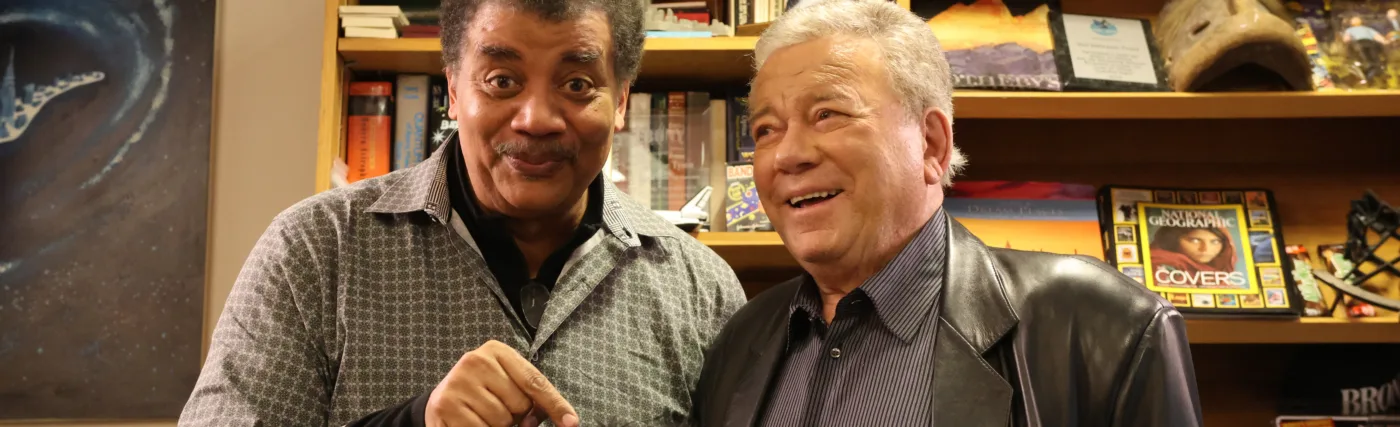
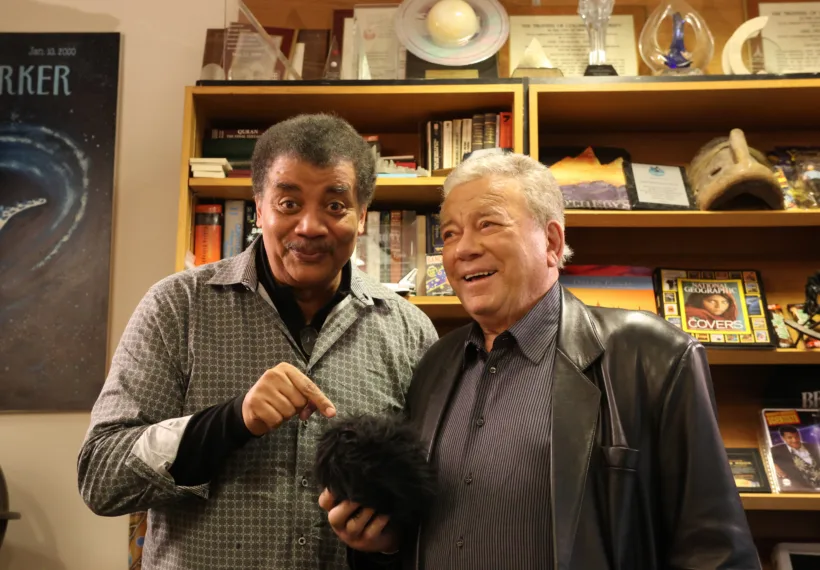
What is the value of curiosity? Neil deGrasse Tyson sits down with William Shatner to explore the nature of spacetime, Star Trek, human curiosity, loneliness, and more. How would warp drive work?
What is William Shanter’s favorite Star Trek episode? Learn about the question Stephen Hawking had for Bill and the secret power of science fiction. Bill talks about what it was like to watch Neil Armstrong walk on the moon after Star Trek was originally canceled. We discuss Artemis, our return to the moon, and how we can create a base there. Will there be enough water on the moon for people to use?
Neil breaks down how water can be used for fuel and how humans have harnessed the power of physics. We discuss Bill’s new documentary You Can Call Me Bill and some philosophical points about science. Are electrons lonely? We explore the difference between being lonely and being alone and the nature of curiosity. Is human curiosity a double-edged sword? Is there anything left on Bill’s bucket list? Plus, Bill asks if living beings like mycelia could be analogs for the universe’s structure.
Why is it spacetime and not space and time separately? What is the vacuum of space made of? Discover virtual particles and how the fabric of spacetime may be a web made of wormholes. We break down dark energy and dark matter, and why their names may be misleading. To end, we discuss old age and wisdom: do they go together?
Thanks to our Patrons Thor Juhasz, Kevin Thompson, Ben Walters, Fredrick Murphy, Lynne Fowler, Jonathan Ramirez, and Aaron for supporting us this week.
NOTE: StarTalk+ Patrons can listen to this entire episode commercial-free.
Transcript
DOWNLOAD SRTI caught you in Judgment at Nuremberg, 1963.
I said I recognized that, man.
That’s Sir William Shatner.
Yes, but here’s a guy with three names, Neil deGrasse Tyson.
Don’t beat them, no, I’m talking about your name right now.
So.
Welcome to StarTalk, your place in the universe where science and pop culture collide.
Bill, welcome back to my office.
Isn’t it wonderful?
A continuity.
Oh, I love it.
I love it.
Thanks for coming back.
You’ve been busy?
Yeah, I’ve been busy, but you know it’s my pleasure to talk to you.
A real pleasure.
Well, thank you.
People ask you, can we interview you and on?
You know, interview and you know.
But to talk to you in your erudite way, and it’s just a pleasure.
Well, it reminds me that you have a very active mind because we go everywhere, which we’re certainly gonna do in the next few minutes.
I promise you.
So I just wanna get some perfunctory things out of the way.
Just, I have to ask you, forgive me.
You’ve been asked this a thousand times, but I have to ask.
A thousand and one now?
Let it be a thousand and one.
Which of all your episodes is your favorite of Star Trek?
So somebody in your flight path.
Stephen Hawking.
Stephen Hawking.
Asked me, I asked to interview him.
And so we wrote the questions out, sent them on to Cambridge, and then I followed it with an airplane and sat in his house and we talked.
I asked him the questions.
I forgot the questions, but there were things like dark, the black holes and things that he was.
It’s his expertise.
It’s his expertise.
So we talked for maybe a half an hour and then the interview was over.
And he had said, ask me three, four questions, and then I wanna ask Shatner a question.
So now we were at the end of the interview.
I said, Dr.
Hawking, you wanna ask me a question?
Because I thought, I’ve read a little bit about black holes and the dynamics and the event horizon.
So I thought he’s gonna ask me about time.
I’m fascinated by the, where does time go?
I wrote a song about where does time go?
I said, yes, sir, what’s your question for me?
And he said, with a little bit of a pause, what’s your favorite episode?
That one of the great minds of the 20th century wanted to know my favorite episode.
I don’t have an answer for that.
I mean, first of all, I don’t remember, but those that I do remember and everybody likes would be my favorites.
There’s a maybe 10.
Your work served its purpose in that way.
Well, it was the subject matter of things that, there was a wonderfully moving one, I forgot, something across the river about how to go back in time and save somebody and maybe alter the future, which contained me.
And that question of going back in time is always there.
Like where does time go?
Can you go back in time?
Can you take away what has happened and try and allow it to happen again if you had the ability to go back in time?
So that was very moving, I thought.
I don’t know how well-compared the drama was, but the concept of going back in time because of necessity of something you love.
Somebody died and you needed to change that now.
And you have the ability to go back in time and you go back in time and change what happened, but at the same time.
You’ve changed the past, but the past is now changed the future.
So do you exist?
It was a wonderful, wonderful concept.
Very good.
So you became a fan of the theme and the idea of the show, regardless of how it was acted or anything else.
That’s the secret of science fiction, isn’t it?
Yes, it is.
The secret of science fiction is now you and I know, is about human stories placed in the future.
Stories that you might not even be able to tell in the present because people can’t relate to it.
Well, you can’t go back in the future, but you can sacrifice for love.
You can die protecting the person you love.
How, you know, that’s got ramification, hasn’t it?
If you protect somebody you love and die in the process, what have you done?
So if memory serves, that was City on the Edge of Forever, which was a famous story by Harlan Ellison, a famous, yeah, science fiction writer.
Yeah, and I loved Harlan, he was close to the show and wrote other shows.
Yeah, I mean, a testament to the power of that storytelling was the sourcing of these stories from people who thought deeply about how you can-
The human condition.
The human condition, how you place that story in the future.
Exactly.
Because so many stories, if you put it in the present, no one would relate to it, perhaps.
No, well, you can, I’d like to go, oh, God, I wish I hadn’t done that.
Or, you know, I stepped on the mine.
If I hadn’t stepped this way, it wouldn’t have blown up.
I wish I could go back and watch my feet a little closer, but you can’t do that.
But in science fiction, you can go back and not step on the mine.
So it’s interesting.
So Star Trek lasted three seasons, and then it was canceled, and then minutes after that, we walk on the moon.
What’s up with that?
How does that make you feel?
Two minutes later, it was a short time later that I now broke for a variety of personal reasons, mostly a divorce, was lying in a camper on the bed of a truck that I had bought, and I was living in the camper touring summer theaters.
And I’m now in the Hamptons in a pasture in the Hamptons.
And I’m lying on the little bed in the camper with a four by four inch television set on my chest.
I’m looking through the window of the camper at the moon.
Armstrong is walking on the moon, and I’m seeing it on this little four by four television set where as, oh, several months earlier, I had been to NASA and had adulation.
You were an honored guest.
I was the actor coming to wherever it was in Florida.
Kennedy Space Center.
Kennedy Space Center.
And I was on a stage with the LEM, and in fact got into the LEM, the Lunar Excursion Module, that they used, that they walked out and onto the moon from, and looking up at this myriad of lights and switches, and then coming out of the LEM onto the stage, and they had gathered a thousand engineers and applauding.
So I had all this adulation, and now several months later, I’m broke inside a camper watching this thing that I thought maybe had a little bit to do with that, because I wrote on the model spaceship that they had bought.
Oh, look at this, we got a spaceship for it.
And I wrote, I’ll see you on the moon.
And there I was looking at this thing, on the one thing, I’m like, wow.
Yeah, don’t underestimate, even though the show was canceled, what seeds it might have planted.
Well, little did anybody know.
The show is canceled, it’s gone, bye.
And we’re all off as a series is canceled.
Every series sooner or later is canceled.
We were canceled after three years.
And we all went our disparate way.
I went to the December theater.
And that’s like months later, because it went into…
Syndication.
Syndication.
It became, Star Trek became popular, and they asked me to come back.
So, the fact is, the seeds were planted, but they were not appreciated until they germinated.
That’s right.
And there was a several year gap.
In France and germinated.
They francinated and germinated in the United States.
Yes, yes, it went into syndication and became popular.
And tap roots were formed, and there was no stopping it then, at all.
Exactly, it became…
And I’m just reminded that the Star Trek, the movie, was 1979, that’s just 10 years after it was canceled.
Right.
Right.
And meanwhile, there are other versions of Star Trek that kick in.
Innumerable versions of Star Trek.
Yes, yes, yes.
So, I just want to thank you for helping the country and the world think about space as a natural next step.
And not as a distant…
Well, is it a natural…
Well, if we feel it, then we make it so.
Well, wait a minute.
Yes, if we feel it.
But we’re going to go to the moon.
No question.
We’re going back to the moon again.
We’re going back to the moon.
We’re going to build a thing on the moon.
Yeah, a little base in the Telfold.
A base, and we’re going to put things together.
We may get some manufacturing done.
I don’t know.
Perhaps you do the kind of manufacturing that they’ll do in the weightlessness.
You want to be able to make some of your own parts.
So, the moon, you can’t breathe the air because there’s no air.
You can’t, so you need a little more…
You’re constricted by…
You need a little more…
You gotta be a little more self…
Energizing.
Yeah, yeah.
You need what NASA calls ISRU, in situ resource utilization.
And so they’re gonna want to build a little…
Well, hopefully there’s water there.
Yeah.
And bring everything else.
That’s why they go into the South Pole for that.
You think there is water there?
No, we’re pretty sure.
That’s not a thing.
Well, it’s ice, but I mean…
No, I’ll tell you why.
Is there enough there?
No, I’ll tell you why.
So, on the moon’s South Pole, we have craters.
Imagine this crater has a complete rim on it.
Okay, it’s struck by an asteroid?
Yeah, something hit an asteroid.
You know, the moon’s been struck before.
So, imagine this has a full rim, and we’re in the South Pole.
When you’re in the poles, not only on Earth, but also on the moon, the sun never gets very high above the horizon.
Yeah, it never gets very high.
So, there are craters on the South Pole where the crater rim shadows the bottom of the crater, and the sun never reaches the bottom of the crater.
It is literally where the sun don’t shine, okay?
So, the moon has been hit by asteroids and comets.
Comets are a lot of water.
Water will go up and fall back to the surface.
If it’s sunlit, it evaporates away.
If it falls in here, it’s called a cold trap.
The water molecule falls in here and never escapes, ever, for billions of years.
So, the craters on the south pole of the moon have slowly accumulated water.
And water is going to be a very important ingredient for the new travelers to the moon, and that’s why we’re targeting places where the sun don’t.
I understand that.
Do you think there’ll be enough water for an industry?
For billions of years of comet impacts?
I think we’re expecting that.
We’re expecting that.
Tell me, do you think…
But who’s conducting this interview?
Who?
I’m having a great conversation with you.
Let me ask you another question.
Go ahead.
That hasn’t occurred to me up until now, and that is the water.
What we think of as pure water, purified water, we drink it in our bottles, we’re gonna drink a bottle of water with no chemicals in it, how polluted is that water from a raw asteroid?
Well, first of all, what we think of as pure water here is not what we’re drinking.
There’s usually some minerals in it that give it some kind of texture and flavor.
If you want pure water, you’d have to drink distilled water.
That’s pure H2O through and through, but nobody does that.
You know why?
You do that, it sucks the minerals out of your body so that the mineral balance matches the water you just consumed and your body.
So you suck the goodness out of your body.
The goodness out of your body.
So there has to be some mineral content.
So you’d have to add that.
You gotta add that.
Would that be pure water, do you think, there?
Will it have been distilled?
Here’s what you do.
Bottle a liter of it, bring it back to Earth, sell it for moon water.
Well, wait a minute.
You can make a fast buck.
When they landed, there was no water there.
No, no, no, they brought everything with them.
No, no, there must have been prior to their going there, some suspicion that there was water on the moon.
Well, wait, not where we went for Apollo.
That’s what I’m asking.
No, no, no one went, this in full sunlight.
Any water molecules there will vibrate and escape.
Okay, so they knew there was no water where they landed.
They brought all the water they were gonna use.
That’s correct.
And now we know how to recycle water, as in the space station.
So your sweat, your pee, your spit gets filtered.
Sounds delicious.
Your poop, okay, unless you poop rocks.
There’s liquid in all of these body secretions that they then, you put it through the purifying machine and out comes the water again.
It’s a water molecule, it’s a very stable thing.
All right, but my question is, what quality do you think the water has in those?
It won’t matter because you can turn it into the quality you need.
We have filters, we can distill it.
Or add to it.
Or add to it, correctly, that’s gonna be, you’re gonna be on the moon and you say, oh, this tastes a little metallic.
A little moonlight.
A little moony.
A little moony, what?
I’m Kais from Bangladesh, and I support StarTalk on Patreon.
This is StarTalk with Neil deGrasse Tyson.
How do they break down water to make fuel?
Well, so NASA knows, or has very strong suspicions, that on the South Pole, there’s water deep in the craters where the sun never shines.
Well, you can do a couple of things with water, many things, but top two, you can drink it, you can drink it, and that’s good.
You don’t have to bring water to the moon for your sustenance.
But also, if you put it in, there’s something called, you can dissociate.
So they’re devices where you add energy to the system and it’ll break apart.
Add energy.
Yeah, yeah, you need a way.
Like an electrical anything?
Yeah, yeah, yeah, one way.
There’s a way to do this so that you break apart the hydrogen and the oxygen.
As you know, water is H2O.
Once you separate them, oh, keep them apart, keep them apart until the time arises where you want to bring them back together.
Because the moment you bring them back together, it is highly exothermic.
It releases huge amounts of energy, and that is exhausting.
How does that work?
If you separate them with energy, do you give them more energy in separation?
Okay, so there’s no such thing as a free lunch.
So how much energy does it take to separate the hydrogen and oxygen?
The same energy you’re going to get back when they come together.
I see.
Yeah, there’s no free lunch there.
So how does that work?
You have to build a whole factory to rip them apart.
And the oxygen goes here and the hydrogen goes there, put them in separate tanks.
Then you want to launch back to earth, you feed fuel tanks as part of your rocket assembly, and then have a nozzle that brings them together, and then you get exhausted.
Why is it then making water?
It is, water is the by-product of that process.
But that huge flame, why isn’t, why is it?
That’s the energy of the chemical reaction.
And the exhaust is water.
No.
Yes.
Yes, it’s as pure as it gets.
So we can do that on the moon that’s in situ resource utilization.
Right, fantastic.
We humans have learned to use some of the principles that we’ve discovered in the universe.
Oh, yes.
Let me say that even deeper.
Oh, yeah.
This is what makes physics so useful.
When you know a law of physics, you can do things even if you’ve never seen it before, because you know it will succumb to the laws of physics in whatever way you need it to, to get the job done.
But the problem and the possibility is those explosive qualities.
It’s highly dangerous to work with those things.
It is, but if you’re good, it’s not a problem.
And by the way, these reactions are not unfamiliar to you.
You’ve had these heat packs, maybe, where you slap them together and they get warm, and you put it on your joints to warm them up.
That’s an exothermic reaction, not nearly as powerful as bringing hydrogen and oxygen together, but nonetheless, and it works the other way, as well.
And we’ve learned that here on Earth.
And others, you can slap it together and it gets cold.
It’s an endothermic reaction.
It’s sucking energy out of the environment.
Yeah, yeah, isn’t science great?
Science, science is romantic.
Speaking of that, Bill, there’s a film about you out there right now.
It’s about you.
You can call me Bill.
Which is something you never actually said to me.
I didn’t feel I needed to.
You’re such a friendly guy.
We corresponded for 20 years back.
I occasionally drop you a very simple text or an email.
I caught you in Judgment at Nuremberg, 1963.
I said, I recognize that man.
That’s Sir William Shatner.
Yes, but here’s a guy with three names.
Neil deGrasse Tyson.
Don’t beat them.
No, I’m talking about your name right now.
So I popped you a note and you kindly replied.
You say, oh my gosh, that was like, you know, centuries ago.
I recognize that name deGrasse.
It’s a legendary family name.
Yes.
That’s a whole other thing.
Conversation.
This interview is about you, not about me.
So in that, what impressed me, I was impressed but not surprised that it wasn’t just about this happened to me when I was this age and there was that.
No, it was here are my thoughts on the world that sometimes distract me, but always enlighten me.
How presumptuous of me to think that my thoughts on the world would be of interest to somebody like yourself.
Well, except that, you have a very different path through life.
Bill Nye is famous for saying, everyone out there knows something that you don’t, no matter who they are.
It’s the same thing I say in working with other people, everybody has their story.
Everybody’s got a story.
And if you can uncover that story.
Or yeah, reveal it in a way that can benefit others, then why not?
And you got oxygen and nitrogen.
And oxygen and hydrogen together.
So a good filmmaker will do this.
They can find those gems and bring it forth.
And there’s certain themes of the film that were just sort of intriguingly philosophical.
You’re talking about the film.
Yeah, so I’m talking about this documentary on you.
And you reflected on whether one of the, I got a list here.
It’s like, are electrons lonely?
It’s an interesting thought.
Are electrons lonely?
Well, well, are they?
Well, are they looking for something or someone to unite with?
They can, but if they’re part of an atom.
Well, we’ve got to, we can’t have them coalescing, consorting, consorting with other elements.
We have to have them apart to have them lonely.
Is an electron looking for a resting place?
At all times.
Because it has an electrical charge.
So it either wants to go away from something else over here that has the same charge or towards this thing over here that has an opposite charge.
We learn in physics that every electron is identical.
What?
So what does it mean for an electron to be lonely if every other electron is exactly like itself?
I’m trying to put, when I say those things, as a non-scientist, but also as somebody looking for basic truths that I know.
Like, I believe everybody’s lonely.
Why do you believe that?
Because we’re born alone.
Yeah, but I lead a life, and I meet people, and I have friends, and wife, and kids.
But how attached is that?
Or are you lonely and your wife dies?
You breathe, but you go on.
But are you confusing lonely with being alone?
These are two different concepts, two different emotional states.
Well, if you’re alone…
When I’m writing, I want to be alone.
I’m sure it’s true with you.
Well, then you’re occupied, and your mind is working somewhere else.
But that doesn’t mean I’m not alone.
Well, it does.
Yes, I’m accompanied by words.
Exactly, and thoughts.
Yes, words and thoughts.
So this is all going through in your writing and saying, that’s not bad, that’s pretty good.
That deserves the name of Neil deGrasse Tyson.
Yeah.
But now you’ve finished however you’ve written down your thoughts.
Oh, there’s a great quote about that.
I forgot who, forgive me.
It’s no great work of writing is ever finished.
It just comes due.
So that indicates loneliness.
It’s never finished.
You get up from the desk and you say, wow, that’s it.
No, it’s not finished.
No, I got to do more.
So you’re alone and you’ve got to go back.
So you see your wife, you see your kids and all that.
But aren’t you alone with those thoughts you’re thinking about?
You speak of it, let’s even assume you’re onto something there.
Allow me to suggest that…
That’s a polite way of saying you’re wrong.
Allow me to suggest that when I am alone or lonely, I’m more introspective than at any other time.
And so maybe we all need periods of loneliness.
So that we can understand ourselves better.
No, that’s not what I’m referring to.
We all have periods of being alone, interrupted by an association of some kind.
A dog or a wife or a child or a friend.
Right?
But say there’s none of that there.
Say for one reason or another, mental illness, your bodily odors, you’re alone.
What are friends?
What does that mean?
What does a friend mean?
Do something that clears the room.
This sounds like you’ve done that before clearing a room from body odors.
Unbeknownst to me, people have left the room.
What are they doing?
No, but loneliness and being alone, as you point out, is not the same.
But if you’re alone and you realize, wait a minute, where can I go not to be alone?
And you have no place to go.
You can go on the street.
A guy comes over, hello, you need a dollar.
Here’s a dollar.
And you make communication with another human being.
But you really haven’t.
You’re still alone.
In the documentary about your life, you speak passionately about curiosity.
Curiosity.
And you went up in Jeff Bezos’ rocket as a 90 year old man.
Most people would have said, my bucket list is done.
Let me go to the Bahamas, you know, and don’t call me.
But you’re still out there.
You’re still composing poetry.
You’re still…
So can you just comment on the curiosity that’s within yourself?
Yes.
In ways that maybe others can learn from?
Yes, but curiosity.
What makes things, people, objects tick while electrical current across an electrical current into an amniotic soup can create life?
I realize that curiosity is both the…
what would be a good representation is both the food and the poison of human nature.
Why is it poison?
Poison gas.
Atomic bomb.
Atomic bomb.
So the curiosity of man spreads every which way.
We’re curious about God and we’re curious about how to kill.
It’s a two-edged sword that is probably very equal, that curiosity.
It’s both the bane and the benefit of mankind.
All right, so what guidance would you give us as we…
We are intrinsically curious that mankind, along with the need to eat and sleep and make babies, is why is that thing crawling there?
Oh, it’s crawling.
I wonder if it’s edible.
Oh, it wasn’t edible.
I wonder what made me sick.
And you go down that rabbit hole of curiosity.
So that element of man, mankind, is a slippery slope.
I thought you might have been a little more positive there.
But do you…
Well…
Then what hope do you have for us?
Because the more awesome our scientific powers become, the higher at risk we are with that other half of the curiosity.
So when the universe was born, you know better than I do.
I love all sentences that begin that way.
Mine has an ellipse and I don’t know what I’m talking about.
There was both positive and negative energy, maybe equal or slightly more positive energy, and that’s why those molecules or atoms stayed.
Matter versus antimatter, that’s probably what you’re referring to.
Well, didn’t I say that?
You said negative and positive energy, but that’s fine.
No, no, I’m just curious as to why that isn’t the right thing to say.
Oh, it’s okay.
All right, so you’re getting my point.
My point is, for some reason, and we don’t know the reason, positive energy, positive whatever, was the balance.
Matter outweighed antimatter and won the contest.
And won the contest, but it was very, very slim majority.
One part in a hundred million particles.
How did you measure that?
Because you can actually measure it.
Is that right?
Oh, yeah.
So one part in a million…
A hundred million.
A hundred million was positive, and as a result, the universe was born.
With regular matter and didn’t completely disappear into photons.
Exactly.
My point.
So that curiosity may have a slight edge of positive…
Oh, I’m glad I made you say oh that way.
Because you say oh a lot.
I didn’t know where you were going.
Well, that pleases me more than anything.
Now I know where the man is going.
Okay, so when you say oh, you have a variety of meanings for your oh.
I have something to say about that, because I’m Neil deGrasse Tyson, and I know.
But you didn’t know where I was going, and what do you think of my point?
It’s interesting.
It’s hopeful.
I don’t think we have strong evidence for it.
Other than that, we’re not all dead yet.
Well, we’re not all dead yet because of positive things.
Right, but the day that we are all dead, no one is around the day after that to say, oh, we have slightly more positive.
We’re positively more curious than negatively.
Right, right.
It’s true up until this point.
We’ve been slightly ahead of that.
Well, we’re up to this point because everything we’ve discovered.
Atomic energy for energy and atomic energy for bombs.
We’re slightly ahead because we’re alive, but as of the day we’re talking, there’s been a threat that the world will be consumed.
There’s no guarantee.
There’s no guarantee.
Yeah.
So what do you say to people who’ve lost their curiosity, even from early on in life?
I’ve met some people.
They’re dead because there’s always curiosity.
And the question…
They’re emotionally dead.
What kind of dead are you?
Yes, dead intellectually, dead every which way, because they haven’t lost the curiosity of, am I going to die?
And when?
You never lose that question.
And that may be the motivating factor of everything or some of what happens when I die.
Okay, but other curiosity, like what’s under the rock, what’s behind the tree, what’s across the river, what’s in the bottom of the lake.
There are people, there are grownups who don’t have any of those thoughts.
I can’t imagine that a scientist who doesn’t believe in God, an atheist scientist, doesn’t say, I wonder what’s going to happen when I die.
That’s not what I’m talking about.
I’m talking about other adults.
I want a thoughtful person.
Every one of my colleagues, if there’s something we see and we don’t understand it, we poke it, we probe it, we ask others.
Right.
It is a state of mind.
I understand that.
But at some point, doesn’t somebody’s scientist say, I’m 93 years old, why do I need that knowledge?
What I want to do is have a good dessert.
They do both.
It’s not one or the other.
They eat it and study it.
You think the good stuff, and then you eat the dessert, and then you go back to it.
Particularly if the dessert is tasty and you get good energy from it.
Tell me, we’re both a big fan of trees.
Big fan of trees.
Big fan of trees.
I’m a tree hugger.
You’re a tree hugger.
Are you?
No, because I’m born in the…
My wife was from Alaska, so she’s a tree hugger.
Why from Alaska?
There’s no trees in Alaska.
There are trees in Alaska.
Alaska’s a big state.
Well, that’s true.
It’s five times bigger than Texas.
So maybe there’s some places you haven’t been yet.
That’s true.
Okay.
Maybe.
So I value what they are.
Trees?
Yes.
You know, the giant sequoias live a thousand years.
They deliver oxygen that we breathe.
They’re home to fungus and birds and insects and their role in our world is, I think, undervalued relative to what we do to this world and how our species conducts itself.
The whole mystery of the sequoias and how they irrigate themselves.
And I mean, it’s just an enormously complex.
So you spend not a small amount of time in this film, in this biography, this documentary of your life.
You can call me Bill.
You can call me Bill.
You spend not a small amount of time reflecting on trees.
Yes.
And so I thought that was poignant.
Well, trees represent the mystery of our world.
So we know that they emerge from the ocean as grass and the grass evolved into trees and trees became more preferred locations and as a result adjusted to the locations and became the variety of trees we see.
By the way, there are hardly any trees in Star Trek.
That’s what I did.
There’s only telephone poles.
I just thought I put it out there in Star Trek.
Hardly any trees.
So trees and I’ve said this many times, I’ll say it again.
Talk to each other.
The mycelium is the network of fungus.
And they use the mycelium in the way we use dendrites in our brain to send electrochemical signals at a slower rate.
But the magic of an electrochemical signal from a tree and its comment on electrochemical signal in our dendrite is not unlike a mycelium.
So the mycelium and the dendrite perform the same function.
And so our brains are working the same way trees are working.
Trees are working the same way our brain.
The evolution would have been from trees to humans.
Now you also reflect on the universe, whether there’s some kind of analog to the structures of the universe.
Everything on earth communicates, whether it’s to each other or to other things.
Everything is in communication.
Everything is electrical.
Some mode of electricity that we call electricity is working on earth.
It seems unlikely to me that that stops here on earth, that everything in the universe is communicating with gravity and electricity.
There’s an interesting challenge to the assumption that this interconnectivity on the small scales and all life on earth would extend to the universe.
It’s just an interesting fact.
And it has to do with how fast can anything actually communicate from one place to another.
And so your head itches and then your brain tells your hand to come up and scratch it.
How long did that take?
Well, they’re electrochemical signals and they go.
So you don’t think about how long that takes because it happens pretty quickly.
The bigger you are, the longer that signal will take.
So that seems to be a practical limit on how big any coherent organism can be in the universe.
Imagine something the size of the galaxy and it has an itch on its head.
It has to communicate that to the scratching mechanism.
The scratching mechanism has to come to the head and scratch it.
That would take 200,000 years.
But it doesn’t.
So a prehistoric animal, a dinosaur, would have scratched its ear in less time than 200,000 years.
In less time.
So it suggests that life or anything that’s coherently self-aware would not be particularly functional on these largest of scales.
Yeah, but you see, but I wonder how much you really believe that.
Because the speed of light…
As one limiting factor, yes.
But I am of the opinion that in my lifetime, which is a lot shorter than yours, we’ll discover that the speed of light…
What’s the speed of light again?
500?
186,282 miles per second.
That we’ll discover that it isn’t a limiting factor.
That we’ll discover that light travels slower or faster.
That it isn’t the basic measurement of…
You already discovered it, and you called it warp drives.
That’s how the Enterprise could cross the galaxy during the TV commercial.
Otherwise, it would have taken you 100,000 years.
Well, there is a theory that you know of, where instead of going to the object you’re traveling, from left to right on your travel, you bring the travel to you.
So you compress the space in front of you.
And then stretch it out behind you.
That’s a version of a warp drive.
And so, yes, but you’re not traveling through space faster than light.
You’re warping space so that you’re effectively…
You could do whatever, you could explain it whatever way you wish, but it would be the…
It would require the energy of the universe to make that happen.
And it’s…
I’m giving that to you, but we can’t imagine a life form that is going to scratch its head using warp drives to get there quick enough.
No, but we can imagine that whatever…
Abrontosaurus, was that the one that reached up into the trees?
Yeah, but it got renamed.
Whatever it was, those long-necked dinosaurs that ate off the tops of the trees and the engineering that went into those long necks in order to support that head is magical, right?
Magical in that it evolved from a little nibble here to going higher and higher, and the body and the chemistry of life adjusted to that.
So I can’t imagine that whatever, Brontosaurus, I’ll name it for now, reaching up to the leaves and saying, oh, that tickles, and took 200,000 years to tickle its ear.
It had to react to it now.
And it’s a much smaller creature than it could the size of the galaxy.
And in a fight with a T-Rex, in a fight with a T-Rex, it had to move and get out of the way or slap it with its tail.
So it took more than 200,000 years for it to happen.
I know.
So explain that.
Because it’s a smaller creature on Earth.
All I’m just saying is we can get those sizes.
But you want to think about the whole universe as some coherent mycelium communicating in some meaningful way.
It’s got to happen.
There has to be a unity to the universe that doesn’t have disparate elements and say, well, that works, that doesn’t work.
A good scientist will never, ever say it has to happen.
I’m not a scientist.
I’m a believer.
And I think the universe has to have a unity that we mortals, the relentless mortals, your hand is hushing me up.
I’m about to say words.
It’s an agreement, Hush.
It’s an agreement that unity you speak of.
Unwritten agreement, I haven’t yet applied.
That agreement you speak of is not in the animal scratching its head.
It’s in the laws of physics that underpin everything that goes on.
And it has been the holy grail of modern physics to find the one idea, the one theory, the one equation out of which everything unfolds.
Is that the speed of light?
It’s bigger than the speed of light.
Oh, you’re saying in theory, that’s what we’re looking for.
In theory, if the universe is unified, that’s the unified field theory that Einstein’s been looking for.
Okay, so we’re all looking…
You’re in good company.
I’m appreciative.
What question about the universe have you been harboring ever since your earliest days?
Now is the time to ask it.
The question I ask every pseudo-scientist and an actual scientist is something I’ve never been able to get a decent answer.
We talk about space-time, and it’s like one word, space-time.
And yet, if I look at a photon coming from 13.8 billion years away, and it hits my retina, it’s taken 13.8 light-years to come.
It’s gone through that space, and it’s taken that time.
What is space-time?
What are we doing with this thing called space-time?
Ask yourself, the last time you met someone, did you just say, all right, I’ll meet you in the town square?
No, that’s missing information.
You know that inherently within you, because the person is gonna ask, when?
You supplied a location, but that’s not good enough until you supply a time that is a space and a time.
Here’s another, Bill, I’ll meet you tomorrow at noon.
That’s not enough information for us to meet, because we have to include a where.
So, space by itself and time by itself in our lives only have meaning when they are brought together as one concept, space-time.
We know this intuitively when we set up encounters with one another.
You offer a space-time coordinate, that’s when the two of you come together.
Otherwise, no, it’s not meeting.
Here’s an interesting fact, out of COVID, a Zoom call separated space and time from each other, so that you only had to be at the same time, you didn’t have to be at the same place.
And that enabled many more people to gather for meetings than what would otherwise be possible.
So, space time is a measure of where you are and what you’re doing and at what time you’re doing it, every moment of your life, every moment of the life of the universe itself.
The thing that unifies space and time is that proton, is that photon, whether it’s a wave or a particle, and I don’t know the difference, when that particle of light leaves the source and reaches my retina, that’s the unifying, that’s where and when.
An interesting fact about light, because it travels at the speed of light, we know from Einstein that if you travel at the speed of light, time stops for you.
So that in fact, all photons that are crossing the universe have no clock at all.
As far as they’re concerned, the photon emitted at the early universe that enters your retina at the moment you register its existence, that’s the same moment it was emitted in the early universe.
In the timeframe of the photon itself.
All right, so everything you’ve just said, I don’t understand.
The universe is under no obligation to make sense to you.
But it makes sense to other people and is driving me insane.
You understand it, I don’t.
I want to understand it.
All right, one more point about space time.
We’ve always been wondering, what’s it made of?
Is there some, we speak of the fabric of the universe metaphorically, but is there something literal that can bend and twist as we describe it doing so according to Einstein’s general theory of relativity?
There is recent thinking that in the vacuum of space where there are what we call virtual particles that pop in and out of existence, these virtual quantum physics predicts them.
These virtual particles, when they’re formed, are quantum entangled.
So they know about each other, so that when they come back together, they return to their state of energy from the particles they once were.
But if the vacuum is a seething soup of this, then this quantum entanglement, how do they know about each other so instantaneously?
Maybe they’re all connected by wormholes.
If all quantum entangled virtual particles are connected by wormholes, then maybe wormholes are the threads.
Okay, good, mm, but talk to me about dark energy and dark matter, of which we know nothing about, and which is apparently 90% or more, we think, of the universe, and how, since it’s totally theoretical, how you can explain that 90% of a universe and we don’t even know what it’s about, and we’re busy theorizing particles, and, I mean, we got all these esoteric theories not containing 90 or more percent of what we’re talking about.
Bill, try not to blow a gasket on this one.
This is a gasket blowing out of thought.
Two points.
First, what we call dark matter is that 85% of the gravity of the universe has no known origin.
So we call it dark matter, but we don’t know what it is.
We don’t even know if it’s matter.
85% of the gravity of the universe.
We measure that.
We didn’t pull that out of our ass.
We measure this force in the universe, and we gave it a name.
It’s possible to talk about something if you can measure it, even if you don’t know what’s causing it.
So just chill on that one for a moment.
Then there’s a mysterious pressure in the vacuum of space that is forcing an acceleration of the universe opposite the wishes of gravity.
That’s what we call dark energy.
We can measure that.
A Nobel Prize was given for the first measurement of dark energy way back in 2011.
So, we don’t know what’s causing that either.
Add up dark matter and dark energy, you are right.
It is 96% of what’s driving this universe, and we don’t know what that is.
But we feel it’s a curious state of existence to say, we know enough about the universe to quantify how much we don’t know.
And it’s most of it.
Deal with it, deal with it.
That’s exactly right.
Deal with it because we don’t know.
I love it.
What’s the point of getting older unless you have wisdom to show for it?
In life and in the history of civilization, it has always been the wise who has led the unwise.
It’s been the wise who we all line up to gain insight and advice from them.
And they’re people who we think might be wise, but who have never left their corner.
Bill Shatner is restless in this world.
He’s never stopped to say, yeah, I got it now.
Come to me for everything I know and think and can advise on.
No, he kept moving.
And he’s humble enough to recognize that a previous thought might have been wrong or incomplete.
When I think of what we need to drive civilization forward, we need eight billion Bill Shatner.
We’re just out there curious at every turn, restless because there’s something behind a tree, under a rock that they have yet to investigate.
And then upon discovering it, they have the urge to share it with others, sharing the knowledge, wisdom and insight so that we all can become better shepherds of a civilization where we want the next generation to be proud of the decisions we’ve made rather than embarrassed by it.
That is a Cosmic Perspective.
We’ll see you next time on StarTalk.

 Become a Patron