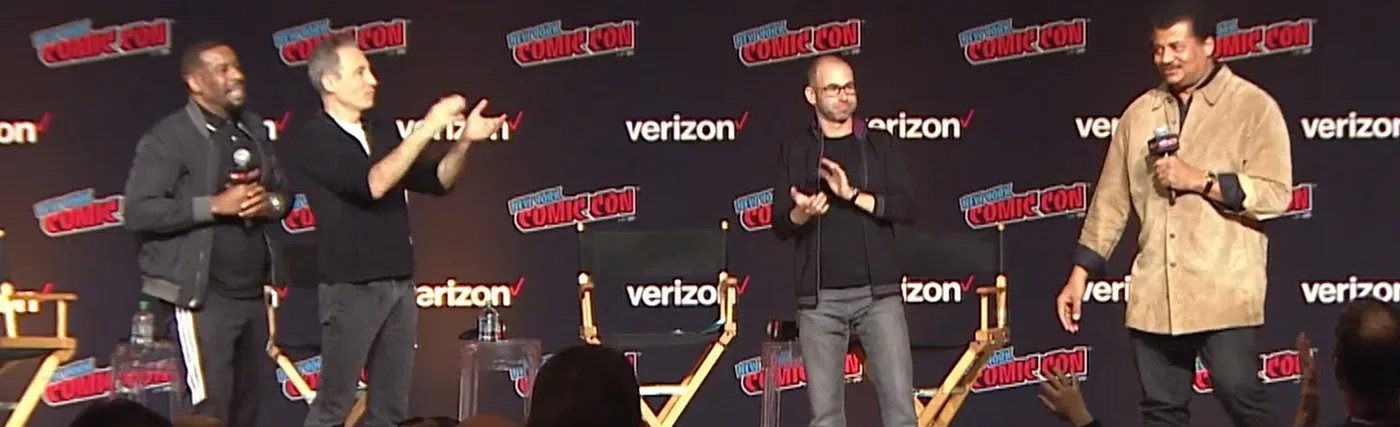
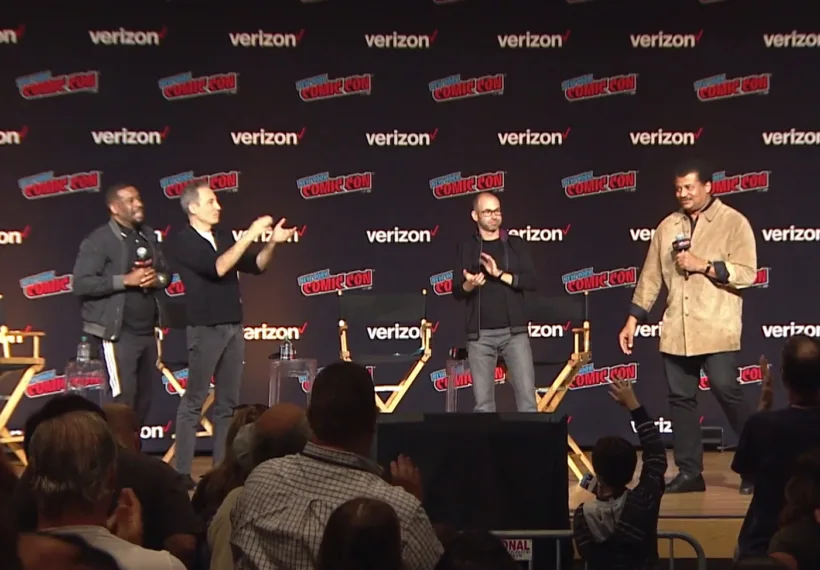
Time is of the essence! Or, is it? Is time travel possible? Can we change the past? On this episode of StarTalk Radio, Neil deGrasse Tyson explores the wibbly wobbly, timey wimey nature of time itself with theoretical physicist Brian Greene, comic co-host Chuck Nice, and Impractical Joker James “Murr” Murray. Join us on a pop culture adventure, from the TARDIS of Doctor Who, to the shrinking capabilities of Ant Man and the Wasp, to the Upside Down parallel universe of Stranger Things.
Explore if the laws of physics allow time travel to be possible. You’ll learn how the physics of time travel differs depending on whether you’re going into the future or the past. We discuss wormholes and what happens when you place a wormhole next to a black hole. Find out about the “chronology projection conjecture,” a concept first introduced by Steven Hawking. Ponder the logic paradox that occurs when you travel into the past. You’ll find out if other species process time similar to the way humans do. We also venture into the fourth dimension as we explore the TARDIS and it’s capabilities.
Next, we move from time travel to the Quantum Realm as we discuss the shrinking science of Ant Man and the Wasp. You’ll learn what the laws of physics say about shrinking. Discover more about the empty space inside atoms. Investigate “molecular disequilibrium,” quantum entanglement, and what Einstein called the “spooky action.” Neil gives praise to the movie A Bug’s Life on its ability to represent the microscopic (besides the obvious error in ant anatomy).
Lastly, we take a trip to the Upside Down as we investigate parallel universes. Find out more about string theory and the “brane” idea. Explore the idea of a “gravity phone” used to send out vibrations in space time rather than vibrations through air. Unlock the possibilities of the Many-Worlds interpretation of quantum mechanics and learn more about the “order of infinites.” All that, plus Neil offers an emotional, poignant happy birthday message to his birthday buddy, NASA.
Transcript
DOWNLOAD SRT
Welcome to StarTalk, your place in the universe where science and pop culture collide. StarTalk begins right now. Thanks for coming out at New York Comic Con. This is my hometown. I'm gonna bring out my guests. First, you're gonna...
Welcome to StarTalk, your place in the universe where science and pop culture collide.
StarTalk begins right now.
Thanks for coming out at New York Comic Con.
This is my hometown.
I'm gonna bring out my guests.
First, you're gonna meet my co-host, the one, the only, Chuck Nice.
Chuck, comedian, come on out.
Chuck, who'd you bring with you today?
Hey, so you may know this.
Who is another comedian?
And he is also extremely funny.
You probably know him from Impractical Jokers on True TV, it's James Murr Murray.
Yeah, I don't belong here.
Let me bring out our fourth and final guest, a colleague and friend of mine, theoretical physicist, Brian Greene, Brian.
Let me tell you why we brought out this firepower.
Because tonight, we are going to handle three different topics very specific to this audience and our concerns.
In part one, we are going to talk about time travel in Doctor Who.
And in part two, we're gonna talk about the quantum physics of Ant-Man.
And part three, we're talking about parallel universes in Stranger Things.
So let's do this.
All right.
So, thanks for coming.
This is my first time I've met you.
Likewise.
I've been a fan of yours literally forever.
No, that would not be literally true.
Right, okay.
Expect a lot more of that tonight.
I'm just saying, I'm just saying.
So, we know Dr.
Who's the longest running science fiction franchise ever on television.
And the current doctor, Jodie Whittaker, is that right?
Yes, give it up.
Is anyone here dressed as Jodie Whittaker?
We got nobody?
Okay, fine.
Okay, just checking.
Wow, that is almost a statistical impossibility.
Yeah, so as you know, Dr.
Who follows the adventures of a humanoid alien, basically, and that person travels through space and time in a wibbly wobbly timey wimey way.
Yes.
And so, given these facts, what we really want to know, Brian, is travel through time theoretically possible, at least as imagined in Dr.
Who.
So, you have to think about time travel in really two stages, because time travel to the future is very different from time travel to the past.
So, time travel to the future-
They have different consequences.
They have different consequences, and they have a different understanding of the laws of physics.
So, as we know physics today, time travel to the future is not hypothetical.
It's not some idea that people argue about.
Time travel to the future is absolutely part of the way physics is constructed.
There is nobody who knows anything about what they're talking about who would disagree with that.
I like the way you worded that.
Okay, so, but of course in Doctor Who, they go into the past.
So, what's going on there?
That's a trickier one.
That's a trickier one.
Well, he's a time lord, so he figured it out.
So, my question to you is, in this universe, how would you make it happen such as the way we see it in Doctor Who?
So, if you want to travel to the past, there are a few proposals that are on the market, but I'd say the one that has attracted the greatest attention is to make use of wormholes.
So, a wormhole is a tunnel through space.
It's a shortcut, like any ordinary tunnel in the real world.
It takes it from one point in space to another point in a more direct manner.
So, rather than going over the mountain, you go through the mountain.
You go right through the mountain.
Now, that is a tunnel from a point in space to another point in space, but here's the thing.
If you take one of the openings of the wormhole and you put it near a black hole and you let it hang out there, according to Einstein, time will elapse more slowly near the edge of a black hole because of the powerful gravity.
Yes.
And that means that time at this opening of the wormhole will be different from time at the other opening of the wormhole.
Which is farther away from the black hole.
Farther away from the black hole, feeling a different gravitational force.
Yes.
Which means now when you go through the wormhole, you're not just going from one point in space to another point in space.
You're going from one moment in time to a different moment in time.
Why does that mean you're going backwards?
Well, one direction is forward, one direction is backward.
So, depending on the direction you go through the tunnel, it tells you the direction in time that you're traveling.
There is another way to travel back in time.
Scrapbooking is a fantastic way.
Facebook Memories, you see those video collections they do?
You go right back in time, you're transported there instantly.
So, what about the something conjecture, the...
Chronology protection conjecture.
Chronology protection conjecture.
I believe I have a condom, name that.
Chronology protection conjecture.
So that sounds like time travel backwards should not be allowed.
Yeah, this is an idea that came from Stephen Hawking.
And he asked the question I think all of us ask, which is if time travel to the past is possible, where are the time travelers?
I've heard it hypothesized that the reason why the Titanic sank is everyone want to go back to the Titanic the first day a time travel device was invented.
And then there were millions of people crammed on the Titanic and then it sank.
Why would you go teleport to a sinking ship?
No, because they wanted to experience a bit of history.
So Brian, so give me an example of the problem.
A demonstration of why that conjecture might be true.
Well, the puzzle is if you go to the past and you change things that prevent, for instance, your own birth, how were you there in the first place to make that change?
So the usual example we talk about, you see them back to the future, many other incarnations of these ideas.
You go back to the past and you prevent your parents from meeting, right?
So how were you there to execute that action if your parents never met you or never born?
So you run into this logical paradox if you allow certain kinds of changes to the past to take place.
Now, there are ways out of this that you don't need the chronology, prediction, conjecture, which would say you can't travel to the past.
You could simply have it that the laws of physics prevent you from ever changing anything that was in the past.
Namely, if you go to the past, you were always at that moment.
There was never a version of that moment when you were not there.
So it's always self-consistent because moments of time just are.
They can't change.
So that is the, so what you're saying is no matter, you can't change because no matter what, you were there, period.
Whatever that moment in time was, you were already there.
Or the influence was there.
Or the influence was there.
Is there another possibility that when you go back in time and if you change something, it splinters off to its own different universe?
That's the other possibility.
Yes.
That's mind blowing stuff.
So you can change the past, but you can't change the past of your own universe.
So if you go back into the past and say you prevent your parents from meeting, you're preventing them from meeting in a parallel copy of the universe within which you were born.
So if they don't meet, that means you won't be born in that universe, but there's no mystery of where you came from.
You were born in this, the anniversary of parents did meet.
So one of the interesting features of Doctor Who is that this blue thingy, it's called a TARDIS, which is an acronym for Time and Relative Dimension in Space.
Okay, by the way, by the way, I got to say that was pretty damn awesome what I just saw here.
You just went, by the way, it's an acronym, stands for, and everybody else just said it right along with you.
That's how we, because that's how we roll at Comic Con.
Without missing a beat.
So one of the fascinating elements of it, and they just treated this quite casually throughout the whole series, is that you walk into this police call box, it's a British police call box, and then inside is the entire ship.
So that you're accessing another dimension of space by entering in it.
So this would be like a fourth dimension.
Yeah, so you're saying the inside is bigger than the outside.
You didn't say it right.
That's what I keep telling her.
Wait, what?
You just have to say.
I don't know if the joke works.
You just have to say the phrase is it's bigger on the inside.
That's all you got to say.
Repeat that.
Just repeat it.
I'm afraid to.
So Doctor Who has just been very smartly written in this regard.
It's got good physics in it.
Yes, it's fiction, but it's got you thinking about how events can influence past and future.
And this is why they say time is this wibbly wobbly timey wimey.
It's not so rigid that it's going to follow what you think is a strict law of physics.
It's got some more sort of chaotic elements to it.
But it has a single timeline or it has multiple timelines?
I interpret it as multiple timelines and the Time Lord can access any timeline that is necessary for the task at hand so that you can save the universe in every episode.
Can I ask a general question?
Is time just a human construct?
Do other species understand the concept of time, the passing of it and the future versus the past?
Yes.
Okay.
Yes.
There you go.
I mean, it's all too easy for we humans to say what we do and think that other animals do not.
Yes.
There's the human hubris deeply embedded in that assumption.
Who are you to say that other animals don't think or contemplate or wonder about their fate?
Maybe we are pitied by eagles because our vision sucks compared to that of eagles.
Those poor humans, they can't even fly.
Oh, I wonder if they dream about all those poor things.
Do you know how much pity we might be garnering in the minds and bodies of other animals?
Most animals look down on me.
Yes.
I got another one.
Here's another one, right?
We can talk about and praise certain primates, other primates who maybe mimic sign language, okay?
So these are animals that can speak to us using typically American sign language.
But no one is asking.
Here are chimps speaking to us in our language, but at no time are we asked, can we speak to them in their language?
So this is smart enough to speak our language, we're not smart enough to speak theirs.
So I don't know.
All I know is what you said is beautiful and eloquent, but I doubt if there's a horse somewhere going, I wonder about the fabric of time.
Goldfish are not thinking about time.
They're just doing circles in the bowl.
They can't remember their ass from their elbow.
Keep telling yourself that.
So one of Hawking's quotes, which is related to my Titanic comment, is, if time travel were possible, where are the tourists from the future?
Yeah, I think that is the question.
And one answer is every time they come here, we just put them in white coats and lock them up.
I mean, that's one possibility.
Or we put them in white coats and call them astrophysicists.
But wait a minute, isn't this quote from Hawking exactly what a time traveler would say?
On that one, we just got to meditate.
I see where you're going with this.
See where I'm going with that.
So the people who are way ahead of the rest of us at any given time and space, like Da Vinci, like Einstein, like Marie Curie, like Stephen Hawking.
Or Snooki.
Snooki.
Isn't it temporal law that if you ask a time traveler, if they're a time traveler, they have to say they're a time traveler, like a cop or a vampire, right?
I have not heard that law.
Temporal prime directive.
So do you think one day we'll have a machine that'll just send us forward in time?
We know it's possible, but why aren't we doing it actively?
Well, I think we do have a machine in principle, right?
We just can't go very far forward in time.
Because every time you go into a vehicle and you undertake a round trip journey, you are traveling into the future.
By some calculatable amount.
Yeah, now at ordinary speeds, you're only going, you know, a billionth of a billionth of a second or something like that.
Into the future.
Into the future.
But if you found yourself in a ship that was going near the speed of light, you go out for six months, you turn around, you come back for six months, you get off that ship, you will have aged one year.
But depending on how close to the speed of light you got, when you step off the ship, the Earth will be 10,000 years or a million years into the future.
You will have jumped into Earth's future.
That is what we mean by time travel.
How important in the future are the survival of humpback whales?
Star Trek 4.
Right, because it seems like we've got to solve the humpback whale problems.
You just need transparent aluminum and then you can solve it.
The faster you go to the speed of light, the slower time moves, correct?
So somebody on a spaceship would age slower than somebody on Earth.
They'd come back one year later and the people on Earth have aged 10 years, 100 years, something like that.
That's the basic idea?
That's the idea.
Let me add, just to close out this segment, our GPS satellites orbit high enough so that there's a measurable and important difference in its rate of time that it keeps compared to us here on the surface of the Earth.
They're farther away from the source of gravity, Earth, so their time ticks faster than our clock time on the surface.
And we know this, and it's Einstein's general theory of relativity.
So they calculated how much faster their clocks would tick, and they come back correct for that before it sends us the time that ends up on our smartphones.
So if you accelerate towards the speed of light, time actually slows down?
Yes.
Okay, hold on.
Chuck!
Sell Apple!
Sell your Apple!
Thanks, everybody, for coming to the 2019 Comic-Con.
You've been gone a year or something.
All right, we got to bring time travel to a close.
Thanks for that topic.
Comic-Con, our next topic is the quantum realm of Ant-Man.
Give it up for my panel for that.
All right, are we ready for round two?
All right, round two.
I got with me theoretical physicist, Brian Greene, Brian.
You can, what, yes.
I got Chuck Nice, my co-host, Chuck.
Chuck, who did you bring?
And of course, from Impractical Jokers, it's the Murr!
The Murr.
All right, so in a recent movie, The Ant-Man and the Wasp, okay?
That's starring Paul Rudd, who we've had on StarTalk Live before.
And-
He is delightful.
So, Brian, what does physics say about shrinking things?
Well, it's tough to do, right?
Because ultimately, things are made of molecules and atoms and the quantum laws restrict the size of the individual atoms.
So it's pretty tough to imagine changing them without changing the basic constants of nature.
Wait, wait, but Rutherford, 100 years ago, noticed that atoms are mostly empty space.
I could just squeeze that puppy down.
Yep.
Yeah, in fact, if you were to squeeze down, if you could do it, the space in the atoms in every single human being that has ever lived on planet Earth, the resulting stuff would fit inside of a baseball.
Ooh.
And that's even with, you know, obesity problem in America?
Yeah, yeah, yeah, no, that's softball, man.
So, why is there some challenge, then, to shrinking out that empty space?
It's very hard to get that empty space out because atoms have a certain amount of energy, and whereas we're used to being able to continuously change the energy in something, right?
If I take this from down on the floor, this water bottle, and as I raise it up higher and higher, it looks like I'm continuously adding in energy.
Quantum mechanics says that is misleading.
Energy comes in steps.
You can't actually continuously change it.
So for an atom, when you get down to the lowest step, the lowest energy, there is no lower step that is in existence.
So if you have a minimum amount of energy, you can't actually squeeze things down to zero size.
You're telling me that we can't have Ant-Man then?
Well, you can have Ant-Man.
All right, so let me ask you this.
What constant of nature would need to be adjusted so that you could shrink down the atom?
Is it Planck's constant?
Yeah, Planck's constant is one of them.
So, you know, that's a, it could be a little bit technical, that's a dimensional number, but the radius of an atom depends on Planck's constant.
It depends on the mass of the electron.
It depends on the electric charge of the electron.
So if you can imagine a zone where you influence quantum constants, you could in principle make a much smaller version of what existed in a larger state.
You could.
Now, you'd probably destroy the universe, but yes.
That's all right, we'll take that risk.
Well, but it'd be worth it, though.
No, we weren't totally worth it.
Just to make it happen.
How would it destroy the universe?
What's that?
How would it destroy the universe?
Well, the universe depends on the values of the constants in a very specific and delicate way.
You start playing this game.
The speed of light, the gravitational constant.
Yeah, you change the ratio of the masses, you change the strengths of the forces, you change the fundamental speeds, and for instance, stars no longer have nuclear processes and stars don't light up.
Without stars, the universe is a very different place.
So in that sense, you don't just change the constants and look at how a bottle of water changes, you see how the entire universe changes.
No, that's if you change the constants for the entire universe.
I'm talking about changing the constants for just where Paul Rudd is standing.
Okay, well yeah, yeah.
In principle, you could imagine that in your wildest dreams, but yeah.
Yeah, that's what we do here.
We imagine our wildest dreams.
That's not even my wildest dreams.
I live in a world where a reality TV star is the president, okay?
Yeah.
Well, he's overinflated, isn't he?
Where am I here?
But yeah, in terms of shrinking, yes.
If you could.
Okay, so now watch what happens.
Yeah.
So if you shrink, now I made you smaller, but you still have the same mass.
And in the movie, Ant-Man is like riding the back of an ant.
Now, he would still weigh as 160 pounds or 170 pounds on the back of an ant, but he'd be this big.
He squashed the ant.
Yeah.
So is there any way in this universe to get rid of that mass?
Because in the Ant-Man universe, I think there's something called a Pym particle that transfers your mass out into another dimension.
Yeah, well, I mean, the quick answer is Einstein taught us that energy and mass are actually two sides of the same coin.
So if you want to change the mass of something, you just extract energy from it.
So you could have, you know, you have Paul Rudd there and you just watch heat and light and radiation all flying off of him as you shrink him down to a smaller size.
And then he's on the amp, but he's just really tired.
Okay, so if they were to put a nuance in the Ant-Man storytelling, he would be highly radiant as he got smaller.
That would be one way of doing it, yeah.
Sounds like you're describing a Swanson chicken dinner, like in a microwave.
No, so.
I'm just happy to be here, Neil.
So, so then, so.
Does anyone still eat Swanson chicken dinner?
Is that what you're?
I don't know.
I'm an old geek, I'm sorry.
But do you have a girlfriend or something?
Oh, yeah, that's what I'm saying, right, right.
Somebody to eat with, you just, it's a TV dinner, you're still eating, that's the thing.
So, but they described the quantum realm.
And just give me a couple of minutes reflection on the George Gammos series, where he changed the values of the constants.
Oh, you mean Mr.
Tompkins in Wonderland?
Yeah, Mr.
Tompkins in Wonderland.
Yeah, that was from, I think, the 1940s, or something like that.
And yeah, it was a wonderful series of books in which he imagined a universe in which somehow human beings are the same, but the constants of nature have a different value.
So Mr.
Tompkins is doing the kinds of things that Paul Rode is doing, but with not quite the same special effects.
You know, he's there playing pool, and he hits the pool ball, and the cue ball passes through one of the other balls on the table, and it bounces around in a chaotic manner that illustrates the many worlds of quantum physics.
And I think he had a version where the speed of light was like five miles an hour.
So then as people are walking by, they're shrunk and they'll rinse contracted to be the size of a pancake as they're walking by you.
So yeah, that was the kind of world it was.
So this would be an early version of just imaginary worlds that you would easily fold into a superhero universe.
That's right.
Yeah, yeah.
So ironically, if you were shrunk down, you would have less energy.
So you wouldn't be more powerful than you would be a full size, right?
You would be, what?
That's two.
For those who are counting, that's two.
No, no, think about it.
Jealous.
Right, right, because if you have power as a superhero, it's in your body somewhere.
And if you've got to release all that energy to reduce your mass to become smaller, you're a weakling at that point.
You don't have like the ant strength that people always want to talk about.
Yeah, I think it has to do with like the ratio of the size to the, I mean, you have to really sort of work it out in detail.
But yes, in principle, you could be right.
Yes, unless you're Ruth Bader Ginsburg, in which case you have the power of 10 men, no matter what.
That's true.
So, are you familiar with something called molecular disequilibrium?
No, I don't think I am.
You want to tell me that?
That's because he just made it up.
Well, can you give us a moment?
Tell us about quantum entanglement.
Oh, quantum entanglement, yes.
So this is an idea that again came from Einstein.
It's only an idea, I thought we were doing it.
Well, that's where it began.
And Einstein brought it up because he didn't like quantum mechanics and thought this would be the death knell of quantum physics.
He pointed out to all of the world's quantum mechanicians that their theory predicted that you could have a particle over here, another particle over here distant from each other, but somehow, even though they're separated and you do something to this particle, the math said that it will influence that particle, regardless of how far apart they are in space.
I have a twin brother just like that.
There you go.
And Einstein called it spooky, that fact that you could do something here and affect something there, and they're spooky action at a distance, and he thought it was nuts.
In the movie, there are two characters that fuse together from a distance, so there's a quantum thing going on, but they're macroscopic objects.
You're describing just subatomic particles.
Yeah, I'm talking about particles like electrons and photons, but in principle, there's nothing about the world that would prevent these kinds of entangled qualities to exist on arbitrarily scales, right?
Really?
Yeah, it's just hard to cause the particles to maintain those quantum properties, but it's just easier.
When you have ensembles of particles.
Yeah, because they're all banging into each other, knocking each other around and diluting the cohesion of the system, but you can have it in principle on arbitrarily large scales.
You know what's the crazy thing is that in our lifetimes, encryption will completely change, right?
We are going to see it in the next 20, 30 years because of quantum entanglement, right?
Of course, it'll revolutionize passwords and how to decrypt things like that, but the Russians will still find ways to hack it, I'm sure, so.
What?
It...
Can you imagine?
You have a quantum entangled password, but the password is like one, two, three, four, five.
Still, still stupid passwords.
I'm going to go backwards.
So, Brian.
So...
So, we got...
So, give me just the plausibility of Ant-Man as a story mechanism.
You know, I'm not just repeating my answer to the doctor, who I've not actually seen Ant-Man.
So, I don't really know, but I know it's like...
Give the man a break.
I've been working.
I got things I got to do.
He's a theoretical physicist, for God's sake.
Thank you.
Doesn't have time to go see Ant-Man.
Solving the problems of the universe, and you mad because he's not sitting in the theater going, you know Ant-Man, this ain't half bad.
Brian, a couple more minutes in the segment.
Brian, so have we ever found a realm in which our understanding of quantum, where quantum physics actually breaks down?
We've never had a single piece of data, a single experiment that has contradicted the predictions of quantum mechanics.
It has never happened.
That's a profound comment.
Second, we know that as you get smaller, the laws of physics manifest differently to you because different other forces dominate relative to when you're big, all right?
So one of my favorite scenes in the movie A Bug's Life is when the geek aunt goes to, and by the way, the theme of Bug's Life was really just The Magnificent Seven, wasn't it?
Think about it, think about it.
So the colony is being terrorized by grasshoppers.
The geek aunt goes to find a set of rough neck other bugs to help protect them from these evil grasshoppers.
And he goes to a bug bar.
And at the bar, there's a mosquito who orders a drink.
And what does the mosquito order?
A Bloody Mary, of course.
And so, not blood, it's a bar, of course.
So he orders a Bloody Mary.
So what does the bartender do?
Puts a blob of Bloody Mary right in front of it.
Nice.
Surface tension.
Surface tension!
It's here for surface tension.
So they knew, the writers of this script, even though they gave the ant only four legs, they knew way more physics in this movie than biology.
But they, so there's the drink.
And then the mosquito sticks its thing in it, it sucks it out, and it was a beautiful moment.
So my question to you is, if you get really, really quantum small, is there a point where our tiniest organisms actually need to interact in a quantum way?
Or is quantum so small, they're not even there yet?
No, absolutely.
So, you know.
Think of a tardigrade.
Think of a tardigrade.
We love these little buggers.
You're talking about those little.
The little, the water bears.
You know who taught me about tardigrades?
Who?
The only other person in my life that's ever mentioned the word tardigrade, Paul Rudd.
It all comes together, man.
It comes together.
It all comes together.
But it's the case right now.
So if you look at the molecular mechanisms that are in your body producing energy right now, right?
Anybody in organic chemistry, they learn about ADP, ATP.
The details don't matter.
But those are all quantum processes where these particles are coming together and allowing your body to persist only because of the laws of quantum physics, acting themselves out trillions of times a second inside your body.
So it's happening now.
Wait, say that again.
What about the big what?
The big crush.
The big crush.
What about it?
Ha ha ha ha ha.
Because.
The opposite of the Big Bang.
She said it's the opposite of the Big Bang for those of you in the back who cannot hear her.
Ha ha.
Well, so we'll get a minute from Brian on this, but then we got to get to our next segment.
So Brian, at the Big Bang, I'm quoting you almost verbatim.
The large was small.
And quantum physics commands the small.
General relativity commands the large.
When the large is small, you have two very different theoretical descriptions of the universe in a shotgun marriage with one another.
Thus is born the string theorist.
There you go.
All true.
Ha ha.
String theory.
You're gonna marry my daughter and make her an honest woman.
All right, so just to affirm what our conclusions have been, that Ant-Man, there are ways you can imagine it happening.
You just don't want to change the laws of physics for everyone, the quantum constants.
You would do it just in the zone, in the quantum realm that Ant-Man occupies.
Then Ant-Man can drop.
Ant-Man, if we were to do it honoring known laws of physics, he'd have to release the energy of the mass that he loses, because mass and energy are equivalent.
That would be an awesome, bright light that could have made an interesting visual effect in the film.
So then he gets small, he's got to get energy from somewhere, but he has sort of normal sort of bug strength at that level.
So that's fine, and that's still consistent.
That works.
And now he's got to get back, he's got to absorb the energy back into himself.
But first he has to go save a colony of ants.
So that's some complicated, he has to go back in some machine or something to come back to life, to back to his size, so you can make that work.
I think we can make that work.
Good to know, I wanted that affirmation.
Brian Greene.
Welcome back to StarTalk at Comic-Con.
We're going to spend some time in the hit TV series on Netflix, Stranger Things.
Yeah, they talk about sort of an upside down world, an upside down, it's at some parallel universe where people could disappear into it, and it's still looking for people who went there.
So Brian, when we want to think about multiple universes, I've heard the term brain used, B-R-A-N-E.
Could you explain what that is in your world?
Well, that's an idea that does come out of string theory, and the notion is that everything that we know about should be thought of as if it's one slice of space in a larger cosmos.
Much higher dimension.
Higher dimensional cosmos.
The analogy that I like to use is imagine everything we know about is one slice of bread and a big cosmic loaf, and the other slices of bread would be other slices of the other realms, other universes potentially like ours, but separated from us by a distance along the axis of the loaf.
So our entire universe would be one slice of bread.
One slice of this bread.
So if you left this universe, but you still existed, you in principle found some way to get to the next slice of bread.
Yes.
And in fact, we know according to the physics that we study how one would do that, or how in principle energy can leave one slice of bread to the other.
If the energy is carried by gravity, gravitational waves, then that can travel.
So gravitational waves can leave our membrane and go to another membrane.
That's right.
So if you want to communicate from one membrane to another, you can have like a gravity phone that would send out vibrations in space time as opposed to vibrations in air.
Okay.
So Brian, there's the gravity waves that can get, gravitational waves that can get across the membrane.
But is there some way a wormhole could do it?
Or is there some access to these higher dimensions that we just haven't figured out how to invoke yet?
And in fact, in Stranger Things, this other dimension, it's got like monsters in it.
I mean, it's not just another universe with me in it.
It's a different place.
And so can you imagine a way to do that?
And the reason why I ask is there's this great example I think you've given, is it the flea on the tightrope?
Tell us that example.
Yeah, this is the idea that dimensions can be big and small.
And if a dimension is curled up, like this circular dimension that's on a tightrope wire, from a disadvantage point, you and I won't see it.
The tightrope just looks like a straight line.
You only see that one dimension.
But if you zoom in and take the perspective, a little flea that's walking along it, that little flea can go along the tightrope, but it can also walk around it, revealing that curled up portion of space that we would miss because we're just too big.
We're too big.
So if you're the tightrope walker, it's a one-dimensional line.
You're a flea, it's a whole world to you.
It's like the book Flatland, right?
It's a version of that, yes, exactly right.
So Brian, what I'm asking is, can we find some portal in our own universe we just step through it and you disappear?
What's preventing that?
I want that.
Well, in principle, these other slices of bread, these other brain universes, are governed by the very same laws of physics that we know about.
We know in our universe you can bend the fabric of space by having a lot of energy.
You can bend the bread by having a lot of mass, a lot of energy.
That's what a black hole does.
It creates a tunnel, an indentation, if you will, in the fabric of space.
So imagine you got a black hole in that realm, a black hole in this realm, and you indent the space in such a way that they join together into this wormhole structure.
Whether this could really work in this context, I don't know.
That's not what I'm asking you.
Is there law of physics that prevents that?
No, I don't think so.
There it is.
Is there a world in which you could have two quantum entangled pieces of information?
Across universes?
Across universes.
Absolutely.
So if you had two gravitons that were entangled and one shot off our brain because gravity can freely move through the entirety of this larger cosmos, then yeah, you could have two entangled gravitons in principle existing in different universes.
That is pretty awesome.
That's mind-blowing.
But I still can't send a text from the Staton Ferry.
I don't get it.
No reception.
So what is this multi-worlds interpretation of quantum physics?
Do those count as parallel universes?
They do.
I mean, the key idea is that multi-universe theories don't come in a single flavor.
There are various versions.
And the one you're referring to now...
These are competing theoretical ideas.
Oh, actually, some people think they're the same theory in disguise.
You know, so in quantum mechanics, you have this idea that the equations only predict the probability for one outcome or another.
Like an electron has a 40% chance of being here and 60% chance of being here.
And the question is, when you measure the electron, you find it over here.
What happened to the other possibility?
And one of the notions that came out of the 1950s is that that other possibility is just as real as the one that you witnessed.
It's simply taking place in another world, another universe parallel to yours.
And there's a version of you in that world measuring that electron and seeing it at that position, thinking there's a unique outcome from your experiment, but you're completely wrong because there are two of you each having that thought.
There are multiple worlds.
Calm down.
Calm down.
He's about to blow a gasket there.
That was awesome.
The only way that could have been better is at the end of that little diatribe, you just went, I'm Pickle Rick!
No, if he just...
So.
So, now, where do we leave off on that?
It seemed like he was about to slap Chuck.
I don't know.
No, no, no.
He's getting very worked up.
No, so we're just trying to understand that the idea that you can leave this universe and enter another one without any special arrangements, it's just, there's a place that you disappear there.
Do I need special black holes and wormholes and warps in the fabric of space time?
Or can I just pry open a hole?
No, I think you do need all those gadgets that you're referring to because, for instance, in the many worlds approach, you would still be in this universe.
There would just be another version of you in that other universe.
If you really want to disappear.
So you're saying, Shrodinger's Cat is still alive somewhere?
In one universe, in this approach, Shrodinger's Cat is alive.
In another universe, Shrodinger's Cat is dead.
So each of the outcomes happen, they just happen in different places.
Talk to me about Elvis.
Alive, dead, and what, that did not work, that joke.
I'm going to move on.
Can you undo a fist bump?
Is that possible?
I'm down to one, back down to one.
You got docked one fist bump on that one.
There's another universe where I now have three fist bumps.
Sadly, not this one.
So Brian, holding aside your loaf of bread, the multiverse, whether or not they're lined up as loaves of bread, we can still think of an infinite number of universes.
And a lot of talk about there's another universe where we're all on stage, but we're seating in a different order, or I have a goatee, which makes me evil, you know.
So, so.
I've seen that episode.
All right, so, so is there, is it plausible to imagine that in an infinite number of universes, everything is possible?
Or, and I kind of want to end on this thought, I happen to know, I learned this early in life, that there are orders of infinity.
Some infinities are bigger than other infinities.
And is the infinity of multiverses a large enough infinity to accommodate all possible variations in all outcomes of all molecules assembled as all life?
The answer is yes, according to the traditional interpretation.
That is mind-blowing.
It's inconceivable almost for the human brain.
The universe is under no obligation to make sense to you.
Yeah, I know.
Or any of us, yes.
Yeah.
However, there's another universe where it is under that obligation.
So what are you saying here?
Yeah, so when you actually look at the quantum equations, the idea is that any possible configuration of the particles that's allowed by the laws of physics, which means it has a non-zero probability of happening, is represented in one of these worlds.
If there's an infinite number of worlds.
There has to be an infinite number.
And indeed, there are a number of them.
What do you mean there has to be?
Because there are so many configurations of the particles that we wouldn't be able to accommodate it otherwise.
Because otherwise, you would limit the configurations.
Yeah, you would.
I mean, imagine if the universe goes on infinitely far.
That's a real possibility in terms of space gone infinitely far.
The extension of the universe goes infinite.
Yeah, so we could have an infinite number of particles in this infinite expanse of space.
And each of them has some configuration that's evolving through time.
So you have to be able to accommodate that if this math is the right way of doing things.
I'm gonna tell you one thing.
I don't smoke weed, but I'm gonna start.
I'm just happy to be here.
And now I am too.
So Brian, could you offer us some parting thoughts on what you would like to see treated more seriously or more authentically in the imagination of science fiction writers based on the physics that you know?
For example, we had the film Interstellar, which made great attempts to represent black holes and wormholes and time dilation and the like.
So do you see more of that or should we leave a little extra room there for people to make up what the hell they want?
Yeah, I'm a big fan of make up part of what you want because ultimately, at least when I, on the one time that I've seen a film, you know, I just like it to watch over me.
I don't sit there like I think perhaps you do, or maybe you don't, you know, where you're actually constantly judging the accuracy of what you're seeing.
Just take me away.
That's all I want to happen in these things.
So I'm a little bit different perspective, I think.
Did you not know there's no sound in space?
So, okay, so you can just, they can tell what I'm...
Well, within reason.
No, no, let me qualify.
Let me qualify.
Wait, wait, no.
Let me...
You, I just want to say...
You're gonna let me qualify.
I will.
You were in a science fiction movie yourself, playing a professor.
That's true.
And you were in The Last Mimsy.
I was in The Last Mimsy.
Yes.
Yes.
You didn't remember him in The Last Mimsy?
The little teddy bear had a chip in it that was very advanced, more advanced than anybody, and you went in and analyzed the chip.
That was good.
There's nobody who understands that.
But...
Yeah.
But the actual way I would describe it is this.
I'm willing to buy in to a fictional setting where whoever it is, the writer, makes up the rules.
And if the rules are applied consistently and coherently, I'm willing to go along for the ride.
But I can't stand is, when partway through the rules change because it suits whatever narrative hold is on.
Yeah, I think we all agree on that.
Right.
We'll buy your rules, but stay consistent with them.
Yeah, that works.
That works.
Let me see if I can offer some parting thoughts.
I'll do so after.
Do you have a final thought here?
My final thought is...
I'm not gonna say I'm just happy to be here.
But thank you seriously for inviting me.
That's not a final thought.
No, it's not.
My final thought is this.
Listening to a lot of the conversation and thinking about the multiverse and how inconceivable that is, it actually makes you appreciate how incredible and special this exact moment is and the exact life you're living is.
Because it is only here and is a million, trillion, trillion, trillion times other varieties of that in existence, according to quantum physics.
It just makes you really treasure and value how amazing your life is right now.
Chuck.
Murr, that was really cool, man.
It was beautiful.
It's the we talking, yes.
You know, my final thought on just the entire evening is the fact that isn't it wonderful to see that science and curiosity has reached a place where 3,000 people can convene in New York City in an arena to listen to two scientists talk about the possibilities and wonder that is indeed science and because of people like you, I have faith that we may indeed be all right after all.
Brian?
After that, I got nothing to add.
You got nothing?
So, let me offer some brief reflections.
It was the 1890s when Percival Lowell, a wealthy amateur astronomer who had enough money to build one of the finest telescopes ever in the world and put it on a mountaintop in Arizona.
And his observatory is called Lowell Observatory.
He, among other things, launched the search that discovered Pluto, just so you know.
There's some Pluto lovers out there.
Just get over it.
Don't get me started.
So, too soon?
Too soon, okay.
So, he believed he saw canals on Mars.
And it's because he didn't understand Italian.
There was an Italian astronomer who wrote that he may have seen channels on Mars with his telescope.
And the word channel in Italian is canale.
So he reads this and says, oh, somebody sees canals on Mars, but I have the best telescope at the best location.
Let me look.
I bet I can see them better.
And so he looks and he thinks he sees canals on Mars.
And if a channel is different from a canal, why?
Because a channel is just something that running water makes.
A canal is something intelligently constructed.
And he publishes books on this.
First book was titled Mars.
Next one Mars and its canals.
And he has maps of the surface of Mars with canals connecting nodes to the poles.
We all know Mars has polar ice caps.
Even when we will lose ours, Mars will still have its.
So, these were canals and he was imagining that these were cities that were losing their water supply.
And they were melting the ice caps and bringing water in this huge irrigation system, redistributing water across its surface.
This was published in the 1890s.
Within a few years of this, HG.
Wells wrote War of the Worlds.
Inspired by those observations.
If there is life on Mars, I'm going to write a story about it.
I'm going to take our imagination to a new place.
HG.
Wells was scientifically literate and he had the imagination of any brilliant writer that any brilliant writer should.
So, when I see all of the storytelling that goes on, the stories that we celebrate here at Comic-Con, all dimensions of those stories, all the creativity from the writers, the producers, one of the most beautiful things for me about Comic-Con is, yes, you can bring in the actors, but the longest lines are going to be the ones for the writers and the creative storytellers because you know, this audience knows that this is the source of that creativity.
And so here we had just within a couple of years, a creative person with the science literacy create this terrifying story about Martians coming to Earth.
I do not ever want to see an end to the creativity following the progress of science giving us no end of stories to take us into the future so that we can have Comic-Cons until all the universes re-collapse.
And that, I like to think of that as a cosmic perspective.
Dr.
Neil deGrasse Tyson, ladies and gentlemen, Dr.
Neil deGrasse Tyson.
And our panel.
And give it up for the Murr, James Murr Murray, theoretical physicist, Brian Greene.
Thank you.
And as always, we leave you with Dr.
Tyson saying, keep looking up.
See the full transcript



 Unlock with Patreon


 Become a Patron