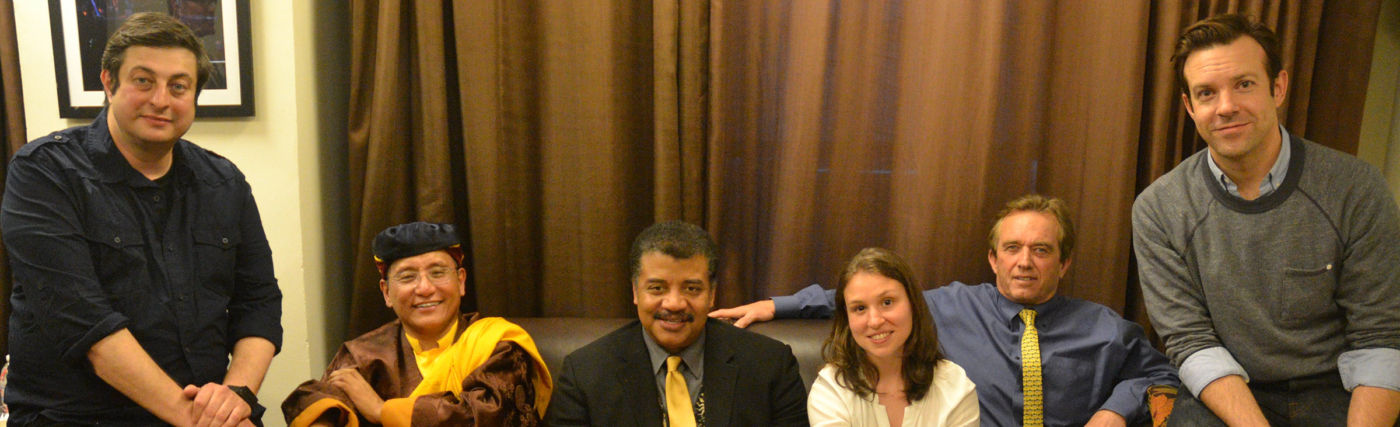
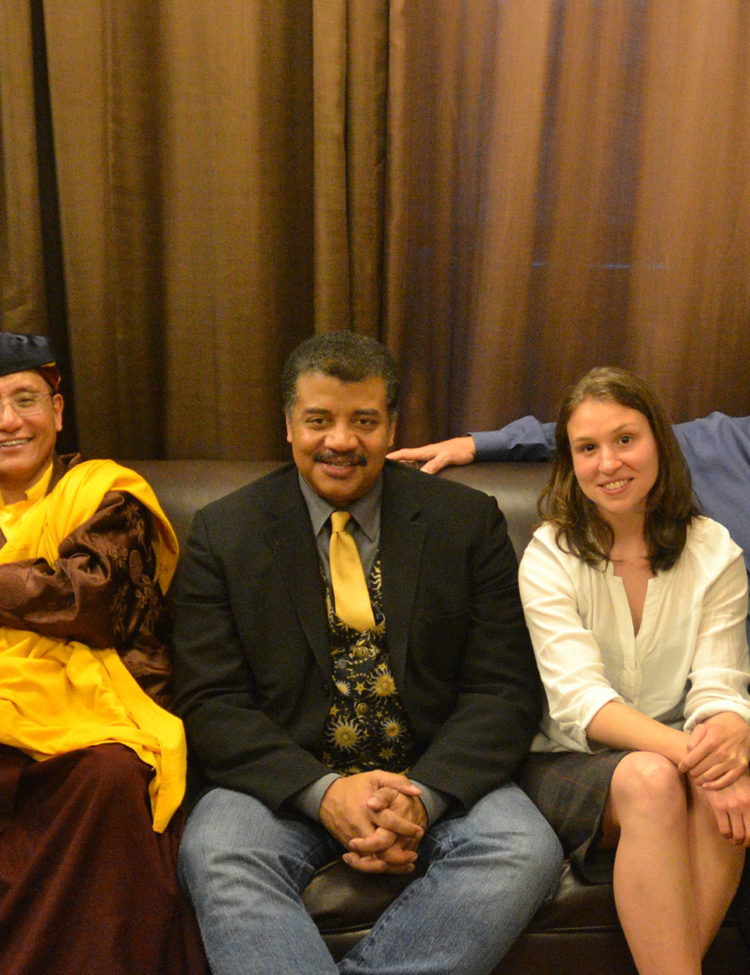
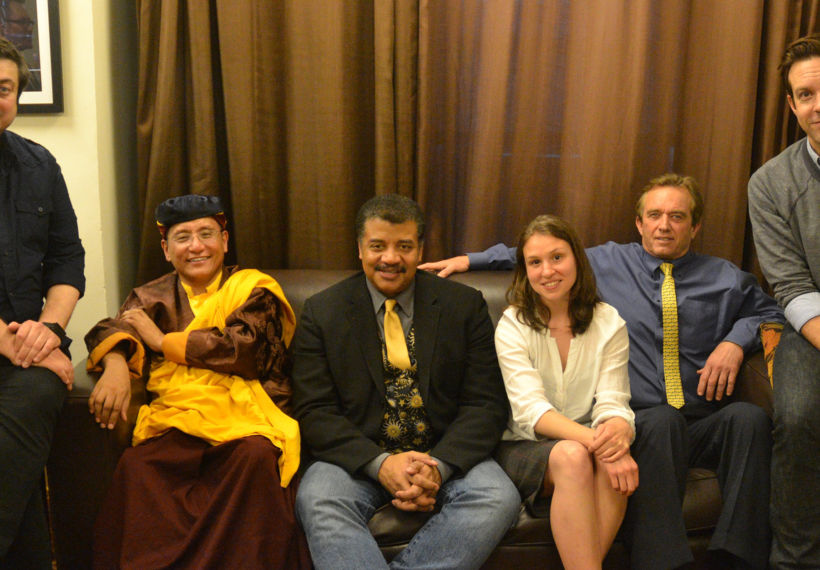
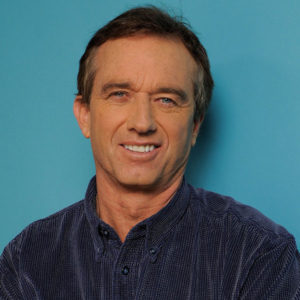
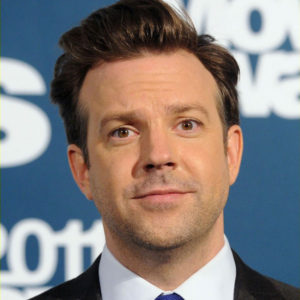
In the conclusion to our show from the Beacon Theater in NYC, Neil deGrasse Tyson and Eugene Mirman navigate the waters of greed, bad science and a lack of basic understanding about water, with the help of their guests Robert F. Kennedy Jr., His Holiness the Gyalwang Drukpa, hydrogeologist Dr. Tess Russo and Jason Sudeikis. You’ll hear His Holiness explain how he ended disease in a Himalayan village by convincing people to stop throwing dead bodies – human and animal – into their local lake. Find out why depleting ground water can reduce the available surface water, and how both fracking and rising sea levels can lead to the contamination of aquifers. RFK Jr. explains that the most important environmental issue we face is having livable cities so we can preserve the wilderness to protect the water supply. You’ll learn about desalinization plants, managed recharge, and other water technologies, including drip agriculture that can reduce water use in farming by 95%. And you’ll discover the dangers of the trillion-dollar water privatization industry, and why the Pentagon says global warming and water shortages are the principal threat to US security (and have already lead to wars over water in Bolivia and Belize).
Transcript
DOWNLOAD SRT
Welcome to StarTalk, your place in the universe where science and pop culture collide. StarTalk begins right now. We are back live at The Beacon Theater, New York City! We are talking about water and all its forms, and all...
Welcome to StarTalk, your place in the universe where science and pop culture collide.
StarTalk begins right now.
We are back live at The Beacon Theater, New York City!
We are talking about water and all its forms, and all the consequences of too much water, too little water, dirty water, clean water.
Tess, you've also studied disruptions to the hydrologic cycle.
What are examples of disruptions to that?
I would say changes, not really disruptions.
Okay, what's an example?
If you build a dam on a river, you are...
Like what beavers do.
Exactly.
Humans do it too, but we learned it from beavers.
So that's an example of disrupting the flow down the river.
All right.
Is that always bad?
No.
So what else would disrupt it?
If you pumped lots and lots of water out of the ground.
You might be a redneck.
Redneck.
I don't know where to go from there.
Shout out to Jeff Foxworthy right there.
Okay, so continue.
Yeah, so pumping lots of water out of the ground could lower the ground water table.
It could start pulling water from the rivers and the streams down into the ground.
So water that used to make it all the way to the ocean now gets sucked into the ground.
I never knew that.
Are you saying if you pull water out from other places, your river now might leach into those places that it didn't go before because there used to be water there.
Right.
Right.
So that drains your river before it even gets to the ocean.
Yeah.
So the surface water and the groundwater are connected, even though you don't see the groundwater or the connection.
Okay.
And so some of the hidden costs of climate change would include what, would you say?
Well, changing the water availability.
So changes in precipitation patterns are gonna change how much water seeps into the ground and recharges our groundwater.
It's gonna change how much water flows down our rivers.
Temperature changes are gonna change how much water we need, which is a big problem.
And as you melt glaciers, sea levels rise, so that's another...
Flooding, if you're melting glaciers too quickly.
Okay, so if the sea level rises, might that force water back up rivers and make it brackish?
Yeah.
Yeah.
When it wouldn't, when it wasn't that way before, is that something that can happen as well?
And you can have seawater intrusion into the aquifers.
So now you're pushing salty water into our groundwater and then no one wants to pump it anymore.
Contaminating the wells that people might go from.
So it sounds like most of the problem is beavers.
All right, so I'm fascinated by hearing this and hearing Bobby give the recitation of geopolitical conflict.
Your Holiness, is there any history of how water is dealt with spiritually, water as ritual?
Is there any traditions that you could share with us about how people think about water beyond just something to drink?
I just wanted to ask you that question.
Since you are a scientific man, do you really think that there is some sort of a connection with the spirituality, a spiritual connection with the water?
There is a quote from JFK, John Kennedy, the president.
He spoke of returning to the water's edge.
He was a boatsman, as we know.
If I get any of this wrong, correct me here.
And when asked, why do you come to the ocean, he reflected on the fact that life on land started in the ocean.
And he hypothesized that this point of origin of life continues to call to us.
And in its calling, we are drawn to the boundary between land and water, and we gaze upon.
Who here hasn't stared at the waves coming in?
Not even in conversation with anyone, just transfixed by nature and how it moves water towards the land and away.
And so, I don't know if that's a spiritual reference to water, as much as sort of a biological one, but it's a comment that I've never forgot ever since I've heard him speak those words.
To my understanding, the old elements has the spiritual existence, definitely.
The water represents the energy, energy of the growth, the prosperity.
And of course, the fire represents something else.
I don't want to take much of your time to tell all these things.
That's kind of why we have you here.
It's kind of you to not want to take up my time.
Why won't you tell us the secrets of wind?
Do you ask for the secrets of wind?
Okay, that's well known.
George Bernard Shaw said wind is caused by trees waving their branches.
Just prove that one.
So the water definitely has spirit.
We call it naga, which is of course the holder of the water.
When we pollute the water, these guys are not happy.
This is from a superstitious point of view.
When it works, I believe.
When it doesn't work, I don't believe.
We are all happy to learn that you lead an evidence-driven life.
So if I share some example, up in the Himalayas, there is a village that has a very beautiful lake and the beautiful rivers, and then they were contaminating the river and the water.
They don't have that many stuff to dump in the water.
But when people die, the dead body goes in there, and the horse goes in there, and the dead yak, dead sheep, they are all dumped in there because it's easier for them.
I've noticed that so many people are sick, especially skin disease, and every doctor goes there, they can't help.
So they want me to help.
So then I thought, okay, there must be something to do with the water.
So then I said, let's experiment.
Then I asked them to clean the lake, to clean the river, and I asked them not to throw the dead body there, please cremate in a cemetery.
I create a cemetery for them, and within two years, the whole entire disease stopped.
That's where the saying, don't throw your dead body, where the water comes from.
The very first biochemical warfare ever, it was figured out that if you had the carcass of some farm animal that was sort of putrefied, and you managed to dump it into the well of your enemy, you would then contaminate their water supply and basically make them all sick and possibly kill them.
So, is biochemical warfare in its earliest stages?
Really?
So, in this case, they are waging biochemical warfare on themselves, contaminating their own water supply.
That part, I believe because I saw with my own eyes, but there are many things that we can talk about, religious, blind faith and all these things, superstitious, that I don't believe.
Many things that are not believable.
What more of a spiritual journey exists than existing on Earth like water does, ascending to the heavens, hanging out there for a few days, coming back down and then helping people out again.
That seems like a pretty common spiritual journey, at least, etolicism.
I mean, like that water cycle is, you know, there's a threes, magic number, schoolhouse rock, etc.
etc.
Etc.
etc.
There's another point about water.
Water is a very stable molecule.
It's really hard to break the H2O apart.
Really hard.
It takes a lot of energy.
In fact, the inverse of that fact is what drives what was once the engines of the space shuttle.
The big orange tank, fuel tank, is hydrogen separated from oxygen.
You don't see it, but there are two tanks inside that tank.
One of them is twice the size of the other.
The one that's twice the size has hydrogen, H2.
The other one is half the size is oxygen.
Those two chemicals funnel out of the engine, and when they combine, they release energy, an exothermic reaction it's called, and therein is rocket fuel.
And that energy is the energy you have to put back into water in order to break it apart again.
So because it's so stable, every water molecule you ingest has basically been around since the beginning of the earth.
So you want to talk about spirituality.
You take a swig of water, it contains water molecules that have passed through the kidneys of Abraham Lincoln, of Genghis Khan, of Jesus.
Pick your person from the past, be they holy or otherwise.
Bill Russell.
No, he's not far enough in the past because the water, you have to drink it, it has to come out of you, goes in the ground water, goes to the river, the river goes to the ocean, the ocean circulates, it comes up as rain, comes back on the, so it takes a while.
William McKinley?
That would be great, you start selling water, then this pass through whomever.
So of course my broader point is that water is communal, internationally communal, for that very reason.
Water molecules don't carry passports, they will move from one part of the world to the other.
I've never been more scared in my life than moments in water, like when you're in a wave, you're there having fun, and then you get caught.
It's the time I've been most afraid in my life, and I've been on the highway in LA, and it's still being in the ocean.
Yeah, I mean, we fear death, I think.
And that's a very spiritual moment in that moment.
It's like, oh no, here I go.
So there's water that can bring life and death.
Yeah, yeah.
We all need some contact with wilderness, with the wild part of the earth.
If you've gone camping or if you've been on white water or sailing or whatever it is, there's kind of a spiritual renewal that takes place and that everybody can document.
Everybody knows that.
One of the things that the water keepers do is we focus on waterways that go through our major cities.
This country particularly was founded on the idea that Frederick Jackson Turner said that an American democracy came out of the wilderness.
And it was a whole movement in this country after the revolution of our artists and our cultural leaders who were telling the American people you have to build public parks in your city like Frederick Olmsted, our great painters painted these vast landscapes, usually including water, to tell the American people that you don't have to be ashamed because you don't have the 1500 years of culture that they have in Europe, because you have this relationship to the land and to the water and wilderness, and that's the undiluted work of the creator.
That is the distinction that you're going to have as a nation.
That's where your values and your virtues and your characters and people are going to be.
We do a little bit of that.
We have the national parks.
Are you not happy with how we've divided up the landscape here in America?
You're making me look like a malcontent.
The most important environmental issue is that we have livable cities.
Instead of investing in huge highways and subsidies that go out to settling the landscapes around our cities, we should be investing in police protection and great schools and great health care in the city, making people want to live here, and then saving the landscapes to filter water.
And that's what they do in Portland, which is consistently the most livable city in the United States.
They've made an urban boundary.
You're from the Pacific Northwest, right?
I used to live in Portland.
Do you miss that about Portland?
I loved living there.
In Portland, you can take a bus at the end of the line, and you're in a city, and you can step out of that bus and walk into a redwood forest with sitka spruce that are 30 feet around at the base, and you see the eagles and everything else, and it's accessible to the poorest person in the city.
Whereas in New York, when Robert Moses designed the parkway, the whole point of those parkways was to get New Yorkers out to their parks so they could renew this relationship with the roots of the democracy.
But he specifically made the bridges on the Hutch and the Merritt low enough so that a Greyhound bus couldn't pass under them because he didn't want black people from New York visiting the parks.
And that's how they are today.
And it's one of the most important civil rights issues that we have in this country is the access of poor people and minority communities to public parks.
And they're always the ones who shoulder the disproportionate burden of environmental interests.
If you've seen those parkways, all the bridges are very low.
So all you have to see is a black person in a really low Lamborghini coming through.
His head would explode.
He wouldn't know what would happen there.
Many of us are old enough to remember when you didn't just buy water in the store.
It means somebody owns access to water and is selling it to you.
Your Holiness, does that offend you when someone says, I have declared this water something I own and now for you to have fresh water, I'm going to sell it to you?
Let me make it a bigger question here.
Your Holiness, from your understanding of human nature, are you hopeful?
I am very optimistic, but we have to educate.
And also, me coming from Himalaya, the waters are all running down to the world.
The biggest river, the Indus River, is just next door to me, is going down.
And elsewhere, if there's some sort of a tragedy that is connected with the weather and the so-called natural disaster, of course, it is not a natural disaster, it is a man-made disaster.
But when I hear this sort of disasters elsewhere, I feel, oh, is it us who created?
So we feel very big responsibility.
We means we, people who live in Himalaya, we feel very big responsibility to take care of all these water and the elements.
Then here, we are talking about selling and buying all these things, and also the people in the city, they bath a lot.
I was sharing with Kennedy the other day that people are having shower like for hours, they don't need to.
That's not a real thing.
In the name of enjoying, they just stand there for a long, long time, wasting a lot of, we don't know anything about that.
I feel like, egoistically speaking, oh, this is my property, water is not belongs to one person, it belongs to everybody.
So we have to be careful and we have to be thoughtful.
So Bobby, you've occasionally said positive thing this evening about the future of our species.
Do you think World War III would be fought over water?
You know, Pentagon has done two assessments over the last decade and in both those assessments, they said that global warming and particularly water shortages are the principal threat to America's national security because of the disruption to global political systems and populations that it's gonna cause.
In the last 10 years, water privatization has become a trillion dollar industry.
Trillion dollar industry?
Trillion dollar industry, according to the World Bank.
We've already seen water wars fought all over the world in Bolivia and Coach Obama and Belize and many other countries where foreign companies have come in, privatized local water supplies and then raised rates and literally killed poor people who can't afford those higher water rates.
You know, the interesting thing, Neil, is to look at nations that have water and those that don't.
The nation that has the most water, if any, in the world is Canada, which has about 20% of the global water.
Russia has probably somewhere around 20%.
We have almost as much as Canada, but we have 300 million people.
There's only 30 million people in Canada.
What you're going to see is a very, very strong demand from the southwestern cities that are drying up right now to get a hold of the Great Lakes water, to put a pipeline down from the Great Lakes water.
And these proposals are constantly being made.
And the Canadians will say, well, part of that water is ours.
So that's the kind of conflict you're going to have, even in what we call the first world.
But in other places in the world, the scenario you described before, where you have poor farmers migrating to cities, it's not that they're making demands on government.
These are people who are going to die.
And somebody who is going to die has nothing to live for.
Any of them are going to decide to die violently.
That is where civil war has come from.
You're bumming me out again.
If you were like, what's your favorite flower?
Before we go to Q&A, let me end with a rephrased question.
We have some geopolitical ideas.
Yeah.
What they all said, but happier.
His Holiness said something we all embrace and agree with, that education is key.
It's always the key, for sure.
I don't know that education necessarily makes people less violent when pressed into violence.
So what would you say, in addition to education, is the most important thing we all need to do going forward with regard to water for all?
What bit of wisdom can you share with us?
We want to be responsible citizens, but we don't always know how.
Are you His Holiness?
Right now, you're just a holiness.
I mean, it's true, veganism is a thing.
Let's not get carried away.
So what would you...
Education, to me, is that people have to understand how important the water is.
That's all.
That's it.
That's it.
Water does what?
When you have an abundance, you don't know how important it is.
That's true.
And the water now, right now, people, almost like a majority people, thinks that the water comes from the tab.
But it is not true.
Water comes from elsewhere.
You have to understand.
And the tab.
Technically?
You know?
And it comes from the mountain and the river.
I don't want to go through all the details, but of course you have to know much deeper than the tab.
So it's hard to know that by being told it.
Perhaps maybe Americans should travel more to other...
To Himalayas.
Are we all invited?
I mean, we don't know.
No, no.
I mean...
Not that we're...
Jokingly, I'm saying travel to Himalayas, but they don't have to go to Himalayas.
They just go to a little mountain they have here, and they have to walk around, and they have to talk with the trees.
They have to really be like, really, the trees will talk to you.
Trees will talk to you, plants will talk to you, flowers will talk to you, and water will talk to you.
So everything, really, you just have to be friendly with them, you know, stop being rude to them, abusive to them.
That is the thing.
You have to be respecting them.
Nature needs to be respected.
Like all us, all of us, we all need respect.
We have to understand the good about everybody, you know, not only me, me, me, I.
Everybody has a good thing.
I think everybody has something to offer.
And nature definitely has many things to offer.
Not only that, we survive in the nature.
For example, supposing if there is no tree in this world, there is no oxygen.
I mean, I don't know.
Please correct me.
Green life gives oxygen.
That's true.
Yeah.
It's a byproduct of photosynthesis.
It's their waste product is our life product.
That's it.
Yeah.
That's the education I'm talking about, you know, that we should know how to respect the nature.
We should know how to respect the animal also.
We don't know how to respect the animal.
Animals are the owner of the world.
We are not the only one owns the world, but the animals owns the world.
But we always, always somehow abuse the animal.
In the name of, I don't know, superior, they can't talk, so therefore we just kill them, chop them, abuse them very badly.
So we should respect them.
Not only from the point of view of Buddhist or religion, the Christianity or something.
No, we shouldn't talk about any other religion.
We just talk about the reality.
So this is the religion.
This is what we should be, we should always be with the reality.
This is what I'm thinking, I don't know.
You should correct me again.
Yeah, Neil, you should correct him.
The trees are good listeners but not good talkers.
Your Holiness, there is nothing I can add or subtract from what you just said.
Thank you.
Let's get a round of applause for our panel here.
I keep thinking there's some kumbaya song that we should be singing at the end of that.
Does anyone need a quick potty break before we...
We're good up here?
I'm not gonna use more water.
We're gonna open this up to you to find out just what questions and comments you might have.
There's a microphone on this aisle here.
Sir.
Yes.
Beyond the importance of protecting the scarce resource of small fraction of 1% of fresh water that's available to us, is desalination an option or desalination plants in order to try to reclaim part of the 99% that isn't, especially for some areas in the Middle East that are pretty arid?
Forgive me for not even raising that topic during this hour and a half.
So let's go straight to Tess on that.
Tess.
Why can't we just take the salt out of the ocean?
That would solve all our problems.
So desal is, I think, gonna be one of the solutions.
The problem is, it's still really expensive.
It uses a lot of energy.
The other problem is, you have to still have a water source.
So that works for people on the coast, but like I think Neil said earlier, water is heavy.
And so moving that water inland to the people who live in the middle of the country is not efficient.
Okay, so it's a regional solution, but not a global solution.
Right.
You said that there was a point where water is liquid, solid and gas at the same time.
So what properties would it have?
How old are you?
A little Benji Button.
Call me out on what I said.
So yes, maybe I wasn't clear.
It's not a new kind of water that's all three in the same spot.
But a bucket.
Yeah, I'm sorry.
That would have been cool, though, something that is simultaneously solid, liquid and gas.
I don't know what that would look like.
But when we talk about the triple point of water or of any other substance, a bucket of it would just be happy having ice cubes, water, and that water will be boiling, creating steam.
And the ice and the boiling water are just fine.
And the boiling water doesn't melt the ice.
The ice is just happy.
And so that is what we mean by the triple point of a substance.
And if you could have something that was simultaneously solid, liquid and gas, that would be an awesome superhero or something.
That is usually what happens to me under Taco.
Bell.
I call it the Triple Crown.
So right here.
Besides desolidation, are there any other promising technologies for improving people's access to clean water?
Yeah, good.
Tess?
I think there are a lot of really simple, low-cost technologies that we can improve the way we capture water and can store it using managed recharge into the groundwater.
It's managing the recharge of the aquifer.
So you're basically, you're capturing the water and retaining it.
So you give it more time to go into the aquifer or you actually pump it in.
So instead of pumping out, you're pumping in.
There are a lot of technologies out there right now that if they were widely used would dramatically reduce the amount of water that's needed.
For example, agriculture, there's drip agriculture where you have these very, very inexpensive probes that can measure the moisture in the ground and then turn on computers that tell you exactly how much water the plant needs and you can reduce water and agricultural uses by upwards of 95%.
So we overwater our...
Almost all agricultural water is wasted.
By 95%.
By 95% because you only need water that's actually going to the plant.
What you do is you saturate the whole field with water.
Most of that water either evaporates or it goes into the ground.
Which we spent such hard energy trying to get out in the first place.
Close to 20% of the water that is used goes to dying cotton.
It's a huge use of water and there are now water free dying methodologies that are being adopted by businesses and you should make sure that when you buy clothes that they're using either low water or water free dyes.
It's a consumptive use because the water is so polluted at the end of the dying process that it can't be recovered except by the highest end clothing manufacturers.
Can I add that the point about the agriculture is bright on and we need to emphasize that that if we can save even a little bit of water in agriculture, we're actually saving a huge amount of water because agriculture uses the most water.
So if you're saving 5% in ag, it's much more water than 5% of drinking.
We can save up to 95% of it.
Without knowing any math, that is around something.
Let's go to another question.
And 2013 was the last one, and I think they concluded that even if the human race stopped polluting, stopped releasing greenhouse gases, cold turkey, the average temperature of the earth would raise 1.1 degrees Celsius, and at 2 degrees Celsius, it's irrevocable damage.
So clearly, it's an issue that we should be thinking about.
What's the best thing we should be doing as regular people?
The most important thing that you can do is to vote for a politician who believes in global warming.
It's much more important to change your politician than your light bulb or your automobile, because they're making the rules that will incentivize good behavior.
Free market capitalism is the most powerful economic engine ever devised, but it has to be harnessed to a social purpose.
Otherwise, it will lead us inedulily down the path of environmental destruction and oligarchy and corporate kleptocracy, which is what we're headed for right now.
Kleptocracy?
Yeah, that's where the Koch brothers run everything and steal everything.
We're the wealthiest country in the world.
We create the most greenhouse gasses and we have the capacity to change that.
We shouldn't punish people.
We shouldn't reduce our quality of life, but we should incentivize business people and others to make the right choices and to make sure that you can make money in this country by doing good things for our community, rather than forcing people to make money by poisoning the rest of us.
You were talking about how the pressure on the ice gate affects ice, but I thought the jury was still out on how ice is slippery.
That's it.
That's all I got.
Oh, so this has been eating at you the whole time.
Yes.
It's possible for ice to be so cold that even if you try to compress it, you don't succeed and then you cannot skate on it.
So, ice is not slippery because it's ice.
Ice is slippery for an ice skater because it is converted into water by squeezing it.
Why is it then slippery for just when you're walking on it on your little path to your house and then you fall?
With no ice skates, because no one skates into their home.
There's a temperature below which if you skated, you would not melt the water or the water would melt briefly and freeze quickly and you wouldn't be on loop.
We're referring to the act of skating.
Yeah, yeah, but just walking around though.
Yeah, but he asked why it's slippery.
I don't think it's unfair what I'm saying.
You know, I don't wear skates.
I've only worn skates like five times in my life, but I've slipped on ice.
Okay, in physics it's called the coefficient of friction, which is how one material intersects with the other.
And if you look close in, if one is very smooth, and the other is smooth, like Teflon against some other surface, then the friction is low.
If the surfaces are not smooth, like rubber on asphalt, the rubber gets in, so then you have a high coefficient of friction.
And that's why cars have rubber, and their roads are made of asphalt, rather than Teflon on cows.
Yes, ma'am.
Fracking is probably one of the most divisive issues that we have in the country today, with over 500,000 wells in the country now that use probably 3 to 5 million gallons of water per frack.
That means that they're running at capacity every day, they're wasting our drinking water at a number of 2.5 trillion gallons of water per day.
And that's only in the United States.
In the context of the amount of water you use for agriculture, or in dying cotton, thank you, I learned that today, is that a significant number?
Because in my mind, it seems insane.
I wonder that as well.
We could argue about one topic or another, but if it's a tiny percent of the total problem, we're sort of wasting breath.
So I want to know the answer to that question too.
With this fracking, it uses water...
It's about 1% of the total water consumption in the US.
Which is not trivial.
Like you said, it's trillions of gallons.
But it's nowhere near what we're using for agriculture.
Well, one of the answers to your question is that it depends where you are.
Like in New York state, water consumption is something that we don't have a lot of grounds complaining about.
There's other reasons to oppose fracking.
But the water consumption is probably not a good one because other energy uses use more water per kilowatt hour.
For example, the Indian Point power plant uses a million gallons a minute of water.
In the western states, water would be a huge issue, particularly when they have a drought as they do today.
I would love to use that issue to sue somebody on.
We have time for a few more questions.
Yes.
So my question is along a similar vein.
Is there a scientific consensus on the dangers of fracking to individual water supplies?
It depends if you ask the gas companies.
If you say is there a consensus and you are asking whether we agree with the gas companies, no.
There are some gas companies that are honest, that will admit that they are causing big problems.
But the gas industry trade associations that will say there is no proof that production chemicals or the produce water is actually getting into waterways.
But the science says otherwise.
And more rigorous science has been done in Wyoming, for example, Dimmick, Pennsylvania.
EPA has done very exhaustive reports and found out there is tremendous leakage from the gas wells of benzene, toluene, xylene, produced water, salt, and all of the chemicals that go into the fracking fluids that they can then fingerprint and identify in the groundwater.
So, the science is very clear that it is happening, although the industry still will say that they don't believe it.
A repeating pattern in so much of the world.
Yes.
I would like to know if this climate change and water pollution, it's proven that it's happening, why is it such a big political problem?
Why does everyone have to debate about it when we know that this is happening, other than greed?
Is greed not enough?
Why would we need to debate on something that we know is happening and that we know will affect us in the future?
I would say that it is a failure of democracy.
In a perfect democracy, you would have policy that was driven by science and by objective criteria and by empirical data.
But in our democracy, at this point, policy is driven by moneyed interests.
By investing a little bit of money in a politician and then some money in these so-called free market think tanks and they fill them up with these phony tobacco scientists we call biostitutes who will say there is no such thing as global warming.
Biostitutes?
Biostitutes.
I think the answer is greed.
Greed.
Yeah.
Plus, we seem to live in a world where people want something to be true, whether or not it is.
And that's a peculiar state of a democracy, because it is an unstable foundation for anything that would follow.
And so I keep wondering whether we just have to collapse as a civilization and from that state have all our pistons aligned and move forward together.
The best template for what's going on now on a massive scale is what happened at the tobacco industry.
Here was an industry that was killing one out of every four of its customers that used its product as directed, and yet they were able to avoid regulation for 60 years by creating these phony think tanks and generating this phony science, buying politicians, subverting the political process, capturing the agencies that are supposed to protect us from the polluters and from the bad guys, and making them sock puppets for the industries they're supposed to regulate.
And they developed this whole template.
They had a PR firm called Hill & Knowlton that went out and developed all these strategies for them, and those strategies have now been adopted by the carbon industry that have a lot higher profits at stake than big tobacco ever did.
And you remember eight years ago when Congressman Waxman's committee, the heads of the seven tobacco companies, the CEOs, stood before Congress, raised their right hand and swore under oath that they did not believe that cigarettes caused any health problems to human beings, and everybody knew they were lying.
But they did it anyway.
Why would they do that?
They did it, as you said, because it greed.
Eight years ago, I was being sued by third graders for the demotion of Pluto.
So I had other...
I don't always have the same issues that you do.
We just have time for a couple more questions.
Well, thank you.
I would like to talk about energy.
What do you think is the real future of energy?
I mean, I guess to the scientists on the panel, I'd like to say for a theoretical far-fetched question, do you think 100 years from now we'll have contained fusion and be able to use that?
But in a more practical contemporary sense, what's the real status of the renewables, particularly solar and wind?
I did an op-ed recently with David Crane, who's the head of NRG, who's the biggest energy producer in the country.
He has coal plants, gas plants, oil, and wind and solar.
And he says that he has $100 million to spend on a plant.
He will build a solar plant because solar energy now is so cheap.
It costs under $3 billion a gigawatt to generate energy.
Coal costs $3 billion a gigawatt.
Nukes cost $15 billion a gigawatt.
I'm talking the capital cost of building the plant.
Wind costs about $3 billion.
So they're all the same.
But once you build a solar plant, it's free energy forever because the photons are hitting the earth every day for free.
Once you build that oil plant, now you got to go to Saudi Arabia, punch holes in the ground, bring up the oil, refine it expensively, genuflect to the sheiks who despise democracy and are hated by their own people, bring it across the Atlantic with a military escort.
And guess what?
Exxon doesn't pay for it.
You and I do.
Spill it all over the Gulf.
Spill it all over Valdez.
Earn the oil and poison everybody who breathes the emissions and raises the sea level and everything else.
And have a nice day.
How many gigawatts to go back in time again?
Two point twenty-two gigawatts.
Jigawatts.
The flux capacitor needs that energy.
Given that the Middle East has such low water and they spend a lot of their agriculture watering watermelons, it seems kind of silly.
Why don't they plant things that don't require watermelons?
Is there any...
Less water-intensive crops.
Exactly.
Why don't they just eat bees?
Not that, but they end up exporting a lot of the watermelons because they're subsidized.
So it's a combination of economics and science, so why don't they ever collaborate?
Let me go to Tess on that.
Tess, are people planting the right stuff around the world?
They're definitely not, but what is stopping them?
Why are they being subsidized?
So it depends on the country.
So if you're talking about melons being grown in the Middle East, you could look at Jordan, who has no water in their garden.
They shouldn't be.
And then they're exporting, so they're losing all that water.
If you look at Northwest India, for example, the government has told the farmers to grow rice and wheat.
They say, we'll give you a guaranteed price for these crops.
You don't have to worry about market fluctuations, nothing.
So the farmers say, great, I'm going to grow rice and wheat, even though we don't have enough water for it.
So they're pumping their groundwater faster than they can use it.
And it's all because the government is saying, this is what you should grow in this part of the country.
So you're right to bring it up in that it seems like we should just be able to talk to the politicians and change what crops they should grow.
And that's something that we're working on.
And the politicians in these areas are starting to realize it because they're seeing their farmers facing the point where they're not able to keep farming.
That really doesn't answer the fundamental question of why.
Oh, why were they wrong in the first place?
Yeah.
So what created that discrepancy between what is allowed and what is not allowed?
I don't know.
Some politicians said, I think I can make a lot of money for growing rice.
And so they picked rice for Punjab.
And they shouldn't have.
Greed?
Maybe just greed?
That's the answer to all of this.
Forgive the long line here, but we have time for only one more question.
We're going to take it from the gentleman in the second row there.
Please go.
Thank you.
Is there any point where we could get to a point where there were enough natural and manmade disasters that basically all of our accessible water could get to a polluted point beyond repair?
And if that's the case, could we as humans adapt to compensate for that?
Wait, so you're saying...
Yes, but a lot of us would die.
This room would live, everyone else, bye bye.
So you're saying we pollute the whole planet and then just evolve to thrive on polluted water?
Or adjust our genome so that polluted water is just fine for us?
I mean, it would take time for evolution, but is it possible?
So may I field that?
I would just say that it's not a good plan.
Bobby, that was your most succinct answer.
All honest, though.
Believe it or not, I think a lot about those kinds of issues.
Because the question is, what is easier or harder or cheaper or more expensive?
Finding a solution to a problem so that the problem is solved or adapting to the problem so that you never have to solve it, but you can keep living with it.
It's an interesting challenge that we faced throughout the history of our culture.
If you go back 120 years, there was a challenge among urban dwellers where there was horse manure all in the streets.
Flies would reproduce on it.
Back then, before supermarkets, there were just carts with food, and flies would get on the food.
There was a health challenge.
And so people did all this research.
How do you put something in the feed of the horse that could change the nature of the manure so that flies will not reproduce in it?
It would be considered unattractive to the flies.
All this research went into this, and the fly problem was solved by the invention of a car.
The car solved that problem.
And so solutions are not always linear.
By the way, that's a very different kind.
It had its own problems, but cars don't breed flies, right?
So it's just interesting to me as I study human ingenuity and the advance of civilization, how and when people decide what a solution is to something and whether they just leapfrog it into a whole other realm.
And so I'd like to think that if we had the power of genomic engineering to change our human physiology so that it could survive polluted water, that that world would have enough power to have purified the water in the first place.
That's what I'm just kind of thinking here.
And so this is why the STEM fields are science, technology, engineering and math.
His Holiness spoke of the value of this.
That's why it is so important in our future, because a problem arises.
What's your first thought?
I think of it when the asteroid comes.
The asteroid's coming.
What's your first thought?
Is it run?
Buy water?
Toilet paper?
Whatever people buy when they're escaping.
Is that your first thought?
Or is your first thought, how do I deflect that asteroid?
That's the world I want to live in, where people see a problem and imagine a solution to it that solves the problem rather than escaping from the problem, trying to prevent the problem from further affecting them.
These are two different worlds.
I want to live in this one.
I.
Get that by a stem literate culture.
Not everyone has to be a stem professional.
You could even be an attorney, but if you're stem literate, you can fight for causes that promote stem interest in our culture.
So you are an example to us all.
See the full transcript



 Unlock with Patreon



 Become a Patron