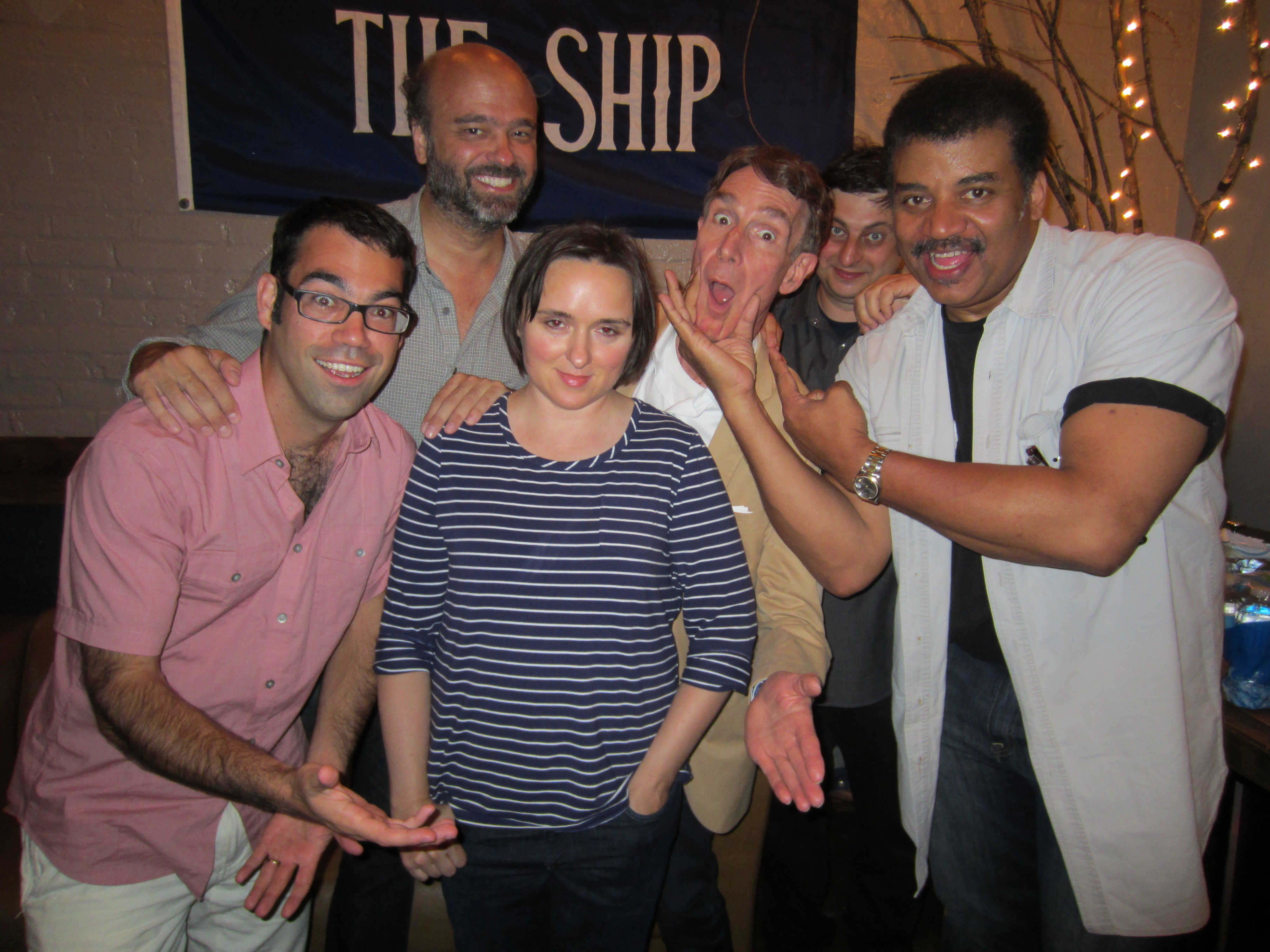
StarTalk Live’s celebration of the discovery of the Higgs boson on July 11, 2012 continues as CERN physicist Kyle Cranmer clues us in to what’s next in the investigation of the Higgs, now that it turns out it isn’t exactly what they thought it would be. Plus a lively Q&A session with the audience that includes Bill Nye the Science Guy bragging about the spacecraft he’s building and astrophysicist Neil deGrasse Tyson waxing poetic about why photons are beautiful. You’ll also learn what Super Symmetry is, and why it may hold the key to understanding Dark Matter. And of course, comic co-host Eugene Mirman and the other Particle Partiers, Scott Adsit and Sara Vowell, do their parts to keep the conversation as lively as a charged particle in the Large Hadron Collider.
Transcript
DOWNLOAD SRT
Welcome to StarTalk, your place in the universe where science and pop culture collide. StarTalk begins right now. Welcome back to StarTalk Radio Brooklyn. We are live at the Bell House. All right, so Kyle, let's assume that this high-confidence...
Welcome to StarTalk, your place in the universe where science and pop culture collide.
StarTalk begins right now.
Welcome back to StarTalk Radio Brooklyn.
We are live at the Bell House.
All right, so Kyle, let's assume that this high-confidence particle that you discovered that could be the Higgs really is the Higgs.
Where do you go next?
What are you going to do with your big bag of Higgs particles?
Let's go.
Well, a thousand of them, yeah.
I think that it's pretty clear that it has something to do with this sort of more general thing called the Higgs mechanism.
So it probably has very much to do with the story of the Higgs and why this is important.
What's the Higgs field?
Yeah, oh, whoo.
And who is Higgs?
And who is Bose?
Yeah, who's Bose?
30 seconds, go.
Yeah, that's right.
Bose, Higgs and field, go.
Okay, right.
So our theory for all of these particles is that they're described by fields.
And so you maybe know about the electric field.
Like you've seen pictures of magnets and magnetic fields.
They're filling space.
We live in a gravity field.
Sure, yeah.
So a field is just something that sort of permeates space and time.
Is there a difference between a field and a force?
They're very related.
I mean, a force you'd probably just think of as things pushing on each other.
But there are force carrying particles that propagate through fields.
So you feel it between yourself and the trees and the tree and the rock and the land and the ship.
Ah, yeah.
Exactly.
So the thing that's not at all obvious-
Are you flirting with nature?
That was beautiful.
Oh, you Pocahontas or something?
What are you talking about?
It's Yoda.
I thought I knew the room.
Oh, the ship.
I started thinking of a regular ship, not a spaceship.
Yeah.
But I can go with the ship analogy for a little bit because if you think about the surface of the water as like a field, okay, the particles are like waves on this field and particles interact with each other and these fields interact.
So it's sort of like, if you imagine the wind blowing on top of the water, it can create a wave, right?
So the wind is like one field, the water is a different field, they're interacting.
And so that's somehow-
Is there interaction of force?
No.
Yes, it is.
Yay, I'm not a dummy.
So all of the particles that stuff is made out of is one class of particles, and all of the particles associated with forces are the bosons.
And so that's where that name comes from, if you will.
So Higgs and Bose was a contemporary of Einstein, right?
That's right.
And basically, you know-
An Indian physicist.
Yeah, that's right, that's right.
So there are sort of two classes of particles that no one wants to know the difference between them, but you know-
Yeah, we do, bring it on.
Look at this audience, you kidding?
Tell us the secret.
Okay, actually, I can say it, here we go.
Bosons like to party.
The reason that lasers work is because once you get one photon going in one direction, all the other photons want to jump on board and they just keep piling up.
And what do you get?
You get light amplification by stimulated emission of radiation, baby.
I don't know why you delivered that so sexually to me, but thank you.
But I am so old, I remember when there was no such thing as coherent light, nobody really had that defined, right?
But lasers invented it.
Yeah, yeah, I mean, the laser is basically the first real place that you saw this quantum mechanical phenomena happening.
Yeah, so there's this Higgs field, okay, which is filling space and time.
All the other particles, while they just want to go about their business and go wherever they're going, they have to go through this Higgs field and they interact with it, like the wind blowing on the water.
And different particles interact with it, more strongly than others.
And the ones that interact with it really strongly are the particles that are very massive.
And so it's-
Like a proton and a neutron?
Yeah, so protons and neutrons are not fundamental.
That's a joke, I was kidding.
Oh yeah.
That's a quirk humor.
Yeah.
One thing that I do want to say, and you should take away, and it's so easy for us to say that the Higgs is the origin of mass, and it is the origin of mass for fundamental particles, like electrons and these quarks.
But when you step on the scale in the morning, most of your mass, most of your weight, comes from the protons and neutrons and things that make the atoms of your body.
And most of that mass is sort of E equals MC squared.
It's the energy that's binding together all the quarks and things together.
So most of your weight is not actually coming from the Higgs boson.
So that is kind of oversold a little bit, but the mass of all the fundamental particles does come from the Higgs.
And if it wasn't there, atoms would not form and the universe would be very different.
So it is really, really fundamental.
But it sounds like the bicycle analogy where what's more important, the wheel or the chain or the spokes?
You take one away, nothing works.
So you're crediting the Higgs boson, but a universe without electrons would be really weird also.
That's right.
So why are you raising up the Higgs boson as being the particle that would mess up the universe if it weren't there?
We have a messed up universe without electrons.
Yeah, I mean, there are a lot of things that have to be sort of precisely like they are for the universe to look anything like it does.
And that's sort of a good segue to string theory is because people ask, why is this the case?
And that's the thing that drives most of fundamental physics.
Whenever you have a situation like this, you're always asking why and trying to explain things from fundamental principles.
People want a theory of everything.
So does the Higgs then give mass then to the quarks or to the fundamental 12 elements that make us all fat?
Yeah, that's right.
That turn into atoms to make Americans fat, sorry.
That's right.
And several of them have been outlawed in Manhattan.
Okay.
I think I now understand.
But along this line, is this getting to the thing where why is the universe slightly one way?
Why isn't there as much anti-matter as matter floating around?
That is one of the deep questions of fundamental physics that we try to understand.
Would the Higgs discovery lead to that?
In other words, there's 10 things we can list that we don't know anything about.
Dark matter, dark energy, the asymmetry of matter, anti-matter in the universe.
There's stuff we don't know.
And you just made a brand new particle discovery.
I now want answers to the stuff we didn't know about.
Do you have them?
Yeah.
And I'm not just pulling this out of the ether.
When Einstein came up with general relativity for free, we got to explain the procession of Mercury's elliptical orbit around the sun.
We had no explanation for that, but explained it for free.
And we were loving it.
And so...
Those were the days.
So, are you going to give me my dark matter understanding, my dark energy?
Right.
I mean, the great thing is that the Higgs is a gateway to being able to look for physics that we say beyond the standard model.
This theory we have now is called the standard model.
And it could just be the last piece.
The sad version of the story is it's the end of the story.
And that we...
I'm skeptical.
Yeah.
That means there's no more particles to discover?
It's the last particle in the theory that we have that describes everything that we've seen, except for the dark matter.
And the dark energy.
And the dark energy.
That's 96% of the universe.
Except for that, except for that.
Don't say, oh, it might all be over because it explains everything we know, except the 96% of the stuff we don't know.
It explains the final of the 4%.
It's the last of the 4%.
That's right, that's right.
Now that we got that, so what's the other 96%?
What's un-reported here is you discovered exactly what you expected to be there.
So now there's no new thing you have to confront.
No, but...
On the frontier of cosmic discovery, that'll force you to pour out some previous idea and invent a new path that could actually be the route to answers.
No, but that's exactly why CERN is being careful about saying this is the Higgs boson, and saying it's a Higgs boson-like particle, a god-like particle, is because we don't know that yet.
We definitely cannot say that it's exactly what we expect, and in fact, the rate at which the Higgs is decaying into these two particles of light is happening about twice as often as predicted by the standard model.
We go, let's find out how fast the universe is slowing down, right?
It's gotta be slowing down.
There was a Big Bang, we go back, we're at Mount Wilson, and they go out there, Saul Perlmutter and his buddies, and the thing's not slowing down, it's accelerating.
The universe is accelerating faster and faster from itself.
And do you know why, audience?
Nobody knows why.
And so, I cannot help but think that this investigation that you're doing over there is somehow related to that.
I'm just hoping that there's a connection.
We're hoping.
It's very related.
So there's two different things that are fantastic.
One is that what we see so far, the first hints are that it's not exactly what was predicted.
So this is great news because it looks like we need a new set of particles.
We need something new.
And most of the theories that have something new have lots of opportunities to explain dark matter.
And it gives us the handle to be able to study that at the LHC.
So that is fantastic for me and my future career and what I'm going to do.
It is like the best news you could have.
So two presents in one, the discovery of a new particle and the sign that there's more to come on the horizon.
So can you explain simply on easygoing terms the concept of supersymmetry?
I think I can do okay.
We'll be the judge.
We'll see.
Hang on, hang on.
The universe has a lopsidedness apparently.
Like there's negative electrons and positive protons and there's an unknown reason for that.
Well, it's mainly the asymmetry between matter and antimatter.
When matter and antimatter come together, they annihilate into energy.
And so everything would have annihilated and there would be nothing left.
But, you know, we have the Earth and mattery stuff that you can touch and tangible things.
All of the stars that we know about are all made out of matter.
We don't know about antimatter galaxies or anything like that.
So why is there this asymmetry?
Why was there a leftover on the matter side?
And so that story is somehow deeply connected to why different particles weigh different amounts.
You're looking at me.
I don't know.
I don't either.
You don't know.
No, we don't really know.
Why won't you guys answer all my questions?
But here's the charm of science, if I understand it.
We believe that it's knowable.
Yeah, exactly.
There are theories that try to explain it.
The laws of physics here are probably the same as they are on Mars.
Or we got to write new laws.
Similarly, we think if we could just get far enough into this, we'd figure out why there's this nonsense.
That's right.
So what is supersymmetry?
I'll just say also that some of the most elegant explanations for the things that you're asking about are also motivated by the idea that you have extra dimensions of space and time.
It goes back to what you asked me earlier.
All of this stuff is very related.
Now stop avoiding the question.
What is supersymmetry?
Einstein taught us about relativity.
He taught us that space and time are intimately related in some way.
And there was a consequence of that, a mathematical, logical consequence, which is that all particles needed to have antiparticles.
Understanding that relationship isn't easy, but that was the consequence.
And it seemed not illogical.
That's right.
And so there was a symmetry about space and time, and the logical implication was all the particles had partners.
And so what kinds of symmetries am I talking about?
I'm talking about, for instance, if you're floating around in space, you wouldn't know which direction was which.
So space has a rotational symmetry.
You wouldn't know where you were.
You could be here or there.
It has a translational symmetry.
Time has a symmetry.
Tomorrow is fundamentally the same as today or yesterday.
What do you mean, fundamentally?
I thought I was only going one way.
You got a way to go back?
I just mean the laws of physics yesterday are the same as the laws of physics tomorrow and things like that.
Oh, that.
Wait, tomorrow when we figure out more, they'll be different.
Yeah, I mean the universe will look different.
Yeah, the laws of physics are not changing.
You win this round.
No, there's another way to say that, I think.
Scientist.
If you showed a solar system time reversed, you would not be able to tell whether that was a time reversed solar system or time forward solar system.
Until you watch people walking.
And they'd be like, they're all walking backwards.
Moon walking would just be walking forward.
So, I mean, you know, most people think about physics in terms of numbers and equations and things, but really the driving principle of physics is symmetry, and it's beautiful.
So there's another symmetry of space and time.
And in fact, it's the only other symmetry possible.
And it's the only one that we don't know that nature realizes.
And that's called supersymmetry.
And the logical consequence of this symmetry, if it exists, is that all the particles that we know about have another doubling.
So there's matter and anti-matter, and then there are their supersymmetric partners.
Well, you mean there's like crickets and anti-crickets?
Well, there are already crickets and anti-crickets.
Now there's supersymmetric anti-crickets.
Wait, wait, wait.
I don't think there's enough LSD in the world to know what you mean.
Where are these supersymmetric crickets flying?
What, you don't believe me?
I do believe you.
I just don't know what you mean.
Kyle, what did you just say?
He's saying that there are crickets.
We have all these symmetries.
Up, down, left, right, front, back, back, forward.
But there's another symmetry that exists.
It is the supersymmetry.
What is it?
Wait, say it again.
Explain it.
What it is?
That one is hard to explain.
Oh, so you didn't explain it.
I thought you explained it.
I didn't understand.
You just said, oh, that's supersymmetry.
I said there is another symmetry and the logical consequence is twice as many particles.
What that symmetry is is a little...
There is a super electron and a super photon.
Yeah, horrible names like the selectron and the smuan.
That's cool.
You put an S in front of it.
And then all of the bosons put Eno at the end.
So there is the Gravitino.
Sounds cool.
Oh, so where would I go to find a Gravitino?
Yeah.
The LHC.
The LSD?
No, the LHC.
Yeah.
What is that?
Hang on, is there a class of particles that would be a Hadron or a Shadron?
Why are you looking at me?
She had a lot of hits.
So Hadrons are like collections of fundamental particles.
I guess you could take all of these super symmetric things and build a...
So you got all your particles and there's a whole other set that corresponds with them in some other dimension of symmetric thought.
That's right.
And you would call them super symmetric particles.
Could they be the dark matter particles?
Exactly, yeah.
So the lightest one of these particles is the prime candidate for what dark matter is.
What's that one called?
It's called the lightest super symmetric particle.
Where did you, how did you come up with that name?
That's really good.
This is your opportunity to name that thing.
The Cranmer.
Name it here and now.
Lightest super symmetric particle.
What do you get?
Larry!
Definitely, let's call it the Eugenatron.
It's the Tyson.
Let me ask you this.
Is it worth building a bigger smasher to find this thing?
That's a good question.
I mean, I think there will always be...
The answer is yes.
Yes, yes.
Are you sure, Neil?
You seem undecided.
The answer is yes.
Tell us how you really feel.
So, where we've seen this Higgs boson right now, it was sort of the very hardest place for us to discover it.
That's right, the upper limit.
14 Tera EV or whatever.
Well, that was the sort of energy that we were trying to run at.
We had a technical glitch, the thing exploded, we put it back together and we're running at eight.
That was where the helium leaked.
And the magnet has all this electricity flowing through it so quickly.
It happens in less than a second, right?
You get an explosion.
Yeah, it was very quick and it set us back for about a year.
But we fixed it and we're back in action.
Were you there when that happened?
He says accusatorily.
I picture you all standing around with blackened faces and shrugging at each other.
Frozen hair standing on it.
No, I moved there for a year to be there for the start-up and it got delayed by a year and then I had to move back and it started like the next week.
So it was pretty painful for me.
Alright, so hang on.
If we had a bigger machine.
So we go in two phases.
There's a discovery phase, which is now, which is great.
And then there's a precise measurement phase.
Characterization phase.
And we are...
So here's what went wrong.
To your point, the snoozing point.
When the physicists were in front of Congress back in 1990, when you were, I guess you were in 10th grade at this point in our story.
No, but really, seriously.
And the Congress people, senators asked the physicists, well, what are you guys going to learn?
These guys started down the road of W's and Z's and Higgs's and the senators and congress people kind of lost their way.
What are you guys talking about?
Let's cancel this arcane, wacky thing.
Instead of saying we're going to uncover the next secret of the universe and make discoveries you can't imagine and change humankind in a better way forever.
The way it actually happened was the senators said to the physicists with the superconducting supercollider, will you find God?
And they answered, no, Senator, we will find the Higgs boson.
What they should have said...
Was we're going to know what he was thinking.
Or whatever is your concept of God, this accelerator will get us closer to it.
What they should have said is whatever discovery we will have, like the internet was created after something like this, Senator, we will get you faster.
Faster, better porn into your own home.
I have a question that will sound silly, but it's the thing that I saw in some, maybe, the Times of Somewhere.
But literally there was like a thing where it rattled off all the possibilities, and one was just like in parallel universes.
Is that at all related?
Like it literally was like a bunch of possible things that this could lead to.
Right, so one of the things that's talked about is that there might be more dimensions of space and time, which is...
Awesome!
Pretty awesome, yeah.
But that's a thing that this could help lead to.
That's right, and that kind of goes along the lines of string theory, and string theory goes even further.
Instead of just saying that there's additional directions of space and time, there might be whole other universes out there.
You know, so it's the multiverse now, it's not the universe.
Where Jet Li lives.
And he has to kill all his selves from the other to anyway.
We're right back at Owlman right now.
We're right back at it.
But I'm just saying it's very reasonable.
Owlman, of the things we've discussed, very reasonable.
Very reasonable.
But actually, you know, in an infinite multiverse, there is no such thing as fiction.
Am I right?
I heard that.
Yes.
I love that.
I think I'm going to use that with my physics colleagues.
We have something called the anthropic principle, which is that certain things that we don't understand, that we've been trying to explain, that are very difficult to explain in our theories, maybe don't have an explanation.
Maybe they are just random chance, because there are so many different universes out there that you're only going to find yourself in the one that supports life.
In some sense, it's kind of anti-science, because it's very difficult to test.
In the other way, it has some precedence.
If you think about the solar system, there's the sun and the different planets going around.
People tried to explain why the orbits of the planets were the way they were.
And people were thinking about, oh, well, maybe the platonic solids, like squares and different shapes.
Cubes.
Octagon.
Tetrahedron.
I mean, octahedron.
I was kidding.
Dodecahedron.
There are five of these shapes that fit inside of each other.
And they fit inside of each other with ratios that are pretty close to the orbits of the different planets that they know about.
And people thought, oh, this is the explanation of why the planets orbit in the way they do.
And now we just see that it was random chance.
There are lots of other solar systems out there.
We're finding them every day.
We're studying them.
And we realize they have all sorts of different properties.
So you're devoting your entire career to a set of what we think of are laws but are just random crap that shows up in one universe versus another.
Well, most of it is beautiful laws with very convincing mechanisms.
But there are a few riddles that we still don't understand.
It gets up in the morning.
And we don't know if we'll explain them in a few years from now or if, you know, a hundred years from now, we'll look back at it and think of it just like the people thinking about the planets going around the sun.
This is the passion, beauty and joy, the PB&J of science.
Let me end this with one final question.
So, Kyle, what are you going to be doing in five, ten years?
I hope that this particle just has all sorts of nonstandard properties.
We get huge hints...
Open new frontiers...
.
that it looks like something like, you know, super symmetry or something else unexpected.
We get some idea of what dark matter is, but it's not the full story.
There's a huge chance we're going to start seeing dark matter inside minds or from...
Minds?
Minds underground.
Minds.
Not inside our brains.
Yeah, in my mind.
And we'll have to put all of this story together into a consistent picture, which might not hang together.
And we have easily 20 years of figuring out what's going on in terms of what the universe is doing, which will take us back to trying to understand what's happening shortly after the Big Bang.
Eternal employment for Kyle.
So long as we continue to fund fundamental science.
Let's get one sentence wrap up from each member of the panel.
Bill, Sir William.
We could be living at a historical time having listened to a remarkable figure in history.
What could be more exciting?
Thank you all.
I grew up early on knowing that I love physics, and I cannot believe that I'm sitting here talking to you about the discovery of this particle that's unlocking secrets of the universe.
It's amazing.
I hope that this makes the idea of flying in a slingshot around the sun to go back in time possible.
That was Star Trek IV, the movie.
Of course it was.
To save the whales.
Did I say possible?
I wanted to say likely.
I saw a guy out there do the double horns when the Higgs boson was mentioned and it gave me hope for American's interest in science.
Oh!
I'm proud to be sitting here surrounded by an electron field so that I can be sitting here, and I think that's an American thing.
Thank you, panel!
Neil, did you make your statement?
No, you didn't.
Nice try avoiding the supersymmetry question.
Alright, a hundred years ago, a famous physicist commented, because the pinnacle of classical physics had already sort of reached its maturity.
Newtonian gravity was going strong, and he said, there are few clouds on the horizon, but basically, physics is coming to an end, because we've got everything figured out.
That statement was made a hundred years ago, 110 years ago.
Who said that?
I think it was Millikan, and within 10 or 20 years, relativity would be discovered, quantum physics would be discovered, and all of classical physics would be turned upside down.
And so, my hope, and it's not a rational hope, it's just a hope drawn from history, is that the next particle accelerator will either not find what you're looking for, or find something that nobody ordered, so that physics can be turned on its head once again, and open up whole new paths of discovery.
We got a little bit of time for Q&A.
We got an extraordinary panel here.
Okay, sir, yes.
So, we were promised unimaginable technology as a result of this discovery.
And I just wanted, for the panel, starting with Sarah, to imagine some technologies that could come from this.
That will come from this?
Yeah, just something imaginary that you could justify coming from this.
Could, you know, the teleporting, like on Star Trek, could that come?
No?
Totally.
I wanna do that because I just flew back from Seoul and it took 13 hours.
We have actually teleported small things with quantum mechanics.
Flies?
Well, I think the biggest things right now are molecules, yeah.
Nice, I'm like a giant molecule waiting to be teleported.
Pretty much, yeah, pretty much.
You might not make it, but.
Today, molecules, tomorrow, Eugene.
Yes, okay.
The slogan of teleportation.
You actually wrote this, Kyle.
I'm curious of your answer that you mentioned the next particle collider.
What's the difference between doing the circular versus the linear particle collider?
What's that gonna result in?
Circular colliders, like for example, Stanford has the Stanford Linear Accelerator.
That's right, okay.
So it has to do sort of with the kinds of particles that you accelerate.
So if you accelerate something like a proton, then you can bend it in a circle.
When you try to bend it, it loses some energy, but it's not so bad.
But if you try to accelerate an electron in a circle, it loses a lot of energy, and it's very hard to get them to high energies.
So electrons like to go straight, and protons, easy to go in circles.
Electrons are straight.
Yeah.
Okay, that's the...
Yeah.
Is there also a problem where you try to pump more energy and you'll run out of room?
The thing has to be miles and miles long, but when it's going in a circle, you can just...
Yeah, so when it's in a circle, you can just keep going around and around, but at some point, you sort of lose more than you can put in and it's...
Where does it go, the energy?
You know, into the rock close to it to just...
Get rid of the rock.
Exactly, yeah.
It goes into the village at the end of the beam.
Yes, here.
Hello.
Hello.
So this question is for you, Mr.
deGrasse Tyson.
Yes, for you, for you.
With all this...
Okay.
I was reading your interview on rookiemag.com and you sounded a little sad about the discovery of the Higgs boson.
And I'm not too into the hardcore science, but I assumed that maybe discovering an explanation would be a good thing.
And I don't know why you're so sad about it.
Oh, okay.
So the proper way to word that was, you don't know why this article about how I felt came across as me being sad.
Yes.
Right, okay.
So what did not end up being communicated accurately there was I ranked my personal preference for what kind of discovery a physicist would make.
One of them is they discover something that no one had ordered, no one had expected.
That's a far more interesting discovery than discovering something that you expected to be there.
You gotta admit.
Okay, so second, you expect to find something based on a whole portfolio of theoretical constructs and you don't.
That would be a null result.
The history of physics has extraordinary null experiments that took physics into brand new direction.
Dr.
Tyson, I am constrained to point out.
That he says he got twice as many photons as you expected, right?
That's right.
So we are definitely in the realm of, I don't know where your list is going, but it's not the bottom.
You know, we saw something and it's not exactly what we expected.
It's not completely crazy.
All right, so I ranked the discovery of the Higgs as the least interesting of three kinds of discoveries a physicist could make.
Way to go, Kyle.
All that money just to disappoint Neil.
So it wasn't a sadness.
It's just that if everyone thought it was there and it wasn't there, that's kind of interesting.
And everybody's got to go back to the standard model and find out what everyone was doing wrong.
And the history of that exercise tells you that there's doors that you didn't even know were there that are waiting to be opened.
And the fact.
What's the second photon doing?
No, it's okay.
So they got some edge work to fit.
There's a particle that kind of was there.
It's Higgs-like.
It's God-like.
It's.
No, but I would say there's four.
Because if you really saw exactly what you expected, that would be great, but not, it would be the bottom of the list.
But when you see something that's new and not right in the details, that implies there's something new.
And that is great.
I'll give you the fourth one there.
So that's certainly better than everything that you're expecting.
That's right.
It's not sad.
It just kind of would have been more disruptive.
The other thing that's sad.
He likes a surprise birthday party, not a regular birthday party.
I think it's what he's trying to say.
The other thing that's sad, I think, though, is that number two on the list, which I would agree with you, is that you don't see it at all, unfortunately, is very hard to sell to the public.
It's like, look, we didn't see anything.
Isn't this fantastic?
Okay, so it's a marketing discovery.
Yes, okay.
So don't over read the emotion there.
I was just ranking the hierarchy of discoveries.
Alright, so we've been talking about it for about 2 hours.
I'd love it if each of you could tell me what your favorite particle is.
Well, let's start over here, Scott.
Favorite particle.
I'm a big fan of the top quark, because it was discovered in my lifetime, and I was very excited at the time, because I remember thinking, I've got all these quarks that don't have a lid.
I'm from the 20th century, I still like electrons.
Mr.
Eugene.
I like the second proton of the two, the one that's a little unexpected, the kind of goofball proton.
What are you all about?
I think I pretty much only get one choice here, right?
Yeah, if you said electron, you know.
Yeah, do you want to be quoted in Huffington Post as his favorite is still the electron?
You don't need that shit.
I'm going in on the Higgs.
You're going in on the Higgs.
Sir William.
Well, for me right now, it's photons.
You know, I'm the CEO of the...
Photons are old school, you know.
Well, but I'm a fan, CEO of the Planetary Society, the world's largest non-governmental space interest organization.
And we are building a spacecraft, a light sail spacecraft that will be propelled through space by photons.
That's has zero carbon footprint.
That's it, it is the only technology available to go to another star that we know of.
Furthermore, it may lower the cost of space missions dramatically.
And these photons have no mass, yet they have momentum.
And that, to me, is at the crux of this whole thing, this duality that's like, how can this be?
But myself, personally, I'm made of matter.
Some of my best friends are made of matter.
And so, it's this thing.
I like the photon, but I like them all.
Bring it on!
Alright!
So, I'm with Bill on this one.
My favorite is the photon, but for different reasons.
Well, you didn't have to squeeze in the plug for the Planetary Society, although you're on the board of directors.
So, the photon, for me, is spooky, because, as you may remember from your relativity, as particle as it moves faster, others who observe that particle will notice that time slows down for them.
The faster you go, the slower the time ticks in that entity.
If you go the speed of light, time stops.
Are you moving so quick now that it seems like time has stopped?
Which means a photon that's emitted wherever it is in the universe is absorbed at its destination the same instant it was emitted from wherever it came in the universe.
And I just think, that is awesome.
I turned my telescope to the universe, and these photons have been traveling billions of years.
But if you are the photon, the instant it left the atom from which it was generated, it then became part of my detector.
And I just think that is not only profound, but beautiful.
I'll go for that.
That is pretty good.
This is weird for the photons.
Are tachyons a real thing?
Tachyons were proposed.
These are particles that would exist faster than light, and they would live backwards through time.
So I've sent a message to you with tachyons, you would receive it before I sent it.
One more question.
Being one of the few Europeans here probably, when you read the news, you just hear horrible things, economic collapse.
Just to hear that the Higgs boson was discovered over there, it just makes me really proud.
We have fun with the nationalism, but in fact, we put on our scientist hat.
Whoever discovers it, it's an advance of human understanding of this cosmos.
Get it up for the Europeans!
Sir, what country do you hail from?
South of France, Spain.
Doesn't sound like Geneva.
So allow me to leave you with a thought.
The thought of the night.
It remains true that scientific collaborations are one of the few activities of human conduct that genuinely cross international borders.
Because the science, as it is conducted, is not subject to national interest.
The results that you get have nothing to do with what your religion is, what your country is, what your political system is.
And in fact, the International Space Station, which has had its critics, I would even count myself among them, but the fact is that is an example of a collaboration of nations where science is conducted on board.
That is the greatest collaboration of nations that has ever occurred outside of the waging of war.
And so when you think of what is the future that could possibly unfold in a world that is divided by politics, by religion and by any other reason people give to kill someone from crossing a line in the sand, it tells me that the only hope we have is the search for the truths that transcend those national and cultural boundaries.
And those truths issue forth from the research conduct of people such as Kyle.
Let's give Kyle a round of applause here.
One world, one Kyle.
StarTalk Radio is brought to you in part by a grant from the National Science Foundation.
As always, I sign off by bidding you not only farewell, but encouraging you to...
See the full transcript



 Unlock with Patreon




 Become a Patron