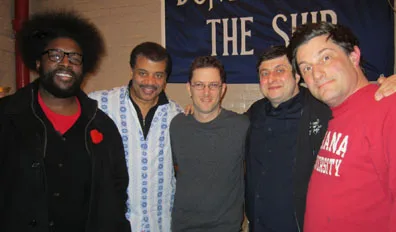
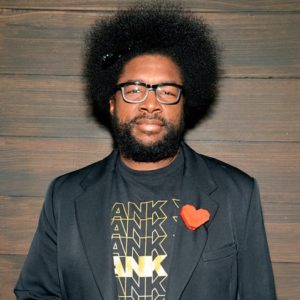
Weather gives way to climate change as the StarTalk Live crew grapples with the impact of the Industrial Revolution, greenhouse gases and the Earth’s orbit and axial tilt on climate change. Neil goes back to the Carboniferous Era to explain where fossil fuels come from, and climate scientist Dr. Adam Sobel tells us how much carbon we’ve put into our atmosphere. With insights from his involvement in the last Presidential election, musician and author Questlove raises the issue of politics in the climate change debate and asks the question, “Aren’t scientists not supposed to lie?” And comic co-host Eugene Mirman and comedian Michael Showalter bring a bit of humor to bear on subjects from deforestation and ice ages to chaos theory and “The Butterfly Effect,” all on the eve of Winter Storm Nemo pummeling the Northeast with the Blizzard of 2013.
Transcript
DOWNLOAD SRT
Welcome to StarTalk, your place in the universe where science and pop culture collide. StarTalk begins right now. Now. Here, live at the Bell House, Brooklyn, New York, StarTalk Radio. I've got with me, Adam Sobel, climate scientist from Columbia...
Welcome to StarTalk, your place in the universe where science and pop culture collide.
StarTalk begins right now.
Now.
Here, live at the Bell House, Brooklyn, New York, StarTalk Radio.
I've got with me, Adam Sobel, climate scientist from Columbia University.
Questlove, Eugene.
Yes, and Michael Showalter, everybody.
We're talking about storms, hurricanes.
We're trying to get to the bottom of this.
And I'm wondering, is it psychological?
No.
Thank you for that answer.
Storms are real, go on.
Can I ask a question?
Yes, Quest, go for it.
Okay, so I'm really fascinated by all the facts.
You're telling me I have absolutely no reason to believe that you're feeding us false information.
Now, having been very active on the campaign trail, why are, quote, they so hell-bent on proving otherwise?
How does that person feel then, when they...
You know what he's talking about?
What, just, you know!
No, no, no, when you hear political revisionists denying that these things don't exist.
The climate change is man-made.
You're asking about a climate change issue.
Well, yeah.
Let's define climate first, because people get climate and weather confused, and everybody wants to take one incident and say, that's climate change, and just give us the background on that, and then we can explore the politics of this.
Yeah, so climate, what is it?
So climate is the average over a long time of what the weather is, so...
A week, a month, a year, what's a long time to you?
As much data as you got, we usually define it as the average over some long period of time, 30 years, 50 years.
The trends over long periods?
Well, first the climate is the average, and then a trend would be a slow change in the average.
So if one period of 30 years is different than the 30 years before that, then we might say there's a trend in the climate.
There's a change in the climate.
Is there a trend in the climate?
Yes.
That's my understanding as well.
And it's also, I think, our life experience, looking at weather patterns, which if you average would make climate today versus when many of us grew up.
So what's the challenge then?
Why are people still out there saying no?
Isn't the debate as to whether or not the reason for this change is manmade or not?
So there's a couple different questions.
So we started off talking about hurricanes.
There's two different questions you can ask because hurricanes are a very special, very unique part of the weather, right?
They're not just any old weather, they're unusual.
They're hurricanes.
They're like the closest thing we have to a black hole in astronomy, if that.
They're singularities, right?
And so you can ask, is the climate changing?
Okay, if that's your best singularity, I got it beat.
I just want to tell you.
I got a singularity that'll eat the entire earth, you know.
But, but that's fine.
We all do what we can.
You'll do what you can.
So you can ask, is the climate changing?
The answer is yes.
It's getting warmer.
That does a lot of different things to the atmosphere and the ocean and all the systems on the earth that depend on them.
Can you quantify the rate of getting warmer?
You know, on the order of a degree Celsius in the last century.
So we'll all be dead in about 80 years?
It's warming at an exponentially faster rate.
Well, exponentially is a little hard to measure.
Since the Industrial Revolution, haven't things increased?
Yes.
The Industrial Revolution is the cause of it.
Since the Industrial Revolution, we started burning a lot of carbon from the ground and that goes into the atmosphere and makes carbon dioxide and that's the main factor that's warming the climate.
Well, I must clarify, we're burning more complex chemicals with carbon in it.
We're, right.
And then the carbon separates from the rest of its molecule.
Right.
Leaving carbon behind.
We're burning oil and gas, which is complex carbohydrates and then those.
Good, because you actually try to burn carbon, you can't.
Unless you try really hard.
Right, pure carbon.
I think even if you try.
The diamonds don't burn.
Right.
Diamond has the highest melting point of any, carbon has the highest melting point of any element.
So you can't melt a diamond.
That's correct.
Essentially, you can't.
What if you threw it into the sun with something?
It would vaporize.
It wouldn't melt just before vaporizing?
No, some things go straight to gas, like dry ice, it doesn't melt, it just goes straight to gas.
All right, you win this round, scientist.
Okay, so finish, finish before we get to the question.
So you can ask if it's warming because of humans burning chemicals that make carbon put to carbon dioxide in the atmosphere.
The answer is yes.
Then you can ask, is that doing something to hurricanes?
And the answer is we think it will eventually, but it's too hard to see that clearly now because the hurricanes are so rare that you have to count a lot of them before you can compute an average meaningfully, right?
And so then if you want to see a change in the average, you have to wait even longer because you have to have the average now and the average later.
They're so rare, they're such bursty things that from just the observations alone, it's hard to prove that the hurricanes are changing.
Of course, we all in New York feel like they are.
I just want to put some emphasis on what you just said.
So this is true for any scientific study, right?
If you can get a set of data, you can get averages, that's fine, but now you want to see what the change in the averages are, you need more data than what you just got to get the same confidence in what's going on.
So it doesn't mean they're not changing, it means we just can't prove it that way.
But you're asking, if I'm not mistaken, why the need to refute your evidence?
Why people want to refute it, I don't know.
I don't have any particular scientific expertise.
I have an oil company and I can answer that.
Because it's a psychological, I mean.
Well, right, I mean, I think.
I want 10 billion and not $9 billion.
It's a little easy to.
But there's lots of people who don't own oil companies that feel strongly that this.
But they might one day in the hope of owning an oil company.
Oh, you comedian.
Well, let me get deeper into it.
What is your frustration level when they have their own scientists trying to debunk your.
My frustration level is very high.
Yeah, it shows, yeah.
They're the.
Yeah, you're totally freaking out.
Wait, that was Eugene joking.
Eugene say it.
In the fact.
It shows.
No, and the fact that they have, quote, their own scientists, isn't there a fraternity, a sorority of scientists, sort of like, you know, with lawyers and doctors?
Yeah, we have a few of those.
Don't you have your own oath of which you're not supposed to lie about these things?
No, actually, we don't have an oath, but we all know we're not supposed to do it.
Pretty much.
Wait, Quest, there is an oath.
It's just not taken explicitly, and you know what it is?
Thou shalt not lie, because if you do, your colleagues will discover it in you, and you'll be exorcised, exercise, ostracised, ostracated, ostrichesized.
You'll be ostracised.
But I will say that climate science is an interdisciplinary science, where you have to know a lot about a lot of different things, and some of the people who deny climate change have a specialty that doesn't look at the other factors, which is why they are wrong.
Right, is that part of it, or no?
Thank you, Eugene, for that expertise.
It's a pretty good joke.
No, uh, is that true?
Yeah, I mean, the science is pretty much settled.
Among those who study this seriously, pretty much everybody agrees that the earth is getting warmer because of human activity.
There's a few people who say that it's not.
The situation is a lot like the cigarette company's trying to tell you that smoking didn't cause cancer.
And I think it's for much the same reasons.
There's, you know, the best-
Or that guns don't kill people.
Yeah, that they simply make them slightly heavier.
Questlove, on the campaign trail, was it a big platform point that was made?
There are people that were looking to the president for various things, his views on the economy, education.
And I just happened to be around a lot of people that were kind of staring at their watches impatiently, like, okay, when's he gonna get to the environment?
Like really stick his foot to the man.
Which I personally thought that he was gonna wait until after he's secure in this term, and then he's really gonna stick his foot.
I mean, just from having spoken to staff and what, you know.
Sources, yes.
Yeah, is, you know, I'm in contact with some of them.
So, I got friends in little places, so.
Yeah, so I'm more, I'm not, you know, I'm not surprised about politicians that lie to get what they want and, you know, their hands in other pockets, but the scientists that they have to debunk these theories, like how come?
It's a pretty small number of people.
Like, where's the bully on your side of the fence, like the Al Gore?
Yeah, I mean, it's frustrating for us.
I mean, the scientists in this field, and there's a lot of us, we feel that we've been saying the same thing for a long time.
It hasn't really changed a lot.
It's just become more and more certain.
But wouldn't you say-
There's some people that don't want to hear it.
Most of them are in the United States, actually.
The rest of the world is better.
Wouldn't you think that the people who are in denial, when confronted with the damage of category three, four and five hurricanes, might just think differently about it?
Yeah, it's interesting.
I mean, we certainly could have had a hurricane Sandy 200 years ago.
You can't say it's a result of climate change in the sense that it couldn't have happened without it.
So for those who are still in denial, even among our colleagues, perhaps, yes, they're the minority of the bunch, but they're out there and they get peddled forth by those who have politically different views.
What will it take?
Well, I think these catastrophic events help.
I mean, even if you can't.
The sentence of the night, people.
But wait, do they really?
Because I thought, well, it takes a tragedy for us to learn our lesson.
But we tend to forget after.
You just rebuild and act like it didn't happen.
We haven't forgotten this one yet.
We were willing to forget about Colorado and then Sandy Hook happened.
It's like, oh, okay, yeah, we kind of have to deal with the situation.
You know.
I'm certain that it will take four or five more Hurricane Zandis to hit New York before.
You know.
What you were just gonna say?
Well, I had another random question, which is, let's say this warming continues, right?
Could it get cold again?
Like, cause there was like the ice age, right?
Right.
Could it get hot and then all of a sudden something else happens and then it starts getting really cold?
Yeah.
I mean, I don't think that's anything we have to worry about anytime soon, but-
But is it possible?
Can you quantify the word soon in your sentence?
If it starts getting hotter, is that irreversible?
That's my question.
It's pretty much irreversible for the foreseeable future of our lifetime and our grandchildren's grandchildren.
The ice ages in history come about because of the slow changes of the Earth's orbit due to the other planets pushing on it, gravitational orbits.
Neil, you know anything about that?
Neil could probably tell us about it.
Yeah, it's almost, give him a C plus on that one.
Go on.
You know, you have a singularity that could eat the entire Earth.
But those take 10,000 years.
No, no, it's worth saying a little something about.
So Earth's orbit around the sun is not a perfect circle.
It's-
Good band though.
Perfect circle.
So it's oval, okay?
Which means sometimes we're closer to the sun and sometimes we're farther.
So that's fact one.
And by the way, that happens, it happens that in January, we are closer to the sun than we are in July.
And by several feet.
Yeah, by about three million miles closer.
Yeah, so I'm right.
I just use a different measure.
Yeah, yeah, that's right.
So at 94 million miles away, we'll get someone to convert to metric for you later.
94 million miles away in-
It's from 1910.
In our summer and 91 million miles away in our winter.
So that is one cycle.
Another cycle is the tip of our axis, which right now is 23 and a half degrees, that bobs up and down.
Okay, so it goes from like 22 to 24 degrees.
The more it tips towards the sun, the hotter the two hemispheres will get in their respective summers.
So if you cycle these two phenomenon, have you tipped down more towards the sun and closer to the sun, you have a warming trend.
If you tipped away and up, you have a cooling trend.
And you cycle this through, you run the math, you run the numbers, because one can happen while the other one is not ready yet.
For it to combine.
But when they combine, you run through these master cycles of climate on earth and you get the ice age, which enabled the early migrating humans to go from Asia into North America over the Bering Strait.
Because when it's cold and it rains.
It snows.
Thank you.
When it's cold.
I caught myself, but apparently not fast enough.
So when it snows under these conditions, the moisture comes from the oceans, which are still liquid.
It snows on the land and it stays there.
So there's a systematic draining of the oceans that occurs during an ice age.
And huge glaciers build up on the land masses and the oceans become lower and lower filled.
And you start exposing land masses that were previously completely buried, like the land bridge that is the Bering Strait between Alaska and Northwestern Asia.
So that's just the little interlude there.
Please continue.
So that's the past ice ages.
I mean, there's times when, in the past, in the geologic record.
Oh, can I add?
Wait, so watch what happens.
No, this is, no, I can't stop there.
Wait.
Yeah, start 10 billion years ago.
No, no, watch, watch, watch, watch.
Watch, no, no, this is important.
It's irrelevant, but important.
So our early human ancestors migrate.
They enter North America and they keep going through Central America and South America and they're hanging out and making, you know, civilizations.
Then we come out of the ice age.
The glaciers melt back into the oceans.
The oceans fill up again, it breaks the land bridge and strands an entire branch of the human species in North and South America where no one else in the rest of the world knew about them.
And so when Columbus came across, in some ways that was the most significant event in the history of our species because two entire branches of the human species that had been separate and distinct for 10,000 years reconnected.
Wow, wow.
No, I'm saying it's irrelevant but important.
I would say it's not irrelevant.
It's not irrelevant because some of the ice is still there in Greenland and Antarctica.
That's left over from the ice age.
That's left over.
And if that, as we warm the planet, as that melts, that is what's posing the danger of raising the sea level higher.
And the sea level getting higher is what's gonna make us at risk for a lot more coastal flooding events, even if the storms don't change.
And to think those two people liked the same bands.
So Adam, do you expect more hurricanes as the temperature of the earth rises, or fewer hurricanes, or more that are more intense, or fewer that, you model this stuff, right?
Yeah.
So what does it tell you about hurricanes and climate change?
Because I wanna know the future.
So it's actually a difficult problem that a lot of people have been working on, and there's still a lot of uncertainty, but we're starting to hone in on some general results that we think are right, in at least a rough, qualitative sense.
Can you buffer that answer any more than you just did?
We kinda sorta think we might have it.
I'm holding back, yeah.
We kinda think we might be converging possibly on what?
Yeah, I don't know why deniers don't believe you.
I don't know, there's a 98 point...
Yeah, you're right, you're not the first to say that, yeah.
We're all flooded.
All right, so go, tell me.
We think that hurricanes will get more intense in a warmer climate on average, and so the worst ones will be worse than what we have today.
At the same time, we don't think that there will be more of them on average over the whole Earth.
We think there's more likely to be fewer rather than more, but they'll be more intense on average.
So the real question is, and I don't think we have the answer to this yet, is will there be more or fewer of the most intense ones?
So it's like if you ask how many kids took the test and got an A, and you let fewer kids take the test, but they all study more.
Will more get an A or will fewer?
It depends which effect is bigger, right?
If there's fewer hurricanes.
That example didn't help me understand your hurricanes.
I actually kind of enjoyed it.
I think that's a good example.
If there's fewer hurricanes, but the few that.
But they're all getting A's.
Hurricanes are taking tests?
What you're saying is that if there are fewer hurricanes, but the hurricanes that remain are more severe, that could, in fact, be more devastating to us than more hurricanes that are.
But based on that Dante-esque descent into hell that I just.
Because as you said.
Give me 10 category two hurricanes.
I don't ever want to see a category five.
That's right.
With each category, the damage goes up very, very fast.
So every category go up, it's not like a linear scale.
It's not like, well, category four is just one more.
When I read the one where there are no leaves left on any tree, that just freaked me out.
Is it possible to predict whether, right now, there's a 10-day forecast.
Is it even possible to, even with the best technology, predict it beyond 10 days?
Are you limited by chaos?
The answer is maybe a little beyond 10 days, but not much.
There's a limit beyond which you can't go, and it is because of chaos.
That's right.
You want to explain that?
No, you, go for it.
I got your back.
Is chaos an acronym?
Wait, wait, wait.
That was a Get Smart.
What was chaos?
I know, but it's an acronym for?
Cannibalistic Humanoid.
Okay, go.
If you have some kind of dynamical system, a dynamical system means something that has rules that govern how it behaves in time, then with certain types of systems, if they start from two different points that are almost the same but slightly, slightly different, as time goes on, the paths that those two systems are on, the rules are exact.
So if they start at exactly the same place, they'll do the same thing.
There's no doubt about the rules that govern the system.
It's completely predictable in principle.
But if you start at two slightly different places, those two trajectories will diverge.
So the two paths will become more and more different till after a while, they're as different as any other two states of the system that could reasonably happen.
And you never know the state of the system now perfectly.
We don't measure the temperature and the wind and all that everywhere perfectly.
So there's always a little uncertainty in what the weather is now.
There will never be a 20 day forecast.
There will probably never be one that's any good.
That means no, I think.
I mean, 20 is around the edge.
I mean, we think 10, 15 days, 20 is probably beyond it.
But you can predict the climate for longer.
The climate is the average and that can sometimes evolve in a more predictable way.
So a perfect example is, you know that the winter's gonna be colder than the summer.
And that's because it's being forced by the orbit of the earth, so that the sun is shining at a different angle and all that.
But it's a predictable climate change.
But you can't predict the weather on any day in the next season.
You can just predict the average.
I checked the weather report avidly.
And this storm was not being talked about a week ago.
No, it kind of came out of nowhere.
Which one, the one tomorrow?
Yeah, the one we're gonna get tomorrow.
Yes, I am addicted to the 10 day forecast.
This was not in the forecast.
No, no.
No, this came out of nowhere in the last couple of days.
That's right.
And that can happen.
That's a...
Chaos.
Just to add emphasis to your chaos discussion.
So what you're saying is that because models are perfect in what they can calculate, two models that are exactly the same will evolve the same forever.
But an arbitrarily small difference in the initial conditions, given the forces of chaos, can have them rapidly diverge into a completely different thing that it could have gone ahead.
You started the model from somewhere else.
That's exactly right.
And so, and weather is such a complex system, and you want to project it forward with all these dynamical...
Back to the future.
Operating.
I said sliding doors.
You said sliding doors, and I went a little bit less obscure.
Okay, so when did we start first even understanding that we were limited by chaos?
60s, a guy's name was Ed Lorenz, he died a few years ago.
He was at MIT.
I remember him, I remember him.
He had a very simple model of the weather, it wasn't accurate enough for forecasting, but he had stripped it down to just a couple of equations that he could solve on what now would be considered a very primitive computer.
And he did the same experiment twice to make sure he'd done it right, and he would get completely different answers, and then he would check back again what his initial conditions were, and they would look the same, and he'd check the program, and it looked right, and he'd keep getting a different answer, and it was only after he checked a lot of times that he realized that his initial conditions, which was just a couple of numbers, because he wasn't trying to do the whole weather, it was a much simpler mathematical problem, his initial conditions were different, far down, many decimal places down, so instead of 1.0000001, it was 1.0000002, or something like that.
It was a difference so small, he would have never noticed it, but after a while, it became a huge difference.
So he stumbled on chaos.
He did, but he was smart enough to understand it.
And this is the famous butterfly effect.
Yeah, it says a butterfly today can cause a big difference in the weather.
This is why I warn people about time travel.
It really is very dangerous.
And then there's the Fibonacci code, but we won't even go there.
There you go.
Because I don't know what it is.
What are the top reasons to not go there?
We'll say Fibonacci for a math show.
Right, Tom Hanks was in the movie, that's all I know.
That's all.
So do your climate change models also think about storm surges, along with wind and rain and other kinds of precipitation?
And are you including the fact that as water gets warmer, as it heats up, it actually expands, so that the ocean level will change simply because the temperature changed.
And meanwhile, back at the ranch, we're melting Greenland's ice caps, we're melting Antarctic ice caps, and so the water is returning to the ocean from whence it came.
So, most of the great cities of the world are on the water's edge, because they were merchant-based, they were founded on shipping and trade.
So, where's all this going?
You're asking about the models or what's gonna actually happen to the planet?
Apparently, models don't have to be correct.
No, they don't.
But we'd like them to be correct.
What are your best models telling you?
The best models are telling us that as carbon dioxide increases, the planet's getting warmer.
It's a greenhouse gas.
It's a greenhouse gas, so it traps the infrared radiation that the earth emits and reflects it back down.
Like the way a greenhouse lid traps heat, the greenhouse gases do that in a somewhat different way.
Hydroponic.
They keep the planet warm.
Would it help to chop down all of the trees in the world?
Would that be helpful?
Uh-oh, uh-oh.
Wait, just to clarify, so Earth doesn't just radiate infrared on its own, visible light comes in from the sun, gets through the atmosphere just fine.
Carbon dioxide doesn't trap visible light.
If it did, you wouldn't be able to see the sun in the daytime.
So the atmosphere is transparent to visible light.
As obvious as that sounds, it's in fact an important feature of our atmosphere and sun.
So visible light comes in, gets absorbed by the earth.
The earth re-radiates that energy back, not in the form of visible light, but in the form of infrared.
And that's how you can trap sunlight because we just transformed what that sunlight was from visible light to infrared.
Pick it up for there.
Right, go.
So as we add carbon dioxide and other greenhouse gases to the planet, we're warming the climate.
Something like, as you double carbon dioxide, so it was 280 parts per million pre-industrial, and now we're up to 380 something, I don't remember.
Maybe it's 390.
Where we haven't, so double would be 560, I guess.
So we'll reach that sometime late in this century, and the climate models predict something like two to six degrees of warming Celsius, so it's about double that, Fahrenheit, for the global average of the planet.
And we expect a lot of things to happen as a result of that.
It's gonna be very hot, first of all.
I think we talk a lot about hurricanes and all that kind of exciting stuff.
But the temperature is gonna be a big problem in places like New York City, where 100 years from now, the coolest summer is gonna be hotter than, the hottest summer that anybody now has experienced.
So it's a little bit disturbing.
Yeah, don't live for 300 years because you're gonna be screwed, buddy.
That's right.
That's right.
Not to mention Miami.
Yeah.
Wait, wait, wait, wait, wait.
So I think you implied something that you didn't say.
You said in 100 years, the temperature will go up by two to six degrees.
I can handle two to six degrees.
Celsius.
Celsius, okay.
So double that in Fahrenheit roughly.
So it's, you know, okay.
What are we on?
Five nines plus 32.
Are we Celsius?
It's about double, just double it.
I'm serious though, what are we?
What are we?
We're Fahrenheit.
So that means 100-
We are Fahrenheit creatures.
So then 100 years from now-
So make it four to 10, okay?
Okay, so 100 years from now, it's gonna be on average 12 degrees hotter.
That's the upper end of the range.
Well, that's for doubling CO2.
100 years from now, we might more than double.
Why are you so angry with me?
I'm just this guy who-
Wait, wait, wait.
So there's something else that went unmentioned there, and correct me if I'm wrong.
Everything rises, but not only that, isn't it true that under global warming scenarios, the extremes increase?
So on a heat wave, it gets more hotter than a hot heat wave would have been a century before?
Absolutely.
I mean, the temperature oscillates up and down and in some chaotic fashion all the time, but if you start, if the whole average is higher, those oscillations are gonna be on top of a higher average.
So the high points are gonna be higher, and the low points are gonna be higher than the low points used to be too.
So we won't have as cold winters, we'll have hotter summers.
All right, so when should we move to Mars?
Mars is very warm.
Mars climate has got a long way to go to get to where-
Mars is several hundred degrees below zero at the moment.
I think you should just first start with Quebec.
And then when that's too hot, then you should be like, let's get a spaceship.
But if people get their act together, can they slow the trend?
We can slow it, but we can't stop it.
We're committed to quite a bit of warming because the carbon that's already in the system that we've already put up there, the warming from that is gonna take a while to play out.
Hundreds of years.
If there's a lag time, partly because the oceans take a long time to heat up, the oceans have just only the top layer, the oceans has begun to warm, and the oceans got a lot of water and it's very heavy, takes a long time to heat it up.
So we're committed to quite a bit more warming, and there's almost nothing we can do to stop that, but we can stop it from speeding up more.
Can we, I mean, so we can't solve this with just, I don't know, say like four nuclear bombs.
And would that slow anything down?
If it was like, say, in Antarctica and Greenland, which is really icy, actually.
I mean, this is something people talk about, not nuclear bombs, but putting dust up into the stratosphere, which would block the sun and cool the planet.
That's a bad idea for a lot of reasons.
Name two.
So you're saying, well, I mean, I can imagine some, but what are two reasons bad to put dust up in the sky?
So one reason is, I can't believe I'm saying that, but I really want to know.
One reason is that it is that what that dust would do, you have to put it up very high, first of all, and it stays for maybe a year or so.
So you have to keep putting it up there.
And once it's gone, the planet will just warm up again to where it would have been anyway.
So it's sort of a short-term fix that you have to keep doing.
A band-aid, a climate band-aid.
It's a band-aid, right?
The other thing is that it wouldn't just stop global warming.
It would have a lot of other negative effects.
In other words, carbon dioxide is not just the opposite of dust in the stratosphere.
It would change the rainfall patterns and do other things that are probably bad ideas.
I think most of us in any environmental field think that it's not a good idea when we're doing big changes to the planet to try to, it's usually better to try to stop doing those bad things than to try to do other bad things that would somehow catch them up.
No, I agree.
Okay, great.
I But I did a calculation once.
If you take the current rate of population growth and extend it into the future, the same amount of time as the time elapsed since Columbus, so a little more than 500 years, if we maintain that rate of population growth, there will only be enough room on the landmass of the earth for everyone to stand up straight.
By what time, by when?
500 years.
From now.
From now.
Yeah.
Sounds like climate change is so bad.
We gotta get nice, make nice with other planets.
Or drain the oceans.
These guys are good.
How to make more beachfront property, right?
It's just, you can do that with an ice age, sir, as we have established.
So let me just put some closure on this.
There's a period of time, some years ago, geologists refer to it as the Carboniferous Era.
This was a period, why would they call it the Carboniferous Era?
Because in that era, plant life, trees in particular, did not have the organisms surrounding them that would decompose their material substance.
When a tree falls in the forest, and it makes sound whether or not you're there, tell that to your philosopher friend.
So a tree falls and then it decomposes.
Well, it doesn't decompose by accident.
There is a portfolio of fauna that dine upon the material that was once a living tree.
And this decomposition of the tree returns the chemical composition of that tree back to the environment.
It's a very natural cycle of life.
During the Carboniferous era in the history of Earth, such organisms did not exist.
They had not evolved yet to exploit the fact they had a fat dead tree in front of them ready to be consumed.
So trees would die and they would stay there forever.
Another tree would grow up, it would fall and die and stay there.
And vegetation kept growing.
And vegetation is made of carbon.
That is the principle ingredient of the vegetation.
So every tree that grew took carbon out of the atmosphere, it fell, the carbon stayed with the tree.
This continued and continued and huge layers of dead vegetation gets submerged in the crust of the Earth.
That vegetation became fossil fuels.
And so the balance of carbon in our atmosphere is disrupted when we take carbon from a place where it has been buried for millions of years and introduce it into the stable balance of carbon in our atmosphere today.
So the act of doing so changes Earth's carbon dioxide levels from what it is accustomed to managing in the balance of the atmosphere.
So here's the challenge to us all.
We like energy, right?
Especially here in America.
We have come to demonize the consumption of energy.
You see the Hummer and you know, at least if you're sort of liberal minded.
That's the wrong attitude, in my opinion.
Wrong attitude is not to demonize energy.
It's to, if you want to demonize something, demonize that which alters your environment.
The universe has limitless energy.
I tweeted recently that I'd be embarrassed to tell an alien who just moved through the vacuum of space bathed in limitless starlight that here on earth we kill one another to extract oil from beneath the sands because that's where we're getting our energy.
So the goal here really ought to be what are all the ways we can make energy so that one day we'll have a future where there's actually limitless energy.
We wouldn't even have to have these conversations.
We wouldn't have to be warming up the atmosphere and have earth do things that it hasn't done in a million years.
And so I'm upset when I see people not thinking about these other pathways, getting back to the point where solutions can rise up from unexpected places.
Right, is the solution stop to stop burning fossil fuels or is there some other solution that comes along that doesn't negate this, it just renders it completely obsolete?
As the car did to the horse.
I mean, are there examples of this?
What happens if you run out of silver to make your silverware?
Oh, you discover aluminum and now you can still have silverware made of aluminum.
Right, so airplanes all flying on pterodactyls.
Just as one example.
I saw that exhibit in Kentucky.
Nice comeback, nice comeback.
Yes, yes.
Just to help out.
So, I think the lesson here is of course it's all interconnected.
You know, you turn the key of your car, some CO2 goes out, and your climate models change.
Our understanding of the climate for the future changes and what we bequeath to our descendants is really the product of our foresight or absence thereof.
Thank you all for coming.
Thank you.
This has been StarTalk Radio.
Thank you.
We are funded in part by a grant from the National Science Foundation.
They believe in what we're doing.
See the full transcript



 Unlock with Patreon

 Become a Patron