


 Unlock with Patreon
About This Episode
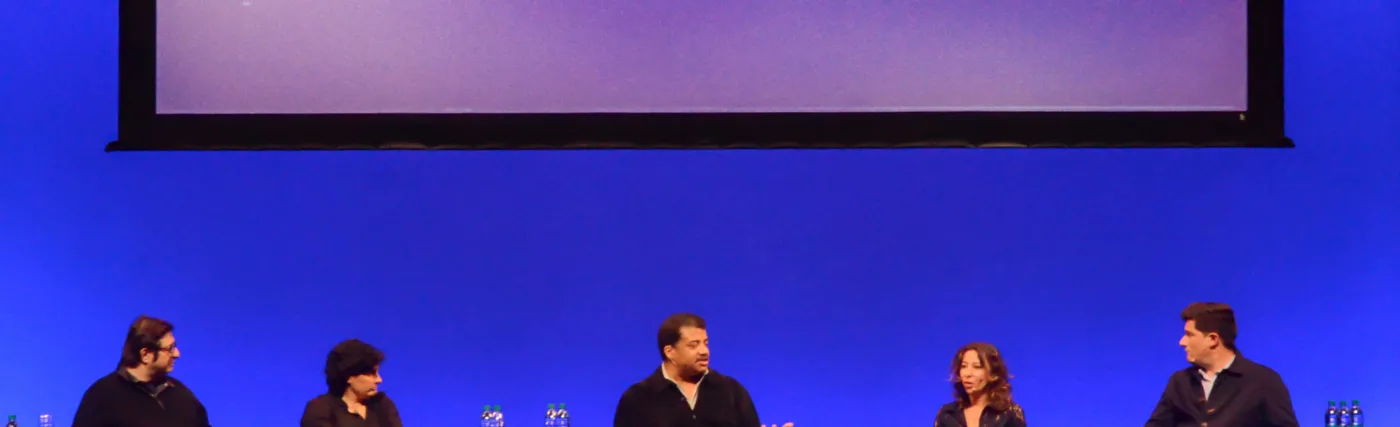
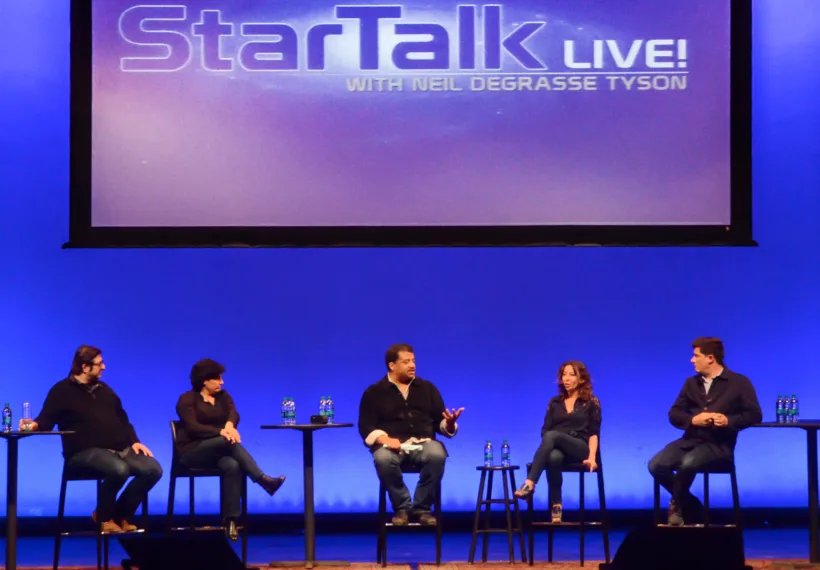
On February 11, 2016 the Laser Interferometer Gravitational-Wave Observatory reported that it had discovered gravitational waves, heralding a new field of scientific study. Just a few months later, host Neil deGrasse Tyson and co-host Eugene Mirman took to the stage at the Count Basie Theatre in Red Bank, NJ to explore that discovery with the help of LIGO astrophysicist Dr. Nergis Mavalvala, cosmologist and StarTalk All-Stars host Dr. Janna Levin, and comedian and returning StarTalk Live! guest Michael Showalter. Join us for an evening full of surprises, starting with Neil getting schooled in turn by both Nergis, on the difference between gravity waves and gravitational waves, and Janna, on why, even though, “in space nobody can hear you scream,” you would hear two black holes colliding if you were close enough – just before you were spaghettified, that is. In Part One, you’ll learn exactly how LIGO is able to measure a wave motion 10,000 times smaller than the nucleus of an atom which began 1.3 billion light years away from Earth, and why it’s critical to have two different facilities, one in Louisiana and one in Washington, working in tandem. You’ll also find out why it took the LIGO team half a century and a billion dollars to discover something Einstein predicted nearly 100 years before, how unexpected the discovery was, and why it took them so long to make the announcement, when they’d actually recorded the event on September 14, 2015.
NOTE: All-Access subscribers can listen to this entire episode commercial-free here: StarTalk Live! LIGO and the Black Hole Blues (Part 1).
Transcript
DOWNLOAD SRTWelcome to StarTalk, your place in the universe where science and pop culture collide.
StarTalk begins right now.
We are live at the Count Basie Theater, New Jersey.
This is StarTalk.
I’ve got Janna Levin, Professor of Physics and Astronomy, Columbia University and Barnard College.
Did I get that right?
Yeah, sounds good.
You got it.
We have Nergis Mavalvala.
She’s Professor of Physics at the Massachusetts Institute of Technology, and she is one of the world’s experts on the detection of gravitational waves.
And who do you have with us here?
I’m Eugene.
Eugene Mirman.
Michael Showalter.
Michael, you’re directing a movie now, right, what?
Yes, I have a movie that’s in the theaters as we speak.
Hello, My Name is Doris with Sally Field.
As we speak.
As we speak.
Excellent.
Excellent.
It’s great, I want to see it.
Cool.
Okay.
So what we’re going to, what I want to know is what’s next?
Okay, detect a few more gravity waves.
First one, we’re done.
You know, just go out and have a beer.
How can I make money off of gravitational waves?
How, why are they, why should they matter to anybody?
Can they be surfed?
Surfed, well I like that.
Janna, can they be surfed?
Yeah, it would be pretty hard to surf them, but in some sense, that’s kind of what the mirrors are doing, is they’re kind of surfing the wave.
So the mirrors are suspended so delicately in this instrument that when the wave passes, they just kind of bob, so that’s kind of what they’re doing.
I mean, they don’t write it.
Okay, and so what happens next, Nergis?
Yeah, so the detection that we made was with a certain sensitivity on the instrument.
The instruments are actually down right now since January for a few months where we’re trying to make improvements.
And the idea is that every time we make improvements, we improve the sensitivity and that allows us to look a little farther into the universe or to see fainter objects.
And that’s what we’re trying to do.
So my, over the next few years, we’re gonna just keep walking the sensitivity down.
It’s just like with telescopes, you build better and better telescopes, you can see fainter objects that we’re trying to do the same thing.
So what, so say you see all the waves, then what are we gonna do once we’ve seen all the waves?
There’s all the colliding black holes, but that’s not the only stuff out there giving you gravity waves.
Ah, ah!
Exactly, in fact, weren’t there gravity waves in the early universe, shortly after the Big Bang?
There were.
So why aren’t you detecting those?
Because they’re too weak.
So our detectors are not.
It’s the Big Bang.
It’s the Big Bang and.
Should have been bigger.
Yeah.
So they are too weak, but there are many other kinds of sources that we could look for.
We could certainly look for the same kinds of motions of orbiting neutron stars instead of black holes.
So neutron stars are not as big a gravitational disturbance, but they still give you a gravity wave.
That’s right.
They’re cousins of black holes.
Basically, they’re lighter and they actually have more matter-like properties than what Janna described.
Black holes are which are regions of space that are really not matter-like.
But in any case, so neutron stars could be colliding.
Supernovae, when stars sort of run out of their nuclear fuel and they explode as supernovae, that should give off copious amounts of gravitational radiation as well.
So we should be able to see that.
So this gravity wave that you imitated, with such precision and accuracy.
Boo!
Was the other way.
Boo!
No, no.
No, I got this, I got this.
I got this.
Yes.
Oh.
What did I get?
B plus?
B plus?
So, so.
You can tour as an impersonator of gravity.
So, so that took a certain amount of time to happen.
All right, like fractions of a second.
Now, suppose there are things that give you strong gravity waves, but take seconds or minutes or hours.
Oh, do we have the power of detection to see those?
So, our instruments are most sensitive, LIGO and sort of instruments on the earth are most sensitive to signals that are occurring at about 100 hertz.
So, these are motions at about 100 times per second.
Per second.
Hertz from Heinrich Hertz, famous German physicist.
But the idea is, so what sets the frequency of a gravitational wave is really the rate at which these black holes are moving around each other or neutron stars are moving around each other.
So, we have something really remarkable that it’s really hard to wrap our heads around, but say the signal we saw.
So, these were 30 solar masses, 30 times as massive as our sun and they’re whipping around at hundreds of times per second around each other.
So, it’s mind boggling and that’s why they distort space time as much as they do.
And just to be clear, the sun rotates, but it does so once in a month.
Now, you’re talking about two objects, each 30 times more massive than the sun, revolving around each other.
At a couple of hundred hertz.
A hundred times a second.
A second, yes.
So, we have to just think also about the longer story of these black holes.
You’re not buying it.
I buy it.
I just won’t forget your face.
You’ve given that face like eight times this evening.
The first time it’s, well, space and time are reversed.
Give me that face.
It was like a whole, there’s a list, a laundry list of stuff that made that face.
Yes.
Okay, I’m impressed by that.
So, here’s something I know that happens in the universe and it’s gotta make an awesome signal.
We just don’t live long enough to hear it.
And that’s the collision of two galaxies.
I’m betting that makes a nice signal, but that takes, like a whew!
But it takes, you can calculate how long that takes.
It takes like a half a billion years.
Yes, and so those signals.
You’re not hearing those signals?
No, because they’re not within the band of our instruments.
What you mean is you don’t live long enough?
Well, we don’t live long enough, but even if we did, those signals, when those black holes are merging, would cause signals at frequencies that our instruments can’t hear.
LIGO’s actually sensitive to the same frequency range as the piano.
The black holes that collided were actually in the human auditory range, the sounds that they made.
They didn’t have to be rescaled.
And so that is something that’s just remarkable.
That’s what LIGO is sensitive to.
Just like you’re talking about different telescopes, there’s going to be different instruments that are sensitive to longer, lower notes that the human ear can’t hear.
Are other LIGO centers that are being planned around the world, are they gonna take you to other frequencies?
No, so the terrestrial detectors on the earth are really limited to having sensitivities that, it’s pretty hard to make a sensitive detector below 10 hertz or so.
I feel what’s coming.
You said detectors on the earth.
Yes.
Okay, so that means…
That’s space.
Space.
So here’s what you have to think about.
On the earth, you can do well out to about 10 hertz.
Maybe if you really push it, you might get out to one hertz, so once per second oscillations of the wave.
But at lower frequencies than that, you’ve got to get off the planet.
And that means you’ve got to go into space.
Tell me about it.
So like, what can we do with this?
If you go to space.
You can make a sandwich with it.
There’s…
Lisa, Lisa.
Laser interferometric space antenna.
Is it a good thing?
Does it make you feel good?
Yes, absolutely.
You know, we’re…
Like, is it a good thing that this happened?
Yes, we’re being bathed by these gravitational waves all the time, and that’s what makes us so happy.
I wish that was true.
So that’s what it is.
The secret.
So what does this mean?
What does this discovery mean in terms of everything?
You have to realize that we can’t see black holes with telescopes.
The reason why we argue that we’re seeing black holes in the universe before this is because what we’re really seeing is the black hole demolished something in its neighborhood.
We don’t ever actually see the black hole, right?
So this is the first time…
The black hole is essentially flaying the star that got too bulbous in orbit around it.
Yeah, it’s like pulling tufts of the star off like cotton candy, which then fall onto the black hole and become incredibly hot from the fall, collides with other material from the star.
That’s what we see.
That’s what we see.
So if it looks like someone’s eating a sun, that’s a black hole.
Exactly.
Right, if the sun slowly, like cotton candy, starts to splatter someplace, there’s a black hole nearby.
But this is the first time in history that human beings have actually detected two bare black holes, black holes with nothing around them.
And you could argue in some sense it’s the closest we’ve ever come to really, you know, the detection of black holes.
And it’s certainly the first time that we’ve detected two black holes colliding because that is a completely dark event.
So that’s an important fact, just in case it was not obvious to people.
Anytime any one of us, we the astrophysics community, said we have a catalog of black holes, we have a catalog of radiative signals coming from the matter descending into what we are pretty sure is a black hole.
That’s what the catalogs are full of.
Yes, that’s right.
And it’s excellent evidence.
I mean, we see stars in the center of our galaxy orbiting a dark space, and you can tell from the orbit of the stars that the thing it’s orbiting is four million times the mass of the sun, but it fits in about three sun whiffs, and it’s dark.
I mean, that’s pretty good evidence for a black hole.
Yeah, I mean, I’m convinced.
It’s pretty good.
So here’s, let me offer a philosophical question.
You detected what you expected to see.
Well, so could something have happened that you didn’t have a template for that is going on in the universe and it remained undiscovered because you weren’t even looking for it?
Yet, what’s the word?
It was invisible right before your eyes.
Yeah.
So we certainly, for the black holes, we looked in a number of ways.
One of the ways we looked was what you mentioned, templates.
What a template it searches is one where you figure out beforehand from theory like Janna does of what the signal should look like and then you try to match that predicted signal with what you see in your detector.
Yeah, and when they match up, you say, aha, I have a black hole signal.
So that’s one way to look for the signal.
But we also looked for signals in generic ways where we don’t make a prediction that the signal should look like the whoop sound that we hear.
It could be a poop, thump, ruff, whatever it wants to be.
I would like more examples.
And we would still find those if because those have, they represent some excess power relative to what the background of the detector is.
So we looked in a number of different ways.
Could we have missed something?
Yes.
But we didn’t look just for the things we expected to see.
We looked for other signals.
So you’re more, I’m not joking.
No, you’re always joking, aren’t you?
This isn’t a joke.
You’re more than pretty sure that what you heard was two black holes colliding.
Yes, but you’ve given me confidence that you might have detected something that you didn’t understand because you understood your background levels very well and you looked for things that just went above or that revealed themselves on that backdrop.
That deviate from that average background in both detectors.
See, that’s the most critical thing here.
What I want to know is because we take telescopes and we can put them in blank areas and just look and see what shows up.
By doing so, we discover things like galaxies and we discover things.
I don’t know what this is.
It’s not any catalog.
It’s a new thing.
Can you imagine what kind of new thing is out there that we haven’t detected or even dreamt of so that the signal will come and you can say, I am dumbstruck as to what this is in our universe?
Well, if you think about Galileo, he was also only looking at what he knew.
He was looking when he first pointed the telescope at the sky at the sunspots and at Saturn at the moon.
So you could say, oh my God, we knew those things existed.
I mean, it was still huge and revelatory, but he didn’t think, oh, I bet there are black holes out there and things called quasars, which are sending jets a million light years across.
I mean, he didn’t even have that vocabulary.
So I think that…
He didn’t know about quasars?
Was he an idiot?
But he had the wherewithal to look at the sun and then say, wait a minute, the sun has spots on it.
I’ve discovered something new that no one…
And we call them to this day, sunspots.
That’s how we roll in astrophysics.
So, and he looks at the moon and he finds craters and mountains and valleys.
Did not expect them.
All right?
So there’s some things you can see and identify that you don’t expect, and they count as discoveries.
I’m wondering, is there some astrophysical phenomena?
Because every 10 years, something shows up.
Dark energy, dark matter, black holes, quasars, pulsars, everything I just listed there showed up in a decade where before that decade, no one had any idea it even existed.
An expanding universe, for goodness sake.
So I want to know that your telescope has the power of discovery that previous attempts to understand the universe have granted us.
I think it does.
I’ll give you one example right now.
Well, history will tell if it did, right?
I hope it does.
Look at these 30 solar mass black holes we detected.
Look, this is the way discovery goes.
You discover something and it only opens up new questions.
We do not really understand how nature forms 30 solar mass black holes.
We don’t know how those are put together.
And we’ve gotten the first snapshot into how that happens because we saw two 30 solar mass black holes merge and form a 60 solar mass black hole.
Okay, so now there’s a thing to talk about.
Yes.
That we had no way to talk about.
Someone gives me one billion dollars, I’ll get to the bottom of it.
All right, so…
In 50 years.
How much more sensitive…
But I promise to give it a real try.
How much more sensitive do you have to be than a thousandth the diameter of a proton to detect stuff that happened at the Big Bang?
So it sort of depends on exactly which theory of the universe of history you follow.
But if you take the most standard theory of what’s called slow roll inflation, it’s about a factor of a million.
That’s a big factor.
So a millionth of a thousandth of the diameter of a proton.
Yes, but like I said, that’s the most conservative version.
I have a question.
What are you guys talking about?
I’ll catch up with you there in a sec.
I’m on a roll now.
What is it about the Big Bang that you would be detecting?
So what we really would be detecting are gravitational waves from the very early universe, which should have been around because just as space-time had quantum fluctuations on it.
So all of space-time itself was ever so slightly popcorn-y or ripply.
And those ripples, those early initial ripples, grew with the expansion of the universe.
And they would have a signature.
They would have a signature.
Okay, just to be clear, space-time would have these ripples because the entire universe would have these quantum ripples because the entire universe was the size of quantum phenomenon at the very early universe.
Yes, and then it grew.
And so quantum physics, the physics of the small, normally separate and distinct in our experience from the physics of the large, now influences the physics of the large because the large is small.
I think the worst part is I followed that.
When I leave here, I’m going to explain it to cats and they’re going to get it.
So just to be clear why it is we can detect something from the Big Bang at all, if the Big Bang happened 14 billion years ago, we can detect it because, because as we look out in space, we look back in time and as you look 14 billion light years away, you are seeing objects being born at the beginning of the universe.
And at a billion years from now, that horizon will be another billion years farther away from us.
That stuff is now a billion years old.
You’ll see that boundary of objects being born.
So we should start looking now.
As long as there are always matter being washed over by our expanding horizon, you will always see evidence of the birth of the universe.
And it’s a profound fact.
You get that?
But it’s a profound…
It’s like, holy shit!
Wait, it’s like…
The timeline of the universe is being laid bare in front of us in every instant of every day.
And the spooky part would be, the day the signature of the Big Bang disappears, because that would mean our horizon has washed over the last bastion of matter forming in this universe.
And it goes into oblivion.
And cosmology as we know it would end.
But then what is there then?
I have no idea.
And you think that’s like something that would happen in a few billion years or a hundred billion years?
Do you have a guess?
Your guess is pretty good.
There are some guesses.
The size of the actual universe beyond the horizon.
If you had a ship and you see your horizon, that’s not the edge of the ocean.
You know this, all right?
You could like move and you see more of the ocean coming in.
So our horizon is forced upon us because light does not travel infinitely fast.
Because there’s a place where the light is still just reaching us from stuff that was born 14 billion years ago.
Well, here’s a problem with that story.
In the future, if the universe is accelerating, that means the expansion is getting faster and faster in the future, which is actually what we see happening.
Our universe right now is not only expanding, the expansion is getting faster.
There will become a point in the future if it continues like this, where not even light can outrace the expansion of the cosmos.
And even if there is matter out there, even if the universe is infinite and the Big Bang happened infinitely everywhere, there will come a point where the light can’t make it to us and the sky will go dark.
For how long?
I’m always a bit of a downer at this stage.
You mean the sun will go dark?
Well, this is, you know, our sun is not expanding with the expansion of the universe.
Thank goodness.
So you know the Woody Allen line?
He won’t do his homework because he’s worried that the universe is expanding and his mom’s like, you live in Brooklyn.
Brooklyn is not expanding.
So Brooklyn is not expanding and neither is the sun and neither is the solar system.
So she described a terrifyingly factually accurate future.
Where, because dark energy is not only an expanding universe, but it’s an accelerating universe.
And the idea that galaxies at the edge of our horizon who send light in our direction, that light will never reach us because the fabric of the universe is expanding faster than the speed of light.
So it cannot overtake the expansion.
The universe will start blinking off one by one.
I got it.
Until the night sky has no light in it whatsoever.
Oh, but that’s in light.
That will be the end of astronomy, the end of cosmology, the end of any attempt to understand anything beyond the events of Earth’s surface.
What’s that?
But then couldn’t something else happen?
Something else could happen.
The dark energy could evaporate and the whole thing could start to slow down and we’d start to see the galaxies again.
Or came back.
Or, which is a little more terrifying.
I’ve read this.
Janet, help me out here.
That we do not know how elastic space actually is.
So that if the dark energy forces this acceleration on our expansion to some breaking point, maybe the fabric of the universe will rip instead of expand.
And what would that rip look like?
I mean, it might look like a quantum event where stuff is being created.
So it’s kind of like little mini big bangs almost.
Like you’re just tearing the fabric of space time and quantum particles are being created in this big rip.
You sound like you just made that up in this moment.
I’m not telling.
How would you know?
This would happen in like 20, 40…
Well, here’s the reassuring bit is that the future is much longer than the past.
So we look back to the Big Bang and it’s about 13.8 billion years ago.
The future is like…
Trillions.
Googleplex, is that a thing?
That’s a number.
It’s a really big number.
We have roughly easily that many years in the future, even if we keep going exactly as we have.
I have to clarify.
Our sun will not live that long.
Well, we’ll go somewhere else.
I’m going to freeze myself and put it in a robot.
How long will our sun live?
We got about another 5 billion years on the sun.
Yeah, yeah.
We’re going to collide with Andromeda before then, right?
No, about the same time.
Have you picked out an outfit?
So, let me get back to Nergis here.
Nergis, a lot of frontier engineering occurred to make this detection.
Are there any obvious or not so obvious spin-offs that the public can look forward to?
Yeah, so, I mean, I think…
Home gravitation wave detectors.
Absolutely, when you make a measurement at the level of 10 to the minus 18 meters, something good should come out of it.
Yeah, I’m thinking.
So, I mean, I think the two main technologies involved are laser.
If people wanted to make your own gravitation wave detectors, there’s really only two things you have to do.
You have to make mirrors that are really, really still.
That means you have to isolate them from all the vibrations of the ground, so vibration isolation systems.
And then, once you’ve done that, you actually need something that helps you measure those tiny motions, and that’s the laser light.
Oh, not the ruler.
He wants the stapled ruler.
Yeah, but you know, I’ll tell you something really fun, Michael.
The laser light is our ruler.
The wavelength of the light acts like the tick marks on the ruler for us.
So it is actually acting in the same way.
It is a ruler, really.
It’s a space ruler, Michael.
It’s a light ruler.
A light ruler, a quantum light ruler.
But tell me about the spin, surely there is something that is going to come out of this.
Yeah, so the laser that was developed in university labs initially for LIGO eventually became a commercial product.
You, in your lab, could buy one.
So that was a spin-off of a company.
And what would you do with it?
You would do other experiments, measuring atoms, for example.
Or, I mean, you could, you know, the kind of thing you like to do.
Yeah, yeah, cooking and measuring atoms, I have my hobbies.
I’m just thinking if I can make a sandwich with it, I want it.
You have very low needs in this world.
If you wanted a sandwich that sat really, really still, didn’t go anywhere, I know how to do it for you.
Okay, great.
I’ll paraphrase Carl Sagan when he says if you want to make a sandwich, you start with the Big Bang.
I start with mustard.
That was 13.8 billion years later.
Yeah, you need your basic ingredients first.
Okay, I hear you.
That’s all I’m saying.
Which for me is mustard, rye bread.
So we’ve got to try to land this plane here.
So what’s the…
Nergis, what’s the future of gravitational wave astronomy?
Okay, so I think we’re going to continue taking the sensitivity, improving the sensitivity of the detectors we have.
How many more powers of 10 sensitive can we get?
I think powers of 10 are going to be hard in LIGO, in these four kilometer long facilities.
I think we can probably do maybe another factor of 3, 5, maybe we’ll eke out 10 over the next 10, 15 years, but not more than that, not powers of 10.
I think personally the next big news from gravitational wave detectors is going to be something like gravitational wave detectors measure a signal and scientists have no idea what it is.
I want to stare at something and have no idea what I’m looking at.
That’s a beautiful day in science.
Exactly.
That I think will happen for the same reason you said it.
It’s happened with every telescope we’ve ever turned on.
Contrary to what journalists report, they’ll say, scientists have to go back to the drawing board, they’re befuddled as though that’s a state of mind that we somehow want to resist.
In fact, we seek out befuddlement because out of befuddlement comes discovery.
Janna, Janna, what’s next up for you?
Well, I think you’re exactly right, and I know you were trying to get at this earlier.
I mean, we’re going to keep working on the things that we know we understand, like the black hole collisions and this.
It’s gonna be very exciting.
But already, everyone’s getting greedy for what is out there that we’ve never detected before.
And we know that the universe is made of a significant amount of dark matter, which is just a proxy for something we don’t know, a significant amount of dark energy, another proxy for what we don’t know, the stuff that makes up this room.
And everything, every telescope has ever detected in the history of the universe is less than 4% of what’s out there.
And so this is an opportunity to detect dark stuff, the dark side of the universe.
And so I would be-
I don’t think I can do that.
Here, I’ll give you a space.
We want to detect-
And that’s gonna be the thrill, exactly what you were getting at earlier, what is out there that we haven’t even thought of before.
So it’s, I’m, that’s curious.
What you’re saying is that we’ve been blind because we’ve only been seeing the light.
There you go.
Ooh, I got a nod from.
So, so do you have any concluding reflecting thoughts on what just happened?
Oh, I mean, fascinating stuff, fascinating and perplexing and just glad that my children won’t be around when we crash into Andromeda.
Apparently.
Yeah, unless you freeze them and then you thaw them out in time for it.
Yeah, actually, it’ll be a visual spectacle, but probably Earth will be safe.
You’ll have much more to worry about with regard to the end of the sun.
But that’s also not coming for a little while.
You have five billion years, right.
But they’ll happen around the same time.
But when the sun ends, it will expand so large that it will engulf the entire orbits of Mercury, Venus and Earth.
And Earth will be a charred ember spiraling down into the center of this crucible that we call the sun’s nucleus.
By then, Earth will have vaporized after the oceans would have come to a rolling boil and evaporated into the atmosphere.
I’m okay with that.
And the atmosphere would have itself come to a rolling boil and evaporated into space before Earth itself vaporizes.
That’s fine.
That’s fine.
So, have a nice day.
Can we save the sun?
Would that?
If we blow on it?
If we blow on it, really?
I think our power to travel to other solar systems might be greater than the need to have to save our sun.
By then, is my suspicion.
Sounds good.
Yeah.
So, Eugene, you have any reflections?
Oh, boy.
Yeah, I mean, I guess I’m very curious about the 96% of the universe we haven’t seen.
So, I’m very excited to learn a little bit more about that.
Yeah, okay, cool.
Yeah, we’re in a field where we’re actually, I don’t want to call it proudly ignorant, but we’re bluntly, we’re frank about what we don’t know.
And it keeps us all humble on this frontier of search.
If I can offer some reflections on this.
You know, I didn’t know until I saw the notes prepared for this what LIGO cost over all those years.
You added up taxpayer money, more than a billion dollars.
Some of it’s Italian taxpayers.
Well, mostly, yeah, okay.
Taxpayer money went in to detect the collision of black holes.
And for many people, it’s your tax money and you didn’t even know it, or you didn’t explicitly vote for money that would be allocated to the National Science Foundation, which is the principal funder of this.
And so some will say, a billion dollars, we have problems here that we need solved.
And I reflect on this just briefly, briefly.
NASA is way more expensive than that.
We’re talking about a billion dollars over 30 years, 25.
Divide that out.
That’s the annual hit to the budget of the United States.
NASA’s budget is nearly $20 billion a year.
So ground-based experiments only really get super expensive if you put them in space.
That’s where the real costs are.
Now, to put that in context, take LIGO, a billion dollars spread over 25 years.
Take the NASA budget, $20 billion in a year.
Go take them both.
Add them up, fine, fine.
Let’s do that and you know what you get?
You get, you get one half of 1% of your tax dollar.
That’s what you get.
That’s the hit to your tax dollar.
When I hear people say, why are we spending all this money and all?
Why, and I’m thinking, how much money do you think it actually is?
And then they say, oh, I think you’re spending probably 10% of my, 20%.
What a testament it is that NASA can spend one half of 1% of your dollar.
The NSF can spend a thousandth of that on your tax dollar.
Have the results be so visible, you think it’s 10% of the tax dollar.
I wanted to start a movement where federal agencies got an allocation of the tax dollar equal to what people thought they were getting.
So, I’ll leave you with a thought.
Whatever this cost, however much you think the money maybe should have gone somewhere else, okay, in a free country, you have that right.
I’m not gonna even stop you from that right.
But at the end of the day, I would pose you the question.
That question is, how much is the universe worth to you?
Thank you all for coming.
Yes.
Right over here.
When you were talking about black holes earlier, you mentioned how light and all particles can fall in, but never out, and how the temperatures inside increasingly get hotter and hotter to seemingly no end.
So given the theory that the Big Bang could have been, you know, was just a giant explosion, presumably it would have taken many, many, you know, the thousands of degrees to make the Big Bang happen.
Is it possible that within a black hole, some sort of Big Bang could happen and an entirely new universe could be created in which life could theoretically exist one day?
Woo!
Woo!
Yeah, breath after that.
Isn’t the answer just yes?
Thank you, yes.
I was gonna guess that, now I regret it.
I think that’s a yes.
Yeah, I mean, we really don’t understand, we don’t know that black holes are getting hotter or anything like that in the interior, but we do know that the singularity conversation that we had earlier is a lot like how we talk about the Big Bang.
The Big Bang seemed to be some kind of singularity.
And that’s not what we think will be the ultimate story.
We think that as we understand quantum gravity, the idea that space time itself can have quantum properties and fluctuate, when we understand that the singularity will go away, but the idea that the interior of a black hole is very similar to the Big Bang will not go away, presumably.
So, yes, I mean, it is conceivable.
That’s why we think that although the black hole might be 200 kilometers on the outside, it could be as big as an entire universe on the inside.
I will add that if you look at all the mass in the universe and ask, what size black hole would that much mass make, that black hole is the size of the universe.
And our horizon would be the mathematical equivalent of the event horizon of a black hole.
Mr.
Tyson, you are my hero.
We got a lot of people online.
Let’s see if we can do like a lightning round Q&A here.
See how many people we can get through.
A few more minutes.
Okay?
Okay, okay.
Yes, go.
I’ll make it quick.
Why do gravitational waves travel at the speed of light?
Go.
Why?
That’s actually a prediction in Einstein’s theory of general relativity.
There are other theories of gravity where that would not have to be true.
And in fact, that’s one of the things we can test with our signals.
Good.
So, if it requires an infinite amount of energy to reach the speed of light, and the universe is eventually going to be expanding faster than light, how does that work?
And is it going to create new energy in the process?
So, the fact that space time is expanding faster than the speed of light does not violate the principle that nothing can travel faster than the speed of light because no information is propagating faster than the speed of light.
It’s really, that’s the reason why you simply won’t see other signals because they can’t outrace the expansion of the universe.
So it really doesn’t require, oddly, as much energy as you would think to make the universe expand faster than the speed of light.
You can’t make a particle do it, but you can make space time do it.
Right.
So in other words, the fabric of space can stretch faster than the speed of light, but you cannot move within that fabric of space faster than light.
Thank you.
Yes, right here.
My name is Aileen.
I’m a junior at Rutgers.
My question is, what adaptations will have to be made to the detector in order to get it into orbit?
Yeah.
So that’s not a short answer.
But the idea is really just that you’re really putting three mirrors out in space.
But first, you don’t have to create a vacuum because space is already…
You get the vacuum for free.
It’s a little easier.
Okay, now go on.
So you put three spacecraft out in space.
They’re spaced by five million kilometers, so that’s a triangle.
And each spacecraft has a mirror and a laser on board.
And so you’re shooting a laser beam from one spacecraft to the other where it’s received.
And you do that in a pairwise across all of these three combinations.
And then the wave comes by.
And the wave comes by, and then the spacecraft should change the distances between the spacecraft.
And that should make the light travel time longer or shorter.
And so the challenge is there are just…
That these spacecraft are kind of floating in space independent of each other.
And how do you keep the distances between them still enough that when the gravitational wave comes by, you measure that.
Next, over here.
Hi, I’m Mike from Friel.
I was kind of curious.
And what high school do you go to?
A little past that.
A little past that.
All right.
I was kind of curious about how far away were the object, the black holes spinning from each other when you first detected them?
You saw them when they collided, how far when they started to when they…
It’s a great question.
Presumably those two black holes were formed as dead stars maybe billions of years ago.
They were very widely separated.
They were emitting extremely quiet gravitational waves which caused them to spiral inward.
So it could have been billions of years or hundreds of millions of years at least that they were doing this.
So those gravitational waves were passing over the Earth this whole time incredibly quietly.
And it wasn’t until the final 200 milliseconds when they were only a few hundred kilometers apart orbiting each other near the speed of light that it got loud enough to ring the detectors.
And in fact, how much energy was released in that last fraction of a second?
10 to the 49 watts.
Okay, 10 to the 49, anything is big.
Trillion, trillion, trillion.
A squillion watts.
It’s brighter than all the shining stars in the universe for that brief instant.
So that’s a lot.
It’s the most powerful event we’ve detected since the Big Bang.
Yes, sir.
Ben from Ocean Township.
Everything I’ve seen is explanations about the formations of stars, planets, the matter within the universe.
But where did the space that everything goes in come from?
Where did the infinite space come from?
We got this.
Why do you think I got her on stage?
Where do you get the space from?
This is a not entirely understood question.
When I first started learning about the Big Bang, we learned things like the universe simply didn’t exist.
No space, no time.
The Big Bang was the creation of the space and time that we call our universe in this quantum event that we don’t fully understand in fairness.
But it could have been instantaneously infinite when the universe was created.
Or it could be that the universe like the Earth is finite in size.
That if we travel like in a straight line away from the Earth, we’re eventually going to come back to where we started.
And that is a real possibility.
But the more we understand pushing beyond Einstein’s theory, the more we think maybe space-time is this lumpy surface.
And our Big Bang is simply one area that kind of caught fire, became a Big Bang, and looks like an entire universe.
But it’s certainly not the first time or the last time it has happened.
And there might be an infinite number of universes out there.
This is kind of the multiverse.
The multiverse idea.
So the answer is we don’t really know.
So we don’t know.
That’s the answer.
That’s the answer.
That would have been faster.
I admit that would have been faster.
If it was straight to that, it would have been totally…
Yes, right here.
Hi, I’m Sarah.
I’m a junior at Lacey High School.
And I was wondering, you guys were talking about how the black holes were spinning in like fractions of a second at a time and how there was more and more gravitational waves being created.
Is it possible that the ripples and the intensity of those ripples caused by the orbit of those black holes would actually cause a like a rip in space-time?
And would that be possible or…
Oh, Nergis?
No, I think Janna should take this one.
That’s a really…
Because this was a serious disturbance.
It was a serious disturbance, yet the black holes are so big that in some sense, while the power is huge, the gravitational waves themselves are not energetic enough to do what you’re describing.
However, you might ask if something more catastrophic could happen if you actually weirdly made the black holes really tiny, which is kind of a confusing difference.
The smaller the black hole sometimes, the more intense the gravity.
So we worry about things like black holes exploding from Hawking radiation and things like this, the smaller they get, not the bigger they are.
So we don’t expect to see something like that in astrophysics.
Big objects.
So you’re worried about the universe ripping itself in part?
She doesn’t think that will happen.
Yeah.
Like when they turned on the Large Hadron Collider, we were pretty sure we weren’t going to make any black holes.
But there was a really cool video, a YouTube video of the parking lot outside of the Large Hadron Collider.
Falling into a black hole.
Yeah.
So and they had a countdown clock to when they turned on the Collider.
And when they turned it on, all the cars fell into a black hole.
Yes, over here.
Hi.
My name is Nicholas and I’m in third grade and I’m from Sao Paulo, New Jersey.
Wow, that’s cool.
You’re in third grade?
Yeah.
Wait, wait.
Is this past your bedtime?
It’s past my bedtime, that’s what I tell you.
Well, thanks for coming out for this.
My God, thanks.
You like science and the universe and everything?
Yeah.
Okay, so do we.
So, very cool.
Okay, so what’s up?
I hope you better get extra credit for this in your science class.
Yeah.
All right, good.
I was wondering if the placement of the detectors is strategic.
You just got into fourth grade.
Fourth grade, ninth grade.
Okay.
So explain the placement of the detectors.
That’s a great question.
So there are two detectors and the best thing you could do if you have two detectors is to put them as far apart as possible and what that does is two things.
The first thing it does is it keeps all the different noises that could be correlated between them.
That could be the same in both detectors.
It kind of makes that very hard when there are thousands of miles apart.
So that’s the first thing that you want to do.
You want to keep them far apart because of that reason.
The other reason you want to keep them apart is one of the things we haven’t talked about is gravitational wave detectors are kind of like our ears in another way, which is that they’re not very directionally sensitive.
So if you hear a sound, you can kind of tell it came from this side of the room or that side of the room, but you can’t tell exactly where it came from.
And they’re kind of like that.
So the further apart you put them, the more precision you have in reconstructing where the black holes in the sky were.
Is that like a triangulation?
Triangulation is the word for it.
I was trying to avoid that for the third grader, but I think you should be.
Do you think he wouldn’t know what triangulation is?
He just asked you about strategic placement of LIGO, use the damn word.
Triangulation, we got that?
Okay, so, but that’s for two detectors, but other detectors coming online around the world.
Yeah, so there’s one in Europe that should be on end of this year, maybe early next year.
There’s one under construction in Japan.
There’s another one that’s planned, and it should begin construction in India.
So eventually in the next five to 10 years, there will be multiple detectors.
What that allows us to do is if you triangulate with multiple detectors, you can localize the source on the sky more precisely.
That’s the goal.
And then maybe put your telescopes on it, but they probably won’t see anything because we’re detecting black stuff.
For black holes, they won’t see anything.
But if you were to observe a pair of neutron stars colliding with each other, those should actually give off a flash of light.
And so we should be able to see that.
Very cool.
So this thought given into not only the engineering, but the placement on earth and around the globe.
Well, that’s an awesome question.
Thank you.
Yes, indeed.
Ladies and gentlemen, this has been StarTalk right here in the Count Basie Theater.
I want to thank you all for coming out tonight and helping us make our show.
Thank you all and thank you to the panel.




 Become a Patron