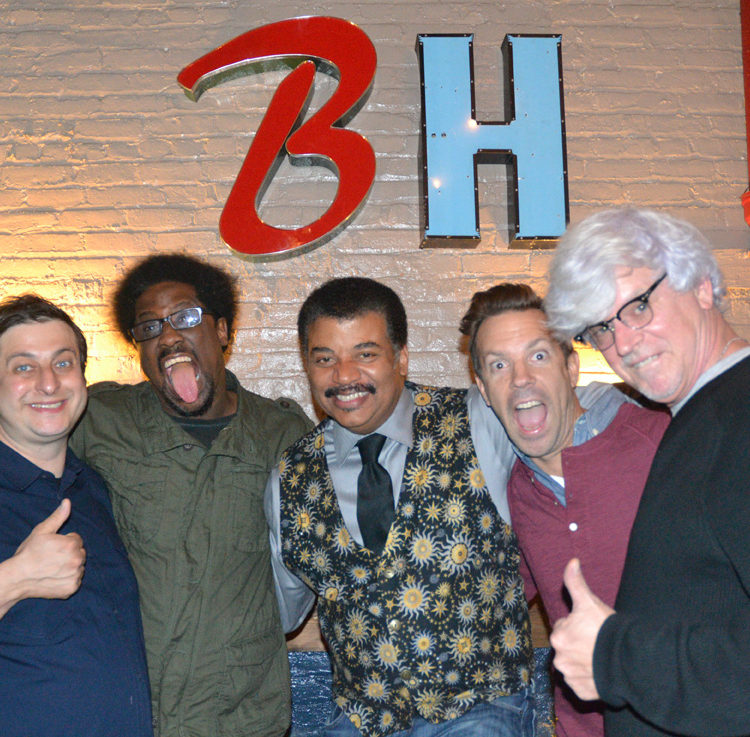
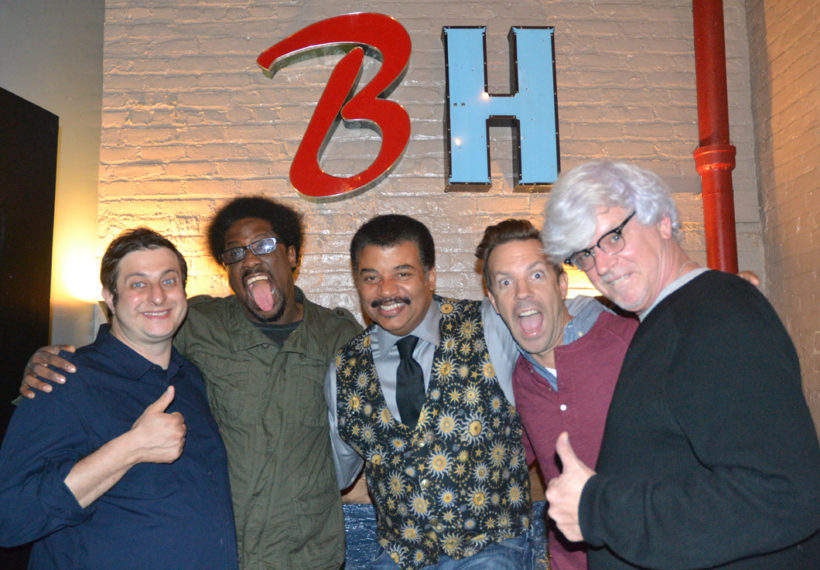
Robots can’t laugh, but the crowd never stopped when StarTalk Live went back to the Bell House for the 6th Annual Eugene Mirman Comedy Festival. Guests included Stephen Gorevan of Honeybee Robotics, the makers of robotic equipment used on NASA’s Mars Rovers, along with comedians W. Kamau Bell and Jason Sudeikis. In Part 1, host Neil deGrasse Tyson leads a conversation about robots and space exploration, from Voyager 1 to the Mars Opportunity, Spirit and Curiosity Rovers and beyond. You’ll learn what actually defines a robot, why some robots are built to mimic humans and others are built to perform certain tasks, and the benefits and drawbacks of using robots vs. people. You’ll also find out about the New Horizons mission to Pluto, Robonaut 2 on the ISS, and the plans to send a nuclear powered robotic mole to Jupiter’s moon, Europa, to dig through its icy surface to explore the ocean beneath.
Transcript
DOWNLOAD SRT
Welcome to StarTalk, your place in the universe where science and pop culture collide. StarTalk begins right now. Welcome to another evening of StarTalk Live. It is my very great pleasure to bring on the host of StarTalk Radio, ladies...
Welcome to StarTalk, your place in the universe where science and pop culture collide.
StarTalk begins right now.
Welcome to another evening of StarTalk Live.
It is my very great pleasure to bring on the host of StarTalk Radio, ladies and gentlemen, Neil deGrasse Tyson!
Tonight's topic is robots.
Yeah.
So I want to bring out one of the world's experts in robotics, in fact, he's based in New York City.
He is one of the co-founders of Honeybee Robotics, why should you know that name?
Because they make robotic tools that fly on rovers that have been to Mars.
Give a warm Brooklyn welcome to Stephen Gorman.
Stephen.
The show wouldn't be complete with just two people who know everything about robots.
We need people to be inquisitive and make fun of their knowledge.
So it is now my great pleasure to bring on two comics, ladies and gentlemen, from FXX's Totally Biased, Kamau Bell.
And from Film and Television, Jason Sudeikis.
So we're going to start off with perhaps the most famous space probe ever, made headlines in the last couple of weeks, Voyager 1.
Voyager was launched September 5th, 1977.
What's special about it is that it was launched with enough energy to careen around Jupiter and Saturn.
By the time it exited the solar system, it had enough speed to leave the solar system entirely.
And upon doing so, just recently, it actually crossed the border between our solar system and space.
The farthest object we have ever sent anywhere ever.
I hope it has its papers.
So it's powered by Plutonium.
Yeah, you're looking at me like, yeah, yeah, Neil, this one fact you have correct.
Plutonium, by the way, was manufactured in a lab in a particle accelerator in 1940, and was the next element discovered after the cosmic object known as Pluto was discovered.
And so they named the element after Pluto.
The planet.
The dwarf planet.
His whole thing is that he ruins the careers of planets.
That's right, that's right.
By the way, the two elements before Plutonium on the periodic table are Neptunium and Uranium.
So it's Uranus, Neptune, and Pluto.
So Pluto got an element named after it on false pretense.
Did Pluto hurt you as a child?
Yeah, what happened?
You got it named the dwarf planet, you won.
Voyager took advantage of a rare alignment to the planets because when you launch a probe, you don't aim for where you want to be, you want to aim for where the object will be when you get there.
I get that, that's like Magic Johnson to James Worthy.
I get that.
Magic leads the past, leading the fast break.
You don't pass to where he is, you pass to where he will.
He's gone, he's not gonna be there.
He's not even gonna be there.
So the Voyager mission took advantage of the gravitational fields of Jupiter, Saturn to gain further energy to get out of the solar system.
And it took images.
We got the best images of Saturn at the time, of Jupiter's red spot, of the moons of Jupiter.
One of them is Io, which is tidally torqued by Jupiter and the surrounding moons itself, which makes it hot.
You have it in a racket ball.
If you hit it, so let's warm up the ball.
You squeeze it and this heats up the ball.
It also heats up planets.
Who squeezed Voyager again?
I'm sorry.
No, I'm just saying we got good images of volcanoes on Io from Voyager's trip.
Let me ask you something here.
Voyager, there's nothing sort of mechanical on it really.
Would you, in your classification, think of it as a robot?
No, there you go.
He just Not a planet, not a robot.
We're just crossing them off.
Next subject.
The question of what a robot is, is an important one, I think.
And I think the simplest definition is that it's a programmable manipulator.
Now, I realize that that sounds more like a cross between a computer and my ex-wife.
I just got you a writing job on his show.
Nice.
But if a machine doesn't do more than a few things, it's not really a robot.
That's why the Curiosity robot on Mars.
We got a whole segment on that.
Well, I know, but it does many things.
When it manipulates things, I think that's what makes it a robot.
If it does sort of one thing or a short classification of things, then it's an automated spacecraft.
Okay, so you make things that manipulate things, and the name of your company has robotics in it.
But that's what robots, I think, do.
No, no, you define robots to be that what you make in your company.
Is that fair to my toaster?
Are you quoting Shakespeare?
No, no, I mean, I'd like to think of everything that does a task that you'd otherwise have to do manually.
Is a Coca-Cola machine, the bottling machine, a robot?
I bet is...
The one with the moving arm, and can it make new choices?
Oh, you've seen the moving arm one, it's good.
Okay, we could debate that, I don't know.
Is a player piano from the 1920s that can play all different kinds of music on it, and it's a very complicated mechanism.
No, that's a ghost.
It is true, those keys just move.
Yeah, because you see them.
No, it's not a robot.
So I'm saying that a robot can do many different things without having to retool it.
If it was a walk, then I'd be like, that's a robot.
Sorry to complicate things.
Okay, so then I have nothing to talk to you about for this whole segment.
It's okay to call it a robotic spacecraft.
He said condescendingly.
The reason why you need plutonium on board is plutonium is radioactive.
It gets hot, and you take something called a thermoelectric coupler.
We've seen that in the future.
You gotta go 88 miles per hour.
We get it.
And then you generate electricity from that.
Yeah, from the clock tower.
We know this.
Why doesn't it use solar panels?
Because it is so far away.
The sun is no brighter than just a slightly brighter little star in the night sky.
It's ineffective as an energy source.
So therefore you gotta give it an energy source that it takes with it.
And there you have your plutonium.
We're running out of plutonium in the world.
What?
Really?
You're telling me you can't make plutonium at the Museum of Natural History with all your knowledge and access to bones.
Right now there's 36 pounds of plutonium in the world.
That's it.
Can't we steal it back from terrorists?
What did the doc have?
That was plutonium, wasn't it?
Yeah, so we can get it from Christopher Lloyd.
He's one source.
Well, no, he stole it.
He stole it from the Libyan terrorists.
There was a lot of protest when that plutonium showed up at Cape Canaveral to be launched into space because people considered that it was dangerous.
There was a lot of preparations made for the protests that were going to happen for the launch.
One person showed up for the protest.
And there was a SWAT team there to deal with it.
You know what happened?
They beat the crap out of that guy.
Good!
That's what he gets for trying to stop the future of progress.
That was in Florida?
Was he a black guy?
I'm just trying to get to the other angle.
It could have been that.
Here's what makes Voyager sort of culturally special.
We knew in advance it was going to leave the solar system.
And if anybody was going to capture this after it left the solar system and try to ask questions about it, it would be some intelligent aliens.
So why not put messages on board that they could then decipher, and then maybe they could learn about us?
And so included in that messaging is like the return address of where the solar system is in the galaxy.
Fools.
And at the time, that really sounded like a good idea, but now you don't give your address to strangers of your own species.
And we're giving the address of-
You do if you like to party.
So Voyager, after it passed Neptune, was instructed to perform a task.
They turned it around, looked back to the inner solar system, and photographed Earth.
A selfie.
I haven't thought about that.
It still had the duck lips?
Yeah.
And the moon is photobombing?
It's a whole thing.
That moon.
So this image led Carl Sagan to write a very famous book called The Pale Blue Dot.
And in it, he waxes poetic about our presence in space.
He talks about, as you stare upon this pale blue dot, barely a pixel in the image.
This is Earth, something we're so accustomed to seeing with mountains and valleys and craters and hills and oceans, it's big, it is not even a pixel in this image.
And he says, everyone you've ever known, read about, heard about, lived out their lives on that speck.
And all the wars that are fought over the temporary command of one plot of land versus another, all happened on this speck.
Everyone who contributed to what we call history lived out their lives on that dot.
And so it's humbling.
It's the cosmic perspective.
Yeah, there's a great indigo strain that will make you feel that way too.
I've heard, I've heard.
You've heard, exactly.
Also on this ship, there's a golden record.
It's gold plated.
The set of sounds on it are called murmurs from Earth.
And we put together a sequence of them.
Let me just, I got a crib sheet here.
Is it like a romantic mix CD, like we got Olivia Newton-John?
No, it does not contain Olivia Newton-John.
She didn't travel back in time to send her music to space?
Where it belongs.
It's got greetings in 55 languages recorded on the sidewalk of the UN.
People of all these languages came up and they recorded greetings in their native languages.
So literally, aliens can come to Earth, say hello in 55 languages and then murder people.
And you will literally, 55 nations will let their guard down.
Maybe more.
So they know how to say hello.
They must be friendly.
Let's check it out.
Imagine you're in outer space and this is what you're hearing.
You don't know what humans are.
Oiknis poteste hairete.
Eirenikos pros philos ele luthamen philoi.
That's Greek.
Gokwai houma.
Joukkoukwai pengon kenhon phailok.
Tahiatuna lel astiqa fin nujoom.
Jalaita yajmaoun az zamane.
Who is that?
Arabic.
Hola i saludos a todos.
Salvete kwi kumkwa estis.
Bonam erga vos voluntatim abemus et pacem perastraferimus.
We're assuming this is greeting to 50 swears.
Hello from the children of Planet Earth.
Aww.
That was Jeffrey Dahmer.
Is this one Spanish?
I'll close this cousin right there, it's embarrassing.
The Tractor in a River?
I would love it if this is just the guy from Police Academy.
Morse code.
Shh.
They sent Michael Winslow to space to make the sounds of machine guns to scare away enemies.
We're missing the Morse code.
Oh!
Oh!
The whole thing.
Catch the time delay between the countdown and when the microphone catches it.
If you went somewhere and they made you listen to this and you didn't know about their culture, you would think they were insane.
98 sounds.
One of them is a tractor and a river.
This is followed by a kiss.
Oh, all right.
It was a quick kiss.
And finally, back to the future, just like I was saying.
So you might wonder, where is Voyager going?
It will take 40,000 years for it to come near the nearest star to it.
And so we really still haven't gone anywhere.
It's comforting, yeah.
It's headed towards a star in the constellation Camelot Pardalis.
Camelot Pardalis is the giraffe.
Of the 88 constellations, one of them is a giraffe.
This is the point it starts to feel like science is just making stuff up.
Yeah.
It's headed towards this place to name this thing.
You don't know that it's named that thing.
We sent Voyager to meet a giraffe in outer space.
And you're gonna stick by that story?
It's gonna come within 1.6 light years of a star called Gleesey 445.
So there you have highlights from Voyager.
It's our robotic emissary that has gone the farthest.
And we're calling it Robot, just wanna say.
I'm with Steven, I don't know.
Taping Chuck Berry to a spaceship is not necessarily a robot.
That's what it is.
That's what it was duct taped.
Admittedly impressive.
It was duct taped to the, yes, that's what it was.
By the way, the aliens were given instructions on how to play this phonograph record.
How to make the needle and how to then retrieve the sound from it.
Oh yeah?
So, yeah.
That's kinda condescending.
How are they giving?
But what if we affect other cultures?
With American rock and roll.
Oh by the way, it wasn't just Beethoven and Chuck Berry, it was music from all around the world.
It was aboriginal music and mountain music.
So there's been some debate about whether it really left the solar system, because Earth's gravity extends beyond that, and it hasn't really fallen into the next star yet.
So if you're a gravity person, no.
It hasn't left the solar system.
If you're a gravity person.
And what if you're not a gravity person?
Well no, if you were a planet person, Then you're floating.
If you were a planet person, you would say left the solar system after it crossed the orbit of Neptune.
It's just a matter of how you wanna define your solar system.
How do you define it?
I'm gonna go by your take.
I like the definition they used.
The sun is losing mass every moment of every day.
And as we call it the solar wind, it's charged particles extending out.
So isn't it where the solar wind heads the other direction?
Is it the end of the heliopause?
No, no, so the solar wind goes out in every direction.
And it keeps going out.
And there's a point where the sun's field that controls what these particles are doing becomes indistinguishable from the galactic magnetic field.
And when you cross out of us into that, you will no longer be able to use the particles as an indicator of which way you came from.
That's all.
So you can't use solar particles to get back to Earth if you happen to be far, far deep in space.
You'd have to use some other cues, but not that.
What would be some cues, like a rope?
Well, there's the sun right there.
You can still see it.
It'll be your closest star to you.
But Apple Maps still work that far out?
Does it work here?
All right, we're done with Voyager.
When we come back, more on Robots, Robots on Mars.
So, now let's talk about the robots that Stephen will agree are robots, because he builds these.
I gotta say, he might be right about what's a robot because of his robot knowledge.
Nothing worse than a nerd bully.
Right now, I've lost count.
There are dozens of robots and telescopes orbiting the Earth on their way to planets, orbiting planets, and basically, it's humans attacking the solar system.
And in particular, the ones that typically get the most press are the ones that go to Mars.
Because Mars, if you didn't already know, has basically a 24-hour day.
It has a tipped axis, like Earth's axis.
Mars has polar ice caps, like Earth.
Mars has evidence of running water that had been there long ago.
So Mars captures our imagination like no other planet.
And the most recent rover there is Curiosity.
And Curiosity, beautiful.
It's the size of an SUV.
Had very complicated landing mechanisms.
They couldn't land this one with airbags.
Previous rovers were small enough that you surround it with airbags.
It just drops out of the sky, bounces.
The airbags deflate and it goes running on its way.
This thing had joists and retro rockets and drogue chutes and all manner of things to slow the damn thing down so it could land safely and softly so that it can then conduct its tasks.
Before this, we had a pair of twin rovers, Spirit and Opportunity.
One of them that launched 10 years ago, one of them is still going.
Which one is still going?
Do you remember which one?
Opportunity, 3,500 days.
Ooh, nice.
Opportunity, those are much smaller rovers.
Do we get information from it?
What does it do?
Absolutely.
It's just doing donuts, right?
It's just peeling out and you know.
So Curiosity descended through the atmosphere in six minutes of terror.
Of beautifully executed terror.
Wonderful engineering achievement.
Just to get the thing down on the, finally engineers had a day in the sun.
They just said we're gonna just plop this thing down.
And they optimized the mass of the rover that way.
They didn't have to develop a lander.
And plus if you drop it down, you can land with more precision.
You can land exactly where you want from the surveillance photos.
And we landed about two and a half kilometers close to the center of where we wanted to land.
Two and a half kilometers.
Which is very, very good.
Because of.
Well, it's good if you went a hundred million miles.
Yeah, that's what I'm saying.
Like, if I was like, I'm at your house, but I'm two and a half kilometers away, they'd be like, you're really, really off.
But if I went to another planet, they'd be like, not bad.
It's that Apple Maps problem again.
Yeah.
You know, we lost the landing location of Opportunity.
We didn't know exactly where it landed.
And Mike Malin, one of the members of the science team, suggested we spell out with do wheelies and make a drawing.
Oh, spell something?
Yeah.
So that we could see it from orbit, because we have spacecraft going around the planet.
Did you do that?
No, because we found it before we were able to do it.
That would have been so fun.
So you built a tool that was on Spirit.
Spirit and Opportunity, both of them, right?
Well, they're twin rovers, so the tools are identical.
So we've abraded the rocks on Mars so that you could get below the surface of the rocks so that you could reach a virgin rock material.
What's wrong with the surface of the rock?
Because there's dust and dirt on the rocks.
Just be looking at aeolian material that's been blown around the planet.
You want to look inside the rock to get a window into the history of the rock and the climate.
Aeolian.
That's wind swept.
Wind swept.
So abraded, it means you're like grinding it, basically.
We grind into the rock with diamonds.
What's an example of some of the things that you would get from grinding it?
We found a rock at Gusev Crater where Spirit, the first rover, landed.
That was a volcanic rock, but there were veins in it, and these were minerals, and we found out that it were water-deposited minerals.
So, we concluded that there had to have been water at Gusev in liquid form.
At some time in the past.
At some time in the past, and of course, life is usually associated on the Earth with liquid water.
Yeah.
It's always associated on Earth.
Yeah.
So, there might have been gazelles on Mars.
Our mantra for NASA and the Mars Exploration Program is to follow the water.
Follow the water.
You had an acronym for your tool.
What was it called?
RAT.
The RAT.
So, the R stood for what?
Rock abrasion.
Rock abrasion.
Tool.
Yeah.
Can I have a job naming stuff?
So, how deep in would it go?
How deep in?
10 millimeters, typically.
Okay, just enough to get it to get out.
Just to get past what we call the rind of the rock.
And do you have anything on curiosity?
We have a similar tool, and we also have a sample manipulation system, because samples now on the Curiosity Rover, Mars Science Laboratory, MSL, are taken by the robot arm and deposited in a very sophisticated chemical laboratory where we can identify organic compounds that might...
So you're reaching in scooping up soil and putting it in this...
And cuttings from drilling into rock.
Did you say 10 millimeters?
10 millimeters.
So, again, that's an inch, yeah?
Half an inch.
Oh, I mean, I'm sorry, a centimeter?
Is 10 millimeters a centimeter?
It's definitely 10 millimeters.
25 millimeters to the inch or so.
Yeah.
Well, wait, so...
So...
I think when you say this piece of paper, is that a millimeter?
No way less than a millimeter.
Yeah.
Right.
I'm gonna get it right with these papers.
So 25...
Best radio ever.
2.54 centimeters is an inch exactly.
Yes.
But I'm talking about millimeters.
How many millimeters are in a centimeter?
25.4 millimeters is an inch.
So it's a little less than half an inch, but that was enough to get to Virgin Rock.
You don't want to talk about centimeters, do you?
For Virgin, for it to feel anything.
I would say that's not very deep.
That's not very far into the rock.
Yeah, but it's not for it to be like fresh and new.
Is it really?
That's what I say.
That's crazy.
But it's not soil where stuff could have seeped in.
It's a rock.
Yeah.
Completely solid.
Okay, yeah.
So you're just cutting off.
I'm thinking it's dust.
I got you.
You're right.
If you scooped up a fossil, you wouldn't even know that it was life because it was fossilized.
Isn't that right?
You'd be grinding up the fossil and then analyzing ground up fossil and say there's no life on Mars.
Well, you're pointing out a very good problem with these rovers.
You know, compared to sending...
I know, but compared to sending...
Neil, be nice, he's a guest at your thing.
If you send out...
You ain't doing nothing over there with your man robots.
If you would have sent a geologist...
A geologist to the Mojave Desert, you know, in a helicopter, he'd get out and he'd walk over to a high rise of land and he'd look at the most interesting rock in the distance and he'd walk over to it, he'd take out his rock hammer and break it open and take out his loop and look at it.
That takes maybe a minute and a half.
In the beginning, with Spirit and Opportunity, we could do the same thing, but it took us four days to do that.
So you actually want to go there?
Well, that means that robots do not approach the capability of human beings.
It takes us four days to do something a geologist could do in a man.
Well, in speed, yeah, but you can analyze it there.
You can't duplicate, we have brought a very sophisticated laboratory with Mars Science Laboratory to Mars, more than sophisticated in that anything has been brought to another planetary body before, but it still pales to a laboratory in the Earth.
So all you have to do is go to Mars, bring stuff back.
That's right, and that's what we're doing now.
Let's go.
Yeah.
Well, what do you mean you're doing it now?
You're not doing it now.
Well, I'm a part of a group that's already getting ready for the 2020 mission that will go...
The Illuminati.
Ha ha ha ha ha.
Well, wait, is this a funded mission?
This is a mission called Obamacare.
Is this a funded mission in 2020?
It's as close as it can be to a funded mission.
I can tell you that there's money now for developing the conceptual design for the 2020 mission, which will not only...
You have design money.
You don't have launch money and...
No, no, but it's looking very good.
Maybe a $7 billion Kickstarter, where people get also a CD of sounds from spaces.
But the 2020 rover, if it happens, and I think it will, it will have a...
You pray that it will, yeah.
I pray that it will.
It will develop probably a cache to gather samples.
Handpicked by people on Earth.
That's right.
And there will be like a triage system on board the rover to pick the best samples, store them, and come and get that cache, and yet another mission.
Another mission to retrieve it, or it'll come back to Earth?
Another mission to retrieve it.
Oh.
Oh, wow.
So now you have to get funding for that mission, too.
Think about it, if you're going to...
Well, that's true, but if you're gonna return a sample from Mars, you have to bring a rocket to Mars.
Yeah.
Yeah.
Unless you converted the water in the soils into rocket fuel, and then build a rocket ship and send it back.
Get on that, Neil.
Spoiler alert.
So, we got other robots out there.
We've got New Horizons Mission.
That's a mission to Pluto, by the way.
Mm-hmm.
Just so you know, and I'm down with that.
Okay.
Who names these things New Horizons?
It sounds like a retirement center.
Wouldn't you name it like Space Laser 50 Million?
It used to be called the future of everything.
It used to be called the Pluto-Kyper Express, and that was happening right around the time when Pluto was getting demoted, and the people who were tooling the spacecraft were worried that if Pluto got demoted, the Pluto-Kyper Express would somehow get its funding affected, and so it got a whole fresh makeover, basically.
New Horizons.
This is, die in peace.
So NASA has a robot called Robonaut 2.
Do you know about this robot?
I do.
And that robot tweets at Astro-Robonaut, and this is a robot that looks like a human to do what a human would do in a previously human design task.
Now when you say it looks like a human, do you mean like, looks like a human?
It's an anthropomorphic design.
You would look at it as at least looking like a moving mannequin of some kind.
Yeah, because think of it-
Like a movie mannequin?
But you would not be fooled at a restaurant.
You wouldn't be like, this is my friend Jack, and he'd be like, Jack's a robot, sir.
I wouldn't say that.
If the person introduced the robot to me as a human, I would deal with it that way, because I don't know what this person's deal is.
I don't want to judge.
You gotta learn to accept people.
I mean, I'll leave there.
I'll go to the bathroom, I'll go, you'll never believe the shit I'm dealing with at this table.
But so it looks fairly human.
What does it do?
When you say human tasks, do you mean like it makes breakfast?
I just want to clarify.
I just want to clarify.
So the old days, you'd make a robot, and a robot in our mind was something that looked human.
And then we realized we can make something better than a human to do specific tasks.
So why anchor it to the form of a human?
Well, that's right.
Maybe make a human that could crawl across a truss work on a space station should be more like a bug than a human.
Right, than a human, for example.
And so there might be some tasks that we duplicate with human motion that we use this robot to do.
That's right.
Part of the idea, I think, is that if the astronauts are unavailable, we need the robonaut to use the tools that the astronauts use.
So it would have to be a similar design.
How long till whatever you're describing, it has fingers and arms and it's gonna fit through hatches and so on.
And how long till it votes?
Like 10 years?
There'll be a new amendment, it'll be a three-fifths rule regarding robots.
Not enough black people here to have that reaction.
Calm down.
So, what's your favorite robot in space out there now, other than your own rat?
It could be his own rat.
Or your favorite spacecraft.
I just want to know, what does a roboticist think is the favorite?
And don't just say Led Zeppelin.
Yeah.
Well, I actually have a, this is gonna sound terrible, but my favorite is one of the Russian spacecraft.
He's Russian, so you're good with him, right?
It's kind of my spacecraft, go on.
Which one?
Snapple Return was what we're trying to do on Mars is such a complicated thing, I thought you have to bring a rocket to the surface.
The Russians executed a sample return mission in 1970.
Because they scared the spacecraft so much.
That it was like, if I mess up, I'll die.
They'd return samples three times from the moon with a completely automated and a robotic device, and it just astounds me, hardly anybody knows about it, but it was a stupendous achievement.
And where did it go and come back?
That's what sample return means.
Yes, no, I mean, I'm getting it slowly now.
We had to send Neil and Buzz to get those samples, and they sent an automated spacecraft three times, and they did it, we never did it.
What a country.
No one's ever done it from a big planetary body.
We sent Neil and Buzz, they sent a robot, they probably did it for less money.
So, if you had the choice to send a robot or a person, what would you do?
To which location?
Oh.
Yeah, France, the moon, the sun.
Okay, so Mars.
Can we pick the people and be like, here's somebody I don't like?
I'm all in favor of ultimately sending people to Mars.
And part of the Curiosity Rover is equipped with instrumentation that is designed to look, for example, at not only the amount of water that's available on Mars because it's important for the astronauts when they get to Mars someday that they have water available for, not only for drinking, but for power and energy.
Would you be also...
But also they need to know if the radiation levels are survivable and there's an instrument on Curiosity that is constantly monitoring the...
Radiation from the sun.
From the sun and the galactic radiation and cosmic radiation as well.
Could you drink the water?
If we found water on Mars, you could drink it.
In fact, this is a finding of Curiosity's finding is that the water that was present at one point was probably quite drinkable.
At one point, but not now.
Well, I mean, it's not there now on the surface.
It might exist.
There's a chance there's still water there.
In fact, we know that there's water.
Another finding, I think it was just released the day before yesterday, is that the contents of the rocks in the near surface are holding a tremendous amount of water.
In them.
You are saying, be careful of the water in Mexico, but drink the water on Mars.
It's fine.
Squeeze a rock right into your mouth.
So, speaking of looking for water, one of Jupiter's moons, Europa, has an ocean of liquid water.
Another one of these moons kept warm by the gravitational stress of...
This is not a smart-ass question.
You said liquid water.
Yeah, yeah, I was right there with you.
I was right there with you.
Is that because you would distinguish for ice and a gas?
Well, frozen water or gaseous water.
Gotcha, okay, cool.
Yeah, I'm just checking.
That was not a smart-ass question.
I preface with that.
No, no, no.
We're cool.
I'm just checking.
We're cool.
I'm trying to learn stuff here as well.
I dropped out of community college, so this is like four credit hours.
Dear college, I think now I can graduate.
Listen to this.
So Europa's kept warm on the inside.
It's frozen on the outside.
If we want to look for life in that ocean, it's been an ocean for billions of years, we're going to have to drill through maybe a half a mile of ice.
That's right.
Can you drill through a half?
Can your peeps do that?
We are among a few groups that are conducting research development projects where we are building a mole to try to dig through a half a kilometer of ice.
Is it drill?
What does it do?
It does drill.
Is it a robot mole?
It's a robot mole.
And it takes the cuttings that it's drilling down and throws it behind itself and keeps drilling down that way.
But you have to get rid of the cuttings.
So it eventually has to bring the cuttings up to the surface and keep going down.
And it may take months to do it, but there's no technical reason what we see that can prevent it from happening.
I have a question.
You said you're on a team.
How much nowadays space exploration is distinguished between country?
Like when you're saying the Russians did this.
How international are your collaborators?
I'm not sure exactly what your question means.
I mean, are we still in a space race against the Russians?
Have you ever had an Italian friend?
Yes.
Like friend, friend.
Like, you know, like driving to the airport kind of friend.
Not just someone like, oh, you're having a dinner at your place.
Yeah, you've got to go to this guy's place.
He makes amazing bread kind of friend.
No.
Well, the Cold War definitely spawned actually some amazing space races in robotics.
But these lunar missions, the Russians sent countless missions to the moon that were automated.
And to Mars, also into Venus.
They landed...
They're the only ones that have ever been to Venus.
And they took pictures on the surface of Venus.
What have they done lately?
Are they still doing that?
Is it still happening?
No, but see, now after the Cold War, the Russians have way scaled back their space exploration.
But they have fabulous capabilities.
We're sending our astronauts on Russian spacecraft to the space station.
Because we don't have a shuttle.
I want to get back to Europa.
There might be life there.
You're drilling a hole through it.
There's liquid water.
You have collaborators.
Yes.
And your collaborators are American or international?
Well, on the technology, they're American.
But the instrumentation, there's a lot of international.
Curiosity has instruments from Spain, Russia, France.
Even the French?
So when is this launch?
The Europa mission?
Oh, no.
Well, the engineering problems are so titanic, NASA is smart enough to know that this is going to take a decade.
When you're looking for water, don't use the word titanic, okay?
That's true.
Fair point.
We're going to need decades of research and development, and we're talking about digging a hole tens of millions of miles away with only a small amount of power, and like you said, a half a mile deep.
It's a really big achievement.
It'd be hundreds of millions of miles away.
Hundreds of millions of miles away to the outer planets.
Yeah.
Thousands of miles away too.
And there's no solar power available out there, so you're going to have to bring nuclear power.
Way more than one mile away.
Well, it's great that you're in all of this, but I'm not done with you.
We're going to find out what robots are doing back here on Earth.
You're listening to StarTalk Live!
See the full transcript




 Unlock with Patreon




 Become a Patron