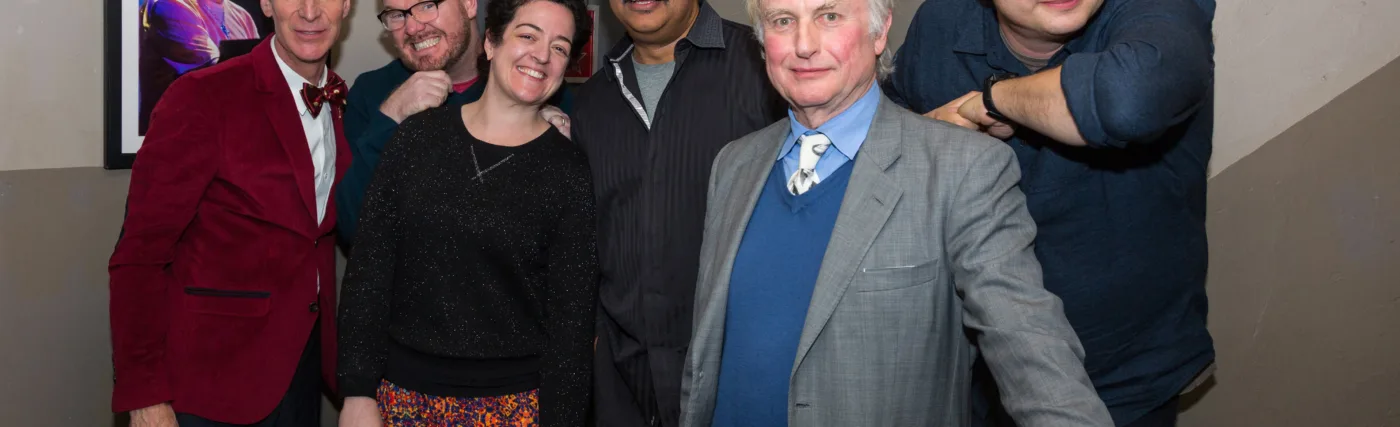
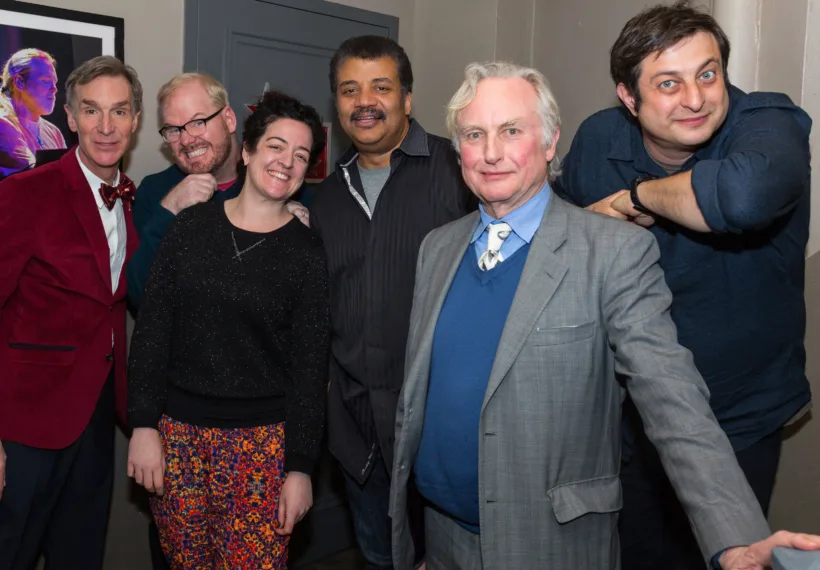
Our evolutionary journey at the Beacon Theatre in NYC concludes with host Neil deGrasse Tyson, comic co-host Eugene Mirman, and guests Richard Dawkins, Bill Nye, Jim Gaffigan and Maeve Higgins. First up: human design flaws, or what Neil describes as putting “an entertainment system in the middle of a sewage complex.” Richard explains the evolutionary reason a giraffe’s recurrent laryngeal nerve improbably travels the length of its neck and back. Find out why negative traits like male pattern baldness persist – and why Eugene can’t be president. Explore how many generations it would take a mouse-sized species to evolve to the size of elephants and how to breed men who can lactate. You’ll also hear about stem cells and cloning, selective breeding vs. inducing mutation through genetic modification and manipulation, putting fish genes in tomatoes, the unintended consequences of GMO corn, the morality of breeding humans to be better musicians or resistant to Ebola, herd immunity and vaccines, and what we can learn by studying AIDS-resistant prostitutes in Nairobi.
Transcript
DOWNLOAD SRT
Welcome to StarTalk, your place in the universe where science and pop culture collide. StarTalk begins right now. Thank you. So, Richard, when I was in college my freshman year, I attended a full year course on art and design,...
Welcome to StarTalk, your place in the universe where science and pop culture collide.
StarTalk begins right now.
Thank you.
So, Richard, when I was in college my freshman year, I attended a full year course on art and design, one of the more influential courses of my life.
And we spent the first month or two drawing nudes.
And that was fun, I thought.
But it became clear to me immediately that the beauty of the human body is a highly overrated concept.
These were like great dealer people coming in taking off their clothes, and so.
You can pick who you draw, you know what I mean?
As I saw this, I'm thinking, if I had control of the body, I would have made some changes, evolutionarily.
So can I get you to comment on the difference between how much praising we do of the human body, and how much critique should go alongside it if we were honest about ourselves?
The famous cases are things like the retina being backwards.
It's a historical accident, but the retinal cells, the light-sensitive cells in the vertebrate retina, but not in the octopus retina, they all point backwards.
So it's as though you designed a digital camera with the pixels and the forest of wires, but the photocells are all pointing backwards, away from the image.
And the wires have to run over the surface of the light-sensitive screen.
With that said, Richard, I'm not sure that's what Dr.
Tyson was driving at.
When you looked at the models there in art class, you weren't thinking, those retinal cells.
Changes could have been made.
Why aren't they more like octopuses?
Why is he being erudite in his example?
That's cool.
I could give a more basic example.
I'm looking at this.
They're facing all different directions, they're bending over, you know, and I'm thinking.
We have a human body that, between our legs, we have an entertainment system in the middle of a sewage complex, okay?
So any engineer would not have designed that.
I'm certain.
Plus the fuel tank, the nozzle for the fuel tank is right next to the air filter.
I mean, stuff's gonna go wrong.
So some percentage of us choke to death.
We're alive, like, in spite of our body's design.
And there's a great video, which I highly recommend, where you autopsy a giraffe.
Oh yeah, there's a nerve, which is one of the cranial nerves, and it starts in the brain, and the end organ is the larynx, the voice box.
But in this nerve, it's called the recurrent laryngeal.
Instead of going straight to the voice box, it goes down into the chest, loops around one of the main arteries in the chest, and then goes straight back up again to the larynx.
In a giraffe, that is a very significant diversion.
Could you just say that again?
That was just so, it's like the British understatement, right?
Say it again, in a giraffe, I don't want to hear that again.
No, no, I can't repeat the exact words, but only yesterday I was doing an episode.
Do you know the wonderful Mr.
Deity?
Brown Dalton.
He had me on, and I was arguing with him as God about what a lousy job he'd done.
And this question of the recurrent laryngeal nerve of the giraffe came up.
And he said in his wonderful sort of whiny voice, but you know, we had a surplus of laryngeal nerves.
We didn't know what to do with it.
So we had to use it.
It is a very uneconomical thing.
And of course the explanation is history.
The explanation is that in the ancestors, when this nerve originally started in our fish ancestors.
A vertebrate ancestor.
Yes, in a fish, the end organ of this nerve is straight across.
It doesn't have to go south into the chest.
It goes straight.
It is the most direct route.
And then as the land vertebrates developed a neck, fish don't have a neck, as the neck lengthened, the marginal cost of slightly increasing the length of the diversion was very small in every generation.
We just added a tiny fraction of a millimeter to the diversion.
And it wasn't as it were a great increase in cost, whereas the cost of jumping it over the blood vessel and making it go straight to the larynx would have been probably some major embryological upheaval.
When we were dissecting-
In other words, you'd have to disconnect it, reroute it and reconnect it.
So this is a great insight is it has to work.
All of our ancestors had to work at each stage.
Yes, that's right.
This is just amazing thing.
It's a very important part.
So how long is the nerve in the giraffe?
Well, you know how long a giraffe's neck is.
The larynx is right near the head.
Where you should be.
And we dissected this nerve and it goes-
The giraffe had already died.
Yeah, yeah.
It had already died.
And the nerve went within an inch of the larynx.
I mean, you'd think it would be so easy just to say, oh well, any engineer would immediately have said, well, obviously that's where it goes.
It goes within an inch of the larynx.
It goes on and on and on and on and on, down, down, down the neck.
And then round this artery and then back, back, back, back, back up to where it started.
And it is something that no engineer would countenance.
So it would be, you just send it straight back, which is what-
So the whole, the idea is, the big idea in evolution, Neil, and everybody, is it's bottom up.
It is not, there's not a designer at the top that showed up and routed the giraffe larynx wire.
It just had to work at every stage.
You had talked about piston engine becoming a jet engine.
Another example is a grocery cart you take to a fairway market or something with two wheels.
Bill is now a New York resident, so he is fairway fluent.
So imagine you took that and made it into a bicycle, but at every stage you go to make it into a bicycle, the wheels will be here or across from each other, then they have to be end to end or in tandem.
Every stage that you do has to work and reproduce cars.
You can't throw away the design and start again.
Okay, so how about.
This?
So now what impresses you about the human body?
There are now 7.2 billion of us.
Yes.
So whatever it is, it works really well.
I mean, I tell you what impresses me about the body of almost any animal is how elegantly beautiful it is from the outside.
If you look at a lion, a cheetah, a gazelle, these are beautiful machines.
They are high speed, fast running, either predators or running away from predators.
And they...
Gazelles.
They are very beautiful things.
And we all think they are beautiful.
But if you cut them open, it's a mess.
The same is true of cars and rockets and airplanes.
Luke Skywalker figured this out, you know, on the ice planet.
Yeah, he did.
There's another nice example.
I thought it was Luke.
Excuse me.
Han Solo.
Feel that nerd rage.
There's another...
And guts spill all out.
And another nice example, which is a bit like the recurrent laryngeal, the tubes that connect the testes to the penis.
Uh-huh.
They don't go by the most direct route.
They go up and they loop around.
Mine hang down.
Just at the prostate gland gets involved.
Like, what's going on?
But they go up and they loop around the tube that comes from the bladder.
And that again is a historical accident.
Okay, so, you're cool with what animals look like on the outside, but when you cut them open, it's nasty, ugly stuff.
If you look inside a car, the exhaust manifold, the tubes all kind of cut in a nice, neat road, don't they, whereas if you look at the similar thing, the main artery leading off the heart, it's sort of, it's vaguely similar, but it's just not well designed.
Okay, how about all this other stuff that goes on, like male pattern baldness?
Where does that come from?
Well, anything that tends to characterize age.
The longer you've lived, the greater your chance of already having passed your genes on.
And so we're all descended from an unbroken line of people who lived long enough to reproduce.
Very few of us have descended from ancestors who were very old when they reproduced.
So there's no sexual selection.
Not just sexual selection, but any kind of selection is weaker, the older you get, because you've already passed the genes on.
I mean, if you think about a more unpleasant example, like getting cancer, a gene that makes you get cancer when you're 50 has already been passed on by the time you reproduce.
A gene that makes you get cancer when you're 10 has never been passed on.
So lead a very short life.
So the older you get, the more likely you are to be hit by lethal genes which have slipped through the net.
This is part of what I was calling good enough.
You're good enough.
Your eyesight, my eyesight is good enough to get us this far.
Basically, bald people have sex when they're 20 and no one knows they're gonna be bald.
So if you don't have kids before you go bald, you never will.
Baldness is very fashionable nowadays.
I was gonna say, ladies, help me out.
Some guys rock the bald thing, right?
Yeah.
I talk by ladies.
Those women clapping are married to bald guys.
I'm sure Vin Diesel is still sexually active.
So let me ask, as we go forward in time, what becomes of organs that are not vestigial organs?
So your appendix, perhaps.
The toenail on your pinky toe, of what possible value is that ever going forward?
People still put toenail polish on.
I've seen women with the tiniest little nail and a toenail polish on.
Let me turn the question around two ways.
Okay, turn it around.
First of all, what's the cost of having that?
Does it hold you back some way?
It's why I can't be president.
And if there's no cost to it, it'll just persist.
Secondly.
But it won't persist forever because you can have copying errors that don't.
Do you think it would inhibit a woman's chance of hooking up if she showed up without a pinkie toe?
If her picture on Timmy was over her toes and she was missing a toe, I think that would be a pass.
Let's take a summer day in Central Park where the women are rocking their sandals, right?
And they've got their toes painted and all that stuff, and the woman shows up with no pinkie.
You don't think a guy would give a chin stroke and maybe veer off on that?
I think you underestimate the...
It's like the dating game.
Traditional science.
People have done, Holden and Stebbins and people have done mathematical calculations on this question of something being too trivial to matter.
If you put into the equations of evolution an assumption that something utterly trivial, like a tiny little toenail or lack of a pinky, and you set a value on the selective pressure against it, you make it as low as you like, and then you calculate how many generations it would take at that low selection pressure to eliminate it.
And Haldane did it, and it came to something like 12,000 generations if you set it at a value so trivial that you couldn't detect it in fieldwork.
12,000 is not that many.
That's right.
That's the point.
Stebbins did a calculation.
How long would it take a species of mouse sized animals, if they were subjected to relentless pressure to get bigger, how long would it take to become as big as an elephant?
If you assume that the pressure to get bigger is so trivial that it's impossible to detect in ordinary field experiments.
So you've got field biologists going around catching mice, measuring them, and it's in the noise level.
They can't detect it.
So Stebbins set the selection pressure at this very low level.
He put it in the noise, and then he calculated how long it would take to become elephant sized.
And I forget the result.
But the point was that it was so fast that you wouldn't detect it on the paleontological time scale.
It would look like an instantaneous change.
How much would you have to scare mice to make them much bigger?
Like I said, not me, but like, so how long is it?
This is a fascinating point.
So it's why you can look in the fossil record.
Yes, and see a T-Rex that's this big.
Exactly.
But there's no half a T-Rex.
Exactly.
Right.
There's a mismatch between what field biologists can measure on the one hand, it's in the noise, and what fossil hunters can measure on the other hand.
Now, it probably doesn't mean usually there aren't intermediaries, but if there are not, then you can appeal to Stebbins' calculation.
So how many generations about, if it's 12,000 for people?
I think it's two.
Is there a similar estimate for how many generations it would take for a light?
I've forgotten the figure, but I mean, it's in the tens of thousands, which is an eye blink on the geological.
Yeah, totally.
So let me end this segment with a question for you to address.
Different people give different answers to this, I want your answer.
Are we getting smarter or stupider?
Because sometimes I don't know.
I am completely baffled by the Flynn effect.
The what effect?
The Flynn effect.
Yes.
Named after a man called Flynn.
I was going to guess that.
Yeah.
But it was a man, not a woman.
It was a man, actually.
Yeah.
And Flynn, he's a psychologist who's been studying IQ.
Now IQ is actually standardized so that the average is 100, but he allowed for that.
And he finds that over the course of the 20th century, average IQ has been going up massively.
And I must say, I don't notice it.
But the data seemed to be there, and I wish it were true.
What it may come down to is being smart may not be of that great value.
Compared to your ability to resist junk.
We tell ourselves that being smart gives us an advantage.
Where I'm thinking, if being smart gave you an advantage, there'd be many more other what we would think of as smart animals in the tree of life.
And in apocalyptic earth, we're extinct.
A whole lot of other animals have rise up in our place, and no one ever accused them of being smart.
So, can you comment on the value of being smart with regard to evolutionary survival and natural selection?
We were talking earlier about the number of times things have evolved, and eyes have evolved 40 times.
Linguistic intelligence, the sort of intelligence we have where we can actually formulate philosophical thoughts, has only evolved once, and didn't evolve until the world had been around for more than 4 billion years.
You know, I tweeted on this recently.
Did you?
Yes.
Yeah, with regard to farm animals.
I was just wondering if farm animals, when they're just chewing their cud, if they're contemplating the history and fate of the universe, if they have theories of the universe that they're thinking about.
And then I wondered if the farm animals wondered the same about us.
Yeah.
So, I've speculated on this a lot, and I've spoken with my dog friends about it.
And by that, I mean my friends who are dogs.
Not the people.
And what I get from them is just a couple of things, really.
Food.
Food.
Squirrel.
Food.
Are you a girl dog?
Food.
Are you a girl?
Food.
And I've spoken to dolphins.
I was in Hawaii.
They let you hang out with dolphins.
Yeah, did dolphins tell stories?
It doesn't seem like it.
Or not good stories?
I don't think so.
You know, like we build libraries and theaters.
I don't know if they've even contemplated.
I'm reminded of a comic where two dolphins are swimming together, commenting on the humans up on the deck.
And one dolphin says to the other, They face each other and make noises, but it's not clear whether they're actually communicating.
Oh, sure.
My mother told us a story when I was younger, that there was a shipwreck off of Japan, and there was only men and a baby on the raft, and then one of the men was able to lactate to feed the baby.
Because she said the baby was crying, and somehow he was able to produce milk, but I don't know.
But I know men had milk, but I don't know.
Yet the variation on that is, what's up with men nipples?
And also that man was John F.
Men's nipples, because embryologically, we start out the same.
But the question of males lactating, a great biologist, John Maynard Smith, ended one of his papers with the single aphoristic question, why don't male mammals lactate?
And there are anecdotal stories of this type, which I think are probably true.
I believe that I could do the following experiment.
I think that if you were to get some men and stimulate them with...
Are you giving a very long version of yes, it's possible?
Let me start again.
You could probably make males lactate by giving them hormone injections.
So you do that, and then you breed from those males who need the least amount of hormone injection in order to lactate.
And this would wake up...
And you gradually, as the generations go by, you gradually wean them off the hormone injections.
This is actually quite an instructive illustration of something called the Baldwin effect.
The Baldwin effect?
Baldwin effect, yes.
Will you get very angry?
The idea is that originally a change comes about through a non-genetic means, through say learning or through in this case hormone injections.
And that exposes genetic variation which was not otherwise visible.
And so in this case the hormone injection is exposing that certain males are a bit more likely to lactate than others.
But they don't have the opportunity to do so until you get the hormone injection.
And so you use the hormone injection as a way of bringing to the surface genetic variation which was there all the time.
But unexpressed.
That's an interesting way to manipulate the genome.
I guess we've been doing that with wolf genes from the beginning and creating the whole diversity of dogs.
Getting the one that's slightly more friendly, that's not going to bite you, that's a little cuter, that's smaller.
And we go from a wolf to a Pomeranian, right?
In just two weeks.
Call now.
What about?
I'm just thinking the wolf sees a Pomeranian, I'm just wondering what is the wolf thinking?
That we must be completely messed up as humans to take a wolf gene and turn it into a puff ball.
So in that vein, I'm wondering if we can manipulate genomes in this way, how real is Jurassic Park?
Or more disturbingly, how real would any eugenics movement be given the control we now have or the access we now have to the human genome?
You're making a distinction between manipulating genes directly and doing it by selection.
And the way you turn a wolf into a pomeranian is by selection, it's just the artificial equivalent of natural selection.
We could do that with humans.
And we could do that with humans, there's no question about that we could do it with humans.
If you really wanted to breed a human equivalent of a pomeranian, you could do it.
Kardashian joke, anyone?
I'm about praying love.
Isn't that what Hitler was attempting?
It is, yes.
It is what Hitler was attempting.
He was attempting to make these dreadful, you know, tall, blonde, blue-eyed...
I'm right here.
Hitler wanted to create a comic that exclusively jokes about food.
It's odd if he's trying to breed blonde-haired people because he had black hair last I checked.
That's just an odd fact to me.
So, right, there's selective breeding.
You could do selective breeding or you could do the other half, which is the mutational part.
You could induce mutation.
You'd have to know a lot more genetics than you know at present.
But the time will come.
Nothing's in the way of that.
No.
Should it be in our future?
Should it be in our future?
Who decides if it will be in our future?
Who decides if it will be in our future?
Well, that's a political question.
It should probably be up to me.
You want to be the...
What sort of stuff would we be able to do if we genetically manipulated people and would it be awesome or weird?
Yes.
I mean, if you wanted to make a brilliant musician, you might be able to do that.
Oh, really?
Not yet.
No.
At present, the most you can do is...
No.
You wouldn't make a brilliant musician.
You'd make a person who could be a brilliant musician, but they have to want to do that.
They still got to practice.
But notice that you don't know...
For every musician you tried to make, you'd make a lot of baristas, right?
But I love coffee, so we should do it.
So another question, though, is what is of the greatest value?
What trait do you want to select for?
And it may be that the best thing to have in 50 years is resistance to Ebola virus.
That may be actually much better than what's useful and what's going to be passed forward, rather than blue eyes, blonde hair, or whatever they have.
Glasses.
That's right.
Yes, genetically engineered people, well, not great.
There is genetic resistance to AIDS.
I actually did a television documentary in which I went to Nairobi where...
You were born in South Africa, right?
I was born in Kenya.
In Kenya, uh-huh.
Let's see your birth certificate.
As you know, AIDS is a very, very serious epidemic in Africa.
And there is a population of prostitutes in Nairobi who are resistant to AIDS.
And I went with this television.
Are they immune?
Yes.
Or it's easier on them?
I think they're immune.
They don't get HIV?
The other way around.
They get HIV, but they don't get it.
They don't get acquired immunity.
But it doesn't do anything to them.
So they'll have HIV and it doesn't manifest as AIDS.
I think that's right.
I'm not sure if that's right.
But I went and interviewed for television.
You just interview one person.
You don't do a statistical sample.
And I interviewed one Nairobi prostitute.
And I asked her how long she'd been in that profession.
And she said 20 years.
And I said, what about all the friends who started at the same time as you?
She said, they're all dead.
They all died of AIDS.
And I said, well, why do you think you didn't die?
And she said, I think God must be looking after me.
So I said, well, why didn't God look after all your friends?
And she said, well, I can't answer that.
But I'll tell you this, God is extremely fond of condoms.
And so what was her feeling, so like is this group of women who work as prostitutes, are they like being studied by?
Yes, they figured it out in the first place.
There's a Canadian team working on them and working on the...
Almost any verb during this interview with a prostitute.
But that's incredible that they survived.
Well, it's not incredible in the biggest of pictures.
This is to say it is not unreasonable that somewhere somebody is going to have resistance to this virus.
There's a mutation which gives you resistance and it survives.
And the greatest diversity of human genes is still in Africa.
So when I look at the animal kingdom, I say, all right, there's a newt that can regenerate its tail and there's a snake that can see in the infrared.
And I'm looking at this talent, this biological talent expressed in the genetics of animals that we don't have as humans.
So if there is a common ancestor between humans and newts, should there be some gene within us or some gene insertable to us that we can turn on and then be able to regenerate limbs first for army veterans?
I do know that the genes for smelling things, which so many other mammals have, we've got most of those genes, but they're turned off.
And so our ancestors must have been able to smell as well as dogs, or maybe not quite, but certainly as well as other mammals.
And we seem to have lost that ability, but the genes are still there in vestigial form.
But is it because we live in cities now and it's probably best that way?
No, it's not.
Let's not turn them on too much in New York.
Okay, I think we are genetically closer to dogs than we are to newts, I presume.
So is it harder to find where the gene is for regenerating limbs?
Is it deep in us somewhere, or is that just so vestigial as to be completely lost?
I'm not sure that you'd be right to call it a gene in that case.
I think it's probably something deeply buried in the kind of embryology that we have, the newts have, which would make it difficult.
But Richard, also, this was the charm, the amazing, the potential, everybody was so excited about stem cells, that if you knew what you were doing, you could get stem cells to make anything.
Yes, yep.
New hips, new knees, new arms and so on.
Actually, that's right.
As I understand it, the problem is the cloning of Dolly the sheep was done mechanically.
These guys got this fantastically fine pipette and they poked it into the cell, which was from a mammary cell and that's why they called her Dolly, I'm not joking.
They poked the DNA into the cell and it fused and grew, right?
So that technique, that cloning technique would be exactly the same technique that you would use to affect any stem cell.
And this caused lawmakers, at least in the US to, if I may, like totally freak.
And so that's why stem cell research was generally put to a halt.
And let me go on to ramble that you don't want to clone yourself.
Why?
Imagine how funny it would be.
We shouldn't clone that jacket of yours either.
It's a radio show, but the jacket, some people like the jacket.
But if you were to clone yourself, then this new person that you created would be genetically identical to you, would not have the great advantage that you get with sex.
And with sex, you get a new combination of genes.
And it is one very good theory of why you want a new combination of genes is because your enemies are not lions and tigers and bears or wolves.
Your enemies are germs and parasites, are Spanish flu and Ebola.
In that vein, Richard, do you have friends who want to reconstruct the flu virus from 1918?
Well, I'm sure that there are probably-
Your answer wasn't known to that question.
Not friends.
There are germ warfare possibilities which are horrific and cloning the 1918, whatever it is, 1919 flu virus would be a horrible thing to do.
But we have the power to do that.
But isn't that virus still extant?
By the way, this virus killed more people with 50 million, estimates vary, 50 million people, many, many more than were killed by fighting in World War I in the same winter.
Factor two.
Yeah.
Is it still out there?
That's what I'm asking.
I don't know that.
Why would it disappear?
Aren't we all descendants of people who could handle that?
By handle it.
Yes, I guess that lived through it.
So yeah, go ahead, make your flu.
I don't care.
No, most of the people that it killed already had sex and babies.
It took out the top end of the age distribution.
I think it took young.
I think it did.
It also did that.
But I mean, when I've been to cemeteries in Seattle, we did a show on it and there's a lot of kids that were killed that winter, people six, seven years old.
How many people, may I ask, how many people have had a flu shot this season?
How many people, how many people have not?
When I grew up, I swam in the Hudson River.
I know that sentiment, but let's say hypothetically, everybody, there were a vaccine for each vaccine for Ebola.
How many people would not want it because you just don't believe in vaccines, Neil?
Wouldn't everybody want it?
Yeah.
I think everyone would want it.
And whoever claps, okay.
So in some more vein, I ride the subway, I meet people, I would just assume you all got flu vaccinations.
Yeah.
So you're saying why wouldn't someone get the flu vaccine, right?
Well, we wonder why people don't get vaccines.
It's just like you just get so busy and...
No, but you know, that's a good reason.
But it's a serious point that it's not just protecting yourself, it's protecting the herd because the whole thing about epidemiology is that if you can get a sufficiently large number of people immunized, an epidemic won't get going.
And so it is actually antisocial.
I'll get a flu shot, I just haven't had a chance.
So I got a flu shot, so I'm a good guy.
Yeah.
Well, you're on this side of it.
Yeah.
Good or bad, I don't know, man.
But I'm sorry, he can't get the flu now, can he?
Can't get this year's flu.
Yeah.
Unless a new one evolves.
Which they do very quickly.
It's like cell phones, whenever you buy the one, then they...
So Richard, if we have control over the genetics of ourselves, of our food supply, I presume this is a good thing, but is there a downside to it?
Might we be experimenting incompetently, ultimately making a mistake we would later regret?
Like tomatoes that are wolves.
Well, like fish genes and tomatoes.
And I'm not kidding.
So George Washington, apparently, Richard, George Washington was a...
I like it when you hear the story.
My ancestor, General Sir Henry Clinton, commanded British forces in the American Revolutionary War.
And you're proud of that?
So you're bragging about him fighting in the Revolutionary War with him?
Everyone here at first was British.
So the deal is, George Washington bred wheat, took pollen from one wheat stalk and shook it onto the eggs, the ova of another one to try to hybridize, or he did, I guess, hybridize wheat.
And we still do that.
And that's intraspecies, if I may say.
That is, within a species.
But then, when people take genes from a fish that is real good in cold water, and put it in tomatoes to try to get the tomatoes to be real good on cold days, that's when you're kind of crossing a line, right?
Yes.
So here's what, you can know what'll happen to the tomato, but you can't know exactly what'll happen to the ecosystem that the tomato is in.
And so the famous couple of cases for this with the corn in the US were crazy for our corn, Richard, we love our corn.
And we had the European corn borer insect was eating the corn, thank you.
And these people took the gene from a virus in the soil and put it in the gene of the corn.
And when the corn borer eats the corn, the corn crystallizes and the corn borers die.
Buh-ha-ha-ha-ha-ha.
They also messed around so that you could spray the corn with this crazy, super strong weed killer Roundup.
And that was great, the corn could tolerate that, but the milkweed, which lives in the same corn field, couldn't.
And so the problem there, anyone?
Right, monarch butterflies.
So monarch butterflies, like any butterfly, love milkweed pollen.
And so when you killed a lot of the milkweed, there was huge concern that you would wipe out the monarch butterfly population.
Everybody likes monarch butterflies, they're so cool, they fly around.
And they're probably called.
I think we like them because they're beautiful.
Yeah, that well.
And delicious.
And they do extraordinary things.
And I've watched them, they fly really, they can fly upwind.
And that's an example of, there might be unintended.
Unintended consequences, so we have huge monocultures, which we call Iowa.
The corn in Iowa goes on for a long time.
If you ever drive or ride your bicycle across Iowa, you will not miss it.
And if we did something to make that enormous crop not survive by accident, that could be huge trouble.
Huge trouble.
So the general lesson would be that if you mess around with anything, you may destroy an ecosystem.
But that doesn't particularly apply to putting fish genes in tomato plants.
Not specifically so, that's right.
You have to be careful with anything you do.
It's not just putting fish in.
But what could we have a rule?
Okay to breed within a species, but you gotta do some super crazy diligent testing to breed between species.
I'm not sure that's the right division.
I mean, I'm not sure that between...
What is it?
I don't know.
I mean, I think that the...
Well, let's do it anyway.
The precautionary principle where just be very, very careful whatever you do.
I wouldn't make the divide between intra and inter-specific.
Oh, really?
Okay.
Favorite line, I was told it appeared in a Kurt Vonnegut novel.
I don't remember which one.
Where it postulates, what's the last sentence ever spoken on earth?
It's, let's try it this way.
And that gets into this verb that it should work.
Is there still enough natural selection going on so that we'll be the strongest?
Or will we meddle with our genes so that tomorrow natural selection's irrelevant?
So, Neil, it's not being the strongest.
It's fitting in the bestest.
It's not being the greatest weightlifter.
It's making sure you fit in the equal.
I'm talking about forces here.
What is the, of all the things that could affect us genetically, what is the greatest among them?
Selection is still going on with us.
So what way are we evolving?
Well, probably we're being selected by viruses, by bacteria, that kind of thing.
We're probably no longer being selected to get brainier.
I mean, clearly in the last two or three million years, there's been selection for us to get bigger brains and to get cleverer.
That's clearly happened if you look at the fossils.
And so during that time, it must have been the case that the brainiest individuals survived and reproduced.
In order for that still to be going on, it would be necessary that the brainiest individuals have the most children.
Okay, is it the most children or the most children that survived to have children?
Well, that, of course, but it's enough to point out that there's absolutely no reason to think that being clever makes you likely to have lots of children, quite the reverse.
In fact, the film, Idiocracy, built the entire plot line on that very premise.
People who are highly educated and call themselves smart, I know that people would call them smart, they'd like delay having children and then they might not have children and meanwhile others are just having babies, the babies are just popping out.
And so if that tendency is heritable, then...
Martin Rees, who's more or less typifies the great and the good in British science, he's the president of the Royal Society and all that sort of stuff, he has written a book in which he gives the human species a 50% chance of making it through this century, the 21st century.
Possibly going extinct after that.
Yes, he's worried about massively powerful weapons falling into the hands, not of vaguely responsible governments, but falling into the hands of...
Well...
Well, the terrorists.
Terrorists.
The principle of deterrence, which is the nuclear standoff, presupposes that everybody wants the world to live and go on.
Now we've got people who, for religious reasons, want to die.
Yeah, or quite okay with dying, right?
And so if they got their hands on a biological weapon, the normal deterrence might not apply.
So that's in the calculation, you're saying?
Yeah.
But going forward again, the people, like you said, the genes that will go for are the ones who have the most children.
And Jim, how many kids do you have?
I have five, but I haven't talked to my wife in an hour, so...
So Jim, you earlier in this show commented on your poor eyesight and your sun-sensitive skin and your receding hairline, and you have the most children of any of us here.
I'm good in bed.
He's also...
Very good in bed.
He's a generous lover.
I'm a generous lover.
Yeah, no, I didn't plan to start my own nationality, but it seemed like a good idea.
Bill Nye, you are who any one of us would choose to be the professor on Gilligan's Island, if any one of us were caught on Gilligan's Island.
Do I have agreement there?
Bill, you have how many children?
I don't have any.
But I still got my eye on Mary Ann.
Mary Ann?
Mary Ann from Gilligan's Island, yes.
So what was the point?
It was a point like, Jim, you're a moron, you have five kids, he's the science king of the world, he has none, we're doomed, is that the idea?
Let me tell you something.
All right, here, I have a question.
I have a question.
If we're going to survive on a dead island and make radios out of coconuts, I'm picking Bill.
But if you just want to hook up, you know that Gilligan's Island.
You know, I do have a question for this esteemed panel.
I think that the overpopulation thing is a myth.
I think it's an absolute myth.
Says the man with five children.
Yes, I do.
But you know, it's like, convince me otherwise.
I've seen information that said that you can feed everyone.
It's not population.
It's delivering of food.
It's corruption.
You know what I mean?
No, no.
We weren't here saying that having five kids was bad for the environment.
No, no.
We're saying having five kids makes your genome more populous in the future than Bill's genome.
That's all we're saying.
Oh, you're stating a fact, you're feeling guilty about it.
No, but that's...
No, I am.
You did some great genome stuff.
I did some great genome stuff.
No, but I am curious because I think that there is this ongoing...
Like you know, I have five kids and people are like occasionally friends and I, individually, I thought, you know, there is this overpopulation crisis, but I did research into it and it is a myth, isn't it?
Or am I wrong?
Well, it is surely true that we can go on feeding more people for a while, but not indefinitely.
But isn't the population of the earth going to reach a peak and then go back down?
If everybody keeps having five kids.
But wait a minute.
I am not proposing, but wait a minute.
I am having five kids, you are having none.
How many kids do you have?
I don't know.
How many kids?
Yeah, our average is only, yeah, it's like what, seven kids.
Maeve, how many children do you have?
None that I know of.
None?
She is unbelievable.
So Richard, in a hundred years, a thousand, a million, will we recognize ourselves in that future?
Or will we be so different from evolutionary drivers that we might have either more biological talent or perhaps even less?
Usually you get new species when they split, when they speciate, and that's not going to happen with humans.
Wait, wait, don't tell me we get new species when they speciate.
That's...
When they are isolated.
Is that what you mean?
I need a better answer than that.
When populations are come up.
When they split, it would be quite difficult for humans to evolve a new species unless a subset of humans were sent off to a different planet or something.
So all interbreeding now.
Yes, we are all interbreeding now.
But if we set up colonies on Mars, for example, then it would be not unexpected that they might in quite a long time become a separate species which could no longer interbreed with us.
What if no one went to Australia for 2,000 years?
Would that be easier?
Sorry, I don't think that's what we should do.
I was just throwing out an easier way to do this.
Australia has already done that experiment.
People keep flying there and hooking up.
No, no.
I'm saying, but kangaroos don't keep flying there, right?
Oh, right.
So, the animals in Australia are some of the most exotic in the world.
But that takes more than 2,000 years.
Okay.
So, would Martha's Vineyard be easier then?
But is there something that we could hope for?
And do you see any trend lines?
You think about this all the time.
We're doing other stuff.
Well, you're thinking about life.
Is there some direction that you think...
No, we won't become another species, perhaps.
The environment might put pressure on ourselves where some of us emerge, others don't, and there's some talent expressed within the genome itself so that in a million years we won't recognize.
I think cultural evolution is so much more important than biological evolution now.
I mean, technology is changing so rapidly.
And so that's what's really going to change.
And that might include genetic engineering, genetic technology.
So if we do come back in a thousand years and find ourselves different, it's more likely to have been engineered differences by human bioengineers rather than by the normal processes of evolution.
And if we become good shepherds of that legacy, there's some hope that we will be better to ourselves, to our planet, to the...
Difficult to agree among ourselves as to what would constitute better.
So it's reasonable along that line that, you know, we have this urge to be altruistic, apparently observed in all sorts of species to help each other out.
It could be that we will select for people that have a tendency to be better stewards of the earth.
That is reasonable.
And the other thing is certain, we are also selecting for people who think babies look cute.
Yes.
And it could be we're selecting for people...
Even when they're not cute.
I think all babies are cute.
What does that mean?
People who don't think babies are cute don't have babies, right?
That's how that is.
So it could be we're selecting for people who have the resources to go to colleges and what's it called, advanced degrees and still have babies later in life.
We could be selecting for that.
Something like that, yes.
Yeah.
Yeah.
Young professionals.
I want to end it here.
Thank you all for coming.
See the full transcript



 Unlock with Patreon




 Become a Patron