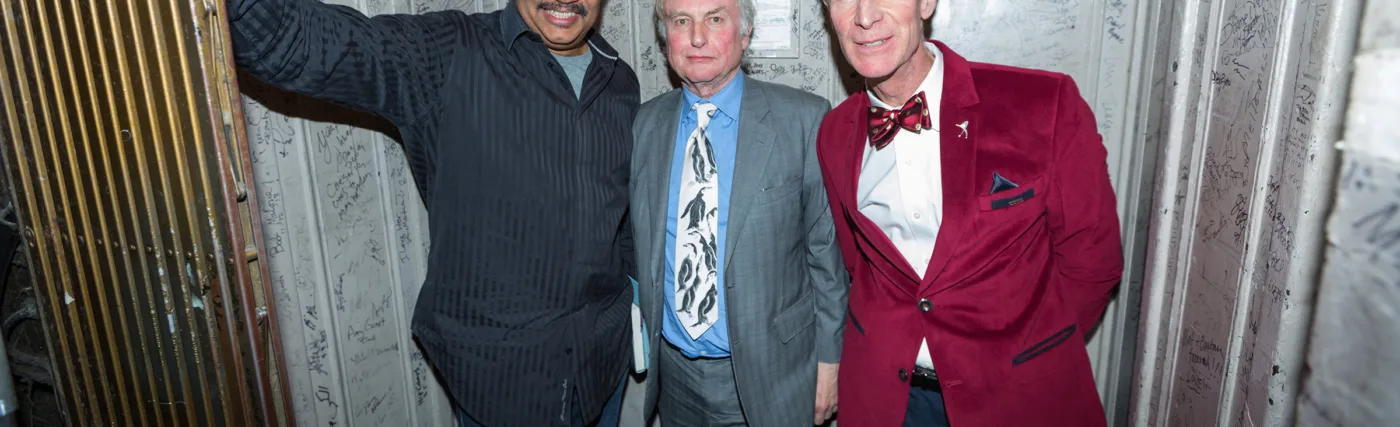
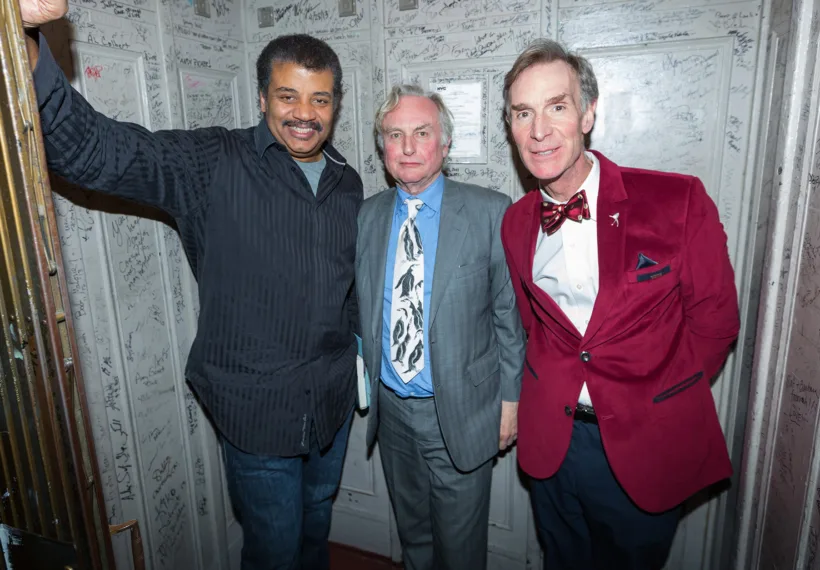
Science and rationality take the stage when Neil deGrasse Tyson welcomes Richard Dawkins and Bill Nye to NYC’s Beacon Theatre to discuss evolution, with help from co-host Eugene Mirman and comics Jim Gaffigan and Maeve Higgins. In Part 1, you’ll discover why evolution and natural selection are hardly random processes. Find out how genes are like computer programs, and why transmission errors are so important. Explore epigenetics, mutations, convergent evolution, speciation, neotony and more. Learn how a characteristic can evolve independently: eyes evolved about 40 times, stingers about 12 times, while echolocation has only evolved 4 times. The group also speculates about alien evolution and life in the universe, and discusses how amino acids, the building blocks of life, have been discovered on asteroids. You’ll even hear how a new species of mosquitoes is evolving before our eyes in the London Underground… and that’s just in Part 1.
Transcript
DOWNLOAD SRT
Welcome to StarTalk, your place in the universe where science and pop culture collide. StarTalk begins right now. It is my incredibly great pleasure to bring out for you the host, director of the Hayden Planetarium, ladies and gentlemen, Neil...
Welcome to StarTalk, your place in the universe where science and pop culture collide.
StarTalk begins right now.
It is my incredibly great pleasure to bring out for you the host, director of the Hayden Planetarium, ladies and gentlemen, Neil deGrasse Tyson!
All right, it is my great pleasure to bring out two comics, the first of which, she is here from Ireland.
She's super funny.
Ladies and gentlemen, Maeve Higgins.
It is also my pleasure to bring out an incredible comedian.
Ladies and gentlemen, Jim Gaffigan.
Eugene, you didn't mention that Jim Gaffigan has an album called Mr.
Universe.
That's right.
So do have a seat.
I want to bring out a friend.
I've known him for about 12 years and he's a tireless defender of how we all got here.
Give a warm New York welcome to Richard Dawkins.
On a note, Richard did arrive with very British-looking leather shoes, but we had access to moon shoes to put on his feet.
More on that later in the show.
So Richard, thank you for donning some moon shoes for us.
And this tonight, we'll be talking about how humans got here, how life got here, all the spectrum of life we find in the biodiversity of the world.
And a good friend of mine has also written a book on that.
And I said, you gotta come join us for the show.
The one, the only, Bill Nye!
So let's get this party started.
Richard, you've had an extraordinary career.
You're retired now.
You were professor of the Public Understanding of Science at Oxford for many years, a post funded by Charles Simone.
He was one of the Microsoft billionaires, if I remember correctly.
But he felt deeply that more people needed to know about science.
And I just want to applaud your tireless effort to try to get the world to think rationally about this world.
And so thank you.
Thank you.
And I suppose with his earnings over the years, he could have bought an island and moved there, but instead he-
That's not true.
A small island then.
He founded the-
A rock.
Richard Dawkins Foundation for Science and Reason, which occupies a lot of his work of late.
So let's get started here.
Evolution, we all learn it in our biology class.
And you've written on evolution eloquently in many books.
My first exposure to you was with The Blind Watchmaker, but that's just one of many books you've written.
So I'm just wondering if you could highlight just for a couple of minutes, just what evolution is.
I know it took Darwin many books to do this, but I know you can do it in two minutes.
It's why we all exist.
It's why all living things exist.
Thank you.
It is an astonishing fact that on this planet, the laws of physics got channeled through this remarkable process, Darwin's evolution by natural selection, to produce objects like us and like kangaroos and like wombats and like oak trees, which are, while never actually disobeying the laws of physics, they do remarkable things.
They walk, they run, they have sex, they think, they swim, they fly.
And they have sex.
They listen to jazz?
And for many centuries, it seemed obvious to everybody that because living things look as though they've been designed, that must mean that they were designed.
And it took till as late as the middle of the 19th century until two geniuses, Charles Darwin and Alfred Wallace, realized what was really going on, which is a purely natural process, an utterly natural process, gave rise to this magnificent complexity, this beauty, and this illusion of design.
It works by very, very slow change from generation to generation.
It depends upon there being, Darwin wouldn't have put it like this, but it depends upon there being something like genes, something where you have information.
He didn't have that vocabulary.
He didn't have that vocabulary.
But we now understand that what happens is that there is highly accurate, high fidelity information, really like a computer language, which is copied from generation to generation and within each generation, programs the development of the body in which it sits.
And therefore, the fate of the program is bound up in the fate of the body in which it sits.
It's driving around in a vehicle, which is you and me and a dog and a rhinoceros.
It's driving around in the vehicle.
Are you going to stop with those examples?
There's no more.
You probably want to leave out my old boss.
I was never sure about him.
It doesn't matter what the vehicle is.
It can fly, it can swim.
All of them are doing the same thing.
They're preserving and propagating the instructions that gave rise to them.
And as the generations go by, the ones that survive to reproduce the genes pass on the instructions for making them.
And so we are, all of us descended, by all of us, I mean every living creature, descended from an unbroken line of successful ancestors.
Millions and billions of animals died without ever reproducing.
Not a single one of your ancestors failed to achieve at least one heterosexual copulation.
Troubling as that sounds.
Because it includes your parents.
And.
And at least one child.
We have the genes of an unbroken succession of successful ancestors.
And it was those genes that made them successful.
And that's why birds are so good at flying, fish are so good at swimming, hedgehogs are so good at whatever hedgehogs do.
Moles are so good at digging, et cetera.
Gambling.
Hedgehogs are famous for their gambling.
So getting back to how we might have all learned evolution in our biology class.
And by the way, Dr.
Tyson, did everybody learn evolution in biology class?
Yeah, yeah, sorry.
You have independent evidence to suggest something different.
We'll get back to that.
So I'm just curious.
We've learned evolution as reproduction, variation in the product and it gets carried on.
We learned to reject Lamarckianism on the assumption that you can't acquire properties that you then pass genetically.
But over the years we've learned more nuances in the simplified idea of Darwinian evolution.
You know, I've heard terms like epigenetics.
There are these terms that involve the modification of the genome after it's already been established that you perhaps could then pass on.
What is going on with Darwin now?
The big change came with the introduction of genetics into the evolutionary story.
Darwin had no concept of genetics.
You guys, just stop and think.
This guy or these two guys came up with this theory that is the basis of life and they didn't know what DNA was.
They had no idea.
Wallace and Darwin, I mean, maybe they had an idea, but they did not have x-ray evidence.
It's really an extraordinary convergence.
I mean, Darwin's ideas of genetics were actually completely wrong.
What he did have was that there's something that is passed on from generation to generation.
With variation.
That's all he needed.
Then Mendel came along at roughly the same time, but Darwin didn't know about it, and showed that genetics was digital.
Again, one wouldn't have called it digital in those days, but you either get a gene or you don't get a gene.
Genes don't blend.
They don't mix.
Every one of your genes came from one of your parents, from one of your four grandparents, from one of your eight great grandparents, et cetera.
They don't blend.
They don't mix.
They just pass unchanged through the generations.
All that changes is the frequencies of them.
Some of them survive.
Some of them don't survive.
And that was the great insight of the 1930s, the neo-Darwinian synthesis of the 1930s.
People like Ronald Fisher, JBS.
Haldane, they changed evolution into a genetic view, whereby what happens is that as the generations go by, some genes become more frequent in the gene pool.
And you could literally think of the gene pool as like a bag of balls being stirred about.
Like a McDonald's playpen.
And Haldane is the guy that said, if there is a God, he must have been...
I'd have an inordinate fondness for beetles.
Because there's a lot of beetles.
A lot of different kinds of beetles.
Haldane also had a nice one.
A lady said in an audience such as this, I simply don't believe that there's been enough time to go from a single-celled ancestor to people like us.
And Haldane said, Madam, you did it yourself.
And it only took you nine months.
Plus a few minutes.
What role does the environment have on our genes?
The main role the environment has is in providing the selection pressure on which genes survive and which don't.
So it doesn't alter the genes that we would pass on?
The genes that we pass on are altered by the environment in the selective sense.
If you're asking, does the environment cause mutation, does the environment cause genes to change?
Yeah.
Well, it does, but not in a very biologically interesting way.
Things like cosmic rays cause genes to change.
That's pretty interesting.
Are you saying the fantastic four is possible?
Richard, let me just add, correct me.
The thing is, species make more copies of themselves than can survive in an environment.
And that's what leads to trouble.
This was the big point Darwin made, that there's overproduction and therefore there's competition.
And a minority of individuals usually are the ones that give rise to the next generation.
And that minority are the minority that have the genes that it takes to be good at it.
It's only a statistical effect.
It's not an absolute thing.
So, but about epigenetics, we did a show on that for Innova Science Now.
It was new to me just a few years ago.
It would not have been new to the biological community.
I'm just curious, when I learn about it and where your genes can actually be altered from what you were born with and then you would then pass them on to a next generation.
Is that true?
Do you guys understand that?
No.
No, I know you don't misunderstand.
This is different from those traveling pants movies, right?
Because I did two of them.
I think, is it like if you're like an Irish girl and you wish you had like olive skin, so you put on fake tan and then your kid has olive skin and then she's like the sexiest one, and then she gets to...
She gets to what?
Is there video?
She gets to do it.
I'm just asking for a friend.
If there's jeans, why do I have so many recessive jeans?
Balding, eyesight, pale sexy skin.
You know, one of the remarkable insights in evolution, and I write about it in my book, is you only have to be good enough...
I'm not just talking about you.
Talking about all of us.
You know, I may be out of shape, but I can still kick his ass.
All of us, you just have to be good enough.
Like, if you were going to design somebody from the top down, you'd probably make some changes, yeah?
I mean, the exhaust pipe and the plumbing, there's some issues.
But in evolution, you just have to be good enough to make it to the next generation.
Yeah, but don't forget, you're competing with others, and so that good enough one, I think, is a bit overdone.
You're competing with hundreds of others, and if you're just good enough, some of you are going to be a bit better.
So why don't I have wings?
And it would definitely make me better.
That's a very good question.
The one thing I do know so far is that I'm the smartest person on this panel.
Right?
I mean, that's pretty obvious.
Yeah, it's the glasses.
But why don't people have wings, considering everyone wants wings?
It's an excellent question, why don't people have wings?
Because they wouldn't be better off with wings.
Wings can get in the way.
A queen ant has wings and she flies and gets mated, and then she digs a hole and starts the nest.
The first thing she does is bite her own wings off.
Because they get in the way, you don't need wings.
Worker ants don't have wings.
Ants only grow wings in order to fly to get mated.
So I wouldn't want ant wings, but what about regular pretty bird wings?
I'll take this one, Richard.
Okay.
So you dig us out of this one.
Yes.
Yeah, I'll save you on this one, Richard.
So I ventured a guess that you-
You're going to take over with I venture a guess.
If you had wings, you would either be dead or have more successful sex.
The latter is sort of one of the reasons I'm curious.
Yeah, so the point is-
I would definitely hide them.
The act of having a feature doesn't always mean you'll be better at reproducing.
Just because it would be fun to fly around.
You're flying around while other people are not flying around having sex.
Their genes get passed on.
Are you guys saying the wings are the thing holding you back from getting laid?
Okay, well, let me answer your question.
If there was a science fiction movie in which a man of our size had wings, bird-sized wings, I'm curious.
He couldn't get off the ground.
We'll call it X-Men.
You've got to be fairy-sized.
Little fairies, they could have wings.
Really?
Fairies.
Wait, why couldn't a person?
Okay, Dawkins believes in fairies, right.
She got you on that.
Well, why couldn't you just have enormous wings that were fairy-sized in proportion?
You would then need enormous chest muscles.
You wouldn't have big enough chest muscles.
How do you explain those Victoria's swimsuit models?
Never tried to explain it.
I just sort of accepted them.
No, but he's talking about if you and a bird and the queen ant are made of roughly the same material, we are constrained by the same laws of physics.
No, no, I understand now why I'd be very different.
You were just joking.
No, no, I could have tiny wings, but they would be ineffective.
That's what I've gained.
But would you be able to...
People will hook up with me still, yeah.
Even a man with tiny wings, it's weird enough.
So Eugene, it's a deep law of physics, actually.
So the bigger you get, the higher is the ratio of your mass to your surface area.
And your surface area is what air goes across in order to give you lift.
So as you get bigger, you require that much more surface area for you to attain lift.
And so for you at your weight...
No, no, sorry.
He means it in general.
We would all have the same difficulty in flying.
At the American Museum of Natural History, we have collections of birds.
Well, before I get to the bird collection, I'm feeling like dinosaur femurs and this sort of thing.
And they're all heavy, long bones of other large creatures.
And then they show me the femur of a penguin, a bird.
Even though it doesn't fly, it felt like it was made of styrofoam.
So the very architecture of birds is lighter than any of the rest of us.
What about pterodactyls?
I don't know.
They're light too.
They're very light?
Bill, also what's cool is go to the Air and Space Museum, Washington DC and you can see the gossamer condor and the gossamer albatross, which they flew across the English Channel.
A guy just like you, pedaling a bicycle.
He was a world class athlete of some sort, but the wings are 80 feet across.
And they're made of super lightweight stuff and that guy was just barely able to do it.
Whereas something like a tiny insect hardly needs any wings at all.
Just more or less floats.
Yeah, so they have much more surface area relative to their body.
That's why those Victoria Swim Seat ladies are so thin.
He's got the one track mind.
He's not alone.
Evolution, people accuse it of being random, but it's not really random.
It's something in the variation pool survives, and that's selected for by the environment.
I get that correct.
It's kind of the opposite of random.
It's opposite of random.
Yeah, the opposite of random.
So in that, we have convergent evolution, which has always intrigued me, where the capacity for sight, eyesight, has independently developed in the tree of life, and yet has enabled different species to see just fine.
That's an extraordinary fact.
It is.
Sight, eyes of one sort or another, have evolved several dozen times independently, and often to exactly the same design.
I mean, the vertebrate eye, which is a camera eye, and the mollusk eyes, especially squid and octopus eyes, are very, very similar indeed.
What do you mean by a camera eye?
With a lens that focuses a real inverted image on a retina, as opposed to a compound eye, say, or a parabolic reflector eye, which some mollusks have.
What kind of people have?
We have a camera eye.
Camera eye.
A camera eye, and then what's the other eye, what's like a compound thing that has that?
Well, a compound eye is a thing that insects have and shrimps have and things, where you have a great big hemisphere and lots of little tubes pointing out all over the hemisphere in different directions.
And so each tube is looking at a different part of the visual field.
It sounds fairly erotic.
I think I have that, I have that.
In so far as there's an image at all, it's not an inverted image because that tube is looking up there, that tube is looking down there.
Whereas in our eyes, that light there is focused on the bottom of my retina and that there is focused on the top of my retina.
So a camera eye has an inverted image.
It's a mildly interesting philosophical question, why we see the world the right way up.
But I think there was some experiments by a man called Stratton who actually wore glasses that turned the world upside down.
And it took him a few months to get used to it.
And then when he took the glasses off, he couldn't see anymore.
Brilliant.
Hence the expression, don't try this at home.
How about this, don't try this while you're driving a cab.
But Neil, you're quite right.
I mean, eyes have evolved independently many, many times, but convergent evolution tends to mean that animals that are not related look very alike because they're doing the same thing.
Things like wood lice and pill millipedes, which look exactly the same.
One's a millipede and one's a crustacean, but they look the same.
Yet they get so offended when you mix them up at parties.
They're all the same to me, I'm sorry.
Well, yeah.
So of course, knowing the genome of these things gives you the identity that would otherwise be confused if you just saw their external, just what they look like.
Yes, I mean, if you saw a dolphin superficially, you might think it was a fish, but actually you don't need the genome to know it's not a fish.
I mean, it bears its young, it supples them and that kind of thing.
So it's quite clear that dolphins are mammals, but they are very convergent on say, tarpons, fast swimming fish in the surface.
So what I wonder, I just back up for a quick second here.
If we say that evolution is anything but random, yet you publish a book called The Blind Watchmaker, what do you expect people to think by reading that title other than the whole thing is random?
Okay, very important difference between blind, as in not foreseeing.
A watchmaker knows what he's making.
He's making a watch, he knows what it's for.
It's for a purpose.
Every cog, every spring, every screw, every rivet is designed for a purpose.
The blind watchmaker, natural selection, has absolutely no foresight at all.
It's not random, but it's not foresightful.
It blindly follows the path of survival.
Whatever that takes.
So he's not trying to end up with a beaver, but he ended up with a beaver, as the example of how a beaver came to be.
Okay, so if I combine these forces, everything you know, this formidable knowledge of life on earth and how it got here and how it speciated, or the forces that drive the speciation.
In my field, we invest a fair amount of our intellectual capital thinking about what aliens might look like.
To the point where we have to actually constrain the question to say we're looking for life as we know it.
Because life as we know it requires liquid water and a certain temperature range and certain conditions.
So then we design our experiments on our space force to kind of hang with that.
So what I wonder is, if we have convergent evolution, might other aliens on other, have limbs and sight?
And can we judge what they might look like based on your body of knowledge of the biology of life?
One of the things you can do is to ask the question of life on this planet, how many times has it evolved?
In the case of eyes, it's about 40 times.
In the case of say, echolocation, the thing bats do when they use echoes to find their way around, that's only evolved four times.
In bats, dolphins, well, with toothed whales and two families of birds.
So I put more money on eyes evolving than on echo ranging evolving.
Stings, hypodermic injection of poison has evolved about 12 times.
I think it's a profoundly interesting question.
I think we should be speculating more about what life would be like.
Nevermind about eyes.
I mean, would it have to be based on carbon?
I suspect it would.
I think only carbon has the necessary.
I have like very big eyes and a tiny mouth and I used to get bullied that I looked like an alien.
And my comeback was, but there's no such thing, no offense.
But I was like, there's no such thing, you know, like how do you know?
And they were like the X-Files, you know.
So they cited as evidence for why you look like an alien, the aliens they've seen on fictional television shows.
Let's stop saying they, it was me, all right?
I was trying to pick her up, it didn't work.
Why do so many aliens in movies look like seafood?
Yeah, that's actually not a bad question.
The aliens also have bigger heads compared with their bodies.
They have baby proportions.
So we're trying to get this esteemed man to comment on the thought process of Hollywood.
Yeah.
I don't know if this is not what you said.
I want to know what you picture if you do think of an alien.
I wouldn't.
Could we say that most living things on earth are in the ocean?
So if you're going to create an alien, maybe you start with the ocean.
I would rather say things like, does there have to be something equivalent of DNA?
And I think that there does.
And information encoding.
Information encoding, which has to be very high fidelity.
It's got to be extremely accurate.
So I would bet that it won't be DNA itself.
That would be too improbable.
And if it was DNA, it certainly wouldn't have the same DNA code, which is highly improbable.
But there would be something like DNA.
It might not even be a one-dimensional code, which is what DNA is.
It might be a two-dimensional matrix.
What would it mean for it to be two-dimensional?
Sure.
But what would it mean for then the creature that had two-dimensional DNA?
That might not matter.
I mean, that would all be going on in miniature.
Yes.
Could you tell me, I've seen this word neotony.
What is that?
Oh, right.
That's when juvenile characters are retained into reproductive adulthood.
The classic example is the axolotl, which is a salamander, except that it's not a salamander, it's a tadpole.
So it's an adult and it reproduces in the tadpole form.
And Julian Huxley did a brilliant experiment.
He took some axolotls and injected them with thyroxine.
And he turned them into salamanders, which had never been seen before.
This sounds diabolical.
Yes.
And by the way, how much do you need, like an injection every day, every once?
I can't remember.
But what's interesting is that his brother Aldous Huxley...
He did the same thing, turned him into a salamander?
One shot in the neck.
It had been already recognized that we humans are a neotenous species.
We're juvenile apes.
We're apes that have retained juvenile characters into adulthood.
If you look at a juvenile chimpanzee, it looks much more human than an adult.
So Aldous Huxley speculated that if you could somehow prolong human life, and he had a fictional character, the duke of somebody or other, who lived to be 300 years old and turned into a gorilla, because that was the analogue of his brother Julian's experiment with injecting axolotls with thyroxine.
This is what your professional ancestors have been thinking about.
Neotony, by the way, has the word neo in it, which means new.
So it's like the new thing stays new.
The baby stays new.
Neo.
So Richard, let me ask you, evolution is an understanding of how life speciates and how we can grow or reduce in complexity depending on the needs of the survival of the organism.
But at some point, we must presume we went from non-life to life.
So does evolution say anything about that or any of your professional community?
Where do you go there?
We know the key step that had to be taken, which was the origin of what you could call the first gene.
It wouldn't have been DNA, but it would have been something self-replicating.
There's got to be accurate copying.
So there had to be some kind of a chemical accident which produced the first self-copying molecule.
And it had to be self-copying in an interesting way that was possible for there to be mistakes which were also copied, and therefore competition between the different types.
Slightly different.
Slightly different.
Let me ask you, how analogous is this primordial copying to crystals, crystal and growth?
Crystals are a pretty good model for it.
In fact, Graham Cairns-Smith had an actual theory of the origin of life that it started with inorganic crystals and flaws in the crystal, because the crystal grows by atoms joining on to existing atoms on the crystal.
And if you get a flaw in the crystal, then it's replicated throughout the rest of the growth of that part of the crystal.
In the Andromeda strain, the bug that came from space was crystalline.
That's right.
Correctly.
Well, it was able to keep its chemicals separate, which for us it still does.
In a way, DNA is a crystal because it makes copies of itself.
It's behaving in that way.
It's behaving, but it's an information-rich crystal.
That had to be the first step.
It could have been a very, very improbable step.
It could have been so unlikely that it only happened once in the universe.
That's not impossible.
That's so troubling.
No, it's not.
It really isn't.
Since we don't know what's in the rest of the universe, if it did only happen once, if there is only one planet in the universe where this singular event happened, then it has to be this planet.
That's brilliant.
No, but I hope it makes you feel special.
Well, I don't believe that, but it is an interesting thought.
Here's my argument against that.
If going from non-life to life was so hard, it wouldn't have taken just a few couple of hundred million years on earth for that to have happened.
Here's the timeline of earth, and at the beginning of earth, we were heavily bombarded by leftovers in the solar system, so it's not fair to start the clock there, let the surface cool a little bit so that complex molecules have some chance of forming.
So you subtract all half a billion years.
That's about how long our models show that we've been bombarded.
And in two or three hundred million years, life appeared.
That's a very good argument, and that's one of the reasons why I don't believe what I've just said.
It's an interesting thought.
We can't rule out that possibility because anthropically, we have to be on the one planet.
And what that would mean, if anybody out there wants to believe that we are alone in the universe, what that means is that the origin of life on this planet was a stupefyingly improbable event and therefore we're wasting our time speculating about it because we're not looking for a plausible theory.
We're looking for a highly implausible theory, which is another of the reasons why I don't actually believe that.
But there are people who do believe that we are unique in the universe.
They want to believe it and they do believe we're unique in the universe.
All I'm saying is that it follows from that that the origin of life is so improbable that chemists are wasting their time trying to speculate about how it happened.
Because in science, we look for generalized ways that things happen.
And if you can generalize how life formed, but it only happened once in the whole universe, you're barking up the wrong tree.
Well, I think that said, let us keep in mind, we landed Philly on asteroid CP67 and asteroids here on Earth show up loaded with amino acids.
Wonderful.
This is one of the great things, the famous Miller-Urey experiment where he managed to go to get life-like molecules in his complex organic complex.
It wasn't necessary.
They're turning up all the time in asteroids.
And so the raw materials for making life are all over the universe.
I mean, that's a very, very encouraging, encouraging.
The building blocks of life are all over in asteroids?
Yes.
Oh, yeah.
Great.
I didn't know.
Thank you.
So Earth is being spoon fed these ingredients.
Yes.
All the time.
It just means that we are made of some of the most common ingredients in the universe.
Another argument in favor of whatever we became, why think it wouldn't happen that way elsewhere?
I did this, man, if you guys heard about this, I did this debate in Kentucky.
And on their website, they point out that in the Uri Miller experiment, they only got 0:001% amino acids or something, if I may, just a minute, that you got any complex molecules is infinitely more than zero.
And so get your head in the game.
For crying out loud, if you add four and a half billion years, some stuff can go down.
That's all I'm saying.
But that fundamental, that inability to grasp, sort of that enormous idea of like, dude, dude.
So Richard, what's your favorite Hollywood alien?
I don't have one, but I can tell you what my wife's lala says when she's asked as a Doctor Who girl.
Wait, wait, your wife is a Whovian?
She played Doctor Who's glamorous companion.
I didn't, why do I know this?
I don't know, but...
Wait, wait, wait, you are by marriage related to not just Whovian fans, but people who are actually in Doctor Who?
Yes.
She was the companion to one of the Doctor Who's, who was Tom Baker, and whom she actually actually briefly married.
Let's dig into this.
Does her current husband know about this?
The question that Neil has just posed to me is my favorite science fiction alien.
She goes to Doctor Who conventions, and the commonest question she gets is, what's your favorite Doctor Who monster?
Because they have monsters, and her answer always is Tom Baker.
A little bit about our special guests.
Sneakers are actually manufactured by General Electric, as bizarre as that sounds.
General Electric actually did research back in the 60s and produce rubber and plastic products that the Apollo astronauts took to the moon that could survive very high temperature ranges and still retain their flexibility and their integrity.
And since we're not going to the moon anymore, what else might they have done with this?
And they decide they just make sneakers.
And so these are basically moon shoes that were donned by our esteemed guests.
So I'm just sad that rather than say, oh, our latest astronauts reported back from Mars, I don't get to say that.
I get to say we're wearing shoes made of extra ingredients invented in the 60s.
Dr.
Tyson, you're wearing leather shoes.
That goes back somewhat more than 50 years.
Yeah, I'm just saying that cows never went to the moon.
All right, so in spite of the fairy tale, that material went to the moon.
Cows can't have dreams and goals.
Maybe that's what they're saying the whole time.
Moon.
I'm actually blushing, I'm blushing, I'm full of fire.
I will never hear a cow the same again.
So, I want to talk about human evolution, because we care about humans.
But if we took how we got to humans, and so we went from non-life to life in some way that is not yet fully understood, but the plausibility is there, then we went from single-cell to multi-celled life.
That was a big gap in time, from the time we had single-celled ancestors, right?
So that must have been hard.
It sounds like it was easier to go from non-life to life than from single-celled life to multi-celled life, because we spent more time as single-celled ancestors than we did as not-life at all.
I'm not sure about that, I mean.
I am sure about it.
Multicellular life is another of those things that's evolved convergently.
I mean, there are multicellular bacteria, and there are several different kinds of multicellular protozoa.
A lot of years went by between the first life and the Cambrian explosion of life, where you have...
Cambrian explosion isn't the only multi-cellular organism.
Yeah, but isn't that when you first got sight and limbs and locomotion?
Well, but that's different from multicellular.
And they had hard shells.
That's why we're able to, that's part of why we're able to find them.
I mean, nobody really knows why the Cambrian explosion happened.
There are lots of ideas.
And you guys, the explosion took 220 million years.
My uncle was a geologist.
He worked for DuPont Diamond.
He blew stuff up all day.
It's a lot quicker than 220 million years.
Wrong adjective, I guess.
Okay, so...
Well, but I mean, the usual explosion and everybody's charmed by it, but I just like to remind people it was a long old thing.
The Cambrian explosion is overrated as well.
So you're quite right.
Overrated!
Fill that to the trial of bites.
So, let's get on to humans here.
We astrophysicists conveniently sent an asteroid this way to get rid of T-Rex, so that our mammalian ancestors wouldn't have to keep running underfoot, avoiding being odors.
Then we have primates.
There's a branch of the Tree of Life that we call primates, I guess.
Is that correct?
And we are in that branch with our primate relatives.
Is that a fair characterization?
So the fossil record shows that we have very close ancestors that we called Neanderthal.
Was it not ancestors?
Oh, sorry, sorry.
Cousins, cousins.
Yeah.
But there are no Neanderthal today.
No.
So did our ancestors eat them or cross breed with them?
Or is there any reason why they're not here and we're here?
We did cross breed with them.
There's genetic evidence and modern genetics is very good now at reconstructing history in fascinating ways.
And it's clear that a significant, not a large, but a significant proportion of the genome of Europeans, not Africans, but Europeans, has some Neanderthal admixture.
Yeah.
When I was in high school, definitely, there was this one guy.
You felt the Neanderthal?
Yeah, I think he definitely was a Neanderthal.
Wait, so who was cross breeding with the Neanderthal?
The homo sapiens who were around at the time.
Do we have a word for them?
They're sometimes called-
Party animal.
Just call them sapiens.
Same, just like us.
Yeah, they were just like us, yeah.
Okay, so we cross bred, did we breed them out of existence?
No, I think they died out and possibly we killed them or outcompeted them, but there was a certain amount of cross breeding.
Okay, and that's evidenced in the genome sequence.
Exactly, that's the only evidence.
Richard, let me ask you this.
So compared the size of the brain of a Neanderthal with his over or her overall body weight, compared with our size of brain and our overall body weight.
Slightly larger.
Who's slightly larger?
Neanderthal.
They had more brain for their body than we do.
Yes.
Yet we kicked their empanages.
Well, brain size is very variable anyway.
All our brains are different sizes and it doesn't correlate well with ability.
Okay, what leaves me curious is that we would interbreed with Neanderthal when I'm thinking they might have just been all rounded up and killed.
I mean, we'd do that with our own species.
Surely we would do that with a competing species.
Sounds highly plausible, yes.
I mean, I hate to say that, but why would we treat another species competing with us better than we treat each other competing with us?
Quite.
We definitely treated Neanderthals not great, right?
Because they're all dead.
They're gods.
And we might have first had sex with them and you're wondering why.
Maybe we had sex with them and then we killed them.
Yeah.
That's probably what happened.
I hope we didn't have sex with them and killed them at the same time.
I mean, nobody knows.
The early man was not polite.
Well, let me ask you this.
Is it possible disease took them out?
Yes, nobody knows.
We're speculating in a vacuum here.
We don't know.
Oh, so they could have just had a cold, all of them, which at the time might have been terrible.
Most species that have ever existed have gone extinct.
And it's not an unusual thing.
So it's not necessarily our fault.
No.
Don't feel bad about that.
In any case, Neanderthal and we have a common ancestor at some point in the primate tree.
Yes.
Okay, and that's true for us and any other primate.
And any other animal or plant or bacterium.
Okay, and so I once had this conversation with you that I want to like recreate here.
All humans are fertile with one another generally.
Okay, unless you have some deformity.
So we can reproduce with anyone who has ever been human.
But at some point there's a branching of the tree where some other branch of primates went into another direction.
Let's say the chimpanzees.
So we can't mate with chimpanzees, but both we and chimpanzees ought to be able to mate with the species that is at the vertex of that split.
Is that correct?
Yes, it might not be that far back, but what you could certainly say is that there exists an extinct animal that we could mate with, which could mate with that one, which could mate with that one, which could mate with the vertex, which could mate with that one, which could mate with that one.
I once illustrated this with a thought experiment.
You would do one of these human chains and you hold the hand of your mother, who holds the hand of her mother, who holds the hand of her mother.
And as you pass along the line of this enormously long line of creatures holding each other's hand, you eventually come to the common ancestor with chimpanzees and who stands there with holding in one hand her descendant who becomes human.
In holding in her other hand, her descendant who becomes chimpanzee.
And then you go all the way down the chimpanzees.
There is a continuous line connecting us to chimpanzees up towards the vertex and then back down again.
And if you walked along the line, at no point would you be able to say, this individual is of a different species from that.
They're all of exactly the same species as the next one in the chain.
Every creature ever born is a member of the same species as its parents and its children.
But yet if you have a sufficiently large number of generations, you then come to a point where you can no longer interbreed.
It wouldn't be a sudden change, would be a gradual loss of fertility.
Okay, so the woman at the vertex, she could then go back and extend her hand backwards.
Yeah.
And then you could go back to rodents.
And to jellyfish.
Jellyfish.
Oak trees.
Yes.
Because I was thinking it sounded like a really awkward threesome, but when you put it that way, it sounds totally fine.
It is actually, it's a very arresting thought, but it's more or less inescapable.
Okay.
The Human Genome Project.
Yeah.
That's, I guess, is it completed?
Yes, yeah.
Okay, so in there is Neanderthal.
Is chimpanzee.
In there ought to be that which we still have in common with other life forms on Earth, correct?
Exactly, yes.
Okay, so what's to stop you or your peeps from just going in there, just creating Neanderthal in the lab and have them walk out the back door?
Well, actually Neanderthal is a particular case because the genome is now being worked on by Svante Parbo and his colleagues and they will get the Neanderthal genome.
And so it would be possible to make, clone one.
Could we create a Neanderthal in a lab?
Yes, probably.
Why haven't we?
We have the genome and I'm conjecturing with reasonable confidence that the embryological technology will exist before this century is out, when you would recreate it.
Oh, wow.
And would people do it just for curiosity?
A lot of people would think it was highly unethical to do it.
I don't really see that myself.
I mean, it's an interesting question.
Can I ask you about this idea?
This idea that your model, and I love your model, like from the ancestor's tale kind of thing, where one person's holding this hand, the threesome.
But in the case, I'm fascinated by the mosquitoes in the London underground.
Yes, yeah.
So this is where a new species is becoming right before our eyes.
And I say becoming because there's, I'm asking you to speak to this, there's a spectrum, right?
Like certain of them can mate with the ones upstairs and certain of them cannot.
The London Underground Tube Railway is a peculiar ecology for mosquitoes.
There are plenty of puddles of water and things down there.
They can breed.
And so they are breeding a separate species of mosquito before our very eyes.
They never come out and cross-breed with other.
Well, I don't know that.
They don't have the card.
You have to have the card to exit.
The London Underground has only been in existence since the 19th century.
And so it's a fast process.
So this process, my understanding, was accelerated by World War II, where humans went underground.
They went underground to use them as air raid shelters.
That's right, yes.
And so the mosquitoes who lived down there had their food come walk down to them every night.
Why bother going upstairs?
Why get a MetroCard?
Yeah.
Just stay here, light a cigarette, and just wait for the humans.
What are the differences between those mosquitoes and regular ones?
I can't remember what the difference is.
Well, they just can't breed, or most of them can't breed.
There are probably anatomical differences as well.
I can't remember.
I've often wondered if they're not better at hunting in the dark and so on.
Something like that.
But in other words, we've seen it in a human lifetime, a new species of insect come into being.
So you make predictions with theories, and here it happens.
So we're gonna end segment one.
We are live at the Beacon Theater, New York City.
See the full transcript



 Unlock with Patreon




 Become a Patron