


 Unlock with Patreon
About This Episode
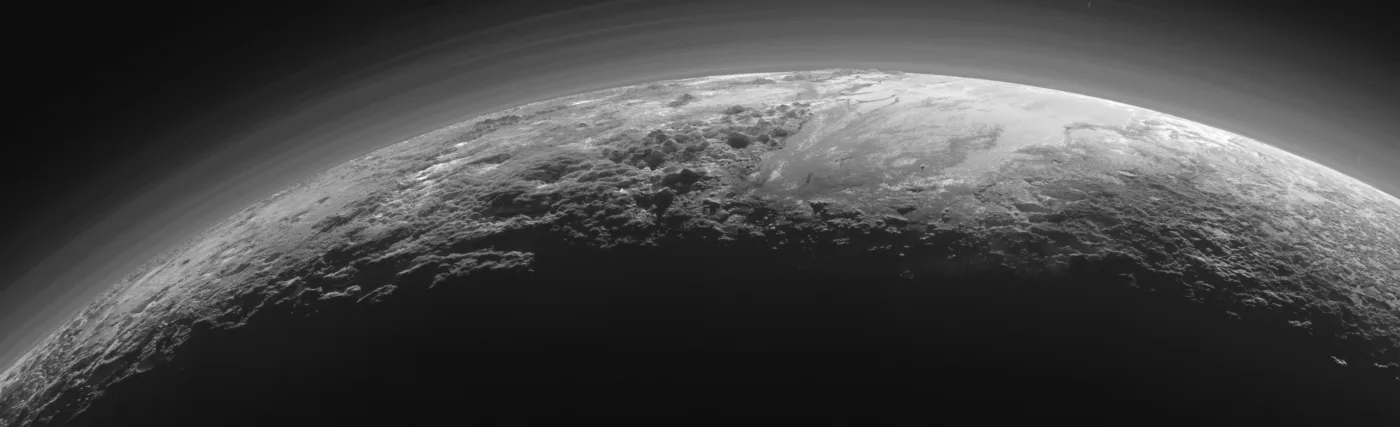
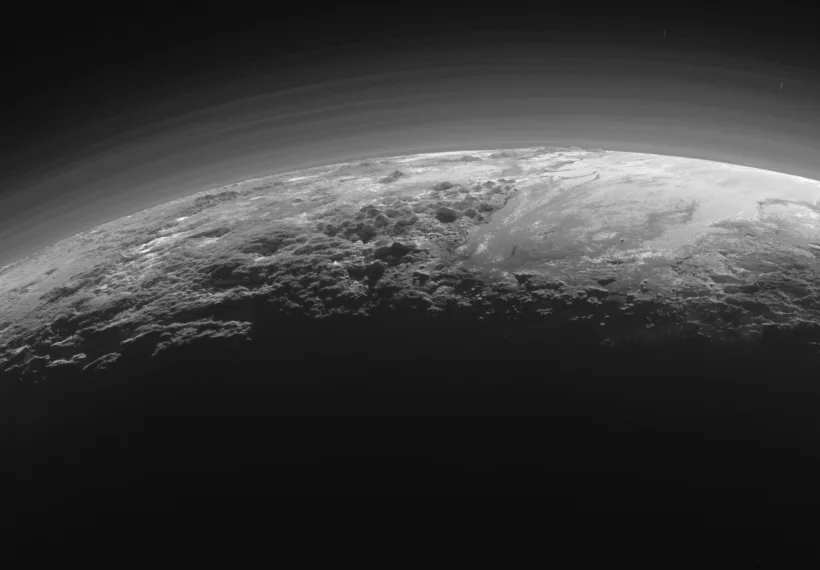
Our show from NYC’s Beacon Theatre concludes with everything you ever wanted to know, or never thought you could know, about Pluto, the “King of the Kuiper Belt.” The evening’s main event is the debate between host Neil deGrasse Tyson and guest cosmochemist Dr. Natalie Starkey about whether Pluto is a planet or not, including a discussion of whether the definition of “planet” even makes sense anymore. The debate is judged by our comedians: co-host Eugene Mirman, Ilana Glazer and Scott Adsit. But before the gang can tackle Pluto, they’ve got to get there first, and Neil and Natalie review the New Horizons mission. Find out why New Horizons almost didn’t get off the ground, and how the fastest spaceship ever launched was able to pass the Moon in just 9 hours and travel 3 billion miles in just 9 years. As impressive as that is, it’s not as incredible as the unexpected discoveries New Horizons made once it reached Pluto, including the fact that the icy body appears to be geologically active. You’ll also hear about Pluto’s moon Charon, its fellow dwarf planet Ceres, volcanoes on Jupiter’s moon Io and the potential for life on Europa. Finally, as a special treat, singer/songwriter Christine Lavin takes the stage to sing her song “Planet X.” Recorded live on 9/21/15 as part of the Eugene Mirman Comedy Festival.
NOTE: All-Access subscribers can listen to this entire episode commercial-free here: StarTalk Live! at the Beacon (Part 2): King of the Kuiper Belt.
Transcript
DOWNLOAD SRTWelcome to StarTalk, your place in the universe where science and pop culture collide.
StarTalk begins right now.
I’m your host, Neil deGrasse Tyson, your personal astrophysicist, and we’ve got with us Scott Adsit, who is a comedian and performer and all-around good guy, and Natalie Starkey, visiting from the Open University in the UK, expert on comics, welcome.
Eugene, introduce.
Ilana Glazer from Broad City.
And Eugene Merman, just so you know, this StarTalk Live concept was birthed as a part of Eugene Merman’s comedy festival, and it’s called Eugene Merman’s Comedy Festival.
It’s an honor to be a part of your celebrations with Showcase’s Comedians, and as we continue to do even for StarTalk on this.
So thanks, Eugene, for that.
So, ladies and gentlemen, we will be discussing Pluto in its entirety.
Everything you ever wanted to know or never thought you could know about Pluto.
All right, so, Natalie, what can you tell us about the New Horizons mission to Pluto?
That was launched in 2006, and so it took ten years to get to Pluto.
And all designed for Pluto.
That was its target.
Exactly, but it wasn’t actually an easy mission, because it didn’t have a lot of support initially, so there was a bit of a mission in itself to get it launched.
You’re looking like it was my fault or something that Pluto was tiny.
I won’t blame you.
But yeah, there wasn’t support, and basically a bunch of astronomers got together and thought, right, hold on, we need to go to this planet, because it so happened it was in a position in space where it was kind of easy to get to within a certain time frame.
And this was because Jupiter happened to be in alignment, meaning that basically the journey was 50% shorter than it could have been if we waited a bit longer.
Shorter in time?
Yeah, shorter in distance.
In time, yeah.
Why is it shorter in time?
Because they used Jupiter as we mentioned.
A slingshot?
Yeah, we had two slingshots, exactly.
And Jupiter is really big.
The sun is the best, I know from Star Trek IV.
But I understand…
We saved the whales…
We saved the whales, Star Trek, okay.
So, did we slingshot Jupiter?
Yeah, we did.
And we actually got a really good view of one of Jupiter’s moons called Io.
Because although the spacecraft was in hibernation for a lot of this journey, because they needed to save the power, they woke it up for this encounter with Jupiter’s moon and got some beautiful images of a volcano erupting in space.
Which is pretty cool.
Io, just from reading about, it’s the most volcanically active place in the solar system.
It kept warm from hot, from the stresses of Jupiter’s gravity.
Exactly.
So, it’s pretty much true, no matter when you swing by, there would be something erupting, pretty much.
Maybe, but I guess, yeah, we don’t really know.
We need to go and look at it more.
So, there’s volcanoes on a moon of Jupiter that are constantly erupting, is that accurate?
Yeah.
And it’s molten and all that.
That’s not even the coolest volcanoes, though.
There are other moons that have ice volcanoes.
Really?
Yeah, where it’s erupting, like, cold things instead.
Because it’s just a matter of pressure.
And ice, like the regular ice, not the super heavy?
No, other things that are ice at much colder temperatures.
It’s not water?
No, not water ice.
No, no.
So, all that matters is that at the temperature, something is boiling hot.
So, there are things that are boiling hot at much cooler temperatures.
If you look at liquid nitrogen, it is boiling hot.
But I interrupt, go on.
So, we swing by IO and get some good data, close down again and keep going?
Yep, and keep going.
That’s sneaky.
And, you know, it was kind of quiet, this mission.
I think a lot of people didn’t really know it was happening and what they were aiming for, because it’s hard to get the public excitement over nine years.
So, it often kind of all happens at the end, as it did with Rosetta as well.
And then, you know, I kind of, I wasn’t personally expecting it to be as good as it was when it finally got to Pluto.
And then, I thought, oh, they’ll just get a few grainy images, you know, a few pixelated images of this little round blob in space.
And we’re not going to learn anything new.
Well, that was completely wrong.
I mean, the images are still flooding back.
It’s going to take them a huge amount of time to download all the data, because we’ve got a very slow connection.
You wouldn’t want that kind of internet connection normally.
It’s going to take a while to get these images.
But what we’ve got coming back already is, it’s just absolutely amazing.
Now, this is the fastest spaceship ever launched.
Yeah.
Yeah.
And so, for good reason, that’s on purpose.
It’s not by accident, because Pluto is far.
And as I’ve said many times on this stage, in any scientific experiment, the number one rule is that you want the experiment to be finished before you die.
So they strip the spacecraft of as much of its mass as possible and put the fattest boosters they possibly could.
So you have high thrust, low mass, gives you high acceleration, Isaac Newton, second law.
Because you know, Newton’s my man, you know that.
So I’m told it got to the orbit of the moon in nine hours.
Whereas it took the astronauts three days.
Right, so this is booking out of the…
How fast is it going?
36,000 miles per hour.
36,000 miles per hour.
Left our atmosphere 36,000 miles per hour.
Escape velocity for Earth is 25,000 miles per hour.
So this was going at about 12, 13 miles per second.
From Earth, per second.
From launch?
Yes.
So it was gone before they could see where it went.
But we kind of know where it’s going.
It’s not like we track it.
Put a flag on it, something like that?
Yeah, we got this.
You pointed it before you turned it on.
Yeah, we got this one, Scott.
We got this one.
How does it launch?
How does it launch that fast?
It’s got very strong boosters on a very low mass craft.
Now, here’s an interesting fact, I think.
Back when we launched the Saturn V rocket and the astronauts to the moon, that is a massive thrust, but the rocket is very heavy.
So it took a long time for the rocket to clear the tower.
So it looked like a very slow launch.
The space shuttle had much less mass for its rocket thrust.
So, yeah, so the acceleration is high.
It gets to high speed very quickly because it’s going a very long distance.
From what you say, it exceeded our expectations in every way.
Yeah, probably not the scientists that designed it, but I’ve been really impressed.
I just think we got some amazing images from Rosetta, and we’ve learned so much about the comet just from getting images.
It’s amazing as a geologist what we’ll do with a picture of a rock.
I won’t go there, but we can learn so much.
But with Pluto, we can learn what is going on on its surface.
So we’re not going to be analyzing it directly.
We don’t have a piece of it.
That’s annoying, but we can learn a lot about what it looks like by comparing what it looks like to what we see on Earth and other planets that we understand very well and then try and work out how it formed.
And so, of course, Pluto has its large moon, Charon, and I think this also can be pronounced Karen.
So that’s a huge moon.
In fact, it is so large compared with Pluto.
I don’t know if you knew this.
So we’re Earth and we have our moon, and the moon doesn’t go around Earth.
Earth and the moon go around our common center of gravity.
But that center of gravity is like within the Earth.
So the Earth is kind of jiggling like that as our moon goes around us.
Fine.
Pluto’s moon, Charon, is so large compared to it that the center mass is outside of Pluto.
That’s embarrassing.
If your moon pulls you…
Is its moon bigger than Pluto?
No, no.
Pluto…
Charon is about half the size of Pluto, half the diameter of Pluto.
How big is Charon?
I don’t know, a thousand miles across?
Something like that?
Yeah, because I think Pluto is around 2,000.
So, I noticed that the terrain, from the images I saw, was not simply a victim of space impacts, which is what I expected it to be.
It looked like it had interesting geologic or plutologic features unto itself.
And you, with geologic roots, what do you say about this?
Does that mean Pluto had plate tectonics or build mountains?
Did it have a heat source that could make that happen?
Well, the answer is we don’t know for sure.
And that’s annoying, but scientists are still looking at all the data that’s coming out.
But the hypothesis was that this thing had just sat in the outer solar system, maybe being bombarded by the odd comet and some impacts had happened.
And so we would see the result of that, like we do on our moon, on the surface of Pluto, we’d see lots of craters.
But now we look at it, well, we would describe it as a geologically young surface, like the Earth, basically.
We have plate tectonics on Earth that renews our surface.
Now on Pluto…
You say geologically young, it’s not how old the planet is, it’s how old the surface is.
Yeah, when that formed.
And so we’re saying that some of the features on Pluto look like they formed, you know, within millions of years ago rather than billions of years ago.
So I know millions is still a huge amount of time, but it’s not billions.
That means it’s got some kind of energy source within it generating these features.
Yeah.
We’re trying to understand the structure at the moment.
We think maybe it’s got a rocky inner portion.
It maybe has a liquid kind of outer shell to it and then surrounded by an ice crust, essentially.
This would be a water ice crust because ice floats on water.
So you could have a solid surface sitting on top of a liquid next layer, right?
Yeah.
And we think the moon, Sharon, could be the same.
But we’re still trying to understand because of the mass of the planet, what we predict the mass to be and the size of it.
We can then use that to work out the density of that object.
So working on the known densities from these parameters, we can start to predict what is inside that planet.
So, if I understand correctly, you are a Pluto-phile.
Yeah, why not?
I just want to get a sense of, because you all know my situation with Pluto, I think.
If not, how did you even get in here?
Where did you come from?
Because Pluto and I have issues that go way back.
But if I could just get a show of hands or just some noise, who here is still a little disturbed that Pluto got demoted to dwarf planet status?
Now, how many of you understand the data on this situation?
Because I’ve found people closer to Pluto have sort of deeper sentiment for it.
And we could argue that they know more about it than I do, and therefore, they’re more right.
But I just thought we might explore this more deeply.
We might actually have sort of a debate in front of you on this.
And maybe we can have the three comedians be the judge of…
Can you guys know how to judge something?
Oh, yeah.
Yeah, yeah.
I look forward to telling all of you whether it’s a planet or not.
So, Natalie, you want to give it your best shot?
And I’ll sit back and I will stay silent the whole time.
It’s a debate.
So, you’re arguing for Pluto’s planethood.
Yeah.
And you’re in front of…
These are my people out here.
You want to…
I’m more worried that I’m debating it with you, but anyway.
Go ahead.
Well, I think my first reason for Pluto being a planet is maybe a little bit silly, but my mnemonic fails seriously for naming the order of the planets, which I rely on still.
So, my very easy method just speeds up naming planets.
It doesn’t really work if we don’t have Pluto.
So, I think across every single language, they’re going to have a mnemonic, and what are we going to do?
We’ve got to think of a new one.
That’s pretty bad.
Not a disaster.
Not a disaster.
And just to be clear, pizza is a pretty popular food in the United States, especially New York, especially New York City, especially Manhattan.
So, our mnemonic, the P stood for pizza.
My very educated mother just served us nine pizzas.
Still doesn’t work, though, does it, if you lose Pluto?
Yeah, yeah.
If you lose Pluto, you’ve got to fix the mnemonic.
So, that’s a problem.
You’d have to change it to, my mother just served us nothing.
That works.
By the way, I don’t mean to interrupt, but yes, I do mean to interrupt.
In my Pluto book, I had like five pages of new mnemonics to help you through that transition.
My very educated mother just served us nachos.
Okay.
We’ll move on, because I don’t think you can argue with the fact that Pluto appears to be geologically active.
Now, it’s like a planet, right?
We don’t get geologically active comments that we know of.
We see the comet we went to with Rosetta has processes happening on its surface related to what happens when it goes close to the sun.
But it’s not the reason on Pluto.
Some of it is, but there’s some internal force happening.
It’s acting like a planet.
And it’s also pretty large.
We can’t deny the fact that, okay, we found some larger objects out there, but it’s kind of been there all the time.
It’s the little cute Pluto.
I don’t want to lose it.
It’s just special.
And then finally, I think my final reason…
Those are your two lead arguments, and now it’s finally…
You’re going to like…
Go on.
One final thing is that you’re saying it’s a comet.
Well, it doesn’t behave like a comet.
Now the word comet comes from the Greek for long head, because this tail of comet is like a long hair flowing in the wind.
When Pluto goes via the sun, it doesn’t have a tail.
It’s not a comet, and this is how we define them.
Well, I guess, Neil, you can say your piece and then we can have questions.
Okay.
So I take my cues from history.
I do a fair amount of reading of where our understanding of the universe and our place within it pivoted based on new information.
In the year 1800, or was it 1801, we discovered a new planet orbiting between Mars and Jupiter.
Everyone was excited.
It made it into the books.
We even had a Latin name for it, as was the name of the other planets.
We named it Ceres, C-E-R-E-S, for the goddess of harvest.
And Ceres is the root for the word cereal.
Everyone was excited.
The books counted an extra planet now discovered between Mars and Jupiter.
And then we kept looking and then we found like another planet there and then another and then another.
Four planets were discovered relatively quickly.
Ceres, and we named them Ceres, Pallas, Juno, Vesta, all of these.
Everyone was excited.
So for a while there we had Mercury, Venus, Earth, Mars, Ceres, Pallas, Juno, Vesta, Jupiter, Saturn, Uranus.
We had like 12 planets.
I have textbooks from the 1800s that enumerate these and everyone is celebrating.
But then they kept looking and they found even more and more.
Now there’s 30, now there’s 50.
And what people realized was that these objects, which were so small, you could not see their size through a telescope.
They were pinpoints of light appearing just the way a star would, a pinpoint of light, they were star-like, asteroid.
And what came out of this exercise was that instead of having discovered four planets, what actually happened is that we discovered a new swath of real estate in the solar system, the asteroid belt.
And now we’re upwards in hundreds of thousands of these objects.
And, of course, upon recognizing that the solar system gained a new place, no one got upset by the demotion of these four objects because we didn’t lose four freshly discovered planets.
We gained an entire deeper and new understanding of the structure of our solar system.
And so it was.
Time would move on until 1930.
We discover, though it was motivated by the search for Planet X, some perturbing unseen force of gravity on the orbit of Neptune, it was not where you would have expected Planet X to be and Planet X would later evaporate in the dustbin of errors in scientific measurements.
That’s why you don’t hear about Planet X anymore.
But 1930, Clyde Timeout discovers what everyone wants to be that Planet X, the ninth planet.
Everyone is excited.
The New York Times reports that day, the supposed size of Pluto, the size of the Earth.
Well, if it’s the size of the Earth, it’s got to be a planet.
How could it be anything else?
What they didn’t tell you is that there was not a measurement.
It was an assumption.
It would take 45 years before our measurements of Pluto would become precise enough to learn that it is a fraction the size of our moon.
Not only that, well, that was the 1970s, add another 20 years, right, when we are designing what would become the Rose Center for Earth and Space, we’re about to cut metal.
We want to make exhibits that are future proof.
And we ask, what’s up with Pluto?
And we look around and we find that new objects had just been discovered in the outer solar system.
Icy like Pluto, weird orbits like Pluto.
And we said to ourselves, perhaps Pluto is not the ninth planet.
Perhaps Pluto was the first object discovered of a new swath of real estate, which today we have come to name the Kuiper Belt of icy bodies.
Yes, I called Pluto a comet.
That was just, I was being a little mean there.
But it is nonetheless an icy.
Mean or wrong?
It was nonetheless an icy body, 70% made of ice.
If Pluto were, if you put Pluto where Earth is right now, subject to the heat from the sun, it would in fact grow a tail.
Just as other planets do when they near the sun.
Did you just say other planets?
Other comets.
So, if we were Jupiterians, and looked around and said, how many planets are in the solar system?
We would say four.
Jupiter, Saturn, Uranus and Neptune, and everything else would be vagabonds.
Especially since Jupiter has weather systems that are larger than the entire planet Earth.
So, I’m not even gonna, size is not an issue to me here.
Otherwise, we gotta start demoting Earth.
So, what is an issue is that the IAU came up with three criteria for planet status.
One, is it massive enough for gravity to make it round?
Pluto is that.
It is, it’s round.
It’s round, yeah, we got that, it’s round.
If Pluto were smaller, the strength of the rock would define its shape more than the strength of the collective gravity of the rocks.
And that’s why very small objects are craggy.
Your comet was not spherical.
Because it’s only a few kilometers across.
The moons of Mars look like Idaho potatoes, they’re not spherical.
They’re like the size of Manhattan.
They’re small, they cannot, the gravity cannot wrap them into a sphere.
So maybe we should next demote the Mars moons to something else, Mars potatoes or something, I don’t know.
Work on those next.
And so Pluto is round, second criterion.
In its orbit around the Earth, is there other crap orbiting with it?
Yes, there is, the Kuiper belt, all right?
The mass of the Kuiper belt far exceeds the mass of Pluto.
Pluto does not own its orbital space.
Every planet owns its orbital space.
And so the largest asteroid, Ceres, is actually massive enough to be a sphere, the only such object in the asteroid belt to be a sphere, but it does not clear its own.
It’s in the asteroid belt.
Ceres got elevated from asteroid to dwarf planet.
Pluto got demoted from planet to dwarf planet.
It’s a planet, planet in the name.
Okay, so you want to do that on a technicality, that’s fine.
It’s a planet, what kind of a planet it is?
It’s a dwarf planet.
Fine, I’ll cede that if that’s what you want.
What’s the third requirement for something being a planet other than having the word planet in it?
I forgot the third criteria.
Geo, does it matter that it might have geostuff on the inside doing stuff?
No, that’s not one of the…
No, that doesn’t matter?
That was one of your main points?
Because once it failed that one, I didn’t have to remember any of the other rules.
But it didn’t necessarily fail the second parameter because I’m not a physicist, correct me if I’m wrong, but it all depends on the scattering parameter of that planet related to its sun, or sorry, its star system.
And so if you were to maybe take Pluto to a different star system, it might have a different scattering parameter such that it did clear its path.
It’s just that we’re looking at here.
So we would call it a planet somewhere else, but maybe not here.
Okay, so this is a point that Alan Stern, who’s the principal investigator of the New Horizons mission makes.
He’s saying, whether you call something a planet should not be dependent on where you find it.
It should be something inherent in the object itself.
And I don’t in principle have a problem with that.
I will just wait for you to find something as puny as Pluto that in fact did clear its orbit, and then we can resume this conversation.
But until you find it, it is a wild hypothesis that Pluto in another system at its size and at its mass would own its orbit.
That’s, it’s, I’ll wait for you to find that and then we can talk.
But until then, your argument is invalid.
I love saying that.
You know before how you were like, if Pluto were closer to the sun, it would have a tail.
Totally, totally have a tail.
More than half of Pluto’s volume is ice.
But it’s not close to the sun.
It’s a planet just orbiting happily.
It’s not getting closer.
Okay, so now watch, but you can’t have it both ways.
I’m now telling you, you’re saying it’s a planet no matter where it is.
I take Pluto, you call it a planet out there and it doesn’t have a tail.
Put it near where Mercury is.
It’s gonna have the biggest tail you ever saw.
All right, let’s try it.
Okay, I was reminded of the third criteria, okay?
The third criterion is that the primary thing that it orbits is the sun.
So the moon has cleared its orbit.
The moon has cleared its orbit and is large enough to be round, but it is not the primary body orbiting the sun.
We are.
So it’s how you exclude moons from this conversation.
Now.
Pluto’s its own moon?
Now, can I offer reflections on this, if I may?
Go ahead.
It does orbit.
So it meets two of the three criteria.
Yeah, it meets two of the three.
Even though it’s doing a jig with Sharon, it’s still the primary object in that system.
It meets two of the three.
And that other one that you didn’t like, we could argue the other way.
So it could meet three of the three, in which case it’s a planet.
We just need to prove it.
We need to go out and.
Do you comedians have any sort of feelings or reaction to this Pluto conversation?
I was gonna say, I thought Pluto wasn’t a planet, but now I think it’s maybe a planet.
And I think dwarf planet is a type of planet.
So I find it upsetting that it’s a dwarf planet and that this argument even exists.
If you called it a dwarf and then the second word was not the word planet, I would be a lot more comfortable with it.
I have no rebuttal to you on that.
Yeah, your points were like, both your points were scary good.
It seems to be a tiny planet and a tiny like weird planet in our system.
It’s a bit of an oddball, you know?
It likes to do its own thing.
And it’s okay to be different, right?
It’s not like the best planet.
Okay, it’s like a little planet.
Scott.
Well, first of all, I don’t think Pluto cares what we call it.
Yeah, that’s kind of true.
I mean, that’s like, you think about like a, we call something a bivalve invertebrate on the bottom of the ocean.
And it just says, I’m Kevin.
So I don’t think Pluto cares about this argument at all.
But, do bivalves have gender?
Did I say he?
You said Kevin.
Who says Kevin has to be a boy?
Kevin’s quite the lady.
I think that, I think you found a happy medium here when she called you out on calling it a dwarf planet.
I think it’s, I think you both win because it is, yes, it’s too small to be a planet.
It’s a dwarf planet.
It’s still a planet.
I think everybody wins.
May I reflect on this?
Yeah, of course.
So, my sense of this, and I’ve made this case.
I’ve made this case.
At like the end, I did a PBS special on this, right?
And at the end, I just sort of laid it out.
What I think really should have been going on all along is, do you know the original definition of planet?
It was defined by the ancient Greeks, and planetes means wanderer.
And they looked up in the sky, and they counted precisely seven objects that moved against the background stars.
Mercury, Venus, Mars, Jupiter, Saturn, the sun and the moon.
These were the seven planetes, the seven planets.
We trace the names of the seven days of the week to these seven planetes.
The fact that they were called wanderers is quite an indication of our ignorance of how and why they moved the way they did, because we call them wanderers rather than orbiters, for example.
So, that’s the original definition.
Copernicus comes along and says, wait a minute, the sun is very different from these other objects in the sky.
It is in the middle of all of this motion.
We are one of these other objects moving around the sun.
I hope he was killed for this.
So.
Or at least had to go like, just kidding.
So, you are half, you are two thirds right on this.
I know Greeks.
All right, so Copernicus, this is in 1542, 1550, around the mid-16th century.
He waited until he was on his deathbed to publish the book.
So he wasn’t killed for it, he died for it.
He knew he was like.
Do you think he told his friends?
So now.
The son’s a little different.
So then, one of the people encouraging him to publish this said, this is pretty scandalous stuff, heretical stuff.
And we need to put a disclaimer in the preamble.
So there’s a disclaimer there.
And it is not written by Copernicus, even though the author of its name is not given.
We know from other texts who did this.
The disclaimer says, here is a new model for the solar system that will allow the mathematics to be simplified.
It does not have to actually be true if it’s helpful to the scientists, the mathematicians to calculate.
And so that was the disclaimer.
It was a simple mathematical exercise in putting the sun in the middle and the orbits around.
Previous to that, we had epicycles and other highly complex orbital patterns of these objects in the night sky.
My point is, the original definition of planet, once Copernicus came on the scene, became completely idiotic, all right?
Understandable in its day, but it made no sense to think of planets as wanderers anymore once we had a deeper understanding of the structure of the solar system.
The sun in the middle, the rest of us going around the sun.
That relegated earth to planet status.
The sun to star status.
The moon to something, to a satellite of earth.
So we went from seven planets to six planets.
Mercury, Venus, Earth, Mars, Jupiter, Saturn, six planets.
So we dropped the planet count at that time.
Okay, so now, if a planet is just anything that goes around the sun, then fine.
We have billions of planets orbiting the sun.
But what you really want a word to be is useful.
You wanna hear a word, you say, I know what you’re talking about as you use that word.
So I would have appealed to my community to step back and say, let’s rethink the entire enterprise and find objects of like properties, like the gas giants.
Let’s have a term for them.
How about the rocky objects, Mercury, Venus, Earth, Mars?
They should have their own category.
The belt of asteroids, it should be its own category.
The icy things, their own categories.
In Star Trek, they have this.
There’s a whole list of planet classifications.
All right, and what’s useful about that, if you’re looking for other planets around other stars and you find a rocky planet in the Goldilocks zone, that should be a class of object.
And you just say, I found a blah blah around it.
Oh, it could sustain life.
The very word would indicate that.
But right now, if you say, I discovered a planet, you gotta play 20 questions.
Is it big?
Is it small?
Is it rocky?
Is it gaseous?
Is it icy?
Is it this?
So what the hell is the value of the word planet at all?
Sounds to me like you think Pluto is a small planet.
Pluto was discovered in 1930s, it’s not until the 1970s that we even knew, with precision, how small Pluto actually was.
Its size settled out in our measurements in the 1970s.
And when we noticed how small it was, we said, my gosh, this is not like what we thought it should have been.
And textbooks around then started grouping the discussion of Pluto with other icy bodies and comets and asteroids, the vagabonds of the solar system.
And there was a discussion of Pluto.
So the writing was on the wall that Pluto’s days were numbered.
Well, in the 1990s, there was a folk singer who took note of this.
And I’m a big fan of when science influences the creativity of artists, where science becomes the artist’s muse.
And I heard this song called Planet X.
No, I will not sing it.
I have something better.
I will get the original writer and performer of Planet X, Christine Lavin.
Come on out, Christine Lavin.
In my book, The Pluto Files, chronicling the rise and decline of Pluto, I had to make sure that every word of every lyric from her song Pluto X is in an appendix of that book because it is itself a lesson plan in the plight of America’s favorite planet.
And you agreed graciously at two o’clock this afternoon to come in here and sing this song for us.
You’re probably the first audience who knows that’s a real club.
They too say that Pluto is a planet reinforcing Clyde Tombaugh’s view of nature.
Professor read that Theoretical Astrophysics Institute.
He too says Pluto is a planet and a significant one to boot.
But at the University of Colorado, astronomer Larry Esposito says if Pluto were discovered today it would not be a planet.
End of discussion to Nito.
He says that Pluto was definitely not spun off from solar matter like the other eight planets we know.
By every scientific measurement we have, is Pluto a planet?
And now many astronomy textbooks refer to Pluto as less than a planet.
I guess if Pluto showed up at a planet convention the bouncer might be forced to ban it.
Saint Christopher is looking down on this and he says, Is now reading their daily horoscope just a futile waste of time?
It takes 248 Earth years for Pluto to circle our sun.
It’s tiny and it’s cold but of all heavenly bodies it was Clyde Tombaugh’s favorite one.
Till he was 92 he worked every day in Las Cruces, New Mexico.
Determined to maintain the planetary status of his beloved Pluto.
Scientists think they have proof.
The Pluto is never a planet.
How do we handle this truth?
As the PhDs all disagree.
Who is wrong?
Who is right?
But wherever you are, whatever you are, Pluto we know you’re up there tonight.
And on July 14th you’ve got to see the new Horizons Express.
Fly by and take pictures of your way cool surface.
Descend to your web page address.
See plutonow.com.
You got your own web page for little guy Pluto.
You’re the bomb!
Yes at the turn of the 20th century astro-mathematician Percy Voloel in his quest for Planet X started this ball to roll.
But here in the 21st century we think he may have been a little off base.
So we look at the sky and wonder what new surprises await us in outer space.
I’m out of breath just listening to that song.
So the origin of that song was 10 years before the International Astronomical Union made an official vote.
That song was, the genesis of that song was 1996.
The IAU voted in 2006 to officially demote Pluto.
And so I want to get just sort of some concluding, reflecting remarks.
Natalie, if you give us sort of a final reflection that we can react to.
If you can just comment on the state of solar system exploration today, either in the European Union or in the United States, and where is the 10-year, 50-year horizon going to take us?
That’s a really good question.
I think at the moment we’re focusing…
We’re focusing on asteroids as one of our main targets.
They’re pretty close, but they have the potential to tell us nearly as much as comets do, because they form very early.
Some of them are very carbon-rich, and they have the potential to tell us about life on Earth and water.
Some asteroids contain a lot of water.
So when we think of rocky asteroids, some of them also have organic elements on them.
And water, it’s this whole crossover which we didn’t realize until a couple of years ago.
Cross-over between comets and asteroids.
Yeah, there’s this potential continuum of compositions between them.
But the other things we want to do is go to some really exciting places we’ve never been again, which is out to the outer solar system a bit further, like to Jupiter, or we’ve got a moon called Europa.
And this has the potential to…
I know, that’s good.
So we’ve got liquid water that might harbour life.
So, you know, it’s this long question, are we alone?
And I think that would…
If we could answer that question in our lifetime, if we found life on Mars, which we’re also planning, obviously, I think that’s pretty certain.
We’re trying to put humans on Mars.
That’s a whole big subject.
I’m not sure how I feel about it, because, yeah, we need geologists.
I want to go, but it just takes a bit of a long time to get there.
But I think we need to send people into space.
Some of our best samples from space are from the Apollo missions, because we sent geologists up there to pick the right rocks.
You sent one geologist.
One geologist.
Just to clarify.
Yeah.
Everyone else was a military pilot.
The others were trained in geology, and so they knew what they were picking.
But robots can’t do that.
Robots are slow and they can’t pick as good samples.
So, there’s a lot going on.
And then we’ve got all these missions that are still going, that are kind of out at the Kuiper Belt at the moment.
And you know, it potentially would take 30,000 years to cross the Kuiper Belt, but they’ll be long dead by then.
So there’s an awful lot going on.
So my favorite possibility there is life on Europa.
And I’ve said this before, if we find life on Europa, one of Jupiter’s moons, we would have to call it European, right?
We’d have to, because that’s what else would you call that?
Scott, any reflections?
I was thinking about how you have a lot of similarities to Bill O’Reilly.
Because you bring very smart people on and then just tell them they’re wrong.
I saved that for the very end.
I thought I was pretty well behaved the whole other time.
You’re a gentleman, sir.
So, Ilana.
I’m leaving here tonight thinking that all planets are not created equal, and that goes against a foundational value of mine.
So, I’m a little broken and lost after this experience, but I’m thinking about things.
Eugene.
Yeah, I mean, one, I love that we have some sort of planes that fly around collecting dust that we’re learning from.
I still think we should make the panels twice as big.
The evidence here, especially delivered to us through Natalie, is that solar system exploration remains alive.
It’s never as much as we want it to be or would like it to be, but it remains alive with whole debes of scientists working on it both sides of the pond.





 Become a Patron