



 Unlock with Patreon
About This Episode
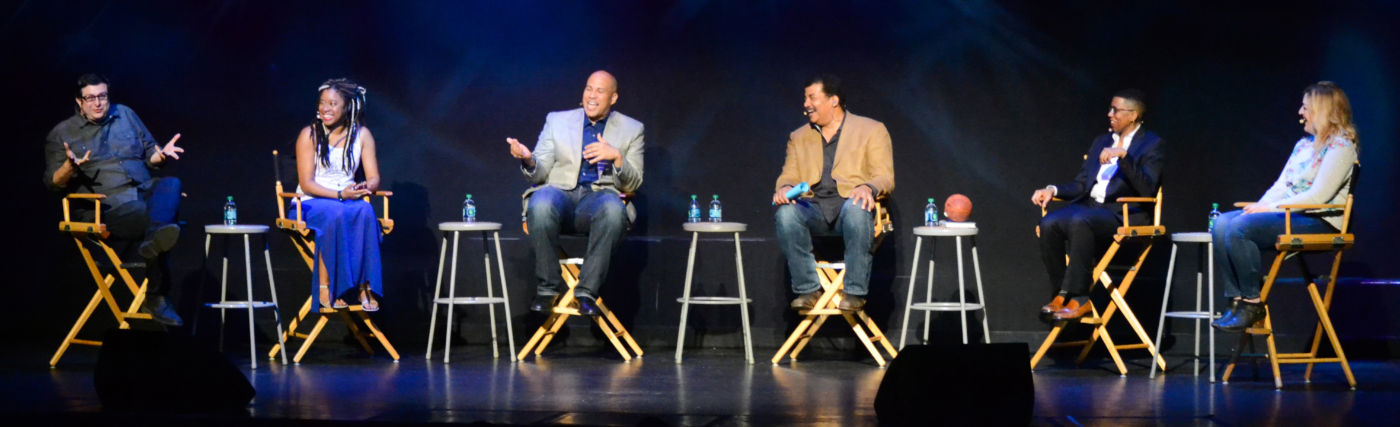
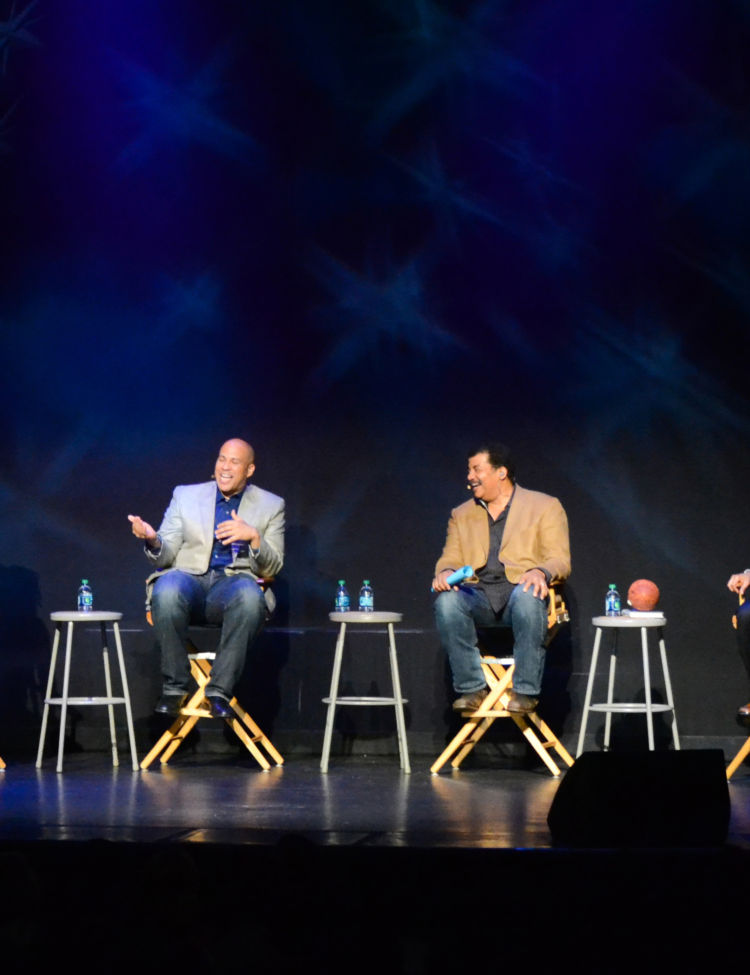
Our show from the historic Apollo Theater in Harlem concludes with a discussion of how technology and social media are empowering people to change the world. But it’s not all positive: Dr. Ainissa Ramirez raises questions about the impact of social media on our ability to communicate with each other, and Maeve Higgins, Phoebe Robinson and Senator Cory Booker talk about dealing with trolls – and ISIS. Eugene Mirman and the rest of the gang share their hopes for America’s future, social mobility, global warming, and The Kardashians, and the Senator shares his personal philosophy about choosing to be a force against hate. You’ll hear questions from the audience about topics including freedom of speech, hotels on the Moon, moving from STEM to STEAM, shifting funding priorities from the military to education, and even a question from a 10-year-old fan about role models and what inspired Neil deGrasse Tyson to become an astrophysicist. Plus, no trip to the Apollo would be complete without a musical act: in our case, an original StarTalk rap written and performed by Neil’s nephew Steven, aka the rapper Tyson.
NOTE: All-Access subscribers can listen to this entire episode commercial-free here: StarTalk Live! at the Apollo (Part 2).
Transcript
DOWNLOAD SRTWelcome to StarTalk, your place in the universe where science and pop culture collide.
StarTalk begins right now.
Live from the Apollo Theater in Harlem, New York, this is StarTalk.
Excellent.
I’ve got Maeve Higgins.
She’s from Ireland, a professional stand-up comedian.
We’ve got Ainissa Ramirez, who’s an expert on mechanical engineering and education in STEM.
And of course, Senator Cory Booker from New Jersey.
Excellent.
And I just met you, so Phoebe, another stand-up comedian, and Eugene Mirman, who’s one of the great organizers of all these.
So Cory, a recent Kickstarter campaign was conducted by the Planetary Society, who a friend of StarTalk, Bill Nye, is the CEO of that.
And they kind of kickstarted to fund a light sale campaign, which is a spacecraft that is driven by the pressure of the light from the sun.
Think about the disintermediation of powerful or-
Did that word just come out of your mouth?
It did.
I thought I could drop those here.
Disintermediate me.
This audit, all of us, if we used to want to get money for a business or for an idea, we had to go supplicate ourselves before banks.
How did you get elected?
Let me break this down.
All right.
Kickstarter.
There are so many platforms now for you to go straight to the people with your idea and get resources.
Information.
You used to have to go up to ivory towers to get the best access to the best professors.
Now you can go right to the Internet and get some of the best lectures.
Information gets your degrees.
Even the disintermediating access to work as well.
You used to have to go to a big corporation to get a job.
Well, now there are people being able to make money with Uber or Airbnb.
There are so many different ways to go directly to people to get your power.
And so what excites me to this is we used to have an oligarchy of people that were making decisions about what was important, what had value, what had worth.
And now it doesn’t matter what your background is, what’s your race, what’s your sexual orientation is.
If you have a great idea, if you have something that you want to bring before the people, that’s a much more democratic way of getting it.
We started with Kiva in Newark, for example, because the biggest complaint I got from entrepreneurs is it was so hard for them to get money for their ideas, banks weren’t loaning.
And so Kiva is an online nonprofit platform where people like you and I can give money to good ideas and businesses.
We sort of select what we want to donate to.
And so this is a technology revolution that in many ways makes me and Congress get upset that when things like broadband access, which we’re behind other nations, in getting people that which is becoming a lifeline.
It’s one of the ways that…
Again, places that don’t have the copper wiring, they just have the straight internet access on the phone.
And so these are the issues in the Senate that are really important to me.
Technology is critical and I’m fighting battles to not let America fall behind and think of something simple as drones.
And I know that sounds like really bad to people, but other countries, because they’re not dealing with government regulations like we are, they’re using drones now to fix poles, to do mine surveys, cutting costs and moving ahead in innovation.
While we, our FAA, is so slow on promulgating regulations for safety that the innovations are going on in other countries, and there’s lots of examples of this.
A friend of mine in Ireland just got engaged to a drone.
They’re so happy.
Very quiet, very helpful guys.
Wait, how can drones can fix stuff in other countries?
Drones are very powerful uses of technology.
Think about this.
Do they have little drone hands or something like it?
There are place, yeah, there are facsimiles of hands, I’m sure.
There are types of levers or whatever.
I’m not a drone specialist, but yes.
I mean, when I think of drones, I was looking at a real estate section online recently, and now there are views of homes where if it were a helicopter doing it, it would kick up all the vegetation, and it’s just a silent view around the property.
And I say, what’s doing that?
It must be a drone.
So there are all these uses for drones that I don’t think we fully understand or embrace yet.
That’s the beauty of a guy like Biz Stone.
He creates a platform called Twitter without even an understanding that by elevating this platform, the innovation, the millions of innovators are gonna apply that platform in ways that they never even imagined.
But don’t you think we should think about these things a little bit more?
I mean, when we created the telegraph long, long time ago, I’m going back in time.
Telegraph shaving used to be one of the worst things.
It’s a we.
I guess when you’re an engineer, these are your peeps from…
That’s right.
Sorry.
Engineer peeps, they go across generations.
Any engineers out there?
When we created the telegraph, sentences got shorter.
But there was one clap from up there.
The engineer in the house.
That’s right.
But when we created the telegraph, sentences got shorter.
We used to have these long sentences like, you know, you’d see in the Victorian ages.
But when we created the telegraph, because it was…
You mean written sentences, not legal time served in prison sentences.
No, no, no.
I don’t know anything about that.
Right.
Sending a telegraph is like $1,300.
And so we got used to having short sentences.
And that’s the reason why language got shorter.
And so now we’re in the age of Twitter and everybody’s using LOL, OMG.
The comma is, you know, death.
I mean, it’s gonna go away.
So shouldn’t we really think about these, how technology also impacts these things?
Okay, you sound like an old fogey.
I do.
Wait, I have a question.
Oh, wait, I have to say, there is a Twitter handle called Celebrity Oxford comma.
And if you’re a celebrity, you are supposed to tweet to that handle whether you agree with the Oxford comma or not.
It doesn’t follow anyone.
It’s just collecting data.
Yeah.
Who follows Oxford comma?
I had to vote it.
I had to say.
Yeah, are you Oxford comma?
Are you not?
Oh, so I’m an Oxford comma guy.
You are?
Oh yeah, oh yeah.
But if you have a choice, you have 140 characters.
How committed are you to the Oxford comma?
Wait, that brings in my-
I got the answer.
Hold, hold, I tweet to 125.
All my tweets, they’re 125 characters.
No, they’re not.
Yes, they are.
Are you serious?
I’m serious.
And not only that, I do not say LOL.
And I don’t use the letter U when I mean Y-O-U.
I spell that sucker out.
So, so to me, here it is.
I feel like Michelangelo when I have this many words and it has to become a tweet.
Because what I do is, I carve away that which is not the tweet that I want to post.
So if you…
And what remains is the essence of the thought that might have taken long, taken more space to communicate.
But in fact, all that really matters at the end of the day is its essence.
That’s what emojis are for.
Not only that, there’s some tweets, I carve them out so much, they almost read like Haiku.
And if I gave you Haiku, you’d say, that’s too short, make it longer.
And that’s not what Haiku is about.
No.
It’s about the essence.
It’s a beautiful thing.
Yeah.
But let me get, I’m off-tropic here.
Wait, so let me get, I’ll find you again.
So, there’s a little, I gotta go back to ISIS for one split second.
Please.
Yes, they’re using social media, but if others use social media, that doesn’t mean you’re gonna sort of win.
You have to be better at it than they are.
Yes, you have to compete in the marketplace of ideas against evil.
You know, as Martin Luther King said, darkness can’t cast out darkness, only light can do that.
You have to compete with the darkness with light.
And I don’t think when it comes to our countries sort of pulling, and I’m not just talking to government, I’m talking about others, should be talking against this hate that’s out there.
No, no, but you have, you’re famous, you know you’re famous for this, how you deal with trolls.
Right.
How do you deal?
Now, I know you could just kick their ass if you wanted to, because you used to play football, but that’s not what you do.
You’re like a kind, gentle man.
Yes, operative words are used to a long time ago.
The older I get, the better I was.
But I’d love to hear about trolls, and I’m sure Phoebe, like being a comedian, being a woman, we get trolls, right?
You get trolls in your audience.
Yeah, we get hecklers and…
And on social media, when they’re anonymous, it’s much worse.
So the question is, is I believe that every action is an equal and opposite reaction, right?
So if you punch, there’s going to be a reaction to that.
So why not just defuse the whole situation and express love?
So if somebody says to me on Twitter something really offensive or whatever, my response to them will always be trying to just extend kindness to them no matter what.
But it’s always better to just say, oh, you have a small d***, and then they just totally, they stop talking.
And I just wanted for the audience to translate again, we are still talking about Dick Cheney.
You have a tiny Dick Cheney.
Like in Total Recall, like Quado, but Dick Cheney.
Yeah, bomb them.
Okay, that’s the kind of nerd illusion I love.
So my point is that we have every day the most powerful thing you have, I think, is your ability to choose.
You can either accept conditions as they are, or you can take responsibility for changing them.
If you think there’s too much hate in the world, you can either just accept that and continue to motivate hate, or you can be a force against that with an unyielding, undetermined love.
Because we all here as Americans are the ancestors of folks who loved those who cursed them, who were able to endure insults and still push forward with their positive vision and spirit for this world.
That’s very Martin Luther King of you.
I just think that when we give in to our baser instincts, you know, my father, God rest his soul, who used to say to me, there’s two ways to go through life.
He’s either a thermostat or a thermometer.
You can just reflect the world around you.
If it’s hot, you go up or down.
Or you can be someone who tries to set the temperature.
And so my point is that why don’t…
That’s deep.
That’s deep.
Yeah.
And so my thing is why not be a force in the world that tries to elevate things, try to be warm when it gets cold.
And so that’s what we have on social media because we talked about this before.
Because you’re disarming the trolls at that point.
Well, yeah, and look, I think that the…
He loves me, I can’t.
No, sometimes I get apologies, sometimes I get more hate.
But it doesn’t matter because my karma has nothing to do about what you do to me.
It’s how I choose to respond.
I tell my truth in how I react to that stimulus.
And we talked about this earlier that that’s the difference between humanity, the divine, I think divine difference, is that for a plant, if you do something to it that it’s gonna respond in a way, it doesn’t have a choice.
But human beings, there’s a power between stimulus and response, and that is choice.
And we can choose to manifest our highest self, or we could choose to simply reflect that which is done to us.
And to me, the people I respect from history is that they did not, they realized that they were born an original, they were born unique, they were not born to be dull carbon copies of the world around them.
They were born not to fit in.
It’s from paper, right?
It’s an early version of a photocopy.
Yes, yes.
Tell us about mimeographs.
And for those millennials…
And just the facts, please.
And those millennials, the CC in the email line, that stands for carbon copy.
Yes.
So, let me just find out from the comedian…
So, just get back to your trolls.
Sure, on the internet, but you could be in front of an audience, and this somebody who’s a verbal troll.
And, you know, the best…
I wish there was a word for it.
It’s like a heckler?
Yeah, a heckler.
I think it’s true, like what Cory was saying.
It’s like, what you put out there, because more aggressive comedians like Eugene, no.
A lion on the web.
Fearsome teddy bear.
It’s like the more aggressive comics do get a lot of shouting and aggression back, but like I don’t really get a lot.
Live, I remember like one old lady was like, we didn’t have hula hoops then.
Anyway, it was like a total nonsense.
Wait, so that’s the worst heckler you’ve ever had?
An old lady saying, we didn’t have hula hoops?
I know, it was great because I didn’t want to slam her.
Eventually, she just fell asleep, so it was totally fine.
So Cory, we’re going to wrap up this segment.
Okay, I’m afraid that you’re slamming elderly women out there for just professing a love of real hula hoop authenticity.
I know, I know, they’re the worst.
They’re the real problem.
So Cory, we’ll close down this segment.
Is there some bit of politics that you think the nation needs to know, that you think your social media access will help move the needle?
I don’t mean political view, I mean something about our system and how it works and why it should work.
Is there something that we’re missing that you have the power to change?
Well, we have the power to change.
We used to be number one in all categories of innovation.
And if you think about everything from degrees in engineering, percentage of our population graduating from college, research and development, we used to be the number one country in percentage of GDP in R&D.
Now we’ve fallen down to number ten.
We’ve fallen down to number ten.
We’ve fallen out of the top ten as of 2011 data.
Who is ahead of us?
I mean, every country is ranging.
Italy is beating us.
Who is?
Italy.
We had wine and that was it.
But my point is the World Economic Forum, OECD, these are international organizations that look at data for innovation and competitiveness.
And we came in, we inherited a country that was number one in the globe, dominating even things that are innovation and competitiveness like the quality of our infrastructure.
And that’s everything from aviation infrastructure.
But the sad thing is now we’re leading the globe in things that we don’t want to be leading the globe in.
From childhood obesity, we’re leading the globe.
From infant mortality, we’ve fallen dramatically.
We want a country that’s not doing as well in infant mortality as we should.
We’ve got to get fatter kids.
No, we have the fattest children.
What we need is more scientists, fat little scientists.
And so the political message is simply this.
And this goes back to the power of social media, the power of engagement, is that those powerful 10 two-letter words.
Whenever you talk about something in the world, you need to turn yourself into a look in the mirror and remember those 10 powerful two-letter words.
If it is to be, it is up to me.
So nothing in the world changes unless we do, and we’re a product of that change.
And so we all have the power, whether it’s our little phones, which have, if we have a hundred friends following us on social media, we have power to create change.
Because as you know, this idea of virality, if you talk to a hundred friends and 72 of them decide to retweet what you did, and 25 of them, it goes on, it can go on and on and on, and ripple into a movement.
And right now America needs a movement.
As Langston Hughes said, and I’ll stop with this, he said, you know, America never was America to me.
But I swear this oath, America will be.
We need to swear an oath that we will be agents of our democracy.
We’ll be true patriots, not the shallow patriotism of flag pins and symbols of patriotism, but the substance of patriotism.
Cory Booker on the case, there!
We’re back, StarTalk, welcome.
I’m going to introduce to you my brother’s son, that makes him my nephew, Steven Tyson Jr.
Steven, come on out.
Yeah.
Now, I’m doing this because I like what he’s doing with his life right now, and I’m sure the senator would…
I know it sounds like what you were doing before, I didn’t like, no, but it was cool.
So, you’re in school at Arcadia University.
Yeah.
Getting a PhD.
Yeah, EDD, in educational leadership.
In educational leadership.
Focusing on, with what tools?
Using hip hop as a medium of uplifting youth, and also bringing awareness to science, tech, social justice, whatever the case may be, just using hip hop to uplift youth.
So, and this is kind of in the spirit of StarTalk, because what we do is, we look for things that are emergent in pop culture, and then we bring them into our forum, and then plug, for us at least, we’re plugging science into what is already pop culture.
Hip hop is clearly out there.
It is mainstream, it used to be fringe, it’s mainstream now.
It started by the Zulu Nation, 1973, proud member.
Okay, and so…
And one other out there, I guess too.
And so, you’re using hip hop, realizing its potency in our culture and in society, and try to do some good with it.
Absolutely.
So that’s awesome.
He has composed a rap song inspired by StarTalk.
Now, this is the Apollo Theater.
I never thought I’d ever say this.
This is great.
Put your hands together for Stephen Tyson, Jr.
premiering his StarTalk rap.
Alright!
My name is Tyson once again.
Dr.
Neil deGrasse Tyson.
Thank y’all.
Is that going on?
All right.
He’s related to you.
Yeah, yeah.
Were you a hip hop fan when you were young?
I was around when I was around.
How come I’m the oldest one?
You’re talking about Martin Luther.
Like he was your friend.
Were you using like gramophones as decks?
So, no.
What was I talking about?
Maeve, though you be from Ireland, what hope do you see for…
First of all, I just want to applaud High Ireland for letting love win.
And what’s the kind of visa you’re here on?
Oh, it’s the I have to find a husband really quickly visa.
That one, that’s a special provision.
It’s an alien of extraordinary ability.
Alien with extraordinary ability?
Yeah.
What’s your special power?
I can’t show you now.
It’s illegal.
It’s a sex thing.
So that would tell me that if we were visited by actual space aliens, the fact that they got here in a spaceship says immediately that they have extraordinary abilities, and that we would make them citizens immediately.
Yeah, totally.
And they’d be like, hey, Maeve.
And I’d be like, this is Neil.
So what hope do you have for America?
Well, you know what?
I was so happy that Ireland passed the equal marriage bill, and it was like a referendum by the people, and that was so great.
But I have to say, living here in New York City, and I know New York is different to America, you know, like, it’s not.
But anyway…
I feel like it’s such a diverse and cool place, and I’m so thrilled to be part of it.
And I think, like, you’ve got a lot to teach the world, and I know America isn’t, like, the leader in the way it was before, but it totally can be again.
You know, it totally can be again.
So, and I’m psychic, I know you believe in that.
I’m a psychic witch, and I’ve got a lot of hope.
I’ve got a lot of hope and that’s why I live here.
Okay.
And most of what people claim as their psychic powers is nothing more than their acute sense of observation of what goes on around them.
Totally, and I’m keeping my peepers open, and I love it, and I live here in Harlem, and I love it.
Excellent, so what hope do you have for America?
I’m actually very hopeful.
I know I’ve been Debbie Downer, but I love the fact that technology, if you have an idea, you can do it.
You don’t have to wait to get a PhD or whatever.
I mean, if you have an idea, you can actually be actualized by a lot of the technology.
If you’re a kid and you’re like, hey, I wanna make a song, you don’t have to go to a studio.
You can just garage ban or whatever.
So I like that these tools are available and we can be far more creative if we’re not too distracted.
Distracted by what?
Kardashians.
The Kardashians.
Yeah, so, I’m a fan of free enterprise and free flow of pop culture.
So, for me, it’s not, well, let’s get rid of the reality TV and the Kardashians.
It’s, let’s put other TV on that is more compelling than whatever they’re doing.
That should be the challenge to producers.
I think the Kardashians should talk about global warming.
Then we wouldn’t have to worry about this, you know?
Maybe we could get Kim Kardashian on StarTalk.
I mean, if you could do that, boom.
I’m working on it.
So, Eugene, what’s your hope for…
Can I just say a Kardashian point?
Because I can’t let that go.
Okay, go.
So, you know, a lot of life is about perception.
And you know that.
That’s a very, I hope a very scientific perspective.
You can have two people with very different views of the world based upon their perspectives of an event.
And there’s something about the Kardashians, which I used to sometimes throw jokes at as well.
But this last month or two with Bruce Jenner, I think that was one of the great moments of education for our country, lessons in love and acceptance and an exposure and an understanding of the diversity of humanity.
And so I’ve been celebrating in many ways what Bruce Jenner’s experiences as well as the Kardashians have done to elevate.
And the platform, that was a huge platform.
A huge platform.
If you didn’t remember, if you missed that news cycle, Bruce Jenner, of course, was the Olympic world record setting decaf from, I think, 1976 in Los Angeles.
Was that Los…
LA?
LA, yeah.
And he would later reveal that inside he felt that he was a woman.
And via marriage, he was connected to the Kardashian family, if I get my pop culture accurate.
And so that access to him in various images throughout this reality program revealed what he had become and then he just fully outed the whole story recently, just this year.
Yeah, it was a remarkable courage.
And I think it really did help to elevate conversation, understanding and love in our country.
So Eugene, what do you have for us?
You’re born in Russia?
Yeah.
Confess that to this audience.
I stole this job from you.
Sorry, but not really.
Yeah, it’s funny because I do, I guess, have a, well, sort of a very great appreciation, because there’s no way I could do this in Russia.
So I do very much, like you were talking about the patriotism of not a pin, but a reel.
And it’s true that I…
The patriotism of what?
Of not wearing a pin, but a real patriotism.
Oh, not a pin.
Don’t make it about the pin.
Make it about the ideas and actions.
So I think, I mean, so I always kind of see the idea that if you actually focus and persevere, you can do well.
And I think that, you know, in terms of what you were saying, where the idea of being effective, the idea of data-driven stuff, I think that you see a lot of just conflict and bickering and politics and stuff sort of staggering.
But I feel like actually quite hopeful hearing you speak about data-driven solutions and really focusing and picking a problem and really moving forward.
So I find that actually quite inspiring.
Yeah, so I think that it will hopefully be all right.
Certainly prices here are a little much, but I think it will be fine otherwise in America.
So what do you have for us?
What I hope for America is that we’re all going to come together as people and force Instagram to make a filter that interracial couples can use.
Because my boyfriend is white, and when I use a filter, either he looks great and you just see teeth on me, or I look amazing and I’m standing next to powder.
Then all will be well with America.
You just need funding.
You have the product.
Will you back my Kickstarter for this, Cory?
So, you need a special optical filter that understands this distinction.
Yes.
That’s powerful.
That’s powerful stuff.
Okay, I’m going to offer my reflections, but I know Cory’s going to have some deep thing to say.
We’re going to end with whatever comes out of his mouth after I say what I’m going to say.
You know, I’m born in this country.
What’s that?
Braggart.
No, no, I’m an American.
I’m a scientist.
I’m an educator.
And in these different hats, when I see scientific discovery across the ocean and happen in other countries, as a scientist, I say, fine, at least somebody is doing it.
When the Higgs boson was discovered, no relation to Maeve Higgins here, when I was discovered and Nobel Prizes were handed out, my scientist hat said, great, somebody is doing it.
Then my American hat said, we could have made that discovery with the superconducting supercollider which was being built in Texas in the 1980s.
The budget was canceled by Congress before your day.
Then the Center of Massive Particle Physics went elsewhere.
We lost that leadership.
That was, I think, emblematic of many other places where the edge of discovery and whatever that is that gets you to want to do that, I saw it fade.
I think it can return.
Maybe we have to sink lower before all of our pistons realign.
I’m deeply concerned about conflict in Congress, because if Congress aligns, oh my God, OMG!
There’s nothing more efficient than a democracy where everyone agrees with one another, because stuff happens like this.
That’s a totalitarian.
There was just one person that did what he said.
No, the difference is, totalitarian is the person at the top does whatever they want.
But if we all agree what we want, and Congress agrees with what we want, and we have a capitalist democracy, then we can go to the moon.
We can defeat evil in Europe, as we’re coming on the anniversaries.
So, I still have hope, and I see science trending now.
Cosmos aired in primetime on a major network, right?
And it wasn’t just any, it aired on Fox, okay?
That tells you anything is possible.
I was very confused by that, very confused.
I get you, but that should be an existence proof of what is possible in this country when people devoted to a cause, particularly a good cause, have their pistons aligned.
Senator Cory Booker, I did not introduce you as the Democrat from New Jersey, because I don’t really give a s*** what your political affiliation is.
I care…
I should reword that.
I don’t…
Give a f***?
I’m not interested in what your political affiliations are.
I’m interested in how your mind works, and how you think, and do you have good ideas.
Because good ideas transcend politics, policy, and the best of those ideas transcend time itself.
So, I just want to ask, can you please leave us with some hope?
I will, but I do want to say very first that I just want to say thank you.
This has been an extraordinary experience in conversation.
A good idea for me was to come here tonight, and you are just an extraordinary, I’m not even going to say American, because love of country is a wonderful thing, but why should love stop at our borders?
That you are an extraordinary, you are an extraordinary exemplar of humanity, and your voice, your vision, your inspiration is changing this planet for the good, and I thank you for that.
And so, on hope, I just want to say this, I believe this as a person that’s wrestled with some really tough challenges, especially in my time as mayor, that hope is relational.
Just like you cannot have courage without fear, you can’t have hope without despair.
And a lot of people want to be hopeful and happy and turn away from depravity, from despair, from darkness, but hope is confrontational.
It stares despair and evil and sadness and darkness right in the eye and it wrestles with it.
And the idea of hope is to never let despair have the last word.
And so what gives me hope and empowers me is understanding that we do have horrendous challenges in this country, unfinished business of our democracy.
But I know that American history is a declaration of hope.
It is a testimony to hope because it is this country, despite the wretchedness of poverty, of slavery, of sexism as racism, we have always seen hope triumph over that, people being prisoners of hope, deciding every single day to choose hope despite every other reason not to.
And because of that, we have been a hopeful nation that has advanced generation after generation.
And now here in our generation, we must have the courage to confront our darkness and despair again.
We must be people that not only choose hope, but have an activist, a rebellious, on audacious hope that confronts our problems and overcomes them.
And knowing our history, knowing our potential, knowing that promise of hope in this country, I am lifted every single day.
Live, from the Apollo Theater, StarTalk!
Woo!
In this next segment, we have a couple of minutes for Q&A, and so it’ll be great to hear what you guys are thinking.
So, go for it.
So, internet and social media has a lot of benefits.
You have a wealth of information and a touch of a button, but there are also a lot of pitfalls.
I mean, there are a lot of websites spewing pseudoscience.
So, with, for example, the anti-vaccination movement, global climate change deniers.
So, what is the best way to address this, especially since it can affect policy?
I have opinions there.
I mean, yeah, I mean, there’s, there’s a conflict between the freedom of speech.
I mean, you are free to be ignorant, right, in the world of the freedom of speech.
You are free to write anything you want.
So, isn’t, doesn’t it come down to, in the end, making sure that in the face of the misinformation and the disinformation, that there’s the accurate information that’s out there that is indeed accessible.
But I don’t know that you can let, freedom of speech is like the First Amendment, right?
Absolutely.
It’s the First Amendment.
So, I don’t want to say ban this and don’t ban that.
You know, I can’t say that.
I would not feel comfortable doing that.
All I can say is, if we get people producing content that is so compelling and so interesting, that you gravitate to that and you learn how and why the universe works.
In fact, if all you did was tell people what is true, then they don’t have the capacity to think about why it’s true.
And there’s a whole missing part of our educational profile in this country that does not teach you what science is, how it works, and why it works.
It tends to just think of your empty vessel and pour science into it, and then you go out and take your test.
Science is a method of inquiry about what is true and what isn’t.
You don’t just get it handed to you by what website you happen to stumble upon.
So I’m keeping the freedom of speech, because that’s sacred, that’s like constitutionally sacred, but that puts the greater challenge on the rest of us.
Yes, right here.
And I will repeat the question because you don’t have a microphone, sir.
He wants to know when we might see a hotel on the moon.
So I guess the future of space tourism, perhaps.
Yeah, so my stock answer for that is you might have a hotel on the moon, but it would have no atmosphere, you know?
I think the future of space exploration, if there is a future at all, has to be based in commercial enterprise, because that’s only when you’ve turned a space program into a space industry does that ever become a routine thing.
Otherwise, they’re one-offs based on tax-based sources.
SpaceX is an important cog in that wheel.
So if it’s going to happen at all, that will happen, and that will have to happen, is what I’m saying, if we have a presence in space in a big way.
Yes, over here, question.
How did your role model inspire you to become an astrophysicist?
How did role models inspire me to become an astrophysicist?
It turns out it wasn’t a role model at all.
It was a visit to my local planetarium.
The Hayden Planetarium.
And how old are you?
You’re ten?
Okay.
My parents took me, my brother and my sister, every weekend, essentially every weekend, to different places around the city.
To the zoo, to the art museum, to hockey games, to everything that talented grown-ups did.
All right?
Art, sports, the opera, Broadway plays.
I was bored in a lot of that, but what did not bore me is the trip to the Hayden Planetarium.
And I was nine years old when that happened.
And at that age, it was not I who discovered the universe.
It was the universe that discovered me.
Oh.
So later on, role models would matter.
You get a piece of one person here and there to help shape that interest and ambition.
But in terms of the infusion of love for learning about the universe, that happened in my first trip to the Hayden Planetarium.
And that’s now where I now serve as director.
Yeah.
Sir, up there.
Yes, sir.
All right.
I work in the STEM profession.
I work with kids from pre-K in the college, and I work with adults as well.
What I often hear omitted from this conversation is arts role in STEM.
In kindergarten, we start with crayons and paint and clay, and we build our mental muscle through the arts.
But yet, we’re having a conversation about STEM without the A.
There’s nothing in art that doesn’t involve science, technology, math.
It’s all there.
But yet, we have these conversations.
Why is that?
Okay, so there is a movement called STEAM.
I know.
Where they put the A in the STEM.
Can I take a shot?
Yeah, definitely.
We’re steaming past STEM.
I think it’s based on this zero-sum game that people feel left out.
But I actually think that if you inject the A in STEM, it’s going to blow the whole thing up.
It’s going to look absolutely different.
Because the problem is that we’ve siloed everything.
We siloed STEM, technology, engineering, math, so our brains don’t get confused by nature.
Nature has all these things fused together.
So schools are going to have to change the way they teach so things are integrated, so that we’re not having conversations that the A is missing and the M is missing.
That we’re just teaching the way the world is in all of its beautiful complexity.
Nice.
Okay, I’m sorry, this has to be the last question I’ve just been notified.
Yes, go.
So, yes, the pressure is on.
Yeah, it definitely is.
It piggybacks kind of off of the conversation about the military industrial complex and the money that’s in politics right now.
It’s hard to take a look at something like Kickstarter and Kiva and all those things that we champion as something that is wonderful about the country, when really it seems more, and sorry to be cynical and Debbie Downer about this, I guess, but it seems to be more like something that helps us feel better about the fact that we don’t have real impact.
So when the focus should be on education, instead we’re funding the largest war machine that has ever been perpetually funded.
So how does that conversation shift back to education as the only way that we’re able to bring ourselves into the broader conversation?
Women in education, kids in education, bringing people out of poverty, the only way to do that is to…
Senator, in the Constitution there is no mention of power over education granted to the federal government.
So it all goes down to the states.
So what influence…
However poetic or deep or philosophically meaningful your rhetoric is, at the end of the day, you’re a senator with no control over education, constitutionally.
That’s a constitutional fact.
So where do we go from there?
Well, first of all, I agree with you that education is principally a local initiative, but please understand we have a federal department of education that does make massive choices about investments.
The Obama administration, whether you agree with their education policy or not, created programs like Race to the Top that was able to incentivize states to change their programs.
So the senators…
It’s not without some influence.
It’s not without some influence.
But I guess to the young lady who asked the question, I mean, this is sort of where we keep coming back to as a nation, which is how do we change the things that are incredibly important that are right now unfortunately in many ways undermining the best of what we thought America is, was, or should be.
Social mobility, for example.
We have this major fracturing in our country in terms of those haves and the haves and nots.
We used to be the top country in the globe for moving from poverty.
It was the American dream.
Well, now other countries are blowing past us.
If you want to be born poor on the planet Earth and have a shot of making it to the middle class, better to be born just factually in England or Canada where people can move social mobility greater.
And so the question…
Let me interject, though.
I think it needs to be a grassroots effort, and we need to educate parents to insist on having STEM, STEAM, and that will change states.
It has to come from the grassroots.
It has to be this ground swell, because we had Kennedy, and he said, hey, we’re going to shoot for the moon.
We don’t have Kennedy now.
We have all of you.
So we have all of you to say that this is what we are insisting on, and it grows from the bottom up.
The thing I would add to that is, because I’ve been in these conversations since I was in college, and people leave, I left feeling good about what we talked about, but if we’re not willing to do something different than we did before, the world will not change unless we do.
And we forget, we allow our inability to do everything to undermine our determination to do something.
We get caught often in what I call the state of sedentary agitation.
I know big words, but it basically means I’m sitting on my couch at home, watching, I get so upset, but I’m not getting up and doing anything.
And the example I’ll give you is I am here right now because of this conspiracy of love of ordinary Americans who did small acts of courage and kindness that liberated me and frankly all of us.
My father was born poor.
He was too poor.
He couldn’t afford to be born poor, so he was Poe.
What did you say?
He was so poor?
I’d say you can be so poor you can’t even pay attention.
Yes.
But my father was taken in by a family when his mother, single mother couldn’t take care of him.
People rallied around.
They would not let him fail.
We live in a country right now.
You want to know one of the best ways to stop violence in our communities?
Those data show that one mentor in a kid’s life dramatically drives down incidents of juvenile crime, drives up educational attainment.
But yet there are tens of thousands of kids in this metropolitan area alone that are on waiting lists because somebody won’t give four hours a month is what it takes to do a mentor.
The amount of time we spend watching our favorite TV show.
The problem we have in America is poverty, but not material poverty.
It’s a poverty of action, a poverty of compassion, a poverty of engagement.
If we individually don’t make that decision, then we’re not going to see change.
And the powerful thing about us making a personal decision is we actually influence those around us to do the same way.
And our decision of love to another person adds up to a grand conspiracy of love that does change the nation and the world.
Ladies and gentlemen, thanks for coming out.





 Become a Patron