



 Unlock with Patreon
About This Episode
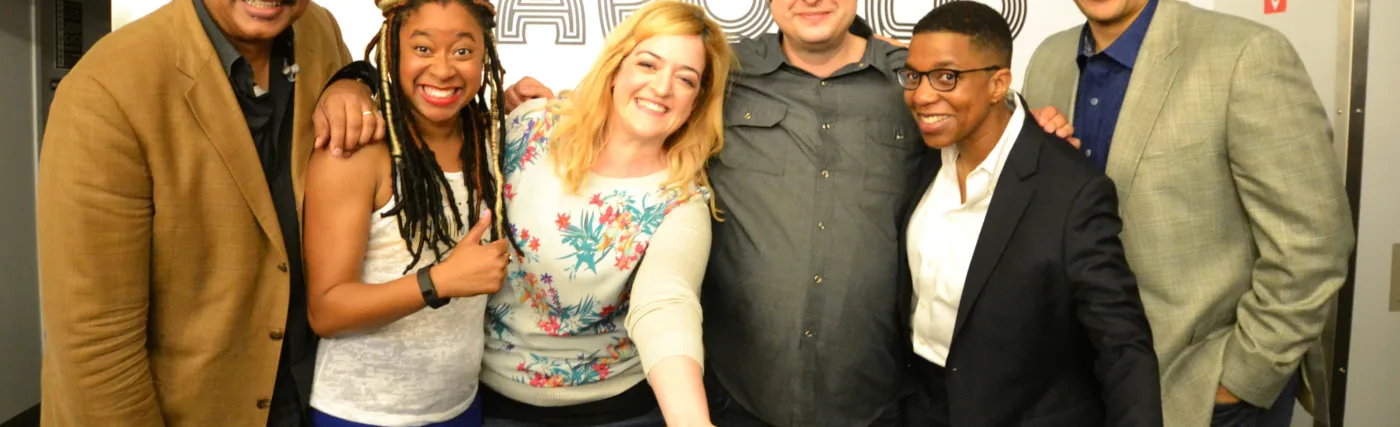
It’s not your typical night at the Apollo when Neil deGrasse Tyson and Eugene Mirman welcome Senator Cory Booker, science evangelist Dr. Ainissa Ramirez and comedians Maeve Higgins and Phoebe Robinson to the historic theater in Harlem, NYC. It’s not your typical StarTalk Live! either. Instead of focusing on a single topic, the entire show orbits the Senator’s life in three subjects: social media, the physics of football (he was named to the same All-USA H.S. Football Team as Emmitt Smith), and STEM education. Dr. Ramirez is an expert in all three, having taught mechanical engineering at Yale and co-written Newton’s Football: The Science Behind America’s Game. You’ll hear Neil get schooled about Deflategate, what causes concussions, the “weaponizing” of football helmets, and how to fix the NCAA. You’ll also learn how there used to be more women than men in STEM classes, why educating prisoners in STEM fields can reduce recidivism, the dangers of the “prison industrial complex” and the disproportionate jailing of people of color for non-violent crimes.
NOTE: All-Access subscribers can listen to this entire episode commercial-free here: StarTalk Live! at the Apollo (Part 1).
Transcript
DOWNLOAD SRTWelcome to StarTalk, your place in the universe where science and pop culture collide.
StarTalk begins right now.
It is now my incredibly great pleasure to introduce your host, America’s wonder of science communication, Neil deGrasse Tyson!
Welcome to StarTalk Live.
So Eugene, what guest do you have on your side of the fence there?
We have…
This is Eugene Mirman.
Ladies and gentlemen, she is here on a visa that is of an alien of extraordinary ability.
All the way from Ireland, the incredibly funny Maeve Higgins!
And she is very, very funny.
I’m very excited she could do this.
Ladies and gentlemen, Phoebe Robinson!
So, tonight’s topics, we’re going to talk about social media and technology.
We’re going to talk about football.
We’re going to talk about education.
I have someone who is formerly Professor of Mechanical Engineering at Yale who wrote a book on the science of football and has specialized in the role of technology and education in STEM and all like the right ingredients.
Plus, she’s an expert in the science of football.
Give us a warm welcome to Ainissa Ramirez.
Our feature guest this evening is, in fact, a former college football player, tight end was his position.
He’s also thought a lot about science and technology and what force that could play in the future of the country.
And he’s also active in social media.
In fact, if you triangulate on those data, you get one person, and that is Senator Cory Booker from New Jersey.
So, there’s some Newark love out there.
Got Jersey in the house.
You sure you didn’t bring them in just to stalk the audience there?
The bridges are open, people.
So Cory, you’ve, I think, is it true, you have more Twitter followers than like anyone else in both houses of Congress, is that correct?
I am pretty sure that is true.
Maybe as many as the sum of all Twitter followers of both houses.
Actually, you know what, that is not true.
There’s a guy that ran for president in the Senate that I think still might have a little bit more than me.
Someone named Barack Obama.
No, he is no longer in either house of the Congress.
They kicked him upstairs.
Yeah, they kicked him upstairs.
They’ve got like a billion Twitter followers now.
No, it’s John McCain, ran for president and has a whole bunch of folks who follow him.
I didn’t know that, okay?
All right.
So he mostly tweets d*** pics.
Tonight, I am your love translator.
What he means is pictures of Dick Cheney.
Yes.
I’m going to translate your comedic comedy.
I hope this doesn’t become your last day as senator.
So, Senator Booker, for those who might not know who you are, you cut your teeth in New Jersey State Legislature?
No.
Newark.
Newark.
I was the mayor.
Newark legislature.
Newark people can’t finish getting it out of their system there.
We’re Vick City Proud.
And that kept going and you became mayor of Newark.
Yes.
And mayor is my favorite political position.
It is.
Yep, because it’s above that you don’t really influence the quality of an individual’s life in a town.
You do policy and things, but mayor, if the garbage isn’t collected, the mayor, you got to talk to the mayor.
You got to pick up the snow.
You got to pick up the garbage.
You are responsible for just about everything that touches the city.
And you were mayor as recently as like a year and a half ago.
Exactly.
Wow.
Yes.
And then the Senate next?
And then Senator Frank Lautenberg passed away.
The United States Senate seat was open and I ran for that.
And I got elected.
Well, I didn’t know you slipped into an empty seat.
You didn’t tell me that.
You make it sound almost illicit.
No, the seat was vacant and there was a special election called.
I ran and I got inaugurated on the auspicious day of Halloween 2013.
What did you dress as?
You just accidentally created.
I’m going to get booed off the Apollo stage.
Wear something.
All the New York people are like so embarrassed now.
It’s OK.
When you become a certain age, it’s OK to tell what are called dad jokes.
Dad jokes.
Right?
They’re just like you’re going to.
No, I think you have to be a dad.
And tonight I’m here to tell you are a dad.
When you’re a mayor, you get called mother often, but usually followed by something.
So if you’ve got, so let me just ask you, what, if you tweet and you’re a politician, what are you tweeting?
Vote for me?
I mean, where are you going with this?
Where is it going to land?
Well, for me, I’ve used the platform, started to use it when I was mayor, and we found out that it was in a phenomenal way to be very responsive to constituents.
On the spot.
So in Newark, what we found, once we started using social media, is that my residents, instead of just sort of driving past a pothole, they would take a picture of it and say, Cory, fix this, and you’d be out there fixing potholes.
No, but the reality is I started to find out about potholes before my road crews would.
I found out about traffic lights out before my engineering crew.
It went from just being sort of e-government to we-government.
Everybody began to participate, and so we started increasing the efficiency of our response time thanks to everybody getting involved.
Because you have a million eyes watching the city.
Thousands of eyes.
As soon as the water main broke, we would hear about it before people often even called water.
Before the news got there.
The news cameras got there.
And so in really bad situations, like in Hurricane Sandy, we started getting tweets from people out of the city, out of the state.
I lost contact with my disabled senior citizen great aunt.
Could you please find her?
And so we located people in that storm who were in crisis situations, often through social media.
Okay, so this is a whole other, I mean, rather than having a hamburger now, I’m going to the movies now.
This is a real civic social good that you’re describing here.
Well, I do still tweet about movies.
Because I’m a bit of a movie addict.
But you also, you got some geek in you too.
That’s why this is like, when I got the call to be sitting next to this man, you have no idea, my staff is like, I’m like, I am a groupie.
I will go, if you call me, I don’t care if I’m in a heated debate with Rand Paul.
I will say, Rand Paul, you’ve got to wait.
You would leave Rand Paul’s company to come here?
I would leave Rand Paul, I would leave John McCain.
Yes.
Next time, bring him.
Bring him.
I’m sure he would love to come here, because in many ways, science should be above politics, right?
And we should be…
That’s how I view it.
Except global warming.
Alleged global warming.
Yes, yes.
There was a snowball on the Senate floor, so that was an indication.
That wasn’t the House, that was the Senate.
That was the Senate.
Yeah, yeah, yeah, that’s your Senate.
Those are your peeps.
Those are…
So…
That’s what I call them.
I say, yo, what’s up?
So, we had someone named Biz Stone, which is a cool name.
He’s amazing.
He’s one of the founders of Twitter.
We had him on StarTalk, and I didn’t know where that conversation would go, and he took it to a place I hadn’t even imagined, just speaking of Twitter as an engine of social change, things like the Arab Spring, like you said, people trying to get the neighborhood fixed.
I know Ainissa is very active in social media trying to promote STEM interest and STEM education.
And so, would this mean that you would encourage everybody to kind of do this?
I’m a big believer, and we’ve talked about it before, and I said to you earlier that Alice Walker said the most common way people give up their power is not realizing they have it in the first place.
That’s a profound statement.
And it’s true.
We all have the power to influence our surroundings.
And in fact, I’ve looked at this from lots of different social science data, even in voting, the most common…
You actually, you look, you’re in Congress and you look at data.
That’s good.
Spread that.
Just get that out there, all right?
When I was mayor, one of my favorite savings to my team was, I said, in God we trust, I’m the man of faith, but everybody else bring me data.
Let’s make decisions based on the science and not on opinions, but based on the facts.
And so social science data shows that the most powerful influence you have is with your circles of friends.
If I show you 10 campaign commercials, vote for X, that’s not as persuasive as your friend saying, hey, I know Cory, he’s a really good guy, you should really go out and vote.
In fact, if you know your friends are going to know if you voted or not, you’re much more likely to vote.
That’s interesting.
So social media then becomes on Facebook pages and Twitter pages and all the way we connect with each other, you are a very powerful persuasive force in this world.
You know, I was going to say that technology has had this role for a long, long time.
It’s new to us.
But, you know, Martin Luther, when he wanted the referration.
Damn, you go back.
I was ready.
Martin Luther King?
You know, when we had to do wood cutting and paper, I mean, that was new.
That was hot at one time.
And that’s how, you know, at that point, there was this discontent about something.
So we spread an idea.
And hammer it on a door.
That’s right.
And similar to Twitter.
I mean, it’s the same thing with the Arab Spring.
So we’ve been, you know, technology has helped us in terms of changing things for a long, long time.
But the power you have to understand is that technology, whatever the platform is, radio, TV, they are neutral forces.
What affects the reality is what we pour into them or what we, how we influence them.
And I was sitting on a committee hearing, in a subcommittee hearing, on how well ISIS is using social media.
They’re running circles in many ways around us in terms of their ability to use social media to influence other people and recruit.
And all we have is Air America, an old-fashioned way to do it.
We spend tens of millions of dollars using this old-fashioned way of communicating.
People younger than you and I, we were talking about millennials, they’re getting the majority of their news now and their information is coming from social media.
And so if we don’t change with the times, this is not the 1940s where we’re.
So it’s more than just the social media tweet, but it’s also a podcast and we…
Thank you very much.
So it’s also a podcast you can download?
Like a radio show.
And then listen on the treadmill.
So we need basically, the US government needs to take some of the money we put into like weapons and put it into Snapchat and then an army of…
It’s more than that.
It’s not just what’s the tweet you put out, it’s is your tweet meme-ifiable, right?
Is that a word?
It is today.
I think this goes from…
It’s got to become something that people want to repeat and it gets in their skin.
But think about technology in general and you see this powerful wave throughout every element of society, the democratization of society, and it goes to a simple understanding, the power of the people is greater than the people in power.
So what’s ISIS doing that’s actually effective?
Everyone talks about how they’re really great.
Is it just to get teenagers to come over and join them?
They’re talking to people all over the world and they’re sending to people that wouldn’t have access to them otherwise and you don’t even know who it is, right?
They’re using very persuasive propaganda, these memes.
They’re communicating relentlessly.
Just to be clear, the word meme was invented 10, 15 years ago to be a thought counterpart to a gene.
I don’t know if you knew this.
So, you would inherit genes from your genetic parents and this is a property of you physically or biologically that could carry it on.
A meme is sort of a mental gene.
It’s something that comes into your head and you can’t get it out.
It is so tasty and so easy to re-say that it goes to someone else and they can’t get it out and it spreads.
So, that’s where we get the word meme relative to gene.
So, you played football for this college, small college in the West Coast.
Called Stanford.
Yes.
Yeah, okay, just checking.
And you played tight end?
Yes.
And so that meant you not only would receive a toss ball, but you would also…
That’s not really how he said it.
Oh, okay.
The tossing of the ball.
Yeah, tossing, sorry.
Tossing.
I can’t tell if, were you an Ed score?
But the only point I’m making is that you would run with the football or occasionally block for someone else.
Yes.
Okay, so if you block, that means you are running into people.
Yes, very hard.
You hit them as hard as you can.
As hard as you can.
Yes.
Wow.
And the harder you hit, the better a player you are.
No.
Okay, because, and there was a day when you would hit people like with your shoulder.
But there really is a physics that we are taught on the field, you want to get leverage, you want to hit them in the right places.
There are certain places to hit that are illegal.
And so it’s not just how hard you hit, it’s really how effective you hit.
Okay, and so lately people have been hitting other people with their heads.
Yes.
Okay, did you hit people with your head?
I had some very bad head collision experiences.
Okay, that sounds like a yes.
Yes.
That was a politician yes.
Sorry, is that, so did anyone tell you that your brain is in your head?
Um, they didn’t teach that at Stanford.
Okay, so.
Well, I mean, my most nightmarish experience in football.
Tell me, what, yes, tell me.
It was, we were playing UCLA, so I’m running down on the kickoff team.
You know, I would just go down there like a kamikaze and they would form what’s called a wedge.
They’d bring the four of the biggest guys together.
And that wedge is protecting the?
The guy with the ball.
The guy who’s received the kickoff.
And I was running down as fast as I could.
I put my head down, blasted that wedge, hit it with the wrong way, the way that I was not taught.
And my, I guess my spine compressed.
I just, my whole body below my neck went numb.
I fell to the ground.
And I just remembered lying there thinking, praying to God that I would be able to get up again and walk.
So everything below your neck is animatronic now, is it?
No, but the interesting thing is-
To be good at doing very well, the gestures are cool.
To be good at anything, public speaking, fearlessness or courage is not the absence of fear.
It’s going on anyway.
But my fear after that, from that experience, you need that sort of fearlessness or that courage.
And I lost it.
And so I became very ineffective on the kickoff team and was soon pulled off.
I don’t think that’s fearlessness.
I think that’s being smart.
Yeah.
You’re like, I was afraid to run at people with my head.
Seems super reasonable.
So you went numb.
So that was some neuroelectrical impulse going down your spine.
And were you taken off the field in that play?
No, I watched it on the videotape the next day.
I sort of got up as I started to feel sort of my body again.
And I just sort of gingerly walked off to the sidelines.
There’s some controversy in Ireland.
We don’t have American football in Ireland.
But I mean about like concussion in sports.
Because like in rugby where it’s also like really big tackles, they don’t have helmets.
And they used to be, if you got a bad concussion, you would be off the pitch for a week.
And then they were like, actually just a game.
You know, because they want the players.
But it’s actually football that has the greatest concussion rate.
And it’s because we have a helmet.
See, the web…
Wait, wait, wait.
Before you get there, let me ask you something.
There are other animals in the animal kingdom that are banging their head like there’s nobody’s business, like a woodpecker.
Yeah.
Why doesn’t a woodpecker’s brain get scrambled every time it’s pecking its head at the side of a tree?
Well, woodpecker pecks 12,000 times a day.
The next day, 12,000 times a day.
That’s crazy.
Yeah, that’s crazy.
Yeah.
What’s it thinking?
Okay, so what’s up with that?
So we talked to some folks who study birds, ornithologists, just to use the word.
The we is now your actual…
Myself and my co-author when we wrote Newton’s Football, we talked to an ornithologist just to speak Cory Booker talk.
Okay.
Ornithologists, one who studies birds.
Ones who studies birds, thank you very much.
So what they told us is that the bird has a smaller brain.
From the science point of view, when something is smaller, it can undergo greater forces.
So if I had my laptop here and I had my cell phone here and I dropped them both, my cell phone would be fine.
My laptop I probably have to take to the store.
Well, that’s what’s going on.
Smaller brains can handle larger forces.
Bigger brains like what we have can’t handle those bigger forces, so we get concussions.
Also, around the brain of a bird, they don’t have that fluid so the brain doesn’t slosh around.
It’s in there tightly fitted.
So those are some of the reasons.
Woodpeckers don’t get concussions, but there’s nothing we can learn from woodpeckers to make it so that we don’t get concussions.
The reason for concussions is the face mask of the helmet.
Of the helmet, exactly.
Check this out.
The reason why we had helmets to begin with is that people used to die from the game.
They died because their brains were being…
They had skull fractures.
So that’s where helmets came from.
So rather than stop playing that game…
No, keep going, keep going.
We just say, we still want to smash heads.
Now let’s just protect the head.
Let’s put a leather head on top of it.
Leather helmet.
That’s right.
That became a little more sophisticated until it got to a hard shell.
In the 1950s, there was a player, Otto Graham.
He had a gash on his face and his coach wanted to protect him.
So he put this plastic around his face.
That was the first face mask.
And then that became a standard issue.
What that did is that changed the way that we tackle.
We used to tackle with our shoulders.
Then we started tackling with our heads.
So by putting the face mask, the helmet became weaponized.
And so that’s what gave rise to the concussion.
Whoa.
Did you get any bad concussions that you can recall?
He doesn’t know what I just said.
So, Senator, I mean, you have a sense.
I didn’t know this.
But one of the committees you serve on has oversight over professional sports.
Is that…
Well, just so you understand that the Commerce Committee in the Senate oversees sports and science.
And so that’s why I’m very excited to talk about this.
I got no money from that part of the Congress.
You should tweet him.
I need to talk to him.
Okay, so that means you have…
You not only have the fact that you play ball as an infusion of interest in this, but you also have your interest in science.
So that’s great.
You’re the right guy for the job.
I really enjoy the committee.
It’s one of my favorite ones.
So give me the full name of that committee.
It’s got a lot of words after it.
Commerce, science, transportation.
Does it use commas?
I think that’s the committee I testified in front of about NASA’s budget.
Oh, right.
Yeah, it’s overseas NASA.
You weren’t there, though.
I’m a newbie on the Senate.
I testified in front of that committee.
I was surprised how many things they had oversight over.
Yeah, it’s one of the broadest jurisdictions of any committee.
But does that mean you have to worry about concussions in NFL?
It means that we worry about concussions period in the NFL, but also we worry about…
I mean, the NFL was granted a lot of authority by Congress, like antitrust exemptions they were given.
We have this illusion in this country that I think was created purposefully, that somehow the young people that are doing those sports are amateurs, so we don’t pay them, but yet they are working 50, 60, 70, 80-hour weeks.
Yeah, that ship sailed back in the 70s when amateurs in the Olympics…
I mean, Olympics, amateur, amateur, this and amateur.
My father ran track, and there was AAU, amateur athletic union.
I mean, everything was split up.
Amateur, professional.
Now that boundary is gone.
It’s blurred.
And everywhere else but the NCAA.
Look, my football was my ticket in many ways.
I joke that I got into Stanford because of a 4.0, 1600, 4.0 yards per carry, 1600 receiving yards.
1600 would be a perfect score on your SAT at the time.
I think everyone here knows that.
No, because the SAT now is three parts and so it’s not 1600.
Well, I did very poorly, so what do I know?
It’s lucky you were a star athlete, Eugene.
Yes.
I got a ping pong scholarship that I didn’t waste.
So what a privilege it was.
I’m not taking away from that.
My ability opened up doors for me that were extraordinary.
But my point is that in my opinion, it’s grossly unfair the way the NCAA treats a lot of our scholarship athletes, particularly football players and basketball players who work full-time jobs and go to school.
And let’s assume that they did get an injury.
Now you can find yourself 10 years after you’re playing football.
By the way…
They drop you like a hot potato.
It’s not even a four-year scholarship.
It’s a one-year renewable scholarship.
So you have kids that are promised education.
They serve the football team.
They pack stadium seats.
They blow out their knee and they’re losing their scholarship.
Or they have injuries 10 to 15 years later and now have medical costs that the university is not covering.
They work so much during school.
They may not be able to finish in four years.
Their scholarship isn’t guaranteed for five or what have you.
The scholarship doesn’t cover the full cost.
So if you’re a poor kid coming there, your parents might not even be able to fly and see you playing games.
You can’t work necessarily.
So there’s all these injustices that I see about the way the NCAA treats athletes.
We had a hearing on it.
But how much of that is, to use the phrase, hoop dreams, people wanting to go pro one day, rather than just, okay, I want to be exploited for four years and then go on to a regular job.
I mean, a high percentage of in Division I athletics, they think they’re going to play pro, don’t they?
Yeah, look, I think the ambitions are there from a lot of folks, but the reality also…
Did you want to go pro?
You know, I always said that football would be my ticket, but not my destination.
I saw it as an opportunity.
You know, I was the most highly overrated high school football player in the history of America.
You know, somehow I was a high school All-American on the same team of guys like Emmett Smith and things like that, who also came out of a different state, but we made the same USA Today All-American team.
So I had the blessing of choices, and the reason why I chose Stanford, I said, look, you know, I could get a full scholarship to one of the top educational schools.
I said, let me go to that one, and it will open up more doors for me in the future.
I was very clear on the stats that maybe two, three percent of kids are going to make from college, are going to make it to the pros.
So you looked at the data.
I looked at the data.
And so, you know, look, there’s got to be some balancing here where folks, because they often find themselves five years later with no degree, with an injured body, medical costs, not prepared to enter the real world in a competitive way.
So we’re not honest with ourselves about the exploitation of the students in that realm.
That’s really what it is.
But the safety concerns that you’re bringing up, they’re real as well.
And we need to begin to really take that seriously.
And some of it has to do with, again, at the college level, how much is that kid actually playing?
How much risk are we putting them in?
Should they have, you know, we were doing two-a-days or three-a-days?
What is the measure of success for a student athlete?
Is the measure of success how many games they win or how good of an education they receive?
And so that’s the balance.
And so these schools that are winning these championships but have graduation rates that are horrendous, a lot below the actual student body, to me that is exploitation.
And it’s a failure of the mission of the institution itself.
And so…
Okay, wait, be careful what you wish for.
So suppose we change this and then we say, okay, let’s give them all very high salaries.
And then they buy homes, you know, as undergraduates and then what is that?
But no, no, but that’s what often happens in my senatorial and congressional debates is people want to debate you by leaping to the extreme.
And what I’m simply saying is…
There’s a middle.
There’s a middle somewhere.
There’s a large middle area that you said, why not, first of all, give a scholarship that is the full work, the full cost of an education at the school, because even now, the NSA even admits it’s hundreds of dollars below the living costs.
Why not have, instead of one year renewables, so if you get injured or something happens to be kicking you off, when you sign that letter of intent, you are guaranteed X numbers of years or a degree or at least five years.
Why not say that we’re going to cover your medical costs if you get injured in a lot of those things?
Tell me about Deflategate.
What was that all about?
Oh, man.
That was crazy.
But that was science.
That was great.
That’s why I brought that to you.
I didn’t accidentally have you on the stage.
I figured that out.
The thing that we know is that pressure and temperature in this dance, wherever temperature goes, pressure goes.
Temperature goes down, pressure goes.
Okay.
So we knew that it was a cold day, so the temperature went down, so the pressure followed it.
However, if you do the math, you’re not going to cover for the PSI that was missing.
So what I like to say is Mother Nature is off the hook.
She didn’t do it.
So just so I understand something, Cory.
Yes.
I don’t know deflating a ball would make a team win by 48 to 7.
Whatever was the score.
It seems to me you’re really reaching here.
To try to say, that’s why you won by such a great margin.
I think you’re missing the larger part.
I so am, and I need you to help me out here.
This is not the point, but anybody who’s ever played Nerf football, you can grab it better.
It’s easy to catch a deflated football.
When I used to play football like this one had a lot less pressure than it should have either grown.
But that is not this point.
The point is this.
This is a professional that has millions of Americans, millions of people globally, children, young people.
I, when I was young, I used to dream.
These guys inspired my dreams.
And the point is not how much they won by or the points on the board.
It really does matter the integrity of the game.
What message are you giving to the public?
And if you choose to cheat, you’re basically saying it is win at any cost necessary even to cheat.
And so the damage you do to the game when you cheat for that little advantage, whether it’s putting, if you’re a pitcher, putting Vaseline or what have you on your arms, that is injuring the sport and injuring the game.
So I don’t care if they won by 50 points, 60 points, 70 points.
They cheated.
And that should mean something.
It should have a consequence.
I’m with you on this.
I just didn’t know why a two PSI lower pressure ball would be better for winning.
I just thank you for telling me.
So it’s because you can grip it better.
Oh my God.
If you go out and play with a Nerf football versus the same football fully inflated, you’ll see the difference between being able to grip it, you know, throw it, the accuracy.
OK, so I know in the physics…
And it was also a very rainy day, so it was a slippery ball.
OK, this was up in New England it was.
So also, so then if that’s the case, let me just take this a few physics steps further.
I think you want greater friction.
That’s why it’s easier to compress so you can get a better grip.
A better grip.
That’s the physics.
But no catching it, as a guy who spent a lot of my years catching those, the footballs, the deflated ball for me was easier to catch.
But the report had one paragraph that everybody overlooked.
It said, can you take 13 balls and deflate them in two minutes?
And they had engineers do this test and they’re like, yes.
That was the test.
But you could do it?
You could do it.
In a bathroom?
Well, you get one of those needles and you just, you can deflate it.
That was the test.
Okay, so and another point is this is what it tells me, because we wrapped this segment up.
It’s, it tells me that the football players themselves didn’t know enough physics to realize they would get caught.
You gotta, you gotta explain that one to me.
No, no!
If you knew the physics of this, you would say to yourself, if we deflate this, you cannot fool Mother Nature, and the laws of physics will ultimately indict us, not the laws of the land.
Right?
And the laws of fi-
science!
They needed the science!
Well, they tried to hide behind science, the first, you know, back in January and February, they were talking about, well, this can happen, you know, they were really trying to hide-
If it’s whole, but they didn’t do the calculation, had they done it, they would have said, we better stop this right here.
Yeah.
That wraps up segment two on football with Senator Cory Booker.
More StarTalk when we come back.
He’s related to you?
Yeah, yeah.
Yeah.
Did you, were you a hip hop fan when you were young?
Yeah, I was around when…
I was around…
How come I’m the oldest one?
You’re talking about Martin Luther, like he was your friend or something.
Cory, we’re now on a subject that’s near and dear to everyone, and if it’s not, it should be, or just, are you even human?
And it’s education.
Just education.
Yeah.
Who would, and you, for me, one of your most noble causes that was written all over you in New Jersey as a mayor.
It’s Still There is How We First Met.
It’s trying to reduce recidivism in prisons by educating prisoners while they’re there so that when they come out, maybe they got a new thing they can do.
Why hasn’t anybody been doing that since prisons were invented?
Why is that a new thing?
Right.
Well, first of all, I wish, this is an area where the data should be controlling our decisions, but what was controlling our decisions was fear, and I suspect a lot of other bases of emotions.
America went over-
Fear of a criminal, of a felony.
Fear of a criminal.
I think there was a lot of race issues also in this.
Let’s just keep it real that we have gone through.
Right around the end of the Civil Rights Movement, we had this explosion in incarceration fueled by a failed war on drugs, over 800% increase in the federal prison population, and we now lead the planet Earth dramatically.
We are 4%, 4 to 5%-
We as in the United States.
The United States has 4 to 5% of the globe’s population, but we have about 25% of the globe’s incarcerated people.
And then when you start breaking it down about who gets arrested, you begin-
that’s when you start to see that this affects everybody, white folks who are turned into the system, black folks who are turned into the system, but there is no difference between drug usage.
Let’s give marijuana usage, for example.
The last three presidents have admitted to using marijuana.
But if you are an African American in this country, you are almost four times more likely to be arrested for using drugs, even though there is no difference statistically between blacks and whites using, you are almost four times more likely to be arrested for using drugs than somebody white.
And so we’ve got this massive increase in incarceration, disproportionately in communities of poor communities, disproportionately blacks.
We have states like New Jersey that have blacks that are about 14% of the state’s population, probably a little less, that make up over 62%, about 60% of the prison population.
But then the problem is, as you said, then we let people out of prison.
Remember, the majority of people are arrested, these are not murderers, these are not violent criminals.
The majority of people we arrest are non-violent offenders.
Then we let folks out, and then we immediately put them into a caste system in which they’re punished for the rest of their lives.
Because when you get out of prison, you have a felony conviction for a non-violent, say, drug offense, you can’t get a Pell Grant, you can’t get a job, you can’t get business loans, many business licenses.
What’s that?
You can’t vote.
Your voting rights are restricted, your serving on a jury is restricted.
Prisons are a business.
Their business model is crime, right?
So you want people to come back, you don’t want to educate them, you want them back.
Well, that’s why I’ve railed against private prisons.
But private prisons are kind of the problem.
And so now you have this large population that is going to find it very hard to reintegrate into society.
And we wonder why two-thirds or more of our people that we release go right back into prison, fueling this prison industrial complex as you seem to be putting it.
And so this is an aberration.
It should not be.
And there are logical things based on facts.
We know there are ways to do better.
If they’re in prison, somebody’s paying for them to be in prison.
If they have a job, they’re earning money.
And they’re paying the common treasury.
Right, right, right.
So, is there…
Now, we’re in a century where fluency in STEM is gonna make the difference between whether you lead the world economically or not.
So, do you get pushback from non-STEM people saying, why don’t you help out the other subjects too?
Yeah, well, you know…
Literature and…
The liberal arts.
Yeah.
I mean, I…
You get pushback?
I do get pushback.
One of my favorite people on Sunday morning put the book in defense of liberal arts.
They’re assuming that it’s a zero-sum game.
I’m saying when we…
We need to…
You know, everything’s going towards STEM, but we don’t forget the other things as well.
Because we need to know things in context.
That’s why I’ve been spitting out all this history.
I’m a scientist.
Because we have to know that how things are related and how things are interrelated as well.
So, I don’t think those things get left out.
I don’t think we have the perfect model.
So, your commentary this evening is living proof of why the rest of these subjects are important.
That’s right.
Because otherwise, you would have no way to think about how what you do know from your sciences fits in to our culture.
That’s right.
You’re thinking this is an invention and you’re the first person to see it and it’s never been done before.
But if you look at history, you’ll say, hey, we’ve been here before.
Twitter, yeah, that’s fine, but that used to be the pamphlet some time ago.
So, we have to know how these things are all interrelated.
So, we need all those things.
But the tragedy, I think, in our country, and I love the way you put it, and that’s definitely worthy of applause.
Mm-hmm.
It really is, again, what I was saying in the previous segment about the global competitive.
Does America want to stay as a dominant global economic force?
And if we do, we’ve got to change our ways dramatically because we are failing to graduate people from the STEM subjects, and we’re leaving.
Nobody would field a football team with only six players.
You’re the one that tweets with less words, but most people want to put the full team out there.
Fewer words.
Fewer words.
Fewer words.
Ah!
He started it.
With your big old SAT words.
We had Sputnik.
We had Sputnik, and that galvanized everything.
Everything was aligned.
But just to be clear, Russia had Sputnik.
I’m talking about the global world.
Yes, okay.
But my point is that we’re fielding a team in science and technology, and leaving large amounts of our team on the sidelines.
A, women, only about one out of 10 STEM professionals fulfilled by women.
That’s outrageous.
The genius we’re leaving on the sideline.
And all my mothers.
It’s more outrageous if you realize, again, I’m spitting out history, but in the 1890s, there were more girls in a STEM class than boys.
57%.
What happened is the home economics movement sucked them all out.
And by the time that bubble collapsed, what do I say?
We were like, let’s teach people to make pie, and then they were like, oh, we’ll just do that instead of math.
Instead of learning how to eat.
That’s right, run the house.
Wait, wait, you just blew my mind with this data.
1890, there were more women in STEM fields, however that was defined at this time.
In a STEM classroom, 57% in an algebra class, a chemistry class, was girls.
And then the home economics movement pulled them all out.
And then when that bubble collapsed…
I didn’t even know there was a home economics movement.
Yeah, oh yeah, oh yeah.
It was called domestic science in my school, and I was always like, I don’t know about this science.
But wait a minute, at the turn of that century…
That’s right…
.
the suffrage movement was warming up.
So women were ready to claim voting rights in the UK, here in America.
You tell me women are ready to want to go out and vote and change the world, but they just go in droves to become home ec…
Because we were sold a bill of goods that this is what we need in order…
This was a way to empower women so they can run the home, run the farm, and doing it in a way that’s very business-like.
And everyone just did it.
Everyone did it.
All the girls had to go to this class.
But then that home economics bubble collapsed.
Girls tried to go back into the science classes and they adopt…
They got this bad reputation that they can’t do science.
So when we talk about girls in STEM, it’s erroneous.
I’m trying to use a big word.
I’m sorry.
I’m not up to it.
Erroneous would go right.
It’s because…
Girls could always do STEM.
We used to rock STEM.
It’s just that there’s no memory in the system.
Right?
And so if our STEM team now is missing 50 plus percent of the population, and then if you take blacks, Latinos, Native Americans, they make up less than 10 percent, about 10 percent of STEM, too.
So you’re leaving that pipeline dry as well.
And so we’re not getting everything on the field.
And so we as a society have to begin to understand.
We have to figure out how to prime these sources of our genius because this country’s most valuable natural resource is not oil or coal or gas anymore.
It’s the genius of our population.
But we’re not doing enough to cultivate that.
No, you’re working on it.
You’ve got a program.
My new science podcast called Science Underground.
We explain science topics in two minutes.
Why not take four hours?
Because schools can use it.
Schools can use it.
Why not over explain it though?
Why not have people tune out in the middle?
But I feel like even that fact that like girls used to outnumber boys in STEM, like I never heard that before.
Like if you get that message into like one girl’s head, that’s so powerful.
Like that’s just like one line.
It took a few seconds to say.
But if you don’t know it, then like you don’t know it.
That’s right.
You think that we’ve always been at the bottom, but we haven’t.
We used to rock it.
But you can’t say that for two minutes.
OK, so you got these two minute biscuits really of wisdom and insight.
Oh, biscuits that you made in home economics.
It has some text, Mary Poppins.
That’s right, that’s right.
It happens, just so you know, that because many foods, especially fruits, are spherical, like oranges, apples, and many objects in the universe are spherical, food becomes a potent way to reference things in my field.
I’m just saying, so food is always, in the mind of the astrophysicist, food and orbs, they all go together.
In your podcast that’s in progress now, it’s one thing to teach people and then they learn something, but there’s something every kid has, and it’s the why.
I say this often, you know, we spend the first year or so of a child’s life teaching them to walk and talk.
We spend the rest of their lives telling them to shut up and sit out.
And this inquiry, which is a fundamental part of childhood, gets beaten out of us, or it withers on a vine.
And so maybe it is, it’s not how much science do you know, it’s how long do you keep asking questions.
That’s what a scientist is, a scientist asks questions.
I’ve seen kids, toddlers go into an elevator, right?
With a rabbi, like, is this a bit?
Toddler walks into an elevator.
And they’ll go to, like, push one of the red buttons in the thing.
And the parent will say, no, don’t do that.
I’ll say, let the kid push the emergency button.
What harm could that do?
The siren will go off and then the kid will never do it again.
But they’ll learn something about pushing red buttons.
Plus, what is the fire department doing anyway?
Let them meet this nice child.
My kids, my wife and I, she has a Ph.D.
in mathematical physics.
So people always ask if we have really messed up kids.
But I don’t think they’re messed up.
So what you’re saying is that we should give young children a screwdriver and show them an outlet and say, hey, we’re going to learn about electricity.
I think that that idea that you learn so much by experiential world, you might cut yourself, but you’re going to learn a lot.
And I’m still one of those guys.
I’m sort of a big kid and I say, should I push this button?
And when I first came into the Senate, I might be saying something that you’re not supposed to tell people.
But senators in their offices have a panic button.
And I didn’t know what it was.
I started pushing this button.
And so Capitol Police stormed my office.
And so…
These freshman senators, oh my God.
We can’t like wrap our children in bubble wrap.
But that’s what parents do, right?
They don’t let them do anything.
You can wrap your child in bubble wrap.
You just, it needs breathing, right?
But there’s another great study about…
It is true, you can wrap your kids in bubble wrap.
There’s another great study about over the years, they looked at the radius in which children are allowed to walk.
Over three generations has been shrinking so much more.
Kids are such wimps today, it’s clear.
When we…
I tweeted this.
I had a whole hashtag, when I was your age, right?
One of them was, when I was your age, if you fell off the monkey bars, you landed on cement.
Am I right?
Who’s old enough here?
Nowadays, it’s these soft cushions.
Oh, I fell off the monkey bars.
You know how to grip if you know cement is waiting for you.
20 feet down.
Did you play on Soviet playground?
When I was in school, I asked, you guys play dodgeball?
And it was almost like I said a dirty word.
We don’t play dodgeball anymore.
I think this translates to, kids are afraid to fail.
And that’s what you need in the 21st century if you’re going to make something.
This is how you learn stuff.
But if we bubble wrap them, they’re reluctant to do that.
And also if we test them, and we tell them that you have to get this right answer, no one’s willing to try.





 Become a Patron