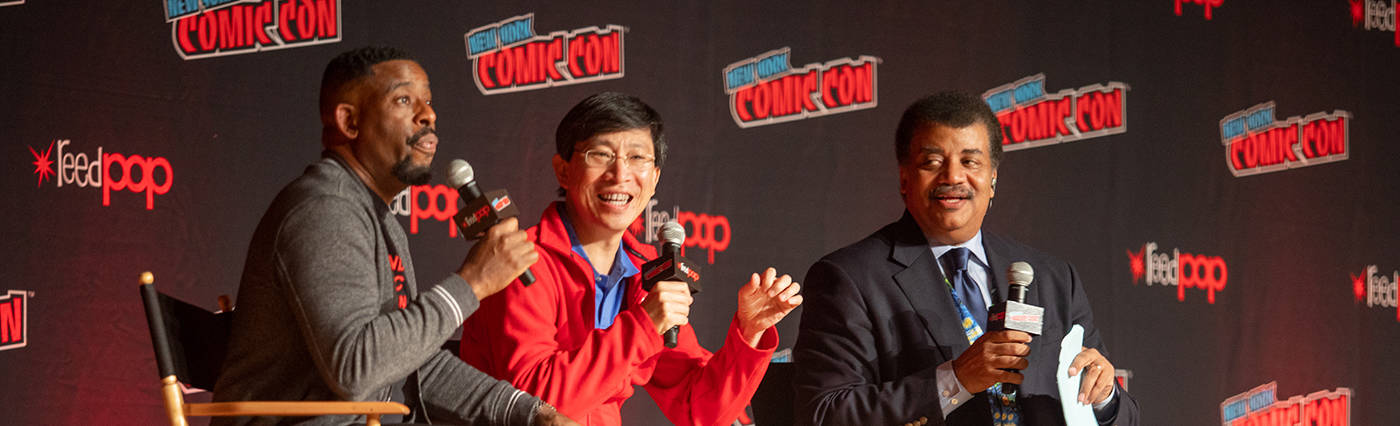
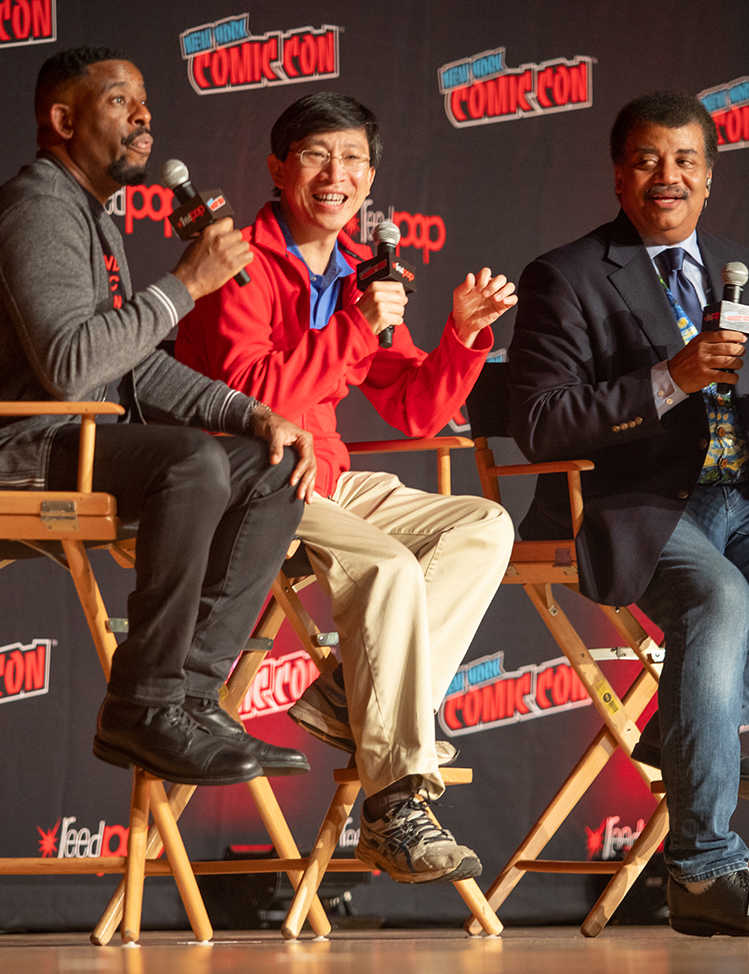
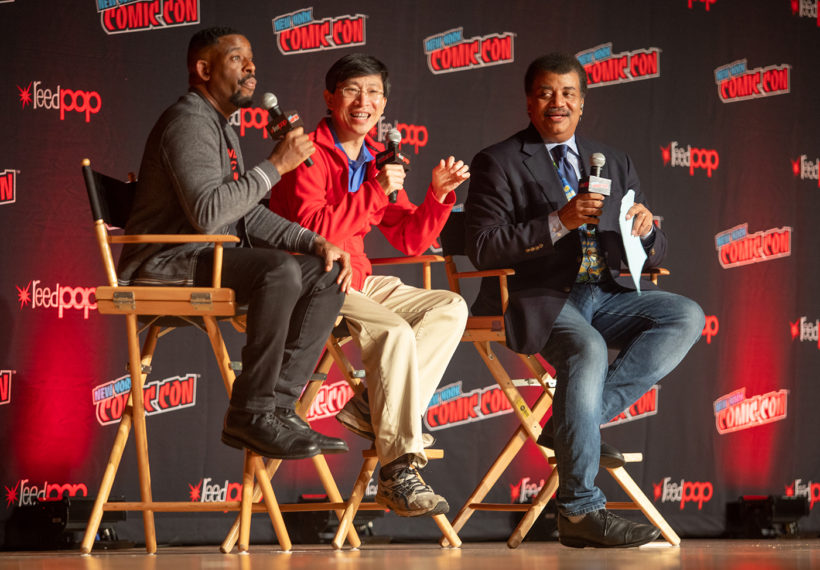

Knightmare6’s photo of Chuck Nice, Charles Liu, and Neil deGrasse Tyson onstage at NYCC 2019.

StarTalk Live at NYCC 2019 with Neil deGrasse Tyson

Chuck Nice, Charles Liu, and Neil deGrasse Tyson onstage at NYCC 2019. Photo Credit: Knightmare6.
  • Free Audio
  • Ad-Free Audio

About This Episode

On this episode of StarTalk Radio we’re coming to you live from New York Comic Con 2019! We have returned to opening night of NYCC once again to explore the science of comics, sci fi, and pop fiction. Our intrepid host Neil deGrasse Tyson is joined on the main stage in front of a packed house by comic co-host Chuck Nice and astrophysicist and StarTalk geek-in-chief Charles Liu, PhD, to explore everything from Star Wars to virbranium to flying through space.

We start with the building blocks of all comic books and science fiction…literally. You’ll hear about some of the most notable fictional elements that are responsible for the powers and stories of some of the most popular superheroes. Find out how much Thor’s hammer would actually weigh if forged in a dying star. We explore the lore of Wonder Woman and the science behind her bracelets. We investigate the history of vibranium. Dive into the controversy surrounding Iron Man’s suit being powered by palladium.

Next, you’ll learn more about the classic sci fi techniques of getting around the universe as fast as you can. Discover more about warp drives: how they work, why the ship is actually moving in a “bubble,” and how warp drives add to the scientific authenticity of Star Trek. Then, we switch over to Star Wars. We break down their constant jumps to light speed. Charles and Neil air out their grievances with some of Star Wars’ science inconsistencies – especially involving X-Wings and TIE fighters. However, discover why they praise the inclusion of a double sun on Luke’s home planet of Tatooine. 

We stick in the realm of Star Wars as our trio ponders the portrayal of alien life in science fiction. We discuss why a lot of aliens look humanoid. But on the flip side, we debate whether aliens must look humanoid in order for them to be relatable to the audience. We ponder the exploration of exoplanets and Neil tells us that if you find a place with oxygen in the atmosphere, you might find life. Lastly, you’ll learn why E.T. the Extra-Terrestrial might be a vegetable. All that, plus, Neil ends our evening at NYCC with a moving reading from his new book Letters from an Astrophysicist. (Warning: Adult Language).

Thanks to this week’s Patrons for supporting us: Heidi Ritzel, Sydney Reising, Andy Green, Michael Brown, Victoria Delpiano, and Cesar Alban.

NOTE: StarTalk+ Patrons and All-Access subscribers can watch or listen to this entire episode commercial-free.
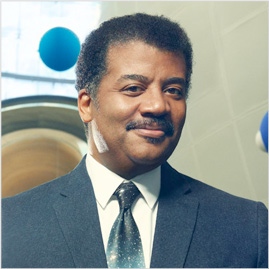
Transcript

DOWNLOAD SRT
From the American Museum of Natural History in New York City, and beaming out across all of space and time. This is StarTalk, where science and pop culture collide. 2019 New York Comic-Con. We're back! All right, we're gonna do...
From the American Museum of Natural History in New York City, and beaming out across all of space and time. This is StarTalk, where science and pop culture collide. 2019 New York Comic-Con. We're back! All right, we're gonna do some Comic-Con stuff tonight. I promise you, the theme for this evening is the science of pop fiction. And we have two scientists, myself included, and from the StarTalk stable of experts, we have our resident geek-in-chief. I'll introduce him in just a moment. But first, let me get my co-host, Chuck Nice, Chuck, come on out here. Alright, Chuck Nice, go take a seat. And next up, we have a friend and colleague. He's an astrophysicist at the CUNY system, based in Staten Island. Come on up, Charles Liu! Charles, what was that about? I'm just so excited to be at Comic-Con. New York Comic-Con is the best. It really, really is. Yeah. Comic-Con rocks, man. So we've got three segments. The first one will be devoted to the topic of fictional elements. Ooh, what does that even mean? Well, like antimony, arsenic and luminum, selenium, hydrogen and oxygen, nitrogen, rhenium. Those are real elements. Yeah, we're talking about fictional elements. You didn't win anything, man. So, Charles, what role do fictional elements play in the world of comics? Fundamentally, of course, there are only a certain number of elements. Like any of you count the ones that we have been able to create in the laboratory, 100, 120, 120-something, right? But we always have to... That means everything in the universe is made of 120 things. But we always have to have something that makes someone be able to fly or stretch or run really fast. So it's got to be an element of some kind, right? Really they're compounds. Most likely they might be alloys, they might be metals, but don't worry. Elements are good. But in the comic books, they generally, whatever they are, they're not common, they're rare. Yes. And they have special properties, like I said, that they want. Usually they're strong in some kind of way. Yes. Okay. So one of the early one of these is Thor's hammer. Uru. Uru. Is that how you pronounce that? Do you have to say it like you're taking a dump? Is that part of it? I'd rather like to think of it as the Norse, Norwegian, stately, god-like Asgardian, Uru. Oh, that was convenient. So, it's an Asgardian dump, okay. Okay, so Uru is a fictional element. They don't have a lot of vegetables. Asgard. Wolverine's claws? What are those? Adamantium. Adamantium. Another element. And Wonder Woman's bracelets? Feminum. Feminum? Feminum. Wait, wait, wait, wait, wait, wait. That sounds malformed because elements should end in I-U-M except for aluminum. All the others are I-U-M. Feminium. That should be feminium. Well, maybe if you're in Britain, right, because you pronounce aluminum, aluminium, so this is feminium. I'm with Neil on this one. Feminium sounds so much better than, what's it called? Feminum. Feminum. Feminum. They're from Paradise Island. What do they care how we pronounce it? This is true. I'm just saying, you know, feminum sounds like something that you would use to, you know, get rid of like male toxicity. You know, it's just like, ladies, is your man an a-hole? Well, the feminum name. So it'd be like a perfume. Yeah, you can either spray it on or give it to them in a pill. You know what I mean? Try new feminum. Well, the term feminum came originally from a two-part episode called The Feminum Mystique in the original Wonder Woman television series from 1976 to 1977. Featuring a young 20-year-old Deborah Winger, three-time Academy Award nominee as Wonder Girl. Wonder Girl. Jusilla. Yes, Diana Prince's fictional younger teenage sister. Wait, Academy Award or Emmy Award nominee? She was nominated for three Academy Awards. Deborah Winger. Officer and a General. Officer and a General. No, Linda Carter, regrettably, has not yet been nominated for an Oscar. Hey, man, let me tell you something. If I didn't know and love you as much as I do, I would think you would have an unhealthy obsession with Wonder Woman. Given what he knows about the situation. Guilty as charged. It's awesome. So tell me more about the bracelets. Theoretically, the bracelets were originally a symbol from the ancient Greek days. This is based on the Wonder Woman sort of creation anthology back in the 1930s and 40s. She's Amazon. Yeah, she's Amazon. But these bracelets were a symbol that they were subservient to men, that they had been captured by men, they were enslaved by men. But what happened was when Paradise Island was established and broke free, Aphrodite, the goddess of love, made them indestructible and a symbol of the great abilities and powers of women, specifically those Amazons on Amazon. So turn it back on its head. That's right. Right. And so what happened was that now they are bulletproof and they were able to deflect bullets. And if you're skilled enough, you can block weaponry and so forth. And the pilot of the original Wonder Woman TV series, which I still can't find on reruns anymore. If any of you have a copy, let me know where I can get one. There's a scene where she is trying to make money because money was not something she was used to. And she got on a stage and she was knocking away bullets. People were shooting with handguns. And then some little old lady brings out a Tommy gun, like a sub machine gun, and starts blasting. And he's like, I can't find it anymore. Wait, wait, a little old lady is trying to kill Wonder Woman with a Tommy gun? With a sub machine gun. What the hell? What episode was that? The pilot, the first two hour series one. And you wonder why they bought it, please. I mean, I would have... Wait, wait. The first time I saw it... A little old lady picked up a Tommy gun to kill Wonder Woman. Well, not so much to kill, but yes, to kill. She was a Nazi agent. And the whole point was that... She's a Nazi grandma? Grandma Nazi. Remember that the original Wonder Woman series was set in World War II. It was a historical fiction. So what happened was that this character, okay, Wonder Woman, Linda Carter, needed to make money. And so she was a stage personality, a impresario. Like Spider-Man. So that she could demonstrate people bought tickets, paid money, so that she could stop bracelets and have them watch it. And then some old lady came up and said, I'd like to try. And she came up and she had a violin case and she opens it up and it's a sub-machine gun. Before you know it, she's a high-heeled law. And it was like, well, we do this and then she said, oh, you can't do this. And then Wonder Woman says, she's not afraid. And she goes, brrr, and she's do-do-do-do-do. I still can't find it. Good. After all these years. Because I don't know what would become of you if you found that. I have a bit of physics observation to share that only came to me in this moment. It's not good enough for the bracelet to be bulletproof. You have to be faster than the bullet to put the bracelet in the way of the bullet to block it. Right. If you're that fast, you could just step to the side. Yes. Right. Yes. I'm just thinking. There are two good reasons that you don't have. First you killed Pluto, now this? Really? I'm just saying, why stand in the middle of bullets when you can pull a Matrix thing on it and do one of these? There are two good reasons not to dodge, although you can do that, yes. One is that you protect the people behind you. But not the people on the sides. Everybody behind you is great. And that was the second point. Just like in, let's see, the Phantom Menace, it was, when it was first introduced that you could use your lightsaber to deflect blaster shots and use them as weapons against the people that were firing against you, you can now use those bracelets to attack. In Defense of the Jedi, when they use a lightsaber, they don't just deflect it, they send it back to where it came from, thereby rendering the shooter... Wonder Woman... Isn't that what he just said? Were you paying attention 14 seconds ago? I have a very short attention span. One other bit of physics about blocking bullets, handguns wouldn't, but a rifle shot is actually supersonic typically. That's right. So if the bullet is moving supersonically, your hands would have to be moving supersonically as well to intersect them typically. So each hand would leave a little sonic boom behind. And so they didn't do that. So they missed an opportunity. That's true. It could have been real science. That's all. I am sure they're losing sleep. We got to move on. Charles, tell people why metals are generally strong things. Because so many of these fictional elements are metals of some kind. That's true. So what is going on inside the atom and whatever lattice it's in that makes them strong relative to rocks or anything else? Well, that's a complicated question, of course. All material science. The question was easy. It's the answer you're saying is complicated. That's a good way to put it. That was an easy question. Material science makes it very hard. Metals are essentially, you think of them as many, many atoms that together work together to form one atomic-like structure. That's why, for example, they conduct electricity really well. They do those kinds of things in general. But within metals, there's a lot of variation, right? And that's why alloys are very important. So for example, copper and tin are both very soft. If you actually have tin foil, right? We use aluminum these days, but copper and tin are very soft. But if you can smelt them together, then you create bronze, which is actually very hard. And so the whole concept of the Bronze Age, right? Where for more than a millennium of human history, the fates of entire civilizations and cultures were determined by whether or not you could get tin and copper together to make bronze. It was all about whether or not you knew metallurgy well enough. And the Hittites were very important also in smelting iron. Metallurgy? Yeah, metallurgy. Metallurgy. Metallurgy, okay. Oh, I see where we're going with this. Okay, I'm just trying to... I didn't know what you said. So, I have to like translate it. Metallurgy. Metallurgy. Metallurgy? Metallurgy. Like I said, metallurgy. Okay. He's got Palladium in there. What is that? There could be some very serious Iron Man fans out there that do not like that rea... See? They're banding together now. No, no. Iron Man is cool. I have no problem with Iron Man. It's the Palladium part. Okay. So Palladium is one of the elements on the periodic table. Yes, yes, yes. And this requires a little bit of history, okay? Back in the 1960s when Iron Man was first created, the suit acted like a defibrillator or a heart helper because he had that shrapnel in his heart. So it wasn't on this arc, whatever, right? But actually, he occasionally would actually have to sit down in some room and plug in his armor chest plate, like into the wall, in order to forget to get recharged enough to keep his heart beating. That is awesome. Okay, that was in the 60s. In the 80s, Marvel Universe, this is based on the Marvel handbook of the 1980s, officially his armor was solar powered. He actually had perfected an industrial strategy where you could put like little mini microbe-sized solar panel chips into the armor, which allowed him to charge from the sun and allowed him to have the superpower that way. That's brilliant. Yeah, that was really cool, right? But now there's Palladium, and the reason that came about was in 1989, two scientists in America claimed, based on their experiments, that they had developed cold fusion through Palladium. You remember this, Neil? I remember, and the stock price went through the roof. Right. Palladium futures went crazy, but what happened was they were trying to do these, what we now call... Oh, wait, just a quick... So cold fusion, normal fusion takes millions of degrees to slam nuclei together, which are positively charged. You want to overcome their electrical repulsion because positive rejects positive. Right. Opposites attract positive, the same repel. So if you can do this on a tabletop without requiring a million degrees, then you can produce energy by not having anything start out to be hot at all. So the claim was palladium was one of these ingredients that... Hans Bethe in the 1930s, who won the Nobel Prize for this, figured out that you could do nuclear fusion when you got so hot, not because it was so hot that it could overcome the electromagnetic pulsing, but you could create the environment for something called a quantum tunneling reaction that would allow two protons to come together and become a deuterium nucleus. Now what happened was that these folks... And I think Buccaro Bonzai, he tunnels through the mountain, doesn't he, in his car? Yes, yes. Do we agree on that? Yes. Yes, yes. Absolutely. But what happened was that the palladium folks thought that they could create this quantum tunneling effect in palladium at room temperature. Okay, or close to room temperature, instead of having to go to millions of degrees. And so they thought they did it. Sort of palladium-107 becomes palladium-103 plus a helium-4 plus a little bit of extra energy or something. For the next five years, huge amounts of time and energy and money were invested in trying to reproduce that experiment, and it never worked. So finally, by the mid-90s, people decided that this really wasn't mainstream. This was just an unfortunate accident or something that they did. Did anyone ever look into how much palladium these two dudes owned? I do not know. But the answer is there are still plenty of people in the world today who think that there might still be something to that cold fusion thing. Nowadays we call that low energy fusion reactions or something, LEFR research. And so that's why palladium still holds a little bit of interest in the sort of fictional world of trying to create power, something from nothing. So let's go straight to particle accelerators. If you're going to make an element that you don't happen to have handy, so what do we do? We take an atom and we bombard it with lots and lots of neutrons. And in the proper circumstance, one of those neutrons will stick or a few of them will stick and then you create an environment where the new element is born because neutrons will transform into protons through specific processes having to do with the weak nuclear force. So basically, in principle, we can make any element we want. So the whole dream of alchemy is real today. It is absolutely real. It's just not economical. Yeah. We could make gold out of lead, but it's cheaper to just go buy it at the corner gold shop. And I will mention that to this day, astronomers, we think that the best manufacturing of elements comes from stars. When for example, a star goes supernova, the elements surrounding it are bombarded with so many neutrons, sometimes thousands of neutrons per second, that there are possibly quantum tunneling reactions that can happen that will create elements with atomic numbers in the 150s, even in the 200s, only they don't stay around in our universe for very long. They decay almost immediately. So let's go on to Thor's hammer. Again, he's still constipated. Yes, without a doubt. On the hammer. So I just want to say that when I saw the Thor movie, the one that has Natalie Portman playing an astrophysicist. You say that like you're angry about it. No, no. I'm just letting people know that my people, my profession shows up in movies. I'm just saying. Right on? Really? In fact, there was an astrophysicist in Top Gun. Kelly McGillis was an astrophysicist. I don't know why, because she was an expert in the F-14 planes, and none of us are. But she was an astrophysicist. I'm just saying. Well, you know, listen. I'm waiting in danger zone. Nicolas Cage was an astrophysicist in the movie Knowing. In the movie? Knowing. Okay. Knowing. It really should have been called Not Knowing, actually, if you saw the plot. But so we out there. So anyway, I'm watching the movie, and I'm thinking, gee, I wonder how heavy the hammer is. And there's a scene where his father talks about Moudiniere, the name of the hammer, right? And says that there it is, forged in the heart of a dying star. And I said, I got this. It's made in a dying star. We know dying star, we astrophysics people. So, I went home, got densities of the densest dying star. So I got a pulsar, dense pack neutrons, and I said, I'm going to make Thor's hammer out of neutrons. So I got a replica of his hammer, measured the volume, figured out how many neutrons you could fit in it, and then I tweeted how much that hammer would weigh. And I said, if Thor's hammer is made of neutron star material, as implied by legend, it would weigh the equivalent of a herd of 300 million elephants. Yeah. That's all. No, if you take the hammer like that and you dropped it, it would fall through the earth as if it were not there. Cut all the way through the center of the earth, come out the other side, and then come back and oscillate back and forth, ripping out the interior guts of the earth as we rotated. It would not be cool. So, then, you must know that what I'm about to say is true. Wherever you think you are in the geek spectrum, wherever you, if you think you are at the top, there is someone at Comic Con who knows more about it than you do, okay? No matter who you are, it is like a semi-infinite continuum of expertise. And that's why I love Comic Con. What a great place. Within 36 hours. Yes. That's just a terrific place. Within 36 hours, somebody tweeted back, okay, Dr. Tyson, you are wrong about Thor's hammer. It's 356 billion elephants. I was apparently really wrong. Really wrong. So apparently they cited a Marvel Comics trading card from the 1990s that said Mjolnir is made out of fictional material Uru, and it weighs exactly 6.2 pounds. 6.2 pounds. So, I'm saying, I like my answer better. Yeah, but your hammer, you can't use it to actually do anything. Well, except for can't. Wait, wait, I'm not done, wait. So, so, okay. So, I mentioned this one time, and I had like a super fan in the front row, and it said 6.2 pounds. Did they say on which planet it weighs 6.2 pounds? We are not worthy of that. We can find the planet where the 6.2 hammer weighs 300 billion elephants. And then HGTV tweeted, is it a ball peen hammer or is it a regular hammer? Just saying. What can you build with this hammer? So here's the problem. I thought it was made out of neutron star material, but that's not what he said in the movie. He said it's made in a neutron star, in the field of a dying star. And then they captured that in the... Infinity War. Oh, the guy, that's right. Infinity War. With that whole contraption. They used the power of the neutron star to forge the... So, let me end this first segment. End this first segment. Tell us about Vibranium. Vibranium. Yeah. The black element. What? What? What? Vibranium was introduced in Fantastic Four number 52, which came out in 1965. Why do you know this stuff? How do you know? Easy, he's making it up. No, this is the wrong audience to make that stuff up. That is so true. Yeah, you are right. It's a thing. Okay, go. So go ahead, Fantastic Four number 52. I own Fantastic Four number 52. That's why I know. So what does it do? It's a beat up old copy. It smells all moldy. It's not worth anything. What does Vibranium do? This is Comic Con. This is Comic Con. Don't you share the love of a beat up old 1965 comic book. Tell me about the properties of Vibranium. Originally, when it was designed, Vibranium was just able to absorb any kinetic energy. In other words, it just magically dissipated. So any impact on Vibranium made it as if it were never there. That made it like Kevlar. Yes, but better. Okay. I mean, so good. Vibranium. Right. And in fact, the Super Society of Wakanda, which again, was introduced at this time in 1965. I mean, Stan Lee and Jack Kirby were so ahead of their time, right? This super society in the middle of Africa. But at that time, the Black Panther was not spiritual in the sense that he is now that he has like the powers of the ancestors and so forth. He was just so well trained and so smart that he was a superhero and he had great technology and he was really talented in that way. But he had problems with this guy named Irving Klaue, who had killed his father in a much more elegant way than it was done in the movies, although it was okay in the movies too, I guess. Am I right that the movie Black Panther had two hobbits in it? Hobbits? Yeah. You mean from Middle Earth? I think I'm right there. I missed them. Yes. Okay. Now you can't just do that, you can't be dropping hobbits in the middle of Black Panther and then just try to go on with the show. How the hell are there hobbits in Black Panther? Well, it's the actors who played hobbits. Oh. Every night. That's different. Yes. That's different. Okay. What about second breakfast? They're taking the hobbits to Iceland. Tell me about Vibranium. So Vibranium later on was actually mixed into Captain America's shield from the 1980s. So it was a mixture, an alloy of Vibranium and adamantium, which made it even stronger than pure adamantium, which is what Wolverine's claws are made of and Ultron's body, et cetera, as you well know. So modern, modern Vibranium, as done in the Marvel Cinematic Universe, right at the very beginning it's claimed as the world's hardest metal, right, the world's strongest metal. It turns out that the strength of it is completely secondary to this amazing ability for it to absorb kinetic energy. That's what made it special. So Vibranium is cool, but it was not because it's hard, but because it's literally soft power, the ability to take whatever it gets and be able to spread it out and produce this both marvelous technology and also incredible weapons of war. If that ain't a black man, I don't know what is. So it doesn't just only absorb it, it keeps the energy and you can do things with that energy later. As evidence in the movie. Energy storage device. Yes. Okay, very cool. Is there anything on earth that we know of that actually can mimic that in some way? In any way? The storage battery. Yes. That can take kinetic energy, turn it into potential energy and then put it back out. Yeah. Rubber ball. Right? You know what, man? You ain't have to be a a-hole about it. You know, I'm just saying. I'm going to end the first segment on the a-hole comment. You are participating in StarTalk Live New York Comic. StarTalk. We are back, New York Comic Con 2019. Chuck Nice, co-host. Thank you, sir. Tweeting at Chuck Nice Comic. At Chuck Nice Comic, sir. Excellent. Charles Liu. Hello. Do you tweet? At Chuck Liu, C-H-U-C-K-L-I-U. So you're both Chucks? Yeah, but he's the real Chuck. No, no, no, we're both Chucks. Yes. We're like two Chucks. That's how many Chucks. We knew somebody was going to do it in a second, you know. But this is how many Chucks it takes to Chuck that wood, sir. All right, so let's talk about how you get around the universe. Oh. Oh, God. Let's talk about how you get around the universe and the technologies that empowered it. So we've got obviously the warp drive. Oh, yeah. OK, and so just to put some reference frame here, if in Star Trek they did not have warp drives and they were constrained to just the speeds that we currently achieve with our fastest rockets. These are the ones that don't even have people on them, right? The fastest rockets, it would take them 100,000 years to get from our solar system to the nearest star system. About 100,000 years, which greatly exceeds the life expectancy of human physiology. Unless you travel at almost the speed of light, in which case everyone else would die, but you'd be just fine. So that's enough time. So what is Warp 4372? Everyone on Earth is dead. Picard will never die. How is it that in the series, he's 50 years old, but had the body of a 25-year-old, speaks with a British accent, but had a French name? What's that? What is that? That is the beauty of Jean-Luc, baby. No, no, today we would call that cultural appropriation. No. No. If you do it respectfully and if everybody is together in peace and harmony like they are in the 24th century, I don't consider it appropriation. That's a cultural harmony. Are you waiting for the 24th century? We'll find out. So, what is going on in a warp drive, in a warp speed? Most of you probably know better than we do. But basically, the dilithium crystals create a reaction through the warpnase cells which creates a warp bubble which allows the object within the bubble to travel through what's called subspace, which is a sort of a higher dimensional construct that our space-time lives in, allowing us to travel from one point in our space to another point in our space faster than light would be able to travel that same speed. But you're not really traveling faster than light. You're within this little warp shell. That's the authenticity of the science of Star Trek. Right, yes. The only problem is, of course, then you have to be able to communicate in subspace. Subspace communications, presumably if you're sending a radio signal, that's traveling at the speed of light. And if you're traveling faster than the speed of light, you get there before Uhura tells you there are Klingons on the starboard bow. That doesn't work so well. So they had to create this subspace communication thing, too. That would get there faster than they would during warp speed. Right, so... Otherwise, you beat the signal and what good is that? Exactly. So that's not talked about very much, but it's a big deal. No, it's not. Okay, so how would you contrast Star Trek faster than light travel to Star Wars faster than light travel? Yeah, I'm making you do that. Number one. Okay, Star Wars travel... One is number one, the other is number two. Maybe number seven. The situation with Star Wars travel, right? The overall Star Wars light speed jumps and so forth, unfortunately, there's a lot of inconsistency in how Star Wars moves from place to place. You think? Star Trek purposefully made this warp bubble thing to make things as causally reasonable as possible. For Star Wars, I think they just punted. It's really hard to imagine a way where you can, for example, fire a planet killer, for example, in one solar system, send it all the way to another solar system instantaneously, pass a third solar system as you're watching it go by in the sky, and then destroy five planets in a fourth solar system, right? It's just, I mean, how are you getting there, that fact? People complain when I talk about movies that way. Oh, yeah. I mean, I'm sorry. And look, we are not even going to talk about the Kessel Run. Don't get me started. Hold me back. Not even going to talk about the Kessel Run. They make a mistake calling time a distance, and then they double down on it in sequels. Well, okay. Did the Kessel Run in 30 par... How about that? Twelve parsecs? Oh, my God, we really are at Comic Con. It's under 12, so it's 11 points. Under 12. Yeah, we did it in under 12 parsecs, which is a unit of distance. Yes. I'm angry. No, let's skip this. No, I'm not even going there. No, here. I'm old enough, because I'm older than both of y'all, to remember seeing Star Wars in first run, episode one, which became episode four. Yes. When he jumped to light speed, that was freaking awesome. No one had done that before. And you had the blur of the stars like, whoa. And then when the first Star Trek movie came out, then they just copied that. Because they didn't do that in the series. That's right. Oh, they did better than that. They wound up with the wormhole effect. Yeah, they thought it up a bit. But just the visual effect. So I give them that. You know the only other scientific fact I'm going to give Star Wars? What? The Luke sees the double sunset. Because we know astrophysically that more than half the stars you see in the night sky contain at least two stars in orbit around each other. Some are triple star systems, some are even more. And that was never portrayed in fiction. But you know the problem with Tatooine's double star system? If you take the geometry of the sunset and where those stars were, the temperature that they obviously do, Tatooine and so forth, and you watch the planetary orbit, that orbit would have been unstable. Tatooine would have been ejected. I'm going to tell you something. It's so funny. When I was watching that scene, I felt the same way. No, no, Charles. I was like, there's no way that's a sustainable gravity... No way! It's not. No, no, but Charles, I thought about that. And I thought that they'd look close enough in the sky so that that planet's orbit would be sufficiently far that it wouldn't go into a chaotic spiral out of control. I'm going to tell you right now, if George Lucas were here, he would kick you both in the testes. But it was beautiful. And in fact, there was an Astrophysical Journal article written around 2005 or so called Two Suns in the Sky. And that was an early attempt to do a census of stars and exoplanets that had double star systems. That was actually a very, very good paper. What about the what? Oh, triple stars, quadruple stars. Yeah, they exist. They're plenty. You just have to be orbiting really far away. Otherwise, as you orbit, your gravitational allegiance continually changes depending on which star you're closest to at any given point. And that can wreak havoc not only on the stability of the climate on the planet you're on, but also on its very orbit. And when an orbit goes unstable, it'll either fall into one of the stars or get ejected from the solar system entirely. And in fact, if you do simulations of the formation of solar systems, you can give a solar system like 40 planets and it'll settle out over time, kicking planets out, eating other planets down to some stable set of planets. We think our solar system with its eight planets might have had... Don't even... Don't even get me started here. So all I'm saying is it may be... Oh. That there are more planets, rogue, moving between stars than there are in orbit around stars themselves, ejected from the formation. The formation process of solar systems themselves. Homeless planet. That's correct. Hi, I'm Sarah McLaughlin. You know where the rest of the bit goes. We don't have time for it, but... Our astronomical technology has gotten to the point... One last thing about those planets... Where we can actually see these interlopers coming through the solar system. You may have seen the news that a second such asteroid-like product, an interstellar object, they're calling them, ISOs, coming through the solar system at a weird angle, and we can watch them go by, sometimes even just for a few days, but they certainly exist. And so I expect to see many, many more of those as the years go by and our technology improves. And another interesting thing, they could actually possibly have life, because we know on Earth, Earth still has retained heat from its formation and their life forms thriving on geochemical energy at the bottom of the ocean where they've never seen sunlight. So if you have a rogue planet, there could be an entire biosphere beneath the surface that cares not a whit that it isn't orbiting a star. Yo, that's dope. That is dope. Charles, at our next conference we have to say, that's dope. Right after a fancy talk about that. We're gonna end that segment and go into our third segment. Time to give a shout out to our Patreon patrons, Heidi Ritzel, Sydney Reising and Andy Green. Thank you guys so much for helping us make our way across the cosmos. And if you would like to support us on Patreon, go to patreon.com and do so. This is StarTalk. New York Comic Con 2019. All right, we got to go there, Charles. No, anywhere but there. Yeah, it's... No. We have to explore whatever science we can find in Star Wars. Okay, so how about, but let's give it a scientific grounding. Let's talk about the planets that they find them on. So there'd be exoplanets we're looking for, as well as aliens that they encounter. Like the famous bar scenes. Exactly. So what's your judgment of how well they did the aliens in that? Aside from the fact that almost all of them have two arms, one head and two legs and one torso, they did a pretty good job. They're actors that have to get a paycheck. Yeah, yeah, yeah. It's really hard to do otherwise. Although with digital technology, now what's his face? Jabba the Hutt has a tail, right? Right. So yeah, they're doing better and better. I think more and more people are recognizing that alien life forms are not limited by the imagination that we human beings have. The panoply of life that could exist is far beyond our own imaginations to be able to imagine them. Well, I would make a stronger statement than that. If you look at other life forms on Earth, most of it does not look humanoid, with a head, two arms, two legs. Earthworms, oak trees, octopoids. I said that right. Most life on Earth looks less like humans than the aliens in the bar scenes of Star Wars. That's right. Well, in Star Trek, The Next Generation, we're talking about Star Wars right now. Oh, sorry. But in the Season 7 episode, The Chase, Okay, go. In the Season 7 episode, The Chase, they sort of tried to explain why maybe every humanoid species looks humanoid, right? There's a species that predated all of us, that seeded all of Earth's planet. So they're self-aware of how unimaginative their aliens were. And they backed into an explanation for it in ways that no one would have ever thought to do for Star Wars. But you know, for Star Trek, the Andorians were very clever. Well, I'm sorry, we're talking about Star Wars, aren't we? So, tell me about the exoplanets that they land on. Why is it that no one ever needs a spacesuit when they land on a planet? I think it's because they're so capable of going at their purported light speed thing to anywhere in the galaxy at any arbitrary speed that they can just find enough planets that everyone lives perfectly and they don't have to have spacesuits. They don't need to go to the ones that they need spacesuits for. Why would you? Yeah, there's no point, right? Yeah, it's like... You can pick and choose, is what you're saying. Well, here's something that I thought was true and I later learned wasn't. Oh. That you can find a planet that has nitrogen, oxygen, atmosphere, so you don't need a thing. And you realize, no, it's not that planets have this random combinations of gases and you find the one that you could survive on. We have oxygen in this atmosphere because we have life. Yeah. So if you find a place with oxygen, given our current understanding of things, it probably has other life there as well. That's right. So... That's a great point. That's actually a really good point. Right, right. You're not looking for planets at random in that regard because oxygen is chemically unstable. So if you have stable oxygen, it means it's constantly being regenerated. The stuff that pulls out, others get added to it. Great point. So can you muster any other thing about Star Wars? Star Wars science? Well, X-Wings, they can't fly. They just can't. Wow. TIE fighters, they can't fly either. Wait, wait, plus, if TIE fighters are moving in the vacuum, why do they need wings at all? Well that's the point. Because they love the pool. Wings are completely useless in the vacuum of space. But I think that what we're seeing in that environment is that the propulsion systems in Star Wars have somehow tapped into something that's not in our galaxy or universe, but maybe a force of some kind that we don't really understand. That might allow things that otherwise could not fly to fly. But what force that could be, I just don't know. I don't know. I don't want to force that explanation too much. You don't want to be too forceful about that. So a couple other things, if you're moving through the vacuum, your ship will not bank a turn. That's not how you turn in a vacuum. And I'm not even commenting on all the sounds and explosions in space. That was good. I bet you'd do Wookie really well, too. Now do a wookie banking through space. Let's give it up for this guy. That was awesome. So Charles, what I think happened there is, with the aliens, is that anything that sort of looks a little different from human that's not from Earth, it counted as alien for so many decades in people's imaginations in science fiction. Give it a third eyeball, or give it an antennae, or make it green. Or look like a gorilla. Yeah, just put some other feature on it, where it's intelligent, but clearly not human, and that's to satisfy people's need for how different an alien might look. The otherness of what was on the screen, what mattered, not so much... Or sometimes it's the familiarity of what's on screen. I mean, when you look at the abominable snowman that tied Luke up in the snow cave, that's just an abominable snowman. That's not like, you know, an alien. Like, seriously, it belonged on the island of misfit toys with a dentist. With Rudolph, yeah. That's a really good point. The idea that aliens in movies have to be different but not so different as to be unrelatable to us. That's a great point. If on the ice planet Hoth, Luke Skywalker were dangled by some amoeboid-like thing, I guess we wouldn't feel so scared of it, right? Wait, wait, wait. So, I agree with you but I don't agree with you. So, in other words... That means you don't agree with me. No, what it means is you are right. The alien has to have something you can relate to, otherwise you can't relate to it. Like ET, right? ET even spoke a little English, okay? Both of you all scare me sometimes. Did I tell you that ET is actually a vegetable? Did you know this? Because it can turn plants. So, that accounts for why it has such a good relationship with plants. Because it touches a plant and the plant grows. Now, someone said, what? What? Can I tell you how I know this? Please. Okay, not just... Okay, Steven Spielberg visited my office. And we talked about ET. And I said, look, the thing is, it's got two arms, two legs, fingers, a head, eyes, nose, mouth. It's human. And so, actually, he conceived it to be a vegetable. That is Steven Spielberg communicating directly to me. First-hand knowledge. For what? First-hand knowledge. You can't get more first-hand than that. That's right. But wait, would that mean it'd be moral to eat ET? No, no. So would a vegetarian eat ET? That's the question. Well, he's sentient. Many years ago, there was a comedian named Paul Mooney. I remember him. And he used to do a joke. He was like, ET, he better be glad he didn't show up in the ghetto. They would have put him in a pot of greens and ate his ass. Thanks for. We've got to end it there. Join me in thanking Charles Liu, our resident geek-in-chief, Chuck Nice. I've been your host, Neil deGrasse Tyson, your personal astrophysicist, and as always, I bid you to... Let's try this again. And as always, I bid you to... Thank you, all 14 of you, who knew that. Thank you. If I may take liberties, may I read a letter to you? If I may. Thank you. Ha ha ha! Ha ha ha! Ha ha ha! Oh, thank you. You remembered. Thanks for watching! I don't know why they planned Comic Con on my birthday. I don't know how they did that. So at the risk of sounding like it's a shameless plug, I have a book coming out on Tuesday. It's called Letters from an Astrophysicist, and it contains correspondence I've had over the years with the public on all manner of very personal, private things that I just never talked about on YouTube videos or on shows such as this. And you've never seen me debate a creationist, for example, or a ufologist. I never. They're in here, okay? I have conversations with them in this book. Someone asks, is there a large hairy ape wandering the Pacific Northwest? I engage that person in this book. Three letters are from prisoners. One who's serving time and he won't be able to watch his kids grow through their teenage years, wrote to me and said, I just learned that they like science. Is there any advice you can give me that I can share with them to reassure them that I still love them? I mean, it's so, there's some heart-wrenching stuff in here. What I want to do is read to you the epilogue, if I may. It's very personal, but... So the epilogue. I know, I might. There's some demanding people out there. Read it! Don't do this! Read! Damn, y'all. Okay, I got to put on my old people glasses, so hold on. Did I have them? Because I'm an old fart. I'm probably 60% gray, and it's all tinted now, because it's like... Yeah, in a couple years, I'll come out all gray, and I'll be with y'all. I see some gray folks out there. Right there. Okay, I'm with you. By the way, Neil, we call that hair color. Hair color? All right. Epilogue. A eulogy of sorts. A letter to dad. Saturday, January 21st, 2017. Based on a eulogy I delivered to friends and family here in New York City at the Holy Trinity Catholic Church. Dear dad, thank you for a lifetime of wisdom you've bestowed upon me, drawn from moments, circumstances and incidences in your life. With your permission, I'll share a few of that which for me rise above all others. I've never forgotten the story of your high school gym teacher who highlighted your body type as one that would not make a good runner in the track and field unit of class. Your reaction? Nobody's going to tell me what I cannot do with my life. You immediately took up running. You also ran in Hitler's Berlin Stadium for the 1946 GI. Olympics. The post-war world was not ready for a traditional Olympics, so this special event contested soldier athletes of the various theaters of conflict around the world. And by college, you became world class in middle-distance races, at one time capturing the fifth fastest time in the world for the 600-yard run. Drawing upon that example for inspiration, I have overcome the most negative societal forces on my life's ambitions. I have never forgotten the story of your best friend Johnny Johnson, also a track star, competing in a meet against the New York Athletic Club. In the day, they of course admitted only wasps. So athletic blacks and Jews instead competed as teammates for the Pioneer Club. Founded for that purpose. As Johnny came around the last turn in the quarter mile, he was ahead of the New York Athletic Club runner by several strides when he overheard the fellow's coach audibly yell to his runner, catch that nigger. Johnny's reply to himself was simple and direct. This is one nigger he ain't gonna catch. And lengthened his lead to the finish line. What today might be called microaggressions, back then were parlayed into forces of inspiration to excel. From that example, I've used such occasions in my life to excel beyond even the expectations I held for myself. You told of immigrant grandma's work as it's seamstress. Grandpa's work is a night watchman for the food service company, Horn and Heart Art. A good thing because he would occasionally bring home leftover food when the money was tight. Your stories of strife were never hate-filled, never bitter. Instead, they were hope-filled and inspirational, conveyed with tentative confidence that the arc of social justice will continue to bend towards righteousness. I carry that vision for society's future into every day of my life. You studied hard in school and took your interest in social justice all the way to your appointment as Mayor Lindsay's Commissioner of New York City's Human Resources Administration. Journalists don't write articles about news that does not happen, but the programs you enabled in the inner city empowering the youths during the powder keg years of the late 1960s ensured that any unrest or disturbance would be mild. Sure enough, New York was calm compared with what went down in Watts, Newark, Detroit, Cincinnati, Milwaukee, and especially in Chicago, Washington, DC and Baltimore, for which federal troops were called in to quell the violence. You worked behind the scenes on this with your only reward, the quiet knowledge that the nation's largest city did not burn during the most turbulent years of the most turbulent decade in American history since the Civil War. Striving to do what is right without regard to who takes notice should be a model for us all. Your stories and perspectives have got navigating people, politics, funding streams, and the legacies of institutions deeply informed my successful efforts to create from whole cloth a brand new department of astrophysics at the American Museum of Natural History. You taught me that in life, it's not good enough to be right. You also must be effective. For that, I now count the formation of that department as one of the highest achievements of my professional career. So dad, this thank you is simply public notice of what I have already thanked you for in life. Bestowing upon me guiding principles for living my life to the fullest and along the way, when possible, lessening the suffering of others. I know I will miss you because I already do. Cyril deGrasse Tyson, rest in peace, October 1927, December 2016. So, listen all, we love you. Comic Con, there's nothing like a Comic Con community, a Comic Con audience, where the biggest fight anyone gets into is whether your cosplay was authentic. And if the world were run by Comic Con attendees, it would be a peaceful place, and we'd have technology taking us into the future. Yes, it will be. Who would have ever thought that the geek set, who was pummeled and bullied in school, would become one of the most strongest economic forces of the land, as well as the people who everyone else comes to, to fix their computer. So, I just want to say the Comic Con community is a very special community. I don't want any of you to forget that. Surely you won't. Thank you for indulging me in this letter to my father. He was 89, so his death was not tragic. But I miss him, as we miss so many loved ones who have passed. But you can tell, if you speak of a loved one, you bring them back to life. And this is part of what it is to carry wisdom, insights, and love from one generation to the next. Comic-Con, thank you, have a good night.
See the full transcript

In This Episode

Get the most out of StarTalk!

Ad-Free Audio Downloads
Priority Cosmic Queries
Patreon Exclusive AMAs
Signed Books from Neil
Live Streams with Neil
Learn the Meaning of Life
...and much more

Episode Topics