


 Unlock with Patreon
About This Episode
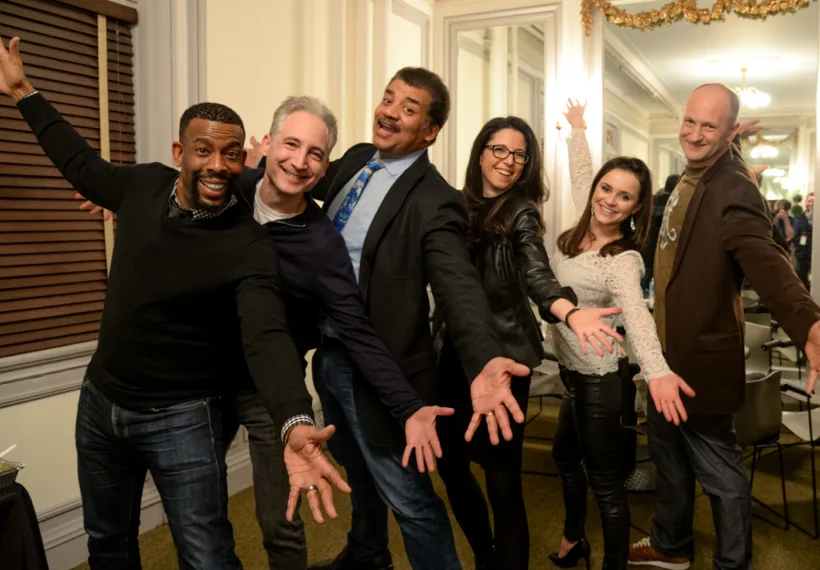
Science really is everywhere. On this episode of StarTalk Radio, we bring you the first part of StarTalk at BAM – Science is Everywhere. Back in March, we had a great time at the Brooklyn Academy of Music highlighting the shows under the StarTalk Podcast Network banner. In Part 1, you’ll hear StarTalk Radio and StarTalk All-Stars. To start, Neil deGrasse Tyson is joined by comic co-host Chuck Nice and theoretical physicist and author Brian Greene to discuss the early universe. You’ll hear about the “Cosmic Dark Ages” and what we know about the first stars born in the universe. Discover more about the Big Bang, string theory, and time on a universal scale. Then, rapper and science communicator Baba Brinkman freestyles a rap about the show that just happened. Next, we put a cap on StarTalk Radio and move right into StarTalk All-Stars. Neil hands the hosting baton to neuroscientist and All-Stars host Heather Berlin as she leads us in a discussion about the intersection of neuroscience and physics. We explore free will: our current neuroscientific understanding of it and if physics has anything to say about it. Come back next week for Part 2 to finish the StarTalk All-Stars segment and to enjoy our presentation of Playing with Science.
NOTE: All-Access subscribers can watch or listen to this entire episode commercial-free here: StarTalk at BAM – Science is Everywhere (Part 1).
Transcript
DOWNLOAD SRTWelcome to StarTalk, your place in the universe where science and pop culture collide.
StarTalk begins right now.
Brooklyn in the house.
In the house.
Welcome.
Can everybody hear me?
Welcome.
Did you hear that?
There you go.
Brooklyn in the house.
This is.
Thanks for coming out and giving us your Friday night.
This is a special presentation of StarTalk, StarTalk at BAM.
And in this presentation, you’re gonna get three versions of what our StarTalk franchise is all about.
The first one, lasting 30 minutes, is StarTalk.
StarTalk flagship, all right, where I am the host and we have special guests talking about special topics.
We then go to another 30 minutes featuring StarTalk All Stars.
And that’s where we have a cadre of counterparts to me who are experts in other fields of science.
And they each have their own sort of radio show with a comedian, similar format, but they get to do it their way.
StarTalk All Stars, you’ll get a sampling of that for 30 minutes.
And then we will end with one of our favorite new franchises of StarTalk, StarTalk Playing with Science, which is all about the science of sports.
And tonight we’re gonna talk about the physics of figure skating.
And we’ll get back to that in a minute.
Right now we will begin StarTalk at BAM.
I’ll bring out my comedic co-host, the one, the only Chuck Nice.
Come on out!
Oh, man.
This is my man.
I’m Seve, it’s good to see you.
Very cool.
And so, tonight, we’re gonna talk about the physics of the early universe.
And I realized, this whole event was introduced as a radio love fest, but he didn’t say it right.
He said, a radio love fest.
Yeah, you gotta do that right.
Yeah, exactly.
I think you just made the universe pregnant.
Love fest.
Let me introduce a colleague and a friend, one of the smartest people on earth, theoretical physicist, Brian Greene, everybody.
Everybody.
Ready.
Brian Greene, best known for sort of popularizing concepts like String Theory and the Multiverse.
You just made String Theory pregnant, man.
Your best selling author, The Elegant Universe, a beautiful book.
Give it, that person read your book.
Right there, that person read your book.
I know the rest of you are just posers.
So that was followed with Fabric of the Cosmos?
Yep.
A beautiful book.
Hidden Reality was a third book.
And then you are co-founder of the World Science Festival.
Co-founder, it’s a bit audacious to call the World Science Festival.
Well, we’re gonna call it the universe, but you know, pulled it back to world.
No, it’s just great.
It’s a World Science Festival held in New York.
That’s just, I’m just saying.
Also in Australia, so it is world in that way.
Okay, all right.
And co-founded with your wife.
That’s great.
Very good.
You’re a smart man.
How to keep that marriage going.
Yeah, there you go.
So Brian, there was recent news of the earliest star ever formed in the universe.
So were you on top of that story?
Been following it, yeah.
Yeah, because what we know from, as astrophysicists, is you get the Big Bang, got that, okay.
Then you have the Cosmic Microwave Background, got that.
But nothing’s formed yet.
You gotta make stuff that you can recognize in modern times, and there’s this long period, hundreds of millions of years, where nothing is happening.
And so we call that the Cosmic Dark Ages.
Gotta say it right, dark ages.
And let me hear dark.
Dark ages.
You give them a B plus?
So the dark ages before the first stars had formed.
So there was the hunt, the eternal hunt.
Can we find that first star?
And a recent news announcement said what?
Well, there’s now evidence that those first stars may have formed about 180 million years after the Big Bang.
And it’s hard to find them because they’re not actually sitting out there waiting for us to see them directly.
You have to find an indirect test to see their presence by virtue of their impact on their environment.
And in a very clever experiment, that’s what was done.
And how did they do that experiment?
Well, you mentioned the cosmic microwave background radiation, right?
I think, I mean, just people know what that is.
It’s just here, yeah.
No, I mean, even if, listen, because, you know, there are some people like at home listening that may not know.
So, you know, I’m just saying, you know, for their sake, maybe you should tell them.
Okay.
So, this is heat left over from the Big Bangs.
The Big Bang is very hot.
As the universe expands, it cools down, but the heat doesn’t disappear.
It’s still there.
And indeed, we can see that heat coming to us through powerful satellite-borne telescopes today.
Now, that is a fantastic discovery in its own right that won the Nobel Prize in the discovery of the microwave background radiation.
But now imagine this.
It’s won the Nobel Prize twice.
That’s true.
Yes, absolutely.
Yeah, the initial discovery and then the final version.
I got to tell you, that’s very good.
The same thing just like five years later.
Oh my God, that was so…
We should give it to him again.
Give it to him again.
Right.
So, no, it was a bad-ass thing we found in the universe.
Yeah.
Okay.
And it was found by mistake.
Oh, so you do know about this.
Man, you said mistake before I did.
Oh, I didn’t mean to.
So, yeah, so, so how, so how did the, the Cosmium background tell us this?
Well, the, the theory was that when these initial stars formed, they would be very large, much larger than the sun and very hot.
And they would have emit a lot of ultraviolet radiation.
And that radiation would have had an impact on the environment.
A lot of hydrogen around it would have ionized the hydrogen.
Why does that matter?
When you cause the hydrogen to change in that way, it has an impact on the microwave background radiation that otherwise would have passed through it.
Passed through it with no incident.
With no incident.
And now it’s been perturbed.
That’s right.
Now actually some of it gets absorbed, which means when we look out, there should be missing parts of the spectrum that are being absorbed by this hydrogen, which itself is being affected by these early stars.
So we’re not seeing the stars themselves.
We’re seeing some kind of smoking gun of the stars.
Yeah, we’re seeing a shadow in some sense of the stars.
Oh my God.
It’s just like the Russia investigation.
So Chuck, I didn’t tell you, the reason why we have such Big Bang expertise is because we have both independently appeared on The Big Bang Theory.
That’s true, actually.
Actually, I was only on once.
Were you on once?
Only on once, yeah.
Oh, they didn’t invite you back?
No, they didn’t.
Yeah.
Welcome to my world.
But I thought you did really well.
I thought you did really well.
No, I’m so not an actor, and I depend on people allowing a little latitude for that cameo, non-actor delivered lines.
Yeah.
You know?
You say, okay, they’re not really an actor, but we’ll let it slide.
You were good.
Well, thank you.
And plus, Sheldon gave both of us a hard time.
He did.
Right.
He told me that I should give up physics and consider reading to the elderly.
But he said, don’t read your own books to the elderly.
Yeah, he was pissed off that I was an accessory to the demotion of Pluto.
Of Pluto, yeah.
Yeah, he said Pluto was one of his favorites.
And you told him to get over it.
Yeah, to get over it, yeah, yeah.
Yeah, but he’s scripted to just get angry.
So he just got angry.
Yeah.
Yeah, I couldn’t rely on a natural response.
That’s because he’s not real.
So, so Brian, so this early star, does it tell us something backwards towards the Big Bang that we should know about?
Well.
Because you’re a Big Bang guy.
Yeah, it does.
I mean, the curious thing is that the signal is stronger than the theory predicted.
So the signal’s there in the sense that you’ve got this missing part of the spectrum.
So you have people saying, what would a first star look like?
Let’s map it out.
Now you compare it and now we got something stronger than that.
That’s right.
So that means you gotta go back and recalculate what?
You’ve gotta tweak the theory and people are suggesting that dark matter may play a key role.
We gotta tweak.
Tweak.
Yeah.
Right.
So I don’t know what he’s cooking up, what he just tweaking stuff.
But the tweak also kind of spilled over into the dark matter.
So I’m not sure what this means.
I don’t know what either of you are talking about.
Okay, so what of the Big Bang do you have to tweak in order to allow our hypothesis to match the observation?
Well, it may be that the dark matter interacts with ordinary matter in a way that differs from the conventional description.
This is very speculative.
We’re right at the beginning of this kind of experiment.
At what point do you say I need to tweak my theories?
At what point do you say I need to throw out my theories?
Well, that’s the art.
That’s the art of science, you know?
And some people criticize scientists for sticking to theories long after the data seems to suggest that they really need to move on.
People say that even about string theory.
They’re wrong.
But yeah, so it’s an art and it’s a personal choice.
I’ve to his face, just to be clear, because I’ll say this again publicly, but I did really say this to his face.
When I asked Brian, I said, Brian, I remember y’all, I’m that old, from the 1980s.
String theory was being born.
And I said, wow, this is great.
A new understanding of the universe, general relativity, married with quantum physics, a marriage that Einstein died trying to find.
How soon will you have this?
Said, we’re about five years out.
About five years.
About five years, and then 10 years later, another five years.
And then 10 years after that, just another five years.
I’m consistent.
So then it’s like the year 2018.
Brian, how about-
About five years, I’d say, something like that.
How close are you to this?
And it’s like, so then I said, so Brian, why?
He said, well, it’s a hard problem.
So then I said, or every one of you working on this problem is an idiot.
He did.
I said that to his face.
Brian, I’m going to go with hard.
At what point do you, I said that, you know, jokingly, at what point do you say, we’re simply not smart enough to even answer the question we ourselves posed?
Yeah.
Or do you just say it’s hard?
Because Einstein figured out general relativity basically by his lonesome in 10 years after he had special relativity.
Yeah.
And you got how many dozens of you guys?
And.
Yeah.
For 35 years.
Yeah, yeah.
Well, look, I got to tell you, the reason I accepted to be on the show tonight is.
I’m finally willing.
No, here’s the situation.
If we were not making progress, then I wouldn’t need you to tell me to give it up, right?
I don’t believe in reincarnation.
I think you live once and I don’t want to spend my life working on a theory if I really don’t think it has a promise to reach the goal that we have set for ourselves.
So you’re honest with yourself.
Totally honest.
We have so much in common.
I don’t believe in it because I don’t want to be a turtle.
No, you said I don’t believe in reincarnation.
For some reason, I think I’m coming back as a turner.
Went like this.
Yeah, yeah, yeah.
And you’re the astrophysicist.
Because they got it.
Where’s the thing?
They did not get that.
Did you not get that?
I was thinking…
Stupid people unite!
No, I was thinking…
The turtle was a reference to sort of the Hindu…
On the back of an elephant.
The elephant standing on turtles.
And his turtle is all the way down.
See, that’s why you got doctor in front of your name.
Where were we?
I know exactly where we were.
I know exactly where we were.
What I’m asking you, as a theoretical physicist, leading theoretical physicist, we have an observation, an astronomical observation, and it forces you to go back and reas…
tweak…
You’re tweaking Big Bang?
You’re tweaking quantum physics?
You’re tweaking, what are you tweaking?
Well, in this particular case, you really are tweaking something that we yet don’t understand fully, which is dark matter.
So that’s right for being tweaked.
But look, there are all these things.
Dark matter is like mysterious gravity of the universe.
We have no idea what’s causing it.
But I’ll give you another example, which has happened recently, right?
There have been measurements of the rate of the expansion of space.
And those measurements, very recently, are seeming to be incompatible with earlier measurements done in a different way.
This had a whole other recent result.
A whole other recent result, exactly.
And this one, if it’s correct, this is one that could really change our understanding of the early universe dramatically, right?
In order to get the measurements that are done on the expansion of space, looking at the microwave background radiation, and those that are coming from looking at supernova explosions, to get those compatible right now is gonna require perhaps tweaking the dark energy.
It may require tweaking our understanding of the gravitational force.
I mean, there are many things that may come into that particular reconciliation.
Our understanding of the gravitational force itself.
Yeah, I mean, whenever you talk about dark energy, right?
Everyone knows what dark energy is, yeah?
Well, I’m just saying some people at home may not.
Right, so this energy filling space that we believe yields a repulsive gravity that’s causing the universe to speed up in its acceleration.
When it theoretically should be slowing down.
That’s right, ordinary gravity pulls things together, it should be slowing down.
The shock that we got in 1998 is that it’s not slowing down in the rate of expansion, it’s speeding up.
Against the wishes of gravity.
And well, here’s the thing, we didn’t understand gravity well enough.
Gravity can not only be attractive, it can be repulsive.
And that really wasn’t taken into account until about 1998 when it comes to cosmology.
Now the possibility is maybe this outward push is itself getting stronger over time.
And so that means thinking it was one thing would be an incomplete understanding of that phenomenon.
Yes.
And that’s what science is.
Which would actually change everything.
But that’s what science is.
Which is why you have to tweak string theory.
Yeah.
So if it affects gravity, then every moment of our models from the Big Bang forward would have to be rethought, put back in the computer, say now what are you going to give me with this new understanding?
Literally.
Because these equations are so complex, there are so many features that come into play that you have to put it on a computer and simulate and see what happens.
Okay.
So now, does that affect any thinking of what’s going on before the universe began?
Well, I mean people play with those sorts of ideas, but it’s hard to know if that question even makes sense, right?
It makes sense to say what happened before you were born, what happened before the earth formed, those sorts of phenomenon certainly were preceded by something else in the universe.
But the Big Bang may have been not just the beginning of the universe as we think of it as stuff, it could have been the beginning of time itself.
This past Sunday, we aired my interview with Stephen Hawking.
Went to the dude’s office in Cambridge.
And I asked him what was around before the Big Bang.
He gave an answer and nobody understood the answer.
Yeah.
So now, you check it out if you don’t get it.
I have no idea what he was saying.
What was he saying?
I have no idea.
I haven’t seen the podcast.
You got to watch the show.
Yeah, I will.
You didn’t prep me on this one.
All right.
Allow me to explain what he was saying.
You can give me two or three ideas that people have about what preceded the Big Bang.
Absolutely.
Whether or not they’re your idea.
Yeah.
I mean, one idea is that the Big Bang may not have been a unique event.
There may have been many Big Bangs giving rise to many universes.
We are one of those.
And we’re just one of those.
Sort of like a cosmic bubble bath of universes.
And we’re just one bubble expanding in that larger landscape of reality.
If that’s the case, then our Big Bang was not the beginning of everything.
It was just an interesting event that we hold dear because it gave rise to us.
But there would have been a time before it that wouldn’t have been any more exotic than the time now.
A time measured by some methods we have yet to divine.
Because every method of measuring time exists within this universe.
That’s right.
So the notion of a time going across all of the universe is a very difficult idea to make mathematical sense of.
Like a meta time.
A meta time of some sort.
But people don’t fully appreciate.
But that wouldn’t be time.
It wouldn’t be time as we experience.
That would not be time.
You’re absolutely right.
You’re absolutely right.
So in this universe, the fact that we can say that the universe has an age of whatever, 13.8 billion years, is only because our universe is highly symmetric.
You look at one chunk of the universe over here and another chunk over here and on average their properties are the same.
If that weren’t the case, there would be no notion of time across even our universe.
Because of this symmetry of appearance, you’re saying, we can justifiably say we are all experiencing the same age of this universe.
That’s right.
But if we looked over there and stuff was being born and over here stuff was dying out of proportion, we would be forced to say there’s not one coherent time across this space-time continuum.
Right.
You see, because Einstein, as we’re all familiar with, taught us that if you’re moving, time ticks off at a different rate.
If you’re near a black hole, time ticks off at a different rate.
Right?
So you should ask yourself, when people say the universe is 13 billion years old, according to which clock?
Right?
If those clocks are moving or if they’re near a black hole or a strong gravitational field, they’ll tick off time at different rates.
And the way we get out of that conundrum is what you’re saying.
The overall uniformity means that on those clocks that are experiencing basically the same physical conditions, they’re going to experience time the same way.
I love your clock pantomime.
I love it too.
Now I know why they do it, man.
So we got to land this plane.
So two final questions.
So if we’re asking what was around before the Big Bang, you say maybe there was this bubble bath, the Big Bangs, then that just pushes that question a little further.
What was around before the bubble bath?
Or it may push it infinitely far back.
That’s a possibility.
Turtles all the way down.
So it could be turtles all the way down.
But the other idea that does come out of string theory initially is that maybe our universe is a slice of space floating in a larger cosmos, right?
Higher dimensions of string theory allow for that freedom.
So our universe is like a slice of bread and a big cosmic loaf that may have other slices, which would be other universes.
I bring that up because there’s a theoretical description.
I’m going to ignore these guys.
We were good at that.
I got you.
With this, the bread loaf universe.
Exactly.
And there’s a way of describing the Big Bang where it’s actually arising from the collision of these two universes.
It’s not even called the Big Bang or it’s called the Big Splat, right?
So it’s a little more evocative way of thinking about it.
In which case, before the Big Bang, before the Big Splat, would just be these two giant sheets of space slamming into each other.
And they create a yet a subsequent Big Bang.
That’s right.
It’s a cyclic universe.
It happens over and over and over again through these collisions.
So then what’s before our Big Bang?
It would just be an era of the universe similar to this potentially, but was just a different part of the cycle.
So therefore, and my last question to you, the very distant future universe, where we’re accelerating, at whatever rate it is, does what you’re saying now affect that very distant universe?
It can, absolutely.
Because if, for instance, we’re talking about a cyclic universe…
No, but my slice of bread is getting bigger.
Your slice of bread is getting bigger, but that other slice may be coming toward you.
So a trillion years from now we may get hit again and be completely obliterated.
How will we know if another slice of bread is coming towards us?
That’s the thing, we won’t.
All I know is I am hungry right now.
Well, Brian Greene, thank you for totally fucking with our heads here.
Thank you.
It’s phenomenal.
So we’re going to wrap up this part of the show before I hand the baton over to neuroscientist Heather Berlin, one of our StarTalk all-stars.
And while she comes out, but before that happens, we are going to have a special musical interlude.
Musical interlude.
We are going to have a special performance by Baba Brinkman.
Baba Brinkman, come on out!
All right!
Baba, you’re a science rapper.
I am a science rapper, as such things do exist.
That’s a thing.
It’s a thing now.
You will demonstrate that now.
Let’s all hope so.
Baba Brinkman.
All right.
They gave me one song to demonstrate that science rap exists.
And all this physics stuff is gonna mix with neuroscience, and pretty soon we’re gonna start talking about free will.
And as a rap artist who’s been at this for over a decade, you gotta get into freestyle.
So I’m about to do a freestyle interpreting a lot of what was discussed for this last half hour.
And I want you to think about this.
Either every word they said and every word I’m about to say was predetermined since our Big Bang on our slice, or there is some kind of free will possible.
Hit it.
Now, I’m from Western Canada.
When I was a young rapper, picturing myself on MTV.
This is the rap I always pictured myself kicking.
Listen to this lyric.
It isn’t freestyles written.
I wrote it of my own free will.
It was my decision.
Every intimate constituent, part of it was deliberate.
I considered how to script it and how to stand in deliberate.
I wanted to get up on stage and do a lot of damage and talk about how all the universes were like a big sandwich.
And I could just step up here and do some things that are drunk on beats and find out why astrophysics makes people feel hungry.
That was forethought, but that doesn’t mean nothing comes before thought.
Look at the source of your thoughts.
You might find the doors blocked.
If every decision is made in a part of my brain that’s invisible to me, that’s well, but with a subliminal origin, I’m not thinking it’s too free.
See, I break it down.
I show you the freestyle basics.
You can’t see me.
All you can see is the imprint of my radiation.
It’s only strong when it’s used.
Well, I could stop.
I could stop if I want.
The question is, why would I wanna stop?
I could stop, it’s just not recommended.
At least not till this song is ended.
Thanks for watching!
Thank you.
Well done.
Okay, so that was a piece from an off-Broadway production.
I’m doing hip hop theater, very inspired by Hamilton.
It’s called The Rap Guide to Consciousness.
And it’s all neuroscience, cognitive, psychology.
And you’re performing that tonight.
You gotta leave here tonight to perform that.
The show starts in 45 minutes.
Well, get the hell out of here at the Soho Playhouse.
Soho Playhouse, hope y’all can come see it.
Thanks for having me here, I appreciate it.
All right.
Thank you, Neil.
That guy is my favorite rapper now.
Jay-Z, suck it!
I ain’t never heard Jay-Z say anything about his prefrontal cortex.
There’s some good vocabulary running down there.
Oh man, that was serious, man.
Just to be clear, he did that in rehearsal, and 5% of it was the same.
The rest was completely invented in that moment.
What’s the dude talking about, my mustache?
See, he knew better than to do that in rehearsing.
So our next segment is gonna be StarTalk All Stars, where I take a back seat, and we bring on the host, one of our many talented StarTalk All Stars, neuroscientist, Heather Berlin.
Heather, come on out.
So, Heather, it’s your show.
Okay.
Go for it.
All right, Neil, you can take a back seat, and I’ll…
Yeah, I don’t think so.
You don’t know me very well, Brian.
So, welcome to StarTalk All Stars at BAM.
I’m your host, Heather Berlin.
I’m a cognitive neuroscientist.
I’m based here in New York at the Mount Sinai School of Medicine.
So, Neil, Brian, thanks for being my guest tonight.
And we’re gonna…
And Chuck, forget about you.
You’re just ingrained in my mind.
We’ve become one.
We’ve become…
Chuck, my co-host, for bringing all of the wonderful scientific insights and comic relief.
Thank you for being here.
So wonderful of you to study.
So we’re gonna talk a little bit about the intersection between neuroscience and physics.
Talk a little bit about consciousness, time and free will.
So we’re just gonna keep it light.
Light and easy.
Free will.
Not free willy, right.
Free will.
It’s not that kind of show.
We are gonna…
You know what’s funny?
I was thinking that.
And I was like, nah, I better not say it.
I told you, we are one.
You’re like my subconscious that I just kind of try to keep at bay, but it keeps coming up.
That’s a very good plan, actually.
So, actually, Brian, you once tweeted.
You said, free will is the same.
Wait, you’re gonna quote a tweet of mine in front of this guy over here?
That’s like saying I play baseball in front of Babe Ruth, right?
It’s like saying I write music in front of Mozart, right?
Your tweets matter.
Your tweets matter.
Free will.
All tweets matter, yeah.
Not all tweets.
Not all tweets.
Blue tweets matter.
Okay, so you said free will is the sensation of making a choice.
The sensation is real, but the choice seems illusory.
Laws of physics determine the future.
So.
I had to say that.
You.
You were compelled.
It was determined from the Big Bang.
What does physics have to say about free will?
Well, it’s not definite because we don’t fully know the laws of physics, but the laws of physics that we currently have at our disposal have no opportunity for intercession by human will, right?
I mean, we are a collection of particles governed by laws that you can write down and fit on a t-shirt.
And those laws don’t at any point in the evolution of the particle say, hey, can you like, tell me now what to do person?
They just determine the future based upon what things were like in the past.
But Brian, can’t there be an emergent property of that collection of molecules that we can call free will?
Just because the emergent property, if you know emergence, it’s a feature of an ensemble that cannot be deduced by the study of the individual.
Like ants.
Like ants.
You study one ant, you say hi ant, you’ll shake your hand, you have no idea that a thousand ants together are going to make an ant mound.
Or a thousand termites make a termite mound.
Where the birds will flock.
You have no way to predict that.
That one ant sounds like Woody Allen.
If free will doesn’t exist at the level of physics.
In other words, if it doesn’t exist at the level of physics, could it not exist at the level of biology or say psychology?
That’s right, so it’s a very good point and it really depends on what your definition of free will is, right?
Normally, the intuitive definition is things could have been different and I could have made a choice for things to turn out differently.
And if that’s your definition of free will, does that resonate with your perspective of free will?
Then I don’t see any way to square that with the laws of physics because anything that you do is your particles executing some kind of motion and the motion of your particles in your brain, in your body have no opportunity to allow you as a conscious being to direct them.
What force could possibly that direction come from?
Is it the electromagnetic force?
Well, that one we understand from Maxwell.
Is it the gravitational force?
We understand that one from Einstein.
Is it the nuclear forces?
Those we understand from the standard model of particle physics.
What force could you possibly exert on your particles that goes against or goes beyond those that emerge from the equations of physics?
That’s the issue.
Could our free will thrive in the probabilistic description of quantum physics?
No.
Not as we currently understand it.
And that’s a natural place.
Don’t make me fight you here on stage.
We’ve done this before.
Yeah, we did actually.
But we both were wrestlers in high school.
Different weight categories.
But so I should have said it’s possible, but I consider it highly unlikely.
So there is a puzzle right now in quantum physics that has been on the table for 50, 75 years.
And we don’t know the answer to this puzzle.
And that’s why I have to couch my remarks with a little bit of uncertainty.
And that puzzle is this.
Quantum theory says that you can only predict the probability of one outcome or another, right?
50% chance electron here, 50% chance there.
Yet when we measure the electron, we always find it either here or there, right?
One or the other.
So how do you go from the fuzzy probabilistic haze of many possibilities to the single definite reality that we all experience in everyday life?
We still don’t know how to bridge that gap.
So within that, if consciousness somehow plays a role in picking out one outcome from the probabilistic haze, then sure, then free will might come for the ride as well.
No, no, no, no.
You just said, you just said probabilistically the particle can be here or there.
Yes.
But if you measure it, it is only in one place.
Yes.
So my act of thought is I want to go, I want a cheeseburger, that’s the particle in this state.
And I’m going to say I want a cheeseburger, bam, the particle is there.
See, that’s the part I don’t buy.
Right there, you see, because-
Why are you poking your foot?
Because it’s random.
There’s nothing that you did to pick one outcome because you wanted it, because you willed it, because it was your desire.
And yet your intuition is you had the cheeseburger because you chose it.
If it comes from a random process, it’s like throwing the dice.
And throwing the dice to get an outcome is not what we mean by free will.
Okay, wait.
You physicists, I’m going to give you a neuroscientific perspective.
Okay, so from a neuroscientific perspective, first of all, what’s happening at the quantum level doesn’t really scale up to whether a neuron fires or not, right?
I mean, that indeterminacy.
But from the experiments that we’ve done, starting in the 80s, Benjamin Libet did studies where he said to somebody, whenever you feel like it, just press this button.
And he measured brain activation.
And he found, and he said, even before they actually press the button, because that takes time to make the movement, just let me know where this little dot is on the clock when you feel the first inkling of the intention of wanting to move.
And then what he found is about 350 milliseconds before a person even had that conscious intention, there was a gearing up of brain activation, right?
So then, leap forward to current times, we do neuroimaging experiments where we can say to a person-
Just so that people know, you measure people’s brains for a living.
That’s my job.
That’s what I do, yes.
I would be no help to you.
So, it’s my unconscious here again.
He’s always buttoning in and, you know, we need you, we need you.
But you can measure it using FMRI, which looks at blood flow to different parts of the brain.
Functional Magnetic Resonance Imaging.
Basically, looking at blood flow as a proxy to neurons fire.
The blood is going to go where the neurons are firing because they need energy.
So we can say to you, okay, just choose left or right, or that hamburger or not.
Cheeseburger.
Cheeseburger.
Cheeseburger.
He chose to put cheese on that burger.
We can say, we can predict up to 10 seconds before you even have the conscious inclination of your intention, which you’re going to go.
Left or right, or cheese or no cheese, right?
So at that level, I like to say, yeah, sure, we have free will, but we’re just not conscious of it, right?
The brain is making these decisions all the time, and we have this illusion of free will.
But the question really is, is why do we have this illusion?
Why did we evolve this illusion?
Is it important?
If we didn’t have it, would it change our behavior?
Yeah.
I mean, it strikes me that it gives us that sense of control that presumably out in the savanna 50,000 years ago, 100,000 years ago, made the difference between surviving and not.
If you’re invested in how things turn out and feel that your decisions can affect how things turn out, you’re more attentive, you’re more engaged.
It’s something that matters to you more and presumably something like that or some parallel story like that suggests why we have this illusion.
So you’re less likely to be eaten.
Yes, that’s the point.
That’s the point.
So you both agree with one another, with each other, that from a physics point of view, it’s deterministic.
You didn’t use that word, but I’m putting it in your mouth.
Okay.
I mean, it’s okay on the radio and live show, but I…
And so Heather, so your results are consistent with his, basically?
Yeah, yeah.
I think from both a physics perspective and a neuroscience perspective, we come to the similar conclusion that it’s an illusion, that free will is an illusion, even though we really feel like it’s not.
And actually studies have been done, which when you tell people that free will is an illusion and you start giving them subsequent tests, they’re more likely to cheat on a math test.
They’re more likely to act unethically.
So the fact that we have this belief, those who have had it actually are better able to survive in the system along the lines.
We’re more likely to behave.
We’re more likely to behave.
However, we also have evolved for there to be cheaters, right?
And they can win.
So if we were all cheaters, no one would win.
But if we all…
I just asked Tom Brady.
And Chuck, he looks so deflated at the end of that game.
He was sad.
So, Heather, let me ask you a blunter question.
Does it even matter that you know this if we all feel like we have free will?
I want to believe that I go to school and get a good job and behave.
I want to believe all that.
Are you telling me I shouldn’t believe it?
That if one day I end up in prison, that was predetermined from the Big Bang?
And wait, just as…
You’re saying yes to that?
But wait, as an addendum to the…
As an addendum to the…
If I kick your ass right now…
That’s it.
That was predetermined…
That it was meant to be…
.
from the Big Bang.
It was meant to be, my friend.
I don’t know how this got so sexy.
Plus, Brian, kicking one’s ass is not a literal sticky sticky.

 Become a Patron