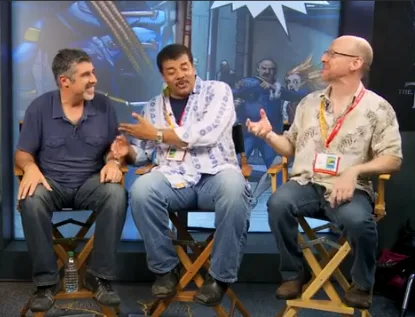
In part 2 of our show from San Diego Comic-Con, astrophysicist Neil deGrasse Tyson, Gadget Gary (Baba Booey of the Howard Stern Show) and The Bad Astronomer Phil Plait turn from gadgets that exist to gadgets we dream about. From Star Trek and Star Wars to Doctor Who and James Bond, the guys expose the coolest fictional technology to the harsh light of science. Could the Starship Enterprise travel faster than light? What would happen if you beamed a person from one place to another using a transporter? What are the practical problems with the lightsabers in Star Wars? Could the Death Star really blow up a planet? How possible are Doctor Who’s sonic screwdriver, psychic paper and TARDIS? And are they any less plausible than James Bond’s vehicular cloaking device or bullet-deflecting magnetic pen? Join StarTalk at SDCC and find out for yourself.
Transcript
DOWNLOAD SRT
Welcome to StarTalk, your place in the universe where science and pop culture collide. StarTalk begins right now. We're back, live StarTalk, San Diego Comic Con 2012. Two special guests. We've got the man, astronomer Phil Plait, friend and colleague....
Welcome to StarTalk, your place in the universe where science and pop culture collide.
StarTalk begins right now.
We're back, live StarTalk, San Diego Comic Con 2012.
Two special guests.
We've got the man, astronomer Phil Plait, friend and colleague.
Phil, love to have you.
Love you, man.
It's great to be here.
Love you, man.
I love doing this show.
Gary Della Botte, tech gadget extraordinaire, writes about tech gadgets for?
Sound and Vision Magazine.
Sound and Vision Magazine, very cool.
For this hour, I just want to talk about gadgets that we still need, not ones that exist today, but ones we wish already existed or we think might be a little just beyond our horizon.
Why not start with some movie gadgets?
Well, I'm gonna jump right off of that.
I'm going right to Star Trek.
I'm gonna ask you guys, seriously, as scientists, what about, say, are we 20 years away, 50 years away, or 1,000 years away from teleportation?
When you're sitting in the LA airport on your way to New York, don't you dream of going in the William Shatner cubicle and teleporting to New York?
Maybe a Patrick Stewart cubicle, but.
Well, so there's a difference.
There's the teleportation room, but all you really need is your own portable wormhole that you can dial in a location.
And then you just travel, and then you don't have to decompose yourself and hope that you reassemble correctly on the other side.
So how do you, where do you get a wormhole?
Well, in Star Trek, they always talk about, but we're gonna convert you from matter into energy, which we can then send off as a beam or something to some other place.
And the problem with that is you convert your mass into energy, that would be an explosion larger than every nuclear bomb on the planet.
That would be bad.
Right, so the energy contained by E equals MC squared and all of its atoms would take out this quadrant of Earth.
Yes, that would be bad.
On the other hand, there is an equation that describes the way you're constructed.
And if you could write out that equation exactly, then I could redefine you someplace else.
The problem is, that's sort of impossible.
Well, if that's the case, then you don't have to lose him here.
You just duplicate him in another place if the equation's defining.
So then you could just, that's essentially a clone.
Unless there's a term in the equation for a location.
Ooh, I don't know.
I'm making this up, right?
That's right, cause he's only himself here at this time and place.
That's gotta be part of the data.
Yeah, space and time and, yeah.
So it's a great writer's tool.
Writer's tool.
That's impossible.
So they don't have to keep landing the ship back and forth.
But it's impossible?
Do you guys feel it's impossible?
Yeah, I hate to use that word.
Yeah, I would say a thousand years or more.
But okay, but it's seven.
Thousand and one, price is right, right?
I go for one dollar.
No.
If in the year 1850, in the year 1850, which is 170 years ago, if I'd have walked up to somebody and I told them that, forget about the telephone and the telegraph and the television and all that stuff, that we're going to have devices where through some weird thing in the sky, we can look at each other and communicate that way, that would have seemed as outrageous as what I just told you.
Okay, so no, no.
If you come a little later, like 1890s, because by then we had the telegraph, and so we knew how to use electromagnetic energy to send information.
And if you said, they will come where all the information in the world will be transmittable in this way, you could essentially extrapolate to that point.
There's no way we can extrapolate to a teleporter.
Right.
That doesn't break the laws of physics or engineering.
But a teleporter, as we understand physics right now, a little dicey.
It's kind of like faster than like travel.
Using a wormhole to create a wormhole and go through it, physics says that doesn't work as we understand physics right now.
Now, Star Trek was what, the 23rd century?
Depending on which one you're talking about.
Yeah, whatever, a couple hundred years from now.
A couple hundred years ahead.
So, what I'm entertained by are the gadgets they had that we invented and now we're beyond them.
The Macintosh disk.
I mean, those little colored disks that they use to spot at them, right?
And I've just been rewatching with my kids from the beginning, the first series, and they talk about storing data on tapes.
And so that itself, we're past.
When I first saw Star Trek, the most unbelievable part of it to me was not the warp drives or the photon torpedoes or the transporter.
It was that you could just walk up to a door and it would open.
I said, well, how does it know?
It doesn't know.
Yeah, but I'm unimpressed by that because a year after that show, they were able to do that at my local A&P.
But they were pressure sensitive.
Pressure or they're infrared sensitive, right?
What if it's a weightless being that is at room temperature and it's just waiting for somebody to walk up and open the door for it?
A weightless being at room temperature would not be able to open the door.
How would the thing detect it?
No, no, no.
The infrared is not detecting your thermal radiation.
I know, it's breaking the...
No, it's just reflecting the light, like your remote control.
It's an infrared absorbing alien.
Okay, right.
I can keep doing this.
Okay, then that alien ain't walking through the door.
But when you talk about future gadgets, one of the things...
I'm okay with that.
One of the things that I...
How come in my house, it never has come to a handprint on the door to open things up or a thumbprint on the door?
I don't see why not.
But why hasn't that gone on?
I mean, the technology's there.
Biometrics, actually.
Yeah, but suppose you eat and can't, you know...
How often do you have to clean the surface of your iPad?
I love those movies where they cut off the guy's thumb and they keep it in the room.
What's the one where they took the guy's eye?
Yeah.
In a baggie?
Yeah, that was nasty.
And for me, I slice my hands up all the time.
I'm a complete clut, so this thing would...
I'd have to actually program it to say, I have blood stain, that must be you.
Do you remember the scene in 2001, the movie, where it's such a romance of the future that as he's coming on to the space station, he has to go into the secure area, says, welcome to voice print identification.
State your name, Christian name first, given name second.
And then he says it.
And thank you, voice print.
And so they took five minutes to just relish in the voice print identification.
By the way, that movie is very ambitious because 2001 came, it didn't look anything like that.
That's exactly right.
Well, actually, AT&T was out of business.
Howard Johnson's was out of business.
Pan Am.
Pan Am, right?
But we did have a shuttle.
But you'll notice on the ship, when they're going to Jupiter, I believe this is true, they had little flat screen computers that sat on.
No, they were in the headrests.
In the back headrests of them.
They were iPads.
But there were some that were sitting on a countertop or something.
And yeah, they look just like iPads.
And it makes you kind of wonder if maybe, Steve Jobs or whatever was looking at that going.
Well, listen, we all had access to the movie.
Yeah, yeah.
Exactly, that's what it takes.
So what else from Star Trek you want?
You want the teleporter, we don't have it, sorry.
I want to figure out a way to not sit in traffic.
How to not sit in traffic?
Move to some place where you don't have to sit in traffic.
I never have to leave my house.
I always had this dream that, like I work in the city and I live in Connecticut.
I always had this dream.
The city, New York City.
New York City.
That I would get in my car and I would hit some buttons and via some sort of magnet underneath the ground or whatever, that I could put my chair back and it would just take me home.
We could do that.
That's not an unimaginable future.
In fact, it can take you faster than you can drive it because a computer can take you faster with greater precision than a human.
And there's no accidents because theoretically, if the grid is being run correctly.
Exactly.
That is just a simple computing power thing, right?
Let's talk more about that because I think Google designed a car that would be undriven.
And when we come back to StarTalk, more on Gadgets of the Future.
Date Line San Diego Comic Con 2012.
I'm Neil deGrasse Tyson, your host of StarTalk.
Today we're talking about gadgets we always wish we had.
Gadgets of the Future.
Gadgets imagined by creative science fiction writers and represented, demonstrated on the unlimited infinite palette of cinema.
And I've got with me the bad astronomer, Phil Plait.
I've got gadget man, Gary, right here.
Gary, welcome to StarTalk.
Thank you.
And so let's talk about Star Wars.
There's all these Star Wars characters walking up and around here.
And Star Wars, they got the lightsaber, they got droids.
Did you have anything, you're a gadget guy, was anything they used that you felt you wanted or should have or you want to invent?
I got to think about that.
There's nothing that's jumping out at me because I'm more of the audio visual stuff.
You know what I did, how about the holographic movie thing?
What would you use that for?
Would you use that to send a message to somebody the way they do in the movie?
I guess so, but remember when they did it in the movie, you didn't actually have to look at them.
It was just an audio.
What mattered was the audio.
Right.
Maybe they were just trying to show off.
I thought it was sort of confirmation that you were actually getting it from the right person.
You know what I mean?
In other words, instead of making a fake audio thing, you could see that it's the right person.
You know, my favorite part of that whole thing.
That's the future equivalent of the ring stamp on the ceiling wax.
Wax seal.
Yeah.
Very good.
My favorite part of that whole thing is at the end you see Princess Leia look because the Empire is coming and she turns the thing off.
And it's like, you know, no time to edit this.
I mean, she was getting away and sending it off.
I think maybe, I guess the Empire was right on her.
But you see that a lot in YouTube videos now.
So they were fairly well ahead of the time there.
Now, one of my issues was with C-3PO, because, you know, he's a robot, right?
But a robot doesn't have to look like a human.
The human form is really poor at so many tasks.
Look at him, he can't even run.
Well, but there are a lot of different robots in that movie, some smaller, some bigger, they've run the gamut.
And I do think that there are some things that a human robot-
A humanoidal robot?
Well, you know, just its functionality with handshaking and the way they hand things to you.
Remember, he's a protocol droid, and most of the aliens in Star Wars are humanoid.
So you want to see something that looks familiar, but doesn't get into the uncanny valley and freaks you out.
So he's vaguely humanoid, you can talk to him, relate to him.
I don't think anything freaks out anybody at that time, given what everybody looked like in the bar.
Exactly.
That's true.
And on the other hand, you know, what's the favorite android, or the favorite robot in Star Wars, right?
Everybody loves R2-D2, which is basically a trash can.
Right, right.
And everybody, well, not everybody hates C-3PO, but he's irritating, it's his character.
So it doesn't really work out the way maybe you'd expect.
All right, what else did you want?
Let's have a look at the lightsabers.
I have issues with the lightsaber.
In fact, I tweeted once about it.
I mean, if it's light, you can't have light block light.
Light is not space filling.
So two lightsabers are just passed through on another.
That doesn't mean we couldn't make it powerful enough to decapitate you, or to punch a hole in you.
It could still be a dangerous weapon, but you wouldn't be able to have a sword fight with two beams of light.
And then someone said, oh, well, it reflects back, and it's got some magic goo in it that solidifies.
But I thought that was a lame comeback.
There's a lot of literature on the web, of course, about how lightsabers work.
And you really would call it literature.
Yeah, yeah, I know.
A lot of fanboy murdery.
There's a lot of encyclopedic knowledge on something that doesn't exist and how it works.
Yes, exactly.
And I always think, well, maybe the name is just wrong.
Maybe they just call it a lightsaber.
It doesn't mean it's made of light.
If it's a force field that comes out and is filled with a plasma or something like that, then they will interact with each other.
But if it interacts with you, it'll slice your head off.
So you can imagine a plasma containing some ingredient that suspends it within plasma.
Or magnetic field or something like that.
Yeah, two magnetic field lines.
You'd have a hard time crossing those.
That's true.
That's true.
Magnetic fields, you know, the lines never cross.
You've never seen a bar magnet with magnetic fields crossing.
With iron filings on it, remember from school?
They always have a beginning and an end, and they don't touch each other at any time.
And if you try to cross these two things, they might repel each other.
And in fact, on the sun...
We may be onto something here.
On the sun, the sun has explosions, flares, and sunspots and all kinds of turbulent activity when the magnetic field that's embedded within the gas...
I don't know if you know, the sun does not rotate as a solid ball.
I mean, it's gas.
But the equator rotates faster than other regions of the ball, so that in fact, magnetic fields that are in the gas wrap up on each other, and they start coiling, and it reaches a breaking point where it busts free from the surface of the sun, and it takes plasma and flings it into space with it.
And so magnetic fields don't like getting messed with.
And so I bet we can work on this.
I'll call an engineer.
I'm getting lost, man.
I'm not gonna lie.
Magnets, how do they work?
Yeah, yeah, it's a magnet.
Magnets, I understand.
So what else from Star Wars?
Well, you know, just any kind of spaceship would be awesome.
To be able to actually go and see these things.
Yeah, there's spaceships that just kind of hover in there.
I mean, I mean, sorry, not the spaceship.
The speeders.
The speeders, yeah, they just hover.
They didn't say how, they didn't say why.
But you know, we have that technology now.
Just the magnetic levitation?
Yeah, the Meissner effect, which is where you have a superconducting magnet, where you actually, you're sort of freezing the magnetic field into two things.
And so you can have a magnet, that you usually have to dip these in liquid nitrogen, and they're really cold, but sometimes you don't have to.
And you can put these two magnets together, and then just let go, and they'll float.
Now, if you try to do that with just two regular magnets, they flop around.
But if you freeze the magnetic field in it, it's like you've locked them together.
And you can actually take this magnet and spin it, and it'll spin in place.
And it is the freakiest thing you've ever seen.
Spin in place just in the air.
Just sitting there, yeah, it's awesome.
And you could actually build a hoverboard or a car that way.
A hoverboard from Back to the Future.
Yeah, so if you had, but that gets very complicated because you're trying to move something.
And it's not always over another magnet.
What happened to the speed of travel?
That's one of the things in the movie.
So we got to a point where we had the SST.
We stopped going faster.
It's hard, expensive.
I'm pissed off.
No, but I know the SST wasn't cost effective, they went out of business.
But I would like to think that we've gotten to a place where we can sort of recreate that in a more cost effective way and a more comfortable.
Remember, I never flew on it.
You know part of the reason why the SST went out of business?
Part of the reason?
It was uncomfortable.
No, no.
It was.
Part of the reason was it wasn't our airplane.
And so we did not allow the Concorde to fly Europe residents at supersonic speeds to the west coast.
We said you cannot fly supersonic over our land.
It wasn't our airplane.
And so all you could do is just cross the pond.
That's it.
And then it takes two and a half hours instead of seven.
But now with the internet on the airplane, I don't even care how fast the plane goes.
That's true, I just watch movies all the time now.
Or I'm writing.
You make an important point, and I'm angered by that because we imagine the future as the time when you would continue ever to go faster and faster and faster.
And we got there and we stopped.
And you know what the natural limit of that would be?
Suborbital flight.
Yes.
Yes, where I was going.
Suborbital flight, here's how it goes.
You're sharing a brain here, yeah.
Here's how it goes.
So orbit takes about 90 minutes.
Space shuttle, space station, 90 minutes to orbit the earth.
That means that you're never more than 45 minutes from any two places on earth.
If a full orbit is an hour and a half.
So wherever you want to go, if you go suborbital, you get there in 45 minutes.
So I want to do a day trip to Tokyo.
That's something I would have liked to have enjoyed today, and we can't do that.
Right.
I would love that, except I would have to get into a rocket and be blasted into space.
But, yeah, you were out 100 years ago there, so I'd have to get into a plane and get blasted into the atmosphere.
Yeah, and riding on planes sucks.
Well, by then, a lot of people died back then.
But again, going back to the whole, again-
But that's a technicality.
Going back to the whole travel thing again, when you travel a lot, like I still want the thing from Total Recall, why can't we just walk past a screen?
Why do I have to stop and put my arms up, do all that stuff?
Why can't we walk past a screen?
You really want to start talking about TSA here?
You're feeling unviolated on this trip?
Mike, so what we need is a device that, here's the problem.
We're in a system where everybody is presumed to be guilty.
But it was like that in the movie, and everybody walked past that screen and you could see what was what.
You saw the bones.
Exactly.
Isn't that kind of what this thing is?
What do you call that machine you're going to?
Yeah, I think it is, but it's ridiculously slow.
My wife says that the reason they're doing this is to get us used to holding our hands up.
So when they come to get us, we'll just do this automatically.
When they come to serve man.
Yeah, exactly.
All right, so I know I'm going to lose you after this segment.
So other than instant travel, is some other handheld gadget you think needs to be invented?
You stump me.
I can't really think of...
I don't have the answer.
Wouldn't you want your own Death Star?
It worries me.
No, the answer is yes.
I want the ability to read women's minds.
Oh, that...
Oh, yeah, that's gonna be good.
That would make social life really efficient.
Have you tried listening?
Have you tried being sensitive?
That's no 1890s.
Well, Gary, thanks for hanging out on StarTalk with us.
It's a lot of fun.
And I'm going to find you again in New York or Connecticut.
I'll find where you're hiding.
Next gadget's coming around.
I want to get a full report.
All right, man?
Excellent.
Thank you.
Take care, man.
StarTalk Radio will be back in just a moment with a conversation with the bad astronomer.
Welcome back to StarTalk, live San Diego Comic Con.
Comic Con 2012, baby.
I got my friend and colleague, Phil Plait, the bad astronomer.
If you're the bad astronomer, then I gotta be the badass astronomer.
But I wanna do that only with your permission.
We need to settle this one of these days, one way or another.
Uh-oh, he's calling me out.
But you'll lose that.
That was audacious of you, that one.
That's like the little dog that just says, with the big bark.
We'll find some way.
In the Star Trek Trivia Contest, we'll figure something out.
We'll find it.
So, we've been talking about gadgets, and, but you took it up a notch.
Over the break, you were talking about whatever gadget it is that could destroy a planet, such as the Death Star does.
Right.
And did you do a calculation about this?
Yeah, it's actually not that hard.
You need a little bit of physics, but basically.
Because what it's doing is, it completely destroys all the material connectivity of the solid object.
Why would you need to do that?
A 10-mile wide asteroid pretty much takes care of a planet pretty well.
It takes care of the surface.
Surface life.
It'd wipe out everything on the surface.
Every living thing on the surface.
And certainly 30 or 40 miles across would do it.
But to completely blow up a planet, that's a terror device.
It's overkill.
Yeah, there's no reason to do it unless you're trying to scare the crap out of somebody.
I mean, it's kind of like a nuclear weapon in today's standards of war.
Yeah.
And it turns out, well, first of all, you don't need to do it.
And also, it's almost impossible.
You could take something the size of Mars and hit the earth with it and not completely destroy it.
To completely destroy a planet, think about it, right?
You've got this planet here and you take a rock and you have to fling that rock off to infinity.
All the rocks in the planet have to get, get, okay.
And look at what it took to get three guys to the moon.
It took this giant rocket.
So it takes a huge amount of energy to do this.
And when you calculate it, it's like more energy than the sun puts out.
It's some outrageously huge number.
So you can't just blow up a planet.
So what you did was calculate the binding energy of the planet.
And if you pump more energy than the binding energy into the planet, it'll explode in the way the Death Star destroys the planet.
Yeah, it's like breaking a stick.
The molecules are bound together.
You snap, unbind it.
That takes some amount of energy.
All right, and so the whole unbinding of the planet, so that's just overkill.
So this is the future.
A lot of other things happen in it that we just accept, including sound and space.
So why don't you accept that their death star can kill a planet?
Well, if it's just trying to like throw a beam at the planet and blow it up, that doesn't work.
But you can think of other ways this might do it.
For example, if this beam actually converts 1% of the planet into antimatter, boom, right?
That's going to blow the planet up.
Antimatter and matter, when you touch them, release energy.
Is that enough?
1% antimatter?
Whatever, some small amount.
Some small percent is what you're saying.
So why not just have an antimatter torpedo?
So then you can blow up a planet.
Why are you telling me you can't?
It still takes a huge amount of antimatter.
I mean, the amount of antimatter we've made in the past few decades.
So 10% of the mass of the planet is still huge.
I don't know the numbers off the top of my head, but you can calculate that, and it's still a huge amount.
Planets are extremely dense objects that want to stay together.
Did I hear you right that you tweet about the Death Star?
Have you been checked out?
Do you know how many people want to read tweets about the Death Star?
If I recall...
So you're tweeting at the Bad Astronomer.
At the Bad Astronomer, yeah.
So tell me one of your more popular Death Star tweets.
Well, in this case, I just said, because I do a daily fact, a BA fact, a Bad Astronomy fact, and today was in honor of Comic-Con, and I just said basically, don't tell Darth Vader, but the Death Star cannot blow up a planet.
And I linked to an article I wrote where I do the calculation, which shows how that works.
In fact, this was written on the sci-fi channel portal called Blaster.
So you get around.
I do, yeah.
Gotta love your blog.
The blog's got a huge following.
This is Bad Astronomer blog.
This is coming from you.
You have a huge following.
No, but I'm not writing.
You've got a decent following.
So on Discover.
Discover magazine.
Discover magazine.
Bad Astronomy blog.
There's a Bad Astronomy blog in their blogosphere.
Yeah.
Right, right.
Okay.
So we have a series of blogs.
There's a cosmology blog, and there's one about current events and that sort of thing, and I do the astronomy one.
But they let me write about whatever the heck I want.
And in this case, I did write an article.
You guys admit.
Oh yeah.
And it was almost in my contract.
I said, you know, I'm going to write about Dr.
Who.
And they're like, absolutely.
Write about Dr.
Who.
Yes.
So you can do these calculations.
And it's a lot of fun.
I mean, you must play with numbers in your head.
I was never attracted to Star Wars to do the calculation.
I am more of a Star Trek guy.
I try to be a little more real than the fantasies of Star Wars if I'm going to put a calculation out there for the public.
Right.
I mean, yeah, you can call Star Wars space opera.
Calling it science fiction may be a stretch, but it depends on how you define things.
I don't want to get into the whole fan war kind of thing.
But if you're going to establish something, the Death Star can blow up a planet.
The Enterprise can move faster than light.
We can beam people from point A to point B.
There is some math you can do with that.
And I know you, and I know that you studied the same things I did when you were in grad school.
And it's fun to play with that math.
It is fun.
It's definitely fun.
I just need...
the funness still to me has to have some connection to what could happen or might happen.
That's all.
I feel the same way, yeah.
Okay, that's good.
So what else in Star Wars got you?
You know, I think the hair bun muffin ear muff technology that was very advanced for this being so long ago and so far away.
The ear muffs.
And you know, there are headphones you can get like that, and you can buy these things.
You can see people walking around with them.
It's awesome.
Okay, so that's something we think the future will never bring.
Probably not.
Well, when we come back in our next segment, I'm here with my special guest, Phil Plait.
We're both here in San Diego.
I'm overwhelmed.
I'm a newbie here at Comic-Con, and I'm a bit overwhelmed.
This is what Comic-Con for you?
You're in my territory now, baby.
This is my fourth or fifth.
I am unworthy.
So, when we come back more live from San Diego.
We're back at Comic Con, StarTalk Live.
I'm your host, Neil deGrasse Tyson.
StarTalk, you can find us on the web, startalkradio.net.
And not only that, StarTalk tweets at StarTalk Radio.
I tweet about stuff that just pops into my head at Neil Tyson.
And there's a Twitter dude right here as well.
My friend and colleague, the bad astronomer, Phil Plait.
Phil, thanks for being on StarTalk.
I've been known to tweet.
I know!
Thanks for having me on again.
In fact, you're up to like 20,000 tweets or something.
You're just out there.
You have a lot more followers than I do.
When you gain followers faster than I do, you got a lot to learn about tweeting per day, my friend.
When you get up to 20 or 30 per day.
Per day, all right.
I'll take lessons from you later.
So we're just riffing on gadgets.
Earlier, we had Baba Booey talking about gadgets he's reviewed, and we took this into the future.
So we're in the future now.
The real or imagined future of gadgets.
Let's talk about Dr.
Who.
Dr.
Who.
He's got a sonic screwdriver.
Love that.
Who doesn't want a sonic screwdriver?
I do not understand the sonic screwdriver.
Well, what I like about it is it does anything he needs it to do.
Open a door.
It's literally a plot device.
Unlock a window.
I mean, I wonder if he walked by a cash machine with me.
Yeah, right.
Oh, they've done that.
Yeah, he's done.
They did it in one episode in a Christmas special to get cash out of an ATM.
That's wrong.
I don't know.
Whose cash was it?
It's insured.
Now, the thing is, that makes sense to me.
You can encode stuff into a Sonic Wave maybe, and it's Gallifrey in technology and interaction.
In fact, it might not even have to be Sonic.
I mean, when that first came out, Sonic was...
They weren't thinking microwaves, right?
Well, they also do talk about a laser screwdriver in a couple of episodes.
The Doctor Who franchise goes back to what, the 60s?
1963.
Fine.
Okay, so back then, they're not thinking microwave transmissions.
I know a lot about Doctor Who, apparently.
I've been watching the show since I was a kid, and I love the new stuff and everything.
But you know what kills me, though, is...
You made the transition without pain.
Oh, yeah.
Oh, yeah.
I love all the new...
There's a much higher budget shows now that they're putting on.
But the writing is fantastic.
It's really wonderful.
And the thing that gets me is, you know, opening a door and all that kind of stuff.
I'll believe that.
You can manipulate things with sound waves.
The thing is, he'll scan somebody and he'll look at it.
And I'm thinking, it's just a green light on the...
What's he seeing in there?
But there's other things like psychic paper, where he'll flip open this thing that looks like an ID badge, and it's a blank piece of paper.
And you will see what you want to see on it.
And so it'll say, I'm the Inspector General for the planetary defense.
In the language of whatever it is.
Yeah.
So is he affecting the mind of the person who he's showing the badge?
I don't think they've ever explained it.
I think it just reads the mind and will find what it needs.
It is pulling out of the head.
Because the person obviously knows what they need to look for.
Yeah, exactly.
In great detail.
And when they first used that as a plot device to get past the guard, I was dying.
I thought, that is so funny.
So you don't need the force.
No.
This is not the TARDIS you're looking for.
The TARDIS you're looking for is elsewhere.
And the great tech of Dr.
Who is the TARDIS.
TARDIS is an acronym.
It's for time and relative dimensions in space, which is totally made up.
It's just a cool sound, right?
But it's a spaceship and a time machine.
But it also can change its shape.
But it's stuck in the shape of a 1960s police box.
Call box, yeah.
Yeah, call box, where people could go in and close the door and call the police and be safe from whatever's going on outside.
But it's an iconic shape now.
The idea of it being bigger on the inside than the outside, I love that.
So it has access to a fourth dimension.
Or some extra dimension, yeah.
And they actually explain it in one episode in a brilliant scene where he puts something on a pedestal and then he walks 10 feet away and says, which one is bigger?
And the person says, well, the one in the foreground.
And he says, that's right, it looks bigger.
Now imagine I can keep it looking bigger, but put it back over there.
And that's how the TARDIS works.
And I was like, that's awesome.
That sounds like it makes sense.
And then you go, wait a minute, wait a minute, wait a minute.
They offered an account.
Yes, it's great.
And that's what I love about Doctor Who.
They explain things, but you don't really gain any knowledge when you walk away.
But other than that, there are not many gadgets.
It's just he's got the TARDIS and his sonic screwdriver.
Everything else is him figuring out how to save the universe.
Pretty much.
And the TARDIS is generally a plot device.
It gets them to 1888 or the far future or whatever, but it's become a character on its own in the show.
It's a character on its own.
Much like the Enterprise on Star Trek.
But unlike other classic franchises like James Bond or Batman or others where it's kind of all about the gadgets.
The gadgets are kind of, you can't wait to see what the next gadget that they're going to pull.
When I was a kid, yeah.
Out of the utility belt or out of the compartment of the car.
So when we come back, let's talk about that.
Absolutely.
Yeah, yeah.
When we come back to StarTalk Live from San Diego Comic Con 2012, I'm here, Neil deGrasse Tyson, your host and astrophysicist.
I work at the American Museum of Natural History in New York.
And Phil, you write a blog.
I write the Bad Astronomy blog for Discover Magazine.
But where do you work, if I were to find you?
I work from home, I'm a blogger.
I work from home and don't wear pants.
Okay, but he put on pants for this.
Yeah, where exactly are we here?
What's the framing?
I may be wearing pants.
We'll be back in a moment.
We're back at StarTalk in San Diego, live at Comic Con 2012.
The bad astronomer, my friend and colleague, Phil Plait.
Phil, let's talk about, in this special show on gadgets, the gadgets of James Bond.
Sure.
One James Bond episode, he made the car disappear.
The car had a cloaking device.
I don't know if you caught that one.
And I think they were just catching on to that news story where one side of an object can receive light and transmit it around the skin of the object and project it out the other side.
Said if you're looking, your light path actually did that, but you'd never think that a light path curves, you'd think that's a straight line to your brains and eyes.
So I thought that they were trying to stay ahead of things, but still with a foot in reality.
I don't even think you need to do it that way.
Now there has been some technology where you can create this device and they can be microwaves at it, and the microwaves will go around this thing and come out the other side.
And it's as if that object doesn't even exist.
It just looks like the microwaves are coming at you from the source.
But you need some way to guide the microwaves around it.
Ah, but do you?
I have this idea.
If you had, and I've had this idea a long time, and it's actually, I'm seeing it implemented in some very primitive ways, it's still really cool.
It's not that you need to guide the light around.
You can stop that light and say, so when you're seeing something, I see something over there.
There's light coming off that surface.
Yeah, so there's light coming at me, so it has a direction, right?
It's coming from there, not there, so it's coming in a direction, and it has a certain color and a certain brightness.
And if I can record that information, if I know the direction it came from, the color and the brightness, then I can say, oh, all I have to do is now have an emitter on the other side of me.
And electronically send that continual image.
Yes, and then I don't send that photon, I send the information to the other side somehow, recreates it and sends it out in the other direction.
Now it turns out.
So it electronically communicates this information out the other side.
And if you want to be invisible to everybody, right, you have to know where every photon is coming from every direction and send them back out.
It turns out we don't really know how to do that.
But there are.
You can do it probably coherently, but not from every direction.
Yes, so if I wanted to hide from you, I could know where your eyes are, I could do that.
As you're looking around at me, my computer could figure out where you're looking and make that part invisible.
Someone two feet to the side of me has got another angle on your light.
It's still gonna see me.
And it turns out in Mission Impossible movie, they had something like this.
It was actually registering where a guard was looking and then projecting.
In the latest one.
Yes, and it was very well done and it was that sort of idea.
And I really liked that because it was something I thought of on my own and thought, I'll make a million dollars, except I didn't think about telling Tom Cruise about it.
A million dollars.
But what some people are doing, and this is a really clever application of it, is they will put a camera right here and then a monitor on their back.
Yeah, like right there, you know, on their stomach or whatever, a solar plexus.
And then they have a monitor on their back.
And so if you're standing behind somebody and you're looking at them, what you're seeing is what the camera is seeing, projected on to the monitor.
And it looks like they have a hole in them.
It's awesome.
And the first time I saw it, I was just like, oh, why didn't I think of that?
It's a great costume.
So you could be like a zombie or something like that.
And it looks like you have a hole in you.
The only difference is it's only a hole if you're looking straight on.
If you try to look at an angle to the other side, it's not gonna get, it's not gonna do it.
Right, it's like looking at a TV from the side.
But I love this idea.
You can imagine a way of making an object invisible to everybody, a cloaking device.
And by the way, of course, what no one talks about is that there are bands of light that render most of what we interact with in a day completely transparent.
So a car is transparent to radio waves, for example, largely.
These walls are transparent to microwaves, otherwise my phone wouldn't work.
So.
Word Comic-Con, your phone doesn't work, man.
The circuits are completely overrun by the population.
Everybody tweeting 100,000 people at the same time.
But we forget that certain solid objects are actually transparent to visible light, like glass.
Right?
We don't marvel.
I wake up in the morning and say, damn, I can see through this solid object.
Oh, I think that's awesome.
It's completely awesome.
And we just call it glass.
He's always just glass.
But there, I want to see through this wall.
Well, just pull out some microwaves and you'll see through the wall.
You can put a window in it.
Your way's hard.
So what else do we have?
I complained about one of the James Bonds where he had a fountain pen and Q said it had an extremely strong magnet at its tip.
And he might use it for any number of things.
So someone shoots a bullet at him and he deflects the bullet with the magnet on his pen.
In train, what's the bullet made of?
Lead.
Yeah, or whatever.
Whatever, it's not something magnetic.
Maybe it was copper.
No, copper conducts.
It's not magnetic.
It's not magnetic.
You're not going there.
Nickel?
You're trying to bail them out.
Just say they messed up.
Just say it.
Oh, I'll be happy to say that they messed up.
Yeah, it could be a nickel bullet.
A nickel bullet could do it.
Yeah, and momentum is an issue as well.
I mean, if you're trying to push a bullet to the side, I guess you're pushing it to the side.
Yeah, it's a deflection.
You're not stopping it.
Yeah, if you try to stop it, that would blow its hand off.
But if you're just trying to push it to the side, yeah, it's not.
That's right, because.
Oh, no, yeah, because that bullet is moving so quickly, you have to apply a huge force to the side to be able to move it from here to here in that amount of time.
In the time.
So it's still, he still.
That would be like getting punched in the face.
Yeah, that won't work.
Right, he can't just hold a magnet and have the magnet do its work.
He's gotta be behind the magnet.
Yeah, and you have to really.
That's the same problem when they show people firing heavy machine guns and not showing them recalling.
Yeah.
I mean, you need, the physics still has to work, which is what Terminator got right.
Because when they shot the Terminator, everybody felt the recoil of these bullets, of the shot that was working.
Yeah.
So, Phil, we gotta wrap up.
Thanks for being on StarTalk.
I love doing this.
It happened so quickly.
We both talk too much.
I don't talk too much.
Get your back on.
It's been great to have you.
You've been listening to StarTalk Radio.
I'm your host, Neil deGrasse Tyson.
We're funded in part by a grant from the National Science Foundation.
Signing off from San Diego, as always.
See the full transcript



 Unlock with Patreon


 Become a Patron