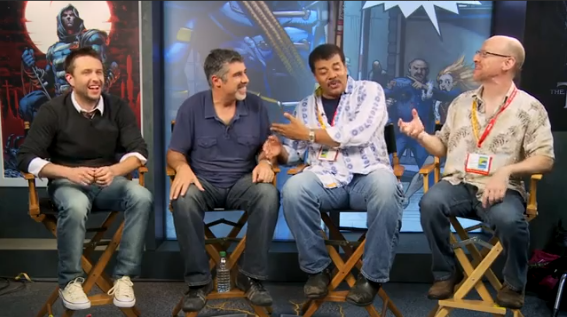
Join us from the floor of San Diego Comic-Con 2012 for the ultimate gadget geek-fest! Astrophysicist Neil deGrasse Tyson interviews Gadget Gary (aka Gary Dell’Abate aka Baba Booey of The Howard Stern Show). He’s joined by Chris Hardwick, the Nerdist, and Phil Plait, the Bad Astronomer. In Part 1, they dish on the coolest, and in some cases, not-yet-available-to-the-public, consumer technology: working sonic screwdrivers, wireless appliances that use inductive charging, a credit-card sized, 160GB Bluetooth memory drive for iPads, and an always-on, ear-mounted camera that can replay the last 2 minutes of your life. They’ll also discuss the psychology of “unboxing”, the puzzling science behind the Lytro camera that shoots now and focuses later, the reality of being a science geek, and the promise and peril of storing your information in “The Cloud.”
Transcript
DOWNLOAD SRT
Welcome to StarTalk, your place in the universe where science and pop culture collide. StarTalk begins right now. I'm your host, astrophysicist, Neil deGrasse Tyson, and we are here live at Comic Con San Diego 2012. And I've got Chris...
Welcome to StarTalk, your place in the universe where science and pop culture collide.
StarTalk begins right now.
I'm your host, astrophysicist, Neil deGrasse Tyson, and we are here live at Comic Con San Diego 2012.
And I've got Chris Hardwick.
Hello.
The Nerdist.
The one and only.
Yes, sir.
And of course, the one, the only, the inimitable, Gary Dela Vati.
Baba Booey.
Baba Booey.
Baba Booey.
Baba Booey.
This is your first Comic Con, too.
It is my first Comic Con.
I'm a Comic Con virgin.
How is it so far?
I'm feeling it.
I'm feeling the craziness.
There's a lot of love out there for Neil deGrasse Tyson.
And, you know, we were out there in the street, and like storm troopers walk by, and Klingons walk by, and you don't even look twice.
Where else can you not look twice?
I know.
At creatures, you know?
I'm sure people will come up to you and go, that's a really good Neil deGrasse Tyson cosplay.
No, no, I really, yeah.
This is my Tyson outfit.
Somebody interviewed me last night and they said, what's the weirdest thing you saw at Comic-Con?
And I go, nothing's weird.
There's nothing weird here.
Everything's normal.
That's right, right, right.
I'm the weird guy.
It's a safe zone, it's a safe zone, yeah.
Now I got you on StarTalk because I have good information that tells me that you're like tech gadget geeky dude.
I'm an enthusiast.
I love the tech stuff.
Love the gadgets.
You own everything.
I have a lot of stuff.
I mean, you can't own everything, but I write a column for a magazine, so I do get enough stuff.
You gotta stay on top of it.
And I get to test stuff out, and it's great, because I say-
And you write a column, that means they send you the stuff for free.
But you gotta send it back.
That's the thing with gadgets.
When you're working with gadgets, they send it to you for a minute.
And some companies are like, you'll get calls.
When are we gonna get our thing back?
Well, you know they're serious when they give you the bubble wrap and the sticker to send it back.
The return of the envelope.
Exactly.
So what's your favorite gadget right now?
Oh my gosh, there's so many.
I'm a big fan of Sonos.
You know what Sonos is?
Yeah, the system.
S-O-N-O-S.
Sonos.
So many people want to do all room audio on their home, but they don't want to be chipping away at walls.
So this is a way to do all room audio through a wireless system.
And they've really perfected.
They've been around for-
So now your surrounding neighbors can't hide from you.
Yes.
Because every room is vibrating.
Apple has a version of it called AirPlay where you can get music from your device onto other devices in your home, but Sonos, they bridged all of that.
And Sonos has done a better job because they partnered with SiriusXM, Rhapsody, and actually they partnered with all these companies.
So whatever device you have that makes noise, it can now be in every room in your house.
Well, you buy a Sonos and you hook it to a pair of speakers and through your computer or through Wi-Fi, you can feed it what's on your computer, also your library of music.
But they've really done a great job of keeping going with it because they started like three or four years ago.
So there's a docking station for your iPad.
So if somebody comes over, say, hey, put your iPad in, let's listen to what you're playing tonight.
And you can send music out to your back patio.
Well, I'm not running wires from the basement.
Now you don't have to.
Okay, so that's a gadget that just improves on our previous capacity to want to just share music.
Give me a gadget that I didn't know I needed.
I didn't even know.
There's a sonic screwdriver that someone has just released that is actually a remote control and using a series of hand gestures, it will control your iPad or devices.
And it's, from Dr.
Who fans in particular, it's like having a sonic screwdriver.
Because it does stuff.
Yeah, you pointed at stuff and it controls.
And you jiggle it.
Yeah.
So did you get one of those?
I did not get one of those.
What do I have you for?
I'm the guy that will try to help you get one of those.
But I mean, when you say what's a gadget you didn't know you needed, that's a great thing is you don't need any of them.
They're just awesome to have.
Well, but then when you have them, you can't imagine life without it.
Like the remote control.
I'm old enough, maybe you're old enough.
No, I am.
You actually had to get out of the couch and walk to the TV to change the channel.
No, you just watched one channel all day because it was easier.
You wouldn't get out of the couch.
I went to a place last week, it was like an antique place where they have like old Coke machines and old jukeboxes.
They had old TVs.
Do you know what a predictive TV is?
Here's a science fiction, which got sort of that funky front on it.
It's sort of like on an angle.
And I didn't even know this because I sort of collected.
Was that a mod TV in its day?
In its day.
So what they did is there was the TV, the head, right?
And then the main box came with this 50 foot ridiculous looking cable.
And what you would do is you would take the box with you so you could change the channel from the box.
They probably were like, oh my gosh, we're living in the future.
It's technically a remote control.
In some ways.
I'm really interested in, and they're making a lot of advancement in like inductive charging.
It's really just the move to wireless everything.
So I see a lot of this untethering ourselves from our devices.
So I wanted to pose the question, then what of the title Wired Magazine?
Then it becomes retro.
Because that is retro.
That would pass Wired.
Well, it is.
I was at the Consumer Electronic Show last year.
There's a company that's working on that.
So they had a demo area.
So they had a kitchen island, right?
And in the bottom of your kitchen aid is this magnetic thing that just gets power.
So you don't plug it in anywhere.
So you can move it all over the kitchen.
But the thing that got me is because they make it in drywall now.
So when you put your drywall up, you can put these lights on, right?
That just are magnets that go on the wall.
And they're getting electricity from what's in the drywall.
So for me, the way I say is like, okay, I got a 50 inch TV.
Now I got a 100 inch TV.
You know what I mean?
You can just move the lights on these.
That's really incredible.
So all of these are things for the consumer home electronics marketplace.
There's gotta be some gadgets that are outdoor gadgets or stuff that's not just for the home.
Well, there's an outdoor TV, which I love that you can put on your patio.
That's waterproof.
I'm trying to think of-
Waterproof?
Are you watching TV in a rainstorm?
What do you need a waterproof TV for?
But that's the whole point.
There's stuff out there all the time.
Oh, okay.
It's like underwater other stuff that I would never need to be doing underwater.
I got an underwater camera and I went scuba diving with my kids and it was awesome.
I took great movies and great pictures.
And then I put it away for 364 days.
Right, that's how that works.
It was also when I needed it.
I came back to your sonic screwdriver.
Yes.
Do you have one that actually can unlock a safe?
Not yet.
That's a good one.
But someday, someday.
So it could go up to the cash machine.
Yeah, exactly.
This is the real need.
Well, you really could, especially with a lot of advancements in NFC, the near field communication, where you basically just need something on you that activates.
So near field communication would be like Bluetooth.
Well, it's a form of near field communication, but not the near field communication that like Apple was rumored to have put in their iPhones.
That you could just walk through a store, not even need a cashier, they would take everything you bought.
It's sort of like an easy pass, but how does it know?
How does it know that you're buying something?
Everything would have a chip in it of some type that would emit a signal, and then if you remove something, it would be.
So it's like smart chips.
Smart chips.
Yeah, but I guess there's no more shoplifting because you pick something up and you have that since you walk out the door, it registers.
Yeah, it just makes shoplifting way less fun.
Well, unless you don't have one of those phones.
Unless you don't have those phones, yeah.
So what does this cost?
If they just send it to you, you don't have no clue what it would set you back.
No, they tell you what it costs.
I mean, they give you the price and everything.
One of the things about the gadgets that I love is there's a thing called unboxing.
And unboxing is when you get it, there's this moment like, okay, I got my.
Your little kid.
So the day the iPad comes out.
The smell of a new Apple product to me is the best smell of the world.
And so I'm going to slowly.
It is.
I'm gonna take the plastic off.
I'm gonna slowly take the box off.
I'm gonna take all the pieces off.
And there's pleasure at every.
It's a strip tease.
It really is.
The Apple Store is my like bath and body works.
Where people go in there like, oh smell all these fragrance.
Like just smelling new electronics to me is the greatest thing in the world.
When we come back to StarTalk, we will get more into the psychology of unwrapping.
We'll be back in a moment.
StarTalk Radio, joining me over the break is the bad astronomer himself, Phil Plait.
Long time friend and colleague.
Love this man.
Trying to, where do I?
We'll just watch.
Phil, meet Gary.
Howdy.
Tech dude, extraordinaire, and of course, the nerdist himself.
Y5.
You look familiar, Y5.
Y5, I like Y5.
Y5, Y5.
Before we left for the break, Gary was telling us, because he gets tech gadgets to write about, which is very cool.
He didn't have to buy them.
They show up on his doorstep.
And he was talking about the emotional high he gets in the striptease of removing the gadget from the box.
Well, it's called unboxing.
And if it's something you wanted for a long time, or something you've been waiting for for a long time.
It's an actual psychological term.
Video gamers have it too, by the way.
Video gamers, like the actual unboxing of the video game is very ritualistic for a lot of people.
Same with gadgets.
And I gotta tell you, with a gadget, there really is something to be said for how it's packaged.
And Apple really has it down to a science.
You take it out of the wrapper.
No, no, Apple doesn't have it down to a science.
They have raised it to an art.
They really have.
Ooh, well done, well done.
Well done, well done, well played.
It's something you've either been waiting a long time for to come out, or something you've waited and saved a lot of money to get.
So the anticipation adds to the moment.
It's Christmas, and when you get an item that you want, or a gadget that you want, it's Christmas morning.
It really is that feeling.
Every time you open it.
Absolutely.
So what else you got?
What else have you been coming your way?
Well, you know, it's funny, I haven't been able to try this out yet because they're really not sending many of them out, but I went to the Consumer Electronics Show in January.
Where was that?
In Vegas.
Vegas?
It's there every year, right?
It's there every year, yeah.
And they have this thing, it's called, have you heard of a camera called Lytro?
No.
It's a, it's like, L-Y-T-R-O.
It's a light field camera.
Now, I don't understand exactly how it works, but it's supposedly taking light from everywhere, and I know that it's a little, it doesn't look like a regular camera.
It looks like a square kaleidoscope, right?
And you look through it, you take the picture, and no matter what the picture looks like, you can always put it in focus because it's gathering light from all different areas.
Do you know about this?
I thought it was a joke when it came out.
It's not.
And what you do is you take a picture.
So what's the optics of it?
I don't know.
This is what's killing me.
I can see it going this way.
It's what's killing me because I think about it, it's like, how would you do this?
You take a picture and it maps every photon that comes in, and then after the fact, you can change the focus.
So you've got this data cube, I guess, and you can say, where do I want it focused?
At five feet, 10 feet, 20 feet, and you can do that.
After the fact.
After the fact.
So somebody were taking a picture of us, we were all in focus and the background was out of focus, that's probably what we want.
But if for whatever reason, we wanted the back to be in focus as well, we can change that, and for whatever crazy reason, we want to be out of focus and we want the back only in focus, we can change that after the fact.
So, what that means is everything is in focus to begin with, and it's defocusing what you don't want.
It's got to be, because you can't start out how to focus as data and then get focused.
But that's what they're saying, that it does start out how to focus.
No, no, I'm assertive, I don't believe that.
I think it has to take everything in as a focused cube, as he said.
But how does every, how do you, but there is no camera that can focus on everything.
Well, there is, you know what that is?
It's a pinhole camera.
A pinhole camera has infinite depth of field, a pinhole camera.
Everything is in focus.
The problem is the pinhole is so small, you need flooded lights to get everything there.
And so it becomes a challenge.
Otherwise, everything would be a pinhole camera.
Well, I have not been able to get my hands on this camera to try.
Right.
Because it's so, and that's sometimes, you know, That's the future of cameras.
But that makes me a little nervous, because they announced it in January.
If I'm not seeing it, I always wonder, sometimes they come out with these big.
Vaporware.
What's that?
Vaporware.
Vaporware.
Yeah, Vaporware is basically when a company or someone talks about something that's coming out, but then it's like vapor, it never, like it never sortifies it.
They never got it to match what they said.
It just doesn't work, and then it never comes out, and you hear about it for years.
It happens at CES all the time.
Right, because what I think what happens is some of these people show up to CES with these grand ideas, a prototype, and then what they're hoping is someone will see it, and go, oh, I wonder if there's money in that.
So I don't know, but it's called Lightroom, and I want to try it.
And this is why I haven't been able to figure out how it works.
Maybe there's information on it on the web, but when it was first announced, I went online and I was thinking, how would you do that?
Something like what you're saying, you're creating this map of where all the light's coming in.
There's a series of planes of detectors, and you focus on each one, and then you choose what combination of those detected planes are.
And there are problems with light coming in from different angles, and it's really interesting.
And maybe by now, somebody's put up an explanation of this, but at the time when it was announced, I did not know.
Okay, I'm very disappointed in you, I just want to say.
I just want a Photoshop filter.
You know, it's like, if you know in Photoshop, you can go in some areas dark, the information's still there, so you can go in and lighten it up.
I would just be great if there was just a focus filter.
In one way there is, and that is, if you know what a point source looks like.
In other words, I have a point of light, and it gets defocused somehow by a telescope or a camera or whatever.
But you know it's a point of light, and it's like, well, it starts a point of light, but later on it's blurred.
If you could collect that light back into a point, it's like you're focusing it after the fact.
But how would you collect that light in the next point?
You have to take all that light off of the detector itself and then put it back in the point that you know was started out as a point.
It's called deconvolution, and we had to do that when Hubble was first built because Hubble was out of focus.
And I spent two years doing that.
It was deconvoluted for two years.
Are you going dot by dot and defocusing?
Essentially, pixel by pixel.
Oh, that is amazing.
You're removing the light from each pixel and putting it back in the pit.
That is the scientific version of like going in and cleaning up old art, where you're just kind of going in and it's like that.
Except, the problem with that, if you have a crack, you can kind of just say, well, it was brown on this side and brown on this side, I can just make that gap.
With light brown and dark brown, and sort of interpolate across the gap.
The problem here is that if I'm taking light from one part and putting it in another, because it was, it started here and focused, it defocused over here.
But if there was something here, I'm taking light away from that and putting it over here.
But now there's light over here, I have to put back over into here.
And it's all, it's what's called nonlinear.
You have to do everything all at once.
And it's very complicated.
And there are issues with it mathematically.
It makes it really hard to do.
Does complicated mean it also takes a lot of time?
Or is it just, the notion is complicated.
It's computationally intensive.
But now with Moore's Law just handing us computational capacity, I don't see why that can't just happen on the fly.
I used to run programs overnight.
That three years later, I was doing over a snack break.
Over a snack break.
But isn't Moore's Law slowing down?
I mean, I don't see processors really getting that much faster than they were.
Actually, they've been cheating because now they sold them in parallel.
Right.
So I want to be twice as fast, get twice as many processors.
One core, eight core.
But you have to program it in a way that all the processors can share the calculation.
Sure.
Right?
If you have to wait for one to finish after another, core processors don't help you.
I mean, is there a-
So programmers have to know in advance how to distribute what is being calculated.
I mean, have we achieved all we can achieve with current technology?
I mean, do you know anything about quantum computing or?
I'm waiting for that.
Yeah.
A little overdue, I think.
I remember the video game Qubit, but not-
Did you say Qbert?
You know, Qubit, I know, I know.
Oh, Qubit, you said Qubit.
What else you got on your list?
Hold on, let me look up.
I do have a list of-
There's a crib sheet.
I do, hold on, I have a list on here.
On your pocket computer that you can carry around with you.
So Kingston is a company that makes, you know, thumbnail drives and memory and all that.
So they just came out with an item.
I'm literally testing it out on this trip.
So it's 160 gigabyte Bluetooth little memory drive.
So what do I need that for?
So I've got my iPad, it's now filled with everything.
I've got, it's overloaded with movies, it's overloaded with music.
I've been on the road for a week now.
And you can't put it back on your desktop, right, where your big disks are.
What happens is whatever's on your iPad, it's full.
You can't put any more stuff on it.
And you can't delete movies while you're on the road or anything, even if you do, you don't have any more room to put it on.
So as a, for instance, I have this little hard drive, and I put like the entire second and third season of Breaking Bad, because I'm catching up on it, on there.
Am I gonna get to it?
I don't know.
Well, it turns out I am getting to it.
So without hooking it in the computer, because you can't hook it to an iPad, I turn it on, Bluetooth, and now I have access to a secondary hard drive.
Which is little.
It's like a credit card.
Yeah, and what's great about that is, it's not only good for movies and stuff like that, but it's also good if you're on the road, if you're doing a PowerPoint presentation, and you want everybody can Bluetooth into you, you can put it on the desk in front of you.
So I like that gadget a lot.
Does the Bluetooth have a USB port to go in?
Well, the iPad doesn't have.
No, it's got a USB port, it's got a fire wire, the USB for putting it into your computer.
So a USB to put the data on it.
Now I can Bluetooth into any device.
How fast is it?
It's pretty fast.
So it'll be Bluetooth fast.
So that's what it is.
When I was packing for this trip, I'm thinking, well, I got my video camera, I got my still camera, but I don't want to bring my laptop.
But if I'm taking a video, if I'm going to interview somebody like, say, Nerdist, sorry, Chris Hardwick.
Now I've got it on my flip camera.
What am I going to do with this?
I've got my iPad.
You're saying I could take my flip, plug it into this Bluetooth, get it there, and then it'll go to the iPad.
I don't know if it's got to be.
It might need a file system to feed it.
Right.
But if they had that, I'd be golden because the iPad only has that stupid.
Well, it's better if you come back to StarTalk more with Gary the Gadget Man talking about his stuff.
You've just begun to tell us.
We'll be right back.
We're back on StarTalk.
Delibate.
Delibate.
Delamonte?
I got it all when I was a kid, don't worry.
Baba Booey, the one and the only Baba Booey.
I got him right here.
We're talking about tech gadgets.
I got the Nerdist, Chris Hardwick, my colleague and friend, the Bad Astronomer.
Welcome to StarTalk, not your first time.
So, we were going down this list of these gadgets you get that you write about.
And where does it appear?
I write a column in Sound and Vision Magazine.
Sound and Vision Magazine.
I go into the name Gadget Gary.
All right, Gadget Gary.
What else do you got for us?
Okay, so now, they make a Bluetooth camera that looks like a little bullet and it goes over your ear, okay?
So, there's a couple of things that you can do with it.
You're like, why do I need that?
So I can be low-Q to support.
Hello?
I do have to say it's a little weird looking and you would be the weird guy at your kid's recital with it on.
But there's a couple of uses for it.
First of all, you can Bluetooth it right through your phone and write to anybody.
So if grandma's sitting at home in Milwaukee and your daughter's doing a recital, you can have this camera going through your phone, Bluetoothing live into your phone and going right to the grandma's.
That doesn't say why it has to be stuck in your ear.
Well, that's one of the things they had because the feeling was they wanted it to be small, they wanted it to be portable, and they want it to be your point of view.
So the premise is if it's on your ears, wherever you're looking.
That's very similar to the Sergey Brann at Google.
They're developing the glass.
The Google Goggles.
Yeah, which I spoke at Google and he was there, and it's weird, he looks at you with the glasses on, they just look like little sport glasses, but you see a little flickering light in the middle, and you feel like you're being targeted.
Yeah.
Well, just like you don't know what information he's seeing.
Did you see the thing that they did where they jumped out of the plane?
Yeah.
Yeah.
It's crazy.
They did a thing where they wore the goggles, and there were guys in a plane over where they were.
They were talking about what they were going to do.
They jumped out of the plane, they landed on the roof where the event was, and then they got on bicycles and they rode into the event.
Everybody could see the whole thing via these glasses being transmitted.
It was very cool.
So point of view is interesting, right?
But the other interesting thing about it that I love is, it's constantly recording, almost like a Tivo.
So it's going 30 seconds, 30 seconds, 30 seconds, or maybe it's like a two-minute buffer.
So if you have this thing on all day and something really cool happens, because you don't know what's going to happen.
You don't know right when what you decided was cool.
It's too late to catch it from the beginning.
Or if you saw it and you go, oh my God, I want to take a picture of that, it's way too late.
You hit the button on top and it immediately saves-
So it's got a two-minute buffer, right?
The previous 30 seconds.
So like I was at an event last night where I saw this guy holding up a sword to this electron thing, and it was like blowing sparks out.
And I went to get my camera and I missed it.
If I was walking around with this very goofy ear thing on, I would have pushed the button and I would have saved the file.
What else you got?
There's a lot of stuff going on with Bluetooth speakers.
So I talked about SOTUS, but even if you don't want to go that route, you want to go a smaller route, the people that make Jawbone were the guys that make us-
Jambox.
Jambox.
Jawbone is a company, Jambox, it's about this big.
They just made a bigger one.
So what it is, it's a speaker.
Bigger isn't always better in this business.
But it's got really, really good sound, like shockingly good sound.
You're looking at-
The little Jambox had great sound.
It does.
And it's kind of rubbery, so you can drop it.
So this one's got a few-
It is, no it isn't.
So you can just-
It doesn't bounce.
But just don't drop it.
Well, that's the other approach.
So again, like I built a house, I wired it to the hilt, and I forgot to wire the porch.
It just didn't dawn on me that I'd want to sit on the porch and listen to music.
So again, I could go drilling and putting wires in and putting speakers in, or bring the Jambox out.
I take my iPhone.
I usually do either Sonos over that, or I can do Siri SXM.
So sit on the porch and I will stream it to the Bluetooth speaker, and it's got great sound and it's a great way to get that sound without tearing your house apart.
All right, so now, are there any gadgets that put you into a profound state of silence?
You mean I'm so blown away by them?
No, no.
The cone of silence, I think is where...
The cone of silence.
Everything you've described is to distribute sound and music.
Is there anything that creates a meditative state?
No, I don't want that.
I want the ultimate visual or audio experience.
That's what I'm about.
That's a cool idea, though, particularly thinking about we're at Comic-Con right now, so not just noise-canceling headphones, but is there any kind of a device that creates a feel that cancels out?
There is an acoustic deadening force field.
Yeah, what is it?
Michael Jackson had one.
What was that tank?
It was the Hyperbaric Chamber.
The Hyperbaric Chamber.
It was the one that William Hurt gets in and comes out an alien in that movie.
Yeah, where he goes into suspended animation.
See, that would make me very claustrophobic.
I would be freaked out by that.
Could you get one of those?
Could you close the lid?
Like deprivation chambers?
Yeah, complete darkness, complete silence.
I couldn't handle that.
I could not do that.
It would be kind of cool if that were just an area you could walk into in your room.
For example, the baby's crying, there's traffic noise, they could just walk into the zone, total silence.
I think they call that the wife chamber.
Have you ever been in one like that?
For example, at NASA, when they test satellites, they do all these different shake and bake tests where they'll heat it and they'll shake it and everything.
What they'll do is they'll also put them into these rooms, which are completely dead in sound.
And they can do all kinds of tests.
And that's an anechoic chamber.
And they have those weird triangle foamy things come in.
In fact, it's what set the standard for the foam wall insulation in sound studios.
Yeah, yeah, yeah.
But when you go into one of these high-falutin ones and you stick your head in between these cones, sound is gone.
And it is freaky weird.
All of a sudden we start hearing blood course past your eardrum.
I wouldn't like that.
It's really distressing.
You'd probably get used to it.
But I guess they do it because you don't want to send a guy up to find out he's claustrophobic.
Hopefully they test for that before they're like, you're a master.
Yeah, I've been in one at Bell Labs out in Jersey, and it's the quietest place on earth in the Guinness Book for just this reason.
We are live at Comic-Con 2012 San Diego.
We're talking about gadgets.
We're back at StarTalk, live from San Diego Comic Con 2012.
Got the bad astronomer, I got Gary the Gadget Man, and I got the Nerdist.
So you're going down your list of gadgets, so give me, you got a couple more for me?
Yeah, I got one.
This is, you know, a lot of the gadgets are about, you know, making me feel better.
Wait, wait, someone pays you to test their gadgets and write about it?
And you're okay with that?
I would be doing it for free, so shut up.
Okay, so what do you got?
But there's things that are practical, too.
So I'm very big on backing up the computer because I have so much music, I have so much video now, I have so much audio and so many important files.
So I have a RAID drive system and I use this company called Drobo and it's for RAID.
Yeah.
RAID is acronym for?
Really Awesome Interface Device.
Thank you very much.
Good on a statement.
I knew it was good for that, go.
But it's a backup system, so what you do is I put in four, one terabyte drives.
If one of those drives dies, the other three pick up the slack.
So theoretically, you can never lose any of your stuff.
It's redundant.
It's redundant.
However, as great as that is, I still, this is how nutty I am.
I still have a drive that once every four or five, six months, I back it up, right?
A regular drive, not a RAID drive, I back it up and I take it to my bank and I put it in the safety deposit box.
And your bank is in Cheyenne Mountain.
But the point is, here's the one thing a RAID drive won't save you from, a fire.
Right, because that drive gets lost.
Well, there was one company I looked at that had a RAID drive that it survives a fire, you can throw it in a fire.
So I thought I almost lost a lot of my photographs once and it is the most horrible feeling in the world.
I ended up getting an expert, he went way deep into the drive and he found that they weren't lost.
Wait, I'm pulling your leg, but I'm equally as manic about my backups.
And there's a backup that I put 100 miles away from the other backups.
So I calculated what nuclear device would take both out and then I figured that's a large enough nuclear device that I'm not really worrying about my iTunes music.
See, your drive to the bank isn't so crazy anymore.
Did you account for the EMP that's gonna wipe out everything?
No, the EMP I don't think would affect a non-running drive.
No, unless it creates a current that goes through the drive, it could have an induced current.
I gotta think about that.
But I do have a question for you guys.
This is where I feel like I'm being really old school.
Does everybody trust the cloud?
Because the cloud is another way to backup.
So do you trust putting your most important stuff on the cloud that's backed up in Kansas City?
I have issues with the cloud.
I use it for accessibility.
I use the cloud.
I have a Dropbox and I have access to all the files.
But would you take your most important stuff and just rely on the cloud?
No, no, no.
I see what you're getting at.
People put their stuff on the cloud, and that's where it lives.
And for me, the cloud is just the superhighway to get it from the iPad to the iPhone to the desktop.
But you are of a certain age.
I have a daughter who was in her teens and has grown up with the Internet.
And so for her, that's just the stuff that happens.
For me, I wouldn't trust the cloud because maybe, corporate interests running all of my data is not something you want.
There's two things going on.
The kids don't know that.
There's two things going on.
And yeah, we go to bank.
We put our money in banks which are like financial clouds.
I'm not happy.
I like that.
Oh yeah, your money is in Ben Milley's house, in Eddie's house from Where It's A Wonderful Life.
Merry Christmas, you old Chris Hardwick.
I keep my money under my mattress.
But there's two things in the cloud that are weird.
The first is, you're exactly right.
How do I know that somebody is not looking in my cloud or where it is?
And the other thing is, so I've now got this wonderful company who stores it in this temperature-controlled room in Kansas City.
What do I do when they go out of business?
It's close to Colorado Springs.
What do I do when they go out of business?
Well, Kansas City is in the middle of the country, so if we're invaded, you still have time to get ahead of the line and then save your music.
I'm not talking about a nuclear disaster.
I'm talking about a business disaster.
They ran the company so bad that they go out of business.
So what happens to the hardware?
Right.
And they got no money to go dig it out because they're broke.
So I think Chris is on to it.
You use the cloud for convenience.
But I keep everything on my hard drive.
Yeah, me too.
Me too.
Don't trust the cloud.
Right.
Use it for convenience.
Yeah.
And also, when I leave town, I take all my backup drives and I put them away, hide them just in case someone breaks in.
Then my drives are protected.
Take my jewels.
But don't take my data, please.
But what's your backup system for if your house catches on fire?
Well, then it's like worst case scenario is the cloud right now.
The cloud.
So hopefully, if my house doesn't catch on the fire, the same time as the cloud does.
We got to wind down this segment of StarTalk.
So we're going to lose you.
Yes.
I have to take leave of you.
I'm going to doing my live Nerdist podcast at the Baba Booey Theater in San Diego.
So we're going to lose you for the next segment.
We're going to lose you for the next segment, but it's been such an honor to be here.
Thanks for sharing your Nerdist time with us.
It's so great.
It's such a fun collection of dudes.
But you got to spread your Nerdist love.
I know we only get you for a piece of it.
I got to go do my show now, but it was wonderful to get you on your show.
Thanks for having me here.
Good to see you, Gary.
All right.
When we come back to StarTalk Radio, we're going to launch this into the future and find out what gadgets we always wanted to have and have yet to be invented.
I've got the bad astronomer, and I got Gary the Gadget Man, otherwise known as Baba...
Baba Booey.
Baba Booey.
Baba Booey.
I have to say, when they told me that I was doing a show with an astrophysicist and his astronomer's friend, astronomer friend, okay.
I'm both, actually, yeah.
I thought it was gonna be two nerdy guys, but you guys are very, do you get that a lot?
Do people expect you to be socially awkward because you're not?
Well, you don't see us in other settings where we are.
Yeah, well, that's true.
I think we're, you know, yes, we're socialized.
You think smart guys get a bad rap?
Yes, yes, but not only that, in astrophysics, there's no reward for being socialized.
So even if people have the capacity, it goes untrained in many circles.
Like, do you watch The Big Bang Theory?
Of course.
In fact, I had a cameo on The Big Bang Theory.
But so a guy like Sheldon is not that uncommon.
No, no, we see that all that cast of characters, they're a bit of a caricature, but still.
It's really true, and in fact, especially with scientists, we see ourselves.
You know, I think, I have, not only have I known Sheldon and Raj and, you know, and how, all those guys, they're me in different situations.
I've seen myself in all of this.
So it accurately captures.
Yeah.
Have you ever been at a party, gotten a little drunk, and realized that you're over explaining something to somebody who can't comprehend it?
You know, it's funny you'd say that.
When I first met my wife at a party, I was in graduate school, she was an undergraduate.
She was at a party.
I was actually looking through some math books that were in that host's house, because I was looking for something I needed for my work.
And she came up to me and said, so, what are you doing?
And I told her, oh, epicycloids.
And I went through this whole thing and her eyes, and she was gone, okay?
Married that woman, eventually.
That sounds creepy.
Now she has to chase her down.
Yeah, exactly.
Caveman style.
No, no, this is cool, this is so cool.
Before the expression stalking had been invented.
That's right.
But it worked out, you know?
We've been married a long time.
So we need a device that can make that happen.
So how long have you been writing about gadgets?
Probably about five years now.
Five years.
And like you said, they actually pay you to do that.
They do, not a lot.
Okay, now what's the clumsiest, stupidest gadget you've ever looked at?
You said this is stupid, why?
Say the iPad, say the iPad.
Think about how much traffic you'll get.
Are you an Apple hater?
No, I think Apple is just as sucky as every other kind of computer.
So if what?
I'm interviewing.
There are no computers?
I'll pull him in in a minute.
I have a PC with an iPad, I have an iPhone.
You have a PC?
Yeah, I had a Mac for a long time and it died.
I got a PC because it was a lot cheaper.
What do you use it in, your DeLorean?
I'm really wishing I had gotten an iMac.
I know, I know, I know.
I'll get a Mac again, but you know.
Are you one of those people who thinks like Mac is taking over the world and you just don't want to be like everyone's lemmings?
No, I take things as they come.
I make my decisions based on what's going on.
There are things I like about the iPad and things I have to get are really dumb.
That's why in a minute we're going to talk to her about future gadgets, not current gadgets.
Don't ask me questions, I'll start talking.
What's your suckiest gadget that you know?
Oh gosh, some of them are just so stupid.
There was one, when I was at CES, there was one that was supposed to be like a, it looked like Rosie the Robot from the Jetsons.
Oh yeah?
And it was like a-
What's her name, Rosie?
Rosie the Robot.
I didn't remember that.
There's somebody cosplaying us earlier today.
But it was like a mini version of her, and it was supposed to help you lose weight, and you're supposed to go talk to it every morning and tell it what you ate, and it was going to tell you calories back, and it was like, I caught it using your brain.
Like, you know, I may come up with all these different things for weight loss, and this was like a very expensive item.
It was like a mini computer, and I just thought it was so dumb, and I haven't seen it since.
So it was overkill for the need.
There's a thousand apps on your Droid or iPhone that will do the same thing for you with a little bit of input.
It was just, you know, like Lose It, for example.
I use Lose It, and it just keeps track of your weight.
I prefer to lose 30 pounds on Lose It.
It reminds you what you're doing.
So this was-
And it plots it.
Right, but that's all losing weight really is.
Yeah, that's all it is.
So that's a $399 app versus a $500 robot.
Anything that you felt was too hard to figure out?
Yeah.
Because that's the big thing.
You know, Apple, you just walk up to it and it runs itself, right?
I will tell you this-
no Apple user uses them for instruction manning.
Well, the story I'm about to tell you are very ashamed to talk about because I'm not very handy, mechanically inclined.
Yet you just said you built your house.
No, I had somebody build it.
You think I was out there like a Quaker?
I know.
I was about to be impressed.
You had enough money to pay somebody else to build your house.
Me and the Amish were out there.
Yeah, right, right.
We did a barn raising.
No, there's a couple of companies.
One of them is Schlage Locks.
So they came up with this really cool lock that again, works off an app via a wireless thing.
So you put the door lock on and you can key code it.
That's easy.
It's pretty common.
Or I could be in traffic an hour away, and my buddy calls to him at your house, where are you?
I'm stuck in traffic.
I can hit the app and open the door for him.
Whoa.
So that's awesome.
A remote door opener.
A remote door opener or I can remotely set codes for the cleaning lady, a delivery guy, people that you don't want to have the same photo.
Or again, it's great.
Awesome.
I've had it for four months.
I haven't been able to test it out because I don't know how to put the doorknob in.
The mechanical part of taking out a doorknob, I can't do.
Yeah, there's some stuff you got to pull in and go.
Is it two dimensions, right?
Exactly.
Have you ever installed a doorknob?
I got an A in shop when I was a kid.
Guys, okay.
They keep calling me.
They go, when are you going to review it?
I'm like, I'm getting there.
I'm waiting for somebody to come over who says, oh, I got a friend who's like, oh, give me that and could put it in two minutes.
We got to wind down this first half.
You've been listening to StarTalk live from San Diego, Comic-Con 2012.
When we come back in our second hour, we're going to talk about gadgets we wish existed, gadgets we want to be invented.
See the full transcript



 Unlock with Patreon



 Become a Patron