After sending NASA astronauts into low-Earth orbit for 30 years, the Space Shuttle program is over. How will we now make the great leap into space? Russia’s Soyuz spacecraft will carry our astronauts to the International Space Station until NASA can complete the next generation crew vehicle and rocket. Meanwhile, companies such as Virgin Galactic are developing commercial flights so that, someday, everyone can see the stars shine above Earth’s atmosphere.
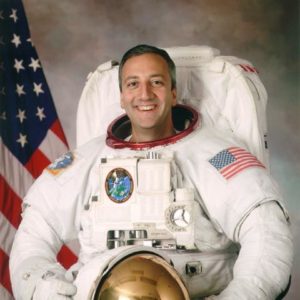
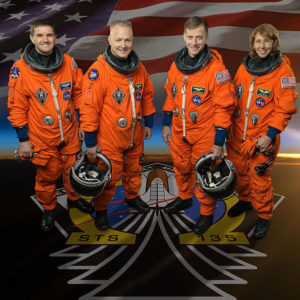
Neil talks with the final shuttle crew—STS-135—about what it was like to fly on the shuttle and their dreams of traveling far beyond our world. Also joining us is Mike Massimino, an engineer and NASA astronaut who flew on two shuttle missions to repair the Hubble Space Telescope. He talks about shuttle’s speed while in orbit (coast-to coast in only 11 minutes), the hazards to human health, and why walking in space is like Heaven off Earth.
Transcript
DOWNLOAD SRT
Lenovo is sponsoring Life with Machines, a new video podcast hosted by comedian and tech whiz, Baratunde Thurston, where he discusses all things AI. Lenovo's Smarter AI is your AI. Personalized and easy to scale, Smarter AI delivers outcomes that...
Lenovo is sponsoring Life with Machines, a new video podcast hosted by comedian and tech whiz, Baratunde Thurston, where he discusses all things AI.
Lenovo's Smarter AI is your AI.
Personalized and easy to scale, Smarter AI delivers outcomes that matter most to you and your business.
With full stack AI hardware, software and service solutions, Lenovo is bringing the transformative power of AI to industries, organizations and people of all kinds.
Discover how Lenovo and Baratunde are using AI for good to power people forward.
Listen to Life with Machines, now streaming wherever you listen to your podcasts.
The holidays bring the world together, and language can help us enhance our connections.
How will you be connecting with others this holiday season?
As the most trusted language learning program for over 30 years, Rosetta Stone immerses you in an enriching experience.
I'm learning and practicing Spanish with Rosetta Stone so that I can say things at the holiday table and nobody will know what I'm talking about.
Things like, estas terriblemente equivocado, which means you are horribly mistaken.
Start learning today with Rosetta Stone's Lifetime Membership Holiday Special.
Visit rosettastone.com/startalk for unlimited access to 25 language courses for the rest of your life.
Available for a short time at rosettastone.com/startalk.
With incredible new features and upgrades, there's never been a better time to armor up and play the critically acclaimed action RPG Diablo 4.
Get ready to continue the epic story in your battle against evil in the new expansion Vessel of Hatred.
As darkness spreads through the lands of Sanctuary, it's up to you to fight back the encroaching corruption.
Read the benefits of massive updates to character progression, loot systems, difficulties and tons of added activities.
Face off against new and iconic bosses teeming with the spoils of Sanctuary.
Plus, harness formidable powers of the jungle with the all-new Spirit-Born class, now yours to customize and progress alongside five other iconic classes.
Embark on the epic journey solo or with friends.
You'll quickly understand why Diablo IV has been called one of the best action RPGs of the last decade by PC Gamer.
Forge your own path through hell-torn lands of Sanctuary.
Get Vessel of Hatred, available now in the Diablo IV Expansion Bundle, rated M for Mature.
Welcome to StarTalk, your place in the universe where science and pop culture collide.
StarTalk begins right now.
Welcome back to StarTalk Radio, I'm your host, Neil deGrasse Tyson.
I'm an astrophysicist and director of New York City's Hayden Planetarium.
The subject this week, Spaceward Bound, or not.
My co-host this week is Chuck Nice.
Welcome back.
And I also have with me in studio Mike Massimino.
Name like that, you have to be destined for something great.
He's a NASA astronaut, veteran of two space shuttle missions, STS-109, that's how they designate these things.
STS.
STS.
I think that stands for Space Transportation System.
Can you get less romantic than that?
Yeah, you're going to fricking space.
Okay.
You would think you would come up with something better than Space Transportation System.
STS-109, that was on board Columbia, which we would later lose a couple of years later.
That's correct.
Couple of years after that.
And STS-125 Atlantis in 2009, both of those, this is one of the many reasons why Mike Massimino is my man, both of those missions serviced the Hubble Space Telescope.
Sweet.
Including the final mission repair for the scope.
That will take it to the next five or ten years into the future.
Not only that, STS-109 set a record for spacewalk time.
In the old days, there was spacewalk just to check it out.
Now, there's spacewalking because they got a mission.
They're repairing and servicing the Hubble Telescope.
And he checked in 35 hours and 55 minutes across five spacewalks.
Nice.
And so, this is awesome.
And so, let me just bring him in to the house.
Mike Massimino, welcome to StarTalk Radio.
Mike Massimino, astronaut and homeowner.
Which helps when you're trying to fix stuff in space, if you've got to fix stuff at home.
Now, how does that work for you with the wife?
It's like, so, you can fix the Hubble, but the faucet is still leaking, I see.
I hear it all the time when someone asks me, oh, you must be good at fixing things at home.
I have to turn and see if my wife is there before I answer.
And I was in Houston a few months ago, and we're like, he's giving me a ride to the bar.
And I get in the minivan.
I'm thinking, Mike, you fly a space shuttle, and at home you drive a minivan?
Yeah, that's what I've been relegated to.
Is this what it's become of the astronaut corps?
Well, now there are a few guys that have held on to corvettes, but they're not probably as happy at home as I am with the minivan.
Absolutely.
So you've got to get your priorities straight.
You just keep telling yourself that, Mike.
What are you driving, Chuck?
What are you driving?
I'm driving a Ford Explorer.
It's worse off than you.
A little sportier than a minivan.
At least it's a gas guzzler.
Yeah.
We just got that going for it.
So, Mike, you were astronaut of the future because you became the first tweeting astronaut.
I did, yeah.
And that was for STS-125.
And NASA made a big publicity bit out of that.
And you ended up with 1.3 million Twitter followers.
Yeah.
A lot of people were interested in what we were doing.
The best thing about it, though, was that it finally got my kids excited about space.
Nice.
About what I was doing.
Because they were watching, following you on Twitter.
Not at all.
Because...
It wasn't good enough that they launched you into orbit.
No, they didn't care about that.
My son, we had to bribe them to come to the launch because it was the 8th grade dance was the same weekend.
But what happened with the Twitter is they made fun of it on Saturday Night Live while I was in space.
The weekend update, they made fun of what I Twittered.
But they didn't care if they were making fun of me and mispronounced my name.
It didn't matter.
We got mentioned on the show.
So they finally got excited about what I was doing.
What was dad was cool.
It was only a brief moment.
It didn't last very long.
But there was a few minutes there where they were excited.
I'm fascinated by the fact that you were able to tweet from space, who is your carrier?
We're a government operation.
We're not supposed to endorse any carrier.
Because that's the commercial that I would give you.
Yeah, I'm not allowed to say.
I'll tell you afterwards.
And then I'll whisper to you after when he goes.
So listen, Mike, you've been at the Space Shuttle program a while.
As we know, it has ended.
The Space Shuttle program has ended.
But let's reflect on it.
The Space Shuttle was designed to carry cargo, essentially.
Isn't that right?
Yes, cargo and people.
You got the payload bay.
And out of that came satellites.
You'd retrieve satellites.
You'd fix satellites.
You became an all-around space doctor for hardware, essentially.
That's it.
That's a good description of it.
And so Space Shuttle dates back to 1981, if I remember correctly.
1981 was the first flight.
We were all quite excited because the craft was reusable.
And that was at a time when reusability was a big thing.
And the very first Space Shuttle was Enterprise.
It didn't go into orbit, but you gave the aerodynamic test on the landing.
That's right.
It was the very first one, and it's coming here.
It's coming here to New York City.
Now, is the Enterprise the one that they piggybacked on the back of a giant jet?
Is that...
They put it on the top of a 747 and released it.
And they used that 747.
It's called the Shuttle Carrier Aircraft, okay?
Just to give you another acronym.
The Shuttle Carrier Aircraft.
It's supposed to be a space transportation system.
Rolls all the time.
Right, yeah.
So they used it to transport, like when we had shuttles landing in Edwards Air Force Base, it has to get back to Florida for a launch.
They put it on top of that same airplane.
That's in case it's snowing in Florida.
Something bad is happening in Florida.
Yeah, bad weather or whatever reason you got to go somewhere.
So that's how they transport.
Or when it was getting refurbished, they put it on that same aircraft, the 747.
And so when they did these drop tests, that's what they did.
They put the Enterprise on top of the 747.
They released it and it came down and landed.
It'd be fun to just be sitting in the cockpit while you're getting a free ride on the 747, eating a sandwich and just enjoying the view.
Yeah, that would be all right.
You know, just kind of cool.
Yeah, that's not bad at all.
I would think.
So Mike, what are some of your most memorable moments?
Because obviously, for all of us, there's the Challenger disaster and the Columbia disaster.
These are tragic moments in the history of our space program.
But aside from those tragedies, which we all remember, are there other sort of fun things you can just share with us?
Yeah, for me being in space, the most memorable thing is...
Well, I got to ask, did you barf first time you went up?
Yeah, well, how many people listen to this show?
I don't want everyone to know, but yes, I did.
Yes, he did.
Did you keep it quiet?
He did.
I did.
On my first trip, I did.
My second trip, I didn't, but my first trip to space, I did.
Now, does that kind of mess up your visor?
No, you never want to...
There's a couple rules.
You never want to throw up into your helmet.
Right.
On your clothes.
So, what I did is I had an Emesis bag, which is a fancy way for saying barf bag.
I had that right handy.
I had one in my shoulder pocket and I actually had one right on my kneeboard because this happens to a lot of astronauts.
It didn't happen right away.
It happened toward the end of our day right before going to bed.
I had stomach awareness the whole time.
I like that.
Stomach awareness.
I felt like barfing the whole time, but I didn't have anything to eat.
The stomach reminds you that it's there.
It reminds you.
Stomach awareness.
I have stomach awareness too, but I'm normally naked in front of a mirror.
Not now, I hope.
That's good.
Where were we?
At the end of the day, I ended up having to heave.
That's what happened to me.
So that is not the measure of who's the right stuff.
Hopefully not.
It happens to just most people.
I wouldn't say everybody, but most people.
I went into a centrifuge and I barfed up my lunch.
I've never thrown up in a centrifuge.
That's pretty sissy.
I'm talking about a spaceship.
A real thing.
Not on a centrifuge.
You understand.
It's very similar.
I was just the adequate stuff.
So, Mike, you know, when the Space Shuttle 135, SCS 135, the last mission, they came through New York and I nabbed them when they visited the American Museum of Natural History on their tour.
Yeah.
And I nabbed them into my office and I got...
Is anything missing?
No.
Oh, I wouldn't tell.
But I got some time with them for StarTalk Radio.
Let's join my interview.
Well, I just got them to introduce themselves and we learned about the very last astronauts in the Space Shuttle program.
Sander Magnus, Mission Specialist 1.
Chris Ferguson, Commander.
Rex Walheim, Mission Specialist 2.
Doug Hurley, Pilot.
Mission Specialist.
That sounds like a euphemism for something.
What is Mission Specialist?
Jack of all trades is what Mission Specialist means.
We do pretty much everything but the flying.
The Commander and the Pilot focus on the dynamic parts of flight and we are the ones that do a lot of the robotics and spacewalks and science and things like that.
So you guys do the cool stuff as far as I'm concerned as an academic.
Well, we think we do the cool stuff, but of course the Pilots think they do the cool stuff, so it's a win-win situation.
So you were a Pilot?
That's correct.
Okay, what does a Pilot do?
In the case of a space shuttle mission, you usually are the person backing up the Commander, keeping him out of trouble, ideally.
Pilot also gets to fly the undock and fly around from Space Station after we've completed the dock mission.
So there's a lot to do.
There's only four of you on this mission.
Usually there's seven, six or seven.
Yeah, so I was relegated to the same level of grunt work as everybody else, which was fine.
I mean, it was good.
Okay, who has to scrub the toilets?
I said that jokingly, actually.
No, that apparently has been a tradition since the early days of the space shuttle.
Where the pilot scrubs the toilet.
The pilot is responsible for the space toilet, yes.
And it's a successful operation.
Luckily, we had no issues, so I was happy about that.
And I also give feedback on people's cleanliness habits and if there's any ways that they can improve their performance.
Because that could be embarrassing if you go public with that.
You know, people, their time in the bathroom is very private, but here it's not apparently.
It's not quite as private as you'd like it to be.
There they go.
STS-135.
Do you know these guys?
Oh yeah, I know them all very well.
Yeah, it's the astronaut corps.
You guys are a club.
Yeah, and Sandy and Rex and I were on the same astronaut class.
Oh my gosh.
We started our astronaut studies together.
Who was the class clown?
Because I know Chuck must have been the class clown in his schooling.
Oh definitely, I got to say.
That's true.
Well, astronauts, you know, it's probably pretty easy for you to be the class clown amongst a group of astronauts, you know, to be a little dry, you know.
So Mike, what jobs did you have in space?
I was the clown of the mission.
You actually were?
We had some funny guys.
But my major job on both of my flights was the spacewalk.
So I was a spacewalker on both STS-109 and STS-105.
Is that hard to do or you're trained and you're good at it?
You know, it really is an acquired skill.
You really have to learn how to work in the suit because the suit is kind of big and bulky.
You got to learn how to get around in that suit and work with the tools and learn how to work with your teammate and the whole crew and all the folks on the ground.
So it takes a lot of practice.
Let's get emotional here.
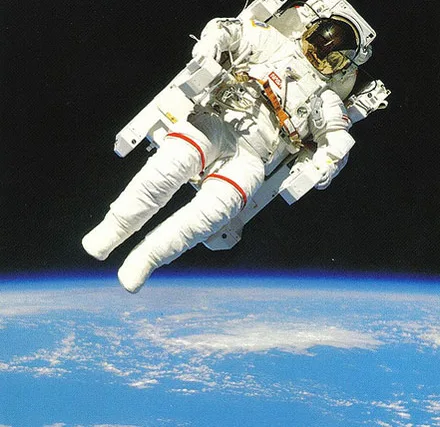
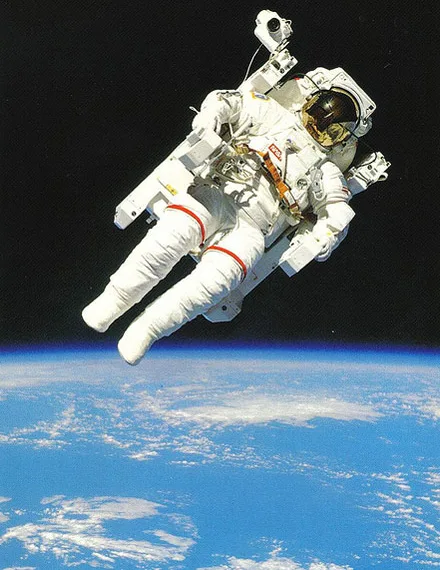
It's one thing to have a hammer in your hand and a screwdriver, but you're floating over Earth, man.
Earth.
It's amazing.
Earth.
What did that feel like?
Well, the best way to describe it as far as what you see is what gets you.
And there's no words to describe how beautiful it is.
So I can just tell you what I was thinking.
And it was on my second spacewalk when I really got a chance.
The first spacewalk I was worried about screwing up.
And I didn't want to lose anything.
My second spacewalk I had a little extra time.
And it was this one moment where I knew I was going to have a few minutes to look.
And I was in a foot restraint, which means I was stable.
It was a day pass.
And I really just just tried to enjoy it.
And when I looked, the first time I turned my head, I couldn't even bear to look at it.
That's how beautiful the earth was to me.
And the thought that went to my mind was God did not intend us to see this.
And I'm not even necessarily coming from a religious standpoint.
Just just went through my head, which people aren't supposed to see this.
And I turned my head.
It's a it's a point of view, a vista beyond that of the human mind.
That's right.
And that's what I felt.
You're not supposed to see this.
This is this is not what I'm but I quickly got over that.
Did you get all weepy on me here?
I did.
The second time I looked, I just couldn't believe what I really soaked it in and I started to get a little teary-eyed.
And Neil, at that time, we were very concerned about liquid getting loose in the suit.
We had a problem with one of our drink bags and it could create problems.
It could maybe short something out.
It could actually was hitting the visor and we have an anti-fog that was reacting with and can cause eye irritation.
And I was really worried about this when I started to tear up because it says, Oh my goodness, if I get tears in there and then I...
Oh, they will know it.
Well, they are going to have to ask.
There is going to be an investigation.
I am going to say I was crying during my spacewalk.
No, no, no.
Can you imagine all the marine pilots making front of me with that?
I would have told them I peed myself.
That would have been probably better.
That would have been there.
But I wasn't that clever to think that at the time.
I should have used the potty before I did the spacewalk.
Sorry.
I was worried.
The third time I...
Oh, sorry.
Oh, go on.
Go on.
I was going to say, but the third time I looked, the third time I looked, the thought went through my head was, this must be the view from heaven.
If you're in heaven, this is what you would see.
But it was replaced, Neil, by a thought right after that, which was, no, no, it's more beautiful than that.
Mike, hang on to that thought.
We've got to take a quick break.
But we'll be back in a few minutes.
Experiences make life more meaningful.
And with MasterCard's priceless.com, you can immerse yourself in unforgettable experiences in dining, sports, art, entertainment, and more in over 40 destinations.
From a round of golf with a legendary player to a cooking class with a celebrity chef, you can fuel your passions and create lasting memories.
Explore experiences today at priceless.com exclusively for MasterCard card holders.
Terms and conditions apply.
You have one goal, find the perfect place to grow your company.
You don't have time for empty promises, and at Jobs Ohio, we don't have time to make them.
You deserve a partner who gets it, someone who understands your vision and the seamless path to sustainable growth.
Expect this and so much more in Ohio, where you'll benefit from the best sites, earlier funding, and the top industry talent you've been searching for.
Bring your business to Ohio and join our centuries spanning tradition of movers and shakers.
Get started today at jobsohio.com.
Lenovo is sponsoring Life with Machines, a new video podcast hosted by comedian and tech whiz Baratunde Thurston, where he discusses all things AI.
Lenovo's Smarter AI is your AI.
Personalized and easy to scale, Smarter AI delivers outcomes that matter most to you and your business.
With full stack AI hardware, software and service solutions, Lenovo is bringing the transformative power of AI to industries, organizations and people of all kinds.
Discover how Lenovo and Baratunde are using AI for good to power people forward.
Listen to Life with Machines, now streaming wherever you listen to your podcast.
Welcome back to StarTalk Radio.
I'm Neil deGrasse Tyson.
Our subject today is the Space Shuttle, its legacy, its astronauts.
Joining me this week, of course, is Chuck Nice.
Chuck, always good to have you.
Always good to be here.
And I've got my friend and colleague, Mike Massimino, shuttle astronaut.
Mike, welcome to StarTalk Radio.
I'm having a great time here, thanks.
Listen, before the break, you were getting all misty-eyed on us about what Earth looked like from above.
First, you said, this must be the view from heaven.
And then you changed your thought on a next spacewalk and said, no, what I'm looking at must be heaven.
Yeah, I felt like this is what heaven must look like.
This is deep.
And you got all misty-eyed and everything.
I almost cried in here.
Well, listen, let me ask you, should everyone have that view?
That's another thing that goes through your mind, is you wish, Neil, I wish you could have been there with me.
Me, Chuck, I wish you could have been there.
I wish my family could have been there.
Are we sending the wrong people there?
Should we be sending poets?
Should we be sending...
Well, since they sent me, they can send whoever they want, as far as I'm concerned now.
Yeah, like, now I've got my view.
I think, yeah, fill them up, whatever you want to send up there.
I think at some point, I think we're going to get there.
You know, I think, but at first, we may still be in the stage where we're sending scientists, engineers, pilots, people that have more of a scientific purpose.
Or a utilitarian purpose.
And actually, let's think about that again, what I just said, because it didn't feel like coming out of my mouth.
Yeah, I think we should be sending poets.
I think you should send people that can describe it, because we're like the representatives of the planet to go up there, and we're not necessarily the most poetic people.
So people in touch with the expression of emotion.
I think that that would be good people to send up there.
Something astronauts do not have a tradition of being.
Right, we can take pictures in movies of it, but explaining what it's like, and we can do the best we can, but...
I think we should send Kim Kardashian.
You think so?
And leave her.
Just joking.
So, Mike, in space, you've been up twice.
And you're up there a long time, and you're in orbit, moving fast.
Oh, yeah.
17,000.
It's quick, man.
Coast to coast in 11 minutes.
In 11 minutes.
I timed it with this watch right here.
You timed it.
Okay, so space can't be always comfortable.
It's certainly hazardous.
Not only the launch, and not only the landing, but your body is facing risks of death from suffocation, from lost pressure, from radiation, to hot, to cold.
And so, are you afraid of all this?
Are you?
Well, now I am.
I'm glad I was speaking before my flight.
I was about to say, I just...
My goodness.
You just sealed it for me.
Yeah, we can send poets.
Don't send comics.
Who knew it was like that?
So, when the last shuttle crew came through the Hayden Planetarium, I asked them about the health consequences of being in space.
Let's check out what they said.
Don't you get taller when you're in space?
Yeah, you do.
You get about an inch or inch and a half taller.
Did you guys actually...
An inch?
Yeah, yeah.
You sure do.
So, now you can go on the rides in Disney World.
Exactly.
I can play NBA basketball.
That was always in my dream, you know.
So, how quickly does it take to lose your height?
It's very fast.
You squish down pretty quickly.
As soon as gravity hits you, you stand up.
Gravity is pretty pervasive force.
During entry, I mean, you can watch the G meter as we get 0.1, 0.2 Gs.
And it's, at least on both of my flights, it seemed like the commander and the pilot were always adjusting our seat, you know, bringing it up higher because you were getting compressed.
So, you had to always raise your seat the whole way in.
And then I think by the time you get 1.5, 1.6 Gs is usually what you experience with a shuttle entry.
You're kind of back to your normal height again.
So, it probably lasted 12 days.
That's funny, I'm imagining, you know, while you guys are just coming out of orbit, I see all of your heads through the front window.
And as you get lower and lower, you're like...
Yeah, so you end up raising your...
Yeah, and now you just see like your eyebrows at the top.
But we actually have to size our space suits.
We're doing space walks to make it about an inch of spinal growth.
So, they actually are taller than when you use them on Earth here.
So, are they different space suits for your space walk than whatever else you have a space suit for?
Yes.
We wear our launch and entry suits, the orange suits you see us on.
That's what we launch and when we go out and do a space walk, we wear a complete pressure suit that can handle going outside for six or seven hours.
So, that's weird to grow in space while your bone mass is dropping.
Yeah.
I'll tell you, they're growing and the shrinking doesn't come without a price for some of us.
It's kind of a painful process, trying to get to sleep at night when you come back.
Some folks backs will hurt for a little while.
So Mike, you're a big guy.
Did you shrink when you were in space?
No.
You're like six two, six three?
What are you?
I'm about six three, but as I'm getting older, I think I'm starting to shrink.
You're feeling it.
I grew just like everybody else.
Just like everybody else.
You get an inch in the spine, more or less.
So I guess that's not a hazard, that's just a reality.
That's just what happens, because gravity is keeping everything nice and compacted.
Compressed, right.
And that's not there, and it grows a little bit.
So space is like being on a rack.
Just like stretches you out.
That's one way to look at it.
Doesn't feel good is the question.
It feels a little bit funny at first, like that first night as Fergie was describing.
You kind of feel like a little discomfort in the back, but nothing that bad.
And by the next day you're feeling fine.
Your body adapts all that stuff within a day, more or less.
Are there any positive health effects that you have any memory of?
Joy.
Joy.
Happiness.
You're a happy guy.
Yeah.
Well, not all astronauts have been happy.
Yes, that's true.
Really?
Oh, yeah, like Lisa Nowak.
Oh, I remember that.
She got back.
Oh, my gosh.
That didn't happen in space, though.
She was on the earth when that happened.
Oh, blame earth.
That's what it is.
It's gravity's fault.
That's what it is.
She couldn't float around.
She missed that extra height, and next thing you know.
Well, let me get back to these hazards in space.
You're going 17,000 miles an hour sideways, and there's got to be stuff in there that you might hit.
That is true.
There is.
So the craft could get damaged.
The spaceship can get damaged.
And so I chatted with your brethren on that very last shuttle mission, if they could reflect on the dangers posed by these micro-meteorites.
Let's see what they had to say.
What we try to do is photodocument the exterior of the space station for micro-meteorite debris hits and other just wellness of the station.
So, because if it's an actual full-up meteorite, you wouldn't have to look hard.
No, that would probably leave a dent or two, a couple scratches.
So, how big is a micro-meteorite?
Very small.
Sandy, in fact, took a lot of the pictures.
I don't know whether we've seen any results.
Let me find out from Sandy.
So, you were running the camera while you were observing damage to the space station.
Yeah, we had a 400-millimeter lens and then an 80-200-millimeter lens and just trying to map the station out as much as we want.
But, you know, something as small as a dust particle can do some damage at 17,500 miles per hour.
And so, that's typically what we see are those kind of small little hits.
If you get something the size of a dime or a quarter, you're in bigger trouble.
And is there any repair mechanism that you guys have available up there, if the body of the craft is punctured?
Yeah, we have on the inside some stuff called duck seal that's sort of like modeling clay that you can put over.
And there's a couple of...
All I can think of is the guy at the dike.
You're not far off, actually.
There's a couple of, like, small metallic seals.
Depending upon the geometry, you know, what the curvature is, that we may be able to affix it to.
Now, I saw Mission to Mars.
They ran into a meteor stream and the craft got punctured.
And they had some kind of epoxy-looking goopy stuff that they put into the hole.
And you're describing something that's also kind of hole filling.
But it's the same idea, I guess.
Yeah, you really just want to block the hole so that the air stays in where you need it.
So you guys more susceptible during a meteor shower?
Yeah, there can be.
There's times where they look at the possibilities of...
Especially when we do spacewalks.
If we do spacewalks and there's a large chance of more damage, you're more at risk when you're out in spacewalks.
So you want to stay indoors when that happens?
Try to stay indoors before it starts, go out after it's over, you know, watch the show from the inside.
That's got to be fun watching meteors below you.
That's got to be a little...
You can see them once in a while.
It is a really strange sight seeing them underneath you going into the Earth.
You're on top of the shooting stars, basically.
They're going by us.
We just can't see them, fortunately.
Well, at the point they're going by you, you can't see them.
Then they enter the atmosphere, they render to glow.
Say, woo, that's a close one.
Ron, get a picture of one, just recently.
Yeah, a current station crew member who we got to spend some time with when we were there got a great picture of one, although I haven't seen it yet, but I heard it's awesome.
So, in fact, since they're not self-luminous, you can't see these as they go by you.
No, they're traveling very fast, too, so you're probably lucky you can't see them.
You can see what the damage they do when you're...
Lucky you can't see them?
My ostrich here, okay.
Where's he sticking his head when danger comes?
When you're out there doing a spacewalk, you can see evidence of them because the space station's got probably dozens or more of micrometeorite hits.
You can see them on the handrails and you can see them in certain areas of the space station.
Before you do a spacewalk, they say, okay, watch out for here, here, here, here, here, and here.
And you're like, now how am I going to remember all that?
But it is very dangerous when you got gloves on.
If you come across one of these micrometeorite hits on the outside of the station, you can cut your gloves.
Because it's no longer smooth at that point.
Yep.
Right.
I have a real-world example.
My first flight, we...
Which was?
STS-115, and we didn't find this out, of course, until after we landed, but we had a tenth-inch diameter hole the inside of the payload bay door.
And you would think that all these micrometeoroids are truly galactic in nature.
And this, when they did a mass spectrometer analysis of the residue that was left, it was a part of a printed circuit board.
Whoa!
Whose circuit board was that?
I would bet it had a Chinese signature on it.
Okay!
From the satellite that they took out a few years ago?
There's a lot of man-made generated orbital debris out there.
And it's a real hazard, and it's something we really are going to have to keep a close eye on in the future.
I thought that satellite was several hundred miles higher than you guys.
Or is it just if you blow it apart, pieces go everywhere?
They're all in different orbits, and those orbits will generally cross a shuttle or space station orbit at one time.
Okay, so you are an unwitting vacuum cleaner of space debris, given the cross-section that the space station has to all of this.
That's one way to put it, yeah.
You just hope that the piece is too small.
You know, we can detect large pieces, usually about 10 square centimeters in radar cross-section.
We will track from the ground.
And the space station is protected for anything that's less than about a centimeter.
The space shuttle is a little more vulnerable, but that one to ten centimeters out there, that range is a little tough.
Those are the station killers that are flying around out there.
Can the space station maneuver in ways that, like, fighter jets do to avoid...
They have an imaginary box of several hundred miles.
Wait, don't say that NASA has anything imaginary, okay?
Give me a different word than that.
There is a box they draw around to protect the space station.
So, a volume.
A volume.
So, if it looks like something is coming in to that volume, they can boost the station out of the way of the potential trajectory.
So, there is a whole group that keeps track of those kind of things.
So, Mike, you have got some kind of spacewalk record.
Were you ever hit by a micro-meteorite?
No.
Did you dodge them as they came by?
Well, you try to avoid them, put the shuttle in an orientation that you hope it will get hit before you do and keep your fingers crossed.
Yeah, great for your friends, right?
Yeah, you guys take it before I do.
When we come back, more with Mike Massimino and Chuck Nice, here on StarTalk Radio.
You're back on StarTalk Radio.
I'm your host, Neil deGrasse Tyson.
With me, astronaut extraordinaire, Mike Massimino.
Two space shuttle missions, each of which, in the service of the Hubble Space Telescope.
The second of which was the last servicing mission.
StarTalk Radio, you can find us on the web, startalkradio.net.
On Facebook, just like us.
Easy to find us, StarTalk Radio.
Not only that, StarTalk Radio tweets.
Did you know that?
Guess what its Twitter handle is?
StarTalkRadio.
Mike, you tweet as well.
You're Master Mike or something, Astro Mike.
Astro Mike.
Astro Mike.
Master Mike.
Master Mike.
I want to get away with that one.
My family would squash that immediately.
It's Astro Mike.
I tweet at Neil Tyson and Chuck, you're tweeting at...
At Chuck Nice Comic.
Chuck Nice Comic, we got you.
Well, just before the break, we were talking about hazards in orbit.
Things like micrometeoroids that are going thousands of miles an hour.
And thanks for the sound effect.
Yeah, I'm sure it's space and they don't make any sound.
They don't make any sound, Chuck.
I'm sure they don't, but that's what I imagine if they did make the sound.
That's why we need you to make the sound.
Pssst.
Chuck, I'm trying to do a show here.
I'm sorry, go ahead.
So now, see, I'm all distracted by...
Meteoroids making sound in the vacuum of space.
Do it again, Chuck.
Yes, I'm totally...
Pssst.
Sorry, go ahead.
All right.
So, in the news recently was this satellite, the upper atmospheric research satellite.
NASA couldn't control it.
It was going to fall out of the sky on its own.
Usually, there's a little bit of extra fuel left in a satellite, so they can deorbit it and drop it in the great satellite toilet bowl of Earth called...
The Pacific Ocean.
That's what it is.
Everybody landed there.
Hubble is going to land there.
The space station, the day that comes out, is landing in the toilet bowl.
But this one, we couldn't control, so it could have landed anywhere.
It turns out most of the Earth is water, most of that which is water is the Pacific.
It, in fact, my understood from the news reports, did land in the Pacific Ocean.
But rather than explode it out of space, the whole thing came down whole, and it breaks up on re-entering, but then most of it burns up and some pieces survive.
You can do like a scavenging mission at the bottom of the Pacific if you're interested, I suppose.
But let me ask you, what's the future of astronauts in space?
How big is the astronaut corps now?
We're down to about 60 or so astronauts.
Down from what?
What was it at its peak?
You know, I think at the peak was a few years ago, was about 140 US astronauts.
Of course.
And we have astronauts from around the world now, but that's the US number.
Oh, you mean others who are in the NASA program who represent other countries.
Right, those from Japan, Europe.
Because they don't have their own manned programs, but we do.
Well, they do, but it depends.
The Japanese have been training with us as in our astronaut classes.
The Europeans have done that from time to time.
They also have their own training center in Europe, but we all kind of participate together.
I just learned that NASA put out a new call for astronauts.
What are they, what are they, what?
What are they going to do?
Help me with this question here.
We need someone to get our space coffee made.
What's going on there?
Well, we still are sending people to space.
You know, Dan Burbank is going to be launching into space in early November, hopefully.
They're going on the Soyuz.
The only game in town right now for the next few years, no more shuttle, is you fly as a crew member on the Soyuz to the space station for a six-month stay.
And that's what we're going to be doing for the next few years until we get another vehicle, another spaceship that we can fly on.
Now, I've sat in the Soyuz in a mock-up in Star City in Russia, and it's not for big people.
No.
Your knees are in your chest.
Yeah.
Yeah.
So are you slated for this?
I am eligible.
I supposedly fit, although I think they turned their back when they took out the tape measure.
Yeah, they're lying.
They're lying.
But, yeah, it would be a really snug fit.
You got to remember, it's primarily just to get you there and get you back so you're not stuck in there for a very long time.
Plus, in America, we prefer our comforts.
We prefer our comforts.
I like a bigger seat with extra leg room, but they don't have it over there.
So this new crop of astronauts, are they going to be the right stuff, like the original ones in the 60s that we saw in the movie, or is it a resort where you just say, oh, here's a book, learn what button to push, and that's it?
Astronauts for dummies?
You mean like me?
Are they going to be like those cool guys, or like me with the minivan?
Yeah.
I think you'll probably have a mix of test pilots, you'll have a mix of scientists, engineers, medical doctors.
You know, the general mix of people is what they'll get.
And it's more important of how they're going to fit in, how they act as a crew member, and so on.
OK, so these astronauts are not for some next stage of the American program.
Well, hopefully will be too.
I mean, for the short term, it's going to be Soyuz going to space, but hopefully they will be for the next stage.
So the long term is because Obama announced that there is this mission to Mars, which of course will happen well outside of his watch, right?
Yeah, that's what happens.
It's for under a president to be named later.
Right.
We're going to go to Mars.
His name on the plaque, yeah.
Well, I asked space shuttle crew STS-135 what they're going to do next, because what's your encore after you fly the very last space shuttle mission?
All right.
Let's find out what they told us.
How many of you will be staying with the astronaut program going forward?
So far, all of us.
We don't have any plans to go anywhere.
How many astronauts were there versus how many will there be going forward?
I think about six years ago, we peaked at about 130, 940 right around there.
Right now, we sit at about 60.
Of course, when the space shuttle flew, you had six flights a year times six or seven people, you had 40, 50 people a year going.
Now, with the space station, we're down to really four years.
So the size of the office will drop off.
I think we're about 60 right now, probably headed down, maybe ultimately about 45.
I like that.
Was it Obama in one of his speeches who said, we left the flag on station for the first commercial crew to take it off?
Well, yeah, this came kind of close to our launch date where they came to us and said, hey, this is a flag that flew on STS-1.
Which of course STS-1 doesn't exist.
That was Columbia and Columbia broke up on entry.
So this has special meaning, right?
Oh, you bet.
I mean, tremendous meaning.
So we took it with us and the idea was to leave it there and then the next crew from a rocket launched from US soil would bring it back.
And I think the president took it and ran with it at that point.
But we hope that's obviously sooner rather than later because it's obviously very important for us to continue launching rockets from US soil.
All right, that's what STS-135 crew is going to be up to now that we're not flying the shuttle.
It's curious, many people are upset that we're not flying our own, we don't have our own access to space anymore.
We're, we're, I'm one of them.
You're one of them.
So we got the Soyuz, which is a really reliable vehicle, isn't it?
It is pretty, pretty reliable.
It's been around for a long time.
Is it, is it reliable because it's a blunt instrument, it doesn't have very many moving parts, and it's, it's, it's like very practically designed, like many Russian hardware is?
Yes, it's it's robust.
You know, it, it's not as complicated.
It doesn't have to land on a runway, it doesn't need good weather to land, like the shuttle did, and it's specialized to get you to low earth orbit and come home.
And the Soyuz has been around since like the 60s?
Yeah, it's been, they've been proved it, they've had a couple different versions of it, it's basically the same idea that they had back then.
Well, why don't we just build a Soyuz?
This man's a genius.
You need to have the space program.
What's the problem?
I don't see the problem.
We can't handle the Russian language displays.
It's a wacky language, we can't handle it in America.
The Cyrillic alphabet.
It's metric.
Challenges us.
We can't do it.
We are going to be hopefully building, there's some commercial companies and NASA itself is looking at building something.
We'll get back to that in the next segment.
But with the Soyuz spacecraft, it docks with the International Space Station like the shuttle would, right?
Right.
The difference is you're not hauling anything.
That is a very good point.
You're taking only people.
Only people.
Well, a little bit of gear, but not very much.
So, in the long term, these astronauts are destined for Mars, I guess.
That is the hope.
Yeah, but so are they recruiting then middle schoolers for this?
I'm just saying.
I don't know.
Yeah, we give them a little test when they're in preschool.
How about your kids, Chuck?
Maybe about the right age?
Let's throw them on a merry-go-round, speed it up and see if they barf.
If they don't barf, they're in.
They're in.
Yeah, we're looking for kids that don't puke.
It's not only NASA in this game now.
We've got commercial space coming up, commercial space development.
We've got Spaceship One that's space.
What's the guy who does that?
Is that Richard Branson?
No, no.
Bert Rutan.
Bert Rutan?
Yeah, Bert Rutan.
Richard Branson is with Virgin Galactic, and he's selling seats too.
Yes, he is.
Two hundred grand.
You got your seat?
No way, man.
Make sure that thing flies before I buy it.
Yeah.
I'm a little skeptical because so much of what they're selling are just these trips to 60 miles up where the atmosphere is thin enough so you can see the stars at night.
So they call that space, but then they just fall right back down.
They're not in orbit.
They want you to think that first we just go up and down.
Next, we go into orbit.
That's a completely different-
That's a big difference.
That's a really big difference.
One of them you need heat shields on re-entering.
The other one, you just fall back with some wings in a parachute.
Sounds like a rip-off.
I'm sorry, but it does.
So I applaud the effort because it reminds me of the old days when there were awards for advances in aviation.
Lindbergh didn't just fly to be the first to cross the O.
He picked up some money for having done that.
And the Ansari X Prize is specifically conceived to stimulate entrepreneurship in your garage.
So Chuck, are you going to go for one of these?
Well, the first thing I have to do is get a garage.
These garage stories, I always grew up in a city, it's like I could never be the garage guy.
Exactly.
I'm here in New York.
That would kick me out.
Mike, where did you grow up, Mike?
Long Island.
Did you have a garage?
Yes, we had a garage.
He had a garage, ladies and gentlemen.
Eligible for the Unsari X-Wings.
There you go.
So, this is StarTalk Radio, and I've got Chuck Nice and Mike Massimino here, my favorite of all the astronauts ever.
We've got to take a quick break, but more StarTalk when we return.
Searching for the perfect place to grow your company?
Whatever you're looking for, you can expect it and so much more in Ohio.
Partner with Jobs Ohio and we'll connect you to the best sites, earlier funding, and top industry talent.
Get started today at jobsohio.com.
If you're ready to elevate your driving experience, the first ever Kia K4 is worth a closer look.
It combines style and performance with a sleek futuristic design, featuring StarMap LED headlights and an available panoramic display for unforgettable looks.
SiriusXM comes standard in every Kia K4, bringing you closer to what you love.
Plus, with an available 190-horsepower turbocharged engine, the Kia K4 delivers everything driving enthusiasts crave.
Learn more at kia.com/k4.
This is StarTalk Radio, welcome back.
So, one of my big issues with NASA, an issue is euphemism, Chuck, for what?
Problem.
Real problem with NASA, is they're telling you you're going into space, yet you're no farther above Earth's surface than the distance from New York to Boston, couple hundred miles up.
It's in a tough direction to get to.
It's in a tough direction, but for me, that's not going places.
That's boldly going where hundreds have gone before.
So what I really want to know is the energy or the urge that any of us have to leave low-Earth orbit and go to Mars.
Let me get to my last clip with STS-135, the crew, the last ones to fly the shuttle, and I just want to get a sense of them, of their feelings for being in low-Earth orbit and how soon they want to get out.
Let's check it out.
Well, I watched Neil Armstrong walk in the moon when I was a seven-year-old, and I thought it was the neatest thing in the world.
That's how I got involved in all this.
You know, at an early age, you never admitted it to many people.
You wanted to be an astronaut because everybody knows what happens when you say you want to be an astronaut.
They tease you.
But I wanted to do it.
But when the space shuttle came along, I was happy to do that.
That's worked, too.
Yeah.
Oh, yeah.
Actually, I had dreams of going to Mars when I was younger.
I think that'd be kind of fun to go step on another planet and be part of that group.
But as I entered the Corps, I realized I was probably not yet quite of the right generation.
That'll be another generation behind that does that.
Everything was written in the 60s.
Oh, on the moon in 1969?
Mars by 1985.
Yep, it didn't quite work out that way.
Yeah, it seems to be a mismatch between dreams, politics and money.
Yeah, it's a hard thing because the space program by its nature depends on multi-year funding and multi-year plans and programs.
And I understand why we went to the shuttle and built the space station.
We're getting great results from the space station and the shuttle is now being retired.
But now it's time to take those steps beyond low Earth orbit.
We'll continue operating the space station for another 10 years, get some great science done there.
But let's keep exploring and it's time to go.
So when, if ever, do you think humans will walk on Mars?
Like 2035, 2036.
Always 25 years from whatever the current day is.
So that's never?
That's a sneaky way to say never, okay?
Sandy's right, 25, 30 years.
If we committed.
In 2035?
Yeah.
Okay, how about you?
2037.
Is this the Price is Right?
You can come in under and...
Don't go 2038 on me now.
I'll do it.
I tend to agree with that.
You know, it's a long process.
The good thing about it is we're learning so much on Space Station about how to survive for two and a half years, which is a typical mission template.
And that's an awful long time to be gone from home, and it's an awful long time for your body to be subjected to all those different things.
Radiation, microgravity, all those different things.
What we're learning today on Space Station is going to make those missions successful.
And sooner is better than later.
But it's a huge investment.
It's a huge commitment.
I'm still waiting for a date.
2038.
Can I change my answer?
I'm now 2039, okay?
So Mike, you know, I got four astronauts, the last ones on the shuttle, saying we're not going to be on Mars until the middle 2030s.
Are you with that?
Do you think that's what's real?
That's probably realistic, but I would hope we get there a little bit sooner.
One of my concerns is that in President Obama's speech, where he talked about the next phase of space exploration, phasing out the shuttle, which was put into play by Bush, people forget that, but Bush said, let's phase out the shuttle, but phase in the next thing.
And the next thing is supposedly going to Mars.
But it included, under the Bush plan, a trip to the moon to remind ourselves, among other reasons, that we can still leave low-earth orbit.
Obama said, hey, we've been to the moon, been there, done that, let's go to Mars.
But I worry, if the next time we leave low-earth orbit, it's a three-year mission to Mars, I don't trust us, that we can figure out how to do that.
It's a long way away.
It's like, you know, when you send your kids out on their bicycle for the first time by themselves, you don't say, go to El Paso.
You say, go around a corner to grandma or whatever, or go to the store and come back, you know.
And that's kind of, you know, the moon, I think, actually, I think it's one of the reasons it's there.
I know you probably have a scientific reason.
But I think one of the reasons it's there is supposedly, I think, our playground.
And I think it would be nice for us to go there, a short little distance.
There's a famous quote in the space community circles.
They say, if God wanted us to have a space program, He would have given us a moon.
I don't understand that.
I don't know either.
I just said, ooh.
You don't get it either.
I have no idea what that means.
It's deeper than you're normal.
You got to think that one through, yeah.
He did give us a moon.
Therefore, we should have a space for a moon.
Therein lies the answer.
There it is.
So, this new vehicle that's supposed to be able to get us out of low earth orbit with strap-ons, they were supposed to be testing that in the early 2020s, right?
Excuse me, as a comedian, when you say strap-ons, my mind goes to a whole other place.
So, could you just take a moment and explain to me what the hell strap-ons are?
Because right now, I can't tell you what is happening in my head.
All right, strap-ons.
I want to hear what he has to say.
So, what we have here is, there's the main space vehicle with its rocket motors.
Okay.
All right?
Typically, that's liquid fuel.
Right.
All right?
It might be hydrogen and oxygen, which was just water when it recombines.
Right.
But the act of recombining is hugely exothermic.
It releases energy like it's nobody's business, with the exhaust product being simply H2O.
So we got a solid fuel rocket.
No, so that's the liquid.
That's the liquid fuel.
So now, you want a little extra boost to get off the Earth's surface.
So you strap on the requisite number of solid rocket boosters.
The Space Shuttle had two of those.
They call SRBs.
Oh, now that's a naughty shot to listen to.
It's two strap-ons.
And so there's a whole controversy about whether the new ship should have the strap-ons or not.
Congress got in.
And I'm agnostic with regard to what's going to get you off Earth's surface.
Just get me the hell off of it.
Get off the surface and then we're good.
The flexibility about the strap-ons is that if you want to go farther, you put on a few more.
That's exactly what I've heard.
Chuck!
So, Mike, how old are you going to be in 2035?
You're going to be old?
Oh, I didn't know there was going to be any math in the falls here.
I will be in 2035, I'll be 62, I guess.
62?
Yeah.
Well, they've gone up older than that.
Yeah.
John Glenn went up, and he came back.
That man had the right stuff.
Yeah, he sure did.
What was he, like, 90 when they sent him up?
102 when they sent him up?
He was like 80, I think.
Yeah, he was 78, I think, something like that.
Yeah, yeah.
Yeah, that was good.
He was a tough guy, though.
He's a Marine.
Nice guy.
Oh, yeah, a Marine, yeah.
And you're just an engineer.
I'm just an engineer, man.
I don't know what I'll be doing at that age.
What I'd like to also is send astronauts to an asteroid.
One of these might have our name on it, and I want to characterize them so I can deflect them out of our way.
I love that.
I think I saw that movie.
Oh!
I love it, though.
Calling Bruce Willis.
We've got to wrap up the show, but of course, I want to thank my guests.
And as always, I want to bid you to keep looking up.
You have one goal, find the perfect place to grow your company.
You don't have time for empty promises, and at Jobs Ohio, we don't have time to make them.
You deserve a partner who gets it, someone who understands your vision and the seamless path to sustainable growth.
Expect this and so much more in Ohio, where you'll benefit from the best sites, earlier funding, and the top industry talent you've been searching for.
Bring your business to Ohio and join our centuries-spanning tradition of movers and shakers.
Get started today at jobsohio.com.
If you're ready to elevate your driving experience, the first ever Kia K4 is worth a closer look.
It combines style and performance with a sleek futuristic design, featuring star map LED headlights and an available panoramic display.
For unforgettable looks, SiriusXM comes standard in every Kia K4, bringing you closer to what you love.
Plus, with an available 190-horsepower turbocharged engine, the Kia K4 delivers everything driving enthusiasts crave.
Learn more at kia.com/k4.
See the full transcript



 Unlock with Patreon
 Become a Patron