


 Unlock with Patreon
About This Episode
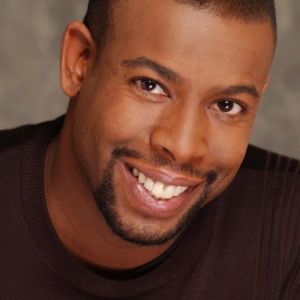
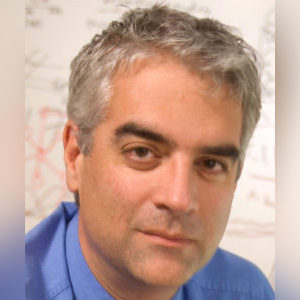
How do diseases and information spread? On this episode, Neil deGrasse Tyson and comic co-host Chuck Nice discover the history of pandemics, how social networks impact spread, and the hidden math behind it with sociologist and professor Nicholas Christakis.
Are we doing better with COVID-19 than in previous pandemics? What’s the difference between a respiratory pandemic and a plague? You’ll learn about the history of plagues throughout human history and what features come with them. Are plagues a feature of humanity? We bring some physics to the field of sociology by looking at wave mechanics within a social network. How do we understand the ways disease– and ideas– spread?
We look at hyperdimensional coordinate systems of information and we’ll tell you what it even means. Discover Nicholas’s sociology research on social networks. Which algorithm used on a network of people provides the biggest information cascade? We breakdown what we did wrong in this pandemic and what unique challenges COVID-19, as a disease, has given us.
What are the different phases of a pandemic? Do we know when it’s going to end? When will things go back to normal? Learn about biological ends to pandemics, which ones we think we’re headed towards, and the pandemic math behind it. How will mRNA vaccines change our responses to vaccines going forward? All that, plus, we discuss how to continue to spread science literacy and to keep people looking up!
Thanks to our Patrons Stephanie Nina Pitsirilos, bj Avent-Farmer, Bryce Irving, Heavily Sedated, Aaron Moss, Rudy Amaya, and Jan Erik Bergli for supporting us this week.
NOTE: StarTalk+ Patrons can watch or listen to this entire episode commercial-free.
Transcript
DOWNLOAD SRTWelcome to StarTalk, your place in the universe where science and pop culture collide.
StarTalk begins right now.
This is StarTalk.
Neil deGrasse Tyson here, your personal astrophysicist.
I got my co-host Chuck Nice.
Chuck.
All right, all right.
You know, it’s time we do yet another installment.
We’ve done some very interesting installments on COVID.
Yes.
And it’s progress and it’s our reactions to it.
Exactly, like the fact that, you know, it doesn’t exist.
And we did the show about how it was a hoax.
And then I think we did that show about how vaccines kill people.
No, no, we did the one with the microchips.
Oh, the microchips, yeah.
I forgot about that.
Microchips, yeah.
Yeah, we did the one about the microchips.
Oh, I love the 5G show that we did.
It could be first time listeners, Chuck.
We don’t want to mess with their heads.
We shouldn’t do that.
So I found in the academic, I think of it as the computers have a cloud that’s servicing.
There’s an academic cloud where in that cloud, you reach in and say, oh, there’s an academic who’s got expertise I want, you pull them out of the cloud, talk to them for a bit and stick them back in the cloud.
That’s how I think about this.
You know, honestly, the way you’re describing this makes it sound like you’re killing scientists.
No, no, no.
It’s not the spirit energy.
It’s worse.
Yeah, it’s worse.
It’s like they’re descending from heaven or something.
Exactly.
So we got Nick Christakis.
Nick, welcome to StarTalk.
Thank you, sir.
And I found you.
I was listening to somebody else’s podcast and I said, damn, I want him on my podcast because I got all selfish about it.
So you’re a professor up at Yale and you’re a trained sociologist with also extensive medical background.
And what a perfect combination of pedigree to talk about COVID-19 and societal reactions to it.
This is exactly the stuff you think about and care about and do.
And your recent book was just released in paperback, Apollo’s Arrow, and give me the subtitle on that again.
The profound and enduring impact of coronavirus on the way we live.
Nailed it.
He got it right.
Yeah, there you go.
By the way, he wrote this before, long before we were where we are right now.
So when people were saying that this was going to last for three weeks, he was writing this book.
He’s up to say, no, it’s not.
I got it right here.
Check it out.
So Nicholas, just want to say that my father was a sociologist, and I have very deep respect for all those who work in that field.
And I think they’re under heralded in what role they can play, do play, should play, and what insights they have that the rest of us don’t.
So I’m delighted to have you on StarTalk.
So Nicholas, in your book Apollo’s Arrow, in the preface you describe the fact that this pandemic and the social reaction to it is playing out as you’d expect.
So what does that mean?
What did you know that the rest of us didn’t?
And does that mean we’re just the same as every previous pandemic that we read about in the history books?
Did we do a little better?
No, we didn’t do any better, unfortunately.
You would think that in the 21st century, we would have done better.
I think there are two benchmarks you can use.
One benchmark is respiratory pandemics.
We have records of those going back about 300 years and very detailed records going back a hundred years, or more generally plagues, which have been afflicting human beings for thousands of years.
And-
So plague is not just a general term for a really bad epidemic, or does it have specific referencing to, like, what it does to your skin or other parts or other organs?
Well, plague, I would say, is the broader category to a respiratory pandemic.
So there are non-respiratory plagues, right?
There are, as you said, afflictions of the skin or afflictions of the gastrointestinal tract, for example, or neurologic plagues, like polio, for example, or HIV, you know, is a plague, but it doesn’t primarily manifest itself in respiratory, other than pneumocystis pneumonia, in respiratory conditions.
And the one thing they all have in common is that they are judgments from God.
So some would believe, in fact, but see, here’s the interesting thing that you guys are highlighting, which is that this way we’ve come to live in 2021, in 2020, 2021, now going into 2022, seems so alien and unnatural, but actually it’s neither of those things.
Plagues are a part of the human experience.
Plagues are in the Bible.
They’re in Homer’s Iliad, one of the canonical works of Western fiction begins with a plague.
They’re in Shakespeare, they’re in Cervantes.
So plagues are not new to the human condition.
They’re just new to us.
We think this is crazy that we have to live in this way and that we’re facing this threat, but this threat is an ancient threat that our ancestors confronted.
In fact, they were so alarmed and disturbed, our ancestors were by their experience, that they reduced this experience into our religious traditions, into our literary traditions.
They tried to warn us, our ancestors tried to warn us.
They said, there’s this thing that happens, it’s a plague, it’s awful and let’s tell you about it.
And we somehow didn’t listen to them.
We didn’t hear it.
And many of my Jewish friends, for example, in the spring of 2020, during Passover, they were like all my life, I’d said a Passover Seder.
And now suddenly, I really understood what my ancestors were talking about when they talked about a plague.
So this is a very, we have written records of plagues going back thousands of years.
Many of the things that we are experiencing, I would say almost all of them frankly, are familiar.
Thucydides in the plague of Athens.
Except for the 5G, except for the 5G accusations.
Yes, but.
I don’t know, I don’t know.
I’ve read some things about Bubonic where they were like, hey, 5G.
Well, no, almost guys, almost literally, almost.
Okay, so in fact, during the plague of Justinian, 1500 years ago, I’m pretty sure it was a plague of Justinian.
It was one of the early.
Wait, wait, wait, you have plague just, what, you just have plagues memorized?
You just plague fluent?
Yes, that’s sad and beautiful at the same time.
Dr.
Christakis has a plague catalog in his head.
There are many plagues, yes, but no, but the 5G analogy.
So one of the things is, so in my lab, we study social network.
Oh, sorry, let me announce that.
Yeah, so you’re a director, I’ll just say it for you, director of the Human Nature Lab at the Yale Institute for Network Science.
So this is where the rubber hits the road.
So go on.
No, right, well, we study the mathematical architecture of human social networks, the evolutionary origin of networks, why do we have friends, why are human networks have a particular topology, a particular structure, how did natural selection shape that structure, what does it mean for our lives and how are we equipped to interact and so on.
So we study all of these things and then we study spreading processes on what are called these graphs, these architectures of ties.
So we study, for example, how germs spread or how ideas spread or how money spreads or how emotions spread and how all of these things spread within networks.
And what we’re talking about now, this is sort of very abstract, but what we’re talking about right now is the spread not only of the germ, the coronavirus in our case, but also you highlighted this 5G conspiracy theory, the misinformation, how it spreads.
And one of the things you need to understand about plagues going back thousands of years is that as the germ spreads through this social network, right behind it is lies.
And in fact, this has been observed for thousands of years.
So during the plague of Justinian, I think, I think it was John of Ephesus, who was a historian and a priest at the time and was documenting what was happening.
He has this very kind of almost funny passage where he says, you know, the plague was devastating the city and a rumor went out such that the housewives in the city concluded that if you threw terracotta pots out the second story window of your house onto the street below and it shattered, this would ward off the plague.
And so John of Ephesus writes, he goes, it became more dangerous to walk through the city for fear of being hit by pots than from contracting the plague itself.
So these types of superstitions, we saw them, you know, from the White House in the last administration, you know, that if you inject yourself with bleach or irradiate yourself or charlatans of all kinds appeared out of the woodwork saying, take silver or do this or do that are all kinds of rumors, as you said, Neil, about 5G and on and on about vaccination, about masking, endless lies.
So the actual thing is just a detail.
It’s the idea that misinformation follows a social networking pattern no matter what that misinformation is.
Except for the bleach, except for the bleach.
The bleach works, it works.
I’m sorry.
The two general principles, Neil, and one general principle is that you might almost say that the emergence of mendacity is a feature of plagues, that in other words, even to call something a plague, you might want to go so far as to say, not only do we need a spreading and serious pathogen, not only do we need rising case counts, which by the way is the sine qua non of an epidemic, but we also need lies.
That’s one principle.
The second principle is that you can model the spreading dynamics, the ways in which this information spreads on the graph.
Similarly, that you model the spread of germs.
That’s a second overarching principle, but the details are of course different, right?
Like what is the constant, what is the rumor?
Is it 5G?
Is it that, what is the piece of misinformation?
That of course varies from plague to plague.
Oh man, I just wanna know, based on what you just said, is any of that, can you measure and quantify who does that purposely?
Because I’m sure there are opportunities to know that and take advantage of it.
You often see demagogues rise at the same time.
That’s exactly right.
In fact, often serious pandemics lead to great shifts in the political landscape or are prompted by prior shifts in the political landscape.
For example, if there are wars or conflict between states, often you see plagues arise then and after plagues, you can see people despots and others rise to power exploiting the suffering of people.
But one of the things that’s also very interesting and this borrows on some metaphors from physics, you can think of a social network, which many listeners may have in their…
No, wait, just to be clear, we can back up just for a moment.
So when you say that a despot would exploit the underclass, I think what you mean there, correct me if I’m wrong, is that if you’ve been badly affected by the plague, whatever previous system of governance did not prevent it.
So it allows someone else to rise up and claim that they’re going to be the one to fix it for you.
Yes, and there’s some ideas.
So that’s how you’re taking advantage of this.
Yes, even in other words, sometimes it’s explicit, like some despot says, I’m going to deliberately exploit this.
Others, it’s not so explicit, it’s just a change in social order.
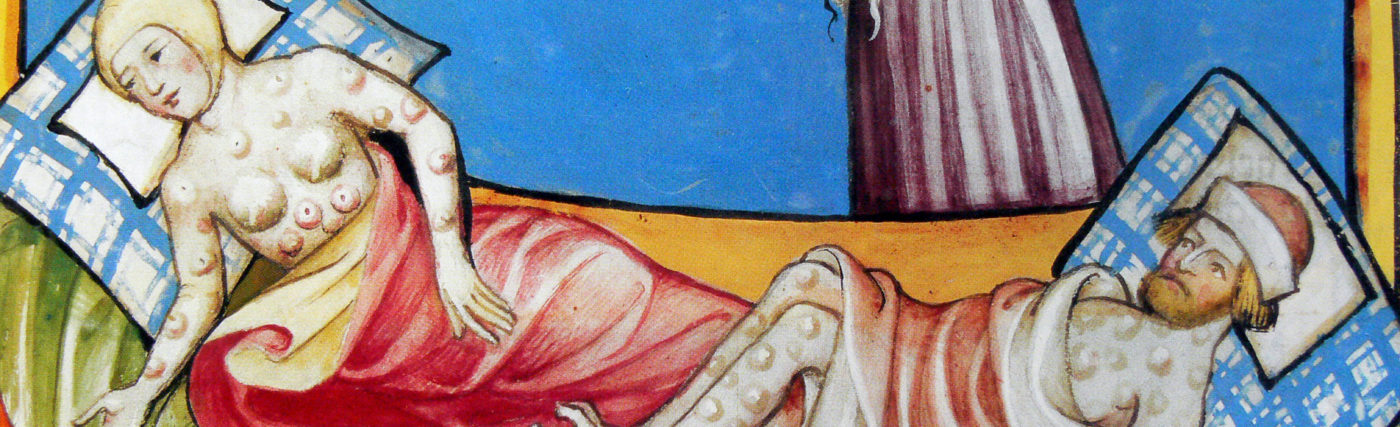
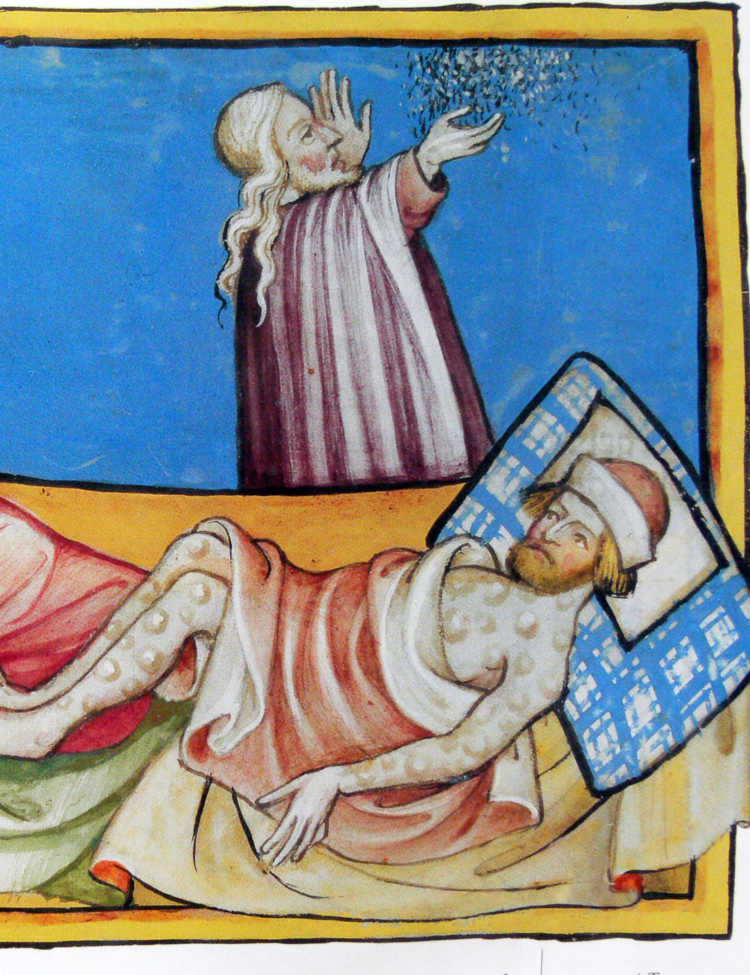
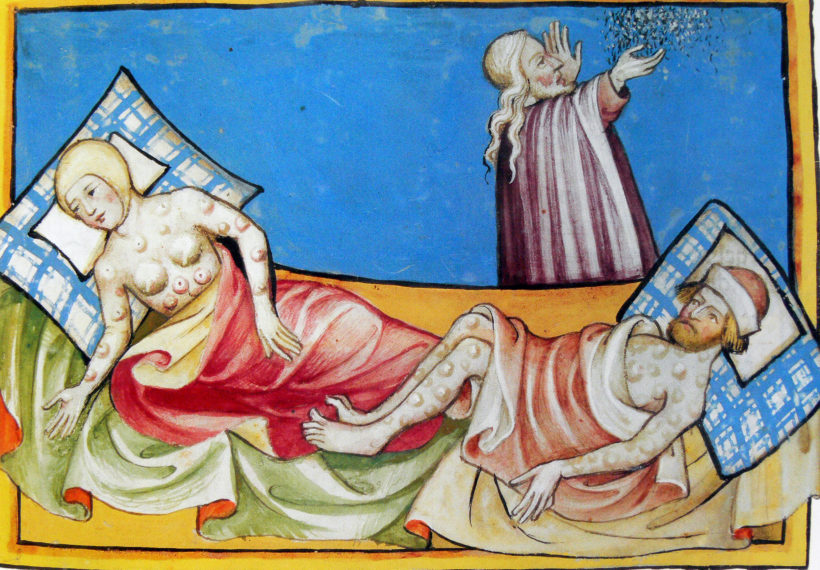
So for example, after the bubonic plague in the 14th century in Europe, and by the way, the bubonic plague, the Black Death so-called.
Yeah, the Black Death so-called, which was in 1340s.
There were waves of it every few decades for 500 years in Europe, and it decimated the European population.
There are many people who have argued correctly in my view that that kind of death, where let’s say about 30% of Europeans died, in some cities, 50% or 80 or 90% of the residents of a city died, led to a great crisis.
So it was very clear the politicians couldn’t stop it.
So those guys were useless.
The priests couldn’t stop it.
So religion was useless.
The doctors and the scientists didn’t know what was going on.
So they were useless.
So many people have argued that it gave rise, it paved the way for the emergence of new democratic institutions politically, new forms of government, new types of science and the reformation that it paved the way for a different attitude towards religion.
So all of those things are things that can happen.
But if I might, I wanted to go back to what I was gonna say on these spreading processes, which was a different aspect of what Chuck asked, which is that social networks, if many people are familiar with these images of networks with dots and lines drawn on a two-dimensional page, this complexity with this sort of knot in the middle and this kind of feathering towards the edges, but actually networks are a hyperdimensional surface.
And you can think of things spreading in that surface.
So for example, the germ is spreading.
You can think of waves of germs in that surface and waves of information in that surface.
And you can actually borrow mathematics from physics to look at wave interference.
And so the question is, which wave, like how do they reinforce each other?
So a wave of misinformation you see can reinforce a wave of the spread of the germ or vice versa.
A wave of the spread of the germ can activate people to seek out accurate information.
And you can borrow certain kind of mathematics involving differential equations and other ideas to model these wave interference pattern.
And you can actually, and my lab does this kind of work, you can actually get a deeper understanding of how these things interact and the circumstances under which waves of correct information can retard the spread of the germ and waves of misinformation can accelerate the spread of the germ.
So this is a, I mean, in wave mechanics, if two waves are resonant with peaks and valleys matched up, then they basically double the effect, but they can come out of phase with each other and then cancel.
And so you’re applying this to social networks.
This is great.
So that’s constructive interference of social networks.
Yes.
Yes.
Yes.
So we gotta take a break, but when we come back, Nicholas, I’m tired of hearing you tell me what the problem is.
I’m gonna know what the solution is.
Okay?
That’s why I have you on this show.
Okay, well, we’ll see.
So with StarTalk, we’ll see what StarTalk returns.
We’ve got Professor Nicholas Christakis talking about the social networks and COVID.
Bye Hi, I’m Chris Cohen from Haworth, New Jersey, and I support StarTalk on Patreon.
Please enjoy this episode of StarTalk Radio with your and my favorite personal astrophysicist, Neil deGrasse Tyson.
We’re back, StarTalk.
I’ve got Nicholas Christakis.
He’s a professor at Yale who thinks about and studies social networks, even before to think of social networks was a common term because there have been social networks even before the internet, believe it or not.
And so when you’ve got that kind of insight, you’re deep.
Take that millennials.
You’ve got some deep understanding of what’s going on, how and why.
So we left off Nicholas with you describing a hyperdimensional coordinate system where information, true or false, moves in this coordinate system and occasionally interferes with other movement of information.
What I want to know is what good are you to have this analysis if you can’t in the next breath say, here’s what you do with that?
Well, we do a lot of experiments in my lab to try to exploit a deep understanding of human social interactions and of the mathematics and dynamics of human social networks to try to invent things to make the world better.
Now, if I might, I’ll just deGrasse and just sketch a couple of experiments and then some potential implications with respect to the coronavirus pandemic.
So for example, one of the things we do is we use some software we’ve developed to map networks in developing world villages, for example, in India, in Uganda and in Honduras where we have a big project funded by a number of funders including the Gates Foundation and the Nomus Foundation.
We map the networks of people there using this software.
We ask people who are your friends and we ask everyone else who are their friends.
We map these networks.
Then we use some mathematical algorithms to identify who in this village, let’s say, is structurally influential, not by virtue of who they are, how rich or poor or tall or short, for example, they are, but rather by virtue of where they are located within the network.
For example, if you were a bioterrorist and I asked you who in New York City would you want to infect to get the biggest epidemic, the fastest possible, you might imagine that someone very popular and very well connected in the city would be the person you would infect rather than someone who has no friends, for example, and just stays alone in their apartment.
So, but we can use more sophisticated methods than that and then you can identify people within these villages and then you can give them an educational intervention, for example, about breastfeeding or vaccinating their children or about proper latrine usage, all these public health things that my lab does.
And then what we do is we do these large scale experiments where we randomly assign out of hundreds of villages, different villages to different targeting algorithms.
And then we test which algorithm gives you the biggest informational cascade.
Can we create artificial tipping points by thoughtfully targeting a small subset of people such that if we persuade them to change their behavior, everyone copies them.
So that’s one class of experiment we’ve done.
That’s good.
That makes complete sense in retrospect, of course, duh.
You just described Fox News.
Well, no, Fox News.
No, that’s a different…
I know, but that’s a different kind of broadcast power.
In other words, one of the things about networks you have to understand is that Neil has the same network power that you and I have, Chuck.
In other words, when he likes a book, he can tell his friends whether they like a book and we’ll have some influence on them just the way I do.
But in addition, he has a kind of…
Like Apollo’s arrow, for example.
For example, but Neil also has broadcast power.
And that’s like different than you and me in that that is a rain from the heavens.
In other words, it’s a kind of a different process.
It’s sort of outside the network system.
But okay, so that’s one class of experiment.
A different class of experiment is these online experiments we do, which we’ve done with tens of thousands of people, where we create temporary artificial societies of real people.
We bring in, let’s say, 4,000 people and we put them into 200 groups.
And we experimentally manipulate, for example, the structure of the groups, or the income inequality of the groups, or who is given what piece of information, who is told the truth and who is lied to, for instance.
And then we let the people interact in that system and then experimentally test different interventions that might, for example, enhance the cooperation of the system or decrease the racism, for example, how people treat each other or how we might optimize the flow of accurate information in the system.
So we do all of these experiments.
So it’s this class of work that we do that sheds some light on some interventions we might deploy with respect to coronavirus.
But it is, in fact…
Okay, so I can say in the last two and a half years, you failed.
I alone, yes, I have been unable…
You…
Yes.
It is your fault.
Yes.
Yes.
Yes.
Yes.
I mean, yes.
You know, it is a difficult problem in our enormous society with our media landscape to try to tackle the problem of the spread of misinformation, a huge problem.
And in some ways, it also reflects some appealing qualities.
You know, we have a free and open press.
We have freedom of speech in our society.
I wouldn’t want to live in a society in which some agent like the government or some other agent specified who could say what or what was the truth.
But the downside of that is we have to tolerate and willfully counteract the spread of lies.
And we haven’t had, unfortunately, a tremendous, tremendous spread of lies.
And if I might just go on a little digression, a more sociological digression.
This virus, in my judgment, happened to strike us at a particularly vulnerable moment in our life as a society.
We have a century high levels of economic inequality.
We have half century high levels of political polarization.
We have a kind of scientific illiteracy that I know you and others are trying to counteract that is very high.
I mean, very large fractions of Americans believe in that the Earth was created 10,000 years ago, for example.
Or don’t understand basic statistics, even basic ideas.
We have as well a kind of suspicion of scientists, like because there’s a very ascendant anti-elitism in our society right now, because of this political and economic polarization, scientists are seen as just another elite, another group of people seeking to exploit us for their own venal interests, which is wrong, of course.
Of course, scientists are human.
They have their own interests.
But that’s not, in my judgment, the correct way to see scientists.
And finally, we have a loss of capacity for nuance in our society.
Right now, everything is black or white.
You’re with me or you’re against me.
There’s a kind of tribalism and a kind of lack of capacity to see, well, things are complicated.
A lot of these topics like climate change or pandemics or nuclear power, all of these things that you talk about are difficult topics that require a serious conversation.
And you know what?
The virus struck us right now when we are unable to work together to develop a basis of facts and then to fight our ideological battles apart from the facts.
And then once we fight that battle, reach a consensus as a nation on how to combat the pathogen.
So we’ve died in great numbers, Neil and Chuck.
We have died in great numbers.
We’re rising through 5 million worldwide.
Worldwide, but in the United States, we will lose a million Americans.
Two million would have died if we’d done nothing, I believe.
But a million of our fellow citizens, I think at least, will have died before this pandemic is over, partly for our lack of ability to have a sound, scientifically based, politically organized response.
It’s funny, while you were talking there, Nicholas, Chuck was saying, yes, yeah.
It’s like in church when you say, amen, amen.
But Chuck’s version of that is, yes.
Look at the man, yes.
Say it now, say it.
I heard you, Chuck.
Every 30 seconds, yeah, mm-hmm.
You know why?
Because it’s, listen, I love, and you do this too, Neil, and so I can’t do it.
And I swear I’m trying because my exposure because of Neil causes people to, you know, ask me stuff, and I’m like, don’t ask me that shit.
But what I like about you guys and many scientists is that everything that Dr.
Christakis just said, and I’ve seen this from you too, Neil, is when you’re a comedian, that person is just stupid.
That’s the way you look at them.
You’re a dumbass, and that’s all there is to it.
But you guys look at people like, no, that’s not the way to look at them.
What we have to do is figure out how to get through to that person.
What we have to do is figure out how do we inspire that person.
And, you know, I admire that, and I hate it at the same time.
Well, also, Chuck, I mean, the other thing is it’s a fact that, you know, our fates are tied to our fellow citizens.
And so we have a selfish interest in trying to get our fellow citizens to behave better.
But even if we didn’t have a selfish interest, we should have an altruistic interest.
I mean, these people who have some of these beliefs in like 5G, for example, deserve our care and our help and our empathy.
They are our fellow citizens.
I have no interest in, like right now, there’s a kind of a narrative that’s rising.
Like if you’re not vaccinated, you deserve to die.
I don’t think that’s true.
I don’t think that’s a little rough.
Yeah, it’s really rough.
I don’t think that’s true.
For several reasons, I don’t think that’s true.
First of all, I don’t think that’s true because I don’t want any human being to lose her life needlessly.
And second, some of those people have been taken in by a set of false beliefs and have been deluded in a way.
Duped.
Yeah, duped.
And I feel sorry for them.
I mean, anyway, so this is, you know, I think I’m very ashamed of how we’ve done as a country in terms of combating the plague.
I mean, we opened this conversation by talking about how plague is an ancient threat.
But the thing that’s a little different about us right now, candidly, is where the richest nation the world has ever seen.
We have 200 years of efforts to invent vaccines.
Countless scientists, doctors and patients have labored to produce this knowledge.
We have scientific experts.
We have virologists, immunologists, epidemiologists, medical historians who could have told you about respiratory pandemics going back a hundred years.
In fact, one of the reasons I knew this was going to be so serious is that I knew the history of respiratory diseases because other scholars had put them into books and you could, by February of 2020, I knew what was going to happen.
You asked me earlier, how did I know?
Well, because I read books, you know, and there are other scientists that have spent their lives studying this stuff, so why do we have…
Wait, Nicholas, if you read books, you’re missing out on some really good video.
No, but I mean, the point is, this capacity, this capacity…
Actually, there are great video games about epidemics too, it turns out.
But, Neil, as you guys know, this capacity to…
The scientific method, which is one of the triumphs of human ingenuity, and this capacity to collect information and transmit it, which, by the way, we spend billions of dollars every year on in our society, in our time of need, when we were being beset by a deadly pathogen, you would think, we would say, aha, we can now take advantage of this and save our lives.
And yet, a significant fraction of people and a significant will didn’t do it.
I’ll say one more thing.
I think the intermediate lethality of this pathogen, it’s 10 times deadlier than the flu, but it’s not as deadly as smallpox or bubonic plague or cholera, which can kill 30 or 50% of the people they infect.
This intermediate lethality harmed us.
I think if this plague had been, let’s say, much deadlier, and there are coronaviruses which kill 10 or even 30% of the people they infect, I think we would have taken it much more seriously.
So this virus was really sneaky.
It hit us right and this capacity of the virus, this virus has this other property which is really interesting.
It has what is called protean manifestations.
In other words, the virus causes a great variety of clinical presentations.
It can affect your lungs, your gastrointestinal tract, can make you fatigued, and a great variety of severity.
So let me give you a thought experiment.
Imagine you had a thousand people, population A has a thousand people, ten of them are infected with the virus and become seriously ill, and one of them dies.
So 10% case fatality rate.
Now imagine population B, you have a thousand people, ten of them get infected and become seriously ill, and one of them dies just like before.
But in addition, 90 people get a mild version of the virus, so a hundred total people infected in population B.
So one out of a hundred dies, one percent fatality rate.
So if you ask people, which of these two worlds would you rather be in, a world in which 10% of the people get infected die, or a world in which 1% of the people that get infected die, many people would wrongly choose world B, where 1% of the infected people die, but that is a delusion.
If you stop and think about it, world B is the worst world to be in, because the same number of people get seriously ill, the same number of people died, but in addition, 90 get a mild illness.
There’s more disutility in world B.
World B is a worse world.
And this virus, because it has…
Not only that, isn’t it true, had it been more deadly, and we sort of sat to attention sooner, a more deadly virus probably would have ended up with fewer deaths in total.
It could have been if we sat to attention.
That’s absolutely correct.
We could model that out.
But it’s not just the lethality, it’s this protean manifestations.
Because what happened to us is that many people could say, well, I have lots of friends who just had a mild case, so I’m not going to pay attention.
So it seems, wrongly so, it seems less serious because you have these people who recover.
Yes, or who have a mild course.
Exactly.
So really what we need is a virus that is quite demonstrable in it’s not just lethality.
If people recover, it’s like they went through some, like Ebola, where you see people bleeding from every single orifice, and then they die, and then you’re like, oh man, I don’t want no parts of that.
Okay, but then the virus is less likely to be transmitted if you’re so effective at that stage.
I mean, this is Nicholas’ point, right?
If the virus can fool 90% of the population into thinking it’s nothing really serious while it kills the others that it is, the virus is having its way with you.
The virus is like that dude at the nightclub that tells every woman something different so that he can go home with a different woman every night.
Could be.
I’m not sure I would make that analogy.
That’s the exact analogy here, Chuck, we’re going for.
But before we end the segment, Nicholas, could you just tell me what impact everybody being forced to stay home had on civilization?
Now, in my community of astrophysics, surely yourself as well, you know, it’s really not a thing.
We didn’t lose a beat having to work at home.
Just with a good Internet connection, I’m fine.
But school children, other workplace challenges that have assembly lines, you can’t do that from home.
What was the net outcome of this?
I like to think of pandemics as having three phases, respiratory pandemics.
There’s the immediate phase, and we are approaching the end of that right now.
So we’re not at the beginning of the end of the pandemic, but we are approaching the end of the beginning.
The immediate phase goes up until 2022.
Said Winston Churchill, by the way.
Yes, but a different thing.
Winston Churchill quotes.
About a different thing.
Exactly.
But so we’re going to reach the United States is good.
Well, I got to flesh that out.
So it was after D-Day, and it looked like the Allies are encroaching on the Axis forces.
And a reporter asked Winston Churchill, is this the beginning of the end?
And he says no, but is the end of the beginning?
Yes, exactly.
So it was set of D-Day.
Exactly.
And so if I remember correctly.
Yeah, so that’s the I was exactly that language.
I was aping Neil.
But what you need to understand is that right now we are being hit with this biological and epidemiological wave of the virus that’s spreading through this immunologically naïve human population.
And the virus is going to spread and spread and spread and spread among us in our country and frankly it has to in the whole world until we reach this important threshold known as herd immunity.
Basically, unless you’re a hermit on the mountains or very lucky, everyone on the planet will either be infected with this virus or get vaccinated or both.
So that’s going to happen.
We’re going to cross that threshold soon in this country.
And then we’re finally going to put the epidemiological and biological impact of the virus behind us.
This does not mean the virus is gone.
The virus will still kill people.
It’s not eradicated.
But at greatly reduced numbers, it’ll fall into the background welter of things that kill us.
But then we will enter the intermediate phase of the virus.
It’s like a tsunami has washed ashore and devastated the countryside.
The waters finally recede, which is great.
But now we have to clean up the mess.
And it’s that mess that you were alluding to.
We’re going to have to cope with the clinical, social, economic and psychological aftershocks of all of this death and isolation and so on.
All of this disruption, millions of kids miss school.
Millions of people will be grieving the loss of a loved one.
Millions of people lost their jobs.
Millions of businesses closed.
We’re borrowing trillions of dollars against the future to kind of cope with the present.
We’re going to have to pay those debts.
And that’s going to take a couple of years, I think, until 2024, where we’re going to have this kind of stuttering emergence from the shock.
And then I think beginning in 2024, it’s going to be a little bit of a party similar to the roaring 20s of the 20th century, after the last major respiratory pandemic, the 1918 influenza pandemic of 100 years ago.
Well, there you go.
Here’s to a terrific 2024, people.
You’re going to have flappers and everything and speakeasies and stuff?
Yes, I think it will not be exactly those things, but it’s going to be, people are going to be like a release, like any human population that survives a war or an earthquake or a hurricane or a plague, the survivors are going to be relieved.
And I think they’re going to have been cooped up, they’re going to have been socially isolated.
I think there’s going to be a kind of a celebration, a kind of return, an exuberant overcorrection, a kind of return to normalcy.
And I think people will relentlessly seek out social interactions and nightclubs and restaurants and sporting events and political rallies going back.
I think we’re going to see a lot of political ferment and people will be spending their money.
You know, we’ve been saving our money during this pandemic, as people have for all past plagues.
So, so yes, I think it’s going to be quite a quite a shift in our society, honestly.
Well, we got to take another break.
But when we come back, yeah, I want to further probe the emergence from this portal, right?
This portal that’s on the horizon and what the future society will look like.
And will we carry this memory or are we going to have to turn it into mythologies and legends to carry it for the next, for our great grandchildren so they don’t go through what we went through?
Or is it the same all over again, when we come back on StarTalk?
Bye We’re back, StarTalk.
We’re talking about the sociology of COVID, what it has done to us as a civilization.
Got Chuck Nice.
And we’ve got our guest from up at Yale, New Haven, Connecticut, Nicholas Christakis.
And Nicholas, how do people find you in social media or elsewhere?
Oh, I’m on Twitter at NA Christakis, and then my lab is humannaturelab.net.
So Christakis, C-H-I-R-I-S-T-A-K-I-S.
N-A-C-H-R-I-S-T-A-K-I-S, yes, on Twitter.
Stakis, yeah, okay.
So what of the fact that the coronavirus is so varied in its incarnations that is there any hope it will ever end at all?
You spoke of herd immunity.
Isn’t that for just one strain but not another?
And if another strain, another mutation is different enough, doesn’t that throw all of our immunizations out the window and we gotta sort of start this all over again?
Well, there are different sorts of ways that these types of plagues end.
They have a biological end and a social end.
The biological end, there are actually different types of biological ends.
One biological end, we talked about this notion of herd immunity when enough people, herd immunity is the idea that a group of people can be immune to a condition even if not every constituent individual is immune.
So for example, if you vaccinate 96% of the population against measles, if one of the 4% unvaccinated people happens to get a case somehow, they don’t create an outbreak because they’re surrounded by immune people.
And that percentage, that 96% is the herd immunity threshold and it’s actually given by a little mathematical formula that connects it to the intrinsic spreadability of the pathogen.
So pathogens that spread more easily, you need higher numbers.
Actually, the spreadability of a pathogen is quantified by something known as the basic reproduction number, the R sub zero, the R naught.
And the formula for computing the herd immunity threshold is R naught minus one divided by R naught.
So for the original strain of the virus, the R naught was three.
Three minus one divided by three means that 67% of the population has had to have acquired immunity one way or the other by vaccination, ideally, or naturally through infection before we reach the herd immunity threshold.
Now, I’m not gonna go into it.
So measles is famously spreadable.
That would have a correspondingly higher R naught.
Yeah, that’s exactly right.
So the R naught for measles is like, it’s the most spreadable, it’s like 16 or 18.
So 18 minus one divided by 18 gets you a number that’s like 96%.
So, but before you go any further, as the only non-scientist here, let me just tell those of you who are listening, what Dr.
Christakis is saying is, we are not at herd immunity, okay?
Well, because the Delta, the Delta variant, Chuck, has an R naught of six.
So six minus one divided by six gets you 83%.
And so, and the Omicron variant.
So let’s get, give me all three.
So the original one, whatever one that was, what was that immunity level?
Well, the R naught was about, it was about three.
The native strain had an R naught of about three.
And so it’s herd immunity threshold was about 67%.
Now let me just quickly say for some listeners who might know, turns out this is a simple arithmetic calculation.
If you take into account network structure and the fact that people vary in how many connections they have, it actually brings that number down a little.
But that’s not really relevant for our conversation right now.
These other strains can be more spreadable and can have, and are more spreadable.
Omicron, we don’t know they are not for sure yet.
It’s probably-
Everybody’s got Omicron now.
Well, yeah, but-
Everybody’s coming down with it.
Yeah, if you don’t have it, you’re not cool, man.
I know.
I do not want to encourage people to get infected.
I know, I shouldn’t even joke like that.
Not even joke like that.
No, you can, but that’s because you’re Chuck.
I’m not, yeah, but seriously, so we don’t know exactly what the intrinsic or not of the pathogen is.
The reason Omicron is so effective is it has a second property, which is its capacity for immune escape.
In other words, it can reinfect people who were previously immunized, either by infection or by vaccination, which is a different property.
Either way, however, we’re getting lots of cases.
But here’s the thing.
You asked me about how pandemics end.
One way they end is that enough people get immunized, either through vaccination or through infection, that finally the germ runs out of places it can go.
A second way, maybe what’s happening with Omicron, and I actually discussed this in Apollo Zero, which is that there’s this tendency, it’s theorized and often seen, but it’s hard to prove, a tendency of pathogens to become more benign with time.
So another biological end, which is likely to be the case, is that this pathogen will mutate to become less deadly, which may be happening with Omicron.
So in other words, if you think about it, as you mentioned earlier, Neil, if the virus infects me and sickens me quickly and kills me, that variant of the virus dies with me.
But if the virus gives me a mild illness and doesn’t put me in bed and I’m out and about spreading it, those variants of the virus come to be ascendant.
They are more fit from a Darwinian point of view.
So they will spread more.
And so what happens with the time is that the more spreadable, less deadly variants of the virus, on average, in general, it is theorized, tend to come to predominate.
So that’s the second way that we get to a biological end.
And maybe that’s beginning to happen.
So if the mild version is ascendant, then does that mean ultimately it will think of it as the common cold?
Yes.
Yes, and I think that’s what’s gonna happen.
And in fact, as I argue, I think that’s probably what happened in 1890.
There was a so-called Russian flu that many people think was influenza, but some other people speculate, myself included, it might’ve been the last great coronavirus pandemic.
The 1890 Russian flu might actually have been coronavirus.
And now the virus, it may be the case that a coronavirus that causes the common cold, something called OC43 may actually be the distant echo of that what was then a very serious respiratory pandemic a hundred years ago, more than a hundred years ago.
So that’s the second kind of biological end.
The third biological end is that over great stretches of time, thousands of years, of course, we evolve to deal with the virus.
So for example, many humans have adaptations against malaria, against tuberculosis, against other pathogens that have been around for a long time because those of us that are vulnerable die and don’t reproduce as effectively.
And other humans with different mutations survive.
Now that’s not gonna be the case in our lifetimes.
That’s over long eons.
But in addition to the biological ends that we’ve been discussing just now, there are also social ends.
And the social end of the pandemic is when basically when people say, you know what?
We’re just gonna accept this.
And I think that’s beginning to happen in our society where people are saying they are kind of beginning.
Enough is enough.
Yes, something like that.
And that can define, you see a social end of the pandemic, even if the germ is still going about its business, at some point, humans may declare victory or put their head in the sand and however you wanna see it.
And that will mark the social end of the pandemic.
Oh, I gotta tell you, none of those sound good.
Is it too soon for that social?
No, right.
Is it too soon now to begin a social end of the pandemic?
I would say so.
I mean, I know people are, one of the metaphors I use is, I don’t have terrific teeth, unfortunately.
When I was in Greece, there was no, as a boy, there was no fluoride in the water.
So I’ve had many root canals.
I don’t know if you guys have, or maybe some of your listeners have had root canals, but they’re awful.
No, I get my teeth are basically never had a problem.
See, but listen, the trade-off is, the government doesn’t control your brain now.
There was no fluoride in the water.
Well, I wish there’d been fluoride when I was-
All the conspiracy theories is a go-to guy.
No, but the thing is, the thing about a root canal is that your being in the dentist’s chair and wishing the root canal to end has no bearing on whether you need a root canal.
In other words, you just, you need the root canal and you’re not wanting it, has absolutely nothing to do with.
And that’s the same with the virus.
Our desires about the virus are irrelevant to the virus.
The virus is another feature of the natural world that has its own destiny.
There’s debate about whether viruses are living or not.
It’s a topic for another conversation.
But for the sake of argument, it’s acting like any other living thing.
It is having what is known in evolutionary biology as an ecological release.
It’s like when we accidentally release rats onto an isolated Pacific Island and they overrun the place.
This virus is overrunning us.
It’s just spreading and spreading and spreading in us.
It’s found untapped terrain and it’s just gonna have its way with us.
So our desires have nothing to do with what happens, unfortunately, to the virus.
But we can develop a kind of social modus vivendi with the virus.
We can just sort of say, well, we’ve had enough.
Now I think, Neil, it is too early for us to do that.
I think if we behave better, we can still reduce the toll of mortality in our society.
I think that the simplest thing we can do is to be vaccinated.
We can get boosted for the existing boosters, but what is also gonna be on the horizon is the pharmaceutical companies are gonna release new boosters for new variants, which I would encourage listeners to get when they come out.
Just like you got your annual flu shot or you got your tetanus shot every 10 years, we’re gonna have these other booster shots, which it will make sense to get.
And I think we need to recognize that this mRNA vaccine technology that we have is mind boggling.
It is going to change the future of how human beings, how our species responds to pandemic disease, because we now have a technology that will allow us to rapidly prototype and develop bespoke vaccines against novel pathogens.
So that the period of time under which we must suffer, either the social withdrawal or the death will be reduced.
And I think that is a feature, one thing that has been different about this pandemic compared to all the ancestral ones.
And will also be different with respect to future pandemics.
Science to the rescue!
Yes.
But of course, Nicholas, because the vaccines would develop so quickly, became a reason for people to distrust.
I know.
They used that fact against the vaccine rather than be delighted in how quickly it arrived.
So you’re a sociologist, like explain that.
And also, before you explain that, you might, because in your book, you talk about the fact that the mixed messaging on mask was also a very bad thing.
Yes, I think that there’s gonna be a reckoning and I think that many scientists, you know, I mean, there are many different, science is a human enterprise, of course, and people vary in their beliefs.
They vary in their ability to collect facts.
They vary in the facts that they’ve gathered themselves.
Different experimenters come to different experiments.
They vary in their analysis of the body of facts.
They come to different conclusions.
This is to be expected.
And I think one of the things that’s very important to explain to listeners is that when scientists disagree, that that’s a feature, not a bug of science, right?
That’s how science progresses.
It’s theology where there’s no disagreement, ostensibly, right?
Like scientists disagreeing with each other is how the process works.
And we test our ideas against the truth.
We test our ideas against the natural world.
And that’s part of the process.
So the disagreement itself, we could have done a better job preparing the public to see that scientists might, for example, disagree about masking, but very quickly we’re gonna do experiments and we’re gonna come to some consensus.
So that would have been helpful.
Now on the speed with which the vaccines were invented, it’s true that they were invented quickly, but now the experiment’s been done.
Hundreds of millions of people have been vaccinated.
The vaccines are incredibly safe.
We have dozens and dozens of studies that show that they are also effective, not just in the original randomized trials, but now in large scale epidemiological studies.
And it’s built on 200 years of science.
I mean, why were we doing this for 200 years, developing these vaccines?
Beginning with cowpox being used for smallpox.
So no, it’s not the case that we’re doing some kind of creepy experiment with the world population, releasing completely unknown technologies.
That’s not what’s happening.
And even if we were, even if that were the case, which it is not, it is not, but even if it were, it worked.
Just look at this, it works, people.
So look, my nephew won’t get vaccinated for whatever reason.
I keep trying to cajole him into doing it, but I said to him, bro, I’m your guinea pig.
I did it for you.
I’m fine.
You might also.
Chuck, you didn’t tell me you had relatives that are anti-vaxxers.
I do.
I have actually more than one.
I have two nephews who are anti-vaxxers and they’re young.
What I don’t understand is they’re young and they don’t want to have any part of it.
They’re also kind of conspiracy theorists as well.
So, you know, by the way, both you nephews know who you are.
I know you listened to this podcast.
I’m not using your name right now, but I could call you out and I’m not calling you.
I call you at any minute.
So, Nicholas, I want to try to end on a positive note.
Is there any demographic shift in respect for science as you go to the younger generation?
I don’t know the answer to that.
I’m sure the answer is known.
I’m sure there’s polling on this.
Many of them are leading the climate change initiatives.
I think it’s an open question.
I think if you force me to pick, I think that the demonstration of the power of science during this pandemic, for example, through the invention of the mRNA vaccine, for instance, which I think ultimately will become widely acknowledged.
And the fact that there were many scientists who were correctly calling what was gonna happen during this pandemic may increase public confidence in science with respect to other global catastrophes.
I taught a course at Yale last semester on global catastrophes with Bill Nordhaus, the famous economist who won the Nobel Prize for his work on climate change.
And we-
Stop name-dropping.
Yeah, exactly.
Well, I mean-
I could talk with a Nobel laureate.
I mean, me.
I was on a podcast with-
Chuck, you gotta get you on.
Get you on.
I was on a podcast with-
Get you a Nobel laureate.
I was on a podcast with Neil deGrasse Tyson.
How about that?
No, but I mentioned it only because people may not know who he is, but just to mention his credentials.
Anyway, we taught a class on global catastrophes and you can think of the coronavirus pandemic as a kind of accelerated version of the challenge we’re gonna face with climate change.
You know, that we have to rely on each other.
It affects the whole globe.
There’s a role of science.
There’s a disputation about what to do, about what’s happening, all of these features.
There’s risk tolerance, who should tolerate what risk and at which generation.
All of these features that are features of the climate change debate and conversation, I think are features of how the world is working on coronavirus.
And by the way, the international collaboration that will be required to detect and respond to future pandemics.
Just by the way, we get respiratory pandemics every 10 or 20 years.
There was, for example, one in 2009, the H1N1 influenza pandemic, but nobody remembers it because it just gave you the sniffles.
We get serious respiratory pandemics every 50 or 100 years.
We mentioned the 1918 pandemic.
There was also 1957 pandemic, which killed 110,000 Americans, which would be 220,000 Americans today.
So this one we’re having is the second worst one we’ve had in 100 years.
We’re gonna have more pandemics in the future.
And there’s some scientific evidence that the inter-pandemic interval is shortening.
So we could get another one in five years, in 10 years, in 20 years, in 30 years.
We don’t know when it’s gonna happen.
But it’s clear to me that we’re gonna need some kind of international system for monitoring the emergence of these new pathogens and responding as a global population to it.
And that system also is gonna be analogous to the kinds of systems we need to deal with climate change.
So there are many ways in which the coronavirus pandemic is analogous to this other global catastrophe that’s on the horizon.
And I think that-
It’s a shot across our backs.
Yes.
It’s a shot across our backs.
And I think that young people may see the utility of science, may have seen it in their own lives with respect to the coronavirus pandemic.
And therefore, Neil, come to also apply it, as you suggested, to other challenges.
So I hope, inshallah, as they say, I hope that we will have a more sober-minded, more pragmatic and more respectful, I’m not gonna say deferential, but respectful attitude towards the utility of science in our society, which, one more thing, is actually the root of our wealth and security.
Like one of the things that’s hilarious to me is, people use this device, which was invented by scientists and engineers.
Actually, you can trace this device back to Faraday in 19th century, you know, in England.
And they use it to say, oh, these scientists don’t know what they’re talking about.
For those of you who are just listening, Dr.
Christakis is holding up a smartphone.
A smartphone, of course.
Yes, yes, yes, yes.
And we got to land this plane, but here’s a quote that I saw on a poster during the science march.
First, one of the posters said, you know things are really bad when scientists have to march.
That’s a great poster.
Another one was, what do we want?
A time machine.
When do we want it?
So that was my other second favorite.
Third favorite was, every disaster movie begins with a person in power ignoring the warnings of a scientist.
Every single one of them.
Well, Nicholas, this has been a delight.
Thank you for giving of your time, and we need you to go back and teach your class with all your Nobel laureate friends.
I’m going to go back to my lab.
I’m going to go back to my lab.
But thanks for coming on on relatively short notice because I only came to…
I knew of you from previous years, but just to have you as relevant to anything I’m doing, that was only the last few days.
Thanks for your fast turnaround on helping to make this happen.
Thank you both for having me.
It’s been a pleasure.
All right.
Chuck, always good to have you here, man.
Always a pleasure.
Next time, I’m going to call out your nephews.
Please do.
I’m telling you.
You know why?
They may actually do something if Neil deGrasse Tyson calls them out.
But seriously, your nephews, what they need to understand is that death is a problem of the aged in general.
In other words, young people face a very low risk of death from all causes.
But coronavirus increases your nephews’ risk of death by about 30%.
In other words, they have their young people, they have a one in a thousand or probably a one in 5,000 chance in dying in the next year.
But coronavirus might increase that to 1.3 in a thousand.
Now, they may think, oh, absolutely, that’s trivial.
But that’s actually a really substantial increased risk of death.
Anyway, this is a conversation I have with the young people in my extended family.
Good luck.
They’re listening right now.
They listened.
So you must be fun at the dinner table.
That’s all the time we have.
This has been StarTalk, another COVID installment, catching up with what it’s doing and where it’s going, where it came from.
I’m Neil deGrasse Tyson, your personal astrophysicist.
 Become a Patron