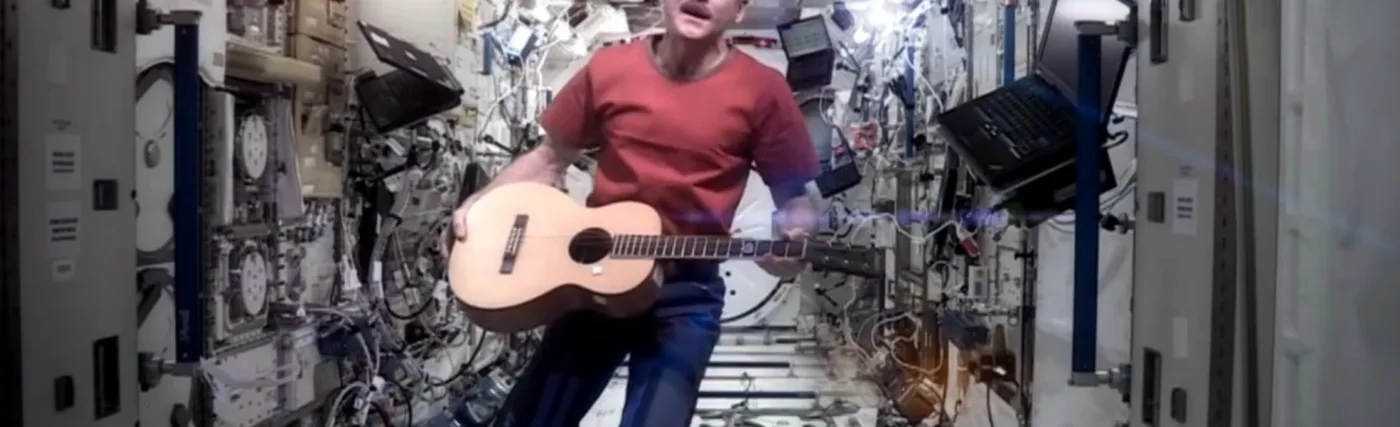
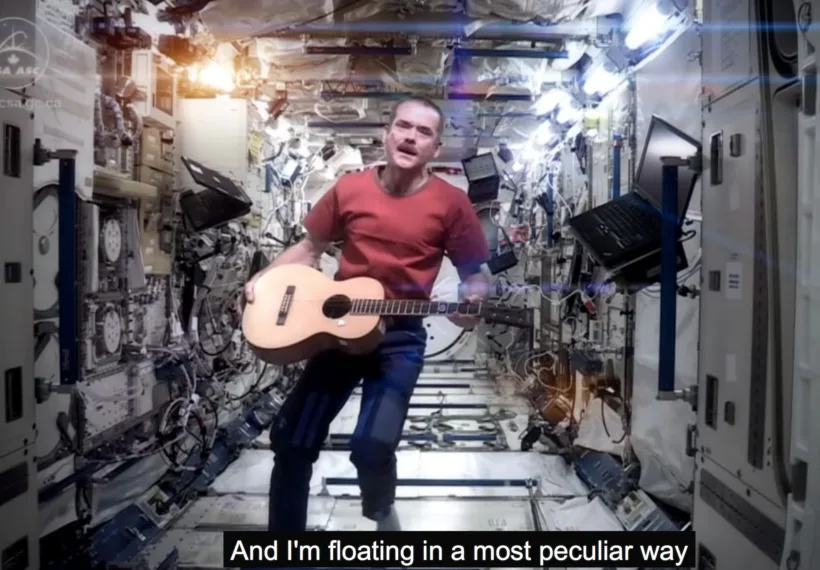
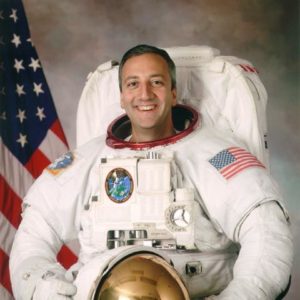
Are you one of the millions of people who watched Chris Hadfield sing David Bowie’s Space Oddity while floating in the International Space Station? Now you can learn what it’s like to be an astronaut in the age of social media when Neil deGrasse Tyson interviews Canadian astronaut and former ISS Commander Hadfield. But that’s not all: frequent StarTalk guest Astro Mike Massimino, the first person to Tweet from space, joins Neil and co-host Eugene Mirman in studio to discuss his two Space Shuttle missions to repair the Hubble Telescope. Explore the different routes Chris and Mike took to get into space: one became a test pilot, the other studied engineering. But both used social media to share what they were doing in orbit with the rest of us down here on Earth. You’ll also find out why national distinctions mean less on the International Space Station than they do at home. Finally, the conversation turns to the Mars Curiosity Rover, and Bill Nye extols the value and the adventure that come with the human exploration of space.
Transcript
DOWNLOAD SRT
Welcome to StarTalk, your place in the universe where science and pop culture collide. StarTalk begins right now. I'm your host, Neil deGrasse Tyson, your personal astrophysicist. I also serve as director of the Hayden Planetarium right here. And I've...
Welcome to StarTalk, your place in the universe where science and pop culture collide.
StarTalk begins right now.
I'm your host, Neil deGrasse Tyson, your personal astrophysicist.
I also serve as director of the Hayden Planetarium right here.
And I've got with me as my intrepid co-host, Eugene Mirman.
Eugene.
Comedian, how you doing, man?
Good, good to be here.
So, how's things?
You're like a regular in Bob's Burger.
Bob's Burgers, yeah.
Yeah, you're like the kid, right?
Yep, I'm the little boy.
We're recording the sixth season now.
Yeah, yeah, no, that's cool.
Yeah.
If the StarTalk thing doesn't work out for you, you got another job.
I have a backup plan of being on another television show.
You know, today we're featuring my interview with Chris Hadfield.
Chris Hadfield's like number one Canadian astronaut ever, ever.
Is there a second Canadian astronaut?
Now, you know, I know a thing or two about space, but I've never been in space.
Yeah, same thing with me.
The same thing with you.
So I didn't want to tackle this alone.
So I reached out to our portfolio of friends of StarTalk, and guess who I found?
Mike Massimino.
Mike, welcome to StarTalk.
Thank you.
Pleasure to be here.
Mike, two-time shuttle astronaut?
Yes.
Each of those times you would take care of my telescope?
That's right.
The world's telescope, the Hubble Telescope.
I mean, the astrophysics community.
Yes, yours.
Telescope.
Everybody's.
Thanks for doing that.
It was a privilege.
So are you retired now from NASA?
Well, I'm too young to retire.
Can you imagine that?
They told me I was too young, but I left NASA.
You left NASA.
And so now you're on the faculty at Columbia?
I am.
At the Department of Mechanical Engineering?
Because you're an engineer dude from way back.
That's right.
Yeah, that's what I was trained as, and I got to do a lot of hands-on engineering on the whole.
So you're an engineer that became an astronaut, not someone who was an astronaut out of the box.
Right.
I came in the, I would say, the academic route.
I got my PhD and did some research.
In engineering.
As an engineer.
Cool, cool.
And also we have another great museum here in New York, the Intrepid Air and Sea Museum.
That's right.
So, you're an advisor to them in all of space.
An advisor on their space stuff.
Good space stuff.
They have a Hubble exhibit there and I really enjoy, I get a chance to go there.
Cool, I got to come check it out.
You should, yeah.
I'll give you a private tour.
Oh, nice.
I'll show you my tools.
They've got Hubble tools and stuff.
Watch your language here.
Wrap it up, you flirt.
No, the tools are part of the tour.
The tools that you used to fix the Hubble.
Right, the real space tools.
The actual space tools.
The actual space tools.
It's like a space wrench?
Yes, and a power tool.
A space drill?
We call it a power tool.
Drill, you know, you can get, you might make holes that you don't want to with that one.
We call it a power tool.
And what does it do?
It mainly unscrews things.
We don't do too much drilling.
Right, you don't make a ton of holes in the Hubble.
No, you don't make a lot of holes.
But what we do is you use it to fasten things, to unscrew things, to move things around.
That's what the power tool.
It serviced the Hubble and also built the International Space Station.
So you can see stuff like that.
Are you friends with Chris, Chris Hadfield?
Oh, yeah, he's a great guy.
We're very good friends.
Chris was, he was on the Space Station for five months.
Is that a long time, short time?
That's about right, about five, six months, six month tours.
Scott Kelly is going to go up for a year.
That just occurred to me.
Since you went to the Hubble, it means you've never been to the Space Station.
No, I have not.
No, completely different orbits.
I know you can't.
You can't do the George Clooney thing, zipping around on a backpack or using a fire extinguisher.
We got him started.
None of that will work.
You have to get him started here.
Oh, that's his thing.
He's with the tweets with all of that.
Don't get him started with that.
You have to get him started.
Forget I mentioned anything.
We'll come back to that.
Yeah, no.
You cannot jump from one to the other.
We'll come back to that.
So, one of the things that distinguished Chris Hadfield compared with the other ton of Canadian astronauts is that he was very social media savvy.
He was.
But you got that first.
I was the first guy to tweet.
First person in space to tweet from space.
Correct.
Yes, that was my contribution to social media.
Thank you.
The first person to walk on the moon said, one small step for man, one giant leap for mankind.
So, your first tweet said what?
It was a lot less poetic than that.
They made fun of what I tweeted on Saturday Night Live.
They said, the first guy to tweet from space, and it was, launch was awesome.
And I added something to it.
Launch was awesome.
I'm feeling great.
Adventure lifetime has begun.
But they just said, launch was awesome.
In 40 years, we've gone from what Neil Armstrong said to launch was awesome.
If this guy ever meets Intelligent Life, it's going to be, jeez dudes, look, aliens.
So I got made fun of on Saturday Night Live and emailed for my shit.
You deserved it.
We'll give you some poetry lessons.
So what my records show is that 541 people have been into space.
This is a pretty exclusive club.
So you're...
I'm one of them.
You're one of them.
Okay, 541.
And there aren't many lists anybody is on where there's only 541 of them.
Just, right?
I get it.
Sure.
Yeah.
I'm just saying.
538 people went to only Earth orbit.
24 traveled beyond low Earth orbit and 12 walked on the moon.
So that's the...
So my lament is that of the 541 people, only 12 stepped on something other than Earth.
Only 12.
Right.
We'll get them started on that.
And we're starting to lose them.
They're getting older.
We don't have as many of them around.
Send them back.
So Chris Hadfield...
They'll live forever on the moon, no?
No.
That's a different movie.
So Chris is Canadian, we established, and it is rumored that when Canada changed their $5 bill from initially having hockey players on the back, and I'm quick to note that Canada really did not need to be reminded that they like hockey, right?
So that was prime real estate to swap out.
And they put the Canada arm on the back of the $5 bill, and there's a spacewalking astronaut there that he said is him.
That's him, yeah.
Wait, wait, wait.
Let's check.
There's other Canadians out of space, but I'm pretty sure.
Well, hold on.
Why, does he have a mustache?
Take a look.
He's got a really cool mustache.
Hold on.
Let's take a look.
Who is going to say that that's Chris Hadfield?
No, you can't tell.
Can you zoom that in?
It's him, it's him.
I'm sure it's him.
Okay, you know what's a little spooky to me about that picture?
Is this menacing, out of focus, maple leaf coming from space.
Yeah, what the heck is that?
And he's trying to escape Houston.
So Chris grew up on a farm, farm boy, and he became...
He's just like Captain Kirk.
Yes, and he's from Iowa, yeah.
Captain Kirk is like, why do you know that?
What do you mean?
I didn't know it was a stupid question.
Captain Kirk isn't a real guy.
Sorry, I watch science fiction, so I know the stuff inside it.
So let's find out.
I mean, not many people have walked in space and he's been in space and the like.
So I had to ask, he came through town and I nabbed him, stuck him in my office, and I had to ask him questions about what made him become an astronaut growing up in Canada on a farm.
Let's find out.
I decided to be an astronaut when I was a kid, and I'm a Canadian, and there was no role model.
There was no Canadian astronaut, no Canadian astronaut program.
That's kind of hard.
Yeah, so I was thinking, well, what do you do?
How do you do this?
And just so I looked to the American program, I looked at my heroes of Neil and Buzz and Mike Collins, and they were engineer, fighter pilot, test pilots.
And I grew up on a farm, you know, with tractors and machinery, and so engineering sounds...
You relaxed the definition of what a role model was to not have to constrain it to Canada.
I expanded role model.
Expanded the definition.
But to me, it sounded interesting anyway.
I knew that there are geologist astronaut with Harrison Schmidt on the moon, and there were doctors and things, but...
Isn't it sad that that was all in singular?
The geologist astronaut.
We went to the freaking moon, and we count one geologist among them.
I was nine at the time, though, so the numbers were really small, of course.
And so, you know, and astronauts fly, so I learned to fly, and it all sounded interesting anyway.
And of course, the odds of being an astronaut are so tiny that I wanted to do something that would lead to other things that sounded interesting to me anyway.
So, yeah, test pilot was always the intent, and then see what happened.
So, Mike, how did you become an astronaut?
I dreamt about being an astronaut when I was a little boy and watching Neil Armstrong and Buzz walk on the moon when I was six.
But unlike Chris, I kind of forgot about that dream until I got older.
And once I got out of college, I decided that's what I wanted to try to do.
Went to graduate school, got my Ph.D.
and started applying while I was in grad school.
So you'd be as a mission specialist, which is what you call the academic grant.
Right, so Chris went the pilot route.
So he's the right stuff.
He's like Hal Jordan.
And then what are you?
The wrong stuff, apparently.
You're setting me up.
What else would I say?
He's fighter pilot.
We learned about the fighter pilot.
He's got a really cool mustache, too.
That mustache is clearly a disguise.
It is a really cool mustache.
No, it's real.
I've tugged on it.
It's a real mustache.
He's Canadian.
Let's find a little bit more about Chris' background.
Because he's into seriously dangerous stuff.
Correct, he was a test pilot.
As a test pilot, we had one friend die a year for like 10 years.
Qualified people because that was a dangerous profession and we did it every day.
Fly in space once every six or seven years, so at least the frequency of risk is lower.
But when we look back now to what the risk was on my first shuttle launch, the risk of death during Ascent was about one in 38.
We thought it was a lot better than that.
But now learning everything we knew, it was an extremely risky thing to do.
But you go, okay, this is going to be risky, but it's worth it.
Now my job is to not die doing this.
How could we spend the next three years learning so much about this that no matter what happens, we have a plan and we're going to react so that we improve our odds of surviving?
And I take it that since you were here with me now, you didn't die in any of this?
No, I came close a couple of times.
But you had to parachute a few times?
I've never had to jump out.
I've come close.
I was doing a test at Patuxent River, Maryland, just over the Chesapeake, and we were calibrating this version on F-18.
It's 50 feet above the water going 550 knots and hit a seagull.
And if he'd been an inch or two over, he would have come through the windscreen and killed us both.
But he just went down the left side, did a bunch of damage to the airplane.
But a couple of close calls like that.
So I've been both really careful.
A seagull at 550 miles an hour.
Yeah, it's a cannonball at that point.
It didn't do the seagull any good, but the airplane and I survived.
Why?
So that's not even a fault of the airplane.
I mean, when I think of the risk that fire pilots take, I'm not thinking they might fly into a seagull.
But it's the real risk.
And, you know, some of the riskiest things I did in spaceships are the random ones.
Also, you know, the peppering of debris from natural and manmade from space.
That's something you just can't do anything about, but it's a definite, measurable, perceptible risk.
So, Mike, what's the most dangerous thing you encountered?
Launching into space was pretty scary.
Did debris fly past you?
I never saw any debris come at us, but there was evidence of it.
Like, for example, on the Hubble, you can see this down at the Air and Space Museum.
We pulled out the Wide Field Camera.
The Wide Field Camera has an exposed radiator on it.
And when I first saw it, and when it went back on Earth, it was at JPL, Jet Propulsion Lab, and it was peppered with little holes.
So these are micrometeoroids?
Yeah, they cratered it.
So while you're spacewalking, you could get hit by something.
Why wouldn't you always be hit by something?
Because it's not constantly coming at the same place.
It's not like a rainstorm constantly.
But every once in a while, something will come.
Did this scare you?
No.
Yes!
The thing is, not at the time.
So we talked about it a lot, about what might happen.
You take precautions.
You practice rescuing each other.
You go through your training and understand what that risk is.
But when you're out there, you don't want to be worried about getting hit by a rock.
You worry about doing your job and then if something happens, you react to it.
You knew it intellectually, but you didn't feel it emotionally.
No.
Because you had to get the job done.
No.
Chris Hadfield was in the space station for five months.
And during that time, he became hugely popular for sharing his experiences via social media.
More on that, when StarTalk returns.
I'm here with Mike Massimino, shuttle astronaut extraordinaire.
You like that, can I?
I wasn't gonna say anything, keep going.
Keep going.
I liked it.
And Eugene Mirman, my co-host, comedic co-host, thanks for always being here.
So one of the things that distinguished you as well as Chris Hadfield in this episode, we're featuring my interview with him, is that you were both social media savvy.
He perhaps a little more than you.
Oh, way more than I was, yeah.
I was first to tweet and did some Twitter messages, but Chris took it to a whole nother level.
A whole nother level.
So I checked your Twitter numbers, just before we began.
Uh-huh.
Now, we agreed he's the right stuff, because he was the fighter pilot.
Cool guy, and he's got the mustache.
He's got the stash.
As you do as well.
He's got the stash, I got a stash.
People said this like a 1970s porn stash, you know, what they all had back then.
I don't know who's telling you that.
I want to know.
Like, Hadfield has a cool one.
He's got a cool one.
So mine's not cool.
I know yours is cool as well.
I used to have these big mutton chops.
They were totally in style in the day, like for a few years, but I had to say, I took them out for Star Trek pointies.
But with the social media, he ended up crewing 1.26 million Twitter followers.
So I asked Chris, what's it like to have flown before social media and then fly in the era of social media?
Times are different, so I just asked Chris to reflect on the difference between then and now.
When you're asked to do something on behalf of a lot of people, how do you share the experience?
What's the right way?
On my first flight, I would grab a camera, this is in 1995, a Hasselblad with 70 milliliter film in it, right, take a picture of some place, and first thing is, well, was that a good picture or not?
Did I get the f-stop?
Did I get everything just right?
I don't know.
So you bracket it, you hope, and then you get home, and a few weeks later, they have this big roll of film, and you look and go, what the heck is that?
And you go, I think that picture's okay, and then they make you a print of it, and you go, yeah, that's a nice picture, I'd like a slide, please, and then they make you a slide, and now you have this little tiny slide of some place on earth, and now, how do you show that to the person that it's interesting to?
Now, on the station, just with-
That's the old days.
With social media, you can grab one of the cameras on board, take a picture of some place, go click, pull the chip out, stick it in the computer, and on Twitter, immediately say, not just to people from that place, but around the whole world, say, look at this, look at this place.
And the power of that was amazing to watch.
Stuff happens so fast on a space station.
You're going so quick around the world, or on space flights, and often, you kind of go, that was amazing, but I don't have time to think about it right now.
I'm gonna, I just have to shelve my reaction to that thing.
I'm gonna maybe take pictures of it or something, and later on, I'm gonna think about it.
And I still-
So it's delayed emotional investment.
You have to, you have to, you can't keep up.
It would just overwhelm you if you tried to keep up emotionally with what's happening, especially during a shuttle flight.
But even on a space station flight, if you and I were by the big window of the space station, and we went around the world once together, what would I show you?
What would, hey, you know, look at this.
Look what's coming.
Look up ahead at Mount Tanaka, or look, wait till we get to Tokyo, or look what we're gonna see of London and then France 15 seconds later.
Cool.
Would you say that social media has boosted public interest in space?
I think so, yeah.
I look at these Twitter numbers.
Most astronauts have a Twitter handle, right?
Yeah, just about every one now.
Just about every one.
NASA, at NASA has 8.7 million followers.
The Mars Curiosity Rover, the Rover has 1.8 million followers.
More than Hadfield, or not as many as you, I would think.
Most of them are bots.
But the great thing about this media, as Chris said, is that one of the frustrating things is, as an astronaut, there's not very many, but one is that it's, how do you share this experience?
Buzz Aldrin had to write a letter, give it to a horse, the horse had to run it back to Earth.
It didn't work so well.
Now we can do it a lot quicker and it's easier and it's streamlined because photography, cameras have gotten so great.
Portable.
He described when he first took those images, what a hassle blast.
It's manual focus and we would goon up those.
Goon is an astronaut.
We would mess up those pictures like, oh man, that picture didn't come out.
We could have figured out what goon meant in context.
We gooned up a lot of photos with that.
Now we have these great digital cameras with a lot of pixels in them and you can take this amazing imagery for enjoyment but also for science.
Not even an astronaut can mess up the photo.
Not even an astronaut can mess it up.
And a lot of the pictures you see of the Earth, I think almost all of them now are coming from the Space Station.
So many photographic objectives are hit by the Space Station astronauts.
What's interesting is not all the great fun imagery are pictures outside the Space Station.
Some actually took place inside the Space Station.
In fact, Chris Hadfield made a video on the Space Station that became a viral sensation on YouTube.
More on that when we come back to StarTalk.
On StarTalk, of course, I'm your host, Neil deGrasse Tyson, Eugene Mirman, my comedic co-host, Mike Massimino, in the StarTalk family, my favorite astronaut.
I'm pretty sure of that.
I should double check, but I'm pretty sure.
I'm the only one in the house right now, so it's okay.
So it's okay.
You don't have to tell anyone else.
Two-time shuttle astronaut.
Never been to the space station, though.
No.
Yeah, so the shuttle is not as large as the space station.
Even if you wanted to do fun things, you're limited to just sort of the seated area.
This is true.
Yeah, yeah, so but Chris was on the space station.
He was, he could fly.
And we've already established that he was pretty good with social media.
And he recorded a video that went viral.
And it's the first music video from space.
Let's check it out.
So that was a sample from his whole video, where it's Space Oddity by David Bowie.
And if you listen to the words of that, I mean, it's quite compelling.
And I remembered hearing that, and I said, this is an artist singing about a future we don't have yet, right?
And that was sort of a force operating on culture that I hoped would have continued and that we'd all be on Mars today.
Yeah, you started as the reason we would like to go.
So here's the data.
So it's obviously Space Oddity by David Bowie, first music video ever filmed in space.
24 million hits on YouTube.
Wow.
Not quite as high as Gangnam Style, but that's up to 2 billion, but it's a while before we get there.
Maybe if he'd only danced like a horse, we would have more science funding.
That's a debrief item for NASA.
We need more of that.
So do you think people, why do you think people resonated so much?
Because he shot a music video in outer space.
So what I wanted to know from him is, how the hell did he get a freaking guitar in space?
Yeah, did that cost like $8 million?
Let's find out.
It's a really good guitar though.
Let's find out.
How did this man get this guitar in space?
The NASA psychiatrist and psychologist put the guitar on board because there's always been guitars on space stations.
The Russians had one on Selju, and then they had it on Mir.
I brought a guitar to Mir in 1995.
So you've been a guitar in space for decades.
Well, I've been a musician my whole life, but when I got to the International Space Station, they had already put a guitar up there.
They brought it up on the shuttle in the summer of 2001, and so it's been up there for 13 or 14 years.
And it's just a little guitar.
I had to fit, you know, it's a parlor-sized guitar, but it's a good one, and it gets played pretty much every night.
There's lots of astronauts who are musicians.
Really?
And it's really nice to have.
But not all of them had a 22 million hit video.
No.
That was just bizarre.
I got to hand it to you.
That's, you know, you picked the right song for that.
As soon as people heard there was a musician in the space station, there was this social media clamoring for, well, you gotta cover Space Oddity.
And I was thinking, who covers Bowie?
Why would I ever do that?
Besides, the astronaut dies at the end of the song.
It's not a good song to play.
But my son said, you've got to.
Everyone really, you know, do it for everybody else, not for you.
And I got him to rewrite the words so that the astronaut lived at the end.
And then I made an audio of it and then got friends to put the instrument underneath.
And then Evan weighed back in and said, it's got to be video.
You're on a space station.
It's got to be video.
So one Saturday I went around and made the video of it.
And then he edited it with a friend back on Earth.
And as you say, it's beautifully edited and it's great.
It's exactly what people wanted, what I think people needed.
I think we grew up in an era where the astronauts were not that.
But I think it's also an interesting crossover between fantasy and sort of fanciful visualization and fiction with reality.
And for the first time, they completely cross over on board a spaceship.
And seeing culture that way, it's not just robots doing experiments someplace weird.
This is us in a new environment looking at our own culture.
It's poetry, song, storytelling, science fiction.
I think that's why so many people found it a little bit fascinating to see.
A little bit fascinating?
Yeah.
It's crazy to see the result.
So it's not the first time music has been played in space.
The golden record on Voyager has music on it.
And so that's intended for aliens to go upon retrieving the spacecraft.
In fact, it's one of these.
I wore my...
What do you got there?
I got everything.
Every square is a different sort of space probe.
Do you have a Hubble on that one?
You must have a Hubble on there.
No, there's a pre-Hubble.
My ties go way back.
But I have Voyager here, clearly.
It's this one.
It's obviously that Voyager.
Cool.
I'm just saying.
Got it.
Yeah.
Obviously Voyager.
So it's got a record with sounds, music from all around the world, eastern and western music and things like heartbeats and sounds of life.
Yeah.
There are going to be aliens when they come here.
They'll be blown away by Radiohead and how far we've come with our music.
So he plays music in his spare time.
What do you do in your spare time?
When I'm in space, well, John Grunsfeld, a good friend of ours, is an astronomer.
Another astronomer.
So John and I were more or less glued to the windows.
The other guys were, I don't know what they were, they were like watching movies.
Remember, they were like, listen, I'm up there looking out the window with Grunsfeld and my friend Drew Feusel yells up, hey, man, come on down.
We're about to watch Nacho Libre.
You're watching Earth go by at 18,000 miles an hour.
So these are badass other astronauts that don't have to look at Earth.
Right, they're going to watch Nacho Libre.
Great movie, but not what I was going to do when I was in space.
Probably fine, great.
But the thing I was going to say.
Great, no, no, yeah.
Really, but I don't-
I saw the movie, it was okay.
Yeah, yeah.
Not compared to what we were looking at, but what I was going to say.
Looking out the window with Grunsfeld, it is the real stuff that you're looking at.
The stars don't twinkle at perfect points of light, and for hours-
Atmosphere distorts the image.
Right, you can see the Magellanic Clouds, you can see all the constellations, and I had John there, an astronomer, he and I just-
Oh, he could point stuff out to you.
He was, I don't know if he was making it up, Neil.
Yeah, and then you could fix his radio.
But he was saying, look, there's this and that, and I'm like, that's great.
It was just-
He's a legit astronomer.
Right, so being up there with your friends and doing stuff like that-
Nice, nice.
Did not want to move from that one.
The Magellanic Clouds are the two nearest galaxies to the Milky Way, visible primarily from the Southern Hemisphere, not close enough to distinguish stars within them, just far enough so that all the stars make one puddle of light.
To Magellan, who first recorded them, they look like clouds.
And so I said, I see clouds in the sky, and they're still there, and then they're still there, and they're still there.
And so they came to be known as the Magellanic Clouds.
I want to go to space with you.
So next, we'll hear about something few of us ever get to experience, and that's living in zero G, when we come back to StarTalk.
I'm Neil deGrasse Tyson.
You're a personal astrophysicist.
I got Mike Massimino, my favorite astronaut, and Eugene Mirman, good, always good to have you here.
Listen, tell me about zero G.
And why do some people call it micro G?
Because every calculation I've ever done in physics tells me if you're in orbit, you are in identically zero G.
So what's this micro G stuff that everybody's talking about?
I don't buy that.
Well, there still is a little bit of a...
You're in orbit, you're in orbit, you're in orbit.
It sounds like you're in orbit.
There's still a little, there's still a little, well, there's actually, well, there's a lot of gravity still pulling on you.
Gravity continues out to, but in free fall, there's no net force of gravity on you, and you're in free fall.
That's what orbit means.
That's what Isaac Newton determined in Principia, 1587.
So you're telling me it's actually zero G?
I'm telling, I've yet to have someone convince me.
Maybe they're just trying to cover their ass.
Maybe a little bit.
What's the difference between zero and micro?
I mean, I get it vaguely.
Micro means there's just a little trace of gravity on you.
What's the debate?
Why do you think one and you think?
NASA calls it micro gravity.
Right, exactly.
And as a physicist, I call it zero G, because that's what orbit means.
I'll tell you what it is, you ready?
If I cut the elevator cable, and you're in the elevator, you fall, the elevator falls.
If I put a scale under your feet, the scale is falling, everybody's falling, scale reads zero, because everybody's falling together.
You're in free fall, okay?
You got that?
Let's do the Newton experiment.
We're on the top of a hill, you send out a cannonball, sideways, it falls.
Take the cannonball, drop it, it falls, right?
Give it sideways motion, it still falls.
The cannonball is weightless the entire time, because it's freely falling to the earth.
You just gave it some sideways speed.
The cannonball don't care, it's falling towards earth.
You throw it a little farther, it goes farther away from you, around the curvature of the earth.
There is a speed with which you can launch the cannonball, where it goes completely around the earth and hits you in the back of the head.
And it is weightless the entire time.
So if you cut an elevator in space, what happens?
What about the, maybe a little bit of the drag, maybe?
The real issue here is, if you're weightless for a really long time, what's it like to come back, back to earth, back to 1G?
I asked him.
I always wonder what it feels like to come back, and now you're back in 1G.
It's brutal.
So why ever come back?
Go stay up there.
Gravity is the ultimate oppressor.
I mean, it literally grinds everybody into the ground, you know, and you get used to it when you live here, right?
You're used to balancing your head on top of your neck and fighting gravity all the time.
Is that what I'm doing?
I'm balancing my neck.
If you think about it.
I never thought about it.
No, I never thought about it.
Think about doing a plank and the effort you do just holding your body.
Plank.
The plank is where you're...
Yeah, it's sort of a push up.
It's a push up without a push up.
Yeah, when you're up.
But, you know, after just a little while, your body starts shaking with the effort and all you're doing is just holding yourself against the perpetual tyranny of gravity.
And so when you've been weightless for half a year, you get so used to the effortlessness of that and the freedom of it.
And when you come back down into gravity, it feels unfair above all.
It's like, you know, like Gulliver with all the strings tied around him.
But at the same time, your body is completely unadapted, unused to it and your heart has forgotten how to pump the blood and lift it like a conveyor belt up to your head and just lifting your arm and your balance system is shut down and your body is just a mess.
So it's like combination between maybe an illness and a car crash when you come back.
It's not easy on the body.
So this is stunning.
You know, there's a list of things you're not supposed to do when you return and it's probably because someone did them and something bad happened.
Like you can't drive a car for three days.
Yeah, you can't fly an airplane.
Your vestibular system is messed up.
Your head eye movements, your eye tracking is messed up.
So there's astronaut instructions like on the side of a medicine bottle.
Do not operate every machinery after you come back to 1G.
Exactly, no heavy lifting, your spine is settling back in.
You told me this, I got to hear it again.
You have a different size suit for spacewalking.
Correct.
Than you do for launching into space.
That's right.
Because you grow.
You do.
Your spine elongates in space.
You gain about an inch to an inch and a half.
So you grew an inch to an inch and a half in space.
Yes.
And you shrunk right back.
It comes right back.
So all that is settling.
Your spine is kept in place by gravity, right?
Or helped be kept in place.
It's kept in place by the spine, but also gravity assists.
And when it elongates, when you come back down, it all settles.
So that's why for three days, you're not supposed to do anything.
So when you come back, do you have a glass in your hand, just let it go?
That has happened.
That story happened.
Scott Altman and I were having lunch at Crew Quarters right after we got back.
And he's looking at me, and he does like this.
And I think he realized once he went like this, and I was like, what are you doing?
He's like, gravity.
And I floated a bag of groceries out of the minivan, because now astronauts drive minivans.
Oh, you drive a minivan?
Chris Hadfield drives a Thunderbird, and he has a cool mustache.
And you drive a minivan?
I drive a minivan.
Okay, so he really is the right stuff, and you're not.
Now you're getting the picture.
But I took out a bag of groceries and just went like this.
And I was like, as soon as you let go, you realize what you did, but it's too late.
Even on the two-week mission that I was on, I felt like I was going to fall over, and that was only after two weeks.
Six months like Chris, if you see the way those guys get out of the spacecraft out of the Soyuz, they're more or less carried out just to make sure.
Now, we don't have the record for most time in space.
It's the Russians, isn't it?
Yeah, if you look, that's another thing you can go and Google, but if you look at the number of people with time in space, the Russians, they don't have as many astronauts, they have cosmonauts, they don't have as many people that they send, and they send them more often for longer periods of time.
Well, times have changed since the Cold War and the space race, and we'll find out what it's like to be an American on board a space station full of Russian cosmonauts when StarTalk returns.
We're back on StarTalk.
We're featuring my interview with Chris Hadfield, a Canadian astronaut who's got a mustache that you admire.
I do.
Never say anything about my mustache.
He's like a young Walter White.
I like yours, too.
Yeah, yeah.
So when you were in the Big Bang Theory, they put you in a Soyuz mock-up.
Yes.
Have you never been in a Soyuz capsule, though?
In training.
I mean, yeah, I've been in a Soyuz capsule before.
Because you might have to escape.
In case you have to go to land on Earth?
Well, yeah, more or less, but even though my flights were to Hubble, most of my training, before you get assigned to a flight, you don't know what flight you're going to get assigned to.
Oh, it's just an all-purpose astronaut.
So a lot of my training was space station related.
A lot of my spacewalk training, a lot of my systems training and so on was station related, which included a little bit of Soyuz for me.
Because we don't like to remember, I mean, it's there, it's not hidden, but we don't reflect on the fact that we have a space program entirely because of the Cold War.
We think, oh, we're Americans and we're explorers and we're discoverers.
No, we were in a fricking war with Russia.
We wanted to be able to throw things from them, at them from space.
Right, right.
This is a man speaking who was born in Russia, so which we is in that sentence.
America.
I'm a US citizen.
I would, yeah.
Where were you born?
In Russia, but then I escaped here to throw things at Russia.
So Chris Hadfield was once up in the space station and everybody there was a cosmonaut.
He always had an American with him.
He always had an American just for safety.
Tom Marshburn.
A drummer?
Is he a drummer?
No, Tom is a medical doctor.
But he had, yeah, he always had Russians with him.
So it's interesting to know, what is it like to work with Russian counterparts to who and what you are in space?
Let's find out.
Yep.
How do you compare American astronauts with cosmonauts?
Now, you retired and you can tell me now.
So you don't have to hide this anymore.
I know you were party line for a while, but now you got to book out, you can tell the story.
I was NASA's director in Russia and helped build Mir on my first flight.
Mir, the Russian space station.
The Russian space station.
And so got to know the place pretty well.
The filter that selects astronauts, so many people apply in the right size, right weight, right education, right operational understanding of how things work.
That filter, no matter what country it's in, tends to spit out fairly similar people.
People with a similar sense of things, people with the right mental horsepower, the right sort of physical attributes, but also the same sort of attitude.
And it was interesting to see when I meet the Japanese astronauts or the German astronauts or whatever, the Chinese astronauts, the similarities way outweigh the nationalities.
And so whether you're a cosmonaut or a taikonaut or an astronaut or a spasio-naut, depending on the language, there's all a kinship.
You know, can I share a story with you?
I don't know if I ever told you this.
When I was on the Presidential Commission to study the future of aerospace in the United States, we went around the world to look at the competition and what people are doing.
We went to Star City, Russia, which is where they train the astronauts.
So we're commissioners, right?
And we happen to have Buzz Aldrin with us, so they gave us, that made them think a little more highly of us, perhaps.
Always bring Buzz, that's what I say.
It helps every time.
But in any case, we go in there, meet the head of the center in the morning.
It must be 10.30 in the morning.
And we're all crowded around a table, and there are translators there.
And we had been to many other cities sitting around tables with aerospace people.
And even places where I spoke their language.
I don't know Russian from Greek.
But in that room, when it's 10.30, he looks at his clock and says, time for vodka.
And he opens up this cabinet and glasses, it's one of these James Bond kind of things.
Vodka comes out.
We all get pour the vodka.
And I'm ready to, apparently my pinky went out, and you're not supposed to do that when you're sipping vodka.
It's not manly, I've learned.
They should have briefed you on that, Neil.
That's literally the first day they teach in Russian at the grad school.
What I'm saying is, I felt a connection to this man that I did not feel to any other official meetings that we had all throughout Europe and the world.
And I got to the bottom of it, and it's simply we as a country valued space and we put people in orbit.
So did they.
And I'm echoing Chris Hadfield's comment that there is something that bonds people with that level of ambition that transcends whatever might be a national boundary.
Russians are very fun.
Don't get me wrong.
And that's what I found.
And I've never forgotten that to this day.
Yeah, I think it's true.
I can hang with these people.
You have a common goal.
I was in Belgium, I was in France, I was in England.
I could speak their language.
And I wasn't thinking, let me hang with these people.
They are...
Russia...
The British are boring until after 5 p.m.
Then they go...
Then they go...
Russia in the morning, England in the afternoon.
That's how you introduce it to the world.
I think it's right.
I think it extends to other things, though, too, Neil, is that if you have a common interest, scientists around the world, maybe comedians, too, I don't know, but you have a common goal, a common interest, and it does transcend all the political issues.
Well, could space exploration be the unifying thing for all of humanity?
I think this is one of the great advantages of space exploration is the international nature of it, and you become friends with your comrades, with your fellow astronauts, your fellow explorers, scientists, engineers, because you have this common goal.
We're already on Mars, but not with people yet.
When we come back, we're going to hear from my friend Bill Nye, who's going to tell us why it's important to put humans on Mars.
You're watching StarTalk.
Welcome back to StarTalk.
We're talking about going into space, in a big way, maybe even going to Mars.
We're already there, we got the Curiosity Rover, but for some people, that's just not enough.
For some people, like my good friend Bill Nye, he wants to send people there.
Let's find out why.
For me, it's all about exploration, just going out there and seeing what's up, up there in space.
Space is where we seek answers to those two deep questions.
Where did we all come from?
And are we alone in the cosmos?
We're talking about looking for signs of life on another world.
Now, the next logical place to look is the planet Mars.
Oh, we've sent spacecraft to be sure, plenty of them.
But what our very best robotic spacecraft can do in a week, a human explorer does in about a minute.
So we have to go, and the sooner the better.
Now, since humans are doing the exploring, we'll make discoveries and we'll have an adventure.
We'll bring our joy and our fear.
We'll also bring our art.
In the old days, we celebrated the singing cowboys, erode the range along a new frontier.
Well, now we have a singing astronaut who takes us on his adventure along a new frontier, the edge of space, beyond a new horizon.
You can never sit that guy down with chasing them all over the city.
So, you know, this thing about going to Mars, I think it's in all of our dreams.
And I had to ask Chris Hadfield the same thing.
Mars lurks in our hopes and in our imaginations.
And so, let's see what he says.
If there's a sign up list, are you there?
Are you on the list?
Well, I want to be involved in the vehicle design.
You know, there are no vehicles that can take us to Mars right now.
And we don't go for rides, as astronauts, we are intrinsically involved with making space flight safe.
And so go to Mars, sure, conceptually, it's easy to say, yeah, sure, I'd love to.
I got the orbit, I can plot it out.
I'm there.
Just go 40% faster on our way.
But I would want to be really involved with the vehicles and making sure that we had a reasonable shot.
I don't want to die on the way to Mars, but I would love the opportunity to be part of that exploration.
Well, Mars, that's of course would be a very long journey.
With the engines we have now.
Yes, certainly.
And if it's a sort of a free energy transfer, it was nine months or something there, then you got to wait till we line up again, Earth and Mars.
We're never going to go that way.
So these are years.
And so you would need many guitars and many songs.
Many cans of tuna, I think.
Yeah, really, my prediction, we will never go to Mars with the engine technology we have right now.
It's like trying to set up airline flights to Australia in 1920.
Impossible, unthinkable.
We don't have the technology to make it safe enough that we can ever do it.
We need to go from propellers to jets.
We need to go from string wings to metal wings.
We got to invent a bunch of stuff first.
And there's no rush to go to Mars.
There's no urgency.
The Earth is a concern, but it's not horribly threatened that we have to abandon it.
I think it's going to be incremental.
From station, that's a 30-year project.
From station to the moon, that's probably a 50-year project.
And then eventually...
International space station.
Yeah, and then eventually to Mars.
So, Mike, you want to go to Mars?
Yeah, I'd love to.
Wouldn't you like to go?
I'd like to go.
I'd bring the whole fam.
Yeah.
It would be a great inspiration.
Get like a Netflix account and I'd be good.
But yeah, no, I think it would be an extraordinary voice.
I have a slightly different reason for sending humans to Mars than Bill gave.
Bill's absolutely correct.
The human brain-eye connection can figure things out way faster than a remote-controlled robot.
Yeah.
So there's a point of efficiency there.
Plus, we can discover things that we're not programmed to have to notice the way a robot might.
The rover goes really slowly on Mars, doesn't it?
I mean, painfully slow.
Painfully slowly.
And it's got to be semi-intelligent because if it gets to a cliff, it was a 20 minutes communication time at the speed of light to say watch out for the cliff.
Yeah.
That's why it has to go so slowly.
Right.
Okay, so I say we need to go because that is, well, if it's only for pure science, you might not need humans, but I don't think that's why we ever went into space in the first place.
I agree.
It was advancing a frontier of discovery.
And the people who did that, we built statues to them.
We honor them.
We name schools after them.
And I don't know any statue built after a robot or high school.
I can't wait.
Look, history of statues, there are statues of explorers, also politicians and military people.
And some eagles.
In there, in there are explorers.
And I don't think our urge to honor explorers is any different as humans today than it has ever been.
And so I value that as an enterprise in addition to the science that we would conduct.
So that's my two cents.
Eugene, Mike, thanks for being on.
And Chris Hadfield, what a guy.
I am Neil deGrasse Tyson.
I've been your host.
And as always, I bid you to keep looking up.
See the full transcript



 Unlock with Patreon


 Become a Patron