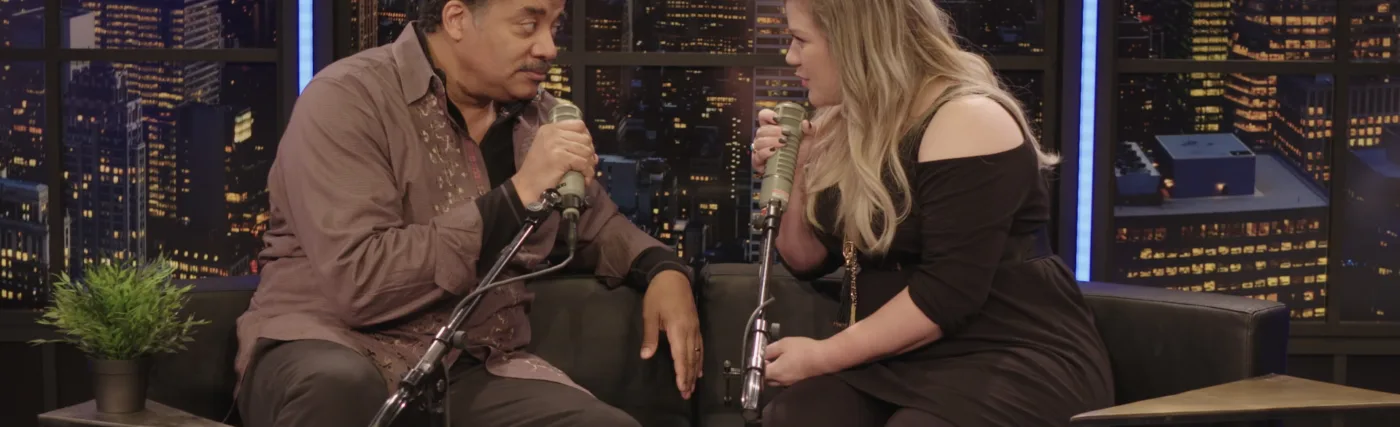
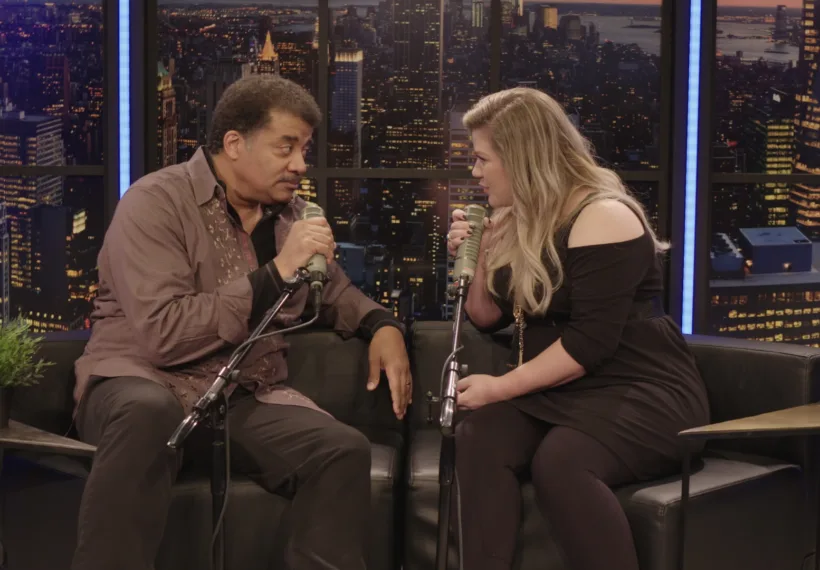
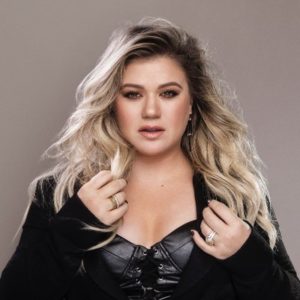
Warm up those vocal cords, we’re getting ready to hit the high note. On this episode of StarTalk Radio, Neil deGrasse Tyson sits down with international pop star Kelly Clarkson to discuss the science of the singing voice. In studio, Neil is joined by comic co-host Chuck Nice and vocologist Dr. Brian Gill, who helps us find the science in song. To start, Neil and Kelly talk about Kelly’s new album, Meaning of Life, and how it’s sonically unlike any of her previous albums. Dr. Gill helps us explore the anatomy of human vocal cords and rank musical genres based on the demands of performance. You’ll also learn why he considers Kelly a “thoroughbred vocalist.” Kelly shares how she brings emotions and feelings into her songs. Discover how tonality factors into performance and how to strike the balance between technique and feel. You’ll also hear a debate about autotune and whether it’s necessary, problematic, or somewhere in between. As a special treat, Neil performs his favorite lullaby, and Neil and Kelly perform two micro-duets. Lastly, Neil and Kelly bond over their shared love of The Great American Eclipse. All that, plus, you’ll find about the children’s books Kelly’s authored, and hear Neil, Brian, and Chuck play us out with a rendition of Frank Sinatra’s “Fly Me to the Moon.” (Warning: Adult Language)
Transcript
DOWNLOAD SRT
Welcome to StarTalk, your place in the universe where science and pop culture collide. StarTalk begins right now. This is StarTalk. I'm your host, Neil deGrasse Tyson, your personal astrophysicist, and I'm also director of New York City's Hayden Planetarium...
Welcome to StarTalk, your place in the universe where science and pop culture collide.
StarTalk begins right now.
This is StarTalk.
I'm your host, Neil deGrasse Tyson, your personal astrophysicist, and I'm also director of New York City's Hayden Planetarium at the American Museum of Natural History.
And I got with me my cohost, Chuck Nice.
Hey, Neil.
Chuckie Baby.
Hey, how are you?
Tweeting at Chuck Nice Comic.
Thank you, sir, yes.
I follow you, by the way.
I follow you, too.
You do?
To the ends of the earth.
To the ends of the earth.
Actually, I might follow you in a list.
I have a lot of lists that I follow, because I follow comedians, and I follow scientists.
I don't feel special.
Like you have yet, I follow you.
Then you qualify.
I follow 46 entities, which includes like the Pentagon, and the Navy, and DARPA, and Chuck.
Somebody will find your Twitter profile and be like, how did Chuck hack his Twitter profile to get in this list?
Well, today we're exploring the science of the singing voice through my interview with singer-songwriter Kelly Clarkson.
Missing depending, misunderstanding.
In fact, the full interview, because for this we cut and paste for this.
The full interview is available on the StarTalk YouTube channel.
Very nice.
You're right.
And her newest album, which is How She Landed in Our Universe, is called The Meaning of Life.
That's how this happened.
Let me tell you, if Kelly Clarkson is telling me the meaning of life, I don't wanna live.
So we have in studio expert guest, cause I am no vocologist or vocal, I sing really good in the shower.
No, your speaking voice would betray the fact that you might be able to sing well.
In the shower, that's it.
Oh, okay.
The acoustics in the shower make anybody sound good.
Our guest today is professor and performer, Brian Gill.
Welcome to the show, Brian.
Hey, thank you very much.
So you are, I got here, you are associate professor of voice.
Yes.
That's a thing.
Yes, and voice pedagogy.
And voice pedagogy.
Yes, wow.
Indiana University.
Yes.
This is in Bloomington, Indiana.
Bloomington, Indiana, yes, lovely little college town.
The Jacobs School of Music.
Yes.
That's a beautiful thing.
Beautiful thing.
Yeah.
And it says here you are a vocologist.
Yes.
That's just wrong.
That should not be a word.
Yeah.
They made that up.
You made that up.
I did it real quick on the fly.
I'm sorry, I won't be in this Friday.
I have an appointment with my vocologist.
Yeah, yeah, yeah.
You're fired.
It sounds official, so then.
It does.
Just cause you're good at a thing doesn't mean you put ologist on it.
And then that's another thing.
Are you a voice teacher or a vocologist?
I'm a funnyologist.
I'm a comedologist.
I'm a comedyologist.
So you're a tenor.
Yes.
And you're a performer as a tenor.
An opera, musical theater, love musical theater.
Concert recitals in the US and in Europe.
I feel privileged that you're in town.
I feel privileged to be here with you two.
We snatched you out of, you were gonna head back to Indiana yesterday.
Yes, and going back tonight.
And we delayed your plane, knowing that you were there.
Trouble on the tarmac?
I gotta know, I got people.
I know the guy who checks the engines.
Right, you see that dude out there with the two like cones, that lit up cones?
Yeah, those are Neil's buddies.
They dragged me off.
I didn't know what hit me.
So I have to ask, what specifically is vocology?
The quick definition science and practice of voice habilitation and if necessary, rehabilitation.
Oh, so now I know what habilitation is.
I never knew.
We all know what rehabilitation is.
But nobody ever habilitates.
Truly, only in private do you habilitate.
Fix it later.
Wait till it's broken.
Well, wait, so habilitate is the, what would that be then, the sustenance and care and feeding of your voice?
You teach a person really high level function so you do not injure your voice.
So you don't injure it.
Yes.
Then you don't have to rehabilitate.
That's right, because it's more difficult to rehabilitate than habilitate.
Once the system's broken, to get the pieces back together, including the mind and how the person reacted to the injury or the breakdown of the system is very difficult.
Wow.
That's when you know you're a real singer when you have a singing injury.
And...
I would love to be in this opera, but I'm on injured reserve.
I tore my rotator cuff in my voice, now playing the part of Carmen, unfortunately, due to injury.
I'm out for the season.
I'm out for the season.
Yes.
That's what happens.
And it covers any professional voice user, which would also be someone like you all that use your voice in this medium.
Right.
We do.
So if something happens with a politician or a teacher at school or something like that, because they have a heavy voice load, then a vocologist is uniquely trained to help them out.
I remember Bill Clinton.
Yes.
I remember he needed to, yeah.
And he ran into, yeah, he already sounded like this to begin with.
I just want to let you know that I talk like this because I'm not habilitating the way I should.
And then I remember he was either campaigning for himself or Hillary or Barack Obama.
I'm not sure.
But anyway, he had to come off the campaign trail because he had injured his voice.
And they call it an injury.
It's a really common thing, unfortunately.
But if you're habilitated.
Interesting.
Nice.
Nice.
All right.
So we'll be drawing on your expertise heavily for this conversation that I've had with Kelly Clarkson.
She's been judged as one of the best vocalists in the industry.
I'm going to say so, yeah.
She's got a powerhouse voice.
She's versatile.
Mm-hmm.
So 25 million albums, 36 million singles worldwide.
And she was the first artist in history, I got a crack team of researchers here, to top each of Billboard's Pop, Adult Contemporary, Country, and Dance charts.
And only two of those actually count.
Pop and Dance.
No, Country, Country people.
Country now is huge.
Country is huge.
Country is huge.
So I had to ask her about her newest album, The Meaning of Life.
Check it out.
So The Meaning of Life is your eighth album.
Yes.
And now forgive me, I haven't heard all your albums.
Yes.
But I heard this one.
I'm so offended.
But I've listened.
I'm leaving.
But I've heard the stuff that is charted off of those albums.
Of course I've heard those.
In this album, it is, there's a soulfulness to it.
That, but it has sort of pop roots bringing soul into it.
Definitely soulful pop.
And I'm old enough that I'm trying to ask myself, where would they have put this album in the stove piped categories in a record shop?
Yeah.
And I don't think there's a spot.
No, I mean, I guess pop, just because it's popular.
No, no, there's too much soul.
Excuse me.
No, no, no, no, no.
No, no, no, no.
No, it is.
It is a more soulful pop.
Well, it's funny, though.
Because you sing, and I just have to stop what I'm doing.
It is soulful pop, and there's definitely a difference when you listen to this album versus the other albums.
I mean, one, you can just, I'm happy, and it creates a whole different, that happiness creates a whole domino effect of different sounds and tones, and even the freedom that Atlantic has given me creates a whole different vibe.
Because an artist in their form, to where they're able to just go, okay, well, wait, I can do whatever I want.
Like, you know.
Yeah, it's scary, because you're like, wait, it's all on me.
Now you're accountable.
Yeah.
This stuff doesn't sell.
Yeah.
But luckily, I love, I was telling my husband this, even before the album dropped, I was like, I've literally been waiting so long to make this musical footprint, that even if it didn't do as well as other things, I'm still happy at the end of the day for that.
Because I've been very blessed.
I've had 15 great years of success, and I'm very thankful.
So, so Brian, from a sort of a vocologist perspective, what sets her voice apart?
Happiness?
Happiness.
I think now that we heard that, that's, I love that, that's beautiful.
And now we know she was miserable for the last 15 years before this album.
Well, she, she's what I'd call a thoroughbred of vocalists, in that she can do something that's a very high demand on the voice, the amount of, we call it connection at the vocal fold level and that she, the vocal folds are two flaps of tissue in the larynx right here.
Let's see if I can do that.
That went air.
No, no, I don't even know what that is.
You flick your finger into your throat.
He plucked his throat and made a sound.
Yeah, that's it.
No, I'm not doing that to my neck.
I'm sorry.
Let me tell you something.
I think he's a robot.
I am plucking myself so hard that it hurts and I still can't get any sound out of it.
Yeah, you have to close the vocal folds and you'll get it.
I'll close the vocal folds.
Like you're lifting something.
You go.
It works.
Nice job.
That's it.
That's it.
Nice.
Yeah, but you can't believe it.
But she's been able to sustain that kind of production and really, really well over 15, I mean, plus years.
It's been 15 years in stardom, but even longer than that.
Now, is that something natural or can you, is it like muscles?
Let me get to that later.
I'm sorry.
So, Brian, you performed opera, hard rock?
Yes.
Funk?
When I had hair.
Yes, yes.
Funk, yes.
Funk?
Not in Indiana?
I'm guessing that was in another municipality.
Jazz, even Indian classical music, which I love, I love Indian classical.
Of these genres, not only the ones you performed there, but what Kelly Clarkson has shined in, can you rank them based on the demands on vocal performance?
Yeah, well, I think they all have different demands, especially hard rock, sort of the gravel people expecting, the voice and heavy metal, that kind of thing.
The gravel, you mean like a Janis Joplin gravel?
Yeah, it's like a noise, kind of like a snarl.
Like you're taking a dump and drinking Jack Daniels at the same time.
Chuck, where did you get that?
Difficult to pass.
It's hard.
I'm just saying it's a difficult thing to do.
When you say things I can't then get out of my head for the next 48 hours.
It's got to sound more constipated.
That's it.
Or like Joe Cocker.
Yeah, Joe Cocker, man.
But then you get to, like for Westerners, Indian classical music involves different tonality, and that's really challenging.
So, figuring out how to do that.
Luckily, I was not the lead singer, so I was the head of a backing group behind it.
I'm sorry, I don't know anything about Indian classical music.
Is that the music that goes on for like a half hour without a key change?
Yes, it can go on a long time with just a beat.
Yeah.
Yeah.
Yeah, okay.
And they kind of change.
There's sitars in there somewhere too.
So in these genres then, because they come from such different cultural places, country, Indian, funk, pop, is it technique or do you have to actually feel it?
Do you need some genetic link back into that place to draw from in order to perform or to excel?
Both.
I think there's a technique to it.
There's a way that you use your voice that you can actually define in a scientific way what the people are doing.
It's no longer as much of a mystery.
But then there's also an exposure to a genre that's absolutely imperative someone have or else they sound like a poser.
Yeah.
You have to grow up loving it.
Yeah.
It's gotta be under your skin.
Yeah.
So I have people who come to me as opera singers and then they're like, I wanna do a little bit more rock.
But I was like, well, do you like rock?
Not really.
They're gonna sound funny.
The guy down the hallway.
Yeah.
So I asked Kelly about her, how she conveys feelings and emotions in her singing.
So let's check it out.
Now that's got me thinking.
I can read a poem on a page or rhyme and it'll mean something informationally to me perhaps.
But if I hear you sing it, there's a whole other conduit of communication going on.
Oh, definitely.
You must be self aware of that and you can go in there and you can manipulate it.
How are you?
What's your balance?
What's your balance?
I like to be a bit poetic, but at the same time, keep the story simple enough to where people aren't focused on the words of the story.
It's more focused on the feeling of the story.
Because I'm more of an emotional person.
Otherwise, just go out and read a damn book.
Yeah.
I always feel like, okay, I know I talk about Meryl Streep a lot, but my point in her-
Not yet on this show.
I know, but I'm just saying I do talk about her a lot.
Here's my point.
I've never said this before.
I love me some Meryl Streep.
But I feel like she's one of those people, it could be a silent movie, and she would effortlessly, flawlessly dictate by her emotions, her eyes, just her, every part of her, you would know exactly what she's saying without her saying anything through the entire movie.
I think she would have been like the most fantastic silent actress as well.
She does so much.
And I think that as a singer too, like that's what I try to do.
Like with songs, I try to like, you know, whatever the words are, I could be not saying words at all and just singing melody, but by my intensity or by the modulation of my emotion.
Yeah, you could almost tell the story I'm saying without even having there being words.
Yeah, so Brianne, is there, would you say there's an evolutionary propensity to respond to a singing voice as opposed to just a spoken voice?
And why?
I mean, if you're just communicating information, I'll just utter a sentence.
But somehow that doesn't work as well as if I sing a sentence.
Yeah, I think singing and the different timbres that you have and ranges that you use in singing are more impactful with communication.
You know, Darwin had thought that in hominids, like early, the progenitor of man, you know, that the first utterances were probably musical.
Yeah, and so I mean, if you think about most species...
Do-op or?
Yeah, like a little do-op.
We don't have vocabulary yet, but it's just, ba-doop-ba-da-ba-doop-ba.
Most species have some kind of song for mating and attracting people, identifying family and territory and all those things.
Like just free and early hominid standing outside of a cave going.
I had to ask Kelly about the basis for the thematic basis for her current album.
So let's check it out.
The meaning of life.
When you say it like that, it's far more dramatic.
That's kind of bodacious, audacious to be calling your album.
It was bold.
You can figure out the meaning of life when you buy my album.
It's like Charlie and the Chocolate Factory golden ticket.
So that means I don't get to learn it.
I know.
Not just yet.
Not till you get it.
I'm just saying.
So the meaning of life, is this something you've known for a while or you just kind of came onto it?
No.
I mean, I think we're all under construction.
And I think the point of me doing it-
I like that.
We're all under construction.
We are.
And I think that meaning of life is really just about connection and making sure there are positive connections.
You know, there's always people-
People to people.
So, and really I think it's simple.
I think we complicated as humans because we try and figure everything out and sometimes you can't, you know?
But you-
Well, sometimes you can.
I can't.
Your mother was a school teacher.
She was.
So, here you are making it part of your life's mission to figure things out and a school teacher, that's what they're trying to get their kids to figure stuff out.
Yeah, I think teachers-
Question.
I love, I mean, she always taught me to question and I think that's the best part of whether you're talking about faith, politics, life, any, you know, love.
It's always to question it.
Like it's always, I love that.
I love to question whatever's happening in the moment.
One, to make sure it's real and two, just because I don't think, when you stop questioning then you stop asking, you stop caring, right?
I don't know.
I can't say it better than that.
I bet you can.
I bet you can effortlessly.
Coming up more on the science of voice and my interview with Kelly Clarkson when StarTalk returns.
Welcome back to StarTalk.
I'm with my coach, Chuck Nice, and our expert guest in this episode, Brian Gill, professor of voice at Indiana University.
Hello.
With Newmington.
Yeah.
We're talking about the science of the singing voice, featuring my interview with Kelly Clarkson.
Yeah.
And I just had something to follow up.
We talked about your capacity to bring an emotion or an authenticity to what it is you're saying.
And I remembered, I like James Taylor, but not enough to buy all his albums.
I waited till he had his greatest hits and I bought the greatest hits album.
And on there.
Why, were you having trouble sleeping?
My sister can't get enough of him.
And so goes to all his concerts and everything.
And so I'm listening to the album and I'm a fan of the blues.
Right.
And in there, he has.
A blues song?
The steamroller blues.
James Taylor.
He has a blues song.
And then I said, okay, he's trying.
Yeah.
But, you know, he went to like a prep school in Massachusetts in high school.
And it goes to Martha's Vineyard.
And how many blues singers ever came out of Massachusetts?
Yeah.
And so I could.
Woke up this morning.
The Volvo wouldn't stop.
Ha ha ha ha.
He does drop the F-bomb though in that one.
He does.
So I think that doesn't.
Is that what that was?
Yeah.
It was improv of the end.
It just wasn't working for me.
Yeah.
He was not convincing as it just wasn't working.
Yeah, it wasn't working for him either.
I'm telling you.
But I think the blues as a genre is probably the one that you would have to feel the most.
I'm thinking.
In order to.
I tweeted recently the list of states that blues singers don't tend to come from.
Oh, I love that.
Utah.
Top of the list.
New Hampshire.
That's amazing.
How did I miss that tweet?
That's amazing.
How did you miss that?
How did I miss that tweet?
That is phenomenal.
Yeah, you gotta be like from Alabama.
Right.
Mississippi.
Exactly.
You gotta be Poe in Chicago.
You gotta be Poe in Chicago.
That's it.
Right.
Louisiana.
Yeah, some place.
Right.
You gotta, there's got to be some poor black people near you somewhere.
That's what it is.
Or you don't have the blues.
Or you're in Colorado.
No.
You know what I mean?
What do they sing about?
Just like, no snow.
Rocky Mountain High.
Yeah, exactly.
That's what you get.
Yeah, exactly.
You know what I mean?
No hot chocolate at the lodge.
Only three marshmallows?
Okay, yeah.
Oh, dude, that's brilliant.
I know, just say it.
That is brilliant.
You gotta find that tweet.
That is, I can't wait.
That's about six states.
Yeah, that is brilliant.
And the Utah Blues, I'm going home to write that.
I'm going to write that song tonight, I guarantee you.
The Utah Blues, can't wait.
So let's get back to my interview with Kelly Clarkson and see where that takes us next.
Check it out.
Do you think of your voice as an instrument that needs cultivating and care?
Yes.
Yeah, no, I have to.
The reason why I ask is we were in the green room before you performed in the YouTube space.
And, but before you were like just yucking it up with everybody in the green room and just walk out there and then out comes this.
Where does, how do you, how?
Well, I warmed up earlier this morning.
So I definitely aimed to warm up every day.
It's just like a speaker, like a public speaker.
Like your voice is, or a runner, your voice is a muscle.
You know, it's these little things that you have to keep trained.
And I know some singers don't have to, I think I've heard Jennifer in an interview, Jennifer Hudson, she said that she didn't, I'm sorry.
You're only a first name people.
Oh, sorry.
I'm gonna start name dropping first name.
No, no, no.
Okay.
I'm saying it because I don't think she does.
Me and Stephen.
All right, my turn, my turn, okay.
My turn, what?
Yeah, you're in a different pool of people.
I was meeting Ike the other day, Isaac Newton, yes.
Okay, Jennifer Hudson.
No, I'm saying she's a huge, big vocalist as well, yes.
And she's a big vocalist and she doesn't.
She said in interviews, I found it shocking.
She was like, I don't warm up at all.
It just happened, so I'm not like that.
I have to warm up a bit.
There, I can do it, it's just not gonna sound as good.
Okay, no, not to call you out, but you are 15 years older than you were when you were an American Idol, so is the warm up the same?
Oh, it's easier.
Yeah, I think, you know what's funny?
I saw Tony Bennett at this, oh, another.
No, no, that's fine, had both names, just say I saw Tony.
No, I was saying I was at this event, and this was years ago, and he sang, and he was 80 something, and I was like, I mean, he killed all of us.
Like, he was amazing.
And I'm a Tony Bennett fan, but I was, you know, I don't know, I thought maybe the older we get, like, I don't know, sometimes people sound different.
He sounds even better, like a fine glass of wine.
It's so beautiful.
And I will say, if you're doing things correctly, and you're taking care of yourself, and you're not ruining your cords, I think that you get better with age.
Your voice sounds more lived in, and it sounds, like, I can go lower, I can go higher.
I like that phrase, lived in.
Yeah.
Like a good pair of boots.
Just to be clear, in the green room before she went out, I understated what she was doing in the green room.
She had friends, her husband, her agent, her book, everybody, and she's just yucking it up with everybody while she's eating chicken and waffles.
Wow.
Just scarfing down chicken and waffles.
So I'm thinking-
That's a good warm up.
Is this, is Zee about, what's about to happen after this?
I had no idea.
She went out there and ripped, just tore a new one.
So tell me about the anatomy of the vocal cords.
So, well, they're two-
And while you add it, I'd like to distinguish them if you can from that of other primates or anything else that would make sounds like birds or whales, yeah.
One of the main things in human beings, the larynx, which is the voice box right here, has descended and so it creates a bent resonator that's like a space here and then a space going this way that are roughly about the same size.
Upward and then forward.
Everybody else, all the other species have a larynx that's way up there and so they only use it for sound and they don't use their tongue very much for articulation when they're making sounds.
So that's unique about human beings.
So where the others sound like the nutty professor.
You're like.
Uh-uh.
So anyway.
So that's one of the unique features and then you've got, I mean, with voice use, you've got this power source, which is the air that comes from your lungs.
You've got the tissue here, the vocal folds that vibrate, that create sound, and then that sounds filtered through the space above it.
So that's the basics of the way the instrument works.
Now does that serve any purpose for us socially or otherwise that we would be so different?
Yeah, yeah.
And the way we use our voice too serves a purpose.
There was a study not too long ago where people could judge trustworthiness and dominance in, I think it was 500 milliseconds of listening to someone.
Really?
Yeah.
Oh, so deep information about social interaction is communicated just by the tonality of your voice.
Just in milliseconds.
Wow.
And so there are certain habits that people have that are often rated higher or like the way a woman modulates the voice using different pitches and things like that, that's trustworthy.
A person who does that and then same thing with male.
And if they're Valley girl and they're, what?
And they speak a little bit higher and they say, now listen, we have to, that's also rated as trustworthy.
Honey, please.
Okay, so it's not just words.
So for example, the writer has that challenge because if you're just putting words on a page, it's harder to then communicate the tonality of how that's actually being expressed.
So the good writers somehow get that in that sentence, right, either by the pre-descriptor, she responded anxiously or she, and then you put that in, but you don't need any of that if you're just speaking it.
Right, because you can hear that, so you can hear all these things.
If you understand the emotions, like the trigger for voice goes through the limbic system, which is part of where emotion comes from, hypothalamus.
Say trigger for voice.
The trigger, like the impulse.
The nerve firing for voice.
Trigger for the interaction of voice with another person.
It runs through the limbic system, and so emotion then can be encoded on the voice because it's running through that.
Which is why when you were talking to someone and you say, I'm terribly sorry, but I really need you to move this along.
And they say, calm down.
And you're like, I am not upset.
You a lion, mo ho.
It's hard to hide.
It's hard to hide because it's there.
Which was what makes a performer so unique because they're taking, they're actually taking a signal.
You know what happens to your voice if you're really upset.
You lose your voice.
I mean, you can't do anything.
So a performer's taking that signal and they're getting just enough of the emotional information, encoding it on the voice so that a community can understand it.
Yeah, on purpose in the moment, but they're not going too far.
So there's this whole thing nowadays where people are trying to push people to feel and then person gets in there and they're like, and they can't sing.
And it's like, that's too far.
So we have to figure out, it's much more complex than that.
You can't be void of emotion, but you also can't be overwhelmed by it.
So tell me, can you reflect on her comments about age and what that does with your voice?
Yeah, so first-
Cause all the sopranos, they're done, but they're no 80 year old sopranos.
Yeah, it's a rare thing.
Marela Franey, though.
I got a shout out to Marela Franey, though.
She's one of the best in the opera world and she's 80 something now and still sounds beautiful.
But they usually send them out to pastor.
So what's going on there?
Yeah, so what happens, there's a breakdown in the voice.
And one of the things that jumped out in that clip was, I mean, I believe Kelly's in her 30s.
I think so.
Yeah, so that's not aging voice.
That's like the prime of your life for voice.
So you get in there, the musculature develops in your 30s into your 40s.
And then it starts right around in the 50s, mid 50s, it starts going downhill.
In that, there's muscle atrophy, there's a thinning of the vocal folds themselves.
And so, and there's also calcification, ossification and calcification in the vocal, in the voice box.
Hardening, which gives you less flexibility.
And so there's a downgrading of technique.
It would make you less versatile, but it wouldn't mean you still can't put some soulful.
Definitely not.
Elements in your song.
Yeah, and what, I think what she was saying.
Like the Tony Bennett example.
Yeah, he's one of my favorites.
He's one of my favorites, and actually functionally, he lasted far more than other singers of his era, so.
But.
As the others died.
Sammy's dead.
They're all gone.
They're all gone.
That's one way to do it.
Martin's dead.
I'll live him.
That is perfect.
Cuomo's dead.
They're all dead.
All dead.
Nice.
But yeah, if you combine the understanding a person gains through life, that even the sort of lack of ability they may have or flexibility that they may have is made up for in their understanding of emotion and they're more deeply grounded in life.
So that shows.
Interesting.
So today, as I came to learn, your singing voice, like most things in society can be enhanced by technology.
And I asked her, asked Kelly about Auto-Tune.
Just find out how that plays.
Let's check it out.
Am I allowed to ask you in front of cameras?
Yes.
Do you use Auto-Tune?
On records?
Yeah.
Yeah, we don't do it live, but we definitely have used it on records.
Because Auto-Tune, you can now do it live.
Yeah.
What you sing here comes out on the right note.
No, you can do it live.
There are people that do concerts that have their vocals.
Yeah, because I know who they are.
Because I know the people that work for them.
Is it just people in the closet about their Auto-Tune?
No, there are people that Auto-Tune live.
I don't do that live.
I don't want to take away from that emotional moment.
But when it's on record, I don't mind.
If I love a performance and I'm like, oh, I don't know if I'm gonna nail that again, or if I even try it again and I haven't nailed it.
Everything was perfect, but one thing, I don't want that one thing to ruin the whole vibe.
So I don't mind using it sparingly, but we definitely don't use it a ton.
Because it's a major addition to the musician's arsenal.
Yeah, and there are a lot of cool things you can do.
I mean, I know a lot of guys in rap use them because it sounds cool.
Oh, that's when you, okay.
Yeah, they like over.
We did a whole program for Nova, back when I was host of a Nova spinoff called Nova Science Now.
I interviewed the guy who invented Auto-Tune.
And he was telling me about what happens if you change, yeah, you can manipulate it over the edge and then it makes that funny distortion.
Yeah, the robotic kind of weird, yeah.
Right, and.
Which can be cool, because on this, we did it on Medicine on this album.
He made it clear that that was not the intent.
The intent is to fix your note, to be the proper note.
Absolutely.
Not to dangle off the side of the waterfall where all these extra weird noises come from.
Yes, and it's also cool, like, okay, there's a song called Medicine.
That's where we use it, like on Medicine, there's this part that goes, never give me high, never give me lit, and I sing it, but then there's this also part, they literally took my vocal and almost like changed it, manipulated it like an octave lower, to where it has this like, never give me high, and it's like this, it sounds like a man.
My mom was like, who's the man on your record?
I was like, that's my voice, they just manipulated it.
So there's really cool things you can do with it.
I think at the end of the day, if you're not capable of doing it live, then I don't think you should maybe be doing it.
That's my personal thing.
But if it's gonna ruin a moment that was really beautiful and you don't wanna change that moment, that doesn't bother me.
Yeah, so Brian, would you say auto-tune in music is analogous to doping in athletics?
Chuck hosts a sports spinoff of StarTalk called Playing With Science and all manner of these topics come up.
But now we have an analog in a whole other field.
You are fixing your performance.
So that people will applaud rather than voice doping.
That is cool.
Doping in sports brings you to the ability to do it though live.
Whereas auto-tune does it.
Auto-tune puts it on some kind of digital format.
And so I think what Kelly said is right on the money.
I think if you can't do it live, what's the point?
Because you're trying to commune.
Most people perform because they're trying to commune with people.
Yeah, but if you can't perform any longer and auto-tune helps you hit that note, then that to me sounds just like doping.
It does.
I'm ready for a fight, but no, that's it, that is settled.
Just another quick one.
Do you think that computers will one day, AI for example, will be able to not only compose in emotional music but then perform it in a way that we might not even need humans because it'll know how to maximize access to your emotional purse strings, not purse strings, heart strings, thank you.
I think I'm gonna go on record saying no.
Never gonna happen.
Well, I don't want it to happen.
He doesn't want it to happen.
It ain't like he know he don't want it.
By the way, Brian, they'll never be able to write a funny joke either.
There are no computer students.
My two experts.
We gotta take a quick break when StarTalk returns more of my interviews with Singing Sensation, Kelly Clarkson.
We're back on StarTalk, co-host Chuck Nice, guest Brian Gill.
Yes.
Vocologist, vocologist.
So, we're featuring my interview with singer, songwriter, voice sensation, Kelly Clarkson.
And just before we went to break, we were talking about whether autotune, which puts you on note, contrary to how many so many people think of autotune as doing a funny thing.
It puts you on, you become a warbler or something.
It puts you on note.
Do you believe?
Thank you, Cher.
Are you, are you, and you said it was, it had meaningful analogies to doping in sports.
But then, during the break, you mentioned that there are actual singers who are actually taking actual steroids in support of their voice.
Yeah, so if you, for some that are legit and they have a big gig that they gotta do and if you're gonna earn $50,000, you're gonna do it.
And if you take steroids, it can reduce the swelling and enable you to get through a performance.
But they're abused often.
So folks behind, you know, they'll be backstage in a Broadway show and they'll be looking who has steroids, who has steroids, and looking for pills.
I need the juice, man.
Exactly, and it's usually because.
No, no, what they have, they're actually pumping iron, too.
Oh, they're buff, these are buff people, sorry.
That's why those singers are getting buff lately.
So let's get back to my interview with Kelly Clarkson.
Did you know she's also an author?
No, I did not.
She's written children's books.
What?
Let me tell you why it counts.
Let me tell you why it counts.
Go ahead.
There will always be children to buy your book.
Whereas there's only one pool of adults at any given time.
This is so true, but a brilliant marketing scheme does not legitimacy make.
Anyhow, I found out that she wrote a lullaby to go with each one of her books.
So I just had to get inside that and find out what was going on.
That's cool.
Let's check it out.
I also understand you wrote a lullaby for each of your two books?
I wrote a lullaby for the first one.
I love lullabies.
Yeah, I did too.
It was when I was gonna write a lullaby for each one and we might still do that, but the Christmas one, which was the second one in the River Row series, I actually did a full on Christmas song for, original every once in a while.
So we did a full on Christmas song for the second book, but there's a lullaby for the first one.
It's the song I sang to her when she was a baby.
So lullabies, I think it's scientifically demonstrated to be soothing to babies.
I mean, we knew that empirically, but I think you can study brain patterns and what parts of it it hits and it calms anxieties.
It's almost the same as a speaking voice, like a smooth, rather than a, like your voice compared to my speaking voice.
Yours would be more soothing.
So you can sing and I can speak and we can like walk on the road.
I'm ready.
I say, the universe.
And I go, the universe.
So Brian, is there a definition of a lullaby?
A functional definition?
Other than that, babies dig it, right?
Other than that.
Babies dig it.
The basic idea is it's a construct of a song that's designed to be super simple because with their cognitive functioning, children can't process something that's too difficult.
So it has really consonant intervals.
Consonant.
Not dissonant.
Oh, not dissonant.
I see, opposite of dissonant.
Yeah.
Da da da.
Da da da.
Okay.
Yeah, and then repetitive.
Nursery rhyme like.
Exactly.
And repetitive is key.
Right.
So something that's repetitive so that.
So it's all of music today, basically.
I fall asleep often.
Yes, exactly.
It's like, you know, when you listen to the radio, it's like, hey, you're an idiot, you'll like this.
Is that what that is?
I'm sorry.
That's the preamble to every song.
Hey, you're an idiot, you might like this.
The dummies are gonna love it.
Can I tell you my favorite lullaby?
Ooh.
It's Feed the Birds.
Feed the Birds?
From Mary Poppins.
I don't know it.
Yes, you do.
Do I know it?
Oh my gosh.
And I love just the words and the, she sings it to lull the children to sleep.
And she sings about the bird woman at St.
Paul's Cathedral.
Tuppins a bag.
Tuppins, tuppins, tuppins a bag.
It worked, Neil, what just happened?
It worked quick.
And so there's a bird lady who's homeless where you buy bags of crumbs from her to then feed the hungry birds on the steps of St.
Paul.
And there's a line where she says, the saints and apostles look down as she sells her wares.
Although you can't see it, you know they are smiling.
Each time someone shows that he cares.
It's a really beautiful song.
It's beautiful, it's socially conscious and these are not infants, they're tweens.
Kids are tweens.
And so that's my favorite.
Well, you got a lullaby?
My favorite lullaby is Sexual Healing by Marvin Gaye.
To sleep or get in the bed?
Just trying to figure that.
It's not to go to sleep, it's to sleep with.
There's two different uses to different things, right?
My wife Kim, most beautiful soprano voice you've ever heard, and she sings to my boys every night.
We both do, but she'll sing Somewhere Over the Rainbow to One by Request.
She takes Request.
And then the other one she sings, The Easter Bunny is Coming to Town Today.
The Easter Bunny is coming to town today.
And he just sits there.
And he loves it.
Wait, how old are they?
Seven and nine.
Seven and nine.
Wait, so you married another singer?
Yeah, yeah, yeah.
Yes.
Because of her voice.
We were performing together.
I heard her voice.
She was rehearsing, and I heard this voice, and I was like, man.
And then later I met her.
I didn't know it was her voice.
And I walked up, and I was like, whoa, man.
And then I put the two in together.
So it was a mating call.
Yeah, it was.
Come to me.
It's like the penguins in the movie.
It's the sound for just one other person in the whole world.
Everything else was silenced.
That's phenomenal.
And the sun rose.
That's awesome, man.
That was cool.
Congratulations.
Good choice.
I have some music.
Yeah, for sure.
The boys sing really well, because we sing to them all the time.
Yeah, that's a singing household.
Yeah.
I grew up in one of those.
We called ourselves the Von Blacks.
The Von Traks?
Instead of the Von Traks, yes.
We were the Von Blacks.
Every night when we went to bed I was like, You know, good night bitch.
The Von Black.
Black.
Get the fuck to sleep, I read that.
I'm done with you.
Lay down.
All right.
Okay, just to atone for this bit of the conversation.
We got to put a link in this to when LeVar Burton read to me Good Night Moon.
Oh, that's right.
Yeah, he read it to me.
That's very cool.
It was beautiful.
Yeah.
It was beautiful.
I love that one.
Touching moments.
So in this last clip with Kelly, we bonded over the poetic beauty of the Great American total solar eclipse of August 2017.
Let's check it out.
So you're from Tennessee.
I'm from Texas, but I've been in Tennessee for over a decade.
Okay, so you're a resident of Tennessee.
I'm a resident.
Okay, now I arranged to have a total solar eclipse go completely through your state.
Actually, Sumner County, where our farm is, is exactly like one of the best places.
So maybe my invitation was still in the mail.
I'll go back home and check.
You could have come.
Maybe it was there.
We had a cookout.
I don't know.
We were on our land just hanging out.
Maybe it's still in the...
I just didn't have your address, the right one.
Did you have any astro person on your ranch for this?
No.
You had no scientists on the ranch?
Do you?
I love that I appear that I have scientist friends too.
That I'm that cool.
Everybody disease a scientist at arm's reach.
Well, we do have Chris Dye on our team, which he's a genius.
We call him MacGyver on tour, but he wasn't in Tennessee at the time.
But yeah, we were floored, though.
It was one of the coolest things I've ever been a part of.
Followed by a moon shadow.
It was so cool.
Steeped in darkness.
Steeped in darkness.
Write that book right now, sir.
Look at you.
Steeped in darkness.
Okay, so the next time there's a total solar eclipse over your farm, you're gonna call me up.
I will call you up.
I'm gonna call you.
You aren't gonna come, but I'm gonna call you.
You think I won't.
Actually, the next time to see it, I think, is it, where's the next one they said that was coming, is it in 24?
Well, there's an eclipse every couple of years, so they're not as rare as the press would have you believe.
No, no, no, agree.
Right, right, so, and nowadays, we have airplanes, so there's one in South America next year, the year after, 2019, I think, so you're never really that far away from the next one.
And lately, by the way, two thirds of Earth's surface is ocean, so there are entrepreneurial ocean people who say, well, sail our boat into the eclipse path, and then you have an ocean cruise the rest of the time you're there.
What?
That's pretty sexy.
Yeah, it totally works completely.
Nice bottle of wine.
Totally.
Yes.
Singing some total eclipse of the heart.
Nothing I can do.
It's amazing.
So I tweeted during the eclipse all the songs I knew that referenced a total solar eclipse.
So you should look it up.
There's some songs in there.
I am not that fun.
No, no, you can make the eclipse album.
No, no, we'll totally.
Oh my God, that's great.
We'll collaborate.
And listen.
You hear that Atlantic Records?
That's your next.
The duet between us.
You could be like the, you're the voice though.
You're the sexy voice in Boys to Men.
And I'll be the singer.
You do that, hey baby.
You just come in and you just start talking it out.
Talk science, dirty science.
Talk nerdy to me.
I say, Kelly, look west.
Look west.
Here comes the moon shadow.
Moon.
1,800 miles an hour.
Yeah.
And I'll just come in with, whoa, whoa, whoa, whoa.
It is a cone through space of darkness.
Darkness, darkness, darkness.
She's every bit as fun as that conversation sounded like it was.
And it also sounded pretty authentic to me in every way.
I mean, I was totally, like, now, people just can be like this, you know, where you're kind of like, you were friends your whole life.
Yeah.
Yeah, and I used to take that personally, like, wow, we really bonded, but I think they're just like that, and that anyone in a conversation with them might feel the same way about them, so.
She just has that type of spirit, you think?
Spirit, that's a good word.
Grounded down to earth.
Yeah, anchored.
Solid person.
Right, right, right, right.
I'm more of a fan after hearing your interview with her, I have to say.
And by more of a fan, I mean, I am now a fan.
That wasn't your thing, right?
It wasn't your thing.
No, I've always liked Kelly Clarkson, always.
So this eclipse song that we were sort of sketching, do you have a favorite universe song?
It's really not a universe, it's more of the closest celestial body in the solar system than it is a universe song, but fly me to the moon and let me play amongst the stars.
Okay, so now people think of that song being about the moon, but the moon is like the closest thing it sings about.
That's it, yeah.
It also sings about Jupiter and Mars.
Alright!
Ladies and gentlemen, that's been Star Talk.
Take it on the road.
No, the three whatever.
Brian, thanks for coming in for this.
My pleasure.
We will have to find you again.
Please, bring me back.
We will totally bring you back.
All right.
Because we get singers, you know, what are we gonna do with this singer this time, you know?
But if we get a vocologist, he can come at it from every angle.
Exactly, you got it.
I'm gonna start using that.
So what do you do?
I'm a vocologist.
Here's my card.
Yeah, you can't say I'm not.
You don't even know what it is.
All right, Chuck, always good having you.
Always a pleasure.
I've been your host, Neil deGrasse Tyson, your personal astrophysicist.
And I wanna thank Brianne, Chuck and of course Kelly for making this show happen.
You've been listening and possibly even watching StarTalk.
And as always, I beg you to keep looking up.
See the full transcript



 Unlock with Patreon

 Become a Patron