To start, we investigate Tim’s geek upbringings. You’ll hear about his fascination with sharks that led to his love for marine biology. We discuss his connection to Jaws. You’ll learn about Tim’s love for science fiction. We dive into the books Dune and Stranger in a Strange Land and explore how science fiction helps us think in different ways.
Find out about Tim’s interest in neuroscience and how his family tree led him to explore more. Neil and Tim ponder the societal impact of psychedelics and why they might have been much more helpful if they weren’t made a Schedule 1 drug under the Nixon administration. Discover more about the writing process as Neil and Tim break down the creation of Tim’s books The 4-Hour Workweek and the 4-Hour Body. Tim tells us how he dealt with getting rejected by over 25 publishers. We also discuss the advantages of testing ideas and how Tim tested ideas for the titles of his books.
You’ll hear about life hacking. Tim shares with us the value of meta learning. Lastly, get a glimpse of Tim’s inspirations as he shares who inspired him growing up, and in college, and who continues to inspire him today. All that, plus, we discuss Tim’s most recent book Tribe of Mentors which offers “short life advice from the best in the world.”
Thanks to this week’s Patrons for supporting us: Saul Flores, Augusta Golian, Alexis Collins, Eric Morales, Solomon Nadaf.
NOTE: StarTalk+ Patrons and All-Access subscribers can watch or listen to this entire episode commercial-free.
Transcript
DOWNLOAD SRT
Hey, StarTalk fans, Neil deGrasse Tyson here, your personal astrophysicist. And as we enter our eleventh season, yeah, I said it, yeah, you heard it, eleventh season of StarTalk, we've decided to move the posting timer of our show from...
Hey, StarTalk fans, Neil deGrasse Tyson here, your personal astrophysicist.
And as we enter our eleventh season, yeah, I said it, yeah, you heard it, eleventh season of StarTalk, we've decided to move the posting timer of our show from Friday nights at 7 p.m.
to Monday afternoons at 3.
As it turns out, many of you like to listen to StarTalk when you drive, walk, or take the train, or use any other mode of transportation throughout your universe.
So, we want to bring you StarTalk right when you need it.
Thanks for listening to the StarTalk podcast.
And remember to keep looking up.
Welcome to StarTalk, your place in the universe where science and pop culture collide.
StarTalk begins right now.
Welcome to StarTalk, I'm Neil deGrasse Tyson, your personal astrophysicist.
On rare occasions, I sit down to interview someone whose presence is powerful, entertaining and enlightening all at once.
And the conversation that comes out of that encounter is so inspiring or enlivening that we must depart from our usual studio format in exchange for some one-on-one time.
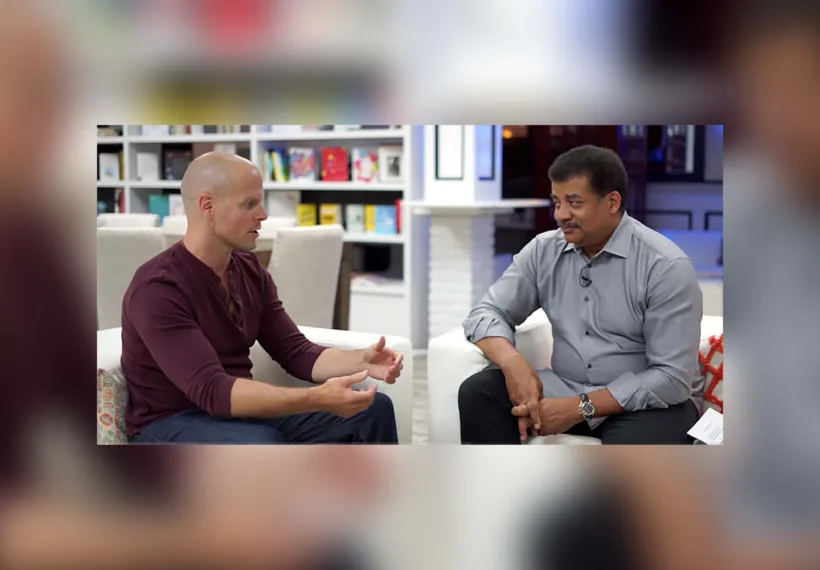
On one such occasion, I sat down with entrepreneur, author and podcaster, Tim Ferris.
That interaction led us all at StarTalk to break format for this special episode.
Instead of our usual panel of in-studio expert guests, comedians and scientists, what follows is my uninterrupted conversation with Tim from start to finish.
Tim is best known as an angel investor and advisor for startups.
And the most notable startups he's either invested in or advised are Uber, Twitter, Evernote and TaskRabbit.
He's also the author of several books, including The Four Hour Workweek, The Four Hour Chef and Tools of Titans.
For this first part of the conversation, we got to know about Tim and the life that prepared him to become such a prolific author.
So let's go to that conversation now.
Yes, sir.
Welcome to StarTalk.
Thank you for having me.
So you got a podcast of your own.
Wait, let me think, what would be a name for that podcast?
You know, one of my friends suggested Tim Tim Talk Talk, which I vetoed, unfortunately for Kevin, but it's called The Tim Ferris Show.
The Tim Ferris Show, a really popular podcast.
And what I like about it most is just how you have, just as a general point of philosophy, you have kind of restructured how people think about how they make themselves what they are.
Is that a fair characterization?
It's fair, it's fair.
I try to do it.
It's very personal for me.
But you can't major in this in school.
You cannot.
You invented this.
I borrowed bits and pieces from a lot of people.
Ben Franklin did something somewhat similar.
Oh, excuse me, your friend Ben Franklin.
My friend, my good friend Ben.
You and Ben go way back.
I think the self-experimentation is really drawn from a lot of different influences.
Well, let's go back.
So when you grew up, did you have any geek underbelly that your friends didn't know?
Oh, well, my few friends that I had definitely knew.
That meant you had some geek friends.
If you only had a few friends, that was a geek profile.
I was born premature out here on Long Island and was very, very small, so I was badly bullied as a kid up until about sixth grade.
So you were bullied, why?
What were you doing to be bullied?
I was bullied because I was the smallest kid in the class.
Smallest kid.
That's it.
That's it.
And had a lot of physical issues, respiratory difficulties, because I had lung problems when I was born premature, and...
So you were a sickly kid.
I was a weak kid, and that explains a lot of things, including affinity for Dungeons and Dragons, refuge in books, and...
Things you can do alone.
Things you can do alone.
Things you can do when other kids go out to recess, so you're not in the middle of the war zone.
And the books largely ended up, because my family very early, my parents did something I thought was very smart, also a necessity, which was they said, we don't have much budget for new bikes or this or that, but we always have budget for books.
And that meant that a trip to the bookstore, specifically to the remainder table, was really exciting for my younger brother, and for me personally, and I gravitated to marine biology, specifically books on sharks, because out here on the East End, I had learned very early that Clint, I think it's Clint, who's the crazy shark hunter in Jaws, was based on a guy named Frank Mundus, who lived in Montauk.
And I went and met Frank at one point.
My mom took me on a field trip to go meet him, and he was a real character.
He was a shark hunter, later became a shark conservationist, but he wore an Australian outback hat, had a big hoop earring, painted his toenails, and he was an excellent storyteller.
The guy wasn't a scientist, but he catalyzed an interest in marine biology.
And so I bought books on sharks, fish, encyclopedias of all different types when I had the opportunity.
And so it's fair to say that I was definitely a nerd.
Up until sixth grade, then that summer I gained-
Wait, all that happened before sixth grade?
I'm thinking you're in high school, No, no, no, no.
starting college.
No, this happened.
You're meeting shark hunters.
I'm thinking you're older than 12.
This started very early, so I remember in third grade sitting on the stoop with this big hardcover book, I think it was called Fishes of the World, and the substitute teacher at the time told my mom he shouldn't bring that book to school, he'll destroy it, and she said, you don't know my son, he's not gonna destroy that book.
So the intro started really, really early.
Okay, so you go from the bullied little kid in the class to someone who's on a mission.
Yeah, yeah.
But wait, so was the science element of this, that was not an active thought, it was just really cool.
It was just really cool, but I ended up later, as I learned more about it, a very narrow interest in apex predators like sharks, or anything that was dangerous to man, basically.
So apex, does that mean nothing is a predator to it?
Right.
So a bear would be apex predator?
Bear would be, exactly.
Humans, in a way, are apex predators.
Humans are the most dangerous apex predator of all.
No one really hunts us except ourselves.
That's right.
Or sharks.
So, although human fatalities from sharks are negligible, but the fact that there were species that still demanded a certain respect from humans was very appealing to me.
And that then broadened, so I went from just looking at sharks to more broadly fish, and I wanted to be a marine biologist for 15 years.
That was a real...
Just because it was cool and I read about Jacques Cousteau and these various people who were diving, gathering samples, running analyses of various types, and I just found the entire implementation of what I found in the classroom to be very boring, fascinating.
It's in the sterile context of a lot of the school classes.
It didn't grab my attention, but when it was able to be presented in a story of some type, which is why Frank was so interesting to me, not because he knew science, but because he was good at grabbing attention.
Whatever it takes.
Whatever it takes.
We'll take it.
If it gets you there, we'll take it.
So that's how it started, and it certainly continued from there.
It ended up veering, in a sense, by the time I got to, and we're skipping some stuff, but by the time I got to freshman year in college, it was neuroscience.
I was more interested in neuroscience because, and that was my first major, actually, because I have Alzheimer's and Parkinson's on both sides of my family.
Oh.
So I was able to watch.
Get in there, figure out.
The decline of cognition firsthand, and that terrified me.
And I also wanted to try to help my parents, potentially, or their brothers and sisters in some way.
Does that also motivate you to make every day count?
It does.
It does, and it also motivates me to not focus excessively on lifespan, but rather functional healthspan, and looking at how different types of interventions can extend functional healthspan, which you can define across a whole bunch of different parameters.
But certainly not forgetting the person's name you're sitting with five minutes into a conversation would be part of that.
So it certainly still is a huge motivator.
So, okay, so now it's coming into focus how this life path, this arc has come together in the books you've written.
You're trying to motivate other people to make the most and best of what they are and their time and their investments in who and what they can be.
I got the list of books here, one of these showed up in my office.
Did you send it to my office?
I did not.
It was the four-hour body.
Was that the one?
No, no, the four-hour chef.
Four-hour chef, that would have been 2012.
I got the dates here if you don't remember, 2012.
These are big books.
They are big books, they are.
They are choose your own adventure books.
They're buffets, so very nonlinear in that way.
But yeah, they're big, they're big.
Let's just spend a minute on each book here.
Okay, so the Four-Hour Work Week.
Where were you trying to go with that?
That book, that was an accidental book in the sense that I...
Yeah, everyone writes books by accident.
Well, it was accidental in the sense that after my senior thesis in college, on native English speaker acquisition of Chinese and Japanese characters.
So I was looking at the semantic and phonetic both pathways and tools that a native English speaker could use to accelerate the acquisition of East Asian writing systems.
And how many majors did you have?
I had one.
So I started in neuroscience.
We can talk about why I made the shift, but I was in psychology technically with a specialization in neuro and then went to the East Asian Studies Department with a concentration in Japanese.
The four-hour work week came about because starting in 2013, that's not right.
That's when I stopped.
Starting in around 2003, I was invited back by an incredible professor I had named Professor Xiao, spelled Z-S-C-H-A-U.
Amazing polymath of a guy.
We could talk about him.
How many polymaths anymore?
That's like an old world thing.
If you can find one in modern times, that's a fascinating fact.
He was a competitive figure skater, a congressman, took a couple of companies public and was a revered professor at Harvard Business School, among other places.
He also taught computer science at Stanford before that.
I had been invited back to his class to guest lecture twice a year to talk about building bootstrap startups as opposed to venture-backed, outside-financed startups.
The notes from that class, as my life changed from, say, 2003, where I was on the verge of burnout because I was working on my own company, to 2005, 2006, as my life changed, the content of the course, or the lecture, changed.
The lecture you delivered.
That's right.
It started off...
These are windows into you.
Absolutely, yeah, for sure.
Every book that I've written has been a book I couldn't find for myself.
I love that.
There's 30 million books in the world, and there's one that hasn't been written yet, and I've got to write it.
Yeah, if I needed it, I can't find it.
That's kind of audacious, you know.
What was that?
That's kind of audacious.
It's...
It's not out there, I'm writing it.
It's audacious and selfish.
It's self-interested in a way.
Bodacious.
Bodacious, there you go.
Let's go bodacious.
That's better.
And at least if you're writing a book that you yourself would have needed, you know you have a guaranteed readership of one.
Which is...
Plus your mom.
Plus your mom.
And so the four-hour work week was really the collection of notes from those guest lectures assembled into a book, which was recommended by a few of the students in the class and then by a friend of mine who was an author.
But after the senior thesis, I had vowed not to write anything longer than an email after that because it crushed me.
I had a very hard time with the thesis.
I had a very, very difficult time.
To the extent that I took a year away from college, actually.
And...
Can I give a personal reflection on that?
Yeah.
So, I've written two theses, a master's and a PhD thesis.
And I have some books.
Each one of those was like giving birth.
Not that I know what giving birth is like, but if I were to imagine it, it's like, this is a piece of me coming out.
There it is.
Okay, I gotta just go home now.
I gotta not do anything for like three years.
I have to regenerate, regrow myself, my mind, body, soul.
Then we can have another conversation.
Definitely, and it's also like childbirth in the sense that at least many of the women I know who have given birth, they're like, all right, not doing that again.
Then a year and a half, two years later, here we are again.
I think the forget chain has to show up, otherwise none of us are gonna be here.
First and last.
The human species would have been gone long ago without that little forget.
Yeah, so you've written a lot.
You've put together a lot of writing.
You've been very prolific.
Yeah, but it's more traditional.
It's like I'm an expert on a subject, and then there's some new stuff in the subject, so I write about it.
But you're creating an awareness that people didn't even know they didn't have.
Right.
Is that a fair characterization?
And if you look at the four hour work week, which is basically an entrepreneurial exploration of hidden assumptions, governing behavior, which was influenced also by a bunch of the professors I had like Bart Hobel who studied, among other things, sugar addiction, published a lot of seminal papers that ended up creating almost a sub-specialization within psychology, it's really about hidden assumptions.
So the four hour body was the same.
What are the hidden assumptions that are limiting the options?
Four hour body, so we just shifted books.
Four hour body 2010, yes.
And just to explain the whole four hour thing, because it's a blessing and a curse, and it sounds like an informational product, I'll cover that.
It so does.
It does.
Just let me be up front with you there.
So I had a number of titles for the book.
The first book, which was turned down by 26 publishers, by the way, and...
Didn't it make a great folder?
It does, yeah.
Some of them were so violent, unnecessarily aggressive, but it's turned down by...
It's like John Grisham has a folder like that.
Yeah, it's great.
All his early turn downs.
They were fantastic.
Didn't feel fantastic at the time, but in retrospect, good to look at.
And I had about a half a dozen or a dozen titles and prospective subtitles.
And the publisher and I disagreed on the preferred titles.
And instead of having a really emotional debate, I said, give me a week, let me test it.
I'm very good at testing.
And went on to Google AdWords and created, or I should say bought domains for these various book titles, created advertisements that had the book titles as the headline, the subtitles as the ad text, and at least at the time, I haven't used Google AdWords in a long time, but it would mix and match and do the multivariate testing for you.
And then I would look at the click through rate.
And if people clicked, it just took them to an under construction page, because I was not testing the content of the page, I was testing the attention advantage of different combinations of titles and subtitles.
And at the time, I was spending about two hours a week managing the business that I created, which was later sold.
The two hours seemed too unrealistic to the publisher, and I was like, four hours?
And they're like, sure, four hours sounds great.
So I tested that and the combination of that and the subtitle performed many standard deviations better than above everything else.
And that's how I ended up choosing the title and the subtitle.
You know, that's disappointing, because we all wanted you to say, well, it was a spark of genius that came to me one night over a beer.
No, no, no, it was the...
You actually applied scientific principles.
Yeah, it was a few hundred bucks, and what it did is it overrode all the sparks of stupidity that had generated a lot of bad ideas.
That's what it was.
When in doubt, test it.
That's right.
That's what that comes down to.
That's right, yeah, when in doubt, test it, absolutely.
And so, you know, when it came out just recently, I haven't read that, so what's that about?
Charmed Mentors is really a collection of profiles of 130 or so, what I would consider, world-class performers, people who are at the top of their respective fields.
That could be sports, it could be poker, could be all of those things.
Business, certainly.
Singularly achieving people.
Singularly achieving people.
And what distinguishes them.
And the way that I was able to discern what distinguishes them is by asking them all the same 10 or so questions.
And what I enjoyed about that book, aside from the fact that it was nice to actually have 130 people write the book for me, is, which I'm not going to do for every book, but the first three brutalized me.
So I decided to take a little breather on that and to see if it would work, and it did.
What's nice about that is that you asked these people questions, what do you do when you feel overwhelmed or distracted?
What have you become better at saying no to over the last five years?
How do you say no?
The no is really important.
People don't realize it.
How many nos are floating around out there?
Yeah, it's really important.
It's really important.
And there are favorite failures, for instance.
What is your favorite failure or a favorite failure, meaning a failure that in some fashion set you up for a larger success later?
And the profiles are organized in such a way that you can spot patterns, because you'll see commonalities across some of those answers, which means, and this has certainly been my experience interviewing people on the podcast, that top performers in distinct fields often share more in common than they do with say the C players in their own field.
There are a lot of shared characteristics.
So that's tribe mentors.
So that would be, that would argue strongly for training people in school to have certain attributes without specific reference to a subject.
Yes.
Then you set them loose on whatever subject interests them and then they know how to tackle it, how to find it, how to ascend to the top.
Totally, agreed, completely agreed.
And the third book, The 4-Hour Chef, is confusingly not only about food, it's about a framework for learning.
A series of steps that one can use to tackle different subjects or skills.
They could be, it could be facts and figures, declarative knowledge, it could also be procedural, it could be some type of physical skill.
And I do think that it's really important not to convince someone that their ability to learn is somehow siloed in a single domain.
That's, I think, not just paralyzing in some respects, but it creates blind spots and is dangerous.
So that's a reason also that one of my most influential teachers was someone I never met who is Richard Feynman.
So I'm not a scientist, I'm not a physicist, but going to Princeton also.
As an undergraduate.
As an undergraduate.
The interest began with, surely you're joking, Mr.
Feynman, as it did.
The best-selling book of his.
Incredible book.
Not a big book either.
No, it's not.
Thinner than your books, by the way.
Just let the record show.
By far, yes.
More quality than quality.
For sure.
Fat books, surely you're joking, Mr.
Feynman.
Skinny books, okay.
And what appealed to me so much about Feynman, and in the last couple years, I don't do this kind of stuff ever, but I actually bought at auction a collection of his encyclopedias.
That he owned.
That he owned and bought when he was 40.
So I'm 42 right now.
And the fact that he bought these encyclopedias at 40 with his track record and accomplishments up to that point was inspiring to me that he would still have not just these references, but he would memorize large parts of the Encyclopedia Britannica.
In any case, so Feynman.
So you have his encyclopedic set.
That's right.
From his, that he touched.
From his office.
Okay, fine.
And this just came up for auction?
It came up very unusually for auction from a private collection.
Almost none of his papers or belongings have ever gone up for auction.
And there are few friends of mine who, like me, are obsessed with a handful of people, including Feynman.
One friend has actually given his, one of his sons the middle name Feynman, just to give you an idea.
And he brought it to my attention.
He said, just in case you haven't seen it, this is coming up.
I'm afraid to ask you if you have kids, what you named them.
Probably not.
That's a little scary at this point in this conversation.
I'll leave.
I don't want, I don't, no Feynman's yet.
But the fact that he took this curiosity, it was more the curiosity than the accomplishments that appealed to me, and applied it to safe cracking, applied it to cryptography, applied it to music.
And this ties into your question about teaching people to learn, or let's just say your comment, rather, of giving people a toolkit, and at the very least convincing them that there are certain principles that apply across, in a cross-disciplinary way, I think is super important.
And so Feynman for me has always been a reminder to take the curiosity that I might be focusing in one place and try to take whatever I learn and see if it applies elsewhere.
And that's certainly the case with a lot of the books.
It's taking something that seems to work in one place and trying to apply it in another and seeing what happens.
We gotta wrap up this segment of StarTalk.
Coming up, more of my one-on-one conversation with entrepreneur Tim Ferris.
Welcome back to StarTalk.
We've been following my one-on-one conversation with entrepreneur Tim Ferris.
Let's get back to it.
So, my crack team of researchers tell me that you've been into science fiction.
So what prompted that?
I've been interested and have loved science fiction for a really long time, fantasy as well, but science fiction included.
And it started with a recommendation from my mom, who said that I should read A Stranger in a Strange Land by Robert Heinlein.
And that really captured my imagination.
And I felt like there was a lot you could learn from it.
As I also feel about a lot of the science fiction I've read since, Dune, certainly.
If you want to learn about leadership, I think Dune is a fantastic book.
You don't have to read non-fiction necessarily.
World building, I mean, that's a great example of world building.
And...
Right, so did science fiction, not to put words in your mouth, but did science fiction enable you to think about possible worlds that don't currently exist, but with some energy and investment and some wisdom, you might be able to get there.
And so in life, a possible world could just be a possible career path that was not otherwise visible.
Definitely, that's absolutely true.
And I think it gives you a lens through which to look at the present that allows you to see possibilities that may have been invisible to you before.
And certainly, a lot of the, if you want to call them predictions, descriptions in science fiction have found a home.
Whether that's a self-fulfilling prophecy or not is a separate question, but.
A fun question, too.
It's a fun question, yeah.
It's sort of the art imitates life, life imitates art conversation.
But it allowed me to look at things differently.
And I enjoy finding prompts and tools that allow or force me to look at things differently.
And that's taken the form of science fiction.
You can do a lot of experiments with sensory substitution and all sorts of weird things that we could talk about that definitely force you to perceive the world differently.
We're getting there.
Yeah, and the science fiction and love of science fiction has continued.
So, more recently, after the classics, Dune and so on, you have people like Ted Chiang, who has an amazing collection of short stories.
I think it's called Stories of Your Life and Other Stories.
But one of his short stories, Story of Your Life, was adapted and turned into a film, Arrival, which is an incredible film that gets into language and all sorts of topics that I appreciate.
It's not every film where a linguist is the star.
It's the star.
And it's so...
By the way, just to be clear, there's a movie with that title from the 1990s starring Charlie Sheen.
Yes.
And then there's one in the 2010s, Arrival.
Which is an incredible story and an incredible film because it uses the allure and the sexiness of science fiction to delve into topics and questions that might otherwise be very sterile.
Like, how does language affect your thinking?
How does language, if at all, affect your perception of time?
And this came about because of our attempt to communicate with aliens.
With aliens.
That were trying to communicate with us.
Who communicate with us?
To have a conversation.
Through basically these Rorschach ink blot pictograms.
And as someone who studied Japanese and Chinese and so on as an undergraduate, specifically the writing systems, I just loved that.
And it's a Trojan horse for getting people interested in subjects that might otherwise be too sterile.
So that's another aspect.
Trojan horse in a good way.
In a great way.
In a great way, yeah.
Most references to Trojan horses, especially with viruses, computer viruses, are negative.
This is a positive smuggling.
Get in the door and then you explore the new city.
That's right.
This is benevolent idea smuggling.
Yes, yes.
What's your fascination with psychedelics?
You have a background interest in neuroscience.
I do, yeah.
So is there a connection there?
There is.
There is a connection.
And it's also very personal and I can talk about that.
But I'll talk about the neuroscience first.
The interest in neuroscience, that was actually one of the contributing factors for also looking at psychology first.
And when I was at Princeton, aside from Bart Hoble and some other professors who had an impact on me, I was attracted to the work of Professor Barry Jacobs.
And Barry Jacobs focused on, among other things, monomian neurotransmitters such as serotonin.
Looked a lot at serotonin in sleep.
He also...
Chemistry of the mind.
Chemistry of the mind.
And he had looked also quite closely at hallucinogens and their impact on various types of mental function.
I'm betting he didn't teach a class on that.
He did not.
I'm just thinking.
I don't know for sure.
He did not.
He did not.
But I wrote one of my junior papers on the physiological similarities, I guess you could call it biological similarities, at least as we measured them at the time, between LSD or LSD 25 and REM sleep.
It turns out there's a lot of common ground, which is really, really fascinating.
I could explain some of the later findings related to not just LSD, but a lot of these serotonin 2A agonists, which a lot of these psychedelics are, meaning that they activate or bind to these serotonin 2A receptors.
There are many other receptors that are impacted.
But it's one thing to have an academic interest in hallucinogenic.
So another thing that if you're sort of a life coach that implies there's some practicality that you can bring to bear.
Yeah, and I definitely view myself more as a human guinea pig who reports the findings more than life coach.
But the personal reason for looking so closely at psychedelics and more recently taking almost all the energy and capital I was applying to start-ups and applying it to science is that my family, aside from having Alzheimer's and Parkinson's on both sides, also has severe depression on both sides, whether it's chronic treatment-resistant or bipolar.
And that is something that I struggled with for many decades.
And it's only really...
You're not that many decades old.
That's true.
I mean, 42.
42?
Many decades.
Many decades.
Many decades.
A handful of decades.
I can talk about many decades.
A handful of decades.
A handful of decades.
Several decades.
One handful of decades.
I've suffered a major depressive episode, I would say, at least every six months.
And in the last five or six years, with many different interventions that we can talk about, not just pharmacological, have not experienced a single extended depressive episode.
That's very atypical.
And that's the personal driver behind looking at some of these compounds that, in the literature and certainly anecdotally, whether it's at a therapeutic dose or a large dose or a micro dose, seem to impart lasting anti-anxiety, so anxiolytic and anti-depressive properties.
And this has been looked at at places like Johns Hopkins and others.
What makes it so compelling to me is that you have many what would be considered intractable, often intractable psychiatric conditions, eating disorders like anorexia, highest mortality rate of any psychiatric disorder, addiction of various types, nicotine, opiates, obsessive-compulsive disorder, depression, chronic anxiety, which may actually all be variations of the same thing.
When you look at functional MRIs and so on, it's specifically something called the default mode network.
So personally, it was the depression.
So functional MRIs, you actively monitor the brain activity while you know what the person is thinking.
That's right.
So you can track it.
That's exactly right.
Or after you've administered them a given drug.
And the psychedelic scientific exploration was suspended, effectively, late 60s, early 70s, onward when the Nixon administration placed many of the classic psychedelics in schedule one for political and not scientific reasons.
Schedule one meaning high potential for abuse, no known medical application.
Heroin.
Heroin.
Yeah.
With corresponding penalties.
Jail.
Jail.
Yeah, the legal side effects.
Corresponding penalties.
Jail.
Yeah, the legal side effects are very, very stiff.
So that's the personal.
So you think that tabled what could have been more exploratory research that could have helped people.
100%.
Not just for therapeutic applications because you find that in some instances you'll, let's take nicotine addiction as an example.
Matt Johnson, Dr.
Matthew Johnson at Hopkins has looked very closely at nicotine addiction.
And with I want to say two or three administrations of psilocybin, which is thought to be the most active molecule from a psychedelic perspective in magic mushrooms, so-called magic mushrooms, psilocybe mushrooms.
You can synthesize psilocybin, administer it two or three times with psychotherapy.
It's not a daily drug.
And six months later, I want to say six months later in this study, which people can look up, there was around an 80% abstinence rate, six months post.
Compare that to the current best intervention or drug available, which is going to be taken constantly.
And that might be high 20s or low 30s.
So it's some.
Yeah, it's some.
It gives people some hope.
It's some.
But not statistically strong hope.
Yeah, you're looking at a huge improvement.
And with the antidepressive effects in many subjects can also last on the order of months.
That's from one or two administrations.
This is not a daily drug.
So my interest in this is in part hopefully funding science that helps with therapeutic applications with what people consider unsolvable psychiatric issues.
Because we had all these breakthroughs in cardiology, immunology, and so on.
Well, brain's a tough nut to crack.
It is.
And psychiatry.
Literally.
Yeah, it really is.
So there's really been very little aside from SSRIs and more recently ketamine that could be considered breakthroughs of sorts.
And they don't necessarily in the case of SSRIs work for everyone and not for a necessarily long period of time.
And a more fundamental exploration of consciousness.
So there's the therapeutic application and then there's the exploration of consciousness itself, which I find equally, certainly equally interesting.
We've got to close out this part of our show now.
But stick around for our final segment when we wrap up my conversation with entrepreneur Tim Ferriss.
We'd like to give a Patreon shout-out to the following Patreon patrons, Eric Morales and Solomon Nadaf.
Thanks guys for helping us as we make our way across the cosmos.
And if you would like to get your own Patreon shout-out, make sure that you go to patreon.com/startalkradio and support us.
Welcome back to StarTalk.
You've been following my conversation with Tim Ferris.
Let's get back to that conversation now.
Tell me more about life hacking.
Just, what does that mean?
Life hacking.
My life is fine, why do I want to hack it?
Yeah, you may not have to.
You may not have to.
Life hacking is...
Okay, who is right to be life hacked?
What kind of profile?
What's the profile?
If someone who feels that they are not optimizing efficiency in one or more areas of their life.
So if there are symptoms of overwhelm, a...
Why is efficiency the measure of what is good?
It's not, it's not.
But that's a symptom that can then lead to applying certain toolkit, I don't use the word life hack much, but it's a term that is broadly used to represent any type of tool or shortcut that allows you to achieve a result or automate certain things, also achieving a result, much like computer hackers.
Okay, okay, so it's not that I live a perfectly efficient life, is that there's certain tasks that I could have gotten done a little faster, better, simpler, and the life hack helps that, and that gives me time to do other things.
Is that a fair characterization?
That's totally fine.
Yeah, I think that's fair.
And hack is really a, it's a versatile word.
And I'll give you an example.
First, just to set the context, like you said, efficiency, you can do a lot of stupid things quickly.
That does not make.
That doesn't make you wise.
Doesn't make you wise, and it doesn't make those things important.
So I do think that what you do is more important than how you do anything.
You need to choose your targets first and then apply a good process.
But a life hack or a hack could be applied to language learning.
Anything that has a lot of assumptions and baggage and decades and decades of the same teaching or the same approach to learning is generally ripe for some type of assumption testing.
And that's where you find approaches that may be much, much more effective.
Interesting.
Why not admit that maybe because it's been done this way forever, that is the best way.
Someone already hacked it a hundred times and then no more hacks left for you.
That might be true, but that is a hypothesis worth disproving, right?
It's like if Karl Popper signs this falsification, all right, great, let's try to falsify.
Because the worst case scenario is we figure out, okay, guess what, this painful rote approach that we have is the best of breed.
Sorry, pal, there's no fast shortcut through this.
So that relates to meta-learning?
It does relate to meta-learning.
In what way?
Well, meta-learning is a, is a systematic way of approaching learning a new skill or subject.
And...
Does it assume you don't know anything about it at first?
It does.
There's a colleague of mine, he said he was never good at swimming.
And I said, well, how do you know?
Well, the first time I tried, I flailed in the water and everyone passed me in the race, so I just gave up.
So that was his measure that he would never be good at swimming.
But I was not convinced of that.
Oh, sure.
Well, that's not much of a data set.
But it's not a data set.
It's like a really crappy data set.
We're assuming that your first time out, if you don't shine, then you'll never be great later on.
And I think that a lot of people who could continue to ascend, if their interest and ambition directs them.
So you have ways of making this happen.
I do, and I'll give you a very concrete example.
Because you mentioned swimming.
So I couldn't swim, meaning to one end of the pool and back, let's just define it that way, until I was in my early 30s.
I grew up by the ocean.
And I had a huge fear of drowning.
Of sharks.
Of sharks.
Not so much of sharks, but of drowning.
I had a very cute fear of drowning.
And anxiety.
And anxiety about it.
And I did not have confidence in my ability to swim.
And it looks bad if you're 30 years old and you've got those little arm, like the floaties on your arm.
You're not getting a date that night.
Hey, ladies.
It's not the best approach.
And what changed that is a friend introduced me to a method of swimming that was very counterintuitive called total immersion.
And what total immersion did is what I also do in other fields.
So there was a kinship.
And that is they test assumptions.
Again, tactics apply to more than one field, yes.
That's right.
And one of the approaches that you would take, and this is a little out of order, but one of the pieces of meta-learning, if you are a novice or if you're an intermediate trying to get to advanced, or advanced trying to get to super advanced, is to ask what the failure points might be.
What are the factors that could cause me to quit, specifically?
And in my case, what were the things I disliked about the lessons I had taken?
Because I had tried lessons, not just once, but many times.
Because I had a friend hold me accountable.
We assigned each other New Year's resolutions, and mine was to do a one kilometer race.
Swimming.
Swimming, and I couldn't do one pool length, full length.
And Total Immersion does this with swimming.
So what are some of the failure points?
Kicking.
So I had been taught, when I took lessons, here's a kickboard, kick your way, we're gonna warm up.
And I would flame out before I, I would flame out and be completely exhausted within five minutes of starting.
And that was the end of the lesson.
I couldn't even continue with the technical training.
So they put conditioning slash warm up before technique.
Number two, fear of drowning.
How do you remove fear of drowning?
Don't practice in deep water.
Practice in a shallow end of a pool.
All right, what else?
Breathing.
How many people do you know?
I know tons who can kind of swim around, but they have no semblance of rhythm with any kind of breathing.
Almost everyone breathing.
Let's take breathing out.
All right, now if you remove those things, how might you practice?
You could practice by kicking off a wall in shallow water and practicing gliding so that you develop the proper fuselage position, right and left, and begin to understand what?
Hydrodynamics, because when most people swim, they keep their heads up and 90% of their energy is going into keeping their heads up and less than 10% is actually propelling them forward.
So this would be an example of how you can do this.
Okay, but that means every next thing requires a kind of analysis unique to that subject.
No, it doesn't.
Well, it sounds like it because I want to learn how to play the piano.
I had lessons when I was 13 and then I stopped.
But I got a piano at home and I stare it down every day.
It's like, tiptoe past it.
The undone homework.
Yeah, the undone homework.
And jumping into that is not about aqua dynamics.
It's not.
But let me back up and zoom out and just give you the framework because I think it will be helpful.
So the framework for metal learning that I use, not the only way, but it does apply to a lot, is DIS as an acronym.
DSSS.
All right, so D and three S's.
The first step, and I can apply this to, you can easily apply this to music, I've seen it applied to music, or to language, for instance.
Deconstruction is taking this thing, learn the piano, or learn Japanese, and breaking it into constituent parts.
What are the pieces?
Body posture, scales.
In the case of language, you could have vocabulary, grammar, oral fluency, writing.
You can start to piece it out.
Deconstruction.
Then the next step is selection, which is when you do an 80-20 analysis of the material you've broken out, looking for the 20% of, say, exercises or practices that will produce 80% of what your desired outcome is.
This is very easy to do in, I would imagine, music and certainly in language because you can look at word frequency lists.
So it's not 400 words in the English language.
I love word frequency lists.
It's not 400,000 words.
It's like 1,500 words.
Yeah, most communication is just a few hundred words.
And then you have, this is the part that we were just talking about, is sequencing, putting things in a logical progression.
That is the secret sauce, I think, that gets ignored by a lot of people who are even very good at what they do, is the sequencing.
And the last one, and this might help with the undone homework and the piano, is stakes.
So setting up consequences so that you have a reward and or a punishment that are more rewarding or more uncomfortable than sitting down and practicing at the piano.
That's the lab rat factor.
Or, yeah.
Put a little cookie on the side.
It could be a cookie.
It could be a cookie.
I'll give you a great example.
One way you could set up stakes is by putting together, let's just say it's for weight loss.
You could put together a betting pool, or you have five friends, and by the end of the quarter, we're going to do before and afters, and we're going to measure our body fat percentage.
Whoever drops percentage-wise the most gets the pot.
In that case, you have a reward and you have the loss aversion, which is very, very powerful as a motivator.
If you're competitive, yeah.
If you're competitive.
That is why the stakes is something that you customize.
There are tools out there, like STICK is a nice one, stickkk.com, we can talk about that, where you pick an anti-charity that your money goes to if you don't hit your year-end goal.
A charity you dislike.
It never occurred to me that surely there are opposite charities out there.
That's pretty scary.
Yeah, for sure.
Do you think a charity, oh, that's the right thing that we all agreed to do?
You've got another one that's trying to not make that happen.
And there are different ways to approach this question of motivation and behavioral change, which is what I've done kind of from day one.
But the point being that I recall hearing a story of this kind of stage, let's call it life coach, who said he could cure any kind of phobia.
And he had this woman come up.
She said, I've never been able to get past climbing ladders or stairs.
And he said, all right, here's the ladder.
And he did some whiz-bang voodoo.
And she climbed the ladder and came down.
And he's like, and you see, ladies and gentlemen, da-da-da.
And he started giving himself all this credit.
And she said, yeah, you know, I'm really happy because my husband told me if I climbed the ladder, he'd give me 100 bucks.
Well, maybe it's not the stage magician.
Maybe it's the incentive.
So that's the framework.
And it does work for a lot.
I noticed that one of the friends of StarTalk you had in your interview book, Jan 11.
Yeah.
And so would she or might she have been your token astrophysicist in that book?
We all need a token astrophysicist.
I said specifically she's a cosmologist.
Everyone should have a cosmology friend.
Everybody should have a cosmology friend.
She is a great not just thinker but communicator.
And I really feel...
And she thinks about how she communicates.
Right, so it comes out...
It's like, wow, I've just been taught by someone who's really thought this through.
And we met through Maria Popova, who runs a site called Brain Pickings.
And she is also someone who thinks about thinking and thinks about communicating important concepts and does a great job of it.
And I think that part of the reason I admire both of them so much is they recognize that knowledge held is one thing, knowledge shared, and then knowledge shared, which is actionable in some way, are three different things.
And they do a really great job, I think, of explaining potentially complex subjects very simply.
You know what frustrates me?
People who read a lot but then don't share anything that they learned.
Like, people read four books a day and they just sit there.
Can you share something?
Did you learn something?
Is there some wisdom?
Is there some?
Not just like reading.
I don't know, do I get to say that that's selfish of them?
I think it's maybe selfish and also delusional in the sense that if you can't teach something, I don't think you understand it.
That's a good one.
People have said that.
So if you want to test your retention and understanding of that book you just read, let's see you try to explain it to somebody.
Then we'll know.
Then we'll know.
Then we'll know.
Yeah, absolutely.
It's time to wrap up this episode of StarTalk.
I hope you enjoyed listening to this conversation with the one and only Tim Ferris.
If any of his contagious energy, passion and curiosity emanated through this podcast, the world will be better off for it.
I think there's not enough people like Tim Ferris in the world.
And you know that because he's so popular.
Yet his message on some level is so simple.
It's how to make the most of who and what you are, how to derive happiness from it, how to bring fulfillment to your life, your work, your home.
Imagine if we all just thought that way and felt that way.
How different this world would be.
You've been listening to StarTalk Radio.
I've been your host, Neil deGrasse Tyson, your personal astrophysicist.
And as always, I bid you to keep looking up.
See the full transcript




 Unlock with Patreon
 Become a Patron