Transcript
DOWNLOAD SRT
Welcome to StarTalk, your place in the universe where science and pop culture collide. StarTalk begins right now. Welcome to StarTalk Radio. I'm your host, Neil deGrasse Tyson. I'm an astrophysicist and director of New York City's Hayden Planetarium at...
Welcome to StarTalk, your place in the universe where science and pop culture collide.
StarTalk begins right now.
Welcome to StarTalk Radio.
I'm your host, Neil deGrasse Tyson.
I'm an astrophysicist and director of New York City's Hayden Planetarium at the American Museum of Natural History.
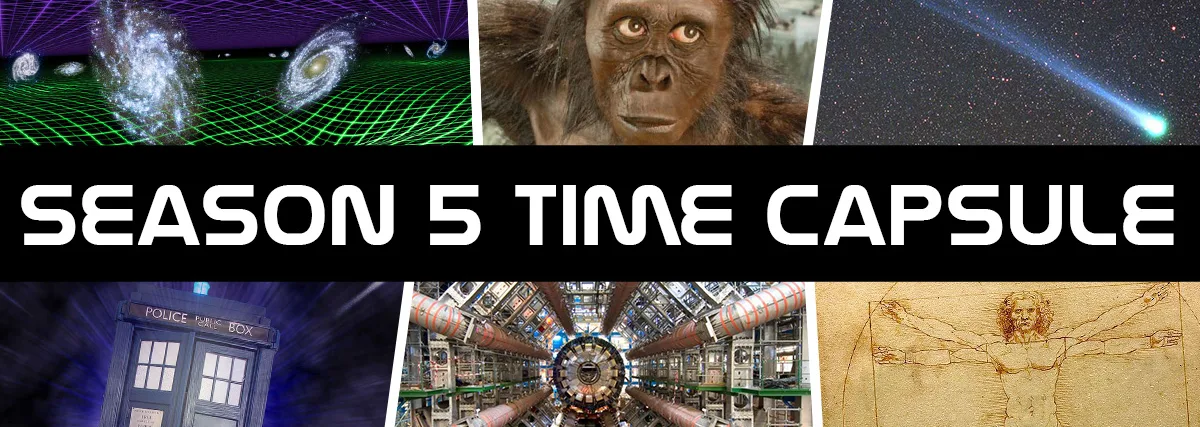
The following show is a Cosmic Queries time capsule, a collection of our fifth season of StarTalk Cosmic Queries shows that were selected by you, our fans, as your favorites of the year.
First up, comedian Leanne Lord reads your pressing questions about one of the four fundamental forces of the universe, gravity.
Of all the questions that I looked at, not one of them is what is gravity?
Okay, well that's good, because I have no idea what gravity is.
Yeah, folks ask some really intricate stuff and I'm like, I need more basics.
Well, you could start with one, what is gravity?
Yes, I'm opening the field, yes, what is gravity?
You're taking co-host privileges.
I am, and I'm putting my question out there first, what is gravity?
You have no idea.
Okay, next question.
Here's the difference, we can describe gravity, we can say what it does to other things, we can measure it, predict with it, but when you start asking what it is, I don't know.
So did I accidentally ask a deeper question than I meant to?
Yeah, no, you were meant to ask deep questions.
Apparently I was.
In life.
So to say, what is it?
I think in an Einsteinian answer, we would say gravity is the curvature of space and time, and objects will follow the curvature of space-time and we interpret that as a force of gravity.
That's probably the best answer I can give to a what is gravity question, or why is there gravity?
That's the best I can do there.
I think that's a good start.
And I can also say that Einstein noted that matter tells space how to curve, space tells matter how to move.
Say that again.
Isn't that beautiful?
It is, no, no, I wanna get that, I like that.
That's a t-shirt.
Matter and energy will curve the fabric of space.
And it's that curvature that tells other matter how to move in the curvature of space itself.
And so Einstein juxtaposed those in a poetic phrase where he said, matter tells space how to curve, space tell, did I get that right?
Yes, matter, matter tells space how to curve, space tells matter how to move.
It's beautiful.
That is beautiful.
It is beautiful.
It sounds like the opening to a dance lesson.
And we begin.
So that is your co-host privileges.
Thank you.
For first question.
That warmed up the crowd.
It did, I hope so.
Other than Mr.
Tyson himself, what is quote, the great attractor?
Does its force affect us and if so, how?
I love that.
The great attractor, I haven't been up on the latest research on the great attractor, but I was around when it was discovered.
And the great attractor, if you look out into the universe, beyond our own galaxy, we live in the Milky Way and there's the Andromeda Galaxy and there are galaxies in the Virgo Cluster.
It's what defines the Virgo Cluster.
There's a bunch of other galaxies there.
And there's the general expansion of the universe, which we measure in the speed signatures of these galaxies.
We got that.
But you can also measure other movements of these galaxies by secondary methods.
And when you do this, this research showed that there was a whole field of galaxies all with an extra bit of motion in one particular direction.
It was called the Great Attractor.
It was mysterious.
And so, hence, it had this mysterious name.
We didn't call it the Great Sun God or Great Galaxy.
It was just the Great Attractor.
And so, no, it doesn't affect us at all.
I mean, it's just stuff moving in the universe.
According to the gravitational fields in which they are embedded.
We are on Earth, moving in the gravitational field of the Sun.
The Sun is moving, dragging the entire solar system with it in the gravitational field established by the galaxy.
The galaxy and Andromeda are moving within our own mutual gravitational field.
We will one day collide.
And the Andromeda and the Milky Way are moving within a general gravitational field of the Virgo supercluster of galaxies.
And just recently, a larger system of galaxies was discovered of which the Virgo supercluster is just a part.
Oh dear.
Oh yeah.
Feeling more insignificant every day.
That's my job.
To think that the job of the Cosmic Perspective is to convey to all of us that we are a small part of a much larger universe.
What's interesting about particle physics is that gravity is essentially irrelevant to everything that's going on down there.
It is as irrelevant to particle physics as gravity is irrelevant to most insects.
You see insects just crawl up the wall or crawl on the ceiling?
Annoyingly so, yes.
Right, do you say, yo, there's gravity, you should be falling, you should be, you know, so, at different size scales in the universe, different manifestations of the laws of physics will predominate.
So, for an insect, surface tension of liquid matters more than anything.
That's why you have the Jesus spider.
Have you ever seen the Jesus spider?
It's called the Jesus spider, it's cute.
It walks on water.
Oh, I thought because it died and then came back in three days.
No, that's right.
Was it the third day?
On the third day, he wrote, yeah.
Well, there's arguments about what constitutes a day and, you know, was it just a bad weekend?
Okay, so it can walk on water, and you say, well, if I try to walk on water, if I'm not Jesus, I will fall through the surface of the water because the insect is responding to the surface tension of the water, which overrides the forces of gravity entirely, entirely.
That's why, so the world of the insect is very different from the world of us.
And that's why you can't take an insect and make a human-sized version of it and have it have any success doing what it was as an insect.
So a lot of sci-fi movies get that wrong?
100% of them get it wrong, okay?
Giant ants, giant spiders.
There's a reason why there are no giant spiders.
They have to have really thick rhinoceros legs and we'd call them a rhinoceros.
You can't just scale it up.
The laws of physics, it's all the same laws of physics, but it manifests differently depending on your scale.
See, I was gonna ask that.
Does that mean insects have a different physics?
Are there insects in little lab coats with different results than we get?
Their lab scientists probably would not yet have discovered gravity.
Really?
Yes, yes.
So now you're a particle responding to a positive charge or negative charge.
Now you've got electromagnetic forces which are 40 orders of magnitude stronger than gravity.
40 orders of, 40 powers of 10 stronger.
So in other words, you take an electron and a proton and say, well, their mass, right?
How much do they attract each other gravitationally?
You can calculate that.
Write down that number.
Now you do your equation for how much they attract one another because they're of opposite electrical charge.
Write down that number.
The electrical charge force of attraction is 10 to the 40th power stronger than gravity.
So if you're a particle, you would never discover that gravity exists.
Two of your favorite guests on StarTalk Radio, Bill Nye the Science Guy and NASA astronaut Mike Massimino took control of the show in this next segment.
They were helped out in the studio by comedian co-host Eugene Merman.
What's new on the subject of high temperature or even room temperature superconductors?
Are we getting any closer to grasping how it works?
And will this knowledge in conjunction with 3D printing create a new industrial age?
Sounds like he's making a prediction of his own, doesn't it?
Yeah, he's like, am I right?
What do you think?
He's a sage.
Yeah.
We'll see.
Maybe she's a sage.
3D printing is fabulous.
And what's the state of superconductors and room temperature?
Well, I don't know that though.
We have superconductors that work at sort of liquid helium temperatures.
Everybody wants to get them.
Yeah, four Kelvin.
Yeah, four Kelvin sounds cold.
It is cold.
It's even colder than like Canada.
Yeah, so it's like super Canada.
Yeah.
But wouldn't it be good if they work with liquid nitrogen?
Wouldn't it be good if they worked with frozen water?
Yeah.
But it's a long way off as far as I know.
But that doesn't mean it can't be done.
What I would do, where I king of the first, is invest again in these nanotubes and getting carbon atoms to arrange themselves in these extraordinary tubes where they have very, very low electrical resistance.
All right, let's do it.
The 3D printing thing is here.
I suppose we 3D printed carbon tubes.
Whoa!
Oh, could we ever do that?
Is that a thing in the future?
It seems very reasonable to me, but I'm not a carbon tube printer.
Have you guys ever 3D printed?
I've never done that.
They're affordable now, sort of.
You can get them at Staples.
Really?
Yeah.
Wait, how much are, meaning a few thousand dollars?
Yeah, less than $2,000.
Oh, wow.
And then you can make your own salt shakers.
I can't wait to go home and make salt shakers.
And plastic swords.
Too bad we can't, people can't see this because it's radio, but Eugene's eyes have just lit up.
He's ready to get out of here and go buy a 3D printer.
Yeah.
If one were to warp space to travel a vast distance, would people existing in the space that is being warped between takeoff and destination, and destination notice anything unusual?
Well, they don't in the movies.
The people in between.
The in-betweeners.
Who's like someone's hanging out, so some people on some planet.
We're assuming there's someone else out there that's gonna get...
Plus, I'm charmed by the idea that, of course, since you're going through a space warp, then of course, you can see whether...
I understand that these things are big fun when you're trying to create a science fiction television show where you really don't have time to have people not speaking English, and you gotta get up and down from a planet and travel around various quadrants in the galaxy or galaxies.
But these things are more theoretical than they are.
And so we will see how people do as they go between extraordinary destinations through unproven theoretical spaces in space.
Would they notice, I think this person suspects they might have seen something.
Would we notice anything unusual?
Right, right.
This person is like, I saw something weird at my house.
I saw something unusual.
All right.
My hamburger special looked a little bit different today than it did the other day.
Is it, someone warped speed through the diner.
Something funny is going on here, I think.
Yeah.
Is there a theoretical limit to the size of a sun?
I keep seeing graphics comparing our sun to larger and larger solar giants.
Just how big can they get?
Well, when you get to be a few hundred solar sun diameters, you become a black hole.
Really?
Yeah, you become a star that has so much gravity, light doesn't escape.
A black hole is, in a sense, a star.
So would you describe it as over a million whales?
Uh, yeah.
Big whales!
That wouldn't be inaccurate, but it wouldn't be the most accurate way to describe it.
A big whale, you're talking about a big whale.
Well, but over a million.
Not a little baby whale.
By a factor of, I guess, 10 to the 19th or something, yeah.
Like the whale that's hanging from Neil's museum.
Exactly.
For those of you who have been to New York City at the American Museum of Natural History.
So a sun that was too big would just become a black hole that would collapse?
Yeah, well, that's what apparently it does.
They do.
Oh, great.
Now I know how to make a black hole.
Thanks.
Look out, world.
Most of the questions sent to us are about scientific theories and discoveries, but in this Cosmic Queries, we tackle the intersection between science and art with comedian co-host Chuck Nice.
I would definitely like to hear Neil's thoughts on the golden ratio and the role of mathematics in aesthetics in general.
That's an awesome question.
Oh my gosh.
So, it has been suggested since antiquity that certain proportions are pleasing to the eye, no matter what your upbringing is, perhaps no matter even, no matter your upbringing within a culture and perhaps no matter even what culture you derive from.
And one of them is the golden ratio.
Golden ratio.
Yeah.
And I think it's one plus the square root of five over two.
So some, I'll look it up over the break, but I don't carry it in my head.
But what it does is it tells you how wide something should be for how tall it is.
And that's why certain paintings, certain pictures in their frame just feel a little awkward.
They don't feel pleasing and you can't even put your finger on it.
It's kind of an emotional force operating on you.
And until a hidden intellectual force that's telling you, I like this picture better than that.
And you might not even know why.
I know why, because I'm looking at porn at that point.
For me personally, I'm just saying.
So you have other ratios that apply to porn.
There's the porn ratio.
We gotta check out that one.
Where my mind just went, go ahead.
So I like geometry.
Geometry, in fact, literally means earth measurement.
Geometry.
And it was applied to measuring distances and a long earth surface and earth is curved.
So you get some interesting mathematical discussions when you bring mathematics to bear on earth measurement.
But math, I think, is overvalued as a force in art.
Because in math, there is no room for emotion.
True.
There just isn't.
And so the question is, is there something that's mathematically pure that is also emotionally rich or satisfying?
And by the way, people have been thinking about this since forever.
And it started with the music of the spheres.
They saw planets in orbit around the sun.
Well, there's a rhythm to that and the different orbits of different times.
Is there a ratio of those that means something mathematically that out of which you can make music?
And it was imagined that music, you can make awesome music from the universe.
And for all the music I've heard that came from the universe, it's not.
If art influences science, how come the International Space Station is so ugly?
It's because art does not influence science.
Art influences design of architecture and hardware, but it does not influence science.
So those were engineers that had an opportunity to make the baddest looking thing there ever was, orbiting the earth, and out came something that looked like some erector set.
And so yeah, I'm a little disappointed now that you mention it, but we want to bring in some art and designers for when we go to Mars, because I want that to be the bad-ass looking thing that's ever come off the earth.
Was there ever a painting or sculpture during the Renaissance, or any other historical time, that captured an accurate depiction of the cosmos at that time?
Yes, there is Giotto's painting of the birth of Jesus, a very famous painting, in which he puts a comet.
We don't put comets to signify good things.
The whole history of civilization, where people have looked up and seen a comet, if you look at how they reacted, they said, oh, something bad is about to happen.
And so he took a leap and said, well, the birth of Jesus is a good thing to Christians, and a comet is just something in the sky.
And that comet is likely Hayley's comet that he had seen in the sky at the time that he painted it.
Because if you date back the appearance of Hayley's comet every 76 years, it lines up with when he made that painting.
So that is real science in a real painting.
Not only that, 1066, the Bayou Tapestry.
There is a dude pointing up at a comet.
The comet came in 1066, and it coincided with William the Conqueror.
Welcome back to StarTalk Radio, I'm Neil deGrasse Tyson.
In this Time Capsule show, we're featuring our fans' favorite Cosmic Queries from Season Five.
Appropriately for a Time Capsule, you selected our Time Travel Cosmic Queries, which featured the comedian and Saturday Night Live Weekend Update host, Colin Jost.
Doesn't the fact that there are no time travelers now prove that time travel will never be invented in the future?
Yeah, that's an excellent point, and I've always thought about that because I said to myself, in fact, if you watch the TV, the CBS sitcom, The Big Bang Theory, in the roommate contract of, I know you gotta be totally in the show for this, but in the roommate contract, that stipulated that if any one of them invents a time machine in the future, they have to go back to that moment that they're reading that phrase in the roommate contract to show up in the room.
And so they're going through the contract and then they pause for a moment.
Nope, okay, we have, you're not the one who invents the time machine in the future.
That's the ultimate like, let's agree to meet back here 10 years from now, but it's at the same time, it's awesome.
Exactly, and so I think that's a pretty good argument and I don't have a rebuttal to that.
But what if people are hiding it?
What if people have come back, but are not telling people for some reason because they don't wanna give something away?
There's a quote, I think it was from Raoul Dahl, but others perhaps have said it, that the only secret that can be kept between two people is when one of them is dead.
I'm pretty sure that if a time machine were out there, people would have figured that one out.
It's been rumored that the reason why the Titanic sank is because in the future they invented a time machine and everyone wants to go back to the Titanic to see the iceberg when it hits and then overloaded the Titanic and it sank.
Oh, well now I'm convinced.
Here's the evidence.
You're looking for evidence?
That's hardcore evidence.
So that's a pretty good one.
And it might be that your time travel machine can only take you into the future and then you don't have these paradoxes of killing your grandmother and then you're never born to go back to the future stuff.
Yeah, yeah, exactly.
The question is if we could fold two points of space time together, what would happen to the matter that was between those two points?
Fold two points in space time.
Oh, so, oh, well you can't because the two points in time will not correspond.
They're two different places on the time axis.
So you can't have time t equals zero in the same place as time t equals five because they're different places on the axis.
If you fold them, you're folding them in a higher dimension and so they're kinda near each other.
If you stepped above them in a higher dimension and look at that, they're not actually in the same place.
And so just to make that clearer, if you took a sheet of paper, and I've got one right here, even though it's radio, you can listen to it, and I've got a sheet of paper, eight and a half by 11, and I'm curling the two edges, and I have the two edges sort of touching each other now, and I can say they're in the same place, but no, they're not.
They're not actually.
They're not actually.
Now what I'll do is I'll punch a hole through one to get to the other little wormhole, and I've just warped the fabric of space, traveled through a wormhole, landed on the other side.
Now I unfold a sheet of paper, and I just crossed the sheet of paper instantly in what might have otherwise taken me some unacceptably long period of time, such as what they do in Star Trek.
They invoke their warp drives, they take their destination, warp their location close to it.
They travel through this warp in the fabric of space and time, they unfold it, and they cross the galaxy during the TV commercial.
That's how that works.
That sounds off, that's a great commute.
And what would have otherwise taken, of course, the galaxy hundreds of thousands of years, even at the speed of light.
So it's a legitimate way to cheat the laws of relativity.
So the detrain going uptown is like the exact opposite of that.
So he'd asked about the Star Trek The Voyage Home, Star Trek IV, which has been dubbed Save the Whales.
Right, right, that's the subtitle of that show.
Where they go back in time to the present day of the time of the film.
So it was 1984, I think it was, or 85.
And so he wants to know, is there an actual speed with which you can swing by, slingshot past the sun, such as what they did in that show, in that movie, in order to go back in time?
Right, and it says, can you use the sun's pull, but is there a safe enough distance that it wouldn't just pull you in?
Yeah, so first of all, you cannot do what they did in the show, in the movie.
Regardless, okay.
Regardless, right, so just would nip that one in the bud.
Okay, so, and the only way you could do something like that is if you had vastly more powerful gravity than the sun.
And you needed a, the fabric of space and time has to be so warped that, in fact, there's a colleague of mine who studies this, his name is Rich Gott.
In fact, he's been on StarTalk before.
He wrote a book called Time Travel in Einstein's Universe, and he found a solution to Einstein's equations that allows backwards time travel with the kind of a slingshot trajectory, but not around the sun.
The sun does not disturb the fabric of space and time nearly enough to pull those up.
What's the kindest thing that would?
Two black holes that are in orbit around each other.
And so you'd have to do a kind of a wiggly path around these black holes, and you can end up in the past of your own world line before you had left to go on that trip.
Whoa.
Yeah, it's a very whoa moment.
And so Star Trek, it was more exciting to do it around the edge of the sun.
Because visually, rather than just two black things in space, which is already black.
This season on StarTalk, we had a few guest hosts take over the show.
One such host was Dr.
Amy Mainzer, an astrophysicist from NASA's Jet Propulsion Laboratory.
She answered questions about comets and asteroids with comedian Chuck Nice.
I have heard some theorize that the water on Earth could have been deposited here by comets, which is what you just said.
These comets have to come from somewhere.
So do you think they are rich?
So where do you think they originated from?
And what is the source of their water?
And that's a really involved question there, and that's a tough one for you to answer.
Well, it's certainly not the tap, clearly.
They definitely have to come from somewhere far away.
It ain't Avion.
No, it is not Avion.
Definitely not, so we know that the comets come from a couple different sources in our solar system.
They are, some of them are way out there, and we think they might even be halfway to the nearest star.
Yeah, really far, really cold, super cold, deep freeze, and that stuff that's been out there is very, very old.
It is ancient, and it is again, billions.
Billions.
Billions.
Billions of years old.
It's extremely old, so when it gets here, every now and again, we don't know exactly how, but sometimes these objects get kind of shuffled loose from that cloud that surrounds our solar system.
We call it the Oort cloud, and occasionally, one will get flung inward and bring all of that ice and volatile material inwards, and when it gets to the sun, what happens?
It starts to melt, because our sun's, from what I hear, kind of hot.
Yes.
Yes.
Exactly.
So the sun basically does a number on the comet, starts to vaporize it, and it can form a big long tail, and eventually, some of them actually make their way to Earth.
We think that that may have been how a lot of the Earth's oceans actually formed.
Wow, are you serious?
Like it was that much ice?
Could have been, yeah.
So, wow.
So the tail of the comet is actually expelling that much ice that if it were to get caught in the Earth's gravitational pull, pull down, it creates oceans?
Imagine lots of comets.
Lots of them.
Lots of comets.
I mean, right now, this is kind of a quiet time in our solar system's history.
And now we're kind of glad for that, right?
Yes, we are.
Because life here on Earth does not really like it when things get too interesting.
No, exactly.
So, but early on, when the solar system was first forming, we do think there was a period when the Earth pretty much just got pelted by asteroids and comets, and that could have been when the water got here.
Wow, that is fascinating.
Do you, Amy, have a favorite asteroid or comet?
If so, why?
Which one do you think is the most interesting?
Oh, this is just, this is, no, I can't answer this question.
This is like Sophie's choice.
Is that like asking you to pick a kid?
I love them all.
They're all my favorites.
I love them all.
Come on now.
Okay, well, all right.
I like the ones that I discovered.
You really do like your own children.
I do like my own children.
It's kind of bad.
Actually, there is one particular weirdo thing that we found with our survey when we were out looking for asteroids, and it's called the first known Earth Trojan.
And this is an asteroid that actually is stuck to the Earth in a peculiar way.
Okay, really?
Yeah.
Now, it's stuck to the Earth.
It is actually trapped in a gravitational resonance with the Earth, which sounds really cool.
And this actually is a really cool asteroid.
It's basically, Earth is following it around in its orbit around the sun.
Sweet.
And it's kind of trapped there.
And what's gonna happen is, after a while, eventually it's gonna pop its way out.
Right, but right now it's like a little mama's boy.
Oh, yes.
Just trapped, can't get out.
Can't get out, won't leave.
Won't leave.
And Earth is like, no, you come with me.
No, I can't see my baby go.
She's like, no, no, don't leave me.
So that's, okay.
That's one of my favorites.
If I had to pick.
Can an asteroid consisting of gold or silver be out there and if it hit the Earth, who would own it?
Well, I say, I would love to find a gold or silver asteroid if I could, but the ones we find that are metallic tend to be nickel iron.
Nickel iron, not nearly worth as much.
No, not nearly as much fun.
And the answer to the second part of the question is, if it does exist, I own it.
Okay, Richie, okay.
So just back up off my ass, Troy.
Get off my ass, Troy, okay.
How scientifically accurate is the 1979 Atari game Asteroids?
Okay, I spent way too much of my childhood playing that game.
Me and you both.
Yes, and so when I became an asteroid scientist, it turns out the game is actually not that bad.
If you hit an asteroid that is big in the game, it breaks into a lot of little pieces.
And sure enough, that is exactly what happens to the asteroids.
Wow, that is awesome.
All right, here's a very quick one.
What role do you think plasma physics plays in the landscape of comets?
Oh my goodness, a confusing one.
Science in the movies is always a popular topic with our audience.
And in this show, comedian co-host, Eugene Merman, asks your questions about Star Trek, Star Wars and so much more.
If you were an astronaut tumbling through space, like in the movie Gravity, could you change your rotation or trajectory, say, through twisting your body?
Thank you, love the show, Brian.
No.
No?
Unless you're in contact with some other thing, or unless you lose mass.
If you do not lose mass or come in contact with anything else, you will tumble in that same way, at that same speed forever.
But you actually will lose mass in the sense that you'll grow hungry and die.
It depends, well, okay.
That's a really slow, as people who have tried to lose weight will attest, that is a slow way to lose, there are much faster ways to lose mass.
Yeah, but if you're tumbling through space and you don't have access to any restaurants or anything.
No, what you can do is, if you open up certain hatches of your space suit, you could like pee in one direction or another.
This will send your mass out another direction, opposite presumably the way you're tumbling and you don't want to go.
That will slow you down.
So I do like the idea of someone spinning and peeing and then it would just be spinning in the other direction.
It would still spin.
So you'd have to know some angular momentum physics before you went about to start.
Started peeing or spinning or pooping or any.
Do you think that's the end of gravity is just someone peeing themselves back to earth?
I'm just saying, oh by the way, you can't be inside the suit.
It has to actually leave your body.
Oh, of course, of course.
Into space, right?
If you do this, you can then control, to some level, your wayward trajectory.
This is no different.
Would you die, say you open the suit, there'd be, your skin wouldn't be able to contact.
Oh, it's just a vacuum.
I mean, yeah, it won't be comfortable, but you can do it temporarily in order to adjust your, oh yeah.
For how long?
A couple few minutes.
Oh really?
That sounds great.
Now I have a new goal, tumble through space for a few minutes and no suit.
So the point is that when you lose, if you look at spacecraft, when they make adjustments, if they're in free open space, they're little sort of what they call these nozzles, these rocket nozzles that are strategically positioned around the body of the ship to make it rotate one direction or another, to change the attitude, the angle, or to slow down or to speed up.
It is losing mass by the active burning fuel that sends gases out in one direction or another.
Oh wow.
Yeah, so anything that comes up, burp, any other flatulent activity, okay?
Yes.
Here's a question from Alex Robinson about the Death Star.
In the movie Star Wars, thanks for clarifying, we see the Death Star blow up the planet Alderaan.
Setting aside the question of how a thing would be possible, what would happen to our solar system if the Empire blew up, say, Mars?
Yeah, so that's a great question.
So it's really simple.
First, how would you wanna go about blowing up a planet?
If you ask yourself how much energy is keeping it together, then you put more than that amount of energy into the object.
It will explode.
So more than the gravitational?
Yeah, so you can calculate that.
That's physics 102, not physics 101.
102 is how to blow up Mars.
That's a pretty, that's quite an accelerated science system class.
So you calculate what's called the binding energy of the planet, all right?
And it's a gravitational binding.
It's gravity keeps it together.
You wanna overcome the gravity that's holding it together.
Calculate that.
How much energy is it?
Now you have a device that can pump that energy into your planet and have that planet absorb the energy rather than have the energy come out the other side.
It will completely destroy the planet to smithereens entirely.
So that's how one would go about it.
If you did it to Mars, we'd lose our Curiosity Rover that's discovering science there now.
But it wouldn't affect us that much.
I would affect our Rover, tax money, excuse me.
I mean our physical well-being, not our mental, emotional, and knowledge well-being.
We will continue to orbit the sun and Mars will have essentially no effect on us.
Welcome back to StarTalk Radio.
I'm Neil deGrasse Tyson.
This Cosmic Queries time capsule show is a collection of fan favorites from season five.
And one of your top picks was when Bill Nye the Science Guy hosted In My Stead, answering questions about space and science with comedian co-host Chuck Nice.
If a planet had a slower axis rotation allowing the star in its orbiting, that it's orbiting, to heat the planet over a longer day, could a planet be further out of what we consider the habitable zone and still sustain life at similar temperatures as Earth?
So bigger planet, farther out, longer day.
Do all those things factor into-
Let's back up.
The Earth Day used to be, before we had clocks as far as it used to be 18 hours in the ancient dinosaur days.
So that's a fact, that's like 30%.
That the Earth is going a third slower than it used to.
I did not know that!
And we're here, we're alive.
So you gotta figure if you're farther out and turning slowly, if conditions are right, you could be a living thing.
Why not?
Who's to stop you?
Wait, wait, there's more.
The planet Mercury spins two thirds of a time for every orbit.
And I don't think there are any Mercurians because it's too close to the sun from what we understand.
Right.
But there's ice in the craters of Mercury.
Is there some place on some other world that's turning slowly, that has some slush and there's living things in it?
I don't know.
Right.
One way to make sure we never find out is to stay here.
Not go looking.
And not go looking.
Exactly.
Wow, that is very cool.
That is, hey, hey, JD, number one, great question.
And number two, who knew that the Earth Day used to be 18 hours?
Well, that's when you talk to the ancient dinosaurs, take a meeting with them.
Well, really, the fossil ferns that are extant that are along with their fossils, you can infer a lot about the ancient environment.
And then you look at silts and ice and things, and you can infer a lot about how the Earth is slowing down now, caused by tidal friction with the moon.
And you can work backwards to how fast it must have been spinning in ancient times.
Since people at the equator go faster, relative to people closer to the poles, do they age more slowly?
It seems to me I've done this calculation in physics class.
For real?
Yeah.
They do, but it's not much.
So it's insignificant.
Oh, it's insignificant, for sure.
But when you get into these thousandths of billionths, things do not add up.
Right.
But it's a cool question.
And astronauts age ever so slightly more slowly than you and I do.
Just by being up there.
By being in orbit.
By being in orbit.
Okay, fantastic.
Now, the astronauts of the very near future, if we can use this term, who will go into where the sky is dark, 100 kilometers, the Karman limit, the Karman limit, they're gonna go up and down without going in orbit.
They will be slightly younger.
By the way, when you're in a jet airplane flying around the continent, around the world, your time is passing ever so slightly more slowly.
Slightly more slowly.
And for those of you who take physics and have not computed that, I encourage you to do that, because it's fun.
And then the other thing that just used to rivet me was, there was a question, what is the attraction, but, and then in parentheses, gravitational, between a 70 kilogram boy and a 60 kilogram girl, in parentheses, gravitational.
Boy, that was a titillating science problem right there.
Gravitational constant times mass one, mass two over the distance between them squared.
And that's gravitational.
Because the other computation is boobs.
I am shocked, absolutely shocked.
Will the earth ever increase or decrease in its size over life?
Over its life.
Over its life, not our life.
Well, I gotta think, yeah.
Now geologists, I'm sure, pondered this question deeply.
It's a question of timing.
Will the sun expand and heat the earth before the earth has a chance to cool off?
See, when you cool the metal of the inside of the earth, your nickel, your iron, your molten earth core, are you going to, you're gonna shrink, but will the sun come out here and cook things up before that happens?
I think the sun's gonna beat us.
As far as cooling the earth off, I wouldn't worry about it.
And let me remind you, one of the tremendous insights into the nature of geology, the nature of our place in space, people wondered quite reasonably, how could you have evolution happen over three billion years?
How could the earth stay hot as it seems to have all this time?
And you can tell the earth's hot inside when you have a volcano.
Absolutely.
Which we have now and then.
That and the way Venus looks at us lets us know we're hot.
I'm sorry, go ahead.
I'm sure you're right, Chuck.
I'm sure you're right.
I've always kind of had a thing for Venus myself.
I don't blame you.
But that said, Venus stays really hot for other reasons.
Anyway, the inside of the Earth has fission going on, nuclear fission, and that keeps it really hot.
But eventually you would think, hypothetically, theoretically, things would cool off, but I think the sun's gonna heat up and cook us before then.
Venus stays hot because of all its carbon dioxide in the atmosphere, which has run away with the greenhouse effect.
So Venus, please, could that be our future?
Would you talk about the greenhouse effect, could it be?
No, I don't think so.
Venus is so hot.
How hot is it?
Thank you.
It's so hot that the ground, you would melt lead on the ground.
You take your fishing weights, they would melt.
Your stainless steel cutlery would just bend, yield.
So, furthermore-
Like a Salvador Dali painting.
It would be.
Really?
But you'd be dead before you could appreciate it, probably.
I mean, instantly.
And then furthermore, not only, wait, wait, there's more.
It rains acid rain.
Wow.
This sounds like an environmental disaster, this place.
Well, Venus is like hell.
And the guys who did the first in the modern era, not the people from the 1700s and the early 1900s, in the modern era, the people who discovered climate change on earth, James Hansen, June of 1983, testified in front of Congress.
It was studying Venus, the atmosphere of Venus with telescopes, that people discovered the real, the real effects of greenhouse gases.
Too much carbon dioxide.
Wow, wow.
And by too much, we're talking about just a little bit too much.
Just a little bit.
Just a little bit.
And that's all we need here is just a little bit too much.
That's right.
And that's game over.
Yes, but I think it's gonna happen even if I whisper about it.
We're wrapping up our season five Cosmic Queries time capsule with the paleoanthropologist Dr.
Ian Tattersall.
He and I are based at the same institution, the American Museum of Natural History in New York City.
Along with the comedian Eugene Merman, we asked him your questions about primate evolution.
Does selective breeding do the same as evolution faster or not at all?
And if it does cause evolution faster, could we possibly selectively breed chimps until they reach intelligence?
Ooh, yeah, why aren't we doing to chimps what we're doing to dogs?
Yeah, and creating super chimps that we can murder us.
Yeah, we already have ourselves, and I think that's probably enough for us to have to deal with right there.
Why you would want to turn a chimpanzee into a human being when human beings are already out there really messing up the world?
What's the difference between buying a cake and making a cake?
You can see the fun.
Well, I suppose.
No, we're not turning chimps into humans, we're turning chimps into smart chimps.
Yeah.
Turning chimps into smart chimps?
People have been trying to do things to teach chimpanzees language.
Turns out that chimpanzees can learn a lot of signs, they can manipulate symbols in their minds, they can add them up anyway, but they just don't manipulate information the way we do.
Wait, excuse me, Ian.
They have another way of.
Wait, wait, Ian, neither are wolves cuddly lap creatures, but we turned them into, we turned wolves into cuddly city dogs that sit on your lap during dinner.
So why aren't we doing that to other animals, to chimps?
I think dogs basically domesticated us.
You know, dogs are basically the victims of their own personal kind of relationship with human beings.
Chimpanzees aren't that way.
Meaning dogs decided they could get food easier if they just hung out with us than hunted it.
And didn't bite us.
And didn't bite us.
That's basically it.
And chimps are like, we can get food easier if we stay away from people.
Exactly, exactly.
In current human populations, the clear selection pressure isn't observed for certain genotypes over others.
Most people can leave offspring.
How will this affect human evolution?
Well, as I was just saying, I think it means that we're not going anywhere biologically.
That essentially, we're static biologically until demographic circumstances change.
But meanwhile, there's a lot going on in the cultural sphere to keep us amused.
So you're saying the X-Men franchise isn't totally realistic.
Totally, unrealistic.
Wait, wait, wait, wait, wait.
So what that says is because we all interbreed and we have airplanes to do it all around the world.
The next time we-
That's why we made airplanes to fly around having sex.
We didn't want, there was no branch of the human species unmated with.
I guess as soon as you have the airplane, everything possible happens.
Exactly, but you also spread disease faster.
Absolutely, yeah.
At jet speed, but so it means if we speciate, it's gonna be because we send colonies to Mars or on generational ships to other star systems.
Well, you're not gonna like this because I think yes, theoretically you could send a colony in Mars which was small and genetically unstable, could incorporate innovations and could speciate, but they'd be so far away that they would have no relevance at all to what was going on on Earth.
What do you mean?
Mars is a long way away.
Yeah, but what if they came back and they were like.
Yeah, that's no different from Australia breaking away from its other mother continent and generating these weird marsupial creatures that you don't find anywhere else on Earth.
Same difference.
Yeah.
We weren't around to see those strange marsupials either until of course the Aboriginal Australians got there and made them all extinct in a hurry.
The fact is that we are here on Earth and we are on this planet and as you say, we're all in it together.
You send out a colony into Mars, it's so far away.
That's what they said about Australia.
Australia.
Okay, so in a hundred years as a wormhole, I get to Mars for lunch.
That's not a convincing point to me.
When Mars, when you can get to Mars for lunch, that'll change the rules.
But right now, how long does it take to get to Mars?
A long time.
How long in a...
The fastest, nine months is the fastest.
Nine months?
So you could totally go there and have sex.
In fact, if you had sex and flew there, you'd have a kid.
I have nothing much else to do on the way there.
It's true.
Well, you could bring a Vectrex, you could bring video games.
I got a question.
I got a question.
If we have so much DNA in common with all the other life, starting with chimpanzees going down the list, presumably we have vertebrates, so we have DNA in common with all vertebrates at some level, correct?
You got 60% of your DNA in common with a banana.
With a banana.
Really?
So, therefore.
So, why am I not as delicious?
I mean, why are you not appealing?
Actually, I think I am as delicious as a banana.
Yeah, as appealing.
So, can I get some props for coming up with that?
That was very good.
Thank you.
That was, I will.
So, Ian, what I ask is, can't you just go into our genome, flick a switch, that excites or turns on or off whatever combination necessary to have your offspring have your arms have become wings?
Yeah, or have people.
If it's all there.
If you knew what to do, you'd have to do it in seven billion people.
No, no, not in the lab.
I would be happy with five people with wings and four that were bananas.
Why do you have to change everyone?
Where would you keep them?
Where would I keep four people with wings?
You want to turn people back into bananas?
I don't want to turn people a little.
I mean, I only found out recently it was possible.
So I'd like to try it just on one person.
Holy moly, this is interesting.
Well, one person that hasn't been born yet has that.
I'm assuming nobody wants to turn their offspring into bananas.
I want to know.
We would force them.
If they're just, so Ian, in the old days, we had computers and they had what was called dip switches where you can change the parameters of the calculation.
Right, if you're old enough, you remember that.
So, if such switches exist in our genes, it's not that you have or don't have the gene.
The gene is manifested or not manifested in its operation within you.
So, in principle, let's turn on the gene that can regenerate limbs, as newts do.
Let's, you know, newts got that.
And here we are, thinking we're evolved in some special way and we can't do stuff that other animals can do.
You know, you don't have a technology to do that right now.
We have to worry about this one down the line.
But right now, you can repair genes, you can insert genes, you can do all sorts of things, but you're not gonna get a separate population going on its own evolutionary trajectory without isolating it somehow.
And that would be probably unacceptable to the majority of people.
Yes, let's not enslave a banana people.
And make them have wings and regrow limbs until they destroy us.
No, I want a flying banana.
That's what I want.
I kind of want a flying banana.
Flying banana, and I'll see how we could do that.
That can regrow.
We really have solved a lot of stuff here.
It could fly, people would eat it, it would regrow another banana.
Did we only get to one question in this segment?
Yeah, but it was a long, solid question.
Bananas need help.
You've been listening to StarTalk Radio, brought to you in part by a grant from the Alfred P.
Sloan Foundation.
I'm Neil deGrasse Tyson, compelling you, as always, until next time, to keep looking up.
See the full transcript



 Unlock with Patreon






 Become a Patron