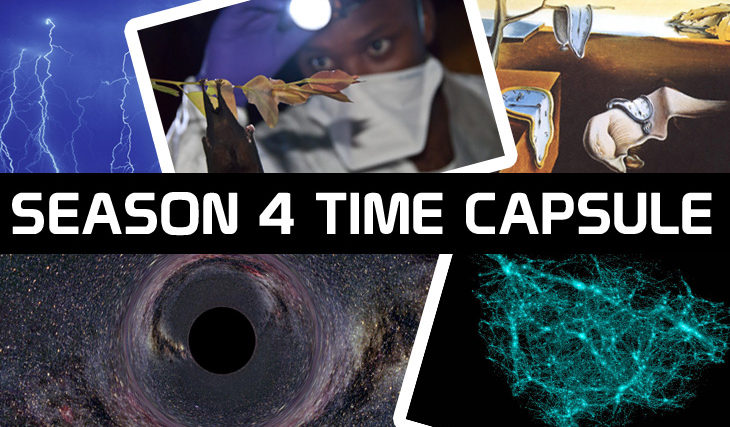
The best part of having your own personal astrophysicist is asking him questions about dark matter, black holes, light, time, relativity and the very fabric of our universe. You asked some great Cosmic Queries this season, and we’ve collected the best from your favorite episodes for Part 2 of our Time Capsule: Dark Matter and Dark Energy, Dark Mysteries of the Universe, Answers at the Speed of Light, Time-Keeping and Viruses, Outbreaks and Pandemics. Get the answers from host astrophysicist Neil deGrasse Tyson, comic co-hosts Leighann Lord and Chuck Nice and guest virus expert Laurie Garrett. Find out how dark matter was discovered and why it’s critical to our models of the universe. You’ll learn about Hawking Radiation, dark flow and The Great Attractor, the multiverse, photons and electrons, brown dwarfs and rogue planets, what happens to time as you fall into a black hole, and closer to earth, how lightning works and the scary truth behind man-made nanotech viruses and “natural” dangers like the Black Death, Smallpox and airborne E. coli.
Transcript
DOWNLOAD SRT
Welcome to StarTalk, your place in the universe where science and pop culture collide. StarTalk begins right now. Welcome to StarTalk Radio. I'm your host, Neil deGrasse Tyson. I'm an astrophysicist and director of New York City's Hayden Planetarium, right...
Welcome to StarTalk, your place in the universe where science and pop culture collide.
StarTalk begins right now.
Welcome to StarTalk Radio.
I'm your host, Neil deGrasse Tyson.
I'm an astrophysicist and director of New York City's Hayden Planetarium, right here in New York City, part of the American Museum of Natural History.
The show you're about to hear is another season four time capsule, this time featuring your favorite Cosmic Queries episodes.
In Cosmic Queries, my comedian co-host and I grapple with a variety of questions asked by you, our audience.
Based on our poll, your favorite Cosmic Queries were all about dark matter and dark energy.
Who discovered dark matter?
And I know it wasn't Al Gore.
Ah.
Sorry, Al.
He discovered it on the internet.
On the internet.
Yeah, so dark matter was discovered in the 1930s by a dude named Fritz Zwicky.
Not Fritz.
That's totally Fritz.
Ah, man.
Look at that dude, party.
When did he have time to discover dark matter?
That dude was always at a party.
So, he was Swiss born, American, I don't know if he was ever naturalized, but his whole professional career was in America, and he worked at Caltech in Pasadena, California, the California Institute of Technology, and he was measuring the movement of galaxies.
Now, the example I just gave was with the sun and our solar system orbiting the galaxy.
He did that same measurement for galaxies orbiting one another in a cluster of galaxies.
So, he's measuring how fast these galaxies are moving, and he says, the speed they're moving tells me how much matter should be there to account for the gravity.
And he does the calculations, and he's off by a factor of five or 10.
Right, and he's double checks and triple checks his calculations, they continually don't match.
And he said there's missing matter somewhere, and it was the beginning of the missing mass problem, today known as dark matter.
And there you have it, it was Fritz Wicke, I think it was 1936.
So he's just covering a math error, is what we're talking about.
It was called the missing mass problem.
And it's the longest unsolved problem in modern astrophysics.
Oh, and not what women are thinking?
Really?
No, that would be a longer problem.
You know, a related, can I give a related comment?
The study of the universe is the second-oldest profession, okay?
Seriously?
How much dark matter or dark energy is predicted to be in the universe?
Well, so the number that we put forth, well, so let me back up.
We measure the stuff.
And so it turns out when we try to make galaxies, well, I mean, on a computer.
I was about to say, did you just let me in on some top-level stuff that I am not clear to hear?
We have, yeah, that slipped out.
There are men in dark suits coming in.
Hello, gentlemen.
What?
I didn't hear anything, what?
Yeah, look at this light.
So we are, so the, it turns out, before we understood how deep the dark matter problem was, we had a hard time making galaxies on a computer.
You put in matter, you spin it up, you see if it's self-gravity, because matter attracts itself, you watch the computer, provided all your formulae are accurately captured in the program.
Newton's laws of motion, differential equations that track where things move, and you put it all in there, you load it up, and we found out we can't make galaxies.
Not only that, we can't make the structure of matter in the early universe, unless we put dark matter in the equations.
So something was missing.
Something was missing.
And so, not only does the universe show us it has dark matter, we need it in our formulations of the universe in order to create a universe that looks like the one that exists.
So we have good theoretical confidence as well as observational requirement that dark matter is out there.
And we think that that missing thing is dark matter and not love.
You need love to make a universe.
An absence of love.
No, it's too much love.
It's too much, it's too much, it's more gravity than we can account for.
I do have a question based on something that you said, that things enter a black hole, but they don't leave.
So.
Not really.
I mean, they sort of leave, but not really.
Okay, because I'm imagining that the black hole needs like a massive super colonic or something.
That's, because when she blows, it's gonna be awful.
Stand back, everyone.
Yeah, colonic, I forgot that word.
I never think I'd ever use that word in an astrophysics conversation.
And that's why I'm here.
This is what I bring.
That'd be a great new storefront, black hole colonics.
You know, they would win in the colonics contest, I'm sure.
I would see that in an episode of Doctor Who.
I feel it coming on.
So black holes eat things, and as far as we know, they stay right there down in their center.
But over time, the black hole slowly evaporates these particles, and Hawking first figured this out, and it's named in his honor.
It's called Hawking radiation.
And given enough time, these particles inside the black hole will evaporate from just at the border of the event horizon.
That's the place beyond which you don't return.
But I throw in all your atoms, they come out one by one over time, very slowly.
So it's an evaporation process, and it comes from quantum physics.
It's a quantum physics phenomenon, actually.
And I don't have, okay, I can get it in the next 30 seconds because we're gonna have to go to break in a moment.
So I'll tell you Hawking radiation in 30 seconds, ready?
Ready.
Okay, so you remember E equals MC squared?
Of course.
E equals, energy is equivalent to matter, okay?
So on the outside edge of a black hole, the gravitational field is so strong, the gravitational energy is so intense, the gravitational energy becomes matter, right at the outer edge of the black hole, and that matter escapes.
So the black hole evaporates because its gravitational energy is getting converted into matter.
And you know something, those particles that escape, invented out of the vacuum of space itself, have the same inventory of all the particles that went in in the first place.
The black hole did not forget what it had eaten.
How does dark matter influence time?
Dark matter, like anything else in the universe that contains energy, Einstein's special theory of relativity says that time slows down in the presence of high sources of gravity.
And so if you have a region where there's a lot of dark matter, if you can find a place near that dark matter that is high gravity from that dark matter, your time will tick more slowly.
Your metabolism will metabolize less quickly.
What would happen if all the dark matter in the universe suddenly vanished?
Awesome question.
If all the dark matter vanished, our galaxy would fly apart because all the speeds of the orbits that all the solar systems have is the right speed for the regular matter plus the dark matter's gravity to contain it.
If you'd instantly take away the dark matter, we fly away and all the orbits go cockamamie and galaxy clusters fly apart and everything goes haywire.
Wow, I'm actually startin to get this.
Welcome back to StarTalk Radio and our season four Cosmic Queries time capsule.
Next up, Dark Mysteries of the Universe, where comedian Leanne Lord and I answered your questions on everything from the tiny electron to the higher dimensions of the multiverse.
I have a question from Joe Vera, and he says, I recently found out about something called Dark Flow.
Isn't that a DJ?
Ha, Dark Flow.
Yeah, exactly.
A beatboxer DJ, Dark Flow.
That's a great name.
It is, isn't it?
It sounds like a cartoon.
All right, now from what I gather, it is the-
The other great name for it was like MC squared.
That's it, you know, if you wanna be MC.
I'm gonna pretend I didn't hear that.
All right, from what I gather, it is the unexplained coherent motion of galaxies toward one side of the universe.
Can you please elaborate on this phenomenon and its possible ramifications for our understanding of the universe?
Yeah, there's something called the Great Attractor that got labeled that, because when you...
When you measure the speed of galaxies as they move in the universe, there are multiple ways to do this.
One of them is just how fast is the universe expanding?
So that's the speed they have just from the expanding universe.
But while that's happening, galaxies are moving among themselves.
For example, we are about to, in seven billion years or so, about to collide with the Andromeda Galaxy.
It's our nearest big galaxy.
So we're about to collide, but the greater activity of the universe is expansion while galaxies are still moving among themselves.
So when you map the speeds of all these galaxies, it was found that there's a whole swath of galaxies in the universe that have sort of an extra motion towards one direction.
So you don't know if they're escaping something or being drawn towards something.
Run, everybody!
So it's an interesting sort of phenomenon that's not completely explained.
So you just didn't explain it.
According to the theory of multiverse, what is space, and he says I'll call it space, between universes?
What is the space between universes?
Yeah, it's a higher dimension.
Next question.
Oh, and not the fifth dimension as in the singing group.
Right, actually, there's a fifth dimension in there somewhere, but if you take the three dimensionality of our universe and then you embed it among other universes in another kind of space, that's a higher dimension.
And in fact, I hosted a panel on nothing.
You hosted a panel on Seinfeld?
On nothing at my host institution, the American Museum of Natural History, and we talked about what is between galaxies if the multiverse produces galaxies.
And that's a kind of nothing, but it turns out it's not the best nothing that you can come up with.
It's like the dark alleys of the universe?
No, because that still has dimensions.
Is it nothing if nothing's there, but it still has a dimensionality?
See, we got really deep.
I mean, heads were exploding left and right in the aisle.
Like now.
So, no, it's what we would call the space of a higher dimension, which is not even our space, because it would not have the matter, it would not have the energy, it would not have the anything that we associated with our stuff or even with where our stuff isn't.
Because outside of our universe, there's not even the nothing of space.
Well, because if space is nothing, then where there is no space, there's not even that nothing.
Okay, next question.
I'm sorry, I'm not allowed to call the next question.
I'm going to the next question, because I'm just, what?
Go for it.
I need to go back to school.
Is there anything smaller than the infinitely small, and can you put it in a way that does not make me hate that I don't even get to be in pre-calc till next year?
Ooh, high school student, nice.
Can you smell that?
Young person.
Yeah, so, by the way, see if you really like math, see if you can skip pre-calc and just go straight to calc.
Just tell them Tyson told you.
Tyson told me, I have a note from my personal astrophysicist, can I please get in?
And just go, see if you can go straight to calc.
But, all right, so is there anything smaller than infinitesimally small?
Mm-hmm.
Uh, yes.
Okay, no, no.
So here it is.
The electron is smaller than the smallest thing we have ever measured.
And in fact, it is so small, we do not know how small it is.
We cannot measure it.
It is so small.
In fact, it could be so small as to not occupy any volume at all.
As far as our measurement devices are concerned, it has no dimensions at all.
The electron.
So the electron comes closest to infinitesimally small of anything we have ever known, thought of, dreamt of or measured.
Approximately how many stars are born and die each day?
Oh, I love that.
Now what's a day?
How are we defining a day?
I'm assuming Earth Day.
Let's assume.
Not somebody else's day, Earth.
Earth.
Right, but of course other planets have days, yes.
In fact, Venus' day is longer than its year.
Just chill on that one for a bit.
So Leanne's face just scrunched up in a, like.
Because I'm chewing on it.
I'm actually chewing on it, that's okay.
Venus the day lasts longer than a year, but we'll get back to that if we go there.
So, now where was I before I distracted myself?
How many stars were born each day?
So, you can do what's called a back of the envelope calculation.
You ready?
All right.
Our galaxy has about, let's just say 100 billion stars, okay?
And the universe has been around for about 10 billion years.
Back of the envelope means you change the number to make the math easy, but your answer will be.
I back of the envelope my taxes all the time.
So but your answer will be approximately correct, and later on you can put the exact number in, if you want the exact answer.
So say we have about 100 billion stars, and the universe and the galaxy has been around for 10 billion years, okay?
So we have 100 billion stars, and we've been around for 10 billion years.
That means the galaxy makes 10 stars a year.
That's an average.
Yeah, on average, that's right.
If it made 10 stars a year, throughout its whole life, we'd have 100 billion stars over the 10 billion years.
That's how that works.
So it makes about 10 stars a year, so that's about one a month.
And so we don't quite make a star a day, on average.
About one a month.
We could live with that.
However, that's not actually how stars are born.
They're born episodically in stars, in stellar nurseries, where thousands of stars are born all at the same time.
So if you're a planet in orbit around one of those stars, you'll see stars lighting up daily as they are born.
That must be pretty.
Well, not daily, but frequently.
Like, poof, there's Brad Pitt, poof, there's Angelina Jolie.
How does the Higgs feel different from earlier ideas of an ether?
Oh, did you spell ether right, A-E?
Yes, yes, the A is silent.
A is silent, so it's a diphthong.
It's a diphthong.
Yeah, I think it's a diphthong.
That's very kinky.
Yeah.
That's a new, they should invent a new bathing suit, the diphthong, you know, that would be cool.
So let me see, we only have like 20 seconds left.
Yeah, cause you're fooling around.
Let me see.
Well, I have to give half the answer and you gotta get the full answer at the end of the break.
But the ether was this proposed medium of the cosmos through which light traveled.
Because people knew that light was a wave and sound is a wave and sound doesn't move through a vacuum, does it?
You ever remember the bell jar experiment where you have a bell ringing, you put a jar over it, you evacuate all the air and the bell shuts off, the bell is ringing and you can't hear it.
It doesn't go through a vacuum.
So neither should light was the hypothesis.
Because the ether was a thing, nobody knew what it was, that was proposed to allow light to vibrate its way from a star to us through the vacuum of space.
Because sound needs something to vibrate, the ground, the air, sound doesn't travel through space.
Such was the tagline to the movie Alien in space.
No one can hear you scream.
Yes, however, light travels through it.
So surely there must have been a medium out there through which light can move and vibrate.
And it was supposed to be the ether, but it was never found, never measured.
It was never found, so, and it went away.
So is the ether dark matter?
No, we learned that light does not require any medium at all to vibrate, it is self-vibrating.
Oh, man.
Mm, mm, ooh, it hurt.
That actually physically hurt.
I'm just talking universe here.
To drain myself.
I'm just universe here.
Is it warm in here?
How do you know math is the language of the universe?
How do we know because the universe tells us?
Eugene Wigner, a physicist back in the 20th century, commented on the unreasonable effectiveness of mathematics.
The unreasonable effectiveness.
Because we invented it, yet it accounts for the operations and motions of the universe.
Since math is purely logical, it means the universe at its finest is logical.
The math is Vulcan.
Love it.
Adam Young wants to know, have we considered the consequences of tapping into the dark side of the force?
And is the dark side of the force really stronger or just more lucid?
Ooh, well, all the forces we know don't have dark sides.
You haven't met my mother.
Welcome back to StarTalk Radio.
I'm Neil deGrasse Tyson.
This time capsule features your favorite Cosmic Queries from season four.
Next up, an episode we called Answers at the Speed of Light.
Now I heard lately that lasers have been used to try to direct lightning strikes.
The laser is shot into the thunderhead clouds and the plasma flows the laser back.
Is there a way to harness this energy and make lightning farms?
Well, first of all, that's the first I've heard of this.
And I think it's amazing.
And I can even explain how it works, even though I only just learned of it.
Because you're that bad.
Cue music.
I need a theme.
A theme.
You're like, you're the shaft of science.
Okay, now, sorry, I distracted myself.
Where were we?
Lightning farm, sir.
So here's what happens.
Lightning comes about because there's a difference in charge between a cloud and the ground beneath it.
And charges don't like being separate from one another.
The molecules reach an excited state because they've lost their electrons.
They don't like staying that way.
And the electrons are sitting on the ground.
And those electrons want to get back to the cloud.
And so the cloud comes over, the electrons gather, and they're ready to rise up and reach the cloud again.
Thus is born a lightning strike, which tells you that lightning goes from the ground to the cloud, not the cloud to the ground.
Now, so if you take a laser that's very high power and you ionize gas at the atmosphere in one place versus another, you can build charges around where the cloud is and force a lightning bolt to go where you say so.
Now that's good.
Now the person wants to know if we can make a lightning farm out of it, I say, why not?
But it sounds great.
It does.
You just have to watch out that your lasers aren't so powerful to ionize the air in places so that you can force a lightning discharge that you're using more energy than you get back from the lightning itself.
Because then that would be inefficient.
Then you're not farming anything.
Right, no.
You're getting less than what you started with.
Now it turns out the act of forming a raindrop in a cloud takes some charge out of the cloud and brings it to the ground.
So you're relying on the sun, which evaporated the water in the first place to make the cloud, to then drop the water, bringing charges to the ground.
You're relying on that in the first place.
So if the laser's just to help it out, to direct the lightning where it would have struck anyway, but now you strike it to your spot, your sweet spot, then you got a good farm going.
I'm sorry, my what?
I just had to say, I had to just clarify all of that.
Yeah, oh sorry, your what?
I need a moment.
I think I need a cigarette.
The man said, my sweet spot.
Who was our most scientifically friendly president?
Like which one of our US presidents was the most friendly to the field of science?
Ever?
Yeah, it depends on what you mean by friendly.
In Washington, friendly means how much money do you give the enterprise.
That's what, in Washington, all that matters is money.
What you say doesn't matter at all.
Okay, but then let's go.
Just an FYI.
Okay, all right.
So a few things.
Abe Lincoln began the National Academy of Sciences.
Now that's kind of cool.
Very.
It was set up to establish an advisory board to Congress that was not itself politically motivated for any reason.
And so Congress would call on the National Academy of Sciences to produce studies on scientific issues that befall the day.
I got to put Lincoln at the top of that list.
Okay.
As the most scientifically aware and literate.
So he was not just a cat owner.
I didn't know he owned cats.
He was the first president to have a cat.
I did not know.
Why do you even know that?
Because I was getting tired of the slavery thing.
Like what else did he do?
How can we determine the difference between a brown dwarf and a large rogue planet?
Oh, it's hard.
Brown dwarf is a star that didn't make it and a large rogue planet is just a big old chubby planet.
There are astrophysical differences between the two, but they're very hard to notice from a distance.
So it's very hard.
It's one of the big challenges.
And we got low mass star people and high mass planet people meeting in the dark of night trying to solve that problem.
You said chubby planet.
Joshua Jenkins wants to know, why does the earth spin in the direction it does?
And what if earth started spinning twice as fast as it does now?
Ooh, okay.
So we spin this direction because I'm gonna say it exactly physically.
You ready?
Yes.
That is the direction of the angular momentum of the entire solar system.
The sun's-
So we're going with the flow.
Beautiful.
We are going with the flow.
The sun spins that way.
All planets orbit that way.
The moons orbit that way.
Everybody is going counterclockwise as viewed from the top.
Now, why do they wanna spin up earth?
I don't know.
That would have the length of the day.
There'd be 12 hour days instead of 24 hour days.
Oh, I can't get enough done.
The act of spinning us up, okay, we'll feel that.
That would not be a good day on earth, all right?
Okay, you will know when earth starts spinning faster.
Well, you know what will happen?
Stuff behind you will run into you and you'll be flattened against it and you'll be a pile of goo on the wall behind you.
Because right now you're moving 800 miles an hour with the rotation of the earth.
If you all of a sudden start going 1600 miles an hour, something came in behind you to push you to do that and that will flatten you into a pile of goo.
Good.
Welcome back to StarTalk Radio and our season four Cosmic Queries time capsule.
One of your favorites was an episode on the science of timekeeping where the comedian Chuck Nice and I discussed nearly an infinity of timely topics.
I've been hearing a lot about this theory that if we place a giant mirror 22 light years away from, away and point it at an extremely efficient telescope, we would see things happening in real time, in the past, that's what he's saying.
So, I think what he's saying is, if you were to put a mirror 22 light years away from Earth, point it back at Earth, would you be able to see Earth 22 years in the past?
No, you would see it 44 years in the past.
Right, because it's gotta go there and come back.
Do the math.
Yeah, you gotta look at it and then it's gotta come back to your eyes.
Exactly, so you see yourself in a mirror, not as you are, but as you once were, two billionths of a second ago.
Gotcha.
If you're a foot away.
If you're a foot away.
The light travels a foot every billionth of a second.
One foot per nanosecond, if you wanna be exact.
We came up with the number 22, I don't know.
Stick a mirror out there, let the light go and come back.
You will see, however many light years away, double that, because it's the round trip time, that's how far in the past you were viewing events on Earth.
So you're viewing the events that they're out, you're actually looking at the past in real time for you.
Yes.
Gotcha.
Gotcha.
That's exactly what's happening.
That beam is on its way to the mirror and it's on its way back and you're catching it.
Right.
Right, that's all.
And by the way, we see other objects in the past because their light has just reached us.
So this is not magical thinking.
Right.
My favorite is a galaxy that's 65 light years away.
I'm sorry, 65 million light years away.
It's a galaxy called M100.
M100.
M100, 65 million light years away.
And guess what they're seeing on Earth right now if they had a telescope big enough.
What?
The extinction of the dinosaurs.
Look at that, that's so cool.
That beam of light that conveys the information that they got slammed is just now reaching them.
It's just reaching them.
Because they're 65 million light years away and when did the dinosaurs go extinct on Earth?
65 million years ago.
You got it.
Is the perception of time universal or do we all perceive time differently?
I wonder if a house fly and other organisms perceive time to be quicker.
It's fun to think about other life forms that live shorter or longer as perceiving time differently.
But typically when we do that, we are humanizing their life.
So one dog year is seven.
Seven human years.
Yeah, dogs don't care about humans.
But the passage of time as measured by the atomic vibrations of atoms within them is the same for everyone.
Oh yeah.
So that's it.
On an atomic level, that's it.
That's it.
No difference.
You can slow it down, speed it up with relativity, but otherwise, if you put the frog and the mayfly and the human and the elephant together in a room, the passage of time is the same.
I gotcha.
And that makes great sense for dogs because that means a dog would be licking its butt for about two months.
Total out of it tonight.
How would a spacefaring people keep time?
Oh, that's good.
Okay, just they-
Real simple.
Look at their watch.
No, do you know what time it was on the moon?
No.
It was Houston time.
Right, because they're talking to Houston.
That's so funny.
Houston is telling them when to wake up and go to sleep.
Oh my God, you're absolutely right.
Yeah, so you pick a spot on earth and that becomes your time on time.
If you had an actual colony, space colony that was nowhere near earth and you didn't care about earth, then you're not dependent on the rotation of the earth or daylight or nighttime.
You can create whatever kind of days you want.
Studies in psychology showed that if you'd lock people away and had them set up their own cycles, that their day is typically 25 hours.
Really?
25 and a half.
That's why you never quite feel right, like the day is always a little bit ahead of you.
Yeah.
It's because you really want a 25 hour.
You need an extra hour.
You need an extra hour.
You need an extra couple hours.
And I thought I was just hung over.
If light can't escape a black hole, how would time be affected inside the black hole?
So now you got a force that is stronger.
The gravity is stronger than light itself.
As you fall into a black hole, time ticks more slowly for you.
And you look out to the rest of the universe and the rest of the universe goes by quickly.
In fact, as you descend to that cosmic abyss, moments go by for you and trillions of years go by for the universe itself.
You will outlive the universe in your descent to the center of a black hole.
Is the universe necessary for time to exist?
For example, was time present within whatever came before the universe?
Time, as we have defined it, exists only within this universe.
If we go outside of our universe, we'll have to think up something else to keep track of things.
Maybe there's some meta time that we can think of, just the way we can think of a multiverse, a word bigger than the word universe itself.
Maybe we are longing for that word, such as meta time, that can accommodate our measuring needs when we exit this universe in which we were born.
Welcome back to StarTalk Radio.
We're wrapping up our season four Cosmic Queries time capsule show with the episode on viruses and pandemics.
Journalist Laurie Garrett joined comedian Chuck Nice and me to answer your burning questions on SARS, HIV, and other spreading diseases.
Chris's point, of course, is if we can make viruses that we control that are sort of machine, machines, but are small like viruses, we can infect you with something that we've manufactured in the lab.
Well, there is nanotech that is targeting disease, and there is a lot of talk about-
That would be nanobots for good.
Yes.
The positive force of Marvel comics would have you.
These nano agents, which are still very much in the, I would say the front end of the research process, it is imagined would target, for example, killing cancer cells.
So, they would recognize something on the surface of the cell that said, I'm a cancer cell, and then go in and kill it with a poison or what have you.
But in the hands of the diabolical evil genius.
Well, the question really is to ask, is there a way to make a nanobot self-reproducing?
If a nanobot-
The way life would, the way a virus-
If a nanobot could be self-reproducing, then indeed you could have an out-of-control infectious problem.
Because it would have to replicate itself in order for that to happen.
Like a virus would do.
Like a virus.
The other thing that's going on now is that we have this dichotomy of purpose where people in public health want to know what's going on with viruses in the natural world, so we're ready and we make our countermeasures, our vaccines and what have you.
But on the other hand, there's a lot of folks that say, well, the best way to answer that question is to do man-made evolution.
Let's direct the evolution of viruses in the lab, manipulate them, turn them into monster viruses and see what does it take to be a monster virus.
So last year, two different teams-
You're scaring the crap out of me right now.
Last year, two different teams, one in Wisconsin and one in Rotterdam, indeed made super killer form of flu in the lab.
And a whole lot of people said, why in the world would you do such a thing?
And those are now sitting in freezers, right?
We kept them.
Last month, not to be outdone by Americans because they don't want to be outdone by Americans with anything.
The Chinese A-Lab in Harbin made 127 man-made flu viruses, of which five readily spread in the air between guinea pigs and killed them.
Oh my God.
So this is the new cusp that we're on is, oh, we're trying to do it for good.
We're trying to see in advance what nature might do.
But in the process, you're putting in a freezer Armageddon.
And people were afraid of physicists.
The biologists are plum crazy.
You are not lying, man.
Oh my God.
I'll take an atom bomb any day over this.
Yeah, I gotta tell you, in the fraternity of science, you guys are animal house.
Well, if you don't like that, check this out.
No, stop there.
No, no, no, no, you got something worse than that.
You got 20 seconds, go.
Synthetic biology.
There's a competition called iGEM.
In order to compete, high school students and college students have to make a novel, not preexisting microorganism.
In 2012, there were 248 competing teams, meaning 248 previously non-existent microbes were made by high school and college students.
That's the end of the world right here, is what you just told us.
What do you think is the most interesting historical plague or epidemic, viral or otherwise, and why is it so fascinating?
Plague, it completely reshaped Europe forever.
The politics, the food.
The culture, the status of the church.
Okay, which plague had many outbreaks?
Which one especially?
14th century.
The big one.
The black plague.
Black plague, black death, black death.
Why's it gotta be a black death?
People's skin turned black.
Yeah, all of a sudden, that's a bad thing.
In the case of viruses and vaccines, if a disease gets eradicated, okay, will future generations still have to get vaccinated for those diseases?
No.
Nice, good.
Okay.
She's getting the hang of this.
She's good.
So when it's gone, it's all gone.
AKA smallpox, we don't vaccinate anymore.
Could pathogens be spread in the atmosphere?
A recent study done by Georgia Tech researchers found that E coli amongst a great deal of bacteria that formed a sort of bacterial sphere in the upper atmosphere.
Yes, we now have proof that pathogens, particularly sporulating ones, can spread in clouds and rain down in locations far away.
Oh man, that is one time you do not want to make it rain.
Ooh, do you stay inside when that happens?
Well, you don't drink rainwater.
You don't know it's coming and you don't know it's there.
You don't know it for nothing.
What is the minimum size of a population that can support a viral infection?
So in other words, for the virus itself to be able to continue on its life, what's the minimum number of people you need in a community so it can spread and continue to be a virulent?
In theory, one, if it's a slow growing microbe and a slow replicating one, for the duration of your life, you can be the host for it.
Gotcha.
So in theory, I could be a virus of one, like the army.
You got it.
Nice.
Has the link between a chicken virus and obesity been proven?
First time I ever heard there was a link between a chicken virus and obesity.
I think by chicken virus, he means like a whole chicken and eating one in a sitting.
You've been listening to StarTalk Radio, brought to you in part by a grant from the National Science Foundation.
As always, I bid you to keep looking up.
To keep looking up.
See the full transcript



 Unlock with Patreon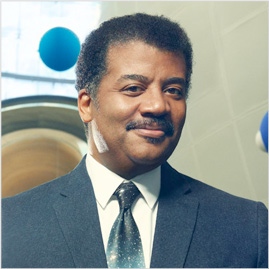

 Become a Patron