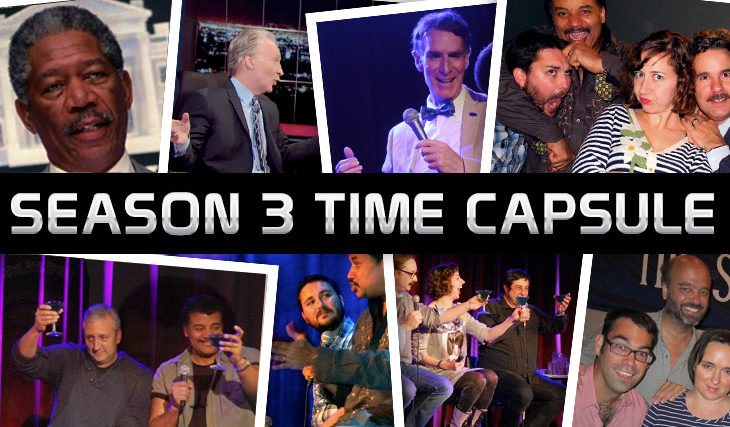
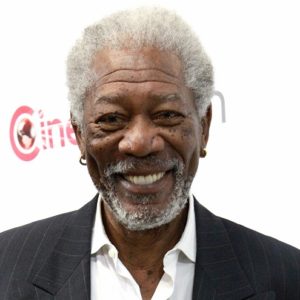
Enjoy the most memorable moments in a season worth remembering, pulled from the five most popular episodes chosen by our audience: StarTalk Live The Particle Party; A Conversation with Morgan Freeman; StarTalk Live: The Astronaut Session; Real Science with Bill Maher and StarTalk Live! A Night at Neptune. Where else can you hear Morgan Freeman explain why he’s not worried if aliens visit in the same podcast that astronaut Mike Massimino explains what it’s like to walk in space and look back at the Earth? Join astrophysicist Neil deGrasse Tyson and all our celebrity guests as we celebrate the discovery of the Higgs Boson with Bill Nye the Science Guy, take a trip to Geek Mecca with Wil Wheaton, and discuss religion and space exploration with Bill Maher.
NOTE: All-Access subscribers can listen to this entire episode commercial-free here: Season 3 Time Capsule.
Transcript
DOWNLOAD SRT
Welcome to StarTalk, your place in the universe where science and pop culture collide. StarTalk begins right now. Welcome to StarTalk Radio. I'm your host, Neil deGrasse Tyson. I'm director of the Hayden Planetarium at the American Museum of Natural...
Welcome to StarTalk, your place in the universe where science and pop culture collide.
StarTalk begins right now.
Welcome to StarTalk Radio.
I'm your host, Neil deGrasse Tyson.
I'm director of the Hayden Planetarium at the American Museum of Natural History, right here in New York City.
For this time capsule show, which we do every year, we're featuring some of the top moments from our third season of StarTalk.
We asked you, the audience, to tell us what were your favorites, and we used your answers to help us put together this show.
First up, an excerpt from my conversation with Academy Award winning actor, Morgan Freeman.
I think that anything humankind can imagine, they can do.
All right.
And so how have you brought this to bear on your life?
Is it stuff you've imagined that you want to make happen?
Ask yourself, why are you sitting here as an astrophysicist, as a very well known and accepted astrophysicist?
How'd you manage that from nine years ago?
I imagined it.
You imagined it.
But I didn't imagine that I would stop the rotation of the earth or reverse time.
I mean, I was kind of sensible, I think, about what the stuff I was imagining.
So I would modify the word, not anything you can imagine.
I think anything you can imagine doing, you can do.
What did Archimedes say?
Give me a place to stand.
A lever and a fulcrum and a place to stand.
And I can move the earth.
That's what he said.
Well, it's true.
So that's actually a good philosophy of life if you have high ambitions.
Yeah, have them.
Have them, because if you can imagine it, you can do it.
Of course, you did March of the Penguins, which that's science.
We'll take it as science, I think.
Yeah, I think that's science.
Biology.
Yeah, it's ecology.
We'll give you that.
I really liked that one, though.
I really liked it.
Yeah.
I think at the time, I was penguin-ed out because I saw Happy Feet, and I thought, how many penguins can a man take?
And I had to put a hold on my penguin viewing for a while there.
No offense, I'm just saying.
Hey, I'm not a penguin.
And then you did some environmental clips.
One Earth, I think, was one of them.
So you're a man about science, I think.
We'll claim you, whether or not that's deep within you, whether or not it was just your next gig, I'll take it, because I think it's important to have at least that association.
But I don't claim to have any knowledge towards scientific anything.
Except that you were in Outbreak.
I remember that movie with that Ebola-like virus that was killing people in sex.
You were in Chain Reaction.
You were in Deep Impact.
My next gig.
You were in Batman Begins.
My next gig.
My next gig.
Well, but not everybody has next gigs that celebrate science the way these films do.
Well, see, you're just putting dots together.
Oh, false pattern recognition.
That's a crime of the analysis of data.
That's what I'm doing, you're telling me.
Well, okay, so I will ignore what you said, that it's just an accident, that you line these movies up.
I want to connect my own damn dots and say, I want to say it's not a coincidence that you're in more science movies than other actors are.
If I try to find, you know, how many science movies has Sean Connery been in?
Or, you know, Robert De Niro.
Oh, that's true.
They're searching for cancer.
And now, okay, well, yeah, he's got one.
How about Robert De Niro?
No, no.
No, no, no, he was in a way, he was this guy who was in a coma, not a coma coma.
Oh, yeah, yeah, yeah, yeah, you're talking about awakenings.
Awakening.
So whether or not it was just your next gig, I have to say I enjoyed all the science movies you've been in, especially Deep Impact with the asteroid strike, because we know these things are out there.
And so it's not just, oh, here's a science fiction movie.
It's like, there's some real stuff going on here and it's a wake up call, a shot across our bow, if you will.
And I got to say, I enjoyed you as the tech dude in Lucius for Wayne Industries, supplying Batman with his bulletproof cape and his, all the doodads, who doesn't love the doodads?
So those are, I'm just saying, those are all convincing and meaningful roles and I'm gonna take you as a science geek, honorary science geek, for those roles in those films.
Hey, I'll accept that I accept it.
You'll take the honor.
An honorary geek.
It's not quite like knighthood, but it's the best we can do for you in America.
I'm on it.
Do you ever dream about commanding a starship?
You've got some time on your hands.
I'll tell you all about it.
So the answer is yes.
Okay.
Yes, you dream about it.
And yes, you know, it's just.
I'm gonna tell you why.
We have access to Arthur C.
Clarke's book, Rendezvous with Rama, and I'm.
The whole series, the series.
Just that one.
But there are four.
So, my fantasy of commanding the starship is commanding Endeavour, which is the ship used to Rendezvous with this craft that's moving towards, has entered our solar system.
It was an alien thing.
Yeah.
Yeah, that's right.
So, you're dreaming yourself into science fiction roles.
Yeah.
Well, that's what a good actor would do, because you see roles, hey, I could do that or I could be...
Oh, absolutely.
So, is this a pitch to be like that person if they ever make that movie?
Well, we're going to make that movie.
You are going to make the movie?
Yeah.
Well, that's what you mean.
Excuse me.
You said you had access to it.
I have to like...
That means you bought the rights to the book.
Yeah.
Didn't that make sense before?
Okay, access to it is code for you bought the rights.
I bought the rights.
Because you want to be that commander on that ship.
Since I read that book somewhere back in the 60s, I always saw it as a movie.
And since you bought the rights to the book, you can be whatever damn actor in that story you want to be.
So you worried that the aliens come and suck our brains out?
I'm with Clark.
Arthur C.
Clark.
Yeah.
I don't think the universe is populated with Northern Europeans.
You mean of the ilk that upon reaching a strange civilization...
Destroy everything.
Kill them all.
Kill them all.
Let God sort it out.
So you think they're a kinder, gentler species.
Even though you have no data to back that up, you're wishing that this is true.
Well, why not wish that was true?
If you're going to reject, just do it another way.
So we're not terrified if something does show up.
Now ask the questions.
So you want like 1960s peaceniks to be the aliens.
See, I don't think you're being kind.
You saw Close Encounters of the Third.
Yeah, of course.
Now, did you walk out of that movie looking up?
I did.
I drove out to a space where there was no light.
I want to be abducted.
I want them to come find me.
Every time I'm alone out in the sky, I say, come on, bring it on.
Yeah, you know, if you're there, I'll go.
You go.
So that makes you feel safer in a universe where you just might get a visitation.
Welcome back to StarTalk Radio, I'm Neil deGrasse Tyson.
This is our Time Capsule Show, and we're replaying audience favorites from our third season.
In this segment, we revisit one of our live shows at the Bell House in Brooklyn, New York.
The topic that evening was the discovery of the Higgs Boson.
On stage that night were my co-host Eugene Merman, comedian Scott Adzit and Sarah Vowell, and New York University Professor of Physics, Kyle Kramer.
We also added Bill Nye, the science guy.
Check it out.
You may remember, the date was July 4th.
I tweeted that morning.
I don't know if you saw it.
My tweet was, on the day America chooses to declare its own greatness, July 4th, Europe, who had just announced the discovery of the Higgs particle that morning, Europe, reminds us how much America sucks at science.
Wow.
I'm just saying, you know, we could have done that.
We would have done it.
I mean, the US could have done it by building the superconductor-supercollider but it was canceled in 1993.
Yeah, yeah, yeah.
Three plus times the energy.
Yes, so what happened?
Yeah, Kyle.
What the hell's wrong with you physicists?
I was still in high school.
Oh, I'm Doogie Howser of physics.
It's equivalent to a small city, the amount of power that's required.
A lot of it is going into accelerating the particles and even more goes into keeping this ring so cold.
It's like a huge air conditioner.
Well, that's, wait, you were saying, so it gets much hotter than the sun, right?
Like millions.
The collisions, where they hit.
Thousands or millions of times hotter than the sun.
You know, it's.
Either way, say twice.
No, no.
So 1.9 Kelvin is cold enough to keep it from blowing up the earth, is what you're saying, or melting the earth, or what's going on?
Let's pick that up.
Why aren't we all dead from your dumb experiment, asshole?
Right, Kyle, let's back up, Kyle.
Answer me truthfully.
Are you making many black holes at CERN?
As far as we know, no.
But we actually.
How comforting.
As far as we know, we don't think we're making Earth destroy black holes.
If it does happen, we'll all be the first to know.
Actually, Europe will.
Oh, fools.
Six hours earlier.
But do you use the verb burning when it's a fusion in a star?
Yeah, no, we talk about stars burning their nuclear fuel.
Yeah, so do chemists just wanna kick your ass for saying that?
Because burning is a chemical reaction.
Not nuclear.
It is, but you know, wow, we're geeking out.
I don't know what you're arguing about.
You're both mad at the word burning, apparently.
And Neil's mad on behalf of people who aren't here.
All right, so now we got 12 particles.
Yeah, so the reason the chemists are really mad is they have a chip on their shoulder that the periodic table is not the right way to think about the universe and what it's made out of.
It is really 12 fundamental particles.
All right, there's a posse gathering here for you later.
It's great, it's just not the fundamental picture that we have.
The fundamental picture that we have is much more concise.
We only have 12 fundamental particles and everything in this room is really just made out of three of them.
Okay, so give us the inventory.
There are six quarks and there are six other things which go into the-
Do you not know what they are?
I don't know what they are.
You're like, there are six quarks and there's a cheese and then-
There are things like the electron which are called the leptons.
Everything's got on at the end, so it's not the Higgs boson, it's the Higgs boson.
Leptons which include electrons and then there are sort of heavier brothers, the muon and the tau which you may not have ever heard of.
Tau doesn't end in O-N just in case.
Tau-on.
But leptons would include positrons.
Right, and all of these 12 have anti-particles, so anti-matter.
So 12 particles have another 12 anti-matter counterparts.
That's right, but we don't really count them as 12 more because they're just so related to the other ones that we just group them together.
Okay, so it's like the good particle and the bad particle.
It's like owl man to Batman.
Wow.
Sorry.
I'm going to leave now.
So all of the particles that stuff is made out of is one class of particles and all of the particles associated with forces are the bosons.
And so that's where that name comes from, if you will.
So Higgs and Bose was a contemporary Einstein, right?
That's right.
And basically, you know, he-
An Indian physicist.
Yeah, that's right.
That's right.
So there's sort of two classes of particles that no one wants to know the difference between them, but you know-
Yeah, we do.
Bring it on.
Look at this audience.
Tell us the secret.
Okay.
Actually, I can say it.
Here we go.
The bosons like to party.
The reason that lasers work is because once you get one photon going in one direction, all the other photons want to jump on board and they just keep piling up.
And what do you get?
You get light amplification by stimulated emission of radiation, baby.
I don't know why you delivered that so sexually to me, but thank you.
So I mean, you know, most people think about physics in terms of numbers and equations and things, but you're really the driving principle of physics is symmetry.
And it's beautiful.
So there's another symmetry of space and time.
And in fact, it's the only other symmetry possible.
And it's the only one that we don't know that nature realizes.
And that's called supersymmetry.
And the logical consequence of this symmetry, if it exists, is that all the particles that we know about have another doubling.
So there's matter and anti-matter.
And then there are their supersymmetric partners.
Well, you mean there's like crickets and anti-crickets?
Yeah.
Well, they're already crickets and anti-crickets.
Now there's supersymmetric anti-crickets.
I don't think there's enough LSD in the world to know what you mean.
Where are these supersymmetric crickets flying?
What, you don't believe me?
I do believe you.
I just don't know what you mean.
Kyle, what did you just say?
He's saying that there are crickets.
We have all these symmetries, up, down, left, right, front, back, back, forward, but there's another symmetry that exists.
It is the supersymmetry.
What is it?
Wait, say it again.
Explain it.
Oh, what it is, it's, oh, that one is hard to explain.
Oh, so you didn't explain it.
No, no.
I thought you explained it and I didn't understand.
You just said, oh, that's supersymmetry.
I said there is another symmetry and the logical consequences twice as many parts of it.
So what that symmetry is is a little, so there's a super electron and a super photon.
Yeah, they have horrible names like the selectron and the smuan.
That's cool.
You put an S in front of it.
I like it.
And then all of the bosons put eno at the end.
So there's the gravitino.
It sounds cool.
Oh.
So where would I go to find a gravitino?
Yeah.
The LHC.
The LSD?
No, the LHC.
Yeah.
So what is a, hang on, is there a class of particles that would be a hadron or a shadron?
Why are you looking at me?
She had a lot of hits.
So hadrons are like collections of fundamental particles.
I guess you could take all of these supersymmetric things and build a, you know, a shadron collider.
A shadron.
A shadron.
So you got all your particles and there's a whole other set that corresponds with them in some other dimension of symmetric thought.
And you would call them supersymmetric particles.
Could they be the dark matter particles?
Exactly, yeah.
So, the lightest one of these particles is the prime candidate for what dark matter is.
What's that one called?
It's called the lightest supersymmetric particle.
How did you come up with that name?
That's really good.
This is your opportunity to name that thing.
The Cranmeron.
Name it here and now.
Lightest supersymmetric particle.
What do you get?
Larry!
Definitely, let's call it the Eugenatron.
It's the Tyson.
We have something called the anthropic principle, which is that certain things that we don't understand, that we've been trying to explain, that are very difficult to explain in our theories, maybe don't have an explanation.
Maybe they are just random chance because there's so many different universes out there that you're only going to find yourself in the one that supports life.
In some sense, it's kind of anti-science because it's very difficult to test.
And the other way, it has some precedence.
So, if you think about the solar system, there's the sun and the different planets going around.
People tried to explain why the orbits of the planets were the way they were.
And people were thinking about, oh, well, maybe the platonic solids, like squares and different shapes.
Cubes.
Cubes.
Octagon.
Tetrahedron.
Tetrahedron.
Yeah, exactly.
I mean, octahedron.
I was kidding.
I was kidding.
Dodecadron.
There are five of these shapes that fit inside of each other.
And they fit inside of each other with ratios that are pretty close to the orbits of the different planets that they know about.
And people thought, oh, this is the explanation of why the planets orbit in the way they do.
And now we just see that it was random chance.
There are lots of other solar systems out there.
We're finding them every day.
We're studying them.
And we realize they have all sorts of different properties.
So you're voting your entire career to a set of what we think of are laws, but are just random crap that shows up in one universe versus another.
Well, no, most of it is beautiful laws with very convincing mechanisms.
The most.
But there are a few riddles that we still don't understand.
And we don't know if we'll explain them in a few years from now, or if a hundred years from now we'll look back at it and think of it just like the people thinking about the planets going around the sun.
This is The Passion, Beauty and Joy, the PB&J of science.
Welcome back to StarTalk Radio, I'm Neil deGrasse Tyson.
You're listening to our Time Capsule Show, where we revisit fan favorites from our third season.
In this segment, astrobiologist David Grinspoon and I comment on my interview with HBO's talk show host Bill Maher.
My view is we need to wait here on Earth until we have better technology and more knowledge, because I just don't think we're ready to do it.
We're like a baby who wants to walk, and we're going to fall down.
But okay, people fall down, right?
And that's how you do it, sometimes it's hard.
But if you wait, you don't fall down.
If you wait a couple of years, then you can actually walk.
But then another country does it before you, so there you go.
Right, I am so worried that Albania is going to beat us to Mars.
That is paramount in my concerns right now about, now what other country, China?
Yeah, yeah, China, well, yeah.
They wanted to put a man in orbit, and they did that, and they want to put a base on the moon, and why should I doubt it?
They got a booming economy.
Well, you know, we got to the moon first.
What did that get us?
I mean, do you really think that they're going to get up there and then use it as the high ground militarily, that we're going to have to worry about them pointing space lasers at us?
I mean, we can all already wipe each other out with the nuclear weapons we have here on earth.
Without having to go to the moon to do it.
Yeah, I don't understand what the big problem there is.
I'm not really that worried about China.
Everybody talks about China as if it's this country that is eclipsing us in leaps and bounds.
Everybody I know has been to China and said, are you kidding?
Outside of the big cities, it is still a very backward nation.
My favorite statistic is that the top fourth in any metric in China outnumbers the entire population of the United States.
I agree with that.
I'm not sure what it means, but I agree with it completely.
So you don't mind space exploration, you just think it's the wrong priority right now.
Right, I mean, who's against the idea of it?
Not I.
And if we had gotten back perhaps more from the exploration we've already done, maybe it would have colored my thinking on that in a more positive way.
But anytime I've heard people discuss what we've gotten out of space, you know, the joke is tang.
What do you think of Bill Maher's comment that he wants to wait until we can do it right and not trip up and fail?
I mean, I think there's an argument there.
I don't agree with it, but I see where he's coming from.
Yeah, but you can't wait because if you stop, then, I mean, you got to keep people working on this stuff.
You got to have people coming on, getting PhDs and learning how to do this stuff.
You have to keep the industry and the academic departments humming and turning out people and turning out expertise.
So you can't just stop and say, well, in 20 years, we'll know how to do it better.
Then nobody will know how to do it because they won't have been doing it.
So you got to keep going to, that's how we get better.
Or he's somehow thinking that the cost is just the time of the launch.
But in fact, it's the persistent investment from year to year with the intellectual capital.
That's really what you're saying.
Yeah, and it costs more if you stop and then 20 years later say, well, how did we do that?
Does anybody know how to build these things anymore?
You know, you start from scratch.
Yeah, we forgot how to build the Saturn V rocket that took us to the moon.
This was the question I was asking in Religious.
A lot of people who've never seen the movie think, if I had a question, it was, gosh, I'm on a spiritual quest.
Which will I find?
The truth that there is a God, no, that wasn't my question.
I already knew the answer to that question when I was 10.
The question I was asking was, how can otherwise intelligent people believe in a talking snake?
That how do people build this wall in their mind between what they must know in part of their mind is untrue, and yet they maintain this belief.
That to me is the most fascinating part of it.
No, and no one will ever really answer it, but it's fun to try to find out, and it made for great comedy.
If it was as simple as saying, all the smart people are atheists, and all the stupid people are religious, you know, it would be very simple, but it's not that simple, because we all know very intelligent people who somehow put that wall up in their mind.
That doesn't mean I respect it intellectually, and it doesn't mean that if you do hold that belief, if you believe in Santa Claus, a God, Jesus, whatever you want, that I really have to disqualify you from the highest rank of thinkers.
I'm sorry, I just do.
And I don't even put myself in the highest rank of thinkers.
I'm not saying, oh, I'm up there in the pantheon, and you're not.
I'm just saying, I can't quite go there with you if you believe in something that is obviously ridiculous and anachronistic, something that some desert dweller had as a brain fart 3,000 years ago and wrote down, and somehow it got passed along in a game of telephone, and now you're still following it?
I'm sorry, you can't be in the highest rank of thinkers.
Amen.
Bill Maher being Bill Maher once again.
So David, like I said, those just joining us, David Grinspoon is based in Colorado, although his recent appointment will put him in Washington for a year.
And apparently people are perfectly fine coexisting with their scientific knowledge and their religious belief.
So do you share the same fears and concerns that Bill Maher did?
Not really.
Personally, I call myself a lapsed atheist.
I was brought up as an atheist and I lapsed from that.
I'm certainly not a religious believer in any kind of conventional sense, but I realized when I was 13 that the talking snakes didn't make sense.
But I've learned that some people, some pretty smart people talk about God, like Darwin and Newton and Einstein.
And they can mean more subtle things than talking snakes.
And I think Bill Maher is setting up a bit of a straw man here.
He's mocking the most ridiculous kind of God that people talk about.
And I've known some very smart and very wise and very rational thinkers who consider themselves religious believers.
So I think there's a bit more subtlety here.
Thank Welcome back to StarTalk Radio.
I'm Neil deGrasse Tyson.
This is our time capsule show, and we're replaying audience favorites from our third season.
This segment features another live show, this time at the Neptune Theater in Seattle, Washington.
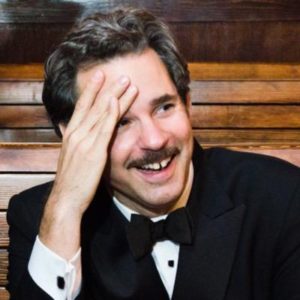
On stage with me were my co-host, Eugene Merman, comedians, Kristen Schaal and Paul F.
Tompkins, and the actor, Will Wheaton.
So when I was a kid and I was working on Star Trek, LeVar Burton and I were the only two original next-gen cast members who were very proud out of the closet Star Trek fans.
Nobody else really knew the show like we did.
I did things like when I was flying the spaceship, you know, like you do.
It was, the buttons that we had didn't really do anything.
It's kind of a...
Really?
But I invented a series of buttons, and this particular series made the ship go to warp speed.
This particular series of buttons put us into standard orbit.
Nobody knew it, nobody cared about it, but it was very important to me.
Well, it probably showed in your face.
Maybe.
Like you're acting.
The Robert De Niro space shuttle button pushing.
I wrote a book about it that nobody wanted to buy.
One of the things that I loved about Gene Roddenberry.
The creator of Star Trek.
He was a good friend of mine when we were working on the show.
I'm sort of a mentor to me.
And the secular humanism of Star Trek informed 100% of my morality in my worldview.
And one of the great features of the show was the storytelling captured social cultural issues.
Well, a way where, oh, it's just science fiction, but in fact, it was pointing directly back to us.
And what you were saying about like all those telescopes that we've made and the things that we can observe in the universe.
I've done a number of educational short videos for the Spitzer Space Telescope program at Caltech.
And it's awesome.
The things that that telescope can see are mind-blowing.
And when you're talking about that.
Spitzer telescope is tuned for the infrared.
So a whole telescope orbiting like Hubble is orbiting, except it's checking the universe out in infrared, which enables you to see deep into otherwise opaque gas clouds, revealing the birth of stars and planets within.
So wear a robe around the house.
So when we talk about those things that we have done, the things that science has done, those things that human beings have done just through the application of knowledge, I think, yeah, we did that.
We sat down as a species and we decided we want to know these things, we want to understand these things, and we will develop and build instruments that let us do that.
And one of the things Gene Roddenberry used to say was, there is no limit to what mankind can do when we just sort of work together.
And the only time I ever saw Gene get angry, we were at a convention and someone was going on and on about the face on Mars and pyramids on Mars and just a bunch of stuff that was like pseudoscience.
And aliens came to earth and aliens built the pyramids.
And Gene was like, no, they didn't.
Human beings built the pyramids, we did that.
And he was incensed.
Being a geek doesn't necessarily have to mean that you're a geek for a thing.
Being a geek is how you love that thing that you care about.
It's a state of mind, it's a state of mind towards a subject.
Yes, absolutely.
And one of the things that really drove this home for me was a friend of mine was at a movie theater in Los Angeles when the Sex and the City movie came out.
And he went to, and just relax, so he went to see a different movie when that movie was coming out.
So when we go to the opening of like an Iron Man movie, some of us might dress up in appropriate costumes.
And when we went to see Serenity, some of us may have gone wearing our Jane hats.
I mean, something like that may have happened, and it might have been me.
So you're one of these guys online that reporters go up to and interview so that everyone else can laugh at you.
They probably don't go up to me because-
And they ask you when was the last time you had sex.
Right, yeah.
You're one of those people in the line.
I'm generally not one of those guys, but you raise a very valid point, and it infuriates me about the popular media.
What is this news show where they're asking people when was the last time they had sex?
Popular media will go past 600 interesting people with families, and they'll go past all of them, and they'll find the one weirdo.
You get enough people together, there's gonna be a weirdo.
It's called entertainment.
I don't wanna hear the regular dad say he's excited about the movie.
But they give this impression that if you like science fiction, you don't know how to talk to people.
If you like gaming, you can't make eye contact with people.
And it's just completely unfair, and it's completely wrong.
So when I go to those movies, I like to dress up because I know that my tribe will be there.
And that is a way that we enjoy the movie.
So my friend Shane was at a movie theater when Sex and the City movie came out, and there were all these women dressed up as the characters from Sex and the City, and they were drinking Cosmos.
So they were Sex and the City geeks.
They were Sex and the City geeks.
And it was this real epiphany for me.
You don't have to be a geek for something that is completely outside of the mainstream.
You can be super geeky for something that, like Sex and the City, that from our perspective, Our correct perspective.
Of course, yeah.
You know, it's like, wow, that's lame.
Welcome back to StarTalk Radio, I'm Neil deGrasse Tyson.
In this, our annual time capsule show, we're replaying audience favorites from our third season.
In this segment, we revisit one of our live shows at the Bell House in Brooklyn, New York.
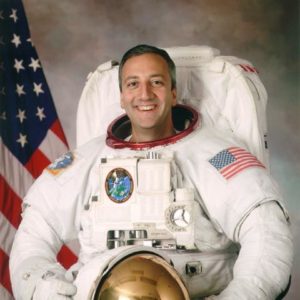
Our featured guest that evening was NASA astronaut and Hubble repair guy, Mike Massimino.
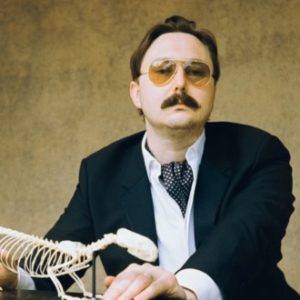
Helping me grill him about life in space were the comedians Eugene Merman, Kristen Schaal, and none other than John Hodgman.
So let me ask you, Mike, with this icon image of the right stuff, did you have to do all the things that we saw that the astronauts did in the movie The Right Stuff?
Did you have to?
Did you have an enema and everything?
Yeah, what did you have to go through to become an astronaut?
The enema question is about when.
Earlier this evening.
I don't remember the right stuff that clearly.
Oh yeah, enemas every day.
I may be thinking of the wrong movie.
So what do they make you do?
Did you have to like, did you need desert training?
And you have to eat salamanders?
Like what did you have to do?
No, we didn't.
Because that's the only food in space.
We don't really know what you're gonna find up there.
But we have a feeling it might be salamanders.
Reptilian.
And hallucinogenic mushrooms.
So we're going to put you in a sweat lodge.
I would imagine for you to actually come to the decision, I am going to seriously pursue a career in astronauting.
Astronauting was a big decision.
How old were you when you made it?
The for reals.
Not the like.
The for real like I want to pursue this.
I was about 21 years old.
And what was your background at that point?
You had gone to college.
I was, actually I saw the movie The Right Stuff.
My wife is here.
She saw it with me.
She can attest to that.
It's like.
We were, yeah.
And that got me thinking again about what I wanted to do with my life.
And I was a senior in college at that point.
And I decided to.
What were you studying?
Literary theory.
What?
I can't, what is this guy talking about?
I didn't go to Yale.
Actually, I think this is why I became an astronaut.
Because the English stuff I couldn't handle.
I don't even understand what he's saying.
And I think he's speaking English.
So I like the math better than I did the English stuff.
I need a dictionary.
Mike became an astronaut in order to get as far away as possible from you nerds.
What were you studying in college, sir?
I was an industrial engineering student.
Okay, and you decided that you wanted to be an astronaut.
And so you...
It's a strange career path to pursue.
And you realize that it's probably not going to happen.
Because lots of people apply and very few are lucky enough to get selected.
But you figure, let me give it a try.
So were you aware at the time of the dangers you might face?
Because I think when they tell little kids, do you want to be an astronaut, they're not thinking I could get hit by an asteroid or a micrometeoroid that will blow a hole through me or that radiation from the sun will sterilize my gonads.
This is not in...
I never knew any of that.
Now they tell me.
As a father, I say that to my children all the time.
So you're up there space walking.
I did a whole segment for Nova on micrometeoroids going 18,000 miles an hour.
And something this size going 18,000 miles an hour will put a hole through you like it's nobody's business.
So were you thinking about this at the time?
No.
How likely or common is something like that?
Are you just trying to retro freak him out?
Or is that like a real thing that's like you're prepared for?
I'm glad I'm hearing about this on the ground.
But even at the Hubble Space Telescope, when we got there, the antenna dish, for example, one of the high gain antennas, has a hole in it.
What's that?
Was there a lot of graffiti on it?
Graffiti, yeah.
Alien graffiti, right?
No, that's secret.
I can't tell you about the graffiti.
But I know it had a hole in it.
It had a hole in it, John, about the size of a quarter.
How do you concentrate on fixing the Hubble when Earth is going by?
When at 17,200 miles an hour sideways, you get how many sunrises in a day?
16.
So, 16.
Yay!
Six.
Sunrise, sunset, light.
Star.
Sounds very romantic.
Sweet.
Cold.
And you have to be the repairman.
How does that work?
You really have to try to focus.
And not look around like, oh jeez, look, there goes Madagascar, and there goes the telescope.
You know, there goes your tool.
You're not allowed to look?
No, you are, but you have to pick your moments.
So, my first space walk, I didn't look around very much, but my second space walk I did.
And looking at the planet is what you really remember.
But you have to also get your job done, so you have to pick your moments.
Is it beautiful or what?
It's the most beautiful thing I've ever seen.
That's the stupidest question I have ever heard in my life.
Oh, it was ugly, my gosh.
Earth from.
He might have said it's the second most beautiful thing, maybe as children, he'd be like, it's the fourth most beautiful thing.
Thanks for listening to our best of time capsule show.
Hope you've enjoyed this past hour.
And if you'd like to hear it again or listen to any of the shows featured within it or any other show we've aired in the past several years, just visit our website, startalkradio.net.
See the full transcript



 Unlock with Patreon





 Become a Patron