Continuing with our Let’s Make America Smart Again series, Neil deGrasse Tyson, comic co-host Chuck Nice, and astronomer David Helfand are here to sift through the data and help you stay scientifically literate in the misinformation age. David discusses the “absent curation” of daily data and how the creation of search engines was helpful but also created more intricate problems. You’ll hear about science browsers and filters, why science might be too successful, and David’s top three tools you can use to sift through misinformation. David describes teaching at Quest University Canada, where he allowed students to “construct knowledge” instead of feeding them a constant stream of information. Discover more about the “reproducibility crisis” in the science community. Learn about the role that scientists play in the age of misinformation and about the many biases scientists can be exposed to – and persuaded by – during their research. Explore why the democratization of information is good overall but comes with baggage and responsibility. Dive into David’s book, A Survival Guide to the Misinformation Age: Scientific Habits of Mind. All that, plus, Neil and company answer fan-submitted Cosmic Queries about a variety of topics including the Dark Ages, dark matter, a global space agency, the correct definition of a fact, dealing with the anti-science culture, and using social media to confront alternative facts.
Transcript
DOWNLOAD SRT
Welcome to StarTalk, your place in the universe where science and pop culture collide. StarTalk begins right now. Welcome to StarTalk Radio. I'm your host, Neil deGrasse Tyson, your personal astrophysicist. And joining me is my co-host today, professional comedian,...
Welcome to StarTalk, your place in the universe where science and pop culture collide.
StarTalk begins right now.
Welcome to StarTalk Radio.
I'm your host, Neil deGrasse Tyson, your personal astrophysicist.
And joining me is my co-host today, professional comedian, StarTalk veteran, Chuck Nice.
Hey, Neil.
You're still tweeting at Chuck Nice Comic.
That's right, sir, at Chuck Nice Comic, thank you.
Someone else take Chuck Nice?
Actually, yes, a guy who has eight followers.
Believe me, I've looked him up.
He's got like eight followers, and he took my name, and there's nothing you can do about it.
He's sitting on it.
That's tough, that's tough.
Today's show is gonna be all about science literacy in the misinformation age.
And once again, I never do this alone.
I find, I comb the universe, finding people whose expertise can not only supplement this topic, but become the topic itself.
And we've got with us in studio, Professor David Helfand.
He's actually a colleague of mine, a fellow astrophysicist.
In fact, he was chairman of Columbia's astronomy department when I entered as a graduate student.
Wow.
So he and I go way back.
It's like your boss.
And so he's got this book, A Survival Guide to the Misinformation Age.
Wow.
That's this.
I mean, could there be anything more relevant at this particular time?
Hence my blurb.
Okay, read it now.
The future of civilization may depend on it.
Can I get a little more urgent than that?
Are we okay with that?
David, welcome to StarTalk.
Yeah, it's a pleasure to be here, Neil.
And in all fairness, David, even though we just made those statements about the timeliness of the book, you were a bit foretelling because this, you wrote last year, right?
Couple years ago.
Couple years ago.
It came out a year ago this week.
It came out a year ago this week, but you actually wrote it a couple years.
So are you, like, you got a third eye or something?
It was building, you know, it was building.
It's not just this.
You saw the writing on the wall.
It's a big step up in the last couple months, but I think it's been building for a while, yeah.
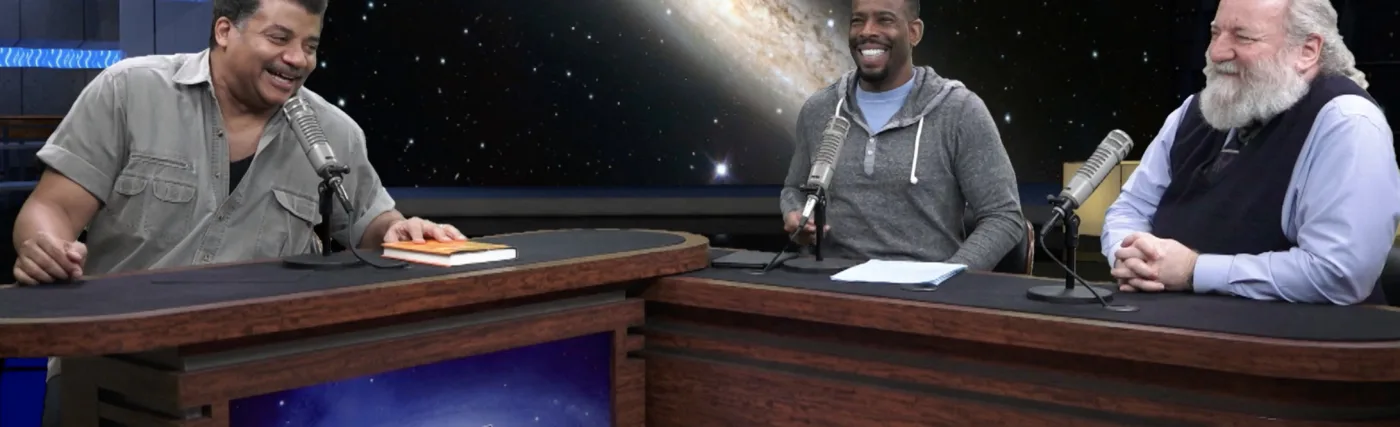
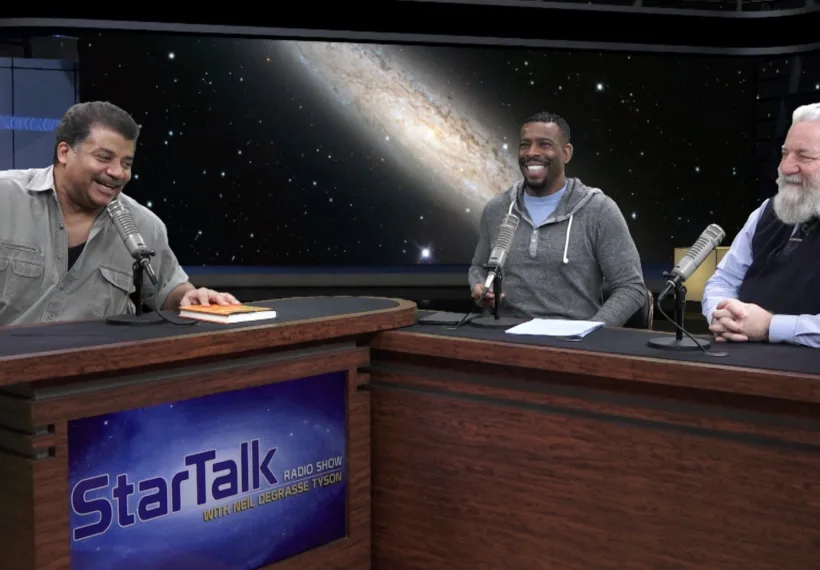
And just for those who are only listening to this, David Helfand has a Santa Claus beard and mustache, just to be clear.
It is cool, though.
Yeah, I just keep, you want to muscle up to him.
In December, you must get so much.
And he smells good.
TSA guys always say, do you work in malls?
No, I work in the North Pole.
So, David, how do you characterize?
Are there some signs that you point to and say, here is the best example of this age that we've just entered?
Well, the first problem with this age is the amount of information or misinformation.
IBM estimated recently that we generate about 2.5 quintillion bytes of information per day on Earth.
And if you're not used to quintillion, you are, Neil, I'm sure.
That's 2.5.
Love me some quintillion.
Followed by 18 zeros.
And if you printed it out, it would fill a bookcase that stretched around the Earth of the equator and was half a kilometer high.
If you printed out that information that was generated per day.
That's 185,000 pages per person per day.
But is it meaningful information?
Well, did you edit 185,000 pages per day that you produced?
No.
So that's part of the problem there.
Uh-huh.
And.
So it's absent curation.
It's completely absent curation.
When we were living in hunter-gatherer groups, there were 30 people, information was very limited.
We didn't have a lot of libraries and stuff.
But it was accurate.
Because if you were the guy who led the hunting party to the hungry lions instead of the zebras, you know, you didn't.
You never came back.
You eliminated from the gene pool really fast.
Right.
But now.
You'd be the stupid gene.
Exactly.
But now.
Oh, those were the days, weren't they?
Now, if you don't know who you're propagating information to, you just send it out to millions of people, right?
You do it all the time.
Millions.
And if you don't know those people, then you have no investment in their survival.
And so if misinformation enhances your fame or power or wealth or something, or if you're a politician, your fame and power and wealth, then why not provide misinformation?
Regardless of its impact on those who receive the information.
Because you don't know them.
OK, so this is what you're saying is, we are victims of something that was quite useful in the past and now has, in a way, become our enemy.
That's right.
Our evolutionary enemy.
Sort of like fat.
I did not expect him to say that in that moment.
That's a great answer.
But it's true.
It's completely true.
It really does.
Yeah, yeah, fat was like holy.
It's like high density calorie survival.
It was your friend.
So David, so it's a survival guide.
So is this the beginning of a movement to recognize, yes, there is this information.
It's not going to go away.
So now, here's a recipe how to sift through it and make sense of it and judge what is and what is not true.
Wow, precisely, because you know, your browser is not going to do that for you.
When you Google something, it just spits back whatever is out there.
Why can't it?
Well, that's an interesting question.
Why doesn't it might be the question?
Can I give just a fast reference to this?
Before browsers, John Alan Palos, he's a friend and mathematician, I heard him once say, and this is before the era of search engines, he said, the internet is great.
The problem is all the books are scattered on the floor.
At that time, you didn't know how to access information filtered by your interest.
Now we have search engines, that's not a problem anymore.
You can sift through it, billions of pages in a fraction of a second, and it's handed to you on a silver platter.
And who would have thought that that created this next level of challenge that perhaps we need some next level browser to handle for us?
Is it on the horizon or not?
Well, I don't know, it would be a challenge to write one, I think, now of course everybody assumes the filters that are put on by various internet companies are all politically motivated.
We need one that's science motivated, I think.
Ooh, a science filter or a science browser.
No, no, what you really mean is a bullshit filter.
That's what you mean.
I think really that's what you were thinking.
Yeah, yeah, it's a bullshit detector.
But that's what the browser could do.
I think you still have to have some judgment involved in how to assess the evidence.
And that's what the book tries to do.
It tries to give you those tools, like I say, it installs those apps in here.
Give me top three tools.
Top three tools.
First is being able to make estimates.
Just using simple arithmetic, being able to estimate whether something makes sense or not.
Almost every day in the established media, the gray lady even, there are mistakes by a factor of a thousand, by a factor of a million, you know, and no one pays any attention because they don't notice it.
You don't even know how to think about it.
I don't care what you say.
There were millions of people there.
Okay, so that would be a failure of an estimate in that case.
Second filter is having some idea of the way the physical world works.
I mean, the problem is that we live in an age of magic, right?
Arthur C.
Clarke said, any sufficiently advanced technology is indistinguishable from magic.
One of his edicts, yes.
One of his third law, I believe.
So what do we live in?
We live in this world with this little box on the car and it speaks to you and it knows exactly where you are at all times.
It knows where grandma lives and when to make a left.
It knows where grandma lives and how to get there, right?
So why shouldn't talking to your dead relatives be reasonable?
You know, and this guy shines a little light in your eye for 30 seconds.
You don't need glasses anymore.
Why shouldn't magnets cure your arthritis, you know?
So it's all just magic.
And in a world of magic, who knows about magic?
You know, astrologers, psychics, homeopaths, you know.
Does this mean science has been a little too successful?
Well, it's too successful in the sense that it's changed things too fast.
Too fast for us to be able to adapt.
So what you're saying in essence is in order for us to actually understand science the way we should, we have to create a society filled with little scientists.
Like we all have to be science literate.
We all have to be scientists in some way, shape or form.
And we all are until we're about five or six years old, right?
Right, right.
So we have to go exploring around and...
But David, I don't want to...
OK, so I try to evaluate every statement I make, hoping that I never make a statement that betrays some kind of old man on the porch point of view.
You mean you've never tweeted, you kids get off my lawn?
You kids go play where you live?
I don't want to be that old man.
And so you just said, yeah, discoveries are happening too quickly for us.
Let me perhaps get you out of the old man syndrome and say maybe it's not that discoveries are happening too quickly because my kids are not complaining about being overwhelmed by data.
It's older folk who come from an era where there wasn't that much data.
Maybe what you want to say is we need tandem educational curricula so that we understand how the world works rather than just be fed volumes of science information thinking that's what makes you scientifically literate.
When the real source of science literacy is not what you know but how you think about the world.
Is that fair?
That's exactly right.
So the whole model of education as information transfer makes no sense.
Makes no sense.
And you've thought about this.
You founded, you co-founded a university, a brand new university in Canada and I hear you're at it again in some other place.
Where?
In the UK?
Just tell me what you, because you didn't just come out of nowhere, out of a cave to say this.
You put, you, you, you did it.
What did you do?
And are you being sued by the New York Attorney General?
No, go ahead.
That's the other guy.
Well, yes.
So the idea is instead of feeding people information, you have them construct knowledge.
Construct their own knowledge out of what they know and a little bit of guidance shoving them down a path takes much longer.
Much harder.
It's much harder.
It takes much longer.
It doesn't matter if you don't have to transfer all this information because it's all there.
Much longer and harder.
I'm going to take you up on that because I'm not sure if I understand what you mean when you say construct your own knowledge.
I'll give you a good example.
We're strong.
We can talk about astronomy.
Yeah.
Yeah, of course.
Yeah.
So when we discovered all these planets around other stars, and that's so planets, so planets, it's amazing.
Yes, it is.20 years ago, we knew no planets except ours, and now we know it.
So how do we do that?
Well, we have to know how planets move.
So Kepler figured this out in 1610, you know, figured out how planets move.
He wrote down three laws of planetary motion.
So at Columbia, I go to Blackboard, I write down the three laws of planetary motion, and my students all copy them down, even though it's sitting in the $150 textbook next to them.
But they write it down.
And then I say, how long does it take the Earth to go around the sun?
And they sort of look at me, and finally someone says, a year?
And I say, well, let's see if that works.
And we plug in the numbers of the period and the semi major axis of the eclipse.
And they write all that down.
And then you send them home and they do it for how long it takes Mars to go around the sun.
Right.
And you know, then on the test, you make it real tricky.
You say, how long to take Europa to go around Jupiter?
You know, and they figure out to change the mass.
But they get their A's and they go away and they're happy.
That's just feeding information to people.
All right.
So that takes 20 minutes.
At Quest, Quest is the name of the university.
In Canada, right.
It's three hour classes, five days a week, three hours a day.
I walk into class.
I give them this little simulation about planets going around other stars.
It's got 15 parameters.
They don't know what any of them are.
Okay.
I give them a sheet of a few questions to say, well, see what this, see what happens if you change this and keep this one fixed.
Figure out what this I means here.
And then I let them play.
Got you.
And three and a half hours later, they stayed a half hour after class, someone got up and wrote down Kepler's Three Laws.
I never mentioned Kepler.
I never mentioned Three Laws.
That's, they had constructed that's freaking amazing.
So therefore, they will not be susceptible to being handed information by others.
That's right.
Now they won't remember Kepler's Laws.
I don't remember Kepler.
You remember Kepler's Laws?
The process matters.
But the process matters.
They remember you can look at information.
You can look for patterns in it.
You can cast those patterns in a mathematical form and you can use that to predict the way something else behaves.
And that's all you want them to know.
And that's the testing and those are tools, that's a toolkit for learning how the world works.
And you can probably construct one for biology and chemistry.
And the reason is because you already know how the world works.
That helps.
Right.
But what it does is it, I don't put words in David's mouth, but what it does is since David already knows how the world works, he knows that the world can be figured out from this set of parameters he puts down on a table.
And so there's a lot that someone knows about how the world works.
Way more than many people would even recognize is the level.
It's amazing.
So that was two.
So you got a third one or did we go through three already?
I don't know.
I can't count that.
Okay.
So one is estimates.
Estimations.
Two is knowing how the world works.
Knowing how the world works.
Three.
Oh, well, I have a bunch of probability and statistics.
Oh, nice.
Well, we need that.
We're getting an idea that whether something's likely or not likely, recognizing that the plural of anecdote is not data, that something happens to you, it doesn't mean that it's highly significant.
I'm sorry.
You just, you sent a chill down my back because I got to tell you, that is the thing right now that it seems as though anecdotal evidence seems to be taken as fact for so many people.
And I don't get it.
It's like, yeah, dude, that happened to you.
There's another, one of the cleanest examples of this I remember was back in the day when Japanese cars were much safe, much more reliable than American cars.
So here you are, you're ready to buy a Honda Accord because Consumer Reports highly rates it.
And it hardly ever fails on the road and the like.
And someone walks out of the dealership and looking frustrated and you say, well, what's the matter?
Well, I just returned my Honda Accord.
It was awful.
I said, what happened?
Oh, it's the worst car I've ever driven.
It broke three miles down the thing.
And then you decide to not buy the Honda Accord because of this one person, not the volume of data from Consumer Reports.
By the way, they made seven million other cars that year.
Not sure if that matters.
Probably evolutionary as well.
The passion of your friend.
Your own experience.
I mean, the tiger chases you up the tree, that gets lodged in your amygdala there.
That's something that's going to trigger a response all the time.
And it happened to you.
And then it probably mattered.
But when you walk into the subway, and well, that's an example I use in the book.
So I was going out to see my mother-in-law in Staten Island.
And I got on the train, and the train went a few stops, then it stopped.
And someone had fallen under the tracks.
And so I think, gee, how often does that happen in New York?
You know, so I later looked it up, but.
I have never seen it happen.
Yeah, right, right.
That's how I've actually caused it to happen.
No.
Shut up.
Coming back the same weekend, it happened again.
Oh.
Calculate the odds in the books, 22 million to one.
So if you're on a jury, and I'm charged with killing two people by showing in front of the subway, because it happened 22 million to one against, you'd vote to convict, right?
But I had nothing to do with it, because it's a completely random occurrence.
Happens 40 times a year out of billions.
It's a billion people ride the subway.
Right.
So it's one of the safest things you can do.
A billion paying customers.
Paying customers, yeah.
Billion fares.
That's amazing, though.
But you're right.
It's probably the safest thing you could do statistically with respect to that anecdote.
Well, that's amazing.
Well, this is, in fact, a Cosmic Query version of StarTalk, which we will begin to solicit from Chuck.
Yes.
We got him there waiting for us after this commercial break, when we come back to StarTalk.
We're back on StarTalk.
I'm Neil deGrasse Tyson, your personal astrophysicist.
I'm here with Chuck Nice.
Yes.
Meet a co-host.
That's correct, sir.
And I've got in studio, not only a friend and astrophysics colleague, he's written a book on science literacy called A Survival Guide to the Misinformation Age, David Helfand, Professor David Helfand.
Great to have you on the show.
Great to be here.
All right, so let's go right back into the conversation.
We have cosmic queries.
Yes, we do.
And by the way, this is the second installment of Cosmic Queries Let's Make America Smart Again.
Again, yes.
It's a subcategory of cosmic queries.
Absolutely.
So let's do it.
Give it to me.
And of course, we always, first of all, we get them from all over.
So whenever you see the call go out, make sure you answer it, whether it's on Twitter or Facebook or what have you.
But we also take questions from our Patreon patrons first.
You know, that's so cheap.
People give you money.
Well, give us money.
I will never get on your case every time you say it.
I know Neil doesn't like it, but I think it's great.
Give us money, we'll read your question first.
We'll read your question first.
I think it's so American.
I can't argue that.
There we go.
All right, let's start off with Mark Miller from Patreon who says this, in a world of alternative facts, would taking the social media to confront the source of the quote unquote alternative facts be at all constructive or helpful?
And Mark is coming to us from Halifax, Nova Scotia.
Yeah, it's just that my sense is it's not that there's a false fact because someone happened to get it wrong.
That there are false facts is because that's how they want it to be true.
And if you actively want a false fact to be true, I wonder, does your book have any access to that mind at all?
Yeah, that's a good question.
It's, I mean, social media is designed to construct echo chambers, right?
So all of your beliefs are reinforced.
Right, as does a Google search.
You can Google search the most, the weirdest non-true thing and you'll find the website dedicated to that.
Yeah, well, I say in the book, if you do a Google search on age of the earth, radioactive dating, some ninth grader might get assigned that topic, right?
Six of the first 10 things that come up prove that radioactivity is nonsense and the earth is 10,000 years old.
Really?
And a Google, are you trying it now?
I'm sorry, I'm trying it right now, okay?
Okay, so therefore, having correct information in the face of misinformation clearly doesn't work.
It's a problem, it's a problem.
Well, I don't have you on the show to tell me it's a problem.
I have you on the show to tell me how to solve it.
The solution is changing the education system.
The education, so you have to give up on the...
Holy, sorry.
I'm actually doing what David said.
I cannot believe the crap that is coming up on Google right now.
This is unbelievable.
No scientific method can prove the age of the earth and the universe, and that includes the ones that are listed here.
Holy crap, you're allowed to say that.
Yeah.
So the...
It's a free country.
Yeah, the democratization of information is good.
It just comes with this big baggage.
With a responsibility.
Holy crap, many different measurable processes are used to, oh my God.
And it's all, I don't even want to say where the sources are from, because I don't even want to get into that, but this is.
I don't want to advertise them.
So what you have to do, it seems, is everyone else is a goner.
You've got to then change the educational curricula.
You've got to change the philosophy behind education, that it's no longer transfer of information, it's teaching kids how to keep their curiosity, first of all, so they question everything.
They do that for free.
They do that for free.
When they're young enough.
When they're young enough, we beat it out of them, right?
And then learn how to construct knowledge for themselves so they can use these tools.
I call them the little apps to install in your prefrontal cortex that filter this information in a way that says, gee, does that make any sense?
Can I figure out if that makes sense?
I love that.
So what do you do when you're confronted with, with, I should call them worldviews, what should we call it?
I would say political bias for the most part.
Well, yeah, but they wouldn't think they're biased when you're in it, so I don't wanna call it that.
And Echo Chamber has been bandied about, but then that's almost still too self-aware.
I know what you're saying.
What do you call it from the perspective of the person who actually believes it?
Okay, so, yeah, exactly, so it would just be, what is your cultural, political, religious philosophy?
There it is, and if that conflicts with fact, with objectively true facts, it just doesn't matter to people.
Well, that's right, but if you work at it, you can get people, usually, to agree on a few facts.
Mm-hmm.
They, you know, like the facts.
Like Earth is round, that's been a hard one lately.
That's been a hard one, but, you know, so, you're airing this room.
Should we just give up?
This is the last episode of StarTalk.
It's getting so depressing.
Okay, David, here, take your book.
And that was the day science died.
Chuck, I'm buying.
Are you ready?
You ready to go to the bar?
I'm gonna go drink it right now, baby.
Oh.
Okay, all right, um, Dave, sorry we interrupted, go on.
Good, you're bumming me out here, but go on.
I'm thinking we're making progress.
We got our own bubble.
We think we're making progress in our own bubble.
We read our feeds and people are you doing a good job?
You know, attaboy, you know, and we say, hey, and then you come at us with this and you gotta go look, you gotta Google the damn age of the universe.
I'm sorry that I did that, I gotta tell ya.
I had no idea.
It's never been the case that the entire global population, all 7.4 billion of these homo sapiens understood everything about the universe, right?
I mean, that's never been the case.
The problem now, we're in the death of expertise, right?
I mean, expertise is elite and elite is evil and therefore we have to abolish all of that.
By the way, I blame some of that on Scientists.
Yeah, on the elite, the intellectually elite, because I think there's an attitude involved that others are just not with them and how could they possibly even want to vote for someone who the elite does not vote for?
And I think it came back and bit them in the ass.
No, that's exactly right.
And scientists are also responsible.
I mean, the level of hype that goes out with press releases when you publish some paper is completely out of proportion to the result.
You'd see the reproducibility crisis and-
I mean, about the reproducibility crisis.
All right, so in-
And now, by the way, now you're talking about a problem in the scientific community.
Oh, let the public alone for the moment.
Let's just mind our own house.
Okay, go.
So, Amgen, some years ago, did a study-
This is the bi-
The pharmaceutical-
The biochemical company.
Right.
And they took 53 studies that were not just published in peer-reviewed journals.
This was on cancer, for cancer, looking for cancer drugs.
53 studies, not just published, but highlighted in the editorials of the issue of the journal they were in as potential major breakthroughs.
And they put a whole bunch of people on it and put a whole bunch of money in it, tried to reproduce them.
89% of those studies were irreproducible.
That's bad.
That's bad.
I'm gonna say that's not a good number.
So just to be clear for people to know it, how when a scientist uses the word irreproducible, that doesn't mean they couldn't figure out the experiment.
It means they did the experiment, did not get the same results.
That's what irreproducible means.
And so if you don't get the same result, then one is wrong and the other is right, the other is wrong, the other is right, or they're both wrong.
But they both can't be right.
That's right.
And so this is a problem.
This is a problem.
Just recently, a very energetic psychologist rounded up a couple hundred of his colleagues and tried to reproduce a hundred and some, I forget how many, there were experiments that had been published in behavioral psychology.
You know, of order, half of them could not be reproduced.
Half of them couldn't be reproduced.
So.
What is this attributable to?
I mean, is it a matter of-
Wait, wait, wait, just to be clear.
Just to be clear, and David will round this out, but I just want to be clear.
There is no requirement, cosmic requirement, that your research will ultimately be shown to be correct.
Okay.
Most research is shown to be either unimportant or uninteresting or sometimes wrong.
Right.
There's no wrongdoing there, but when you want to assert a new emergent scientific truth, you cannot link it to a single research result.
Gotcha.
Because we recognize as a community that we can have bias, we're human, like anybody else.
And I can have bias I didn't know about.
So now I get, I do an experiment, David comes in and says, well, you know, I love you, Neil, but let me just double check you.
And he gets a different result, finds out I made an error.
Or maybe we both made errors and you need a third person to come in and show that.
That happens too.
So you don't-
You can give your thesis.
That will not be broached in this.
So no, so we, so is there a solution here?
Because the ones highlighted by the editor at the beginning of the journal, this is good for the tenure prospects of potential researchers and it's self-feeding.
Exactly.
There's publication bias.
You get a negative result, you don't publish it because it's not interesting.
You get a positive result.
Well, if you do anything 20 times, you're likely to get one positive result that's with...
That's even not even true.
Not even true, right?
It's just on the statistical distribution.
Just the fluctuations.
One of them looks like what you wanted it to be.
And so that's what the publisher...
I like that.
Yeah.
Oh, that looks good.
Finally got there.
So that's the first problem.
The second problem is...
By the way, you know what that's called?
It's called the sharpshooter effect or the bullseye effect.
Where, so you fire arrows into the side of a barn.
Right.
And you look to where all the, where they collect it and then you draw a bullseye there.
I like this grouping here.
Paint the target.
Now look how good my aim was.
Yeah, okay, go on.
And then as you say, there's this pressure to get grants and so you have to produce positive results to get your next grant and you have to get grants because you have to get tenure and you have to get tenure by publishing in prestigious journals.
And there's no currency for duplicating someone else's result.
Well, of course, in the scientific method, there is, that's the ultimate way of showing something is more probable rather than less probable is how to reproduce.
And you should always publish the methods you use such that someone else could reproduce your results.
Let's see if you can put your money where your mouth is.
You were chairman of the astronomy department at Columbia for 20 years.
How many, some order, something like that, okay?
And you were there young.
You were chairman before you were 40.
So would you have tenured someone that devoted their career just to duplicating other people's research?
Well, interesting question.
I'm just calling you out.
I'm just, just keep it as Larry Wilmore would say, keep it 100.
So is it the fact that you guys have made that whole thing too sexy to begin with?
Well, as Neil knows, I refused to accept tenure when it was offered to me and I'm not a fan of the tenure system.
That's a whole other thing.
The man is an iconoclast.
It's gangster right there.
It's gangster, so gangster.
I'm just saying, that is academic gangster.
It's like, we give you tenure, no.
No need your stinking tenure.
Give me a five-year contract and only if I'm good after five years can we renew it.
Oh my God, you're like my wife in that she was like, you can leave me anytime you want.
There's one of us in this relationship that won't have a problem finding somebody else.
You should take a look in the mirror and find out who that is.
I would at least give you a five-year contract.
Awesome.
So you agree to this?
Yeah, so that's the challenge.
I mean, just simply reproducing someone else's results, no, reproducing them in a different way that comes at it from a slightly different tact that supports or refutes the result, sure.
But you don't know in advance if it's gonna refute.
I'm gonna commit five years of my life, it's a choice years of my life where I'm being reviewed for hiring and for tenure.
And I say these three research results are spot on.
Now give me tenure.
I'm last in your line of hires.
Well, you wouldn't be last in my line, but I agree that that's the general view, yes, that that is the general view in science.
Interesting.
So what it also means though, let me try to fix this.
If more than half of all research papers are not reproducible, that means this could be a new cottage industry.
It certainly could.
And in fact, what's been proposed in psychology, which I really like, is you have to publish your methods and your hypotheses and everything in advance.
Before you can do the experiment.
Because now we know your motivations.
We know where you're coming from.
All that is.
Your funders too.
Right, your funders.
It's all out on the table.
It's so transparent that you cannot, once you have your results, you cannot, you can no longer alter those results.
Every cherry picket.
And figure out or figure out.
You can't draw the bullseye where the arrows went.
That's right.
Exactly.
You already drew the bullseye.
Right, it's like somebody falling down the steps and going, I meant to do that.
They have to say, I mean to fall down the steps in this next.
Exactly, right.
Very good.
So in our field, there's also of course, bias from funding sources.
Which we are less susceptible to as astrophysicists.
Who's nobody's funding you, period.
That's why.
What'd you say astrophysicists?
Yeah, it's not like Pfizer doesn't care what the black hole space time continuum is doing.
Unless there's a big zit inside of it.
I got some zit for that black hole.
Sunspots, we can remove those.
Isn't that astrophysics?
No, that's, you know, clearasil.
So is there, so getting back to our own wheelhouse, our own community of scientists, the bias that would result from one source having some expectation, that's obviously stronger in other fields than in ours.
But in your survival guide to misinformation, the scientists are participants in the misinformation when you are biased by your funding sources.
That's certainly true.
I think in our field, it's really easy.
First of all, there is the record of the sky, right?
You can't, I mean, you can't mess with it.
Oh, yeah, yeah.
That's true.
So someone else can go look.
I just discovered a comment between here and here now.
And yeah, if it ain't there, it ain't there.
Right.
The other thing is we have these huge repositories where you take data, it goes in that repository.
Anybody else can go in there and look at that data.
That's the raw data.
That is true.
We don't, it's very hard to manipulate raw data.
It just comes out of the telescope, the detector, it goes in.
And we are, data is like gold to us.
It's public.
Right.
And that's an emergent fact about our field, that your raw data when it's publicly funded It's public all the time.
Goes public right off the bat.
You know, it sounds to me like that's the way it should just be though.
Yeah.
But otherwise, yeah, we don't know what are you doing with your data under the table?
Right.
Right.
We got it.
We got it.
We take a quick break.
When we come back, more of science literacy in the age of misinformation with my friend and colleague David Helfand, we'll have StarTalk continue.
We're back on StarTalk Radio.
We're talking about the science literacy and its relation to the misinformation age.
We've got this book written by David Helfand, published by Columbia University Press.
I got funny man Chuck Nice here.
Yes, sir.
All right, this is a Cosmic Queries.
Yes, it is.
With the subcategory of Cosmic Query, which we call Let's Make America Smart Again.
Absolutely.
And I have-
So would you give me another question?
I got a great question here from Rob Paul Davis coming to us from Facebook and he says this, I have a hard time accepting dark matter, utterly undetectable matter by direct means that cannot be any substance that we already know of.
What other possible alternatives are there to explain this supposed missing gravity?
So David, let me shape that question for you into your center there.
So you said earlier in the show there's crazy things that we as scientists are saying is true.
And then we chastise someone for thinking that crystals rubbing them together will heal them, which sounds way more possible than the existence of dark matter.
So where do you come at it with that?
So it's basically hard to believe science truths and false believable truths.
How about that?
I try to avoid the word truth when it comes to science.
Mathematicians can prove things true.
Scientists just make ever better approximations to the way the universe works.
So dark matter is a current approximation.
And it is detectable in that we can detect its gravitational influence on things that move around in it.
So we just can't see it with our eyes.
But seeing with our eyes is not the only way you can detect stuff.
It is a hypothesis.
And there are alternatives.
That is matter.
That is matter.
There are alternative hypotheses that Newton's laws or Einstein's laws of gravity on scales vastly greater than we can directly experience, are slightly different.
They must be a little tiny bit different.
And then that will explain the way stars move around instead of postulating that there's six times more dark matter than regular gravity.
Because what it fundamentally is, is an absolute, it's a it's a it's a dark gravity.
It's really what it should have been called, because that is an observational fact.
The fact that we call it dark matter is I don't even like using the term for that reason because it leads the listener.
Yeah, it makes you think that it's not.
That you've gone away from talking about gravity.
Right, right, right.
So you're still talking about gravity, no matter what.
It's still gravity, it's still timearily that.
So you have a way to get around that.
Because in your lectures, there would be a time when you say the whole universe once fit inside of a marble.
And why are we going to believe that at all?
How do you, where's the believability there?
Well, again, it's a model, right?
That's what we do.
We kill models of the way things work.
So we have a model that makes predictions.
Now, dark matter, you know, we've been going through various hypotheses.
Are they dead stars?
Are they missing runaway planets?
And we knock those off one at a time.
No, no, no.
Reliably, I would add, yes.
Reliably.
There are some things we haven't knocked off yet.
Are they little subatomic particles from some other part of the...
The particle zoo.
Particle zoo that we aren't familiar with yet.
People are working really hard, spend a lot of time and money and effort to try to find them.
And the over-under on that is that that's where people are leaning.
If you have to lean, if you're a betting scientist, you'd lean towards a new family of particles that don't interact with ours.
That's where the most money is being spent.
Right.
That direction.
And how much validity, which is not the right word, what kind of evidence is showing us that that may be where we need to continue the search?
Again, it's what we keep eliminating.
So we've eliminated huge numbers of these fantastical subatomic particles.
It can't fit the bill.
So we narrow and narrow and narrow.
If we shrink it all the way down to zero, like there's no phase space left, there's no possible range of masses and energies and things for these particles, well, then we've eliminated that as a possibility.
We have to think a little harder.
So that's basically how we roll on that, when it's done sensibly and with a directed mission statement.
So, yeah, I mean, I like the idea when you say it's a model because what we're describing fits the data available to us.
Right.
Or it is not violated in the absence of data yet.
Right.
Right.
So all of this, it's this contest on the frontier of knowledge.
Exactly.
Goes on every day.
So what Rob should know is that this is an ongoing process.
Ongoing process.
No one is saying definitively this is the deal.
What we're saying is in our best knowledge, this is where we are now.
And I'd like David's second opinion on this.
I would say that no longer is science reporting in the news a major weak point in this problem.
And I've seen there's hugely talented science reporters out there that by and large get it right, or they get it right enough so that they're not the ones that we can point to in this.
But a little last peeve I have is when they say, oh, this new discovery about dark matter could send scientists back to the drawing board.
It's like, no, we are always at the drawing board.
If you were not at the drawing board, you were not on the frontier.
It's not like you went, dark matter, my tie's for everyone.
Let's hit the pool.
Right.
Yeah, no, no, no, no.
You know, just go, go, yeah.
I got you.
All right, cool.
Another one.
Give me one.
Give it to me.
Let's move on to Christopher Lean.
And Christopher says this.
Fact, colon, a noun, thing that is indisputably the case.
Maybe we should stop calling things that are disputable facts.
So I think his, his point in this is there's a lot of fact talk being bandied about, about things that maybe are not facts indeed.
So, in science is a fact something that is indisputable in the case.
Let me hear from you David.
How do you deal with?
I have a definition of a fact that I use in my talks on climate change, for example.
A fact is a measurement of some physical quantity done with the best available equipment, vetted through skeptical review and provisional with an uncertainty associated with it.
All right.
Damn.
So wait, wait.
So Chuck is sitting to my left.
Is that a fact?
That is a fact because I can measure that picture of it, right?
Or it's left depends on the point of view.
Right.
To my left, I said.
Yes.
Yes.
Yes.
That's it.
No question.
There are three of us sitting here.
That's okay.
So measurement matters.
Measurement matters.
Measurement matters.
So it's not a fact.
If Jesus is my savior, that's a personal.
It's a very personal thing that you cannot measure by these tools.
So we so just don't even use whatever you want to call it.
You just don't use the word fact.
Right.
Right.
Right.
So I agree with.
Gotcha.
Good.
Ultra suede is amazing.
Fact.
Opinion.
Opinion.
All right.
Do you agree with the rather harsh, but I think mostly true statement, that after the laws of physics, everything else is opinion?
Well.
That's really.
It's audacious.
It's audacious.
Wow.
It depends how broad your definition of physics is.
I mean, I don't think it's physics of the three of us.
They're sitting here.
We can count up to three.
I mean, that's not really physics for yourself there, David.
No.
But if you're counting, you're not measuring.
That's an important distinction.
That's why there's no measurement error when you're counting.
Well.
This is not three plus or minus a half, right?
This is three exactly.
Yeah, but it's 67 million votes plus or minus a few hundred thousand because you can't count them perfectly, right?
So you're counting.
That case, right.
Right.
Okay.
That's it.
All right.
Here we go.
All right.
Keep it going.
Here we go.
This is Jeff Menier.
After this, we go to lightning round.
We go to the lightning round.
After this.
Jeff Menier, who says, with the US only representing 4.4 percent of the world's population, does trying to legislate climate really do any good?
Ooh.
How?
David.
Well, it's 4.4 percent.
Legislate climate in the United States.
No, he's talking about globally.
No, no, no.
He's saying if we do something.
If we do it, we're only 5 percent.
I thought he meant that because we're such an insignificant portion of the world's population, should we have the right to tell the world?
I don't think that's what he means.
I understand what you're saying.
You're saying he's saying, since we're such a small portion of the population, if we do something, will it make a difference?
Difference at all.
How about both of those questions?
Firstly, we produce 22 percent of the greenhouse gases, so that's by a factor of five.
There used to be a concept of American leadership in the world, used to be is the key word there.
And so, taking a leadership position would be addressing a problem which 99 point something percent of the scientific community is in consensus on.
Gotcha.
All right.
All right.
That makes sense.
So, we're going to go lightning round.
Okay, here we go.
So, this is where all answers must be in soundbite form, so we can get through as many questions as possible.
And this is reminiscent, David, of my PhD thesis defense you served on my committee.
And I give my most, you know, my best thesis defense.
And at the end, you said, okay, now how would you explain this to a reporter from the New York Times?
This is the last like two minutes of the thing.
And I'm deep in the stuff.
You know, I'm deep in the stuff.
And he's been requiring that of anyone to graduate from the Astro Department at Columbia.
So now, this is my version of this.
We went through the details.
Now can you turn it into a soundbite?
All right.
There's the bell.
Let's do it.
Go.
Oh, how the worm has turned.
William Fullerton from Facebook.
Is there any merit or a good idea of global space agency?
Science is almost internationally connected anyway on the planet, since space agencies all over the world are already collaborating on dozens of projects.
How long will it be eventually before we're able to do things like send people out of the solar system?
It's just like he wants a United Federation of Planets.
Yes, a United Federation of Planets.
I think it will be a long time and it will come about when the notion of a nation state disappears.
Now there's so much I want to talk about.
He hit that out of the park.
That was great.
That's very Einsteinian, by the way.
Einstein imagined a world government.
So Patrick Leo Beal says this, with reference to WF9, I know people are worried about it will hit the earth.
However, we won't see a close enough approach until December 2055.
And even if that is the case, close enough to do anything about January 2063, it comes real close.
What can we do and should we do about it now?
David, kill our asteroids.
Worry.
No, no, let me let me flesh that out.
I can't.
Okay, ready?
Let me finish a sentence.
Worry enough to put into play what we already know to do under that situation, but do not yet have the wisdom or the foresight to act.
All right.
Derek Seabourg wants to know this.
Seabourt wants to know this.
How much farther ahead would we be if the Dark Ages were avoided?
And do you think the Dark Ages are making a comeback?
David.
Dark Ages are definitely making a comeback.
But we wouldn't be any farther ahead because the Dark Ages were only in a little isolated part of the world that we used to worry about.
But other places at the same time were experiencing a wonderful flowering of intellectual passion.
Okay.
That's a good answer.
But let me come back at you.
We think of the Dark Ages as closing off the intellectual technological enlightenment of the Roman Empire.
So if the Roman Empire did not fall and their interest in architecture and engineering had continued, do you think that would have eventually fallen for some other reason or might that have still stuck with Europe?
Yeah, I think empires are designed to fall.
Man, David is kicking it.
I think history is on your side there.
Caden Cortina says this.
Since you're a professor, David, as a science teacher in a public school, how do I balance teaching inquiry and questioning without being politically correct about my students' beliefs?
Ooh, David.
Well, I think you have to separate beliefs from facts.
Facts and questioning is the critical component of that.
But if someone has a belief system that conflicts with facts as they emerge from the scientific community, then you are teaching something that is directly in the face of their beliefs.
Then what do you do?
Don't challenge their beliefs.
People's beliefs are, you know, that's really tough.
Just let them have their beliefs.
Belief is fine.
They go home, believe what they want.
We're going to do a little exercise now.
We're going to do exercise in the playground.
We're going to do exercise with our brains.
And we're going to see where this chain of logic leads us.
Time for one more.
Let's make it a good one.
Go.
All right.
Evan Mitchell wants to know this.
How should society, government, teachers deal with the anti-science folks or whatever you want to label them teaching these things to their children?
Listen, at home.
So I would imagine many of them too.
Old home schoolers is what he's talking about.
Or school boards that get influenced by their children.
I would imagine telling their children the things that their textbooks and teachers tell them are outright lies.
So what do you do?
Disinformation.
Forget misinformation.
Active disinformation.
Active disinformation.
By educators.
Go.
Again, I think you teach people to construct their own knowledge.
You don't pass them information, misinformation or disinformation.
You teach them how to construct their own knowledge and that will make them question those parents.
Wow.
Nice.
Love it.
David.
You killed it, dude.
Killed it.
You killed it.
David Helfand, special guest today.
Old friend, old professor.
Looks like Santa Claus if you don't see him on the thing.
You're going to have to subscribe to startalkallaccess.com and you can see what David looks like in the video version of this podcast.
The original version, so this closes out this edition of Cosmic Queries, which is a special subcategory called Let's Make America Smart Again.
Chuck Nice here is my co-host.
This is David Helfand's book, A Survival Guide to the Misinformation Age, published by Columbia University Press.
It's subtitled Scientific Habits of Mind.
He's on it.
He's in it because that's how he rolls.
David, thanks for being on the show.
And I hope it's not so long between now and the next time we see you.
All right.
I've been Neil deGrasse Tyson.
And as always, I bid you to keep looking up.
See the full transcript



 Unlock with Patreon
 Become a Patron