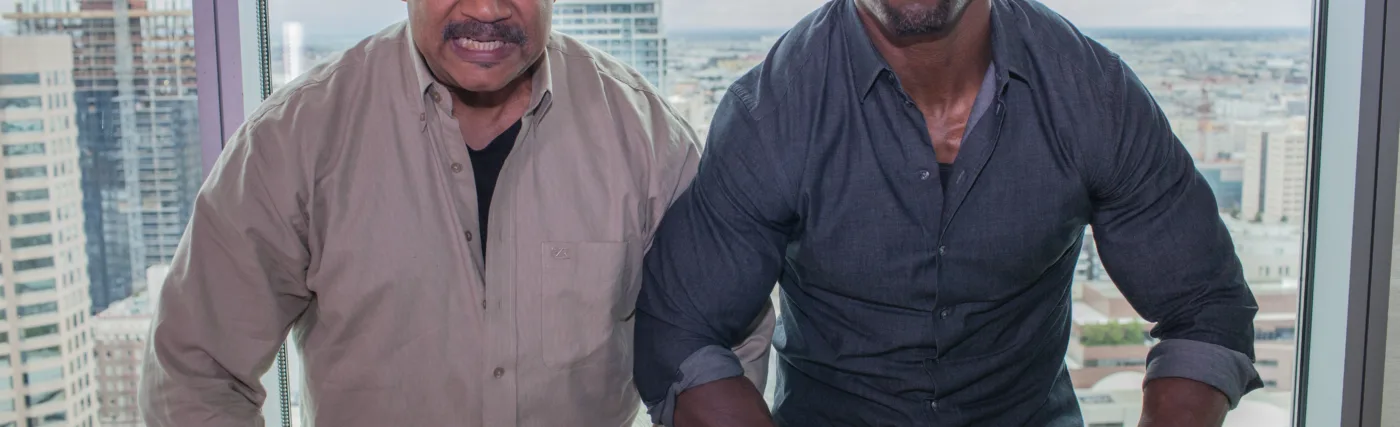
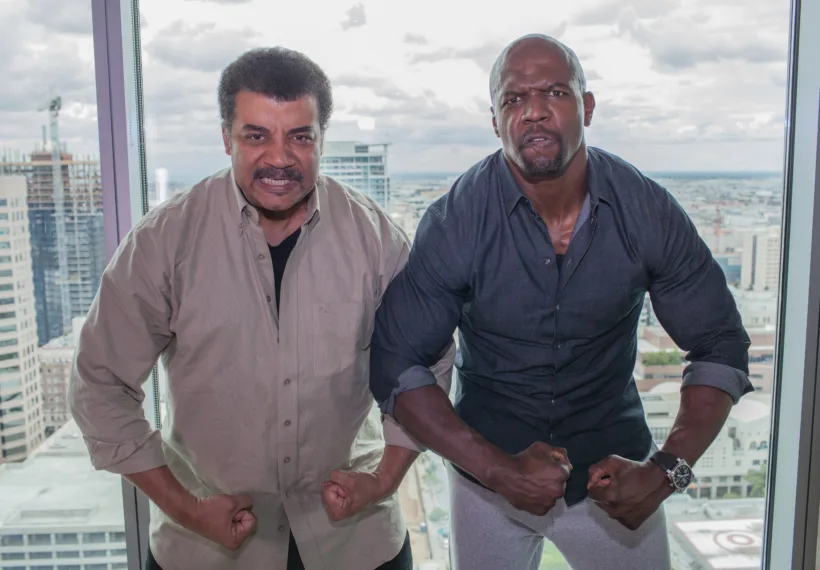
SEASON PREMIERE: It’s time to get pumped up when Neil deGrasse Tyson interviews former NFL star and actor Terry Crews about physical fitness, exercise, and more. Neil and Terry share personal stories about how fear drove each of them to pursue strength to protect themselves and others. In the studio, Neil and Chuck Nice team up with exercise physiologist Dr. Felicia Stoler to review the benefits of weightlifting and flexibility training. You’ll learn why it’s important to exercise every day – and why it’s critical to allow time off between working the same muscles. Explore the science of nutrition, including why the proportion of nutrients is far more important than the source, why people in “blue zones” live longer than New Yorkers, and why Neil says that at some level, a healthy diet is all about physics. Terry, a proud carnivore who maintains 4% body fat, jokes around with Neil about judgmental vegans, while Chuck reminds Neil about a few famous StarTalk guests who happen to be vegans: NJ Senator Cory Booker, theoretical physicist Brian Greene, and former President Bill Clinton. NYU neural science professor Wendy Suzuki calls in to describe the impact of exercise on the brain: how walking can significantly improve creativity, as well as how exercise can help stimulate the growth of new neurons in your hippocampus and improve mood, attention, and long term memory function. Plus, Terry shows Neil his geek underbelly and shares how, as a young child growing up in a very religious household that prohibited movies, dancing, and music, it was Star Wars and science fiction that opened his mind to what was possible and made him who he is.
Transcript
DOWNLOAD SRT
Welcome to StarTalk, your place in the universe where science and pop culture collide. StarTalk begins right now. I'm Neil deGrasse Tyson, your personal astrophysicist, and tonight, we're featuring my interview with actor Terry Crews. No, Terry Crews, you might...
Welcome to StarTalk, your place in the universe where science and pop culture collide.
StarTalk begins right now.
I'm Neil deGrasse Tyson, your personal astrophysicist, and tonight, we're featuring my interview with actor Terry Crews.
No, Terry Crews, you might know him from his chest muscles.
Because there's he, his face, and his chest muscles.
From Old Spice ads, he was in the movies White Chicks, and he's in the series The Expendables.
He's also a former NFL linebacker, and basically a poster boy for strength and fitness.
So, let's do this.
Yeah!
Yeah!
As you know, I don't do this alone.
I get my comedic coach, Chuck Nice.
Chuck!
I love me some Chuck, just so you know.
I love you too.
We also have an expert in nutrition and health.
We have Dr.
Felicia Stoler.
Felicia, welcome!
You're a registered dietician, nutritionist, exercise physiologist.
Yes, yes.
You are all of those things.
All of those things wrapped up in one.
So you better be as healthy as all get out.
Yeah, because it's like being a dentist with bad teeth.
You gotta be as healthy as healthy can be.
Can be.
So we're gonna draw heavily on that expertise in my conversation with Terry Crews.
I asked Terry where his path to fitness began.
Let's check it out.
It was a lot of lonely nights and days as a 14-year-old boy in my room, looking in the mirror, doing this stunt and stuff.
And it's like, oh, and now you're painting me.
But what's so crazy is that.
Well, you were buffing at 14?
Well, you know what?
I have to say, I always wanted to be strong.
That was the thing.
I think it comes from, I had a father who was addicted to alcohol and a mom who was addicted to religion.
So it makes a very caustic mix.
Very caustic mix.
I mean, very...
Combustible.
I mean, it was like...
Yeah, there's no common path out of that.
Because your life, you deal with shame and then you deal with being a child of an alcoholic parent.
You want to be a pleaser.
And the only thing I had to myself was the need to be strong, like the physical thing.
And so...
Because we're of the generation where if you were bullied, the advice was become strong so you can kick their ass.
I just felt the need to be strong.
And I remember, you know, I actually, my earliest memory is I would lift couches and chairs and stuff.
And I actually had a hernia when I was five years old because I was always walking around.
And my earliest video footage, I'm making muscles.
And I'm like, I want it to be strong.
And once I discovered weights, I was like, I can, I'm going to do this.
I'm going to get my, I think it was because of fear.
You know, I was always scared.
I was scared when my dad come home drunk.
I was scared I didn't do something my mom didn't want me to do.
You know, it was that fear of just everything, fear of the world.
You didn't know.
And I had to protect myself.
Felicia, in your life experience, do people lift weights more out of fear or out of fitness?
I think more people lift weights out of fitness.
I think.
Today, maybe.
Today, I think they do.
I can totally understand where he was coming from, that it was something that he was able to put his energy into for himself and he could make something of himself with that.
But I think most people today, I mean, there's a difference between lifting weights for health and well-being versus bodybuilding.
And he sort of is on that fringe of athlete and bodybuilder.
He was afraid.
I understand that.
I had the same kind of experience.
And then I discovered weights and I was like, oh, this is hard.
And he had a hernia at age five from lifting stuff.
All we can think of is bam-bam from the Flintstones.
Right?
And so that seems a little early in one's life.
So let me just ask then, if you go into a fitness center, yes, there'll be the bodybuilders, then the health fitness people.
But then how about the people who, are the people who do it for sex appeal?
I mean, being fit is sexy, right?
Yeah, but what I wonder if evolutionarily, there's a driver for that.
In your studies, does that come up?
Not so much in terms of sexy.
I mean, we look at art throughout the years and you look at what the evolution of beauty was and what was maybe perceived sexy a few hundred years ago versus today.
I think the male Greek statue still holds today.
I'm thinking maybe, is that right?
But.
But when you look at who's the sexiest man or the sexiest woman, they're usually fit.
They're not necessarily bodybuilder-esque.
So I think that there's a very big difference in that.
And then when people are training for those types of events, they don't look like that 12 months of the year.
That's the one thing that I always caution people about when they are training for those events.
You're looking at one moment in time.
When they have to look that way.
When they have to look that way for competition.
So you're saying it's all a lie.
Well, it's a charade, a one day charade.
A one day charade.
A one day facade.
So I, but I can tell you flat out that when I was a kid, any incentive to lift weights was not for health.
It was really because there were bullies out there.
Bullies back then were physical bullies.
It wasn't only this word stuff, it was physical bullies.
And we were told sticks and stones can break my bones, but words will never hurt me.
So I got to stop the sticks and stones from breaking my bones.
The only way I can do that is to go build muscles.
And the ads in the back of comic books were, are you a 97 pound weakling?
Go come lift weights with Charles Atlas and then you can come back and kick some ass.
And so, so I have to agree with Terry, at least in my childhood, the motivation was for protection.
And so.
But you were also an athlete as well when you were a kid.
Yeah, but I wasn't lifting couches and stuff.
And I'd have a hernia at age five.
It was later, I mean, middle school.
You got your hernia at 13.
No, no, so for me, I viewed myself as, because once I got bigger and stronger, I was protector of the nerds.
Yeah, if I were to be a superhero, that's the superhero it would be.
Like nerd shield.
So let me just get back to this.
So does lifting weights make you healthier?
Yes, it does.
Absolutely.
So lifting weights does a few things.
One is it increases your muscle mass.
And we all want to increase our muscle mass because the flip side is that we burn more fat for fuel at rest, like when you're sleeping.
Right.
So that allows you to eat more.
That's right.
You actually have to eat more, right?
You do need to eat more.
Well, it depends on what your end goals are at the end of the day.
So it's good for bone density.
It's also good for overall strength.
So for activities of daily living, as we get older, we should continue to lift weights and to do resistance exercise.
And the other thing is that when we're getting toner and our muscles get bigger, actually the circumference of our limbs gets smaller because our whole body, everything is round, right?
Our arms, our waist, our legs.
So as you get tighter and you get toner, everything gets smaller.
So there's a benefit to that.
This is if you're not trying to get big muscles, if you're just trying to get fit muscles.
Right, fit muscles.
Fit muscles, okay.
Right, correct.
So hopefully you're balancing out any of the strength training that you're doing with some stretching and flexibility training as well.
I love being well stretched as I was when I wrestled.
I could put my foot over my head and do a split.
It was the best kind of.
I'm just envisioning it.
Do you like the cosmos?
Alright, so normally we don't think of lifting weights as strengthening joints.
That's an interesting added feature to this.
Can you lift weights too much?
Oh, absolutely.
Overuse injuries can happen all the time.
It's important to allow rest in between.
That's actually a common problem.
I see that a lot with individuals that I'm working with.
I see that with people at the gym that think they can work out every body part every single day.
The truth is you need to allow your muscles at least two days of rest in between working that muscle.
To recover.
To recover.
That's where I'm a Viking.
Allowing rest in between.
I just never go to the gym first.
So really allowing that rest in between muscle groups.
I'm not saying you shouldn't exercise every day because you actually can exercise every day.
Do something physically.
Upper body, lower body.
Yes, that's how I actually do it because that whole back and bicep, chest and tricep thing, I got a problem with that.
I like that.
Back and bicep, chest and tricep.
But that's been the traditional mantra of weight training.
But the problem is you need the other muscles to do those other exercises, so you really need to do everything from your chest to your fingertips in one sort of day of resistance training.
Do your core and your abdominal stuff.
And then do from your tush down to your toes, right?
You can say ass on this show.
So then you would do your lower body and hopefully you're doing cardio in between and doing a little bit of everything.
So is it possible to lift weights too early?
You said I couldn't have looked like that at 14, but suppose I tried to.
Well, I had a feeling you were going to ask me this question, so I checked.
The American Academy of Pediatrics recommends not doing any strength training until the age of 7.
Really?
So, yeah.
That still kind of feels a little young.
Yeah, I don't see any sort of muscle-bound 10-year-olds.
Right.
So age 7 to me feels a little young, but okay.
And how old can you be?
Well, until you can't do it anymore.
Until your arm falls off?
Well, it's always like use it or lose it.
I mean, there's some great videos online.
You can look at people well into their 60s, 70s, 80s, even 90s doing resistance training.
So a 90-year-old can actually do resistance exercise.
And I would encourage people to do it as long as you can because we want to be able to have strength.
And like when my kids were born, I said to my mom, you should be doing strength training.
Having these babies are going to get bigger.
So having babies is like added resistance exercise.
They keep growing and incrementally getting bigger.
So for activities of daily living and just, you know, simple like things in life, we just need to have it.
Let me tell you something.
If you are 90 years old, every single day is resistance training because you are resisting death.
There was an article about a 96-year-old yoga instructor in New York.
I mean, I think that if you really can embrace a lifetime of physical activity, I mean, look at Jack LaLanne, right?
Look what he did for fitness and he was looking pretty good till the end.
By the way, there are no books written about yoga instructors who died at age 65.
There's a selection effect of what books get written.
All right.
So it's one thing to work out, obviously, but it's a whole other thing to reach the level that Terry Crews has achieved.
So I just asked him, how does he do it?
Let's check it out.
How do you maintain your body physically?
Because you're, what's your percent body fat?
I am probably right now, 4%.
Ouch.
Can I lend you some?
I'll put some of this right there.
No, when I eat a sandwich, you actually see it's still in sandwich form.
It's like, what's that triangle?
You are so low fat.
Anything you eat just shows up.
Oh, hey, what's up?
But to have achieved it and sustain it, that requires some kind of homework that you've been doing to figure out how to do that.
You know, it's one of the things that I enjoy, but I have to get it in.
You have to get it in because, dare I say, you are two characters.
There's you and then there's your body.
So that's a whole other contract you're signing.
Yeah, I mean, can you imagine, all I can say is, imagine how disappointed everybody would be if I gained like 75 pounds, just let it go.
I would have very obese people going, get in the gym, what's wrong with you?
You know what I mean?
I mean, people would come up to me, I don't know, grandmas, they'd go, what the hell, you I believed in you.
It would be...
That would be the end of the world as we know it.
It would, it's kind of become this billboard, poster boy board, so there is a little bit of pressure, but I enjoy it.
So it's very easy to say, I go to the gym, lift weights and I look like that, but you got to be motivated.
And that's got to be half of what you deal with every day with people.
Well it's about getting them to make the commitment to take care of themselves, you know.
As a broader issue.
As a broader issue.
I mean, he likes to really do...
Have you met America?
All the time.
I travel a lot.
I see America everywhere, in airports, and across the country.
And you know, in speaking with people regularly, they say they just don't like to work out.
They don't like to exercise.
And I'm like...
Well, they do.
They like to exercise tomorrow.
That's right.
They like to exercise bringing their fork to their mouth instead of pushing away from the table, you know.
But here's what I wonder.
At some level, it seems to me, and I have a bias, a physics bias, in everything I see.
So, to me, it seems at some level, it's just physics.
So, you know, what is it, 3,500 calories is a pound or something?
Well, it's the energy balance, right?
Okay.
So, if I eat 3,500 calories but burn 7,000 calories in a week or in a few days, I've lost a pound.
No matter what else you tell me, isn't that correct?
That has to be true.
That is correct.
Okay.
So, why isn't your diet book consume fewer calories than you burn?
It's close.
And that's the entire book.
End of book.
Shut your pie hole.
That's really it.
I'm buying that book.
I'm just letting you know.
Because I'm thinking it's just physics.
And I actually, you know, I don't know if you knew this, Terry Crews and I are gym buddies.
Did you know this?
I did not know that.
You didn't know this.
Right.
And I alerted him about the physics.
Let's check it out.
How are you doing that?
It's physics, Terry.
It's physics.
That was a clip from his show, Brooklyn Nine-Nine.
I had a cameo.
By the way, the weights they gave me were still serious weights.
I mean, because they didn't want it to look all jiggly like it was air.
But it was enough weight so that it actually went down feeling heavy, although it clearly wasn't as heavy as...
Yeah, I was going to say, we don't believe you, Neil.
So, next we're going to get into the science of diet and nutrition when StarTalk returns.
Let's check it out.
It's one thing to lift weights, but what are you putting in your mouth?
Oh man, super high protein.
High protein.
High protein diet, low carb, and lots of fruits and vegetables, lots of, I do lots of protein, meat, I'm a big carnivore.
That's one of the things, I know people want to go vegan.
Yeah, people.
And you know, they're gonna get up, you know they'll talk about you.
I've had some delicious vegan meals after a steak.
A delicious vegan side dish next to the most awesome chicken breast I've ever had.
And not to dog them out, but they did.
After my T-bone steak.
It's starting to get really like, okay, you're, I'm like, okay, anytime that finger's pointing, all right, come on, guys, relax, I didn't, you know, I just need the protein.
So what is this, what's this dynamic?
I don't, I don't, I don't think that vegans hate on us.
I don't think they're as judgmental as people think.
As a matter of fact, I don't think we hate on vegans either.
I mean, there's a lot of vegans you love that you don't even know are vegans.
Really?
I have some.
Here's the first one.
Oh, you compiled the list.
I've compiled a list, there you go.
That's Neil's friend and my senator from New Jersey, that is Cory Booker.
Cory Booker, vegan.
That's right, he's a vegan.
And he doesn't have time, does not have time to eat meat because he's too busy saving ladies from burning buildings.
Which he did recently.
Which he did recently, and by the way, that's a perfect time to cook up a steak.
No, no, wait, so what we should ask him is, was he vegan when he was playing football in college?
No, he was not.
Okay, I'm just saying.
Because there are no vegan football players.
It'd be funny if you had like the vegan NFL.
That'd be like a whole other sport.
Or the Vegan Olympics.
The Vegan Olympics.
Where you just, one vegan uses another vegan as a pole for the football.
All right, let me stop before this goes too far.
Hey, bring up the next one.
Who's the next one?
You got more?
That's your friend, Neil.
Oh, that's my boy, Brian Green.
That's your buddy, Brian.
World renowned physicist.
World renowned astrophysicist who does a lot about string theory.
Leading string theorist.
He knows everything about string theory and nothing about string cheese.
That's right, because vegans don't eat cheese.
There you go.
All right.
Who's next?
This is our last one, yes.
And that's right, it is President Bill Clinton.
Lot of people know he went vegan recently.
And a former guest on StarTalk.
And a former guest on StarTalk, Bill Clinton.
I did not have dinner with that burger.
Okay, so Felicia, I gotta ask you.
It's one thing to tell people what to do in the gym, but what do you tell them to do at dinnertime or at any other meal of the day?
Do you get in their face with their diet?
Well, they pay me to do that.
So yeah, I get paid to tell people what to eat.
So yeah, so, you know, it really depends on what people's goals and objectives are.
But you know, it's funny, you're talking about being vegan.
I find most people are crapetarians, you know.
Crapetarians.
Yeah, because a lot of vegans don't even eat a lot of vegetables.
A lot of vegans don't eat vegetables.
What's left?
So what are they eating?
Garbage, right?
You mean literally picking through people's trash cans?
No, I'm talking like junk food.
They're eating a lot of junk food.
There's a lot of stuff, you know, chips, candy bars.
So these are crapetarians.
Crapetarians, crapetarians.
I mean, somebody will send me their food journal and I look at it and they tell me they're a vegetarian.
They tell me they're a vegan.
I'm like, where's the vegetables?
Right.
Right, so that's a bit of a problem.
Okay.
So, yeah, I mean, you know, I was listening to Terry.
He was talking about how he says he eats lots of meat, lots of protein, and he doesn't eat low, he eats low carb, but yet he eats fruits and vegetables.
And I just want to clear up a myth here that fruits and vegetables are carbs.
Yes, they are.
He said low carbs.
He didn't say low carbs, right?
He said low carb, yeah, low carbs.
And I think I find you're mocking him because he eats a lot of meat.
The way you said it, like, she did compitude right there.
Are you against eating a lot of meat?
No, but I just think that-
Felicia, he could kick your ass if he wanted to.
But, okay, so not to make them distinct and different things, but what does the science of nutrition say we should be eating?
What it says is that we should be eating nutrients.
So forget about where the foods come from.
We should be eating nutrients in the ratio that we need them within our body.
So carbohydrates are like gasoline in a car, right?
It's sort of that renewable resource that needs to keep being put in.
We can only store-
And it's there for you right when it's there.
Right away.
And you use it as the car is driving.
That's right.
You're using it.
And then when the tank goes empty, you need to put more in.
We can only store six to seven hours worth of carbohydrates in our body.
Fat is like, you know, the lube in the car, right?
So that's your oil.
It's your oil, right?
We have lots of storage of fat.
We don't need to necessarily consume large quantities of it.
And protein is like the parts of the car, right?
That's the best way to think about it.
So eating more protein doesn't give you muscles.
We need it for muscles, but at the end of the day, all foods that are in excess of need, so going back to our whole physics here, everything gets stored as fat.
Everything in excess gets stored as the F word, not Felicia, fat.
So, we're gonna make that go away.
So it sounds to me, when I was a kid, I remember this all the time, they had public service announcements about a balanced diet.
It sounds to me like you just explained a balanced diet.
Not in terms of foods, but in terms of what the foods become that your body needs and uses.
So in terms of protein, protein comes from animal foods.
It also comes in dairy.
Amino acids, which are the building blocks of protein, are in grains.
They're also in vegetables, nuts and seeds, if I didn't say that, fish, eggs, and all of that stuff.
So what we get in fruits and vegetables, we also get fiber, which is sort of another important nutrient, but not a calorie-related nutrient.
And so we think about, more specifically, eating mostly plant-based is the healthiest way to go.
I mean, when I was going, this is my third career, so when I was going to school for chemistry, my professor said she came to America because protein is cheap in America, and that's the truth.
I mean, we eat, I mean, you've probably traveled around the globe, I've traveled, and I see that most people from around the world eat predominantly plant-based.
They eat smaller amounts of animal-sourced protein, and sometimes they just use it more for flavor and more as a condiment and a side dish.
We're here, it's like the whole cow's on the plate.
Well, you can eat steak houses.
Right, right, and there's like one little, you know, pea.
That is why we are the number one nation in the world, baby.
That's right.
Merkka.
We got the meat.
Look, we have restaurants where the meat is bigger than the plate.
That's right.
We have restaurants where we will serve you a steak big enough to kill you, and if you eat it, you get it for free.
Okay, so nutrition, of course, is not only about what we eat, but it's also, I think, when you eat relative to when you wake up and go to sleep, and Terry Crews takes that very seriously.
Let's check it out.
I don't eat until 2.
I eat from 2 o'clock to 10 o'clock.
I eat in an 8-hour window.
Now, I wouldn't…
What happens at 1.59 in the afternoon?
Are you a monster?
Well, the thing is, what happens is, just like habits, your body gives up hunger pains.
It says, we're done.
I've been doing this for almost four years.
And it says, eh…
It's not working, so it's going to stop.
Your body does what you tell it to do.
I truly believe you are the aggregate.
Your body is the aggregate of your spirit.
Like, whatever you think and feel and know, your body starts to…
It's almost like it's the DNA.
It just starts to come out.
You know what I mean?
You ever see somebody who worries a lot?
And they wear it.
You can see the worry on their face.
But, for me, I always knew, I said, I'm 48 years old.
I would never recommend this thing for an 18-year-old guy or whatever.
As I'm older, I don't need as much food.
I just don't.
And I do eat really well during that eight-hour window.
From 2 to 10 p.m.
2 to 10.
And I just put that on myself just to say, think about back in the day when you had to find food, a salad was an all-day affair.
You had to go get the food.
You had to go chase the chicken.
You had to go kill it.
You couldn't eat meat every day.
There's an equation.
The equation is, how many calories did you burn to consume the calories that you caught?
And if you burn more calories to get to the food that you then just ate, you will eventually die.
That's true.
So, in modern civilization, we perfected this.
You can sit here, water deck out, while you're watching the TV, you don't even have to move.
A thousand calorie dinner could show up in your lap.
We have evolved into bacon, putting bacon in your pizza crust.
So, Felicia, do you eat bacon in your pizza crust?
Is that bad for business?
The tabloids will catch you chowing down on...
Don't catch me at a McDonald's drive-thru, I've got to put the glasses on, you know what I got through there.
But what of the research on people who are slightly undernourished, who outlive everybody else?
In terms of the, like, the calorie, they're not starving, they're the lower calorie.
Lower calorie, and they outlive everybody.
Well, you know, the people that outlive everybody are the people that live in the blue zones, and they don't eat really low calories.
I don't know what's a blue zone.
The blue zone are the places around the world where people live to be around 100 years old, so it's in Greece, it's in Japan.
They're blue zones.
There's about six blue zones in the world.
What zone, what zone, what are we?
New York is not the blue zone.
We are clearly in the red zone.
Right.
Clearly.
Right.
It has to do with diet, physical activity, lifestyle, in terms of people being, they're socializing in terms of stress and stress management.
Genetics?
Some of it is genetics, but some of it really is about lifestyle.
It's like the whole thing with the Mediterranean diet, it's the Mediterranean lifestyle.
It's not just about-
It's the whole thing.
It's the whole package.
Sitting around, smoking cigarettes and drinking wine.
On the Mediterranean.
And I think a lot of it has to do with the fact that you're on a yacht in the Mediterranean.
Well, coming up on Star Talk, we're going to find out what science has to say about exercise and the brain when we return.
We're featuring my interview with peak physical specimen, Terry Crews.
And he associates exercise with creativity.
Let's check it out.
Most of my good ideas I've got on the treadmill during my half hour run in the last 10 minutes.
So strange.
And I think this is the way the brain operates.
There's the thing about the steady, you know, hitting the ground and the steadiness of it.
All of a sudden, activate something in your subconscious that brings up ideas.
You get past your conscious and into something else.
And I truly believe that.
I think that, you know, it's like there's something, some repetitive motion that happens that all of a sudden, Terry, you click in, Terry, our distant ancestors walked from Africa to Europe, across Asia, into North America, into South America.
There were some walking folks.
Wow.
And so, evolutionarily, if walking made you less creative, Wow, right.
Then our species would have ended long ago.
That makes a lot of sense.
So, I've always felt, when I do something long and continuous, such as that, less so running all out, because then you just want to collapse.
You need something that you sustain for a long time.
There's something, I don't want to quite call it cathartic, but it's the mind can then take on a whole other zone of thought.
I truly believe that.
And it can't be too far.
It can't be, like you said, too exhausting, full speed.
It's got to be steady.
And then all of a sudden, your mind, all these ideas come.
There's nothing more natural for the human species to do than to walk.
And think about it, when you're walking, you're in new places and you're new.
So I'm pretty sure what you tapped into goes very deep within our species.
So this connection between the exercise and the brain, we've actually found someone with just the expertise to help us explore this connection.
Neuroscientist, Wendy Suzuki.
I think we've got her standing by right now on a live video call.
Is she there?
Hello!
Hello.
Hello, Wendy.
You're a professor of neuroscience and psychology at NYU?
That's correct.
So tell me, what does neuroscience say about exercise and the brain?
Well, the studies that I'm doing in my lab are showing how exercise can specifically change brain function.
It not only improves your mood, but it actually improves your attention and your long-term memory function.
And to go back to the interview that you did with Terry, there's also studies showing that walking can significantly improve creativity.
So he was absolutely right there.
So he made a discovery that you were doing in the lab.
So you didn't need that grant money that you spent.
You should have just called Terry.
Just called Terry.
Do you have a connection between certain exercises and certain brain features?
If you want to be better at math, what exercise regimen do you recommend?
Here's what we know.
So we know that aerobic exercise, exercise that increases your cardio, increases your heart rate, is the kind of exercise that will improve your attention, your memory and your mood.
So what I'm trying to do in my lab is find that specific exercise prescription that will maximize your brain functions with the minimum amount of exercise.
Usually people ask me, Wendy, what is the minimum amount of exercise that I have to do?
Okay, so we're waiting.
What is that?
Actually, this is amazing.
Only two regions of your brain as adults are regions where you can build new or grow new neurons.
One is the olfactory bulb, important for smell, and the second is the hippocampus.
And the only way we know to stimulate the birth of new neurons in the hippocampus is to increase your exercise.
So Terry Crews is a big man on the hippocampus.
Yes.
Well, Wendy, thank you for sharing your insights.
Great.
All right.
Up next, we'll be taking your questions about the physics of fitness when StarTalk returns.
Whoo!
And right now, it is time for Cosmic Queries.
This is where we answer questions from our fans.
And Chuck, you've got these questions.
I've got the questions.
And I've not seen them.
You have not?
You never get to see them.
And they're on the physics of fitness.
I know some physics and a little bit of fitness, because I was once fit.
But I got a real expert here who is fit, all right, so bring it on.
Jose F.
Briggs, who wants to know, Dr.
Tyson, would you say that earning your PhD was easier than any of the physical demands you went through during your amateur wrestling career?
That's a good question, man.
I once wrestled in a match where I was so sapped of energy, and I was laying out on the mat, I could not hold my pee.
That has never happened to me while doing astrophysics.
So I've got to say wrestling.
I'd say wrestling.
That's the level of intensity.
Can I add one thing?
Ask anybody what the hardest sport is they've ever done, and you'll get a whole variety of answers.
But if they've ever wrestled, they'll tell you wrestling.
That's all I'm going to tell you.
No, I can see that.
That's all I'm saying.
I mean, I never wrestled because I, you know, I was afraid I would get aroused.
And then they would disqualify me.
But that was my best evidence of heterosexuality.
The fact that you wrestled.
I wrestled for eight years.
And you never got turned on.
If I was going to be turned on by men, it would have happened sometime in that eight years as I'm wrestling muscle, sweaty, sinewy men.
Grappling with muscular, sweaty men.
Right.
Oh, my God.
The whole thing is just getting on my nerves.
All right.
Let's move on.
With more and more world records being set and the gap between the one professional athlete and another becoming smaller and smaller, do you believe there will come a time where humans will be required to use performance enhancing drugs in order to reach the next level?
Oh, so where are you here?
Because isn't...
Aren't they doing that now?
Exactly.
But let me recast the question.
When I wake up and if anybody wakes up and they say, I'm kind of sleepy and I got a race in an hour and you have a cup of coffee.
So now you've chemically excited yourself to be more awake for that race.
There's all manner of things we already do to create the chemical circumstances to perform.
You could argue having a glass of juice before would give you the extra energy.
For example, and all the carbo loading that the marathon runners do.
Correct.
So you load your body with carbohydrates as you had said earlier, the energy is available right away.
Right, readily available.
Okay, so where is the limit to what we could or should do chemically to the human body?
We should just try to take out all the performance enhancement supplements that are out there that are sort of things that are not naturally found in foods.
That's where the playing field is not about what's doing, what the body can achieve by itself.
But you know what I also think?
That let's say we're not making leaps and bounds progress in the world records, but what we can do is carry yet another decimal place in the timings.
So maybe we're not improving by a tenth of a second, we're improving by a thousandth of a second or a ten thousandth of a second.
Then you can actually distinguish whether someone is better but you're doing it by ever smaller fractions of a second.
So up next we expose the soft geek underbelly of hard bodied Terry Crews, when StarTalk returns.
We're featuring my interview with actor and fitness fanatic, Terry Crews.
And here on StarTalk, we always bring it back to science.
And so in my interview with him, I had to ask him about his experiences taking math and science in school.
So let's check it out.
I was not good at math.
Very, very, I couldn't understand the concepts because it wasn't very, it wasn't visual.
I could understand concepts.
This is stuff you don't know when you're in school.
You just don't know why you're writing stuff on a board and it's just gibberish.
I mean, it doesn't, the math never hit for me.
But I love physics.
Physics was cool.
Like you could, when Einstein described space time as a bowling ball on a trampoline, I said, I see that!
I see that, I get that!
And it bends in the trampoline and there is time going down with it.
The fabric of space time warping.
And the heavier and more mass it has, the more it affects it.
I said, I got that!
That I understand!
So we need a physics textbook called Physics for Terry Crews.
That'd be a bestseller, right?
It'd be sitting there on the cover like.
That's it.
So some physics for Terry Crews.
He wants visualizations.
If you have the dumbbells that you'd pick up in each hand, you'd know intuitively to pick it up from the middle, because the weight is equal on each side.
But if the weight were not equal on each side, you'd want to pick it up at the center of mass of the system.
And if you did, it wouldn't matter that they were unequal, because by picking it up at the center of mass, you've made it equal.
So that's just one little fact about that.
And in the Earth-Moon system, which is, so there's not actually a stick connecting the Earth and the Moon in space.
Well, now I don't know what to believe.
So it turns out the center of mass between the Earth and the Moon is 1,000 miles beneath Earth's crust on a line that connects the center of the Earth to the center of the Moon.
And so if you could pick up the Earth-Moon system from a point 1,000 miles away, it would balance.
And that would be your Earth-Moon dumbbell.
Now, just to be clear, this looks like this is the right distance, but it's not.
In fact, if the distance were to scale, because the sizes are approximately to scale, if the distance was to scale, this would be 30 feet away.
That's why it took the astronauts three days to get there.
So in physics, you're only doing work, okay, if you're doing it against resistance, okay?
So if I'm just moving it like this, I'm not moving it against gravity, so I'm not really doing anything.
I'm only really working hard when it's like this, because now I'm moving it against gravity.
And this last bit is not doing much either, this little bit right here.
So most of the traditional exercises are only really doing their maximum thing over some tiny range where you're going directly against gravity, okay?
That's awesome.
So the machines have solved that problem, the machines, because that pulley's connecting to a stack of weights.
So if I now have a curling device with a handle that goes to a pulley and lifts weights, every time I move that dumbbell, I am lifting this stack of weights against gravity.
That is awesome.
Yeah, so just a little bit of Terry Crews physics for you.
This has been Physics for Terry Crews.
So Terry Crews, he doesn't only like physics, okay?
He's also got some sci-fi geek in him too.
Oh, really?
Yeah, the card carrying.
So I got a clip of that.
Let's check it out.
You have Star Wars wallpaper.
So where does that, what, that means you have some, you have a soft geek underbelly.
Somewhere in there, there's some geeky too.
So where does that, where did that get cultivated?
Hey man, science fiction really, you know, let me know what was possible.
You know, it's kind of those things where I would get lost in science fiction, in books, in movies.
And I was a Battlestar Galactica fan.
I would watch Star Trek.
I would watch anything dealing with the future I was in.
You know, and I really believe because it opened up those possibilities.
I mean, and I've been a Star Wars nut since, you know, I'm in 1977, you know, you got to understand.
My mother was very religious.
We were not allowed to go to the movies.
This is, I'm trying to tell you about my upbringing.
No movies, no music, no dancing, no sports.
Now, that's, and then dad was an alcoholic.
So it was just like, what are we going to do?
What's left?
Yeah, what, okay, just tell me, tell me what we can do.
Can we just, let's just, let's stop talking about what we can't do.
We already know it's everything.
So, what can we do, right?
So she, my aunt said, I'm going to, this movie Star Wars is the biggest thing out.
I want to take them.
It was the second movie I ever saw, Star Wars.
Star Wars was the second movie.
So that must have blown your mind.
Well, the thing is, I saw TV.
No, but you know, TV back then was this.
Going to the movies.
Must have blown your mind.
It was floor.
When you, you're talking about, to this day, I get emotional when I hear that.
And then you see the words going back in the front.
And the Star Wars goes back.
You're talking about something that's beyond belief.
Like I was sitting there, my mouth was open the whole time.
I have Star Wars wallpaper.
It's in there.
Because it made me who I am.
Only on StarTalk can you extract that kind of confession.
Yes.
Well, coming up in our final segment, Terry Crews shares with us just some life lessons.
We're back on StarTalk, featuring my interview with former NFL linebacker, turned fitness expert, turned actor, Terry Crews.
Now, he says that being a tough guy is all an act.
Check it out.
You can be such a lovable, mean guy.
Well, you know what?
It's wild because in the beginning, no one knew that.
And I use it to my advantage all the time, where I was surprised.
This is a surprise element of you.
This is how I got roles, because I would walk in and look at the cast and agent.
You got in this face.
You're scaring me.
And they would go, okay.
And of course I would get the role on CSI as the murderer and the villain and the whole thing.
And then all of a sudden I'd be on set.
This is a fun shot.
What a great shoot.
They were like, wait a minute.
And you know what it is?
I master nervous laughter.
See, there's a nervous, have you ever been somewhere and you think some guy's going to hurt you?
Like, see, you laugh because there's tension.
And what I always bring and I know what I bring is tension.
Just to give them a little, like, is it going to, he's no, like you said, no, he's nice.
You got to tell yourself that.
You got to tell yourself that, you know?
Wait a minute, is he serious?
Did I offend, oh, no, you're kidding.
And you know what?
The truth is that every person is like that.
It's all an act.
Whatever you see, the badass is an act.
I just let you in, and I let the world in.
But the biggest, toughest guy you've ever seen, he might suck his thumb before he goes to sleep.
You know what I mean?
What you don't know, he's at home like.
Hehehehe.
I like that mean face he made.
Yeah.
Scared the hell out of me.
Yeah.
So let me ask you something, though.
What?
Because he was talking about being, you know, the big, lovable guy.
And there's another big, lovable guy in this room who is also a big guy, and that happens to be you.
So the difference, though, is I have never seen you be angry or mean.
So the way he was able to like, yeah, like, you know, he had that look, do you, can you do that?
Do you have that?
I've, I don't, no, no, no.
So maybe I wrestled for eight years as my outlet for what might have otherwise been pent up within me and expressed in getting into school fights or whatever else.
I might have been dead by now.
I don't know.
I'm just saying I enjoyed wrestling.
It's a really good physical sort of testosterone release.
And then I go back to my studying astrophysics.
I got that out, now I'm calm, and I go figure out how the universe works.
In this last clip of Terry, I'm sad this is the last clip.
In this last clip, he shared just some important life lessons that he's accumulated and realized in his career path.
So let's check it out.
I really decided when I was young, I'm going to do whatever I love, and let that make my way for me.
If I'm broke, then that's the way it's going to be.
Or if I'm rich, then thank goodness.
Not enough people have that attitude.
You know what?
I just realized, but see this is the thing, growing up in Flint, Michigan, I saw people who traded their dreams in for security, and they weren't secure.
They weren't.
They thought they were.
I mean, when you're talking about working for General Motors.
Now they don't have security, nor do they have their dream.
Now you're 0 for 2 right there.
I've seen people give up.
They were excellent artists, excellent business ideas, excellent everything, and then they traded it in for, okay, I'm going to work at the factory for 10 hours a day.
They're going to give me my pension, but I have this skill that I want to do, but that's okay.
And all of a sudden, it was over.
It was over, overnight.
And everyone was like, I could have did this, I should have done that, I should have followed my dream.
That wasn't going to happen to me.
It reminds me of what you see happening so often in college.
You get kids asking, what's the best major so that I can get a job when I get out?
What major will pay the most?
And all of these parameters are being invoked in their career choice, and never is the question, what will make me happiest?
About on what topic am I most passionate?
Once you are passionate about something, you will work on that without somebody telling you, because you enjoy it.
You may even become the best in the world at that.
Then whether or not people thought in advance that that was something you should have done, people will realize that that's what they wanted to do, and they will beat a path to your door because you'll have the expertise that they want and need.
That is a Cosmic Perspective.
Thanks for tuning in to StarTalk.
See the full transcript



 Unlock with Patreon


 Become a Patron